RNA viruses
Measles*
Mumps*
Rubella*
Coxsackie A and B*
Influenza virus*
Rabies virus*
Yellow fever virus*
SARS*
Dengue fever virus
West Nile virus
Polio virus
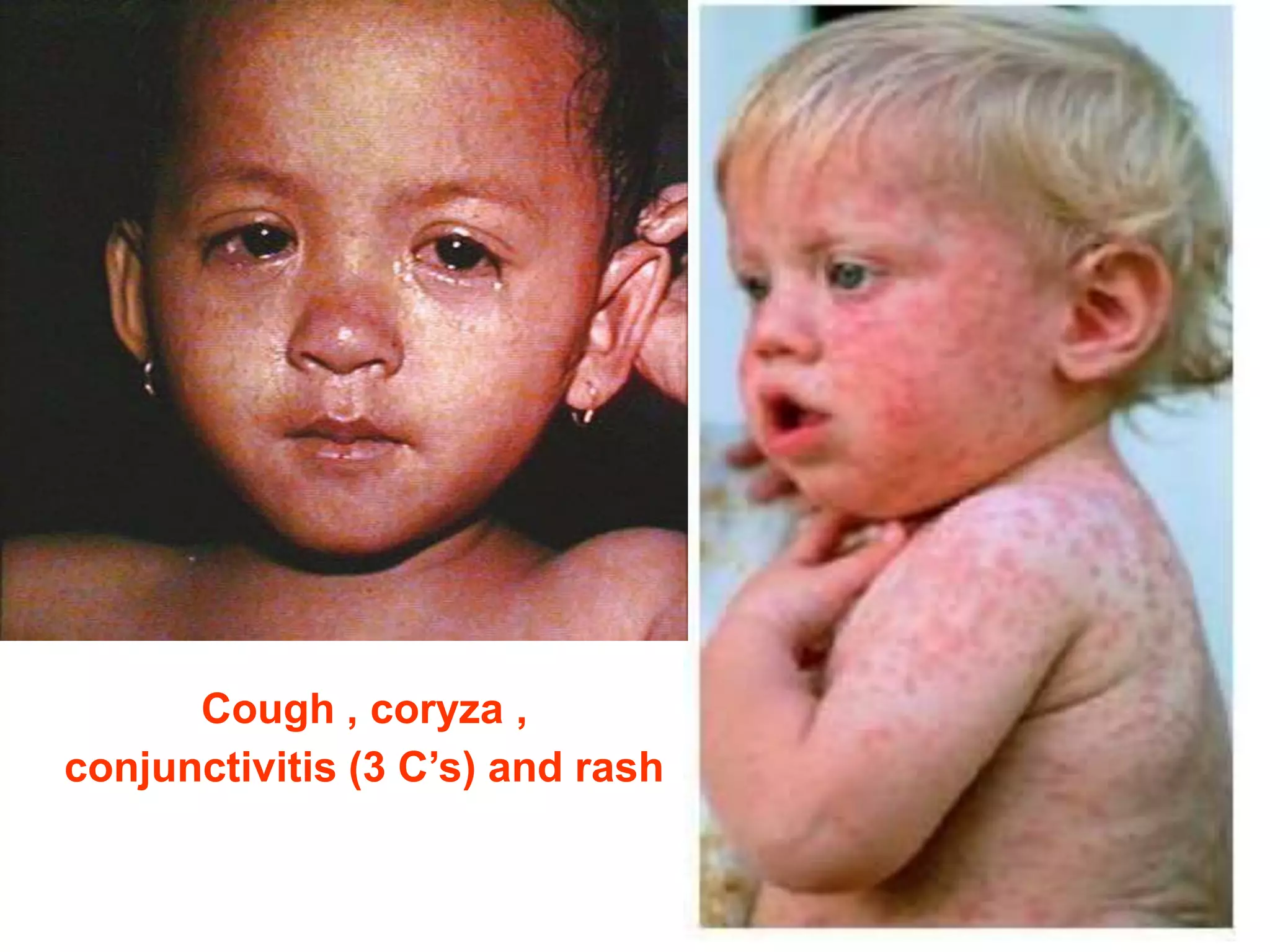
Cough , coryza ,
conjunctivitis (3 C’s) and rash
Measles : clinical
Koplik's spots : White
spots on red oral
mucosa near the
opening of Stensen
duct.
Look like “grains of
salt”
pathognomonic for
measles
Koplik's spots
Measles (Rubeola)
Measles: leading cause of vaccine preventable
death and illness.
The virus is trnasmitted by inhalation of
infective droplets.
Measles is clinically characterized by:
Fever,
Cough, coryza and conjunctivitis (3 C’s).
Mucosal lesions k/a Koplik’s spots and
Rash:
Starts on face and spreads to trunk and
extremities.
Disappears in the same order.
Complications
Otitis media
Measles pneumonia (giant cell pneumonia)
Warthin-Finkeldey giant cells in lung
=multinucleated giant cells
Pathognomonic for measles
Subacute Sclerosing Panencephalitis (SSPE)***
Rare but serious complication in
immunocompromised individuals
Measles giant cells
(Warthin-Finkeldey Giant Cells)
Swelling parotid
gland
Mumps
Clinically, mumps defined as
acute unilateral or bilateral parotid gland
swelling that lasts for more than two days
with no other apparent cause.
Mumps virus infects salivary gland ductal
epithelial cells
leading to classic signs of mumps :
Parotid gland swelling and pain.
Other features include:
Fever, malaise, headaches
This virus can also spread to other sites:
CNS  aseptic meningitis***
Testis and ovary  orchitis/ oophoritis
Pancreas  pancreatitis
Complications
Aseptic meningitis
most common complication** (50% of cases)
CSF findings:
mimics bacterial meningitis
low glucose, high protein, mixed
inflammatory reaction.
neutrophils in first 24 hours; then
lymphocytes
Others:
Orchitis /oophoritis, pancreatitis.
Laboratory diagnosis:
Elevated Serum amylase (salivary gland
inflammation and pancreatitis)
Rubella (German Measles)
Also known as 3 day measles.
A mild disease in children and adults; usually
associated with rash.
In pregnant women: rubella is destructive fetal
pathogen.
Children and adults: present with:
painful post auricular and occipital
lymphadenopathy (very characteristic).
fever, arthralgia, and
Rash: begins on head and spreads downward
lasts 3 days
No 3 C’s of Measles
Face of adult with
rubella.
Rash of rubella on skin of
child's back
Congenital Rubella
Part of the TORCH complex of diseases.
Maternal infection during first 8 weeks  high
incidence of congenital anomalies.
Transmission: Transplacental
Clinical findings:
Hearing loss (nerve deafness) **
most common defect.
Congenital heart defects:
PDA
Neurologic problems
mental retardation, microcephaly**
Ophthalmic problems
Cataract**,retinopathy, microphthalmia
Rash of congenital rubellaCongenital cataract
Case
CC
A 25 year old white male complains of shortness of
breath and ankle edema.
HPI
He also complains of fatigue & chest pain. His
symptoms followed a severe upper respiratory
infection.
PE
Tachycardia, hypotension, low-grade fever, jugular
venous pressure raised; pitting pedal edema; fine
inspiratory rales at both lung bases; mild
hepatosplenomegaly.
Imaging
CXR: Cardiomegaly and pulmonary edema.
Echo: dilated cardiomyopathy with low ejection
fraction
Coxsackie virus
Coxsackie virus
Type A : clinical manifestations
Hand-foot-mouth disease*
Herpangina
Aseptic meningitis
Acute hemorrhagic conjunctivitis
Type B: clinical manifestations
Myocarditis *
Pleurodynia (Bornholm’s Disease)
Aseptic meningitis
Hand, foot and mouth disease
Caused by Coxsackie type A16.
C/F include:
Ulcer: back of mouth and
Red rash: palm and soles
MC complication: dehydration
Myocarditis
Results when myocardium becomes infected.
MCC is Coxsackie virus B (also caused by
adenovirus)
Clinical findings:
Fever, chest pain, cyanosis, tachycardia
, cardiomegaly, EKG changes and
arrhythmia.
May result in cardiac failure.
Coxsackie Myocarditis
Lymphocytic infiltrates
Influenza virus
Influenza: acute, self limited infection of the
upper airways caused by strains of Influenza
virus
Three types of influenza virus A,B and C.
Type A virus : MC pathogen, causes
pandemics and epidemics (most severe form);
infects humans, pigs and horses.
Type B : epidemics
Type C: sporadic cases
Influenza virus
Influenza viruses have envelopes containing hemagglutinin
and neuraminidase.
Hemagglutinin : aids in attachment
Neuraminidase: dissolves mucus and facilitates release
of viral particles from infected cells.
The virus capable of altering its surface antigen:
Antigenic drifts:
point mutations resulting in change of antigenecity
of organism
Results in local epidemics.
Antigenic shifts:
involves replacement of H and Neur. through
recombination of RNA segments with those of
animal viruses.
Results in pandemics
New vaccine needed
Pathogenesis and disease
Spread
person to person via small particle aerosols
Site of infection
Epithelial cells of the respiratory tract
results in Cell death.
As a result, the efficiency of ciliary clearance
is reduced
Predisposition to secondary bacterial
infections
Influenza
Clinical findings:
Fever, chills, myalgia, headache and
nonproductive cough.
Complications:
1. Superimposed bacterial infections
Pneumonia
most common organism: Staph. aureus
2. Reye’s syndrome
Rabies
Transmitted to humans by bite of :
skunks, foxes, bats, raccoons, dogs
skunks most common source in U.S.
dog bite most common source in other
countries
May also be contracted by aerosol (bat
caves)
Results in severe encephalitis with increased
excitability of CNS
Virus enters CNS by ascending along peripheral
nerves from the wound site.
Initial manifestation:
fever, headache,parasthesias around wound
site .
CNS disease:
Chr by violent muscle contractions and
convulsions following minimal stimuli.
painful spasms of laryngeal and pharyngeal
muscles, frothing at the mouth, hydrophobia
followed by flaccid paralysis, coma, and
respiratory center paralysis.
Morphology
Microscopically characterized by
intracytoplasmic eosinophilic inclusions
Negri bodies in the neurons
Pathognomonic
Neuron without
Negri bodies
Negri body in
infected neuron
Other RNA viruses
Yellow fever:
C/F: Hepatitis, jaundice, fever, black vomitus
Histological findings: characteristic midzonal
hepatocellular necrosis and apoptotic liver cells
(Councilman bodies).
SARS virus:
First appeared in November of 2002 in Guangdong
province of China.
First transmitted to humans through wild masked palm
civets.
infects lower respiratory tract.
may resolve or progress to severe respiratory
disease.
Virus Disease
Measles virus* Measles
Mumps virus* Mumps
Rubella virus* Rubella
Coxsackie A and B* Myocarditis
Polio virus Poliomyelitis
Influenza virus* Influenza
SARS Respiratory disease
Dengue fever virus DF, DHF, DSS
Yellow fever virus Yellow fever
Arbo & and WestNile virus Encephalitis
Rabies virus* Rabies
Important RNA viruses

04 infectious disease RNA viruses

  • 1.
    RNA viruses Measles* Mumps* Rubella* Coxsackie Aand B* Influenza virus* Rabies virus* Yellow fever virus* SARS* Dengue fever virus West Nile virus Polio virus
  • 2.
    Cough , coryza, conjunctivitis (3 C’s) and rash
  • 3.
    Measles : clinical Koplik'sspots : White spots on red oral mucosa near the opening of Stensen duct. Look like “grains of salt” pathognomonic for measles Koplik's spots
  • 4.
    Measles (Rubeola) Measles: leadingcause of vaccine preventable death and illness. The virus is trnasmitted by inhalation of infective droplets. Measles is clinically characterized by: Fever, Cough, coryza and conjunctivitis (3 C’s). Mucosal lesions k/a Koplik’s spots and Rash: Starts on face and spreads to trunk and extremities. Disappears in the same order.
  • 5.
    Complications Otitis media Measles pneumonia(giant cell pneumonia) Warthin-Finkeldey giant cells in lung =multinucleated giant cells Pathognomonic for measles Subacute Sclerosing Panencephalitis (SSPE)*** Rare but serious complication in immunocompromised individuals
  • 6.
  • 7.
  • 8.
    Mumps Clinically, mumps definedas acute unilateral or bilateral parotid gland swelling that lasts for more than two days with no other apparent cause. Mumps virus infects salivary gland ductal epithelial cells leading to classic signs of mumps : Parotid gland swelling and pain. Other features include: Fever, malaise, headaches This virus can also spread to other sites: CNS  aseptic meningitis*** Testis and ovary  orchitis/ oophoritis Pancreas  pancreatitis
  • 9.
    Complications Aseptic meningitis most commoncomplication** (50% of cases) CSF findings: mimics bacterial meningitis low glucose, high protein, mixed inflammatory reaction. neutrophils in first 24 hours; then lymphocytes Others: Orchitis /oophoritis, pancreatitis. Laboratory diagnosis: Elevated Serum amylase (salivary gland inflammation and pancreatitis)
  • 10.
    Rubella (German Measles) Alsoknown as 3 day measles. A mild disease in children and adults; usually associated with rash. In pregnant women: rubella is destructive fetal pathogen. Children and adults: present with: painful post auricular and occipital lymphadenopathy (very characteristic). fever, arthralgia, and Rash: begins on head and spreads downward lasts 3 days No 3 C’s of Measles
  • 11.
    Face of adultwith rubella. Rash of rubella on skin of child's back
  • 12.
    Congenital Rubella Part ofthe TORCH complex of diseases. Maternal infection during first 8 weeks  high incidence of congenital anomalies. Transmission: Transplacental Clinical findings: Hearing loss (nerve deafness) ** most common defect. Congenital heart defects: PDA Neurologic problems mental retardation, microcephaly** Ophthalmic problems Cataract**,retinopathy, microphthalmia
  • 13.
    Rash of congenitalrubellaCongenital cataract
  • 14.
    Case CC A 25 yearold white male complains of shortness of breath and ankle edema. HPI He also complains of fatigue & chest pain. His symptoms followed a severe upper respiratory infection. PE Tachycardia, hypotension, low-grade fever, jugular venous pressure raised; pitting pedal edema; fine inspiratory rales at both lung bases; mild hepatosplenomegaly. Imaging CXR: Cardiomegaly and pulmonary edema. Echo: dilated cardiomyopathy with low ejection fraction
  • 15.
  • 16.
    Coxsackie virus Type A: clinical manifestations Hand-foot-mouth disease* Herpangina Aseptic meningitis Acute hemorrhagic conjunctivitis Type B: clinical manifestations Myocarditis * Pleurodynia (Bornholm’s Disease) Aseptic meningitis
  • 17.
    Hand, foot andmouth disease Caused by Coxsackie type A16. C/F include: Ulcer: back of mouth and Red rash: palm and soles MC complication: dehydration
  • 18.
    Myocarditis Results when myocardiumbecomes infected. MCC is Coxsackie virus B (also caused by adenovirus) Clinical findings: Fever, chest pain, cyanosis, tachycardia , cardiomegaly, EKG changes and arrhythmia. May result in cardiac failure.
  • 19.
  • 20.
    Influenza virus Influenza: acute,self limited infection of the upper airways caused by strains of Influenza virus Three types of influenza virus A,B and C. Type A virus : MC pathogen, causes pandemics and epidemics (most severe form); infects humans, pigs and horses. Type B : epidemics Type C: sporadic cases
  • 21.
    Influenza virus Influenza viruseshave envelopes containing hemagglutinin and neuraminidase. Hemagglutinin : aids in attachment Neuraminidase: dissolves mucus and facilitates release of viral particles from infected cells. The virus capable of altering its surface antigen: Antigenic drifts: point mutations resulting in change of antigenecity of organism Results in local epidemics. Antigenic shifts: involves replacement of H and Neur. through recombination of RNA segments with those of animal viruses. Results in pandemics New vaccine needed
  • 22.
    Pathogenesis and disease Spread personto person via small particle aerosols Site of infection Epithelial cells of the respiratory tract results in Cell death. As a result, the efficiency of ciliary clearance is reduced Predisposition to secondary bacterial infections
  • 23.
    Influenza Clinical findings: Fever, chills,myalgia, headache and nonproductive cough. Complications: 1. Superimposed bacterial infections Pneumonia most common organism: Staph. aureus 2. Reye’s syndrome
  • 24.
    Rabies Transmitted to humansby bite of : skunks, foxes, bats, raccoons, dogs skunks most common source in U.S. dog bite most common source in other countries May also be contracted by aerosol (bat caves) Results in severe encephalitis with increased excitability of CNS
  • 25.
    Virus enters CNSby ascending along peripheral nerves from the wound site. Initial manifestation: fever, headache,parasthesias around wound site . CNS disease: Chr by violent muscle contractions and convulsions following minimal stimuli. painful spasms of laryngeal and pharyngeal muscles, frothing at the mouth, hydrophobia followed by flaccid paralysis, coma, and respiratory center paralysis.
  • 26.
    Morphology Microscopically characterized by intracytoplasmiceosinophilic inclusions Negri bodies in the neurons Pathognomonic
  • 27.
    Neuron without Negri bodies Negribody in infected neuron
  • 28.
    Other RNA viruses Yellowfever: C/F: Hepatitis, jaundice, fever, black vomitus Histological findings: characteristic midzonal hepatocellular necrosis and apoptotic liver cells (Councilman bodies). SARS virus: First appeared in November of 2002 in Guangdong province of China. First transmitted to humans through wild masked palm civets. infects lower respiratory tract. may resolve or progress to severe respiratory disease.
  • 29.
    Virus Disease Measles virus*Measles Mumps virus* Mumps Rubella virus* Rubella Coxsackie A and B* Myocarditis Polio virus Poliomyelitis Influenza virus* Influenza SARS Respiratory disease Dengue fever virus DF, DHF, DSS Yellow fever virus Yellow fever Arbo & and WestNile virus Encephalitis Rabies virus* Rabies Important RNA viruses