FRACTURES OF THE
FRONTAL SINUS
CURRENT TREATMENT PROTOCOL
mouth
jaws
face
neck
oral &
maxillo
facial
surgery
Adnan Aslam
Assistant Professor & Consultant
Department of Oral & Maxillofacial Surgery
Margalla Institute of Health Sciences & affiliated hospitals
Rawalpindi
docadnanaslam@hotmail.com
mouth
jaws
face
neck
oral &
maxillo
facial
surgery
Embryology
• Begin as an outgrowth from nasal chamber in utero
• Absent at birth
• Do not develop until 2nd
year of life
• Develop from ethmoidal infundibular air cells by invagination of
frontal bone through frontal recess or from superior meatus
• Cannot be identified radiographically until about age of 8
years
mouth
jaws
face
neck
oral &
maxillo
facial
surgery
mouth
jaws
face
neck
oral &
maxillo
facial
surgery
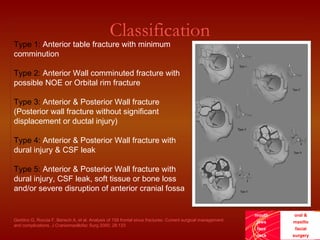
Classification
Type 1: Anterior table fracture with minimum
comminution
Type 2: Anterior Wall comminuted fracture with
possible NOE or Orbital rim fracture
Type 3: Anterior & Posterior Wall fracture
(Posterior wall fracture without significant
displacement or ductal injury)
Type 4: Anterior & Posterior Wall fracture with
dural injury & CSF leak
Type 5: Anterior & Posterior Wall fracture with
dural injury, CSF leak, soft tissue or bone loss
and/or severe disruption of anterior cranial fossa
Gerbino G, Roccia F, Benech A, et al. Analysis of 158 frontal sinus fractures: Current surgical management
and complications. J Craniomaxillofac Surg 2000; 28:133
mouth
jaws
face
neck
oral &
maxillo
facial
surgery
Clinical evaluation
General
Facial pain
Forehead paraesthesia or anaesthesia
Forehead laceration
Visible and/or palpable frontal bone depression
CSF rhinorrhoea
Neurological injuries
Cerebral contusion
Subdural & epidural haematoma
Ophthalmic injuries
Pupillary defect
Optic neuropathy
Hyphaema
Disc edema
Corneal defect
Loss of globe integrity
Associated maxillofacial Injuries
NOE fracture
Orbital fracture
Zygomatic fracture
mouth
jaws
face
neck
oral &
maxillo
facial
surgery
Radiographic evaluation
(Diagnostic Imaging)
Plain radiographs
Caldwell view
Lateral view
Evidence of air fluid level
Clouding of frontal sinus
Pneumocephalus
High Resolution CT Scan
MRI
mouth
jaws
face
neck
oral &
maxillo
facial
surgery
Objectives of management
• To avoid immediate and short-term complications such as
CSF leak, meningitis, spreading infection.
• To avoid long-term complications such as frontal bone
osteomyelitis, chronic frontal sinusitis, mucocele, mycopyocele,
and brain abscess.
• To provide adequate exposure for anatomic reduction of naso-
orbito-ethmoid (NOE) fractures.
• To restore proper aesthetic contour of the forehead
mouth
jaws
face
neck
oral &
maxillo
facial
surgery
Management generally based on
three clinical factors:
• Fracture location and displacement
• Dural and cerebral involvement
• Damage to the frontal sinus drainage system
Treatment options
Conservative
Fracture reduction & fixation
Sinus obliteration
Sinus cranialization
mouth
jaws
face
neck
oral &
maxillo
facial
surgery
Anterior table fracture
(Nondisplaced, linear/isolated)
Conservative treatment
• Local wound care
• Antibiotics, Nasal decongestants, Analgesics
• Follow up evaluation
mouth
jaws
face
neck
oral &
maxillo
facial
surgery
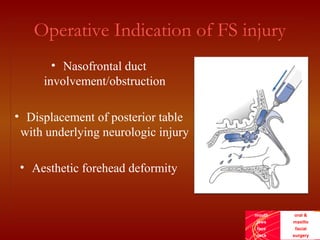
Operative Indication of FS injury
• Nasofrontal duct
involvement/obstruction
• Displacement of posterior table
with underlying neurologic injury
• Aesthetic forehead deformity
mouth
jaws
face
neck
oral &
maxillo
facial
surgery
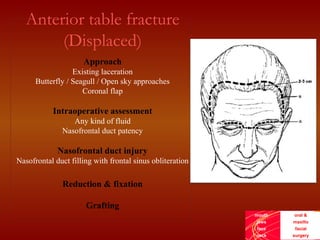
Anterior table fracture
(Displaced)
Approach
Existing laceration
Butterfly / Seagull / Open sky approaches
Coronal flap
Intraoperative assessment
Any kind of fluid
Nasofrontal duct patency
Nasofrontal duct injury
Nasofrontal duct filling with frontal sinus obliteration
Reduction & fixation
Grafting
mouth
jaws
face
neck
oral &
maxillo
facial
surgery
Isolated anterior table #. ORIF
mouth
jaws
face
neck
oral &
maxillo
facial
surgery
Frontal sinus obliteration
Steps
• Sinus exploration
• Mucosal extenteration
• Nasofrontal duct obturation
• Frontal sinus obliteration
• Fracture reduction
mouth
jaws
face
neck
oral &
maxillo
facial
surgery
Frontal sinus
Filling materials for obliteration and obturation
Autogenous materials
Autologous fat
Cancellous bone
Muscle
Pericranial flaps
Banked cadaveric tissue
Synthetic materials
Polytetrafluoroethylene (ePTFE)
Methylmethacrylate (MMA)
Bioactive glass and calcium-phosphate cements
mouth
jaws
face
neck
oral &
maxillo
facial
surgery
Indication for bone grafting
1. Extensive loss of support at the skull base over the fovea
ethmoidalis and cribriform plate, in combination with a
pericranial flap.
2. Superior orbital roof fractures, to avoid pulsatile
exophthalmos and orbital deformity.
3. Extensive bone loss of the anterior table, which cannot be
replaced with elements of the posterior table.
4. In combination with NOE and orbital reconstruction
as layered bone grafts to obliterate the ethmoids and reconstruct
the medial orbital wall.
mouth
jaws
face
neck
oral &
maxillo
facial
surgery
Posterior table fracture
• CSF leak absent and no displacement:
Frontal sinus obliteration
• CSF leak and/or displacement:
Frontal sinus cranialization
mouth
jaws
face
neck
oral &
maxillo
facial
surgery
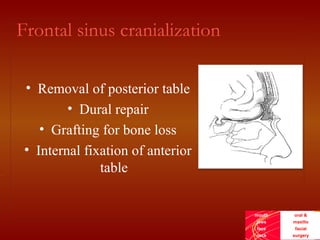
Frontal sinus cranialization
• Removal of posterior table
• Dural repair
• Grafting for bone loss
• Internal fixation of anterior
table
mouth
jaws
face
neck
oral &
maxillo
facial
surgery
Complications
• Early
Forehead pain
Transient paresthesia of forehead
Wound infection
Transient diplopia
• Late
Mucocele
Mucopyocele
Osteomyelitis
Brain abscess
Pneumocephalocele
Meningitis
Cosmetic defect
mouth
jaws
face
neck
oral &
maxillo
facial
surgery
Future direction
• Endoscopy assisted frontal sinusotomy
• Spontaneous osteogenesis and auto obliteration
A
Q&Q u e s t i o n s
A n s w e r s
Thank you for choosing us
for academic interest!

04 frontal sinus FRACTURE

Editor's Notes

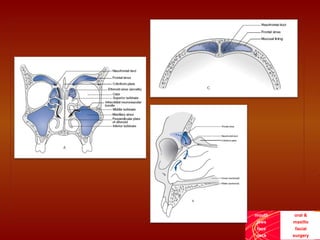
  • #4 Nasofrontal ductal system: Drain FS exclusively into middle meatus Located in the posteromedial floor of frontal sinus Run caudally from few millimeter upto 2 cm Air filled cavity lined by ciliated respiratory epithelium Pyramidal shape Average Dimensions of an Adult Frontal sinus: 28mm height 27mm Width 17mm Depth Average volume:6-7ml Anterior wall is thicker & stronger than Posterior wall Anteriorly: FS overlies ant. Ethmoidal sinus & Nasal cavity Posteriorly: Cribriform plate & Dura mater of Frontal lobe Inferiorly : Roof Of Orbit, Nasofrontal duct Intersinus septum separate FS into two sides Drainage system of frontal sinus: Variable: 34% drain thru ethmoidal infundibulum 62% drain into frontal recess 15% drain thru nasofrontal drainage into middle meatus