Introduction
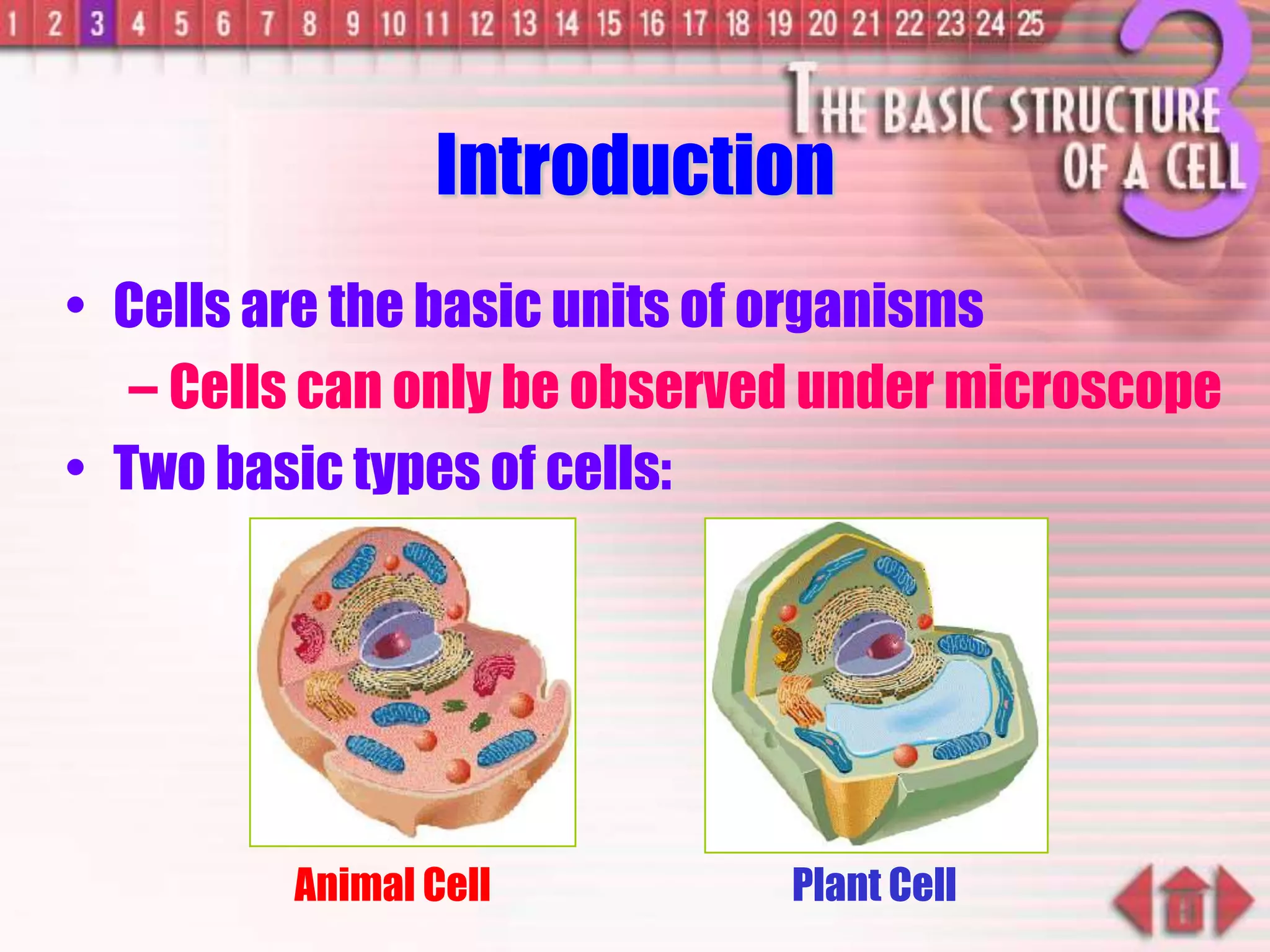
• Cells are the basic units of organisms
– Cells can only be observed under microscope
• Two basic types of cells:
Animal Cell Plant Cell
Plant Cell
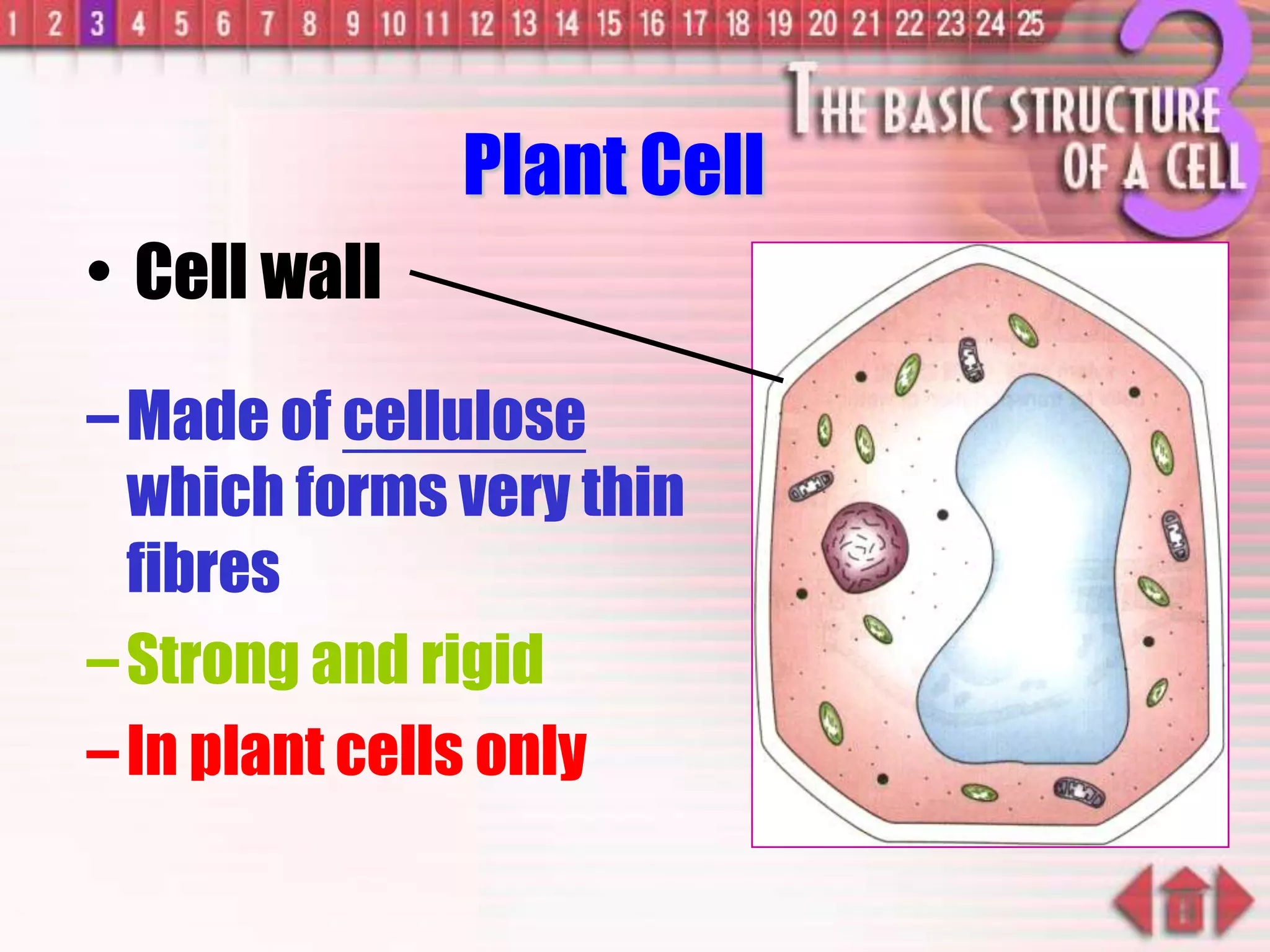
–Made of cellulose
which forms very thin
fibres
–Strong and rigid
–In plant cells only
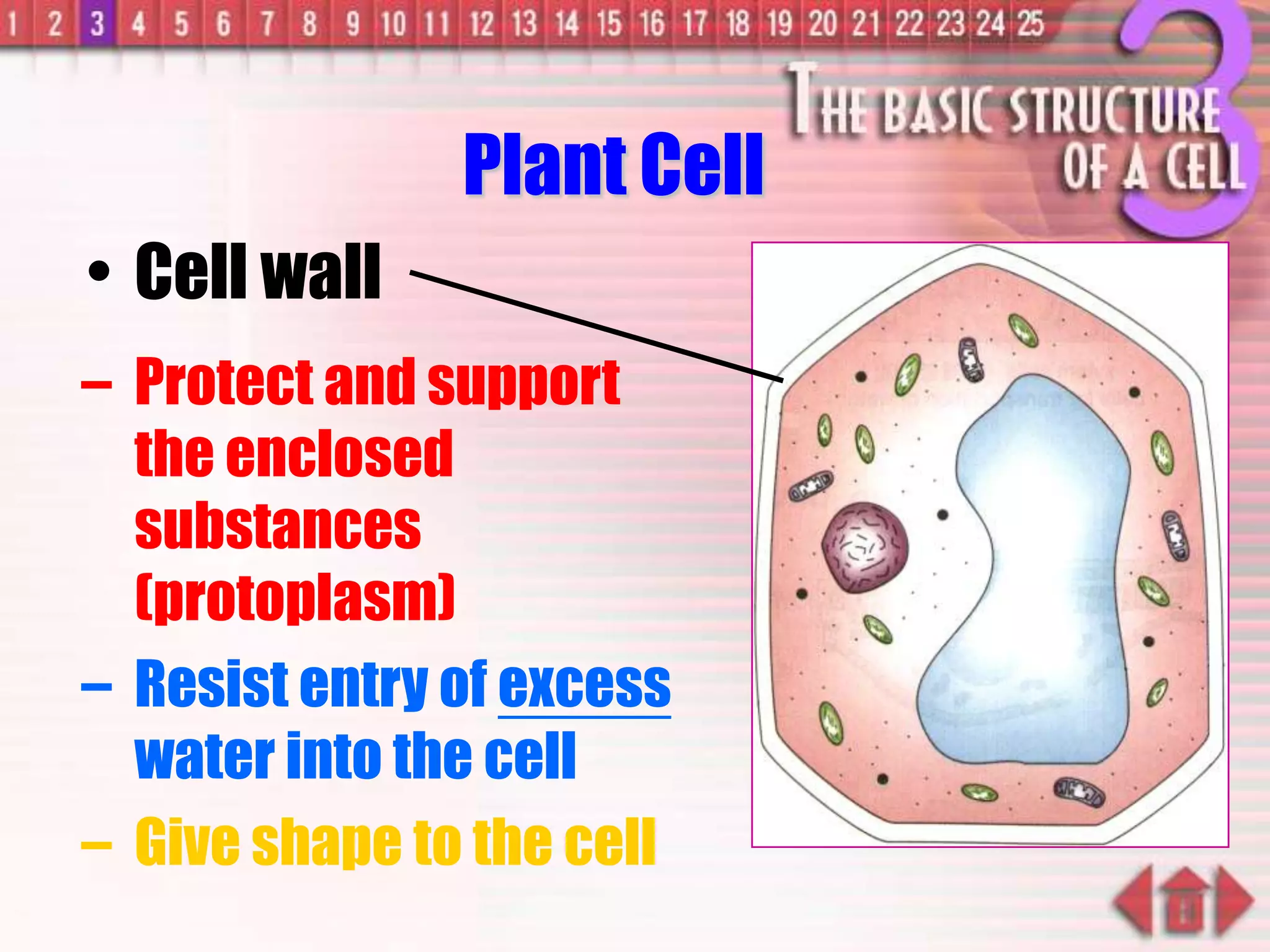
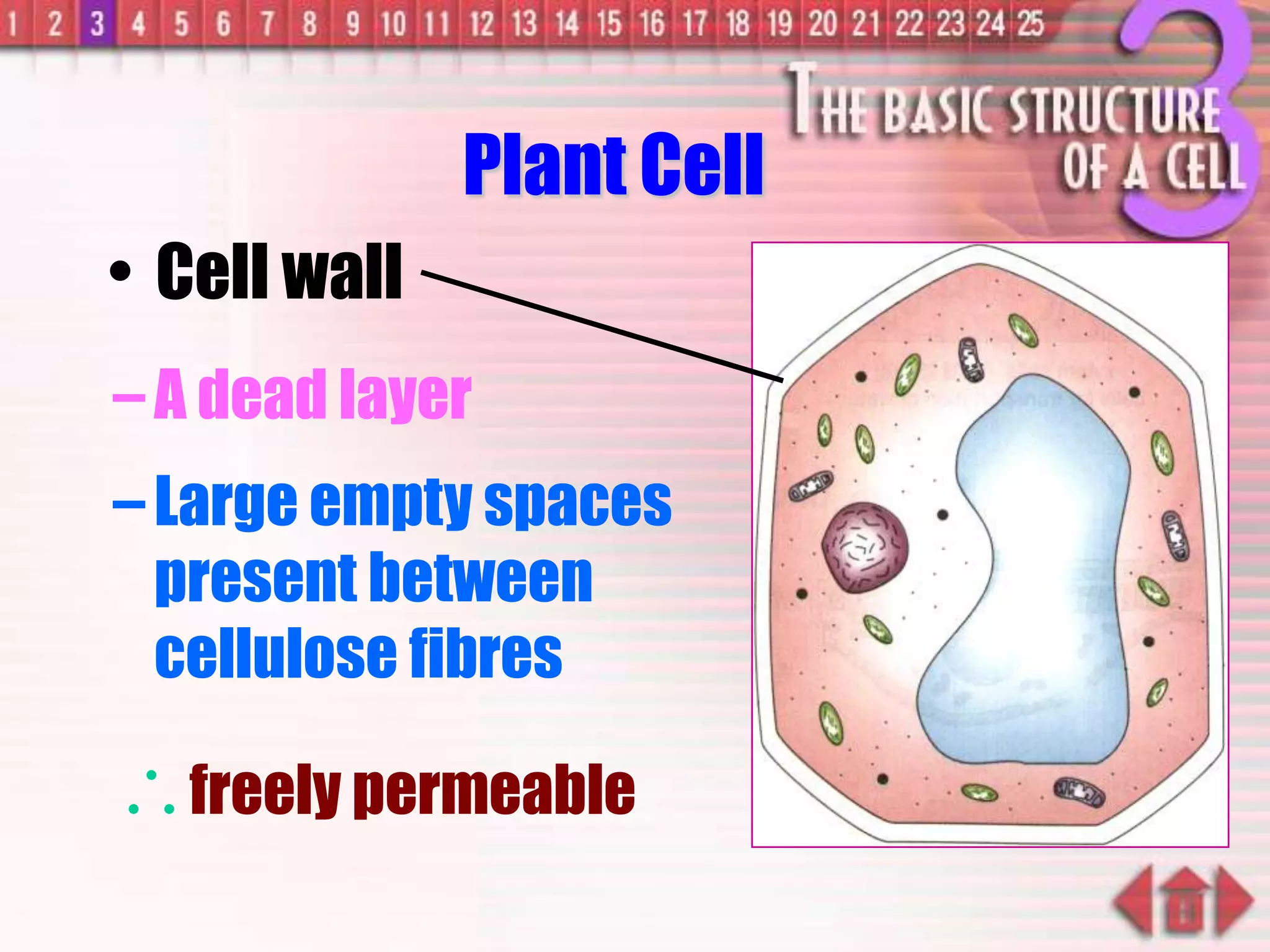
• Cell wall
– Protect and support
the enclosed
substances
(protoplasm)
– Resist entry of excess
water into the cell
– Give shape to the cell
• Cell wall
Plant Cell
–A dead layer
–Large empty spaces
present between
cellulose fibres
freely permeable
• Cell wall
Plant Cell
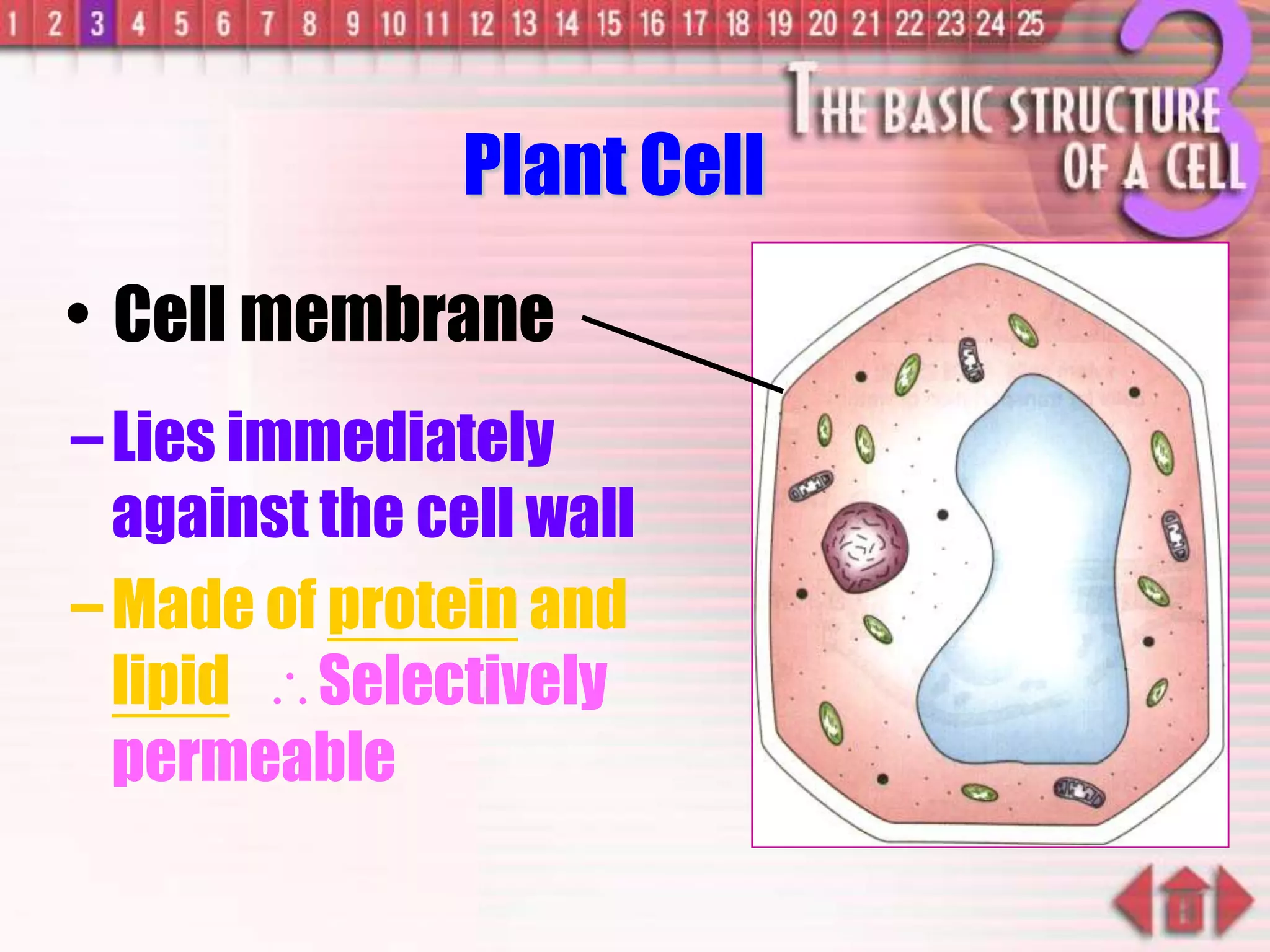
–Lies immediately
against the cell wall
–Made of protein and
lipid Selectively
permeable
• Cell membrane
Plant Cell
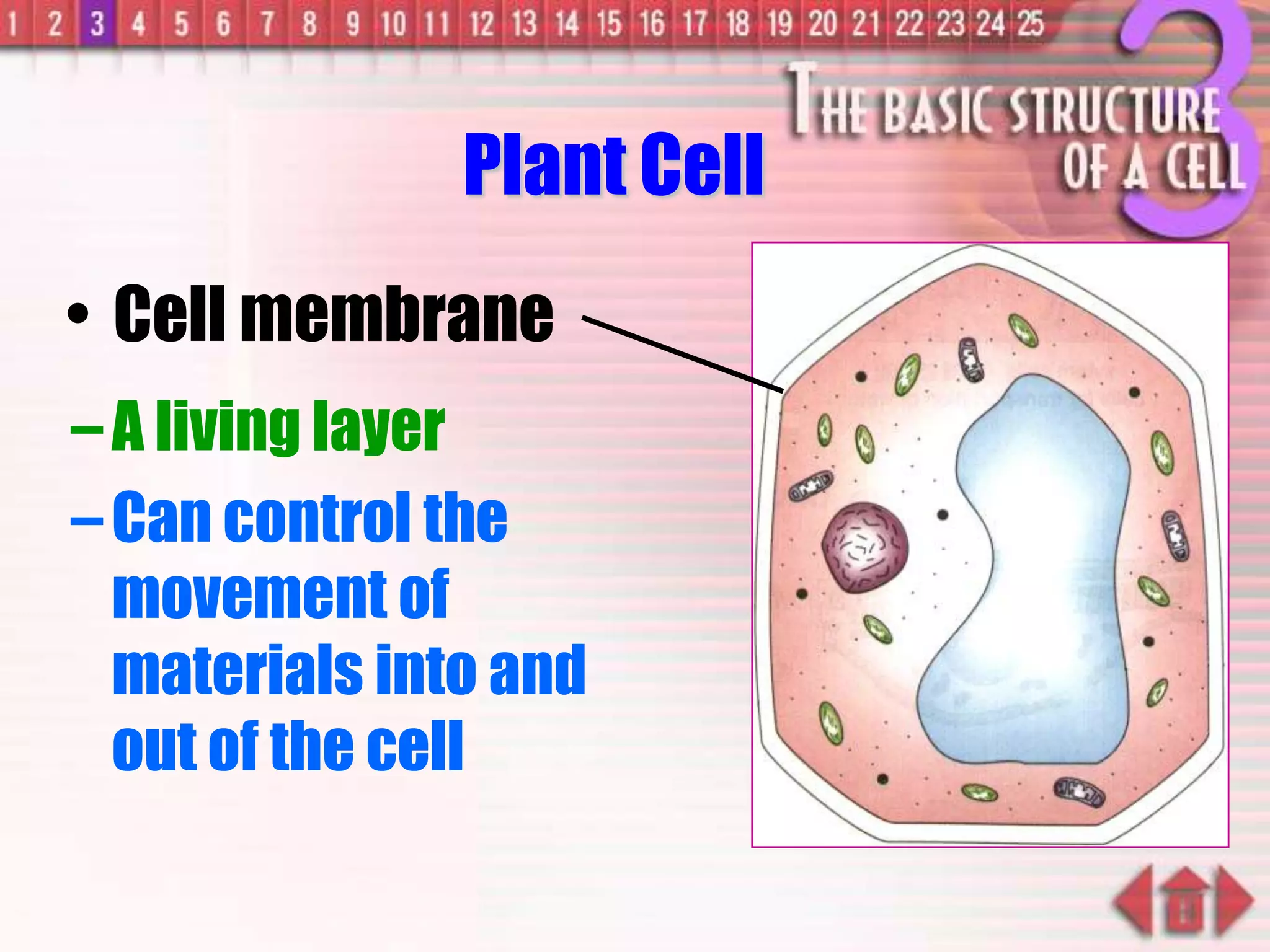
–A living layer
–Can control the
movement of
materials into and
out of the cell
• Cell membrane
Plant Cell
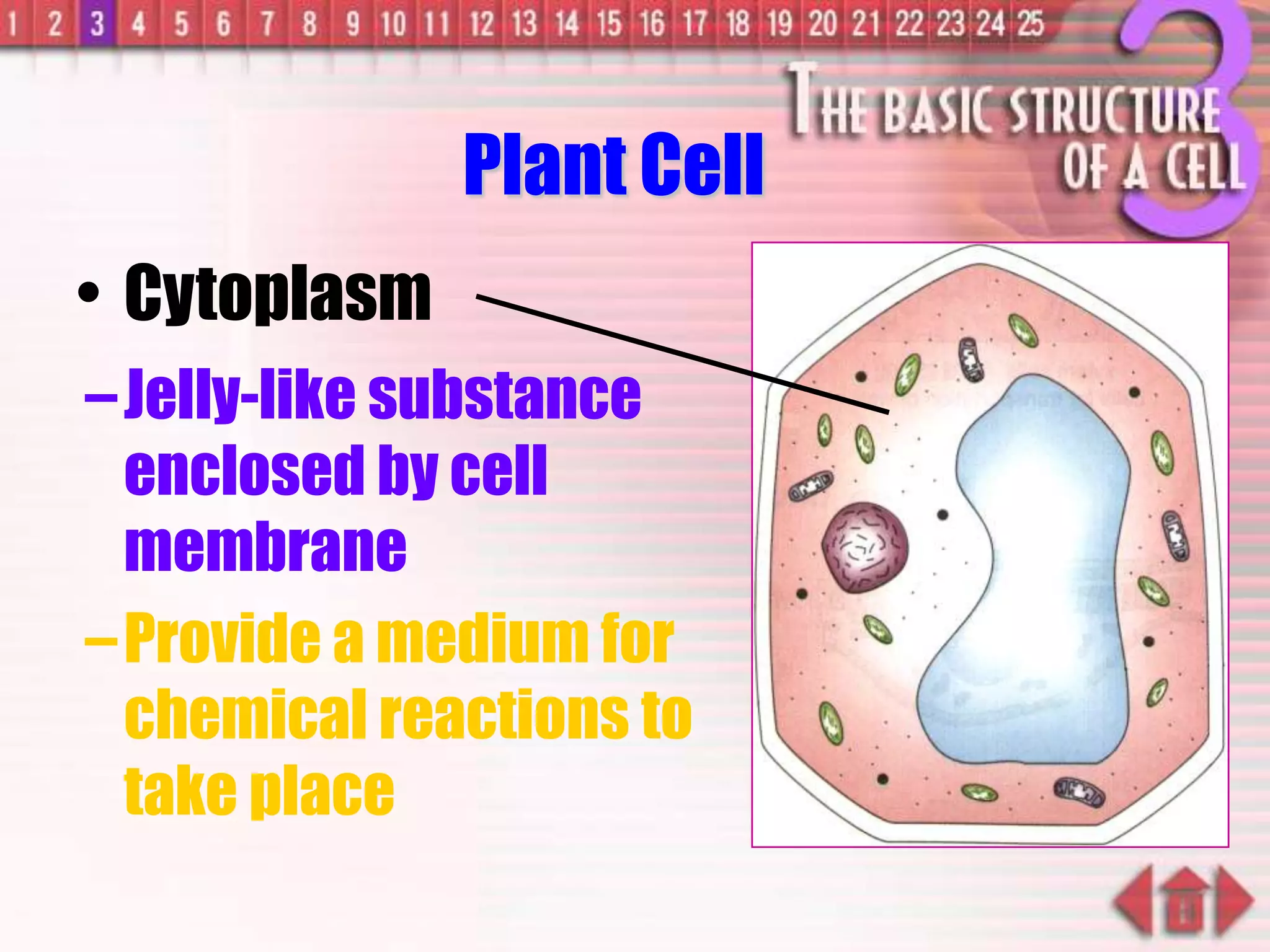
–Jelly-like substance
enclosed by cell
membrane
–Provide a medium for
chemical reactions to
take place
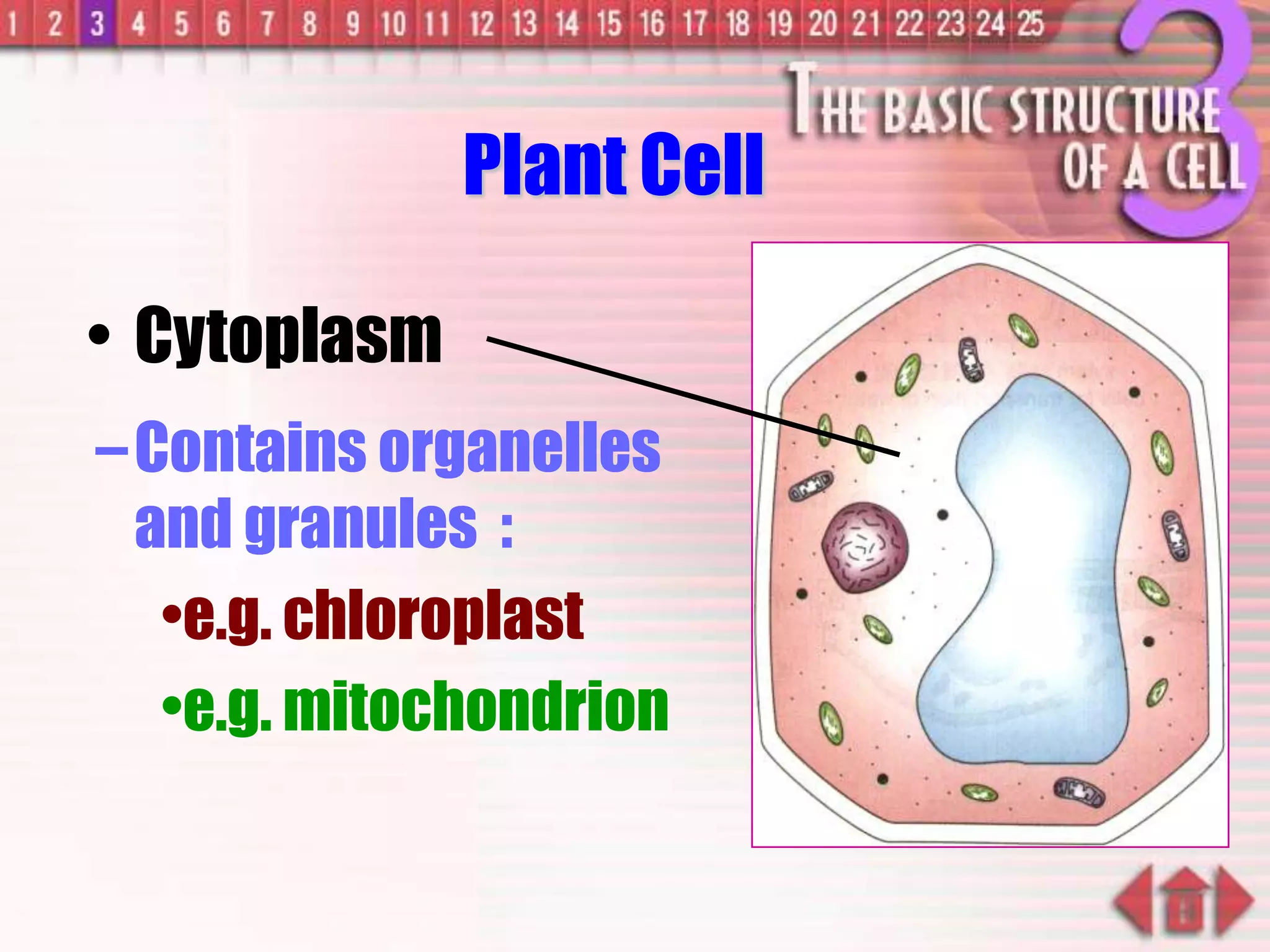
• Cytoplasm
Plant Cell
–Contains organelles
and granules :
•e.g. chloroplast
•e.g. mitochondrion
• Cytoplasm
Plant Cell
Organelles
 very small size – can only be
observed under electron
microscope
 has specific functions
 in cytoplasm
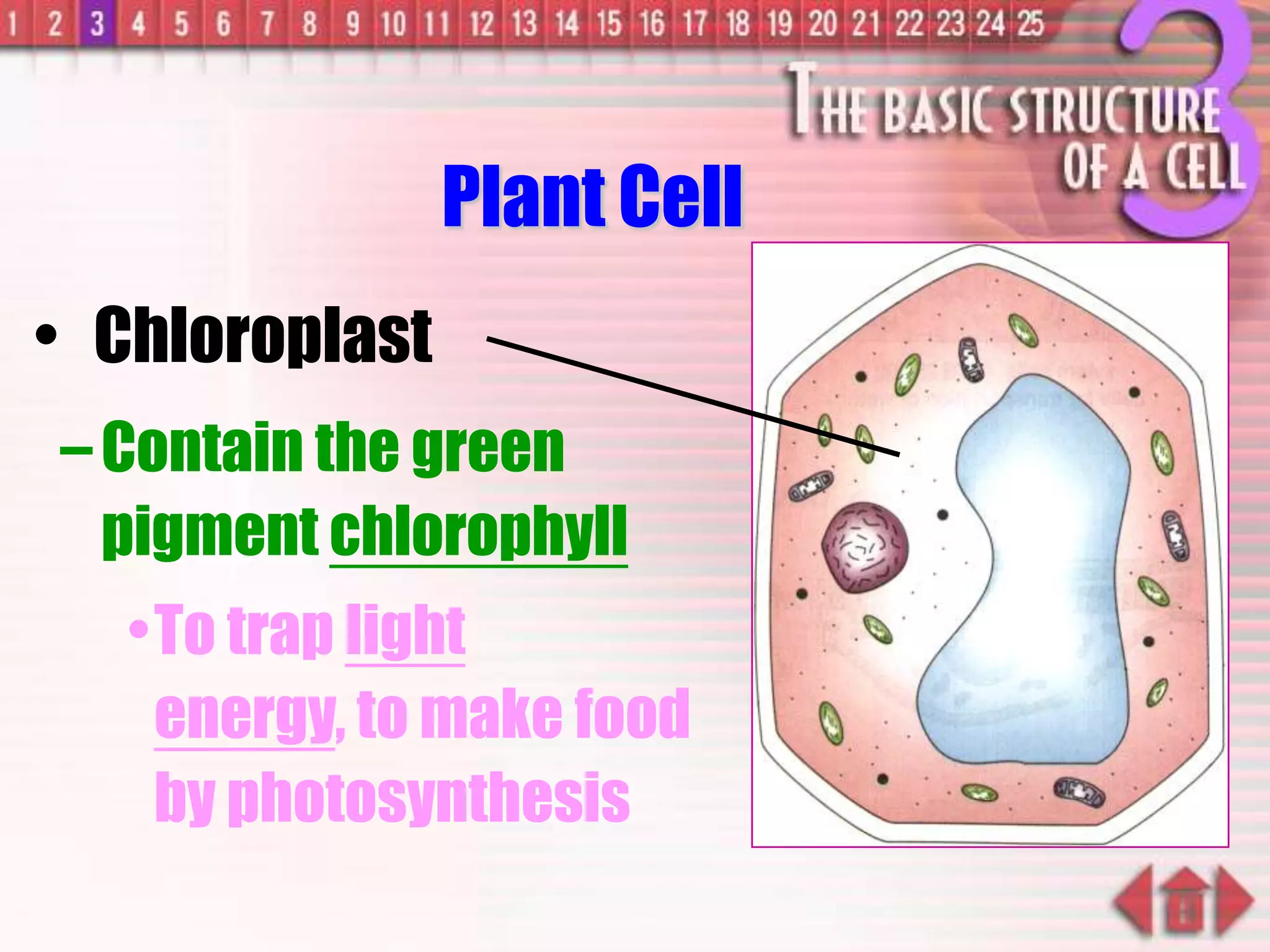
–Contain the green
pigment chlorophyll
•To trap light
energy, to make food
by photosynthesis
Plant Cell
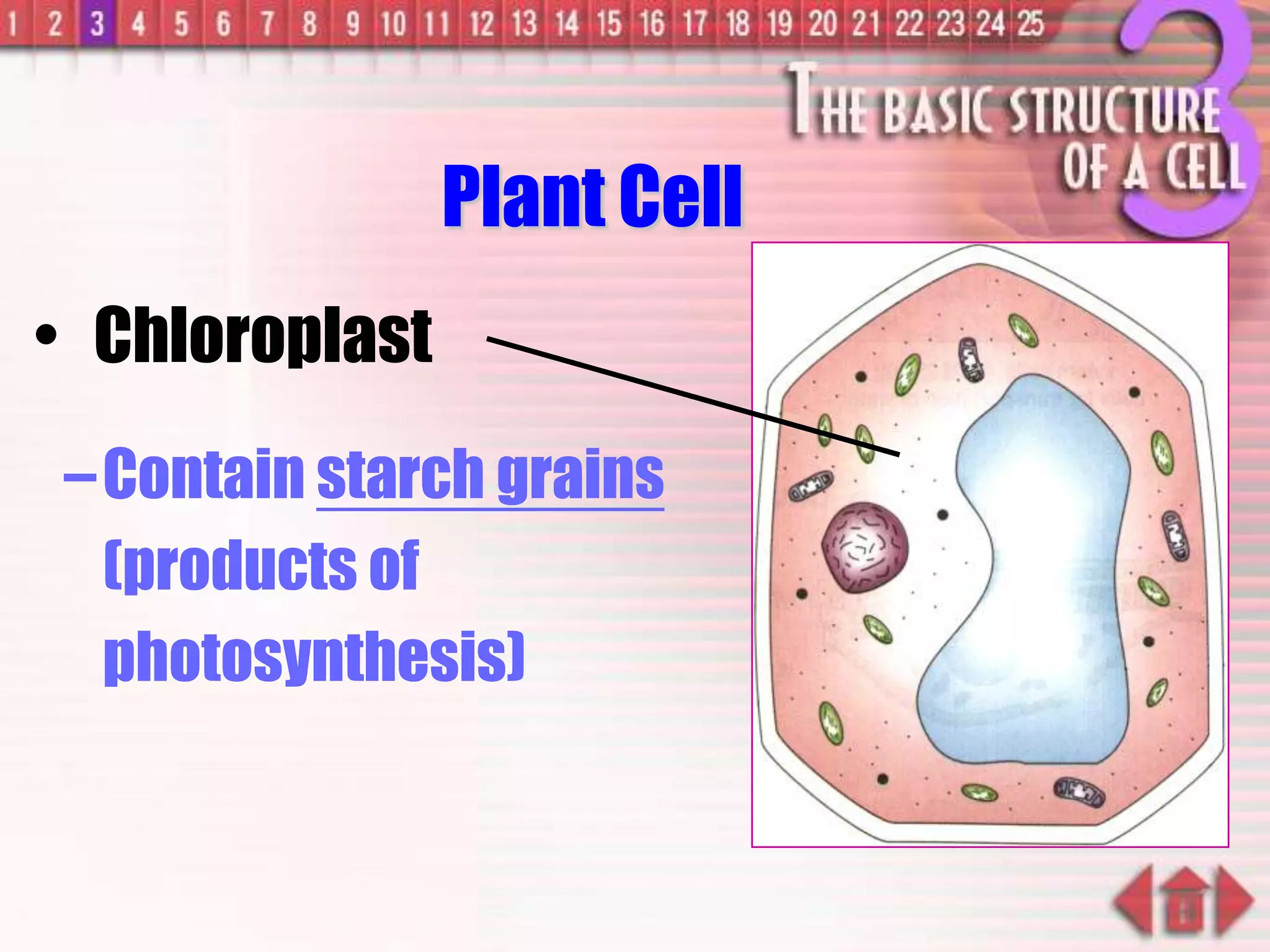
• Chloroplast
–Contain starch grains
(products of
photosynthesis)
• Chloroplast
Plant Cell
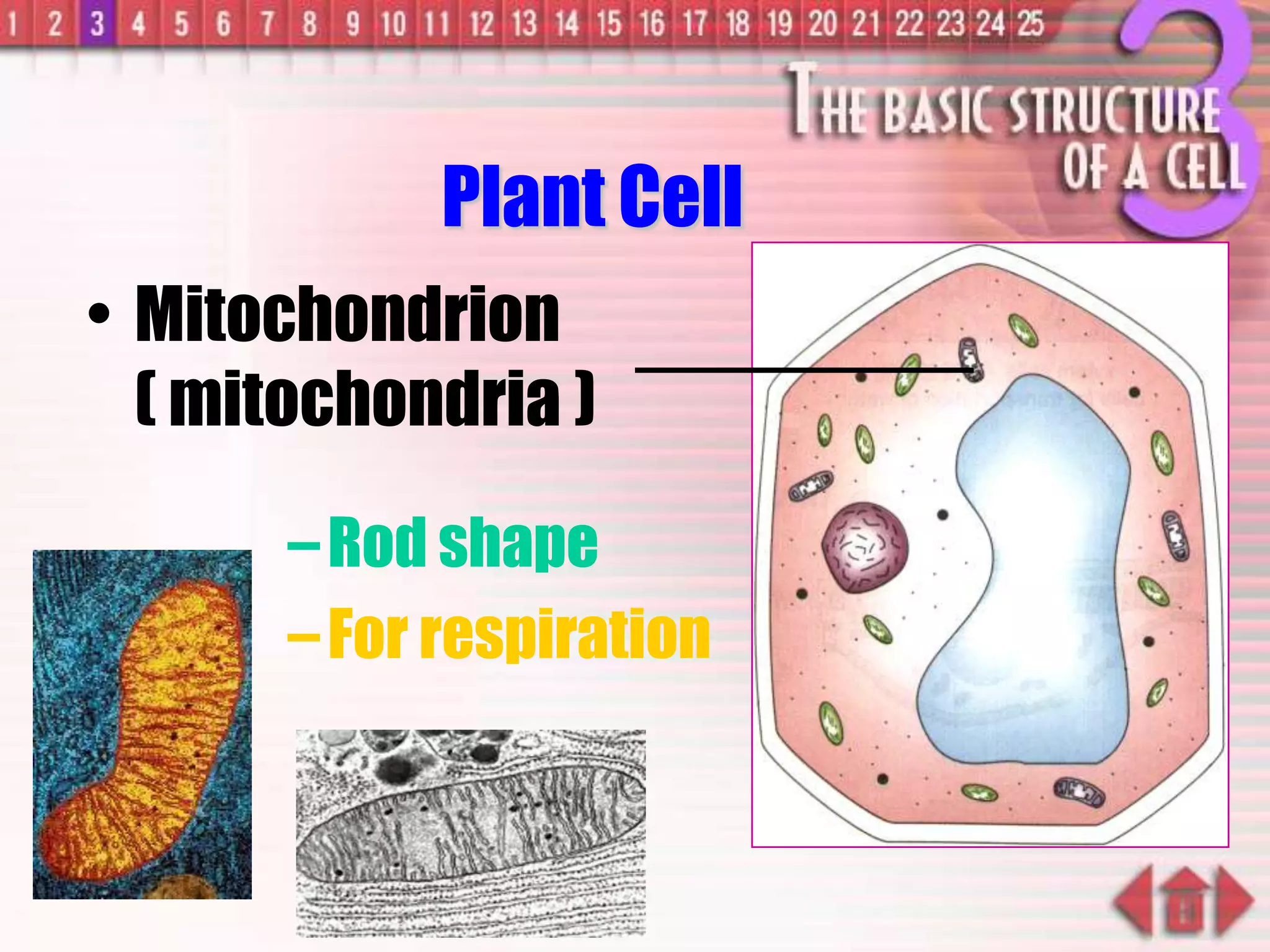
–Rod shape
–For respiration
Plant Cell
• Mitochondrion
( mitochondria )
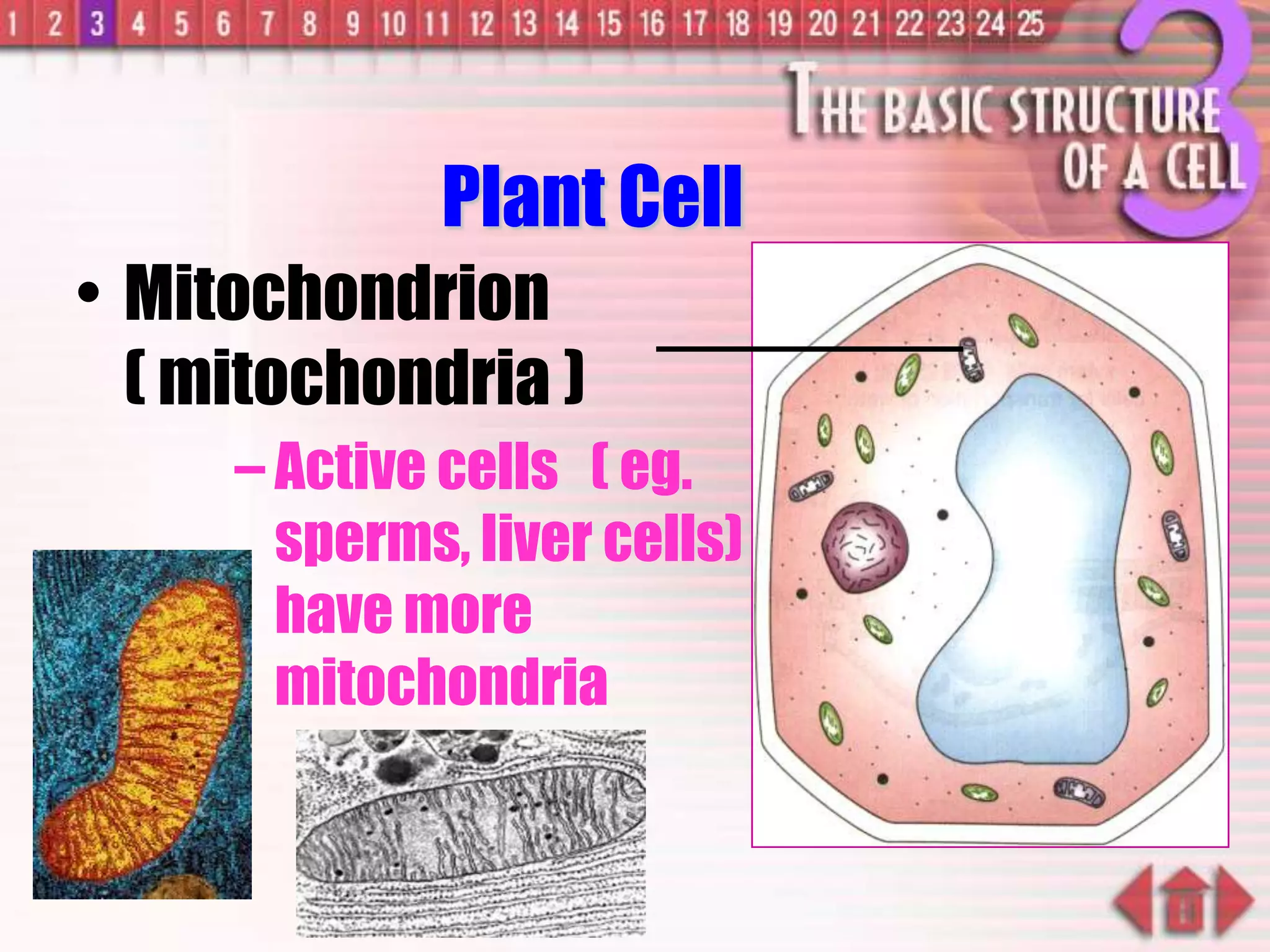
– Active cells ( eg.
sperms, liver cells)
have more
mitochondria
Plant Cell
• Mitochondrion
( mitochondria )
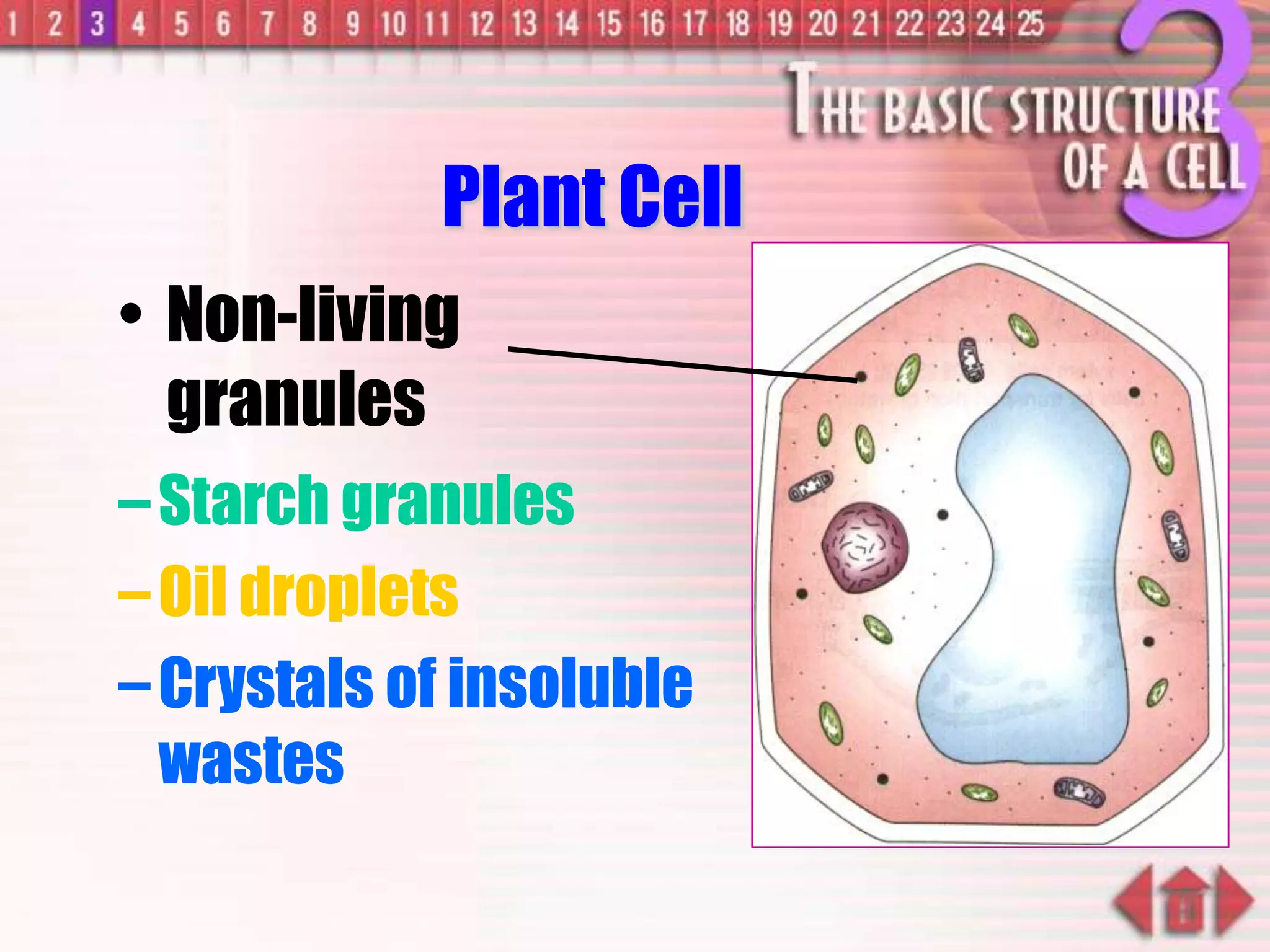
–Starch granules
–Oil droplets
–Crystals of insoluble
wastes
Plant Cell
• Non-living
granules
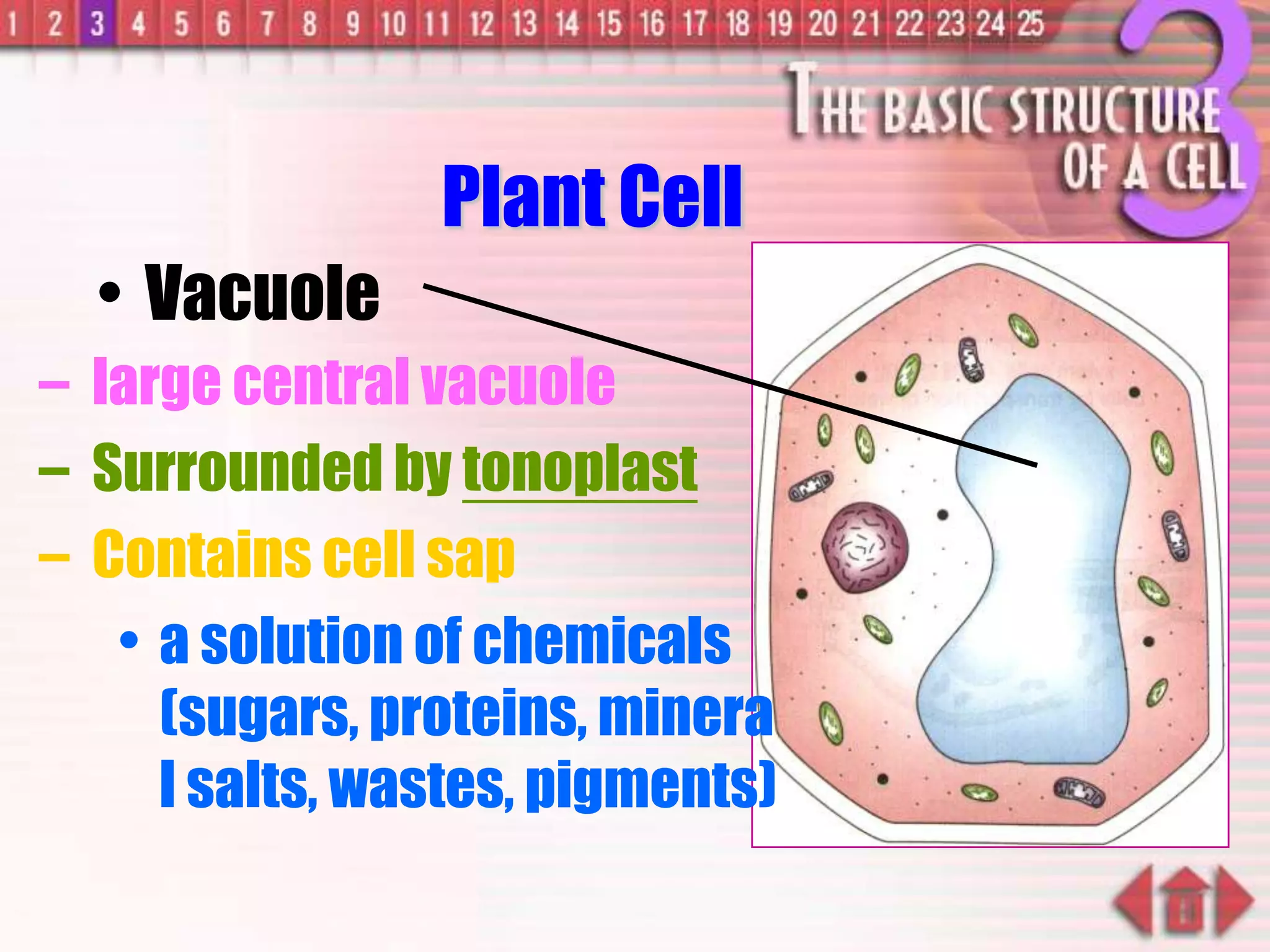
– large central vacuole
– Surrounded by tonoplast
– Contains cell sap
• a solution of chemicals
(sugars, proteins, minera
l salts, wastes, pigments)
Plant Cell
• Vacuole
–Control the normal
activities of the cell
–Bounded by a
nuclear membrane
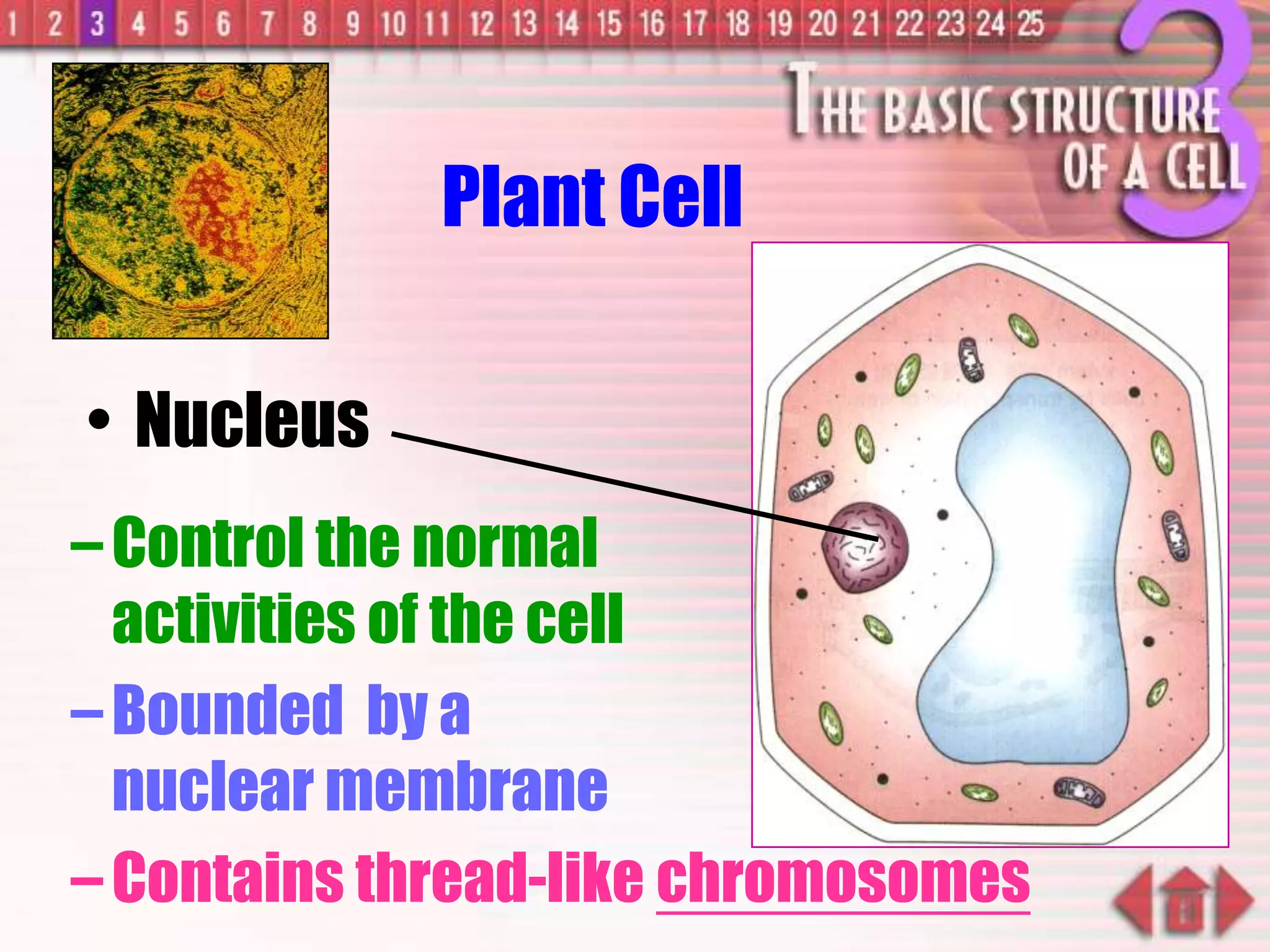
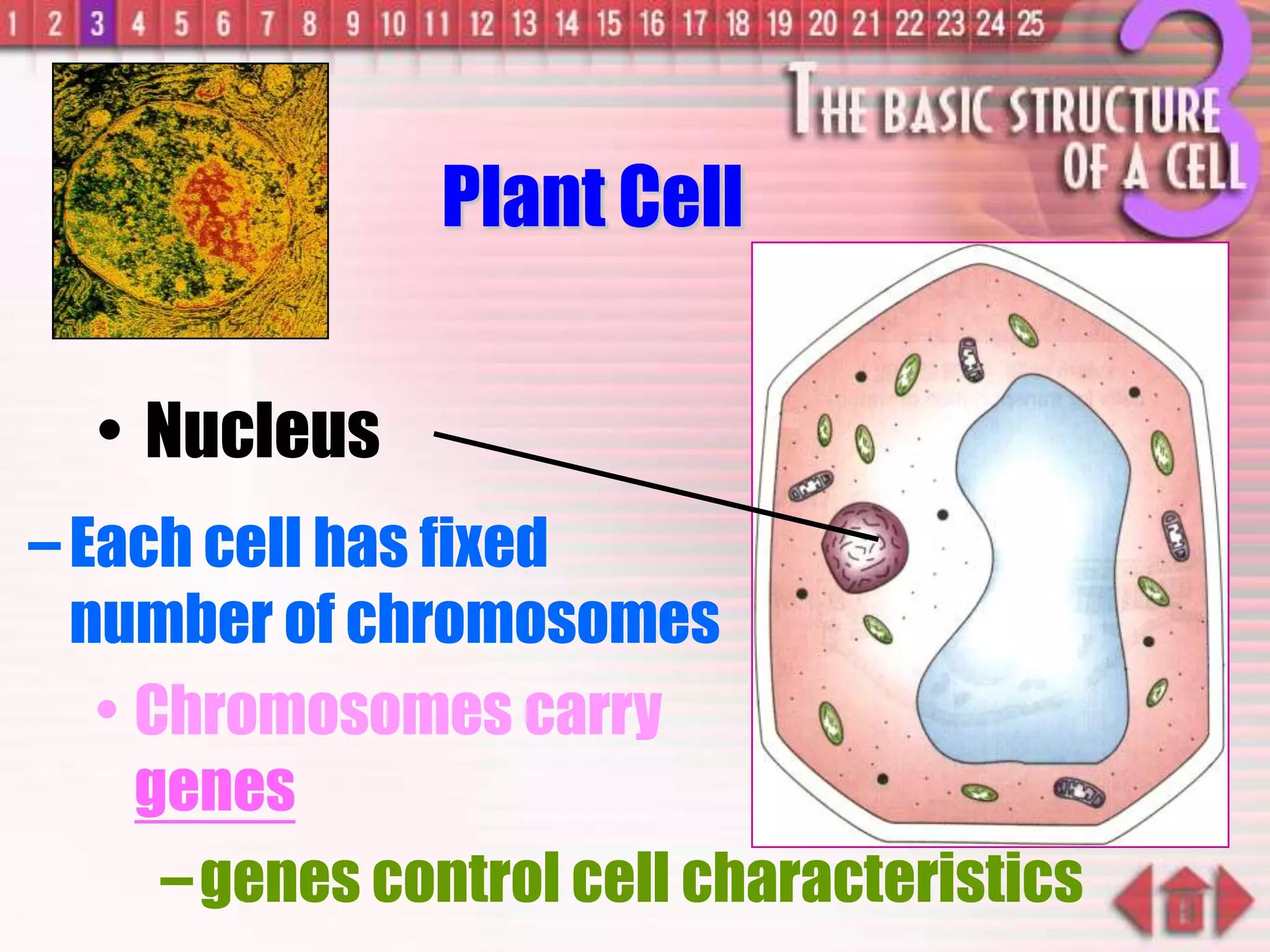
–Contains thread-like chromosomes
Plant Cell
• Nucleus
–Each cell has fixed
number of chromosomes
• Chromosomes carry
genes
–genes control cell characteristics
• Nucleus
Plant Cell
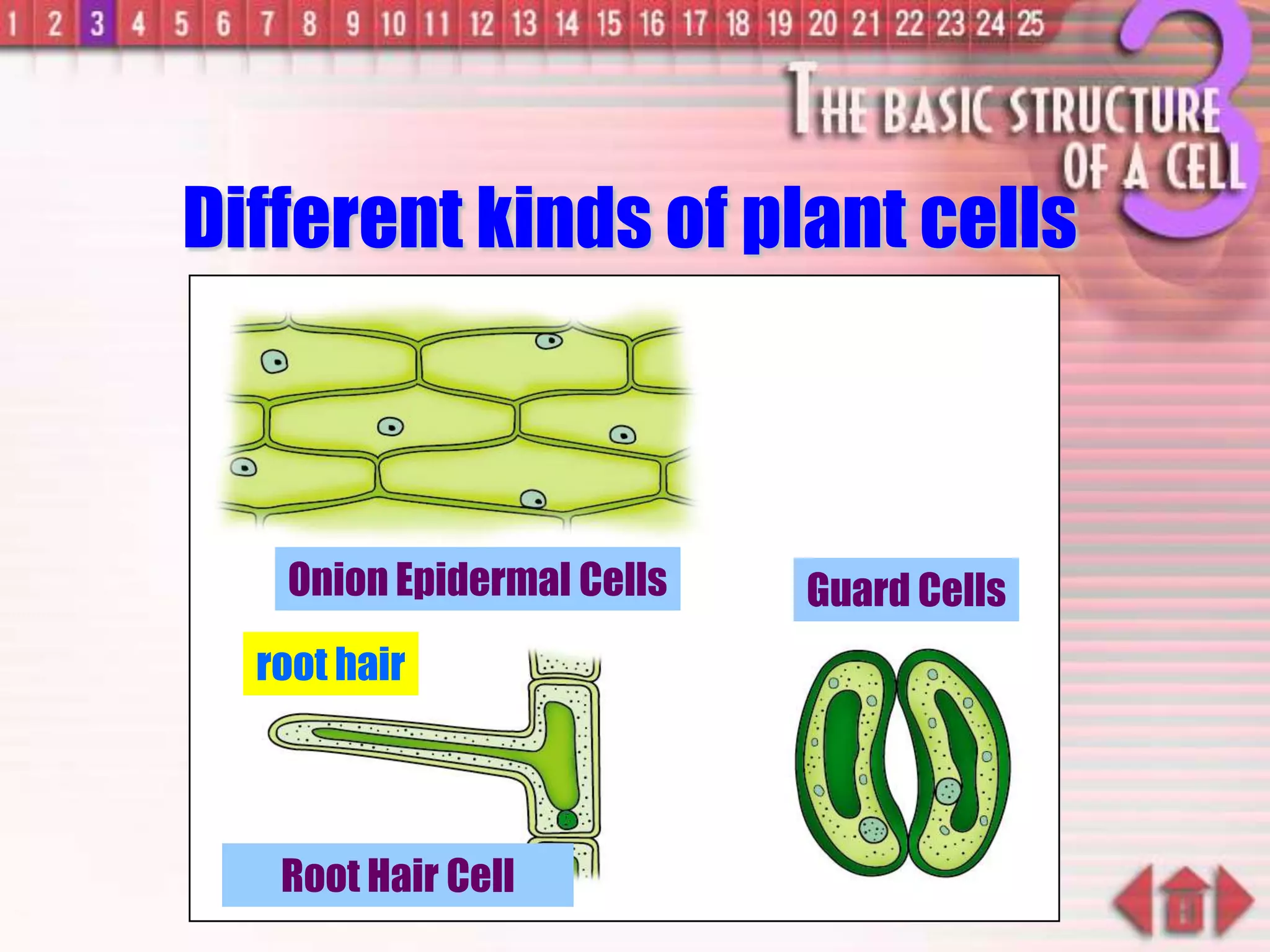
Different kinds of plant cells
Onion Epidermal Cells
Root Hair Cell
root hair
Guard Cells
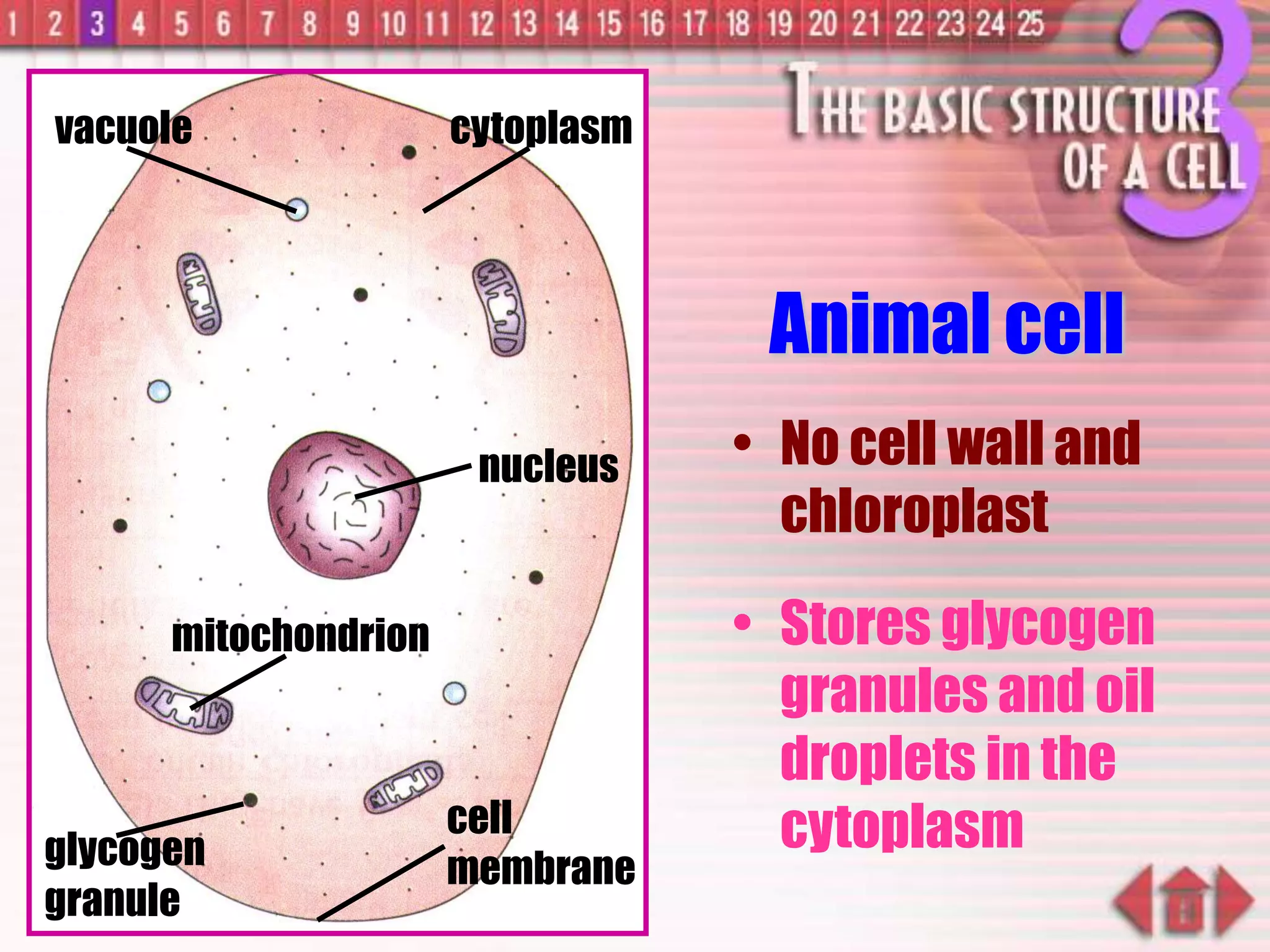
mitochondrion
nucleus
glycogen
granule
cell
membrane
cytoplasm
Animal cell
• No cell wall and
chloroplast
• Stores glycogen
granules and oil
droplets in the
cytoplasm
vacuole
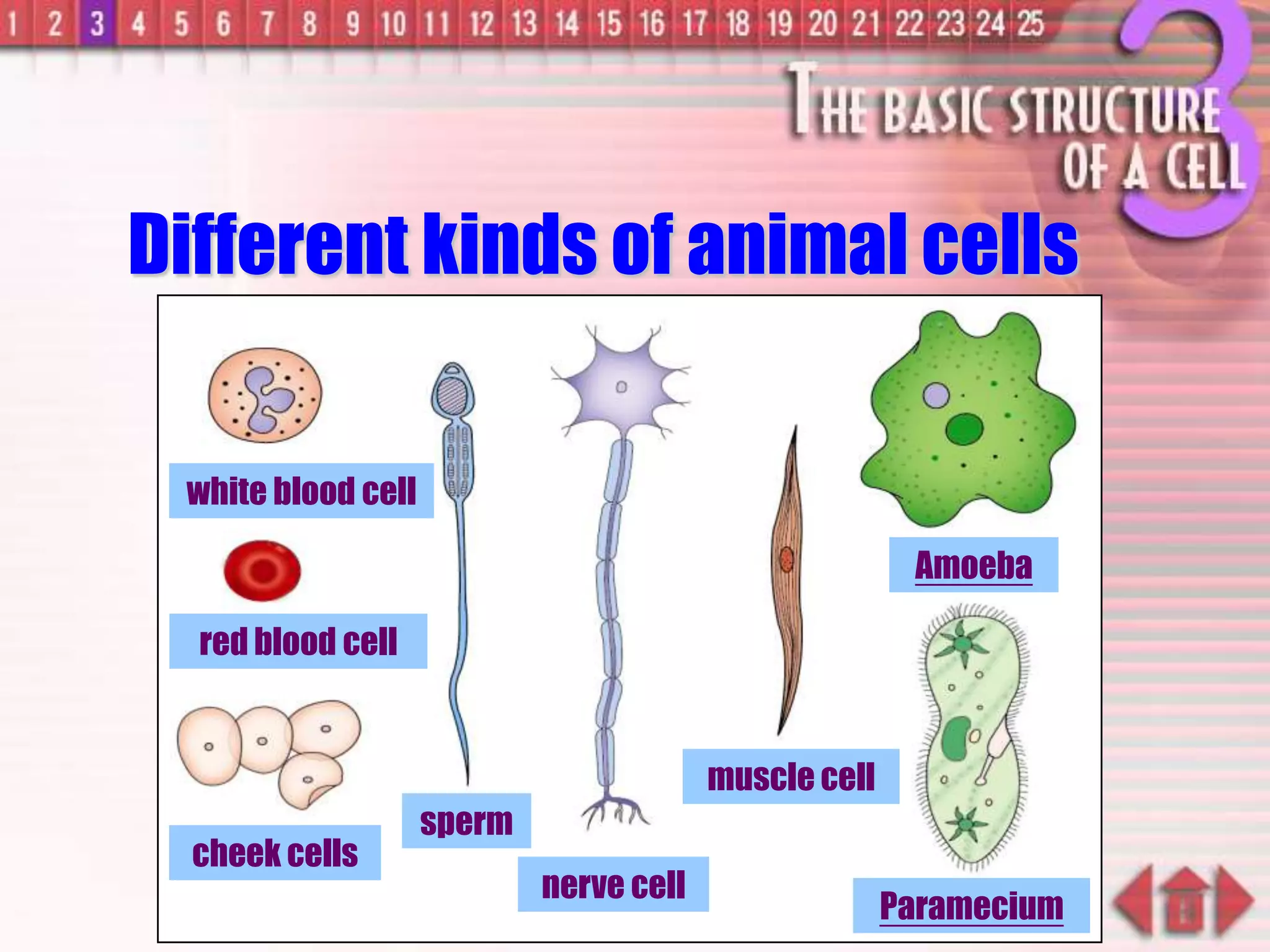
Different kinds of animal cells
white blood cell
red blood cell
cheek cells
sperm
nerve cell
muscle cell
Amoeba
Paramecium
Similarities between plant cells
and animal cells
Both have a cell membrane surrounding
the cytoplasm
Both have a nucleus
Both contain mitochondria
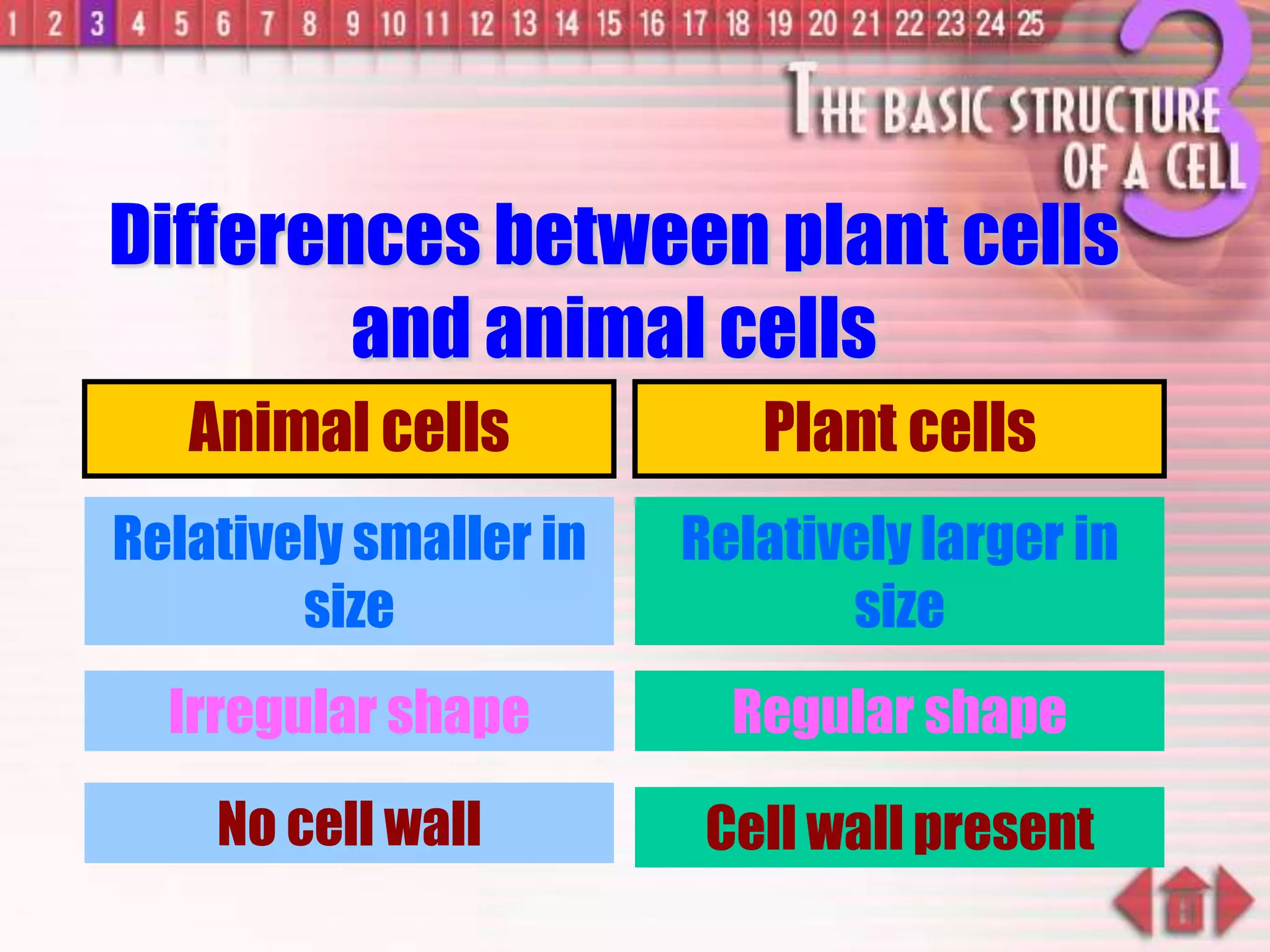
Differences between plant cells
and animal cells
Animal cells Plant cells
Relatively smaller in
size
Irregular shape
No cell wall
Relatively larger in
size
Regular shape
Cell wall present
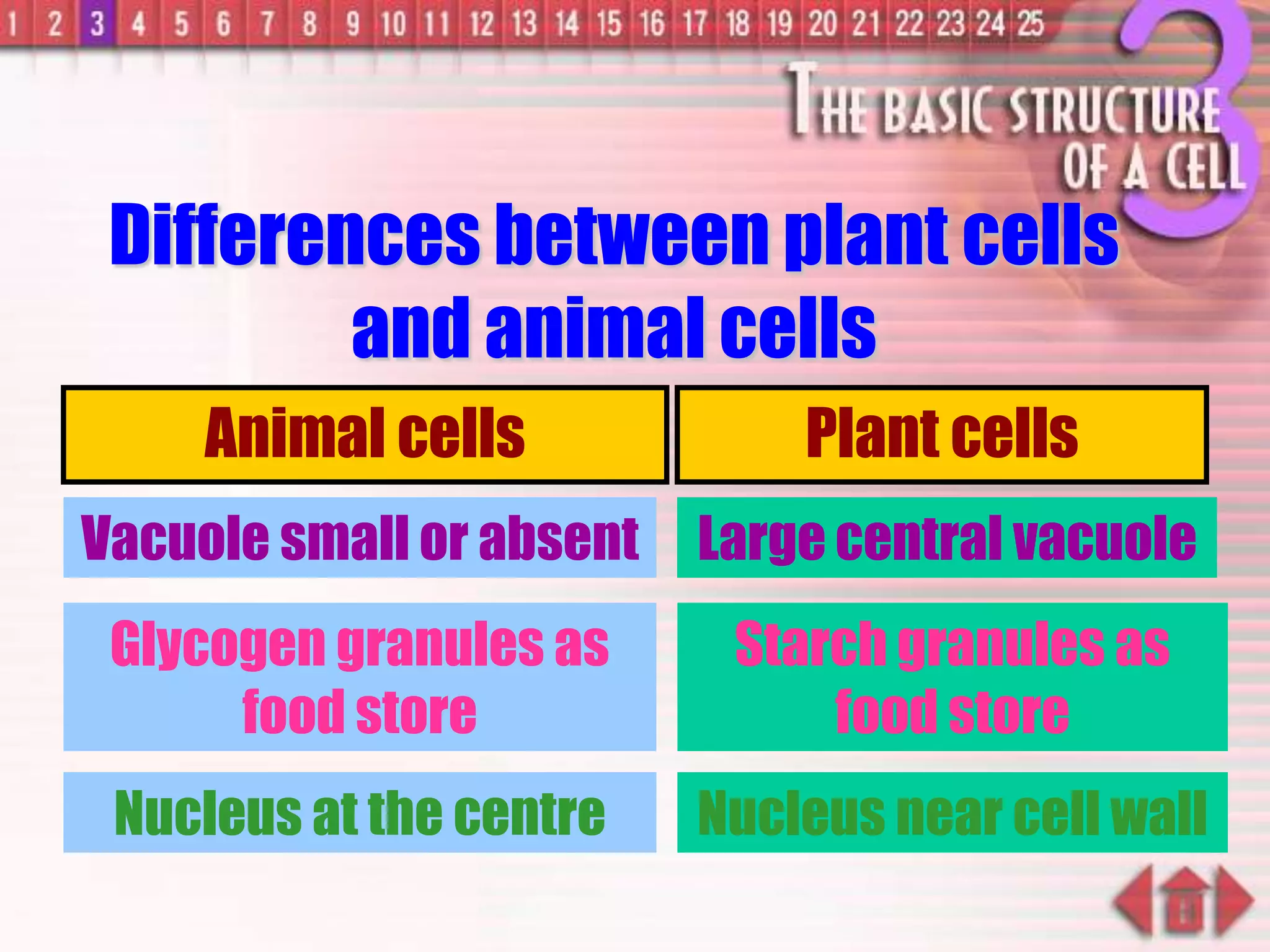
Animal cells Plant cells
Vacuole small or absent
Glycogen granules as
food store
Nucleus at the centre
Large central vacuole
Starch granules as
food store
Nucleus near cell wall
Differences between plant cells
and animal cells
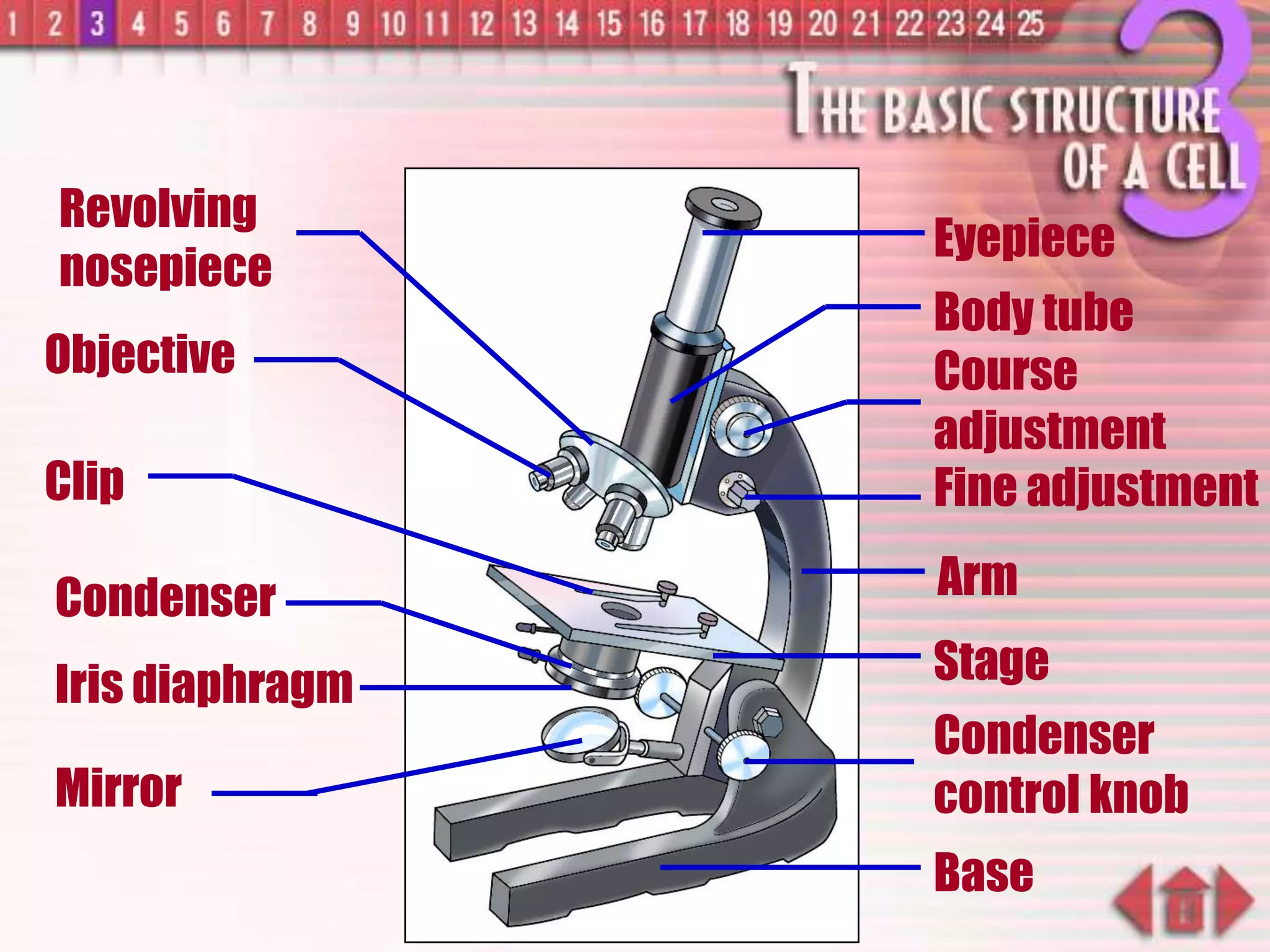
Microscope
• Instrument for
observing small
objects
Different parts of a
microscope
Eyepiece
Fine adjustment
Arm
Stage
Condenser
control knob
Base
Body tube
Course
adjustment
Iris diaphragm
Revolving
nosepiece
Objective
Clip
Condenser
Mirror
The cell as the basic unit of life
• Cell is the smallest unit of living organisms
• Unicellular organisms are made of one cell
only
• The cells of multicellular organisms are
specialized to perform different functions
– e.g. mesophyll cells for photosynthesis
and root hair cells for water absorption
Levels of organization
• Cells are grouped together and work
as a whole to perform special
functions
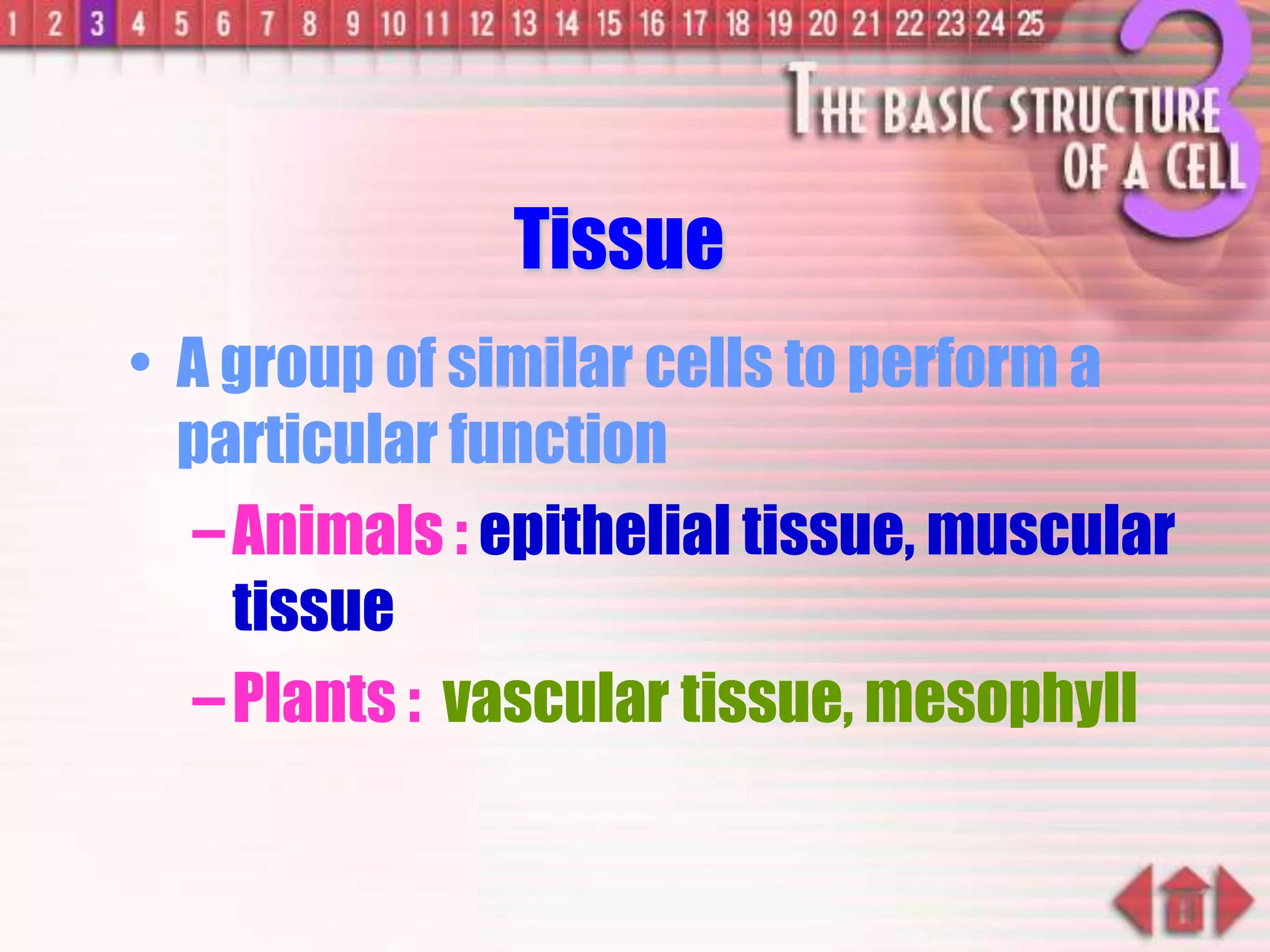
Tissue
• A group of similar cells to perform a
particular function
–Animals : epithelial tissue, muscular
tissue
–Plants : vascular tissue, mesophyll
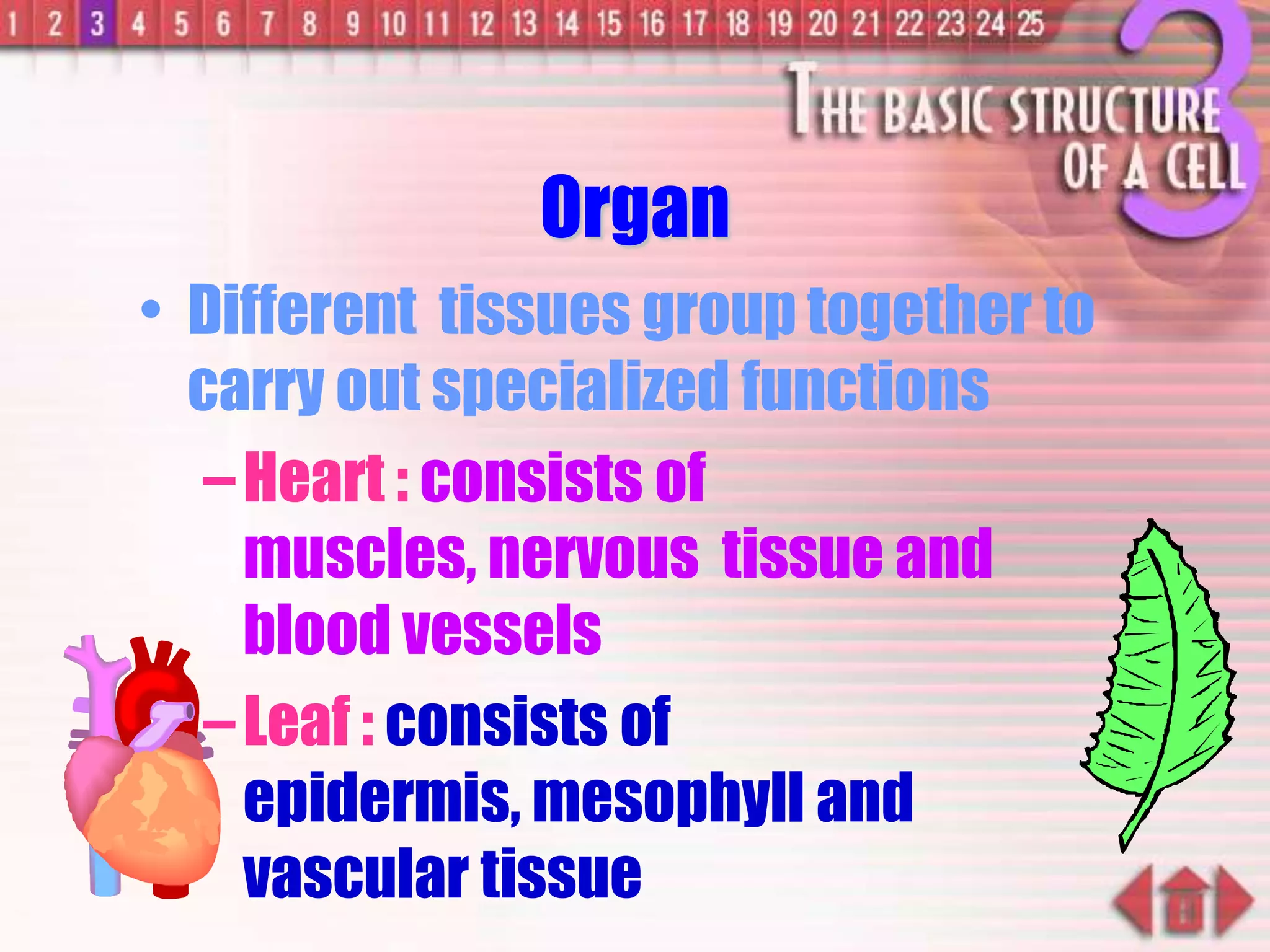
Organ
• Different tissues group together to
carry out specialized functions
–Heart : consists of
muscles, nervous tissue and
blood vessels
–Leaf : consists of
epidermis, mesophyll and
vascular tissue
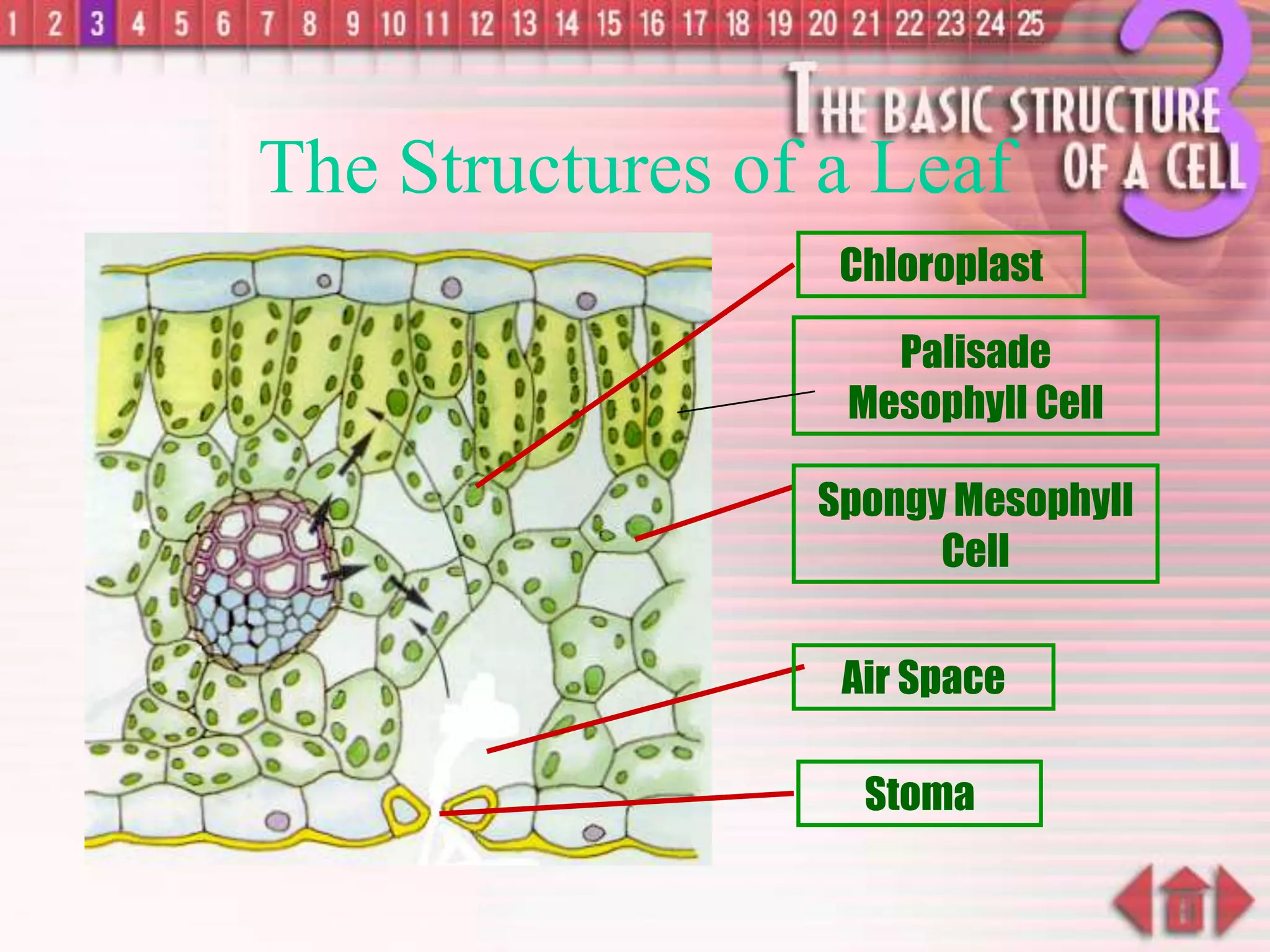
Stoma
Air Space
Spongy Mesophyll
Cell
Chloroplast
The Structures of a Leaf
Palisade
Mesophyll Cell
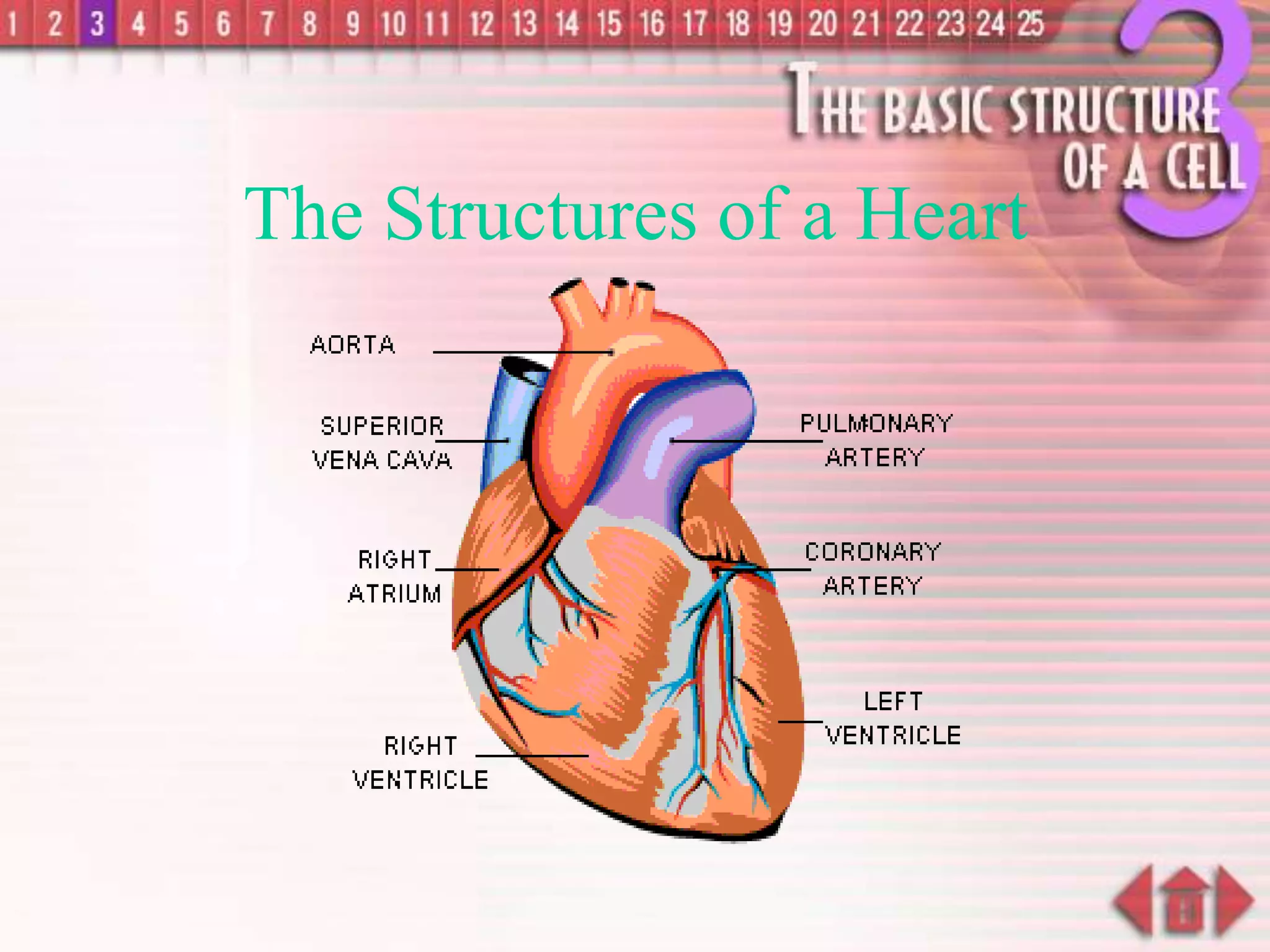
The Structures of a Heart
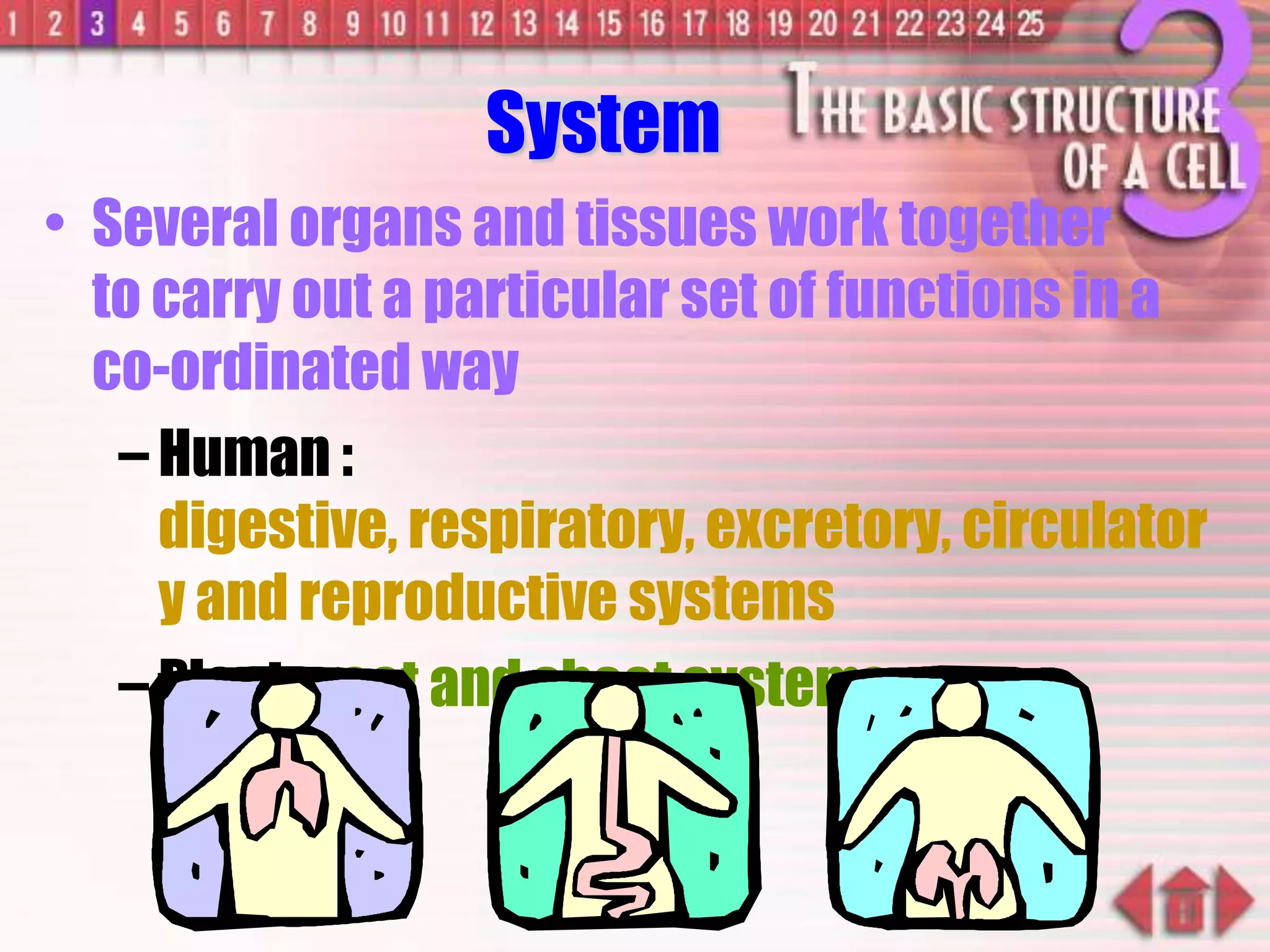
System
• Several organs and tissues work together
to carry out a particular set of functions in a
co-ordinated way
– Human :
digestive, respiratory, excretory, circulator
y and reproductive systems
– Plant : root and shoot systems
System in our body
• examples of systems :
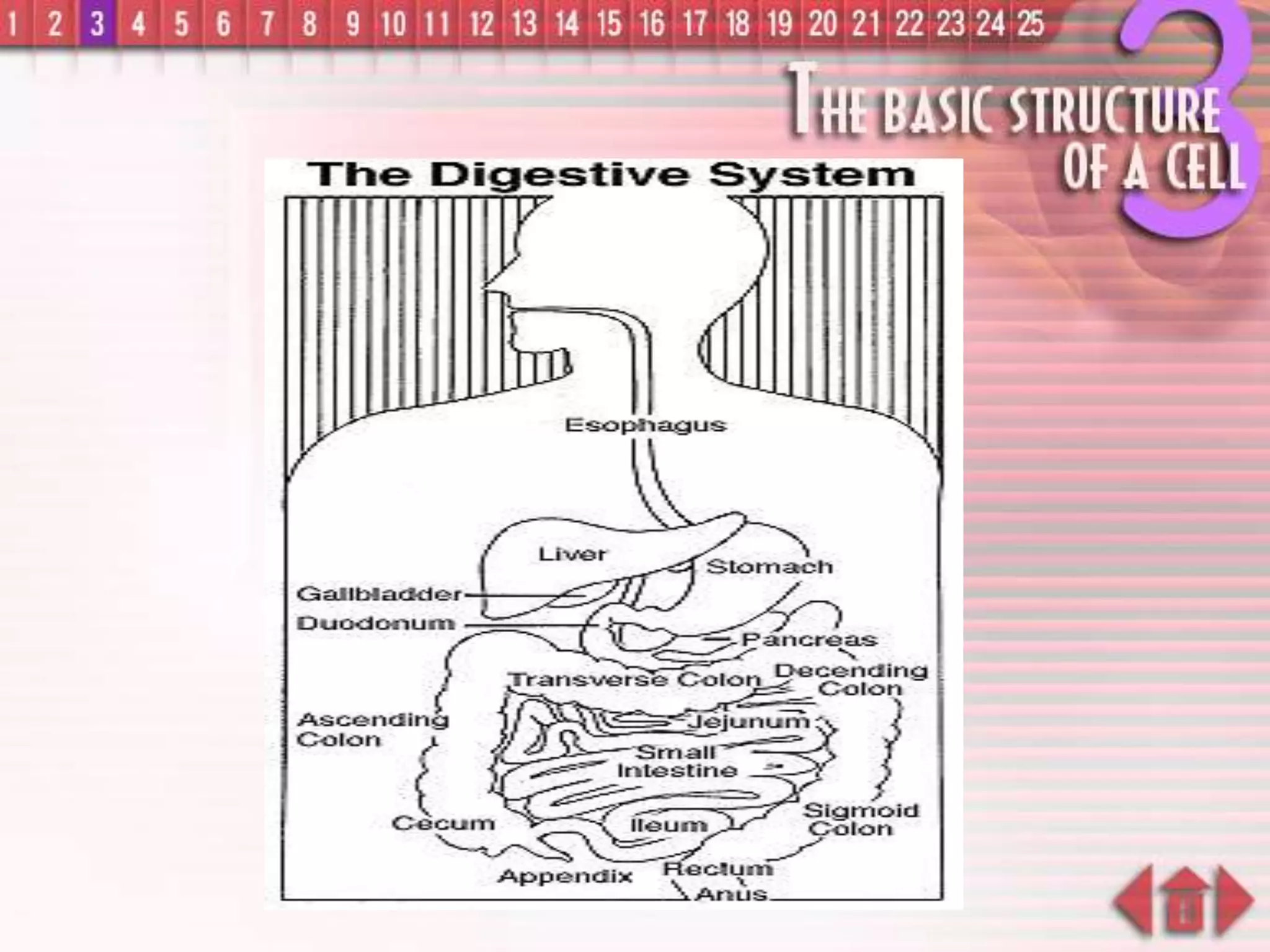
 Digestive System
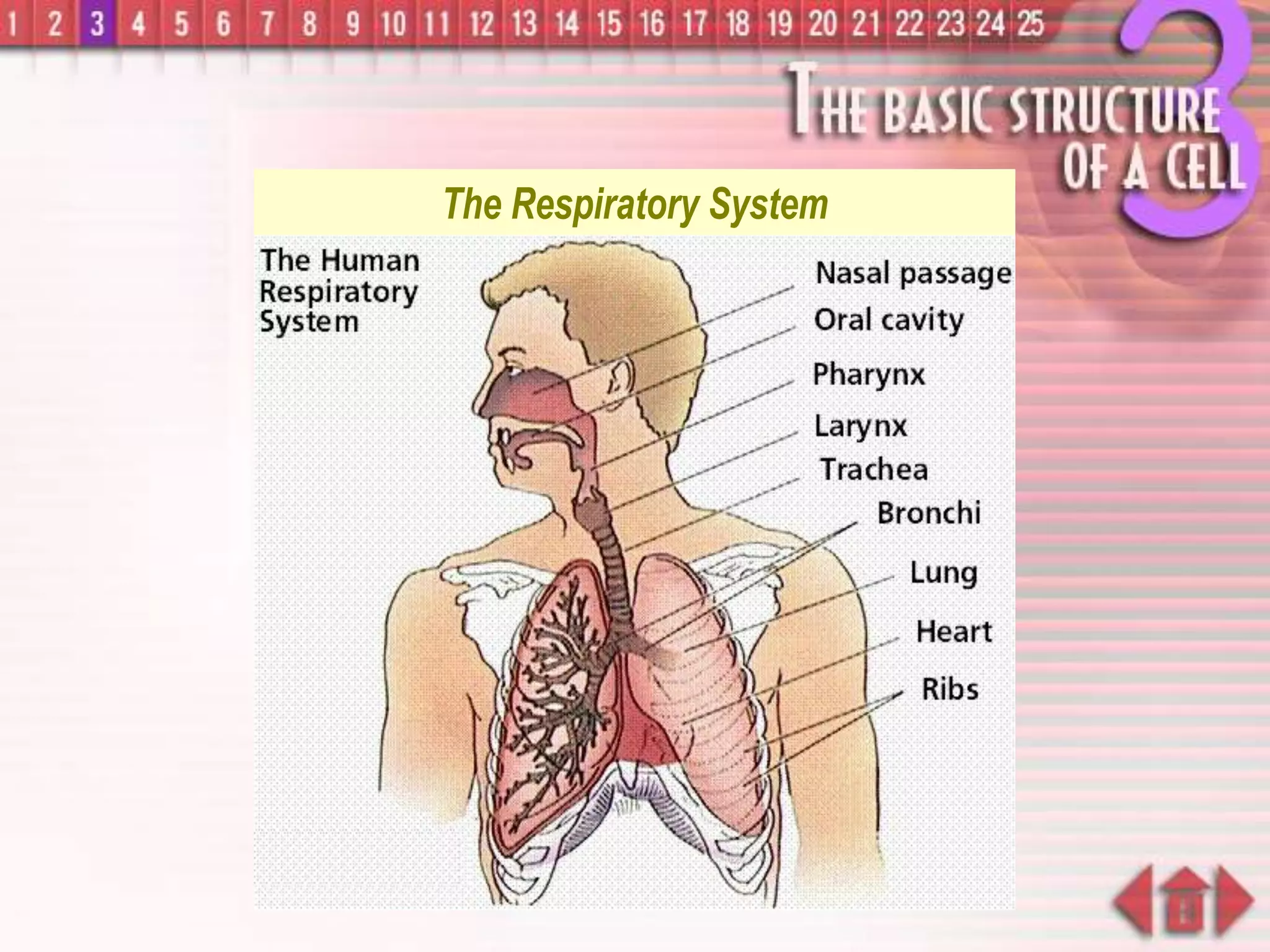
 Respiratory System
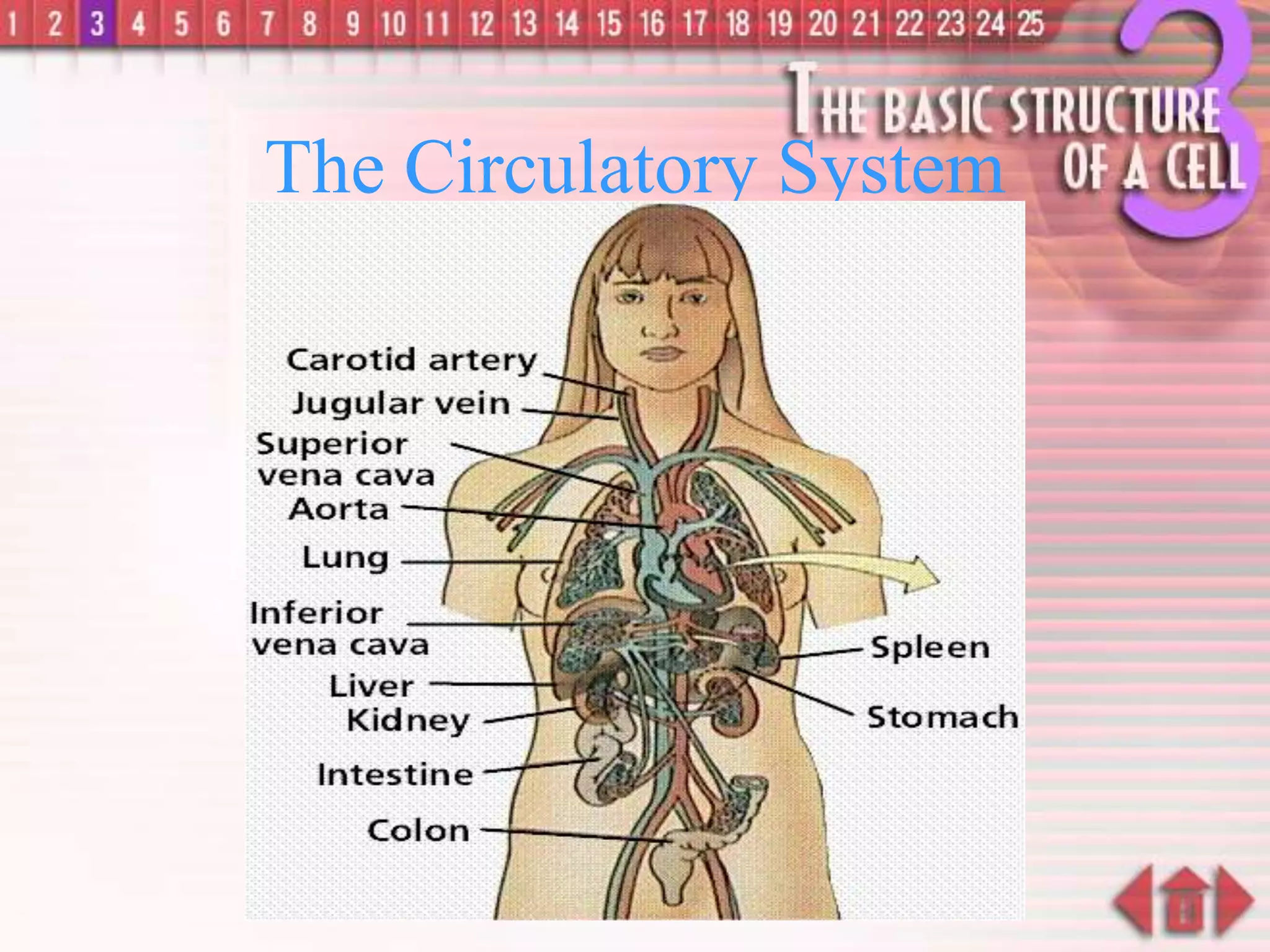
 Circulatory System
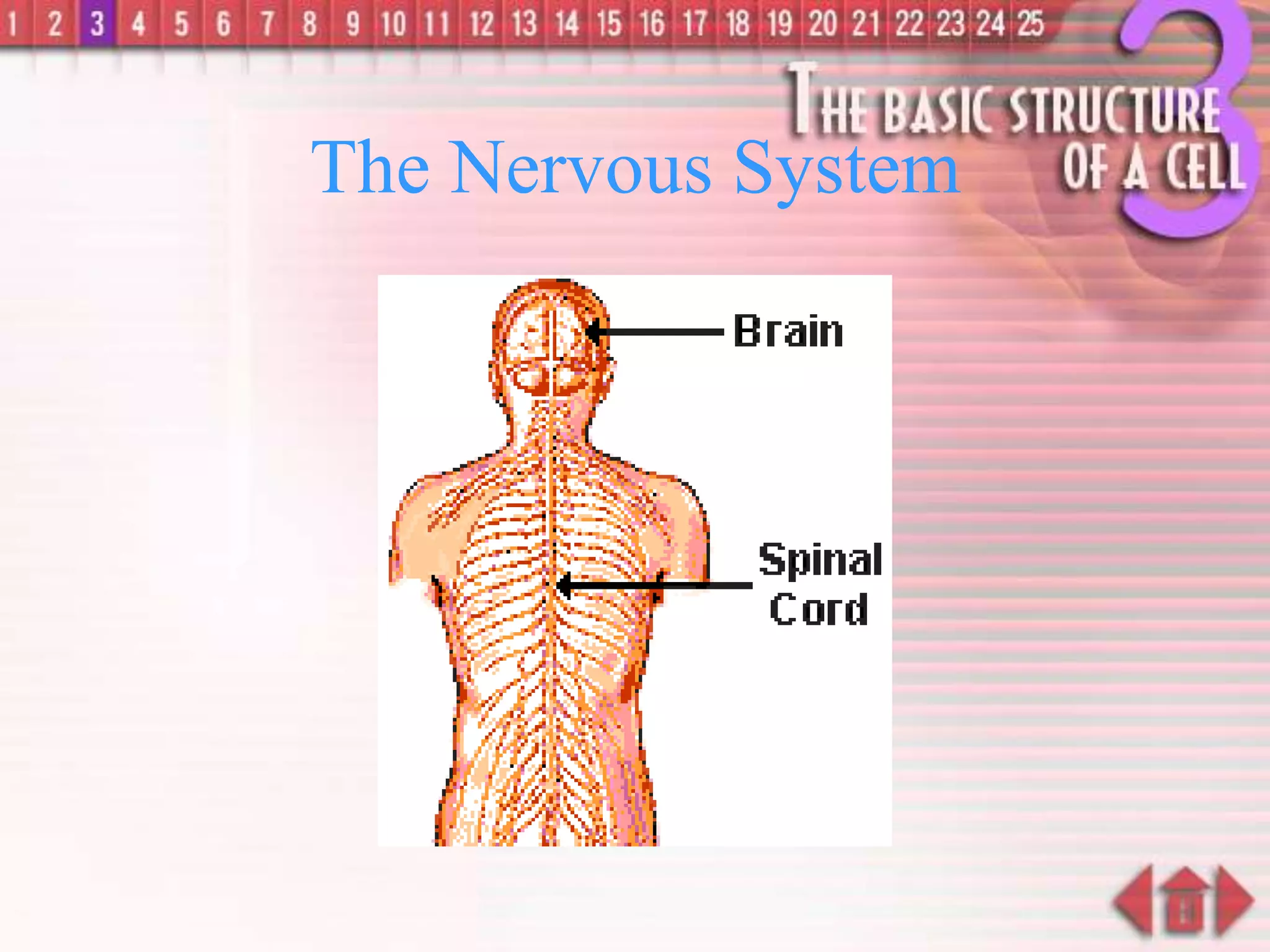
 Nervous System
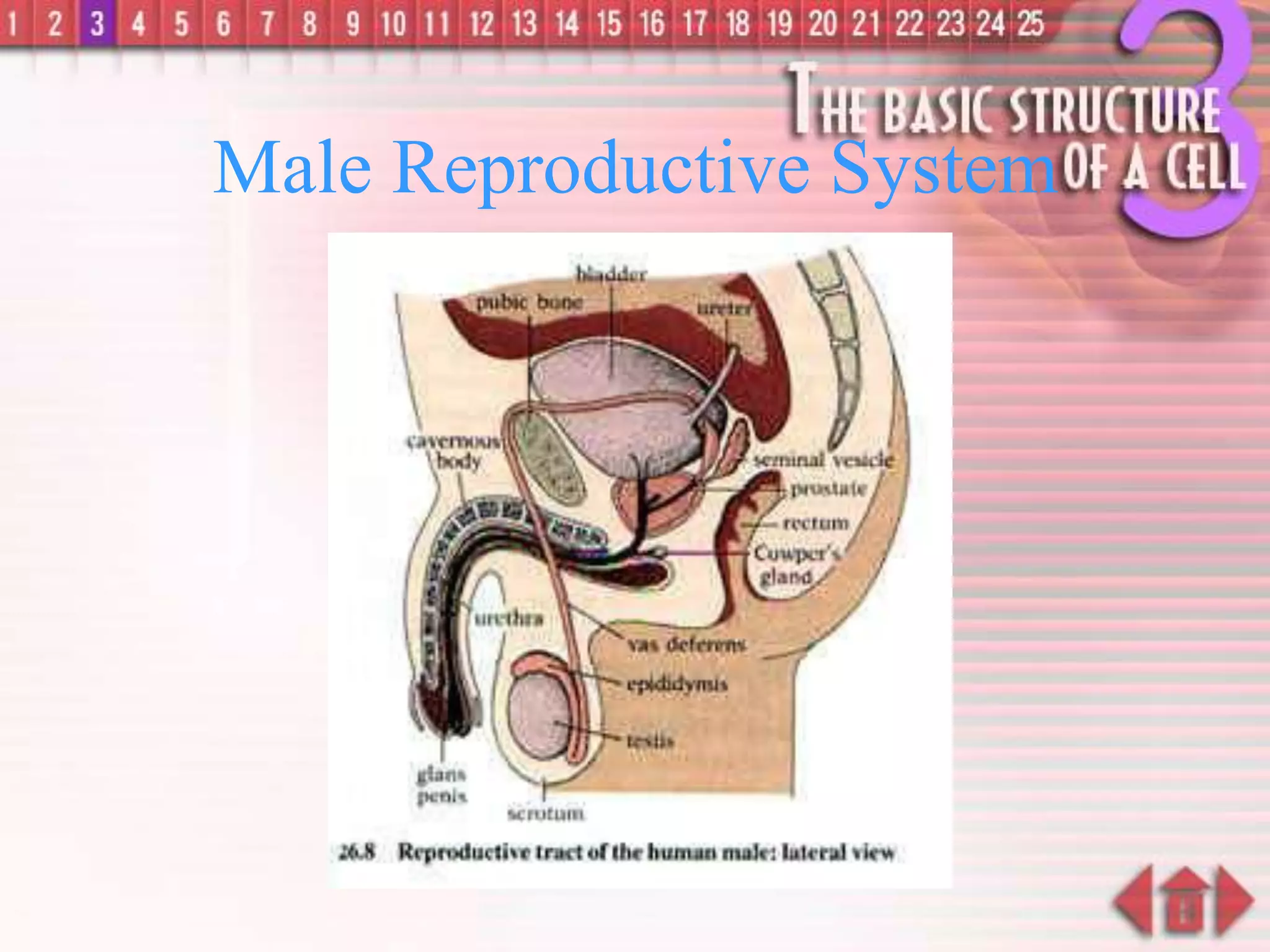
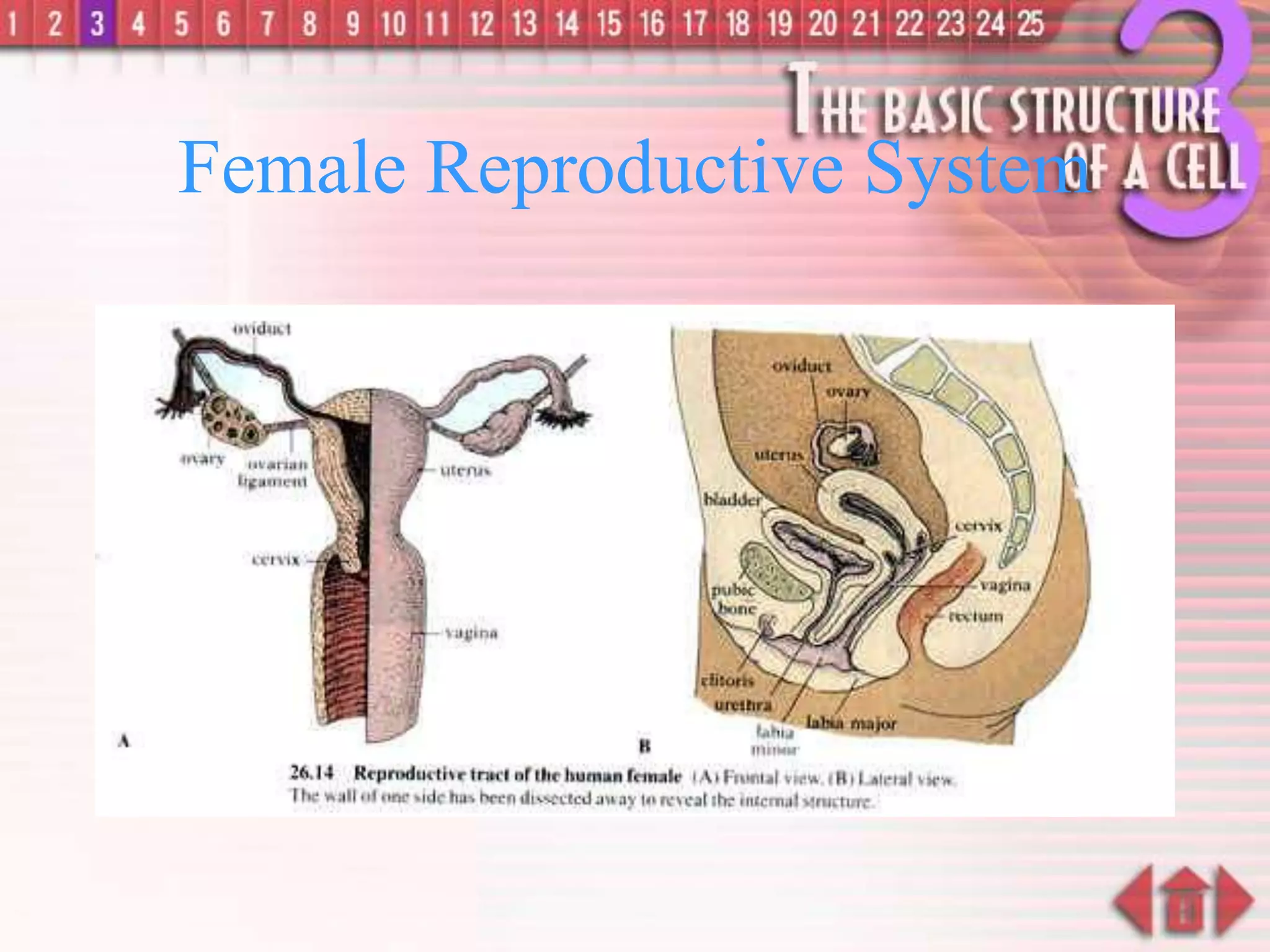
 Reproductive System
The Respiratory System
The Circulatory System
The Nervous System
Male Reproductive System
Female Reproductive System
Level of Organization
cells (e.g. muscle cells, nerve
cells)
tissues (e.g. muscle, epithelium)
organs (e.g.
heart, lungs, stomach)
systems (e.g. circulatory system)
organisms (e.g. man)
It’s You
~ END ~

03 the basic_structures_of_a_