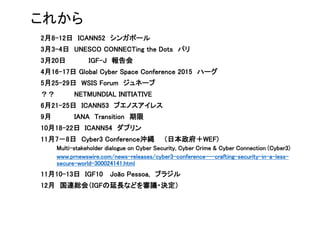
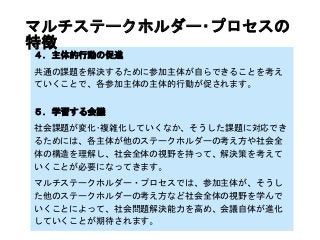
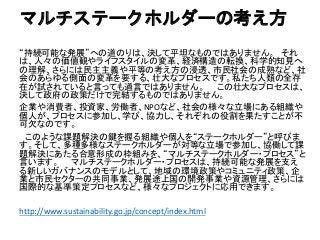
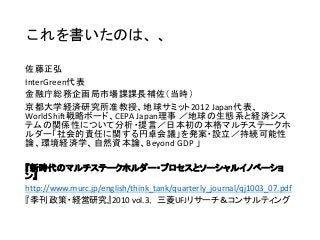
「インターネットガバナンス」の定義
(Working definition)
2005 byWGIG/WSIS
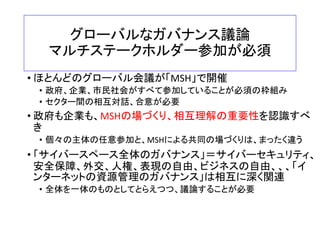
「インターネットガバナンスとは、政府、民間企業、市民社会
がそれぞれの役割に従って開発し、応用する、インターネット
の進化と利用を形成する共通の原理、規範、ルール、意思
決定手続きおよびプログラムのことである」
“Internet governance is the development and application by
governments, the private sector and civil society, in their
respective roles, of shared principles, norms, rules, decision
making procedures and programs that shape the evolution
and use of the Internet.
http://www.internetsociety.org/doc/internet-society-
questionnaire-multistakeholder-governance-report-and-
summary-results-october
It all beganwith
the World Summit on the Information Society
(WSIS)
• Summit: United Nation’s high-level event with Head of
States to discuss matters of mutual concerns, mostly
global emerging issues
• WSIS – proposed by ITU, adopted by GA
• 1st phase 2003 - in Geneva, 2nd 2005 in Tunis
• Objective:
• Close the digital divide in developing countries
• Take advantage of digital economy for further development
• Address new issues of information society
8.
“Internet Governance” becamethe
hottest issue around 2003
• Emerged during prep process in 2002, the hottest of all
issues
• Developing countries wanted to change the international
system around ICANN
• “Internet is a global public resource that requires
governments to manage”, calling for formal intervention of
governments in the management of the Domain Name
System, under the UN System by international
intergovernmental body
• “Replace ICANN with ITU”, “UN to take over ICANN”
• USA and many Western countries argued for “No regulation” by
governments, let private sector to manage Internet resources
• Long and winding debate continued among governments as
well as business and civil society participants in the
preparatory process
9.
2015/2/21 9
What is“Internet Governance”?
1. Governance of Internet infrastructure
• Domain Name System, IP number allocation
• Standardization process (IETF vs. ITU etc.)
• Access – to close digital divide
2. Governance of Social activities over Internet
• Illegal & harmful content (for minors)
• Spam, cyber security
3. Governance of Information Society
• E-commerce, digital economy
• Digital culture
• Social inclusion – no one should be left behind
10.
10
Working Definition ofInternet Governance:
“Internet governance is the development
and application by Governments, the
private sector and civil society, in their
respective roles, of shared principles,
norms, rules, decision-making procedures,
and programmes that shape the evolution
and use of the Internet.”
from the WGIG Report
11.
Why it becameso hot?
• Facing new challenges with changing realities
• From research network to global Public & Economic infrastructure
• Uneven framework with USG holds discretionary power
• Historical legacy became political concern
• Inadequate current systems
• “North” dominates the “South” – less participation in ICANN process from
developing countries – appeal made by G8 DOT Force with no result
• From governments to civil society
• Lack of proper understanding about Internet and ICANN
(history, role and functions)
• Distrust created by politically motivated actors
• ITU to regain control over “telecom”
• “Politics” inside UN system
• Internet empowers the users/individuals/citizens
12.
Politics behind
• Anti-US,anti globalization
• against US dominance in military, technology & economy
• Demonstration against WEF, IMF, WTO, G8 Summit…
• US invasion to Iraq after 911
• Competition for world hegemony for digital economy
13.
Working Group onInternet Governance
(WGIG) – 2004-05
• Outcome of WSIS negotiation on IG
• 40 members, from South and North,
governments, civil society and private sector
• Open and closed meetings
• Sep 04, Nov 04, Feb, Apr, Jun & July 05
• Online consultations
• Contributions, questionnaire and forum
• Webcast and real-time captures
14.
2006~
Internet Governance Forum(IGF)
•A“Product” of WSIS
• Multi-stakeholder set-up
• Gov, Biz, Civil Society – on
equal footing
• MAG(appointed by SG)
• 5-year mandate, with scheduled
review
• Greece, Brazil, India, Egypt,
Lithuania, Kenya, Azerbaijan
• Indonesia (2013)
http://www.intgovforum.org//
15.
IGF Improvement
after 5years
• UN GA agreed to continue IGF for another 5
years with improvements
• EcoSoc, CSTD - formed WG to make report on
IGF Improvement in 2011 (after negotiation)
• CSTD WG Report finalized in Mar 2012
• Adopted at CSTD, May 2012
• Improve Outcome Shaping, Outreach, Support Developing countries’
participation
• No major change in nature and structure of IGF
• Just adopted at UN GA, Dec 16?
16.
2015/2/21 WSIS -Politics of Internet
Management
16
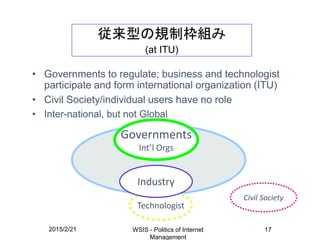
従来型の規制枠組み
(at ITU)
• Governments to regulate; business and technologist
participate and form international organization (ITU)
• Civil Society/individual users have no role
• Inter-national, but not Global
Governments
Int’l Orgs
Technologist
Industry
Civil Society
17.
2015/2/21 WSIS -Politics of Internet
Management
17
インターネットガバナンス 旧来モデル (90年代):
private sector self management
(IETF, ICANN, W3C, Unicode Consortium)
• Self-management led by technologists
• Engineers, pioneers form “private club” to manage
• Looks global, but lacks legal and political legitimacy
• Not scalable, little civil society involvement
Int’l
Orgs
Governments
Technologists
New industry
Traditional
industry
Civil Society
Self- management
18.
2015/2/21 18
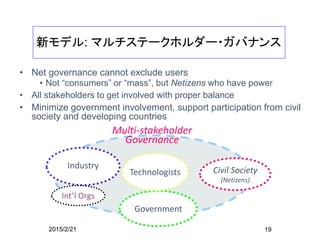
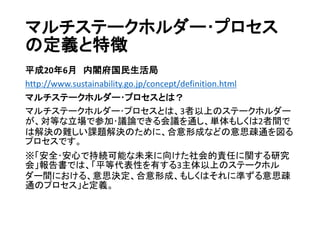
新モデル: マルチステークホルダー・ガバナンス
•Net governance cannot exclude users
• Not “consumers” or “mass”, but Netizens who have power
• All stakeholders to get involved with proper balance
• Minimize government involvement, support participation from civil
society and developing countries
Government
Civil Society
(Netizens)
Technologists
Industry
Multi-stakeholder
Governance
Int’l Orgs
19.
19
My Commitment to
InternetGovernance
• ’80s – promoting PC Networking
• ’90s – promoting the Internet
• Principle
• People to People Communication is the base
• For the better society
• User centric perspective
• Practice
• ’96 organized “Netizen Forum” – mailing list discussion, TV live debate
• Promoting Internet in Asia ’97-2000 ARN in Malaysia
• ’98 – SG for APIA, participated in IFWP
• Bring voices from Asia, users and citizens into ICANN formation process (MAC、AtLarge)
• ’99 – promoted Global Internet Y2K Campaign
• ’00 – participated in G8 DoT Force representing NPOs from Japan
• ’03-05 participated in WSIS, from Civil Society
• ’04 - IGTF WGIG process
• Network Security, IPv4 depletion, NGN issues
• 2009 - ccTLD - .jp issues 日本ドメイン名協議会
20.
15年以上、議論に直接参加
• 1998-99 ICANNMembership Advisory Committee (MAC)
• 2003 - Civil Society Internet Governance Caucus (IGC)
• 2004-2007 Internet Governance Task Force Japan(IGTF-J)
• 2003-2008 ICANN AtLarge Advisory Committee (ALAC)
• 2011- APrIGF MSG
• 2012- IGF MAG
• 2012-13 CSTD/UNCTAD/UN WG on IGF improvement
• 2014 NETmundial (Brazil)
ITU ITU Plenipotentiary Conference
• 2015 IANA/ICANN transition
WSIS+10
21.
Main Issues
• Whogoverns what and how
• Self-selected people – IANA
• Privatization & Internationalization
• Membership of NewCo
• Users? Governments?
• ITU?
• ICANN Reform/coup de ta 2001
• WSIS process WGIG IGF
• Multi-lateral or Multi Stakeholder
• Legitimacy
22.
日本とアジアを「隔離」するな
Proactive Participation
Implement andenhance MSH inside Japan
Establish MSH Principle
• open, transparent, bottom-up, equal footing,
• choice and competition
• independent oversight over monopoly based on minimum legal
framework
24
コンピューターネットワークの初期の歩み
インターネットだけがネットではなかった
ARPANET 1969 ARPA,US DoD JC Lickrider
Com 1970s Uppsala U. /Stockholm U. Jacob Palme
Community Memory 1972 Berkrey, US Mark Szpakowski
UUCP 1977 Bell Lab
CBBS 1978 Generated many “hobbyists” Christensen/Suess
UseNet 1979 U. North Carolina/Duke U. Source of “Netizen”
Electronic Information
Exchange System (EIES) 1979 Computer Conferencing, NJIT Murray Turoff
PARTI 197? Harry Stevens
The Source 1979 Online Utility
CompuServe 1980 Forum
TCP/IP 1982 CNRI Vint Cerf/ Bob Khan
Confer U Michigan/MTS Bob Parnes
CoSy 1983 U. of Guelph, Canada Alastair Mayer
Fidonet 1983 Linking BBS globally Jenkins?
Well 1985 Whole Earth Review S. Barnd, Kelly,
Rheingold etc
BITNET 1981 City U. of NY / Yale U. I. Fuchs / G. Freeman
World-wide Web 1980-90 CERN Tim Berners-Lee
Mosaic 1993 NCSA Marc Andreesen
25.
25
パイオニアたち
• Vannever Bush:“As you may think”
• Douglas Engelbart: ARC, NLS, Mouse, Word Processor,
Computer Conference
• J.C.R. Licklider/ Robert Taylor: “Computers for communications”
• Vint Cerf/Robert Kahn/Dave Farber/Larry Landwieber/Jun
Murai/Kilnam Chon/Jon Postel/Steve & Dave Clocker/Daniel
Karrenburg – Built 1st Internet
• Louis Pusin,
• Rick Adams - UUNet – 1st Commercial ISP
• Frank Burns/Lisa Kimball/Jeff Shapard/Joi Ito – MetaNet/ENA
(Electronic Networking Association)
26.
インターネットが主流に
1992
“Information Super Highway”Al Gore Presidential campaign
INET92 in Japan
1993
National Information Infrastructure (NII)
UN online
1994
Global Information Infrastructure (GII)
APII/KII, proposed by President Kim of Korea at APEC
Mosaic/Netscape, Yahoo
Japanese PM office, US Whitehouse online
1995
NSF backbone quietly retired, Commercial Internet to bloom
NRI, Iran’s first ISP online
Amazon.com, eBay, Vatican, Canadian Gov online
1996
“Internet Boom” in Japan, NTT:OCN started
E*Trade IPO
1997 Clinton “E-Commerce” strategy
1998 ICANN est.
27.
Internet History &Governance 27
“ICT for Development”
1991- Networking Training Workshop at INET etc,
1992 Sustainable Development Network Program (SDNP), by
UNDP as outcome of Earth Summit
1993 Asia Pacific Networking Group (APNG) (APCIRN ’91)
1995 “GII Summit” by G7, Brussels, EU: “Information Society”
1995 PAN Asia Networking /IDRC Singapore
Mongolia, Cambodia, Vietnam, Laos, Sri-Lanka, China…
1996 Information Society and Development, South Africa
1996 Acacia, IDRC
1996 Multimedia Super Corridor (Malaysia)
SingaporeONE (Singapore)
1997 APDIP by UNDP
2000 Okinawa Summit, IT Charter, DoT Force
2001 DoT Force Genoa Action Plan
28.
28
Global trend around“Information Society”
1993 NII – Clinton/Gore
1994 GII – Gore proposed at ITU Development Conf
1995 G8 Information Society Summit
Japan – promoted “Advanced Info Society”
1996 MSC/Singapore One spread to Asia
1997-98 IFWP – ICANN Governance became the issue
1999 Y2K, Dot Com boom
2000 G8 Okinawa Summit – “New Economy” recognized
Digital Divide - DoT Force、“e-Europe”
2003 WSIS Geneva
2004 WGIG
2005 WSIS Tunis
2006 Internet Governance Forum (IGF)started
29.
29
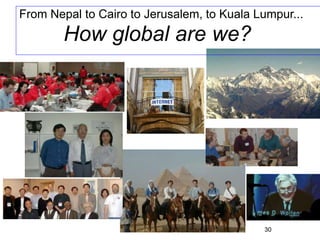
How global arewe?
From Nepal to Cairo to Jerusalem, to Kuala Lumpur...
30.
30
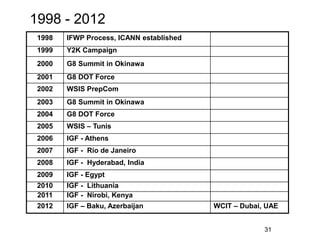
1998 - 2012
1998IFWP Process, ICANN established
1999 Y2K Campaign
2000 G8 Summit in Okinawa
2001 G8 DOT Force
2002 WSIS PrepCom
2003 G8 Summit in Okinawa
2004 G8 DOT Force
2005 WSIS – Tunis
2006 IGF - Athens
2007 IGF - Rio de Janeiro
2008 IGF - Hyderabad, India
2009 IGF - Egypt
2010 IGF - Lithuania
2011 IGF - Nirobi, Kenya
2012 IGF – Baku, Azerbaijan WCIT – Dubai, UAE
31.
31
ICANN 1997-2012
1997 –IAHC process
1998 – White Paper, Green Paper, ICANN
1999 – DNSO, MAC…
2000 – Global Election, G8 DoT Force
2001 – AtLarge Study, 9/11
2002 – “Reform”
2003 – ICANN 2.0 w/ ALS/RALO/ALAC WSIS I
2005 – WSIS II
2006 – IGF started
2008 – ALAC completed – ICANN 3.0?
2009 – AtLarge Summit, New TLD, AoC
2010 – IDNccTLD introduction
2011-12 – New gTLD introduction
Global Multistakeholder Meetingon the Future
of Internet Governance
• Proposed by ICANN, co-hosted by Government of Brazil
• Background:
• Snowden revelation on USG monitoring
• Dilma Rousseff, President of Brazil, UNGA speech criticizing the US
• ICANN needs new framework
• ITU Plenipotentiary Conference, Oct 2014
35
36.
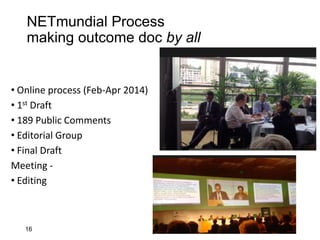
NETmundial Process
making outcomedoc by all
36
• Online process (Feb-Apr 2014)
• 1st Draft
• 189 Public Comments
• Editorial Group
• Final Draft
Meeting -
• Editing
2014年11月
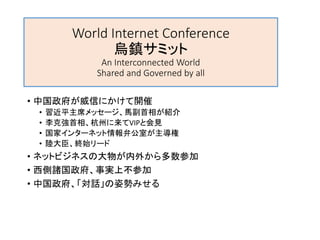
World Internet Conference
烏鎮サミット
AnInterconnected World
Shared and Governed by all
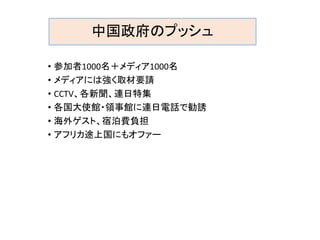
•中国政府が威信にかけて開催
• 習近平主席メッセージ、馬副首相が紹介
• 李克強首相、杭州に来てVIPと会見
• 国家インターネット情報弁公室が主導権
• 鲁炜大臣、終始リード
•ネットビジネスの大物が内外から多数参加
•西側諸国政府、事実上不参加
•中国政府、「対話」の姿勢(ジェスチャー)みせる
主なスピーカー
阿里巴巴(アリババ) 馬雲 JackMa Alibaba.com Executive Chairman
新浪微博 王高飛 Wang Gaofei Shina Weibo CEO 微博
財新伝媒 胡叙立 Hu Shuli Caixin Media 編集長
華数デジタルメディア 曹強 Cao Qiang Digital TV Media 社長
百度 張並勤 Zhang Yaqin Baidu CEO
小米科技 雷軍 Lei Jun Ziaomi Tech
中国電子科技集団 熊群力 Ziong Qunli
China Electronimcs
Technology Group
President
人民日報 Mary Ma People's Daily 副編集長
張一鳴 Zhang Yiming Headlines Today Founder, CEO
中国電信 王暁初 Wang Xiaochu China Telecom Chairman
中国連通 常小平 Chang Xiaobing China Unicom CEO
騰訊控股 馬化騰 Pony Ma Tencent Holdings CEO QQ
京東 劉強東 Richard Liu JingDong Group Founder & CEO
JD
Dotcom
新東方教育集団 愈敏洪 Minhong Yu
New Oriental Education
and Technology Group
Chair of Board
360 斉向東 Qi Xiangdong 360 President
田遡宇
Edward Suning
Tian
Broadband Capital President
太平洋電信連盟 何仏中 Stephen Ho Pacnet President
中央電子台 田薇 Tian Wei CCTV Host
中国企業
42.
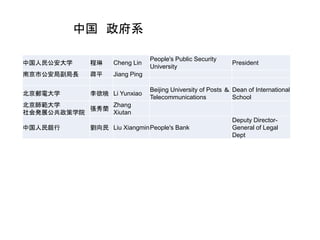
中国 政府系
中国人民公安大学 程琳Cheng Lin
People's Public Security
University
President
南京市公安局副局長 蒋平 Jiang Ping
北京郵電大学 李欲暁 Li Yunxiao
Beijing University of Posts &
Telecommunications
Dean of International
School
北京師範大学
社会発展公共政策学院
張秀蘭
Zhang
Xiutan
中国人民銀行 劉向民 Liu XiangminPeople's Bank
Deputy Director-
General of Legal
Dept
43.
海外企業
欧米 リンクトイン ReidHoffman LinkedIn Co-Founder
フェイスブック Vaughan Smith Facebook VP
アマゾン中国 Doug Gurr Amazon China CEO
トムソンロイター James Smith Thomson Reuters President and CEO
クアルコム Paul Jacobs Qualcom Executive Chairman
アップル Bruce Sewell Apple Inc SVP, General Counsel
ノキア Rajeev Suri Nokia CEO
GSMA Anne Bouverot GSMA Director General
日本 ソフトバンク 孫正義 Masayoshi Son Softbank Chairman
韓国 LINE Plus 慎重ホウ Jun-ho Shin LINE Plus CEO
サムソン ??? Samsung Electronics Chairman
ロッテ Hongjun Li Lotte Group Chairman
シンガポール シンガポールポスト Wolfgang Baier Singapore Post CEO
欧米/
中国
IBM中国・韓国 Josephine Cheng IBM Greater China and Korea CTO, VP
マイクロソフト 沈向洋 Harry Shum Microsoft Executive VP
インテル中国 Greg Stater Intel China VP, General Counsel
オラクル中国 Casey Poon Oracle Greater China CVP
HP Mark Carroll HP VP and CTO
マッキンゼーアジア Bruno Roy McKinsey, Asia Pacific
アクセンチュア 李網 Li Gang Accenture Greater China Chairman
ボストンコンサルティング Francois Candelon Boston Consulting Group
Senior Partner & Managing
Director
ECMA Williem Onno Elzinga ECMA International Deputy Secretary
シリコンバレー銀行 David Jones Silicon Valley Bank President
44.
プログラム
Day 1 NewInternet Media x
Opening Ceremony x
Information Economy Forum
Creating Online Global Village
Mobile Internet Forum x
High-Level Dialogue x
Day 2 Cross-border E-commerce and Economic Globalization
Countering Cyber Terrorism with Enhanced international cooperation
Chinese and Foreign Entrepreneurs Summit
Security and Cooperation in Cyberspace x
Internet and Finance: Financial Innovation & Economic Development
Internet and Government: Reinventing the Public Service
Day 3 Closed Door Session: Constructing a Peaceful, Safe, Open and Cooperative
Cyberspace
Global Internet Governance Forum x
Internet Celebrities Dialogue
Closing Ceremony x