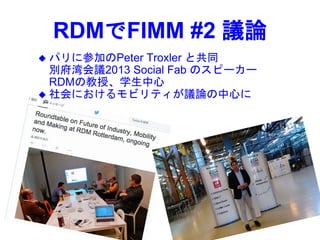
Future of Industry,Mobility & Ma
unReport #1
April 2015
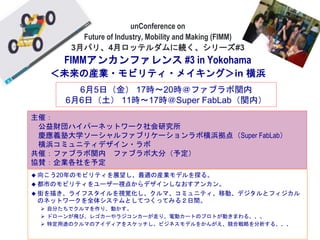
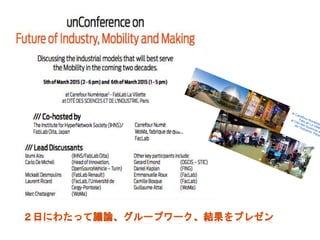
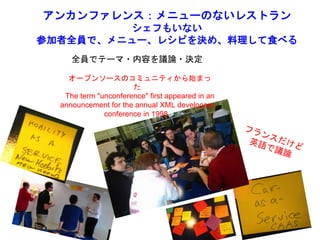
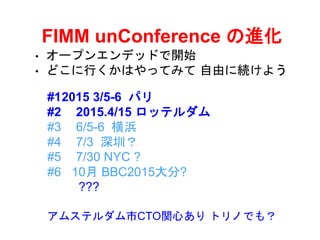
unConference #1 Paris
5th & 6th of March 2015
at Carrefour Numériqu
FabLab La Villett
at Cité des Sciences et
de l’Industrie, Paris.
ABSTRACT
This first unConference on the Future of Industry, Making & Mobility (FIMM) gathered an
interdisciplinary crowd on the 5th & 6th of March 2015, and is planned to continue in a second
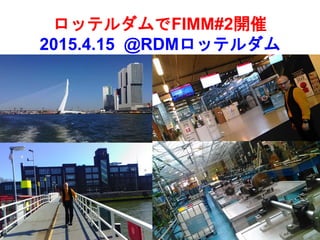
episode later in April in Rotterdam and in June in Yokohama, Japan. We hope this stream will
continue further elsewhere.
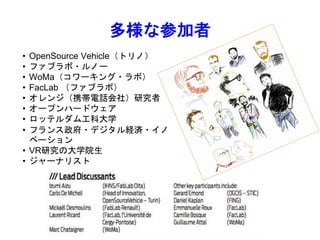
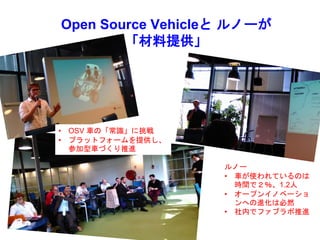
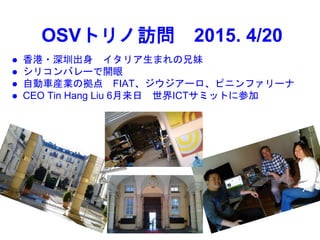
At this first FIMM unConference joined automotive industry related businesses (Renault, OSVehicle),
industry and mobility French ministry representatives, Fablab related people (FacLab, Carrefour
Numérique², FabLab Oita, WoMa), Open Source and peer-to-peer economy folks (OuiShare), PhD
students on labor organization and CAD innovation.
From
the unConference organization to the unReport aggregation, the FIMM
topic nourished
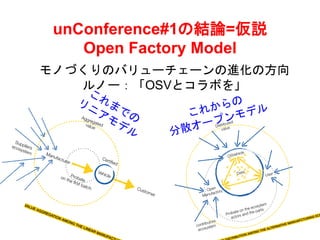
questions that, discussion after discussion, started to get structured mainly around the factory
model, the hardware standards and the users’ status. Thus it then becomes possible to envision
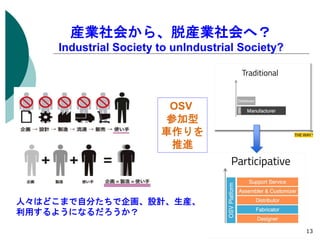
an evolution from the linear industrial model - from manufacturer to end-product to custom
an eco-systemic industrial model, balancing between production means, hardware
users’ skills.
"1
13
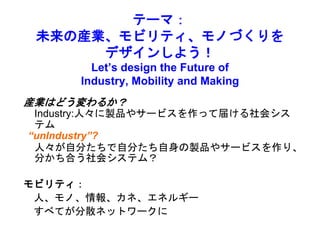
産業社会から、脱産業社会へ?
Industrial Society tounIndustrial Society?
人々はどこまで自分たちで企画、設計、生産、
利用するようになるだろうか?
The kit is distributed by OSVehicle, then all additional c
so on, will rely on other independent actors that may b
of those independent actors as linked to a local marke
may create sustainable local jobs.
Our experience shows us that user’s interested by ma
single person, or a community. So far OSVehicle proje
90 countries, there were 10 000 downloads of the veh
"10
THE WAY VALU
a connected car, and also made for the city, regarding current regulation in Europe. As the Smar
City is one idea the city of tomorrow may look like, OSVehicle could be connected to it.
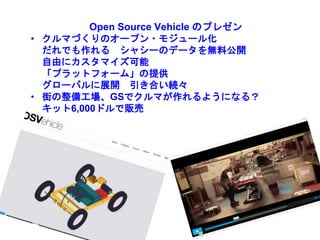
In terms of business model,OSVehicle aims at creating a new value chain, that generates activity
for new independent actors. Instead of trying to integrate all the value like car manufactur ers
traditionally do, the OSVehicle project envisions this value chain as distributed and local.
The kit is distributed by OSVehicle, then all additional changes, other parts crafting, assembly an
so on, will rely on other independent actors that may become potential business . OSVehicle thin
of those independent actors as linked to a local market and existing pr oduction facilities, which
may create sustainable local jobs.
Our experience shows us that user’s interested by making an OSVehicle our project can be eithe
single person, or a community. So far OSVehicle project has received requests to start project fr
90 countries, there were 10 000 downloads of the vehicle 3D CAD files, 200 request for new
OSV
参加型
車作りを
推進




![SSII2022 [TS2] 自律移動ロボットのためのロボットビジョン〜 オープンソースの自動運転ソフトAutowareを解説 〜](https://cdn.slidesharecdn.com/ss_thumbnails/ts2ssii2022r4-220607054405-1c6b5fc2-thumbnail.jpg?width=640&height=640&fit=bounds)


