FEMA NATIONAL US&R RESPONSE SYSTEM
Structural Collapse Technician Training
MODULE 1 c
MODULE 1 c
Structural Engineering
Systems
Systems
MATERIALS & BASIC
MATERIALS & BASIC
STRUCTURAL SYSTEMS
STRUCTURAL SYSTEMS
TERMINAL OBJECTIVES
TERMINAL OBJECTIVES
• The Student shall understand the essential
materials and components of structures,
and how they behave when subjected to
normal and extreme loading
ENABLING OBJECTIVES
ENABLING OBJECTIVES
• Understand the Tension, Compression,
Bending, and Shear Forces that are exerted
on building materials, and how they behave.
• Understand the concepts of Ductile and
Brittle behavior.
• Introduce the concept of Vertical Load Path
and Vertical Load Resisting Systems
ENABLING OBJECTIVES
ENABLING OBJECTIVES
• Discuss Lateral Load Resisting Systems,
including Box, Moment Frame, and
Diagonally Braced Frame Systems
• Define and discuss Structural Redundancy
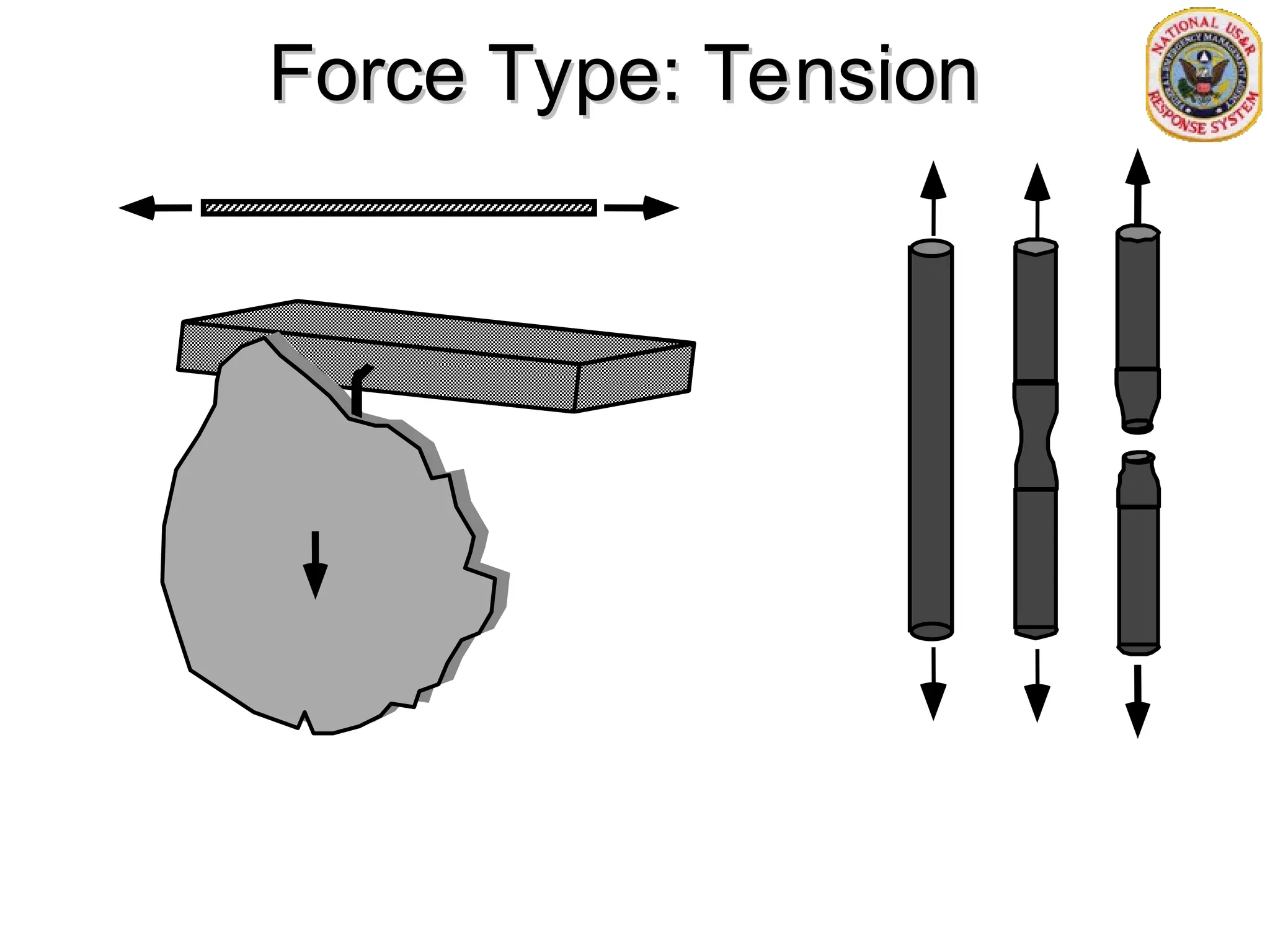
Force Type: Tension
Force Type: Tension
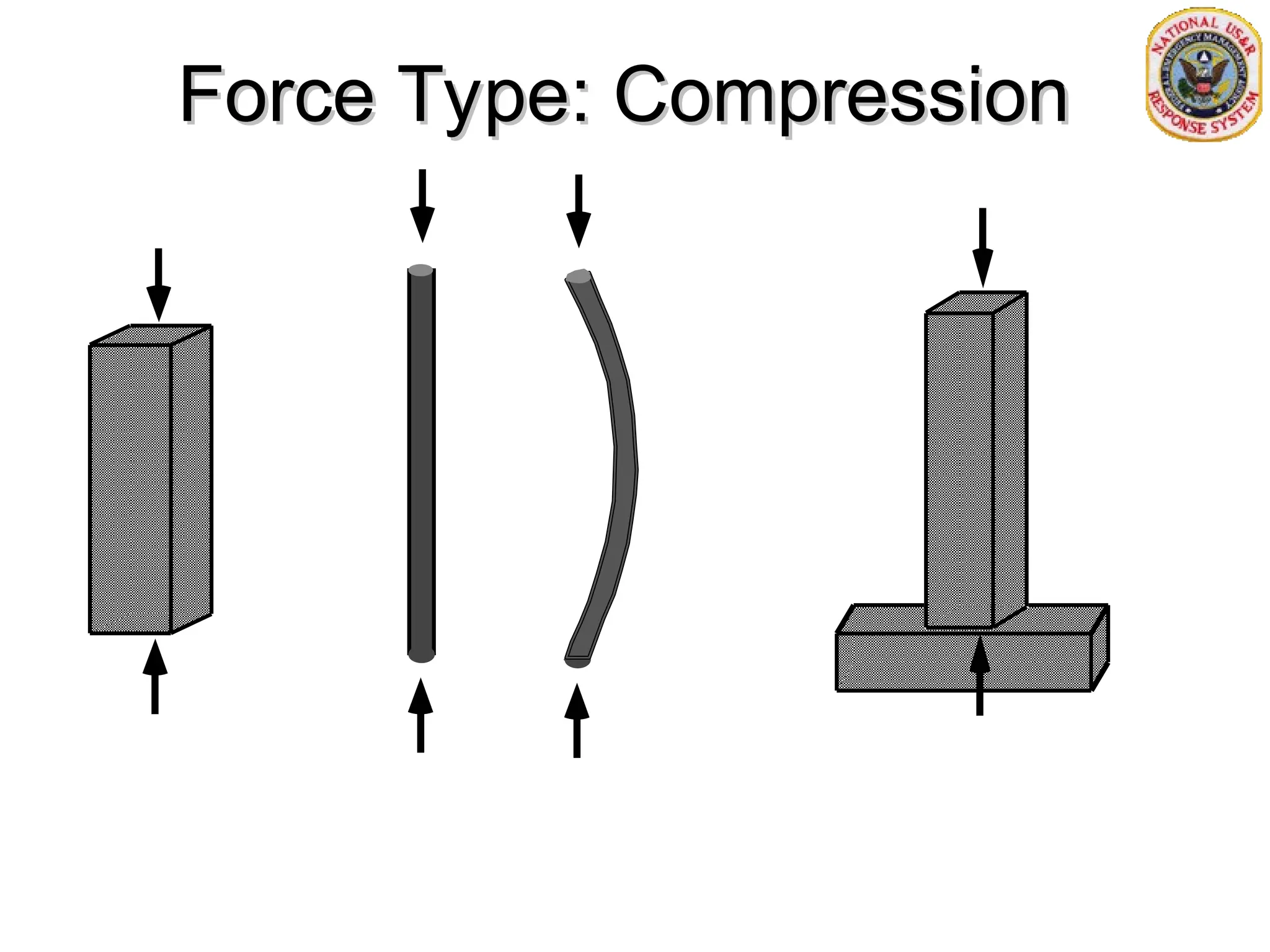
Force Type: Compression
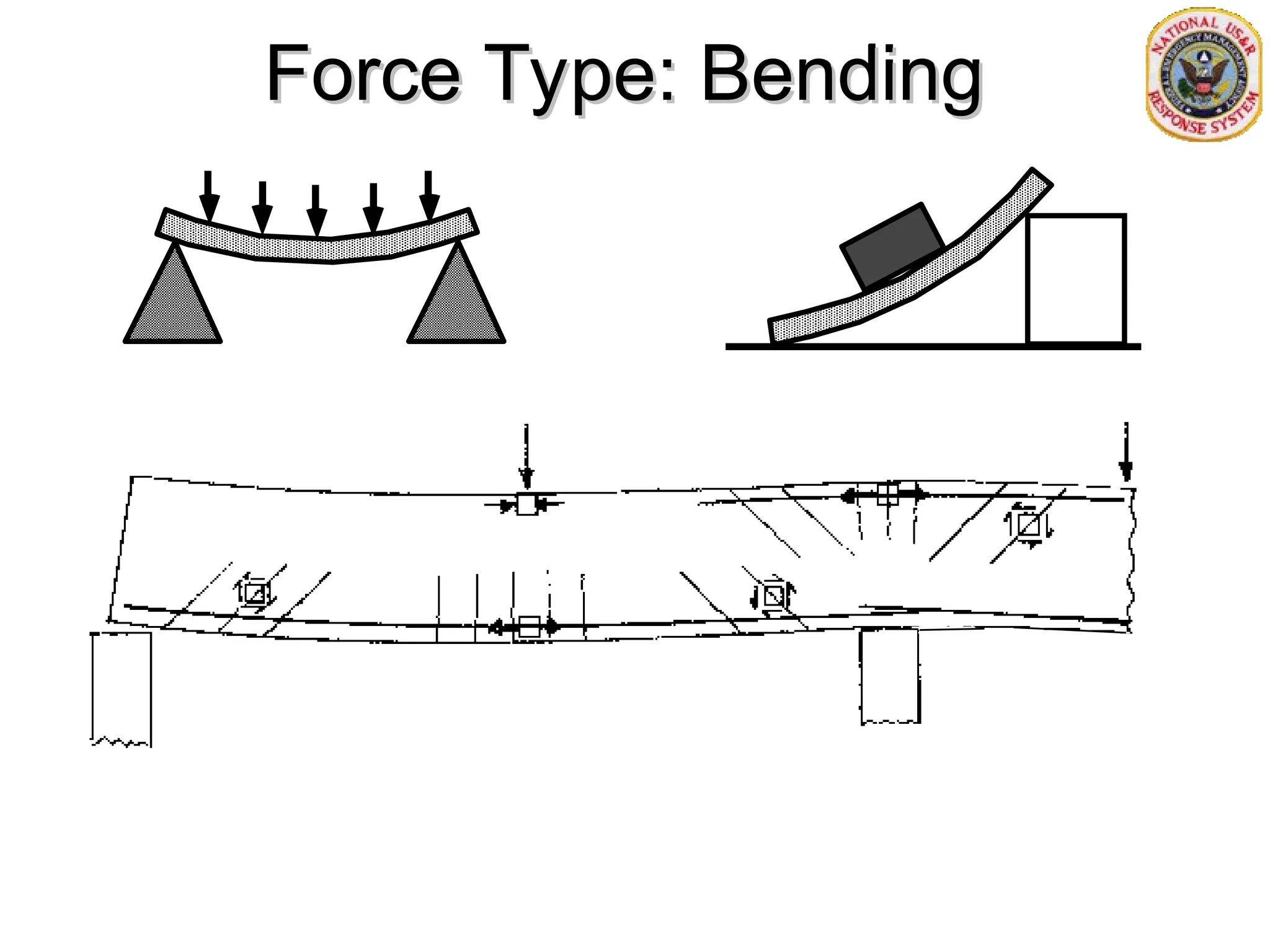
Force Type: Bending
Force Type: Bending
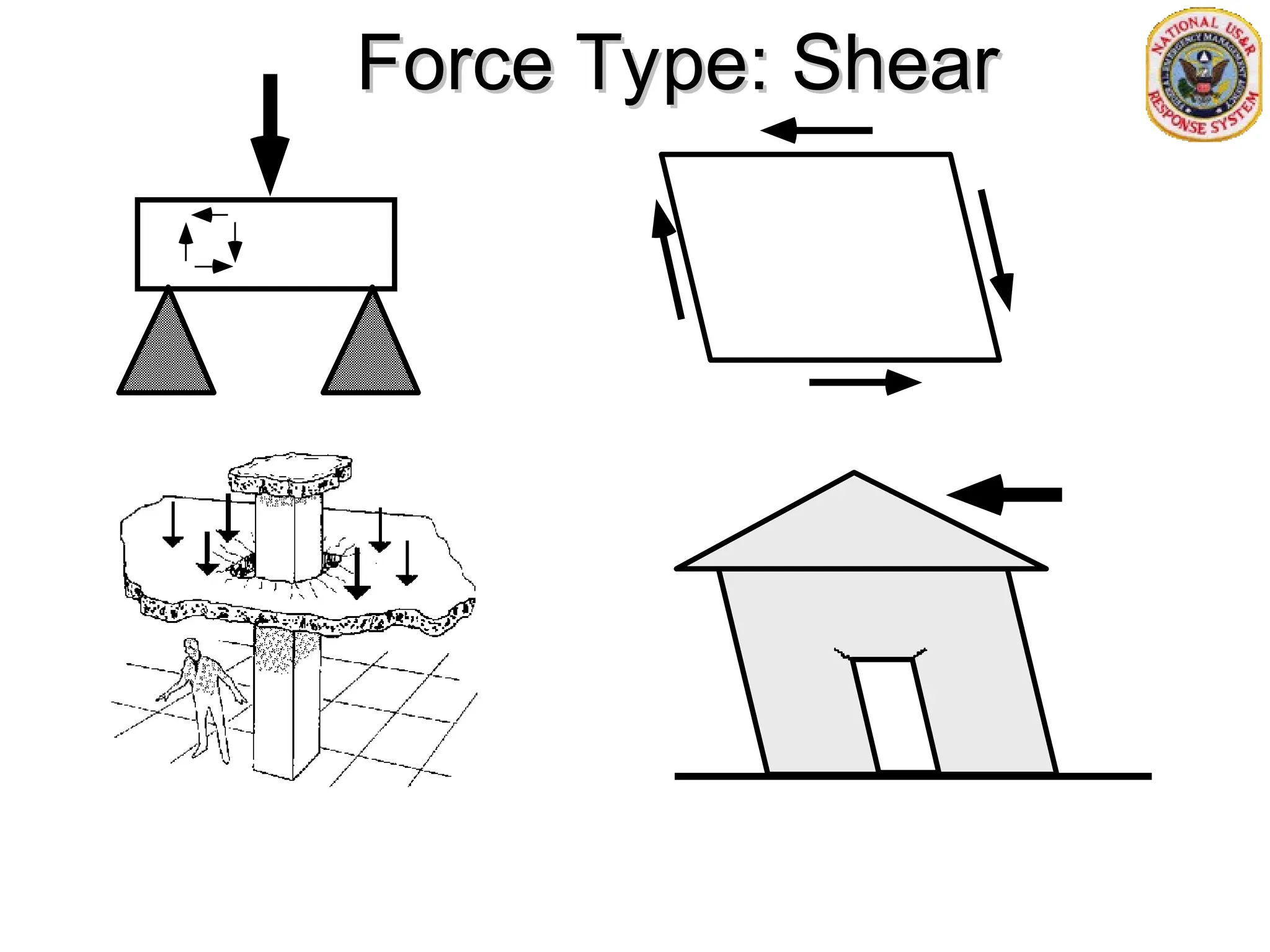
Force Type: Shear
Force Type: Shear
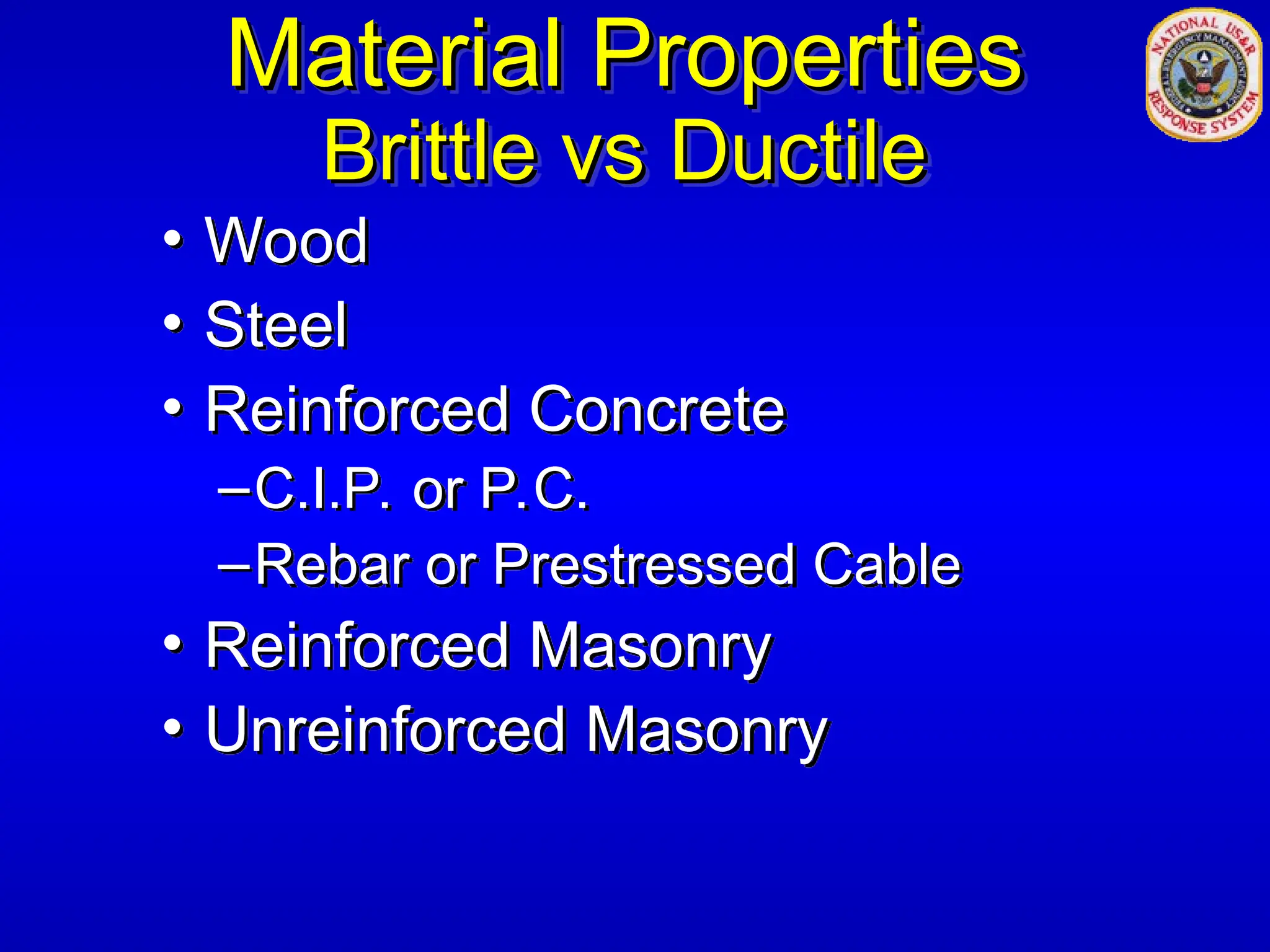
Material Properties
Material Properties
Brittle vs Ductile
Brittle vs Ductile
• Wood
• Steel
• Reinforced Concrete
–C.I.P. or P.C.
–Rebar or Prestressed Cable
• Reinforced Masonry
• Unreinforced Masonry
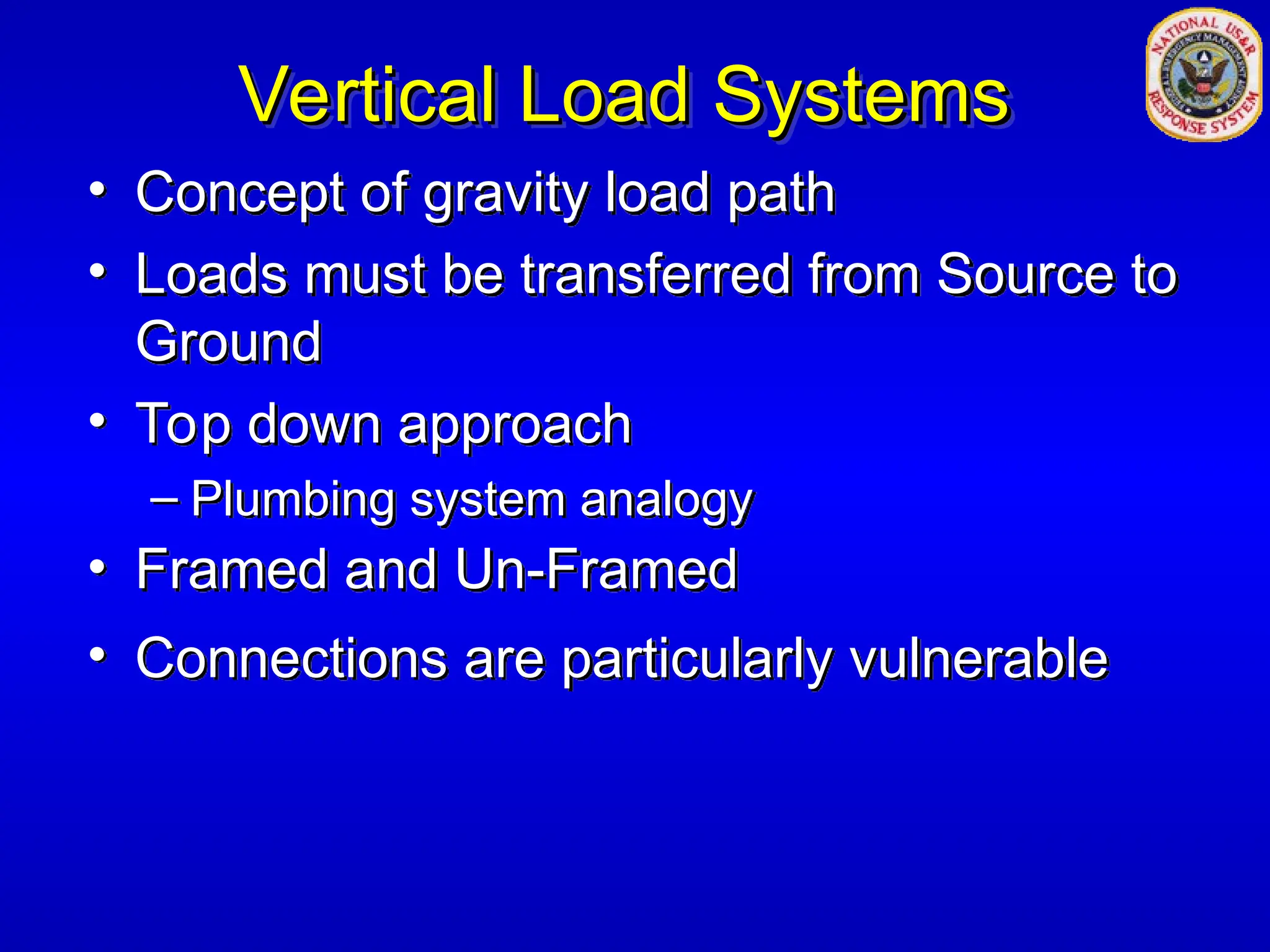
Vertical Load Systems
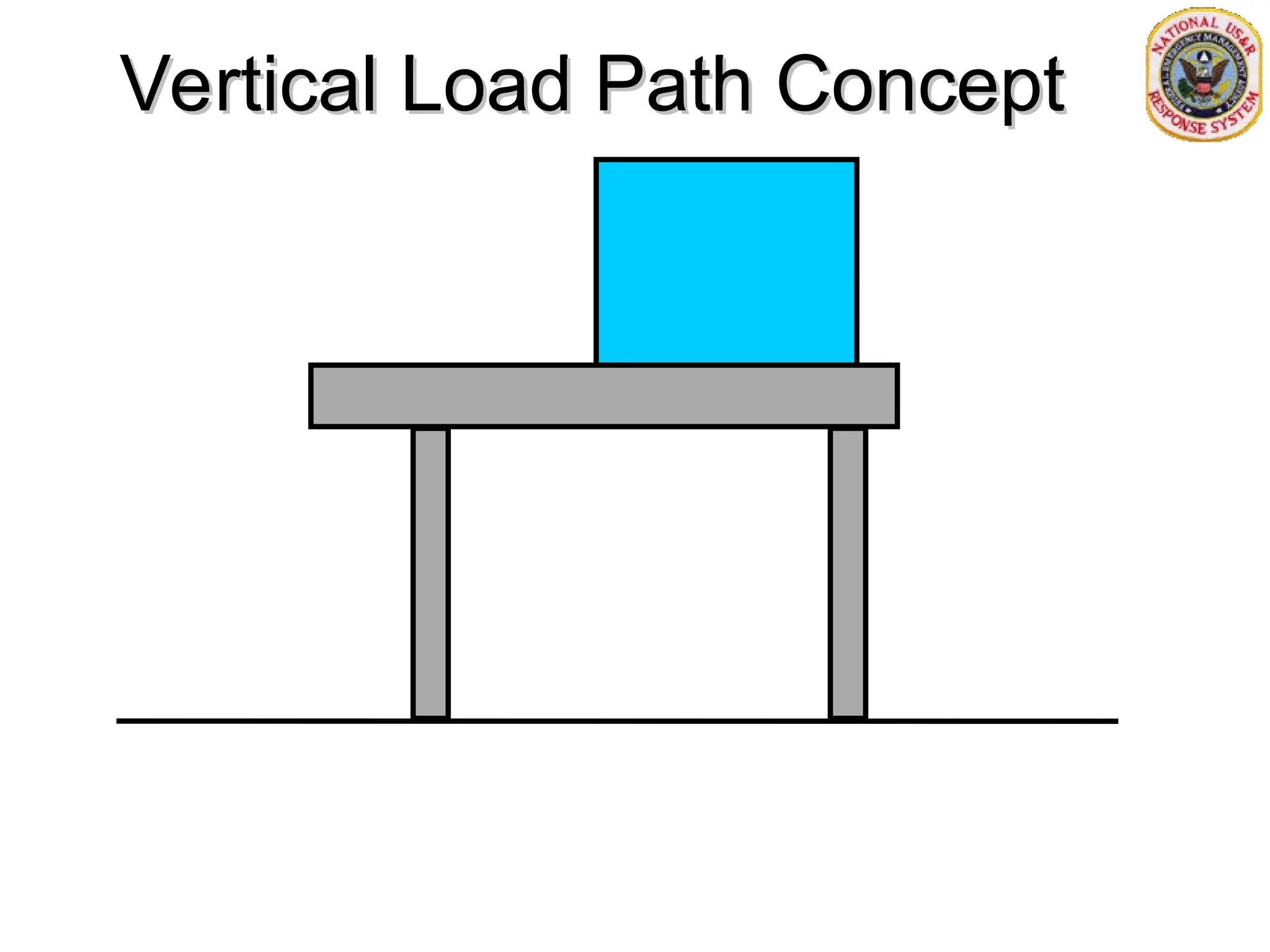
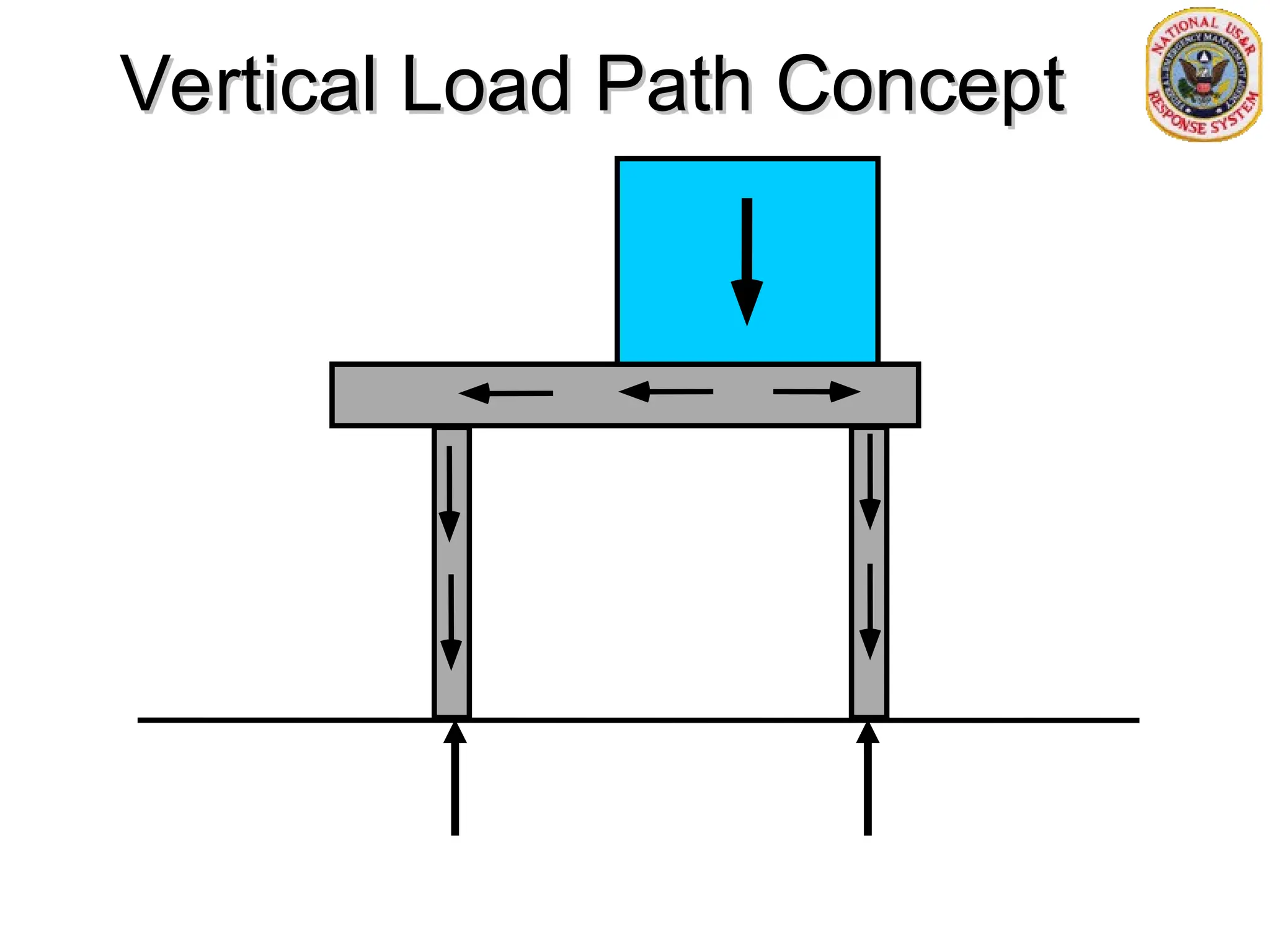
• Concept of gravity load path
• Loads must be transferred from Source to
Ground
• Top down approach
– Plumbing system analogy
• Framed and Un-Framed
• Connections are particularly vulnerable
Vertical Load Path Concept
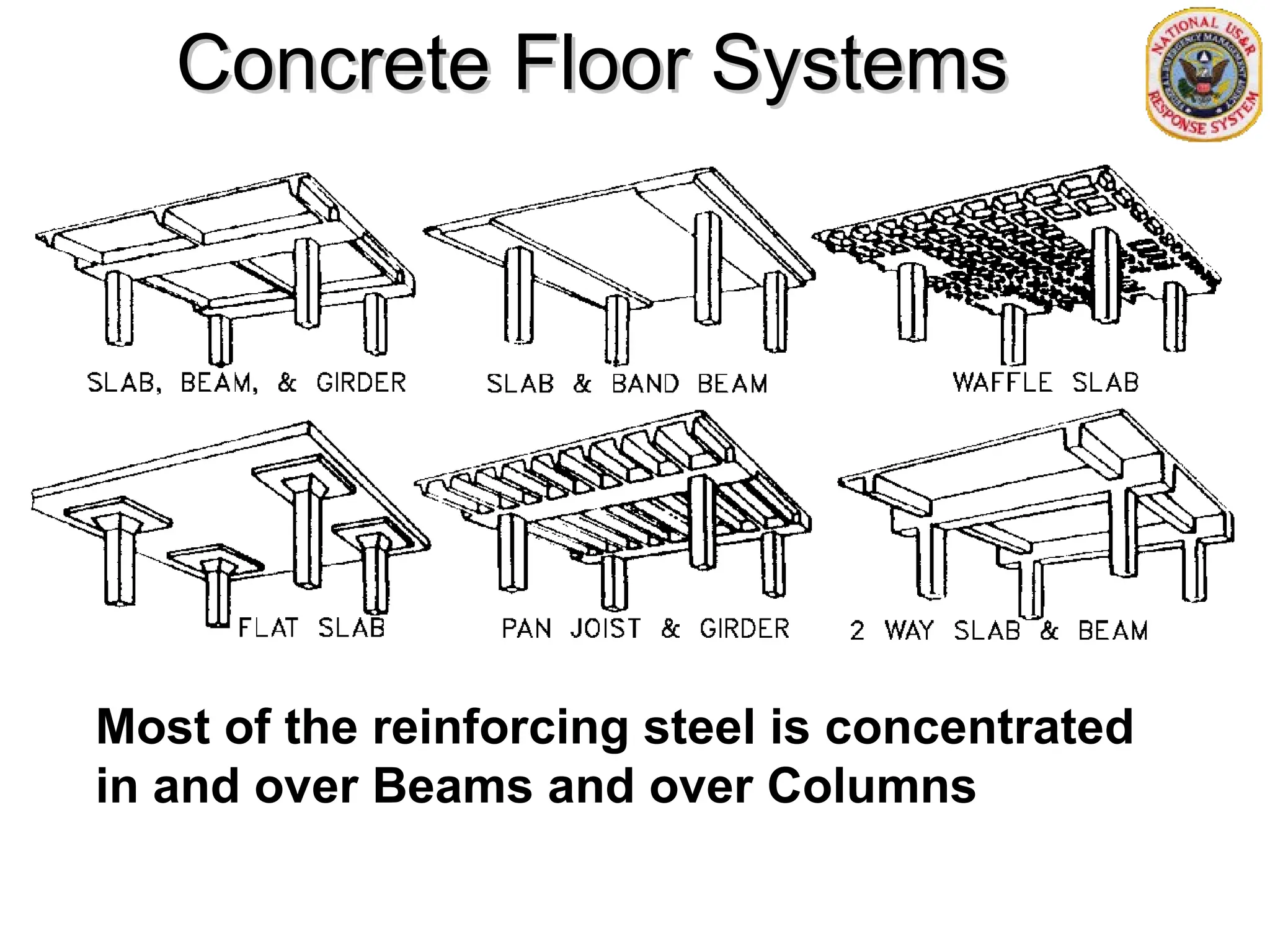
Concrete Floor Systems
Most of the reinforcing steel is concentrated
in and over Beams and over Columns
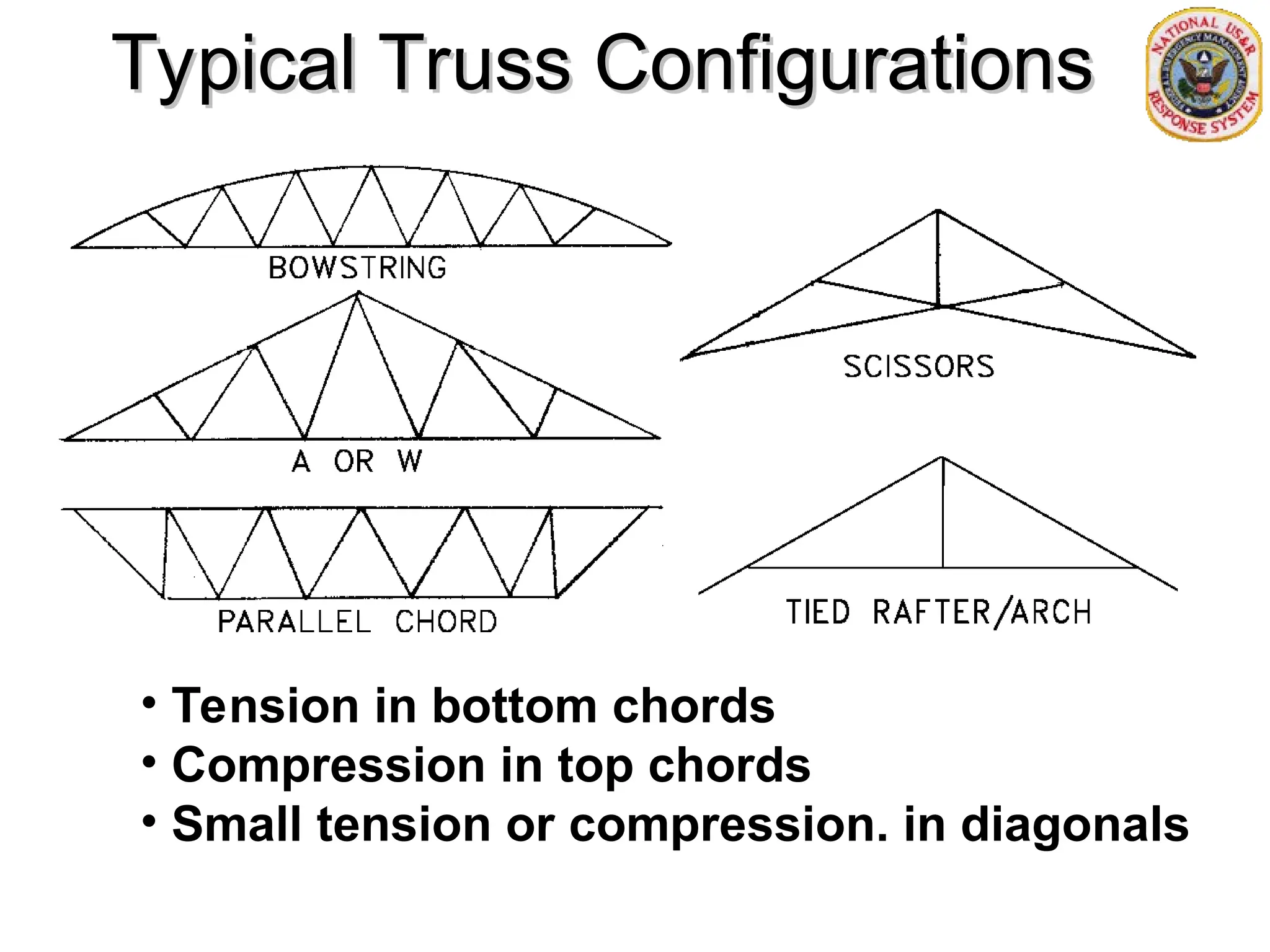
Typical Truss Configurations
• Tension in bottom chords
• Compression in top chords
• Small tension or compression. in diagonals
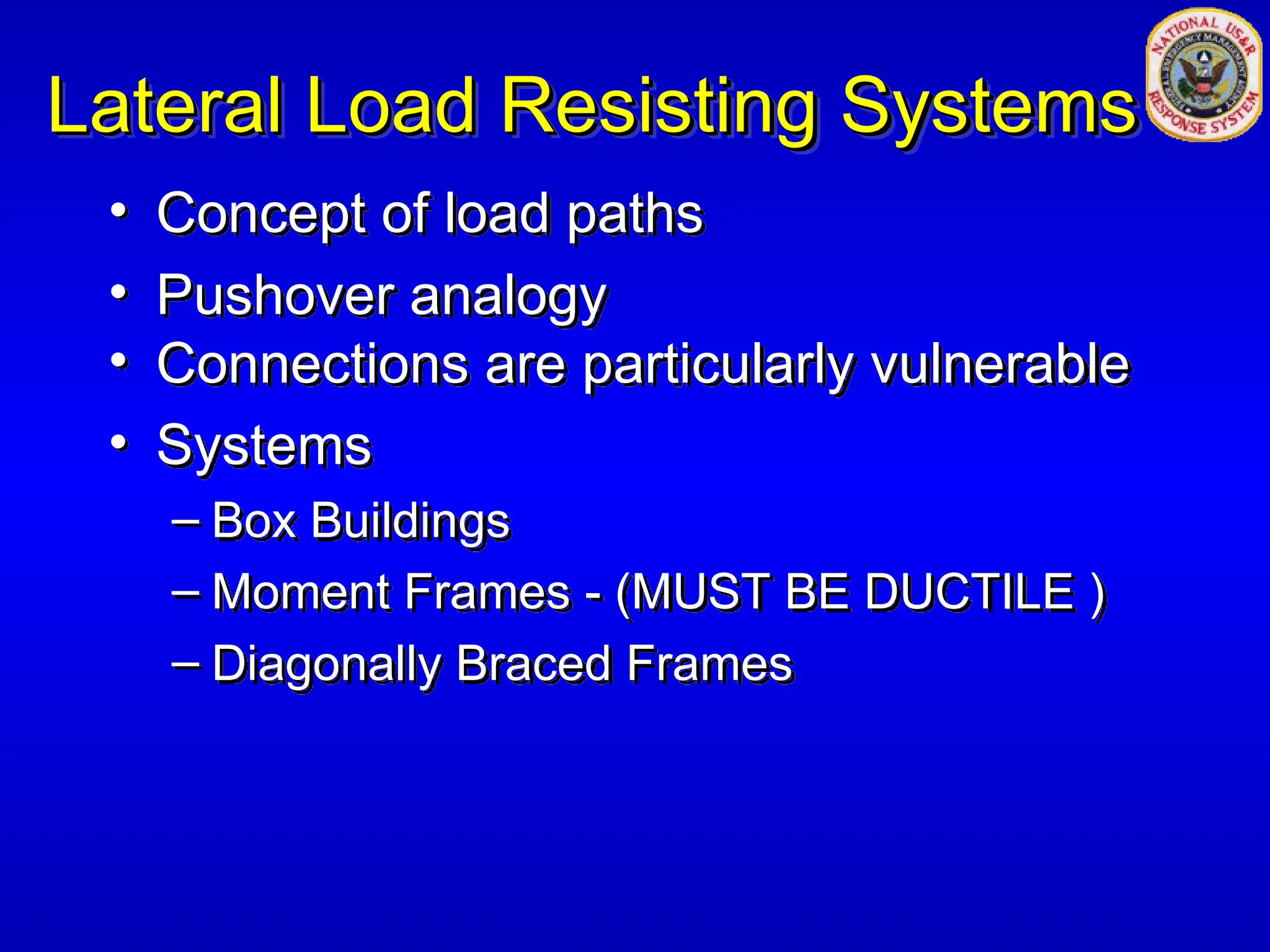
Lateral Load Resisting Systems
• Concept of load paths
• Pushover analogy
• Connections are particularly vulnerable
• Systems
– Box Buildings
– Moment Frames - (MUST BE DUCTILE )
– Diagonally Braced Frames
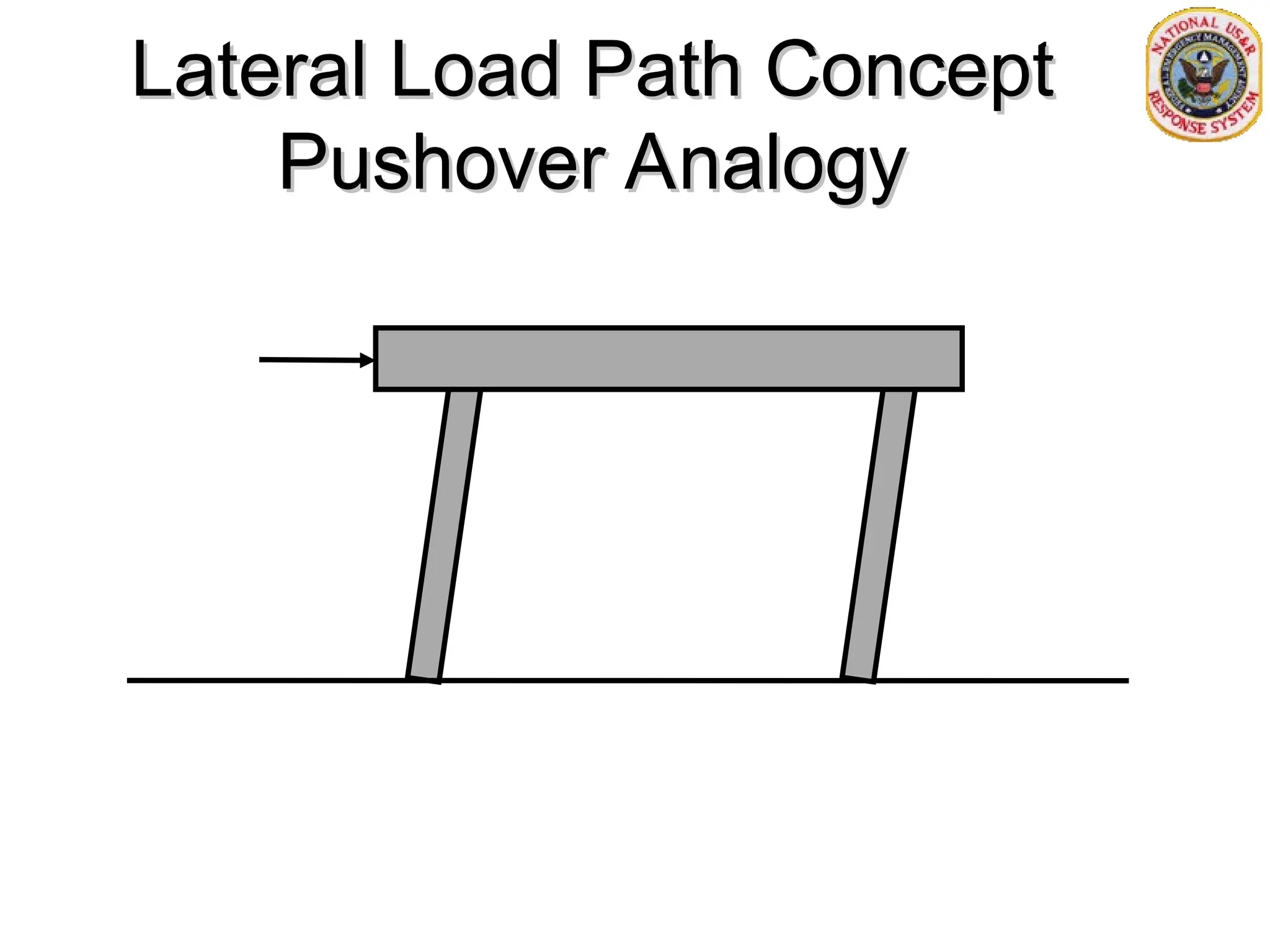
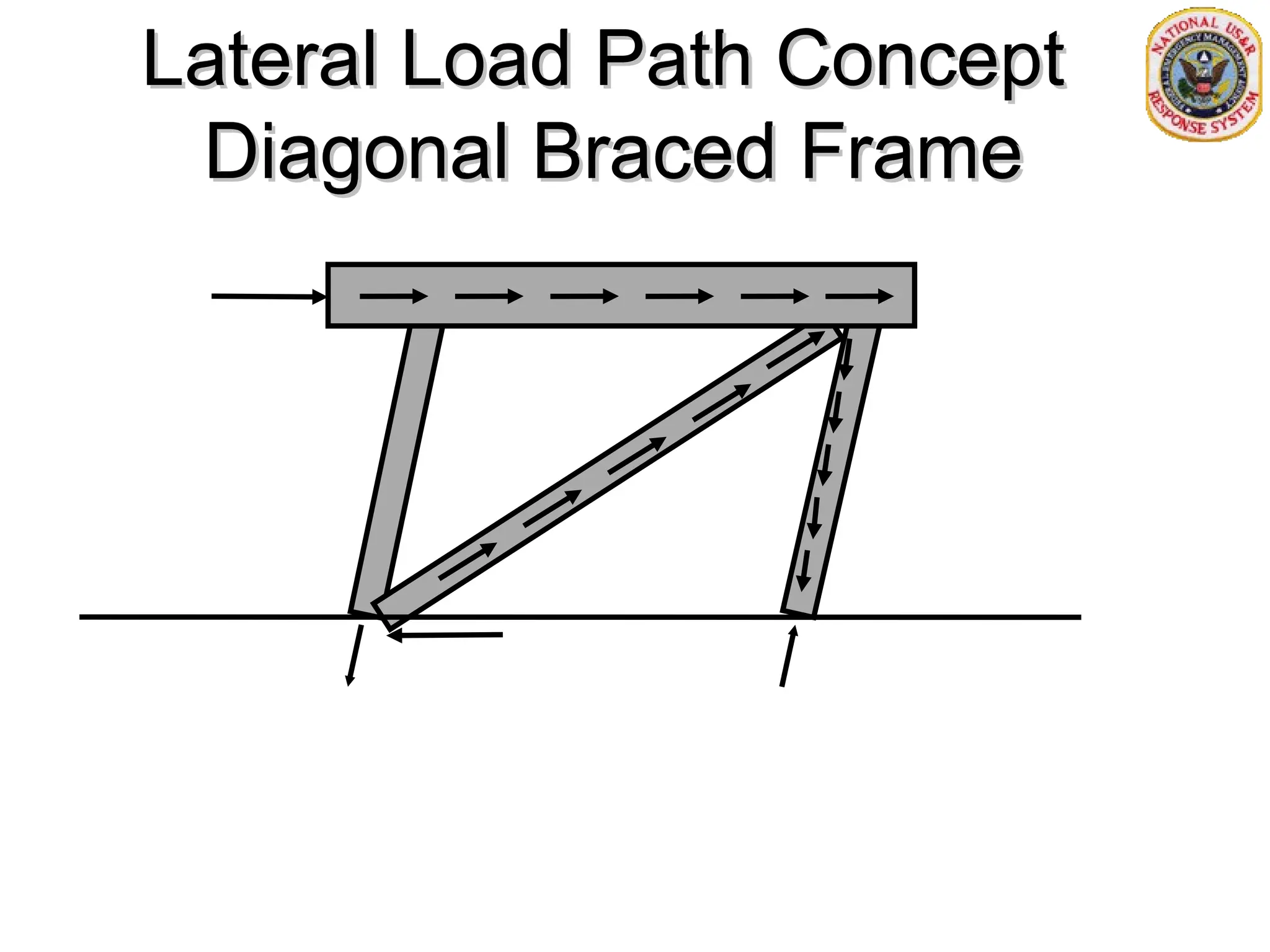
Lateral Load Path Concept
Pushover Analogy
Pushover Analogy
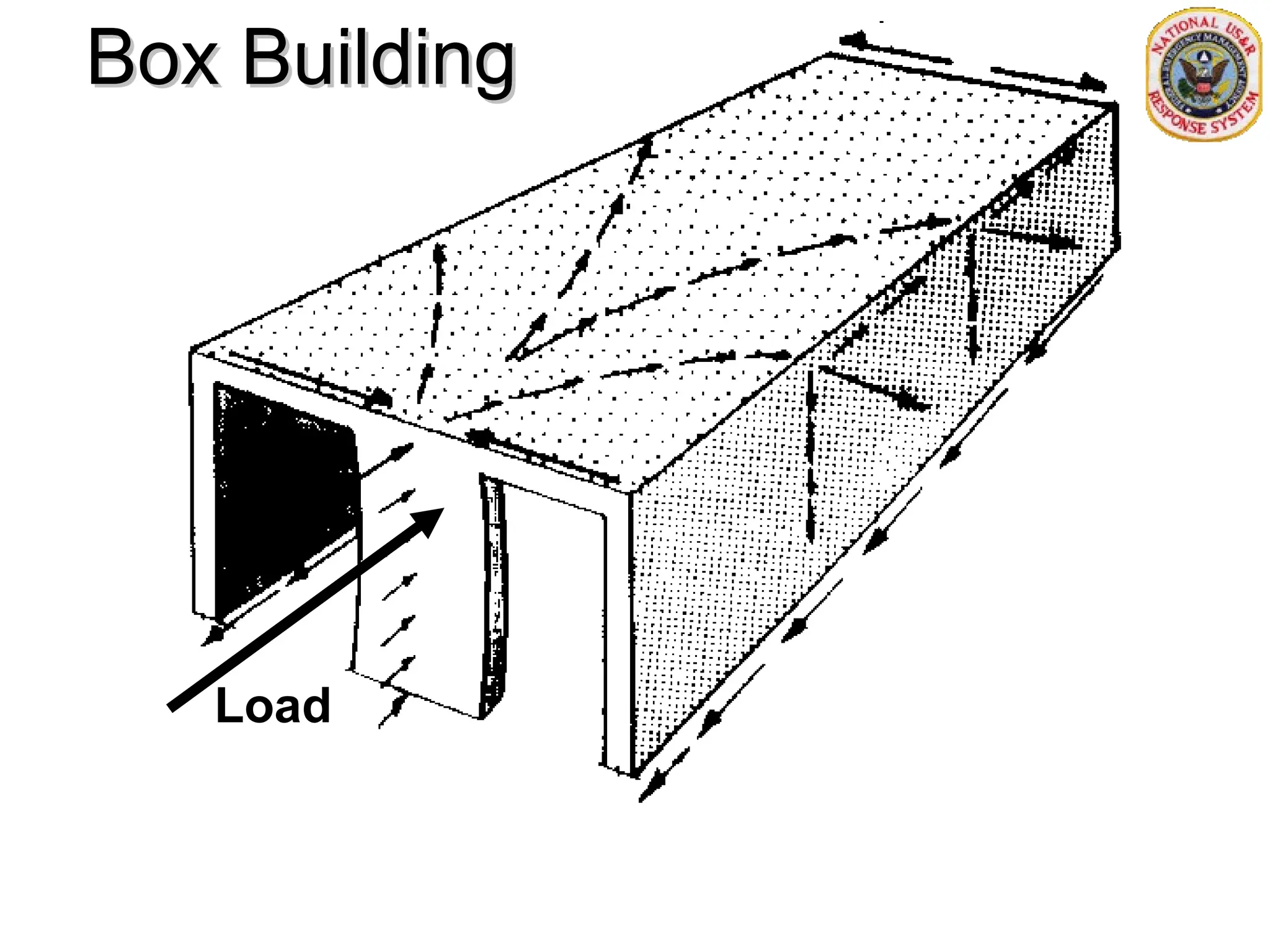
Box Building
Box Building
Load
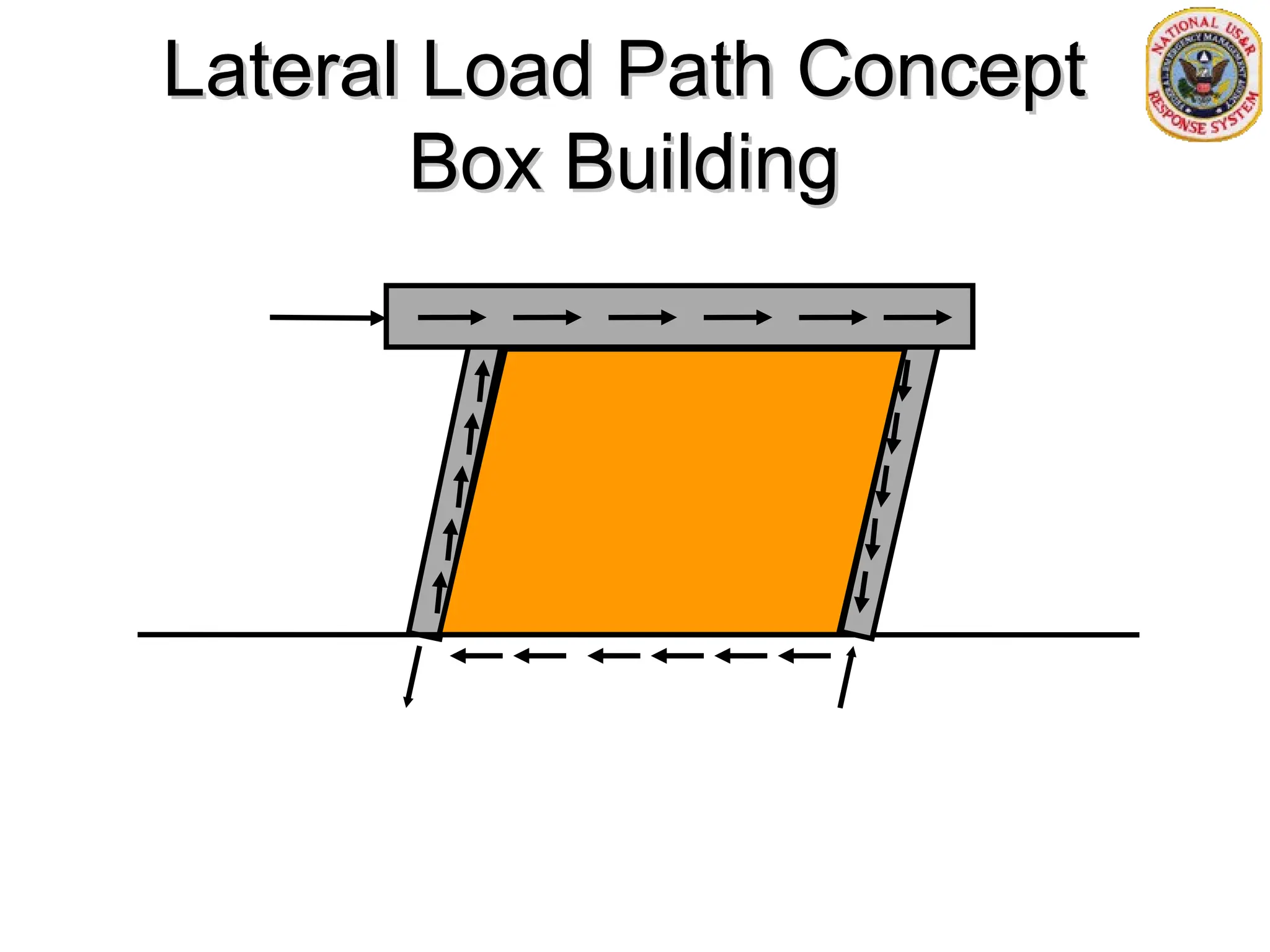
Lateral Load Path Concept
Box Building
Box Building
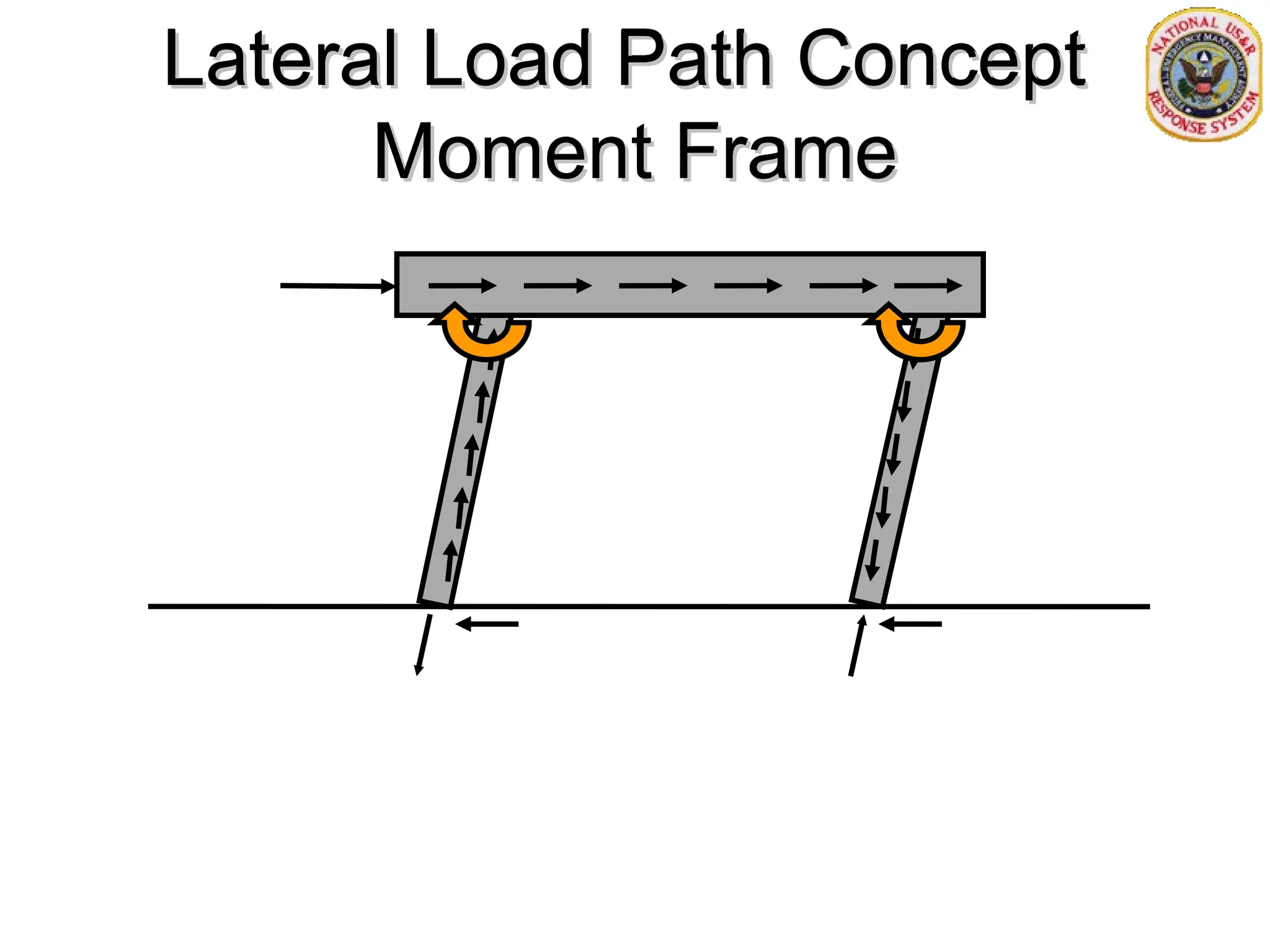
Moment Frame
Moment Frame
Load
Lateral Load Path Concept
Moment Frame
Moment Frame
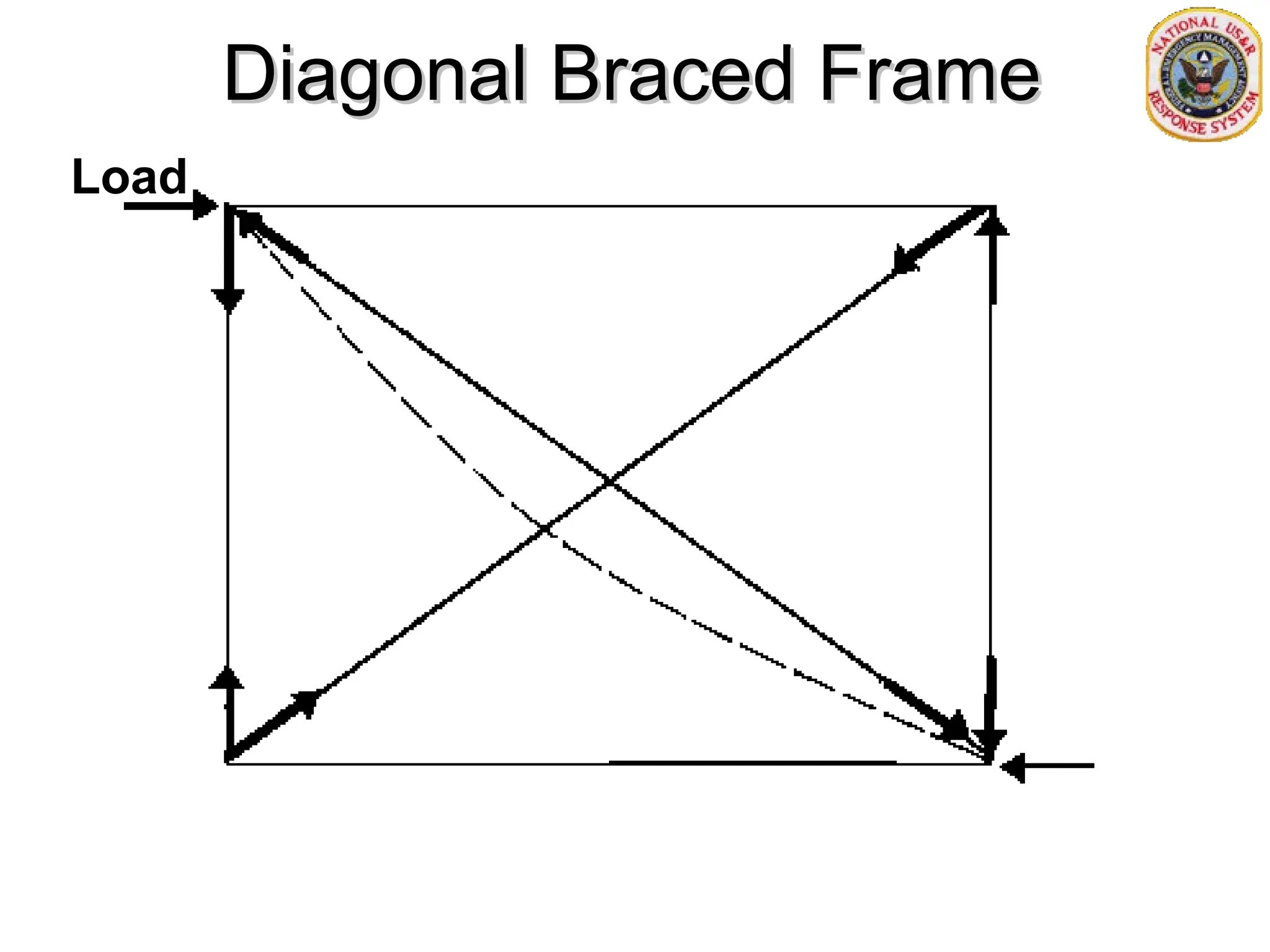
Diagonal Braced Frame
Load
Lateral Load Path Concept
Diagonal Braced Frame
Redundancy
Redundancy
• Multi - Elements
(at least 2 in every line of resistance)
– Box Buildings
– Diagonal Braced Frames
• Majority of Connections
– Moment Frames
• Dual Systems
• Collapse Preventers
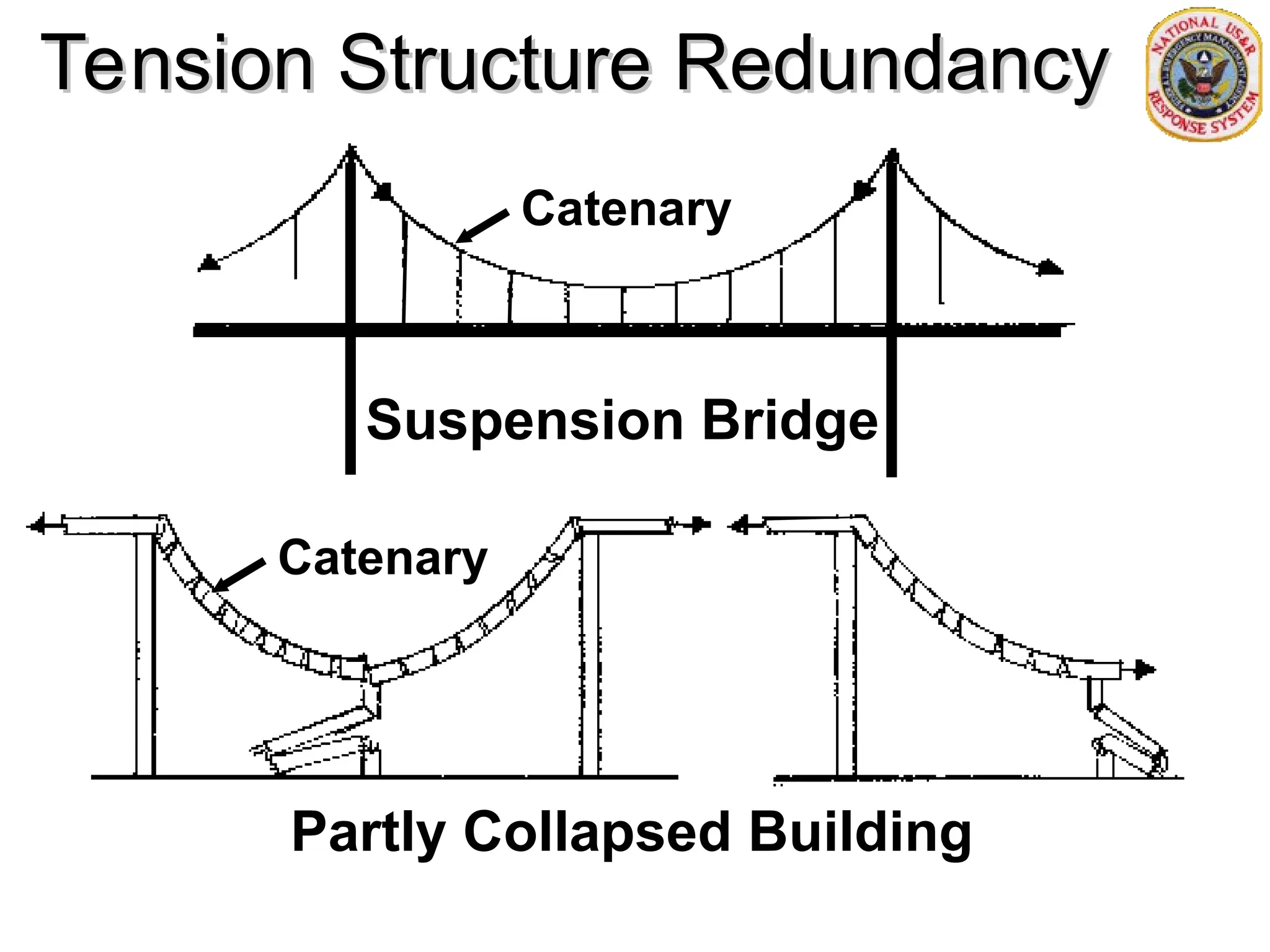
Tension Structure Redundancy
Suspension Bridge
Partly Collapsed Building
Catenary
Catenary
TOPICS we have
TOPICS we have
QUICKLY REVIEWED
QUICKLY REVIEWED
• Force Types
–Stress = Force/Area
• Ductile vs Brittle
• Material Behavior
• Vertical Load Systems
• Lateral Load Resistant Systems
• Redundancy
FEMA NATIONAL US&R RESPONSE SYSTEM
Structural Collapse Technician Training
UNIT I c
UNIT I c
Structural Engineering Systems
COLLAPSE PATTERNS
COLLAPSE PATTERNS
TERMINAL OBJECTIVES
TERMINAL OBJECTIVES
• The Student shall understand the how building structures can be
separated into specific types that exhibit unique collapse patterns
when subjected to extreme forces due to Earthquake Wind , and
Explosions
• The Student shall be able to recognize their unique Collapse
Patterns
ENABLING OBJECTIVES
ENABLING OBJECTIVES
• Understand the extreme environmental and man
caused forces that effect structures.
• Define and Understand how buildings are
classified by engineers based on their Construction
Materials and Lateral Load Resisting Systems.
• Discuss the most common Collapse Patterns that
have been observed as a result of Earthquakes,
Windstorms, and Explosions
Earthquake Basics
Earthquake Basics
• Extent of damage is determined by
– type of shaking that occurs at site
– coupled with the structures response
• Magnitude (energy release)
– determines POTENTIAL number of effected
structures
• Aftershocks
– Earthquakes are unique type of Disaster
– just keeps on giving
Plan of Large Earthquake - M 7
Causes major damage
if Fault is within city
30km
Fault Break
Duration 15 sec
Eff peak accel .5G
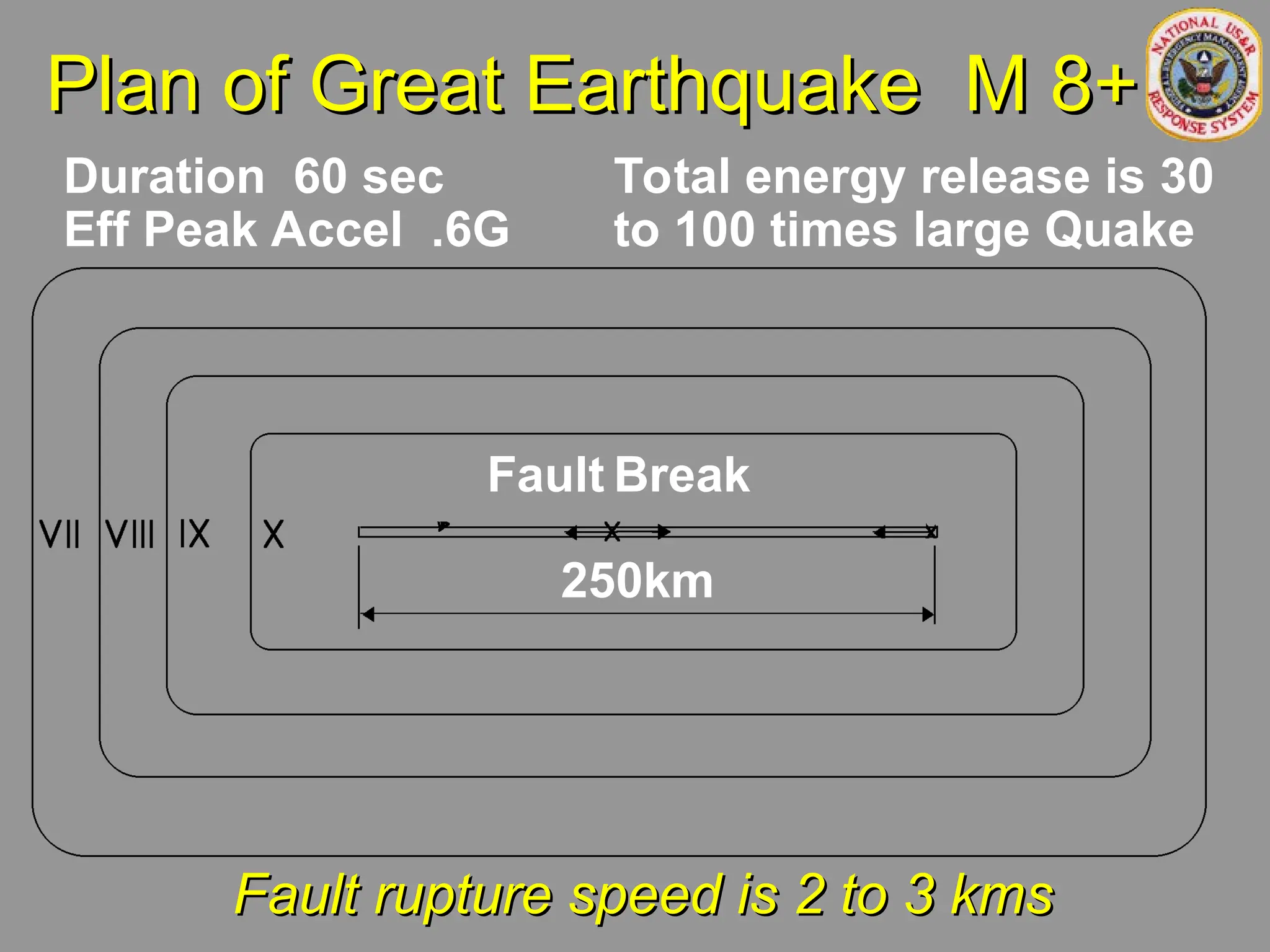
Plan of Great Earthquake M 8+
250km
Fault Break
Duration 60 sec
Eff Peak Accel .6G
Fault rupture speed is 2 to 3 kms
Total energy release is 30
to 100 times large Quake
Aftershocks
Aftershocks
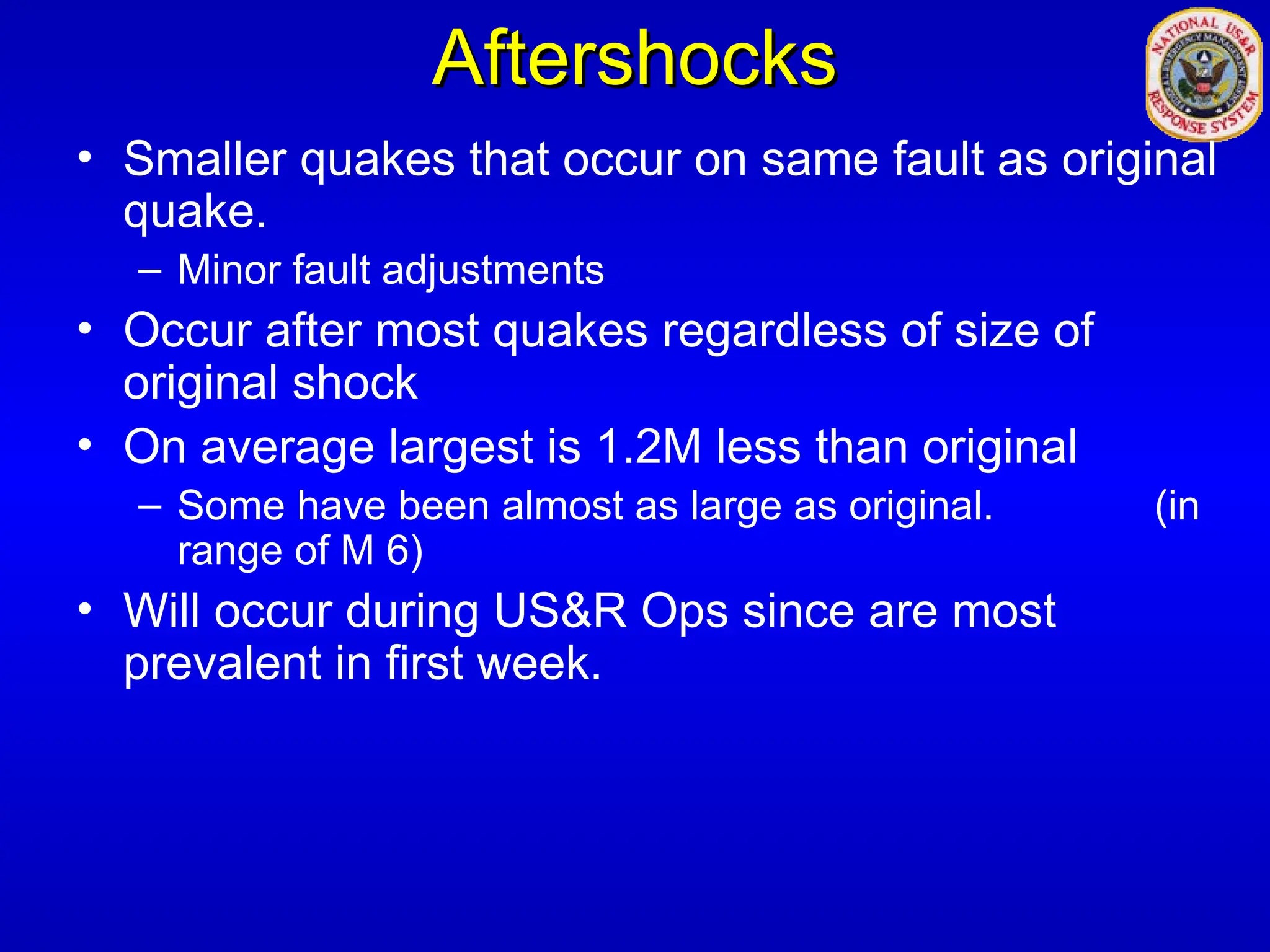
• Smaller quakes that occur on same fault as original
quake.
– Minor fault adjustments
• Occur after most quakes regardless of size of
original shock
• On average largest is 1.2M less than original
– Some have been almost as large as original. (in
range of M 6)
• Will occur during US&R Ops since are most
prevalent in first week.
How Many Aftershocks ?
• USGS - Rule of Thumb
– For every single decrease in magnitude, get
10 fold increase in number
• If original quake is M 7
– 1 or so aftershock in range of M 6
– 10 “ “ “ “ 5
– 100 “ “ “ “ 4
– 1000 “ “ “ “ 3
• Have fewer as time passes
– Day 2 = 1/2 as many as day 1
– Day 3 = 1/3 as many as day 1
– Day 4 = 1/4 as many as day 1, etc
1989 Loma Prieta Aftershocks
Days after original shock
Magnitud
Magnitud
e
e
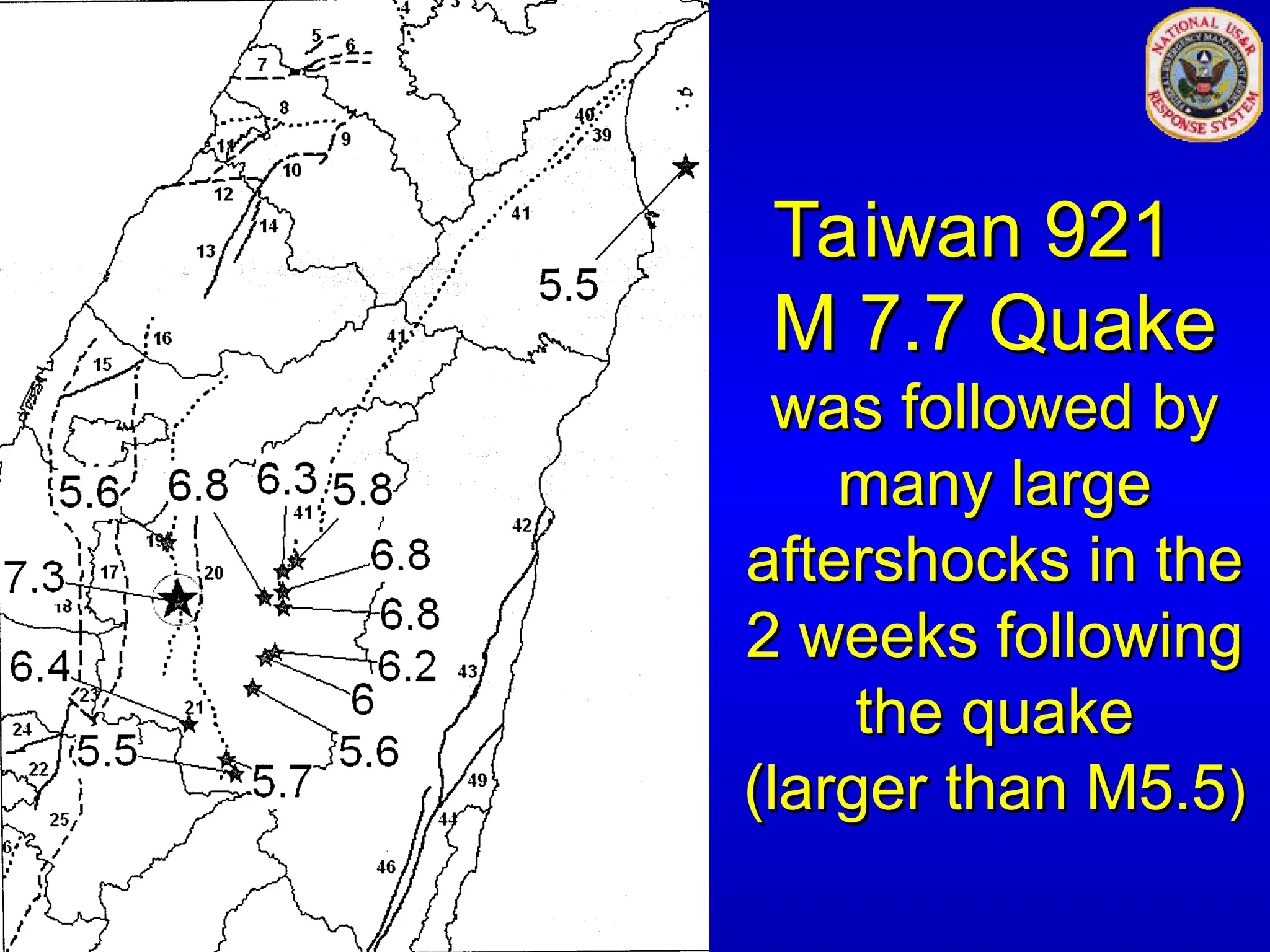
Taiwan 921
Taiwan 921
M 7.7 Quake
M 7.7 Quake
was followed by
was followed by
many large
many large
aftershocks in the
aftershocks in the
2 weeks following
2 weeks following
the quake
the quake
(larger than M5.5
(larger than M5.5)
)
1.1-21
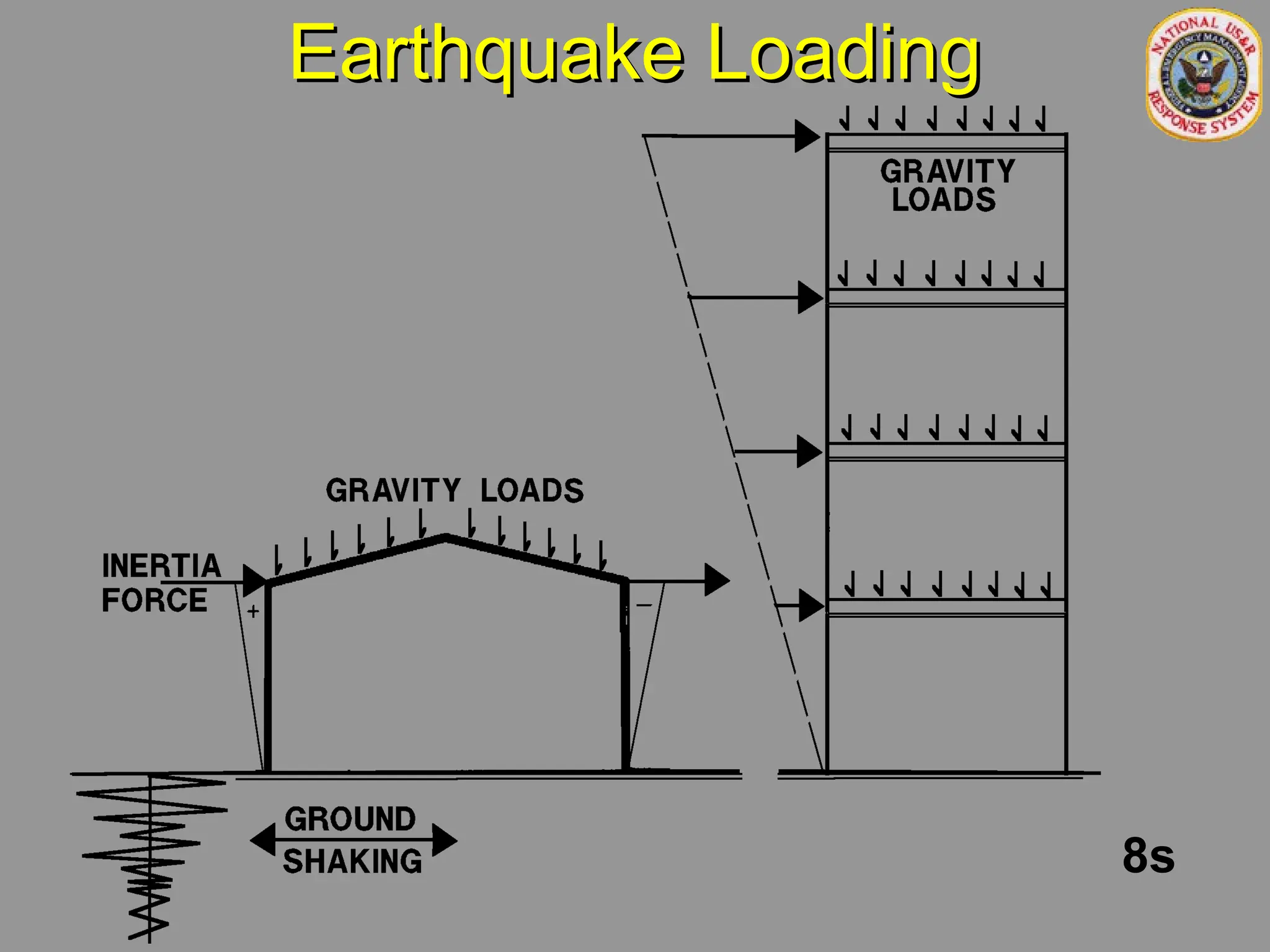
Earthquake Loading
Earthquake Loading
8s
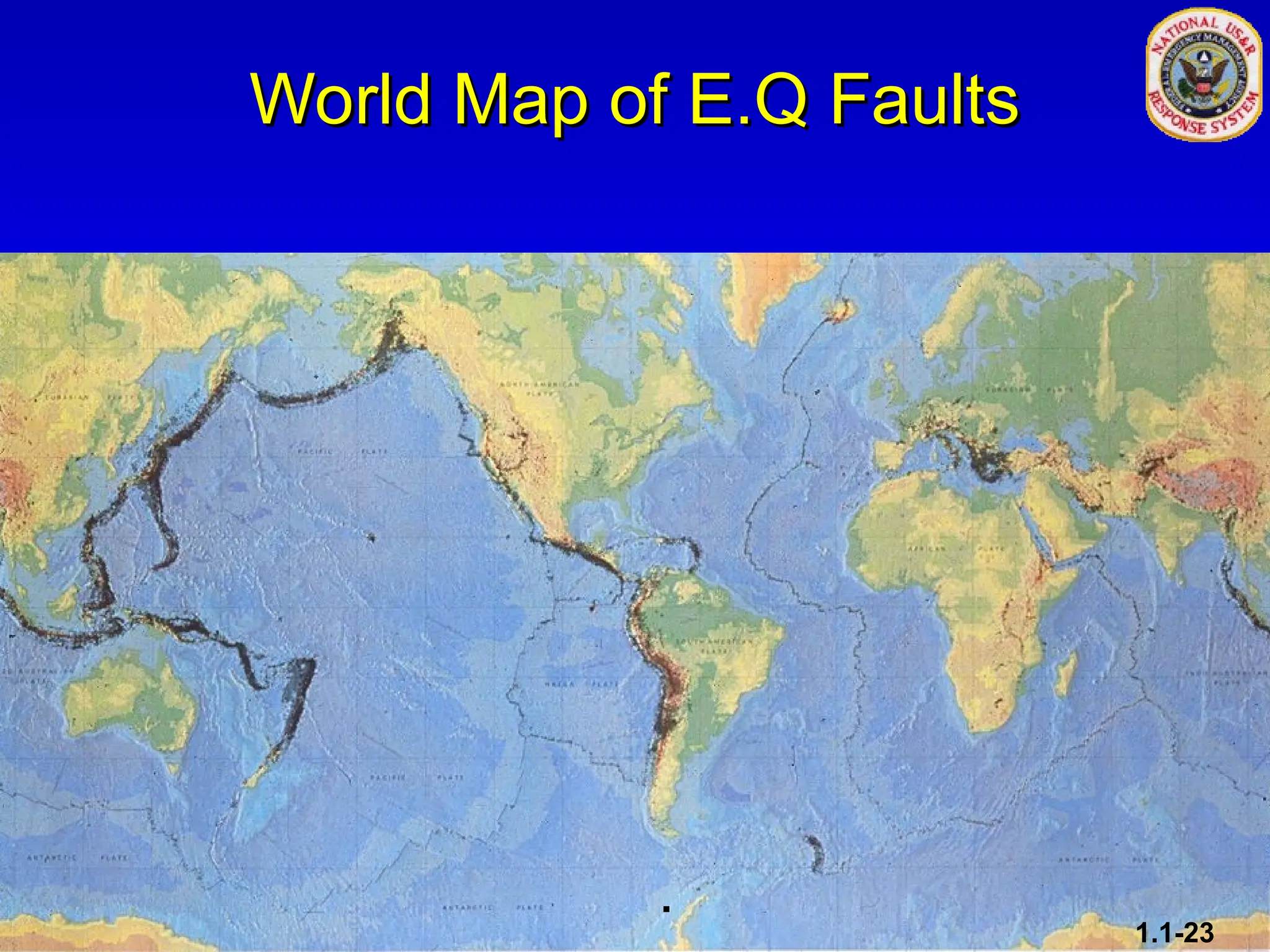
World Map of E.Q Faults
.
1.1-23
San Andreas
San Andreas
Fault Trace
Fault Trace
Actual Faults
Actual Faults
are 5 + km
are 5 + km
deep
deep
1.1-21
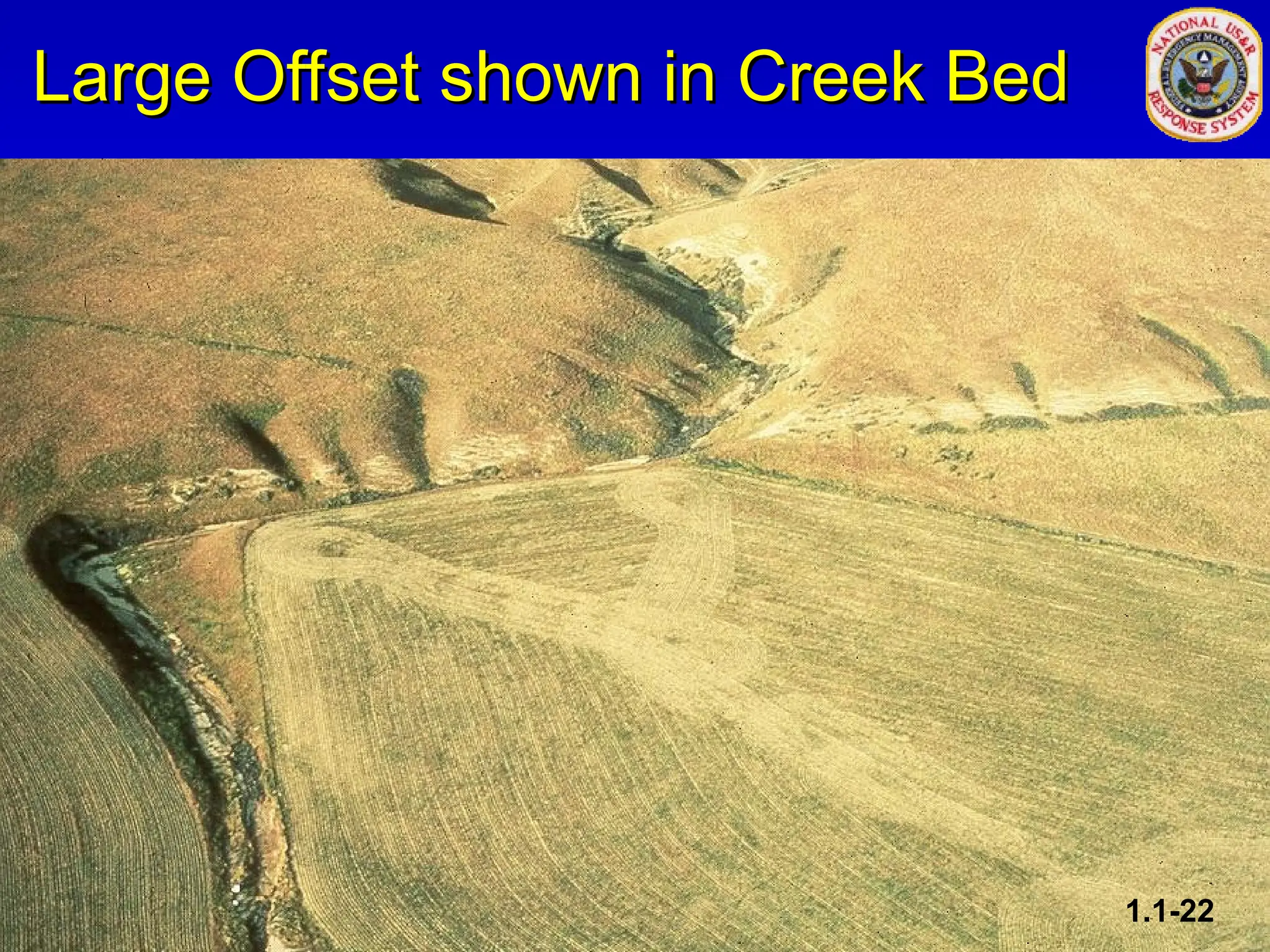
Large Offset shown in Creek Bed
1.1-22
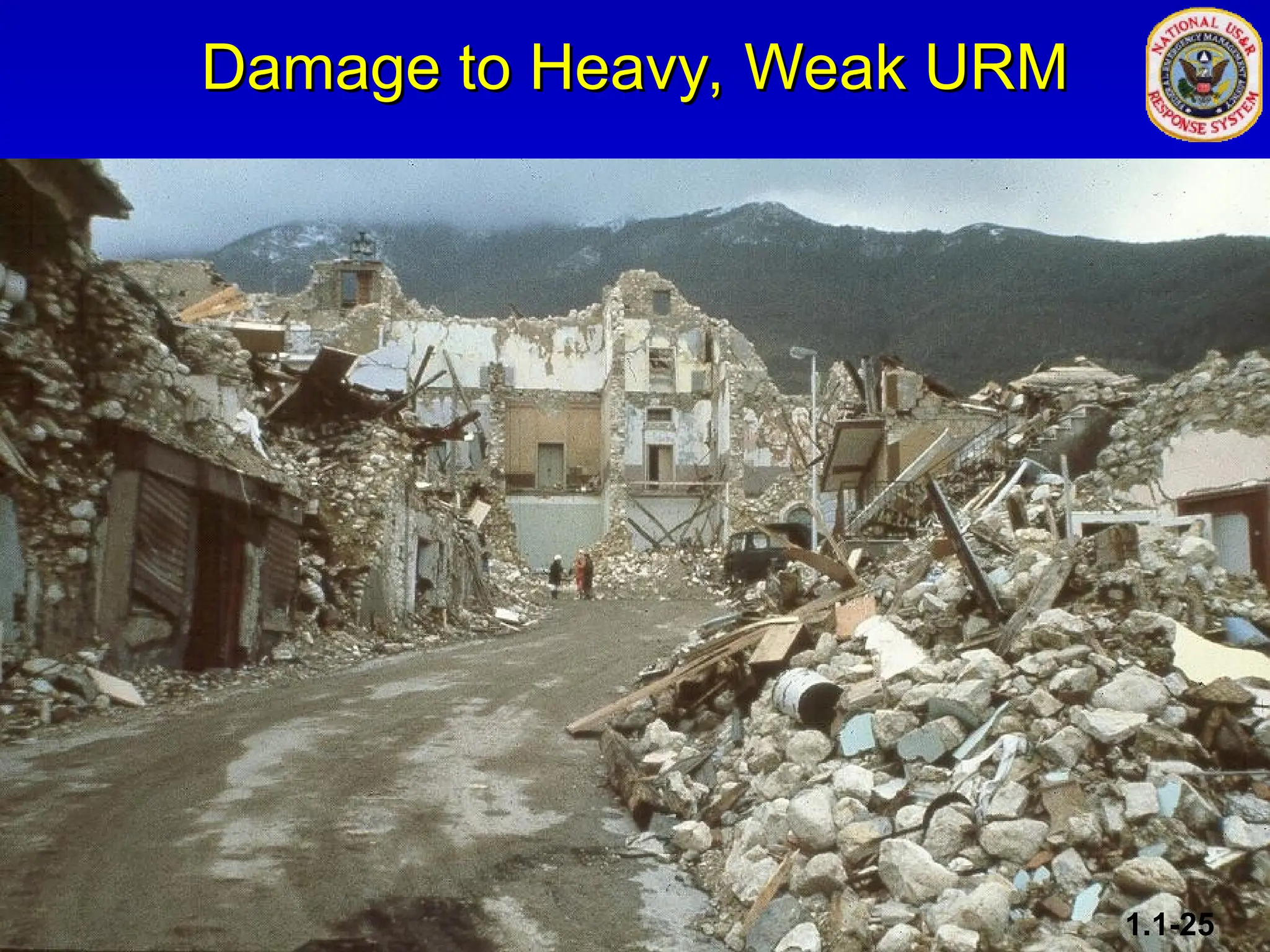
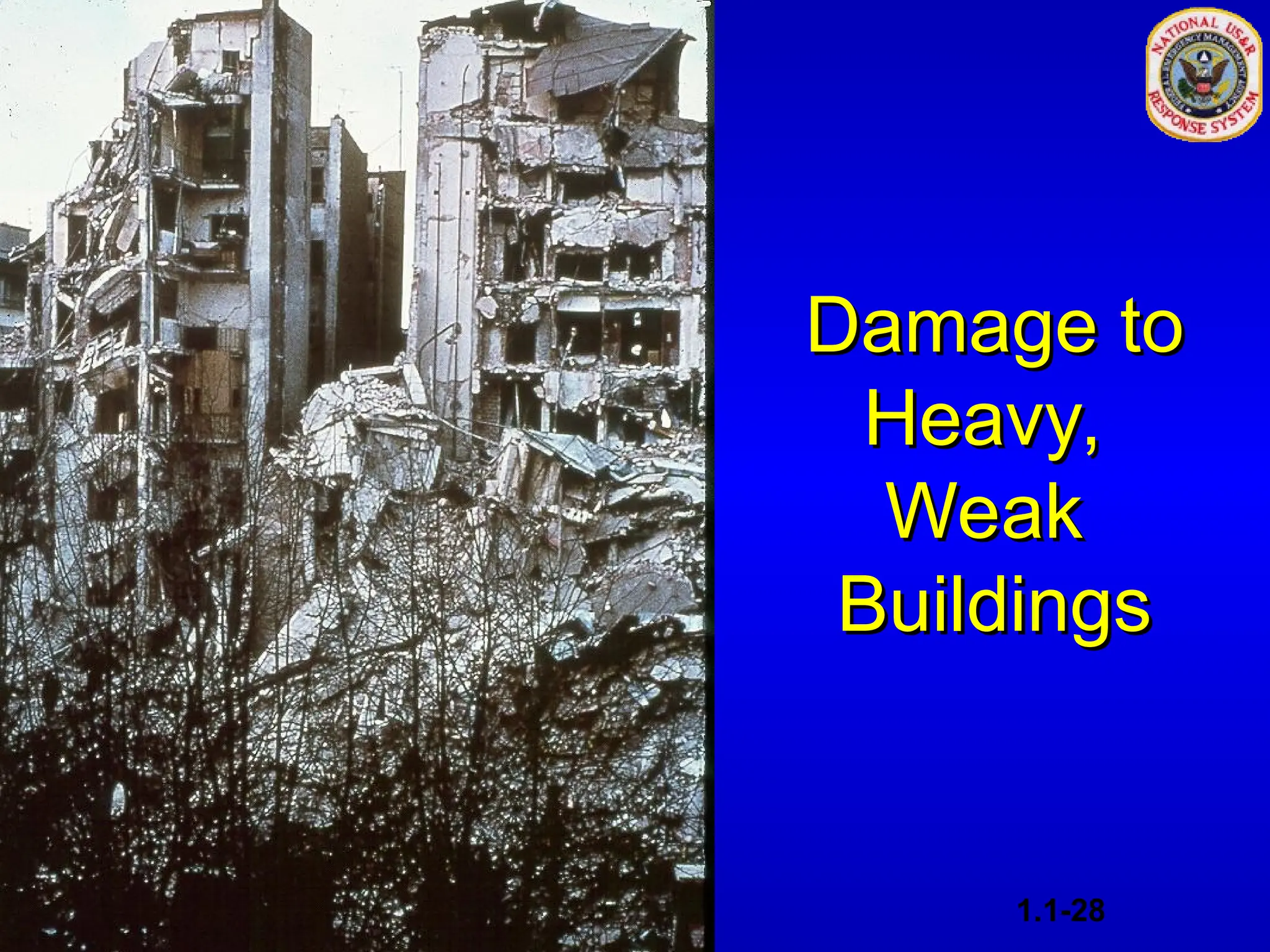
Damage to Heavy, Weak URM
1.1-25
Damage to
Damage to
Heavy,
Heavy,
Weak
Weak
Buildings
Buildings
1.1-28
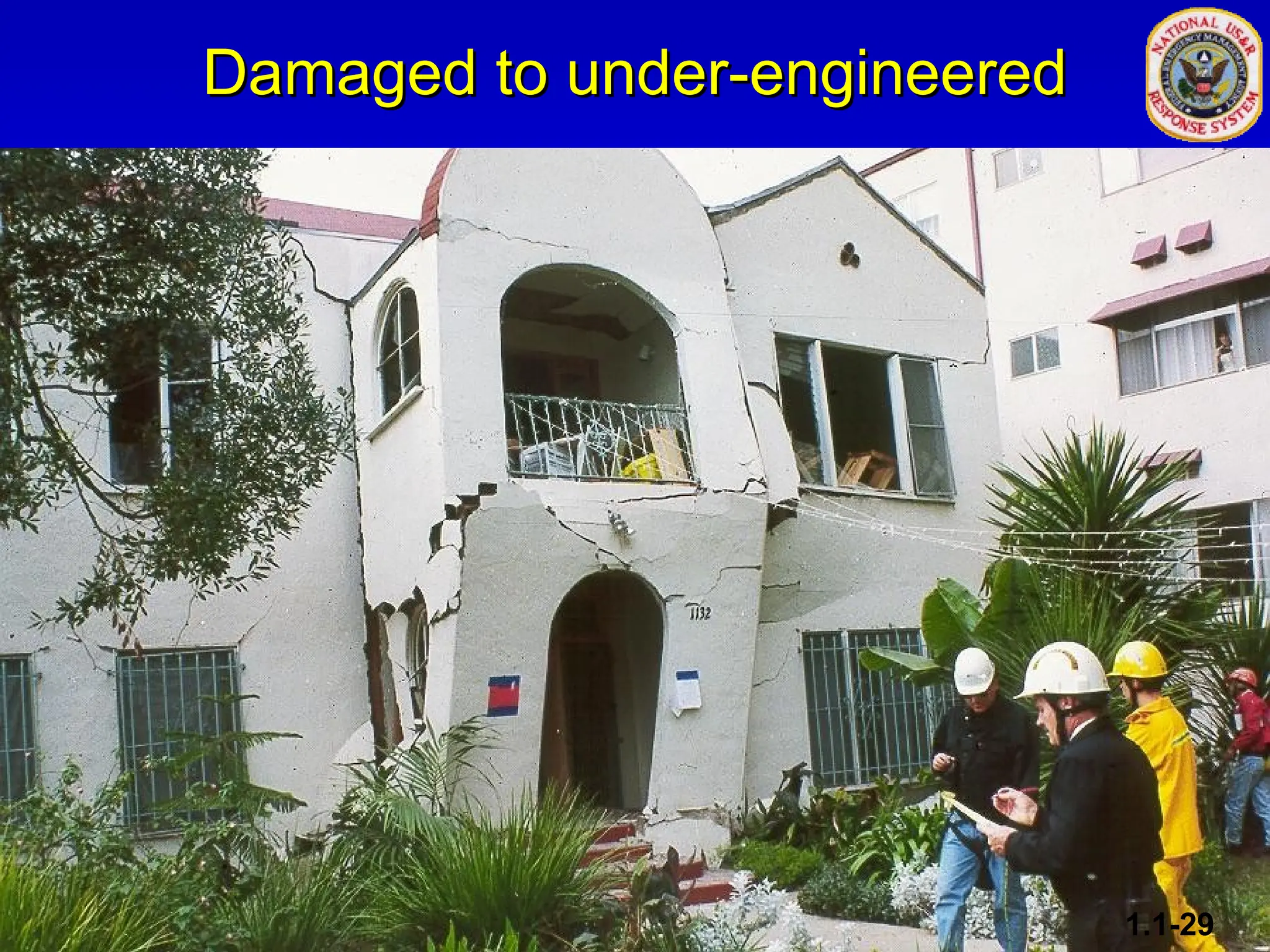
Damaged to under-engineered
1.1-29
KOBE - Severe Damage due to
Near Fault Effects
Near Fault Effects
1.1-32
MEXICO CITY - Harmonic, Far Field Effects
1.1-30
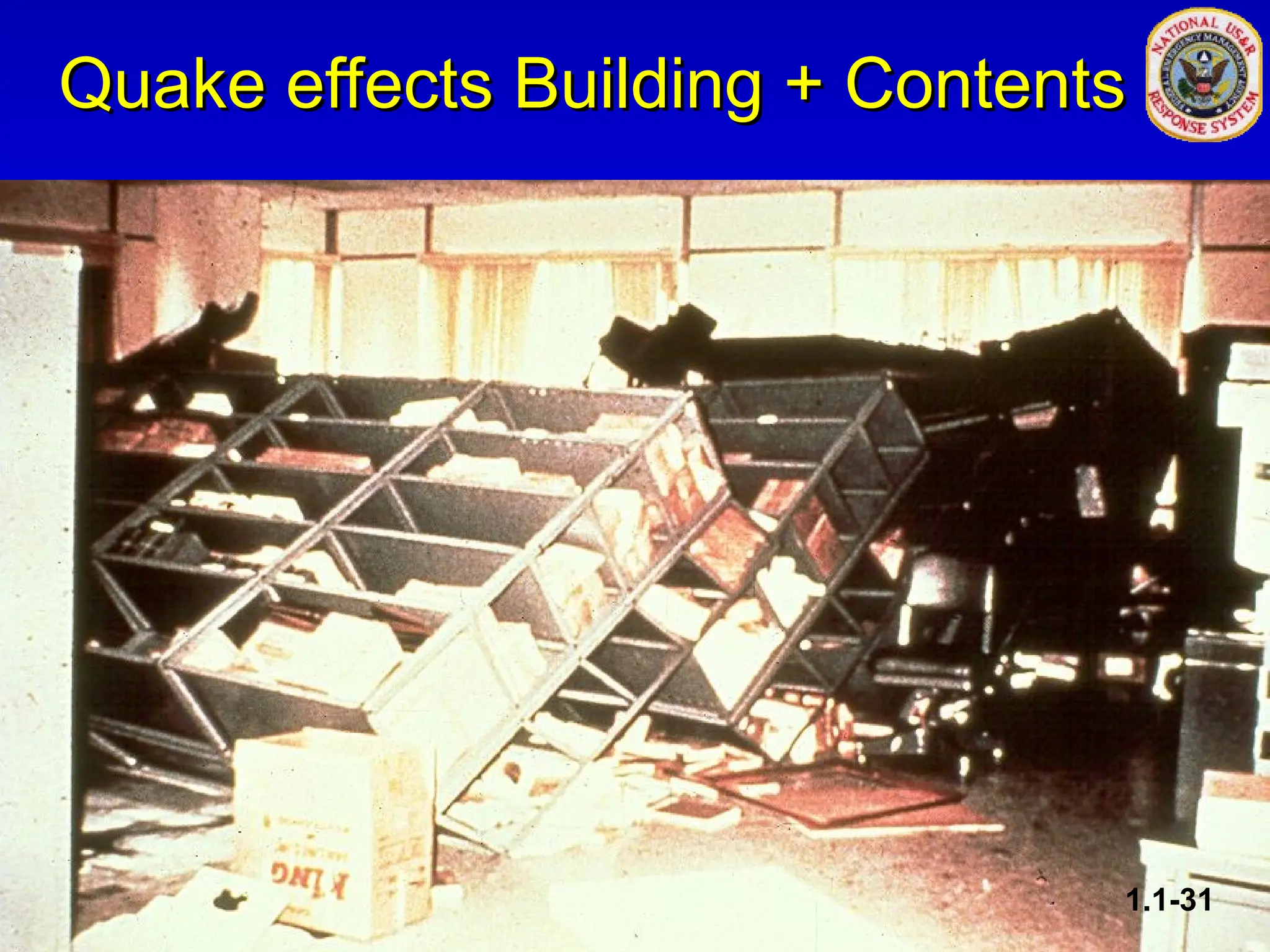
Quake effects Building + Contents
1.1-31
Wind Loading
Wind Loading
6s
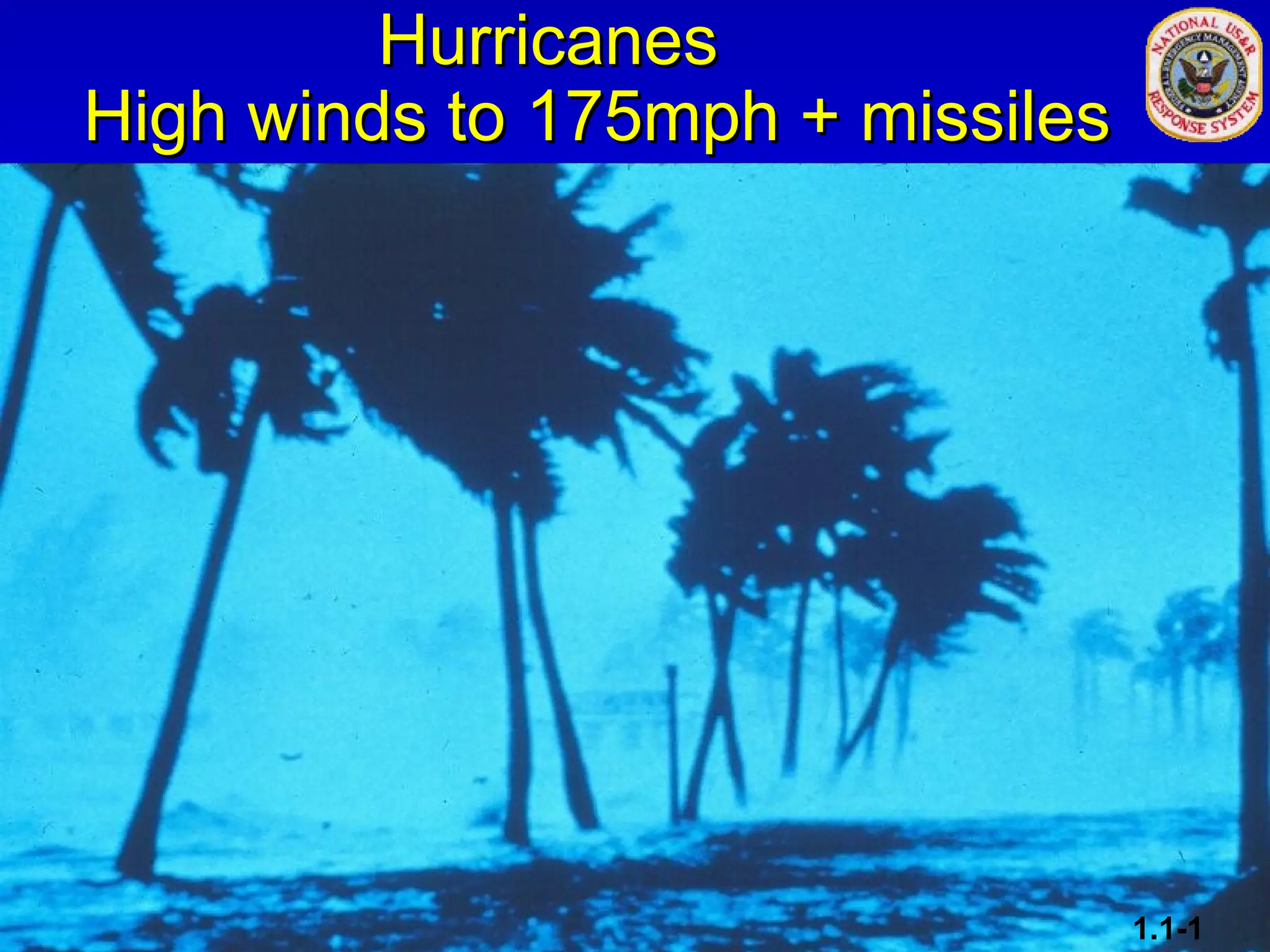
Hurricanes
Hurricanes
High winds to 175mph + missiles
1.1-1
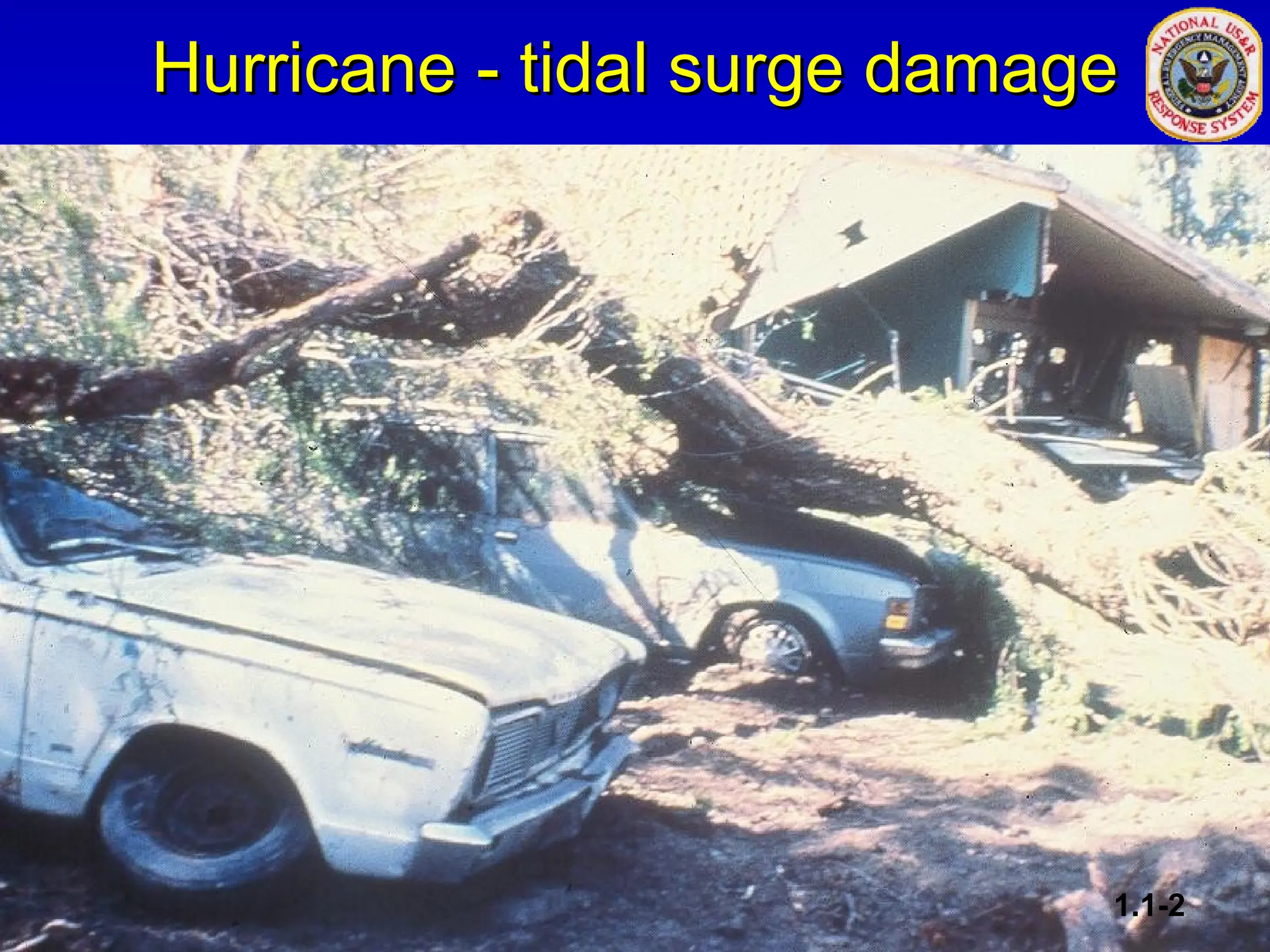
Hurricane - tidal surge damage
1.1-2
Much damage to light structures
1.1-3a
Tornado - smaller but higher speed
winds up to 250mph - little warning
1.1-4
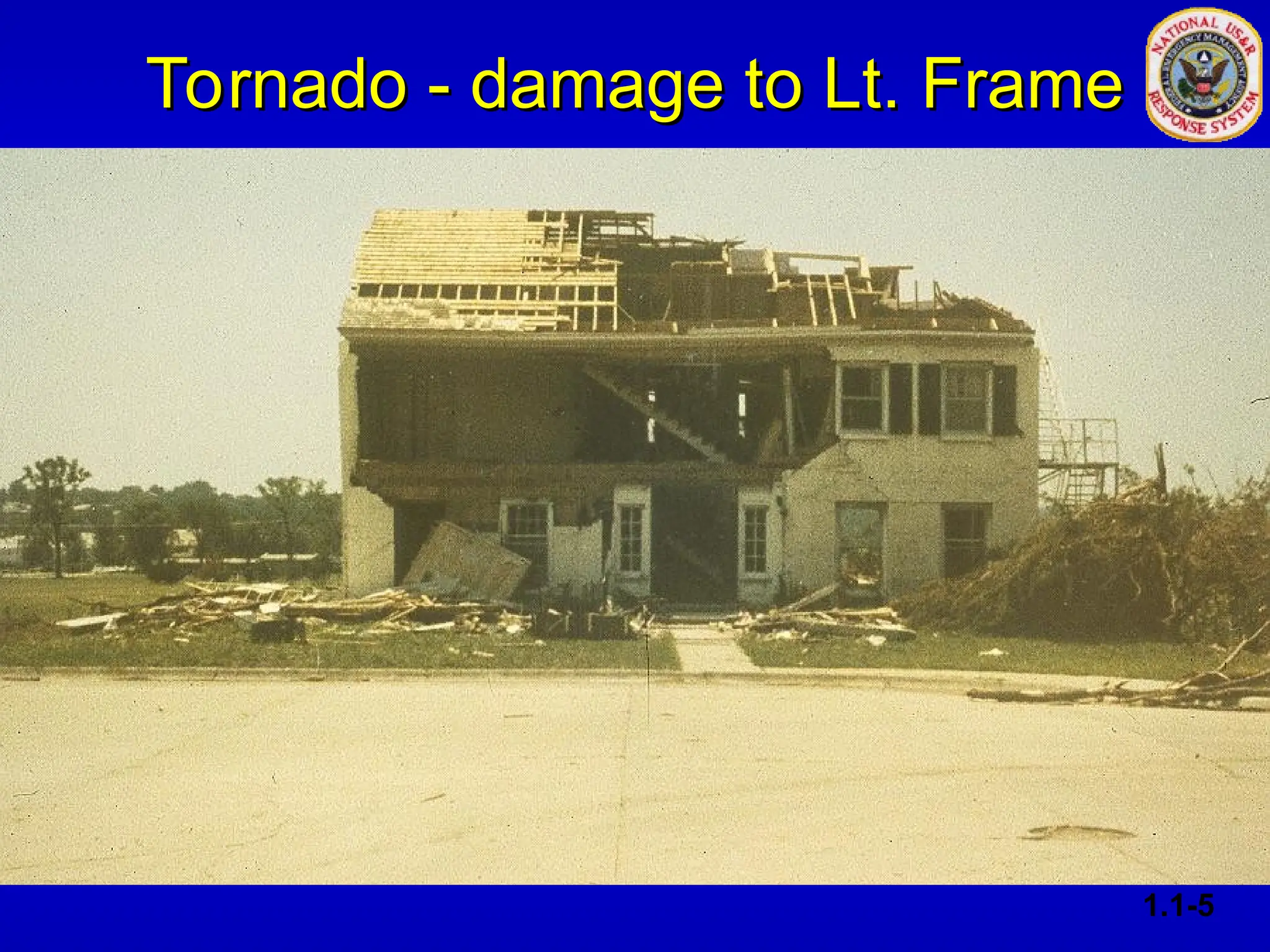
Tornado - damage to Lt. Frame
1.1-5
Tornado - damage to URM
1.1-6
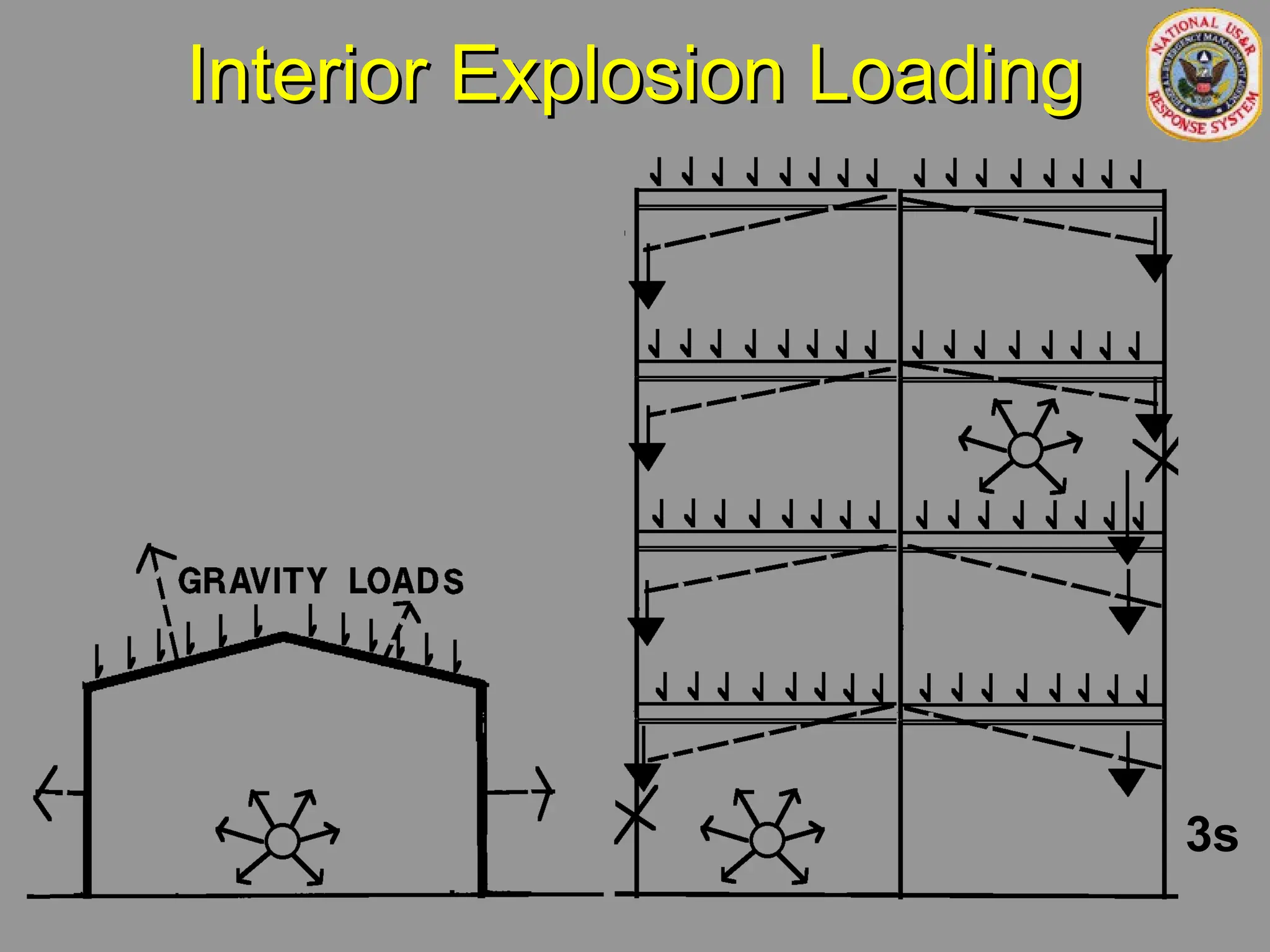
Interior Explosion Loading
3s
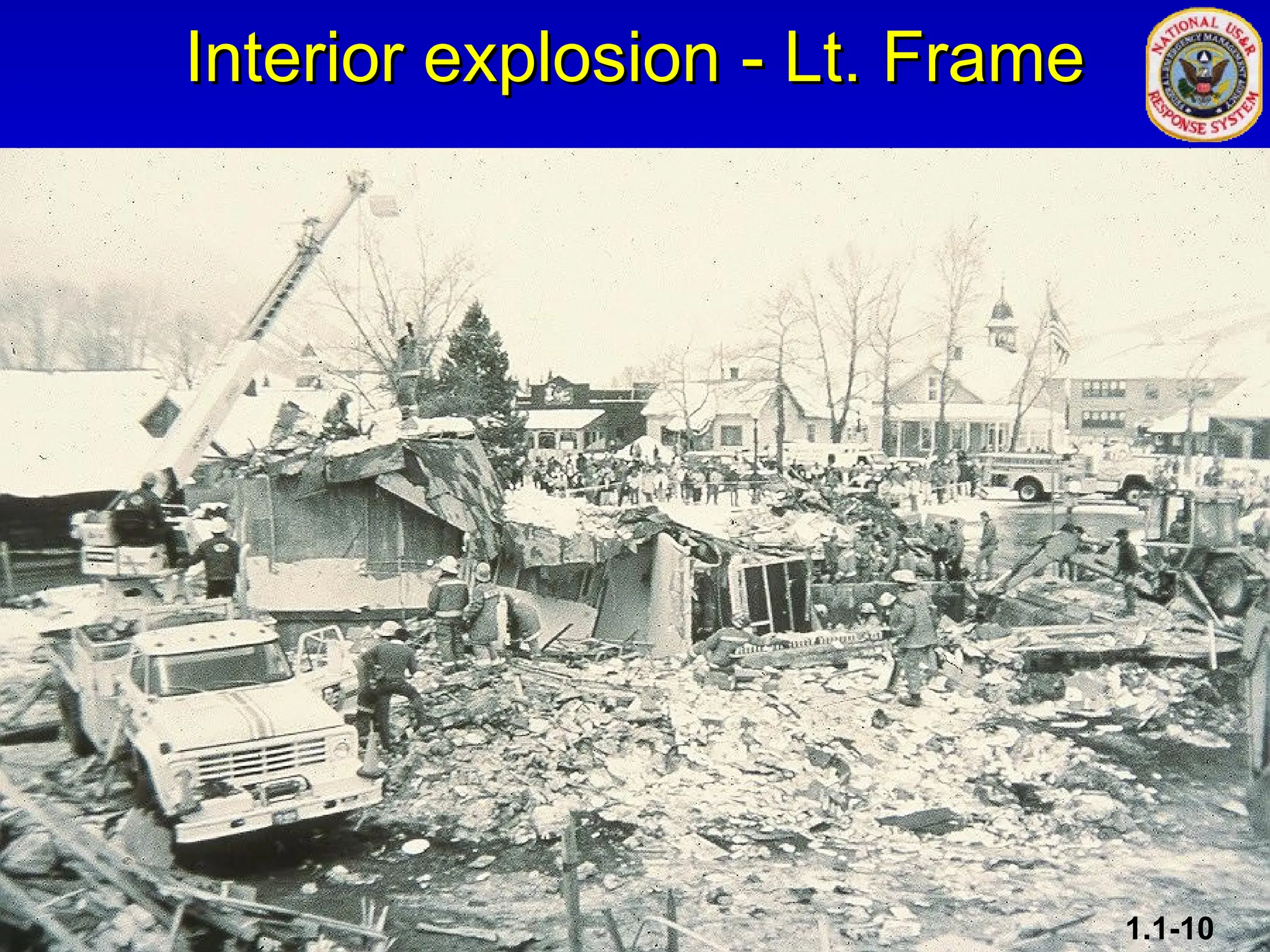
Interior explosion - Lt. Frame
1.1-10
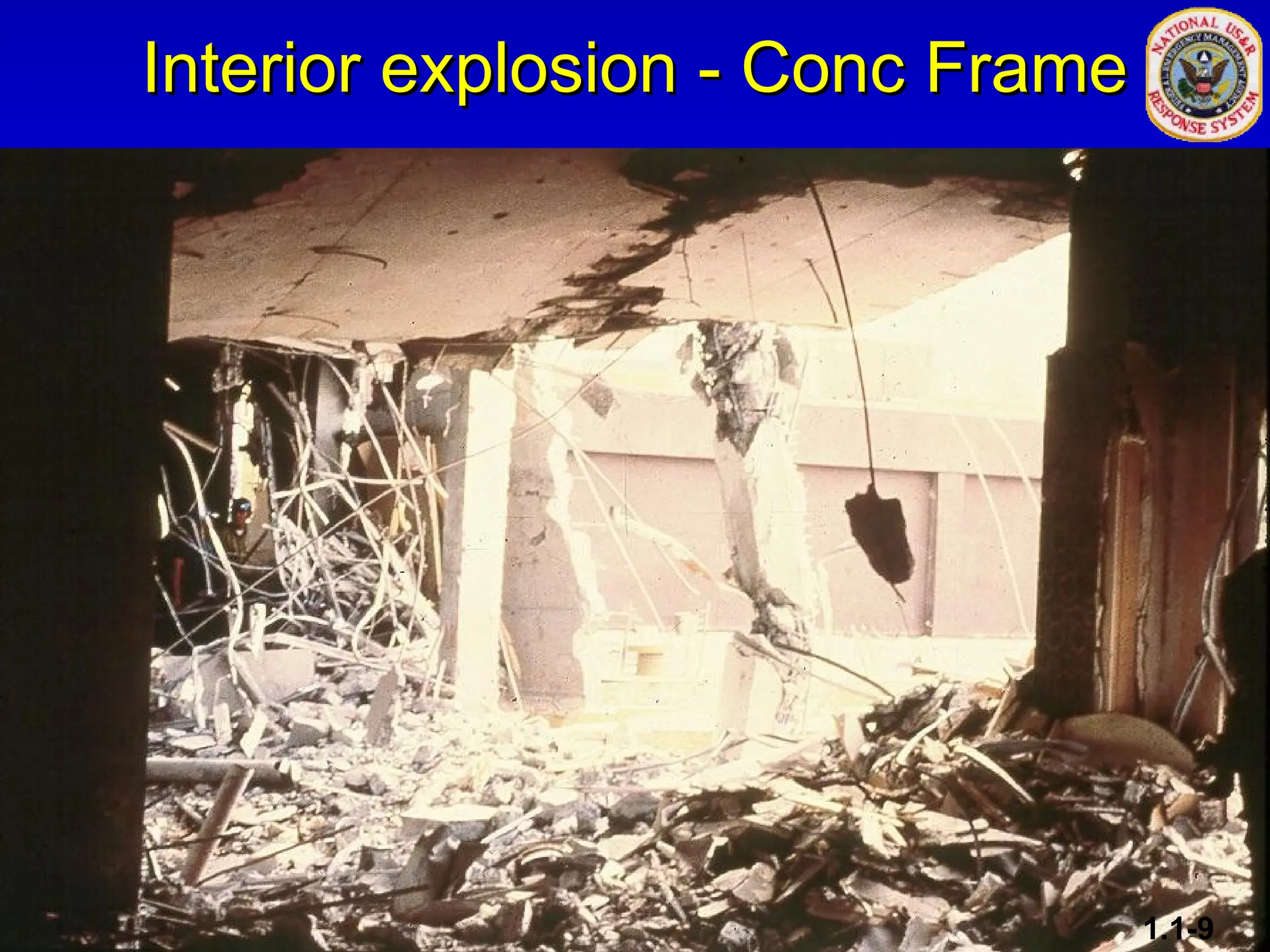
Interior explosion - Conc Frame
1.1-9
Interior Explosion, Light Metal Bldg - Reinf. conc
block walls are all that is partly standing. Steel
Frame w/metal skin was blown away
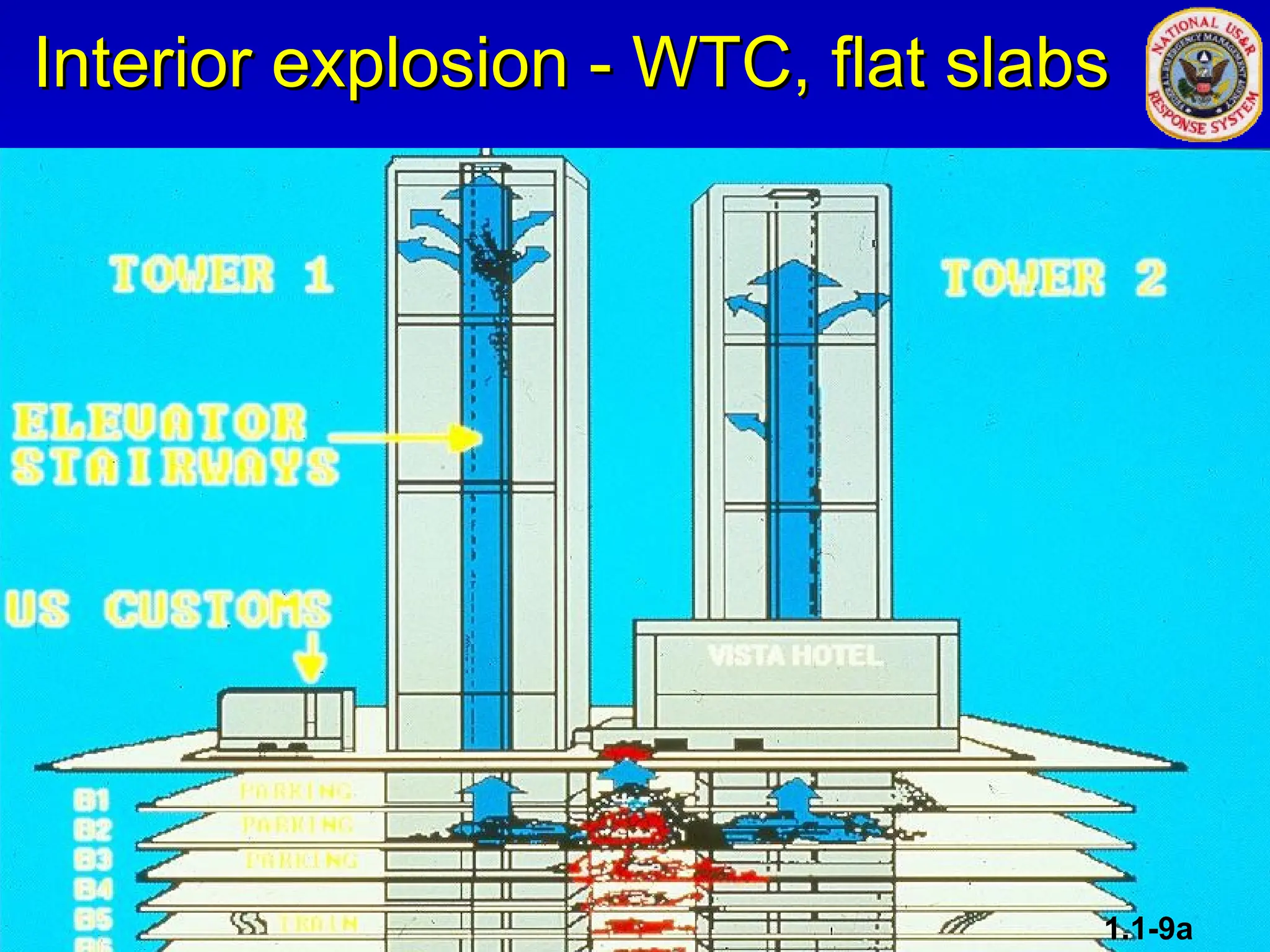
Interior explosion - WTC, flat slabs
1.1-9a
Exterior Explosion Loading
over
pressure
over
pressure
over
pressure
drag
reflected
pressure
spherical
shock
wave
stand-off
1s
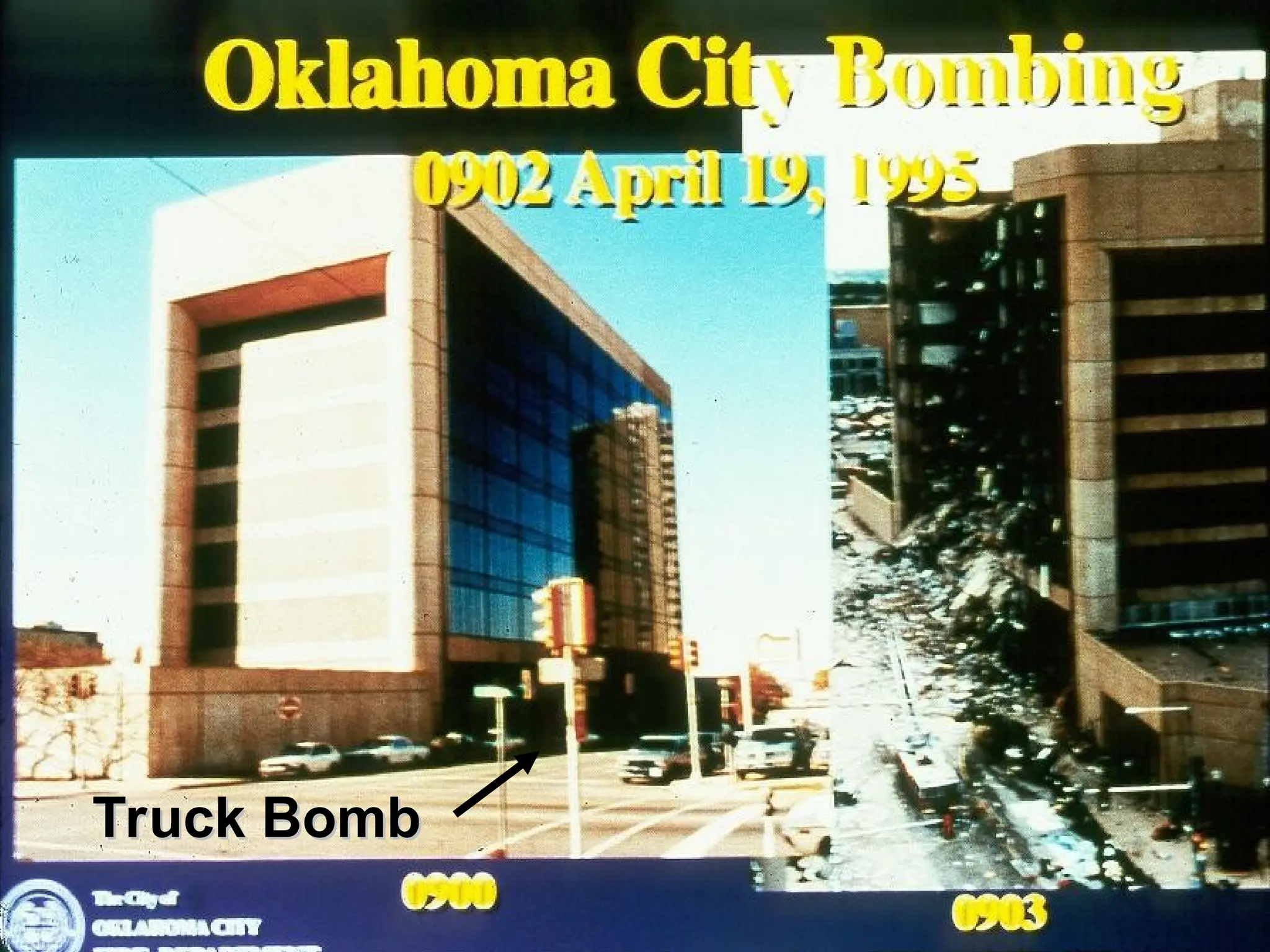
Exterior Explosion - Murrah Building
1.1-9b
Exterior Explosion Loading
A
B
C
Exterior walls,
columns & windows
Roof & Floor slabs
Frame
Ground shock 1s
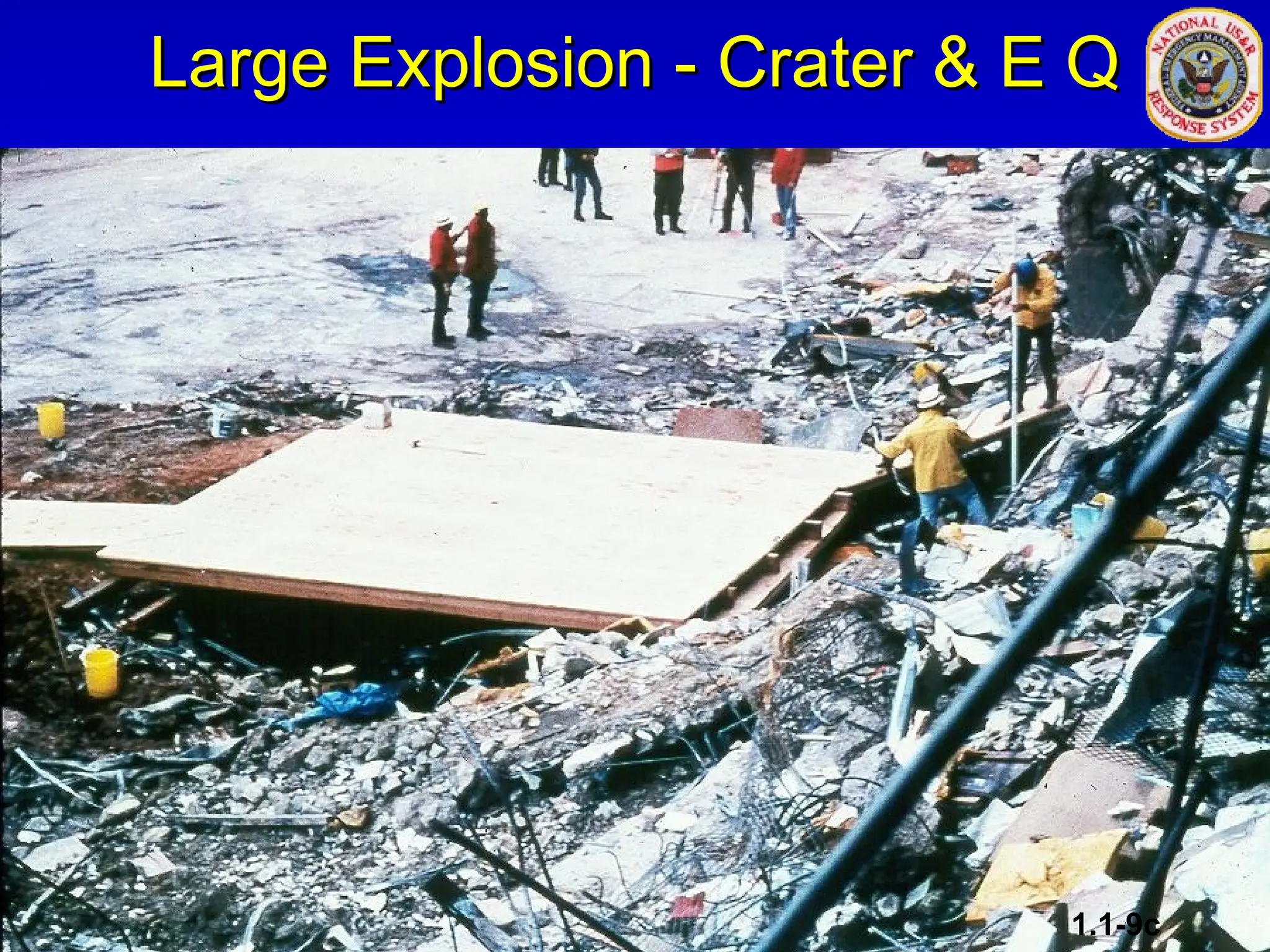
Large Explosion - Crater & E Q
1.1-9c
Loading Caused by Fire
• Burnout of Wood Roof/Floors can lead to dangerous
unbraced walls 2s
• Fire in Steel Building w/restraining walls can lead to
damage due to expansion
• Heat from Burned Wood Apartment caused
Expansion Damage to RM Shearwalls in Basement
Garage 1s
• Wood Bldgs, especially w/2x trusses are a problem
– 34 FireFighters killed in 19 incidents 1977 thru 1999
Worcester Fire - Dec99
Burnout - 6 story unbraced walls
Worcester Fire - Dec99
Burnout - 6 story unbraced walls
Expanding Slab Damaged Shearwalls
1.1-15
Refer to Manual for Following
• Damage by Floods
• Construction Bracing, Overload
• Vehicle Impact Loading
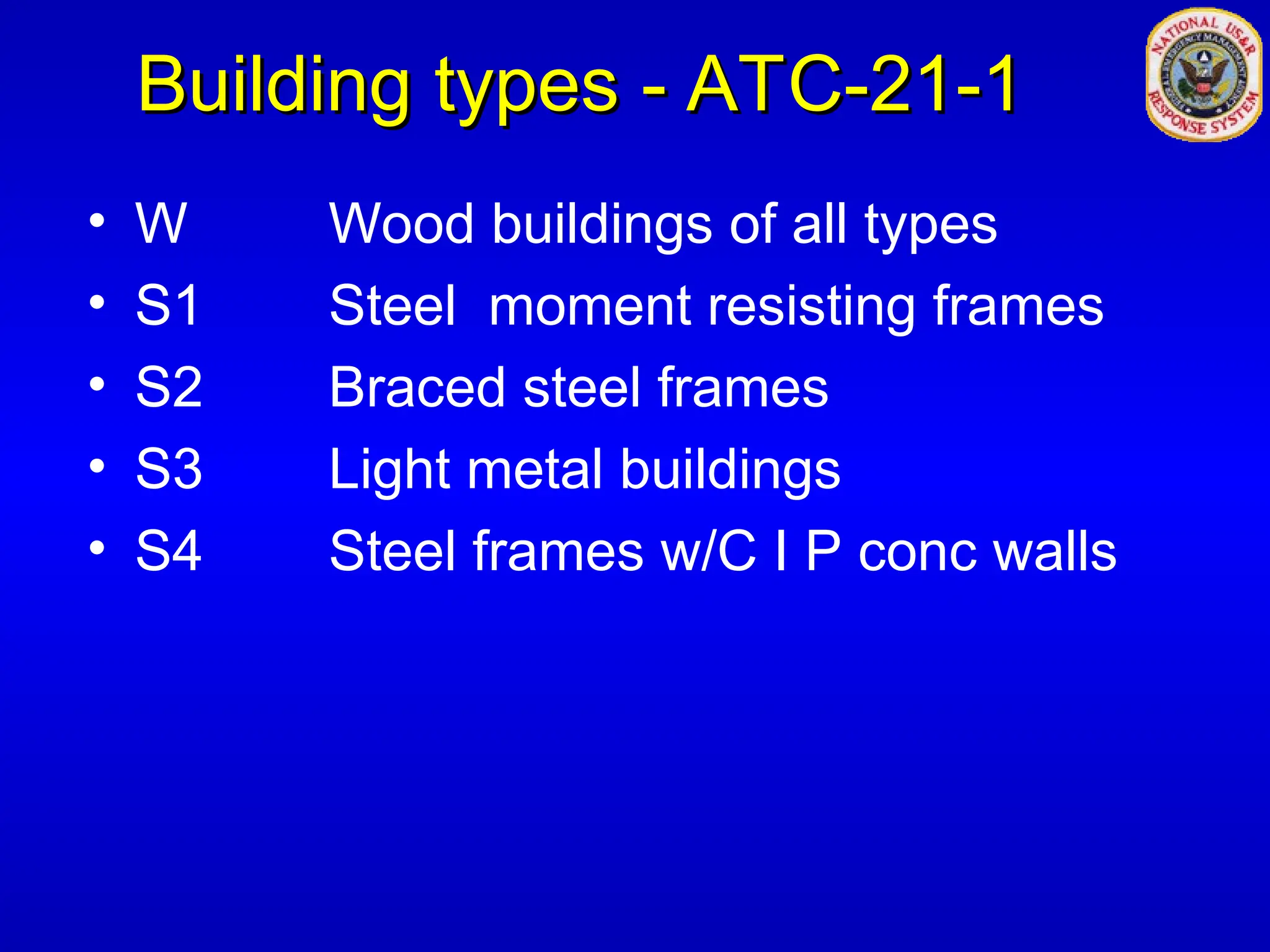
Building types - ATC-21-1
• W Wood buildings of all types
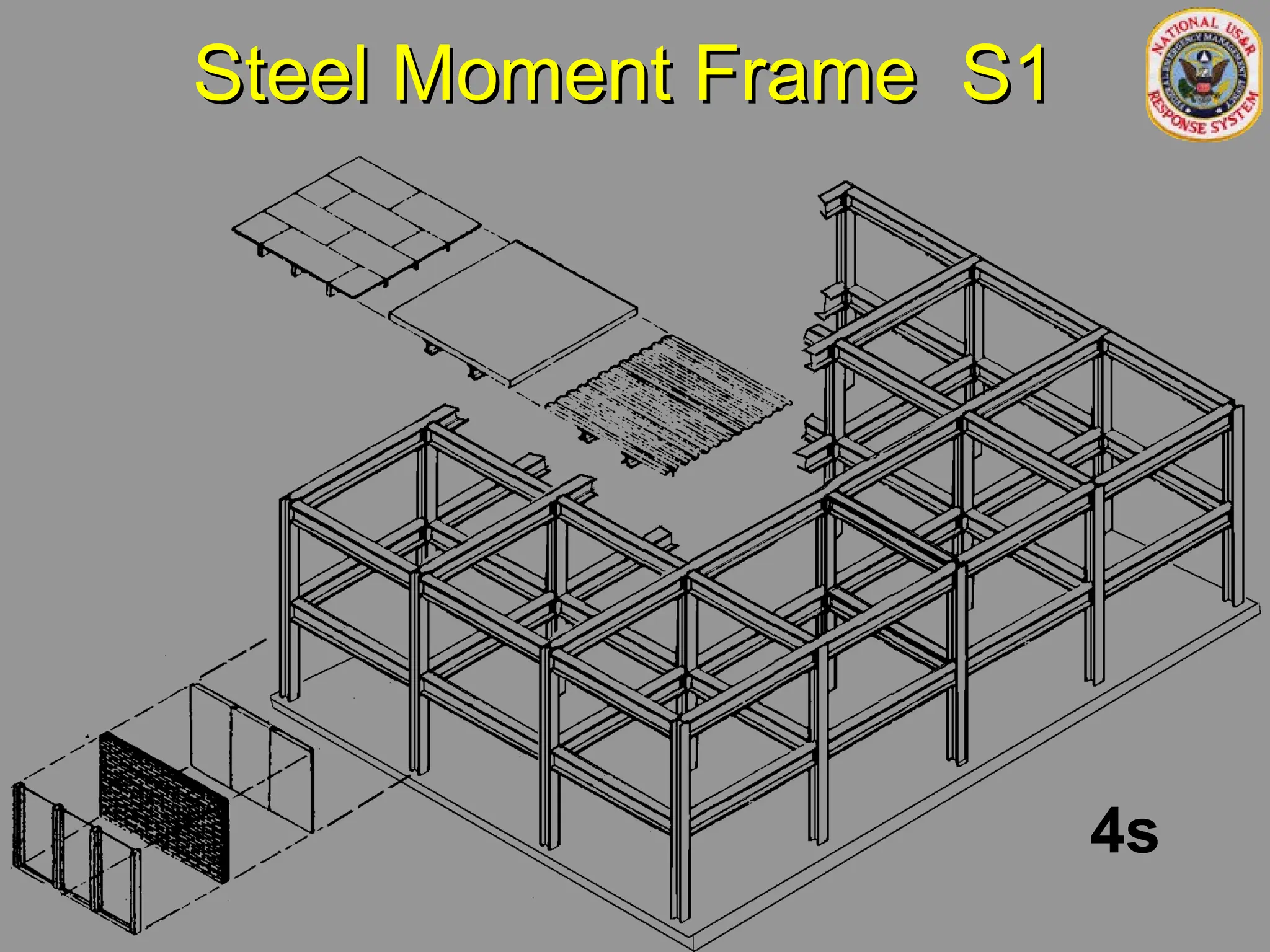
• S1 Steel moment resisting frames
• S2 Braced steel frames
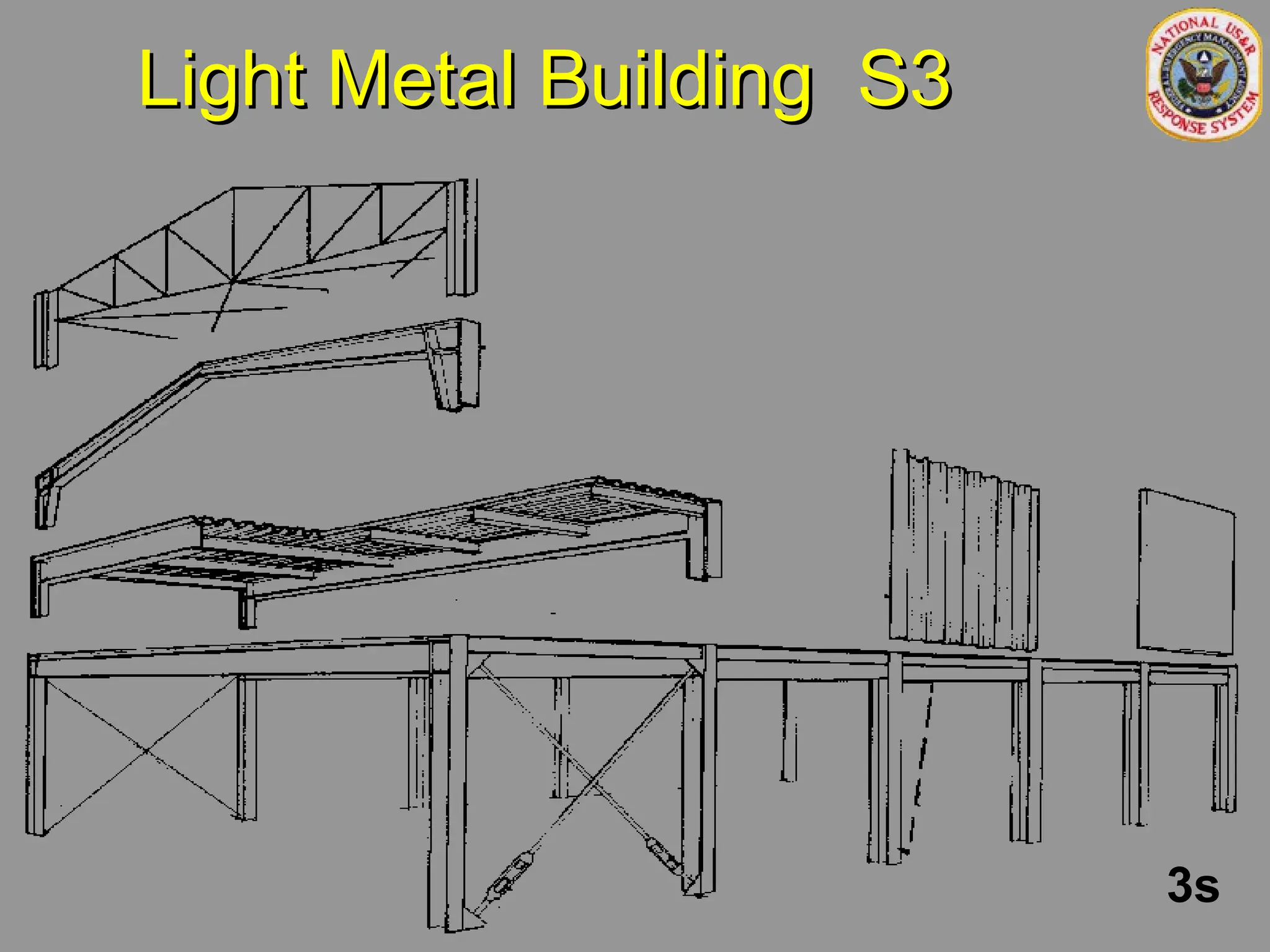
• S3 Light metal buildings
• S4 Steel frames w/C I P conc walls
Building types - ATC-21-1
• C1 Concrete moment resisting frames
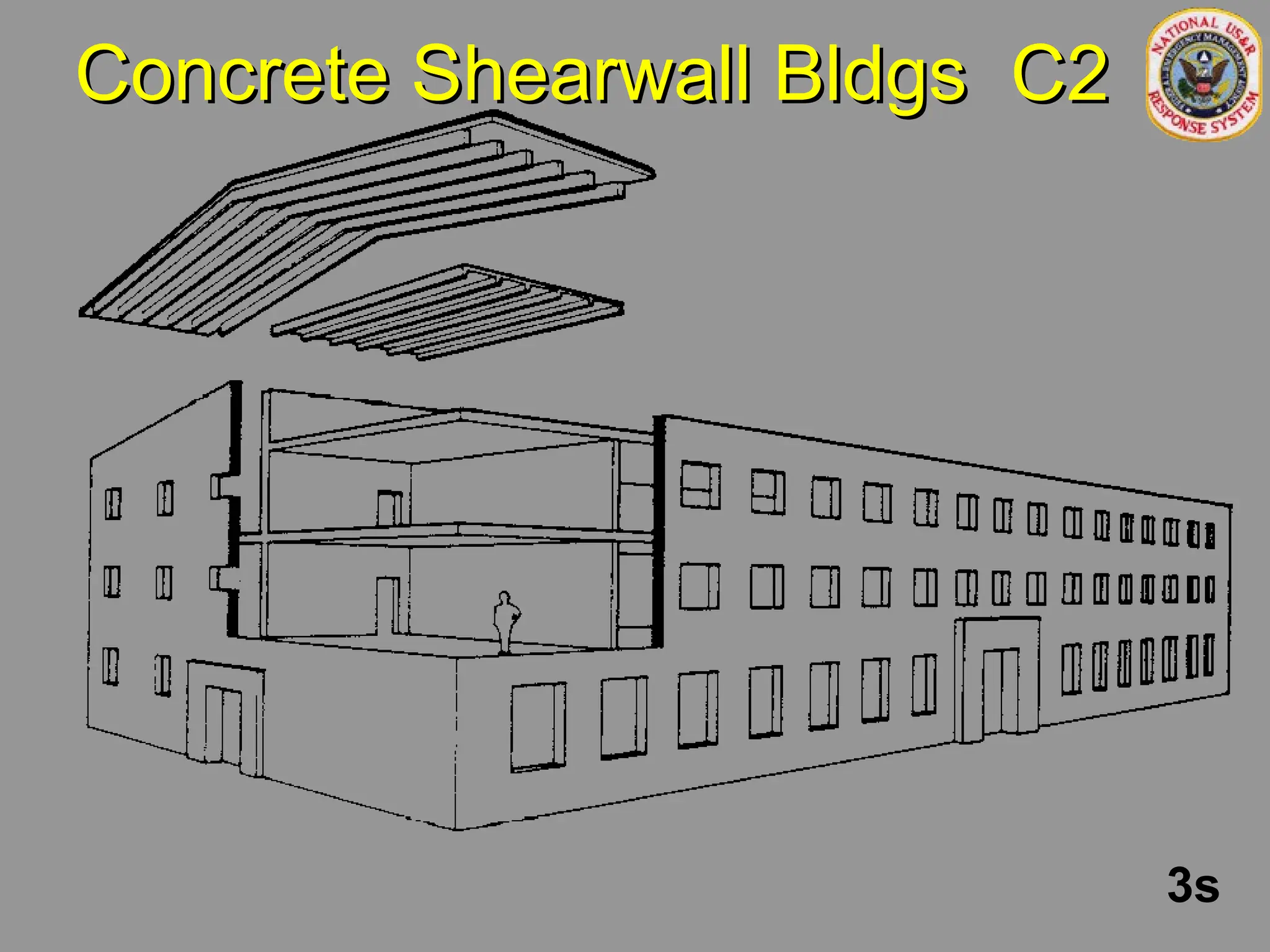
• C2 Concrete shear wall buildings
• C3/S5 Conc/steel frame w/urm infill walls
• TU/PC1 Tilt-up concrete wall building
• PC2 Precast concrete frame buildings
• RM Reinforced masonry buildings
• URM Unreinforced masonry building
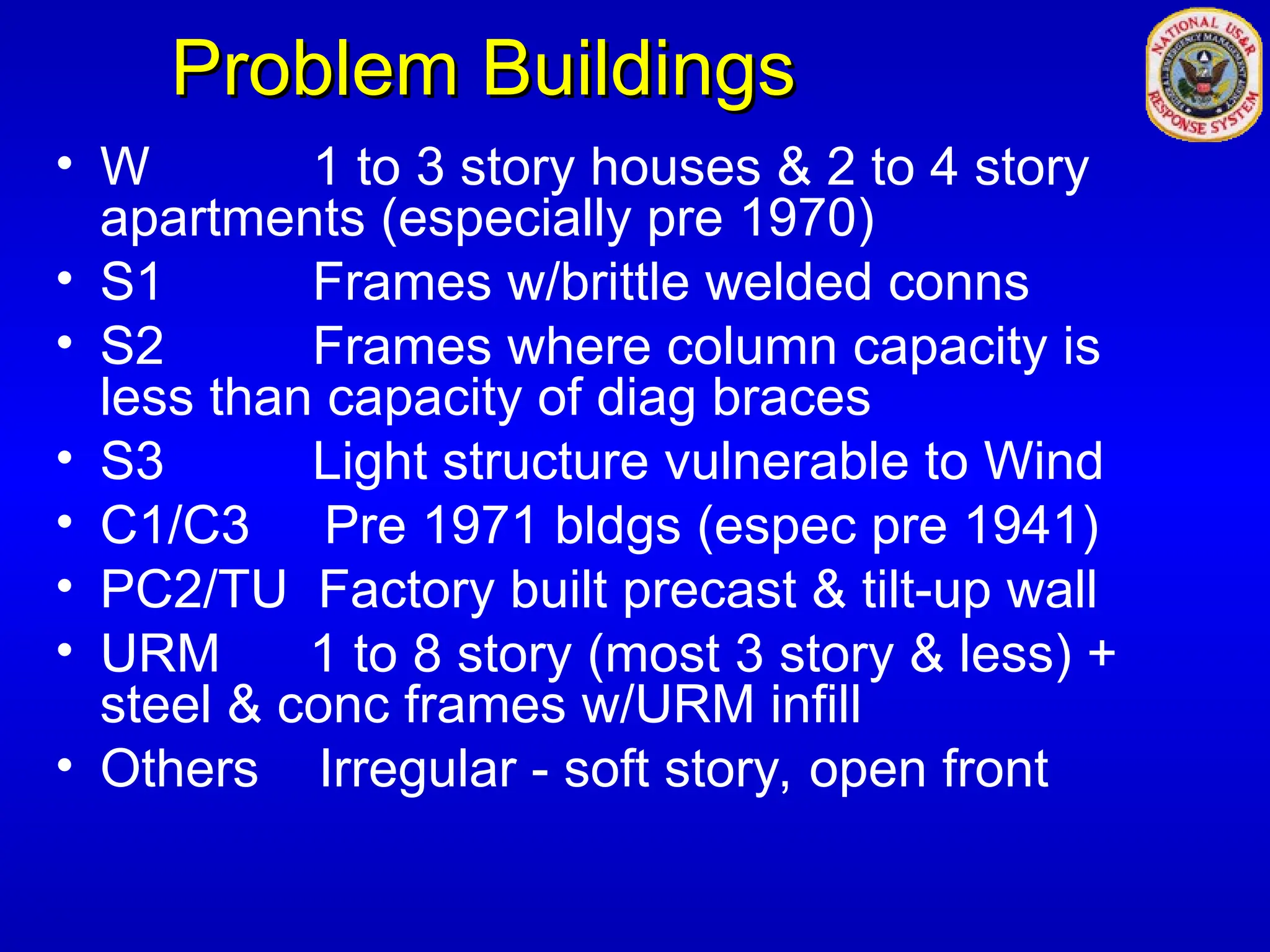
Problem Buildings
Problem Buildings
• W 1 to 3 story houses & 2 to 4 story
apartments (especially pre 1970)
• S1 Frames w/brittle welded conns
• S2 Frames where column capacity is
less than capacity of diag braces
• S3 Light structure vulnerable to Wind
• C1/C3 Pre 1971 bldgs (espec pre 1941)
• PC2/TU Factory built precast & tilt-up wall
• URM 1 to 8 story (most 3 story & less) +
steel & conc frames w/URM infill
• Others Irregular - soft story, open front
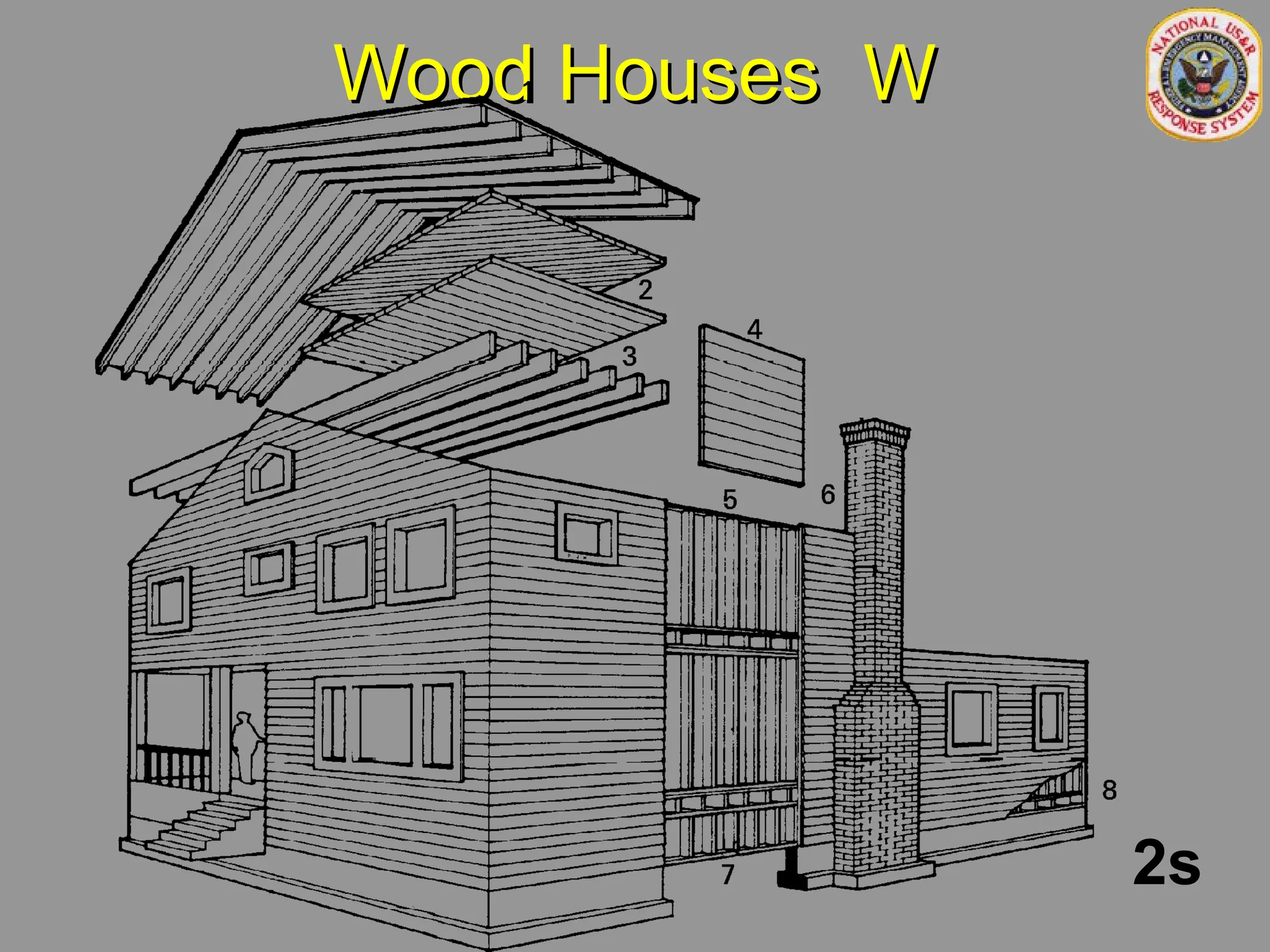
Wood Houses W
Wood Houses W
2s
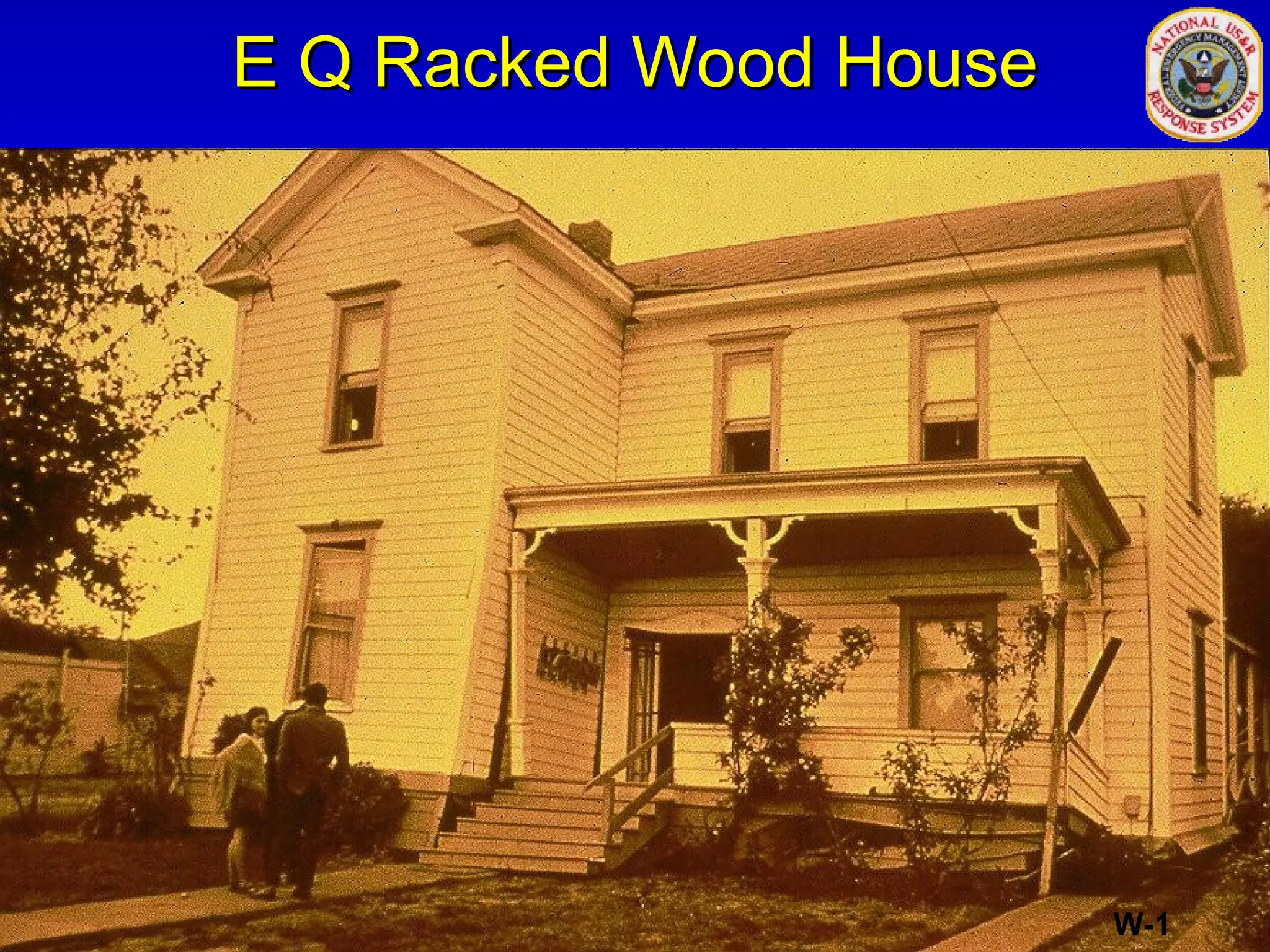
E Q Racked Wood House
W-1
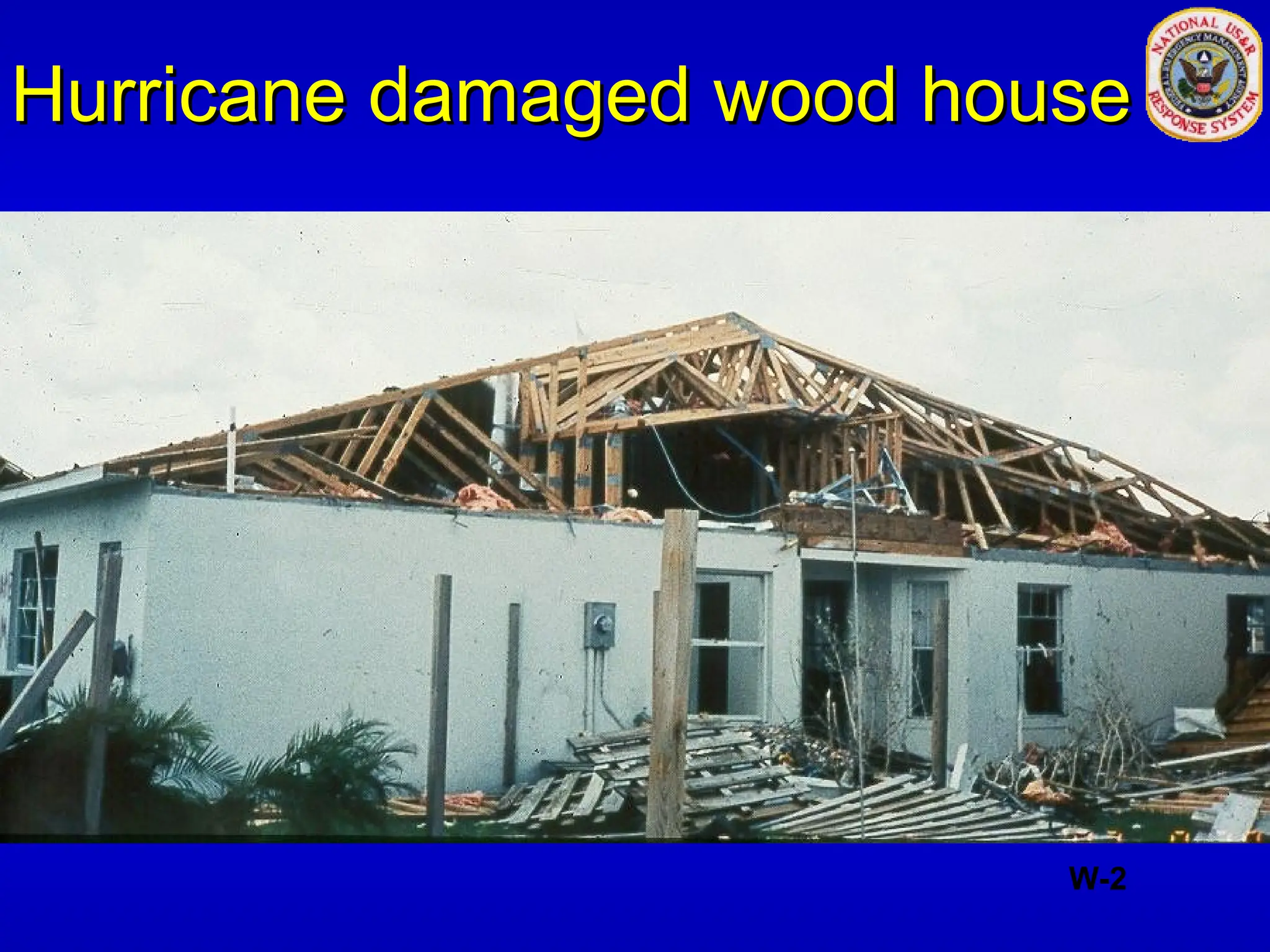
Hurricane damaged wood house
W-2
Wood Frame Apartments W
3s
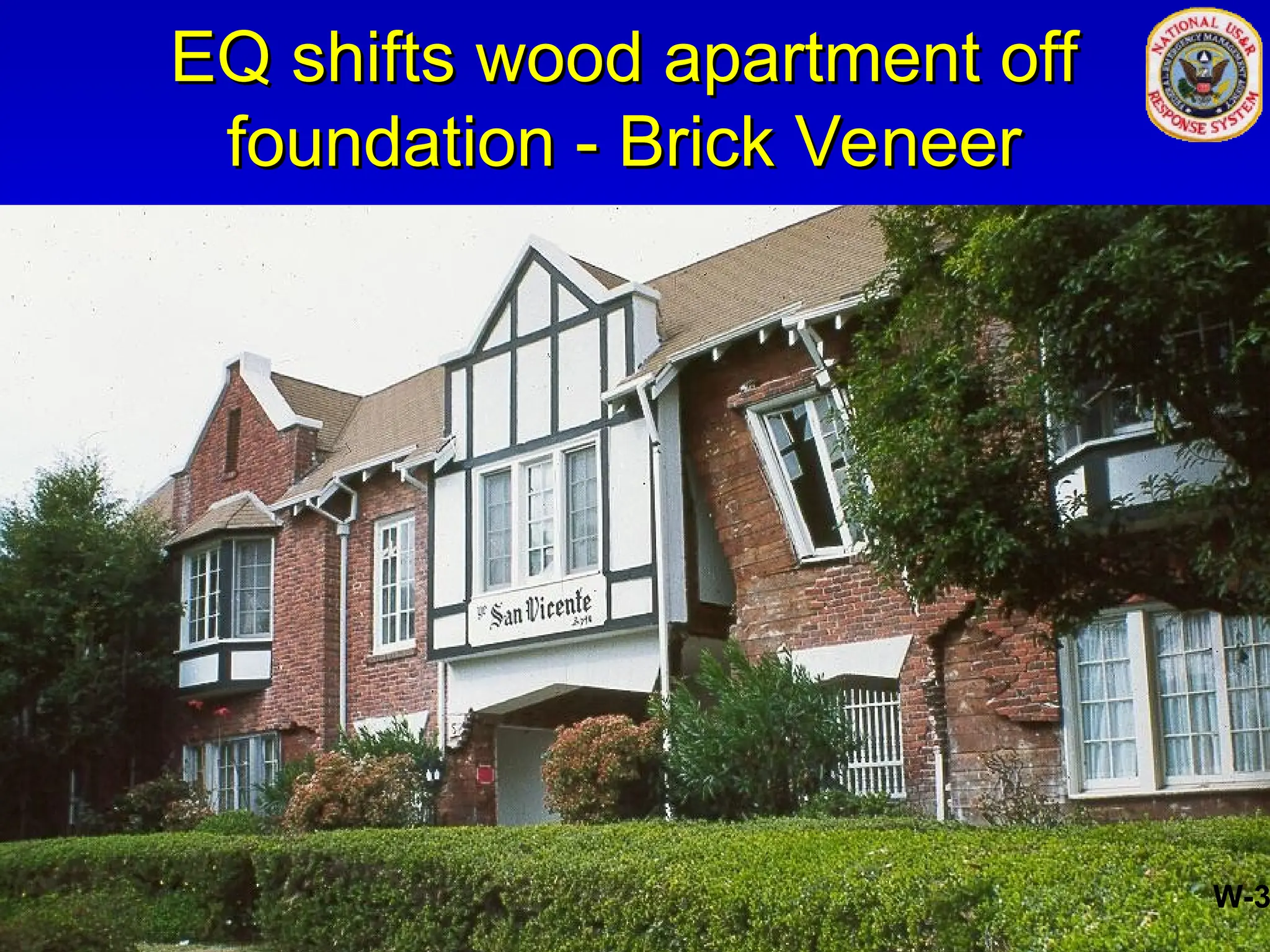
EQ shifts wood apartment off
foundation - Brick Veneer
W-3
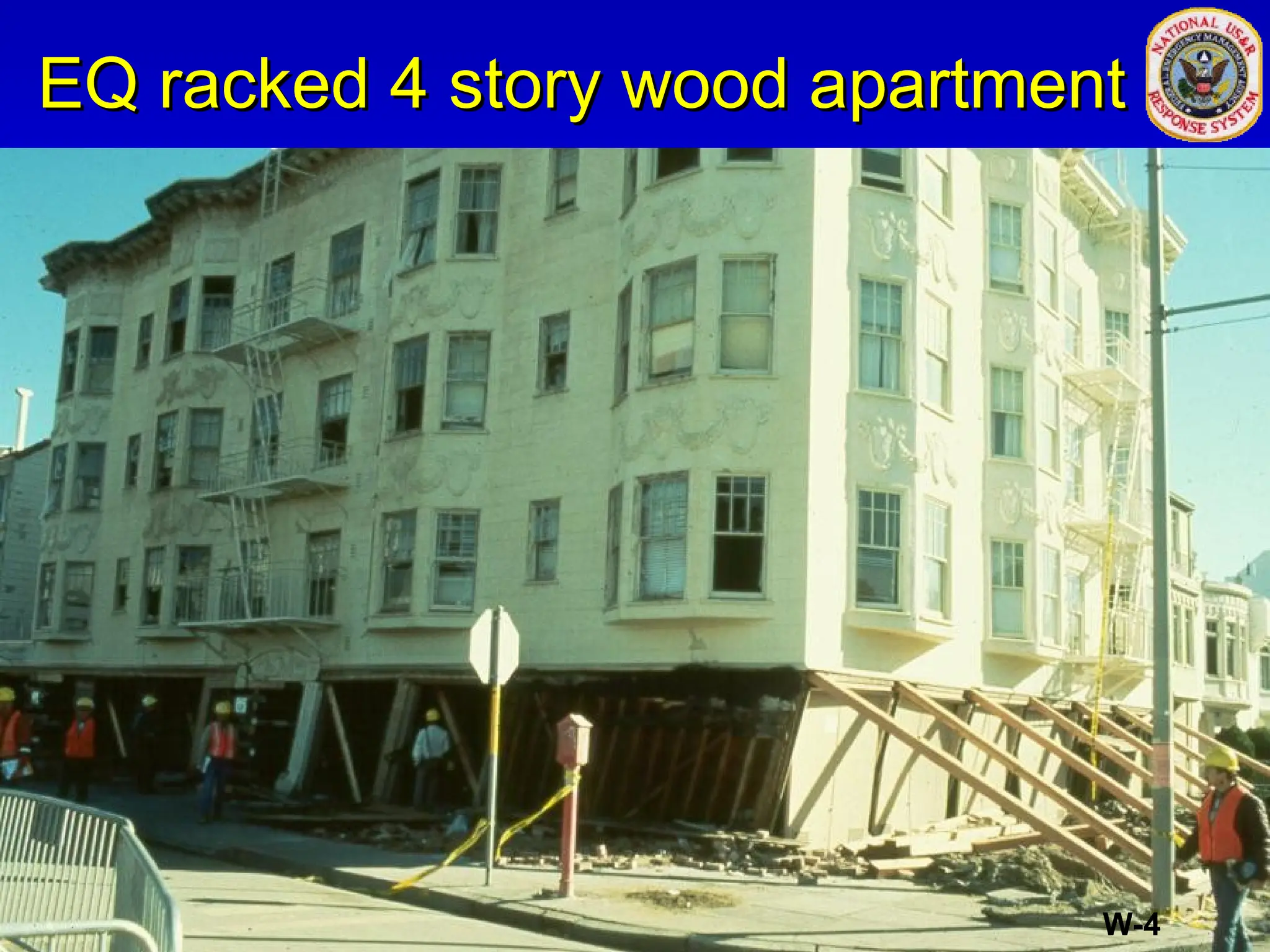
EQ racked 4 story wood apartment
W-4
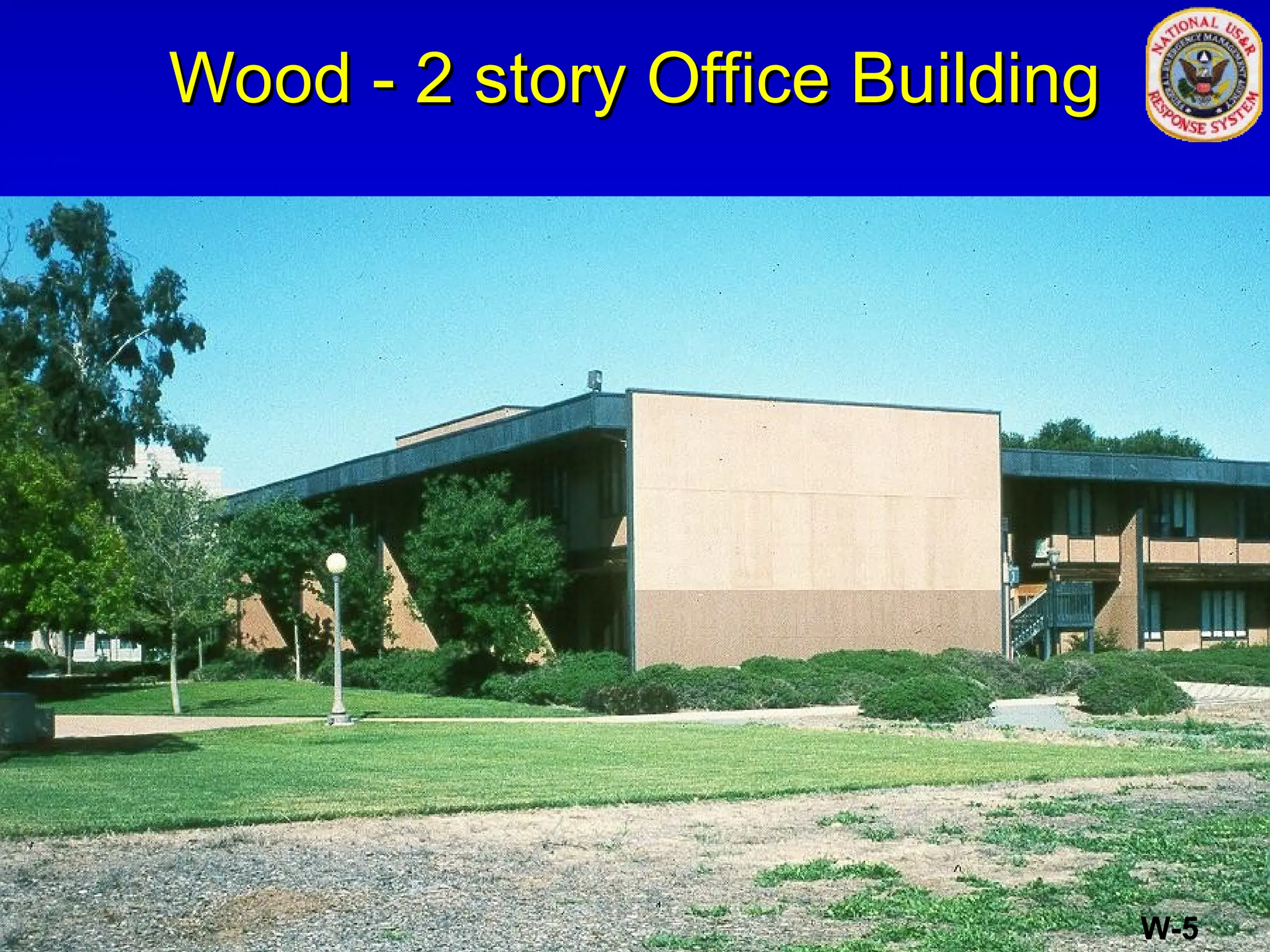
Wood - 2 story Office Building
W-5
Steel Moment Frame S1
4s
Moment Frame under construction
S1-1
Moment frame under construction
Showing new, improved joints
S1-2
Steel Diag. Braced Frame S2
3s
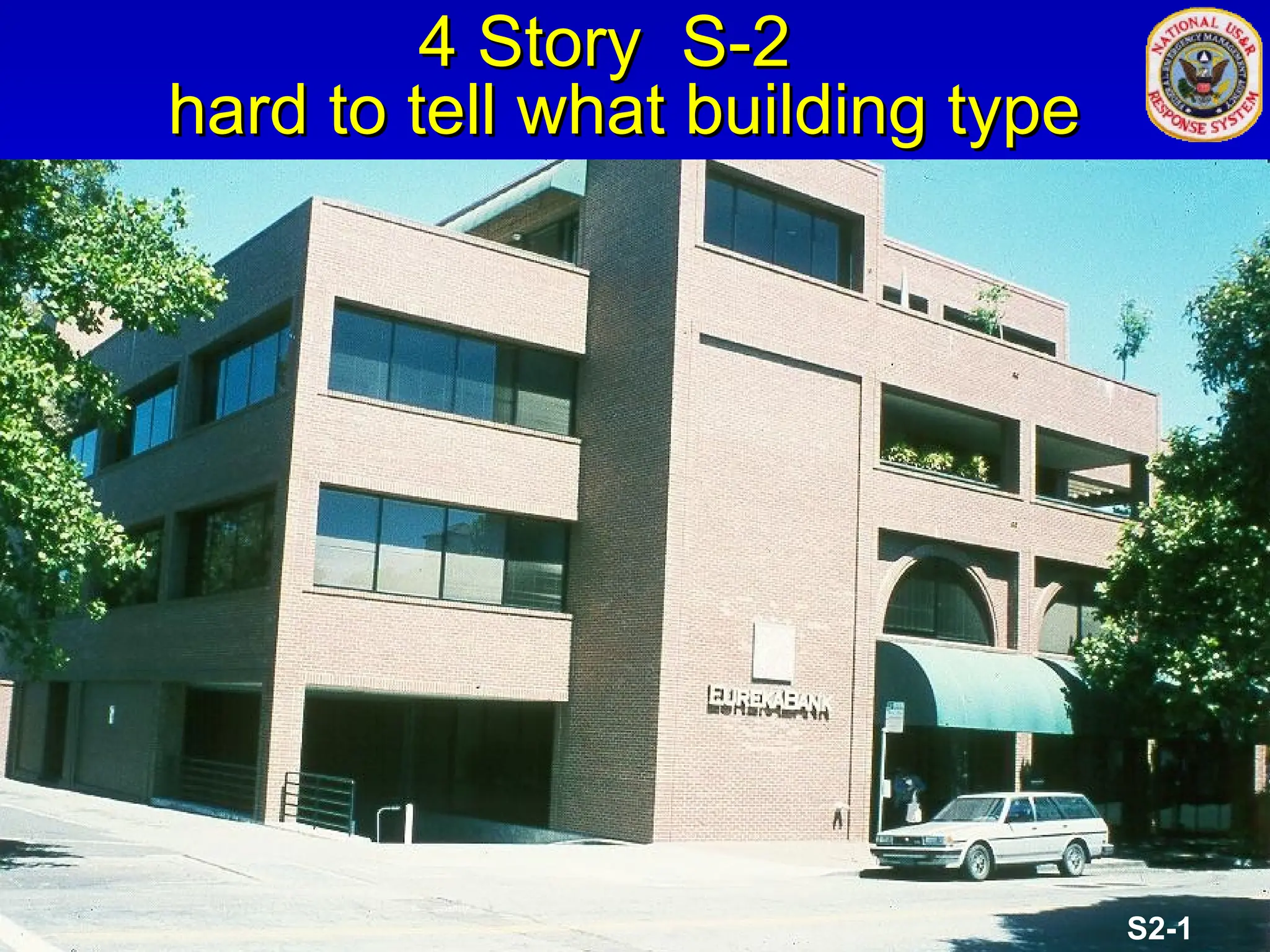
4 Story S-2
4 Story S-2
hard to tell what building type
S2-1
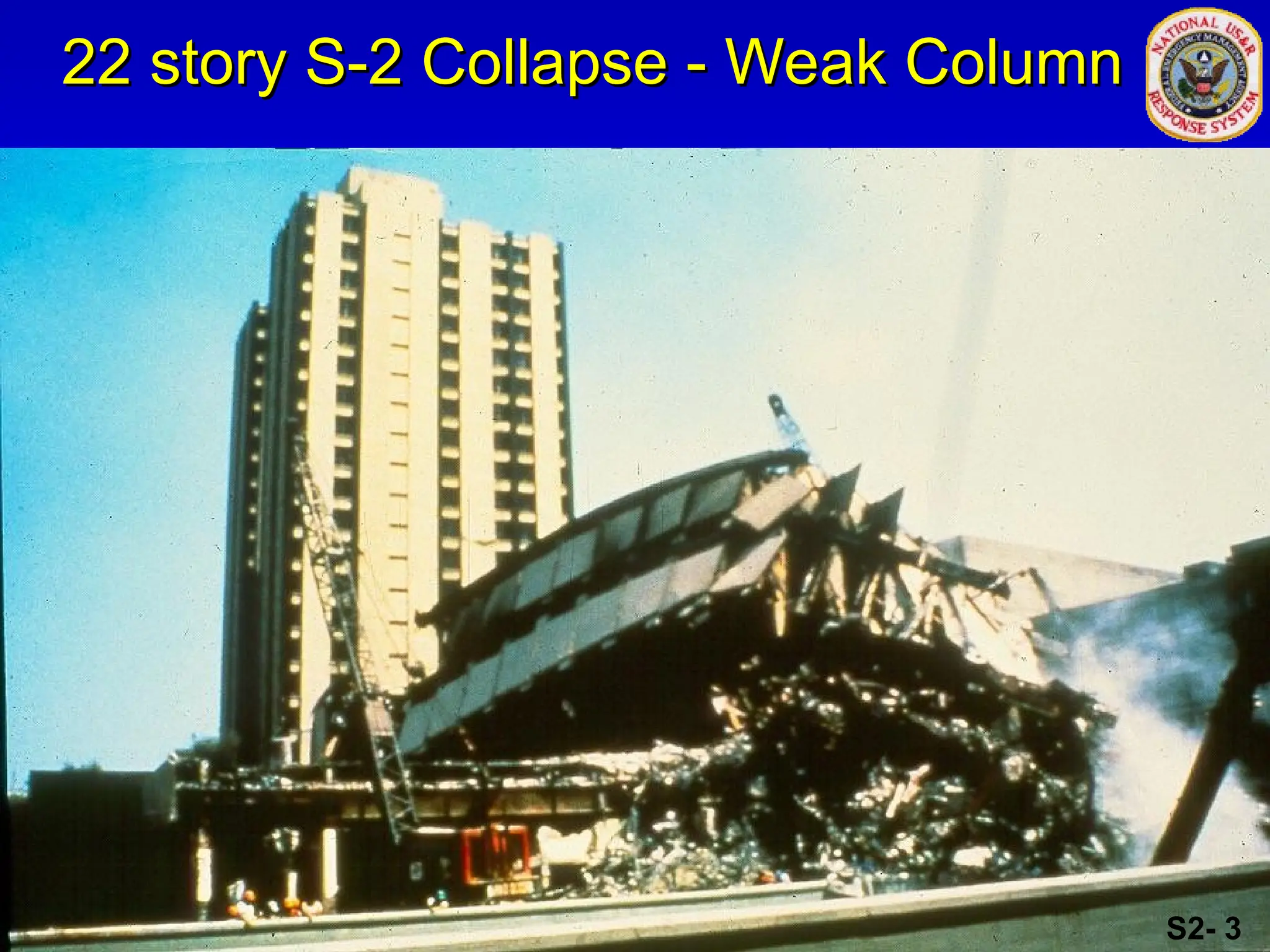
22 story S-2 Collapse - Weak Column
S2- 3
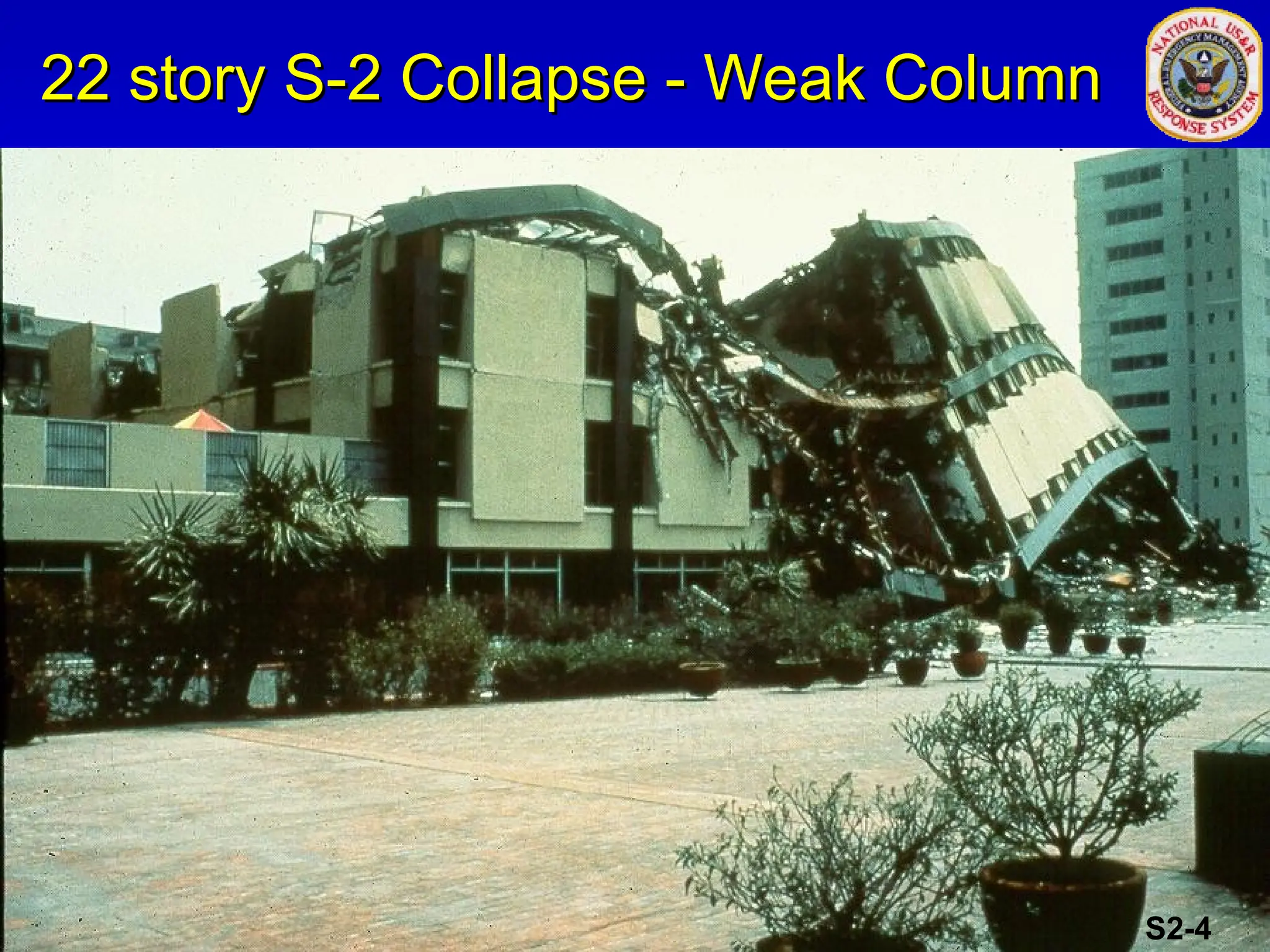
22 story S-2 Collapse - Weak Column
S2-4
Light Metal Building S3
3s
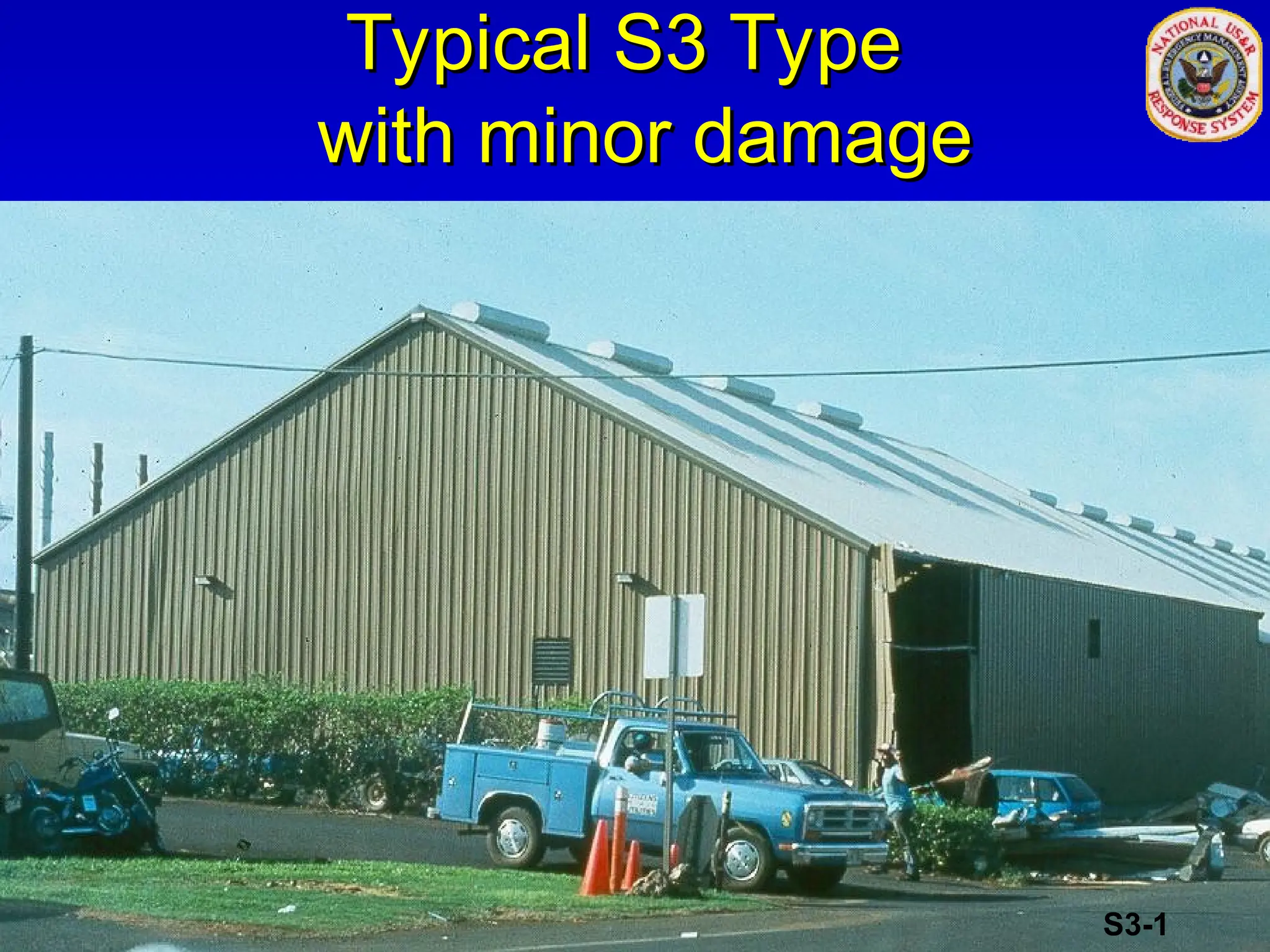
Typical S3 Type
Typical S3 Type
with minor damage
with minor damage
S3-1
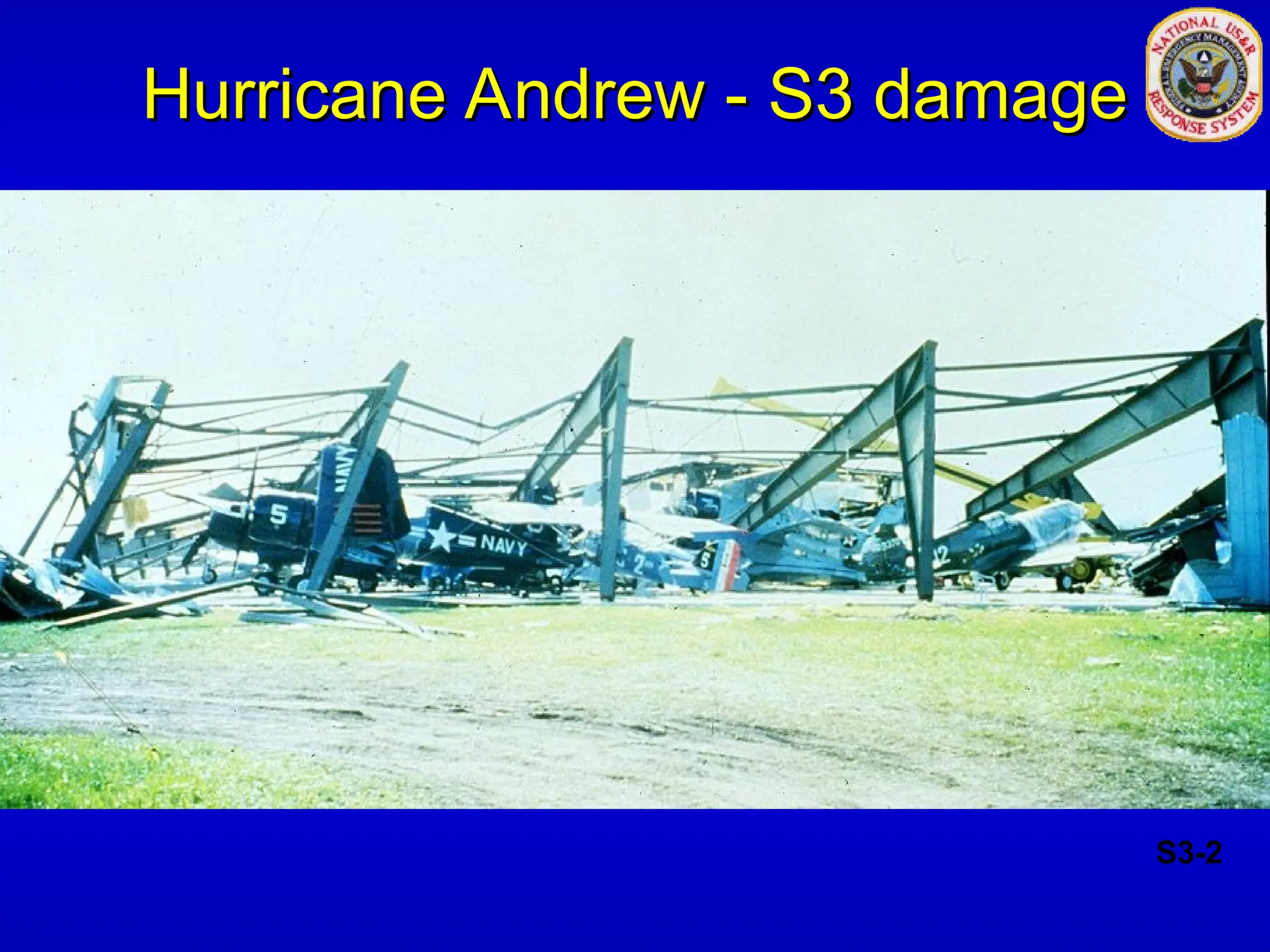
Hurricane Andrew - S3 damage
S3-2
Hurricane Iniki - S3 damage
S3-3
Concrete Moment Frames C1
2s
C1 with brick infill - core collapse
C1-1
C1 with Clay Tile infill = C3
Santa Monica, Sea Castle
C1-2
Concrete Shearwall Bldgs C2
3s
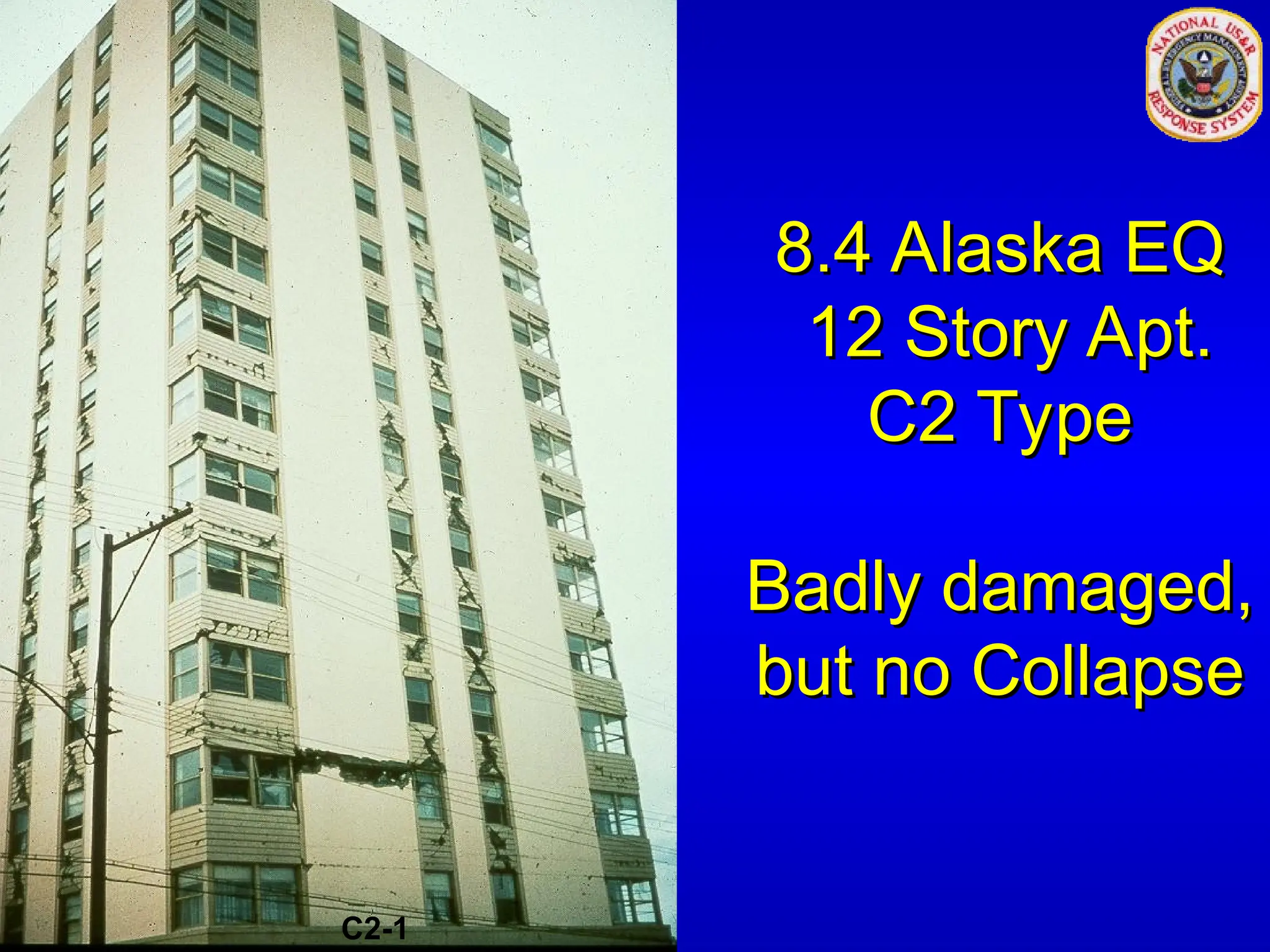
8.4 Alaska EQ
8.4 Alaska EQ
12 Story Apt.
12 Story Apt.
C2 Type
C2 Type
Badly damaged,
Badly damaged,
but no Collapse
but no Collapse
C2-1
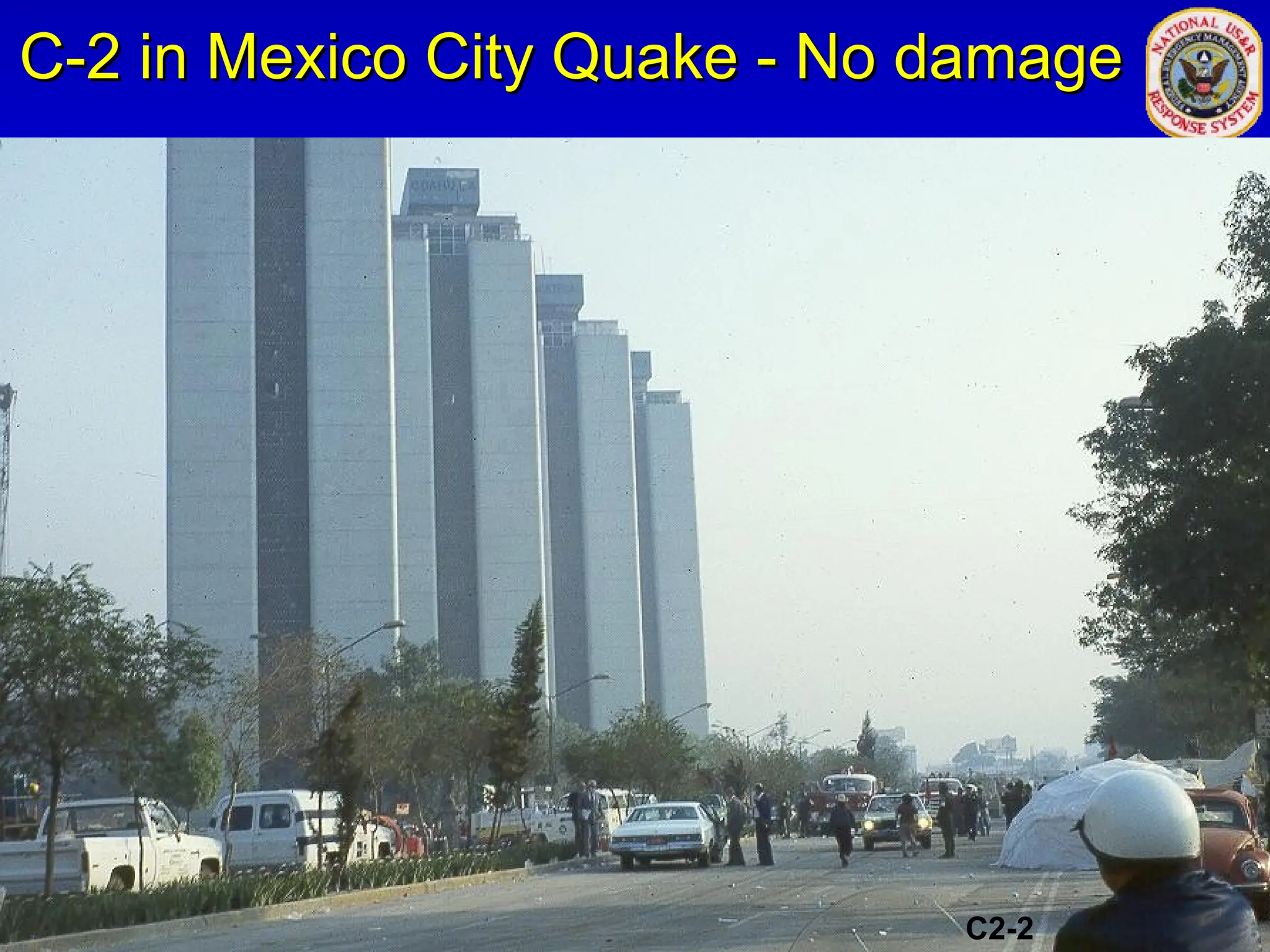
C-2 in Mexico City Quake - No damage
C2-2
C-2
C-2
Coupled
Coupled
Shearwall
Shearwall
Cracks
Cracks
C2-3
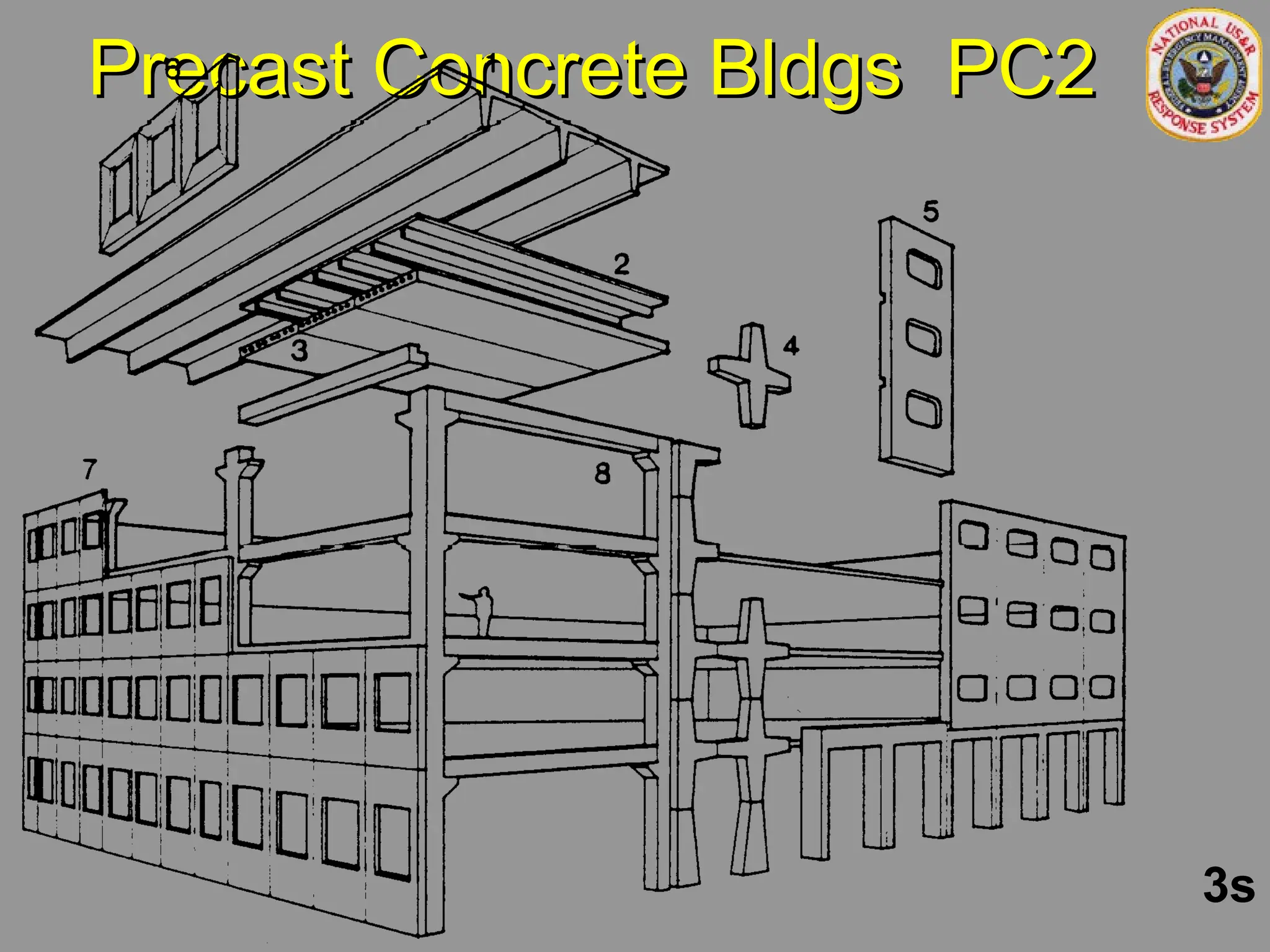
Precast Concrete Bldgs PC2
3s
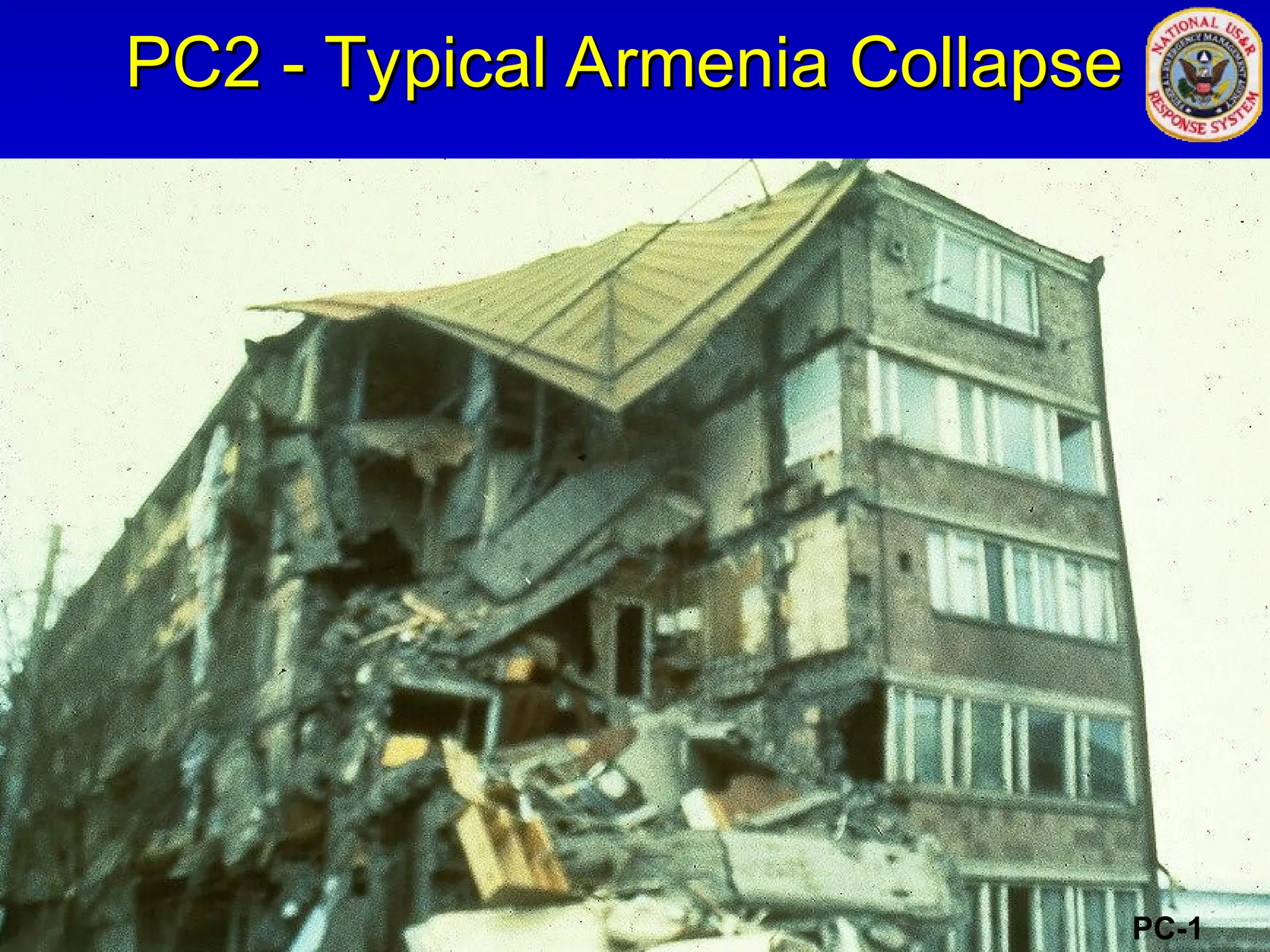
PC2 - Typical Armenia Collapse
PC-1
PC2, Whittier Quake, May Co. Garage
PC-2
PC2 Parking Garage
PC2 Parking Garage
Mexico City Quake, no damage - non C1
PC-3
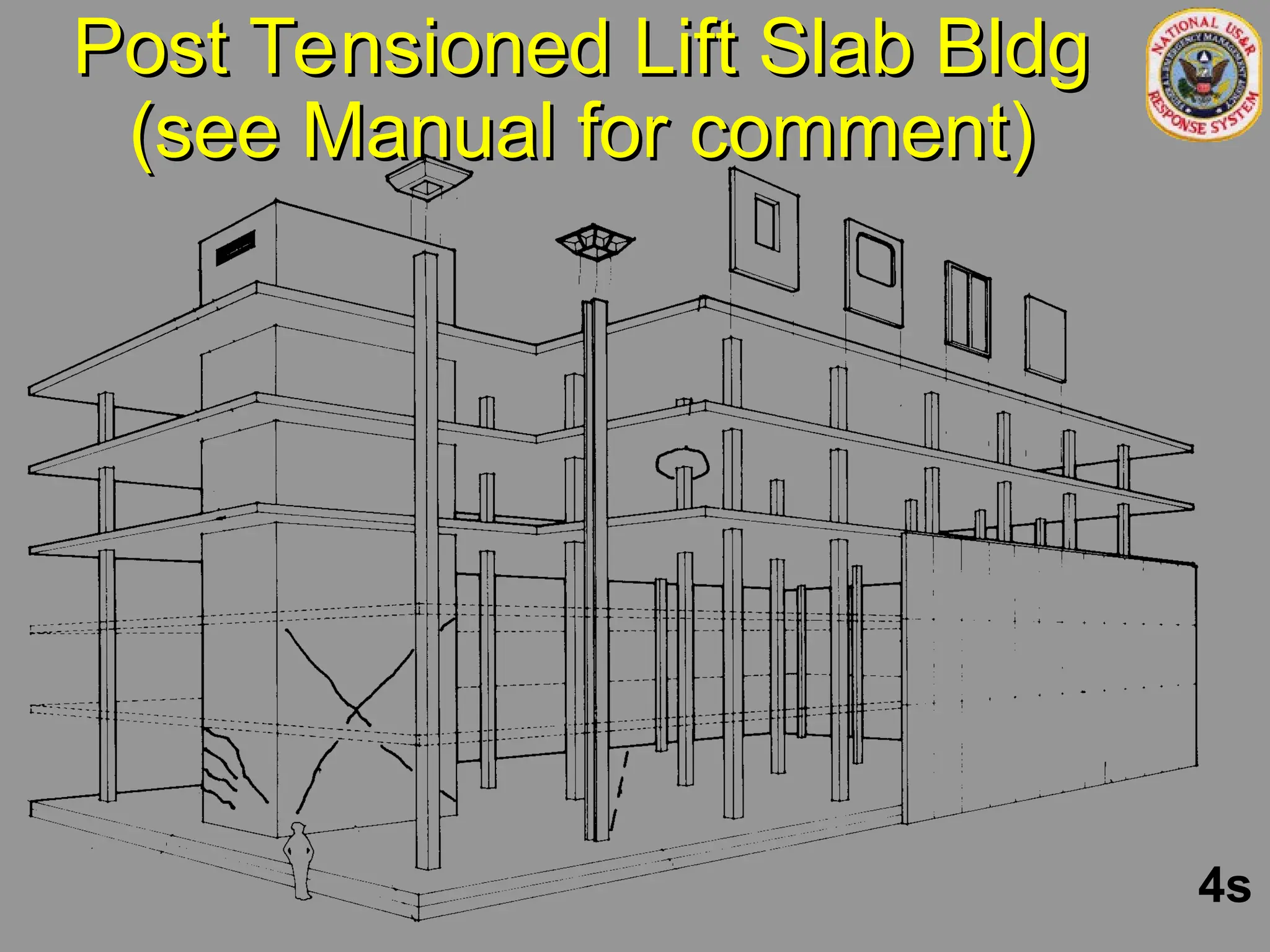
Post Tensioned Lift Slab Bldg
(see Manual for comment)
4s
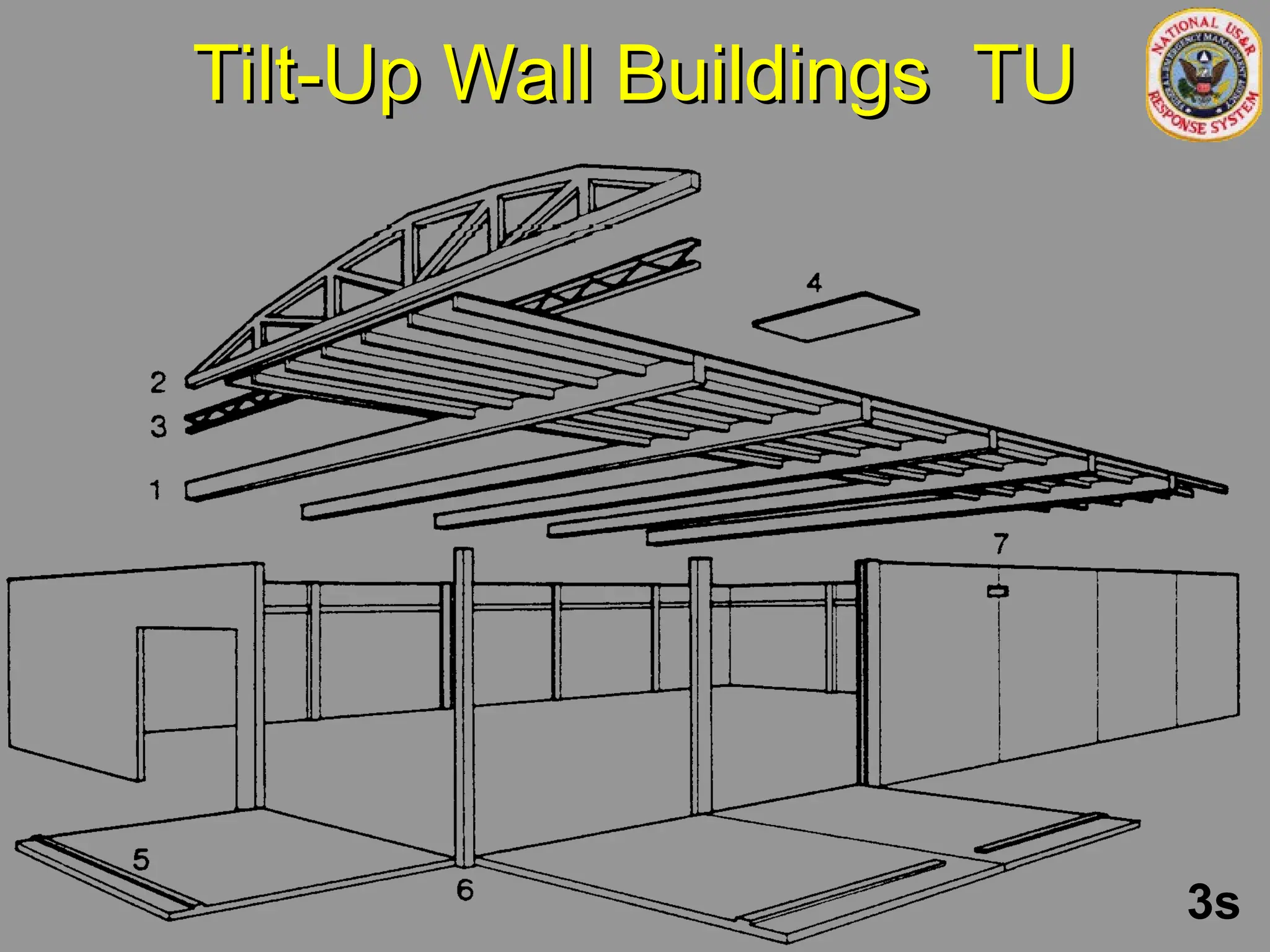
Tilt-Up Wall Buildings TU
3s
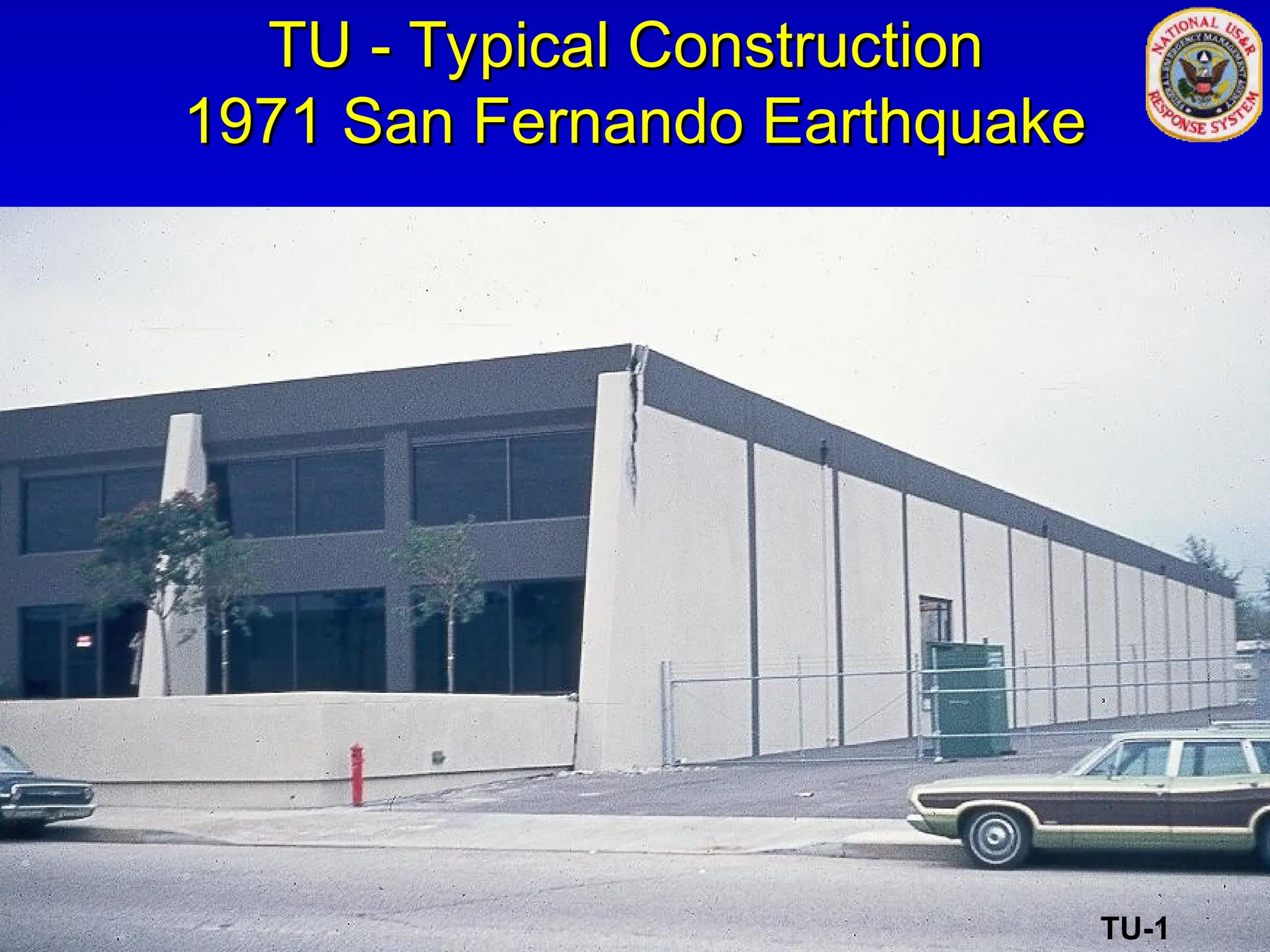
TU - Typical Construction
1971 San Fernando Earthquake
TU-1
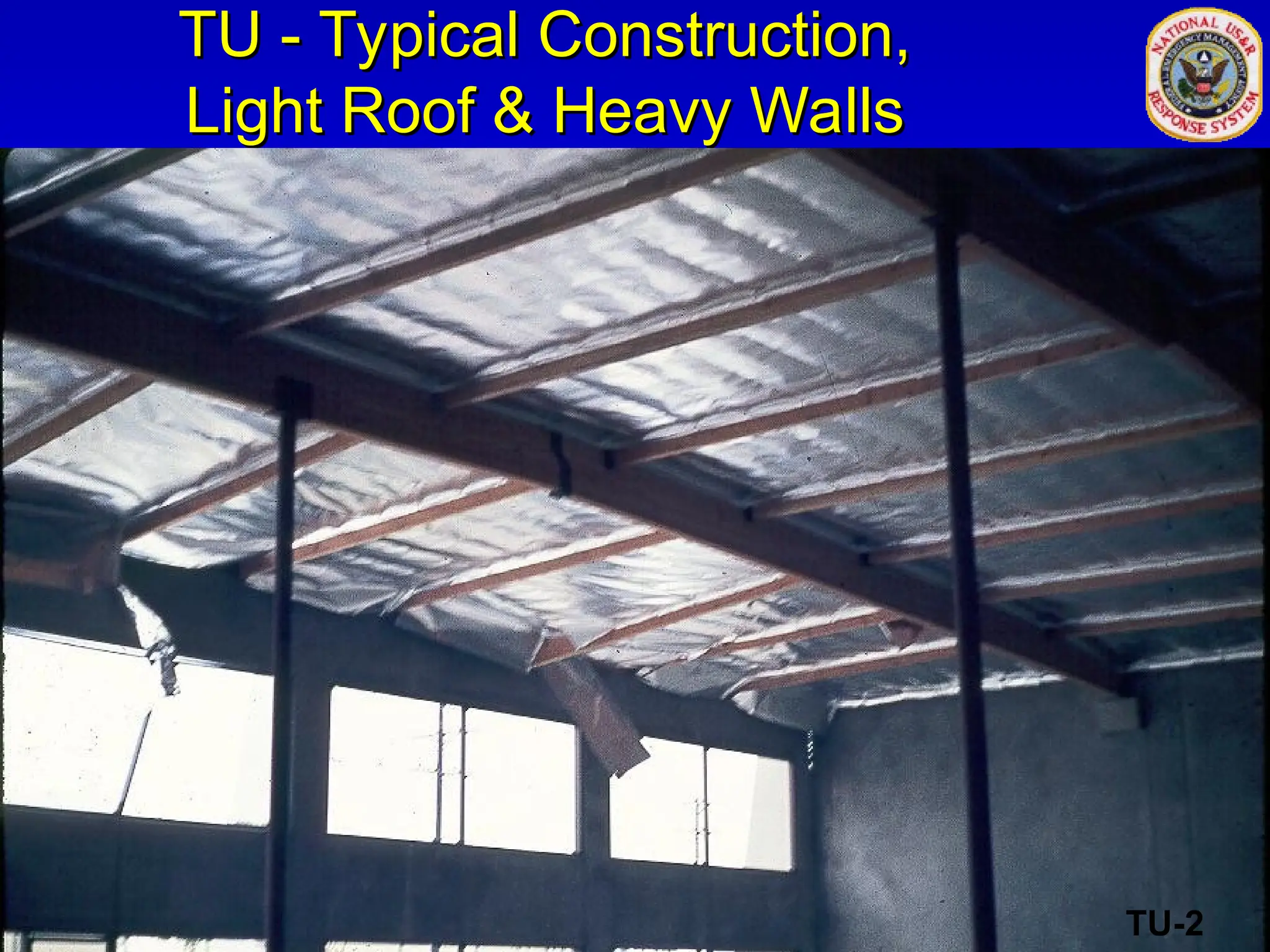
TU - Typical Construction,
Light Roof & Heavy Walls
TU-2
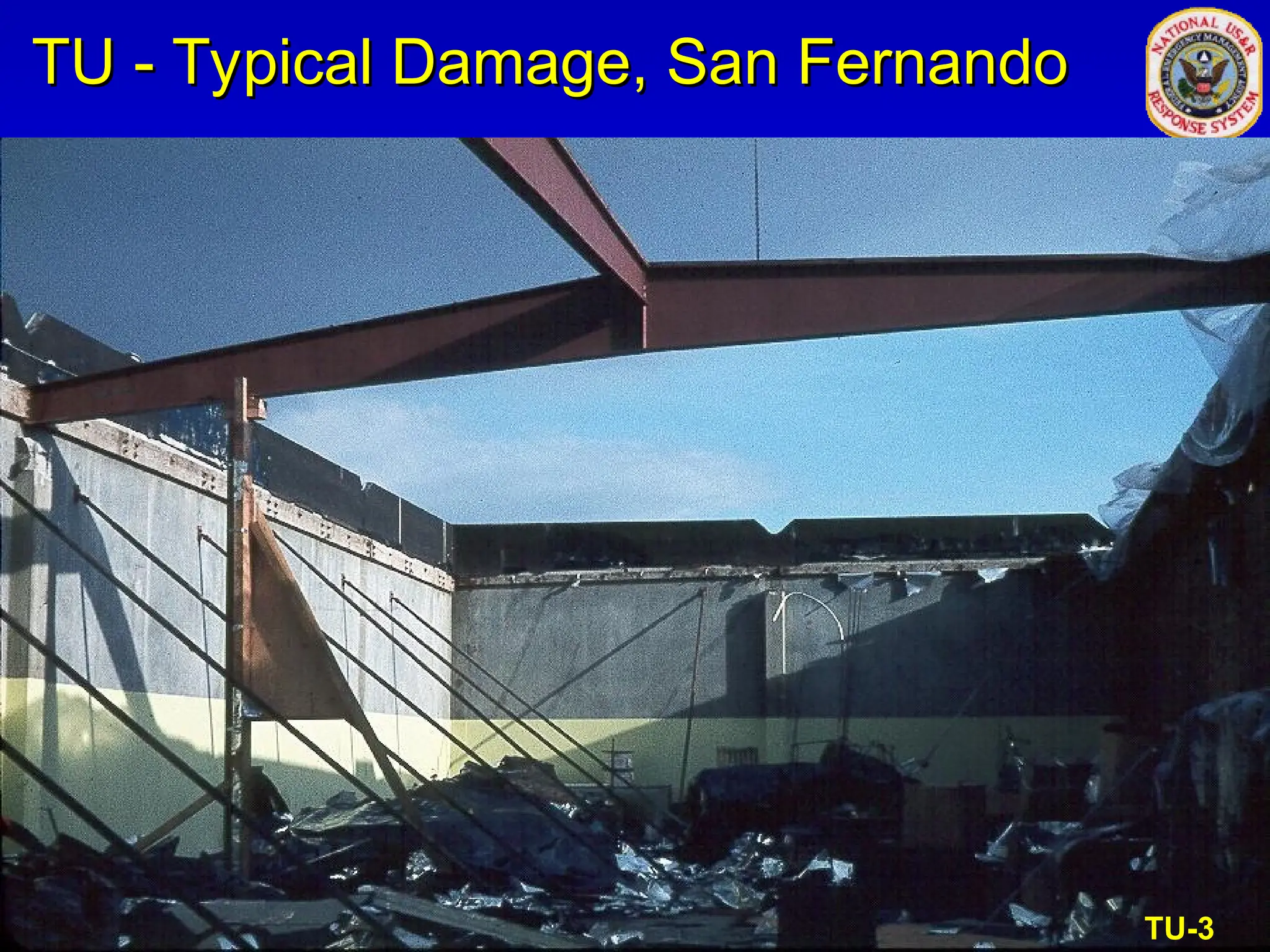
TU - Typical Damage, San Fernando
TU-3
Types of URM Buildings
• Brick bearing wall buildings -
– URM exterior walls
– Wood floors & interior walls.
• URM infill - in concrete or steel frames.
– infill is brick, hollow clay tile, hollow CMU
• UR, hollow conc block bearing wall .
– may have bond beams at floor & roof
– may have vertical bar at edges of opngs
Types of URM Buildings
• UR or Under-reinforced Brick cavity walls.
– insulation layer between masonry layers
– may be used as infill or as bearing walls with bond
beams.
• Masonry veneer on wood/steel studs
– anchorage is all important due to interaction of
brittle wall covering on flexible structure.
• Native stone, adobe, mud, etc. bearing wall
buildings.
URM Bearing Wall Bldg
3s
Typical URM Layout
Typical URM Layout
unless veneer covers it up
URM-1
Bearing wall Type URM - 1906 EQ
URM-2
Stanford
Memorial
Church
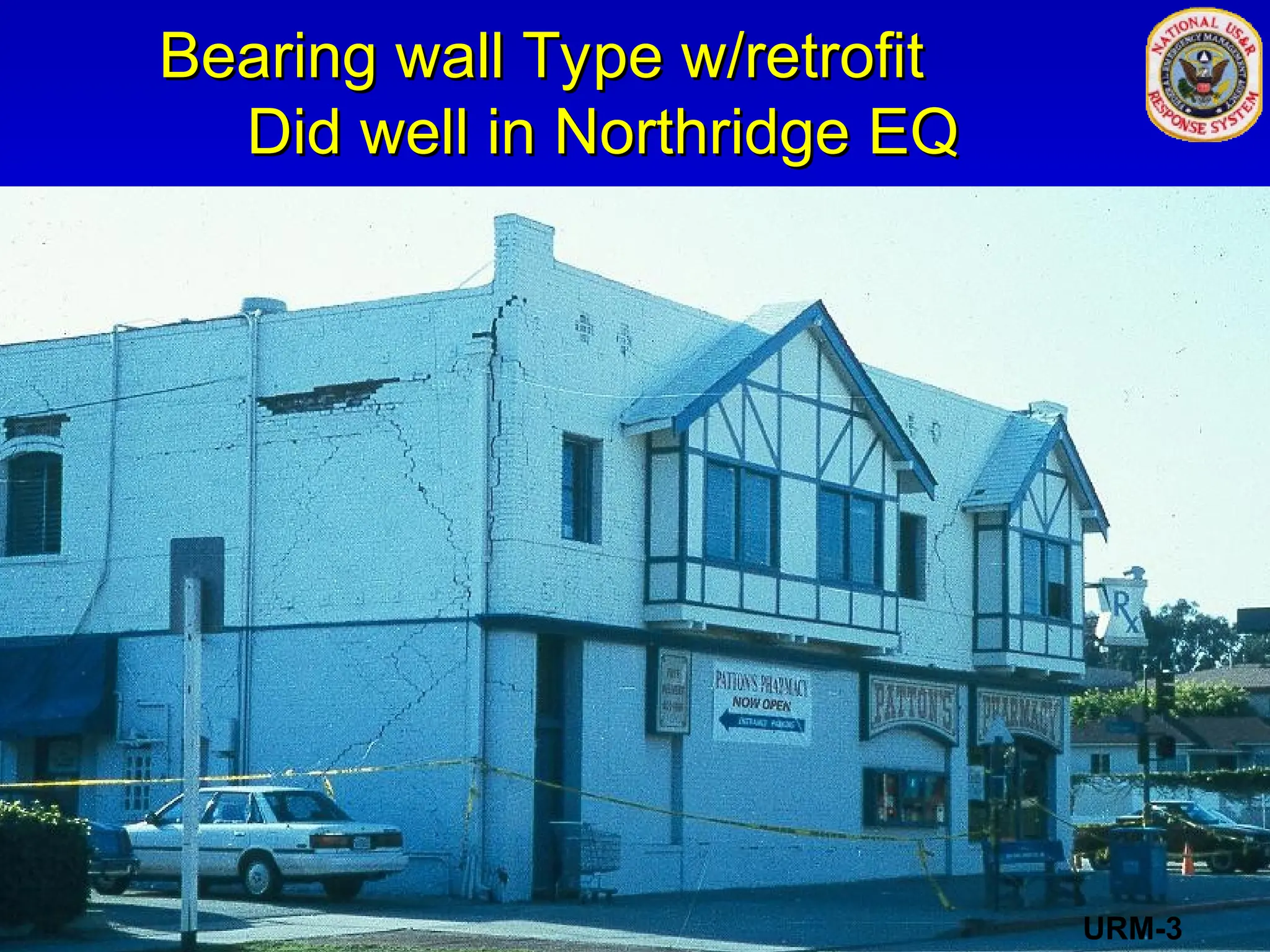
Bearing wall Type w/retrofit
Did well in Northridge EQ
URM-3
URM Steel
URM Steel
Frame
Frame
0s
URM
URM
Concrete
Concrete
Frame
Frame
2s
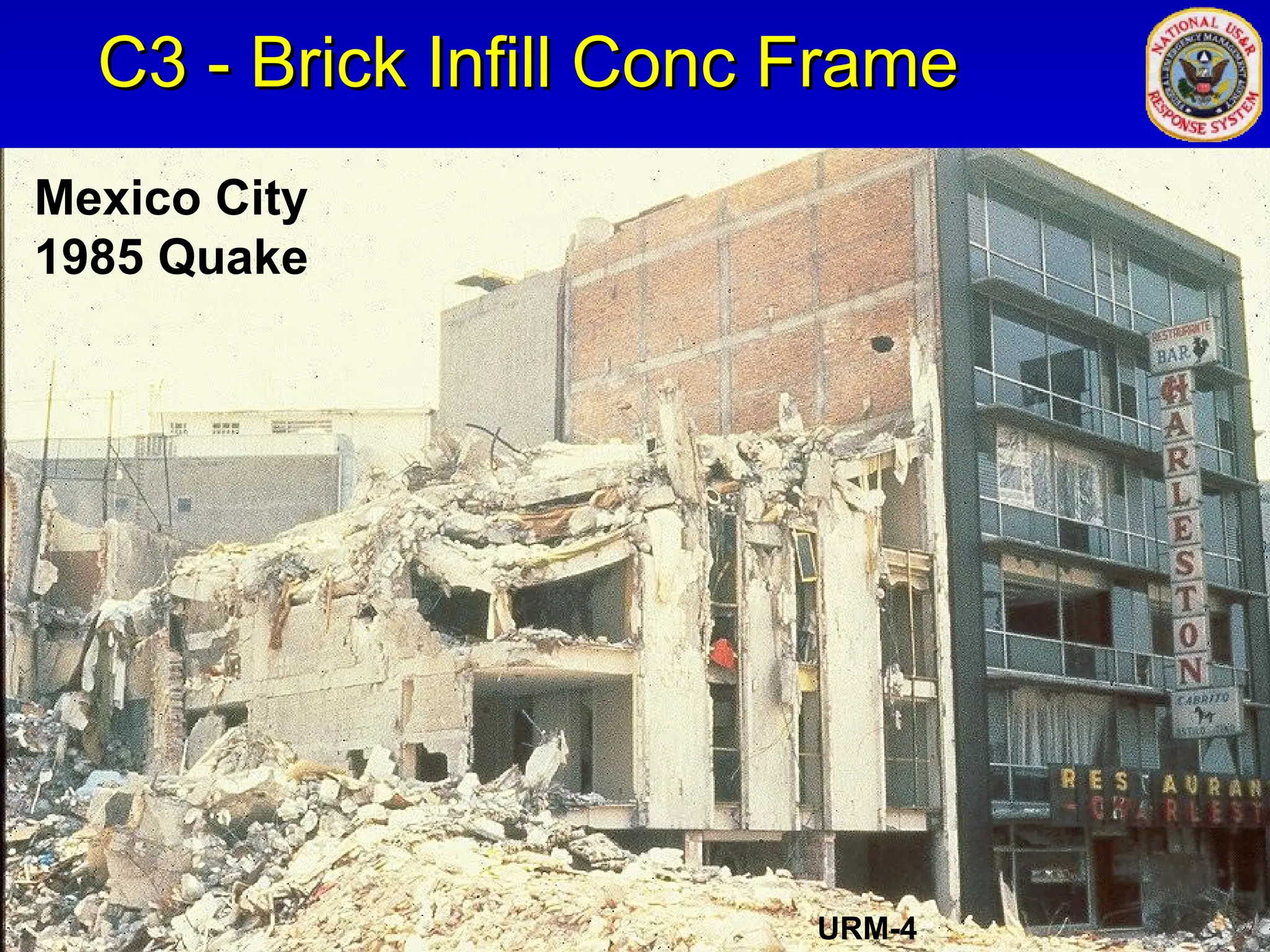
C3 - Brick Infill Conc Frame
URM-4
Mexico City
1985 Quake
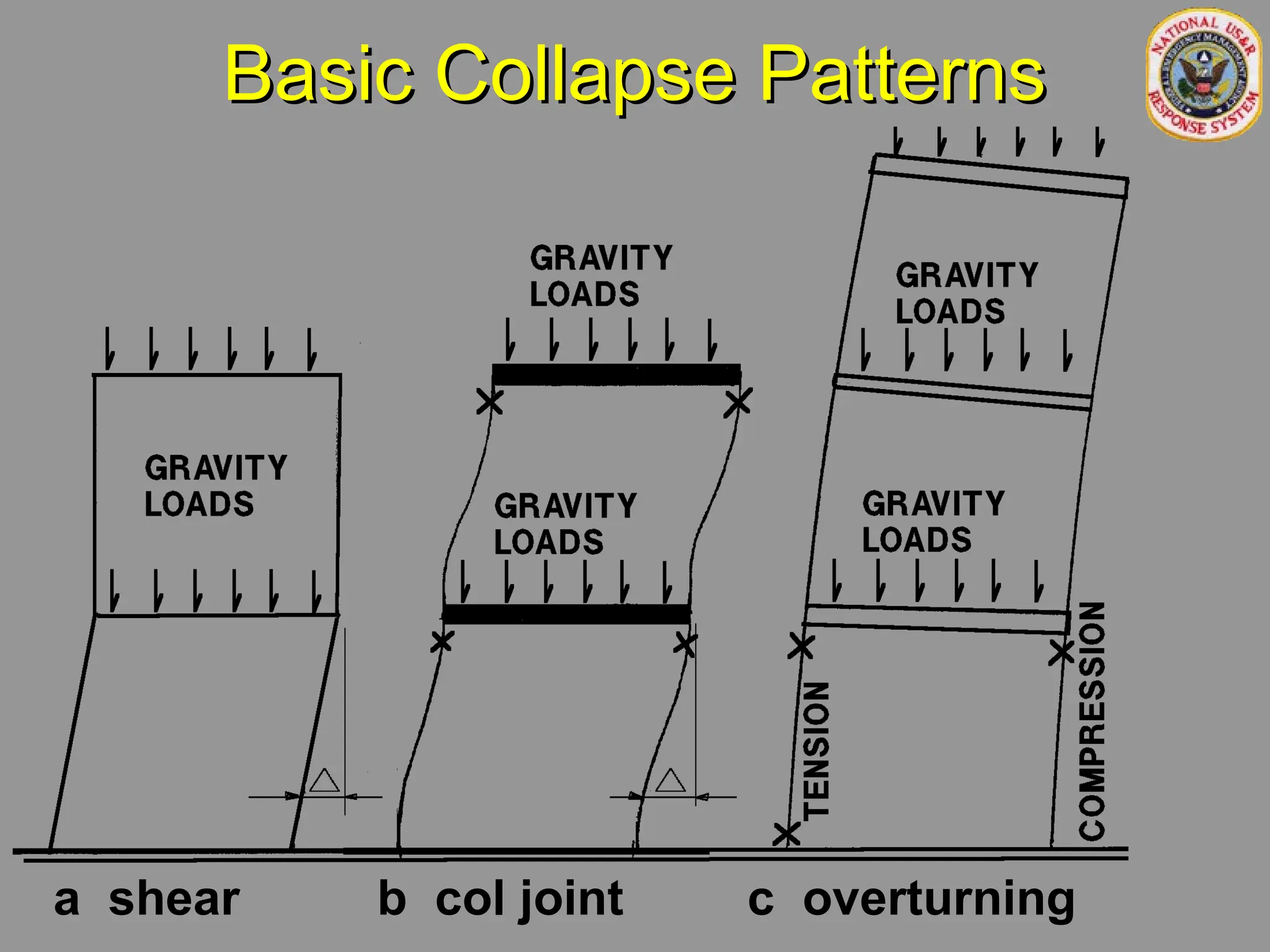
Basic Collapse Patterns
a shear b col joint c overturning
Basic Collapse Patterns
d wall joint e local column f single story
BASIC PRINCIPLES
BASIC PRINCIPLES
Earthquake Caused Collapse
• Earthquake shaking causes damage to
structural load resisting system
• Gravity causes structural collapse
• Redundancy and Ductile behavior can
prevent structural collapse
• Brittle behavior enhances possibility of
structural collapse
Earthquake Collapse Patterns
• Light Frame - wood frame buildings
1 to 4 stories, residential & other
• Heavy Wall - URM, TU, & other low rise
w/concrete or masonry walls
• Heavy Floor - Concrete frame bldgs
• Precast Concrete - fairly heavy floors &
some w/heavy walls
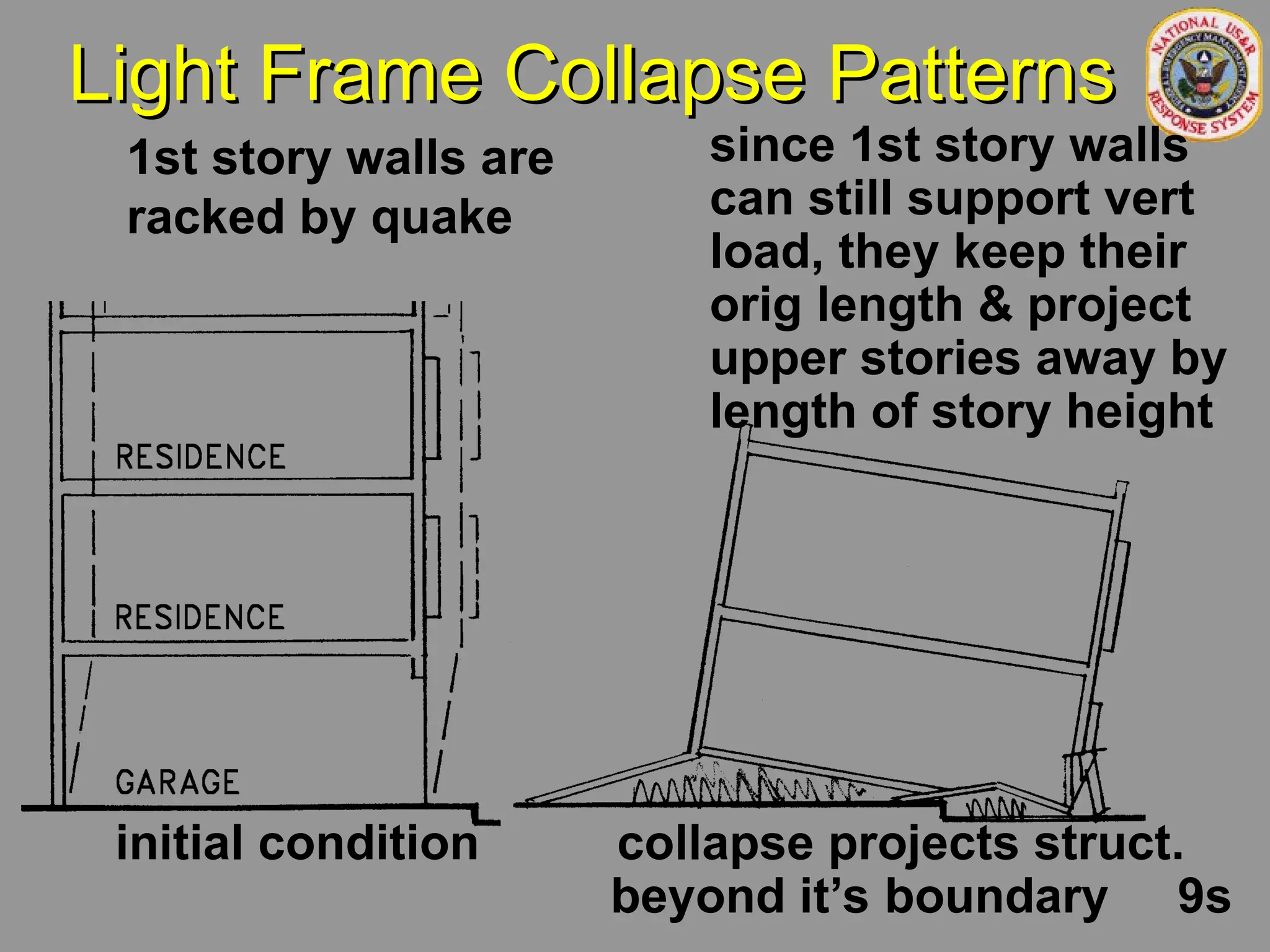
Light Frame Collapse Patterns
initial condition collapse projects struct.
beyond it’s boundary 9s
1st story walls are
racked by quake
since 1st story walls
can still support vert
load, they keep their
orig length & project
upper stories away by
length of story height
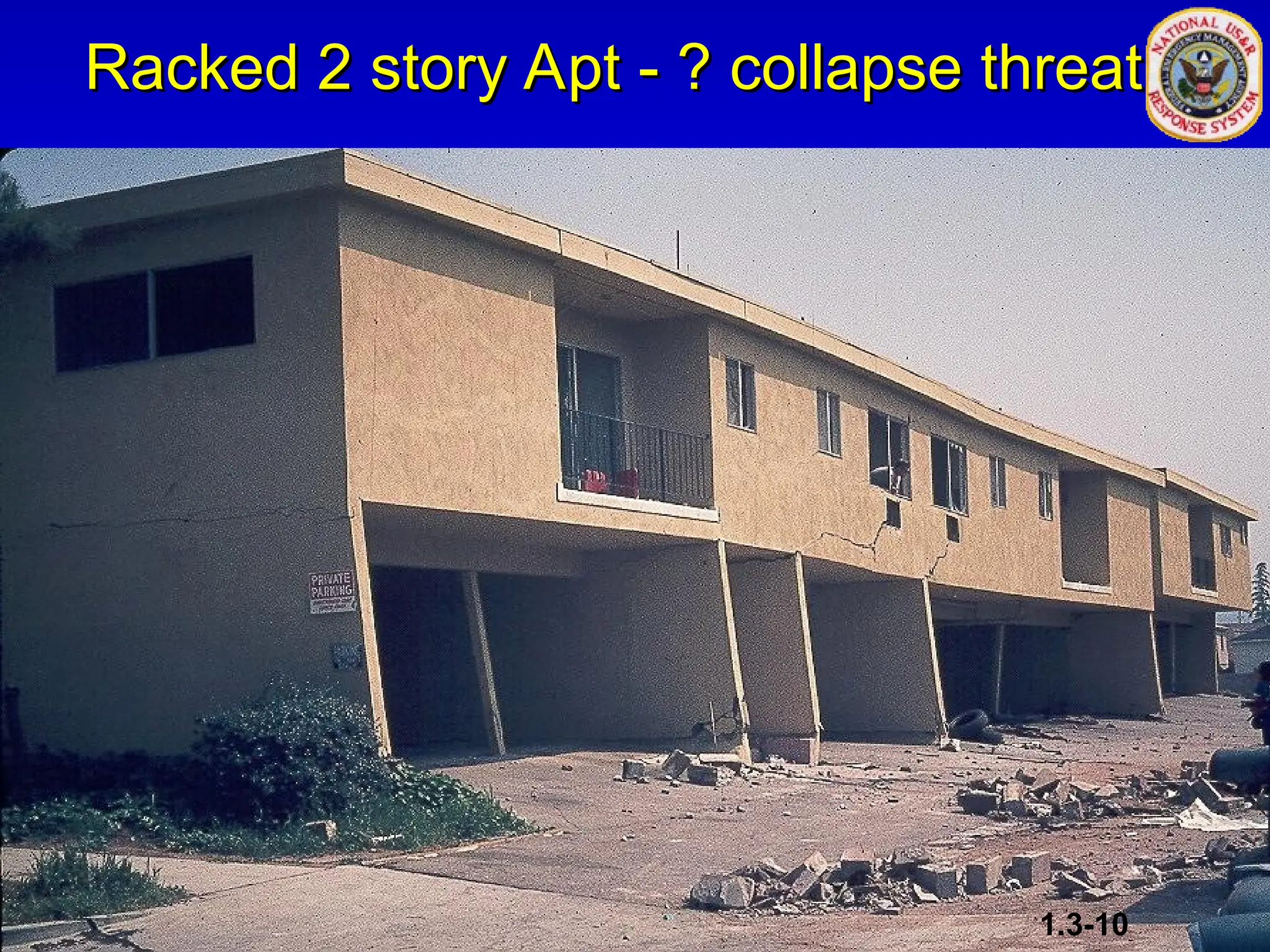
Racked 2 story Apt - ? collapse threat
1.3-10
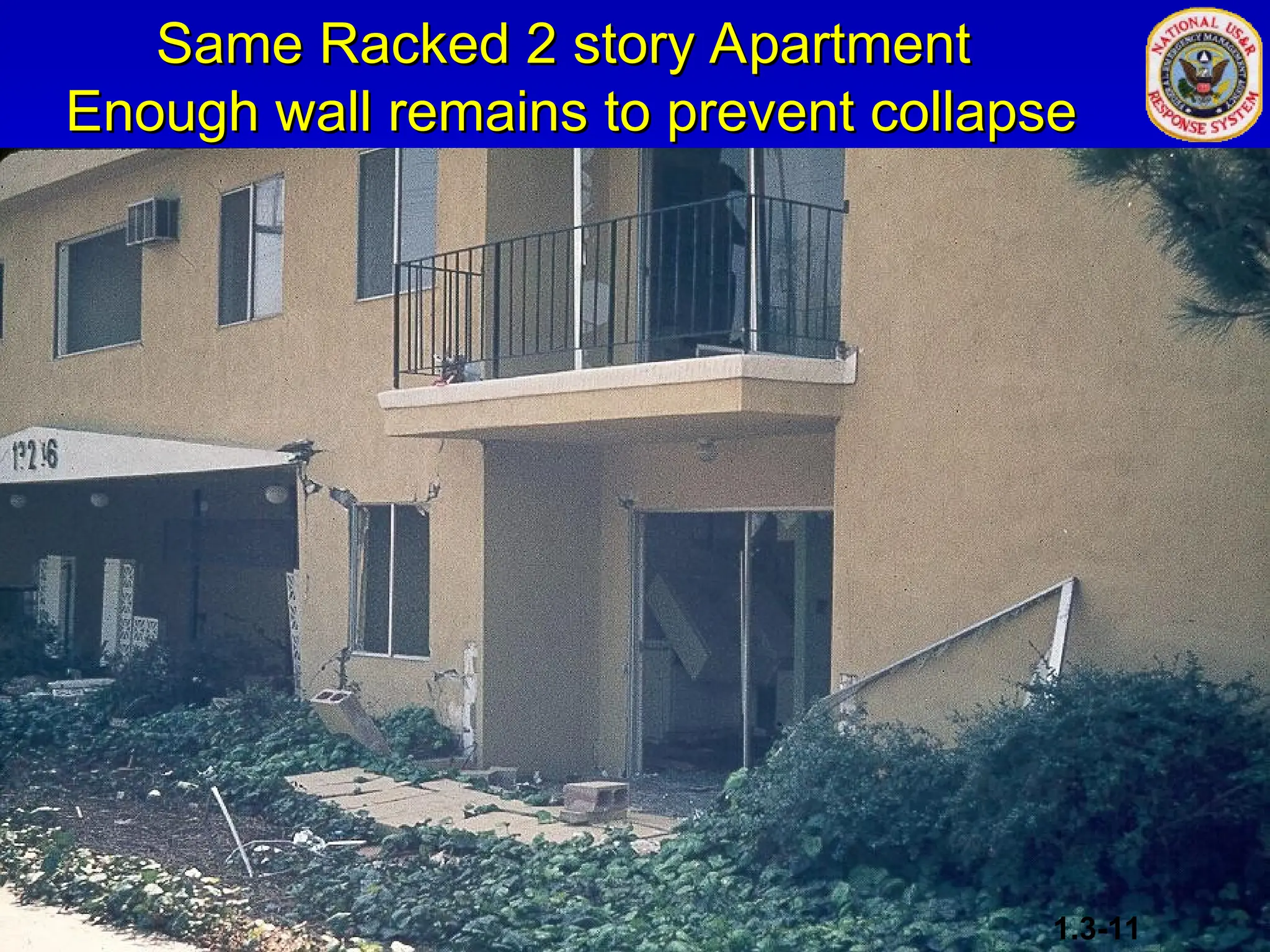
Same Racked 2 story Apartment
Enough wall remains to prevent collapse
1.3-11
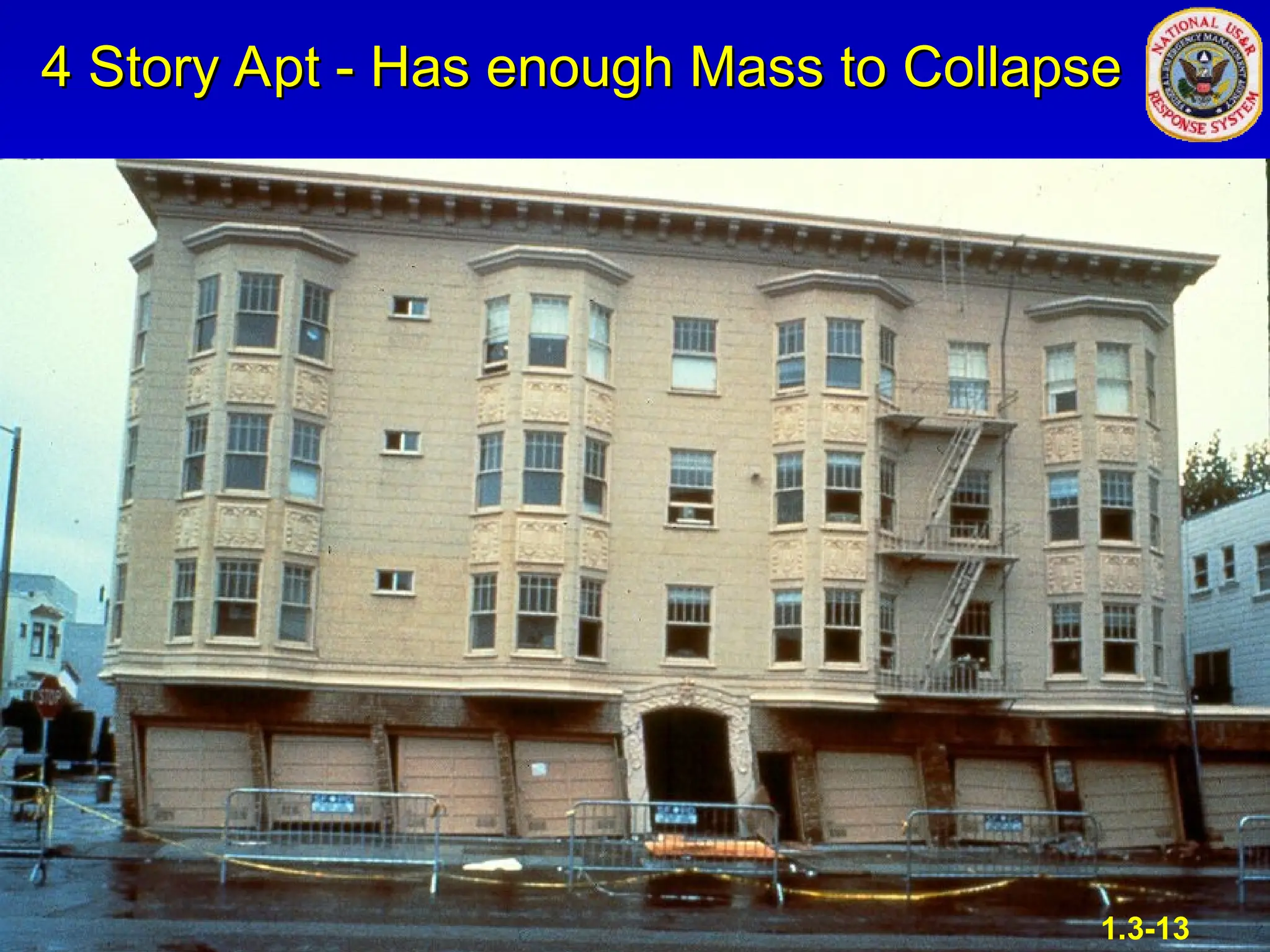
4 Story Apt - Has enough Mass to Collapse
1.3-13
Overview of 3 Story Collapse
1.3-19a
3 Story collapse projected away
from adjacent building
1.3-14
3 Story collapse projected away
from adjacent building
1.3-14a
3 Story collapse projected into street
1.3-15
3 Story collapse projected into street
1.3-16
3 Story collapse projected into street
1.3-18
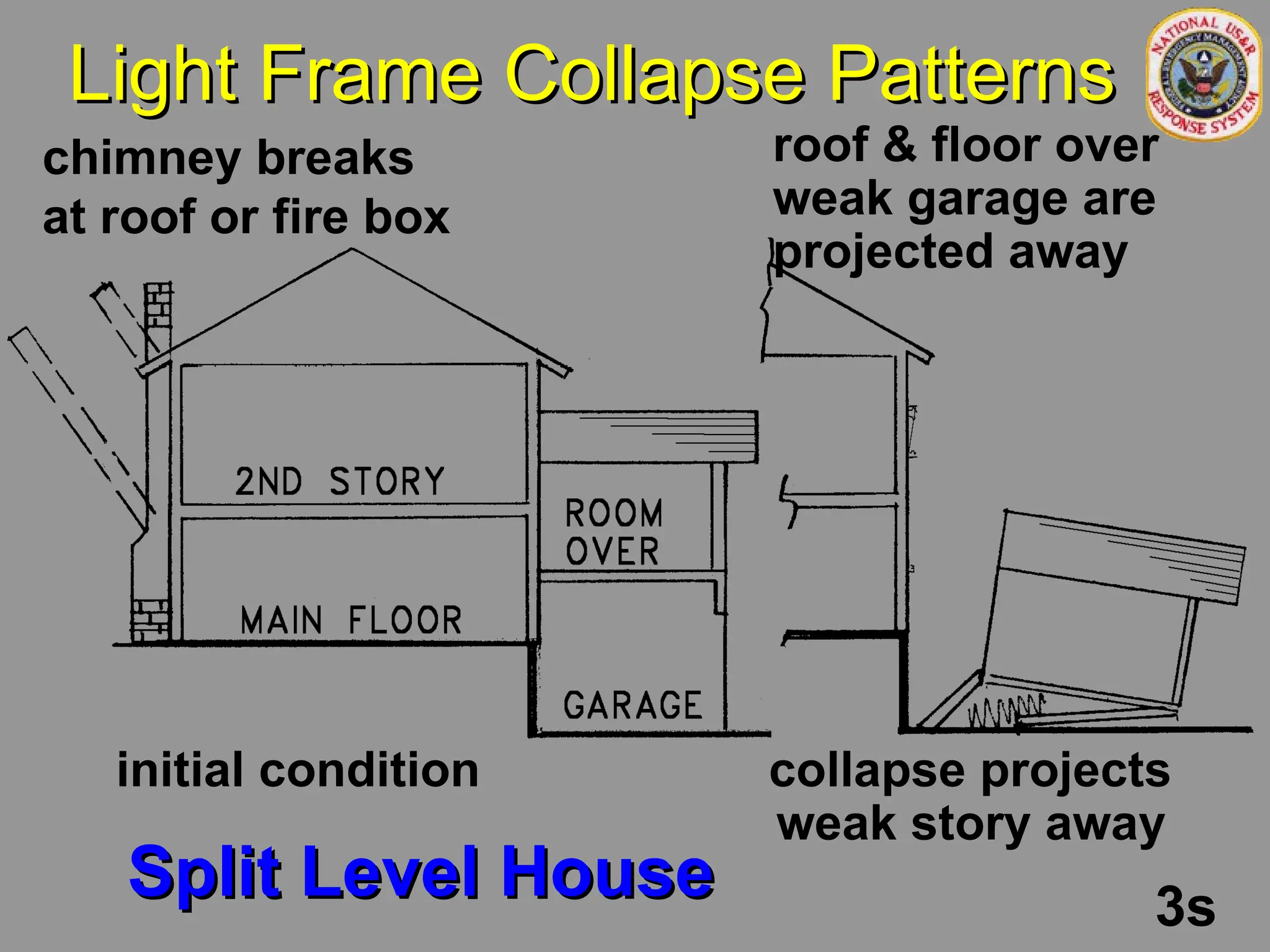
Light Frame Collapse Patterns
chimney breaks
at roof or fire box
initial condition collapse projects
weak story away
Split Level House
Split Level House
roof & floor over
weak garage are
projected away
3s
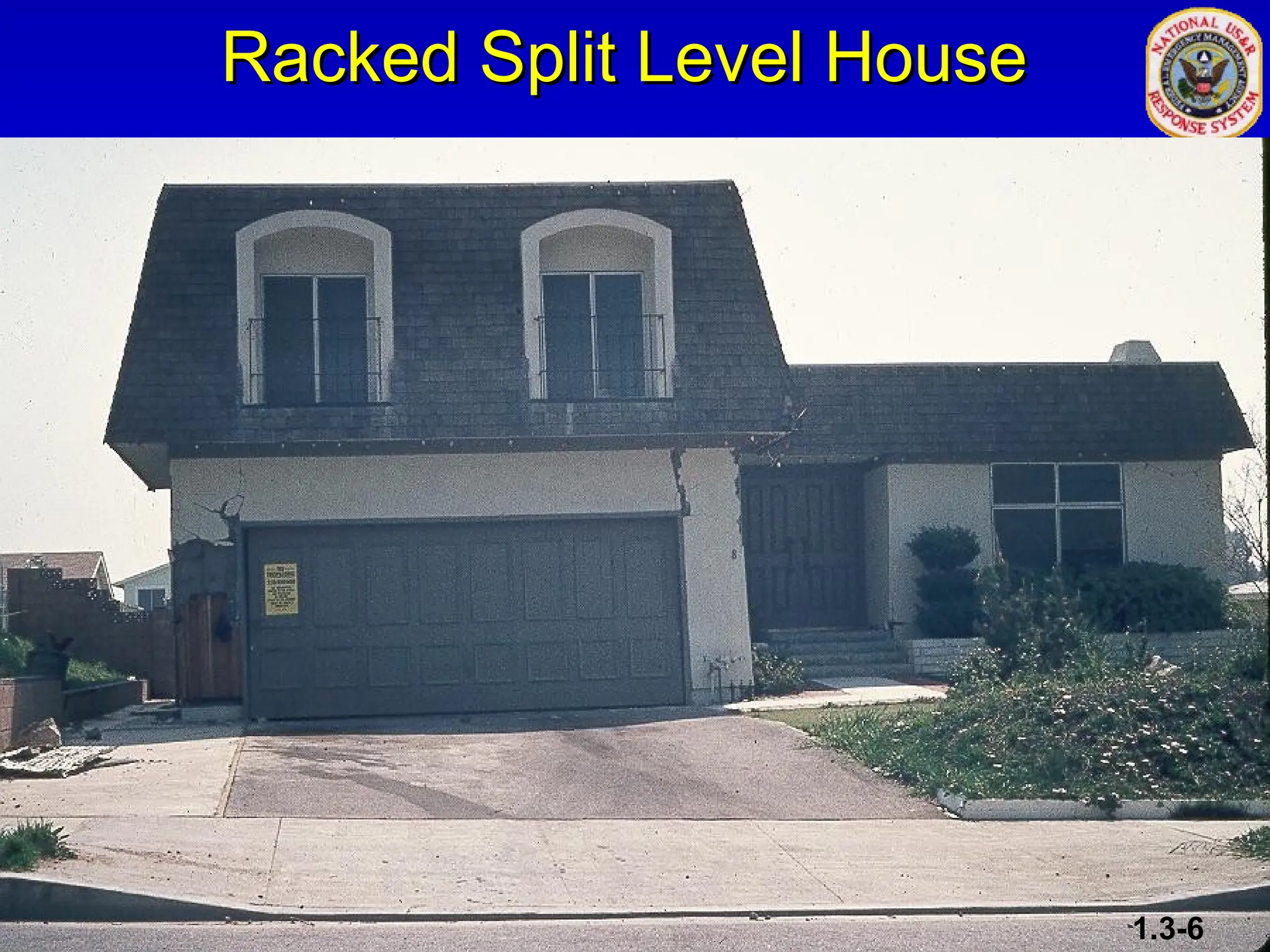
Racked Split Level House
1.3-6
Collapsed Split Level on Garage
1.3-7
Collapsed Split Level on Garage
1.3-7
1.3-7a
Light Frame Collapse Patterns
chimney can fall
as far as it is tall
discontinuous roof
can be knocked off
cripple wall
weak cripple wall racks and allows
house to move as much as it’s ht.
1 to 3 Story House with Cripple Wall
2s
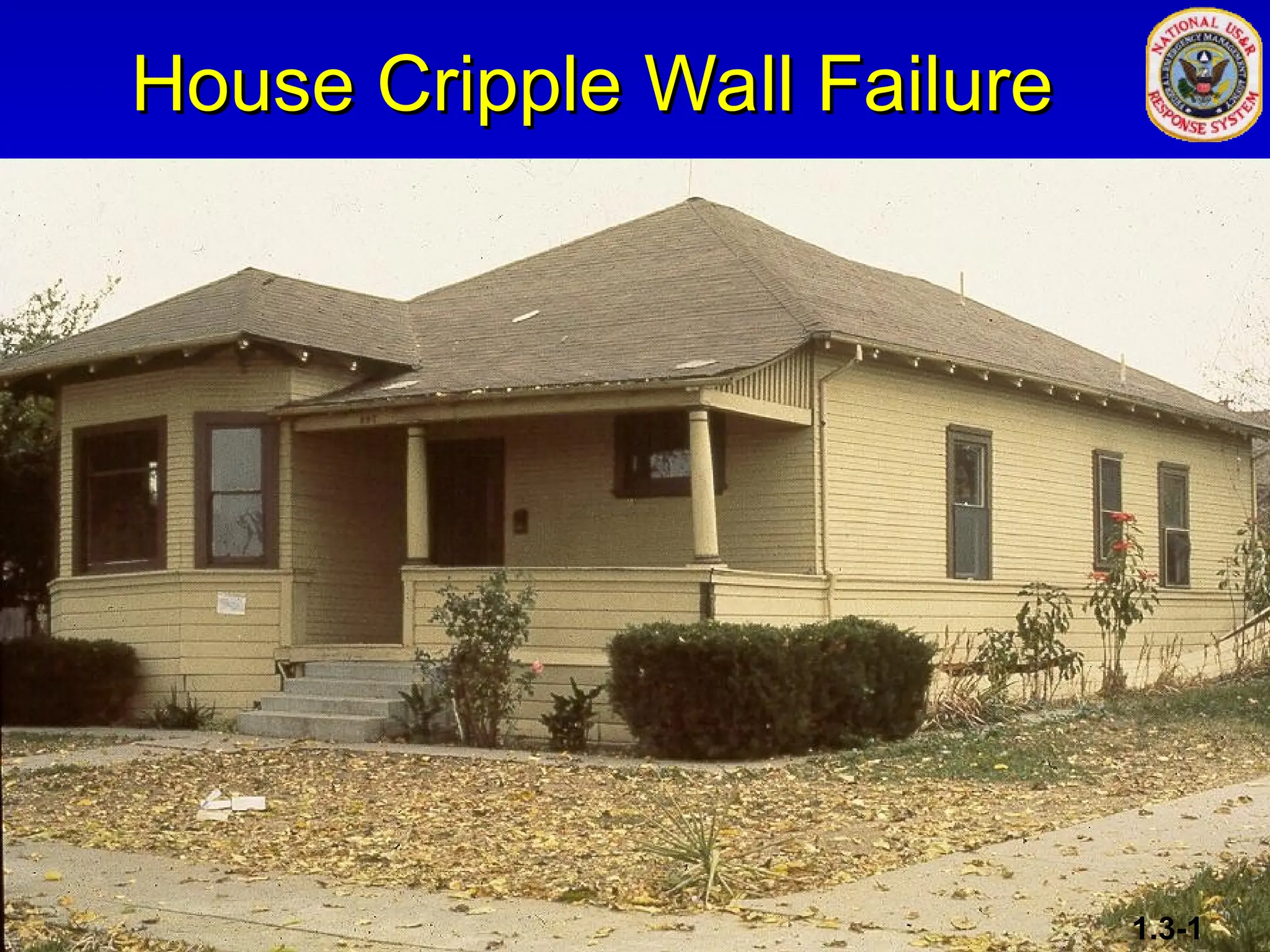
House Cripple Wall Failure
1.3-1
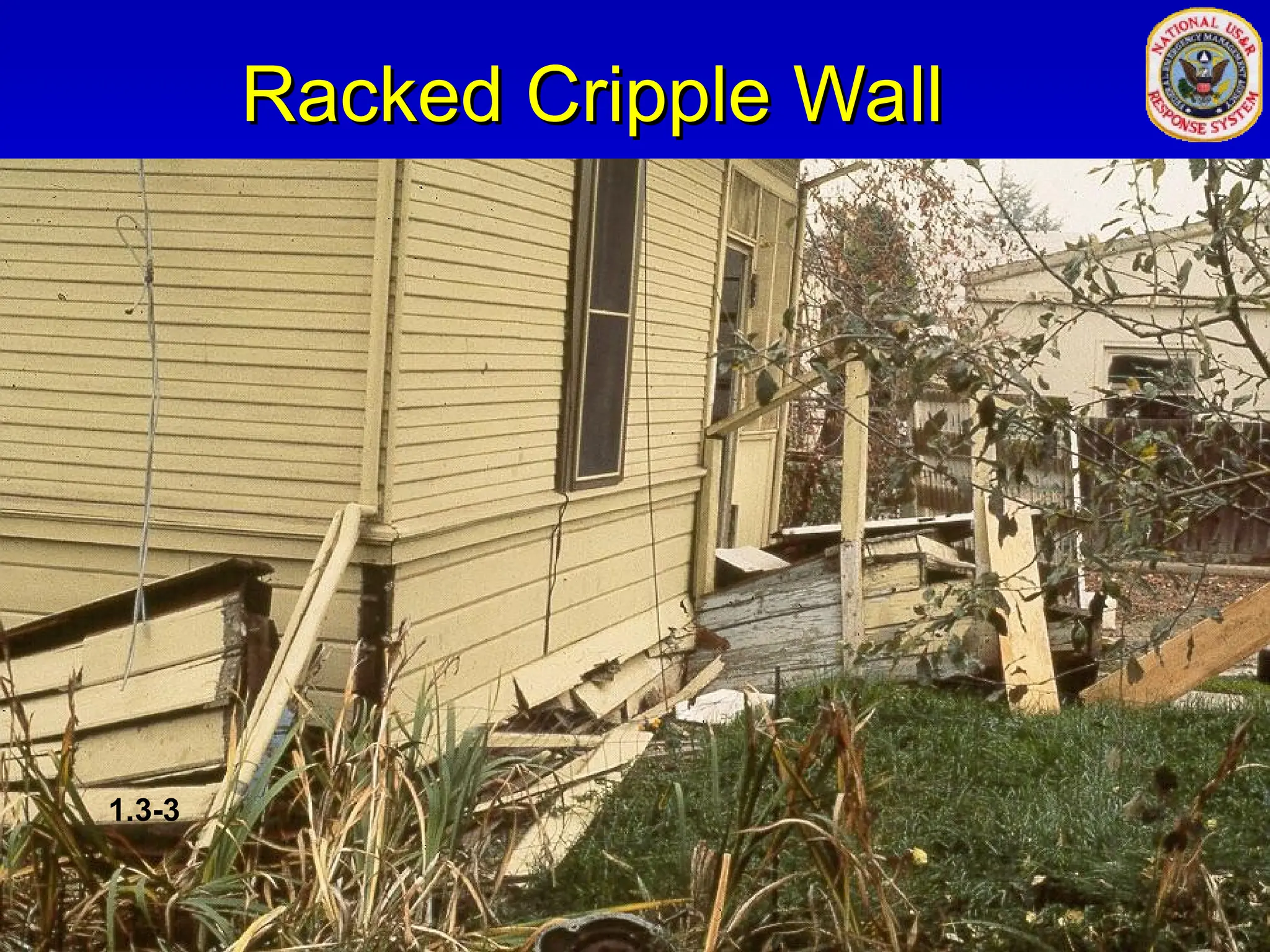
Racked Cripple Wall
Racked Cripple Wall
1.3-3
Light Frame Collapse Patterns
1 to 3 Story House or Apartment
typical masonry
chimney problem
brick veneer is typical
falling hazard if present
floor joist bear directly on footing but
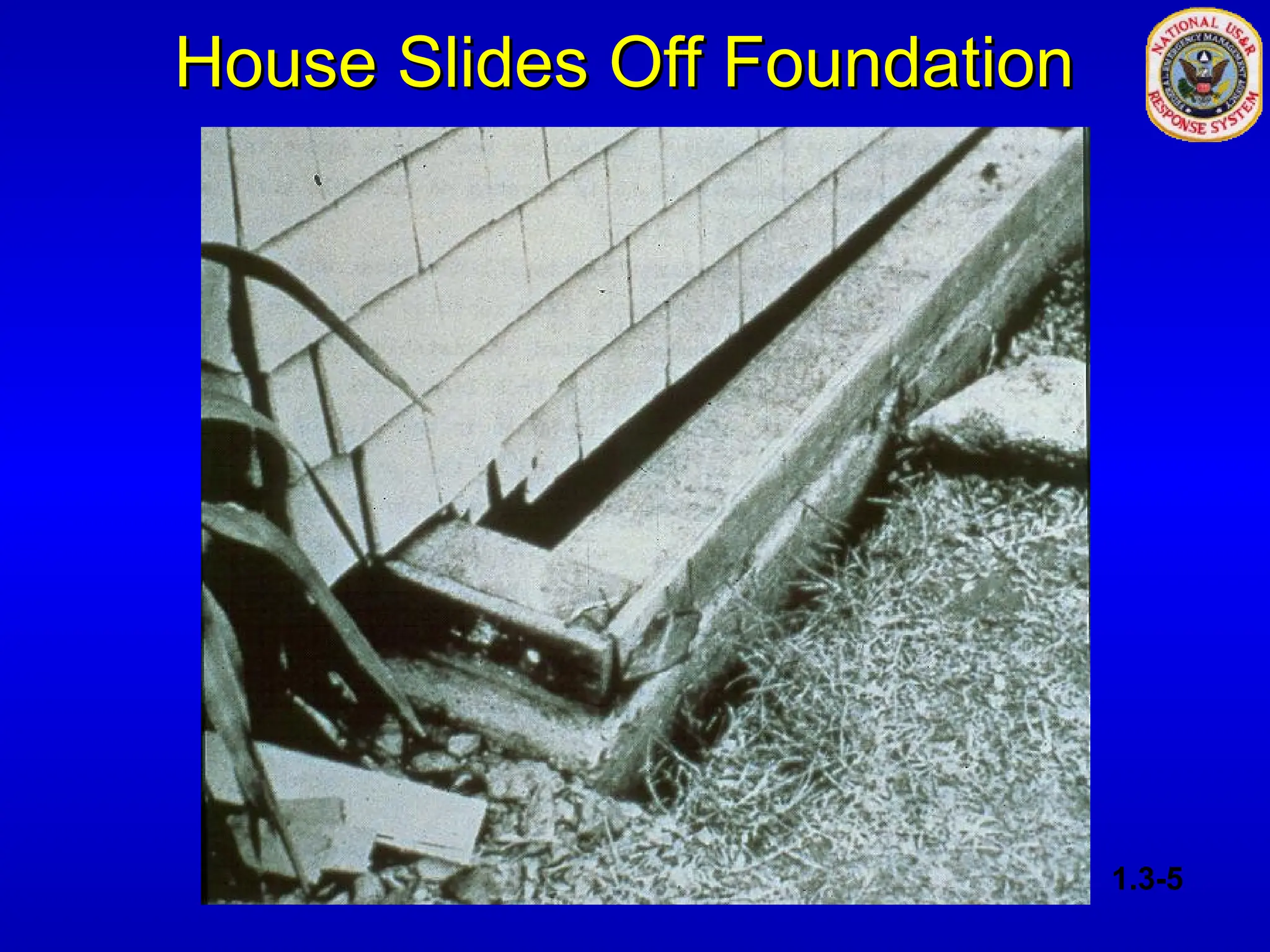
if inadequate conn, bldg will slide off 1s
House Slides Off Foundation
1.3-5
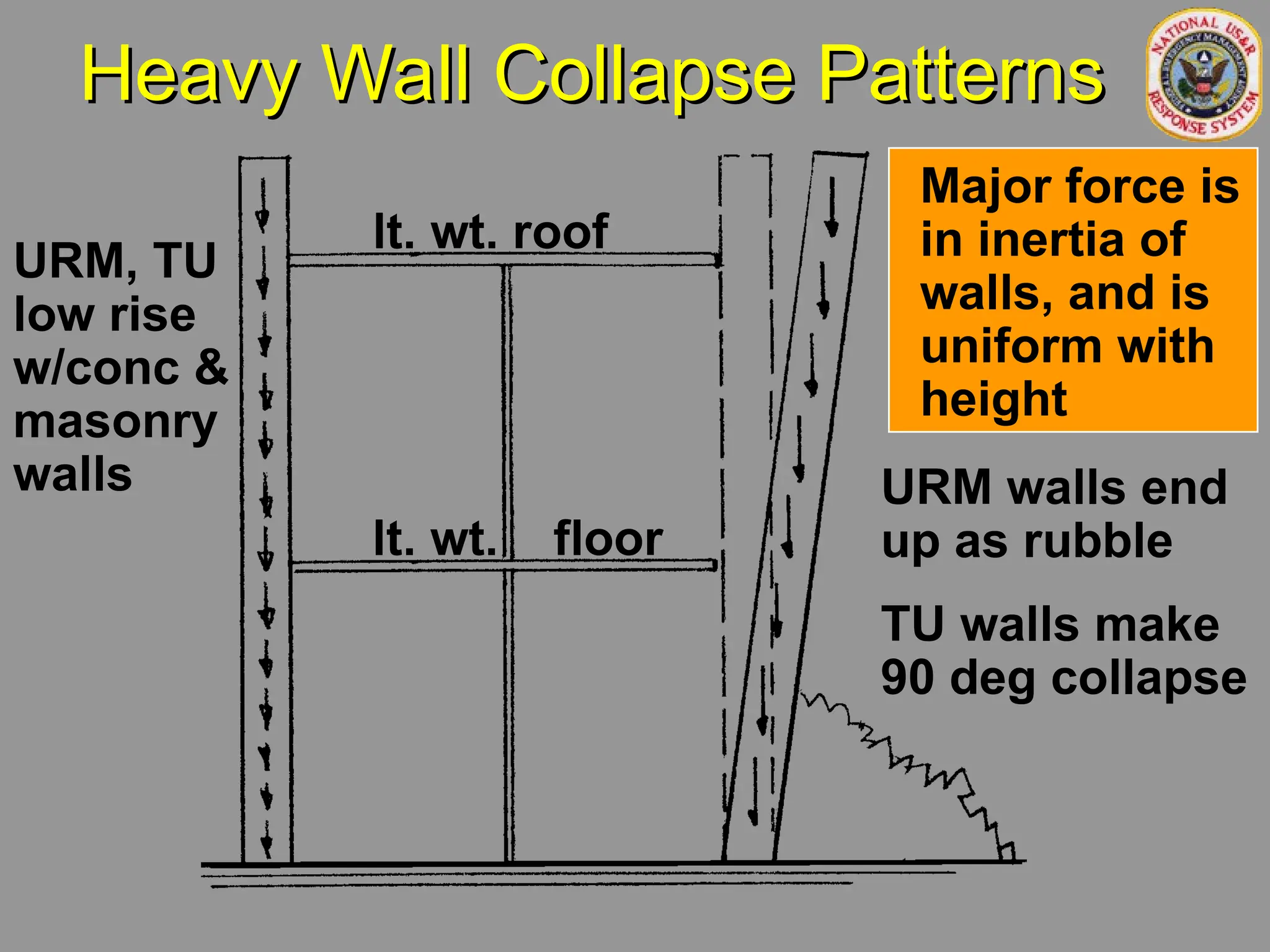
Heavy Wall Collapse Patterns
URM, TU
low rise
w/conc &
masonry
walls
lt. wt. roof
lt. wt. floor
Major force is
in inertia of
walls, and is
uniform with
height
URM walls end
up as rubble
TU walls make
90 deg collapse
Heavy Wall Collapse Patterns
Most Common URM Failure
roof & floors are supported
by interior walls, plumbing,
etc. redundant systems
store front w/
opngs & parapet
walls may split,
peel, crack, etc
5s
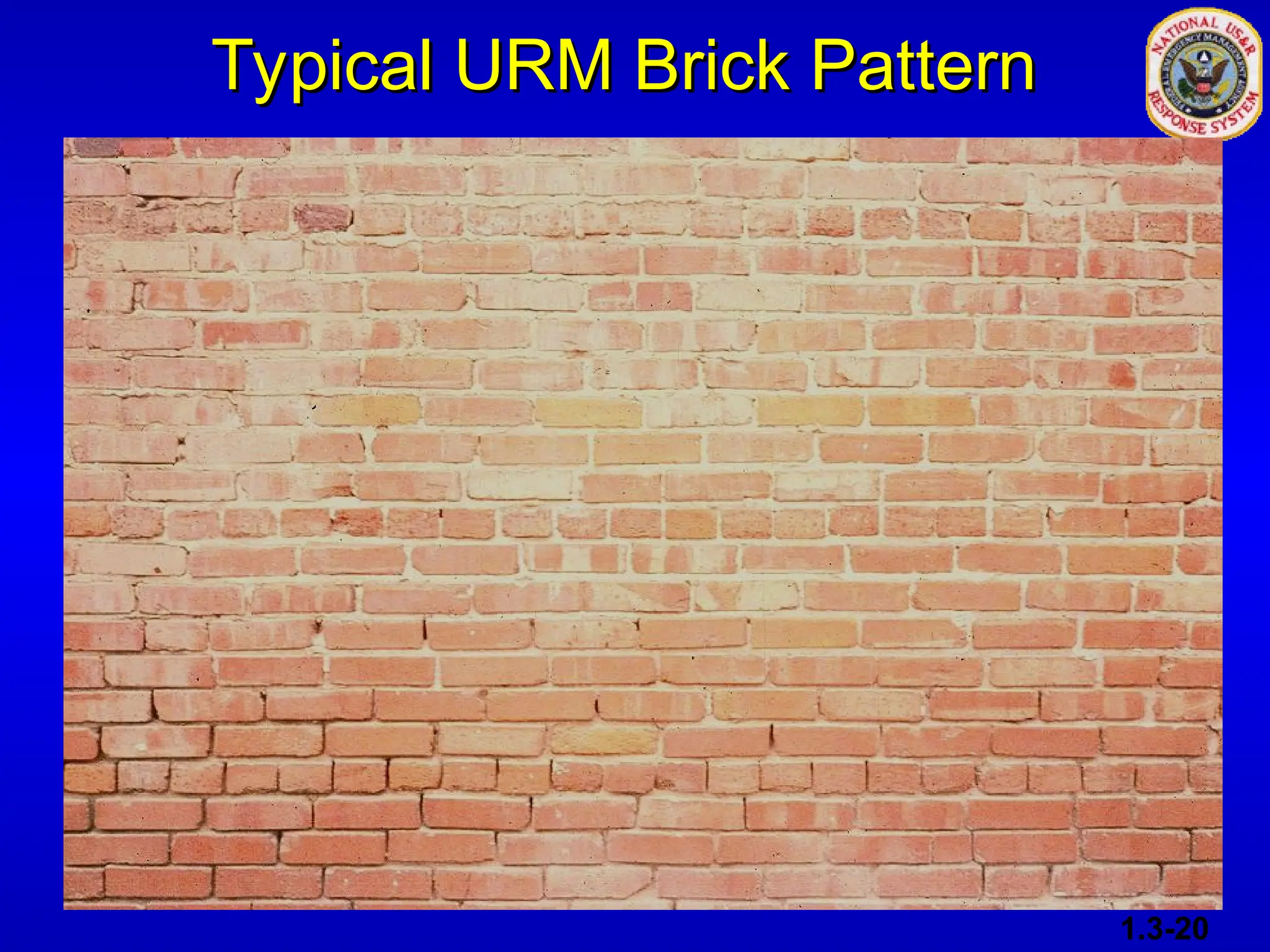
Typical URM Brick Pattern
1.3-20
Typical Front & Parapet Collapse
1.3-21
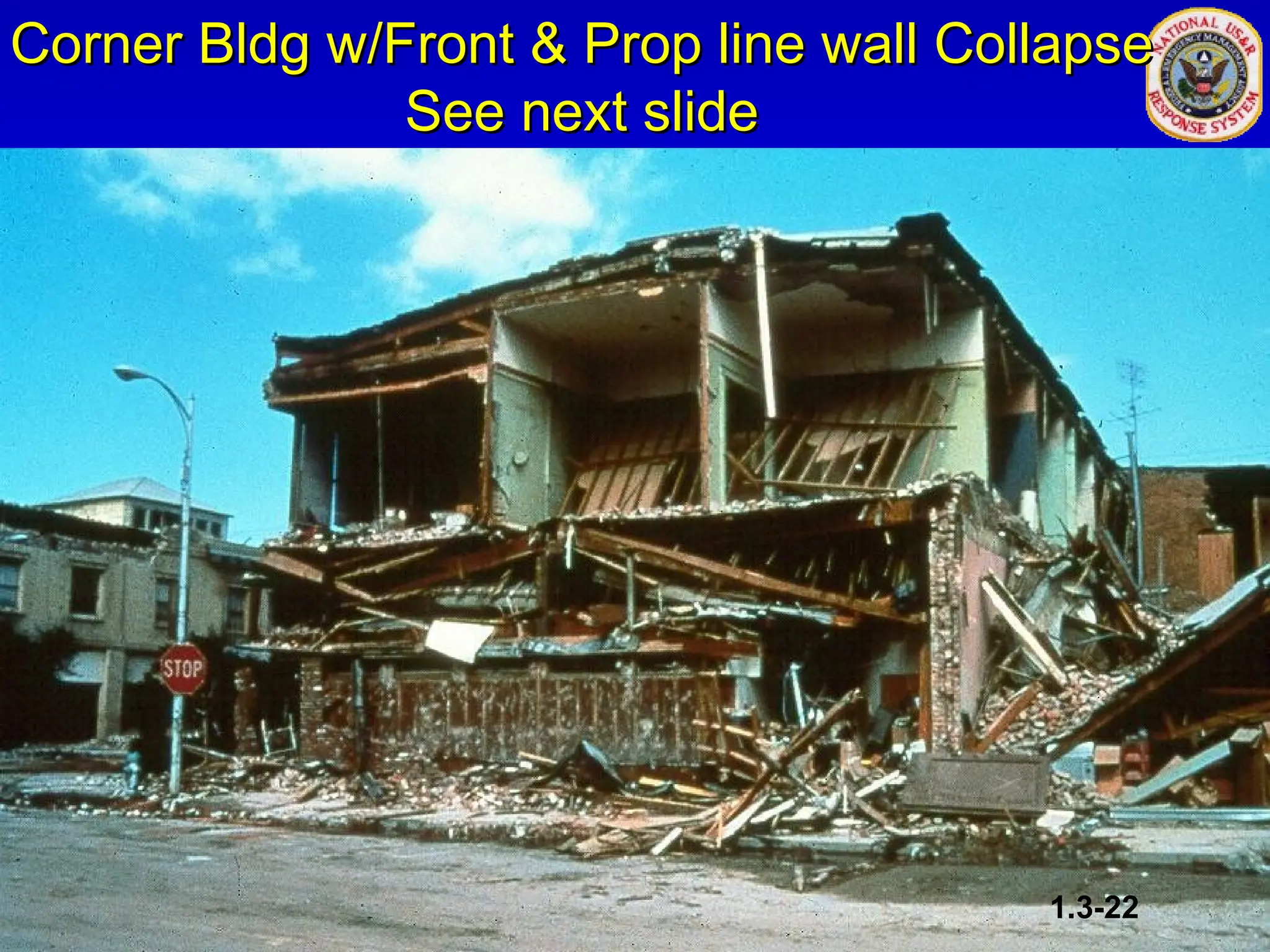
Corner Bldg w/Front & Prop line wall Collapse
See next slide
See next slide
1.3-22
Party wall failure caused collapse
of adjacent building’s lower roof
What redundant structure now supports high roof ?
1.3-23
Adjacent roof, no redundancy
Lean-To Collapse
Lean-To Collapse
1.3-24
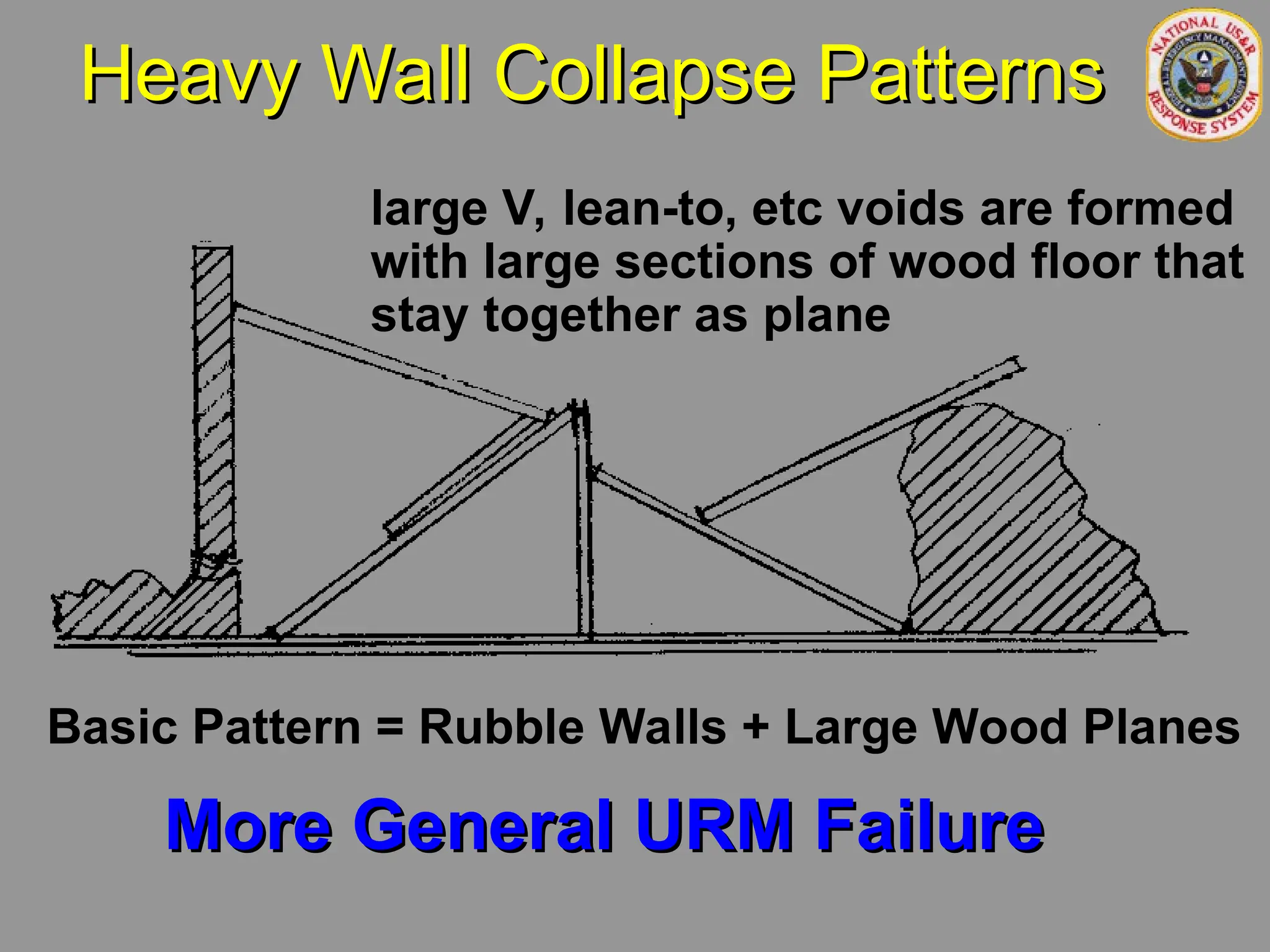
Heavy Wall Collapse Patterns
More General URM Failure
large V, lean-to, etc voids are formed
with large sections of wood floor that
stay together as plane
Basic Pattern = Rubble Walls + Large Wood Planes
Heavy Wall Collapse Patterns
Wood Floor Collapse Patterns
Wood Floor Collapse Patterns 3s
Lean-To Vee
Pancake Cantilever
URM Complete Collapse
Cantilever type in front, may also find other three types
1.3-25
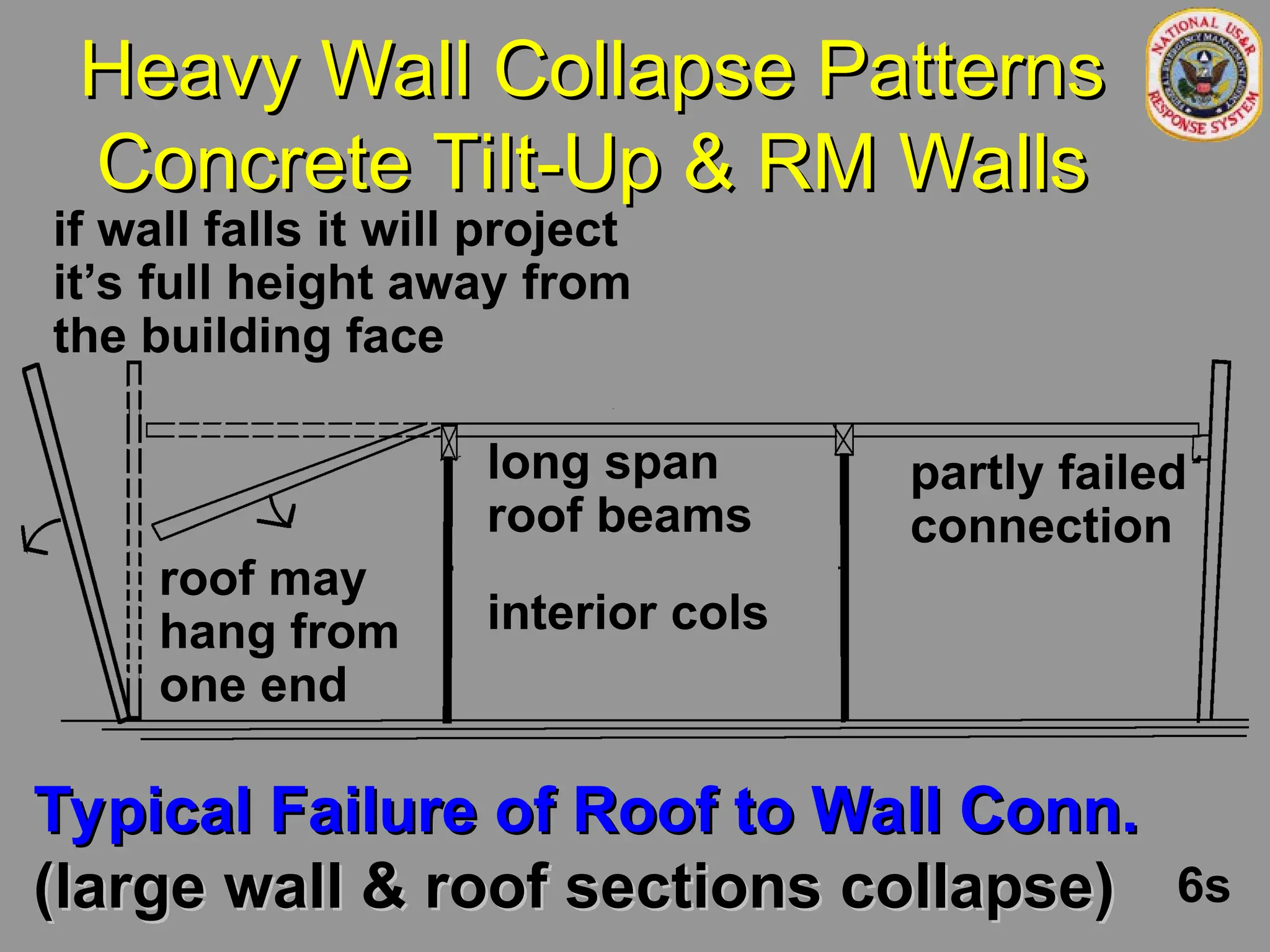
Heavy Wall Collapse Patterns
Concrete Tilt-Up & RM Walls
Typical Failure of Roof to Wall Conn.
(large wall & roof sections collapse)
if wall falls it will project
it’s full height away from
the building face
interior cols
long span
roof beams
partly failed
connection
roof may
hang from
one end
6s
Building front doesn’t look too bad
1.3-33
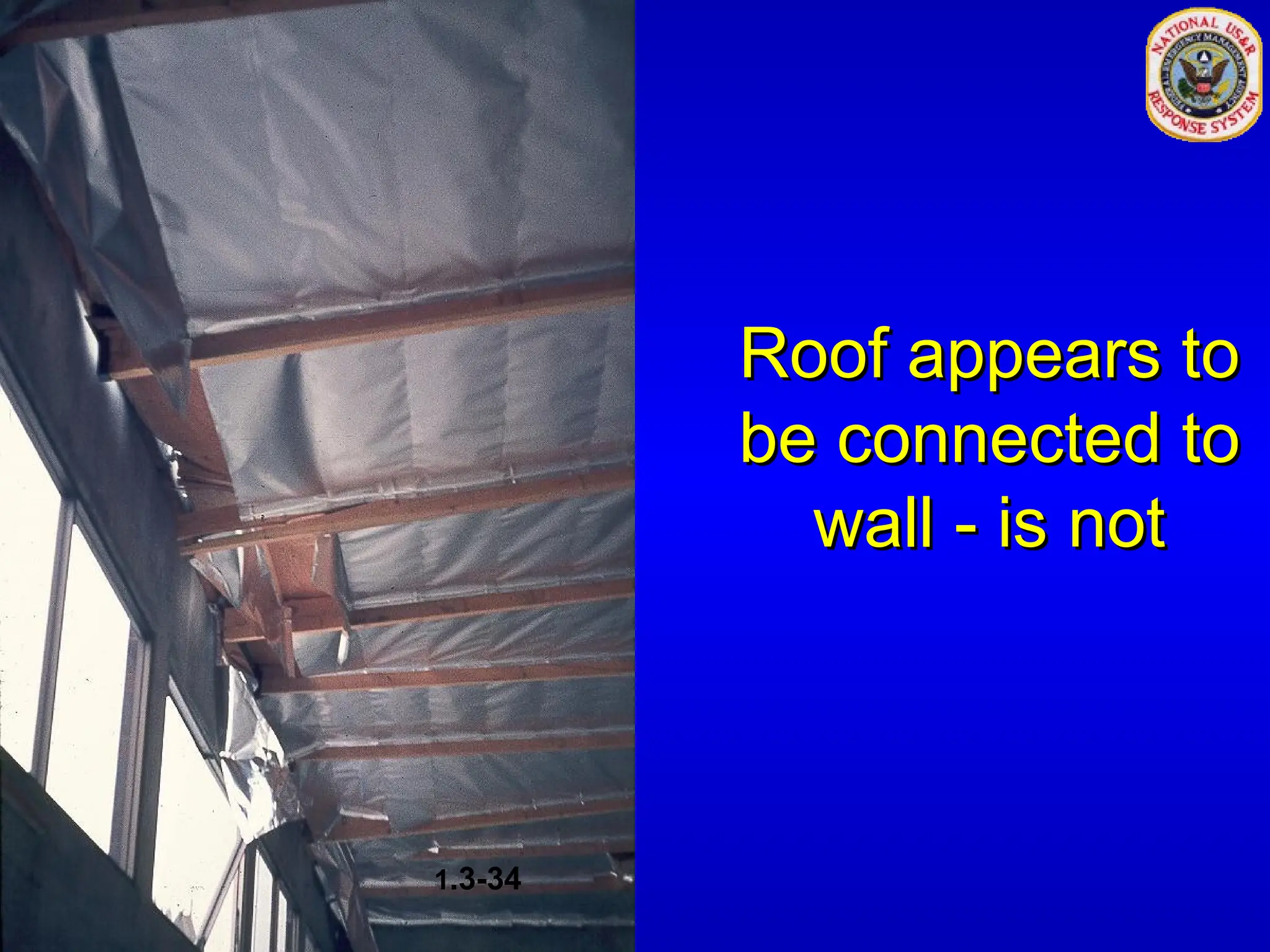
Roof appears to
Roof appears to
be connected to
be connected to
wall - is not
wall - is not
1.3-34
Typical Roof Separation/Collapse
Roof debris has been removed
1.3-35
Roof Collapsed
Roof Collapsed
but
but
“Redundancy”
“Redundancy”
Catenary
Catenary
Supports Wall
Supports Wall
Top
Top
“
“Catenary” is the
Catenary” is the
shape of a
shape of a
suspension bridge
suspension bridge
cable
cable
1.3-37
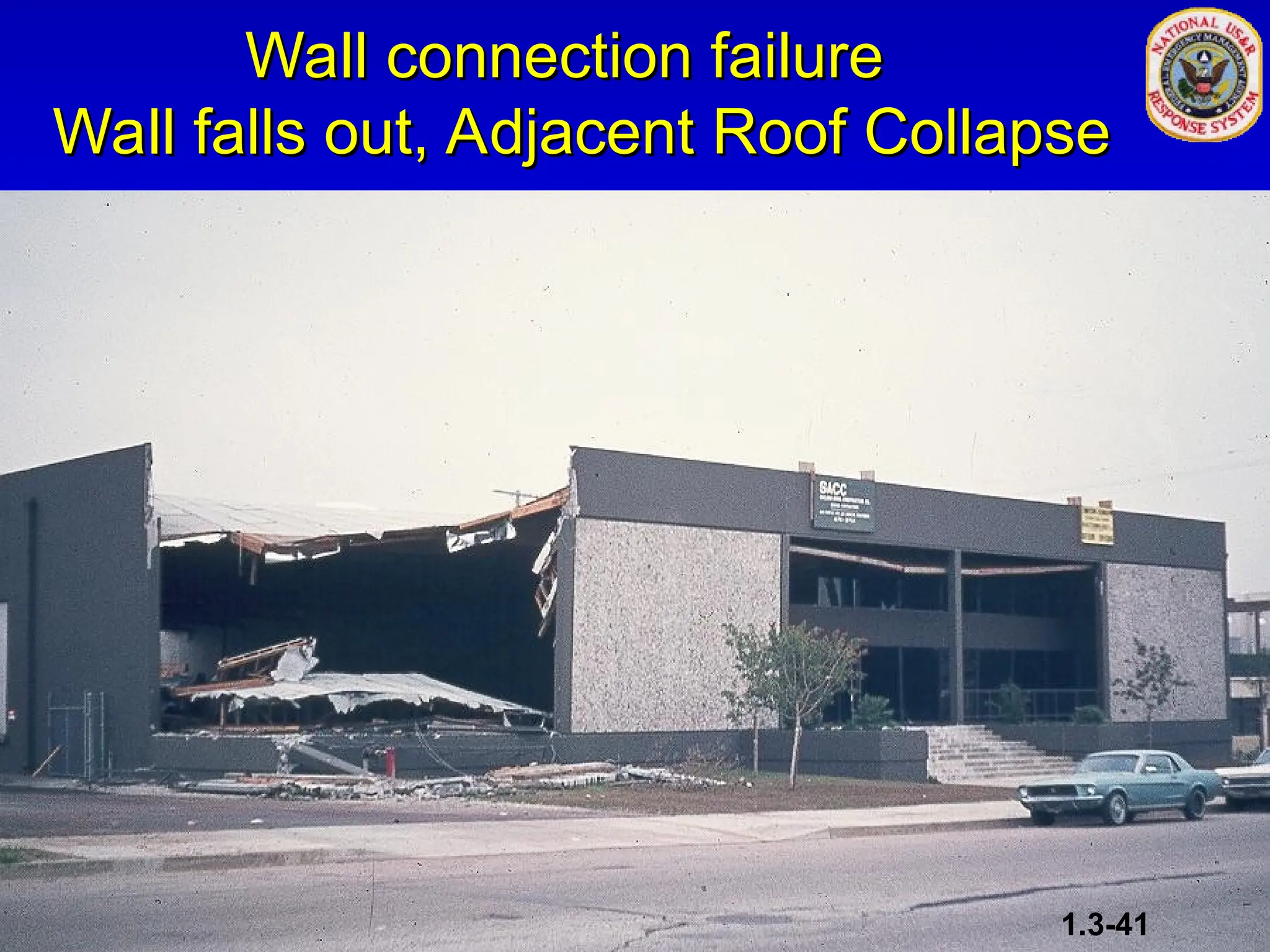
Wall connection failure
Wall falls out, Adjacent Roof Collapse
1.3-41
Same type failure - Corner prevents Collapse
- Redundancy Helps
- Redundancy Helps
1.3-42
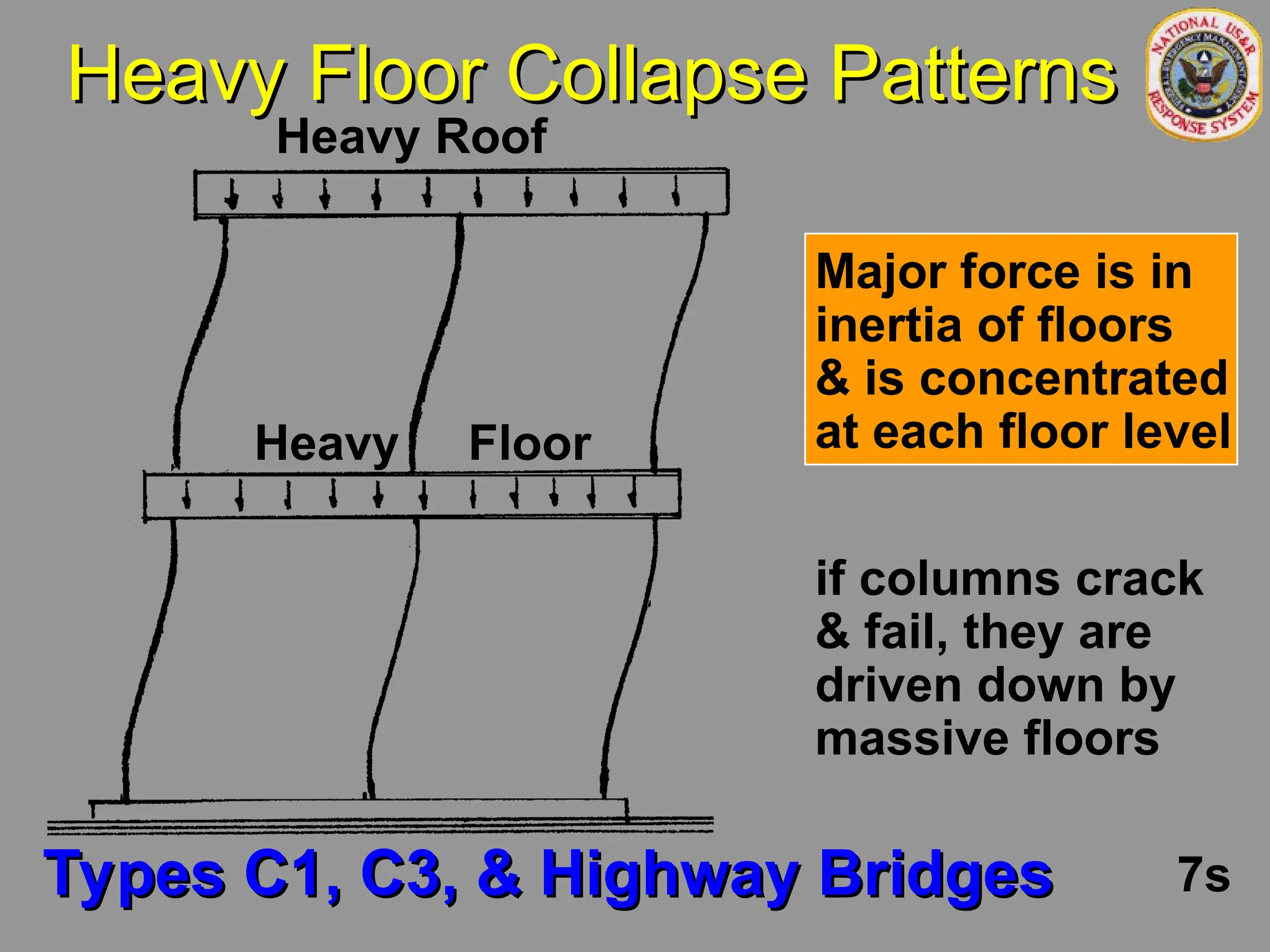
Heavy Floor Collapse Patterns
Types C1, C3, & Highway Bridges
Heavy Floor
Heavy Roof
Major force is in
inertia of floors
& is concentrated
at each floor level
if columns crack
& fail, they are
driven down by
massive floors
7s
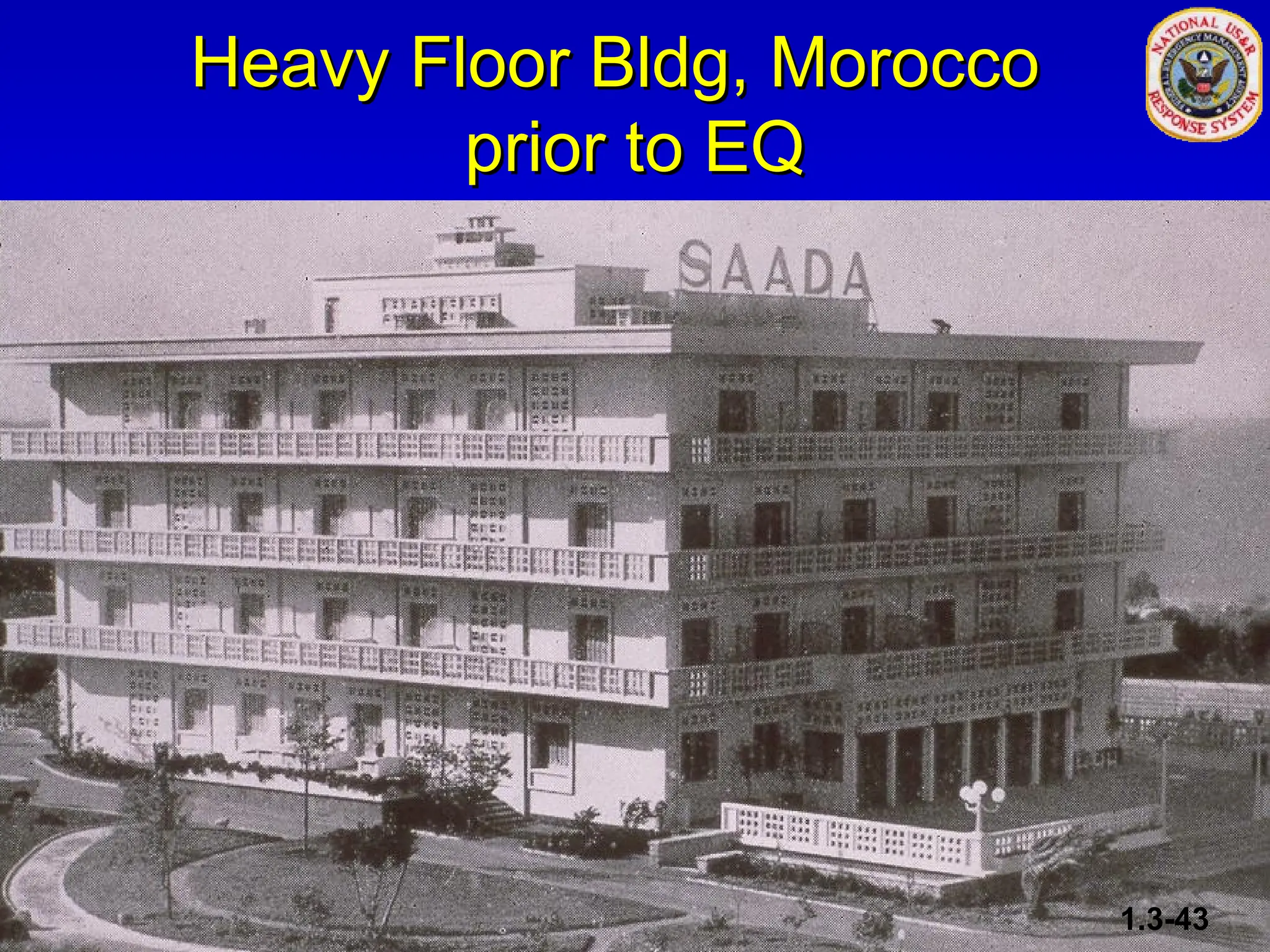
Heavy Floor Bldg, Morocco
prior to EQ
prior to EQ
1.3-43
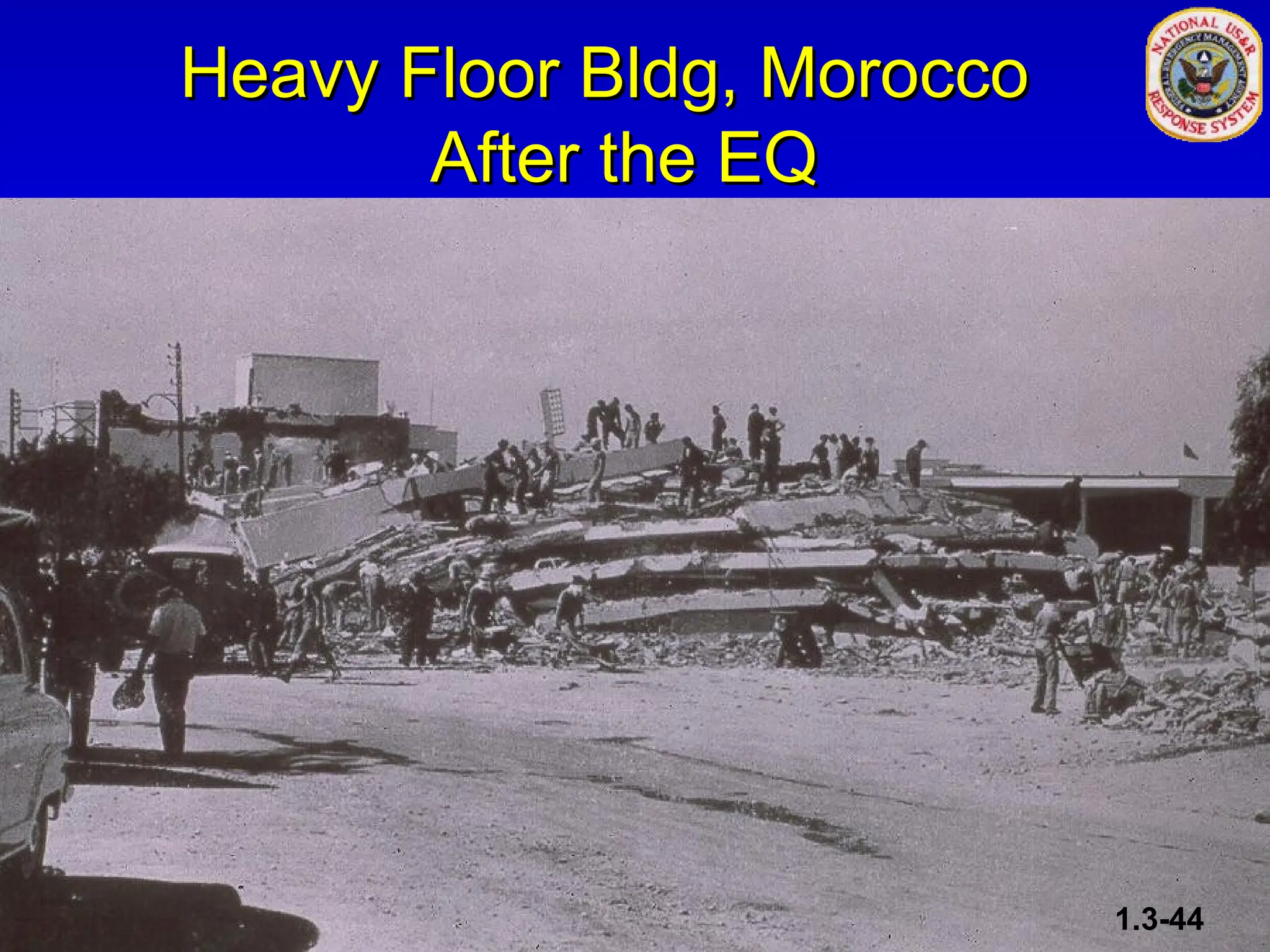
Heavy Floor Bldg, Morocco
After the EQ
After the EQ
1.3-44
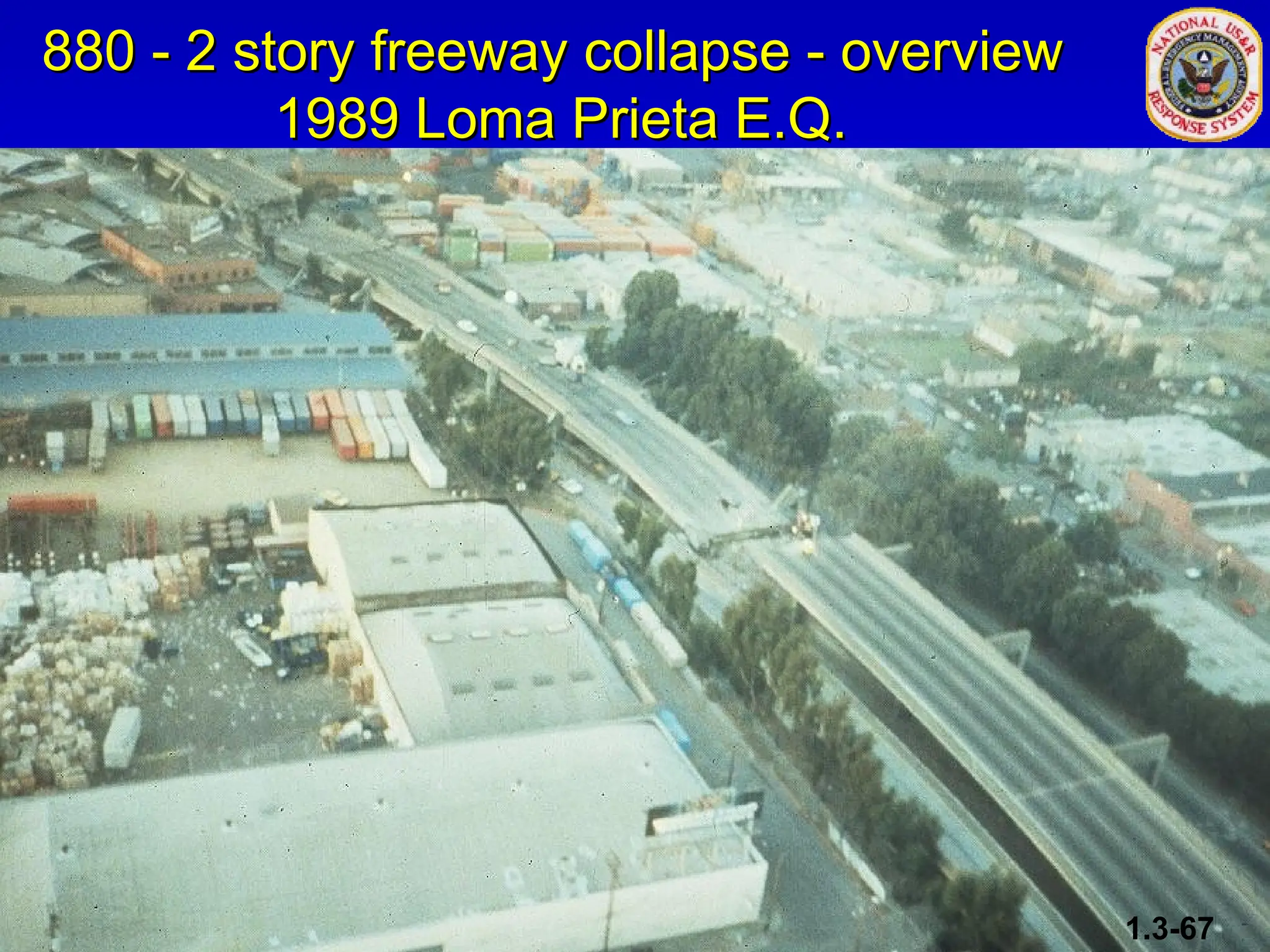
880 - 2 story freeway collapse - overview
1989 Loma Prieta E.Q.
1.3-67
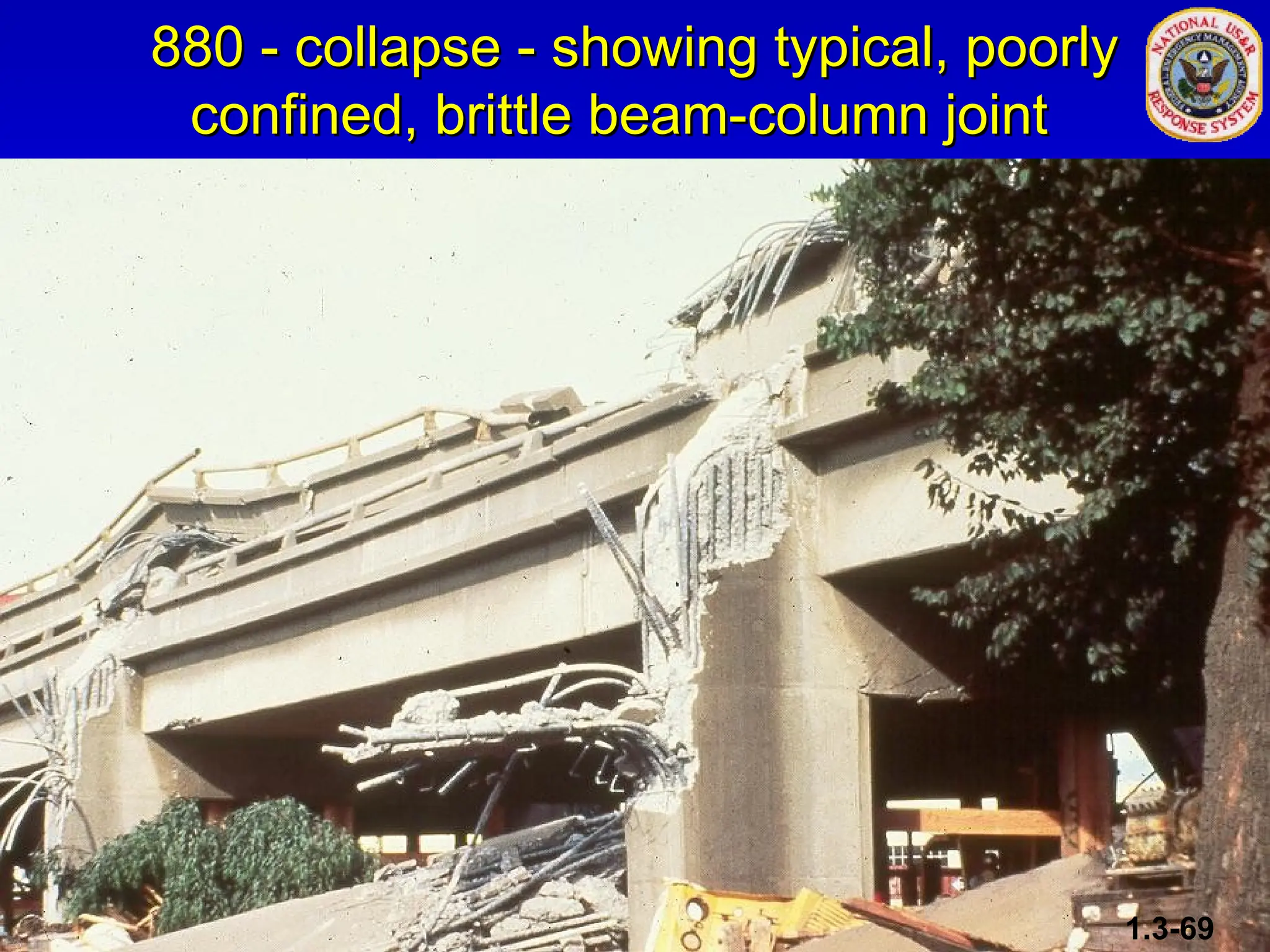
880 - collapse - showing typical, poorly
confined, brittle beam-column joint
1.3-69
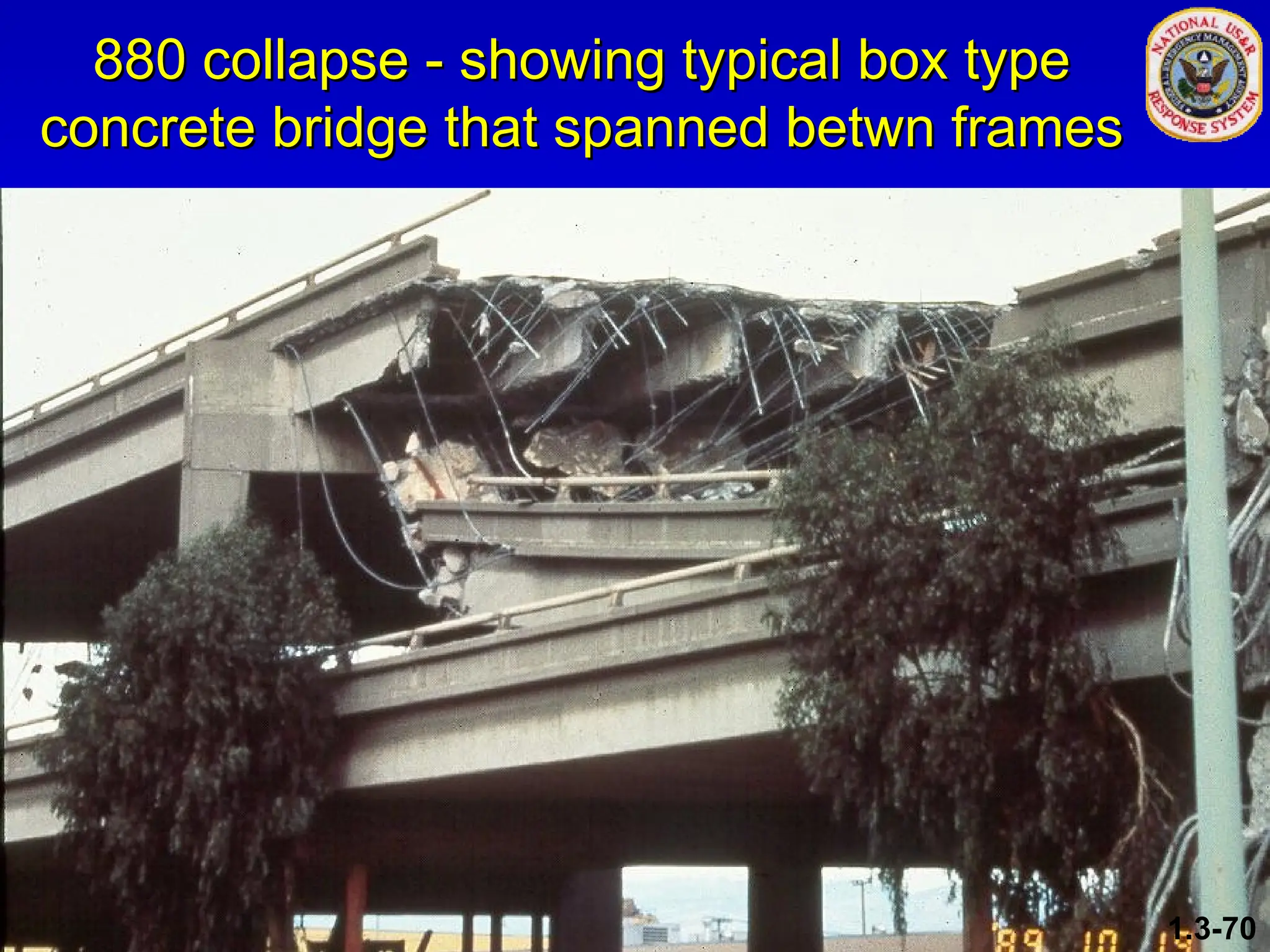
880 collapse - showing typical box type
concrete bridge that spanned betwn frames
1.3-70
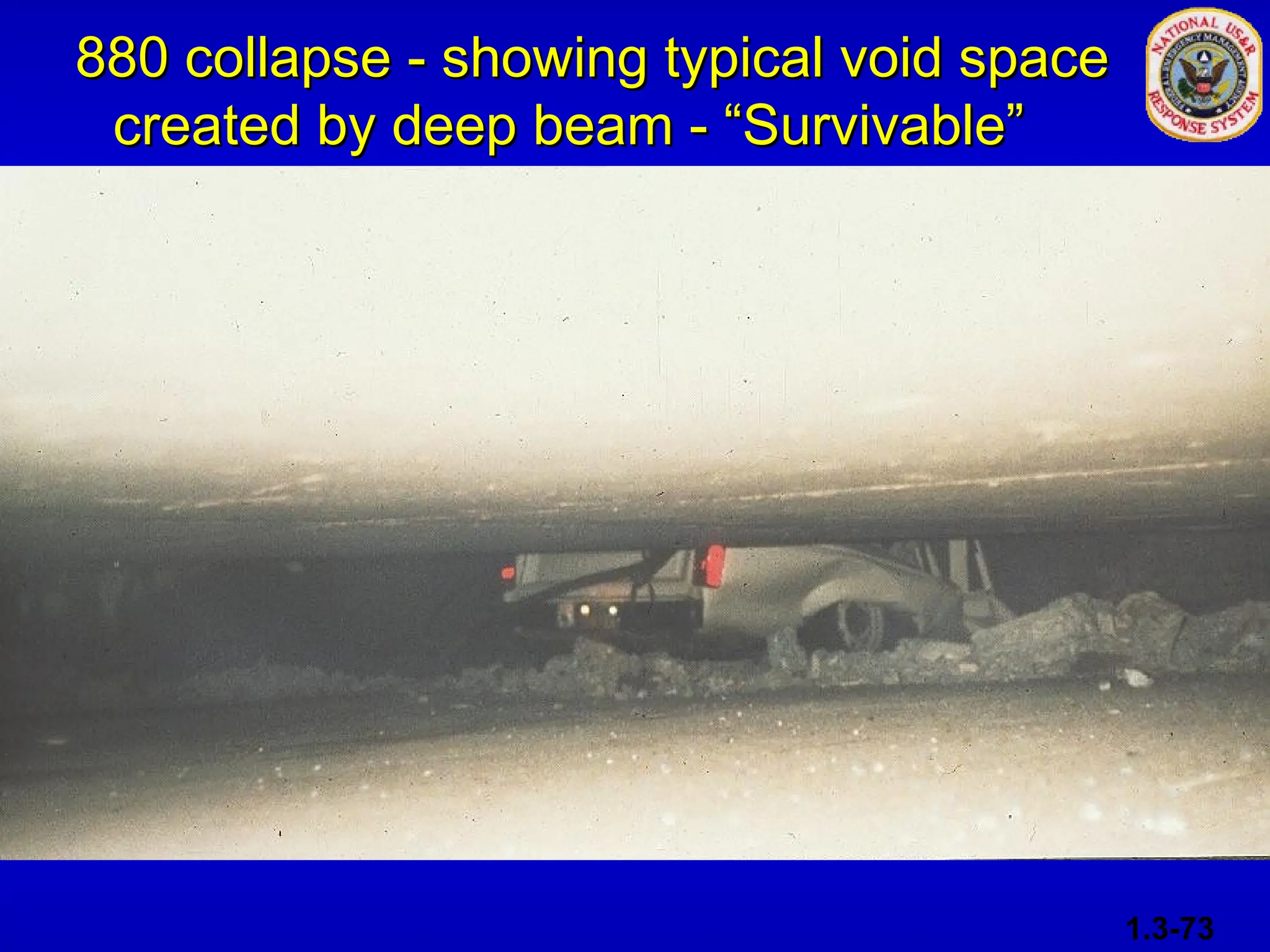
880 collapse - showing typical void space
created by deep beam - “Survivable”
1.3-73
Heavy Floor Collapse Patterns
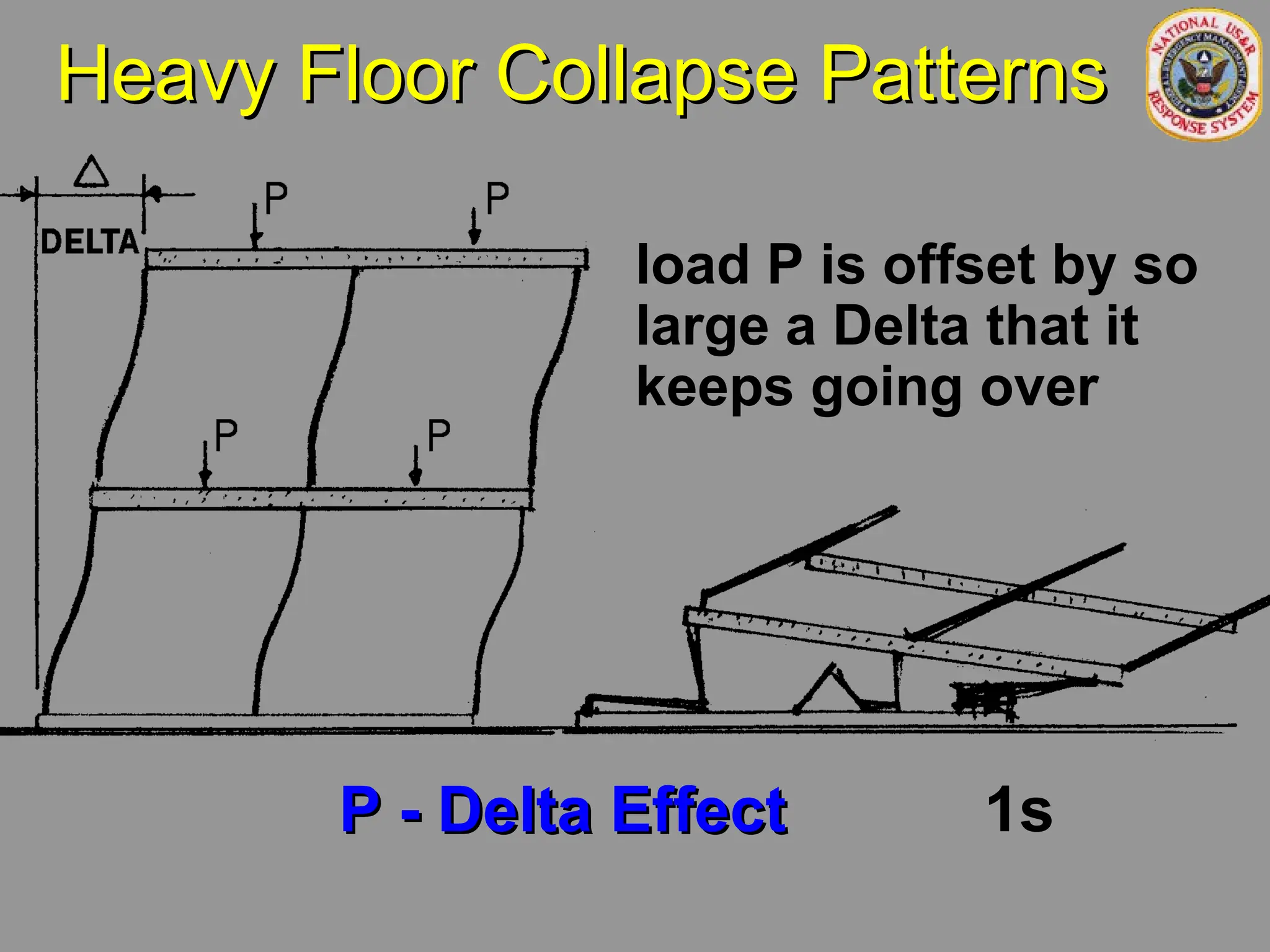
P - Delta Effect
P - Delta Effect
load P is offset by so
large a Delta that it
keeps going over
1s
P-delta effect - 3 story Mexico School
1.3-48
Heavy Floor Collapse Patterns
Column Joint Failure
concrete in column is not
well enough confined by
rebar ties, resulting in
rapid failure as concrete
splits off & rebar buckles
1s
12 story Mexico City Pancake
1.3-45
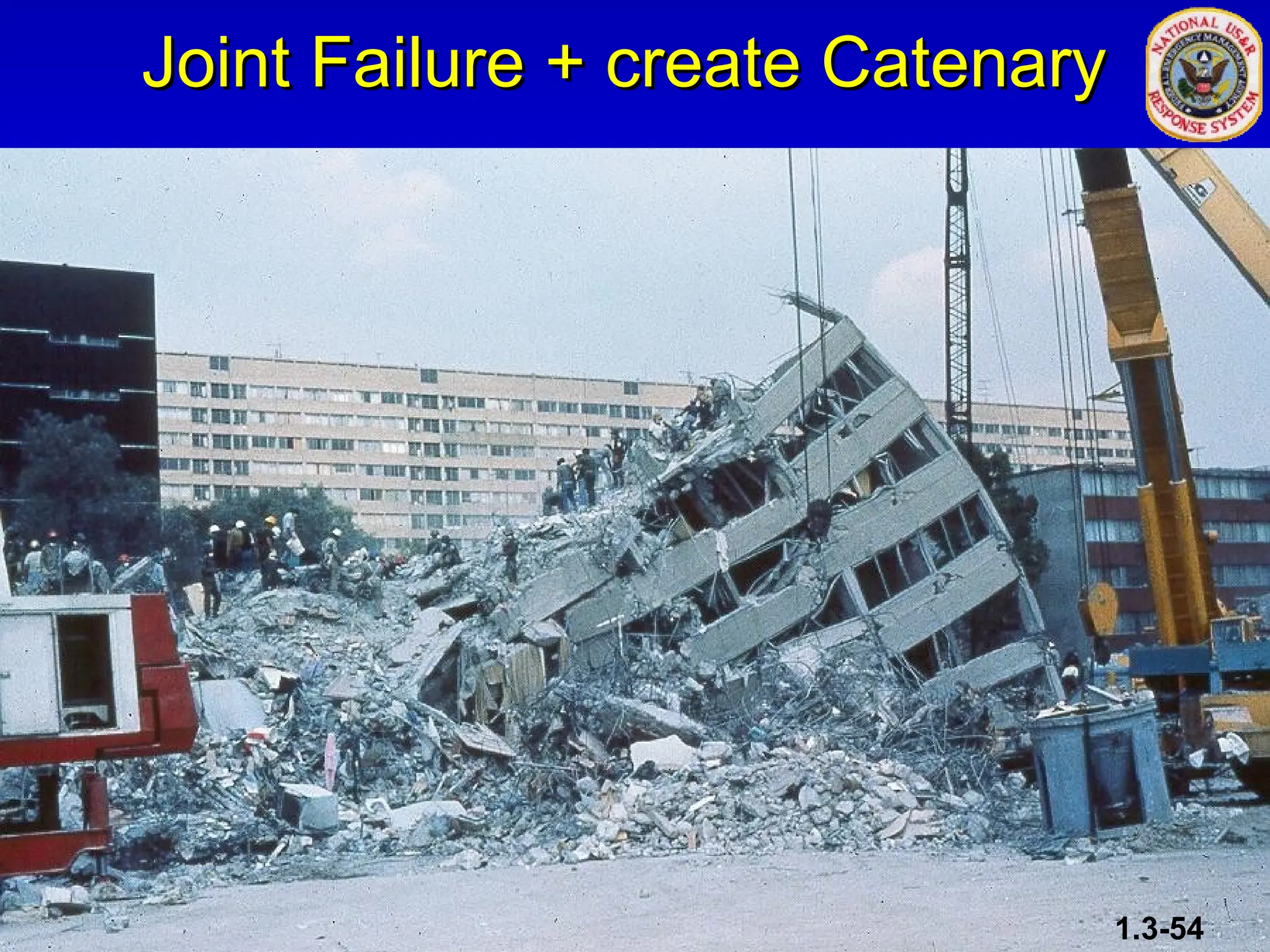
Joint Failure + create Catenary
1.3-54
Heavy Floor Collapse Patterns
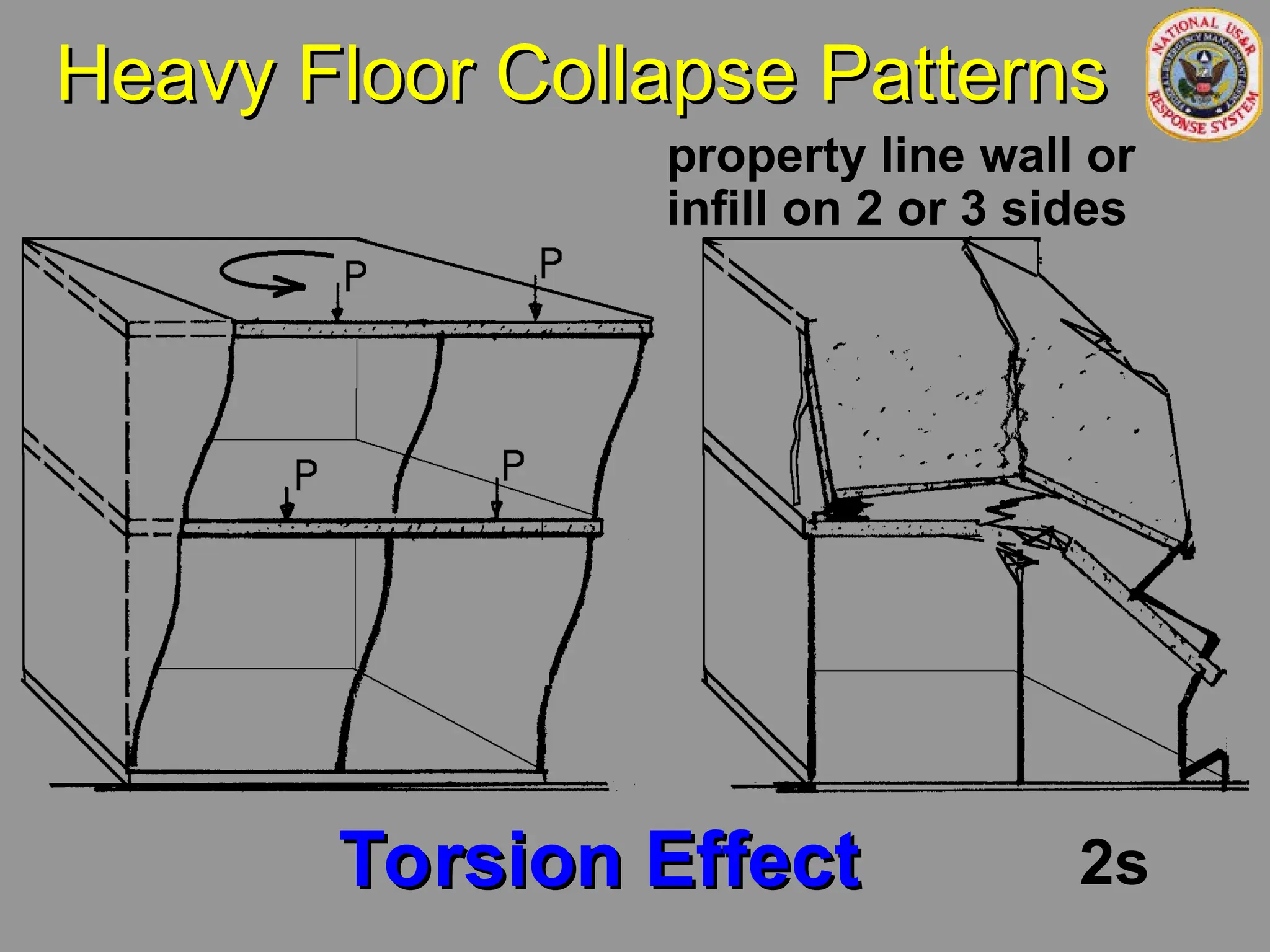
Torsion Effect
Torsion Effect
property line wall or
infill on 2 or 3 sides
2s
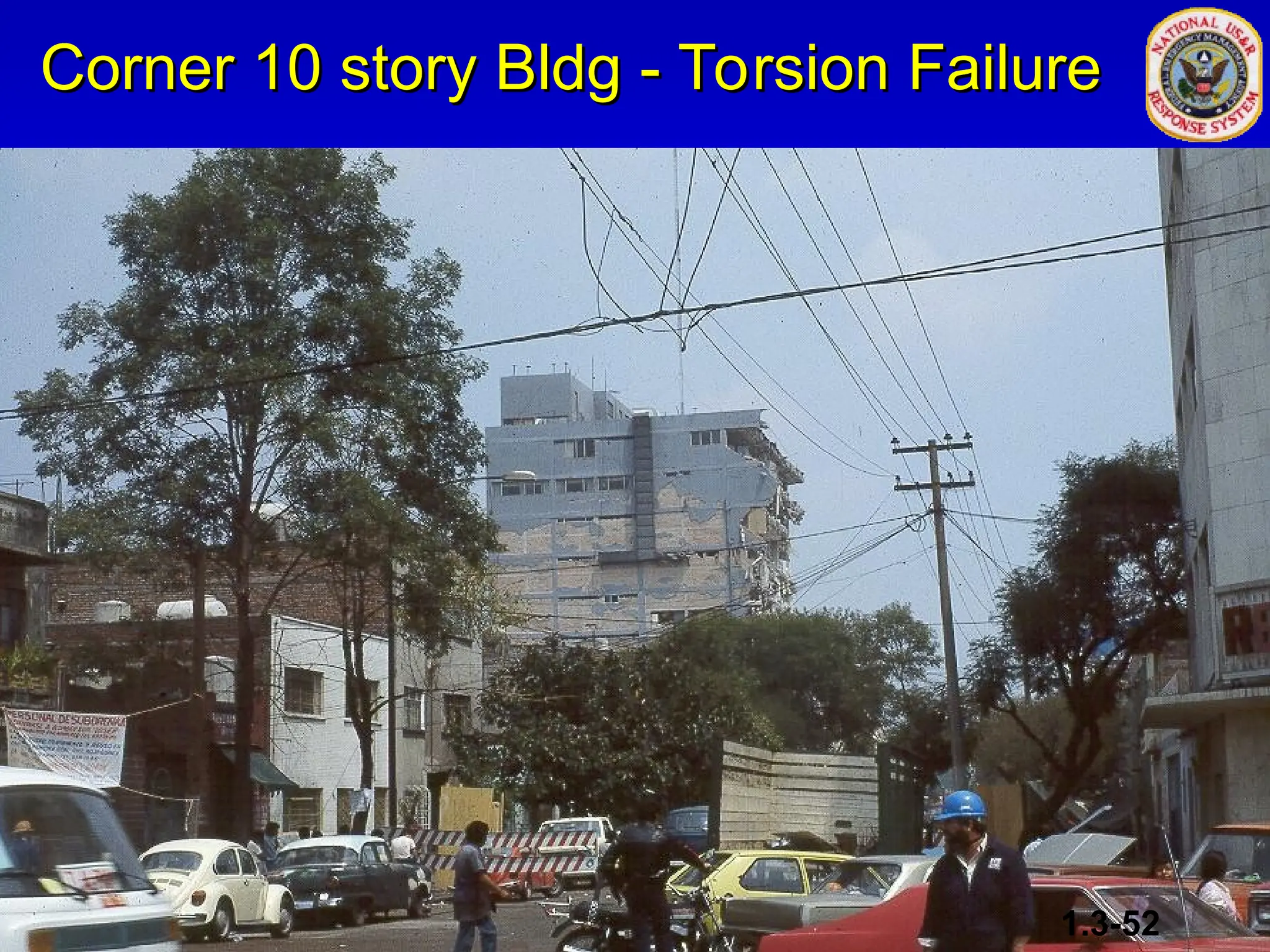
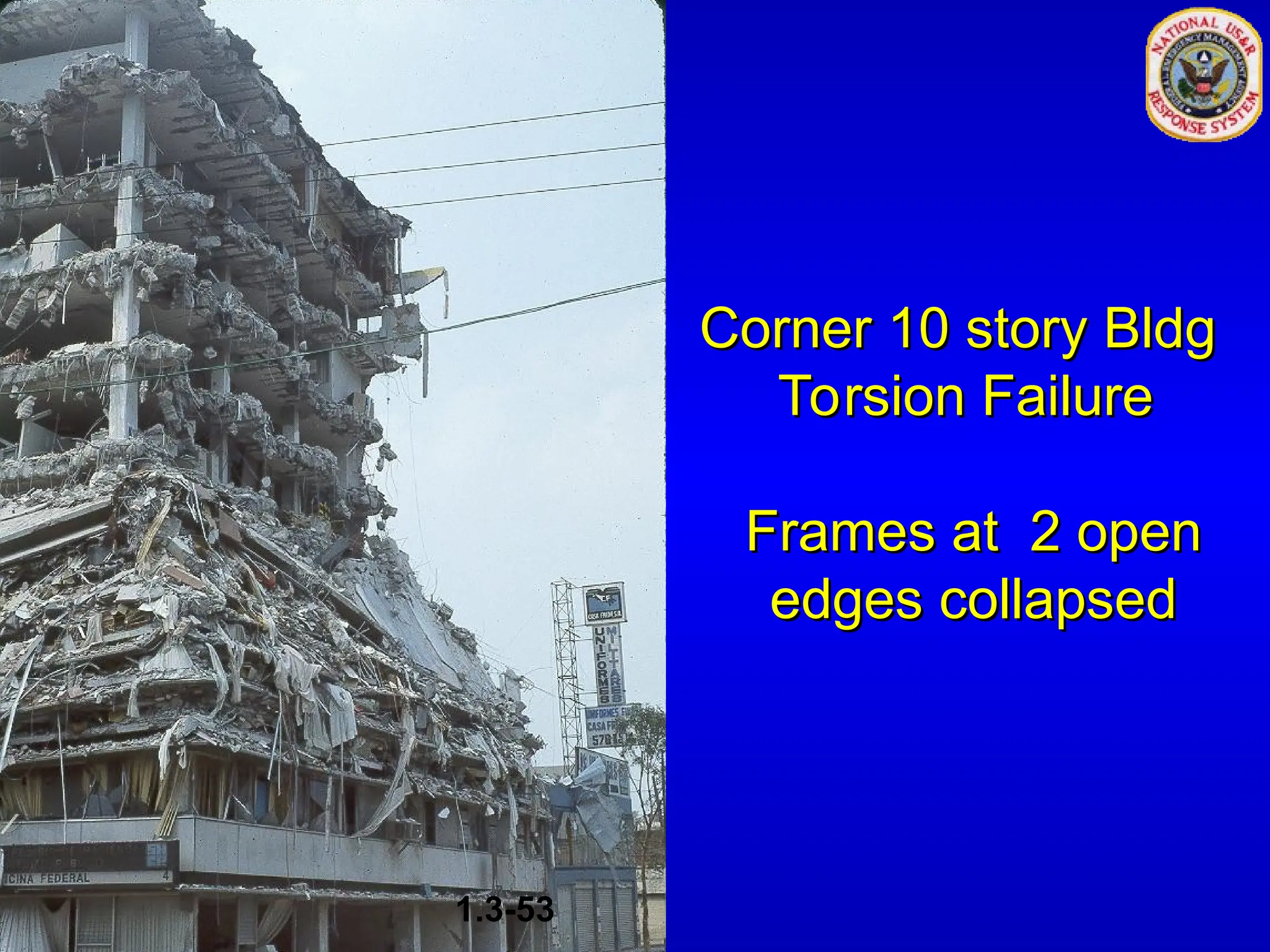
Corner 10 story Bldg - Torsion Failure
1.3-52
Corner 10 story Bldg
Torsion Failure
Torsion Failure
Frames at 2 open
Frames at 2 open
edges collapsed
edges collapsed
1.3-53
Heavy Floor Collapse Patterns
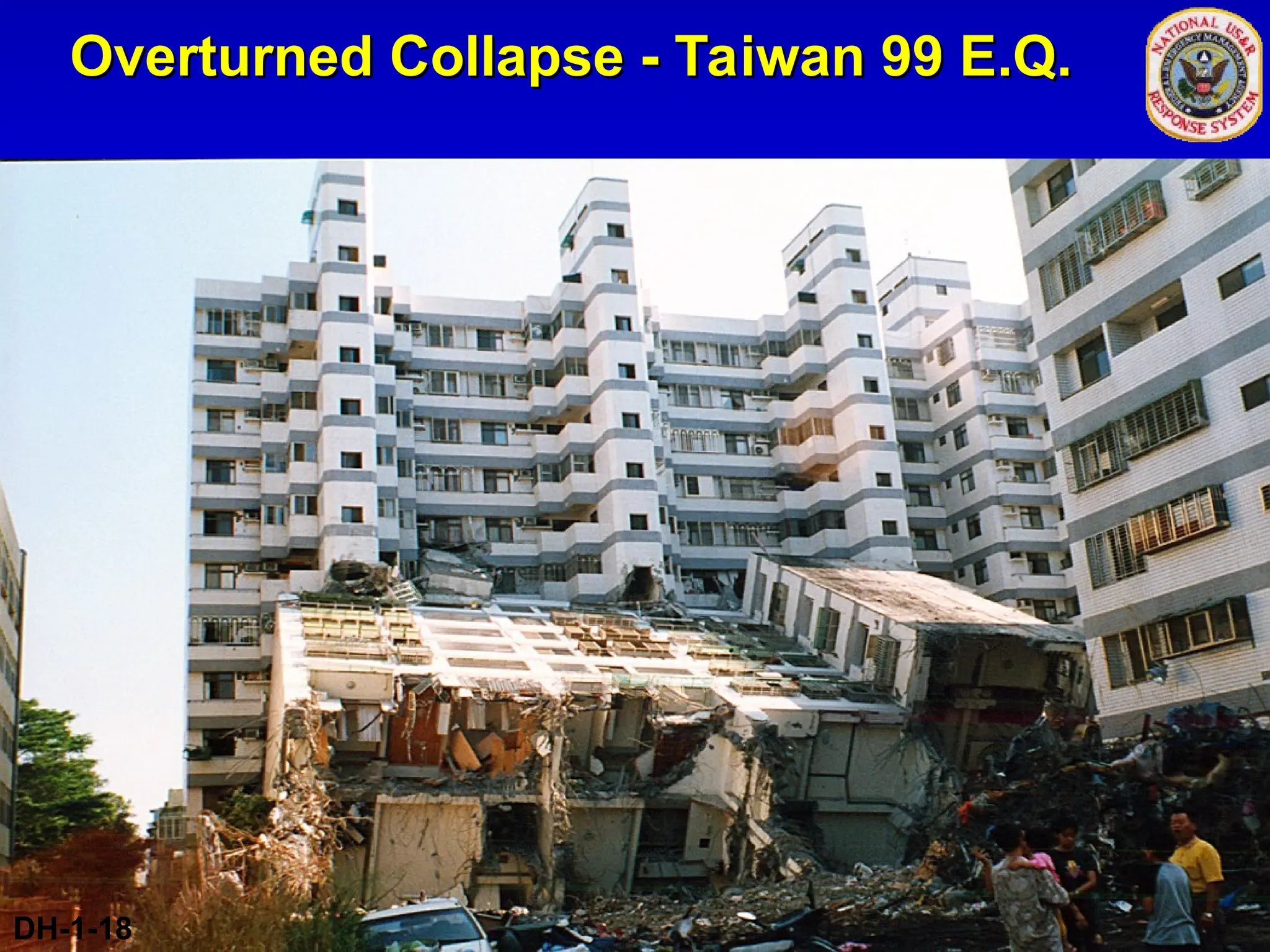
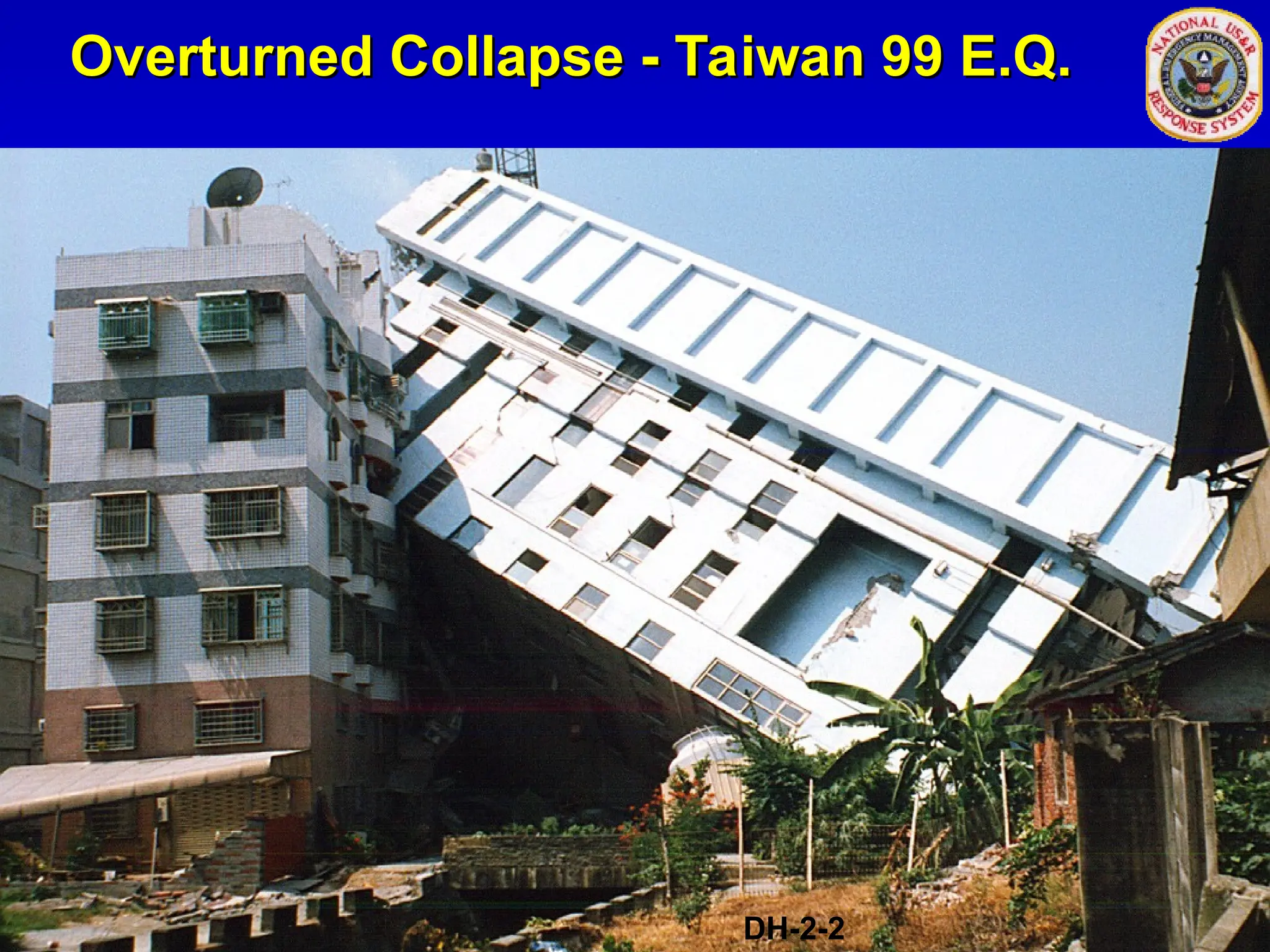
Overturned Structure
failed shearwall or
foundation failure
4s
Overturned Collapse - Mexico City
1.3-50
Overturned Collapse - Mexico City
1.3-51
Overturned Collapse - Taiwan 99 E.Q.
DH-1-18
Overturned Collapse - Taiwan 99 E.Q.
DH-2-2
Heavy Floor Collapse Patterns
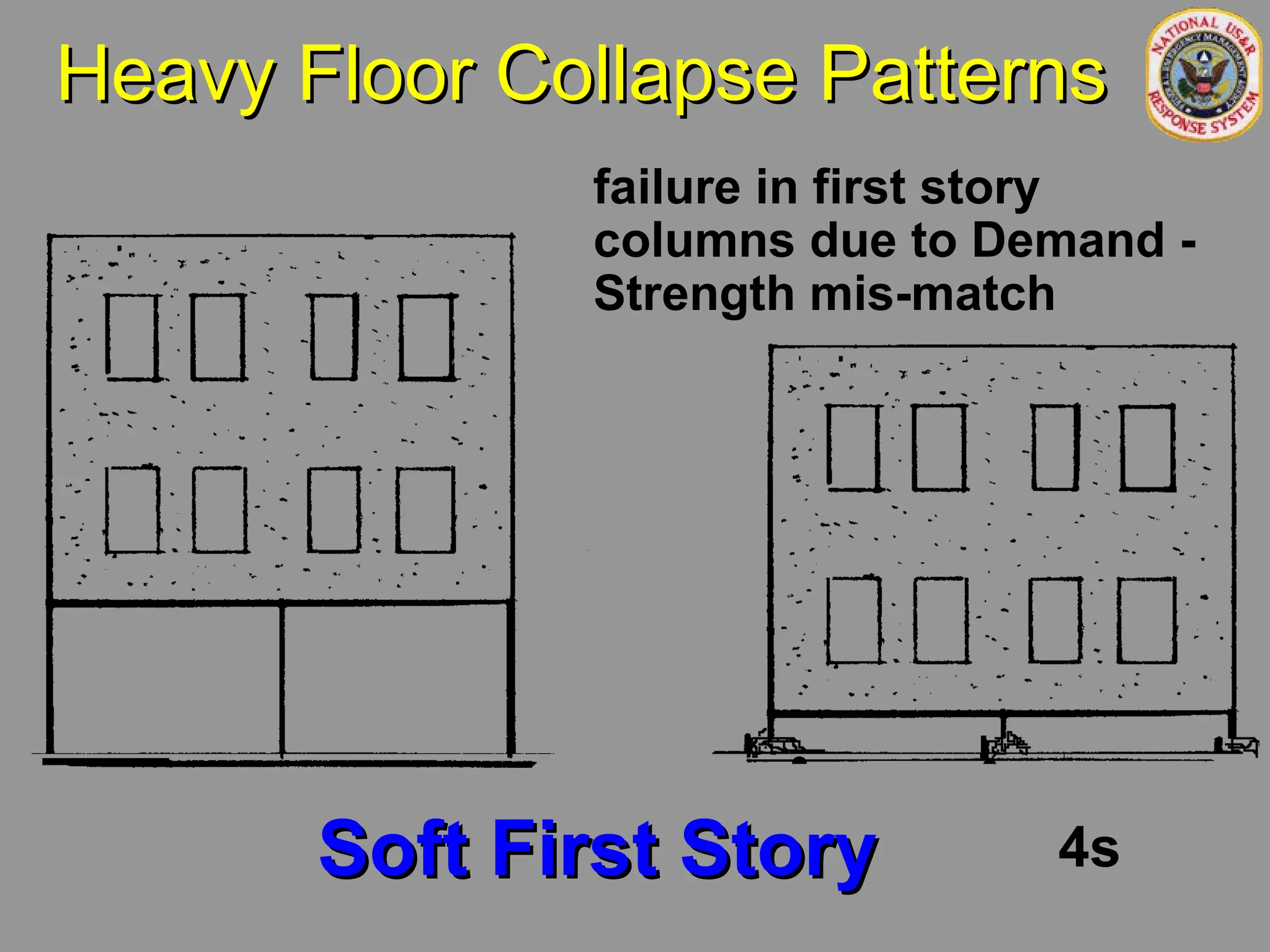
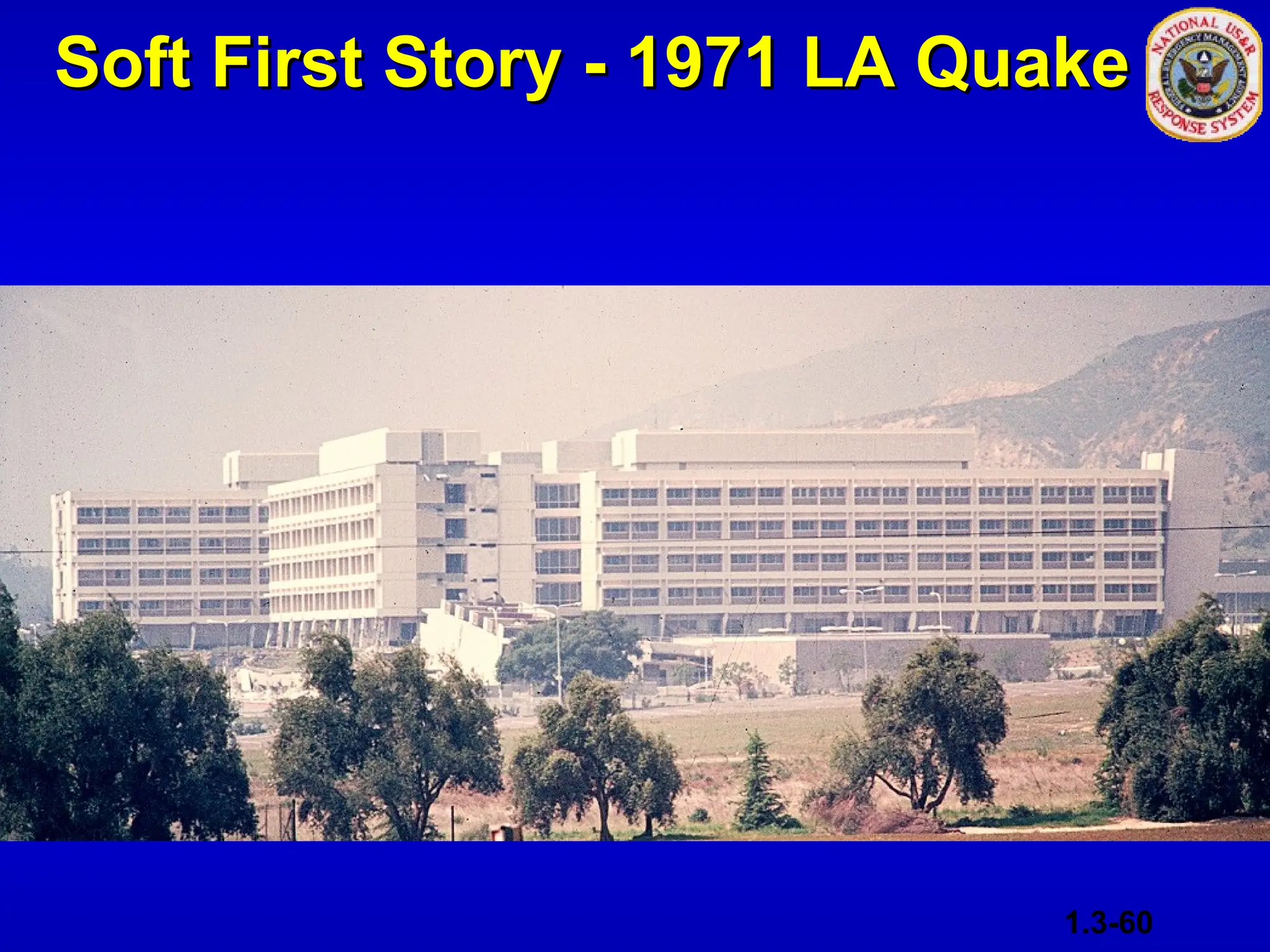
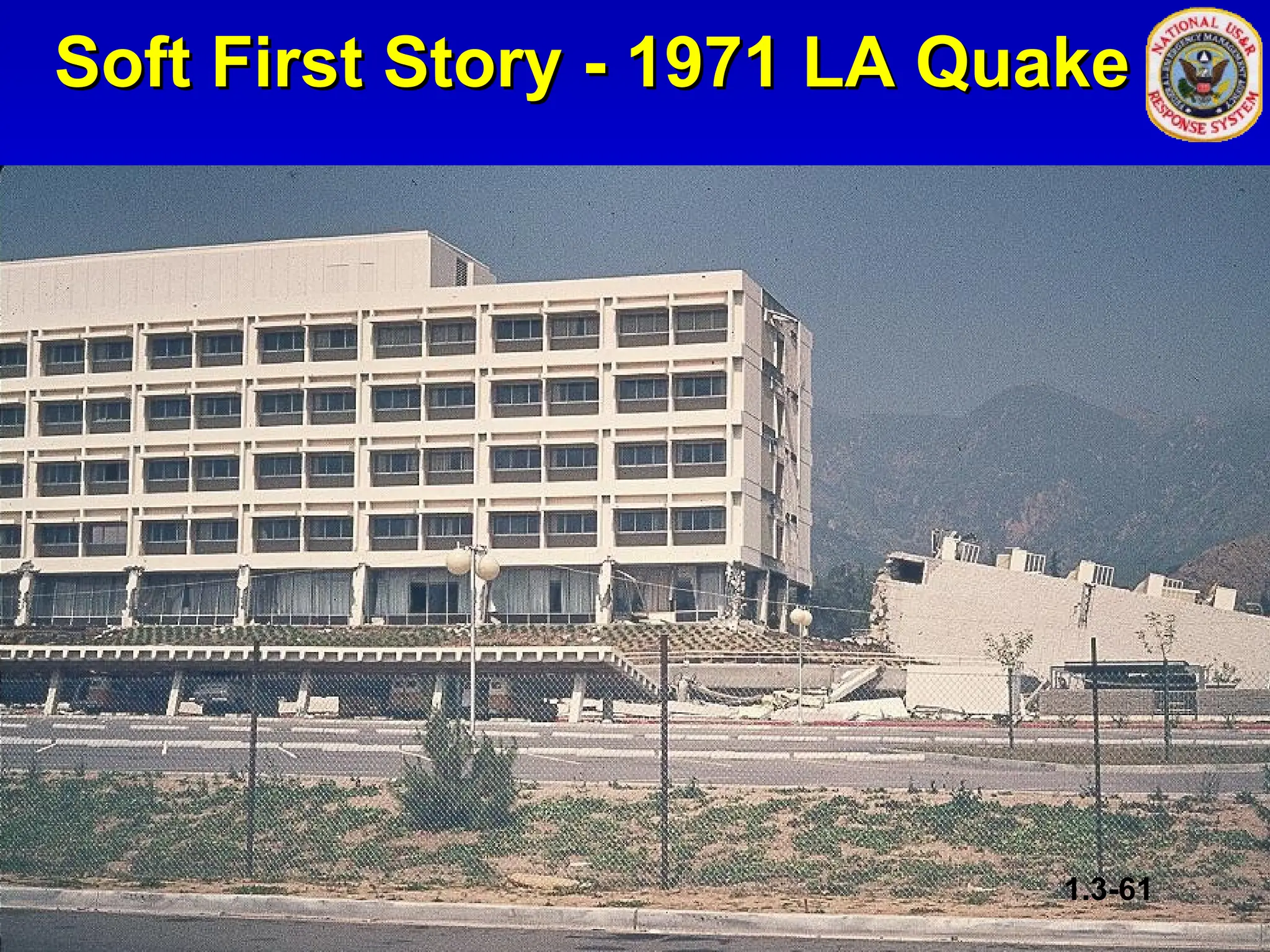
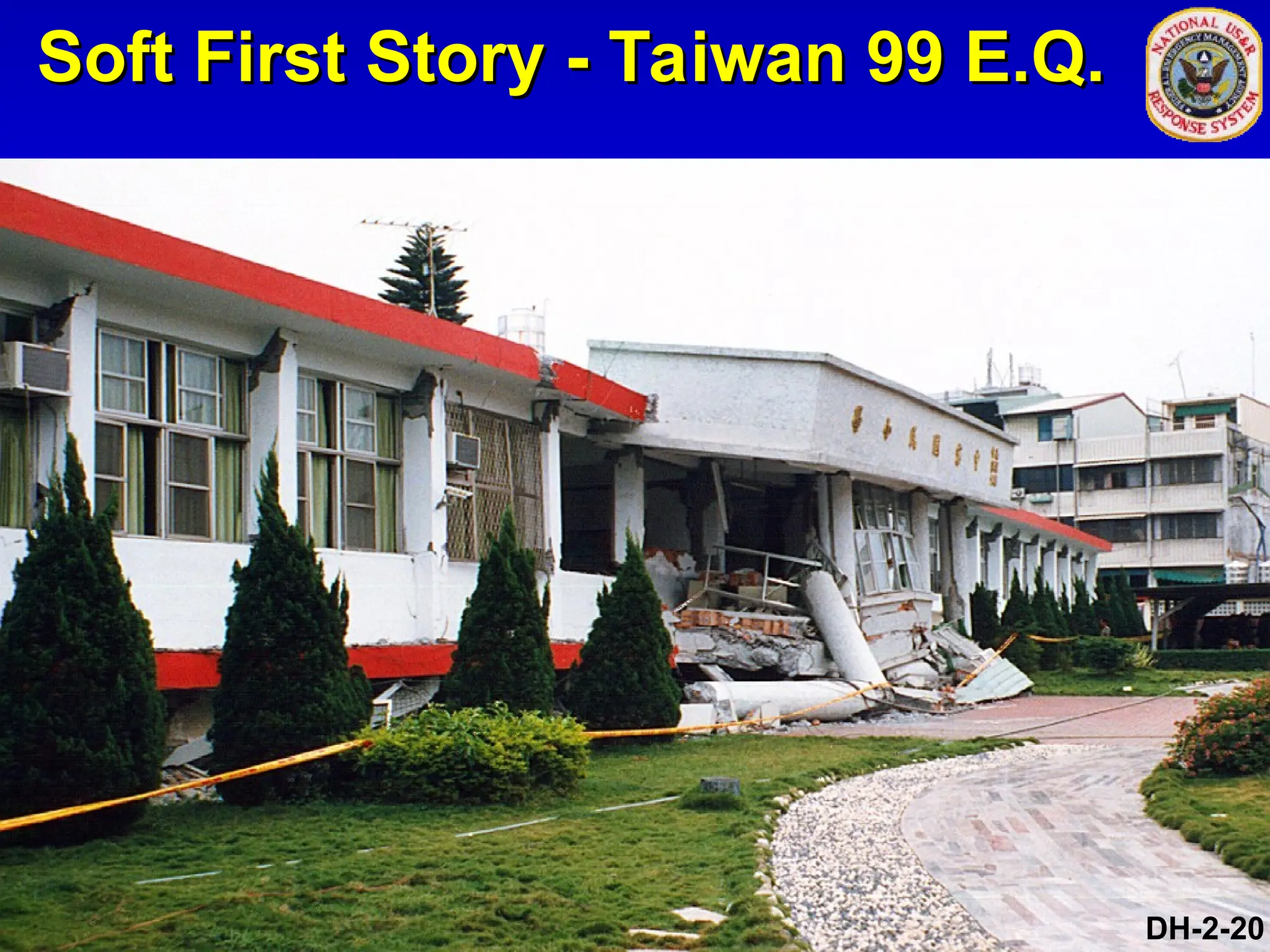
Soft First Story
Soft First Story
failure in first story
columns due to Demand -
Strength mis-match
4s
Soft First Story - 1971 LA Quake
1.3-60
Soft First Story - 1971 LA Quake
1.3-61
Soft First Story - Taiwan 99 E.Q.
DH-2-20
Soft First Story - Taiwan 99 E.Q.
DH-5-4
Heavy Floor Collapse Patterns
Short Wall Columns - Mid Story Collapse
failure of short columns
due to lack of ductility
2s
Mid Story Collapse - Pounding - Mexico City
1.3-55
Mid Story Collapse -
Weak Story Mexico City
1.3-56
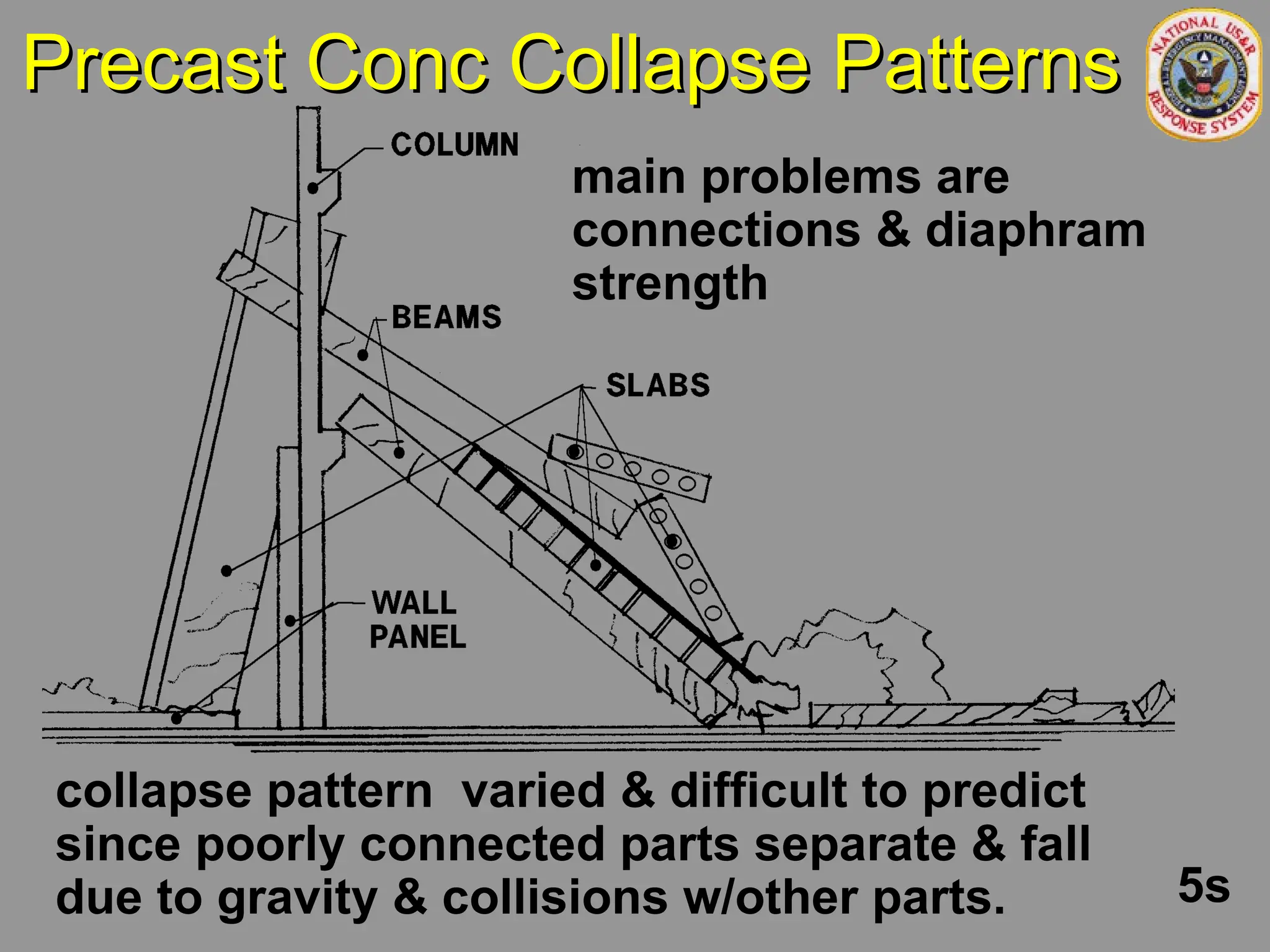
Precast Conc Collapse Patterns
Typical Cross-section of Frame Type
hollow cored slabs
double T floor
columns w/corbels
lt. or medium weight
wall panels
precast roof & floor
beams
Precast Conc Collapse Patterns
collapse pattern varied & difficult to predict
since poorly connected parts separate & fall
due to gravity & collisions w/other parts.
main problems are
connections & diaphram
strength
5s
Alaska 1964
Alaska 1964
Giant Tees with Poor Connections
1.3-77
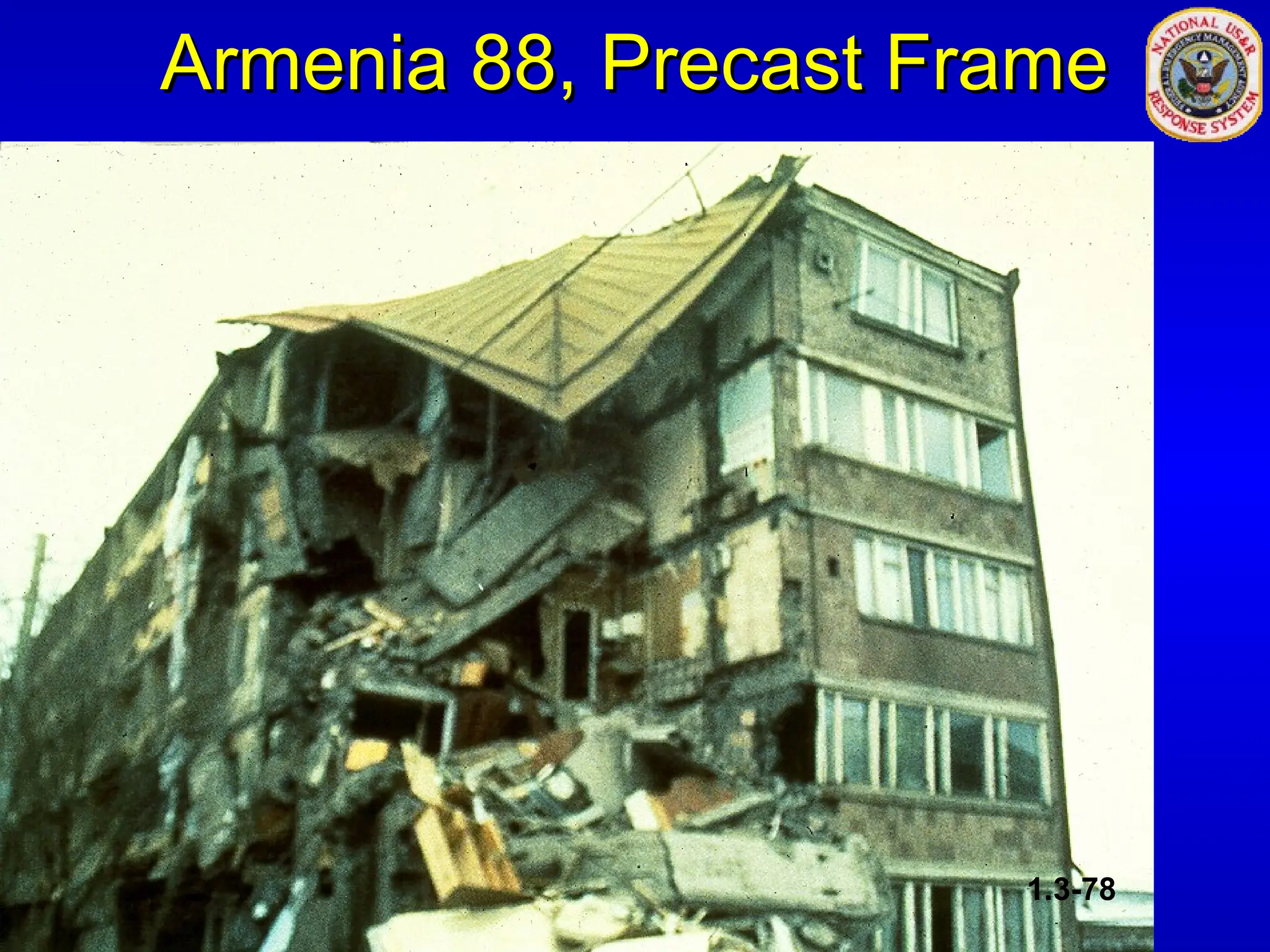
Armenia 88, Precast Frame
1.3-78
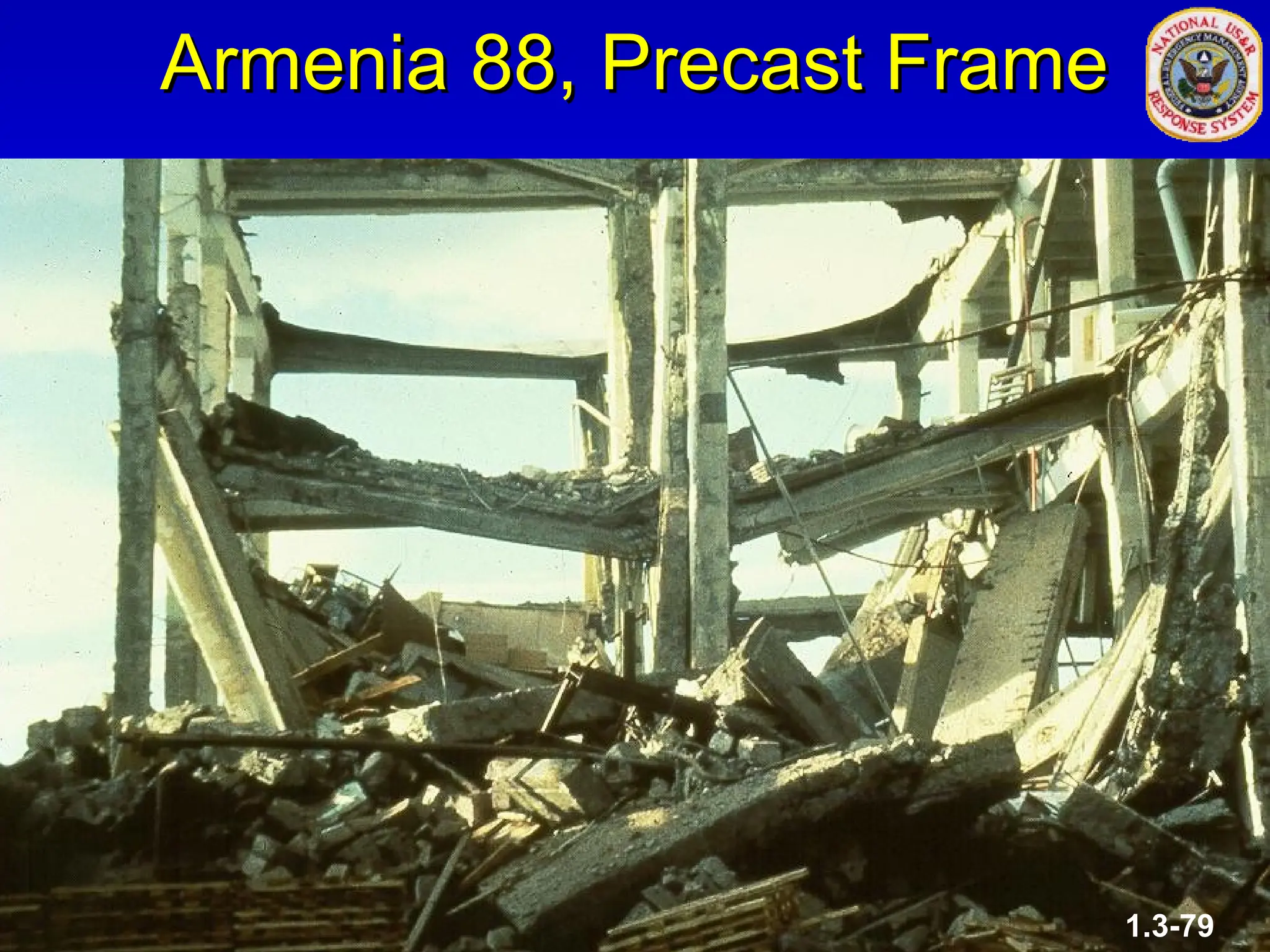
Armenia 88, Precast Frame
1.3-79
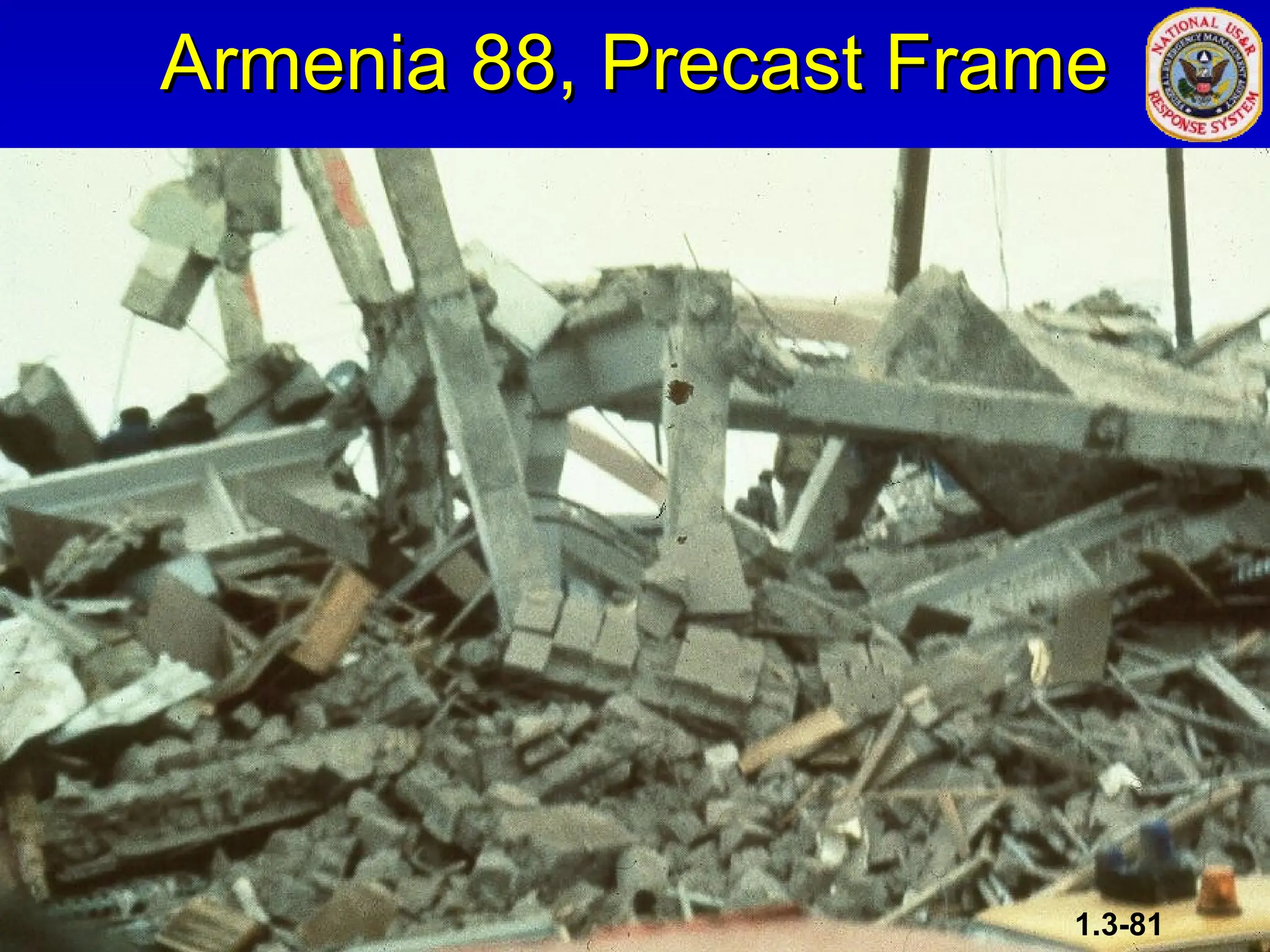
Armenia 88, Precast Frame
1.3-81
Windstorm
Windstorm
Collapse
Collapse
Patterns
Patterns
Windstorm Basics
Windstorm Basics
• windstorms often produce flooding
• most damage/collapse is to light, poorly or
non-engineered structures
• high winds load & peel off light walls/ roof of
structures - especially open structures
• airborne missiles penetrate structure -
cause collapse by impact or by creating
open structure
• tidal surge/high waves can cause
collapse/damage to engineered structures
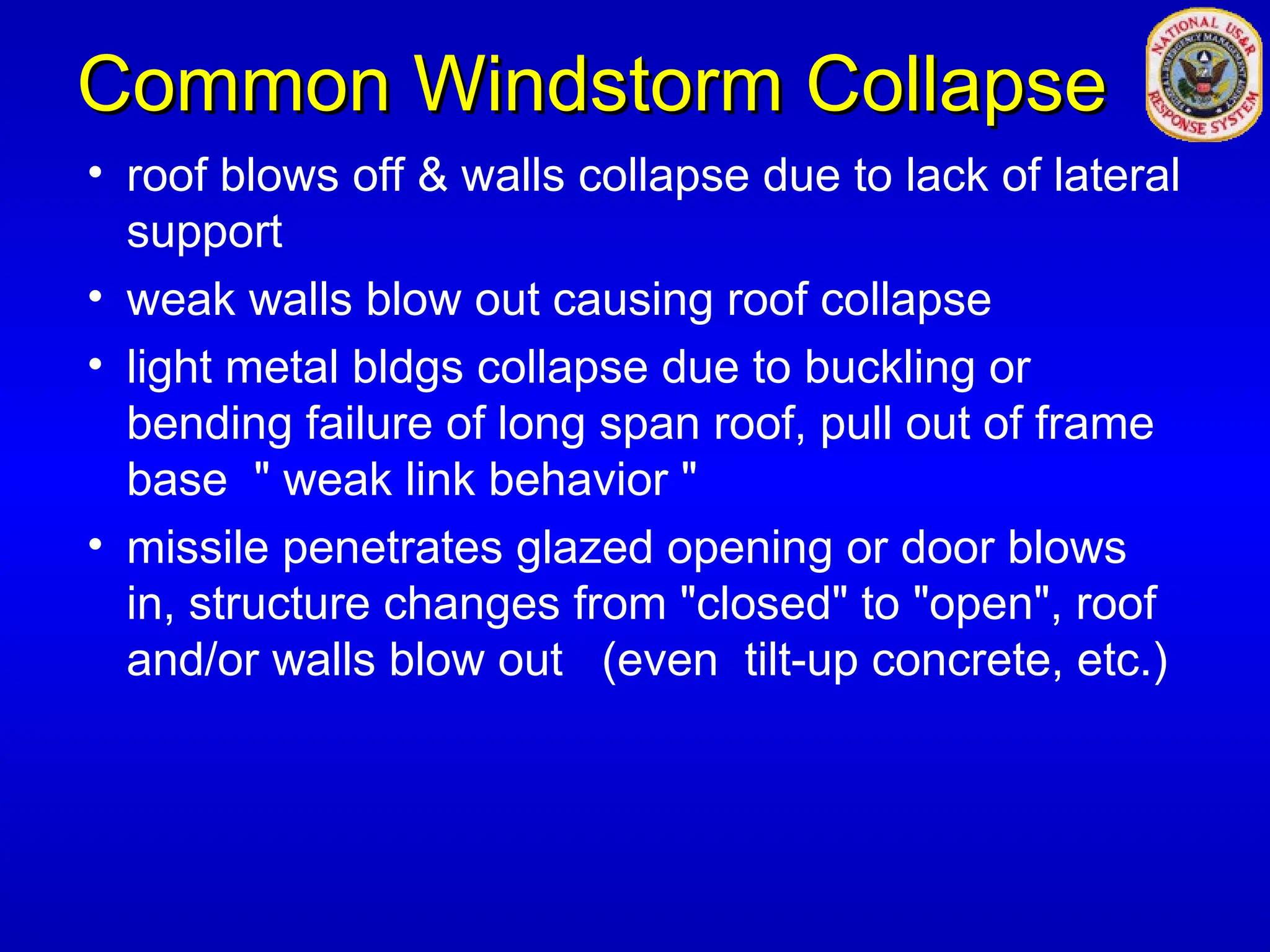
Common Windstorm Collapse
• roof blows off & walls collapse due to lack of lateral
support
• weak walls blow out causing roof collapse
• light metal bldgs collapse due to buckling or
bending failure of long span roof, pull out of frame
base " weak link behavior "
• missile penetrates glazed opening or door blows
in, structure changes from "closed" to "open", roof
and/or walls blow out (even tilt-up concrete, etc.)
Problematic Building Types
• Wood Houses
• Mobile Homes
• Other Frame, multi-residence condos
• Light Metal Buildings
• Commercial & Industrial - URM, RM, TU
• Aircraft Hangers
• Large, Long Span Structures
Problematic Light Buildings
• Wood Houses 3s
• Mobile Homes 1s
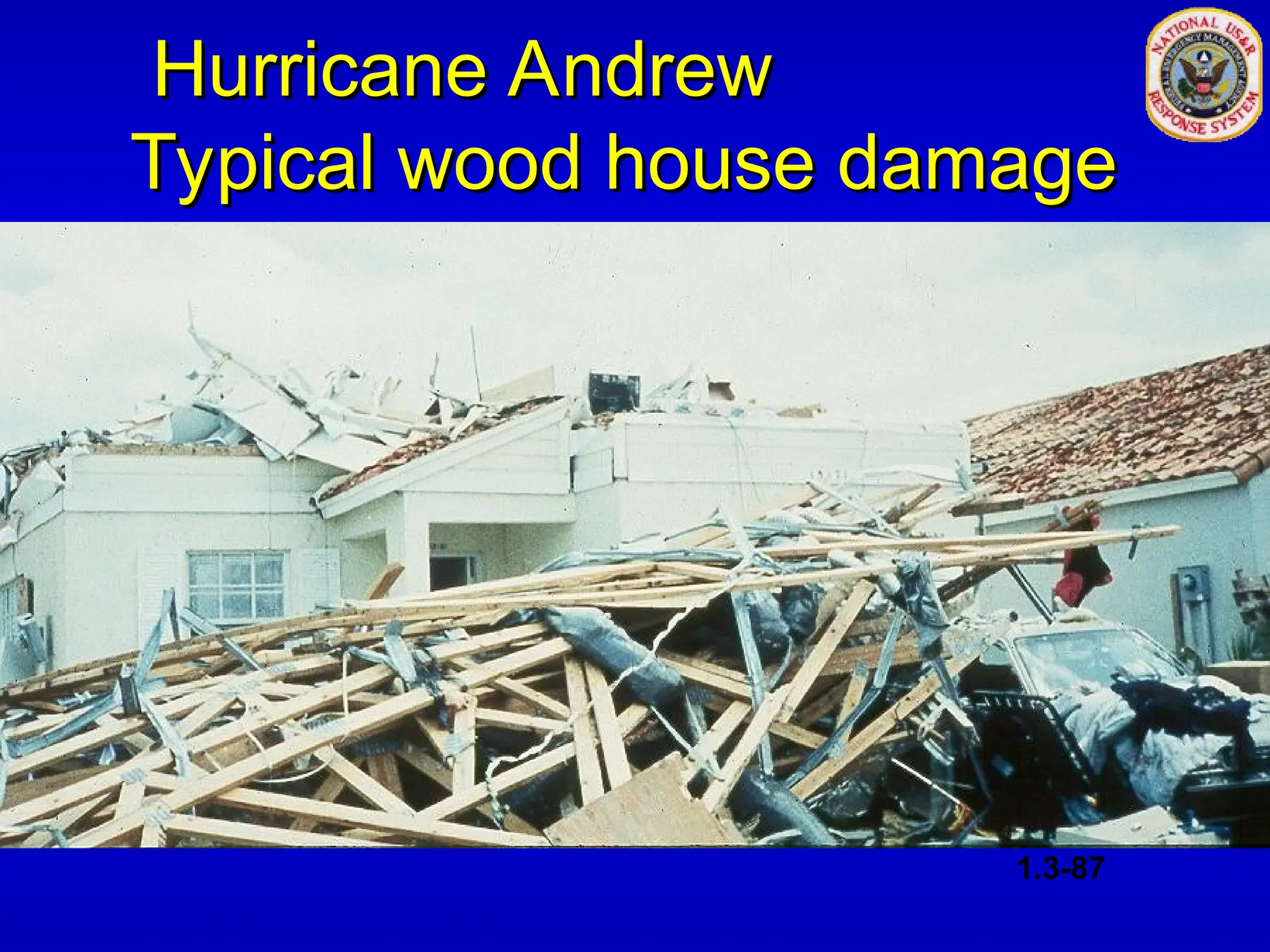
Hurricane Andrew
Hurricane Andrew
Typical wood house damage
1.3-85
Hurricane Andrew
Hurricane Andrew
Typical wood house damage
1.3-86
Hurricane Andrew
Hurricane Andrew
Typical wood house damage
1.3-87
Hurricane Andrew
Hurricane Andrew
Typical Mobile Home Damage
1.3-94
Problematic Light Buildings
• Other Wood Frame
- multi-residence
condos 2s
–low cost housing 4s
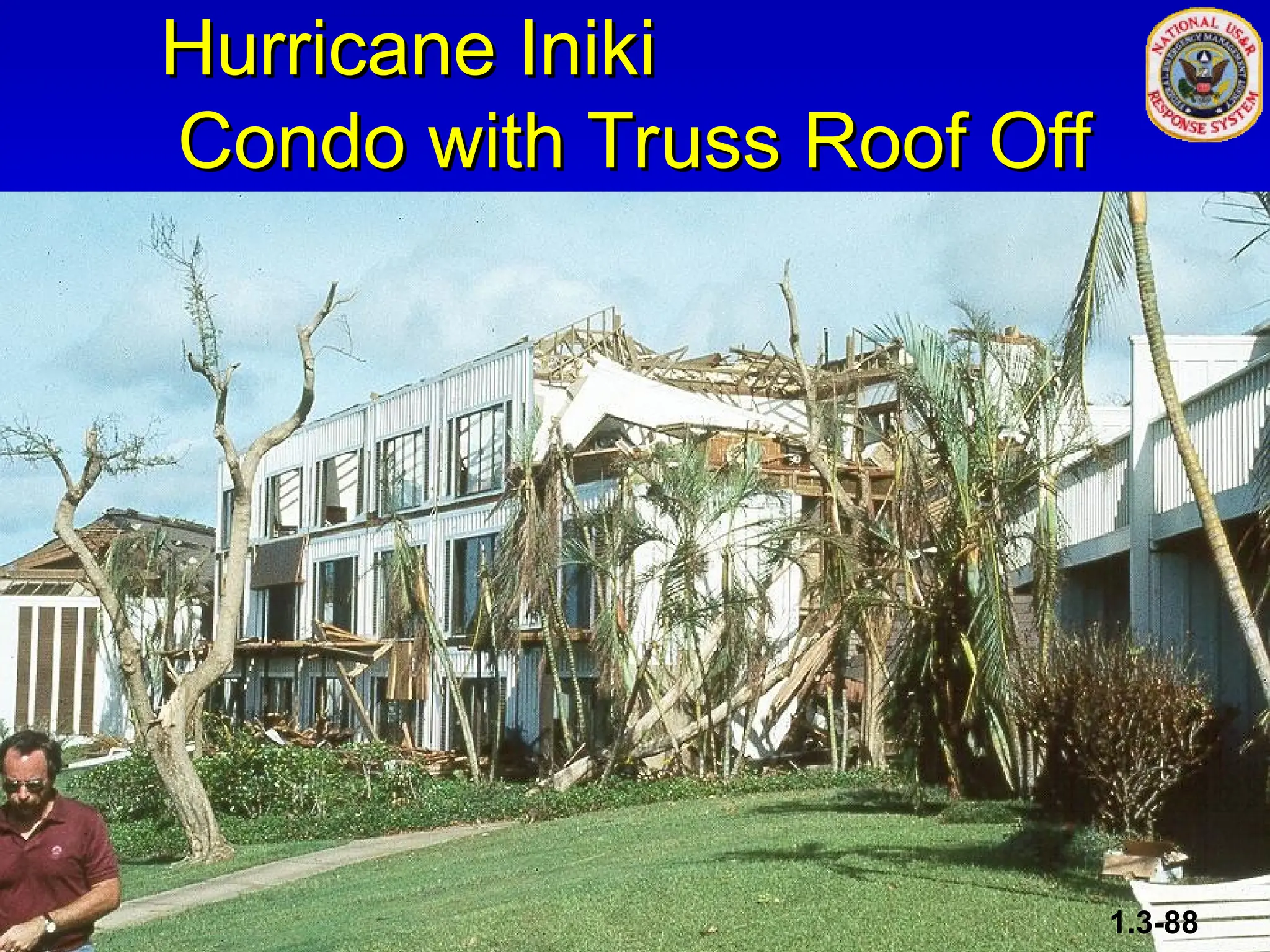
Hurricane Iniki
Hurricane Iniki
Condo with Truss Roof Off
1.3-88
Hurricane Iniki
Hurricane Iniki
Condo w/ H. Timber Roof Off
1.3-89
Hurricane Andrew
Hurricane Andrew
Low Cost Housing - Poor execution
1.3-90
Hurricane Andrew
Hurricane Andrew
Low Cost Housing - No Dowels
1.3-91
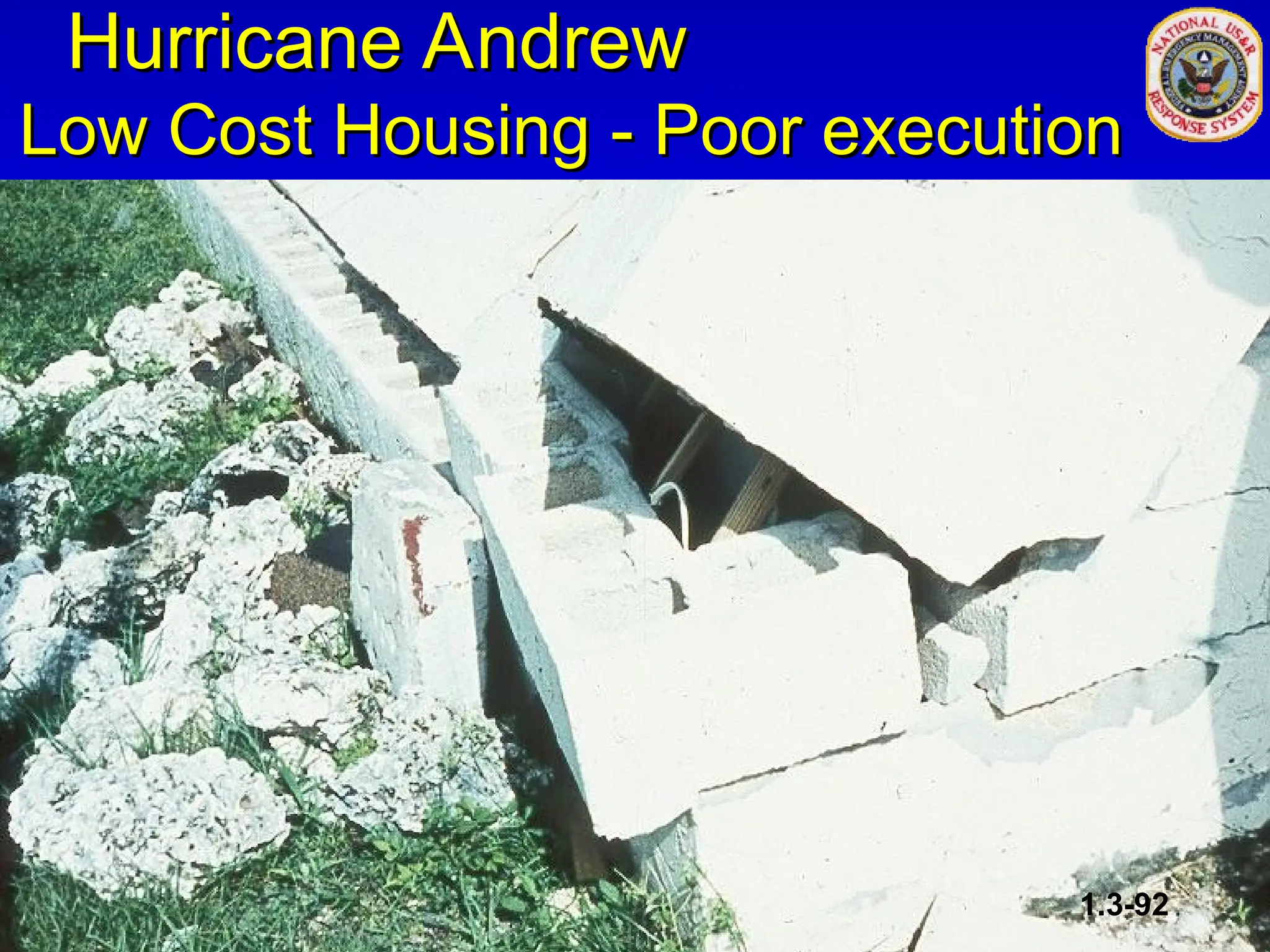
Hurricane Andrew
Hurricane Andrew
Low Cost Housing - Poor execution
1.3-92
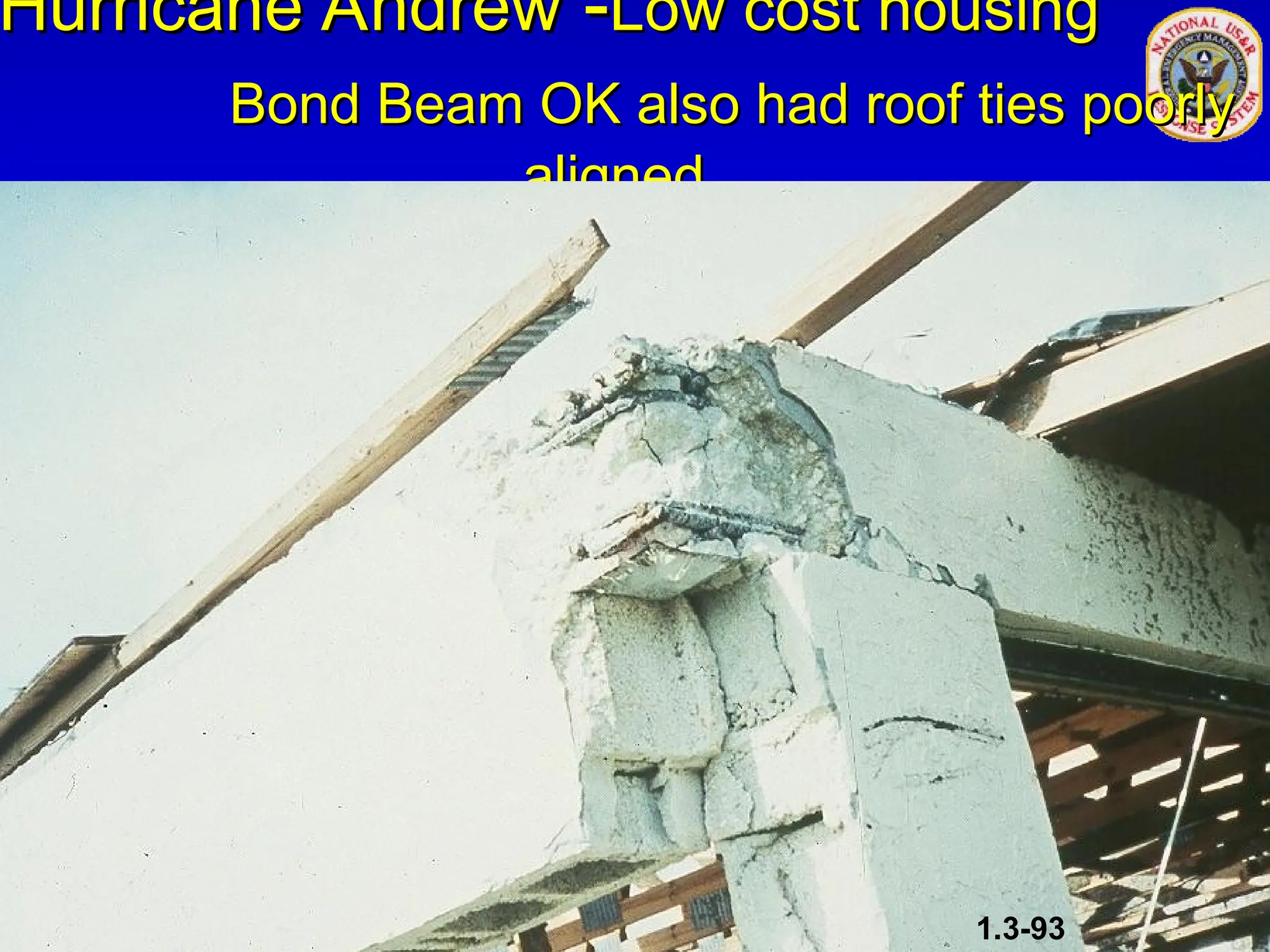
Hurricane Andrew
Hurricane Andrew -
-Low cost housing
Low cost housing
Bond Beam OK also had roof ties poorly
aligned
aligned
1.3-93
Problematic S3, URM, RM, TU
• Light Metal Buildings 2s
• Commercial & Industrial Bldgs
- walls of URM, RM, TU
(if large opngs are penetrated) 2s
Hurricane Andrew
Hurricane Andrew
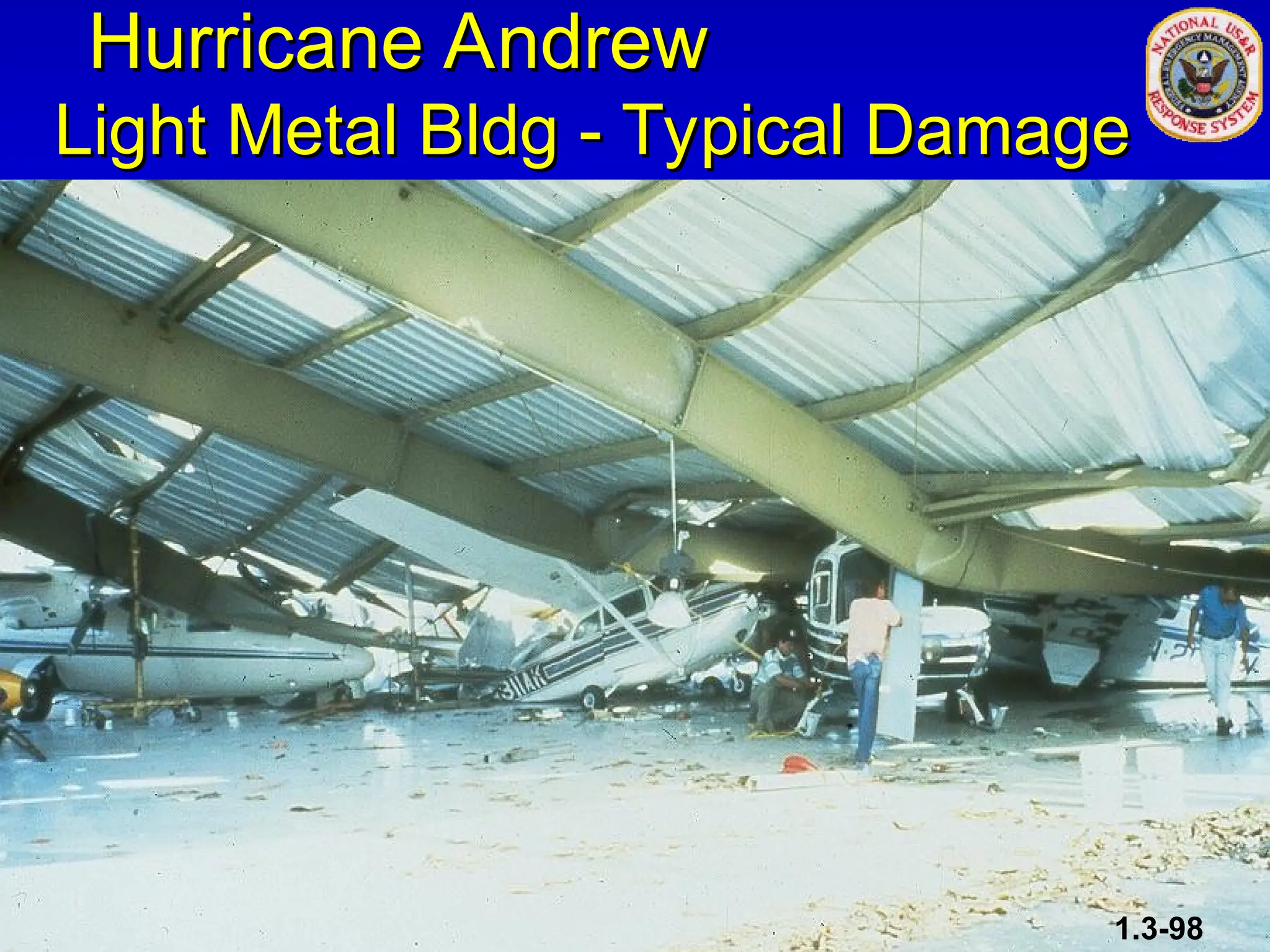
Light Metal Bldg - Typical Damage
1.3-97
Hurricane Andrew
Hurricane Andrew
Light Metal Bldg - Typical Damage
1.3-98
Hurricane Andrew
Hurricane Andrew
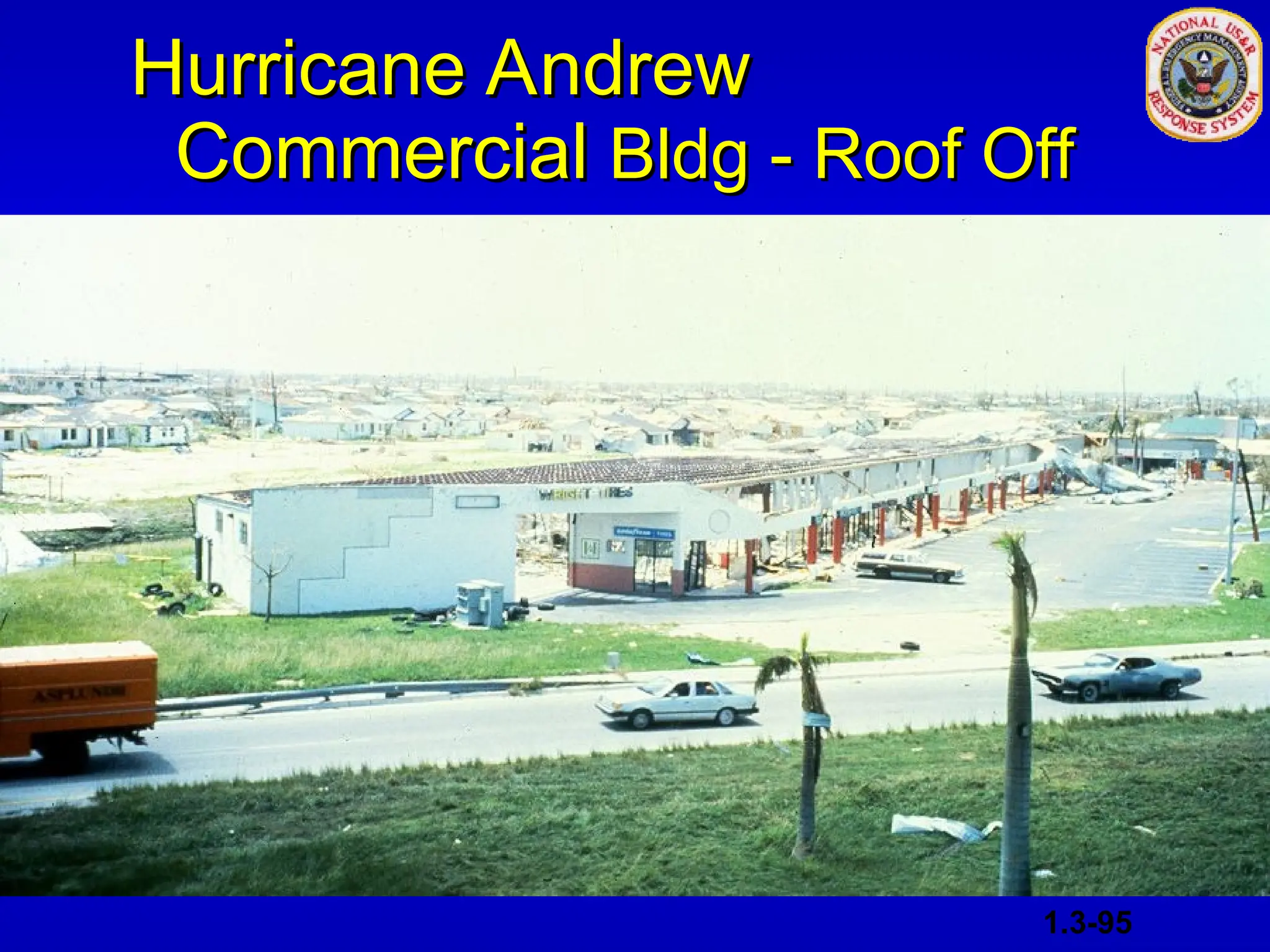
Commercial
Commercial Bldg - Roof Off
Bldg - Roof Off
1.3-95
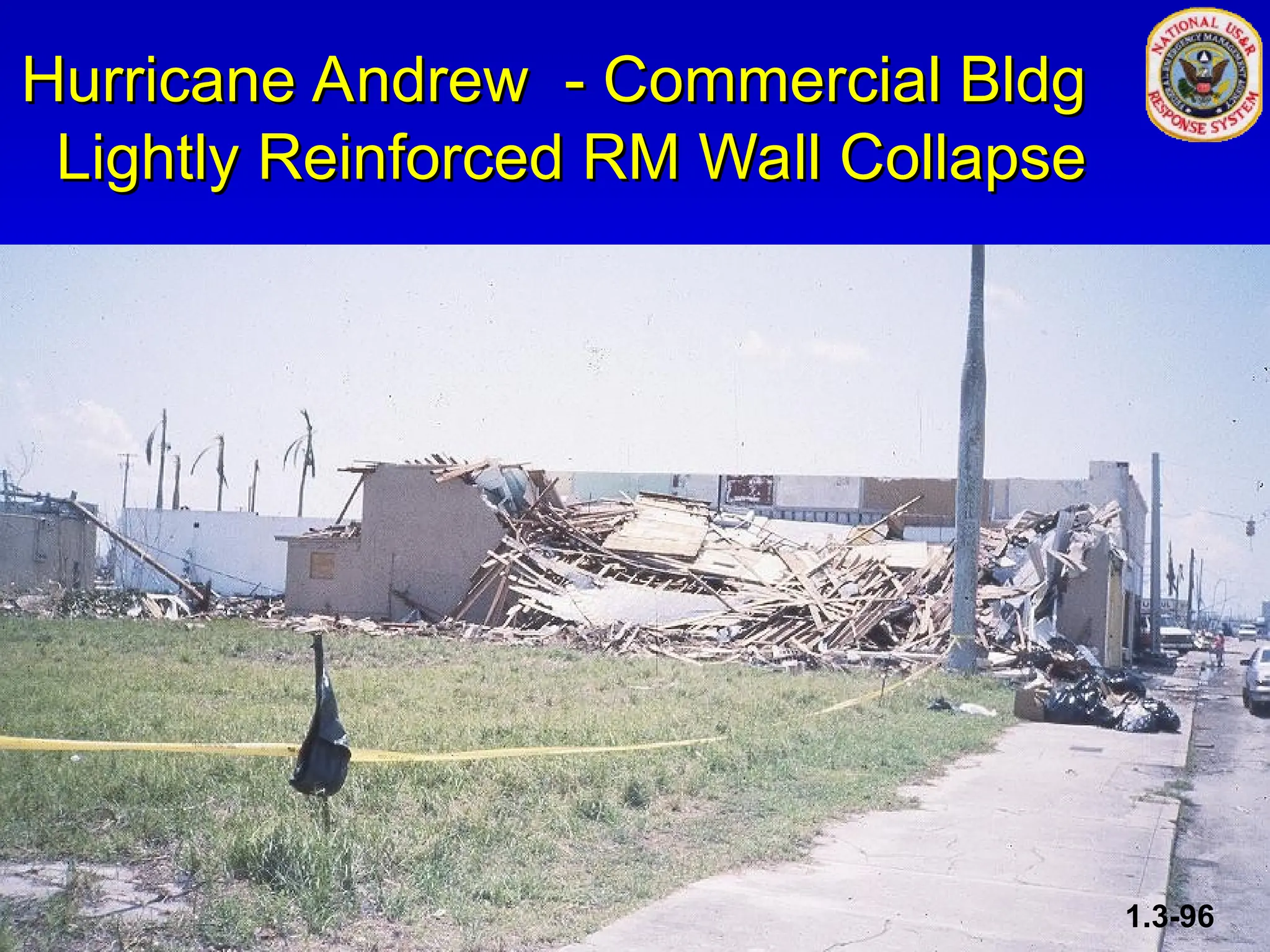
Hurricane Andrew - Commercial Bldg
Lightly Reinforced RM Wall Collapse
1.3-96
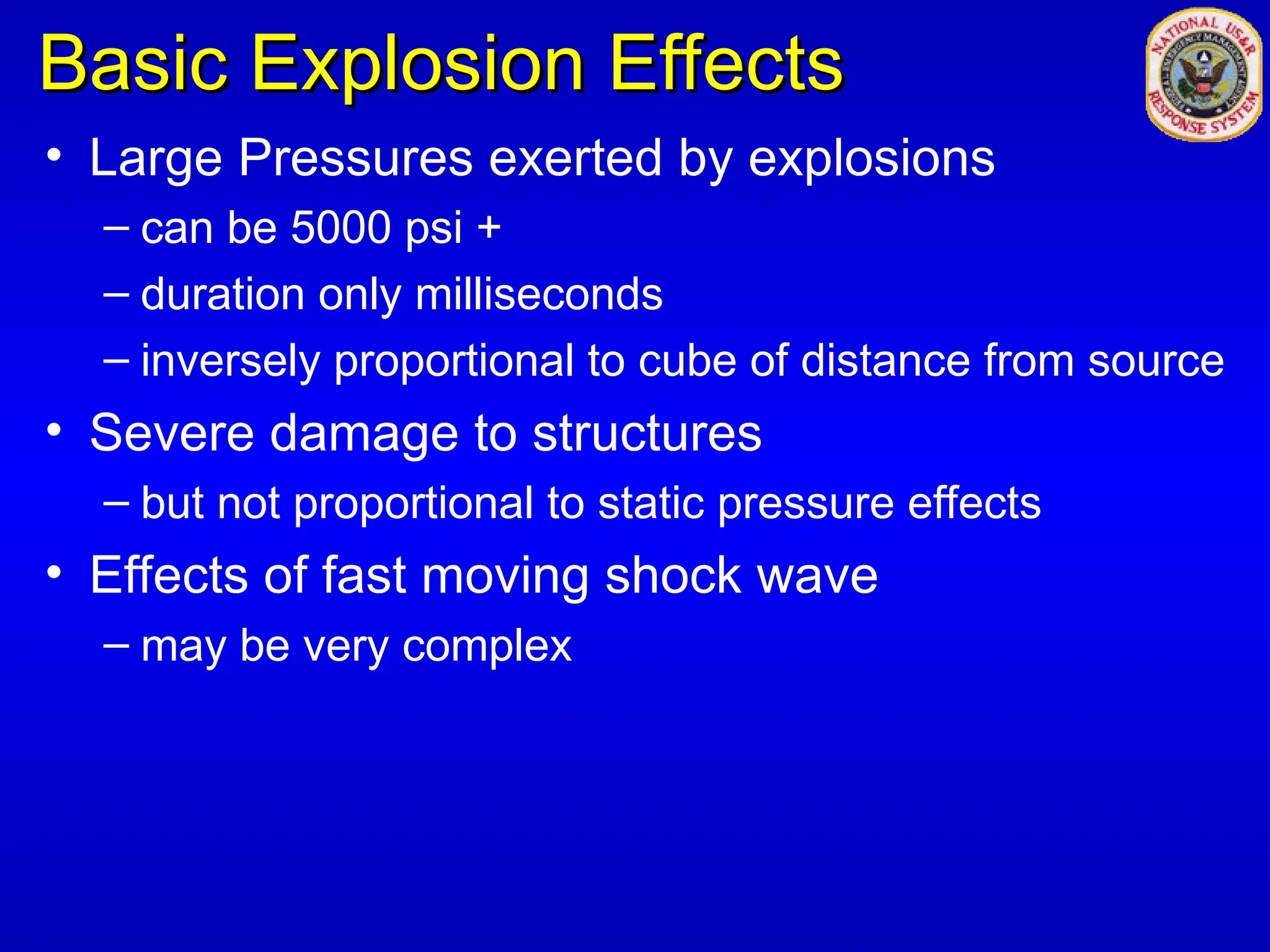
Basic Explosion Effects
• Large Pressures exerted by explosions
– can be 5000 psi +
– duration only milliseconds
– inversely proportional to cube of distance from source
• Severe damage to structures
– but not proportional to static pressure effects
• Effects of fast moving shock wave
– may be very complex
Blast Effects on Buildings
• W - Wood Structures
• S1 & S2 - Steel Frame Structures
• S3 - Light Steel Structures
• C1, C2 & C3 - Concrete Frames
• PC2 - Precast Structures, Frame & Box
• Post-Tensioned Concrete Structures
• Heavy Wall Structures - TU, RM, & URM
Blast Effects on W & S Buildings
• W - Wood Structures
– light wall/roof surfaces are blown away.
remainder collapses
– end up with leveled structure
• S1 & S2 - Steel Frame Structures
– beams / columns have small dimensions and
are very resistant to sudden forces.
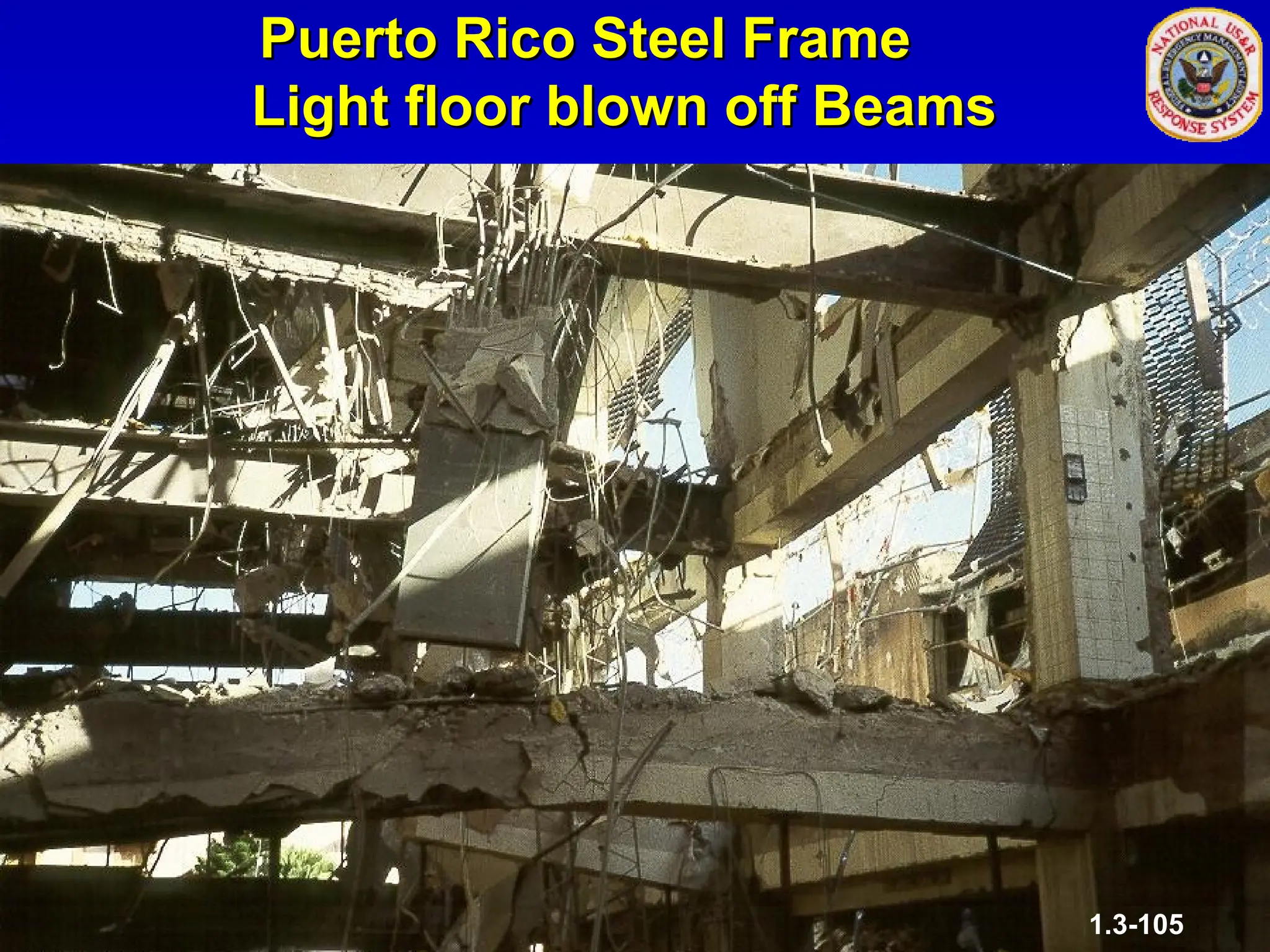
– light floors may be blown away, leaving poorly
braced beams & columns. 4s
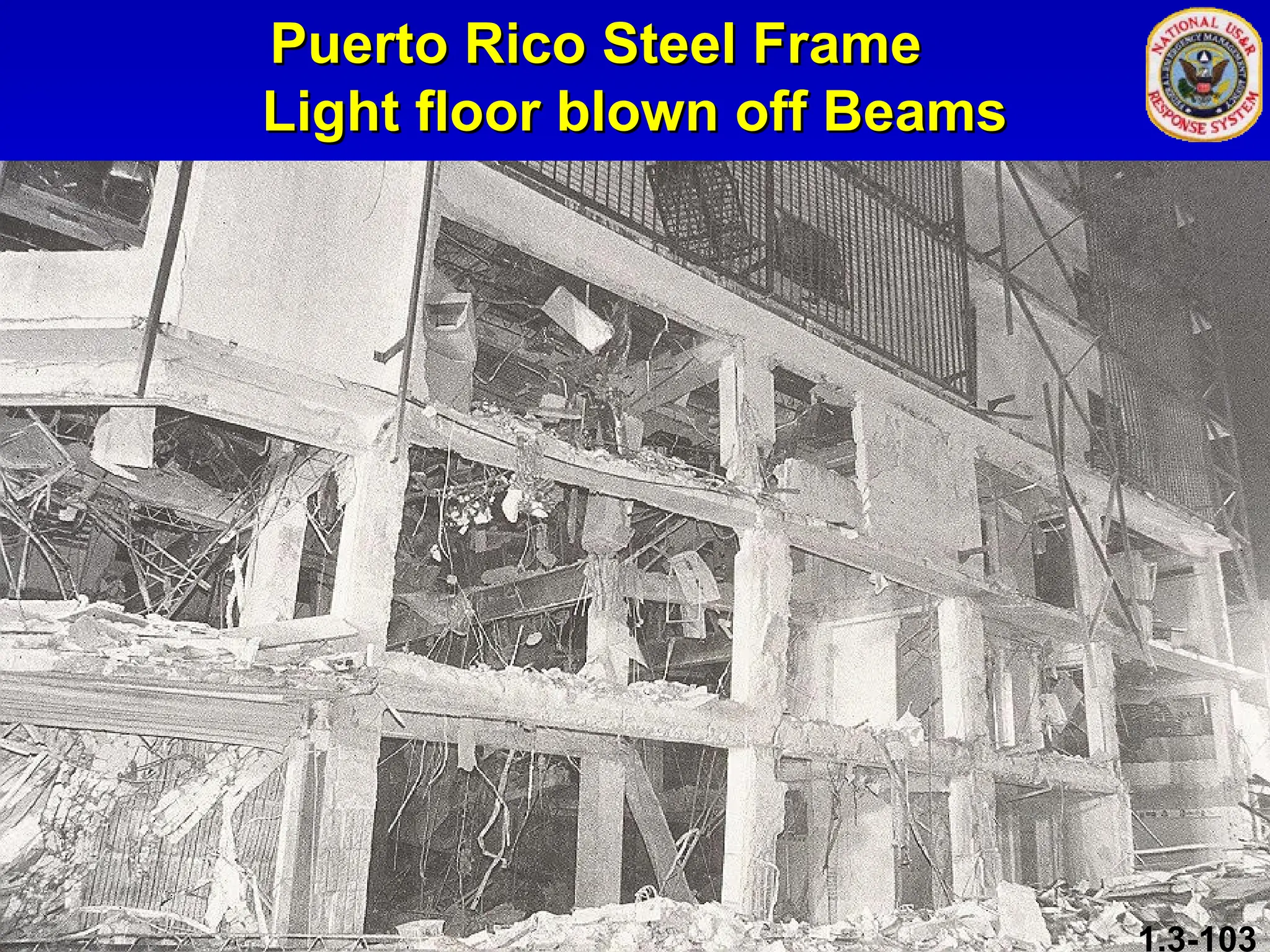
Puerto Rico Steel Frame
Light floor blown off Beams
1.3-103
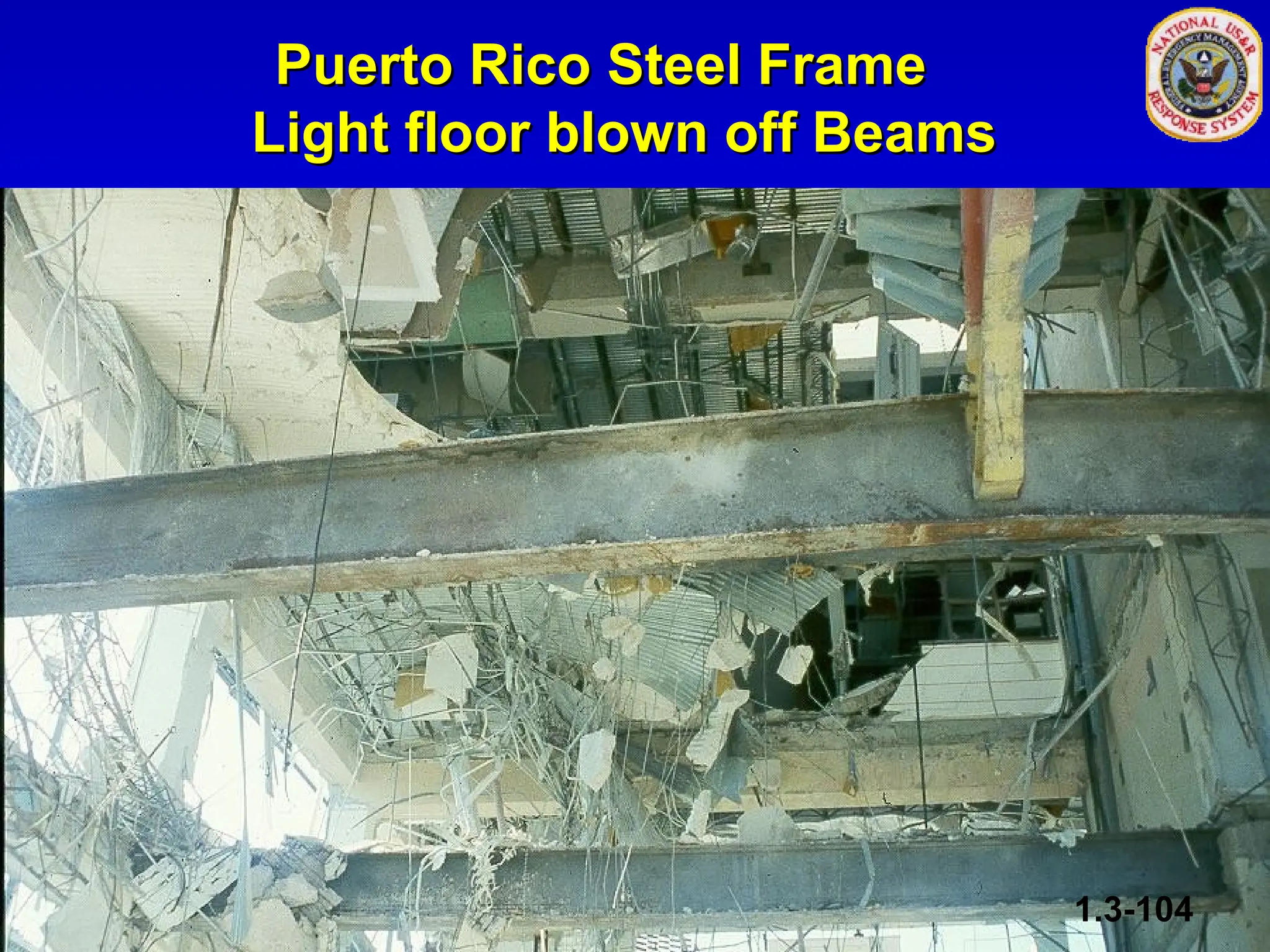
Puerto Rico Steel Frame
Light floor blown off Beams
1.3-104
Puerto Rico Steel Frame
Light floor blown off Beams
1.3-105
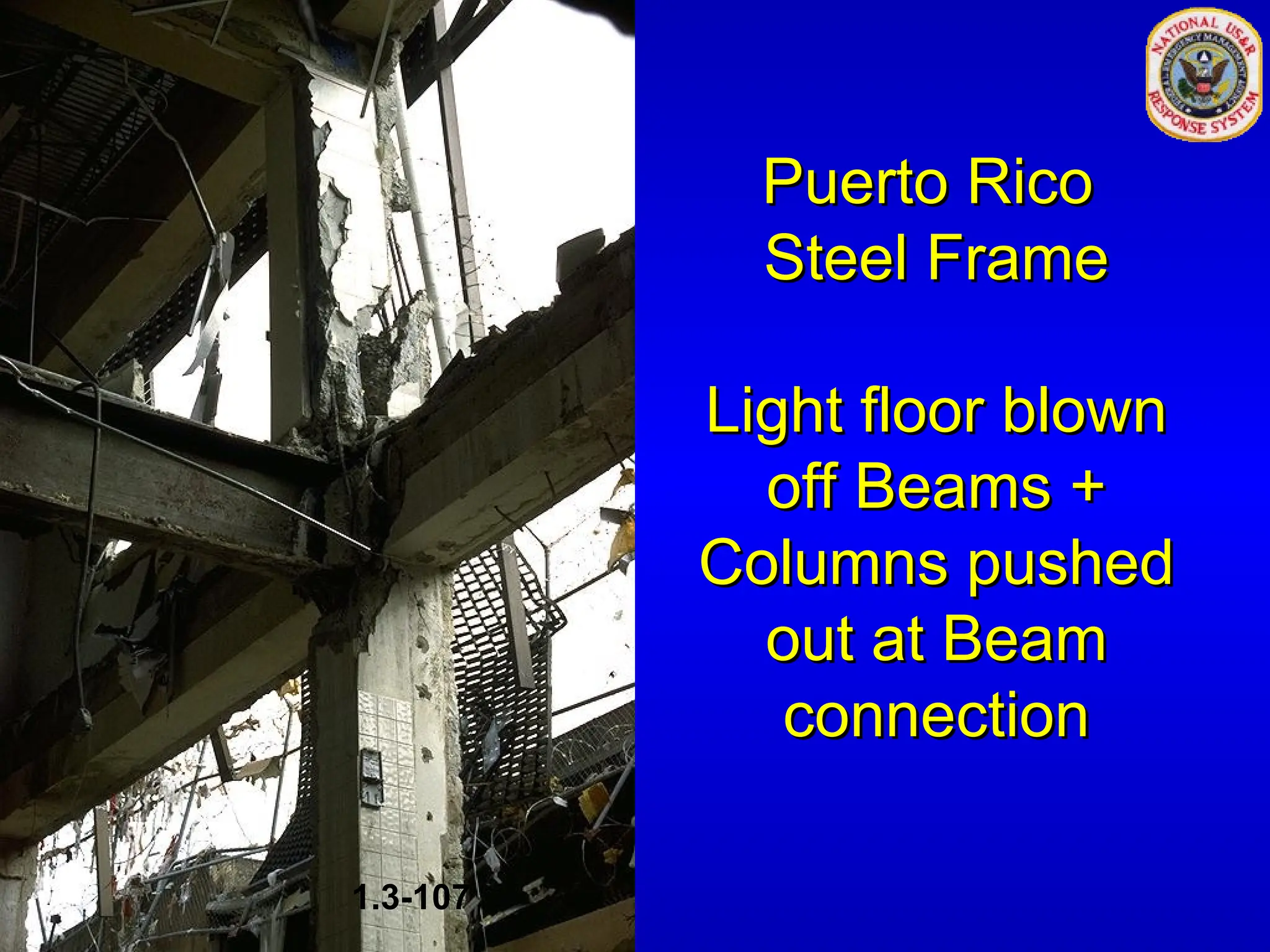
Puerto Rico
Puerto Rico
Steel Frame
Steel Frame
Light floor blown
Light floor blown
off Beams +
off Beams +
Columns pushed
Columns pushed
out at Beam
out at Beam
connection
connection
1.3-107
Blast Effects on C1, C2, & C3
Concrete Framed Structures
• Lift forces have especially devastating effects on
gravity designed slabs
– when gravity force is overcome, slabs and beams can hinge
where rebar is not continuous
• at mid-span and at span ends
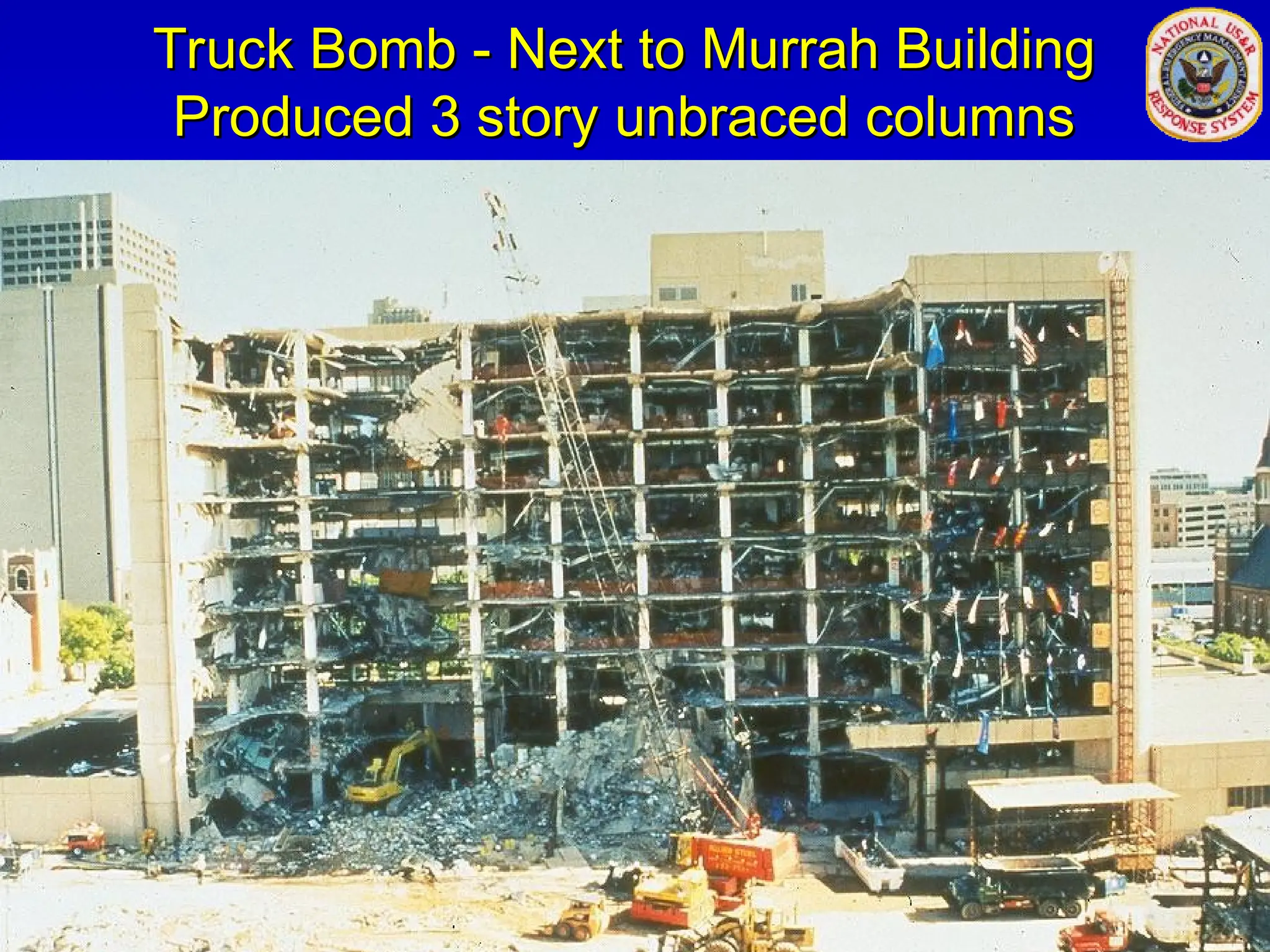
• This can result in multi story columns left standing w/o
enough lateral bracing
– multi level collapse is then probable 6s
• C3 type, URM infill is also blown in/out 2s
Truck Bomb in WTC Garage
Produced 6 story unbraced columns
Truck Bomb
Truck Bomb
Truck Bomb - Next to Murrah Building
Produced 3 story unbraced Columns
Can we see them from here ?
Truck Bomb - Next to Murrah Building
Produced 3 story unbraced columns
Truck Bomb - Next to Murrah Building
Produced 3 story unbraced columns
C3 Concrete Frame at left - OKC
Punching Shear Failure of Flat Slab Roof,
probably caused by overpressure
1.3-115
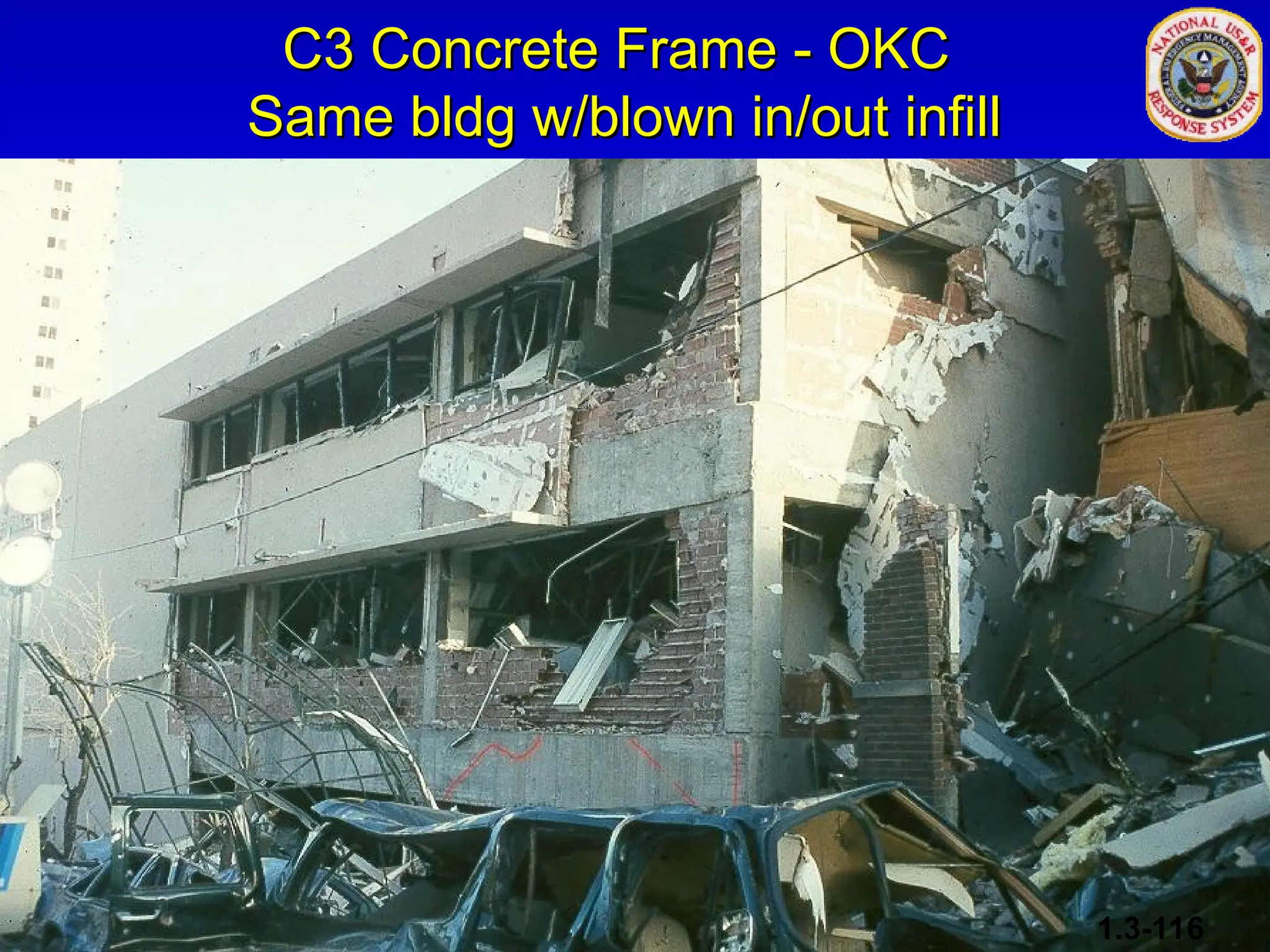
C3 Concrete Frame - OKC
Same bldg w/blown in/out infill
1.3-116
Blast Effects on PC2 Buildings
• PC2 - Frame type structures
– pressures can dislodge walls, slabs
• beams & columns then effected by lack of bracing.
– break/damage many connections
– progressive collapse possible.
• Due to missing supports and dis-continuous members.
• PC2 - Box type structures
– pressures can dislodge walls & slabs
• break/damage many connections
– better response in multi wall buildings 3s
Kobar Towers, Saudi Arabia Explosion
19 Killed and 400 Injured
Kobar Towers, Saudi Arabia Explosion
Very Large Crater
Very Large Crater
Saudi Arabia Barracks Explosion PC2 - Box
Limited damage to living units at face of Bldg
1.3-116a
Blast Effects on PT
Blast Effects on PT
& Other Bldgs
& Other Bldgs
• Postensioned Concrete - very vulnerable
to uplift pressures & progressive failure of
entire slab due to loss of tension in
unbonded cable
• TU, RM, & URM - large wall & roof
surfaces effected. Lifted roof and blown out
,farside walls 3s
Blast compared to very short term - high
velocity wind w/special effects
OKC - URM Blast Damage
1.3-117
OKC - URM Blast Damage
1.3-118
OKC - URM Blast Damage
1.3-119
Review of Topics
Review of Topics
• Basic Structural Loading
• ATC -21 building classification
• Problematical building types
• Basic collapse patterns
• Earthquake collapse patterns
• Windstorm collapse patterns
• Blast effects on buildings

tecnico en rescate en estructuras colapsadas

  • 1.
    FEMA NATIONAL US&RRESPONSE SYSTEM FEMA NATIONAL US&R RESPONSE SYSTEM Structural Collapse Technician Training Structural Collapse Technician Training MODULE 1 c MODULE 1 c Structural Engineering Structural Engineering Systems Systems MATERIALS & BASIC MATERIALS & BASIC STRUCTURAL SYSTEMS STRUCTURAL SYSTEMS
  • 2.
    TERMINAL OBJECTIVES TERMINAL OBJECTIVES •The Student shall understand the essential materials and components of structures, and how they behave when subjected to normal and extreme loading
  • 3.
    ENABLING OBJECTIVES ENABLING OBJECTIVES •Understand the Tension, Compression, Bending, and Shear Forces that are exerted on building materials, and how they behave. • Understand the concepts of Ductile and Brittle behavior. • Introduce the concept of Vertical Load Path and Vertical Load Resisting Systems
  • 4.
    ENABLING OBJECTIVES ENABLING OBJECTIVES •Discuss Lateral Load Resisting Systems, including Box, Moment Frame, and Diagonally Braced Frame Systems • Define and discuss Structural Redundancy
  • 5.
  • 6.
  • 7.
  • 8.
  • 9.
    Material Properties Material Properties Brittlevs Ductile Brittle vs Ductile • Wood • Steel • Reinforced Concrete –C.I.P. or P.C. –Rebar or Prestressed Cable • Reinforced Masonry • Unreinforced Masonry
  • 10.
    Vertical Load Systems VerticalLoad Systems • Concept of gravity load path • Loads must be transferred from Source to Ground • Top down approach – Plumbing system analogy • Framed and Un-Framed • Connections are particularly vulnerable
  • 11.
    Vertical Load PathConcept Vertical Load Path Concept
  • 12.
    Vertical Load PathConcept Vertical Load Path Concept
  • 13.
    Concrete Floor Systems ConcreteFloor Systems Most of the reinforcing steel is concentrated in and over Beams and over Columns
  • 14.
    Typical Truss Configurations TypicalTruss Configurations • Tension in bottom chords • Compression in top chords • Small tension or compression. in diagonals
  • 15.
    Lateral Load ResistingSystems Lateral Load Resisting Systems • Concept of load paths • Pushover analogy • Connections are particularly vulnerable • Systems – Box Buildings – Moment Frames - (MUST BE DUCTILE ) – Diagonally Braced Frames
  • 16.
    Lateral Load PathConcept Lateral Load Path Concept Pushover Analogy Pushover Analogy
  • 17.
  • 18.
    Lateral Load PathConcept Lateral Load Path Concept Box Building Box Building
  • 19.
  • 20.
    Lateral Load PathConcept Lateral Load Path Concept Moment Frame Moment Frame
  • 21.
  • 22.
    Lateral Load PathConcept Lateral Load Path Concept Diagonal Braced Frame Diagonal Braced Frame
  • 23.
    Redundancy Redundancy • Multi -Elements (at least 2 in every line of resistance) – Box Buildings – Diagonal Braced Frames • Majority of Connections – Moment Frames • Dual Systems • Collapse Preventers
  • 24.
    Tension Structure Redundancy TensionStructure Redundancy Suspension Bridge Partly Collapsed Building Catenary Catenary
  • 25.
    TOPICS we have TOPICSwe have QUICKLY REVIEWED QUICKLY REVIEWED • Force Types –Stress = Force/Area • Ductile vs Brittle • Material Behavior • Vertical Load Systems • Lateral Load Resistant Systems • Redundancy
  • 26.
    FEMA NATIONAL US&RRESPONSE SYSTEM FEMA NATIONAL US&R RESPONSE SYSTEM Structural Collapse Technician Training Structural Collapse Technician Training UNIT I c UNIT I c Structural Engineering Systems Structural Engineering Systems COLLAPSE PATTERNS COLLAPSE PATTERNS
  • 27.
    TERMINAL OBJECTIVES TERMINAL OBJECTIVES •The Student shall understand the how building structures can be separated into specific types that exhibit unique collapse patterns when subjected to extreme forces due to Earthquake Wind , and Explosions • The Student shall be able to recognize their unique Collapse Patterns
  • 28.
    ENABLING OBJECTIVES ENABLING OBJECTIVES •Understand the extreme environmental and man caused forces that effect structures. • Define and Understand how buildings are classified by engineers based on their Construction Materials and Lateral Load Resisting Systems. • Discuss the most common Collapse Patterns that have been observed as a result of Earthquakes, Windstorms, and Explosions
  • 29.
    Earthquake Basics Earthquake Basics •Extent of damage is determined by – type of shaking that occurs at site – coupled with the structures response • Magnitude (energy release) – determines POTENTIAL number of effected structures • Aftershocks – Earthquakes are unique type of Disaster – just keeps on giving
  • 30.
    Plan of LargeEarthquake - M 7 Plan of Large Earthquake - M 7 Causes major damage if Fault is within city 30km Fault Break Duration 15 sec Eff peak accel .5G
  • 31.
    Plan of GreatEarthquake M 8+ Plan of Great Earthquake M 8+ 250km Fault Break Duration 60 sec Eff Peak Accel .6G Fault rupture speed is 2 to 3 kms Fault rupture speed is 2 to 3 kms Total energy release is 30 to 100 times large Quake
  • 32.
    Aftershocks Aftershocks • Smaller quakesthat occur on same fault as original quake. – Minor fault adjustments • Occur after most quakes regardless of size of original shock • On average largest is 1.2M less than original – Some have been almost as large as original. (in range of M 6) • Will occur during US&R Ops since are most prevalent in first week.
  • 33.
    How Many Aftershocks? How Many Aftershocks ? • USGS - Rule of Thumb – For every single decrease in magnitude, get 10 fold increase in number • If original quake is M 7 – 1 or so aftershock in range of M 6 – 10 “ “ “ “ 5 – 100 “ “ “ “ 4 – 1000 “ “ “ “ 3 • Have fewer as time passes – Day 2 = 1/2 as many as day 1 – Day 3 = 1/3 as many as day 1 – Day 4 = 1/4 as many as day 1, etc
  • 34.
    1989 Loma PrietaAftershocks 1989 Loma Prieta Aftershocks Days after original shock Days after original shock Magnitud Magnitud e e
  • 35.
    Taiwan 921 Taiwan 921 M7.7 Quake M 7.7 Quake was followed by was followed by many large many large aftershocks in the aftershocks in the 2 weeks following 2 weeks following the quake the quake (larger than M5.5 (larger than M5.5) ) 1.1-21
  • 36.
  • 37.
    World Map ofE.Q Faults World Map of E.Q Faults . 1.1-23
  • 38.
    San Andreas San Andreas FaultTrace Fault Trace Actual Faults Actual Faults are 5 + km are 5 + km deep deep 1.1-21
  • 39.
    Large Offset shownin Creek Bed Large Offset shown in Creek Bed 1.1-22
  • 40.
    Damage to Heavy,Weak URM Damage to Heavy, Weak URM 1.1-25
  • 41.
  • 42.
    Damaged to under-engineered Damagedto under-engineered 1.1-29
  • 43.
    KOBE - SevereDamage due to KOBE - Severe Damage due to Near Fault Effects Near Fault Effects 1.1-32
  • 44.
    MEXICO CITY -Harmonic, Far Field Effects MEXICO CITY - Harmonic, Far Field Effects 1.1-30
  • 45.
    Quake effects Building+ Contents Quake effects Building + Contents 1.1-31
  • 46.
  • 47.
    Hurricanes Hurricanes High winds to175mph + missiles High winds to 175mph + missiles 1.1-1
  • 48.
    Hurricane - tidalsurge damage Hurricane - tidal surge damage 1.1-2
  • 49.
    Much damage tolight structures Much damage to light structures 1.1-3a
  • 50.
    Tornado - smallerbut higher speed Tornado - smaller but higher speed winds up to 250mph - little warning winds up to 250mph - little warning 1.1-4
  • 51.
    Tornado - damageto Lt. Frame Tornado - damage to Lt. Frame 1.1-5
  • 52.
    Tornado - damageto URM Tornado - damage to URM 1.1-6
  • 53.
  • 54.
    Interior explosion -Lt. Frame Interior explosion - Lt. Frame 1.1-10
  • 55.
    Interior explosion -Conc Frame Interior explosion - Conc Frame 1.1-9
  • 56.
    Interior Explosion, LightMetal Bldg - Reinf. conc Interior Explosion, Light Metal Bldg - Reinf. conc block walls are all that is partly standing. Steel block walls are all that is partly standing. Steel Frame w/metal skin was blown away Frame w/metal skin was blown away
  • 57.
    Interior explosion -WTC, flat slabs Interior explosion - WTC, flat slabs 1.1-9a
  • 58.
    Exterior Explosion Loading ExteriorExplosion Loading over pressure over pressure over pressure drag reflected pressure spherical shock wave stand-off 1s
  • 59.
    Exterior Explosion -Murrah Building Exterior Explosion - Murrah Building 1.1-9b
  • 60.
    Exterior Explosion Loading ExteriorExplosion Loading A B C Exterior walls, columns & windows Roof & Floor slabs Frame Ground shock 1s
  • 61.
    Large Explosion -Crater & E Q Large Explosion - Crater & E Q 1.1-9c
  • 62.
    Loading Caused byFire Loading Caused by Fire • Burnout of Wood Roof/Floors can lead to dangerous unbraced walls 2s • Fire in Steel Building w/restraining walls can lead to damage due to expansion • Heat from Burned Wood Apartment caused Expansion Damage to RM Shearwalls in Basement Garage 1s • Wood Bldgs, especially w/2x trusses are a problem – 34 FireFighters killed in 19 incidents 1977 thru 1999
  • 63.
    Worcester Fire -Dec99 Worcester Fire - Dec99 Burnout - 6 story unbraced walls Burnout - 6 story unbraced walls
  • 64.
    Worcester Fire -Dec99 Worcester Fire - Dec99 Burnout - 6 story unbraced walls Burnout - 6 story unbraced walls
  • 65.
    Expanding Slab DamagedShearwalls Expanding Slab Damaged Shearwalls 1.1-15
  • 66.
    Refer to Manualfor Following Refer to Manual for Following • Damage by Floods • Construction Bracing, Overload • Vehicle Impact Loading
  • 67.
    Building types -ATC-21-1 Building types - ATC-21-1 • W Wood buildings of all types • S1 Steel moment resisting frames • S2 Braced steel frames • S3 Light metal buildings • S4 Steel frames w/C I P conc walls
  • 68.
    Building types -ATC-21-1 Building types - ATC-21-1 • C1 Concrete moment resisting frames • C2 Concrete shear wall buildings • C3/S5 Conc/steel frame w/urm infill walls • TU/PC1 Tilt-up concrete wall building • PC2 Precast concrete frame buildings • RM Reinforced masonry buildings • URM Unreinforced masonry building
  • 69.
    Problem Buildings Problem Buildings •W 1 to 3 story houses & 2 to 4 story apartments (especially pre 1970) • S1 Frames w/brittle welded conns • S2 Frames where column capacity is less than capacity of diag braces • S3 Light structure vulnerable to Wind • C1/C3 Pre 1971 bldgs (espec pre 1941) • PC2/TU Factory built precast & tilt-up wall • URM 1 to 8 story (most 3 story & less) + steel & conc frames w/URM infill • Others Irregular - soft story, open front
  • 70.
    Wood Houses W WoodHouses W 2s
  • 71.
    E Q RackedWood House E Q Racked Wood House W-1
  • 72.
    Hurricane damaged woodhouse Hurricane damaged wood house W-2
  • 73.
    Wood Frame ApartmentsW Wood Frame Apartments W 3s
  • 74.
    EQ shifts woodapartment off EQ shifts wood apartment off foundation - Brick Veneer foundation - Brick Veneer W-3
  • 75.
    EQ racked 4story wood apartment EQ racked 4 story wood apartment W-4
  • 76.
    Wood - 2story Office Building Wood - 2 story Office Building W-5
  • 77.
    Steel Moment FrameS1 Steel Moment Frame S1 4s
  • 78.
    Moment Frame underconstruction Moment Frame under construction S1-1
  • 79.
    Moment frame underconstruction Moment frame under construction Showing new, improved joints Showing new, improved joints S1-2
  • 80.
    Steel Diag. BracedFrame S2 Steel Diag. Braced Frame S2 3s
  • 81.
    4 Story S-2 4Story S-2 hard to tell what building type hard to tell what building type S2-1
  • 82.
    22 story S-2Collapse - Weak Column 22 story S-2 Collapse - Weak Column S2- 3
  • 83.
    22 story S-2Collapse - Weak Column 22 story S-2 Collapse - Weak Column S2-4
  • 84.
    Light Metal BuildingS3 Light Metal Building S3 3s
  • 85.
    Typical S3 Type TypicalS3 Type with minor damage with minor damage S3-1
  • 86.
    Hurricane Andrew -S3 damage Hurricane Andrew - S3 damage S3-2
  • 87.
    Hurricane Iniki -S3 damage Hurricane Iniki - S3 damage S3-3
  • 88.
    Concrete Moment FramesC1 Concrete Moment Frames C1 2s
  • 89.
    C1 with brickinfill - core collapse C1 with brick infill - core collapse C1-1
  • 90.
    C1 with ClayTile infill = C3 C1 with Clay Tile infill = C3 Santa Monica, Sea Castle Santa Monica, Sea Castle C1-2
  • 91.
    Concrete Shearwall BldgsC2 Concrete Shearwall Bldgs C2 3s
  • 92.
    8.4 Alaska EQ 8.4Alaska EQ 12 Story Apt. 12 Story Apt. C2 Type C2 Type Badly damaged, Badly damaged, but no Collapse but no Collapse C2-1
  • 93.
    C-2 in MexicoCity Quake - No damage C-2 in Mexico City Quake - No damage C2-2
  • 94.
  • 95.
    Precast Concrete BldgsPC2 Precast Concrete Bldgs PC2 3s
  • 96.
    PC2 - TypicalArmenia Collapse PC2 - Typical Armenia Collapse PC-1
  • 97.
    PC2, Whittier Quake,May Co. Garage PC2, Whittier Quake, May Co. Garage PC-2
  • 98.
    PC2 Parking Garage PC2Parking Garage Mexico City Quake, no damage - non C1 Mexico City Quake, no damage - non C1 PC-3
  • 99.
    Post Tensioned LiftSlab Bldg Post Tensioned Lift Slab Bldg (see Manual for comment) (see Manual for comment) 4s
  • 100.
    Tilt-Up Wall BuildingsTU Tilt-Up Wall Buildings TU 3s
  • 101.
    TU - TypicalConstruction TU - Typical Construction 1971 San Fernando Earthquake 1971 San Fernando Earthquake TU-1
  • 102.
    TU - TypicalConstruction, TU - Typical Construction, Light Roof & Heavy Walls Light Roof & Heavy Walls TU-2
  • 103.
    TU - TypicalDamage, San Fernando TU - Typical Damage, San Fernando TU-3
  • 104.
    Types of URMBuildings Types of URM Buildings • Brick bearing wall buildings - – URM exterior walls – Wood floors & interior walls. • URM infill - in concrete or steel frames. – infill is brick, hollow clay tile, hollow CMU • UR, hollow conc block bearing wall . – may have bond beams at floor & roof – may have vertical bar at edges of opngs
  • 105.
    Types of URMBuildings Types of URM Buildings • UR or Under-reinforced Brick cavity walls. – insulation layer between masonry layers – may be used as infill or as bearing walls with bond beams. • Masonry veneer on wood/steel studs – anchorage is all important due to interaction of brittle wall covering on flexible structure. • Native stone, adobe, mud, etc. bearing wall buildings.
  • 106.
    URM Bearing WallBldg URM Bearing Wall Bldg 3s
  • 107.
    Typical URM Layout TypicalURM Layout unless veneer covers it up unless veneer covers it up URM-1
  • 108.
    Bearing wall TypeURM - 1906 EQ Bearing wall Type URM - 1906 EQ URM-2 Stanford Memorial Church
  • 109.
    Bearing wall Typew/retrofit Bearing wall Type w/retrofit Did well in Northridge EQ Did well in Northridge EQ URM-3
  • 110.
  • 111.
  • 112.
    C3 - BrickInfill Conc Frame C3 - Brick Infill Conc Frame URM-4 Mexico City 1985 Quake
  • 113.
    Basic Collapse Patterns BasicCollapse Patterns a shear b col joint c overturning
  • 114.
    Basic Collapse Patterns BasicCollapse Patterns d wall joint e local column f single story
  • 115.
    BASIC PRINCIPLES BASIC PRINCIPLES EarthquakeCaused Collapse Earthquake Caused Collapse • Earthquake shaking causes damage to structural load resisting system • Gravity causes structural collapse • Redundancy and Ductile behavior can prevent structural collapse • Brittle behavior enhances possibility of structural collapse
  • 116.
    Earthquake Collapse Patterns EarthquakeCollapse Patterns • Light Frame - wood frame buildings 1 to 4 stories, residential & other • Heavy Wall - URM, TU, & other low rise w/concrete or masonry walls • Heavy Floor - Concrete frame bldgs • Precast Concrete - fairly heavy floors & some w/heavy walls
  • 117.
    Light Frame CollapsePatterns Light Frame Collapse Patterns initial condition collapse projects struct. beyond it’s boundary 9s 1st story walls are racked by quake since 1st story walls can still support vert load, they keep their orig length & project upper stories away by length of story height
  • 118.
    Racked 2 storyApt - ? collapse threat Racked 2 story Apt - ? collapse threat 1.3-10
  • 119.
    Same Racked 2story Apartment Same Racked 2 story Apartment Enough wall remains to prevent collapse Enough wall remains to prevent collapse 1.3-11
  • 120.
    4 Story Apt- Has enough Mass to Collapse 4 Story Apt - Has enough Mass to Collapse 1.3-13
  • 121.
    Overview of 3Story Collapse Overview of 3 Story Collapse 1.3-19a
  • 122.
    3 Story collapseprojected away 3 Story collapse projected away from adjacent building from adjacent building 1.3-14
  • 123.
    3 Story collapseprojected away 3 Story collapse projected away from adjacent building from adjacent building 1.3-14a
  • 124.
    3 Story collapseprojected into street 3 Story collapse projected into street 1.3-15
  • 125.
    3 Story collapseprojected into street 3 Story collapse projected into street 1.3-16
  • 126.
    3 Story collapseprojected into street 3 Story collapse projected into street 1.3-18
  • 127.
    Light Frame CollapsePatterns Light Frame Collapse Patterns chimney breaks at roof or fire box initial condition collapse projects weak story away Split Level House Split Level House roof & floor over weak garage are projected away 3s
  • 128.
    Racked Split LevelHouse Racked Split Level House 1.3-6
  • 129.
    Collapsed Split Levelon Garage Collapsed Split Level on Garage 1.3-7
  • 130.
    Collapsed Split Levelon Garage Collapsed Split Level on Garage 1.3-7 1.3-7a
  • 131.
    Light Frame CollapsePatterns Light Frame Collapse Patterns chimney can fall as far as it is tall discontinuous roof can be knocked off cripple wall weak cripple wall racks and allows house to move as much as it’s ht. 1 to 3 Story House with Cripple Wall 1 to 3 Story House with Cripple Wall 2s
  • 132.
    House Cripple WallFailure House Cripple Wall Failure 1.3-1
  • 133.
    Racked Cripple Wall RackedCripple Wall 1.3-3
  • 134.
    Light Frame CollapsePatterns Light Frame Collapse Patterns 1 to 3 Story House or Apartment 1 to 3 Story House or Apartment typical masonry chimney problem brick veneer is typical falling hazard if present floor joist bear directly on footing but if inadequate conn, bldg will slide off 1s
  • 135.
    House Slides OffFoundation House Slides Off Foundation 1.3-5
  • 136.
    Heavy Wall CollapsePatterns Heavy Wall Collapse Patterns URM, TU low rise w/conc & masonry walls lt. wt. roof lt. wt. floor Major force is in inertia of walls, and is uniform with height URM walls end up as rubble TU walls make 90 deg collapse
  • 137.
    Heavy Wall CollapsePatterns Heavy Wall Collapse Patterns Most Common URM Failure Most Common URM Failure roof & floors are supported by interior walls, plumbing, etc. redundant systems store front w/ opngs & parapet walls may split, peel, crack, etc 5s
  • 138.
    Typical URM BrickPattern Typical URM Brick Pattern 1.3-20
  • 139.
    Typical Front &Parapet Collapse Typical Front & Parapet Collapse 1.3-21
  • 140.
    Corner Bldg w/Front& Prop line wall Collapse Corner Bldg w/Front & Prop line wall Collapse See next slide See next slide 1.3-22
  • 141.
    Party wall failurecaused collapse Party wall failure caused collapse of adjacent building’s lower roof of adjacent building’s lower roof What redundant structure now supports high roof ? What redundant structure now supports high roof ? 1.3-23
  • 142.
    Adjacent roof, noredundancy Adjacent roof, no redundancy Lean-To Collapse Lean-To Collapse 1.3-24
  • 143.
    Heavy Wall CollapsePatterns Heavy Wall Collapse Patterns More General URM Failure More General URM Failure large V, lean-to, etc voids are formed with large sections of wood floor that stay together as plane Basic Pattern = Rubble Walls + Large Wood Planes
  • 144.
    Heavy Wall CollapsePatterns Heavy Wall Collapse Patterns Wood Floor Collapse Patterns Wood Floor Collapse Patterns 3s Lean-To Vee Pancake Cantilever
  • 145.
    URM Complete Collapse URMComplete Collapse Cantilever type in front, may also find other three types Cantilever type in front, may also find other three types 1.3-25
  • 146.
    Heavy Wall CollapsePatterns Heavy Wall Collapse Patterns Concrete Tilt-Up & RM Walls Concrete Tilt-Up & RM Walls Typical Failure of Roof to Wall Conn. Typical Failure of Roof to Wall Conn. (large wall & roof sections collapse) (large wall & roof sections collapse) if wall falls it will project it’s full height away from the building face interior cols long span roof beams partly failed connection roof may hang from one end 6s
  • 147.
    Building front doesn’tlook too bad Building front doesn’t look too bad 1.3-33
  • 148.
    Roof appears to Roofappears to be connected to be connected to wall - is not wall - is not 1.3-34
  • 149.
    Typical Roof Separation/Collapse TypicalRoof Separation/Collapse Roof debris has been removed Roof debris has been removed 1.3-35
  • 150.
    Roof Collapsed Roof Collapsed but but “Redundancy” “Redundancy” Catenary Catenary SupportsWall Supports Wall Top Top “ “Catenary” is the Catenary” is the shape of a shape of a suspension bridge suspension bridge cable cable 1.3-37
  • 151.
    Wall connection failure Wallconnection failure Wall falls out, Adjacent Roof Collapse Wall falls out, Adjacent Roof Collapse 1.3-41
  • 152.
    Same type failure- Corner prevents Collapse Same type failure - Corner prevents Collapse - Redundancy Helps - Redundancy Helps 1.3-42
  • 153.
    Heavy Floor CollapsePatterns Heavy Floor Collapse Patterns Types C1, C3, & Highway Bridges Types C1, C3, & Highway Bridges Heavy Floor Heavy Roof Major force is in inertia of floors & is concentrated at each floor level if columns crack & fail, they are driven down by massive floors 7s
  • 154.
    Heavy Floor Bldg,Morocco Heavy Floor Bldg, Morocco prior to EQ prior to EQ 1.3-43
  • 155.
    Heavy Floor Bldg,Morocco Heavy Floor Bldg, Morocco After the EQ After the EQ 1.3-44
  • 156.
    880 - 2story freeway collapse - overview 880 - 2 story freeway collapse - overview 1989 Loma Prieta E.Q. 1989 Loma Prieta E.Q. 1.3-67
  • 157.
    880 - collapse- showing typical, poorly 880 - collapse - showing typical, poorly confined, brittle beam-column joint confined, brittle beam-column joint 1.3-69
  • 158.
    880 collapse -showing typical box type 880 collapse - showing typical box type concrete bridge that spanned betwn frames concrete bridge that spanned betwn frames 1.3-70
  • 159.
    880 collapse -showing typical void space 880 collapse - showing typical void space created by deep beam - “Survivable” created by deep beam - “Survivable” 1.3-73
  • 160.
    Heavy Floor CollapsePatterns Heavy Floor Collapse Patterns P - Delta Effect P - Delta Effect load P is offset by so large a Delta that it keeps going over 1s
  • 161.
    P-delta effect -3 story Mexico School P-delta effect - 3 story Mexico School 1.3-48
  • 162.
    Heavy Floor CollapsePatterns Heavy Floor Collapse Patterns Column Joint Failure Column Joint Failure concrete in column is not well enough confined by rebar ties, resulting in rapid failure as concrete splits off & rebar buckles 1s
  • 163.
    12 story MexicoCity Pancake 12 story Mexico City Pancake 1.3-45
  • 164.
    Joint Failure +create Catenary Joint Failure + create Catenary 1.3-54
  • 165.
    Heavy Floor CollapsePatterns Heavy Floor Collapse Patterns Torsion Effect Torsion Effect property line wall or infill on 2 or 3 sides 2s
  • 166.
    Corner 10 storyBldg - Torsion Failure Corner 10 story Bldg - Torsion Failure 1.3-52
  • 167.
    Corner 10 storyBldg Corner 10 story Bldg Torsion Failure Torsion Failure Frames at 2 open Frames at 2 open edges collapsed edges collapsed 1.3-53
  • 168.
    Heavy Floor CollapsePatterns Heavy Floor Collapse Patterns Overturned Structure Overturned Structure failed shearwall or foundation failure 4s
  • 169.
    Overturned Collapse -Mexico City Overturned Collapse - Mexico City 1.3-50
  • 170.
    Overturned Collapse -Mexico City Overturned Collapse - Mexico City 1.3-51
  • 171.
    Overturned Collapse -Taiwan 99 E.Q. Overturned Collapse - Taiwan 99 E.Q. DH-1-18
  • 172.
    Overturned Collapse -Taiwan 99 E.Q. Overturned Collapse - Taiwan 99 E.Q. DH-2-2
  • 173.
    Heavy Floor CollapsePatterns Heavy Floor Collapse Patterns Soft First Story Soft First Story failure in first story columns due to Demand - Strength mis-match 4s
  • 174.
    Soft First Story- 1971 LA Quake Soft First Story - 1971 LA Quake 1.3-60
  • 175.
    Soft First Story- 1971 LA Quake Soft First Story - 1971 LA Quake 1.3-61
  • 176.
    Soft First Story- Taiwan 99 E.Q. Soft First Story - Taiwan 99 E.Q. DH-2-20
  • 177.
    Soft First Story- Taiwan 99 E.Q. Soft First Story - Taiwan 99 E.Q. DH-5-4
  • 178.
    Heavy Floor CollapsePatterns Heavy Floor Collapse Patterns Short Wall Columns - Mid Story Collapse Short Wall Columns - Mid Story Collapse failure of short columns due to lack of ductility 2s
  • 179.
    Mid Story Collapse- Pounding - Mexico City Mid Story Collapse - Pounding - Mexico City 1.3-55
  • 180.
    Mid Story Collapse- Mid Story Collapse - Weak Story Mexico City Weak Story Mexico City 1.3-56
  • 181.
    Precast Conc CollapsePatterns Precast Conc Collapse Patterns Typical Cross-section of Frame Type Typical Cross-section of Frame Type hollow cored slabs double T floor columns w/corbels lt. or medium weight wall panels precast roof & floor beams
  • 182.
    Precast Conc CollapsePatterns Precast Conc Collapse Patterns collapse pattern varied & difficult to predict since poorly connected parts separate & fall due to gravity & collisions w/other parts. main problems are connections & diaphram strength 5s
  • 183.
    Alaska 1964 Alaska 1964 GiantTees with Poor Connections Giant Tees with Poor Connections 1.3-77
  • 184.
    Armenia 88, PrecastFrame Armenia 88, Precast Frame 1.3-78
  • 185.
    Armenia 88, PrecastFrame Armenia 88, Precast Frame 1.3-79
  • 186.
    Armenia 88, PrecastFrame Armenia 88, Precast Frame 1.3-81
  • 187.
  • 188.
    Windstorm Basics Windstorm Basics •windstorms often produce flooding • most damage/collapse is to light, poorly or non-engineered structures • high winds load & peel off light walls/ roof of structures - especially open structures • airborne missiles penetrate structure - cause collapse by impact or by creating open structure • tidal surge/high waves can cause collapse/damage to engineered structures
  • 189.
    Common Windstorm Collapse CommonWindstorm Collapse • roof blows off & walls collapse due to lack of lateral support • weak walls blow out causing roof collapse • light metal bldgs collapse due to buckling or bending failure of long span roof, pull out of frame base " weak link behavior " • missile penetrates glazed opening or door blows in, structure changes from "closed" to "open", roof and/or walls blow out (even tilt-up concrete, etc.)
  • 190.
    Problematic Building Types ProblematicBuilding Types • Wood Houses • Mobile Homes • Other Frame, multi-residence condos • Light Metal Buildings • Commercial & Industrial - URM, RM, TU • Aircraft Hangers • Large, Long Span Structures
  • 191.
    Problematic Light Buildings ProblematicLight Buildings • Wood Houses 3s • Mobile Homes 1s
  • 192.
    Hurricane Andrew Hurricane Andrew Typicalwood house damage Typical wood house damage 1.3-85
  • 193.
    Hurricane Andrew Hurricane Andrew Typicalwood house damage Typical wood house damage 1.3-86
  • 194.
    Hurricane Andrew Hurricane Andrew Typicalwood house damage Typical wood house damage 1.3-87
  • 195.
    Hurricane Andrew Hurricane Andrew TypicalMobile Home Damage Typical Mobile Home Damage 1.3-94
  • 196.
    Problematic Light Buildings ProblematicLight Buildings • Other Wood Frame - multi-residence condos 2s –low cost housing 4s
  • 197.
    Hurricane Iniki Hurricane Iniki Condowith Truss Roof Off Condo with Truss Roof Off 1.3-88
  • 198.
    Hurricane Iniki Hurricane Iniki Condow/ H. Timber Roof Off Condo w/ H. Timber Roof Off 1.3-89
  • 199.
    Hurricane Andrew Hurricane Andrew LowCost Housing - Poor execution Low Cost Housing - Poor execution 1.3-90
  • 200.
    Hurricane Andrew Hurricane Andrew LowCost Housing - No Dowels Low Cost Housing - No Dowels 1.3-91
  • 201.
    Hurricane Andrew Hurricane Andrew LowCost Housing - Poor execution Low Cost Housing - Poor execution 1.3-92
  • 202.
    Hurricane Andrew Hurricane Andrew- -Low cost housing Low cost housing Bond Beam OK also had roof ties poorly Bond Beam OK also had roof ties poorly aligned aligned 1.3-93
  • 203.
    Problematic S3, URM,RM, TU Problematic S3, URM, RM, TU • Light Metal Buildings 2s • Commercial & Industrial Bldgs - walls of URM, RM, TU (if large opngs are penetrated) 2s
  • 204.
    Hurricane Andrew Hurricane Andrew LightMetal Bldg - Typical Damage Light Metal Bldg - Typical Damage 1.3-97
  • 205.
    Hurricane Andrew Hurricane Andrew LightMetal Bldg - Typical Damage Light Metal Bldg - Typical Damage 1.3-98
  • 206.
    Hurricane Andrew Hurricane Andrew Commercial CommercialBldg - Roof Off Bldg - Roof Off 1.3-95
  • 207.
    Hurricane Andrew -Commercial Bldg Hurricane Andrew - Commercial Bldg Lightly Reinforced RM Wall Collapse Lightly Reinforced RM Wall Collapse 1.3-96
  • 208.
    Basic Explosion Effects BasicExplosion Effects • Large Pressures exerted by explosions – can be 5000 psi + – duration only milliseconds – inversely proportional to cube of distance from source • Severe damage to structures – but not proportional to static pressure effects • Effects of fast moving shock wave – may be very complex
  • 209.
    Blast Effects onBuildings Blast Effects on Buildings • W - Wood Structures • S1 & S2 - Steel Frame Structures • S3 - Light Steel Structures • C1, C2 & C3 - Concrete Frames • PC2 - Precast Structures, Frame & Box • Post-Tensioned Concrete Structures • Heavy Wall Structures - TU, RM, & URM
  • 210.
    Blast Effects onW & S Buildings Blast Effects on W & S Buildings • W - Wood Structures – light wall/roof surfaces are blown away. remainder collapses – end up with leveled structure • S1 & S2 - Steel Frame Structures – beams / columns have small dimensions and are very resistant to sudden forces. – light floors may be blown away, leaving poorly braced beams & columns. 4s
  • 211.
    Puerto Rico SteelFrame Puerto Rico Steel Frame Light floor blown off Beams Light floor blown off Beams 1.3-103
  • 212.
    Puerto Rico SteelFrame Puerto Rico Steel Frame Light floor blown off Beams Light floor blown off Beams 1.3-104
  • 213.
    Puerto Rico SteelFrame Puerto Rico Steel Frame Light floor blown off Beams Light floor blown off Beams 1.3-105
  • 214.
    Puerto Rico Puerto Rico SteelFrame Steel Frame Light floor blown Light floor blown off Beams + off Beams + Columns pushed Columns pushed out at Beam out at Beam connection connection 1.3-107
  • 215.
    Blast Effects onC1, C2, & C3 Blast Effects on C1, C2, & C3 Concrete Framed Structures Concrete Framed Structures • Lift forces have especially devastating effects on gravity designed slabs – when gravity force is overcome, slabs and beams can hinge where rebar is not continuous • at mid-span and at span ends • This can result in multi story columns left standing w/o enough lateral bracing – multi level collapse is then probable 6s • C3 type, URM infill is also blown in/out 2s
  • 216.
    Truck Bomb inWTC Garage Truck Bomb in WTC Garage
  • 217.
    Truck Bomb inWTC Garage Truck Bomb in WTC Garage Produced 6 story unbraced columns Produced 6 story unbraced columns
  • 218.
  • 219.
    Truck Bomb -Next to Murrah Building Truck Bomb - Next to Murrah Building Produced 3 story unbraced Columns Produced 3 story unbraced Columns Can we see them from here ? Can we see them from here ?
  • 220.
    Truck Bomb -Next to Murrah Building Truck Bomb - Next to Murrah Building Produced 3 story unbraced columns Produced 3 story unbraced columns
  • 221.
    Truck Bomb -Next to Murrah Building Truck Bomb - Next to Murrah Building Produced 3 story unbraced columns Produced 3 story unbraced columns
  • 222.
    C3 Concrete Frameat left - OKC C3 Concrete Frame at left - OKC Punching Shear Failure of Flat Slab Roof, Punching Shear Failure of Flat Slab Roof, probably caused by overpressure probably caused by overpressure 1.3-115
  • 223.
    C3 Concrete Frame- OKC C3 Concrete Frame - OKC Same bldg w/blown in/out infill Same bldg w/blown in/out infill 1.3-116
  • 224.
    Blast Effects onPC2 Buildings Blast Effects on PC2 Buildings • PC2 - Frame type structures – pressures can dislodge walls, slabs • beams & columns then effected by lack of bracing. – break/damage many connections – progressive collapse possible. • Due to missing supports and dis-continuous members. • PC2 - Box type structures – pressures can dislodge walls & slabs • break/damage many connections – better response in multi wall buildings 3s
  • 225.
    Kobar Towers, SaudiArabia Explosion Kobar Towers, Saudi Arabia Explosion 19 Killed and 400 Injured 19 Killed and 400 Injured
  • 226.
    Kobar Towers, SaudiArabia Explosion Kobar Towers, Saudi Arabia Explosion Very Large Crater Very Large Crater
  • 227.
    Saudi Arabia BarracksExplosion PC2 - Box Saudi Arabia Barracks Explosion PC2 - Box Limited damage to living units at face of Bldg Limited damage to living units at face of Bldg 1.3-116a
  • 228.
    Blast Effects onPT Blast Effects on PT & Other Bldgs & Other Bldgs • Postensioned Concrete - very vulnerable to uplift pressures & progressive failure of entire slab due to loss of tension in unbonded cable • TU, RM, & URM - large wall & roof surfaces effected. Lifted roof and blown out ,farside walls 3s Blast compared to very short term - high Blast compared to very short term - high velocity wind w/special effects velocity wind w/special effects
  • 229.
    OKC - URMBlast Damage OKC - URM Blast Damage 1.3-117
  • 230.
    OKC - URMBlast Damage OKC - URM Blast Damage 1.3-118
  • 231.
    OKC - URMBlast Damage OKC - URM Blast Damage 1.3-119
  • 232.
    Review of Topics Reviewof Topics • Basic Structural Loading • ATC -21 building classification • Problematical building types • Basic collapse patterns • Earthquake collapse patterns • Windstorm collapse patterns • Blast effects on buildings

Editor's Notes

  • #2 Encourage questions by class members Remember to repeat all questions, especially in large classes
  • #3 Encourage questions by class members Remember to repeat all questions, especially in large classes
  • #4 Encourage questions by class members Remember to repeat all questions, especially in large classes
  • #5 Force that PULLS on an object & stretches it. Explain ELASTIC Behavior (use big rubber band - so back of classroom can see it ) Explain DUCTILE Behavior (use plastic tubing or something else that you can stretch) Define YIELDING = Ductile Behavior Steel NECKS DOWN when it YIELDS
  • #6 Force that PUSHES on an object & shortens it. Explain that CRUSHING can occur or that BUCKLING (bowing) can occur Show Example of Buckling - steel bar or ? Crushing can give warning Buckling produces sudden failure - avoid Wood systems can be proportioned so that slow noisy crushing of cross grain wood fibers can be seen & heard as the system YIELDS Discussed later in Shoring Basics
  • #7 Explain simple bending - compression at top & tension at bottom. Occurs in most Beams, Slabs, Joist Can be level or sloped beam Since concrete has no tension strength, add rebar to take tension. Concrete cracks in order for the rebar to take tension - gives us warning system - Discussed later
  • #8 Shear is Tearing Force Explain Beam Shear (Use example with books or ?) Explain Punching Shear Explain Wall Shear & Define Racking (use example with piece of paper)
  • #9 Discuss properties of each with emphasis on DUCTILE or BRITTLE Define C.I.P. vs. PC concrete and Pre-Tensioned vs Post Tensioned
  • #10 Load system = summation of all FORCES Define Framed & Unframed - this is how Firefighter’s Text Books define structure Mention that we will define buildings by their Lateral Load Systems, NEXT
  • #11 Next
  • #13 Some of Concrete floor systems that we may encounter. Always want to cut thru where slab is thinnest & least rebar
  • #14 Very efficient structures, but often sudden collapse Also difficult to shore
  • #15 Define LATERAL LOADS = Forces from the side Introduce 3 Systems - Next
  • #16 Next
  • #17 Explain - use cardboard box ?
  • #18 Next
  • #19 Explain - use Frame Joint or Hand - Forearm See next slide
  • #20 Next
  • #21 Explain - use example See next slide
  • #22 Next
  • #23 Explain - 2nd way for structure to resist when primary system Yields or Fails
  • #24 Elegant system, but requires complete system to anchor tension forces Will see Catenary forms in collapsed structures, but what is anchoring the tension Student should review this section
  • #25 This should be a very quick review. - 10 to 15 minutes. Inform class that they are expected to study the student manual. Most Firefighters have had classes in structures. Collapse of Burning Buildings by Vincent Dunn is a text book that many will have studied Keep this brief and use as many visual aids as possible. Define FORCE & STRESS, see Manual
  • #27 Encourage questions by class members Remember to repeat all questions, especially in large classes
  • #28 Encourage questions by class members Remember to repeat all questions, especially in large classes
  • #29 Will explain Harmonic response - little later Don’t get hung up on how Magnitude is defined - Energy release is approx. 30x greater for each whole number increase in Magnitude. Aftershock defined later
  • #30 This is to illustrate - rock in pond effect Explain ACCELLERATION, how fast an object changes speed. Inertia wants object to stay put - therefore forces are generated Example: In automobile, push on accelerator several times in succession = successive lateral forces on your body & head snaps back M7 EQ is short, over small area, but can be quite violent (high acceleration)
  • #31 Total Energy release 30x from M7 to 8 and almost 1000 times from M6 to 8 Not that much higher Acceleration, but much greater area effected Length of Fault rupture determines Duration
  • #32 Aftershocks Collapse structures & will effect US&R
  • #33 Very approximate 1 or so could mean 5 10 or so could mean 50 Fewer w/ time, but no guarantee that a big one will not occur the day after a previous big one
  • #34 There were no large aftershocks,M 6 or so Luck
  • #35 There were many large Aftershocks after the Taiwan 921 quake that caused additional collapse
  • #36 Explain Harmonic response -use balls or ? Explain Load Distribution - higher parts of building move further Don’t get hung up with 2nd order effects
  • #37 World Map of EQ faults Keep it short Circum Pacific Belt caused by rotating Plate EQ also occur elsewhere
  • #38 Effect on surface, indicates Fault in rock far below
  • #39 Point out bend in Creek caused by fault movement over centuries
  • #40 Common damage to URM Heavy, Weak = much collapse
  • #41 Romania in 1980s Newer Concrete structure, but little lateral strength
  • #42 Un-engineered wood No plywood or Diag Shtg
  • #43 Explain Near Fault effects Large Pulses as initial rupture passes
  • #44 Far field effects Harmonic effects, usually 50 km + from fault Effects taller structures
  • #45 Everything gets shaken Contents can create victims different from other causes
  • #46 Similar to EQ for tall bldgs Uplift pressures different Here heavy is helpful Basis of design is Elastic
  • #47 Missiles + Tidal surge can be problems Usually have warning
  • #49 Next
  • #50 Can have very high winds & little warning in specific area
  • #51 Shredded exterior
  • #52 URM can be pealed by very high wind forces
  • #53 Rapid conversion of energy to heat, light (fireball) + shock wave Shock wave causes most damage to structures Explain High Order vs & Low Order Explosive, speed of shock wave, detonation vs deflagration (study encyclopedia prior to class) Interior explosion damages structure as shock wave builds up and eventually escapes/dissipates Small gas caused explosion may fail only one column, but lead to progressive collapse
  • #54 Quickly cover now Will discuss in detail at end of this session
  • #55 Badly damaged column, not collapse
  • #56 Light steel industrial bldg in Sparks NV at explosive manufacturing plant. 3 building almost completely blown away with only RM retaining wall partly remaining
  • #57 Lift pressure of shock wave very bad for concrete slabs Move on
  • #58 Explain: Spherical shock wave Initial reflected pressure Over pressure Drag forces
  • #59 Horrific example, discussed later
  • #60 Successive Loading of structure - in milliseconds Also mild EQ
  • #61 Next
  • #62 Some structural effects of Fire Emphasize how dangerous wood roof trusses are
  • #63 Very bad fire in old Cold Storage Warehouse Walls w/o openings caused very fast burning of old wood floor, due to chimney effect Brick walls were monitored by Theodolites as Search using K9 found bodies of trapped firefighters
  • #64 Final after incident photo One can see the extent of the remaining unbraced walls. Some were removed during the search operations
  • #65 3 story wood apartment over concrete parking Was Reinforced Concrete Slab unsafe for final body search ? Rebar not PT Conc slab expanded and was restrained by reinforced CMU shear walls with openings Wall piers were cracked due to expansion Sim to effect of restrained PT slab Structure was safe enough for 10hr search
  • #66 Students need to review this on their own
  • #67 May wish to explain that ATC is Applied Technology Council , research project coordinating body set up by STRUCT ENG ASSN of CAL This simple system is used to classify building in documents for evaluation structures. Engineers shorthand that better defines the type of building and it’s framing system Remainder of categories on next slide
  • #68 Firefighters are more used to terms as defined in Building Construction for the Fire Service by Francis L Brannigan A comparison is given in the manual
  • #69 Be brief - EXPLAIN WITH LATER SLIDES Most URM have been removed or retrofit in Cal Say a little about Irregular structures vs dynamics of Earthquake Will illustrate each ATC Type in following slides
  • #70 Damaged in EQ & Wind Does everyone understand wood systems? Platform framing vs balloon framing ? Problem in EQ is Dynamic incompatibility Brick Chimney Soft - weak crawl space Skin & Bones, Box structure Bones = Vertical Load system Skin = Lateral load system Wind effects poorly engineered / tied
  • #71 Explain & Move on
  • #72 Truss gable ends especially vulnerable
  • #73 Multi story wood have enough mass to collapse in EQ Especially if have concrete floor fill
  • #74 Brick veneer over horiz wood shtg
  • #75 SF Marina District example
  • #76 Modern Wood Box office bldg. Should do well
  • #77 System requires no walls - just infill any ?
  • #78 Completed building in back with PC panels Frame in front
  • #79 New improved steel joint with built-up plates
  • #80 Explain system Any ?
  • #81 Diag braced sys difficult to detect unless badly damaged
  • #82 Too strong of diag. Braces for capacity of column 22 story collapse on top of 14 story + fire Big ? - Why didn’t 2 adjacent 22 story identical buildings collapse?
  • #83 Same as previous
  • #84 Describe system - any? Not much problem in EQ - can get some local buckling at connections of X rods Often damaged by Wind Weakest link behavior As simple as no rubber grommets on screws that attach metal panels Missile penetration also problem
  • #85 Just to show typical building
  • #86 Total collapse
  • #87 Lost wall panels, but kept roof Not too bad
  • #88 Explain system - no walls required Need lots of rebar ties & hoops to keep concrete around longitudinal bars to allow ductile behavior. Not until 1970s Explain Tension followed by Compression causing explosive failure of poorly confined moment resistant joint URM infill can cause unplanned stiffness that leads to failure
  • #89 Typical Mexico City waffle slab/Concrete column frame with infill at property lines Looks O.K. but area around stair & elevator collapsed Was weak core not strong Emphasize that this is INFILLED frame. Infill is needed for fire separation but not usually helpful to performance during Quake, Wind and Blast
  • #90 Typical old (1920s) frame in Calif Hollow clay tile infill is explosive in EQ
  • #91 C.I.P walls & floors - up to 13 stories or so Best performance in EQ and WIND than most other structures. (including Wood and Steel) Any ? About system ?
  • #92 Very badly damaged wall piers, but did not collapse 2 of these 12 story buildings were damaged in 1964, and are still in service today
  • #93 Stiffness of the walls makes the difference
  • #94 Santa Monica - Northridge EQ Some cracking in link beams
  • #95 Discuss Frame type systems & Box type systems Very strong parts, but must be connected well to survive EQ Box systems have performed much better
  • #96 Very poor performance & many duplicate buildings Infill walls don’t help Very poor connections
  • #97 PC parking structures have performed poorly
  • #98 Not a problem in Mexico City, not as limber as frames
  • #99 Special type of structure with many potential problems Potential punching shear problem if any joint rotation PT slabs with no beams No need to discuss in most classes
  • #100 Explain system & basic Wall to Roof connection problem Walls are usually plenty strong
  • #101 Sample of 1970 TU 2 story office in front, & 1 story warehouse in rear
  • #102 Panelized roof system. Any ? Will discuss problems in detail later
  • #103 Walls separate & lean, roof collapse Wonder that walls stayed up
  • #104 Explain each type - Brief
  • #105 Be very brief
  • #106 Very common type URM walls wood floors Any ?
  • #107 Header course every 6 or 7 rows Note The rod/washer wall tie in a single location as seen here (or at some odd spacing) probably indicates a repair of an out of plumb or bulging wall - potential for future damage. Uniformly spaced anchors normally indicates a Seismic Retrofit - better performance is expected All exposed metal ties are subject to fire damage at temperatures above 700 degrees
  • #108 Typical damage prior to retrofit
  • #109 Retrofit so occupants could survive Building was demolished, but good job
  • #110 Many of this type in SF Falling hazards
  • #111 Brick or Hollow tile infill
  • #112 Both are infill type One on right is example of prior to damage
  • #113 Explain each Define Shear & Racking Joint failure in Concrete Frame leads to pancake Taller buildings are more effected by OT Compression in steel diag frames can lead to collapse Tension in Concrete Frames can lead to explosive failure in joint when reverse to compression
  • #114 Wall joint problem very common URM, TU, etc Local Column - explosion or construction failure Can lead to progressive collapse Single story usually associated with EQ Irregularity focus of energy Soft first story or other story where stiffness is different from remainder of structure
  • #115 Helps us determine what may happen
  • #116 Will now discuss these 4 types of structures How effected by EQ
  • #117 Very special collapse Pattern Skin & Bones structure Skin fails in lower story (stories) Bones are OK but unstable Structure projects itself laterally as far as the height of the number of stories that collapse
  • #118 This one is O.K.
  • #119 Same building, shows some capacity left in skin - plaster over gyp shtg
  • #120 About 10 of the buildings that looked like this in SF Marina Dist collapsed Remainder were straightened
  • #121 Make sure all understand that building offset 2 stories
  • #122 It started on property line & projected over 2 stories of distance
  • #123 This structure has come to rest and will probably not require much shoring As discussed later the preferred entry will usually be made from above the collapse zone. Emphasis should be on fast, easy cutting, and minimum exposure to aftershock shifting
  • #124 Collapsed over sidewalk and a car parked at the curb
  • #127 Same collapse pattern, less spectacular
  • #128 Racked
  • #129 Collapsed on garage + offset 1 story
  • #130 Different house in same tract, same result
  • #131 Not much prob for US&R
  • #132 Fire & chimney biggest hazard
  • #136 Many of this type Force in wall can be as much as 200% G Critical Connection - Any ? Collapse Zone for URM is different from TU will discuss later 90 deg collapse is common Fire Service term
  • #137 The higher the URM the greater the chance of collapse
  • #138 Any ?
  • #139 From Coalinga EQ Collapse zone width is usually less than wall height
  • #140 Collapse into street - creates victims Collapse onto adjacent roof, causing it to collapse
  • #141 Discuss redundancy Wood lath & Plaster Catenary
  • #142 Truss roof not redundant, but can create large void space. Mention that Trusses are difficult to Shore, and will discuss later Lean-to, V, Pancake, & Cantilever are patterns that are discussed in most Firefighter classes. Will discuss here in next 2 slides
  • #143 Empathize pattern of rubble walls and large Wood Floor Planes that form in the patterns that are familiar to Firefighters Discussed on next slide
  • #144 These are patterns that are taught thru-out the world, but mostly apply to URM buildings. Their recognition is useful in predicting victim location, as well as areas in need of shoring
  • #145 Many survivable voids in various patterns
  • #146 TU wall falls out as a unit, roof collapses within space Collapse zone = wall height + bounce (90 degree collapse Zone) Most, but not all walls fall away from building In cases where interior columns collapse, due to Fire or other reason, the walls may be pulled in by the collapsing roof.
  • #147 Typical TU This is first generation TU where walls were joined by C.I.P. column or wall sections. Later generation TU with only welded joints, may not perform as well
  • #148 Roof is hanging by plywood hanging on projection of bolts
  • #149 More typical collapse, roof debris was removed
  • #150 Does everyone understand ? Catenary is make more probable by the fact that this first generation TU has C.I.P. wall joints. Later TU with welded joints probably will not perform as well. This action helps restrain the walls after Fire burn-out of wood roof, and assessment should be made as to what type of wall joints are present in assessing post Fire safety
  • #151 Wall spandrel collapsed, then roof
  • #152 See 2nd wall panel fully laid out Corner hangs 1st panel
  • #153 Older Concrete Frame type structures Explain joint failure if needed
  • #154 Typical brittle concrete frame w/ hollow clay tile infill, no real shearwalls Prior to collapse
  • #155 Typical Pancake Collapse
  • #156 Very heavy pancake
  • #160 Following are 6 sub types of collapse Explain
  • #161 One of the few 3 story collapses in Mexico City Probably very bad column beam joint, fairly strong column
  • #162 Very common type of collapse for brittle concrete frame with poor confinement of rebar at joints
  • #163 Explain: Relatively undamaged floors collapse due to column joint failure Survivable voids are created by objects that separate slabs. (Live victims found in Hospital structure, 11 days after Quake) Relatively stable collapse Best to cut-in from top, but slow & difficult Difficult to remove large, interconnected slabs
  • #164 Not complete pancake
  • #165 Common for corner buildings Explain Torsion
  • #166 From distance, showing one property line wall
  • #167 Same building, showing street side bays collapsed
  • #168 Can occur with Concrete frame that have some short shearwalls or Can occur with weakness in lower/first story
  • #169 Shearwall fractured in this case, fairly unusual
  • #170 View of penthouse
  • #171 12 story concrete frame w/brick infill Weakness in first story. Inadequate rebar splice in columns
  • #172 Similar problem as previous slide In this case, 12 story fell on adjacent 6 story concrete frame w/ concrete walls. No one killed in 6 story
  • #173 Collapse due to irregularity All energy focused in one story
  • #174 Olive View Hospital was designed as soft 1st story. It didn’t quite collapse, but knocked down adjacent, structurally independent stairwells
  • #175 Structure at right was separate, stair well Structure in foreground is collapsed one story concrete, covered ambulance parking (not focus of this example)
  • #176 Originally 2 story school Concrete frame w/brick infill Weak first story
  • #177 Typical of many 3 & 4 story (Arcade type) buildings in Taiwan. 1st story is commercial space with no walls along street front. There were a few short shearwalls in rear walls. Very little lateral resistance in building’s long direction. Upper stories have brick infill walls and residential space, and most occupants survived (EQ at 0200)
  • #178 Explain - focusing of energy due to stiffness or caused by pounding
  • #179 Explain Pounding
  • #180 Telephone Exchange Weak mid -story
  • #181 Any ? About system ?
  • #182 Original parts again become parts during collapse and may end up in most any configuration Void spaces not as large as Heavy Floor Easier to remove pieces than Heavy Floor
  • #183 One story w/ concrete roof No fill slab (as in younger structures to help tie things together) This structure had very small welded joints to interconnect the T slabs.
  • #184 Infill walls in Precast concrete frame Very little quake resistance
  • #185 Building made from Slabs, beams, & columns, which fell apart into the original parts Slabs were only connected by only grout, no topping slab or weld joints
  • #186 Void spaces not as large as Heavy Floor Easier to remove pieces than Heavy Floor
  • #188 Big difference from EQ is ANTI GRAVITY loading Heavy, weak structures may survive
  • #189 Mostly restated from previous Missile penetration effects were very common on Hurricane Andrew Any ?
  • #190 These types will be illustrated in following slides
  • #191 Light structures need to be well interconnected to survive
  • #192 Good Building Code, poor enforcement
  • #195 Mobile homes often have very minimal structures
  • #197 Building code now improved for Kawai
  • #198 No ties
  • #199 This partly reinforced, grouted system should have done better if well constructed
  • #200 Grout but no rebar at door edges
  • #201 Same at corner
  • #202 Bond beam at corner Roof ties in offset location
  • #206 Roof off here In some TU buildings, leeward walls were blown out after truck doors on windward side were breached
  • #207 Wall had RM columns @ 16ft oc w/ ladder/joint reinf Wall was large enough to collect enough wind pressure to cause collapse
  • #208 Discuss briefly
  • #209 Have example of each that is shown in yellow
  • #210 Examples follow
  • #211 This structure had exterior concrete frame & interior steel beams with light, concrete filled metal deck Gas explosion in basement, built up pressure and blew off 1st floor, which damaged 2nd 3rd & part 4th Steel beams and most concrete beams remained The Instructor may wish to discuss his thought process in evaluating hazards in next 3 slides to give example of all things that need to be considered (and why there are few easy answers
  • #212 Looking up from 1st floor Lots of falling hazards remained
  • #213 Concrete and steel beams w/ light floor blown off
  • #214 Also pushed out on exterior frame and fractured some steel beam to concrete column connections
  • #215 Explain WTC & OKC examples follow
  • #216 Interior car bomb using high explosives
  • #217 Flat slabs in garage were very susceptible to upward punching at columns and upward hinging at midspan Columns were braced after people were evacuated from both Towers
  • #218 Explain initial uppercut of wave followed by overpressure increasing gravity forces
  • #219 Also structure is anti-redundant
  • #220 After incident was terminated
  • #221 Columns needed to be braced Will discuss mitigation later
  • #222 Blast effects caused damage in C3 building across street from Murrah Bldg Look closely to see the punching shear failure in the concrete roof flat slab. Probably caused by overpressure, not uplift
  • #223 There may have been uplift pressures, then overpressure pushing in. Blast produces very complicated damage URM infill was pushed over in WTC, MURRAH and here
  • #224 No PC2 frame examples, but could perform poorly due to large areas vs light connections. PC2 Box next example
  • #225 Overall view Many bldgs were effected, but none had large collapse zone. Many hurt by flying debris, glass, etc
  • #226 Crater indicates a bomb larger than Murrah Bldg
  • #227 Damage mostly limited to outside cells of building Limited damage, compared to Murrah bldg or what might expect from PC2 frames like Armenian Buildings
  • #228 Discuss unique problem of PT
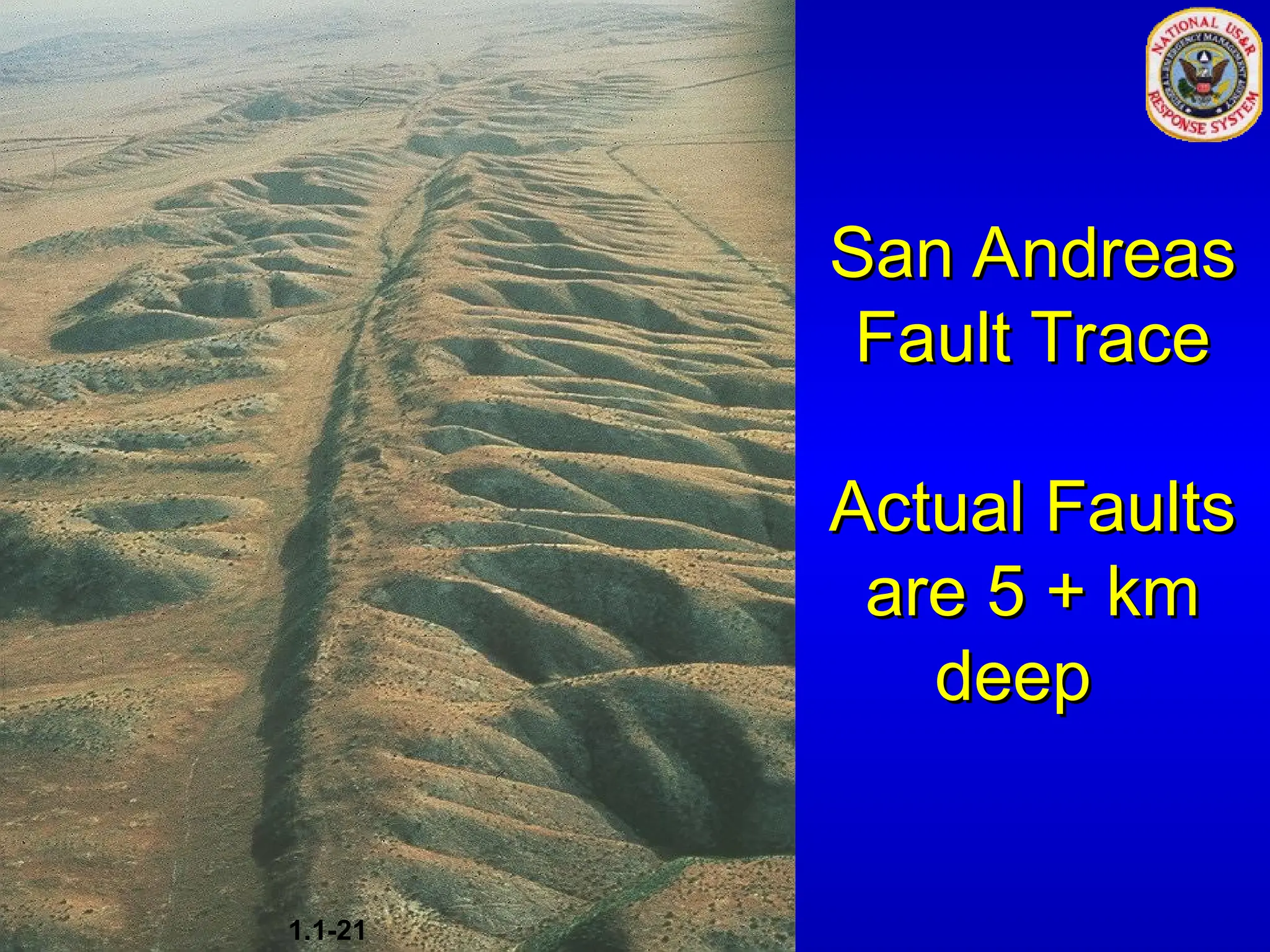
  • #229 URM - large weak walls, blow out or in Across street from Murrah Bldg
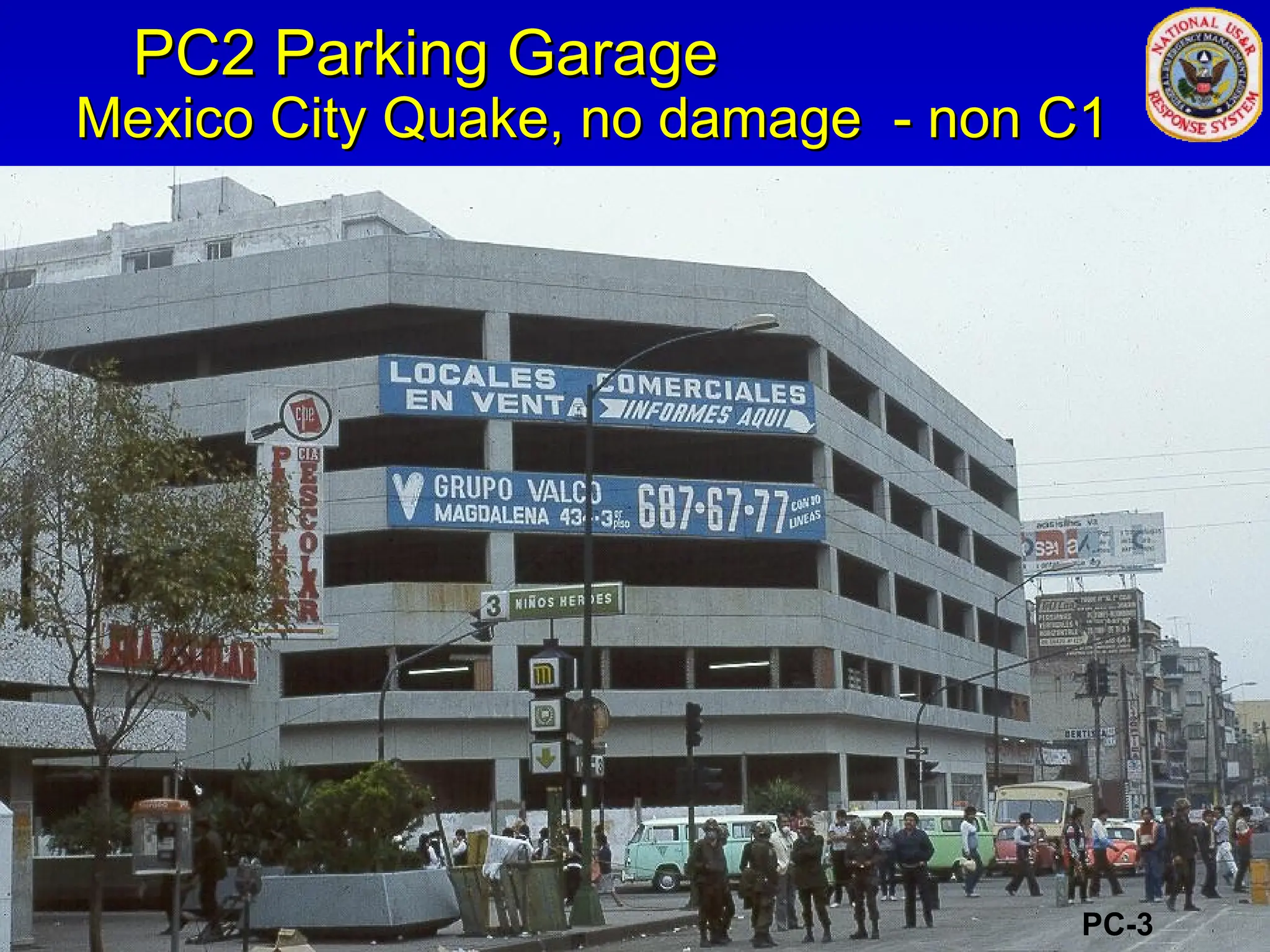
  • #230 Same building Wood 1st floor gone
  • #231 Rear wall of same URM Tied back to prevent falling hazard
  • #232 Any questions