*Corresponding Author Address: Dr Abu-Hussein Muhamad,123 Argus Street,10441,Athens,Greece
Email:abuhusseinmuhamad@gmail.Com
International Journal of Dental and Health Sciences
Volume 01,Issue 03Case Report
SUPERNUMERARY TEETH IN PERMANENT
DENTITION IN PATIENTS WITH CLEFT LIP
AND PALATE
Prof.Watted N1 ,Abdulgani Azz.2, Abu-Hussein M.3
1.DDS, Dr. med. Dent,,Orthodontics Department,Arab American University,Jenin,Palestine
2. 3.DDS,MScD,MSC,DPD, Faculty of Dentistry,Al-Quds University,Jerusalem,Palestine
3.DDS,PhD, Faculty of Dentistry,Al-Quds University,Jerusalem,Palestine
ABSTRACT:
Supernumerary teeth(hyperdontia) is a term used to express for the teeth more than the
normal series in either dentition .supernumerary teeth are developmental anomalies and
are not uncommonly observed in permanent dentition of either jaw.
Supernumerary teeth can present in various forms and in any region of the mandible and or
maxilla but have predisposition in anterior maxilla Supernumerary teeth have been reported
with certain syndromes but multiple supernumeraries in non syndromic individuals have
been frequently reported.
The mean prevalence of supernumerary teeth in clinical studies is about 1.2%
Supernumerary teeth have been reported in association with cleft lip and palate which
result from fragmentation of the dental lamina during cleft formation . The frequency of
22.2% supernumerary permanent teeth in the cleft area in children with unilateral cleft lip
or palate or both has been reported.This paper reviews the supernumerary in currently
available and discusses for the children in cleft lip and palate.
Key words: Dental anomaly, hyperdontia , supernumerary teethμ cleft lip and palate.
INTRODUCTION:
Cleft lip and palate (CLP) has become a
major public health problem affecting one
in every 500 – 1000 births worldwide (1). It
is the fourth most common birth defect
and the most common congenital defect
of the face (2) . These patients are likely to
have significant dental problems that
require attention of various specialties in
dentistry. Embryologically, the formation
of tooth germs and the occurrence of cleft
lip (CL) and/or cleft palate (CP) defects
have a close relationship both in terms of
timing and anatomical position(1,2) .
Supernumerary teeth, or hyperdontia, can
be recognized by the presence of more
than 20 deciduous, or 32 permanent teeth
in one individual. Hyperdontia can
develop either due to the retention of
deciduous teeth or the development of
extra deciduous and permanent teeth
resulting from a derangement in the
process of organogenesis (3) .
The aetiology of these teeth is uncertain,
but various causes for their presence such
as atavism, dichotomy of the tooth germ,
excessive growth of the dental lamina,
Watted N. et al., Int J Dent Health Sci 2014; 1(3): 410-418
411
heredity factors and general diseases have
been suggested (1,3,4) .
The development of extra permanent
teeth can be classified as “heterotopic” –
teeth developing outside the alveolar
region or “normotopic”. The latter
includes teeth that develop in the alveolar
region and erupt in a relatively normal
orientation. Much variation in the
morphology of supernumerary teeth has
also been described. These teeth may be
normal in shape and size,normal in shape
but reduced in size, of conical shape or,
lastly, abnormal in shape as well as
reduced in size(2,4) Single or multiple
supernumerary teeth can be unilateral or
bilateral and it has been shown that the
anterior maxilla and mandibular premolar
regions are most commonly affected .
Multiple supernumerary teeth most often
affect the mandibular premolar region (5).
In the primary dentition, the incidence is
said to be 0.3%-0.8% and in the
permanent dentition 1.5%-3.5% [4]. The
low prevalence of supernumerary teeth in
primary dentition is lower because it is
under reported [5] and it is often
overlooked, because the supernumerary
`teeth are often of normal shape
(supplemental type), erupt normally using
spaces in primary dentition, and appear to
be in proper alignment; and can be
mistaken for germination and fusion
anomalies [6] . There seems to be a racial
variation in the prevalence of
supernumeraries with a frequency higher
than 3% in Mongoloid races [7] . There is
no significant sex distribution in primary
supernumerary teeth; however, males
have been shown to be affected more in
the permanent dentition than females.
Supernumerary teeth are estimated to
occur in the maxilla 8.2 to 10 times more
frequently than the mandible, and most
commonly affect the premaxilla[6,7,8] .
Effects of supernumerary teeth on the
developing dentition may vary. There may
be no effect and supernumerary teeth
may be discovered either following their
eruption or as a chance during
radiographic examination. Failure of
eruption and/or ectopic eruption of
adjacent permanent teeth is the most
frequently reported occurrence in almost
30 to 60 per cent of cases. Crowding may
occur when multiple supernumeraries are
present. Supernumerary teeth may also
cause root resorption, malformation of
adjacent teeth such as dilaceration,
diastema and loss of vitality of adjacent
teeth,
DISCUSSION:
Millhon & Stafne studied 108 cases of
hair lip and cleft palate to identify the
incidence of supernumerary teeth of the
lateral incisor teeth. They discovered that
the incidence of supernumerary teeth in
the cleft palate sample was high, and
related the cause to the splitting of the
lateral incisor tooth bud at the cleft area
(10 ) .
Jordan et al. researched dental
abnormalities with cleft lip and or palate.
They examined 10 human cleft lip and
palate fetuses. The other sample was
made up of maxillary and mandibular
dental casts of 192 individuals with CLP.
Watted N. et al., Int J Dent Health Sci 2014; 1(3): 410-418
412
They found that supernumerary teeth
occur frequently in the lateral incisor
region adjacent to the alveolar cleft (11) .
Hellquist et al. studied the frequency of
dental abnormalities in the permanent
dentition on 172, eight year old children,
with unilateral clefts involving the
maxillary alveolar process. They obtained
photographs, orthopantomographs and
dental casts. They found that the
frequency of supernumerary teeth in the
cleft region was 20%.Where as the
supernumerary teeth found outside the
cleft region was 5.2% for the UCLA group
and 8.2% for the UCLP group (12) .
Dahloff et al. in Sweden researched
dental abnormalities in 49 preschool
children with cleft lip and /or palate. The
subjects were called upon for clinical and
radiographic evaluation. The subject’s
average age was 5.5 years. He found that
supernumerary teeth were found in 18%
of the cases (13) .
Lopes et al. evaluated the panoramic
radiographs of 86 patients with cleft lip
and or palate CL/CP for anomalies in
number. Their age ranged from 9 to 32
years old .They found that supernumerary
teeth were found in 16%. And numerical
dental anomalies are related to type of
cleft, with supernumerary teeth being
inversely correlated to cleft complexity
(14).
Suzuki et al. examined the maxillary
lateral incisors of subjects with cleft lip
and/or palate of 30 patients with
unilateral cleft lip and palate in Kyushu,
Japan. They concluded that almost always
the tooth on the cleft side is certain to be
a supernumerary lateral incisor, not a
supernumerary canine. The
supernumerary tooth was often
malformed in the permanent dentition
(15).
Vichi & Franchi studied abnormalities of
the maxillary incisors in children with cleft
lip and palate. They examined
orthopantomographs of 77 patients that
ranged from 3 to 16 years. The prevalence
of supernumerary lateral incisors was 22.1
% with 15.6% in unilateral clefts and 6.5%
in bilateral clefts. The prevalence of
supernumerary permanent central
incisors on the cleft side was found to be
3.9% (2.6% in unilateral clefts and 1.3% in
bilateral clefts) (16) .
da Silva et al. in Sao Paulo, Brazil
researched dental anomalies of number in
the permanent dentition of patients with
bilateral cleft lip. They selected 150
panoramic radiographs of individuals with
complete or incomplete bilateral cleft lip
that aged from 12 to 15 years. He found
that the prevalence of supernumerary
teeth was 28.2% for male patients with
complete cleft lip and 29.2 % for
incomplete cleft lip males .While
supernumeraries were reported to be
17.5% for females with complete cleft lip
and 46.6% for incomplete cleft lip (17) .
Tortora et al. studied the abnormalities in
dental structure, position, and eruption
pattern in a population of unilateral and
bilateral cleft lip and/or palate patients.
They evaluated 87 panoramic radiographs
of patients with UCLP and BCLP in an
attempt to identify supernumerary teeth.
Watted N. et al., Int J Dent Health Sci 2014; 1(3): 410-418
413
They found that 7.3% of the UCLP
presented with supernumerary lateral
incisors and 1.2% presented with
supernumerary central incisors. The BCLP
showed 6.7% of supernumerary lateral
incisors and 1.7% of supernumerary
central incisors (18) .
Galie et al. evaluated the dental and
maxillary development and the presence
of anomalies in unilateral cleft lip and
alveolus patients. Clinical and
radiographic examinations were carried
out on 20 cases (aged between 13 to 20
years) to identify supernumerary teeth.
No supernumerary teeth were observed
in their study (19) .
Tereza et al. studied the prevalence of
tooth abnormalities of number and
position in the permanent dentition of
individuals aged 7 to 18 years old with
complete bilateral cleft lip and palate.
They studied 205 patients’ records and
panoramic radiographs. They found
supernumerary teeth were observed in
11.7% of the individuals (20) .
CONCLUSION:
Detailed family history, thorough clinical
examination and routine radiographic
examination may reveal the presence of
multiple impacted supernumerary teeth
and their association with the other
conditions or syndromes. These
conditions must not be overlooked and
the impacted tooth must be extracted or
surgically made to erupt to allow the
restoration of normal architecture of
the bone mass, which will prevent the
fracture of bone in response to force.
Observation and periodic follow-up of
radiographs may be necessary if the
impacted teeth are asymptomatic.Early
diagnosis and removal of supernumerary
teeth allow to avoid or reduce possible
complications
REFERENCES:
1. Refoua Y, Arshad M: An Unusual Case
of Bilateral Maxillary and Mandibular
Supernumerary Teeth. Journal of Dent;
2006; 3:140-142.
2. Neville BW, Damm DD, Allen CM,
Bouquot JE: Oral and maxillofacial
pathology, 2nd ed.Philadelphia, PA: WB
Saunders; 2002.
3. Williams P: An unusual case of
hyperdontia. Br Dent J; 1998; 8: 371-
372
4. Liu JF: Characteristics of premaxillary
supernumerary teeth: a survey of 112
cases. ASDC J Dent Child; 1995; 4: 262-
265.
5. Acton CHC: Multiple supernumerary
teeth and possible implications. Aust
Dent J; 1987; 32: 48-49
6. Margarita V, Patricia A, Cesar V: Non-
syndromic concomitant hypodontia
and supernumerary teeth in an
orthodontic population. European
Journal of Orthodontics; 2009; 6: 632-
637.
7. Pioto NR, Costa B, Gomide MR. Dental
development of the permanent lateral
incisor in patients with incomplete and
complete unilateral cleft lip. Cleft
Palate Craniofac J 2005;42(5):517-20.
Watted N. et al., Int J Dent Health Sci 2014; 1(3): 410-418
414
8. Fatani E, AlEmran S, Shaikh H,
Hassanain J, McWilliams J. Craniofacial
characteristics in parents of children
with non-syndromic cleft lip and /or
cleft palate. Saudi Den J 1999;11(3):97-
103.
9. Pioto NR, Costa B, Gomide MR. Dental
development of the permanent lateral
incisor in patients with incomplete and
complete unilateral cleft lip. Cleft
Palate Craniofac J 2005;42(5):517-20.
10. Millhon J, Stafne E. Incidence of
supernumerary and congenitally missing
lateral incisor teeth in 81 cases of
harelip and cleft palate. Am J Orthod
1941;37:599-604. References 116
11. Jordan R, Kraus B, Neptune C.
Dental abnormalities associated with
cleft lip and or palate. Cleft Palate
Craniofac J 1966;3:22-55.
12. Hellquist R, Linder-Aronson S,
Norling M, Ponten B, Stenberg T. Dental
abnormalities in patients with alveolar
clefts, operated upon with or without
primary perioseoplasty. Eur J Orthod
1979;1:169-180
13. Dahllof G, Ussisoo-Joandi R,
Ideberg M, Modeer T. Caries, gingivitis,
and dental abnormalities in preschool
children with cleft lip and/or palate.
Cleft Palate J 1989;26(3):233-7;
discussion 237-8.
14. Lopes LD, Mattos BS, Andre M.
Anomalies in number of teeth in
patients with lip and/or palate clefts.
Braz Dent J 1991;2(1):9-17.
15. Suzuki A, Watanabe M, Nakano M,
Takahama Y. Maxillary lateral Incisors of
subjects with cleft lip and /or palate :
Part 2. Cleft Palate Craniofac J
1992;29(4):380-384.
16. Vichi M, Franchi L. Abnormalities
of the maxillary incisors in children with
cleft lip and palate. Journal of Dentistry
for children 1995;62(6):412-7
17. daSilva A, Costa B, deCarvalho,
Carrara C. Dental anomalies of number
in the permanent dentition of patients
with bilateral cleft lip: Radiographic
study. Cleft Palate Craniofac J
2008;45(5):473-476
18. Tortora C, Meazzini M, Garattini G,
Brusati R. Prevalence of abnormalities in
dental structure, position, and eruption
pattern in a population of unilateral and
bilateral cleft lip and palate patients.
Cleft Palate Craniofac J 2008;45(2):154-
162.
19. Galie N, Enachie M, Podoleanu L,
David D, Podoleanu E, Spinu T, Olteanu
M. Evaluation of dental and maxillary
development in patients with cleft lip
alveolus. Romanian J of Morphology and
Embryology 2009;50(1):91-95.
References 114
20. Tereza G, Carrara C, Costa B. Tooth
abnormalities of number and position in
the permanent dentition of patients
with complete bilateral cleft lip and
palate. Cleft Palate Craniofac J
2010;47(3):247-252
Watted N. et al., Int J Dent Health Sci 2014; 1(3): 410-418
415
FIGURES:
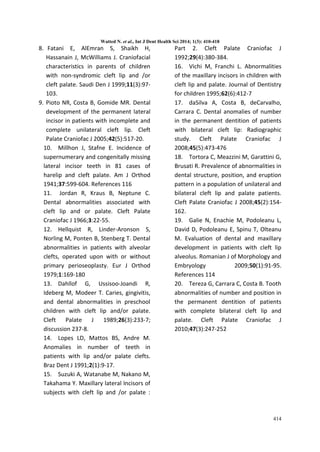
Figure 1: A conical shaped
supernumerary tooth in relation to
permanent maxillary right canine
Figure 2:Orthopantomogram of patient
with cleidocranial dysplasia showing
multiple supernumerary teeth
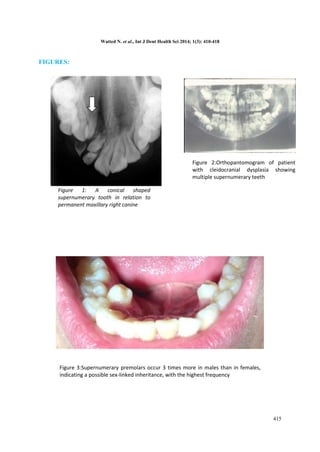
Figure 3:Supernumerary premolars occur 3 times more in males than in females,
indicating a possible sex-linked inheritance, with the highest frequency
Watted N. et al., Int J Dent Health Sci 2014; 1(3): 410-418
416
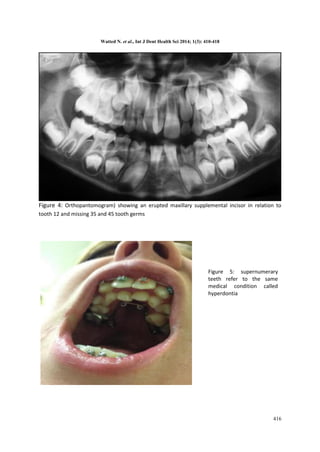
Figure 4: Orthopantomogram) showing an erupted maxillary supplemental incisor in relation to
tooth 12 and missing 35 and 45 tooth germs
Figure 5: supernumerary
teeth refer to the same
medical condition called
hyperdontia
Watted N. et al., Int J Dent Health Sci 2014; 1(3): 410-418
417
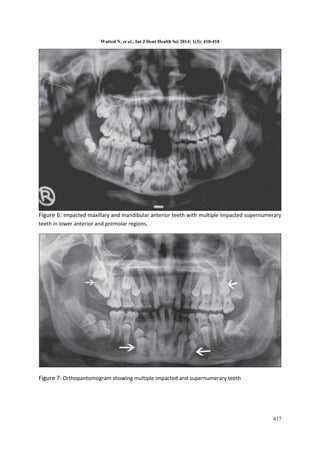
Figure 6: Impacted maxillary and mandibular anterior teeth with multiple impacted supernumerary
teeth in lower anterior and premolar regions.
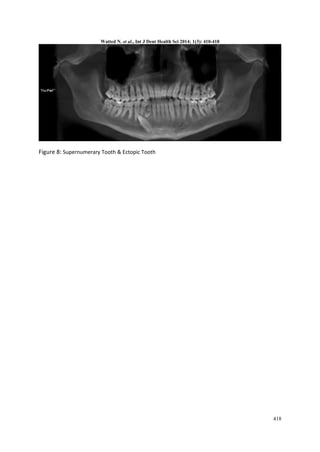
Figure 7: Orthopantomogram showing multiple impacted and supernumerary teeth
Watted N. et al., Int J Dent Health Sci 2014; 1(3): 410-418
418
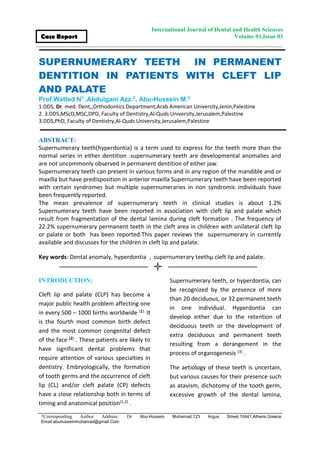
Figure 8: Supernumerary Tooth & Ectopic Tooth

Supernumerary teeth(hyperdontia)

  • 1.
    *Corresponding Author Address:Dr Abu-Hussein Muhamad,123 Argus Street,10441,Athens,Greece Email:abuhusseinmuhamad@gmail.Com International Journal of Dental and Health Sciences Volume 01,Issue 03Case Report SUPERNUMERARY TEETH IN PERMANENT DENTITION IN PATIENTS WITH CLEFT LIP AND PALATE Prof.Watted N1 ,Abdulgani Azz.2, Abu-Hussein M.3 1.DDS, Dr. med. Dent,,Orthodontics Department,Arab American University,Jenin,Palestine 2. 3.DDS,MScD,MSC,DPD, Faculty of Dentistry,Al-Quds University,Jerusalem,Palestine 3.DDS,PhD, Faculty of Dentistry,Al-Quds University,Jerusalem,Palestine ABSTRACT: Supernumerary teeth(hyperdontia) is a term used to express for the teeth more than the normal series in either dentition .supernumerary teeth are developmental anomalies and are not uncommonly observed in permanent dentition of either jaw. Supernumerary teeth can present in various forms and in any region of the mandible and or maxilla but have predisposition in anterior maxilla Supernumerary teeth have been reported with certain syndromes but multiple supernumeraries in non syndromic individuals have been frequently reported. The mean prevalence of supernumerary teeth in clinical studies is about 1.2% Supernumerary teeth have been reported in association with cleft lip and palate which result from fragmentation of the dental lamina during cleft formation . The frequency of 22.2% supernumerary permanent teeth in the cleft area in children with unilateral cleft lip or palate or both has been reported.This paper reviews the supernumerary in currently available and discusses for the children in cleft lip and palate. Key words: Dental anomaly, hyperdontia , supernumerary teethμ cleft lip and palate. INTRODUCTION: Cleft lip and palate (CLP) has become a major public health problem affecting one in every 500 – 1000 births worldwide (1). It is the fourth most common birth defect and the most common congenital defect of the face (2) . These patients are likely to have significant dental problems that require attention of various specialties in dentistry. Embryologically, the formation of tooth germs and the occurrence of cleft lip (CL) and/or cleft palate (CP) defects have a close relationship both in terms of timing and anatomical position(1,2) . Supernumerary teeth, or hyperdontia, can be recognized by the presence of more than 20 deciduous, or 32 permanent teeth in one individual. Hyperdontia can develop either due to the retention of deciduous teeth or the development of extra deciduous and permanent teeth resulting from a derangement in the process of organogenesis (3) . The aetiology of these teeth is uncertain, but various causes for their presence such as atavism, dichotomy of the tooth germ, excessive growth of the dental lamina,
  • 2.
    Watted N. etal., Int J Dent Health Sci 2014; 1(3): 410-418 411 heredity factors and general diseases have been suggested (1,3,4) . The development of extra permanent teeth can be classified as “heterotopic” – teeth developing outside the alveolar region or “normotopic”. The latter includes teeth that develop in the alveolar region and erupt in a relatively normal orientation. Much variation in the morphology of supernumerary teeth has also been described. These teeth may be normal in shape and size,normal in shape but reduced in size, of conical shape or, lastly, abnormal in shape as well as reduced in size(2,4) Single or multiple supernumerary teeth can be unilateral or bilateral and it has been shown that the anterior maxilla and mandibular premolar regions are most commonly affected . Multiple supernumerary teeth most often affect the mandibular premolar region (5). In the primary dentition, the incidence is said to be 0.3%-0.8% and in the permanent dentition 1.5%-3.5% [4]. The low prevalence of supernumerary teeth in primary dentition is lower because it is under reported [5] and it is often overlooked, because the supernumerary `teeth are often of normal shape (supplemental type), erupt normally using spaces in primary dentition, and appear to be in proper alignment; and can be mistaken for germination and fusion anomalies [6] . There seems to be a racial variation in the prevalence of supernumeraries with a frequency higher than 3% in Mongoloid races [7] . There is no significant sex distribution in primary supernumerary teeth; however, males have been shown to be affected more in the permanent dentition than females. Supernumerary teeth are estimated to occur in the maxilla 8.2 to 10 times more frequently than the mandible, and most commonly affect the premaxilla[6,7,8] . Effects of supernumerary teeth on the developing dentition may vary. There may be no effect and supernumerary teeth may be discovered either following their eruption or as a chance during radiographic examination. Failure of eruption and/or ectopic eruption of adjacent permanent teeth is the most frequently reported occurrence in almost 30 to 60 per cent of cases. Crowding may occur when multiple supernumeraries are present. Supernumerary teeth may also cause root resorption, malformation of adjacent teeth such as dilaceration, diastema and loss of vitality of adjacent teeth, DISCUSSION: Millhon & Stafne studied 108 cases of hair lip and cleft palate to identify the incidence of supernumerary teeth of the lateral incisor teeth. They discovered that the incidence of supernumerary teeth in the cleft palate sample was high, and related the cause to the splitting of the lateral incisor tooth bud at the cleft area (10 ) . Jordan et al. researched dental abnormalities with cleft lip and or palate. They examined 10 human cleft lip and palate fetuses. The other sample was made up of maxillary and mandibular dental casts of 192 individuals with CLP.
  • 3.
    Watted N. etal., Int J Dent Health Sci 2014; 1(3): 410-418 412 They found that supernumerary teeth occur frequently in the lateral incisor region adjacent to the alveolar cleft (11) . Hellquist et al. studied the frequency of dental abnormalities in the permanent dentition on 172, eight year old children, with unilateral clefts involving the maxillary alveolar process. They obtained photographs, orthopantomographs and dental casts. They found that the frequency of supernumerary teeth in the cleft region was 20%.Where as the supernumerary teeth found outside the cleft region was 5.2% for the UCLA group and 8.2% for the UCLP group (12) . Dahloff et al. in Sweden researched dental abnormalities in 49 preschool children with cleft lip and /or palate. The subjects were called upon for clinical and radiographic evaluation. The subject’s average age was 5.5 years. He found that supernumerary teeth were found in 18% of the cases (13) . Lopes et al. evaluated the panoramic radiographs of 86 patients with cleft lip and or palate CL/CP for anomalies in number. Their age ranged from 9 to 32 years old .They found that supernumerary teeth were found in 16%. And numerical dental anomalies are related to type of cleft, with supernumerary teeth being inversely correlated to cleft complexity (14). Suzuki et al. examined the maxillary lateral incisors of subjects with cleft lip and/or palate of 30 patients with unilateral cleft lip and palate in Kyushu, Japan. They concluded that almost always the tooth on the cleft side is certain to be a supernumerary lateral incisor, not a supernumerary canine. The supernumerary tooth was often malformed in the permanent dentition (15). Vichi & Franchi studied abnormalities of the maxillary incisors in children with cleft lip and palate. They examined orthopantomographs of 77 patients that ranged from 3 to 16 years. The prevalence of supernumerary lateral incisors was 22.1 % with 15.6% in unilateral clefts and 6.5% in bilateral clefts. The prevalence of supernumerary permanent central incisors on the cleft side was found to be 3.9% (2.6% in unilateral clefts and 1.3% in bilateral clefts) (16) . da Silva et al. in Sao Paulo, Brazil researched dental anomalies of number in the permanent dentition of patients with bilateral cleft lip. They selected 150 panoramic radiographs of individuals with complete or incomplete bilateral cleft lip that aged from 12 to 15 years. He found that the prevalence of supernumerary teeth was 28.2% for male patients with complete cleft lip and 29.2 % for incomplete cleft lip males .While supernumeraries were reported to be 17.5% for females with complete cleft lip and 46.6% for incomplete cleft lip (17) . Tortora et al. studied the abnormalities in dental structure, position, and eruption pattern in a population of unilateral and bilateral cleft lip and/or palate patients. They evaluated 87 panoramic radiographs of patients with UCLP and BCLP in an attempt to identify supernumerary teeth.
  • 4.
    Watted N. etal., Int J Dent Health Sci 2014; 1(3): 410-418 413 They found that 7.3% of the UCLP presented with supernumerary lateral incisors and 1.2% presented with supernumerary central incisors. The BCLP showed 6.7% of supernumerary lateral incisors and 1.7% of supernumerary central incisors (18) . Galie et al. evaluated the dental and maxillary development and the presence of anomalies in unilateral cleft lip and alveolus patients. Clinical and radiographic examinations were carried out on 20 cases (aged between 13 to 20 years) to identify supernumerary teeth. No supernumerary teeth were observed in their study (19) . Tereza et al. studied the prevalence of tooth abnormalities of number and position in the permanent dentition of individuals aged 7 to 18 years old with complete bilateral cleft lip and palate. They studied 205 patients’ records and panoramic radiographs. They found supernumerary teeth were observed in 11.7% of the individuals (20) . CONCLUSION: Detailed family history, thorough clinical examination and routine radiographic examination may reveal the presence of multiple impacted supernumerary teeth and their association with the other conditions or syndromes. These conditions must not be overlooked and the impacted tooth must be extracted or surgically made to erupt to allow the restoration of normal architecture of the bone mass, which will prevent the fracture of bone in response to force. Observation and periodic follow-up of radiographs may be necessary if the impacted teeth are asymptomatic.Early diagnosis and removal of supernumerary teeth allow to avoid or reduce possible complications REFERENCES: 1. Refoua Y, Arshad M: An Unusual Case of Bilateral Maxillary and Mandibular Supernumerary Teeth. Journal of Dent; 2006; 3:140-142. 2. Neville BW, Damm DD, Allen CM, Bouquot JE: Oral and maxillofacial pathology, 2nd ed.Philadelphia, PA: WB Saunders; 2002. 3. Williams P: An unusual case of hyperdontia. Br Dent J; 1998; 8: 371- 372 4. Liu JF: Characteristics of premaxillary supernumerary teeth: a survey of 112 cases. ASDC J Dent Child; 1995; 4: 262- 265. 5. Acton CHC: Multiple supernumerary teeth and possible implications. Aust Dent J; 1987; 32: 48-49 6. Margarita V, Patricia A, Cesar V: Non- syndromic concomitant hypodontia and supernumerary teeth in an orthodontic population. European Journal of Orthodontics; 2009; 6: 632- 637. 7. Pioto NR, Costa B, Gomide MR. Dental development of the permanent lateral incisor in patients with incomplete and complete unilateral cleft lip. Cleft Palate Craniofac J 2005;42(5):517-20.
  • 5.
    Watted N. etal., Int J Dent Health Sci 2014; 1(3): 410-418 414 8. Fatani E, AlEmran S, Shaikh H, Hassanain J, McWilliams J. Craniofacial characteristics in parents of children with non-syndromic cleft lip and /or cleft palate. Saudi Den J 1999;11(3):97- 103. 9. Pioto NR, Costa B, Gomide MR. Dental development of the permanent lateral incisor in patients with incomplete and complete unilateral cleft lip. Cleft Palate Craniofac J 2005;42(5):517-20. 10. Millhon J, Stafne E. Incidence of supernumerary and congenitally missing lateral incisor teeth in 81 cases of harelip and cleft palate. Am J Orthod 1941;37:599-604. References 116 11. Jordan R, Kraus B, Neptune C. Dental abnormalities associated with cleft lip and or palate. Cleft Palate Craniofac J 1966;3:22-55. 12. Hellquist R, Linder-Aronson S, Norling M, Ponten B, Stenberg T. Dental abnormalities in patients with alveolar clefts, operated upon with or without primary perioseoplasty. Eur J Orthod 1979;1:169-180 13. Dahllof G, Ussisoo-Joandi R, Ideberg M, Modeer T. Caries, gingivitis, and dental abnormalities in preschool children with cleft lip and/or palate. Cleft Palate J 1989;26(3):233-7; discussion 237-8. 14. Lopes LD, Mattos BS, Andre M. Anomalies in number of teeth in patients with lip and/or palate clefts. Braz Dent J 1991;2(1):9-17. 15. Suzuki A, Watanabe M, Nakano M, Takahama Y. Maxillary lateral Incisors of subjects with cleft lip and /or palate : Part 2. Cleft Palate Craniofac J 1992;29(4):380-384. 16. Vichi M, Franchi L. Abnormalities of the maxillary incisors in children with cleft lip and palate. Journal of Dentistry for children 1995;62(6):412-7 17. daSilva A, Costa B, deCarvalho, Carrara C. Dental anomalies of number in the permanent dentition of patients with bilateral cleft lip: Radiographic study. Cleft Palate Craniofac J 2008;45(5):473-476 18. Tortora C, Meazzini M, Garattini G, Brusati R. Prevalence of abnormalities in dental structure, position, and eruption pattern in a population of unilateral and bilateral cleft lip and palate patients. Cleft Palate Craniofac J 2008;45(2):154- 162. 19. Galie N, Enachie M, Podoleanu L, David D, Podoleanu E, Spinu T, Olteanu M. Evaluation of dental and maxillary development in patients with cleft lip alveolus. Romanian J of Morphology and Embryology 2009;50(1):91-95. References 114 20. Tereza G, Carrara C, Costa B. Tooth abnormalities of number and position in the permanent dentition of patients with complete bilateral cleft lip and palate. Cleft Palate Craniofac J 2010;47(3):247-252
  • 6.
    Watted N. etal., Int J Dent Health Sci 2014; 1(3): 410-418 415 FIGURES: Figure 1: A conical shaped supernumerary tooth in relation to permanent maxillary right canine Figure 2:Orthopantomogram of patient with cleidocranial dysplasia showing multiple supernumerary teeth Figure 3:Supernumerary premolars occur 3 times more in males than in females, indicating a possible sex-linked inheritance, with the highest frequency
  • 7.
    Watted N. etal., Int J Dent Health Sci 2014; 1(3): 410-418 416 Figure 4: Orthopantomogram) showing an erupted maxillary supplemental incisor in relation to tooth 12 and missing 35 and 45 tooth germs Figure 5: supernumerary teeth refer to the same medical condition called hyperdontia
  • 8.
    Watted N. etal., Int J Dent Health Sci 2014; 1(3): 410-418 417 Figure 6: Impacted maxillary and mandibular anterior teeth with multiple impacted supernumerary teeth in lower anterior and premolar regions. Figure 7: Orthopantomogram showing multiple impacted and supernumerary teeth
  • 9.
    Watted N. etal., Int J Dent Health Sci 2014; 1(3): 410-418 418 Figure 8: Supernumerary Tooth & Ectopic Tooth