
Done by: Mona Mahdi
Group A
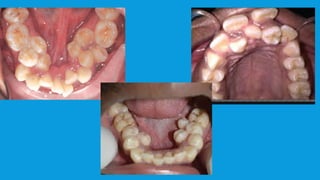
 It is a tooth that has developed in addition to the normal
complement of teeth within the dentition.They could be found
in almost any region of the dental arch.They can cause local
problems during development of the dentition and may require
removal in these circumstances.
 It is generally classified according to its morphology and site
but, like tooth agenesis, can occur as an isolated trait or coexist
with a syndrome.
 Management is dependent on type, location, number and
complications arising from their presence.
 Supernumerary teeth are most commonly seen in the
permanent dentition (1.2-3.5%) and are rare in the deciduous
dentition (0.3-0.8%). Individuals who present with a
supernumerary in the deciduous dentition demonstrate a
higher prevalence of supernumerary development in the
permanent dentition. However, isn't necessarily a significant
risk factor.
 Males are affected twice as often as females, although this is
dependent on the population studied and there’s considerable
variability in these ratios (1.3:1 to 2.64:1).This is sexual
dimorphism isn’t present in the primary dentition.
 Most affected site is the anterior maxilla.
Cont.
 Supernumerary teeth can occur singly, in multiples, unilaterally or bilaterally and
in either the maxilla or mandible.
 Studies show that the majority of patients present with one or two
supernumerary teeth. Multiple supernumerary teeth are more commonly seen in
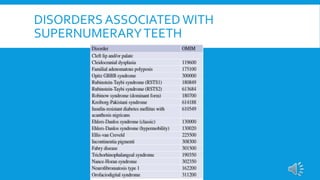
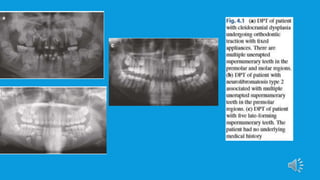
patients with an associated syndrome or systemic condition.The syndromes most
frequently associated with supernumerary teeth are autosomal dominant
conditions: cleidocranial dysplasia and familial adenomatous polyposis.
 The prevalence of supernumeraries in patients with cleft lip and palate has also
been reported at between 1.9 and 10%, due to disruption of the dental lamina
during cleft formation. Supernumerary teeth are the 2nd most common anomaly
found in the cleft area.
 In rare cases, it has been observed that multiple supernumerary teeth have been
located in patients in the absence of any underlying disorder.
DISORDERS ASSOCIATED WITH
SUPERNUMERARYTEETH
VARIOUS HYPOTHESES HAVE BEEN PROPOSED.
 Hyperactivity of the dental lamina has been suggested, with this hypothesis
assuming that the lingual extension of an additional tooth bud leads to
development of a tooth with normal morphology and the supernumerary tooth
arises from proliferation of epithelial remnants of dental lamina.
 Others have considered a genetic predisposition or even a multifactorial aetiology.
Offspring of parents with supernumerary teeth have been shown to have an
increased risk of their development by a factor of six. Furthermore, a sex-linked
transmission could explain why supernumerary teeth are more commonly found in
males.
 Supernumerary teeth are an aberration of tooth development.The genetic
component doesn’t act in isolation and different molecular signaling pathways,
together with transcription factors, also play an important role.
They’re classified according to their location or morphology.
Location:
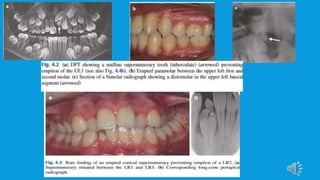
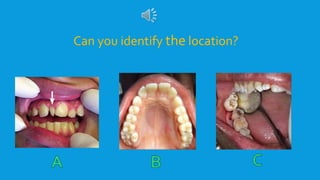
Mesiodens: in the midline
Paramolar: buccal or lingual to a maxillary molar or in the space
buccal to the second and third molar
Distomolar(4th molar): distal to the third molar
Individuals with just one or two supernumerary teeth, they’re most frequently
found in anterior maxilla, followed by the mandibular premolar area. It’s rare in
the mandibular incisor are. In non-syndromic patients with multiple
supernumeraries, these are more frequently located in the mandibular
premolar area.
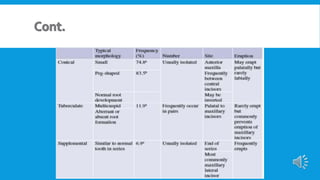
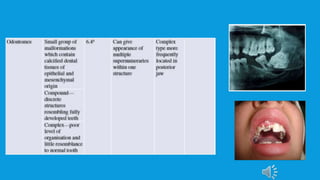
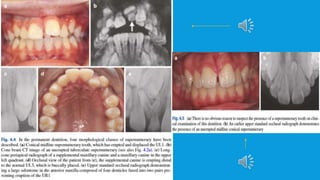
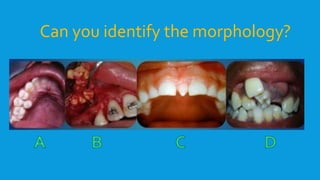
 In deciduous teeth they’re either of normal morphology or conical.
In permanent dentition, there’s more variability and four
morphological classes have been described: conical, tuberculate,
supplemental and odontomes. Each characterized by particular
features.
 The conical type is the most frequently observed class, followed by
tuberculate and supplemental.The frequency of odontomes is less
clear, and in some studies it isn’t considered as supernumerary.
 Morphology is also related to the likelihood of a supernumerary to
erupt. Studies have shown that the supplemental type is most likely
to erupt followed by conical and tuberculate.
Their presence may have no effect on the developing
dentition and can be a chance finding when a patient
first presents for orthodontic treatment.
However, in other instances, a variety of effects may be
seen including displacement, crowding, dilacerations,
root resorption, cystic change and nasal cavity eruption.
However, pathology is rare and the complication seen
most frequently is delayed eruption of an incisor.
 A careful clinical and radiographic examination is required to detect and
localize supernumerary teeth.Treatment is dependent of the type and
position of the tooth and its effect on adjacent teeth.
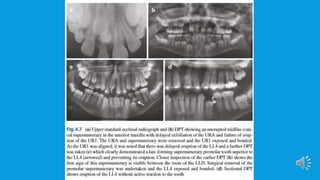
 Routine radiographs such as dental panoramic radiographic, upper standard
occlusal and long-cone periapical can be used in combination to localize a
supernumerary tooth using the parallax technique (horizontal or vertical tube
shift) and may give sufficient information to allow safe removal.
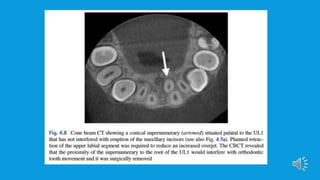
However, if the proximity to developing roots is a concern, assessment of
resorption is required or a decision to whether orthodontic tooth movement
can go ahead without removal of supernumerary tooth, then CBCT may be
indicated.This additional imaging technique has shown to enhance the ability
to localize a supernumerary.
 In some instances, no intervention may be indicated, particularly when
the position of the supernumerary is unlikely to interfere with potential
orthodontic treatment or if its removal posed a significant risk to the
roots of adjacent teeth.
 Early diagnosis and treatment of supernumerary teeth can limit the
complications, but early removal isn’t without controversy. If the
supernumerary lies adjacent to the maxillary incisors, delaying
removal until root development is complete has been advised.This is
because the risk of damage to developing roots is viewed as too great
warrant early removal.This also applies in the premolar region.
 In situations where further dental development is awaited, or a
decision made to leave a supernumerary in situ, the patient may be
reviewed at an appropriate interval and further radiographs taken to
reassess.
 However, if the supernumerary has interfered with normal dental devolvement
or will impede orthodontic tooth development or there’s evidence of a
pathology, then is removal should be planned. In rare cases, removal of a
supernumerary tooth may be required if its presence would otherwise
compromise alveolar bone grafting in patients with cleft lip and palate. Removal
is also indicated if the tooth is positioned at a potential implant site. In these
complex cases, surgical removal of supernumerary can compromise the amount
of bone available and bone grafting may also be required prior to implant
placement.
 Patients presenting with supernumerary teeth in the anterior maxilla associated
with failure of permanent maxillary incisor eruption and who require a general
anesthetic for removal should also have the unerupted incisor exposed and
bonded with an orthodontic attachment to facilitate guided traction.The time
frame within which the tooth will erupt is influenced by the degree of
displacement and the space available within the arch.
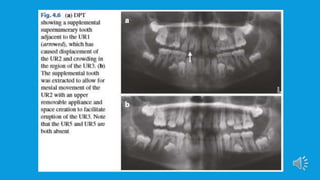
Supplemental supernumerary tooth type extraction is often
indicated due to crowding or displacement of adjacent teeth
and the difficulties associated with tooth-size discrepancies
between the arches if it’s retained.The choice of tooth of
removal is based on the crown and root morphology and
degree of displacement.
Supernumerary teeth may also develop late. In addition, those
patients with midline supernumerary have an increased risk of
developing supplemental premolars.
https://www.youtube.com/watch?v=fC01proKQYs
EXTRACTION OF SUPERNUMERARYTEETH:
Can you identify the location?
Can you identify the morphology?
Supernumerary teeth fifth-year second semester

Supernumerary teeth fifth-year second semester

  • 1.
    Done by: MonaMahdi Group A
  • 3.
     It isa tooth that has developed in addition to the normal complement of teeth within the dentition.They could be found in almost any region of the dental arch.They can cause local problems during development of the dentition and may require removal in these circumstances.  It is generally classified according to its morphology and site but, like tooth agenesis, can occur as an isolated trait or coexist with a syndrome.  Management is dependent on type, location, number and complications arising from their presence.
  • 4.
     Supernumerary teethare most commonly seen in the permanent dentition (1.2-3.5%) and are rare in the deciduous dentition (0.3-0.8%). Individuals who present with a supernumerary in the deciduous dentition demonstrate a higher prevalence of supernumerary development in the permanent dentition. However, isn't necessarily a significant risk factor.  Males are affected twice as often as females, although this is dependent on the population studied and there’s considerable variability in these ratios (1.3:1 to 2.64:1).This is sexual dimorphism isn’t present in the primary dentition.  Most affected site is the anterior maxilla.
  • 5.
    Cont.  Supernumerary teethcan occur singly, in multiples, unilaterally or bilaterally and in either the maxilla or mandible.  Studies show that the majority of patients present with one or two supernumerary teeth. Multiple supernumerary teeth are more commonly seen in patients with an associated syndrome or systemic condition.The syndromes most frequently associated with supernumerary teeth are autosomal dominant conditions: cleidocranial dysplasia and familial adenomatous polyposis.  The prevalence of supernumeraries in patients with cleft lip and palate has also been reported at between 1.9 and 10%, due to disruption of the dental lamina during cleft formation. Supernumerary teeth are the 2nd most common anomaly found in the cleft area.  In rare cases, it has been observed that multiple supernumerary teeth have been located in patients in the absence of any underlying disorder.
  • 6.
  • 8.
    VARIOUS HYPOTHESES HAVEBEEN PROPOSED.  Hyperactivity of the dental lamina has been suggested, with this hypothesis assuming that the lingual extension of an additional tooth bud leads to development of a tooth with normal morphology and the supernumerary tooth arises from proliferation of epithelial remnants of dental lamina.  Others have considered a genetic predisposition or even a multifactorial aetiology. Offspring of parents with supernumerary teeth have been shown to have an increased risk of their development by a factor of six. Furthermore, a sex-linked transmission could explain why supernumerary teeth are more commonly found in males.  Supernumerary teeth are an aberration of tooth development.The genetic component doesn’t act in isolation and different molecular signaling pathways, together with transcription factors, also play an important role.
  • 9.
    They’re classified accordingto their location or morphology. Location: Mesiodens: in the midline Paramolar: buccal or lingual to a maxillary molar or in the space buccal to the second and third molar Distomolar(4th molar): distal to the third molar Individuals with just one or two supernumerary teeth, they’re most frequently found in anterior maxilla, followed by the mandibular premolar area. It’s rare in the mandibular incisor are. In non-syndromic patients with multiple supernumeraries, these are more frequently located in the mandibular premolar area.
  • 10.
     In deciduousteeth they’re either of normal morphology or conical. In permanent dentition, there’s more variability and four morphological classes have been described: conical, tuberculate, supplemental and odontomes. Each characterized by particular features.  The conical type is the most frequently observed class, followed by tuberculate and supplemental.The frequency of odontomes is less clear, and in some studies it isn’t considered as supernumerary.  Morphology is also related to the likelihood of a supernumerary to erupt. Studies have shown that the supplemental type is most likely to erupt followed by conical and tuberculate.
  • 15.
    Their presence mayhave no effect on the developing dentition and can be a chance finding when a patient first presents for orthodontic treatment. However, in other instances, a variety of effects may be seen including displacement, crowding, dilacerations, root resorption, cystic change and nasal cavity eruption. However, pathology is rare and the complication seen most frequently is delayed eruption of an incisor.
  • 16.
     A carefulclinical and radiographic examination is required to detect and localize supernumerary teeth.Treatment is dependent of the type and position of the tooth and its effect on adjacent teeth.  Routine radiographs such as dental panoramic radiographic, upper standard occlusal and long-cone periapical can be used in combination to localize a supernumerary tooth using the parallax technique (horizontal or vertical tube shift) and may give sufficient information to allow safe removal. However, if the proximity to developing roots is a concern, assessment of resorption is required or a decision to whether orthodontic tooth movement can go ahead without removal of supernumerary tooth, then CBCT may be indicated.This additional imaging technique has shown to enhance the ability to localize a supernumerary.
  • 17.
     In someinstances, no intervention may be indicated, particularly when the position of the supernumerary is unlikely to interfere with potential orthodontic treatment or if its removal posed a significant risk to the roots of adjacent teeth.  Early diagnosis and treatment of supernumerary teeth can limit the complications, but early removal isn’t without controversy. If the supernumerary lies adjacent to the maxillary incisors, delaying removal until root development is complete has been advised.This is because the risk of damage to developing roots is viewed as too great warrant early removal.This also applies in the premolar region.  In situations where further dental development is awaited, or a decision made to leave a supernumerary in situ, the patient may be reviewed at an appropriate interval and further radiographs taken to reassess.
  • 18.
     However, ifthe supernumerary has interfered with normal dental devolvement or will impede orthodontic tooth development or there’s evidence of a pathology, then is removal should be planned. In rare cases, removal of a supernumerary tooth may be required if its presence would otherwise compromise alveolar bone grafting in patients with cleft lip and palate. Removal is also indicated if the tooth is positioned at a potential implant site. In these complex cases, surgical removal of supernumerary can compromise the amount of bone available and bone grafting may also be required prior to implant placement.  Patients presenting with supernumerary teeth in the anterior maxilla associated with failure of permanent maxillary incisor eruption and who require a general anesthetic for removal should also have the unerupted incisor exposed and bonded with an orthodontic attachment to facilitate guided traction.The time frame within which the tooth will erupt is influenced by the degree of displacement and the space available within the arch.
  • 19.
    Supplemental supernumerary toothtype extraction is often indicated due to crowding or displacement of adjacent teeth and the difficulties associated with tooth-size discrepancies between the arches if it’s retained.The choice of tooth of removal is based on the crown and root morphology and degree of displacement. Supernumerary teeth may also develop late. In addition, those patients with midline supernumerary have an increased risk of developing supplemental premolars.
  • 23.
  • 24.
    Can you identifythe location?
  • 25.
    Can you identifythe morphology?