Dr.Mohammed Almuzian, 2014 Page 0
UNIVERSITY OF GLASGOW
Supernumerary teeth
Personal notes
Dr.Mohammed Almuzian
1/1/2013
Mohammed Almuzian, University of Glasgow, 2013 Page 1
Table of Contents
Definition...........................................................................................................2
Incidence............................................................................................................2
Aetiology ...........................................................................................................2
Classifications ....................................................................................................2
Another classification according to position into ...Error! Bookmark notdefined.
Complications......................................................Error! Bookmark notdefined.
Management.......................................................................................................3
Summary and recommendations of RCSEng. (Yaqoob et al 2010) ........................5
Mohammed Almuzian, University of Glasgow, 2013 Page 2
Supernumeraries
Definition
A 'tooth' or 'tooth-like' structure which develops in addition to the normal series of
32 teeth.
Incidence
1. Rarely occurs in primary dentition (0.8%) Brook 1974
2. 2% in permanent dentition. Brook 1974
3. Syndromic cases around 22%
4. M:F = 2:1
5. 80% occurin anterior Max
Aetiology
Developmentally due to disturbance during initiation and proliferation stages
(Dichotomy of the tooth bud or hyperactivity of dental lamina).
1. Non Syndromic (familial or isolated)
2. Syndromic
• Down's syndrome
• Cleidocranial dysplasia
• CLP anomalies: Supernumerary teeth associated with cleft lip and palate result
from fragmentation of the dental lamina during cleft formation
Classifications
1. Conicalsupernumeraries are small peg-shaped teeth with normal root formation.
When located in the midline of the anterior maxilla these teeth are known as
Mohammed Almuzian, University of Glasgow, 2013 Page 3
mesiodens ( whilst in the maxillary molar region they are known as paramolars
(buccal, lingual or interproximal to the second and third molars) or distomolars
(distal to the third molar)
2. Tuberculate supernumeraries are characterized by a multicusped coronal
morphology and a lack of rootdevelopment . These teeth are usually found palatal
to the maxillary permanent incisors, often occurin pairs and frequently prevent
eruption of the permanent incisors.
3. Supplemental supernumeraries represent the duplication of a tooth within a
series and can be difficult to differentiate from the normal tooth. These teeth are
usually found at the end of a series and can be seen in the incisor, premolar and
molar fields. They represent the most common type of supernumerary found in the
primary dentition
4. Odontomes are developmental malformations that contain both enamel and
dentine. It can be compound (containing many small separate tooth-like structures
usually situated in the anterior jaw) or complex (a large mass of disorganized
enamel and dentine usually situated in the posterior jaw).
1.
Management
a. Visual examination. The sign of supernumerary tooth include:
1. Erupted supernumerary
2. Delayed tooth eruption and asymmetric eruption
3. Diastema
4. Rotation or abnormal inclination of the adjacent
5. Colour change or mobility of the adjacent
b. Clinical examination
Mohammed Almuzian, University of Glasgow, 2013 Page 4
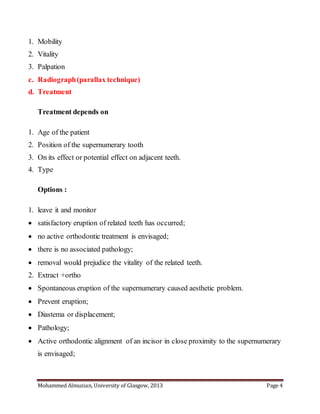
1. Mobility
2. Vitality
3. Palpation
c. Radiograph(parallax technique)
d. Treatment
Treatment depends on
1. Age of the patient
2. Position of the supernumerary tooth
3. On its effect or potential effect on adjacent teeth.
4. Type
Options :
1. leave it and monitor
 satisfactory eruption of related teeth has occurred;
 no active orthodontic treatment is envisaged;
 there is no associated pathology;
 removal would prejudice the vitality of the related teeth.
2. Extract +ortho
 Spontaneous eruption of the supernumerary caused aesthetic problem.
 Prevent eruption;
 Diastema or displacement;
 Pathology;
 Active orthodontic alignment of an incisor in close proximity to the supernumerary
is envisaged;
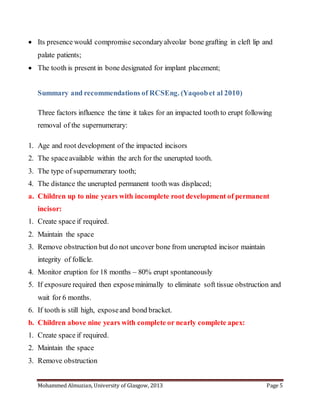
Mohammed Almuzian, University of Glasgow, 2013 Page 5
 Its presence would compromise secondaryalveolar bone grafting in cleft lip and
palate patients;
 The tooth is present in bone designated for implant placement;
Summary and recommendations of RCSEng. (Yaqoobet al 2010)
Three factors influence the time it takes for an impacted tooth to erupt following
removal of the supernumerary:
1. Age and root development of the impacted incisors
2. The spaceavailable within the arch for the unerupted tooth.
3. The type of supernumerary tooth;
4. The distance the unerupted permanent tooth was displaced;
a. Children up to nine years with incomplete root development of permanent
incisor:
1. Create space if required.
2. Maintain the space
3. Remove obstruction but do not uncover bone from unerupted incisor maintain
integrity of follicle.
4. Monitor eruption for 18 months – 80% erupt spontaneously
5. If exposure required then exposeminimally to eliminate soft tissue obstruction and
wait for 6 months.
6. If tooth is still high, exposeand bond bracket.
b. Children above nine years with complete or nearly complete apex:
1. Create space if required.
2. Maintain the space
3. Remove obstruction
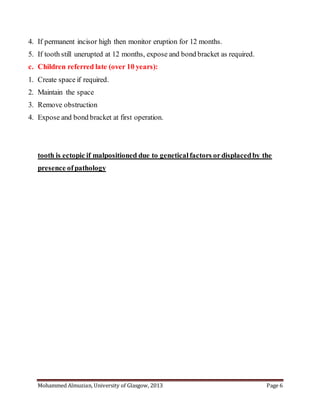
Mohammed Almuzian, University of Glasgow, 2013 Page 6
4. If permanent incisor high then monitor eruption for 12 months.
5. If tooth still unerupted at 12 months, expose and bond bracket as required.
c. Children referred late (over 10 years):
1. Create space if required.
2. Maintain the space
3. Remove obstruction
4. Expose and bond bracket at first operation.
tooth is ectopic if malpositioned due to genetical factors ordisplacedby the
presence ofpathology

Supernumeraries teeth for orthodontists by Almuzian

  • 1.
    Dr.Mohammed Almuzian, 2014Page 0 UNIVERSITY OF GLASGOW Supernumerary teeth Personal notes Dr.Mohammed Almuzian 1/1/2013
  • 2.
    Mohammed Almuzian, Universityof Glasgow, 2013 Page 1 Table of Contents Definition...........................................................................................................2 Incidence............................................................................................................2 Aetiology ...........................................................................................................2 Classifications ....................................................................................................2 Another classification according to position into ...Error! Bookmark notdefined. Complications......................................................Error! Bookmark notdefined. Management.......................................................................................................3 Summary and recommendations of RCSEng. (Yaqoob et al 2010) ........................5
  • 3.
    Mohammed Almuzian, Universityof Glasgow, 2013 Page 2 Supernumeraries Definition A 'tooth' or 'tooth-like' structure which develops in addition to the normal series of 32 teeth. Incidence 1. Rarely occurs in primary dentition (0.8%) Brook 1974 2. 2% in permanent dentition. Brook 1974 3. Syndromic cases around 22% 4. M:F = 2:1 5. 80% occurin anterior Max Aetiology Developmentally due to disturbance during initiation and proliferation stages (Dichotomy of the tooth bud or hyperactivity of dental lamina). 1. Non Syndromic (familial or isolated) 2. Syndromic • Down's syndrome • Cleidocranial dysplasia • CLP anomalies: Supernumerary teeth associated with cleft lip and palate result from fragmentation of the dental lamina during cleft formation Classifications 1. Conicalsupernumeraries are small peg-shaped teeth with normal root formation. When located in the midline of the anterior maxilla these teeth are known as
  • 4.
    Mohammed Almuzian, Universityof Glasgow, 2013 Page 3 mesiodens ( whilst in the maxillary molar region they are known as paramolars (buccal, lingual or interproximal to the second and third molars) or distomolars (distal to the third molar) 2. Tuberculate supernumeraries are characterized by a multicusped coronal morphology and a lack of rootdevelopment . These teeth are usually found palatal to the maxillary permanent incisors, often occurin pairs and frequently prevent eruption of the permanent incisors. 3. Supplemental supernumeraries represent the duplication of a tooth within a series and can be difficult to differentiate from the normal tooth. These teeth are usually found at the end of a series and can be seen in the incisor, premolar and molar fields. They represent the most common type of supernumerary found in the primary dentition 4. Odontomes are developmental malformations that contain both enamel and dentine. It can be compound (containing many small separate tooth-like structures usually situated in the anterior jaw) or complex (a large mass of disorganized enamel and dentine usually situated in the posterior jaw). 1. Management a. Visual examination. The sign of supernumerary tooth include: 1. Erupted supernumerary 2. Delayed tooth eruption and asymmetric eruption 3. Diastema 4. Rotation or abnormal inclination of the adjacent 5. Colour change or mobility of the adjacent b. Clinical examination
  • 5.
    Mohammed Almuzian, Universityof Glasgow, 2013 Page 4 1. Mobility 2. Vitality 3. Palpation c. Radiograph(parallax technique) d. Treatment Treatment depends on 1. Age of the patient 2. Position of the supernumerary tooth 3. On its effect or potential effect on adjacent teeth. 4. Type Options : 1. leave it and monitor  satisfactory eruption of related teeth has occurred;  no active orthodontic treatment is envisaged;  there is no associated pathology;  removal would prejudice the vitality of the related teeth. 2. Extract +ortho  Spontaneous eruption of the supernumerary caused aesthetic problem.  Prevent eruption;  Diastema or displacement;  Pathology;  Active orthodontic alignment of an incisor in close proximity to the supernumerary is envisaged;
  • 6.
    Mohammed Almuzian, Universityof Glasgow, 2013 Page 5  Its presence would compromise secondaryalveolar bone grafting in cleft lip and palate patients;  The tooth is present in bone designated for implant placement; Summary and recommendations of RCSEng. (Yaqoobet al 2010) Three factors influence the time it takes for an impacted tooth to erupt following removal of the supernumerary: 1. Age and root development of the impacted incisors 2. The spaceavailable within the arch for the unerupted tooth. 3. The type of supernumerary tooth; 4. The distance the unerupted permanent tooth was displaced; a. Children up to nine years with incomplete root development of permanent incisor: 1. Create space if required. 2. Maintain the space 3. Remove obstruction but do not uncover bone from unerupted incisor maintain integrity of follicle. 4. Monitor eruption for 18 months – 80% erupt spontaneously 5. If exposure required then exposeminimally to eliminate soft tissue obstruction and wait for 6 months. 6. If tooth is still high, exposeand bond bracket. b. Children above nine years with complete or nearly complete apex: 1. Create space if required. 2. Maintain the space 3. Remove obstruction
  • 7.
    Mohammed Almuzian, Universityof Glasgow, 2013 Page 6 4. If permanent incisor high then monitor eruption for 12 months. 5. If tooth still unerupted at 12 months, expose and bond bracket as required. c. Children referred late (over 10 years): 1. Create space if required. 2. Maintain the space 3. Remove obstruction 4. Expose and bond bracket at first operation. tooth is ectopic if malpositioned due to genetical factors ordisplacedby the presence ofpathology