Copyright © 2011 Pearson Education, Inc.
Chapter 1
Matter,
Measurement,
and Problem
Solving
Chemistry: A Molecular Approach, 2nd
Ed.
Nivaldo Tro
Roy Kennedy
Massachusetts Bay Community College
Wellesley Hills, MA
Copyright © 2011 Pearson Education, Inc.
Composition of Matter
Atoms and Molecules
Scientific Method
Tro: Chemistry: A Molecular Approach, 2/e
Copyright © 2011 Pearson Education, Inc.3
Structure Determines Properties
Tro: Chemistry: A Molecular Approach, 2/e
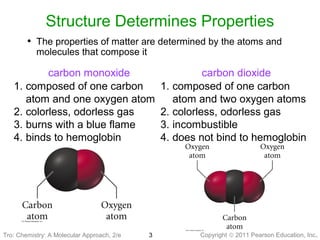
1. composed of one carbon
atom and one oxygen atom
2. colorless, odorless gas
3. burns with a blue flame
4. binds to hemoglobin
carbon monoxide
1. composed of one carbon
atom and two oxygen atoms
2. colorless, odorless gas
3. incombustible
4. does not bind to hemoglobin
carbon dioxide
• The properties of matter are determined by the atoms and
molecules that compose it
Copyright © 2011 Pearson Education, Inc.4
Atoms and Molecules
• Atoms
are submicroscopic particles
are the fundamental building blocks of ordinary matter
• Molecules
are two or more atoms attached together in a specific
geometrical arrangement
attachments are called bonds
attachments come in different strengths
come in different shapes and patterns
• Chemistry is the science that seeks to understand
the behavior of matter by studying the behavior of
atoms and molecules
Tro: Chemistry: A MolecularTro: Chemistry: A Molecular Approach, 2/e
Copyright © 2011 Pearson Education, Inc.5
The Scientific Approach to Knowledge
• Philosophers try to understand the universe by
reasoning and thinking about “ideal” behavior
• Scientists try to understand the universe
through empirical knowledge gained through
observation and experiment
Tro: Chemistry: A MolecularTro: Chemistry: A Molecular Approach, 2/e
Copyright © 2011 Pearson Education, Inc.6
Gathering Empirical Knowledge ─
Observation
Tro: Chemistry: A Molecular
• Some observations are descriptions of the
characteristics or behavior of nature ─
qualitative
“The soda pop is a liquid with a brown color and a
sweet taste. Bubbles are seen floating up through it.”
• Some observations compare a characteristic to
a standard numerical scale ─ quantitative
“A 240 mL serving of soda pop contains 27 g of sugar.”
Tro: Chemistry: A Molecular Approach, 2/e
Copyright © 2011 Pearson Education, Inc.7
From Observation to Understanding
Tro: Chemistry: A Molecular
• Hypothesis – a tentative interpretation or
explanation for an observation
“The sweet taste of soda pop is due to the
presence of sugar.”
• A good hypothesis is one that can be tested
to be proved wrong!
falsifiable
one test may invalidate your hypothesis
Tro: Chemistry: A Molecular Approach, 2/e
Copyright © 2011 Pearson Education, Inc.8
Testing Ideas
• Ideas in science are tested with experiments
• An experiment is a set of highly controlled
procedures designed to test whether an idea
about nature is valid
• The experiment generates observations
that will either validate or invalidate the idea
Tro: Chemistry: A MolecularTro: Chemistry: A Molecular Approach, 2/e
Copyright © 2011 Pearson Education, Inc.9
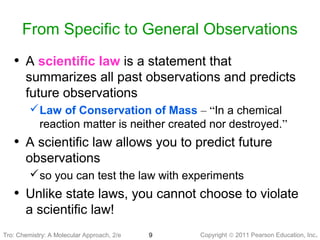
From Specific to General Observations
Tro: Chemistry: A Molecular
• A scientific law is a statement that
summarizes all past observations and predicts
future observations
Law of Conservation of Mass – “In a chemical
reaction matter is neither created nor destroyed.”
• A scientific law allows you to predict future
observations
so you can test the law with experiments
• Unlike state laws, you cannot choose to violate
a scientific law!
Tro: Chemistry: A Molecular Approach, 2/e
Copyright © 2011 Pearson Education, Inc.10
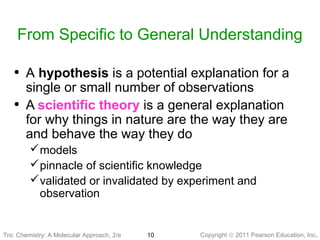
From Specific to General Understanding
• A hypothesis is a potential explanation for a
single or small number of observations
• A scientific theory is a general explanation
for why things in nature are the way they are
and behave the way they do
models
pinnacle of scientific knowledge
validated or invalidated by experiment and
observation
Tro: Chemistry: A MolecularTro: Chemistry: A Molecular Approach, 2/e
Copyright © 2011 Pearson Education, Inc.Tro: Chemistry: A Molecular 11
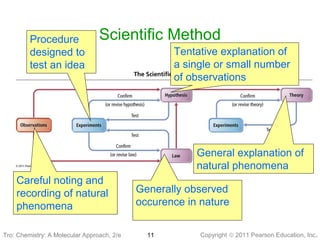
Scientific Method
Careful noting and
recording of natural
phenomena
Procedure
designed to
test an idea
Tentative explanation of
a single or small number
of observations
General explanation of
natural phenomena
Generally observed
occurence in nature
Tro: Chemistry: A Molecular Approach, 2/e
Copyright © 2011 Pearson Education, Inc.Tro: Chemistry: A Molecular 12
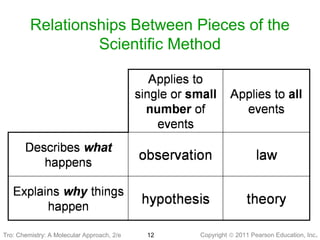
Relationships Between Pieces of the
Scientific Method
Tro: Chemistry: A Molecular Approach, 2/e
Copyright © 2011 Pearson Education, Inc.
Classification of Matter
States of Matter
Physical and Chemical Properties
Physical and Chemical Changes
Tro: Chemistry: A Molecular Approach, 2/e
Copyright © 2011 Pearson Education, Inc.Tro: Chemistry: A Molecular 14
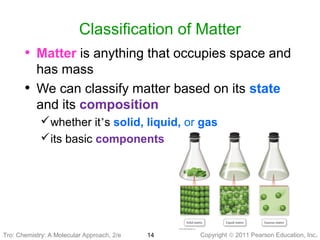
Classification of Matter
• Matter is anything that occupies space and
has mass
• We can classify matter based on its state
and its composition
whether it’s solid, liquid, or gas
its basic components
Tro: Chemistry: A Molecular Approach, 2/e
Copyright © 2011 Pearson Education, Inc.Tro: Chemistry: A Molecular 15
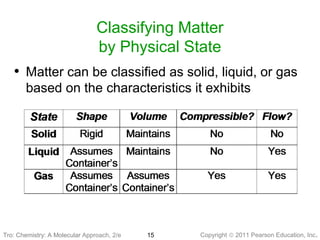
Classifying Matter
by Physical State
• Matter can be classified as solid, liquid, or gas
based on the characteristics it exhibits
Tro: Chemistry: A Molecular Approach, 2/e
Copyright © 2011 Pearson Education, Inc.Tro: Chemistry: A Molecular
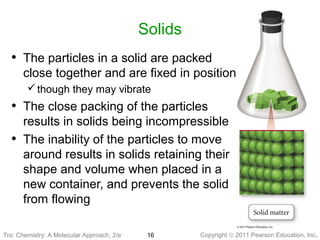
Solids
• The particles in a solid are packed
close together and are fixed in position
though they may vibrate
• The close packing of the particles
results in solids being incompressible
• The inability of the particles to move
around results in solids retaining their
shape and volume when placed in a
new container, and prevents the solid
from flowing
16Tro: Chemistry: A Molecular Approach, 2/e
Copyright © 2011 Pearson Education, Inc.Tro: Chemistry: A Molecular 17
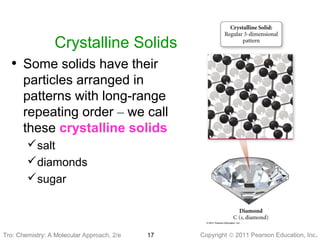
Crystalline Solids
• Some solids have their
particles arranged in
patterns with long-range
repeating order – we call
these crystalline solids
salt
diamonds
sugar
Tro: Chemistry: A Molecular Approach, 2/e
Copyright © 2011 Pearson Education, Inc.Tro: Chemistry: A Molecular 18
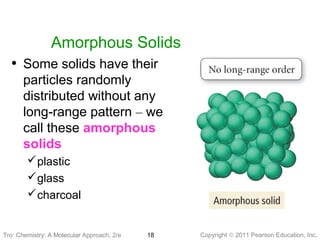
Amorphous Solids
• Some solids have their
particles randomly
distributed without any
long-range pattern – we
call these amorphous
solids
plastic
glass
charcoal
Tro: Chemistry: A Molecular Approach, 2/e
Copyright © 2011 Pearson Education, Inc.Tro: Chemistry: A Molecular 19
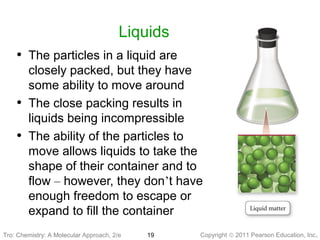
Liquids
• The particles in a liquid are
closely packed, but they have
some ability to move around
• The close packing results in
liquids being incompressible
• The ability of the particles to
move allows liquids to take the
shape of their container and to
flow – however, they don’t have
enough freedom to escape or
expand to fill the container
Tro: Chemistry: A Molecular Approach, 2/e
Copyright © 2011 Pearson Education, Inc.Tro: Chemistry: A Molecular 20
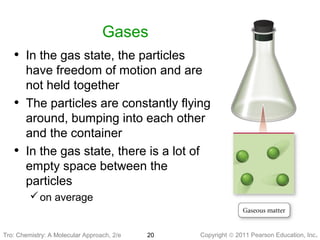
Gases
• In the gas state, the particles
have freedom of motion and are
not held together
• The particles are constantly flying
around, bumping into each other
and the container
• In the gas state, there is a lot of
empty space between the
particles
on average
Tro: Chemistry: A Molecular Approach, 2/e
Copyright © 2011 Pearson Education, Inc.Tro: Chemistry: A Molecular 21
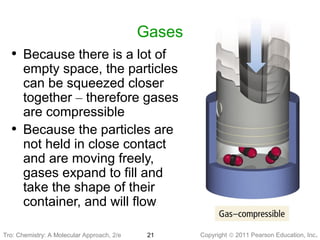
Gases
• Because there is a lot of
empty space, the particles
can be squeezed closer
together – therefore gases
are compressible
• Because the particles are
not held in close contact
and are moving freely,
gases expand to fill and
take the shape of their
container, and will flow
Tro: Chemistry: A Molecular Approach, 2/e
Copyright © 2011 Pearson Education, Inc.Tro: Chemistry: A Molecular 22
Classifying Matter by Composition
• Another way to classify matter is to examine its
composition
• Composition includes
types of particles
arrangement of the particles
attractions and attachments between the particles
Tro: Chemistry: A Molecular Approach, 2/e
Copyright © 2011 Pearson Education, Inc.23Tro: Chemistry: A MolecularTro: Chemistry: A Molecular Approach, 2/e
Copyright © 2011 Pearson Education, Inc.Tro: Chemistry: A Molecular 24
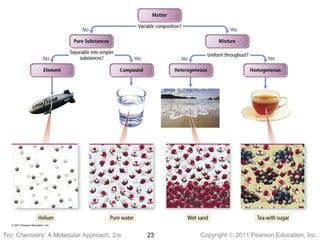
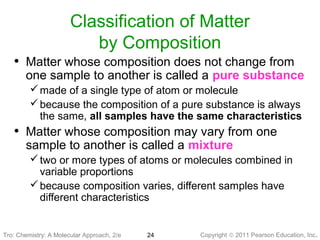
Classification of Matter
by Composition
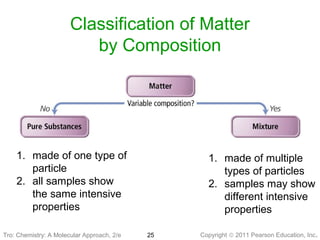
• Matter whose composition does not change from
one sample to another is called a pure substance
made of a single type of atom or molecule
because the composition of a pure substance is always
the same, all samples have the same characteristics
• Matter whose composition may vary from one
sample to another is called a mixture
two or more types of atoms or molecules combined in
variable proportions
because composition varies, different samples have
different characteristics
Tro: Chemistry: A Molecular Approach, 2/e
Copyright © 2011 Pearson Education, Inc.Tro: Chemistry: A Molecular 25
Classification of Matter
by Composition
1. made of one type of
particle
2. all samples show
the same intensive
properties
1. made of multiple
types of particles
2. samples may show
different intensive
properties
Tro: Chemistry: A Molecular Approach, 2/e
Copyright © 2011 Pearson Education, Inc.Tro: Chemistry: A Molecular 26
Classification of Pure Substances 
Elements
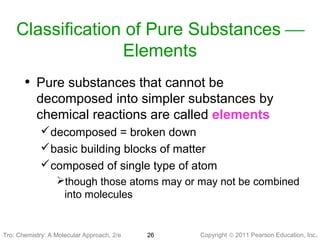
• Pure substances that cannot be
decomposed into simpler substances by
chemical reactions are called elements
decomposed = broken down
basic building blocks of matter
composed of single type of atom
though those atoms may or may not be combined
into molecules
Tro: Chemistry: A Molecular Approach, 2/e
Copyright © 2011 Pearson Education, Inc.Tro: Chemistry: A Molecular 27
Classification of Pure Substances 
Compounds
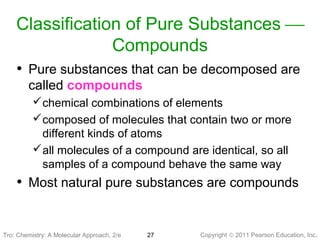
• Pure substances that can be decomposed are
called compounds
chemical combinations of elements
composed of molecules that contain two or more
different kinds of atoms
all molecules of a compound are identical, so all
samples of a compound behave the same way
• Most natural pure substances are compounds
Tro: Chemistry: A Molecular Approach, 2/e
Copyright © 2011 Pearson Education, Inc.Tro: Chemistry: A Molecular 28
Classification of Pure Substances
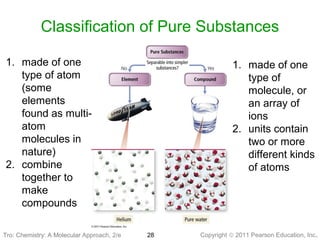
1. made of one
type of atom
(some
elements
found as multi-
atom
molecules in
nature)
2. combine
together to
make
compounds
1. made of one
type of
molecule, or
an array of
ions
2. units contain
two or more
different kinds
of atoms
Tro: Chemistry: A Molecular Approach, 2/e
Copyright © 2011 Pearson Education, Inc.Tro: Chemistry: A Molecular 29
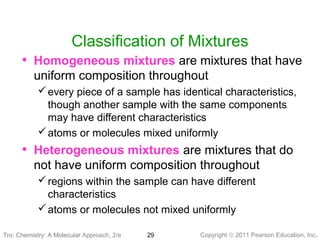
Classification of Mixtures
• Homogeneous mixtures are mixtures that have
uniform composition throughout
every piece of a sample has identical characteristics,
though another sample with the same components
may have different characteristics
atoms or molecules mixed uniformly
• Heterogeneous mixtures are mixtures that do
not have uniform composition throughout
regions within the sample can have different
characteristics
atoms or molecules not mixed uniformly
Tro: Chemistry: A Molecular Approach, 2/e
Copyright © 2011 Pearson Education, Inc.Tro: Chemistry: A Molecular 30
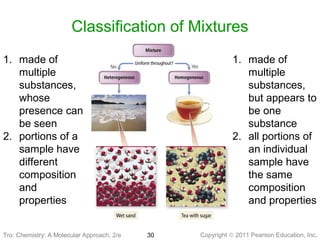
Classification of Mixtures
1. made of
multiple
substances,
but appears to
be one
substance
2. all portions of
an individual
sample have
the same
composition
and properties
1. made of
multiple
substances,
whose
presence can
be seen
2. portions of a
sample have
different
composition
and
properties
Tro: Chemistry: A Molecular Approach, 2/e
Copyright © 2011 Pearson Education, Inc.Tro: Chemistry: A Molecular 31
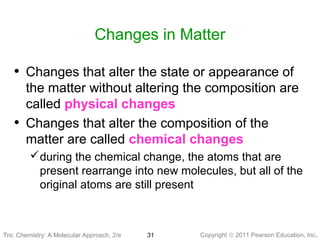
Changes in Matter
• Changes that alter the state or appearance of
the matter without altering the composition are
called physical changes
• Changes that alter the composition of the
matter are called chemical changes
during the chemical change, the atoms that are
present rearrange into new molecules, but all of the
original atoms are still present
Tro: Chemistry: A Molecular Approach, 2/e
Copyright © 2011 Pearson Education, Inc.Tro: Chemistry: A Molecular 32
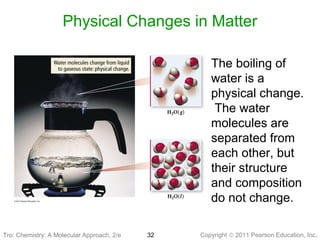
Physical Changes in Matter
The boiling of
water is a
physical change.
The water
molecules are
separated from
each other, but
their structure
and composition
do not change.
Tro: Chemistry: A Molecular Approach, 2/e
Copyright © 2011 Pearson Education, Inc.Tro: Chemistry: A Molecular 33
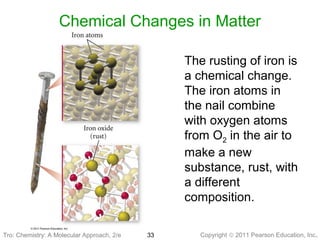
Chemical Changes in Matter
The rusting of iron is
a chemical change.
The iron atoms in
the nail combine
with oxygen atoms
from O2 in the air to
make a new
substance, rust, with
a different
composition.
Tro: Chemistry: A Molecular Approach, 2/e
Copyright © 2011 Pearson Education, Inc.Tro: Chemistry: A Molecular 34
Properties of Matter
• Physical properties are the characteristics of
matter that can be changed without changing
its composition
characteristics that are directly observable
• Chemical properties are the characteristics
that determine how the composition of matter
changes as a result of contact with other matter
or the influence of energy
characteristics that describe the behavior of matter
Tro: Chemistry: A Molecular Approach, 2/e
Copyright © 2011 Pearson Education, Inc.
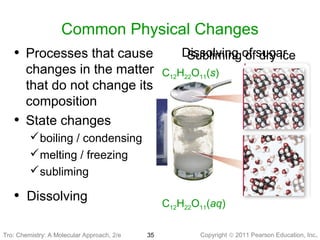
CO2(s)
CO2(g)
Dry Ice
Subliming of dry ice
Tro: Chemistry: A Molecular 35
Common Physical Changes
• Processes that cause
changes in the matter
that do not change its
composition
• State changes
boiling / condensing
melting / freezing
subliming
• Dissolving
Dissolving of sugar
C12H22O11(s)
C12H22O11(aq)
Tro: Chemistry: A Molecular Approach, 2/e
Copyright © 2011 Pearson Education, Inc.Tro: Chemistry: A Molecular 36
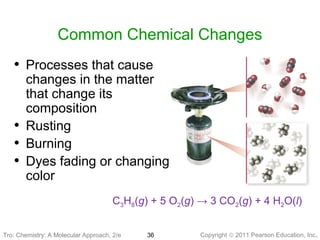
Common Chemical Changes
C3H8(g) + 5 O2(g) → 3 CO2(g) + 4 H2O(l)
• Processes that cause
changes in the matter
that change its
composition
• Rusting
• Burning
• Dyes fading or changing
color
Tro: Chemistry: A Molecular Approach, 2/e
Copyright © 2011 Pearson Education, Inc.
Energy
Tro: Chemistry: A Molecular Approach, 2/e
Copyright © 2011 Pearson Education, Inc.Tro: Chemistry: A Molecular 38
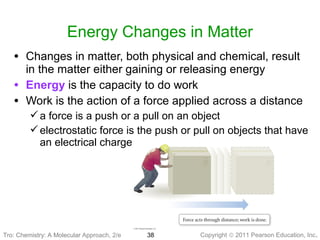
Energy Changes in Matter
• Changes in matter, both physical and chemical, result
in the matter either gaining or releasing energy
• Energy is the capacity to do work
• Work is the action of a force applied across a distance
a force is a push or a pull on an object
electrostatic force is the push or pull on objects that have
an electrical charge
Tro: Chemistry: A Molecular Approach, 2/e
Copyright © 2011 Pearson Education, Inc.Tro: Chemistry: A Molecular 39
Energy of Matter
• All matter possesses energy
• Energy is classified as either kinetic or
potential
• Energy can be converted from one form
to another
• When matter undergoes a chemical or
physical change, the amount of energy in
the matter changes as well
Tro: Chemistry: A Molecular Approach, 2/e
Copyright © 2011 Pearson Education, Inc.Tro: Chemistry: A Molecular 40
Energy of Matter − Kinetic
• Kinetic energy is energy of motion
motion of the atoms, molecules, and
subatomic particles
thermal (heat) energy is a form of kinetic
energy because it is caused by molecular
motion
Tro: Chemistry: A Molecular Approach, 2/e
Copyright © 2011 Pearson Education, Inc.Tro: Chemistry: A Molecular 41
Energy of Matter − Potential
• Potential energy is energy that is stored
in the matter
due to the composition of the matter and its
position relative to other things
chemical potential energy arises from
electrostatic attractive forces between atoms,
molecules, and subatomic particles
Tro: Chemistry: A Molecular Approach, 2/e
Copyright © 2011 Pearson Education, Inc.Tro: Chemistry: A Molecular 42
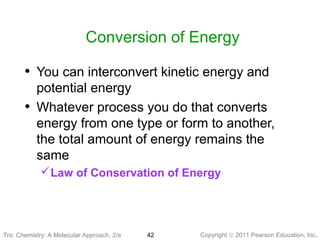
Conversion of Energy
• You can interconvert kinetic energy and
potential energy
• Whatever process you do that converts
energy from one type or form to another,
the total amount of energy remains the
same
Law of Conservation of Energy
Tro: Chemistry: A Molecular Approach, 2/e
Copyright © 2011 Pearson Education, Inc.Tro: Chemistry: A Molecular 43
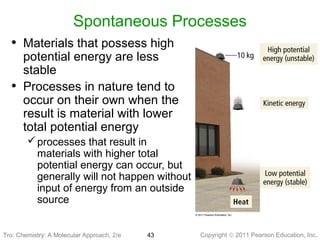
Spontaneous Processes
• Materials that possess high
potential energy are less
stable
• Processes in nature tend to
occur on their own when the
result is material with lower
total potential energy
processes that result in
materials with higher total
potential energy can occur, but
generally will not happen without
input of energy from an outside
source
Tro: Chemistry: A Molecular Approach, 2/e
Copyright © 2011 Pearson Education, Inc.Tro: Chemistry: A Molecular 44
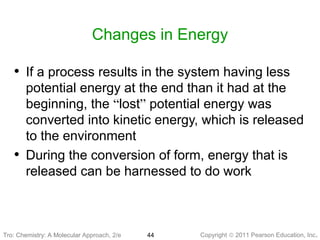
Changes in Energy
• If a process results in the system having less
potential energy at the end than it had at the
beginning, the “lost” potential energy was
converted into kinetic energy, which is released
to the environment
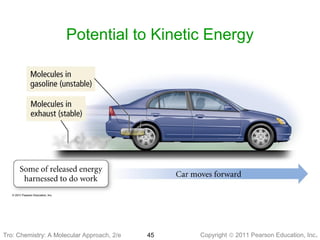
• During the conversion of form, energy that is
released can be harnessed to do work
Tro: Chemistry: A Molecular Approach, 2/e
Copyright © 2011 Pearson Education, Inc.Tro: Chemistry: A Molecular 45
Potential to Kinetic Energy
Tro: Chemistry: A Molecular Approach, 2/e
Copyright © 2011 Pearson Education, Inc.
Standard Units of
Measure
Tro: Chemistry: A Molecular Approach, 2/e
Copyright © 2011 Pearson Education, Inc.Tro: Chemistry: A Molecular 47
The Standard Units
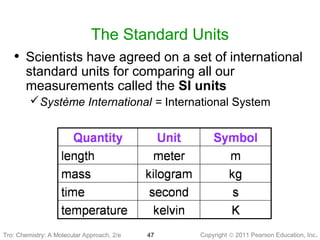
• Scientists have agreed on a set of international
standard units for comparing all our
measurements called the SI units
Système International = International System
Tro: Chemistry: A Molecular Approach, 2/e
Copyright © 2011 Pearson Education, Inc.Tro: Chemistry: A Molecular 48
Length
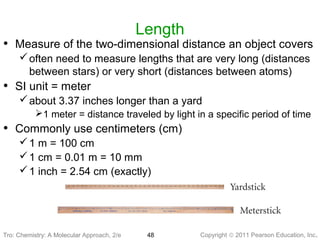
• Measure of the two-dimensional distance an object covers
often need to measure lengths that are very long (distances
between stars) or very short (distances between atoms)
• SI unit = meter
about 3.37 inches longer than a yard
1 meter = distance traveled by light in a specific period of time
• Commonly use centimeters (cm)
1 m = 100 cm
1 cm = 0.01 m = 10 mm
1 inch = 2.54 cm (exactly)
Tro: Chemistry: A Molecular Approach, 2/e
Copyright © 2011 Pearson Education, Inc.Tro: Chemistry: A Molecular 49
Mass
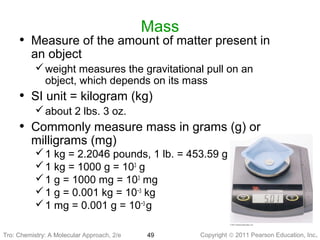
• Measure of the amount of matter present in
an object
weight measures the gravitational pull on an
object, which depends on its mass
• SI unit = kilogram (kg)
about 2 lbs. 3 oz.
• Commonly measure mass in grams (g) or
milligrams (mg)
1 kg = 2.2046 pounds, 1 lb. = 453.59 g
1 kg = 1000 g = 103
g
1 g = 1000 mg = 103
mg
1 g = 0.001 kg = 10−3
kg
1 mg = 0.001 g = 10−3
g
Tro: Chemistry: A Molecular Approach, 2/e
Copyright © 2011 Pearson Education, Inc.Tro: Chemistry: A Molecular 50
Time
• Measure of the duration of an event
• SI units = second (s)
• 1 s is defined as the period of time it
takes for a specific number of radiation
events of a specific transition from
cesium–133
Tro: Chemistry: A Molecular Approach, 2/e
Copyright © 2011 Pearson Education, Inc.Tro: Chemistry: A Molecular
Temperature
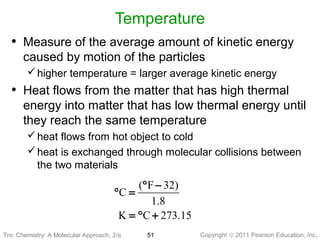
• Measure of the average amount of kinetic energy
caused by motion of the particles
higher temperature = larger average kinetic energy
• Heat flows from the matter that has high thermal
energy into matter that has low thermal energy until
they reach the same temperature
heat flows from hot object to cold
heat is exchanged through molecular collisions between
the two materials
51Tro: Chemistry: A Molecular Approach, 2/e
( F 32)
C
1.8
K C 273.15
° −
° =
= ° +
Copyright © 2011 Pearson Education, Inc.Tro: Chemistry: A Molecular 52
Temperature Scales
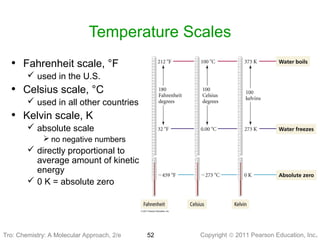
• Fahrenheit scale, °F
 used in the U.S.
• Celsius scale, °C
 used in all other countries
• Kelvin scale, K
 absolute scale
 no negative numbers
 directly proportional to
average amount of kinetic
energy
 0 K = absolute zero
Tro: Chemistry: A Molecular Approach, 2/e
Copyright © 2011 Pearson Education, Inc.Tro: Chemistry: A Molecular 53
Fahrenheit vs. Celsius
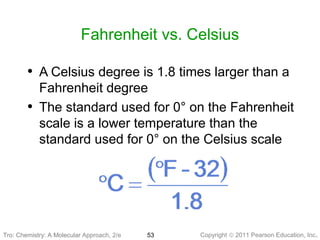
• A Celsius degree is 1.8 times larger than a
Fahrenheit degree
• The standard used for 0° on the Fahrenheit
scale is a lower temperature than the
standard used for 0° on the Celsius scale
Tro: Chemistry: A Molecular Approach, 2/e
Copyright © 2011 Pearson Education, Inc.Tro: Chemistry: A Molecular 54
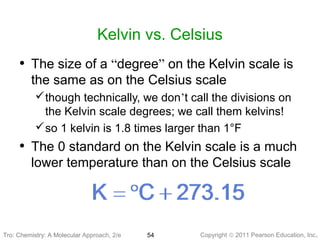
Kelvin vs. Celsius
• The size of a “degree” on the Kelvin scale is
the same as on the Celsius scale
though technically, we don’t call the divisions on
the Kelvin scale degrees; we call them kelvins!
so 1 kelvin is 1.8 times larger than 1°F
• The 0 standard on the Kelvin scale is a much
lower temperature than on the Celsius scale
Tro: Chemistry: A Molecular Approach, 2/e
Copyright © 2011 Pearson Education, Inc.
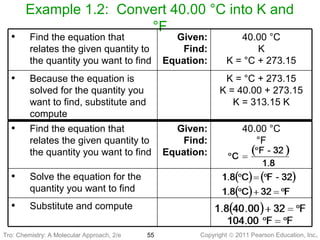
Example 1.2: Convert 40.00 °C into K and
°F
• Substitute and compute
• Solve the equation for the
quantity you want to find
40.00 °C
°F
Given:
Find:
Equation:
• Find the equation that
relates the given quantity to
the quantity you want to find
K = °C + 273.15
K = 40.00 + 273.15
K = 313.15 K
• Because the equation is
solved for the quantity you
want to find, substitute and
compute
40.00 °C
K
K = °C + 273.15
Given:
Find:
Equation:
• Find the equation that
relates the given quantity to
the quantity you want to find
55Tro: Chemistry: A MolecularTro: Chemistry: A Molecular Approach, 2/e
Copyright © 2011 Pearson Education, Inc.Tro: Chemistry: A Molecular 56
Practice – Convert 0.0°F into Kelvin
Tro: Chemistry: A Molecular Approach, 2/e
Copyright © 2011 Pearson Education, Inc.
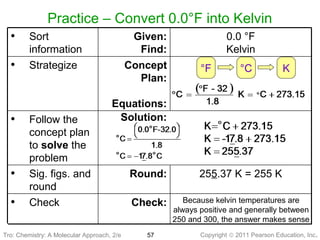
Practice – Convert 0.0°F into Kelvin
Because kelvin temperatures are
always positive and generally between
250 and 300, the answer makes sense
Check:• Check
255.37 K = 255 KRound:• Sig. figs. and
round
Solution:• Follow the
concept plan
to solve the
problem
Concept
Plan:
Equations:
• Strategize
0.0 °F
Kelvin
Given:
Find:
• Sort
information
°F °C K
57Tro: Chemistry: A MolecularTro: Chemistry: A Molecular Approach, 2/e
Copyright © 2011 Pearson Education, Inc.Tro: Chemistry: A Molecular 58
Related Units in the SI System
• All units in the SI system are related to the
standard unit by a power of 10
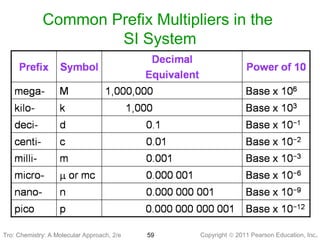
• The power of 10 is indicated by a prefix
multiplier
• The prefix multipliers are always the same,
regardless of the standard unit
• Report measurements with a unit that is close
to the size of the quantity being measured
Tro: Chemistry: A Molecular Approach, 2/e
Copyright © 2011 Pearson Education, Inc.Tro: Chemistry: A Molecular 59
Common Prefix Multipliers in the
SI System
Tro: Chemistry: A Molecular Approach, 2/e
Copyright © 2011 Pearson Education, Inc.Tro: Chemistry: A Molecular 60
Volume
• Derived unit
 any length unit cubed
• Measure of the amount of space
occupied
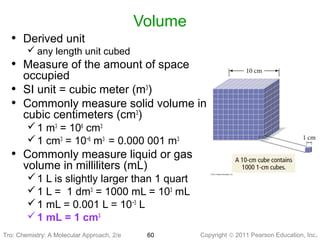
• SI unit = cubic meter (m3
)
• Commonly measure solid volume in
cubic centimeters (cm3
)
1 m3
= 106
cm3
1 cm3
= 10−6
m3
= 0.000 001 m3
• Commonly measure liquid or gas
volume in milliliters (mL)
1 L is slightly larger than 1 quart
1 L = 1 dm3
= 1000 mL = 103
mL
1 mL = 0.001 L = 10−3
L
1 mL = 1 cm3
Tro: Chemistry: A Molecular Approach, 2/e
Copyright © 2011 Pearson Education, Inc.Tro: Chemistry: A Molecular 61
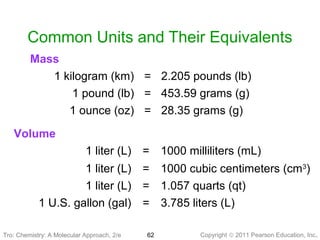
Common Units and Their Equivalents
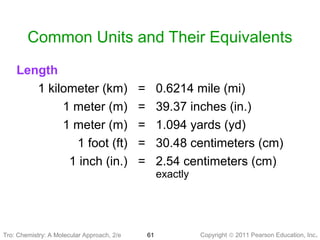
Length
1 kilometer (km) = 0.6214 mile (mi)
1 meter (m) = 39.37 inches (in.)
1 meter (m) = 1.094 yards (yd)
1 foot (ft) = 30.48 centimeters (cm)
1 inch (in.) = 2.54 centimeters (cm)
exactly
Tro: Chemistry: A Molecular Approach, 2/e
Copyright © 2011 Pearson Education, Inc.Tro: Chemistry: A Molecular 62
Common Units and Their Equivalents
Volume
1 liter (L) = 1000 milliliters (mL)
1 liter (L) = 1000 cubic centimeters (cm3
)
1 liter (L) = 1.057 quarts (qt)
1 U.S. gallon (gal) = 3.785 liters (L)
Mass
1 kilogram (km) = 2.205 pounds (lb)
1 pound (lb) = 453.59 grams (g)
1 ounce (oz) = 28.35 grams (g)
Tro: Chemistry: A Molecular Approach, 2/e
Copyright © 2011 Pearson Education, Inc.Tro: Chemistry: A Molecular 63
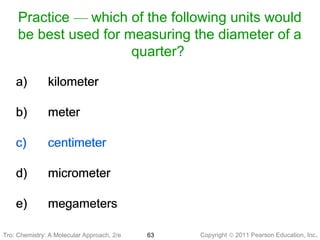
Practice — which of the following units would
be best used for measuring the diameter of a
quarter?
a) kilometer
b) meter
c) centimeter
d) micrometer
e) megameters
a) kilometer
b) meter
c) centimeter
d) micrometer
e) megameters
Tro: Chemistry: A Molecular Approach, 2/e
Copyright © 2011 Pearson Education, Inc.
Density
Tro: Chemistry: A Molecular Approach, 2/e
Copyright © 2011 Pearson Education, Inc.
Intensive and Extensive Properties
• Extensive properties are properties whose
value depends on the quantity of matter
extensive properties cannot be used to identify
what type of matter something is
if you are given a large glass containing 100 g of a
clear, colorless liquid and a small glass containing
25 g of a clear, colorless liquid, are both liquids the
same stuff?
• Intensive properties are properties whose
value is independent of the quantity of matter
intensive properties are often used to identify the
type of matter
samples with identical intensive properties are
usually the same material
Tro: Chemistry: A Molecular 65Tro: Chemistry: A Molecular Approach, 2/e
Copyright © 2011 Pearson Education, Inc.Tro: Chemistry: A Molecular 66
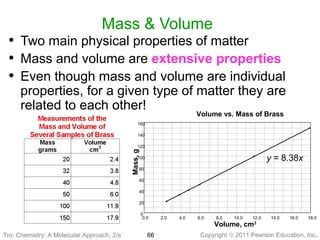
Mass & Volume
• Two main physical properties of matter
• Mass and volume are extensive properties
• Even though mass and volume are individual
properties, for a given type of matter they are
related to each other!
Volume vs. Mass of Brass
y = 8.38x
0
20
40
60
80
100
120
140
160
0.0 2.0 4.0 6.0 8.0 10.0 12.0 14.0 16.0 18.0
Volume, cm3
Mass,g
Tro: Chemistry: A Molecular Approach, 2/e
Copyright © 2011 Pearson Education, Inc.Tro: Chemistry: A Molecular 67
Density
• Density is the ratio of mass to volume
is an intensive property
• Solids = g/cm3
1 cm3
= 1 mL
• Liquids = g/mL
• Gases = g/L
• Volume of a solid can be determined by water
displacement – Archimedes principle
• Density : solids > liquids >>> gases
except ice is less dense than liquid water!
Tro: Chemistry: A Molecular Approach, 2/e
Copyright © 2011 Pearson Education, Inc.Tro: Chemistry: A Molecular 68
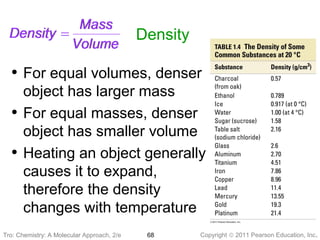
Density
• For equal volumes, denser
object has larger mass
• For equal masses, denser
object has smaller volume
• Heating an object generally
causes it to expand,
therefore the density
changes with temperature
Tro: Chemistry: A Molecular Approach, 2/e
Copyright © 2011 Pearson Education, Inc.
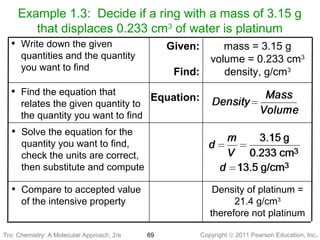
Example 1.3: Decide if a ring with a mass of 3.15 g
that displaces 0.233 cm3
of water is platinum
Density of platinum =
21.4 g/cm3
therefore not platinum
• Compare to accepted value
of the intensive property
• Solve the equation for the
quantity you want to find,
check the units are correct,
then substitute and compute
mass = 3.15 g
volume = 0.233 cm3
density, g/cm3
Given:
Find:
Equation:
• Find the equation that
relates the given quantity to
the quantity you want to find
69Tro: Chemistry: A Molecular
• Write down the given
quantities and the quantity
you want to find
Tro: Chemistry: A Molecular Approach, 2/e
Copyright © 2011 Pearson Education, Inc.Tro: Chemistry: A Molecular 70
Calculating Density
• What is the density of a brass sample if 100.0 g
added to a cylinder of water causes the water
level to rise from 25.0 mL to 36.9 mL?
Tro: Chemistry: A Molecular Approach, 2/e
Copyright © 2011 Pearson Education, Inc.
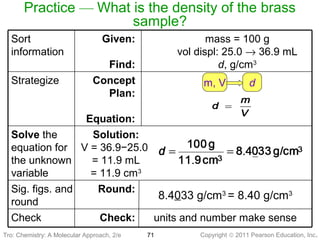
Practice — What is the density of the brass
sample?
units and number make senseCheck:Check
8.4033 g/cm3
= 8.40 g/cm3Round:Sig. figs. and
round
Solution:
V = 36.9−25.0
= 11.9 mL
= 11.9 cm3
Solve the
equation for
the unknown
variable
Concept
Plan:
Equation:
Strategize
mass = 100 g
vol displ: 25.0 → 36.9 mL
d, g/cm3
Given:
Find:
Sort
information
m, V d
71Tro: Chemistry: A MolecularTro: Chemistry: A Molecular Approach, 2/e
Copyright © 2011 Pearson Education, Inc.
Measurement
and Significant Figures
Tro: Chemistry: A Molecular Approach, 2/e
Copyright © 2011 Pearson Education, Inc.Tro: Chemistry: A Molecular 73
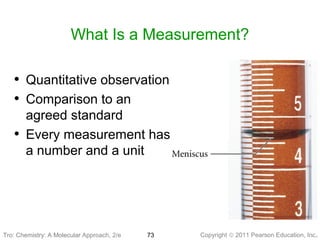
What Is a Measurement?
• Quantitative observation
• Comparison to an
agreed standard
• Every measurement has
a number and a unit
Tro: Chemistry: A Molecular Approach, 2/e
Copyright © 2011 Pearson Education, Inc.Tro: Chemistry: A Molecular 74
A Measurement
• The unit tells you what standard you are
comparing your object to
• The number tells you
1. what multiple of the standard the object
measures
2. the uncertainty in the measurement
• Scientific measurements are reported so that
every digit written is certain, except the last
one, which is estimated
Tro: Chemistry: A Molecular Approach, 2/e
Copyright © 2011 Pearson Education, Inc.Tro: Chemistry: A Molecular 75
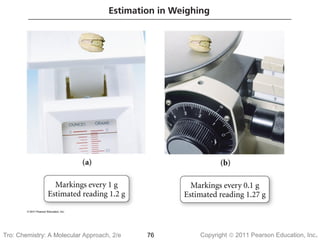
Estimating the Last Digit
• For instruments marked with a scale, you get
the last digit by estimating between the
marks
 if possible
• Mentally divide the space into ten equal
spaces, then estimate how many spaces
over the indicator the mark is
Tro: Chemistry: A Molecular Approach, 2/e
Copyright © 2011 Pearson Education, Inc.Tro: Chemistry: A Molecular 76Tro: Chemistry: A Molecular Approach, 2/e
Copyright © 2011 Pearson Education, Inc.Tro: Chemistry: A Molecular 77
Significant Figures
• The non-place-holding digits in
a reported measurement are
called significant figures
some zeros in a written number
are only there to help you locate
the decimal point
• Significant figures tell us the
range of values to expect for
repeated measurements
the more significant figures there
are in a measurement, the smaller
the range of values is
12.3 cm
has 3 sig. figs.
and its range is
12.2 to 12.4 cm
12.30 cm
has 4 sig. figs.
and its range is
12.29 to 12.31 cm
Tro: Chemistry: A Molecular Approach, 2/e
Copyright © 2011 Pearson Education, Inc.Tro: Chemistry: A Molecular 78
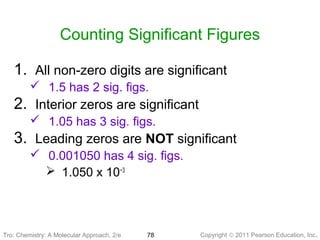
Counting Significant Figures
1. All non-zero digits are significant
 1.5 has 2 sig. figs.
2. Interior zeros are significant
 1.05 has 3 sig. figs.
3. Leading zeros are NOT significant
 0.001050 has 4 sig. figs.
 1.050 x 10⁻³
Tro: Chemistry: A Molecular Approach, 2/e
Copyright © 2011 Pearson Education, Inc.Tro: Chemistry: A Molecular 79
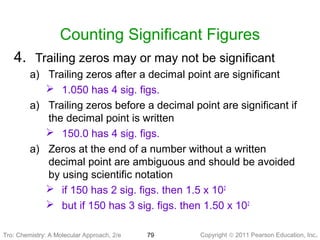
Counting Significant Figures
4. Trailing zeros may or may not be significant
a) Trailing zeros after a decimal point are significant
 1.050 has 4 sig. figs.
a) Trailing zeros before a decimal point are significant if
the decimal point is written
 150.0 has 4 sig. figs.
a) Zeros at the end of a number without a written
decimal point are ambiguous and should be avoided
by using scientific notation
 if 150 has 2 sig. figs. then 1.5 x 10²
 but if 150 has 3 sig. figs. then 1.50 x 10²
Tro: Chemistry: A Molecular Approach, 2/e
Copyright © 2011 Pearson Education, Inc.Tro: Chemistry: A Molecular 80
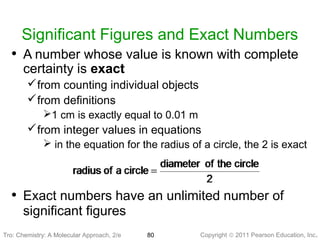
Significant Figures and Exact Numbers
• A number whose value is known with complete
certainty is exact
from counting individual objects
from definitions
1 cm is exactly equal to 0.01 m
from integer values in equations
 in the equation for the radius of a circle, the 2 is exact
• Exact numbers have an unlimited number of
significant figures
Tro: Chemistry: A Molecular Approach, 2/e
Copyright © 2011 Pearson Education, Inc.Tro: Chemistry: A Molecular 81
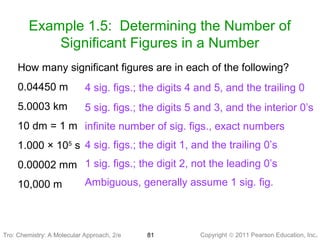
Example 1.5: Determining the Number of
Significant Figures in a Number
How many significant figures are in each of the following?
0.04450 m
5.0003 km
10 dm = 1 m
1.000 × 10⁵
s
0.00002 mm
10,000 m
4 sig. figs.; the digits 4 and 5, and the trailing 0
5 sig. figs.; the digits 5 and 3, and the interior 0’s
infinite number of sig. figs., exact numbers
4 sig. figs.; the digit 1, and the trailing 0’s
1 sig. figs.; the digit 2, not the leading 0’s
Ambiguous, generally assume 1 sig. fig.
Tro: Chemistry: A Molecular Approach, 2/e
Copyright © 2011 Pearson Education, Inc.Tro: Chemistry: A Molecular 82
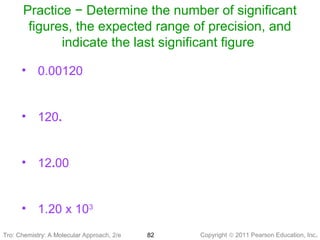
Practice − Determine the number of significant
figures, the expected range of precision, and
indicate the last significant figure
• 0.00120
• 120.
• 12.00
• 1.20 x 10³
Tro: Chemistry: A Molecular Approach, 2/e
Copyright © 2011 Pearson Education, Inc.Tro: Chemistry: A Molecular 83
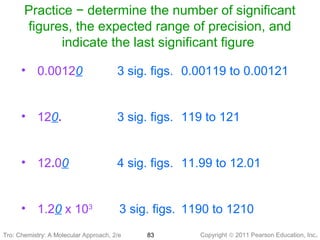
Practice − determine the number of significant
figures, the expected range of precision, and
indicate the last significant figure
• 0.00120 3 sig. figs. 0.00119 to 0.00121
• 120. 3 sig. figs. 119 to 121
• 12.00 4 sig. figs. 11.99 to 12.01
• 1.20 x 10³
3 sig. figs. 1190 to 1210
Tro: Chemistry: A Molecular Approach, 2/e
Copyright © 2011 Pearson Education, Inc.Tro: Chemistry: A Molecular 84
Multiplication and Division with
Significant Figures
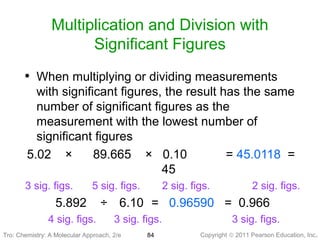
• When multiplying or dividing measurements
with significant figures, the result has the same
number of significant figures as the
measurement with the lowest number of
significant figures
5.02 × 89.665 × 0.10 = 45.0118 =
45
3 sig. figs. 5 sig. figs. 2 sig. figs. 2 sig. figs.
5.892 ÷ 6.10 = 0.96590 = 0.966
4 sig. figs. 3 sig. figs. 3 sig. figs.
Tro: Chemistry: A Molecular Approach, 2/e
Copyright © 2011 Pearson Education, Inc.Tro: Chemistry: A Molecular 85
Addition and Subtraction
with Significant Figures
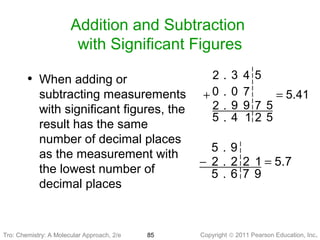
• When adding or
subtracting measurements
with significant figures, the
result has the same
number of decimal places
as the measurement with
the lowest number of
decimal places
41.5
5214.5
5799.2
70.0
543.2
=+
7.5
976.5
122.2
9.5
=−
Tro: Chemistry: A Molecular Approach, 2/e
Copyright © 2011 Pearson Education, Inc.Tro: Chemistry: A Molecular 86
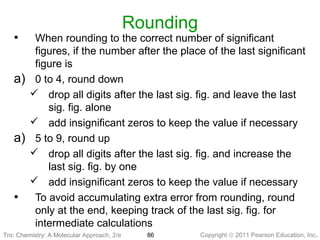
Rounding
• When rounding to the correct number of significant
figures, if the number after the place of the last significant
figure is
a) 0 to 4, round down
 drop all digits after the last sig. fig. and leave the last
sig. fig. alone
 add insignificant zeros to keep the value if necessary
a) 5 to 9, round up
 drop all digits after the last sig. fig. and increase the
last sig. fig. by one
 add insignificant zeros to keep the value if necessary
• To avoid accumulating extra error from rounding, round
only at the end, keeping track of the last sig. fig. for
intermediate calculations
Tro: Chemistry: A Molecular Approach, 2/e
Copyright © 2011 Pearson Education, Inc.Tro: Chemistry: A Molecular 87
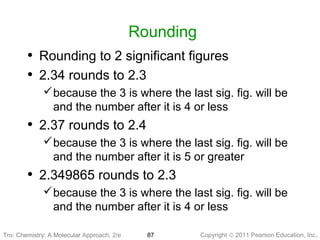
Rounding
• Rounding to 2 significant figures
• 2.34 rounds to 2.3
because the 3 is where the last sig. fig. will be
and the number after it is 4 or less
• 2.37 rounds to 2.4
because the 3 is where the last sig. fig. will be
and the number after it is 5 or greater
• 2.349865 rounds to 2.3
because the 3 is where the last sig. fig. will be
and the number after it is 4 or less
Tro: Chemistry: A Molecular Approach, 2/e
Copyright © 2011 Pearson Education, Inc.Tro: Chemistry: A Molecular 88
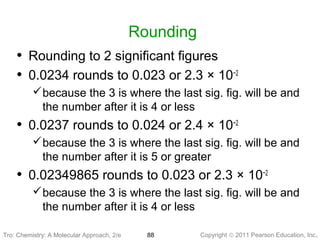
Rounding
• Rounding to 2 significant figures
• 0.0234 rounds to 0.023 or 2.3 × 10⁻²
because the 3 is where the last sig. fig. will be and
the number after it is 4 or less
• 0.0237 rounds to 0.024 or 2.4 × 10⁻²
because the 3 is where the last sig. fig. will be and
the number after it is 5 or greater
• 0.02349865 rounds to 0.023 or 2.3 × 10⁻²
because the 3 is where the last sig. fig. will be and
the number after it is 4 or less
Tro: Chemistry: A Molecular Approach, 2/e
Copyright © 2011 Pearson Education, Inc.Tro: Chemistry: A Molecular 89
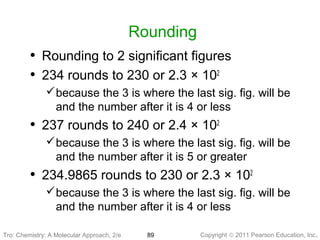
Rounding
• Rounding to 2 significant figures
• 234 rounds to 230 or 2.3 × 10²
because the 3 is where the last sig. fig. will be
and the number after it is 4 or less
• 237 rounds to 240 or 2.4 × 10²
because the 3 is where the last sig. fig. will be
and the number after it is 5 or greater
• 234.9865 rounds to 230 or 2.3 × 10²
because the 3 is where the last sig. fig. will be
and the number after it is 4 or less
Tro: Chemistry: A Molecular Approach, 2/e
Copyright © 2011 Pearson Education, Inc.Tro: Chemistry: A Molecular 90
Both Multiplication/Division and
Addition/Subtraction
with Significant Figures
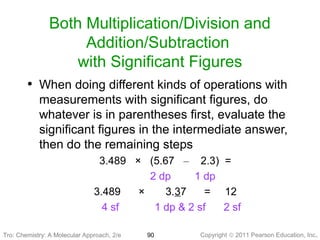
• When doing different kinds of operations with
measurements with significant figures, do
whatever is in parentheses first, evaluate the
significant figures in the intermediate answer,
then do the remaining steps
3.489 × (5.67 – 2.3) =
2 dp 1 dp
3.489 × 3.37 = 12
4 sf 1 dp & 2 sf 2 sf
Tro: Chemistry: A Molecular Approach, 2/e
Copyright © 2011 Pearson Education, Inc.Tro: Chemistry: A Molecular 91
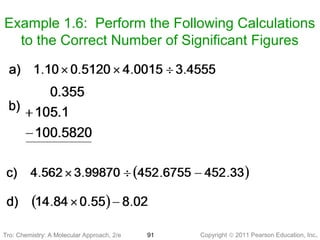
Example 1.6: Perform the Following Calculations
to the Correct Number of Significant Figures
Tro: Chemistry: A Molecular Approach, 2/e
Copyright © 2011 Pearson Education, Inc.Tro: Chemistry: A Molecular 92
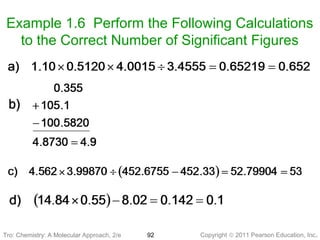
Example 1.6 Perform the Following Calculations
to the Correct Number of Significant Figures
Tro: Chemistry: A Molecular Approach, 2/e
Copyright © 2011 Pearson Education, Inc.
Precision
and Accuracy
Tro: Chemistry: A Molecular Approach, 2/e
Copyright © 2011 Pearson Education, Inc.Tro: Chemistry: A Molecular 94
Uncertainty in Measured Numbers
• Uncertainty comes from limitations of the instruments used for
comparison, the experimental design, the experimenter, and
nature’s random behavior
• To understand how reliable a measurement is, we need to
understand the limitations of the measurement
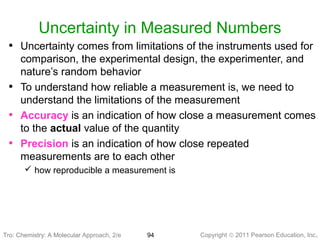
• Accuracy is an indication of how close a measurement comes
to the actual value of the quantity
• Precision is an indication of how close repeated
measurements are to each other
 how reproducible a measurement is
Tro: Chemistry: A Molecular Approach, 2/e
Copyright © 2011 Pearson Education, Inc.95
Precision
• Imprecision in measurements is caused by
random errors
errors that result from random fluctuations
no specific cause, therefore cannot be corrected
• We determine the precision of a set of
measurements by evaluating how far they are
from the actual value and each other
• Even though every measurement has some
random error, with enough measurements
these errors should average out
Tro: Chemistry: A MolecularTro: Chemistry: A Molecular Approach, 2/e
Copyright © 2011 Pearson Education, Inc.Tro: Chemistry: A Molecular 96
Accuracy
• Inaccuracy in measurement caused by
systematic errors
errors caused by limitations in the instruments or
techniques or experimental design
can be reduced by using more accurate
instruments, or better technique or experimental
design
• We determine the accuracy of a measurement
by evaluating how far it is from the actual value
• Systematic errors do not average out with
repeated measurements because they
consistently cause the measurement to be
either too high or too low
Tro: Chemistry: A Molecular Approach, 2/e
Copyright © 2011 Pearson Education, Inc.
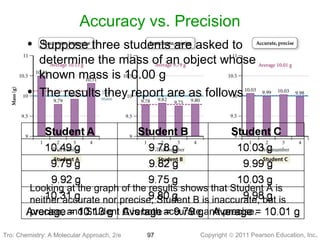
Looking at the graph of the results shows that Student A is
neither accurate nor precise, Student B is inaccurate, but is
precise, and Student C is both accurate and precise.
Accuracy vs. Precision
• Suppose three students are asked to
determine the mass of an object whose
known mass is 10.00 g
• The results they report are as follows
97Tro: Chemistry: A MolecularTro: Chemistry: A Molecular Approach, 2/e
Copyright © 2011 Pearson Education, Inc.
Solving
Chemical
Problems
Equations &
Dimensional Analysis
Tro: Chemistry: A Molecular Approach, 2/e
Copyright © 2011 Pearson Education, Inc.Tro: Chemistry: A Molecular 99
Units
• Always write every number with its
associated unit
• Always include units in your calculations
you can do the same kind of operations on
units as you can on numbers
cm × cm = cm2
cm + cm = cm
cm ÷ cm = 1
using units as a guide to problem solving is
called dimensional analysis
Tro: Chemistry: A Molecular Approach, 2/e
Copyright © 2011 Pearson Education, Inc.Tro: Chemistry: A Molecular 100
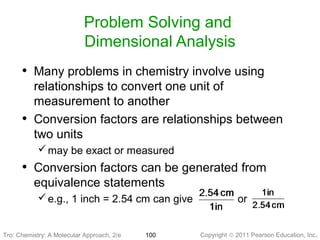
Problem Solving and
Dimensional Analysis
• Many problems in chemistry involve using
relationships to convert one unit of
measurement to another
• Conversion factors are relationships between
two units
may be exact or measured
• Conversion factors can be generated from
equivalence statements
e.g., 1 inch = 2.54 cm can give or
Tro: Chemistry: A Molecular Approach, 2/e
Copyright © 2011 Pearson Education, Inc.Tro: Chemistry: A Molecular 101
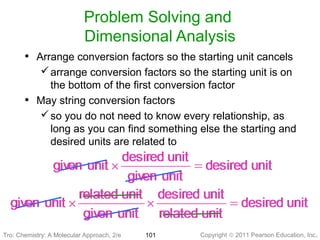
Problem Solving and
Dimensional Analysis
• Arrange conversion factors so the starting unit cancels
arrange conversion factors so the starting unit is on
the bottom of the first conversion factor
• May string conversion factors
so you do not need to know every relationship, as
long as you can find something else the starting and
desired units are related to
Tro: Chemistry: A Molecular Approach, 2/e
Copyright © 2011 Pearson Education, Inc.Tro: Chemistry: A Molecular 102
Conceptual Plan
• A conceptual plan is a visual outline that
shows the strategic route required to
solve a problem
• For unit conversion, the conceptual plan
focuses on units and how to convert one
to another
• For problems that require equations, the
conceptual plan focuses on solving the
equation to find an unknown value
Tro: Chemistry: A Molecular Approach, 2/e
Copyright © 2011 Pearson Education, Inc.Tro: Chemistry: A Molecular 103
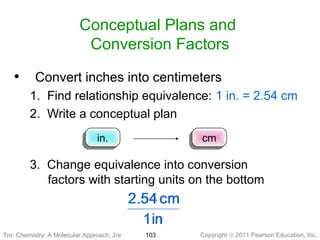
Conceptual Plans and
Conversion Factors
• Convert inches into centimeters
1. Find relationship equivalence: 1 in. = 2.54 cm
2. Write a conceptual plan
in.in. cmcm
3. Change equivalence into conversion
factors with starting units on the bottom
Tro: Chemistry: A Molecular Approach, 2/e
Copyright © 2011 Pearson Education, Inc.Tro: Chemistry: A Molecular 104
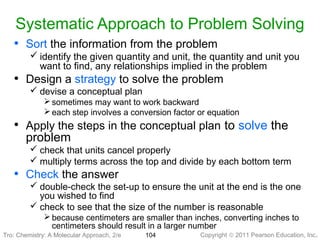
Systematic Approach to Problem Solving
• Sort the information from the problem
 identify the given quantity and unit, the quantity and unit you
want to find, any relationships implied in the problem
• Design a strategy to solve the problem
 devise a conceptual plan
 sometimes may want to work backward
 each step involves a conversion factor or equation
• Apply the steps in the conceptual plan to solve the
problem
 check that units cancel properly
 multiply terms across the top and divide by each bottom term
• Check the answer
 double-check the set-up to ensure the unit at the end is the one
you wished to find
 check to see that the size of the number is reasonable
 because centimeters are smaller than inches, converting inches to
centimeters should result in a larger number
Tro: Chemistry: A Molecular Approach, 2/e
Copyright © 2011 Pearson Education, Inc.Tro: Chemistry: A Molecular 105
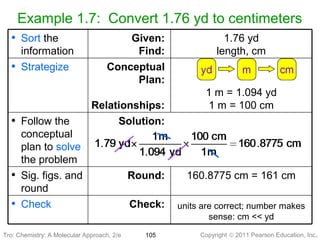
Example 1.7: Convert 1.76 yd to centimeters
units are correct; number makes
sense: cm << yd
Check:• Check
160.8775 cm = 161 cmRound:• Sig. figs. and
round
Solution:• Follow the
conceptual
plan to solve
the problem
1 m = 1.094 yd
1 m = 100 cm
Conceptual
Plan:
Relationships:
• Strategize
1.76 yd
length, cm
Given:
Find:
• Sort the
information
Tro: Chemistry: A Molecular Approach, 2/e
Copyright © 2011 Pearson Education, Inc.Tro: Chemistry: A Molecular 106
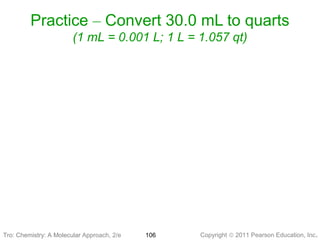
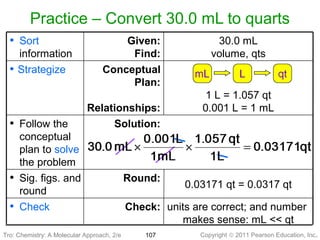
Practice – Convert 30.0 mL to quarts
(1 mL = 0.001 L; 1 L = 1.057 qt)
Tro: Chemistry: A Molecular Approach, 2/e
Copyright © 2011 Pearson Education, Inc.Tro: Chemistry: A Molecular 107
Practice – Convert 30.0 mL to quarts
units are correct; and number
makes sense: mL << qt
Check:• Check
0.03171 qt = 0.0317 qt
Round:• Sig. figs. and
round
Solution:• Follow the
conceptual
plan to solve
the problem
1 L = 1.057 qt
0.001 L = 1 mL
Conceptual
Plan:
Relationships:
• Strategize
30.0 mL
volume, qts
Given:
Find:
• Sort
information
Tro: Chemistry: A Molecular Approach, 2/e
Copyright © 2011 Pearson Education, Inc.Tro: Chemistry: A Molecular 108
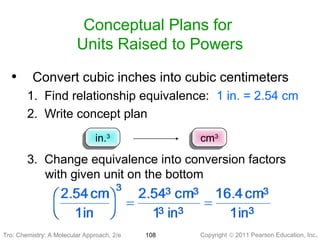
Conceptual Plans for
Units Raised to Powers
• Convert cubic inches into cubic centimeters
1. Find relationship equivalence: 1 in. = 2.54 cm
2. Write concept plan
in.3in.3
cm3cm3
3. Change equivalence into conversion factors
with given unit on the bottom
Tro: Chemistry: A Molecular Approach, 2/e
Copyright © 2011 Pearson Education, Inc.Tro: Chemistry: A Molecular 109
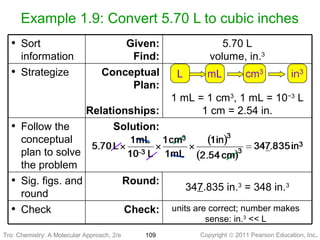
Example 1.9: Convert 5.70 L to cubic inches
units are correct; number makes
sense: in.3
<< L
Check:• Check
347.835 in.3
= 348 in.3
Round:• Sig. figs. and
round
Solution:• Follow the
conceptual
plan to solve
the problem
1 mL = 1 cm3
, 1 mL = 10−3
L
1 cm = 2.54 in.
Conceptual
Plan:
Relationships:
• Strategize
5.70 L
volume, in.3
Given:
Find:
• Sort
information
Tro: Chemistry: A Molecular Approach, 2/e
Copyright © 2011 Pearson Education, Inc.Tro: Chemistry: A Molecular 110
Practice 1.9 – How many cubic
centimeters are there in 2.11 yd3
?
Tro: Chemistry: A Molecular Approach, 2/e
Copyright © 2011 Pearson Education, Inc.Tro: Chemistry: A Molecular 111
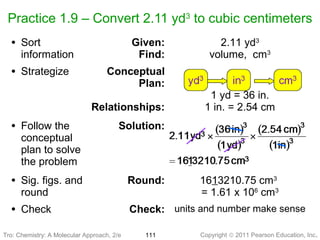
Practice 1.9 – Convert 2.11 yd3
to cubic centimeters
• Sort
information
Given:
Find:
2.11 yd3
volume, cm3
• Strategize Conceptual
Plan:
Relationships:
1 yd = 36 in.
1 in. = 2.54 cm
• Follow the
conceptual
plan to solve
the problem
Solution:
• Sig. figs. and
round
Round: 1613210.75 cm3
= 1.61 x 10⁶
cm3
• Check Check: units and number make sense
Tro: Chemistry: A Molecular Approach, 2/e
Copyright © 2011 Pearson Education, Inc.Tro: Chemistry: A Molecular 112
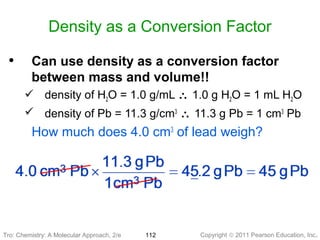
Density as a Conversion Factor
• Can use density as a conversion factor
between mass and volume!!
 density of H2O = 1.0 g/mL ∴ 1.0 g H2O = 1 mL H2O
 density of Pb = 11.3 g/cm3
∴ 11.3 g Pb = 1 cm3
Pb
How much does 4.0 cm3
of lead weigh?
Tro: Chemistry: A Molecular Approach, 2/e
Copyright © 2011 Pearson Education, Inc.Tro: Chemistry: A Molecular 113
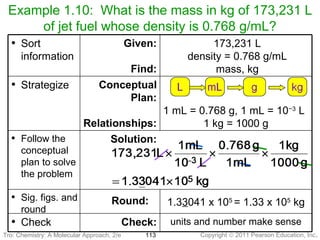
Example 1.10: What is the mass in kg of 173,231 L
of jet fuel whose density is 0.768 g/mL?
units and number make senseCheck:• Check
1.33041 x 105
= 1.33 x 10⁵
kgRound:• Sig. figs. and
round
Solution:• Follow the
conceptual
plan to solve
the problem
1 mL = 0.768 g, 1 mL = 10−3
L
1 kg = 1000 g
Conceptual
Plan:
Relationships:
• Strategize
173,231 L
density = 0.768 g/mL
mass, kg
Given:
Find:
• Sort
information
Tro: Chemistry: A Molecular Approach, 2/e
Copyright © 2011 Pearson Education, Inc.Tro: Chemistry: A Molecular 114
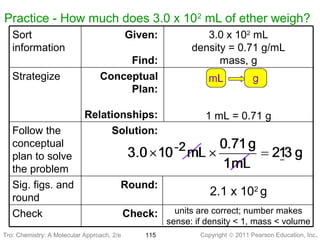
Practice − Calculate the Following
• How much does 3.0 x 10²
mL of ether
weigh? (d = 0.71 g/mL)
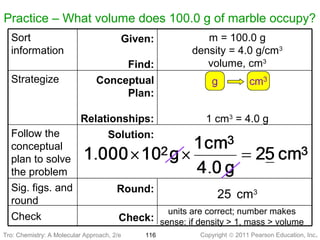
• What volume does 100.0 g of marble
occupy? (d = 4.0 g/cm3
)
Tro: Chemistry: A Molecular Approach, 2/e
Copyright © 2011 Pearson Education, Inc.Tro: Chemistry: A Molecular 115
Practice - How much does 3.0 x 10²
mL of ether weigh?
units are correct; number makes
sense: if density < 1, mass < volume
Check:Check
2.1 x 10²
g
Round:Sig. figs. and
round
Solution:Follow the
conceptual
plan to solve
the problem
1 mL = 0.71 g
Conceptual
Plan:
Relationships:
Strategize
3.0 x 10²
mL
density = 0.71 g/mL
mass, g
Given:
Find:
Sort
information
Tro: Chemistry: A Molecular Approach, 2/e
Copyright © 2011 Pearson Education, Inc.Tro: Chemistry: A Molecular 116
Practice – What volume does 100.0 g of marble occupy?
Check:Check
25 cm3Round:Sig. figs. and
round
Solution:Follow the
conceptual
plan to solve
the problem
1 cm3
= 4.0 g
Conceptual
Plan:
Relationships:
Strategize
m = 100.0 g
density = 4.0 g/cm3
volume, cm3
Given:
Find:
Sort
information
units are correct; number makes
sense: if density > 1, mass > volume
Tro: Chemistry: A Molecular Approach, 2/e
Copyright © 2011 Pearson Education, Inc.Tro, Chemistry: A Molecular 117
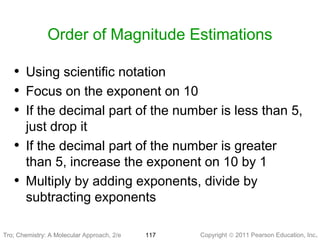
Order of Magnitude Estimations
• Using scientific notation
• Focus on the exponent on 10
• If the decimal part of the number is less than 5,
just drop it
• If the decimal part of the number is greater
than 5, increase the exponent on 10 by 1
• Multiply by adding exponents, divide by
subtracting exponents
Tro: Chemistry: A Molecular Approach, 2/e
Copyright © 2011 Pearson Education, Inc.Tro, Chemistry: A Molecular 118
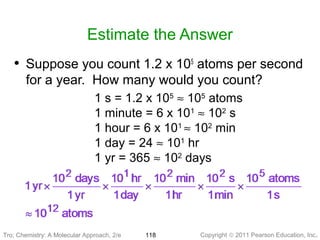
Estimate the Answer
• Suppose you count 1.2 x 10⁵
atoms per second
for a year. How many would you count?
1 s = 1.2 x 10⁵
≈ 105
atoms
1 minute = 6 x 101
≈ 102
s
1 hour = 6 x 101
≈ 102
min
1 day = 24 ≈ 101
hr
1 yr = 365 ≈ 102
days
Tro: Chemistry: A Molecular Approach, 2/e
Copyright © 2011 Pearson Education, Inc.Tro: Chemistry: A Molecular 119
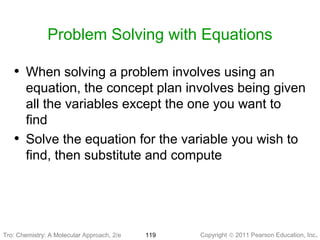
Problem Solving with Equations
• When solving a problem involves using an
equation, the concept plan involves being given
all the variables except the one you want to
find
• Solve the equation for the variable you wish to
find, then substitute and compute
Tro: Chemistry: A Molecular Approach, 2/e
Copyright © 2011 Pearson Education, Inc.
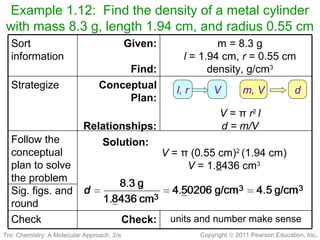
Example 1.12: Find the density of a metal cylinder
with mass 8.3 g, length 1.94 cm, and radius 0.55 cm
units and number make senseCheck:Check
V = π (0.55 cm)2
(1.94 cm)
V = 1.8436 cm3
Solution:Follow the
conceptual
plan to solve
the problem
Sig. figs. and
round
V = π r2
l
d = m/V
Conceptual
Plan:
Relationships:
Strategize
m = 8.3 g
l = 1.94 cm, r = 0.55 cm
density, g/cm3
Given:
Find:
Sort
information
l, r V m, V d
Tro: Chemistry: A Molecular Approach, 2/e
Copyright © 2011 Pearson Education, Inc.Tro: Chemistry: A Molecular 121
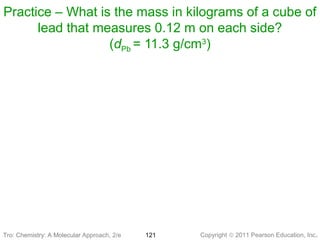
Practice – What is the mass in kilograms of a cube of
lead that measures 0.12 m on each side?
(dPb = 11.3 g/cm3
)
Tro: Chemistry: A Molecular Approach, 2/e
Copyright © 2011 Pearson Education, Inc.
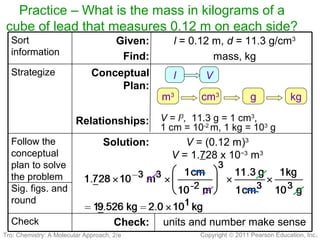
Practice – What is the mass in kilograms of a
cube of lead that measures 0.12 m on each side?
units and number make senseCheck:Check
V = (0.12 m)3
V = 1.728 x 10⁻³
m3
Solution:Follow the
conceptual
plan to solve
the problem
Sig. figs. and
round
V = l3
, 11.3 g = 1 cm3
,
1 cm = 10-2
m, 1 kg = 103
g
Conceptual
Plan:
Relationships:
Strategize
l = 0.12 m, d = 11.3 g/cm3
mass, kg
Given:
Find:
Sort
information
l V
m3
cm3
g kg
Tro: Chemistry: A Molecular Approach, 2/e

01 lecture

  • 1.
    Copyright © 2011Pearson Education, Inc. Chapter 1 Matter, Measurement, and Problem Solving Chemistry: A Molecular Approach, 2nd Ed. Nivaldo Tro Roy Kennedy Massachusetts Bay Community College Wellesley Hills, MA
  • 2.
    Copyright © 2011Pearson Education, Inc. Composition of Matter Atoms and Molecules Scientific Method Tro: Chemistry: A Molecular Approach, 2/e
  • 3.
    Copyright © 2011Pearson Education, Inc.3 Structure Determines Properties Tro: Chemistry: A Molecular Approach, 2/e 1. composed of one carbon atom and one oxygen atom 2. colorless, odorless gas 3. burns with a blue flame 4. binds to hemoglobin carbon monoxide 1. composed of one carbon atom and two oxygen atoms 2. colorless, odorless gas 3. incombustible 4. does not bind to hemoglobin carbon dioxide • The properties of matter are determined by the atoms and molecules that compose it
  • 4.
    Copyright © 2011Pearson Education, Inc.4 Atoms and Molecules • Atoms are submicroscopic particles are the fundamental building blocks of ordinary matter • Molecules are two or more atoms attached together in a specific geometrical arrangement attachments are called bonds attachments come in different strengths come in different shapes and patterns • Chemistry is the science that seeks to understand the behavior of matter by studying the behavior of atoms and molecules Tro: Chemistry: A MolecularTro: Chemistry: A Molecular Approach, 2/e
  • 5.
    Copyright © 2011Pearson Education, Inc.5 The Scientific Approach to Knowledge • Philosophers try to understand the universe by reasoning and thinking about “ideal” behavior • Scientists try to understand the universe through empirical knowledge gained through observation and experiment Tro: Chemistry: A MolecularTro: Chemistry: A Molecular Approach, 2/e
  • 6.
    Copyright © 2011Pearson Education, Inc.6 Gathering Empirical Knowledge ─ Observation Tro: Chemistry: A Molecular • Some observations are descriptions of the characteristics or behavior of nature ─ qualitative “The soda pop is a liquid with a brown color and a sweet taste. Bubbles are seen floating up through it.” • Some observations compare a characteristic to a standard numerical scale ─ quantitative “A 240 mL serving of soda pop contains 27 g of sugar.” Tro: Chemistry: A Molecular Approach, 2/e
  • 7.
    Copyright © 2011Pearson Education, Inc.7 From Observation to Understanding Tro: Chemistry: A Molecular • Hypothesis – a tentative interpretation or explanation for an observation “The sweet taste of soda pop is due to the presence of sugar.” • A good hypothesis is one that can be tested to be proved wrong! falsifiable one test may invalidate your hypothesis Tro: Chemistry: A Molecular Approach, 2/e
  • 8.
    Copyright © 2011Pearson Education, Inc.8 Testing Ideas • Ideas in science are tested with experiments • An experiment is a set of highly controlled procedures designed to test whether an idea about nature is valid • The experiment generates observations that will either validate or invalidate the idea Tro: Chemistry: A MolecularTro: Chemistry: A Molecular Approach, 2/e
  • 9.
    Copyright © 2011Pearson Education, Inc.9 From Specific to General Observations Tro: Chemistry: A Molecular • A scientific law is a statement that summarizes all past observations and predicts future observations Law of Conservation of Mass – “In a chemical reaction matter is neither created nor destroyed.” • A scientific law allows you to predict future observations so you can test the law with experiments • Unlike state laws, you cannot choose to violate a scientific law! Tro: Chemistry: A Molecular Approach, 2/e
  • 10.
    Copyright © 2011Pearson Education, Inc.10 From Specific to General Understanding • A hypothesis is a potential explanation for a single or small number of observations • A scientific theory is a general explanation for why things in nature are the way they are and behave the way they do models pinnacle of scientific knowledge validated or invalidated by experiment and observation Tro: Chemistry: A MolecularTro: Chemistry: A Molecular Approach, 2/e
  • 11.
    Copyright © 2011Pearson Education, Inc.Tro: Chemistry: A Molecular 11 Scientific Method Careful noting and recording of natural phenomena Procedure designed to test an idea Tentative explanation of a single or small number of observations General explanation of natural phenomena Generally observed occurence in nature Tro: Chemistry: A Molecular Approach, 2/e
  • 12.
    Copyright © 2011Pearson Education, Inc.Tro: Chemistry: A Molecular 12 Relationships Between Pieces of the Scientific Method Tro: Chemistry: A Molecular Approach, 2/e
  • 13.
    Copyright © 2011Pearson Education, Inc. Classification of Matter States of Matter Physical and Chemical Properties Physical and Chemical Changes Tro: Chemistry: A Molecular Approach, 2/e
  • 14.
    Copyright © 2011Pearson Education, Inc.Tro: Chemistry: A Molecular 14 Classification of Matter • Matter is anything that occupies space and has mass • We can classify matter based on its state and its composition whether it’s solid, liquid, or gas its basic components Tro: Chemistry: A Molecular Approach, 2/e
  • 15.
    Copyright © 2011Pearson Education, Inc.Tro: Chemistry: A Molecular 15 Classifying Matter by Physical State • Matter can be classified as solid, liquid, or gas based on the characteristics it exhibits Tro: Chemistry: A Molecular Approach, 2/e
  • 16.
    Copyright © 2011Pearson Education, Inc.Tro: Chemistry: A Molecular Solids • The particles in a solid are packed close together and are fixed in position though they may vibrate • The close packing of the particles results in solids being incompressible • The inability of the particles to move around results in solids retaining their shape and volume when placed in a new container, and prevents the solid from flowing 16Tro: Chemistry: A Molecular Approach, 2/e
  • 17.
    Copyright © 2011Pearson Education, Inc.Tro: Chemistry: A Molecular 17 Crystalline Solids • Some solids have their particles arranged in patterns with long-range repeating order – we call these crystalline solids salt diamonds sugar Tro: Chemistry: A Molecular Approach, 2/e
  • 18.
    Copyright © 2011Pearson Education, Inc.Tro: Chemistry: A Molecular 18 Amorphous Solids • Some solids have their particles randomly distributed without any long-range pattern – we call these amorphous solids plastic glass charcoal Tro: Chemistry: A Molecular Approach, 2/e
  • 19.
    Copyright © 2011Pearson Education, Inc.Tro: Chemistry: A Molecular 19 Liquids • The particles in a liquid are closely packed, but they have some ability to move around • The close packing results in liquids being incompressible • The ability of the particles to move allows liquids to take the shape of their container and to flow – however, they don’t have enough freedom to escape or expand to fill the container Tro: Chemistry: A Molecular Approach, 2/e
  • 20.
    Copyright © 2011Pearson Education, Inc.Tro: Chemistry: A Molecular 20 Gases • In the gas state, the particles have freedom of motion and are not held together • The particles are constantly flying around, bumping into each other and the container • In the gas state, there is a lot of empty space between the particles on average Tro: Chemistry: A Molecular Approach, 2/e
  • 21.
    Copyright © 2011Pearson Education, Inc.Tro: Chemistry: A Molecular 21 Gases • Because there is a lot of empty space, the particles can be squeezed closer together – therefore gases are compressible • Because the particles are not held in close contact and are moving freely, gases expand to fill and take the shape of their container, and will flow Tro: Chemistry: A Molecular Approach, 2/e
  • 22.
    Copyright © 2011Pearson Education, Inc.Tro: Chemistry: A Molecular 22 Classifying Matter by Composition • Another way to classify matter is to examine its composition • Composition includes types of particles arrangement of the particles attractions and attachments between the particles Tro: Chemistry: A Molecular Approach, 2/e
  • 23.
    Copyright © 2011Pearson Education, Inc.23Tro: Chemistry: A MolecularTro: Chemistry: A Molecular Approach, 2/e
  • 24.
    Copyright © 2011Pearson Education, Inc.Tro: Chemistry: A Molecular 24 Classification of Matter by Composition • Matter whose composition does not change from one sample to another is called a pure substance made of a single type of atom or molecule because the composition of a pure substance is always the same, all samples have the same characteristics • Matter whose composition may vary from one sample to another is called a mixture two or more types of atoms or molecules combined in variable proportions because composition varies, different samples have different characteristics Tro: Chemistry: A Molecular Approach, 2/e
  • 25.
    Copyright © 2011Pearson Education, Inc.Tro: Chemistry: A Molecular 25 Classification of Matter by Composition 1. made of one type of particle 2. all samples show the same intensive properties 1. made of multiple types of particles 2. samples may show different intensive properties Tro: Chemistry: A Molecular Approach, 2/e
  • 26.
    Copyright © 2011Pearson Education, Inc.Tro: Chemistry: A Molecular 26 Classification of Pure Substances  Elements • Pure substances that cannot be decomposed into simpler substances by chemical reactions are called elements decomposed = broken down basic building blocks of matter composed of single type of atom though those atoms may or may not be combined into molecules Tro: Chemistry: A Molecular Approach, 2/e
  • 27.
    Copyright © 2011Pearson Education, Inc.Tro: Chemistry: A Molecular 27 Classification of Pure Substances  Compounds • Pure substances that can be decomposed are called compounds chemical combinations of elements composed of molecules that contain two or more different kinds of atoms all molecules of a compound are identical, so all samples of a compound behave the same way • Most natural pure substances are compounds Tro: Chemistry: A Molecular Approach, 2/e
  • 28.
    Copyright © 2011Pearson Education, Inc.Tro: Chemistry: A Molecular 28 Classification of Pure Substances 1. made of one type of atom (some elements found as multi- atom molecules in nature) 2. combine together to make compounds 1. made of one type of molecule, or an array of ions 2. units contain two or more different kinds of atoms Tro: Chemistry: A Molecular Approach, 2/e
  • 29.
    Copyright © 2011Pearson Education, Inc.Tro: Chemistry: A Molecular 29 Classification of Mixtures • Homogeneous mixtures are mixtures that have uniform composition throughout every piece of a sample has identical characteristics, though another sample with the same components may have different characteristics atoms or molecules mixed uniformly • Heterogeneous mixtures are mixtures that do not have uniform composition throughout regions within the sample can have different characteristics atoms or molecules not mixed uniformly Tro: Chemistry: A Molecular Approach, 2/e
  • 30.
    Copyright © 2011Pearson Education, Inc.Tro: Chemistry: A Molecular 30 Classification of Mixtures 1. made of multiple substances, but appears to be one substance 2. all portions of an individual sample have the same composition and properties 1. made of multiple substances, whose presence can be seen 2. portions of a sample have different composition and properties Tro: Chemistry: A Molecular Approach, 2/e
  • 31.
    Copyright © 2011Pearson Education, Inc.Tro: Chemistry: A Molecular 31 Changes in Matter • Changes that alter the state or appearance of the matter without altering the composition are called physical changes • Changes that alter the composition of the matter are called chemical changes during the chemical change, the atoms that are present rearrange into new molecules, but all of the original atoms are still present Tro: Chemistry: A Molecular Approach, 2/e
  • 32.
    Copyright © 2011Pearson Education, Inc.Tro: Chemistry: A Molecular 32 Physical Changes in Matter The boiling of water is a physical change. The water molecules are separated from each other, but their structure and composition do not change. Tro: Chemistry: A Molecular Approach, 2/e
  • 33.
    Copyright © 2011Pearson Education, Inc.Tro: Chemistry: A Molecular 33 Chemical Changes in Matter The rusting of iron is a chemical change. The iron atoms in the nail combine with oxygen atoms from O2 in the air to make a new substance, rust, with a different composition. Tro: Chemistry: A Molecular Approach, 2/e
  • 34.
    Copyright © 2011Pearson Education, Inc.Tro: Chemistry: A Molecular 34 Properties of Matter • Physical properties are the characteristics of matter that can be changed without changing its composition characteristics that are directly observable • Chemical properties are the characteristics that determine how the composition of matter changes as a result of contact with other matter or the influence of energy characteristics that describe the behavior of matter Tro: Chemistry: A Molecular Approach, 2/e
  • 35.
    Copyright © 2011Pearson Education, Inc. CO2(s) CO2(g) Dry Ice Subliming of dry ice Tro: Chemistry: A Molecular 35 Common Physical Changes • Processes that cause changes in the matter that do not change its composition • State changes boiling / condensing melting / freezing subliming • Dissolving Dissolving of sugar C12H22O11(s) C12H22O11(aq) Tro: Chemistry: A Molecular Approach, 2/e
  • 36.
    Copyright © 2011Pearson Education, Inc.Tro: Chemistry: A Molecular 36 Common Chemical Changes C3H8(g) + 5 O2(g) → 3 CO2(g) + 4 H2O(l) • Processes that cause changes in the matter that change its composition • Rusting • Burning • Dyes fading or changing color Tro: Chemistry: A Molecular Approach, 2/e
  • 37.
    Copyright © 2011Pearson Education, Inc. Energy Tro: Chemistry: A Molecular Approach, 2/e
  • 38.
    Copyright © 2011Pearson Education, Inc.Tro: Chemistry: A Molecular 38 Energy Changes in Matter • Changes in matter, both physical and chemical, result in the matter either gaining or releasing energy • Energy is the capacity to do work • Work is the action of a force applied across a distance a force is a push or a pull on an object electrostatic force is the push or pull on objects that have an electrical charge Tro: Chemistry: A Molecular Approach, 2/e
  • 39.
    Copyright © 2011Pearson Education, Inc.Tro: Chemistry: A Molecular 39 Energy of Matter • All matter possesses energy • Energy is classified as either kinetic or potential • Energy can be converted from one form to another • When matter undergoes a chemical or physical change, the amount of energy in the matter changes as well Tro: Chemistry: A Molecular Approach, 2/e
  • 40.
    Copyright © 2011Pearson Education, Inc.Tro: Chemistry: A Molecular 40 Energy of Matter − Kinetic • Kinetic energy is energy of motion motion of the atoms, molecules, and subatomic particles thermal (heat) energy is a form of kinetic energy because it is caused by molecular motion Tro: Chemistry: A Molecular Approach, 2/e
  • 41.
    Copyright © 2011Pearson Education, Inc.Tro: Chemistry: A Molecular 41 Energy of Matter − Potential • Potential energy is energy that is stored in the matter due to the composition of the matter and its position relative to other things chemical potential energy arises from electrostatic attractive forces between atoms, molecules, and subatomic particles Tro: Chemistry: A Molecular Approach, 2/e
  • 42.
    Copyright © 2011Pearson Education, Inc.Tro: Chemistry: A Molecular 42 Conversion of Energy • You can interconvert kinetic energy and potential energy • Whatever process you do that converts energy from one type or form to another, the total amount of energy remains the same Law of Conservation of Energy Tro: Chemistry: A Molecular Approach, 2/e
  • 43.
    Copyright © 2011Pearson Education, Inc.Tro: Chemistry: A Molecular 43 Spontaneous Processes • Materials that possess high potential energy are less stable • Processes in nature tend to occur on their own when the result is material with lower total potential energy processes that result in materials with higher total potential energy can occur, but generally will not happen without input of energy from an outside source Tro: Chemistry: A Molecular Approach, 2/e
  • 44.
    Copyright © 2011Pearson Education, Inc.Tro: Chemistry: A Molecular 44 Changes in Energy • If a process results in the system having less potential energy at the end than it had at the beginning, the “lost” potential energy was converted into kinetic energy, which is released to the environment • During the conversion of form, energy that is released can be harnessed to do work Tro: Chemistry: A Molecular Approach, 2/e
  • 45.
    Copyright © 2011Pearson Education, Inc.Tro: Chemistry: A Molecular 45 Potential to Kinetic Energy Tro: Chemistry: A Molecular Approach, 2/e
  • 46.
    Copyright © 2011Pearson Education, Inc. Standard Units of Measure Tro: Chemistry: A Molecular Approach, 2/e
  • 47.
    Copyright © 2011Pearson Education, Inc.Tro: Chemistry: A Molecular 47 The Standard Units • Scientists have agreed on a set of international standard units for comparing all our measurements called the SI units Système International = International System Tro: Chemistry: A Molecular Approach, 2/e
  • 48.
    Copyright © 2011Pearson Education, Inc.Tro: Chemistry: A Molecular 48 Length • Measure of the two-dimensional distance an object covers often need to measure lengths that are very long (distances between stars) or very short (distances between atoms) • SI unit = meter about 3.37 inches longer than a yard 1 meter = distance traveled by light in a specific period of time • Commonly use centimeters (cm) 1 m = 100 cm 1 cm = 0.01 m = 10 mm 1 inch = 2.54 cm (exactly) Tro: Chemistry: A Molecular Approach, 2/e
  • 49.
    Copyright © 2011Pearson Education, Inc.Tro: Chemistry: A Molecular 49 Mass • Measure of the amount of matter present in an object weight measures the gravitational pull on an object, which depends on its mass • SI unit = kilogram (kg) about 2 lbs. 3 oz. • Commonly measure mass in grams (g) or milligrams (mg) 1 kg = 2.2046 pounds, 1 lb. = 453.59 g 1 kg = 1000 g = 103 g 1 g = 1000 mg = 103 mg 1 g = 0.001 kg = 10−3 kg 1 mg = 0.001 g = 10−3 g Tro: Chemistry: A Molecular Approach, 2/e
  • 50.
    Copyright © 2011Pearson Education, Inc.Tro: Chemistry: A Molecular 50 Time • Measure of the duration of an event • SI units = second (s) • 1 s is defined as the period of time it takes for a specific number of radiation events of a specific transition from cesium–133 Tro: Chemistry: A Molecular Approach, 2/e
  • 51.
    Copyright © 2011Pearson Education, Inc.Tro: Chemistry: A Molecular Temperature • Measure of the average amount of kinetic energy caused by motion of the particles higher temperature = larger average kinetic energy • Heat flows from the matter that has high thermal energy into matter that has low thermal energy until they reach the same temperature heat flows from hot object to cold heat is exchanged through molecular collisions between the two materials 51Tro: Chemistry: A Molecular Approach, 2/e ( F 32) C 1.8 K C 273.15 ° − ° = = ° +
  • 52.
    Copyright © 2011Pearson Education, Inc.Tro: Chemistry: A Molecular 52 Temperature Scales • Fahrenheit scale, °F  used in the U.S. • Celsius scale, °C  used in all other countries • Kelvin scale, K  absolute scale  no negative numbers  directly proportional to average amount of kinetic energy  0 K = absolute zero Tro: Chemistry: A Molecular Approach, 2/e
  • 53.
    Copyright © 2011Pearson Education, Inc.Tro: Chemistry: A Molecular 53 Fahrenheit vs. Celsius • A Celsius degree is 1.8 times larger than a Fahrenheit degree • The standard used for 0° on the Fahrenheit scale is a lower temperature than the standard used for 0° on the Celsius scale Tro: Chemistry: A Molecular Approach, 2/e
  • 54.
    Copyright © 2011Pearson Education, Inc.Tro: Chemistry: A Molecular 54 Kelvin vs. Celsius • The size of a “degree” on the Kelvin scale is the same as on the Celsius scale though technically, we don’t call the divisions on the Kelvin scale degrees; we call them kelvins! so 1 kelvin is 1.8 times larger than 1°F • The 0 standard on the Kelvin scale is a much lower temperature than on the Celsius scale Tro: Chemistry: A Molecular Approach, 2/e
  • 55.
    Copyright © 2011Pearson Education, Inc. Example 1.2: Convert 40.00 °C into K and °F • Substitute and compute • Solve the equation for the quantity you want to find 40.00 °C °F Given: Find: Equation: • Find the equation that relates the given quantity to the quantity you want to find K = °C + 273.15 K = 40.00 + 273.15 K = 313.15 K • Because the equation is solved for the quantity you want to find, substitute and compute 40.00 °C K K = °C + 273.15 Given: Find: Equation: • Find the equation that relates the given quantity to the quantity you want to find 55Tro: Chemistry: A MolecularTro: Chemistry: A Molecular Approach, 2/e
  • 56.
    Copyright © 2011Pearson Education, Inc.Tro: Chemistry: A Molecular 56 Practice – Convert 0.0°F into Kelvin Tro: Chemistry: A Molecular Approach, 2/e
  • 57.
    Copyright © 2011Pearson Education, Inc. Practice – Convert 0.0°F into Kelvin Because kelvin temperatures are always positive and generally between 250 and 300, the answer makes sense Check:• Check 255.37 K = 255 KRound:• Sig. figs. and round Solution:• Follow the concept plan to solve the problem Concept Plan: Equations: • Strategize 0.0 °F Kelvin Given: Find: • Sort information °F °C K 57Tro: Chemistry: A MolecularTro: Chemistry: A Molecular Approach, 2/e
  • 58.
    Copyright © 2011Pearson Education, Inc.Tro: Chemistry: A Molecular 58 Related Units in the SI System • All units in the SI system are related to the standard unit by a power of 10 • The power of 10 is indicated by a prefix multiplier • The prefix multipliers are always the same, regardless of the standard unit • Report measurements with a unit that is close to the size of the quantity being measured Tro: Chemistry: A Molecular Approach, 2/e
  • 59.
    Copyright © 2011Pearson Education, Inc.Tro: Chemistry: A Molecular 59 Common Prefix Multipliers in the SI System Tro: Chemistry: A Molecular Approach, 2/e
  • 60.
    Copyright © 2011Pearson Education, Inc.Tro: Chemistry: A Molecular 60 Volume • Derived unit  any length unit cubed • Measure of the amount of space occupied • SI unit = cubic meter (m3 ) • Commonly measure solid volume in cubic centimeters (cm3 ) 1 m3 = 106 cm3 1 cm3 = 10−6 m3 = 0.000 001 m3 • Commonly measure liquid or gas volume in milliliters (mL) 1 L is slightly larger than 1 quart 1 L = 1 dm3 = 1000 mL = 103 mL 1 mL = 0.001 L = 10−3 L 1 mL = 1 cm3 Tro: Chemistry: A Molecular Approach, 2/e
  • 61.
    Copyright © 2011Pearson Education, Inc.Tro: Chemistry: A Molecular 61 Common Units and Their Equivalents Length 1 kilometer (km) = 0.6214 mile (mi) 1 meter (m) = 39.37 inches (in.) 1 meter (m) = 1.094 yards (yd) 1 foot (ft) = 30.48 centimeters (cm) 1 inch (in.) = 2.54 centimeters (cm) exactly Tro: Chemistry: A Molecular Approach, 2/e
  • 62.
    Copyright © 2011Pearson Education, Inc.Tro: Chemistry: A Molecular 62 Common Units and Their Equivalents Volume 1 liter (L) = 1000 milliliters (mL) 1 liter (L) = 1000 cubic centimeters (cm3 ) 1 liter (L) = 1.057 quarts (qt) 1 U.S. gallon (gal) = 3.785 liters (L) Mass 1 kilogram (km) = 2.205 pounds (lb) 1 pound (lb) = 453.59 grams (g) 1 ounce (oz) = 28.35 grams (g) Tro: Chemistry: A Molecular Approach, 2/e
  • 63.
    Copyright © 2011Pearson Education, Inc.Tro: Chemistry: A Molecular 63 Practice — which of the following units would be best used for measuring the diameter of a quarter? a) kilometer b) meter c) centimeter d) micrometer e) megameters a) kilometer b) meter c) centimeter d) micrometer e) megameters Tro: Chemistry: A Molecular Approach, 2/e
  • 64.
    Copyright © 2011Pearson Education, Inc. Density Tro: Chemistry: A Molecular Approach, 2/e
  • 65.
    Copyright © 2011Pearson Education, Inc. Intensive and Extensive Properties • Extensive properties are properties whose value depends on the quantity of matter extensive properties cannot be used to identify what type of matter something is if you are given a large glass containing 100 g of a clear, colorless liquid and a small glass containing 25 g of a clear, colorless liquid, are both liquids the same stuff? • Intensive properties are properties whose value is independent of the quantity of matter intensive properties are often used to identify the type of matter samples with identical intensive properties are usually the same material Tro: Chemistry: A Molecular 65Tro: Chemistry: A Molecular Approach, 2/e
  • 66.
    Copyright © 2011Pearson Education, Inc.Tro: Chemistry: A Molecular 66 Mass & Volume • Two main physical properties of matter • Mass and volume are extensive properties • Even though mass and volume are individual properties, for a given type of matter they are related to each other! Volume vs. Mass of Brass y = 8.38x 0 20 40 60 80 100 120 140 160 0.0 2.0 4.0 6.0 8.0 10.0 12.0 14.0 16.0 18.0 Volume, cm3 Mass,g Tro: Chemistry: A Molecular Approach, 2/e
  • 67.
    Copyright © 2011Pearson Education, Inc.Tro: Chemistry: A Molecular 67 Density • Density is the ratio of mass to volume is an intensive property • Solids = g/cm3 1 cm3 = 1 mL • Liquids = g/mL • Gases = g/L • Volume of a solid can be determined by water displacement – Archimedes principle • Density : solids > liquids >>> gases except ice is less dense than liquid water! Tro: Chemistry: A Molecular Approach, 2/e
  • 68.
    Copyright © 2011Pearson Education, Inc.Tro: Chemistry: A Molecular 68 Density • For equal volumes, denser object has larger mass • For equal masses, denser object has smaller volume • Heating an object generally causes it to expand, therefore the density changes with temperature Tro: Chemistry: A Molecular Approach, 2/e
  • 69.
    Copyright © 2011Pearson Education, Inc. Example 1.3: Decide if a ring with a mass of 3.15 g that displaces 0.233 cm3 of water is platinum Density of platinum = 21.4 g/cm3 therefore not platinum • Compare to accepted value of the intensive property • Solve the equation for the quantity you want to find, check the units are correct, then substitute and compute mass = 3.15 g volume = 0.233 cm3 density, g/cm3 Given: Find: Equation: • Find the equation that relates the given quantity to the quantity you want to find 69Tro: Chemistry: A Molecular • Write down the given quantities and the quantity you want to find Tro: Chemistry: A Molecular Approach, 2/e
  • 70.
    Copyright © 2011Pearson Education, Inc.Tro: Chemistry: A Molecular 70 Calculating Density • What is the density of a brass sample if 100.0 g added to a cylinder of water causes the water level to rise from 25.0 mL to 36.9 mL? Tro: Chemistry: A Molecular Approach, 2/e
  • 71.
    Copyright © 2011Pearson Education, Inc. Practice — What is the density of the brass sample? units and number make senseCheck:Check 8.4033 g/cm3 = 8.40 g/cm3Round:Sig. figs. and round Solution: V = 36.9−25.0 = 11.9 mL = 11.9 cm3 Solve the equation for the unknown variable Concept Plan: Equation: Strategize mass = 100 g vol displ: 25.0 → 36.9 mL d, g/cm3 Given: Find: Sort information m, V d 71Tro: Chemistry: A MolecularTro: Chemistry: A Molecular Approach, 2/e
  • 72.
    Copyright © 2011Pearson Education, Inc. Measurement and Significant Figures Tro: Chemistry: A Molecular Approach, 2/e
  • 73.
    Copyright © 2011Pearson Education, Inc.Tro: Chemistry: A Molecular 73 What Is a Measurement? • Quantitative observation • Comparison to an agreed standard • Every measurement has a number and a unit Tro: Chemistry: A Molecular Approach, 2/e
  • 74.
    Copyright © 2011Pearson Education, Inc.Tro: Chemistry: A Molecular 74 A Measurement • The unit tells you what standard you are comparing your object to • The number tells you 1. what multiple of the standard the object measures 2. the uncertainty in the measurement • Scientific measurements are reported so that every digit written is certain, except the last one, which is estimated Tro: Chemistry: A Molecular Approach, 2/e
  • 75.
    Copyright © 2011Pearson Education, Inc.Tro: Chemistry: A Molecular 75 Estimating the Last Digit • For instruments marked with a scale, you get the last digit by estimating between the marks  if possible • Mentally divide the space into ten equal spaces, then estimate how many spaces over the indicator the mark is Tro: Chemistry: A Molecular Approach, 2/e
  • 76.
    Copyright © 2011Pearson Education, Inc.Tro: Chemistry: A Molecular 76Tro: Chemistry: A Molecular Approach, 2/e
  • 77.
    Copyright © 2011Pearson Education, Inc.Tro: Chemistry: A Molecular 77 Significant Figures • The non-place-holding digits in a reported measurement are called significant figures some zeros in a written number are only there to help you locate the decimal point • Significant figures tell us the range of values to expect for repeated measurements the more significant figures there are in a measurement, the smaller the range of values is 12.3 cm has 3 sig. figs. and its range is 12.2 to 12.4 cm 12.30 cm has 4 sig. figs. and its range is 12.29 to 12.31 cm Tro: Chemistry: A Molecular Approach, 2/e
  • 78.
    Copyright © 2011Pearson Education, Inc.Tro: Chemistry: A Molecular 78 Counting Significant Figures 1. All non-zero digits are significant  1.5 has 2 sig. figs. 2. Interior zeros are significant  1.05 has 3 sig. figs. 3. Leading zeros are NOT significant  0.001050 has 4 sig. figs.  1.050 x 10⁻³ Tro: Chemistry: A Molecular Approach, 2/e
  • 79.
    Copyright © 2011Pearson Education, Inc.Tro: Chemistry: A Molecular 79 Counting Significant Figures 4. Trailing zeros may or may not be significant a) Trailing zeros after a decimal point are significant  1.050 has 4 sig. figs. a) Trailing zeros before a decimal point are significant if the decimal point is written  150.0 has 4 sig. figs. a) Zeros at the end of a number without a written decimal point are ambiguous and should be avoided by using scientific notation  if 150 has 2 sig. figs. then 1.5 x 10²  but if 150 has 3 sig. figs. then 1.50 x 10² Tro: Chemistry: A Molecular Approach, 2/e
  • 80.
    Copyright © 2011Pearson Education, Inc.Tro: Chemistry: A Molecular 80 Significant Figures and Exact Numbers • A number whose value is known with complete certainty is exact from counting individual objects from definitions 1 cm is exactly equal to 0.01 m from integer values in equations  in the equation for the radius of a circle, the 2 is exact • Exact numbers have an unlimited number of significant figures Tro: Chemistry: A Molecular Approach, 2/e
  • 81.
    Copyright © 2011Pearson Education, Inc.Tro: Chemistry: A Molecular 81 Example 1.5: Determining the Number of Significant Figures in a Number How many significant figures are in each of the following? 0.04450 m 5.0003 km 10 dm = 1 m 1.000 × 10⁵ s 0.00002 mm 10,000 m 4 sig. figs.; the digits 4 and 5, and the trailing 0 5 sig. figs.; the digits 5 and 3, and the interior 0’s infinite number of sig. figs., exact numbers 4 sig. figs.; the digit 1, and the trailing 0’s 1 sig. figs.; the digit 2, not the leading 0’s Ambiguous, generally assume 1 sig. fig. Tro: Chemistry: A Molecular Approach, 2/e
  • 82.
    Copyright © 2011Pearson Education, Inc.Tro: Chemistry: A Molecular 82 Practice − Determine the number of significant figures, the expected range of precision, and indicate the last significant figure • 0.00120 • 120. • 12.00 • 1.20 x 10³ Tro: Chemistry: A Molecular Approach, 2/e
  • 83.
    Copyright © 2011Pearson Education, Inc.Tro: Chemistry: A Molecular 83 Practice − determine the number of significant figures, the expected range of precision, and indicate the last significant figure • 0.00120 3 sig. figs. 0.00119 to 0.00121 • 120. 3 sig. figs. 119 to 121 • 12.00 4 sig. figs. 11.99 to 12.01 • 1.20 x 10³ 3 sig. figs. 1190 to 1210 Tro: Chemistry: A Molecular Approach, 2/e
  • 84.
    Copyright © 2011Pearson Education, Inc.Tro: Chemistry: A Molecular 84 Multiplication and Division with Significant Figures • When multiplying or dividing measurements with significant figures, the result has the same number of significant figures as the measurement with the lowest number of significant figures 5.02 × 89.665 × 0.10 = 45.0118 = 45 3 sig. figs. 5 sig. figs. 2 sig. figs. 2 sig. figs. 5.892 ÷ 6.10 = 0.96590 = 0.966 4 sig. figs. 3 sig. figs. 3 sig. figs. Tro: Chemistry: A Molecular Approach, 2/e
  • 85.
    Copyright © 2011Pearson Education, Inc.Tro: Chemistry: A Molecular 85 Addition and Subtraction with Significant Figures • When adding or subtracting measurements with significant figures, the result has the same number of decimal places as the measurement with the lowest number of decimal places 41.5 5214.5 5799.2 70.0 543.2 =+ 7.5 976.5 122.2 9.5 =− Tro: Chemistry: A Molecular Approach, 2/e
  • 86.
    Copyright © 2011Pearson Education, Inc.Tro: Chemistry: A Molecular 86 Rounding • When rounding to the correct number of significant figures, if the number after the place of the last significant figure is a) 0 to 4, round down  drop all digits after the last sig. fig. and leave the last sig. fig. alone  add insignificant zeros to keep the value if necessary a) 5 to 9, round up  drop all digits after the last sig. fig. and increase the last sig. fig. by one  add insignificant zeros to keep the value if necessary • To avoid accumulating extra error from rounding, round only at the end, keeping track of the last sig. fig. for intermediate calculations Tro: Chemistry: A Molecular Approach, 2/e
  • 87.
    Copyright © 2011Pearson Education, Inc.Tro: Chemistry: A Molecular 87 Rounding • Rounding to 2 significant figures • 2.34 rounds to 2.3 because the 3 is where the last sig. fig. will be and the number after it is 4 or less • 2.37 rounds to 2.4 because the 3 is where the last sig. fig. will be and the number after it is 5 or greater • 2.349865 rounds to 2.3 because the 3 is where the last sig. fig. will be and the number after it is 4 or less Tro: Chemistry: A Molecular Approach, 2/e
  • 88.
    Copyright © 2011Pearson Education, Inc.Tro: Chemistry: A Molecular 88 Rounding • Rounding to 2 significant figures • 0.0234 rounds to 0.023 or 2.3 × 10⁻² because the 3 is where the last sig. fig. will be and the number after it is 4 or less • 0.0237 rounds to 0.024 or 2.4 × 10⁻² because the 3 is where the last sig. fig. will be and the number after it is 5 or greater • 0.02349865 rounds to 0.023 or 2.3 × 10⁻² because the 3 is where the last sig. fig. will be and the number after it is 4 or less Tro: Chemistry: A Molecular Approach, 2/e
  • 89.
    Copyright © 2011Pearson Education, Inc.Tro: Chemistry: A Molecular 89 Rounding • Rounding to 2 significant figures • 234 rounds to 230 or 2.3 × 10² because the 3 is where the last sig. fig. will be and the number after it is 4 or less • 237 rounds to 240 or 2.4 × 10² because the 3 is where the last sig. fig. will be and the number after it is 5 or greater • 234.9865 rounds to 230 or 2.3 × 10² because the 3 is where the last sig. fig. will be and the number after it is 4 or less Tro: Chemistry: A Molecular Approach, 2/e
  • 90.
    Copyright © 2011Pearson Education, Inc.Tro: Chemistry: A Molecular 90 Both Multiplication/Division and Addition/Subtraction with Significant Figures • When doing different kinds of operations with measurements with significant figures, do whatever is in parentheses first, evaluate the significant figures in the intermediate answer, then do the remaining steps 3.489 × (5.67 – 2.3) = 2 dp 1 dp 3.489 × 3.37 = 12 4 sf 1 dp & 2 sf 2 sf Tro: Chemistry: A Molecular Approach, 2/e
  • 91.
    Copyright © 2011Pearson Education, Inc.Tro: Chemistry: A Molecular 91 Example 1.6: Perform the Following Calculations to the Correct Number of Significant Figures Tro: Chemistry: A Molecular Approach, 2/e
  • 92.
    Copyright © 2011Pearson Education, Inc.Tro: Chemistry: A Molecular 92 Example 1.6 Perform the Following Calculations to the Correct Number of Significant Figures Tro: Chemistry: A Molecular Approach, 2/e
  • 93.
    Copyright © 2011Pearson Education, Inc. Precision and Accuracy Tro: Chemistry: A Molecular Approach, 2/e
  • 94.
    Copyright © 2011Pearson Education, Inc.Tro: Chemistry: A Molecular 94 Uncertainty in Measured Numbers • Uncertainty comes from limitations of the instruments used for comparison, the experimental design, the experimenter, and nature’s random behavior • To understand how reliable a measurement is, we need to understand the limitations of the measurement • Accuracy is an indication of how close a measurement comes to the actual value of the quantity • Precision is an indication of how close repeated measurements are to each other  how reproducible a measurement is Tro: Chemistry: A Molecular Approach, 2/e
  • 95.
    Copyright © 2011Pearson Education, Inc.95 Precision • Imprecision in measurements is caused by random errors errors that result from random fluctuations no specific cause, therefore cannot be corrected • We determine the precision of a set of measurements by evaluating how far they are from the actual value and each other • Even though every measurement has some random error, with enough measurements these errors should average out Tro: Chemistry: A MolecularTro: Chemistry: A Molecular Approach, 2/e
  • 96.
    Copyright © 2011Pearson Education, Inc.Tro: Chemistry: A Molecular 96 Accuracy • Inaccuracy in measurement caused by systematic errors errors caused by limitations in the instruments or techniques or experimental design can be reduced by using more accurate instruments, or better technique or experimental design • We determine the accuracy of a measurement by evaluating how far it is from the actual value • Systematic errors do not average out with repeated measurements because they consistently cause the measurement to be either too high or too low Tro: Chemistry: A Molecular Approach, 2/e
  • 97.
    Copyright © 2011Pearson Education, Inc. Looking at the graph of the results shows that Student A is neither accurate nor precise, Student B is inaccurate, but is precise, and Student C is both accurate and precise. Accuracy vs. Precision • Suppose three students are asked to determine the mass of an object whose known mass is 10.00 g • The results they report are as follows 97Tro: Chemistry: A MolecularTro: Chemistry: A Molecular Approach, 2/e
  • 98.
    Copyright © 2011Pearson Education, Inc. Solving Chemical Problems Equations & Dimensional Analysis Tro: Chemistry: A Molecular Approach, 2/e
  • 99.
    Copyright © 2011Pearson Education, Inc.Tro: Chemistry: A Molecular 99 Units • Always write every number with its associated unit • Always include units in your calculations you can do the same kind of operations on units as you can on numbers cm × cm = cm2 cm + cm = cm cm ÷ cm = 1 using units as a guide to problem solving is called dimensional analysis Tro: Chemistry: A Molecular Approach, 2/e
  • 100.
    Copyright © 2011Pearson Education, Inc.Tro: Chemistry: A Molecular 100 Problem Solving and Dimensional Analysis • Many problems in chemistry involve using relationships to convert one unit of measurement to another • Conversion factors are relationships between two units may be exact or measured • Conversion factors can be generated from equivalence statements e.g., 1 inch = 2.54 cm can give or Tro: Chemistry: A Molecular Approach, 2/e
  • 101.
    Copyright © 2011Pearson Education, Inc.Tro: Chemistry: A Molecular 101 Problem Solving and Dimensional Analysis • Arrange conversion factors so the starting unit cancels arrange conversion factors so the starting unit is on the bottom of the first conversion factor • May string conversion factors so you do not need to know every relationship, as long as you can find something else the starting and desired units are related to Tro: Chemistry: A Molecular Approach, 2/e
  • 102.
    Copyright © 2011Pearson Education, Inc.Tro: Chemistry: A Molecular 102 Conceptual Plan • A conceptual plan is a visual outline that shows the strategic route required to solve a problem • For unit conversion, the conceptual plan focuses on units and how to convert one to another • For problems that require equations, the conceptual plan focuses on solving the equation to find an unknown value Tro: Chemistry: A Molecular Approach, 2/e
  • 103.
    Copyright © 2011Pearson Education, Inc.Tro: Chemistry: A Molecular 103 Conceptual Plans and Conversion Factors • Convert inches into centimeters 1. Find relationship equivalence: 1 in. = 2.54 cm 2. Write a conceptual plan in.in. cmcm 3. Change equivalence into conversion factors with starting units on the bottom Tro: Chemistry: A Molecular Approach, 2/e
  • 104.
    Copyright © 2011Pearson Education, Inc.Tro: Chemistry: A Molecular 104 Systematic Approach to Problem Solving • Sort the information from the problem  identify the given quantity and unit, the quantity and unit you want to find, any relationships implied in the problem • Design a strategy to solve the problem  devise a conceptual plan  sometimes may want to work backward  each step involves a conversion factor or equation • Apply the steps in the conceptual plan to solve the problem  check that units cancel properly  multiply terms across the top and divide by each bottom term • Check the answer  double-check the set-up to ensure the unit at the end is the one you wished to find  check to see that the size of the number is reasonable  because centimeters are smaller than inches, converting inches to centimeters should result in a larger number Tro: Chemistry: A Molecular Approach, 2/e
  • 105.
    Copyright © 2011Pearson Education, Inc.Tro: Chemistry: A Molecular 105 Example 1.7: Convert 1.76 yd to centimeters units are correct; number makes sense: cm << yd Check:• Check 160.8775 cm = 161 cmRound:• Sig. figs. and round Solution:• Follow the conceptual plan to solve the problem 1 m = 1.094 yd 1 m = 100 cm Conceptual Plan: Relationships: • Strategize 1.76 yd length, cm Given: Find: • Sort the information Tro: Chemistry: A Molecular Approach, 2/e
  • 106.
    Copyright © 2011Pearson Education, Inc.Tro: Chemistry: A Molecular 106 Practice – Convert 30.0 mL to quarts (1 mL = 0.001 L; 1 L = 1.057 qt) Tro: Chemistry: A Molecular Approach, 2/e
  • 107.
    Copyright © 2011Pearson Education, Inc.Tro: Chemistry: A Molecular 107 Practice – Convert 30.0 mL to quarts units are correct; and number makes sense: mL << qt Check:• Check 0.03171 qt = 0.0317 qt Round:• Sig. figs. and round Solution:• Follow the conceptual plan to solve the problem 1 L = 1.057 qt 0.001 L = 1 mL Conceptual Plan: Relationships: • Strategize 30.0 mL volume, qts Given: Find: • Sort information Tro: Chemistry: A Molecular Approach, 2/e
  • 108.
    Copyright © 2011Pearson Education, Inc.Tro: Chemistry: A Molecular 108 Conceptual Plans for Units Raised to Powers • Convert cubic inches into cubic centimeters 1. Find relationship equivalence: 1 in. = 2.54 cm 2. Write concept plan in.3in.3 cm3cm3 3. Change equivalence into conversion factors with given unit on the bottom Tro: Chemistry: A Molecular Approach, 2/e
  • 109.
    Copyright © 2011Pearson Education, Inc.Tro: Chemistry: A Molecular 109 Example 1.9: Convert 5.70 L to cubic inches units are correct; number makes sense: in.3 << L Check:• Check 347.835 in.3 = 348 in.3 Round:• Sig. figs. and round Solution:• Follow the conceptual plan to solve the problem 1 mL = 1 cm3 , 1 mL = 10−3 L 1 cm = 2.54 in. Conceptual Plan: Relationships: • Strategize 5.70 L volume, in.3 Given: Find: • Sort information Tro: Chemistry: A Molecular Approach, 2/e
  • 110.
    Copyright © 2011Pearson Education, Inc.Tro: Chemistry: A Molecular 110 Practice 1.9 – How many cubic centimeters are there in 2.11 yd3 ? Tro: Chemistry: A Molecular Approach, 2/e
  • 111.
    Copyright © 2011Pearson Education, Inc.Tro: Chemistry: A Molecular 111 Practice 1.9 – Convert 2.11 yd3 to cubic centimeters • Sort information Given: Find: 2.11 yd3 volume, cm3 • Strategize Conceptual Plan: Relationships: 1 yd = 36 in. 1 in. = 2.54 cm • Follow the conceptual plan to solve the problem Solution: • Sig. figs. and round Round: 1613210.75 cm3 = 1.61 x 106 cm3 • Check Check: units and number make sense Tro: Chemistry: A Molecular Approach, 2/e
  • 112.
    Copyright © 2011Pearson Education, Inc.Tro: Chemistry: A Molecular 112 Density as a Conversion Factor • Can use density as a conversion factor between mass and volume!!  density of H2O = 1.0 g/mL ∴ 1.0 g H2O = 1 mL H2O  density of Pb = 11.3 g/cm3 ∴ 11.3 g Pb = 1 cm3 Pb How much does 4.0 cm3 of lead weigh? Tro: Chemistry: A Molecular Approach, 2/e
  • 113.
    Copyright © 2011Pearson Education, Inc.Tro: Chemistry: A Molecular 113 Example 1.10: What is the mass in kg of 173,231 L of jet fuel whose density is 0.768 g/mL? units and number make senseCheck:• Check 1.33041 x 105 = 1.33 x 10⁵ kgRound:• Sig. figs. and round Solution:• Follow the conceptual plan to solve the problem 1 mL = 0.768 g, 1 mL = 10−3 L 1 kg = 1000 g Conceptual Plan: Relationships: • Strategize 173,231 L density = 0.768 g/mL mass, kg Given: Find: • Sort information Tro: Chemistry: A Molecular Approach, 2/e
  • 114.
    Copyright © 2011Pearson Education, Inc.Tro: Chemistry: A Molecular 114 Practice − Calculate the Following • How much does 3.0 x 10² mL of ether weigh? (d = 0.71 g/mL) • What volume does 100.0 g of marble occupy? (d = 4.0 g/cm3 ) Tro: Chemistry: A Molecular Approach, 2/e
  • 115.
    Copyright © 2011Pearson Education, Inc.Tro: Chemistry: A Molecular 115 Practice - How much does 3.0 x 10² mL of ether weigh? units are correct; number makes sense: if density < 1, mass < volume Check:Check 2.1 x 10² g Round:Sig. figs. and round Solution:Follow the conceptual plan to solve the problem 1 mL = 0.71 g Conceptual Plan: Relationships: Strategize 3.0 x 10² mL density = 0.71 g/mL mass, g Given: Find: Sort information Tro: Chemistry: A Molecular Approach, 2/e
  • 116.
    Copyright © 2011Pearson Education, Inc.Tro: Chemistry: A Molecular 116 Practice – What volume does 100.0 g of marble occupy? Check:Check 25 cm3Round:Sig. figs. and round Solution:Follow the conceptual plan to solve the problem 1 cm3 = 4.0 g Conceptual Plan: Relationships: Strategize m = 100.0 g density = 4.0 g/cm3 volume, cm3 Given: Find: Sort information units are correct; number makes sense: if density > 1, mass > volume Tro: Chemistry: A Molecular Approach, 2/e
  • 117.
    Copyright © 2011Pearson Education, Inc.Tro, Chemistry: A Molecular 117 Order of Magnitude Estimations • Using scientific notation • Focus on the exponent on 10 • If the decimal part of the number is less than 5, just drop it • If the decimal part of the number is greater than 5, increase the exponent on 10 by 1 • Multiply by adding exponents, divide by subtracting exponents Tro: Chemistry: A Molecular Approach, 2/e
  • 118.
    Copyright © 2011Pearson Education, Inc.Tro, Chemistry: A Molecular 118 Estimate the Answer • Suppose you count 1.2 x 10⁵ atoms per second for a year. How many would you count? 1 s = 1.2 x 10⁵ ≈ 105 atoms 1 minute = 6 x 101 ≈ 102 s 1 hour = 6 x 101 ≈ 102 min 1 day = 24 ≈ 101 hr 1 yr = 365 ≈ 102 days Tro: Chemistry: A Molecular Approach, 2/e
  • 119.
    Copyright © 2011Pearson Education, Inc.Tro: Chemistry: A Molecular 119 Problem Solving with Equations • When solving a problem involves using an equation, the concept plan involves being given all the variables except the one you want to find • Solve the equation for the variable you wish to find, then substitute and compute Tro: Chemistry: A Molecular Approach, 2/e
  • 120.
    Copyright © 2011Pearson Education, Inc. Example 1.12: Find the density of a metal cylinder with mass 8.3 g, length 1.94 cm, and radius 0.55 cm units and number make senseCheck:Check V = π (0.55 cm)2 (1.94 cm) V = 1.8436 cm3 Solution:Follow the conceptual plan to solve the problem Sig. figs. and round V = π r2 l d = m/V Conceptual Plan: Relationships: Strategize m = 8.3 g l = 1.94 cm, r = 0.55 cm density, g/cm3 Given: Find: Sort information l, r V m, V d Tro: Chemistry: A Molecular Approach, 2/e
  • 121.
    Copyright © 2011Pearson Education, Inc.Tro: Chemistry: A Molecular 121 Practice – What is the mass in kilograms of a cube of lead that measures 0.12 m on each side? (dPb = 11.3 g/cm3 ) Tro: Chemistry: A Molecular Approach, 2/e
  • 122.
    Copyright © 2011Pearson Education, Inc. Practice – What is the mass in kilograms of a cube of lead that measures 0.12 m on each side? units and number make senseCheck:Check V = (0.12 m)3 V = 1.728 x 10⁻³ m3 Solution:Follow the conceptual plan to solve the problem Sig. figs. and round V = l3 , 11.3 g = 1 cm3 , 1 cm = 10-2 m, 1 kg = 103 g Conceptual Plan: Relationships: Strategize l = 0.12 m, d = 11.3 g/cm3 mass, kg Given: Find: Sort information l V m3 cm3 g kg Tro: Chemistry: A Molecular Approach, 2/e

Editor's Notes

  • #12 Replace picture with new Figure 1.2
  • #34 replace with new figure 1.8
  • #50 replace picture with figure on bottom left of page 14