Module 1 – Gen Chem 1
Basic Concepts of Chemistry
Chapter Outline
• Chemistry and Its Methods
• Sustainability and Green Chemistry
• Classifying Matter
• Elements
• Compounds
• Physical Properties
• Physical and Chemical Changes
• Energy: Some Basic Principles
Goal for Section 1.1
• Recognize the difference between a hypothesis and a theory and
understand how laws are established
Chemistry is the study of Matter
• Matter
• Anything that occupies space and has mass.
• Mass
• Measure of the amount of matter that an object contains.
Chemistry and Its Methods
• Hypothesis: A tentative explanation or prediction based on
experimental observations.
• Law: A concise verbal or mathematical statement of a
behavior or a relation that seems always to be the same
under the same conditions.
• Theory: a well-tested, unifying principle that explains a body
of facts and the laws based on them. It is capable of
suggesting new hypotheses that can be tested
experimentally.
Qualitative Observations
• No numbers involved
• Color, appearance, statements like “large” or “small”
• Stating that something is hot or cold without specifying a
temperature.
• Identifying something by smell
• No measurements
Quantitative Observations
• A quantity or attribute that is measureable is specified.
• Numbers with units are expressed from measurements.
• Dimensions are given such as mass, time, distance, volume, density,
temperature, color specified as a wavelength etc...
Goals of Science
• Prediction
• Control
• Understanding
• Explaining
Dilemmas and Integrity in Science
• Experimental results should be reproducible.
• Furthermore, these results should be reported in the scientific
literature in sufficient detail so that they can be used or reproduced
by others.
• Conclusions should be reasonable and unbiased.
• Credit should be given where it is due.
Goal for Section 1.2
• Understand the principles of green chemistry
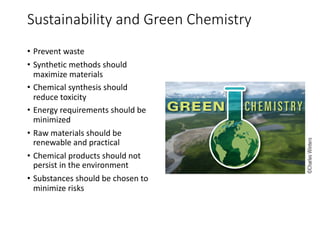
Sustainability and Green Chemistry
• Prevent waste
• Synthetic methods should
maximize materials
• Chemical synthesis should
reduce toxicity
• Energy requirements should be
minimized
• Raw materials should be
renewable and practical
• Chemical products should not
persist in the environment
• Substances should be chosen to
minimize risks
Goals for Section 1.3
•Understand the basic ideas of kinetic-molecular
theory.
•Recognize the importance of representing matter at
the macroscopic, microscopic, and symbolic levels
•Recognize the different states of matter (solids,
liquids, and gases) and give their characteristics
•Recognize the difference between pure substances
and mixtures and the difference between
homogeneous and heterogeneous mixtures
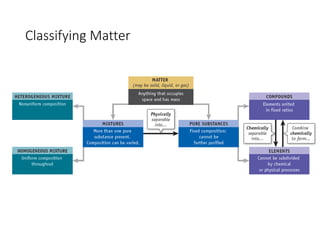
Classification of Matter
• Classify according to its physical state
• Gas
• Liquid
• Solid
• Classify according to its composition
• Element
• Compound
• Mixture
Classifying Matter: States of Matter
States of Matter
•Solid
• Definite Shape
• Definite Volume
• Lowest Kinetic Energy
•Liquid
• Indefinite Shape
• Definite Volume
• Intermediate Kinetic Energy
•Gas
• Indefinite Shape
• Indefinite Volume
• Highest Kinetic Energy
Classifying Matter
Mixtures: Homogeneous and Heterogeneous
•A homogeneous mixture consists of two or more
substances in the same phase. No amount of optical
magnification will reveal a homogeneous mixture to
have different properties in different regions.
•A heterogeneous mixture does not have uniform
composition. Its components are easily visually
distinguishable.
•When separated, the components of both types of
mixtures yields pure substances.
Mixtures
Heterogeneous Mixtures can be separated by filtration.
Mixtures (continued)
A combination of two or more pure substances.
• Homogeneous - Uniform composition
• Heterogeneous - Nonuniform composition
Physical Properties
Mixtures may be separated by physical properties:
Physical Property Means of Separation
Density Decantation, centrifugation
Boiling point Distillation
State of Matter Filtration
Intermolecular Forces Chromatography
Vapor pressure Evaporation
Magnetism Magnets
Solubility Filtration
Are these heterogeneous or homogeneous?
• Blood
• Urine
• “T-Bone” steak
• Gasoline
• Twinkie
• Colt 45
Pure Substances
• A pure substance has well-defined physical and chemical properties.
• Pure substances can be classified as elements or compounds.
• Compounds can be further reduced into two or more elements.
• Elements consist of only one type of atom. They cannot be
decomposed or further simplified by ordinary means.
Pure Substances (continued)
•Element
• Cannot be converted to a simpler form by a chemical
reaction.
• Example: sodium and helium
•Compound
• Combination of two or more elements in a definite,
reproducible way.
• Example: water - H2O
Join In, 1
Which physical state of water has the highest kinetic energy?
• ice at − 4 °C
• liquid water at room temperature (25 °C)
• water vapor at 25 °C
• steam at 115 °C
• Water vapor (3) and steam (4) have the same kinetic energy.
Join In, 1, Answer
• steam at 115 °C
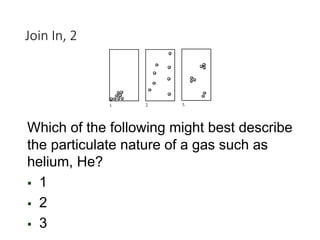
Join In, 2
1. 2. 3.
Which of the following might best describe
the particulate nature of a gas such as
helium, He?
§ 1
§ 2
§ 3
Join In, 2, Answer
• 2
Join In, 3
Why is it more practical to store propane as a liquid rather than as a
gas?
• The molecules of liquid propane are less reactive than those in the
gas phase.
• The molecules in liquid propane are closer together than in the gas
phase so we can store more propane per unit volume as a liquid.
Join In, 3 (continued)
• There is no practical advantage.
• It actually is not practical to store propane as a liquid because the gas
phase is the densest phase of matter.
Join In, 3, Answer
• The molecules in liquid propane are closer together than in the gas
phase so we can store more propane per unit volume as a liquid.
Join In, 4
Mineral water is…
• an element.
• a compound.
• a heterogeneous mixture.
• a homogeneous mixture.
Join In, 4, Answer
• a homogeneous mixture.
Goals for Section 1.4
• Identify the name or symbol for an element, given its symbol or
name, respectively
• Use the terms atom, element, and molecule correctly
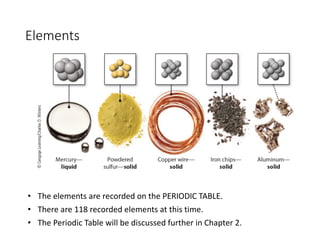
Elements
• The elements are recorded on the PERIODIC TABLE.
• There are 118 recorded elements at this time.
• The Periodic Table will be discussed further in Chapter 2.
Join In, 5
What is the symbol for the element potassium?
• Po
• Pt
• Pu
• W
• K
Join In, 5, Answer
• K
Join In, 6
Which of the following is NOT an element?
• hydrogen
• lithium
• iron
• water
• silver
Join In, 6, Answer
• water
Goals for Section 1.5
• Use the term compound correctly
• Understand the law of definite proportions (law of constant
composition)
Chemical Compounds
Chemical compounds are composed of two or more atoms.
Chemical Compounds (continued 1)
§ All compounds are made up of molecules or ions.
§ A molecule is the smallest unit of a compound that retains its
chemical characteristics.
§ Ionic compounds are described by a “formula unit.”
§ Molecules are described by a “molecular formula.”
Chemical Compounds (continued 2)
Join In, 7
Which of the following is NOT a compound?
• table salt
• water
• chlorine gas
• ammonia
• sugar
Join In, 7, Answer
• chlorine gas
Goals for Section 1.6
• Identify several physical properties of common substances.
• Relate density to the volume and mass of a substance.
• Understand the difference between extensive and intensive
properties, and give examples of them
Physical Properties (continued 1)
•Characteristics that can be evaluated without
changing the composition of the material
• Color
• Odor
• Density
• Melting point
• Thermal conductivity
• Volume
• Hardness
Physical Properties (continued 2)
•Some physical properties:
− Color
− State (s, g, or liq)
− Melting and Boiling
point
− Density (mass/unit
volume)
• Extensive properties
(mass) depend upon the
amount of substance.
• Intensive properties
(density) do not.
Physical Properties (continued 3)
Physical properties are a function of intermolecular forces.
Methane (16 g/mol)
gas at 25oC
C
H
H
H
H
Water (18 g/mol)
liquid at 25oC O
H H
• Water molecules are attracted to one another by
“hydrogen bonds.” (Chapter 11)
• Methane molecules only exhibit weak “London
Forces.” (Chapter 11)
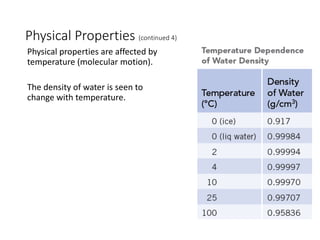
Physical Properties (continued 4)
Physical properties are affected by
temperature (molecular motion).
The density of water is seen to
change with temperature.
Chemical Properties
• Results in a change in the composition of a material.
• Explains how one substance acts in the presence of another.
• Chemical Reaction - how the change occurs.
• A chemical property of wood is its ability to burn -
combustion.
Wood + O2 CO2 + water + heat
D
Reactants Products
The reactants and products are very different.
Chemical Properties (continued)
• Chemical properties are really chemical changes.
• The chemical properties of elements and compounds are
related to periodic trends and molecular structure.
A Scientific Model
Models are commonly used to help visualize atoms
and molecules.
•Atom
• The smallest unit of an element that has all
of the properties of an element.
•Molecule
• The smallest unit of a pure substance that
has all of the properties of that
substance.
It may contain more than one atom and more than one element.
Molecular Formula
• A molecule is the smallest unit of a compound that retains the chemical
characteristics of the compound.
• Composition of molecules is given by a molecular formula.
Join In, 8
A piece of a polypropylene rope (used for water skiing) floats on water,
whereas a terephthalate polymer from a soda bottle sinks in water.
What is the order of increasing density of these substances?
•water < polypropylene < soda bottle plastic
•polypropylene < water < soda bottle plastic
•polypropylene < soda bottle plastic < water
•soda bottle plastic < polypropylene < water
•soda bottle plastic < water < polypropylene
Join In, 8, Answer
• polypropylene < water < soda bottle plastic
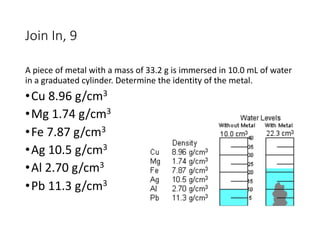
Join In, 9
A piece of metal with a mass of 33.2 g is immersed in 10.0 mL of water
in a graduated cylinder. Determine the identity of the metal.
•Cu 8.96 g/cm3
•Mg 1.74 g/cm3
•Fe 7.87 g/cm3
•Ag 10.5 g/cm3
•Al 2.70 g/cm3
•Pb 11.3 g/cm3
Join In, 9, Answer
• Al 2.70 g/cm3
Join In, 10
Four balloons are each filled with a different gas of varying density:
Helium, d = 0.164 g/L
Argon, d = 1.633 g/L
Neon, d = 0.825 g/L
Krypton, d = 4.425 g/L
If the density of dry air is 1.12 g/L, which balloon or
balloons float in air?
• All four
• helium and neon
Join In, 10 (continued)
• helium, neon, and argon
• helium, argon, and krypton
• argon and krypton
Join In, 10, Answer
• helium and neon
Join In, 11
Which property of matter is NOT temperature dependent?
• mass
• volume
• physical state
• density
• solubility
Join In, 11, Answer
• mass
Goals for Section 1.7
• Explain the difference between chemical and physical changes
• Identify several chemical properties of common substances
Physical Change
• A change that does not entail any change in chemical composition
• Solid iron (Fe) melting in a blast furnace
Fe(s) → Fe(l)
• Ice cube melting
H2O(s) → H2O(l)
Chemical Change
•Involves a change in chemical composition
•Results in a change in composition or structure
• Iron metal reacts with oxygen to form rust (iron oxide)
4Fe + 3O2 ® 2 Fe2O3
• H2 and O2 react to form Water
2H2 + O2 ® 2 H2O
Chemical vs. physical change
• Chromatography
• separated components of mixture
• didn’t change the components
• Electrolysis
• water was changed to hydrogen and oxygen
Which are chemical or physical changes?
• Mulching leaves
• Milk turning sour
• Odor of Mothballs
• Ice melting
• Beer going flat
Join In, 12
Which of the following is NOT a physical change?
• the freezing of a liquid to form a solid
• dissolving a solid in water to form a solution
• burning a piece of paper
• evaporating water to steam
• sublimation of ice to water vapor
Join In, 12, Answer
• burning a piece of paper
Join In, 13
Which one of the following is a chemical change?
• The metallic layer in some mirrored sunglasses reflects sunlight.
• The color of the dye in a red shirt left in the sun fades over time.
• A crystal of table salt (NaCl) shatters when struck with a hammer.
• Water boils at 70 °C on top of Chomolungma (Mt. Everest).
Join In, 13, Answer
• The color of the dye in a red shirt left in the sun fades over time.
Goals for Section 1.8
• Identify types of potential and kinetic energy
• Recognize and apply the law of conservation of energy
Energy: Some Basic Principles
Energy can be classified as Kinetic or Potential.
• Kinetic energy is energy associated with motion such as:
• The motion at the particulate level (thermal energy).
• The motion of macroscopic objects such as a thrown
baseball and falling water.
• The movement of electrons in a conductor (electrical
energy).
• Wave motion, transverse (water) and compression
(acoustic).
Matter consists of atoms and molecules in motion.
Energy: Some Basic Principles (continued)
Potential energy results from an objectʼs position:
•Gravitational: An object held at a height, waterfalls,
etc.
•Energy stored in an extended spring.
•Energy stored in molecules (chemical energy, food)
•The energy associated with charged or partially
charged particles (electrostatic energy)
•Nuclear energy (fission, fusion).
Join In, 14
An animation in OWL illustrates the reaction of the elements
phosphorus (P, gray) and chlorine (Cl, green) to produce the compound
phosphorus trichloride.
Reactants Products
Join In, 14 (continued)
• The reaction involves 1 P atom and 6 Cl atoms and gives 1 PCl3
molecule.
• The reaction involves 4 P atoms and 12 Cl atoms and gives 4 PCl3
molecules.
• The reaction involves 1 P atom and 6 Cl atoms and gives 4 PCl3
molecules.
Join In, 14, Answer
• The reaction involves 4 P atoms and 12 Cl atoms and gives 4 PCl3
molecules.
Join In, 15
You are given temperature readings at three locations on Earth: 29 ˚C,
45 ˚F, and 256 K. What is the order of increasing temperature?
• 29 °C < 45 °F < 256 K
• 45 °F < 29 °C < 256 K
• 256 K < 29 °C < 45 °F
• 256 K < 45 °F < 29 °C
• 45 °F < 256 K < 29 °C
Join In, 15, Answer
• 256 K < 45 ˚F < 29 ˚C
Join In, 16
Place the following in order of increasing size: 215 mm, 9 cm, 2.3 m,
and 0.125 m
• 215 mm < 9 cm < 2.3 m < 0.125 m
• 215 mm < 9 cm < 0.125 m < 2.3 m
• 9 cm < 215 mm < 0.125 m < 2.3 m
• 9 cm < 0.125 m < 215 mm < 2.3 m
• 0.125 m < 9 cm < 215 mm < 2.3 m
Join In, 16, Answer
• 9 cm < 0.125 m < 215 mm < 2.3 m
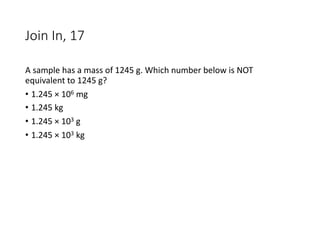
Join In, 17
A sample has a mass of 1245 g. Which number below is NOT
equivalent to 1245 g?
• 1.245 × 10⁶ mg
• 1.245 kg
• 1.245 × 10³ g
• 1.245 × 10³ kg
Join In, 17, Answer
• 1.245 × 10³ kg
Join In, 18
A sample has a volume of 2250 mL. Which of the following is NOT
equivalent to this volume?
• 2.250 × 10³ mL
• 2250 L
• 2250 × 10−3 L
• 2.250 L
Join In, 18, Answer
• 2250 L
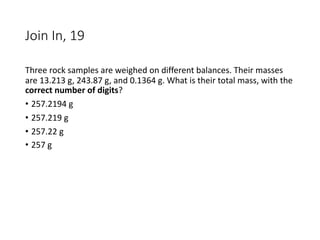
Join In, 19
Three rock samples are weighed on different balances. Their masses
are 13.213 g, 243.87 g, and 0.1364 g. What is their total mass, with the
correct number of digits?
• 257.2194 g
• 257.219 g
• 257.22 g
• 257 g
Join In, 19, Answer
• 257.22 g
Join In, 20
What is the volume reading of the solution in the burette?
• 15.2 mL
• 15.15 mL
• 15.7 mL
• 16.85 mL
Join In, 20, Answer
• 15.15 mL
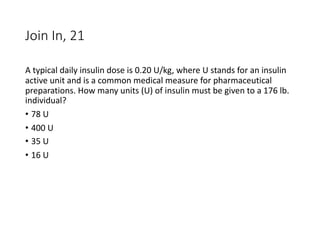
Join In, 21
A typical daily insulin dose is 0.20 U/kg, where U stands for an insulin
active unit and is a common medical measure for pharmaceutical
preparations. How many units (U) of insulin must be given to a 176 lb.
individual?
• 78 U
• 400 U
• 35 U
• 16 U
Join In, 21, Answer
• 16 U
Join In, 22
The common unit for the purity of gold is often the carat (see equation
below). What is the mass % of gold in a 22.5 carat ring?
Carat = 24 × (mass Au/total mass)
• 6.2%
• 93.8%
• 1.07%
• 5.4%
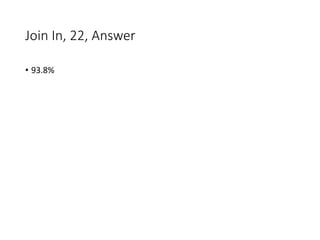
Join In, 22, Answer
• 93.8%

General Chemistry - Module 1 (Basic Concepts)

  • 1.
    Module 1 –Gen Chem 1 Basic Concepts of Chemistry
  • 2.
    Chapter Outline • Chemistryand Its Methods • Sustainability and Green Chemistry • Classifying Matter • Elements • Compounds • Physical Properties • Physical and Chemical Changes • Energy: Some Basic Principles
  • 3.
    Goal for Section1.1 • Recognize the difference between a hypothesis and a theory and understand how laws are established
  • 4.
    Chemistry is thestudy of Matter • Matter • Anything that occupies space and has mass. • Mass • Measure of the amount of matter that an object contains.
  • 5.
    Chemistry and ItsMethods • Hypothesis: A tentative explanation or prediction based on experimental observations. • Law: A concise verbal or mathematical statement of a behavior or a relation that seems always to be the same under the same conditions. • Theory: a well-tested, unifying principle that explains a body of facts and the laws based on them. It is capable of suggesting new hypotheses that can be tested experimentally.
  • 6.
    Qualitative Observations • Nonumbers involved • Color, appearance, statements like “large” or “small” • Stating that something is hot or cold without specifying a temperature. • Identifying something by smell • No measurements
  • 7.
    Quantitative Observations • Aquantity or attribute that is measureable is specified. • Numbers with units are expressed from measurements. • Dimensions are given such as mass, time, distance, volume, density, temperature, color specified as a wavelength etc...
  • 8.
    Goals of Science •Prediction • Control • Understanding • Explaining
  • 9.
    Dilemmas and Integrityin Science • Experimental results should be reproducible. • Furthermore, these results should be reported in the scientific literature in sufficient detail so that they can be used or reproduced by others. • Conclusions should be reasonable and unbiased. • Credit should be given where it is due.
  • 10.
    Goal for Section1.2 • Understand the principles of green chemistry
  • 11.
    Sustainability and GreenChemistry • Prevent waste • Synthetic methods should maximize materials • Chemical synthesis should reduce toxicity • Energy requirements should be minimized • Raw materials should be renewable and practical • Chemical products should not persist in the environment • Substances should be chosen to minimize risks
  • 12.
    Goals for Section1.3 •Understand the basic ideas of kinetic-molecular theory. •Recognize the importance of representing matter at the macroscopic, microscopic, and symbolic levels •Recognize the different states of matter (solids, liquids, and gases) and give their characteristics •Recognize the difference between pure substances and mixtures and the difference between homogeneous and heterogeneous mixtures
  • 13.
    Classification of Matter •Classify according to its physical state • Gas • Liquid • Solid • Classify according to its composition • Element • Compound • Mixture
  • 14.
  • 15.
    States of Matter •Solid •Definite Shape • Definite Volume • Lowest Kinetic Energy •Liquid • Indefinite Shape • Definite Volume • Intermediate Kinetic Energy •Gas • Indefinite Shape • Indefinite Volume • Highest Kinetic Energy
  • 16.
  • 17.
    Mixtures: Homogeneous andHeterogeneous •A homogeneous mixture consists of two or more substances in the same phase. No amount of optical magnification will reveal a homogeneous mixture to have different properties in different regions. •A heterogeneous mixture does not have uniform composition. Its components are easily visually distinguishable. •When separated, the components of both types of mixtures yields pure substances.
  • 18.
    Mixtures Heterogeneous Mixtures canbe separated by filtration.
  • 19.
    Mixtures (continued) A combinationof two or more pure substances. • Homogeneous - Uniform composition • Heterogeneous - Nonuniform composition
  • 20.
    Physical Properties Mixtures maybe separated by physical properties: Physical Property Means of Separation Density Decantation, centrifugation Boiling point Distillation State of Matter Filtration Intermolecular Forces Chromatography Vapor pressure Evaporation Magnetism Magnets Solubility Filtration
  • 21.
    Are these heterogeneousor homogeneous? • Blood • Urine • “T-Bone” steak • Gasoline • Twinkie • Colt 45
  • 22.
    Pure Substances • Apure substance has well-defined physical and chemical properties. • Pure substances can be classified as elements or compounds. • Compounds can be further reduced into two or more elements. • Elements consist of only one type of atom. They cannot be decomposed or further simplified by ordinary means.
  • 23.
    Pure Substances (continued) •Element •Cannot be converted to a simpler form by a chemical reaction. • Example: sodium and helium •Compound • Combination of two or more elements in a definite, reproducible way. • Example: water - H2O
  • 24.
    Join In, 1 Whichphysical state of water has the highest kinetic energy? • ice at − 4 °C • liquid water at room temperature (25 °C) • water vapor at 25 °C • steam at 115 °C • Water vapor (3) and steam (4) have the same kinetic energy.
  • 25.
    Join In, 1,Answer • steam at 115 °C
  • 26.
    Join In, 2 1.2. 3. Which of the following might best describe the particulate nature of a gas such as helium, He? § 1 § 2 § 3
  • 27.
    Join In, 2,Answer • 2
  • 28.
    Join In, 3 Whyis it more practical to store propane as a liquid rather than as a gas? • The molecules of liquid propane are less reactive than those in the gas phase. • The molecules in liquid propane are closer together than in the gas phase so we can store more propane per unit volume as a liquid.
  • 29.
    Join In, 3(continued) • There is no practical advantage. • It actually is not practical to store propane as a liquid because the gas phase is the densest phase of matter.
  • 30.
    Join In, 3,Answer • The molecules in liquid propane are closer together than in the gas phase so we can store more propane per unit volume as a liquid.
  • 31.
    Join In, 4 Mineralwater is… • an element. • a compound. • a heterogeneous mixture. • a homogeneous mixture.
  • 32.
    Join In, 4,Answer • a homogeneous mixture.
  • 33.
    Goals for Section1.4 • Identify the name or symbol for an element, given its symbol or name, respectively • Use the terms atom, element, and molecule correctly
  • 34.
    Elements • The elementsare recorded on the PERIODIC TABLE. • There are 118 recorded elements at this time. • The Periodic Table will be discussed further in Chapter 2.
  • 35.
    Join In, 5 Whatis the symbol for the element potassium? • Po • Pt • Pu • W • K
  • 36.
    Join In, 5,Answer • K
  • 37.
    Join In, 6 Whichof the following is NOT an element? • hydrogen • lithium • iron • water • silver
  • 38.
    Join In, 6,Answer • water
  • 39.
    Goals for Section1.5 • Use the term compound correctly • Understand the law of definite proportions (law of constant composition)
  • 40.
    Chemical Compounds Chemical compoundsare composed of two or more atoms.
  • 41.
    Chemical Compounds (continued1) § All compounds are made up of molecules or ions. § A molecule is the smallest unit of a compound that retains its chemical characteristics. § Ionic compounds are described by a “formula unit.” § Molecules are described by a “molecular formula.”
  • 42.
  • 43.
    Join In, 7 Whichof the following is NOT a compound? • table salt • water • chlorine gas • ammonia • sugar
  • 44.
    Join In, 7,Answer • chlorine gas
  • 45.
    Goals for Section1.6 • Identify several physical properties of common substances. • Relate density to the volume and mass of a substance. • Understand the difference between extensive and intensive properties, and give examples of them
  • 46.
    Physical Properties (continued1) •Characteristics that can be evaluated without changing the composition of the material • Color • Odor • Density • Melting point • Thermal conductivity • Volume • Hardness
  • 47.
    Physical Properties (continued2) •Some physical properties: − Color − State (s, g, or liq) − Melting and Boiling point − Density (mass/unit volume) • Extensive properties (mass) depend upon the amount of substance. • Intensive properties (density) do not.
  • 48.
    Physical Properties (continued3) Physical properties are a function of intermolecular forces. Methane (16 g/mol) gas at 25oC C H H H H Water (18 g/mol) liquid at 25oC O H H • Water molecules are attracted to one another by “hydrogen bonds.” (Chapter 11) • Methane molecules only exhibit weak “London Forces.” (Chapter 11)
  • 49.
    Physical Properties (continued4) Physical properties are affected by temperature (molecular motion). The density of water is seen to change with temperature.
  • 50.
    Chemical Properties • Resultsin a change in the composition of a material. • Explains how one substance acts in the presence of another. • Chemical Reaction - how the change occurs. • A chemical property of wood is its ability to burn - combustion. Wood + O2 CO2 + water + heat D Reactants Products The reactants and products are very different.
  • 51.
    Chemical Properties (continued) •Chemical properties are really chemical changes. • The chemical properties of elements and compounds are related to periodic trends and molecular structure.
  • 52.
    A Scientific Model Modelsare commonly used to help visualize atoms and molecules. •Atom • The smallest unit of an element that has all of the properties of an element. •Molecule • The smallest unit of a pure substance that has all of the properties of that substance. It may contain more than one atom and more than one element.
  • 53.
    Molecular Formula • Amolecule is the smallest unit of a compound that retains the chemical characteristics of the compound. • Composition of molecules is given by a molecular formula.
  • 54.
    Join In, 8 Apiece of a polypropylene rope (used for water skiing) floats on water, whereas a terephthalate polymer from a soda bottle sinks in water. What is the order of increasing density of these substances? •water < polypropylene < soda bottle plastic •polypropylene < water < soda bottle plastic •polypropylene < soda bottle plastic < water •soda bottle plastic < polypropylene < water •soda bottle plastic < water < polypropylene
  • 55.
    Join In, 8,Answer • polypropylene < water < soda bottle plastic
  • 56.
    Join In, 9 Apiece of metal with a mass of 33.2 g is immersed in 10.0 mL of water in a graduated cylinder. Determine the identity of the metal. •Cu 8.96 g/cm3 •Mg 1.74 g/cm3 •Fe 7.87 g/cm3 •Ag 10.5 g/cm3 •Al 2.70 g/cm3 •Pb 11.3 g/cm3
  • 57.
    Join In, 9,Answer • Al 2.70 g/cm3
  • 58.
    Join In, 10 Fourballoons are each filled with a different gas of varying density: Helium, d = 0.164 g/L Argon, d = 1.633 g/L Neon, d = 0.825 g/L Krypton, d = 4.425 g/L If the density of dry air is 1.12 g/L, which balloon or balloons float in air? • All four • helium and neon
  • 59.
    Join In, 10(continued) • helium, neon, and argon • helium, argon, and krypton • argon and krypton
  • 60.
    Join In, 10,Answer • helium and neon
  • 61.
    Join In, 11 Whichproperty of matter is NOT temperature dependent? • mass • volume • physical state • density • solubility
  • 62.
    Join In, 11,Answer • mass
  • 63.
    Goals for Section1.7 • Explain the difference between chemical and physical changes • Identify several chemical properties of common substances
  • 64.
    Physical Change • Achange that does not entail any change in chemical composition • Solid iron (Fe) melting in a blast furnace Fe(s) → Fe(l) • Ice cube melting H2O(s) → H2O(l)
  • 65.
    Chemical Change •Involves achange in chemical composition •Results in a change in composition or structure • Iron metal reacts with oxygen to form rust (iron oxide) 4Fe + 3O2 ® 2 Fe2O3 • H2 and O2 react to form Water 2H2 + O2 ® 2 H2O
  • 66.
    Chemical vs. physicalchange • Chromatography • separated components of mixture • didn’t change the components • Electrolysis • water was changed to hydrogen and oxygen
  • 67.
    Which are chemicalor physical changes? • Mulching leaves • Milk turning sour • Odor of Mothballs • Ice melting • Beer going flat
  • 68.
    Join In, 12 Whichof the following is NOT a physical change? • the freezing of a liquid to form a solid • dissolving a solid in water to form a solution • burning a piece of paper • evaporating water to steam • sublimation of ice to water vapor
  • 69.
    Join In, 12,Answer • burning a piece of paper
  • 70.
    Join In, 13 Whichone of the following is a chemical change? • The metallic layer in some mirrored sunglasses reflects sunlight. • The color of the dye in a red shirt left in the sun fades over time. • A crystal of table salt (NaCl) shatters when struck with a hammer. • Water boils at 70 °C on top of Chomolungma (Mt. Everest).
  • 71.
    Join In, 13,Answer • The color of the dye in a red shirt left in the sun fades over time.
  • 72.
    Goals for Section1.8 • Identify types of potential and kinetic energy • Recognize and apply the law of conservation of energy
  • 73.
    Energy: Some BasicPrinciples Energy can be classified as Kinetic or Potential. • Kinetic energy is energy associated with motion such as: • The motion at the particulate level (thermal energy). • The motion of macroscopic objects such as a thrown baseball and falling water. • The movement of electrons in a conductor (electrical energy). • Wave motion, transverse (water) and compression (acoustic). Matter consists of atoms and molecules in motion.
  • 74.
    Energy: Some BasicPrinciples (continued) Potential energy results from an objectʼs position: •Gravitational: An object held at a height, waterfalls, etc. •Energy stored in an extended spring. •Energy stored in molecules (chemical energy, food) •The energy associated with charged or partially charged particles (electrostatic energy) •Nuclear energy (fission, fusion).
  • 75.
    Join In, 14 Ananimation in OWL illustrates the reaction of the elements phosphorus (P, gray) and chlorine (Cl, green) to produce the compound phosphorus trichloride. Reactants Products
  • 76.
    Join In, 14(continued) • The reaction involves 1 P atom and 6 Cl atoms and gives 1 PCl3 molecule. • The reaction involves 4 P atoms and 12 Cl atoms and gives 4 PCl3 molecules. • The reaction involves 1 P atom and 6 Cl atoms and gives 4 PCl3 molecules.
  • 77.
    Join In, 14,Answer • The reaction involves 4 P atoms and 12 Cl atoms and gives 4 PCl3 molecules.
  • 78.
    Join In, 15 Youare given temperature readings at three locations on Earth: 29 ˚C, 45 ˚F, and 256 K. What is the order of increasing temperature? • 29 °C < 45 °F < 256 K • 45 °F < 29 °C < 256 K • 256 K < 29 °C < 45 °F • 256 K < 45 °F < 29 °C • 45 °F < 256 K < 29 °C
  • 79.
    Join In, 15,Answer • 256 K < 45 ˚F < 29 ˚C
  • 80.
    Join In, 16 Placethe following in order of increasing size: 215 mm, 9 cm, 2.3 m, and 0.125 m • 215 mm < 9 cm < 2.3 m < 0.125 m • 215 mm < 9 cm < 0.125 m < 2.3 m • 9 cm < 215 mm < 0.125 m < 2.3 m • 9 cm < 0.125 m < 215 mm < 2.3 m • 0.125 m < 9 cm < 215 mm < 2.3 m
  • 81.
    Join In, 16,Answer • 9 cm < 0.125 m < 215 mm < 2.3 m
  • 82.
    Join In, 17 Asample has a mass of 1245 g. Which number below is NOT equivalent to 1245 g? • 1.245 × 10⁶ mg • 1.245 kg • 1.245 × 10³ g • 1.245 × 10³ kg
  • 83.
    Join In, 17,Answer • 1.245 × 10³ kg
  • 84.
    Join In, 18 Asample has a volume of 2250 mL. Which of the following is NOT equivalent to this volume? • 2.250 × 10³ mL • 2250 L • 2250 × 10−3 L • 2.250 L
  • 85.
    Join In, 18,Answer • 2250 L
  • 86.
    Join In, 19 Threerock samples are weighed on different balances. Their masses are 13.213 g, 243.87 g, and 0.1364 g. What is their total mass, with the correct number of digits? • 257.2194 g • 257.219 g • 257.22 g • 257 g
  • 87.
    Join In, 19,Answer • 257.22 g
  • 88.
    Join In, 20 Whatis the volume reading of the solution in the burette? • 15.2 mL • 15.15 mL • 15.7 mL • 16.85 mL
  • 89.
    Join In, 20,Answer • 15.15 mL
  • 90.
    Join In, 21 Atypical daily insulin dose is 0.20 U/kg, where U stands for an insulin active unit and is a common medical measure for pharmaceutical preparations. How many units (U) of insulin must be given to a 176 lb. individual? • 78 U • 400 U • 35 U • 16 U
  • 91.
    Join In, 21,Answer • 16 U
  • 92.
    Join In, 22 Thecommon unit for the purity of gold is often the carat (see equation below). What is the mass % of gold in a 22.5 carat ring? Carat = 24 × (mass Au/total mass) • 6.2% • 93.8% • 1.07% • 5.4%
  • 93.
    Join In, 22,Answer • 93.8%