Lawrie Hunter Kochi University of Technology http://www.core.kochi-tech.ac.jp/hunter/ Concept mapping:  styles, techniques and language tasks JALTCALL June 6, 2009
This session will demonstrate the use of two styles of mapping:  (1) Novakian mapping, using Cmap tools, a free and very usable software with web sharing built in; and (2) Hunter's infostructure mapping, using PowerPoint or other graphical software. These important questions will be addressed: (1) which kind of mapping to use for different instructional purposes; (2) when to do mapping electronically and when by hand; and (3) how to go beyond &quot;I do mapping in my class&quot; by means of various constraints and techniques that lead the learner to the use of specific language forms and patterns. Background:  Novakian concept mapping <http://cmap.coginst.uwf.edu/> involves the use of labelled links between nodes. It is a very flexible format, but can be strongly controlled by various constraints on node and/or link content. Cmap Tools software has taken solid hold in science education in many countries, primarily for use in representing learner's and instructor's perceptions of the nature of concepts. It has a number of other appealing applications for education. The tools themselves are free for download, and allow for free online storage and/or sharing. There is a growing online collection of maps at the Cmap website. Hunter's infostructure maps are the underlying structure of &quot;Critical Thinking&quot; (Greene & Hunter, Asahi Press 2002) and &quot;Thinking in English” (Hunter, Cengage 2008). Prereading is available at http://www.core.kochi-tech.ac.jp/hunter/professional/anchoring2/index.html Participants are encouraged to experiment with Cmap Tools beforehand (free download from http://cmap.ihmc.us/download/ ).
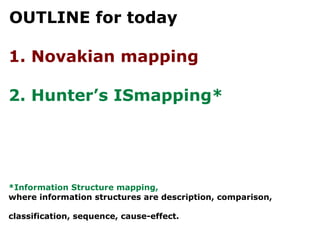
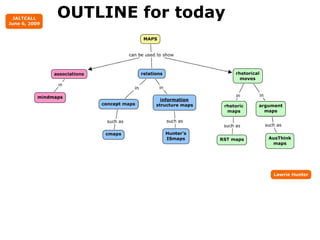
OUTLINE for today 1. Novakian mapping 2. Hunter’s ISmapping* *Information Structure mapping,  where information structures are description, comparison, classification, sequence, cause-effect.
OUTLINE for today
No need to take notes :^0 All materials can be downloaded from Hunter’s website http://www.core.kochi-tech.ac.jp/hunter /
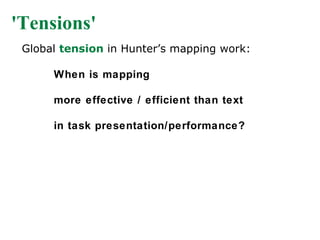
'Tensions' Global  tension  in Hunter’s mapping work:   When is mapping  more effective / efficient than text in task presentation/performance?  
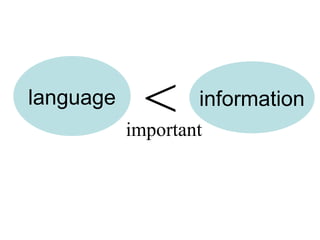
language information < important
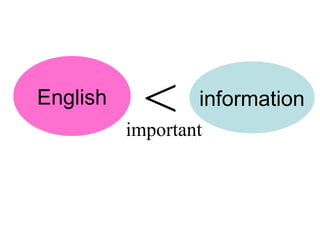
English information < important
The age of  GRAPHIC ORGANIZERS http://www.visual-literacy.org/periodic_table/periodic_table.html
The age of  GRAPHIC ORGANIZERS http:// www.eduplace.com/graphicorganizer /
The age of  GRAPHIC ORGANIZERS Suggested Reading About Visual Thinking and Learning Ausubel, D. (1968). Educational psychology: A cognitive view. New York: Holt, Reinhart and Winston. Buzan, T. & Buzan, B. (1993). The mind map book: How to use radiant thinking to maximize your brain's untapped potential. New York: Penguin Books USA Inc. Buzan, T. (1983). Use both sides of your brain: New techniques to help you read efficiently, study effectively, solve problems, remember more, think clearly. New York: E.P. Dutton. Jonassen, D.H. (1996). Computers in the classroom: Mindtools for critical thinking. Englewood Cliffs, NJ. Prentice-Hall, Inc. Novak, J.D. & Gowin, D.B. (1984). Learning how to learn. New York: Cambridge University Press. Novak, J.D. (1998). Learning, creating and using knowledge: Concept map® as facilitative tools in schools and corporations. Mahwah, NJ: Lawrence Erlbaum Associates, Inc. http:// www.inspiration.com /Parents/Visual-Thinking-and-Learning
Uses of mapping uses of mapping witting mindless
Uses of mapping uses of mapping witting mindless principles of map use?
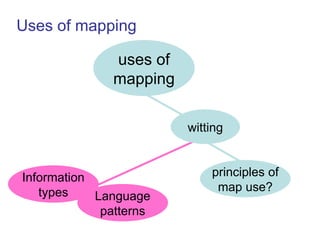
Uses of mapping uses of mapping witting principles of map use? Information types Language patterns
Hunter’s framework Information structures Information organization Rhetorical structure Persuasion Background Key content

01. Introduction to concept mapping

  • 1.
    Lawrie Hunter KochiUniversity of Technology http://www.core.kochi-tech.ac.jp/hunter/ Concept mapping: styles, techniques and language tasks JALTCALL June 6, 2009
  • 2.
    This session willdemonstrate the use of two styles of mapping: (1) Novakian mapping, using Cmap tools, a free and very usable software with web sharing built in; and (2) Hunter's infostructure mapping, using PowerPoint or other graphical software. These important questions will be addressed: (1) which kind of mapping to use for different instructional purposes; (2) when to do mapping electronically and when by hand; and (3) how to go beyond &quot;I do mapping in my class&quot; by means of various constraints and techniques that lead the learner to the use of specific language forms and patterns. Background: Novakian concept mapping <http://cmap.coginst.uwf.edu/> involves the use of labelled links between nodes. It is a very flexible format, but can be strongly controlled by various constraints on node and/or link content. Cmap Tools software has taken solid hold in science education in many countries, primarily for use in representing learner's and instructor's perceptions of the nature of concepts. It has a number of other appealing applications for education. The tools themselves are free for download, and allow for free online storage and/or sharing. There is a growing online collection of maps at the Cmap website. Hunter's infostructure maps are the underlying structure of &quot;Critical Thinking&quot; (Greene & Hunter, Asahi Press 2002) and &quot;Thinking in English” (Hunter, Cengage 2008). Prereading is available at http://www.core.kochi-tech.ac.jp/hunter/professional/anchoring2/index.html Participants are encouraged to experiment with Cmap Tools beforehand (free download from http://cmap.ihmc.us/download/ ).
  • 3.
    OUTLINE for today1. Novakian mapping 2. Hunter’s ISmapping* *Information Structure mapping, where information structures are description, comparison, classification, sequence, cause-effect.
  • 4.
  • 5.
    No need totake notes :^0 All materials can be downloaded from Hunter’s website http://www.core.kochi-tech.ac.jp/hunter /
  • 6.
    'Tensions' Global tension in Hunter’s mapping work:   When is mapping more effective / efficient than text in task presentation/performance?  
  • 7.
  • 8.
  • 9.
    The age of GRAPHIC ORGANIZERS http://www.visual-literacy.org/periodic_table/periodic_table.html
  • 10.
    The age of GRAPHIC ORGANIZERS http:// www.eduplace.com/graphicorganizer /
  • 11.
    The age of GRAPHIC ORGANIZERS Suggested Reading About Visual Thinking and Learning Ausubel, D. (1968). Educational psychology: A cognitive view. New York: Holt, Reinhart and Winston. Buzan, T. & Buzan, B. (1993). The mind map book: How to use radiant thinking to maximize your brain's untapped potential. New York: Penguin Books USA Inc. Buzan, T. (1983). Use both sides of your brain: New techniques to help you read efficiently, study effectively, solve problems, remember more, think clearly. New York: E.P. Dutton. Jonassen, D.H. (1996). Computers in the classroom: Mindtools for critical thinking. Englewood Cliffs, NJ. Prentice-Hall, Inc. Novak, J.D. & Gowin, D.B. (1984). Learning how to learn. New York: Cambridge University Press. Novak, J.D. (1998). Learning, creating and using knowledge: Concept map® as facilitative tools in schools and corporations. Mahwah, NJ: Lawrence Erlbaum Associates, Inc. http:// www.inspiration.com /Parents/Visual-Thinking-and-Learning
  • 12.
    Uses of mappinguses of mapping witting mindless
  • 13.
    Uses of mappinguses of mapping witting mindless principles of map use?
  • 14.
    Uses of mappinguses of mapping witting principles of map use? Information types Language patterns
  • 15.
    Hunter’s framework Informationstructures Information organization Rhetorical structure Persuasion Background Key content
  • 16.
    Hunter’s framework Informationstructures Information organization Rhetorical structure Persuasion Background Key content