Dimensions of
Media Object Compehensibility
Lawrie Hunter
Kochi University of Technology
http://www.core.kochi-tech.ac.jp/hunter/
Dimensions of
Media Object Compehensibility
Lawrie Hunter
Kochi University of Technology
http://www.core.kochi-tech.ac.jp/hunter/
KUT
Island of Shikoku
Kochi
Niigata
Osaka
A pattern language for MMC
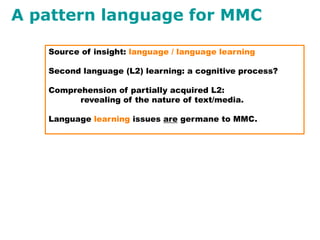
Source of insight: language / language learning
Second language (L2) learning: a cognitive process?
Comprehension of partially acquired L2:
revealing of the nature of text/media.
Language learning issues are germane to MMC.
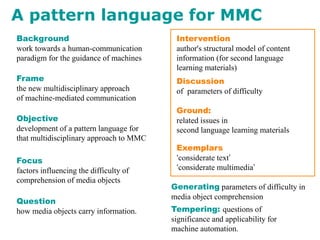
Tempering: questions of
significance and applicability for
machine automation.
A pattern language for MMC
Intervention
author's structural model of content
information (for second language
learning materials)
Discussion
of parameters of difficulty
Ground:
related issues in
second language learning materials
Exemplars
‘considerate text’
‘considerate multimedia’
Generating parameters of difficulty in
media object comprehension
Background
work towards a human-communication
paradigm for the guidance of machines
Frame
the new multidisciplinary approach
of machine-mediated communication
Objective
development of a pattern language for
that multidisciplinary approach to MMC
Focus
factors influencing the difficulty of
comprehension of media objects
Question
how media objects carry information.
L2 learning materials
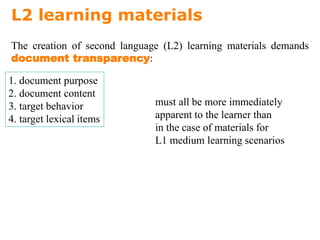
must all be more immediately
apparent to the learner than
in the case of materials for
L1 medium learning scenarios
The creation of second language (L2) learning materials demands
document transparency:
1. document purpose
2. document content
3. target behavior
4. target lexical items
The creation of second language (L2) learning materials demands
document transparency:
L2 learning materials
1. document purpose
2. document content
3. target behavior
4. target lexical items
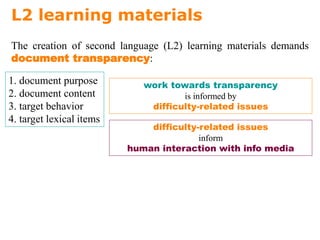
work towards transparency
is informed by
difficulty-related issues
inform
human interaction with info media
Earlier work: an EAP tool
*in a talk to KMI at the Open University
David Kolb* re using hypertext to present scholarly text:
"...the easiest ways of making a complex argument available in HT
tend to move the text toward linear structures
that do not take full advantage of the possibilities of linked text."
Earlier work: an EAP tool
*in a talk to KMI at the Open University
David Kolb* re using hypertext to present scholarly text:
"...the easiest ways of making a complex argument available in HT
tend to move the text toward linear structures
that do not take full advantage of the possibilities of linked text."
"...what the HT can do is present the argument,
but also use linkage and juxtaposition
to make the reader’s engagement with the argument
more creative, self-conscious, and self-critical."
Earlier work: an EAP tool
Lawrie Hunter re using hypertext to present technical L2 text:
For the L2 reader,
engagement can only be enhanced
if the rhetorical and information structures are articulated.
Earlier work: an EAP tool
Lawrie Hunter re using hypertext to present technical L2 text:
For the L2 reader,
engagement can only be enhanced
if the rhetorical and information structures are articulated.
What the HT can do for the NNR/W is
tp present simultaneously the various faces of a research paper:
the rhetorical moves;
the bits of structured information;
the text;
necessary glosses.
* NNR/W EAP = non-native reader/writer of English for Academic Purposes
Earlier work: an EAP tool
Lawrie Hunter re using hypertext to present technical L2 text:
For the L2 reader,
engagement can only be enhanced
if the rhetorical and information structures are articulated.
What the HT can do for the NNR/W is
to present simultaneously the various faces of a research paper:
the rhetorical moves;
the bits of structured information;
the text;
necessary glosses.
And if the NNR/Ws design their personal interface,
a negotiated pattern language of NNR/W EAP* will emerge.
* NNR/W EAP = non-native reader/writer of English for Academic Purposes
Arguably important direction
"Tomorrow's literacies...
need to be process and systems literacies.”
-John Thackara,
In the Bubble: Designing in a complex world.
MIT Press 2005.
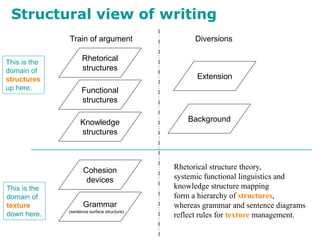
Rhetorical
structures
Knowledge
structures
Cohesion
devices
Grammar
(sentence surface structure)
Background
Extension
DiversionsTrain of argument
This is the
domain of
texture
down here.
This is the
domain of
structures
up here.
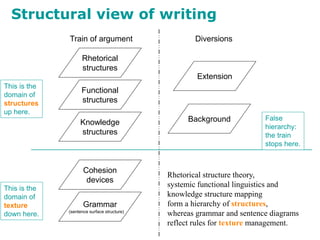
Rhetorical structure theory,
systemic functional linguistics and
knowledge structure mapping
form a hierarchy of structures,
whereas grammar and sentence diagrams
reflect rules for texture management.
Functional
structures
Structural view of writing
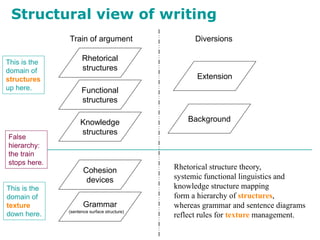
Rhetorical
structures
Knowledge
structures
Cohesion
devices
Grammar
(sentence surface structure)
Background
Extension
DiversionsTrain of argument
False
hierarchy:
the train
stops here.
This is the
domain of
texture
down here.
This is the
domain of
structures
up here.
Rhetorical structure theory,
systemic functional linguistics and
knowledge structure mapping
form a hierarchy of structures,
whereas grammar and sentence diagrams
reflect rules for texture management.
Functional
structures
Structural view of writing
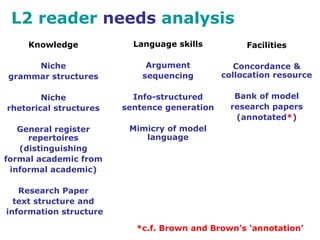
L2 reader needs analysis
Knowledge
Niche
grammar structures
Niche
rhetorical structures
General register
repertoires
(distinguishing
formal academic from
informal academic)
Research Paper
text structure and
information structure
Language skills
Argument
sequencing
Info-structured
sentence generation
Mimicry of model
language
Facilities
Concordance &
collocation resource
Bank of model
research papers
(annotated*)
*c.f. Brown and Brown’s ‘annotation’
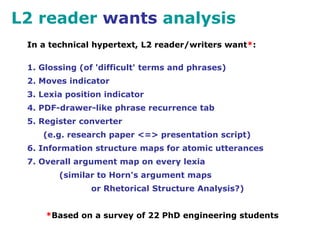
L2 reader wants analysis
In a technical hypertext, L2 reader/writers want*:
1. Glossing (of 'difficult' terms and phrases)
2. Moves indicator
3. Lexia position indicator
4. PDF-drawer-like phrase recurrence tab
5. Register converter
(e.g. research paper <=> presentation script)
6. Information structure maps for atomic utterances
7. Overall argument map on every lexia
(similar to Horn's argument maps
or Rhetorical Structure Analysis?)
*Based on a survey of 22 PhD engineering students
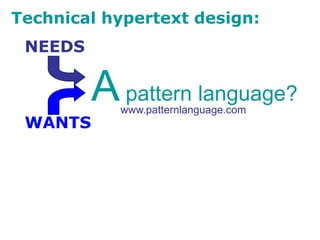
Technical hypertext design:
WANTS
NEEDS
Apattern language?
www.patternlanguage.com
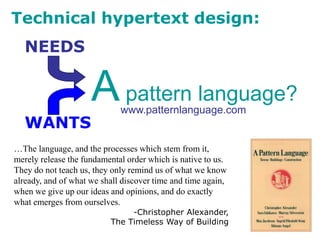
Technical hypertext design:
WANTS
NEEDS
…The language, and the processes which stem from it,
merely release the fundamental order which is native to us.
They do not teach us, they only remind us of what we know
already, and of what we shall discover time and time again,
when we give up our ideas and opinions, and do exactly
what emerges from ourselves.
-Christopher Alexander,
The Timeless Way of Building
Apattern language?
www.patternlanguage.com
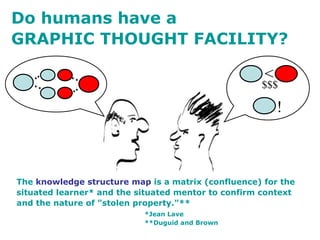
Do humans have a
GRAPHIC THOUGHT FACILITY?
The knowledge structure map is a matrix (confluence) for the
situated learner* and the situated mentor to confirm context
and the nature of "stolen property."**
*Jean Lave
**Duguid and Brown
<
$$$
!
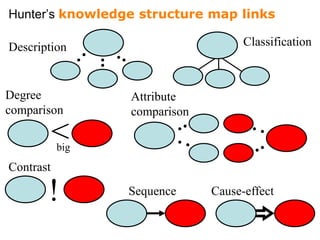
Hunter’s knowledge structure map links
<big
Description Classification
Degree
comparison
Attribute
comparison
Sequence Cause-effect
Contrast
!
2005 project: design level
EEAP* students: HT designs
for the analysis of technical academic papers.
*EEAP = Engineering English for Academic Purposes,
a subset of EAP,
which is a subset of ESP (English for Specific Purposes)
Hunter L. (2005) Technical Hypertext Accessibility: Information Structures and Rhetorical Framing.
Presentation at HyperText 2005, Salzburg.
http://www.lawriehunter.com/presns/%20HT05poster0818.htm
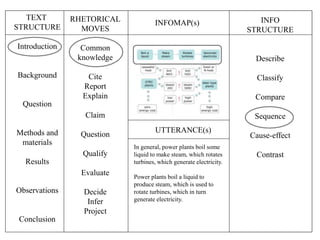
TEXT
STRUCTURE
Introduction
Background
Question
Methods and
materials
Results
Observations
Conclusion
INFOMAP(s) INFO
STRUCTURE
Describe
Classify
Compare
Sequence
Cause-effect
Contrast
UTTERANCE(s)
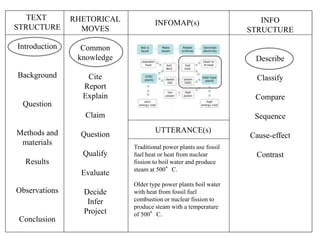
In general, power plants boil some
liquid to make steam, which rotates
turbines, which generate electricity.
Power plants boil a liquid to
produce steam, which is used to
rotate turbines, which in turn
generate electricity.
RHETORICAL
MOVES
Common
knowledge
Cite
Report
Explain
Claim
Question
Qualify
Evaluate
Decide
Infer
Project
TEXT
STRUCTURE
Introduction
Background
Question
Methods and
materials
Results
Observations
Conclusion
INFOMAP(s) INFO
STRUCTURE
Describe
Classify
Compare
Sequence
Cause-effect
Contrast
UTTERANCE(s)
Traditional power plants use fossil
fuel heat or heat from nuclear
fission to boil water and produce
steam at 500°C.
Older type power plants boil water
with heat from fossil fuel
combustion or nuclear fission to
produce steam with a temperature
of 500°C.
RHETORICAL
MOVES
Common
knowledge
Cite
Report
Explain
Claim
Question
Qualify
Evaluate
Decide
Infer
Project
TEXT
STRUCTURE
Introduction
Background
Question
Methods and
materials
Results
Observations
Conclusion
INFOMAP(s) INFO
STRUCTURE
Describe
Classify
Compare
Sequence
Cause-effect
Contrast
UTTERANCE(s)
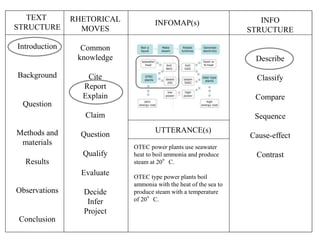
OTEC power plants use seawater
heat to boil ammonia and produce
steam at 20°C.
OTEC type power plants boil
ammonia with the heat of the sea to
produce steam with a temperature
of 20°C.
RHETORICAL
MOVES
Common
knowledge
Cite
Report
Explain
Claim
Question
Qualify
Evaluate
Decide
Infer
Project
RHETORICAL
MOVES
Common
knowledge
Cite
Report
Explain
Claim
Question
Qualify
Evaluate
Decide
Infer
Project
TEXT
STRUCTURE
Introduction
Background
Question
Methods and
materials
Results
Observations
Conclusion
INFOMAP(s) INFO
STRUCTURE
Describe
Classify
Compare
Sequence
Cause-effect
Contrast
UTTERANCE(s)
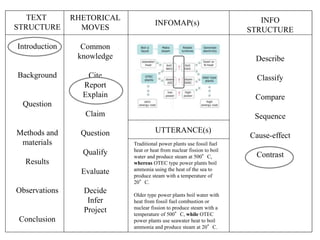
Traditional power plants use fossil fuel
heat or heat from nuclear fission to boil
water and produce steam at 500°C,
whereas OTEC type power plants boil
ammonia using the heat of the sea to
produce steam with a temperature of
20°C.
Older type power plants boil water with
heat from fossil fuel combustion or
nuclear fission to produce steam with a
temperature of 500°C, while OTEC
power plants use seawater heat to boil
ammonia and produce steam at 20°C.
Obstacle in 2005 project
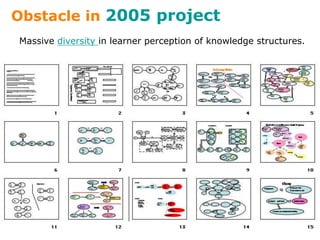
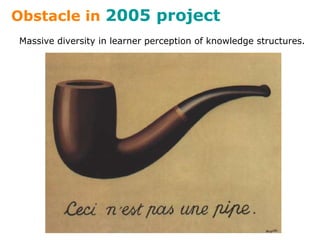
Massive diversity in learner perception of knowledge structures.
Obstacle in 2005 project
Massive diversity in learner perception of knowledge structures.
Rhetorical
structures
Knowledge
structures
Cohesion
devices
Grammar
(sentence surface structure)
Background
Extension
DiversionsTrain of argument
False
hierarchy:
the train
stops here.
This is the
domain of
texture
down here.
This is the
domain of
structures
up here.
Rhetorical structure theory,
systemic functional linguistics and
knowledge structure mapping
form a hierarchy of structures,
whereas grammar and sentence diagrams
reflect rules for texture management.
Functional
structures
Structural view of writing
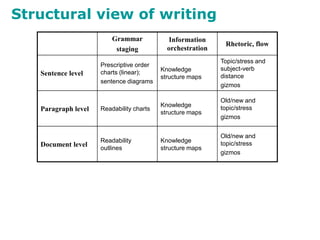
Grammar
staging
Information
orchestration
Rhetoric, flow
Sentence level
Prescriptive order
charts (linear);
sentence diagrams
Knowledge
structure maps
Topic/stress and
subject-verb
distance
gizmos
Paragraph level Readability charts
Knowledge
structure maps
Old/new and
topic/stress
gizmos
Document level
Readability
outlines
Knowledge
structure maps
Old/new and
topic/stress
gizmos
2006~ new layer: READABILITY
The missing link in
technical academic
writing:
Gopen’s readability
-subject-verb distance
-topic position / stress position
-old/new information placement
Background: readability work
In the design of traditional high-text language learning materials,
readability is a prominent concern.
Reading difficulty has for some time been seen as depending on
-word length
-sentence length
-text length
-number of sentences per paragraph
-vocabulary ‘difficulty’
More recent work has extended this list to include
-subject-verb distance
-adherence to old/new position conventions
-topic position/stress position conventions
Treated extensively in
Hunter L. (1998) Text Nouveau: Visible Structure in Text Presentation. Computer Assisted Language Learning 11(4) pp. 363-379.
Background: MM readability
Treated extensively in
Hunter L. (1998) Text Nouveau: Visible Structure in Text Presentation. Computer Assisted Language Learning 11(4) pp. 363-379.
Chun, D. M. and Plass, J. L. 1997.
Research on text comprehension in multimedia environments.
Language learning and technology 1(1): 60-81.
2006~ new layer: READABILITY
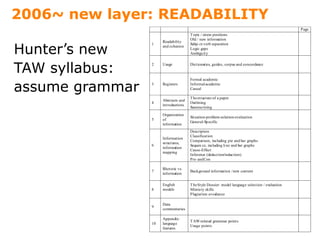
Hunter’s new
TAW syllabus:
assume grammar
Page
1
Readability
and cohesion
Topic / stress positions
Old / new information
Subje ct-verb separation
Logic gaps
Ambiguity
2 Usage Dictionaries, guides, corpus and concordance
3 Registers
Formal academic
Informalacademic
Casual
4
Abstracts and
introductions
Thestructure of a paper
Outlining
Summarizing
5
Organization
of
information
Situation-problem-solution-evaluation
General-Specific
6
Information
structures,
information
mapping
Description
Classification
Comparison, including pie and bar graphs
Sequen ce, including line and bar graphs
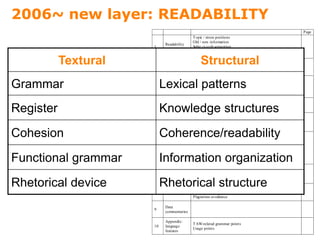
Cause-Effect
Inference (deduction/induction)
Pro andCon
7
Rhetoric vs.
information
Background information /new content
8
English
models
TheStyle Dossier: model language selection / evaluation
Mimicry skills
Plagiarism avoidance
9
Data
commentaries
10
Appendix:
language
features
TAW-related grammar points
Usage points
2006~ new layer: READABILITY
Page
1
Readability
and cohesion
Topic / stress positions
Old / new information
Subje ct-verb separation
Logic gaps
Ambiguity
2 Usage Dictionaries, guides, corpus and concordance
3 Registers
Formal academic
Informalacademic
Casual
4
Abstracts and
introductions
Thestructure of a paper
Outlining
Summarizing
5
Organization
of
information
Situation-problem-solution-evaluation
General-Specific
6
Information
structures,
information
mapping
Description
Classification
Comparison, including pie and bar graphs
Sequen ce, including line and bar graphs
Cause-Effect
Inference (deduction/induction)
Pro andCon
7
Rhetoric vs.
information
Background information /new content
8
English
models
TheStyle Dossier: model language selection / evaluation
Mimicry skills
Plagiarism avoidance
9
Data
commentaries
10
Appendix:
language
features
TAW-related grammar points
Usage points
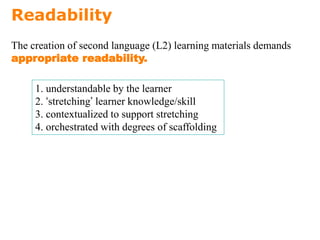
Textural Structural
Grammar Lexical patterns
Register Knowledge structures
Cohesion Coherence/readability
Functional grammar Information organization
Rhetorical device Rhetorical structure
Readability
The creation of second language (L2) learning materials demands
appropriate readability.
1. understandable by the learner
2. ‘stretching’ learner knowledge/skill
3. contextualized to support stretching
4. orchestrated with degrees of scaffolding
Considerate text
Original framing:
・well-written,
・well-organized, and
・signals the organization of its thought to the reader
One inroad to readability is
considerate text:
Considerate text
Original framing:
・well-written,
・well-organized, and
・signals the organization of its thought to the reader
One inroad to readability is
considerate text:
More recent takes:
-glossing
-phrase boundary marking
-de-idiomatizing
-the Plain English movement
-graphic organizers
-text nouveau
Text nouveau is still text
Text comprehension in multimedia environments is
a rich variant, BUT :
Chun, D. M. and Plass, J. L. 1997.
Research on text comprehension in multimedia environments.
Language learning and technology 1(1): 60-81.
Text nouveau is still text
Text comprehension in multimedia environments is
a rich variant, BUT :
Chun, D. M. and Plass, J. L. 1997.
Research on text comprehension in multimedia environments.
Language learning and technology 1(1): 60-81.
Sharing considerate text
Appropriateness of learning materials/tasks is very complex.
Tagging of these materials & tasks is daunting.
L2 learning objects: welcome to the TagTower of Babel!
KUT English
is a Moodle department.
Sharing considerate text
Appropriateness of learning materials/tasks is very complex.
Tagging of these materials & tasks is daunting.
Fortunately, as David Weinberger points out*,
there is a huge amount of metadata out there,
but this allows multiple simultaneous organizations of content.
*June 12, 2007 interview with IT Conversations
http://www.itconversations.com/shows/detail1838.html
Weinberger books
The Cluetrain Manifesto
Small Pieces Loosely Joined
Everything is Miscellaneous
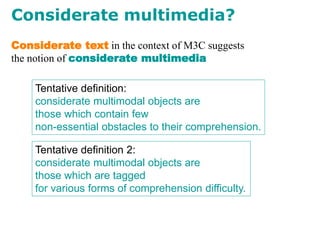
Considerate multimedia?
Tentative definition:
considerate multimodal objects are
those which contain few
non-essential obstacles to their comprehension.
Considerate text in the context of M3C suggests
the notion of considerate multimedia
Considerate multimedia?
Tentative definition:
considerate multimodal objects are
those which contain few
non-essential obstacles to their comprehension.
Considerate text in the context of M3C suggests
the notion of considerate multimedia
Tentative definition 2:
considerate multimodal objects are
those which are tagged
for various forms of comprehension difficulty.
Considerate multimedia?
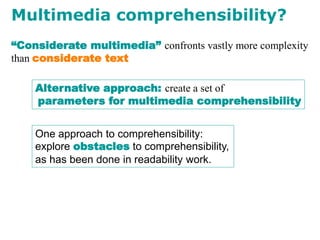
Multimedia comprehensibility?
Alternative approach: create a set of
parameters for multimedia comprehensibility
“Considerate multimedia” confronts vastly more complexity
than considerate text
One approach to comprehensibility:
explore obstacles to comprehensibility,
as has been done in readability work.
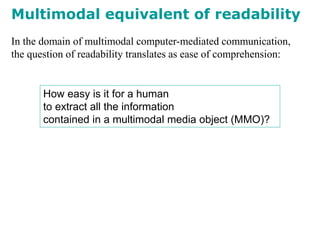
In the domain of multimodal computer-mediated communication,
the question of readability translates as ease of comprehension:
Multimodal equivalent of readability
How easy is it for a human
to extract all the information
contained in a multimodal media object (MMO)?
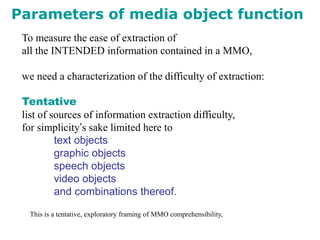
To measure the ease of extraction of
all the INTENDED information contained in a MMO,
we need a characterization of the difficulty of extraction:
Tentative
list of sources of information extraction difficulty,
for simplicity’s sake limited here to
text objects
graphic objects
speech objects
video objects
and combinations thereof.
Parameters of media object function
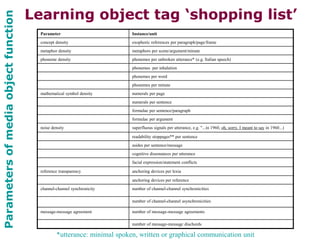
This is a tentative, exploratory framing of MMO comprehensibility,
Parameter Instance/unit
concept density exophoric references per paragraph/page/frame
metaphor density metaphors per scene/argument/minute
phoneme density phonemes per unbroken utterance* (e.g. Italian speech)
phonemes per inhalation
phonemes per word
phonemes per minute
mathematical symbol density numerals per page
numerals per sentence
formulae per sentence/paragraph
formulae per argument
noise density superfluous signals per utterance, e.g. "...in 1960, oh, sorry, I meant to say in 1960...)
readability stoppages** per sentence
asides per sentence/message
cognitive dissonances per utterance
facial expression/statement conflicts
reference transparency anchoring devices per lexia
anchoring devices per reference
channel-channel synchronicity number of channel-channel synchronicities
number of channel-channel asynchronicities
message-message agreement number of message-message agreements
number of message-message dischords
*utterance: minimal spoken, written or graphical communication unit
Parametersofmediaobjectfunction
Learning object tag ‘shopping list’
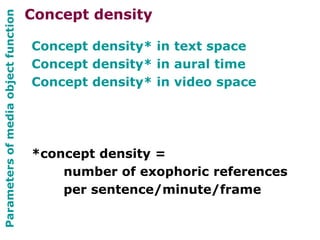
Concept density* in text space
Concept density* in aural time
Concept density* in video space
*concept density =
number of exophoric references
per sentence/minute/frame
Parametersofmediaobjectfunction
Concept density
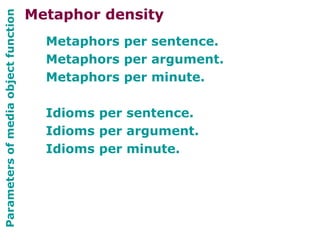
Metaphors per sentence.
Metaphors per argument.
Metaphors per minute.
Idioms per sentence.
Idioms per argument.
Idioms per minute.
Parametersofmediaobjectfunction
Metaphor density
Phonemes per unbroken utterance*.
Phonemes per exhalation.
Phonemes per word.
Phonemes per minute.
*e.g. Italian speech.
Parametersofmediaobjectfunction
Phoneme density
Parametersofmediaobjectfunction
Superfluous signals/utterance
Readability ‘stoppages’ per sentence
Asides per sentence/message
Cognitive dissonances per utterance
Facial expression-statement conflicts
‘Noise’ density
Parametersofmediaobjectfunction
Numerals per page.
Numerals per sentence.
Formulae per sentence/paragraph.
Formulae per rhetorical move.
Symbol density
Parametersofmediaobjectfunction
Imperfect audio channel
Imperfect text channel
Imperfect visual channel
Channel imperfections
Parametersofmediaobjectfunction
Channel imperfections
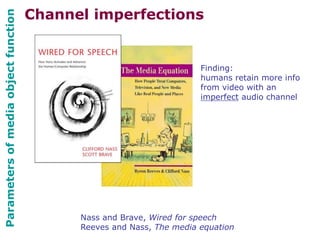
Nass and Brave, Wired for speech
Reeves and Nass, The media equation
Finding:
humans retain more info
from video with an
imperfect audio channel
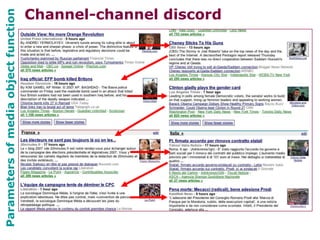
Parametersofmediaobjectfunction Channel-channel discord
Parametersofmediaobjectfunction
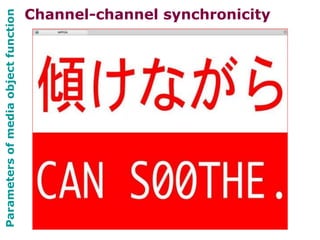
Channel-channel synchronicity
Parametersofmediaobjectfunction
Message-message agreements
Message-message discords
Message-message harmony
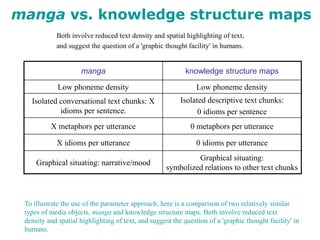
Both involve reduced text density and spatial highlighting of text,
and suggest the question of a 'graphic thought facility' in humans.
manga knowledge structure maps
Low phoneme density Low phoneme density
Isolated conversational text chunks: X
idioms per sentence.
Isolated descriptive text chunks:
0 idioms per sentence
X metaphors per utterance 0 metaphors per utterance
X idioms per utterance 0 idioms per utterance
Graphical situating: narrative/mood
Graphical situating:
symbolized relations to other text chunks
manga vs. knowledge structure maps
To illustrate the use of the parameter approach, here is a comparison of two relatively similar
types of media objects, manga and knowledge structure maps. Both involve reduced text
density and spatial highlighting of text, and suggest the question of a 'graphic thought facility' in
humans.
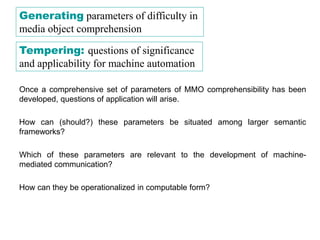
Once a comprehensive set of parameters of MMO comprehensibility has been
developed, questions of application will arise.
How can (should?) these parameters be situated among larger semantic
frameworks?
Which of these parameters are relevant to the development of machine-
mediated communication?
How can they be operationalized in computable form?
Tempering: questions of significance
and applicability for machine automation
Generating parameters of difficulty in
media object comprehension
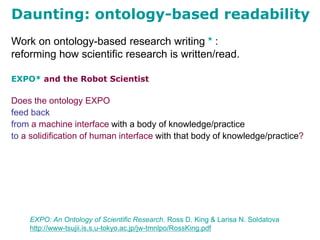
Work on ontology-based research writing * :
reforming how scientific research is written/read.
EXPO* and the Robot Scientist
Does the ontology EXPO
feed back
from a machine interface with a body of knowledge/practice
to a solidification of human interface with that body of knowledge/practice?
Daunting: ontology-based readability
EXPO: An Ontology of Scientific Research. Ross D. King & Larisa N. Soldatova
http://www-tsujii.is.s.u-tokyo.ac.jp/jw-tmnlpo/RossKing.pdf
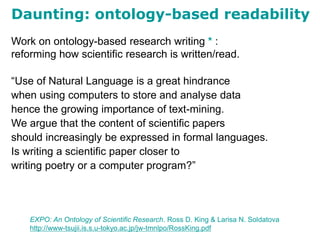
Work on ontology-based research writing * :
reforming how scientific research is written/read.
“Use of Natural Language is a great hindrance
when using computers to store and analyse data
hence the growing importance of text-mining.
We argue that the content of scientific papers
should increasingly be expressed in formal languages.
Is writing a scientific paper closer to
writing poetry or a computer program?”
Daunting: ontology-based readability
EXPO: An Ontology of Scientific Research. Ross D. King & Larisa N. Soldatova
http://www-tsujii.is.s.u-tokyo.ac.jp/jw-tmnlpo/RossKing.pdf
Work on ontology-based research writing * :
reforming how scientific research is written/read.
Can humans now experience knowledge differently,
thanks to machine interface work,
i.e. through a formal language imposed for the machine’s sake?
Will this reform how we read? how we think?
Daunting: ontology-based readability
EXPO: An Ontology of Scientific Research. Ross D. King & Larisa N. Soldatova
http://www-tsujii.is.s.u-tokyo.ac.jp/jw-tmnlpo/RossKing.pdf
References
[1] Elsayed, A. (2007) Machine-mediated communication: the technology. 6th IEEE International
Conference on Advanced Learning Technologies, ICALT 2006, 5-7 July 2006, Kerkrade, The
Netherlands.
[2] Hunter, L. (2005) Technical hypertext accessibility: information structures and rhetorical framing.
Proceedings of the sixteenth ACM conference on Hypertext and hypermedia, Salzburg, Austria.
[3] Kalyuga, S. (2006) Instructing and testing advanced learners: A cognitive approach. Nova Science
Publishers.
[4] Mann, B. (1999) An introduction to rhetorical structure theory (RST).
http://www.sil.org/mannb/rst/rintro99.htm
[5] Mohan, B.A.M. (1986) Language and content. Reading, MASS: Addison-Wesley.
[6] Nass, C. and S. Brave. (2005) Wired for speech: How voice activates and advances the human-
computer relationship. MIT Press.
Chun, D. M. and Plass, J. L. 1997. Research on text comprehension in multimedia environments.
Language learning and technology 1(1): 60-81.
Grow, G. (1996) Serving the strategic reader: cognitive reading theory and its implications for the
teaching of writing. Viewed June 30, 2007 at
http://www.longleaf.net/ggrow/StrategicReader/index.html
Goldman, S.R., & Rakestraw, J.A. (2000). Structural aspects of constructing meaning from text. In M.L.
Kamil, P. B. Mosenthal, P. D. Pearson, & R. Barr (Eds.), Handbook of reading research (Vol. II, pp.
311-335). Mahwah, NJ: Erlbaum.
The Plain English movement http://www.plainenglish.co.uk/index.htm (de-idiomatizing)
References 2
Research via ontologies
Ian Horrocks http://www.cs.man.ac.uk/~horrocks/
EXPO Ontology of scientific experiments http://expo.sourceforge.net/
Soldatova L.N., Clare A., Sparkes A. and King, R.D. (2006) An ontology for a Robot Scientist.
Bioinformatics (Special issue ISMB) (in press).
Soldatova, LN & King, RD. (2006) An Ontology of Scientific Experiments. Journal of the Royal Society
Interface (in press).
EXPO: An Ontology of Scientific Research by Ross D. King & Larisa N. Soldatova, Department of
Computer Science, University of Wales, Aberystwyth.
Hunter
Hunter L. (2005) Technical Hypertext Accessibility: Information Structures and Rhetorical Framing.
Presentation at HyperText 2005, Salzburg.
http://www.lawriehunter.com/presns/%20HT05poster0818.htm
Text Nouveau: Visible Structure in Text Presentation. Computer Assisted Language Learning 11(4) pp.
363-379. (text nouveau)
WordbyWord http://www.core.kochi-tech.ac.jp/hunter/WordByWord/index.html (text nouveau)
Text usability for non-native readers of English. Ueta, R, Hunter, L. & Ren, X. Proceedings, Information
Processing Society of Japan, Vol. 2003.7. Pp. 199-200. (phrase boundary marking)
Thank you
for your kind attention.
Don’t hesitate to write to me.
Lawrie Hunter
Kochi University of Technology
http://www.core.kochi-tech.ac.jp/hunter

Dimensions of Media Object Comprehensibility

  • 1.
    Dimensions of Media ObjectCompehensibility Lawrie Hunter Kochi University of Technology http://www.core.kochi-tech.ac.jp/hunter/
  • 2.
    Dimensions of Media ObjectCompehensibility Lawrie Hunter Kochi University of Technology http://www.core.kochi-tech.ac.jp/hunter/ KUT Island of Shikoku
  • 3.
  • 4.
    A pattern languagefor MMC Source of insight: language / language learning Second language (L2) learning: a cognitive process? Comprehension of partially acquired L2: revealing of the nature of text/media. Language learning issues are germane to MMC.
  • 5.
    Tempering: questions of significanceand applicability for machine automation. A pattern language for MMC Intervention author's structural model of content information (for second language learning materials) Discussion of parameters of difficulty Ground: related issues in second language learning materials Exemplars ‘considerate text’ ‘considerate multimedia’ Generating parameters of difficulty in media object comprehension Background work towards a human-communication paradigm for the guidance of machines Frame the new multidisciplinary approach of machine-mediated communication Objective development of a pattern language for that multidisciplinary approach to MMC Focus factors influencing the difficulty of comprehension of media objects Question how media objects carry information.
  • 6.
    L2 learning materials mustall be more immediately apparent to the learner than in the case of materials for L1 medium learning scenarios The creation of second language (L2) learning materials demands document transparency: 1. document purpose 2. document content 3. target behavior 4. target lexical items
  • 7.
    The creation ofsecond language (L2) learning materials demands document transparency: L2 learning materials 1. document purpose 2. document content 3. target behavior 4. target lexical items work towards transparency is informed by difficulty-related issues difficulty-related issues inform human interaction with info media
  • 8.
    Earlier work: anEAP tool *in a talk to KMI at the Open University David Kolb* re using hypertext to present scholarly text: "...the easiest ways of making a complex argument available in HT tend to move the text toward linear structures that do not take full advantage of the possibilities of linked text."
  • 9.
    Earlier work: anEAP tool *in a talk to KMI at the Open University David Kolb* re using hypertext to present scholarly text: "...the easiest ways of making a complex argument available in HT tend to move the text toward linear structures that do not take full advantage of the possibilities of linked text." "...what the HT can do is present the argument, but also use linkage and juxtaposition to make the reader’s engagement with the argument more creative, self-conscious, and self-critical."
  • 10.
    Earlier work: anEAP tool Lawrie Hunter re using hypertext to present technical L2 text: For the L2 reader, engagement can only be enhanced if the rhetorical and information structures are articulated.
  • 11.
    Earlier work: anEAP tool Lawrie Hunter re using hypertext to present technical L2 text: For the L2 reader, engagement can only be enhanced if the rhetorical and information structures are articulated. What the HT can do for the NNR/W is tp present simultaneously the various faces of a research paper: the rhetorical moves; the bits of structured information; the text; necessary glosses. * NNR/W EAP = non-native reader/writer of English for Academic Purposes
  • 12.
    Earlier work: anEAP tool Lawrie Hunter re using hypertext to present technical L2 text: For the L2 reader, engagement can only be enhanced if the rhetorical and information structures are articulated. What the HT can do for the NNR/W is to present simultaneously the various faces of a research paper: the rhetorical moves; the bits of structured information; the text; necessary glosses. And if the NNR/Ws design their personal interface, a negotiated pattern language of NNR/W EAP* will emerge. * NNR/W EAP = non-native reader/writer of English for Academic Purposes
  • 13.
    Arguably important direction "Tomorrow'sliteracies... need to be process and systems literacies.” -John Thackara, In the Bubble: Designing in a complex world. MIT Press 2005.
  • 14.
    Rhetorical structures Knowledge structures Cohesion devices Grammar (sentence surface structure) Background Extension DiversionsTrainof argument This is the domain of texture down here. This is the domain of structures up here. Rhetorical structure theory, systemic functional linguistics and knowledge structure mapping form a hierarchy of structures, whereas grammar and sentence diagrams reflect rules for texture management. Functional structures Structural view of writing
  • 15.
    Rhetorical structures Knowledge structures Cohesion devices Grammar (sentence surface structure) Background Extension DiversionsTrainof argument False hierarchy: the train stops here. This is the domain of texture down here. This is the domain of structures up here. Rhetorical structure theory, systemic functional linguistics and knowledge structure mapping form a hierarchy of structures, whereas grammar and sentence diagrams reflect rules for texture management. Functional structures Structural view of writing
  • 16.
    L2 reader needsanalysis Knowledge Niche grammar structures Niche rhetorical structures General register repertoires (distinguishing formal academic from informal academic) Research Paper text structure and information structure Language skills Argument sequencing Info-structured sentence generation Mimicry of model language Facilities Concordance & collocation resource Bank of model research papers (annotated*) *c.f. Brown and Brown’s ‘annotation’
  • 17.
    L2 reader wantsanalysis In a technical hypertext, L2 reader/writers want*: 1. Glossing (of 'difficult' terms and phrases) 2. Moves indicator 3. Lexia position indicator 4. PDF-drawer-like phrase recurrence tab 5. Register converter (e.g. research paper <=> presentation script) 6. Information structure maps for atomic utterances 7. Overall argument map on every lexia (similar to Horn's argument maps or Rhetorical Structure Analysis?) *Based on a survey of 22 PhD engineering students
  • 18.
    Technical hypertext design: WANTS NEEDS Apatternlanguage? www.patternlanguage.com
  • 19.
    Technical hypertext design: WANTS NEEDS …Thelanguage, and the processes which stem from it, merely release the fundamental order which is native to us. They do not teach us, they only remind us of what we know already, and of what we shall discover time and time again, when we give up our ideas and opinions, and do exactly what emerges from ourselves. -Christopher Alexander, The Timeless Way of Building Apattern language? www.patternlanguage.com
  • 20.
    Do humans havea GRAPHIC THOUGHT FACILITY? The knowledge structure map is a matrix (confluence) for the situated learner* and the situated mentor to confirm context and the nature of "stolen property."** *Jean Lave **Duguid and Brown < $$$ !
  • 21.
    Hunter’s knowledge structuremap links <big Description Classification Degree comparison Attribute comparison Sequence Cause-effect Contrast !
  • 22.
    2005 project: designlevel EEAP* students: HT designs for the analysis of technical academic papers. *EEAP = Engineering English for Academic Purposes, a subset of EAP, which is a subset of ESP (English for Specific Purposes) Hunter L. (2005) Technical Hypertext Accessibility: Information Structures and Rhetorical Framing. Presentation at HyperText 2005, Salzburg. http://www.lawriehunter.com/presns/%20HT05poster0818.htm
  • 23.
    TEXT STRUCTURE Introduction Background Question Methods and materials Results Observations Conclusion INFOMAP(s) INFO STRUCTURE Describe Classify Compare Sequence Cause-effect Contrast UTTERANCE(s) Ingeneral, power plants boil some liquid to make steam, which rotates turbines, which generate electricity. Power plants boil a liquid to produce steam, which is used to rotate turbines, which in turn generate electricity. RHETORICAL MOVES Common knowledge Cite Report Explain Claim Question Qualify Evaluate Decide Infer Project
  • 24.
    TEXT STRUCTURE Introduction Background Question Methods and materials Results Observations Conclusion INFOMAP(s) INFO STRUCTURE Describe Classify Compare Sequence Cause-effect Contrast UTTERANCE(s) Traditionalpower plants use fossil fuel heat or heat from nuclear fission to boil water and produce steam at 500°C. Older type power plants boil water with heat from fossil fuel combustion or nuclear fission to produce steam with a temperature of 500°C. RHETORICAL MOVES Common knowledge Cite Report Explain Claim Question Qualify Evaluate Decide Infer Project
  • 25.
    TEXT STRUCTURE Introduction Background Question Methods and materials Results Observations Conclusion INFOMAP(s) INFO STRUCTURE Describe Classify Compare Sequence Cause-effect Contrast UTTERANCE(s) OTECpower plants use seawater heat to boil ammonia and produce steam at 20°C. OTEC type power plants boil ammonia with the heat of the sea to produce steam with a temperature of 20°C. RHETORICAL MOVES Common knowledge Cite Report Explain Claim Question Qualify Evaluate Decide Infer Project
  • 26.
    RHETORICAL MOVES Common knowledge Cite Report Explain Claim Question Qualify Evaluate Decide Infer Project TEXT STRUCTURE Introduction Background Question Methods and materials Results Observations Conclusion INFOMAP(s) INFO STRUCTURE Describe Classify Compare Sequence Cause-effect Contrast UTTERANCE(s) Traditionalpower plants use fossil fuel heat or heat from nuclear fission to boil water and produce steam at 500°C, whereas OTEC type power plants boil ammonia using the heat of the sea to produce steam with a temperature of 20°C. Older type power plants boil water with heat from fossil fuel combustion or nuclear fission to produce steam with a temperature of 500°C, while OTEC power plants use seawater heat to boil ammonia and produce steam at 20°C.
  • 27.
    Obstacle in 2005project Massive diversity in learner perception of knowledge structures.
  • 28.
    Obstacle in 2005project Massive diversity in learner perception of knowledge structures.
  • 29.
    Rhetorical structures Knowledge structures Cohesion devices Grammar (sentence surface structure) Background Extension DiversionsTrainof argument False hierarchy: the train stops here. This is the domain of texture down here. This is the domain of structures up here. Rhetorical structure theory, systemic functional linguistics and knowledge structure mapping form a hierarchy of structures, whereas grammar and sentence diagrams reflect rules for texture management. Functional structures Structural view of writing
  • 30.
    Structural view ofwriting Grammar staging Information orchestration Rhetoric, flow Sentence level Prescriptive order charts (linear); sentence diagrams Knowledge structure maps Topic/stress and subject-verb distance gizmos Paragraph level Readability charts Knowledge structure maps Old/new and topic/stress gizmos Document level Readability outlines Knowledge structure maps Old/new and topic/stress gizmos
  • 31.
    2006~ new layer:READABILITY The missing link in technical academic writing: Gopen’s readability -subject-verb distance -topic position / stress position -old/new information placement
  • 32.
    Background: readability work Inthe design of traditional high-text language learning materials, readability is a prominent concern. Reading difficulty has for some time been seen as depending on -word length -sentence length -text length -number of sentences per paragraph -vocabulary ‘difficulty’ More recent work has extended this list to include -subject-verb distance -adherence to old/new position conventions -topic position/stress position conventions Treated extensively in Hunter L. (1998) Text Nouveau: Visible Structure in Text Presentation. Computer Assisted Language Learning 11(4) pp. 363-379.
  • 33.
    Background: MM readability Treatedextensively in Hunter L. (1998) Text Nouveau: Visible Structure in Text Presentation. Computer Assisted Language Learning 11(4) pp. 363-379. Chun, D. M. and Plass, J. L. 1997. Research on text comprehension in multimedia environments. Language learning and technology 1(1): 60-81.
  • 34.
    2006~ new layer:READABILITY Hunter’s new TAW syllabus: assume grammar Page 1 Readability and cohesion Topic / stress positions Old / new information Subje ct-verb separation Logic gaps Ambiguity 2 Usage Dictionaries, guides, corpus and concordance 3 Registers Formal academic Informalacademic Casual 4 Abstracts and introductions Thestructure of a paper Outlining Summarizing 5 Organization of information Situation-problem-solution-evaluation General-Specific 6 Information structures, information mapping Description Classification Comparison, including pie and bar graphs Sequen ce, including line and bar graphs Cause-Effect Inference (deduction/induction) Pro andCon 7 Rhetoric vs. information Background information /new content 8 English models TheStyle Dossier: model language selection / evaluation Mimicry skills Plagiarism avoidance 9 Data commentaries 10 Appendix: language features TAW-related grammar points Usage points
  • 35.
    2006~ new layer:READABILITY Page 1 Readability and cohesion Topic / stress positions Old / new information Subje ct-verb separation Logic gaps Ambiguity 2 Usage Dictionaries, guides, corpus and concordance 3 Registers Formal academic Informalacademic Casual 4 Abstracts and introductions Thestructure of a paper Outlining Summarizing 5 Organization of information Situation-problem-solution-evaluation General-Specific 6 Information structures, information mapping Description Classification Comparison, including pie and bar graphs Sequen ce, including line and bar graphs Cause-Effect Inference (deduction/induction) Pro andCon 7 Rhetoric vs. information Background information /new content 8 English models TheStyle Dossier: model language selection / evaluation Mimicry skills Plagiarism avoidance 9 Data commentaries 10 Appendix: language features TAW-related grammar points Usage points Textural Structural Grammar Lexical patterns Register Knowledge structures Cohesion Coherence/readability Functional grammar Information organization Rhetorical device Rhetorical structure
  • 36.
    Readability The creation ofsecond language (L2) learning materials demands appropriate readability. 1. understandable by the learner 2. ‘stretching’ learner knowledge/skill 3. contextualized to support stretching 4. orchestrated with degrees of scaffolding
  • 37.
    Considerate text Original framing: ・well-written, ・well-organized,and ・signals the organization of its thought to the reader One inroad to readability is considerate text:
  • 38.
    Considerate text Original framing: ・well-written, ・well-organized,and ・signals the organization of its thought to the reader One inroad to readability is considerate text: More recent takes: -glossing -phrase boundary marking -de-idiomatizing -the Plain English movement -graphic organizers -text nouveau
  • 39.
    Text nouveau isstill text Text comprehension in multimedia environments is a rich variant, BUT : Chun, D. M. and Plass, J. L. 1997. Research on text comprehension in multimedia environments. Language learning and technology 1(1): 60-81.
  • 40.
    Text nouveau isstill text Text comprehension in multimedia environments is a rich variant, BUT : Chun, D. M. and Plass, J. L. 1997. Research on text comprehension in multimedia environments. Language learning and technology 1(1): 60-81.
  • 41.
    Sharing considerate text Appropriatenessof learning materials/tasks is very complex. Tagging of these materials & tasks is daunting. L2 learning objects: welcome to the TagTower of Babel! KUT English is a Moodle department.
  • 42.
    Sharing considerate text Appropriatenessof learning materials/tasks is very complex. Tagging of these materials & tasks is daunting. Fortunately, as David Weinberger points out*, there is a huge amount of metadata out there, but this allows multiple simultaneous organizations of content. *June 12, 2007 interview with IT Conversations http://www.itconversations.com/shows/detail1838.html Weinberger books The Cluetrain Manifesto Small Pieces Loosely Joined Everything is Miscellaneous
  • 43.
    Considerate multimedia? Tentative definition: consideratemultimodal objects are those which contain few non-essential obstacles to their comprehension. Considerate text in the context of M3C suggests the notion of considerate multimedia
  • 44.
    Considerate multimedia? Tentative definition: consideratemultimodal objects are those which contain few non-essential obstacles to their comprehension. Considerate text in the context of M3C suggests the notion of considerate multimedia Tentative definition 2: considerate multimodal objects are those which are tagged for various forms of comprehension difficulty.
  • 45.
  • 46.
    Multimedia comprehensibility? Alternative approach:create a set of parameters for multimedia comprehensibility “Considerate multimedia” confronts vastly more complexity than considerate text One approach to comprehensibility: explore obstacles to comprehensibility, as has been done in readability work.
  • 47.
    In the domainof multimodal computer-mediated communication, the question of readability translates as ease of comprehension: Multimodal equivalent of readability How easy is it for a human to extract all the information contained in a multimodal media object (MMO)?
  • 48.
    To measure theease of extraction of all the INTENDED information contained in a MMO, we need a characterization of the difficulty of extraction: Tentative list of sources of information extraction difficulty, for simplicity’s sake limited here to text objects graphic objects speech objects video objects and combinations thereof. Parameters of media object function This is a tentative, exploratory framing of MMO comprehensibility,
  • 49.
    Parameter Instance/unit concept densityexophoric references per paragraph/page/frame metaphor density metaphors per scene/argument/minute phoneme density phonemes per unbroken utterance* (e.g. Italian speech) phonemes per inhalation phonemes per word phonemes per minute mathematical symbol density numerals per page numerals per sentence formulae per sentence/paragraph formulae per argument noise density superfluous signals per utterance, e.g. "...in 1960, oh, sorry, I meant to say in 1960...) readability stoppages** per sentence asides per sentence/message cognitive dissonances per utterance facial expression/statement conflicts reference transparency anchoring devices per lexia anchoring devices per reference channel-channel synchronicity number of channel-channel synchronicities number of channel-channel asynchronicities message-message agreement number of message-message agreements number of message-message dischords *utterance: minimal spoken, written or graphical communication unit Parametersofmediaobjectfunction Learning object tag ‘shopping list’
  • 50.
    Concept density* intext space Concept density* in aural time Concept density* in video space *concept density = number of exophoric references per sentence/minute/frame Parametersofmediaobjectfunction Concept density
  • 51.
    Metaphors per sentence. Metaphorsper argument. Metaphors per minute. Idioms per sentence. Idioms per argument. Idioms per minute. Parametersofmediaobjectfunction Metaphor density
  • 52.
    Phonemes per unbrokenutterance*. Phonemes per exhalation. Phonemes per word. Phonemes per minute. *e.g. Italian speech. Parametersofmediaobjectfunction Phoneme density
  • 53.
    Parametersofmediaobjectfunction Superfluous signals/utterance Readability ‘stoppages’per sentence Asides per sentence/message Cognitive dissonances per utterance Facial expression-statement conflicts ‘Noise’ density
  • 54.
    Parametersofmediaobjectfunction Numerals per page. Numeralsper sentence. Formulae per sentence/paragraph. Formulae per rhetorical move. Symbol density
  • 55.
    Parametersofmediaobjectfunction Imperfect audio channel Imperfecttext channel Imperfect visual channel Channel imperfections
  • 56.
    Parametersofmediaobjectfunction Channel imperfections Nass andBrave, Wired for speech Reeves and Nass, The media equation Finding: humans retain more info from video with an imperfect audio channel
  • 57.
  • 58.
  • 59.
  • 60.
    Both involve reducedtext density and spatial highlighting of text, and suggest the question of a 'graphic thought facility' in humans. manga knowledge structure maps Low phoneme density Low phoneme density Isolated conversational text chunks: X idioms per sentence. Isolated descriptive text chunks: 0 idioms per sentence X metaphors per utterance 0 metaphors per utterance X idioms per utterance 0 idioms per utterance Graphical situating: narrative/mood Graphical situating: symbolized relations to other text chunks manga vs. knowledge structure maps To illustrate the use of the parameter approach, here is a comparison of two relatively similar types of media objects, manga and knowledge structure maps. Both involve reduced text density and spatial highlighting of text, and suggest the question of a 'graphic thought facility' in humans.
  • 61.
    Once a comprehensiveset of parameters of MMO comprehensibility has been developed, questions of application will arise. How can (should?) these parameters be situated among larger semantic frameworks? Which of these parameters are relevant to the development of machine- mediated communication? How can they be operationalized in computable form? Tempering: questions of significance and applicability for machine automation Generating parameters of difficulty in media object comprehension
  • 62.
    Work on ontology-basedresearch writing * : reforming how scientific research is written/read. EXPO* and the Robot Scientist Does the ontology EXPO feed back from a machine interface with a body of knowledge/practice to a solidification of human interface with that body of knowledge/practice? Daunting: ontology-based readability EXPO: An Ontology of Scientific Research. Ross D. King & Larisa N. Soldatova http://www-tsujii.is.s.u-tokyo.ac.jp/jw-tmnlpo/RossKing.pdf
  • 63.
    Work on ontology-basedresearch writing * : reforming how scientific research is written/read. “Use of Natural Language is a great hindrance when using computers to store and analyse data hence the growing importance of text-mining. We argue that the content of scientific papers should increasingly be expressed in formal languages. Is writing a scientific paper closer to writing poetry or a computer program?” Daunting: ontology-based readability EXPO: An Ontology of Scientific Research. Ross D. King & Larisa N. Soldatova http://www-tsujii.is.s.u-tokyo.ac.jp/jw-tmnlpo/RossKing.pdf
  • 64.
    Work on ontology-basedresearch writing * : reforming how scientific research is written/read. Can humans now experience knowledge differently, thanks to machine interface work, i.e. through a formal language imposed for the machine’s sake? Will this reform how we read? how we think? Daunting: ontology-based readability EXPO: An Ontology of Scientific Research. Ross D. King & Larisa N. Soldatova http://www-tsujii.is.s.u-tokyo.ac.jp/jw-tmnlpo/RossKing.pdf
  • 65.
    References [1] Elsayed, A.(2007) Machine-mediated communication: the technology. 6th IEEE International Conference on Advanced Learning Technologies, ICALT 2006, 5-7 July 2006, Kerkrade, The Netherlands. [2] Hunter, L. (2005) Technical hypertext accessibility: information structures and rhetorical framing. Proceedings of the sixteenth ACM conference on Hypertext and hypermedia, Salzburg, Austria. [3] Kalyuga, S. (2006) Instructing and testing advanced learners: A cognitive approach. Nova Science Publishers. [4] Mann, B. (1999) An introduction to rhetorical structure theory (RST). http://www.sil.org/mannb/rst/rintro99.htm [5] Mohan, B.A.M. (1986) Language and content. Reading, MASS: Addison-Wesley. [6] Nass, C. and S. Brave. (2005) Wired for speech: How voice activates and advances the human- computer relationship. MIT Press. Chun, D. M. and Plass, J. L. 1997. Research on text comprehension in multimedia environments. Language learning and technology 1(1): 60-81. Grow, G. (1996) Serving the strategic reader: cognitive reading theory and its implications for the teaching of writing. Viewed June 30, 2007 at http://www.longleaf.net/ggrow/StrategicReader/index.html Goldman, S.R., & Rakestraw, J.A. (2000). Structural aspects of constructing meaning from text. In M.L. Kamil, P. B. Mosenthal, P. D. Pearson, & R. Barr (Eds.), Handbook of reading research (Vol. II, pp. 311-335). Mahwah, NJ: Erlbaum. The Plain English movement http://www.plainenglish.co.uk/index.htm (de-idiomatizing)
  • 66.
    References 2 Research viaontologies Ian Horrocks http://www.cs.man.ac.uk/~horrocks/ EXPO Ontology of scientific experiments http://expo.sourceforge.net/ Soldatova L.N., Clare A., Sparkes A. and King, R.D. (2006) An ontology for a Robot Scientist. Bioinformatics (Special issue ISMB) (in press). Soldatova, LN & King, RD. (2006) An Ontology of Scientific Experiments. Journal of the Royal Society Interface (in press). EXPO: An Ontology of Scientific Research by Ross D. King & Larisa N. Soldatova, Department of Computer Science, University of Wales, Aberystwyth. Hunter Hunter L. (2005) Technical Hypertext Accessibility: Information Structures and Rhetorical Framing. Presentation at HyperText 2005, Salzburg. http://www.lawriehunter.com/presns/%20HT05poster0818.htm Text Nouveau: Visible Structure in Text Presentation. Computer Assisted Language Learning 11(4) pp. 363-379. (text nouveau) WordbyWord http://www.core.kochi-tech.ac.jp/hunter/WordByWord/index.html (text nouveau) Text usability for non-native readers of English. Ueta, R, Hunter, L. & Ren, X. Proceedings, Information Processing Society of Japan, Vol. 2003.7. Pp. 199-200. (phrase boundary marking)
  • 67.
    Thank you for yourkind attention. Don’t hesitate to write to me. Lawrie Hunter Kochi University of Technology http://www.core.kochi-tech.ac.jp/hunter