Inspiration: The Road to
Concept Mapping
The University of Southern Mississippi
What is Concept Mapping
Concept Mapping:
 is a way of representing or organizing
knowledge
 is a visual graphic that represents how
the creator thinks about a subject, topic,
etc.
 identifies the way we think
 illustrates how knowledge is organized
for the individual
What is Concept Mapping (cont.)
 It

shows the relationships between
concepts, including bi-directional
relationships
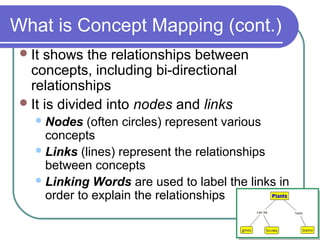
 It is divided into nodes and links
 Nodes

(often circles) represent various
concepts
 Links (lines) represent the relationships
between concepts
 Linking Words are used to label the links in
order to explain the relationships
Why Concept Mapping
 To

generate ideas (brain storming, etc.)
 To design a complex structure (long
texts, hypermedia, large Websites, etc.)
 To communicate complex ideas
 To aid learning by explicitly integrating
new and old knowledge
 To assess understanding or diagnose
misunderstanding
Why Concept Mapping (cont.)
Concept mapping is an excellent planning
device for instruction because it:
 helps

teachers select appropriate
instructional materials
 visually explains the conceptual relationships
used for meeting lesson objectives
 illustrate areas that may appear minor or
trivial
 articulates the themes that teachers want to
emphasize
Why Concept Mapping (cont. 2)
Concept mapping helps teachers
 understand how students see or
organize knowledge differently from
themselves
 identify concepts that are related to more
than one discipline
 know what they want their students to
learn
Why Concept Mapping (cont. 3)
Concept mapping:
 provides a basis for discussion among
students and helps summarize general
course concepts
 supports a holistic style of learning
 sustains meaningful learning
 assists in collaborative learning
Why Concept Mapping (cont. 4)
 Student

made concept maps

allow teachers to see how students structure their
knowledge and comprehend a subject of study
 help teachers identify missing or misunderstood
concepts


 Teacher

made concept maps

enable students to identify and explore the structure
and nature of domain knowledge presented by the
teacher
 help students identify new concepts and relate them to
concepts that are already understood

Steps in Making Maps
 Write

down major terms or concepts about a topic
 Identify the most general, intermediate, and
specific concepts
 Begin drawing the concept map:
Concepts are circled
 Place the most general concepts at the top
 Place intermediate concepts below general concepts
 Put specific concepts on bottom


 Draw

lines between related concepts
 Label the lines with "linking words" to indicate
how the concepts are related
 Revise the map
Some Tips
 Use

a top down approach, working from general
to specific or use a free association approach by
brainstorming nodes and then develop links and
relationships
 Use different colors/shapes for nodes & links to
identify different types of information
 Use different colored nodes to identify prior and
new information
 Use a cloud node to identify a question
 Gather information for a question in the question
node
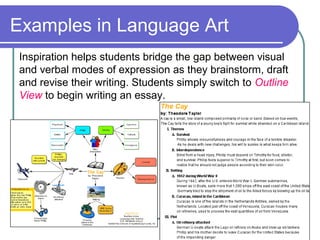
Examples in Language Art
Inspiration helps students bridge the gap between visual
and verbal modes of expression as they brainstorm, draft
and revise their writing. Students simply switch to Outline
View to begin writing an essay.
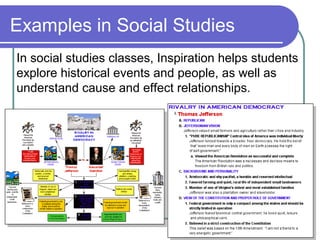
Examples in Social Studies
In social studies classes, Inspiration helps students
explore historical events and people, as well as
understand cause and effect relationships.
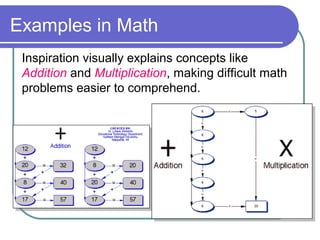
Examples in Math
Inspiration visually explains concepts like
Addition and Multiplication, making difficult math
problems easier to comprehend.
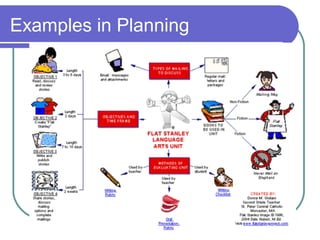
Examples in Planning
Teacher Planning
Inspiration is used to
plan class projects,
activities, lessons,
and units. Visual
diagrams make it
easier to understand
and share a process.

Student Planning
Students can use
Inspiration to plan
speeches, presentations
and projects.
Hyperlinking to a file or
site makes Inspiration a
great choice for creating
student portfolios.
Examples in Planning
Resources







Concept Mapping,
http://www.cotf.edu/ete/pbl2.html
The Concept Mapping Homepage,
http://users.edte.utwente.nl/lanzing/cm_home.htm
Concept Mapping software,
http://www.inspiration.com/
A Video on Inspiration Introduction, Examples, and a
QuickTour,
http://www.inspiration.com/test/dswmedia/intro.html
Examples for Inspiration Integration into the Classroom,
http://www.inspiration.com/productinfo/inspiration/using
_insp/index.cfm

Concept mapping: Inspiration

  • 1.
    Inspiration: The Roadto Concept Mapping The University of Southern Mississippi
  • 2.
    What is ConceptMapping Concept Mapping:  is a way of representing or organizing knowledge  is a visual graphic that represents how the creator thinks about a subject, topic, etc.  identifies the way we think  illustrates how knowledge is organized for the individual
  • 3.
    What is ConceptMapping (cont.)  It shows the relationships between concepts, including bi-directional relationships  It is divided into nodes and links  Nodes (often circles) represent various concepts  Links (lines) represent the relationships between concepts  Linking Words are used to label the links in order to explain the relationships
  • 4.
    Why Concept Mapping To generate ideas (brain storming, etc.)  To design a complex structure (long texts, hypermedia, large Websites, etc.)  To communicate complex ideas  To aid learning by explicitly integrating new and old knowledge  To assess understanding or diagnose misunderstanding
  • 5.
    Why Concept Mapping(cont.) Concept mapping is an excellent planning device for instruction because it:  helps teachers select appropriate instructional materials  visually explains the conceptual relationships used for meeting lesson objectives  illustrate areas that may appear minor or trivial  articulates the themes that teachers want to emphasize
  • 6.
    Why Concept Mapping(cont. 2) Concept mapping helps teachers  understand how students see or organize knowledge differently from themselves  identify concepts that are related to more than one discipline  know what they want their students to learn
  • 7.
    Why Concept Mapping(cont. 3) Concept mapping:  provides a basis for discussion among students and helps summarize general course concepts  supports a holistic style of learning  sustains meaningful learning  assists in collaborative learning
  • 8.
    Why Concept Mapping(cont. 4)  Student made concept maps allow teachers to see how students structure their knowledge and comprehend a subject of study  help teachers identify missing or misunderstood concepts   Teacher made concept maps enable students to identify and explore the structure and nature of domain knowledge presented by the teacher  help students identify new concepts and relate them to concepts that are already understood 
  • 9.
    Steps in MakingMaps  Write down major terms or concepts about a topic  Identify the most general, intermediate, and specific concepts  Begin drawing the concept map: Concepts are circled  Place the most general concepts at the top  Place intermediate concepts below general concepts  Put specific concepts on bottom   Draw lines between related concepts  Label the lines with "linking words" to indicate how the concepts are related  Revise the map
  • 10.
    Some Tips  Use atop down approach, working from general to specific or use a free association approach by brainstorming nodes and then develop links and relationships  Use different colors/shapes for nodes & links to identify different types of information  Use different colored nodes to identify prior and new information  Use a cloud node to identify a question  Gather information for a question in the question node
  • 11.
    Examples in LanguageArt Inspiration helps students bridge the gap between visual and verbal modes of expression as they brainstorm, draft and revise their writing. Students simply switch to Outline View to begin writing an essay.
  • 12.
    Examples in SocialStudies In social studies classes, Inspiration helps students explore historical events and people, as well as understand cause and effect relationships.
  • 13.
    Examples in Math Inspirationvisually explains concepts like Addition and Multiplication, making difficult math problems easier to comprehend.
  • 14.
    Examples in Planning TeacherPlanning Inspiration is used to plan class projects, activities, lessons, and units. Visual diagrams make it easier to understand and share a process. Student Planning Students can use Inspiration to plan speeches, presentations and projects. Hyperlinking to a file or site makes Inspiration a great choice for creating student portfolios.
  • 15.
  • 16.
    Resources      Concept Mapping, http://www.cotf.edu/ete/pbl2.html The ConceptMapping Homepage, http://users.edte.utwente.nl/lanzing/cm_home.htm Concept Mapping software, http://www.inspiration.com/ A Video on Inspiration Introduction, Examples, and a QuickTour, http://www.inspiration.com/test/dswmedia/intro.html Examples for Inspiration Integration into the Classroom, http://www.inspiration.com/productinfo/inspiration/using _insp/index.cfm