Teaching with
Concept Maps
An Interactive Demonstration
What’s a Concept Map?
• It’s a visual representation of the relations among concepts
within a particular subject area.
• A map consists of labeled nodes, each representing a concept,
and labeled directional lines between pairs of nodes,
indicating the relation between them.
• Each pair of nodes and directional line expresses a
proposition.
• The nodes are arranged hierarchically on the map, with the
most general concepts appearing at the top.
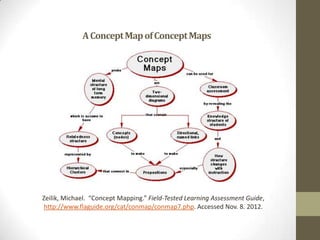
AConceptMapofConceptMaps
Zeilik, Michael. “Concept Mapping.” Field-Tested Learning Assessment Guide,
http://www.flaguide.org/cat/conmap/conmap7.php. Accessed Nov. 8. 2012.
Building a Concept Map
• First, choose a general topic.
• Second, begin to brainstorm concepts associated with that
topic. Select 10 concepts, expressed as single words or very
short phrases.
• Third, arrange students into pairs, and have each pair build a
concept map of those 10 concepts.
Rules
• Each concept must occupy one node.
• Each node must be connected to at least one other node, via a
directional line.
• Each directional line must be labeled, such that one can read a
complete declarative sentence by starting at a node, following
the line, and ending at another node (Warning: this may
require some awkward phrasing!)
• The nodes should occupy levels – those appearing at the top
of the map should represent the most general concepts.
Those at the bottom, the most specific.
• You may add new concepts as you like.
• There is no limit as to how many directional lines you draw
(but keep it legible!)
Why Use Concept Maps?
• They visually represent a student’s broad understanding of a
subject area.
• They are an excellent supplement to traditional means of
measuring student understanding, such as tests and papers.
• They are revisable.
• They are interactive and collaborative.
Tips
• I tend to emphasize that there is no one exactly perfect
concept map.
• However, you can make your concept maps better with
practice and understanding.
• You can connect them to course readings – finding places in
the reading that justifies a particular connection on your map.
• Collaboration is welcome.
Assignments
• Three concept maps, over the course of the semester
• Initially, I gave them all 10 concepts to build their maps.
• Each successive assignment I reduces the number I provided
by 2, and they had to fill in their own, so I supplied 8 concepts
for the second assignment, then 6 for the third.
• Each assignment required at least 10 concepts, and they were
welcome to add more.
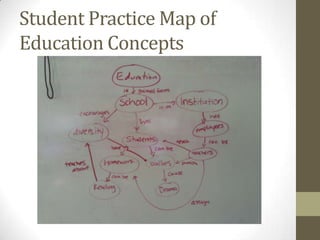
Student Practice Map of
Education Concepts
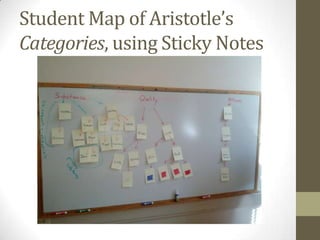
Student Map of Aristotle’s
Categories, using Sticky Notes
Tools
• Wordle.com
• LucidChart

Teaching with concept maps

  • 1.
    Teaching with Concept Maps AnInteractive Demonstration
  • 2.
    What’s a ConceptMap? • It’s a visual representation of the relations among concepts within a particular subject area. • A map consists of labeled nodes, each representing a concept, and labeled directional lines between pairs of nodes, indicating the relation between them. • Each pair of nodes and directional line expresses a proposition. • The nodes are arranged hierarchically on the map, with the most general concepts appearing at the top.
  • 3.
    AConceptMapofConceptMaps Zeilik, Michael. “ConceptMapping.” Field-Tested Learning Assessment Guide, http://www.flaguide.org/cat/conmap/conmap7.php. Accessed Nov. 8. 2012.
  • 4.
    Building a ConceptMap • First, choose a general topic. • Second, begin to brainstorm concepts associated with that topic. Select 10 concepts, expressed as single words or very short phrases. • Third, arrange students into pairs, and have each pair build a concept map of those 10 concepts.
  • 5.
    Rules • Each conceptmust occupy one node. • Each node must be connected to at least one other node, via a directional line. • Each directional line must be labeled, such that one can read a complete declarative sentence by starting at a node, following the line, and ending at another node (Warning: this may require some awkward phrasing!) • The nodes should occupy levels – those appearing at the top of the map should represent the most general concepts. Those at the bottom, the most specific. • You may add new concepts as you like. • There is no limit as to how many directional lines you draw (but keep it legible!)
  • 6.
    Why Use ConceptMaps? • They visually represent a student’s broad understanding of a subject area. • They are an excellent supplement to traditional means of measuring student understanding, such as tests and papers. • They are revisable. • They are interactive and collaborative.
  • 7.
    Tips • I tendto emphasize that there is no one exactly perfect concept map. • However, you can make your concept maps better with practice and understanding. • You can connect them to course readings – finding places in the reading that justifies a particular connection on your map. • Collaboration is welcome.
  • 8.
    Assignments • Three conceptmaps, over the course of the semester • Initially, I gave them all 10 concepts to build their maps. • Each successive assignment I reduces the number I provided by 2, and they had to fill in their own, so I supplied 8 concepts for the second assignment, then 6 for the third. • Each assignment required at least 10 concepts, and they were welcome to add more.
  • 9.
    Student Practice Mapof Education Concepts
  • 10.
    Student Map ofAristotle’s Categories, using Sticky Notes
  • 11.