English Speech I:
Fluency work
Lawrie Hunter
Editor/mentor, GRIPS CPC
The	usual	ways	of	improving	ESL	pronunciation	
are	
1.  Listen and repeat
2.  Contrasting pair work (flight / fright)
3.  Shadowing
4.  Read-aloud (Hunter’s favorite) [parallel text]
These approaches are useful,
but they are not the end of the story.
ESL	pronunciation	work	(not	today)
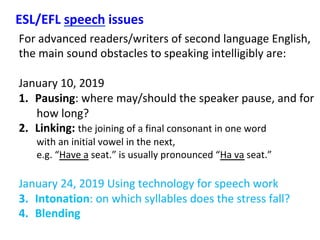
For	advanced	readers/writers	of	second	language	English,	
the	main	sound	obstacles	to	speaking	intelligibly	are:	
	
January	10,	2019	
1.  Pausing:	where	may/should	the	speaker	pause,	and	for	
how	long?	
2.  Linking:	the	joining	of	a	final	consonant	in	one	word		
with	an	initial	vowel	in	the	next,		
e.g.	“Have	a	seat.”	is	usually	pronounced	“Ha	va	seat.”	
	
January	24,	2019	Using	technology	for	speech	work	
3.  Intonation:	on	which	syllables	does	the	stress	fall?	
4.  Blending
ESL/EFL	speech	issues
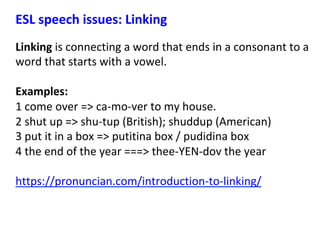
Linking	is	connecting	a	word	that	ends	in	a	consonant	to	a	
word	that	starts	with	a	vowel.		
	
Examples:	
1	come	over	=>	ca-mo-ver	to	my	house.	
2	shut	up	=>	shu-tup	(British);	shuddup	(American)	
3	put	it	in	a	box	=>	putitina	box	/	pudidina	box	
4	the	end	of	the	year	===>	thee-YEN-dov	the	year	
		
https://pronuncian.com/introduction-to-linking/	
ESL	speech	issues:	Linking
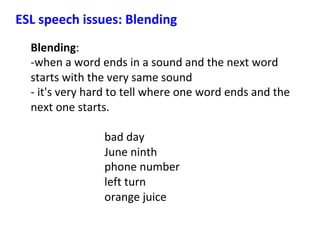
Blending:		
-when	a	word	ends	in	a	sound	and	the	next	word	
starts	with	the	very	same	sound		
-	it's	very	hard	to	tell	where	one	word	ends	and	the	
next	one	starts.		
	
bad	day							
June	ninth								
phone	number							
left	turn						
orange	juice	
ESL	speech	issues:	Blending
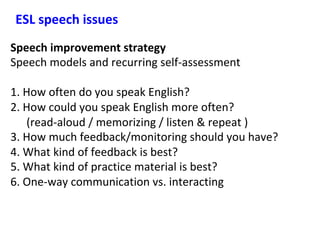
Speech	improvement	strategy	
Speech	models	and	recurring	self-assessment	
	
1.	How	often	do	you	speak	English?		
2.	How	could	you	speak	English	more	often?		
	(read-aloud	/	memorizing	/	listen	&	repeat	)	
3.	How	much	feedback/monitoring	should	you	have?	
4.	What	kind	of	feedback	is	best?		
5.	What	kind	of	practice	material	is	best?	
6.	One-way	communication	vs.	interacting	
ESL	speech	issues
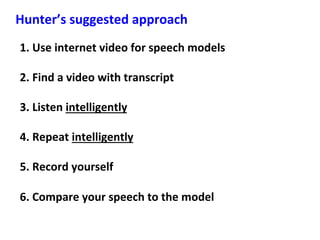
1.	Use	internet	video	for	speech	models	
	
2.	Find	a	video	with	transcript	
	
3.	Listen	intelligently	
	
4.	Repeat	intelligently	
	
5.	Record	yourself	
	
6.	Compare	your	speech	to	the	model	
Hunter’s	suggested	approach
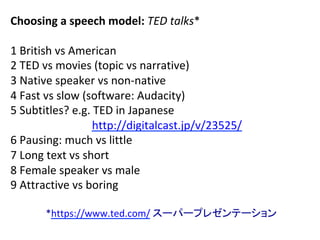
Choosing	a	speech	model:	TED	talks*	
	 		
1	British	vs	American	
2	TED	vs	movies	(topic	vs	narrative)	
3	Native	speaker	vs	non-native	
4	Fast	vs	slow	(software:	Audacity)	
5	Subtitles?	e.g.	TED	in	Japanese		
				http://digitalcast.jp/v/23525/	
6	Pausing:	much	vs	little		
7	Long	text	vs	short	
8	Female	speaker	vs	male	
9	Attractive	vs	boring	
	
*https://www.ted.com/	スーパープレゼンテーション
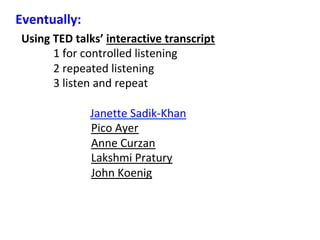
Using	TED	talks’	interactive	transcript	
	 	1	for	controlled	listening		
	 	2	repeated	listening	
	 	3	listen	and	repeat	
	
Janette	Sadik-Khan	
Pico	Ayer	
Anne	Curzan	
Lakshmi	Pratury	
John	Koenig	
Eventually:
Model	analysis:	listening	for	pausing	
	
Janette	Sadik-Khan	
	
Where	will	she	use	pausing?	
	
Listen	and	confirm.	
Activity	1:
Model	analysis:	listening	for	linking	
	
Janette	Sadik-Khan	
	
Where	will	she	do	linking?	
	
Listen	and	confirm.	
Activity	2:
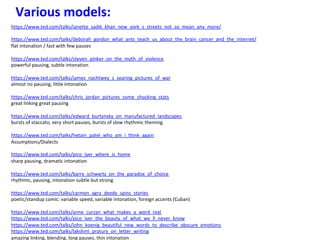
https://www.ted.com/talks/janette_sadik_khan_new_york_s_streets_not_so_mean_any_more/	
	
https://www.ted.com/talks/deborah_gordon_what_ants_teach_us_about_the_brain_cancer_and_the_internet/	
flat	intonation	/	fast	with	few	pauses	
	
https://www.ted.com/talks/steven_pinker_on_the_myth_of_violence	
powerful	pausing,	subtle	intonation	
		
https://www.ted.com/talks/james_nachtwey_s_searing_pictures_of_war	
almost	no	pausing,	little	intonation	
		
https://www.ted.com/talks/chris_jordan_pictures_some_shocking_stats	
great	linking	great	pausing	
		
https://www.ted.com/talks/edward_burtynsky_on_manufactured_landscapes	
bursts	of	staccato,	very	short	pauses,	bursts	of	slow	rhythmic	theming	
		
https://www.ted.com/talks/hetain_patel_who_am_i_think_again	
Assumptions/Dialects	
		
https://www.ted.com/talks/pico_iyer_where_is_home	
sharp	pausing,	dramatic	intonation	
		
https://www.ted.com/talks/barry_schwartz_on_the_paradox_of_choice	
rhythmic,	pausing,	intonation	subtle	but	strong	
		
https://www.ted.com/talks/carmen_agra_deedy_spins_stories	
poetic/standup	comic:	variable	speed,	variable	intonation,	foreign	accents	(Cuban)	
		
https://www.ted.com/talks/anne_curzan_what_makes_a_word_real	
https://www.ted.com/talks/pico_iyer_the_beauty_of_what_we_ll_never_know	
https://www.ted.com/talks/john_koenig_beautiful_new_words_to_describe_obscure_emotions	
https://www.ted.com/talks/lakshmi_pratury_on_letter_writing	
amazing	linking,	blending,	long	pauses,	thin	intonation	
Various	models:
On	Hunter’s	web	site	(this	page	under	construction)	
https://lawriehunter.com/pronunciation/speech-work/	
	
Hunter’s	slideshare	(this	powerpoint	and	many	others)	
https://www.slideshare.net/rolenzo/presentations	
	
Hunter’s	speech	work	resources:

GRIPS speech workshop 1 2019: pausing and linking (pdf)