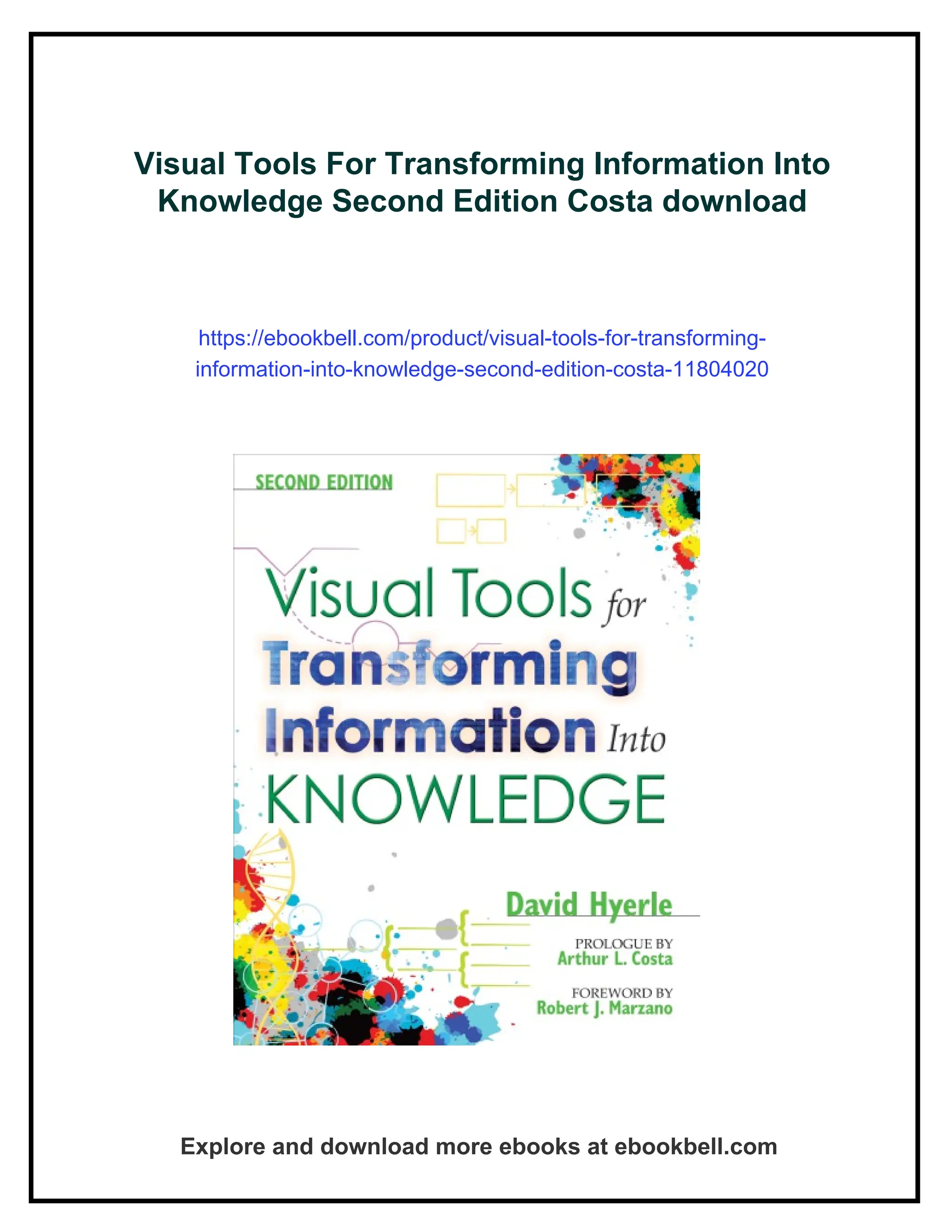
Visual Tools For Transforming Information Into
Knowledge Second Edition Costa download
https://ebookbell.com/product/visual-tools-for-transforming-
information-into-knowledge-second-edition-costa-11804020
Explore and download more ebooks at ebookbell.com
Here are some recommended products that we believe you will be
interested in. You can click the link to download.
Visual Tools For Transforming Information Into Knowledge Hyerle
https://ebookbell.com/product/visual-tools-for-transforming-
information-into-knowledge-hyerle-59503758
Visual Methodologies And Digital Tools For Researching With Young
Children Transforming Visuality 1st Edition Marilyn Fleer Phd
https://ebookbell.com/product/visual-methodologies-and-digital-tools-
for-researching-with-young-children-transforming-visuality-1st-
edition-marilyn-fleer-phd-4601578
The Circle Of Fifths Visual Tools For Musicians Philip Jackson
https://ebookbell.com/product/the-circle-of-fifths-visual-tools-for-
musicians-philip-jackson-48943636
Visual Studio Tools For Office 2007 Vsto For Excel Word And Outlook
1st Edition Eric Carter
https://ebookbell.com/product/visual-studio-tools-for-
office-2007-vsto-for-excel-word-and-outlook-1st-edition-eric-
carter-2122340
Visual Studio Tools For Office Using C With Excel Word Outlook And
Infopath Eric Carter
https://ebookbell.com/product/visual-studio-tools-for-office-using-c-
with-excel-word-outlook-and-infopath-eric-carter-919196
Visual Studio Tools For Office Using Visual Basic 2005 With Excel Word
Outlook And Infopath Eric Carter
https://ebookbell.com/product/visual-studio-tools-for-office-using-
visual-basic-2005-with-excel-word-outlook-and-infopath-eric-
carter-919198
Python Tools For Visual Studio Leverage The Power Of The Visual Studio
Ide To Develop Better And More Efficient Python Projects Wang
https://ebookbell.com/product/python-tools-for-visual-studio-leverage-
the-power-of-the-visual-studio-ide-to-develop-better-and-more-
efficient-python-projects-wang-20632890
Visual Teams Graphic Tools For Commitment Innovation Et High
Performance Sibbet
https://ebookbell.com/product/visual-teams-graphic-tools-for-
commitment-innovation-et-high-performance-sibbet-21980000
Visual Leaders New Tools For Visioning Management And Organization
Change 1st Edition Sibbet
https://ebookbell.com/product/visual-leaders-new-tools-for-visioning-
management-and-organization-change-1st-edition-sibbet-5311296
Visual Tools For
Transforming
InformationInto
KNOWLEDGE
SECOND EDITION
Visual Tools for
Transforming
InformationInto
KNOWLEDGE
SECOND EDITION
David Hyerle
PROLOGUE BY
Arthur L. Costa
FOREWORD BY
Robert J. Marzano
CORWIN
PRESS
A SAGE Company
Copyright © 2009 by Corwin Press
All rights reserved. When forms and sample documents are included, their use is authorized only by
educators, local school sites, and/or noncommercial or nonprofit entities that have purchased the book.
Except for that usage, no part of this book may be reproduced or utilized in any form or by any means,
electronic or mechanical, including photocopying, recording, or by any information storage and retrieval
system, without permission in writing from the publisher.
For information:
Corwin Press
A Sage Publication
SAGE Publications India Pvt. Ltd.
s Company B 1/I 1 Mohan Cooperative
2455 Teller Road Industrial Area
Thousand Oaks, California 91320 Mathura Road, New Delhi 110 044
www.corwinpress.com India
Sage Publications Ltd. SAGE Publications Asia-Pacific Pte. Ltd.
1 Oliver’s Yard 33 Pekin Street #02-01
55 City Road Far East Square
London EC1Y 1SP Singapore 048763
United Kingdom
Printed in the United States of America.
Library of Congress Cataloging-in-Publication Data
Hyerle, David.
Visual tools for transforming information into knowledge/David Hyerle. — 2nd ed.
p. cm.
Includes bibliographical references and index.
ISBN 978-1-4129-2426-9 (cloth)
ISBN 978-1-4129-2427-6 (pbk.)
1. Visual learning. 2. Constructivism (Education) 3. Thought and thinking. 4. Critical thinking.
5. Cognition. I. Hyerle, David.
Visual tools for constructing knowledge. II. Title.
LB1067.5.H94 2009
370.15’23—dc22 2008017823
This book is printed on acid-free paper.
08 09 10 11 12 10 9 8 7 6 5 4 3 2 1
Acquisitions Editor: Hudson Perigo
Editorial Assistant: Lesley Blake
Production Editor: Jane Haenel
Copy Editor: Dorothy Hoffman
Typesetter: C&M Digitals (P) Ltd.
Proofreader: Cheryl Rivard
Indexer: Kirsten Kite
Cover Designers: Anthony Paular and Michael Dubowe
Graphic Designer: Brian Bello
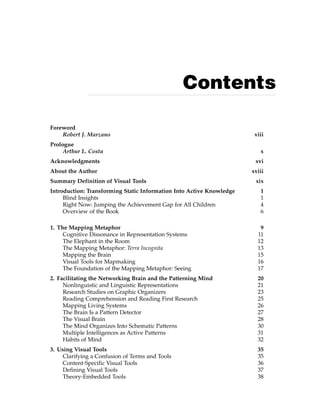
Contents
Foreword
Robert J. Marzano viii
Prologue
Arthur L. Costa x
Acknowledgments xvi
About the Author xviii
Summary Definition of Visual Tools xix
Introduction: Transforming Static Information Into Active Knowledge 1
Blind Insights 1
Right Now: Jumping the Achievement Gap for All Children 4
Overview of the Book 6
1. The Mapping Metaphor 9
Cognitive Dissonance in Representation Systems 11
The Elephant in the Room 12
The Mapping Metaphor: Terra Incognita 13
Mapping the Brain 15
Visual Tools for Mapmaking 16
The Foundation of the Mapping Metaphor: Seeing 17
2. Facilitating the Networking Brain and the Patterning Mind 20
Nonlinguistic and Linguistic Representations 21
Research Studies on Graphic Organizers 23
Reading Comprehension and Reading First Research 25
Mapping Living Systems 26
The Brain Is a Pattern Detector 27
The Visual Brain 28
The Mind Organizes Into Schematic Patterns 30
Multiple Intelligences as Active Patterns 31
Habits of Mind 32
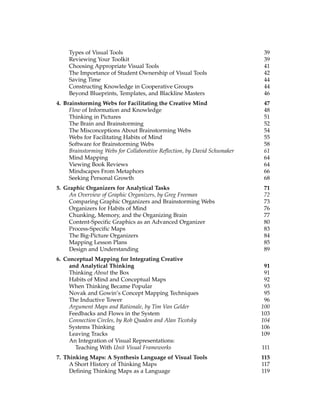
3. Using Visual Tools 35
Clarifying a Confusion of Terms and Tools 35
Content-Specific Visual Tools 36
Defining Visual Tools 37
Theory-Embedded Tools 38
Types of Visual Tools 39
Reviewing Your Toolkit 39
Choosing Appropriate Visual Tools 41
The Importance of Student Ownership of Visual Tools 42
Saving Time 44
Constructing Knowledge in Cooperative Groups 44
Beyond Blueprints, Templates, and Blackline Masters 46
4. Brainstorming Webs for Facilitating the Creative Mind 47
Flow of Information and Knowledge 48
Thinking in Pictures 51
The Brain and Brainstorming 52
The Misconceptions About Brainstorming Webs 54
Webs for Facilitating Habits of Mind 55
Software for Brainstorming Webs 58
Brainstorming Webs for Collaborative Reflection, by David Schumaker 61
Mind Mapping 64
Viewing Book Reviews 64
Mindscapes From Metaphors 66
Seeking Personal Growth 68
5. Graphic Organizers for Analytical Tasks 71
An Overview of Graphic Organizers, by Greg Freeman 72
Comparing Graphic Organizers and Brainstorming Webs 73
Organizers for Habits of Mind 76
Chunking, Memory, and the Organizing Brain 77
Content-Specific Graphics as an Advanced Organizer 80
Process-Specific Maps 83
The Big-Picture Organizers 84
Mapping Lesson Plans 85
Design and Understanding 89
6. Conceptual Mapping for Integrating Creative
and Analytical Thinking 91
Thinking About the Box 91
Habits of Mind and Conceptual Maps 92
When Thinking Became Popular 93
Novak and Gowin’s Concept Mapping Techniques 95
The Inductive Tower 96
Argument Maps and Rationale, by Tim Van Gelder 100
Feedbacks and Flows in the System 103
Connection Circles, by Rob Quaden and Alan Ticotsky 104
Systems Thinking 106
Leaving Tracks 109
An Integration of Visual Representations:
Teaching With Unit Visual Frameworks 111
7. Thinking Maps: A Synthesis Language of Visual Tools 115
A Short History of Thinking Maps 117
Defining Thinking Maps as a Language 119
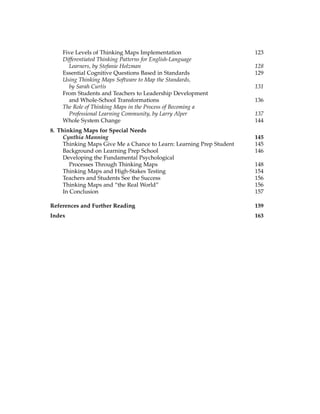
Five Levels of Thinking Maps Implementation 123
Differentiated Thinking Patterns for English-Language
Learners, by Stefanie Holzman 128
Essential Cognitive Questions Based in Standards 129
Using Thinking Maps Software to Map the Standards,
by Sarah Curtis 131
From Students and Teachers to Leadership Development
and Whole-School Transformations 136
The Role of Thinking Maps in the Process of Becoming a
Professional Learning Community, by Larry Alper 137
Whole System Change 144
8. Thinking Maps for Special Needs
Cynthia Manning 145
Thinking Maps Give Me a Chance to Learn: Learning Prep Student 145
Background on Learning Prep School 146
Developing the Fundamental Psychological
Processes Through Thinking Maps 148
Thinking Maps and High-Stakes Testing 154
Teachers and Students See the Success 156
Thinking Maps and “the Real World” 156
In Conclusion 157
References and Further Reading 159
Index 163
I
n Visual Tools for Transforming Information Into Knowledge (2nd edition), David
Hyerle takes the concept of visual tools to new heights. He provides a strong
theoretical base by starting with the mapping metaphor. Just as cartography
increased the speed and efficiency with which new lands and new people could be
identified and connected, so too do visual tools escalate the speed and efficiency
with which an individual can identify new knowledge and connect it to what is
already known. Hyerle reviews not only the theoretical underpinnings of the use of
visual tools but also the research supporting it—some of that research my own.
Specifically, in the book Classroom Instruction That Works (Marzano, Pickering, &
Pollock, 2001), I reviewed a number of studies focusing on what I referred to as non-
linguistic representations. This term included instructional strategies such as
graphic organizers, mind maps, and the like. The research I reviewed strongly sup-
ported the use of such strategies as powerful instructional tools. In my latest review
of the research on general instructional strategies contained in the book The Art and
Science of Teaching (Marzano, 2007), I found even stronger evidence for the efficacy of
nonlinguistic representations.
In his work on visual tools, David Hyerle has expanded the frontiers of strate-
gies involving nonlinguistic representations far beyond what I and others have
attempted to do. He provides not only a comprehensive theoretical basis for the effi-
cacy of visual tools but expands their application to new and exciting arenas. A short
list of the applications of visual tools Hyerle details includes
• Brainstorming
• The use of visual tools for facilitating habits of mind
• The use of software to enhance nonlinguistic thinking
• Collaborative reflection
• Book reviews
• The creation of mindscapes
• Traditional graphic organizers
• Domain-specific graphic organizers
• Chunking content to aid memory
• Process maps
• Mapping lesson plans
• System maps
• Feedback loops
Hyerle also addresses five levels of implementing Thinking Maps and pro-
vides criteria for determining whether visual tools are being used effectively by
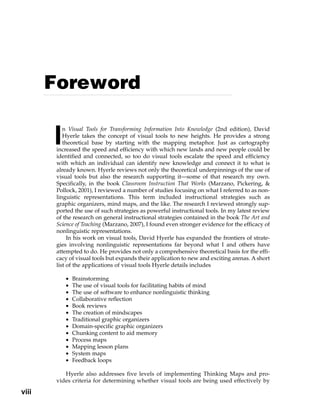
Foreword
viii
FOREWORD
ix
an individual teacher or by an entire school. In short, David’s work is the most
comprehensive and useful to date on the topic of visual tools and what I have
referred to as nonlinguistic representations. This book will no doubt be consid-
ered a classic for years to come.
Robert J. Marzano
March 2008
REFERENCES
Marzano, R. J. (2007). The art and science of teaching: A comprehensive framework for effective
instruction. Alexandria, VA: Association for Supervision and Curriculum Development.
Marzano, R. J., Pickering, D. J., & Pollock, J. E. (2001). Classroom instruction that works:
Research-based strategies for increasing student achievement. Alexandria, VA: Association for
Supervision and Curriculum Development.
D
eeply rooted in constructivist theory, this book draws on philosophical and
psychological models of how the mind works, how human intellectual capac-
ities emerge and grow over time, how humans derive meaning, and how
knowledge is structured. The intent is to provide educators with insights into how
interventions can be arranged and conditions organized so as to educe, enhance, and
refine those human intellectual resources.
In reviewing this book and preparing to write this prologue, I reminisced about
other constructivist theorists who influenced the formation of my views of learning
and human cognitive development: Bruner, Piaget, Taba, Suchman, Feuerstein.
I retrieved several of the constructivist mental models that scaffolded their philo-
sophical and psychological search. I found myself returning to Jerome Bruner’s com-
pelling inquiry, “What makes human beings human?” I began to mentally reflect on
and list some of those unique intellectual capacities that distinguish humans from
other life forms. When I approached the upper limits of my memory span—that mag-
ical number 7 (plus or minus 2) items to hold in my head simultaneously—I realized
I had to write them down or some might drop out. I therefore represented my
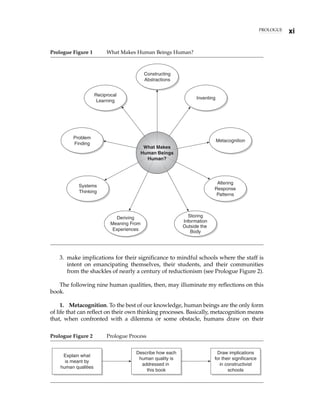
thoughts graphically (Prologue Figure 1).
As I mapped, I also came to realize that what I thought in my head was fuzzier
than what I wrote on paper. As I refined what was on paper, I mutually refined my
inner thoughts. I realized, for example, that many human capacities, while innate,
are underdeveloped and will need to be amplified to live productively in the future.
Not only did the brainstorming web allow me to see the relationships between these
attributes, but it also disclosed overlaps, redundancies, and omissions. I edited here
and there to be consistent and then reflected on my map. I felt satisfied that I had a
structure that could be decorated with a few insightful contributions about the ben-
efits and potentials of this book. Using the structure, I then turned to composing.
As the thoughts flowed from my brain and were translated to individual letters by
my fingers and flowed as words onto the computer screen, I again revisited my map
altering here and there, combining where necessary, and generating more bubbles as
additional thoughts emerged that, in turn, stimulated others.
The gift that David Hyerle has bestowed on us in this book, you see, is a set of
tools for exploring, enhancing, and refining those unique cognitive qualities of
humanness. I would like to
1. explain what is meant by each of these uniquely human qualities that under-
gird constructivist theory;
2. describe how David has so masterfully addressed them; and
Prologue
x
PROLOGUE
xi
Prologue Figure 1 What Makes Human Beings Human?
Constructing
Abstractions
Reciprocal
Inventing
Learning
Problem
Metacognition
Finding
Altering
Systems
Response
Thinking
Patterns
Storing
Deriving
Information
Meaning From
Outside the
Experiences Body
What Makes
Human Beings
Human?
3. make implications for their significance to mindful schools where the staff is
intent on emancipating themselves, their students, and their communities
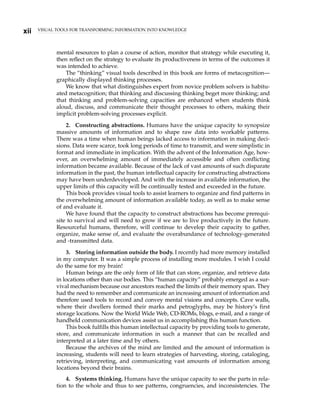
from the shackles of nearly a century of reductionism (see Prologue Figure 2).
The following nine human qualities, then, may illuminate my reflections on this
book.
1. Metacognition. To the best of our knowledge, human beings are the only form
of life that can reflect on their own thinking processes. Basically, metacognition means
that, when confronted with a dilemma or some obstacle, humans draw on their
Prologue Figure 2 Prologue Process
Describe how each Draw implications
Explain what
human quality is for their significance
is meant by
addressed in in constructivist
human qualities
this book schools
mental resources to plan a course of action, monitor that strategy while executing it,
then reflect on the strategy to evaluate its productiveness in terms of the outcomes it
was intended to achieve.
The “thinking” visual tools described in this book are forms of metacognition—
graphically displayed thinking processes.
We know that what distinguishes expert from novice problem solvers is habitu-
ated metacognition; that thinking and discussing thinking beget more thinking; and
that thinking and problem-solving capacities are enhanced when students think
aloud, discuss, and communicate their thought processes to others, making their
implicit problem-solving processes explicit.
2. Constructing abstractions. Humans have the unique capacity to synopsize
massive amounts of information and to shape raw data into workable patterns.
There was a time when human beings lacked access to information in making deci-
sions. Data were scarce, took long periods of time to transmit, and were simplistic in
format and immediate in implication. With the advent of the Information Age, how-
ever, an overwhelming amount of immediately accessible and often conflicting
information became available. Because of the lack of vast amounts of such disparate
information in the past, the human intellectual capacity for constructing abstractions
may have been underdeveloped. And with the increase in available information, the
upper limits of this capacity will be continually tested and exceeded in the future.
This book provides visual tools to assist learners to organize and find patterns in
the overwhelming amount of information available today, as well as to make sense
of and evaluate it.
We have found that the capacity to construct abstractions has become prerequi-
site to survival and will need to grow if we are to live productively in the future.
Resourceful humans, therefore, will continue to develop their capacity to gather,
organize, make sense of, and evaluate the overabundance of technology-generated
and -transmitted data.
3. Storing information outside the body. I recently had more memory installed
in my computer. It was a simple process of installing more modules. I wish I could
do the same for my brain!
Human beings are the only form of life that can store, organize, and retrieve data
in locations other than our bodies. This “human capacity” probably emerged as a sur-
vival mechanism because our ancestors reached the limits of their memory span. They
had the need to remember and communicate an increasing amount of information and
therefore used tools to record and convey mental visions and concepts. Cave walls,
where their dwellers formed their marks and petroglyphs, may be history’s first
storage locations. Now the World Wide Web, CD-ROMs, blogs, e-mail, and a range of
handheld communication devices assist us in accomplishing this human function.
This book fulfills this human intellectual capacity by providing tools to generate,
store, and communicate information in such a manner that can be recalled and
interpreted at a later time and by others.
Because the archives of the mind are limited and the amount of information is
increasing, students will need to learn strategies of harvesting, storing, cataloging,
retrieving, interpreting, and communicating vast amounts of information among
locations beyond their brains.
4. Systems thinking. Humans have the unique capacity to see the parts in rela-
tion to the whole and thus to see patterns, congruencies, and inconsistencies. The
VISUAL TOOLS FOR TRANSFORMING INFORMATION INTO KNOWLEDGE
xii
human preference for perceiving parts or wholes as separate cognitive inclinations,
as some cognitive-style theorists would have us believe, is inadequate for productive
participation in a quantum world. In dynamic systems, tiny inputs can reverberate
throughout the system, producing dramatically large consequences. Systems think-
ing fulfills a human capacity to understand the boundaries within a part of the total
system and, at the same time, to understand the interactions with its interconnect-
ing parts.
Hyerle suggests the use of visual tools to guide thinking when we need to simul-
taneously pay attention to the whole and analyze whether the parts are, indeed,
interdependent and interconnected. Visual tools are one means of describing how
a system functions when altered or when innovative thinking in one part of the
system affects the total system. Maps serve as tools for examining many processes
and interactions, such as how decisions are made, how disciplines work together,
how new practices are initiated, and how priorities are established.
Families, weather systems, and national economies are examples of systems. To
participate fully in any society, and to protect a fragile environment, citizens must
realize that any system involves a synergistic relationship of interlocking parts; as
one part changes, it affects the other parts. No one part can operate efficiently unless
the other parts of the system work in harmony. This capacity for simultaneously
holonomous parts–whole relationships has become essential not only in the work-
place but also in solving environmental and social problems.
5. Problem finding. To the best of our knowledge, humans are the only form of
life that actually enjoys the search for problems to solve. Being dissatisfied with exist-
ing levels of certainty, humans have an insatiable passion for questioning the status
quo, sensing ambiguities, and detecting anomalies. Once having intuited such incon-
sistencies, humans have developed the profound capacity to engage in experimental
inquiry, to set up procedures to test and evaluate alternative ideas, and to strive for
certitude. The process of modern scientific thought thrives on this human tendency.
Maps are tools for displaying intellectual processes, the clustering of the
diverse, complex procedures of experimentation. They represent the sequences,
alternative branches, choice points, and pathways that surround the acquisition
and production of knowledge. These become the basis for systematic inquiry and
scientific investigation.
Process is, in fact, the highest form of learning and the most appropriate base for
curriculum change. In the teaching of process, we can best portray learning as a per-
petual endeavor and not something that terminates when we leave school. Through
process, we can employ knowledge not merely as a composite of information but as
a system for continuous learning.
6. Reciprocal learning. Human beings are social beings who have a compulsive
craving to engage with others. The most hideous form of punishment is to deprive
humans of their quest for reciprocity. Humans learn best in groups. Intelligence gets
shaped through interaction with others: justifying reasons, resolving differences, actively
listening to another person’s point of view, achieving consensus, and receiving feedback.
In this book, Hyerle commends interactivity as tools are developed in coopera-
tive settings. Such tools assist in developing students’ and teachers’ capacity for
flexibility—viewing situations from multiple perspectives, as well as being able to
change and adapt based on feedback from others. Using such cooperative tools tran-
scends the sense of self—enlarging the conception of “me” to a sense of “us.” And
PROLOGUE
xiii
becoming less attached to egocentric orientations permits us to exercise more
advanced reasoning processes. Use of such tools provides interconnectedness and
kinship that comes from a unity of being, a sense of sharing, and a mutual bonding
to common goals and shared values. Students understand that as we transcend the
self and become part of the whole, we do not lose our individuality; rather, we relin-
quish our egocentricity.
Collaboration, cooperation, and interdependence are paramount not only in
today’s work cultures but also in families, in governmental organizations, and
among nations. Schools must enhance students’ capacities for holding their own val-
ues and actions in abeyance and lending their energies and resources to the achieve-
ment of group goals, contributing themselves to a common good, and seeking
collegiality and drawing on the resources of others. Students must come to regard
conflict as valuable, trusting their abilities to manage group differences in produc-
tive ways, to seek feedback from others as a valued source of learning. They must
know that “all of us” is more efficient than any “one of us.” Interdependence makes
possible the most complete and effective intellectual functioning of human beings.
7. Inventing. Human beings are creative—they are toolmakers. Although some
other life forms may perceive the need for and employ instruments to accomplish tasks
and solve problems, only humans are capable of designing and creating new tools.
Further, humans are intrinsically rather than extrinsically motivated, working on
the task because of the aesthetic challenge, rather than the material rewards. They
constantly strive for greater fluency, elaboration, novelty, parsimony, simplicity,
craftsmanship, perfection, beauty, harmony, and balance.
Hyerle disparages giving students ready-made maps to follow and fill in. He
emphasizes the need for students to invent their own tools and to hone and refine
them as they generate and gather information, process or elaborate that information
into conceptual relationships, and then apply and evaluate those generalizations. He
believes strongly that each of us has an inherent motivation for this inventive
process, which can be capacitated through such visual tool making.
All humans have the capacity to generate novel, original, clever, or ingenious
products, solutions, and techniques. We often try to conceive problem solutions dif-
ferently, examining alternative possibilities from many angles. We tend to project
ourselves into different roles using metaphors and analogies, starting with a vision
and working backward, imagining we are the objects being considered. Creative
people take risks—they “live on the edge of their competence,” testing their limits—
if that capacity is developed.
8. Deriving meaning from experiences. Thomas A. Edison stated that he never
made a mistake; he only learned from experience. One of the most significant attri-
butes that makes humans human is their capacity for reflecting on and learning from
their experiences. Intelligent people form feelings and impressions about an event;
they compare intentions with accomplishments; they analyze why events turned out
as they did; they search for causal factors that produced the effects; they summarize
their impressions; and, based on those analyses, they project how they could mod-
ify their actions in the future.
The human mind, however, is inclined to distort or delete information to suit its
own purposes and biases. Hyerle suggests that the use of maps as tools for reflection
can assist us by graphically tracking the procedures employed in an event.
Reflecting on the visual pathways, strategies, and decisions is a more efficient and
VISUAL TOOLS FOR TRANSFORMING INFORMATION INTO KNOWLEDGE
xiv
systematic way of holding information than attempting to recall it. The experience
can be analyzed more honestly and completely if it has been graphically organized.
Autonomous individuals set personal goals and are self-directing, self-monitoring,
and self-modifying. Because they are constantly experimenting and experiencing,
they fail frequently but they fail forward, learning from the situation. A major out-
come for any school desirous of preparing autonomous humans is to develop
students’ capacities for continuous self-analysis, self-improvement, self-referencing,
self-evaluation, and self-modification.
9. Altering response patterns. Whereas other forms of life are wired to respond
in certain ways to stimuli in their environment, humans are self-actualizing and self-
modifying—they can consciously and deliberately make choices about whether and
how they wish to respond. They can alter their habits and can voluntarily select
among alternative responses. We might be inclined to be impulsive, but we can
choose to be deliberative; if we are disposed to make premature evaluations, we can
choose to withhold our judgments; when we are habituated into perceiving egocen-
trically, we can choose to perceive allocentrically. This decision-making process
requires consciousness and flexibility—being aware of our own and others’ actions
and drawing on a repertoire of response patterns. David Hyerle supports the use of
visual tools because they encourage consciousness and flexibility of responses.
Deliberate1y employing mapping tools causes us to restrain our impulsivity, to sus-
pend our judgments, to generate and consider alternatives, and to attend empathi-
cally to others’ perspectives.
Fully functioning humans engage in continuous learning. If our students believe
that their education has been completed on graduation, they’ve missed the whole point
of schooling. Continuous lifespan learning is essential for students today and in the
future. With advances in technology and changes in the workplace and human mobil-
ity, we may find other underdeveloped capacities continuing to learn how to learn, how
to change and grow, and how to relinquish old patterns and acquire new ones.
ENDNOTE
David also proposes that the use of these tools is not just “kid stuff.” Cooperatively
inventing and employing such tools benefits the human intellectual capacities of the
adults in the school as well. When the staff design, generate, and employ these maps,
they too become more aware of their data generating, storing, and retrieval systems.
All staff members are at once beneficiaries and leaders of the learning organization.
They more readily see the parts-whole relationship. They view their particular oper-
ation as part of a larger whole and see that innovative/creative thinking in one part
of the system affects the total system. Everybody in the entire system is perceived to
be a continual learner—a caring, thinking individual capable of complex decision
making, creativity. School life consists of not only the continuity and use of visual
tools across departments and grade levels but also the use of a shared, common
language throughout the organization. Perhaps it is this fractal quality that is the
unique characteristic of a mindful school.
Arthur L. Costa
Professor Emeritus
Sacramento State University
PROLOGUE
xv
Acknowledgments
I
n the mid-1980s, Dr. Art Costa, then and now a leader in our field, opened my eyes
to the complexity and elegance of our human capacity to think. Quietly, Art also
opened several doors for me, one that led the ASCD in 1996 to publish and then
distribute to all its members my first book, Visual Tools for Constructing Knowledge.
Art’s Prologue to this new book welcomed readers to that first edition. His words
stand as a testament to the original nature of his thinking and the universal, endur-
ing qualities of his insights. I am forever grateful to Art for his guidance.
Over all these years, I have been deeply influenced by many people who have
developed visual tools. Tony Buzan, Gabriel Rico, and Nancy Margulies have given
us rich brainstorming tools; Richard Sinatra, Jim Bellanca, and Bonnie Armbruster
have offered an array of graphic organizers and research; and John Clarke, Joseph
Novak, and the late Barry Richmond have offered us languages for mapping con-
cepts and systems. These pioneers have built the trails upon which we now walk and
the maps for navigating the complexity of the present knowledge network.
This revision was a struggle for me, for I wanted to synthesize these pioneering
works with some of the new theory, research, and practice that may enlighten a new
generation of work. The act of drawing together comprehensive research into the heart
of practice is exciting, difficult, and time consuming. This is a task that Robert Marzano
has taken on for years, and I appreciate his research and interest in translating research
into practice, as well as the focus he offers us in the Foreword to this book.
In this edition, there are several new pathways thanks to Tim Van Gelder, Rob
Quaden and Alan Ticotsky, and Christine Ewey, who show us, respectively, how to
build mental models for reasoning, for systems thinking, and for integrating multi-
ple forms of information into visual frameworks. The last two chapters of the book
are anchored by four authors offering new insights into the practice of Thinking
Maps, the work that long ago became central to my life journey. Many thanks to
Stefanie Holzman, Sarah Curtis, Larry Alper, and Cynthia Manning for concretely
detailing how Thinking Maps are used as a language for learning and leadership
across entire schools.
If there is one simple lesson I have learned through my work with visual tools,
it is that the form, or design, of knowledge is inseparable from the content and
processes of creating that knowledge. Unlike most books in education, this book is
rich with the interplay of text and graphics, requiring important design decisions.
Thank you, Hudson Perigo, executive editor of Corwin Press, and the team of Lesley
Blake, Jane Haenel, and Dorothy Hoffman for the high-quality production of this
book, thus giving you, the reader, an opportunity for clearly viewing the form and
function of visual tools.
xvi
ACKNOWLEDGMENTS
xvii
PUBLISHER’S ACKNOWLEDGMENTS
Corwin Press gratefully acknowledges the contributions of the following reviewers:
Mark Bower
Director of Elementary Education and Staff Development
Hilton Central School District
Hilton, NY
Mark Johnson
Principal/Curriculum and Assessment Facilitator
Glenwood Elementary
Kearney, NE
Judith A. Rogers, EdD
Professional Learning Specialist
Tucson Unified School District
Tucson, AZ
xviii
David Hyerle is an author, researcher, workshop leader, and
keynote speaker focused on integrating thinking process
approaches into 21st-century learning, teaching and leading
implementation designs across whole schools. The creation of
the Thinking Maps® model by David in the late 1980s emerged
from his inner-city teaching experiences at the middle school
level in Oakland, California. His development of Thinking Maps
was also informed by his work with the Bay Area/National
Writing Project and the Cognitive CoachingTM
model. David
completed doctoral work at the University of California, Berkeley, and Harvard
Schools of Education in 1993, through which he refined the theoretical and practical
applications of Thinking Maps as a language for learning and leading. Among the
numerous professional books, articles, online/video courses, and resource materials
he has authored—including the ASCD book Visual Tools for Constructing Knowledge—
David has written the training materials for Thinking Maps and guided the profes-
sional development process with Thinking Maps, Inc. In recent years, David has
coauthored the seminar guide Thinking Maps: A Language for Leadership and edited
Student Successes With Thinking Maps, a book that synthesizes background research
and documents the outcomes from the implementation of Thinking Maps. David
now lives in New Hampshire with his wife, Sara, and their son, Alex, and works as
the Founding Director of Thinking Foundation (www.thinkingfoundation.org), a
nonprofit organization supporting research in cognitive and critical thinking devel-
opment for all children and for the purpose of creating “thinking schools” nationally
and internationally. He can be reached by phone at (603) 795–2757 and by e-mail at
davidhyerle@thinkingfoundation.org.
About the Author
Summary Definition
of Visual Tools
V
isual tools are nonlinguistic symbol systems used by learners, teachers, and
leaders for graphically linking mental and emotional associations to create
and communicate rich patterns of thinking. These visual-spatial-verbal dis-
plays of understanding support all learners in transforming static information into
active knowledge, thus offering a complementary representational system to more
traditional literacies grounded in speaking, writing, and numerating. These linear
and/or nonlinear visual forms are also metacognitive tools for self-assessment in
each content area and for interdisciplinary learning that may unite linguistic, numer-
ical, and scientific languages together on the same page.
As shown in Summary Figure 1, and investigated in this book, there are three
basic categories of visual tools, each with specific purposes and visual configurations:
brainstorming webs for fostering creativity and open mindedness;
graphic organizers for fostering analytical content and process specific learning;
conceptual mapping for fostering cognitive development and critical thinking.
A fourth category is a unique synthesis language of visual tools that has been used
extensively across schools called Thinking Maps®
(Hyerle, 1990, 1996). This common
visual language of visual tools integrates the creative dynamism of webs, the analyt-
ical structures of content-specific learning, and the continuous cognitive development
and reflections fostered through conceptual mapping. Over time, new visual lan-
guages may develop that integrate different visual tools and thus enable a greater
range of thinking, communication, and reflection.
Visual tools are used for personal, collaborative, and social communication, negotia-
tion of meaning, and networking of ideas. These graphics are constructed by individual
or collaborative learners across media networks and mediums such as paper, white-
boards, and computer screens. Because of the visual accessibility and natural processes of
“drawing out” ideas, many of these graphics are used from early childhood through
adulthood, and across every dimension of learning, teaching, assessing, and leadership
processes. Visual tools are also used across cultures and languages and may become keys
to new levels of more democratic participation and communication in human systems.
Across traditional cultures and new “virtual” cultures, visual languages ultimately may
be used for uniting diverse and distant learning communities as people in schools, com-
munities, and businesses and in different countries seek to understand each other through
seeing each others’ thinking and perceptions through multiple frames of reference.
xix
Other documents randomly have
different content
Patriarchs, the, 4.
Pecht, Egyptian goddess, 9.
Pekah, the last king of Israel, 248.
Pekah, murdered by Hoshea, son of Elah, 260.
submits to Tiglath-Pileser, 260.
Pekahiah, King of Israel, murdered by Pekah, 248.
Pelethites, 122.
Pelusium besieged by Sennacherib, 276.
Penitential psalms, 337 f.
Pentapolis of the Philistines, 54 f.
Pentateuch. See Law-Book.
Perizzites, 3.
Perpetual fire, an emblem of God's presence, 24.
Persecution of the Judæans by Artaxerxes, 408.
Persecution of the prophets under Manasseh, 284.
Persian doctrines influence Hebrew religion, 403.
religion and Hebrew monotheism, 402.
Persians and Judæans, 407.
conquered by Alexander the Great, 412.
Pestilence in Israel under David, 138.
Petra, capital of the Idumæans, 222.
Pharaoh, opposition of Moses against, 16.
Philip of Macedon, 432.
of Macedonia, 411.
regent of Syria, 480.
Philistines, 54 ff.
and Goliath defeated in the valley of Tamarinths, 95–7.
and Samson, 66.
arouse Judah and Simeon, 77.
at war with David, 115.
capture the ark of the covenant, 71–2.
defeat Saul and his army on Gilboah, 103–4.
defeat the Israelites at Aphek, 70.
defeated by Azariah, 230.
defeated by David at Mount Baal Perazim, 116.
defeated by Saul at Michmash, 88–9.
oppress Israel greatly, 66, 80, 84.
remain enemies of the Judæans, 435, 467.
Philo, the elder, 517.
Philometor of Egypt, 504.
Philopator of Egypt, 429–32.
Phineas puts an end to the profligacy of the people, 29.
Phœnicia, natural wealth and resources of, 3.
Phœnicians—Canaanites, 2.
defeated by Shalmaneser, 263 f.
customs and mythology of, 54..
influencing the Israelites, 53 f.
Phraortes (Fravartch), King of Media, 287.
Pious, community of the, 436.
and worldly among the exiles, 339, 349.
Plain of Sharon, or the low country, 45.
Poetic, allegories (mashal) of Solomon, 158.
talents of David, 96.
Poetry, beginning of Hebrew, 29.
of Nature in Palestine, 48 f.
of the Exile, 340.
Polygamy indulged in by David, 161.
Saul, 95.
Solomon, 161.
Popillius Lænas, Roman deputy, 453.
Praise-songs in divine worship, 78.
Prayers prescribed among the Judæans, 398.
Priests == Aaronides.
expelled from Jerusalem take charge of the temple on Mount
Gerizim, 390.
faithless to their promises, 383–4.
idolatrous, under Manasseh, 283.
in Israel, 25.
leave Jerusalem for want of support, 372.
neglected by Samuel, 79.
of Baal and Astarte in Israel, 107, 204.
provided for by Nehemiah, 382.
re-instated by Judas Maccabæus, 473.
under Ahab, 261.
under Josiah, 294.
Priesthood reorganized by Solomon, 167.
Promises of God to David, 150 f.
Promises of God to the Patriarchs, 4 ff.
Prophecy re-awakened at Samuel's time, 73.
Prophets, characteristics of the, 15.
followers of Isaiah, 253.
helping Samuel, 76.
in Bethel, Gilgal and Jericho, 205, 234.
of the Exile, 344.
persecuted by Jehoiakim, 300.
persecuted by Manasseh, 284.
trained by Elijah, 200.
Prophets under Josiah, 286, 288 f.
Prophets, Books of the, read in the temple, 400.
Prophetess Deborah, 61.
Huldah, 286.
Prophetic spirit of God, its meaning, 14.
writings, authoritative collection of, 400.
Proselytes in Ezra's opinion, 367.
made in the exile, 338, 352, 356.
Prosperity under Gideon, 63.
Jeroboam II., 231.
Solomon, 172.
Proverbs, book of, 340.
Psalmists, 120, 279.
Penitential, 337.
in the exile, 340.
Psalms xxiv., 353.
lxxviii. 60–64, 71.
cii., 344.
cvii. 7 and 30, 355.
cxxii. 3–5, 121.
cxxvi., 352.
Ptolemies defeat Antiochus the Great, 426.
Judæans under the, 420.
Ptolemy I., Soter, King of Egypt, 416.
II. and the rebellious Judæans, 423.
V., Philometor, 437, 504, 506.
VI., Philopator, 425–32.
VII., Physcon, 450, 452, 506, 518.
Philadelphus and the Septuagint, 514.
Ptolemy ben Habub, kills his father-in-law, Simon, at Dok, near
Jericho, 530.
Pul of Assyria invades Samaria, 246.
Pulpit oratory, origin of, 514.
Purification laws, 401.
Pydna, battle of, 453.
Rabbath-Ammon conquered by David-Joab, 128.
conquered by Judas Maccabæus, 474.
Rab-shakeh, Sennacherib's official sent to Hezekiah, 274.
Ramah, conquered and fortified by Baasha, 191.
Samuel in, 75.
Ramoth-Gilead, conquered by Benhadad II., 205.
Razim == royal couriers, 91.
Red Sea, passage of the, 18.
Rebuilding of the temple, 356–9.
Regicides in Israel, 189, 192, 211, 243, 244, 245.
Rehoboam succeeds his father Solomon, 179.
ten tribes secede at Shechem from, 180.
treaty with Tabrimon of Damascus, 183.
Relapse into idolatry shortly after giving the decalogue, 23.
Religion in the kingdom of Judah, 188.
in the kingdom of the ten tribes, 185.
Religious reformation of the Judæans in Babylonia, 363.
revival in Jerusalem under Joash, 217.
schools among the Judæans, 396.
Repetition, a characteristic of Hebrew poetry, 29.
Rephaim, aborigines of Canaan, 2.
Repopulation of Jerusalem, 377.
Resurrection from the dead, 404.
Retribution, doctrine of, 404.
Return from the exile under Zerubbabel, 351.
Reuben settles in the trans-Jordanic territory (Gilead), 29.
Reuel, Moses' father-in-law, 14.
Revelation on Mount Sinai, 20.
Revelations to Samuel, 74.
Rezin of Damascus, 248, 257.
slain by Tiglath-Pileser, 259.
Rezon of Zobah, 177.
Riblah, encampment of Nebuchadnezzar at, 313.
Riblah, Necho at, 299.
Rizpah and the Gibeonites, 110.
coveted by Abner, 110.
Saul's concubine, 95.
Romans and Antiochus Epiphanes, 443 ff.
and Judas Maccabæus, 485.
and Perseus at Pydna, 453.
and the Judæans, 526.
defeat Antiochus the Great, 434.
support Simon, 525.
support the Hasmonæans, 490.
Ruth, book of, written against Ezra's decision on the illegality of
intermarriages, 370, 411.
Sabbath, strict observance of, under Nehemiah, 386.
later observance of, 397.
Sabbatical year, 393.
Sabia (Sheba), Queen of, visits Solomon, 173.
Sacrifices among the Israelites, 24, 57.
among the Judæans, 401.
human, in Judah under Ahab, 261.
Sacrilege by Antiochus Epiphanes, 451.
Antiochus the Great and his son, 434.
Onias Menelaus, 448.
Salt sea or sea of the deep basin, 43.
Samael, the demon, 403.
Samaria, built, 193.
besieged by Benhadad III., 221 f.
capital of Cœlesyria, 414.
taken by Shalmaneser, 263 f.
Samaria, Land of == kingdom of the ten tribes, 193 ff.
after Pekah's death, 262.
colonised by Esarhaddon, 285.
invaded by Pul of Assyria, 246.
Samaritans, 285, 355.
enemies of the Judæans, 389, 410, 467.
in Alexandria oppose the Judæans, 515.
intermarry with the Judæans, 361.
interrupt the rebuilding of the temple, 357.
kill Andromachus, 414.
retain the Old Hebrew characters of the alphabet, 396.
temple of, on Mount Gerizim, 390.
Samson fights the Philistines, 66.
Samuel, Elkanah's son, 72.
anoints David, 96.
anoints Saul, 82, 90.
at discord with Saul, 92.
kills Agag at Gilgal, 93.
the second Moses, 72.
unites all the tribes, 77.
Samuel, First Book of, xiv. 12 and 45, 87, 89;
xv. 12–33, 93, 94;
xvii. 47, 130.
Sanballat attacks Jerusalem, 371.
hostile towards Judæa, 369.
intrigues against Nehemiah, 375.
leader of the Samaritans, 362.
marries his daughter to Manasseh, 383, 386, 389.
Sanctuary and temple, less important after the exile, 379.
at Jerusalem, 120 f.
at Shiloh, 41, 57.
contents of, 24.
re-opened by Hezekiah, 268.
Sarepta, Elijah at, 203.
Satan, 403.
Saul abandoned by God, 93.
at discord with Samuel, 92.
defeated by the Philistines, 103.
defeats the Amalekites, 91 f.
defeats the Ammonites, 88 f.
fights the Philistines, 85.
first king in Israel, 82–105.
kills himself, 104.
meets David, 97.
persecutes David, 99 f.
Saul's character and position, 83.
election as king confirmed, 90.
jealousy and madness, 98 f.
remains brought to Zelah, 124.
severity, 88 f.
Schools of the prophets, 205, 234.
and the Sopherim, 396.
Scopas, routed by the Syrians, 433.
takes Jerusalem, 432.
Scythians, the, 287.
Secession of the ten tribes from the house of David, 181 ff.
Seleucidæ, era of the, 417 ff.
ruling Judæa, 432.
Seleucus, 417.
II. and Hyrcanus, 438.
Sennacherib's army destroyed, 277.
war against Egypt, 273.
war against Hezekiah, 270.
Sennacherib murdered by his sons, 280.
Septuagint, the, 512 ff.
Seraiah, the high priest, 314, 365.
Service, divine. See Worship.
Settlement of the Judæans in Egypt, 503.
of the tribes in Canaan, 35 ff.
Seventy, Council of the, 394.
elders of Moses, 25 f.
Seyag == the fence around the law, 397.
Shallum, husband of Huldah, 293.
Shallum, King of Israel, 244.
Shallum, King of Judah, 298.
Shalmaneser takes Samaria and Tyre, 263 f.
Shamgar, 60.
Shaphan under Josiah, family of, 292.
Sharon, plain of, 45.
Shealtiel, King Jehoiachin's son, 342.
Sheba the Benjamite rebels against David, 148.
killed at Abel, 150.
Sheba, Queen of, visits Solomon, 173.
Shebna, Hezekiah's sochen, 268–71.
Shechariah suggests the people's covenant against proselytes and
intermarriages, 368.
Shechem, 4, 36.
capital of Jeroboam, 180.
Shechemites' feud with Abimelech, 63.
Shefelah == low country, 45.
Shemaiah, the prophet, prevents a civil war between Judæans and
Benjamites, 184.
Shiloh (Salem), ark of the covenant at, 41, 57.
at the time of the Judges, 69.
destroyed by the Philistines, 71.
Shimei executed by Solomon, 160 f.
of Bahurim reviles David, 142.
pretends enthusiasm for the returning king, 147.
Shir-ha-shirim == song of songs, 431.
Shishak of Egypt inimical to Israel, 176.
assists Jeroboam against Rehoboam, 184.
Shobi, Hanun's brother, assists David against Absalom, 144.
becomes king of the Ammonites, 129.
Shofetim == judges, 59.
Sidon, 3.
Sihon slain by the Israelites at Jahaz, 27–29.
Simeon and Judah assist the other tribes under Samuel, 76.
tribe of, merged in the tribe of Judah, 39.
Simon I. the Just and his descendants, 420.
improvements of, 421.
's children, 423.
Simon II., the high priest, 432.
Simon, the Benjamite, 437 f.
Simon, brother of Judas Maccabæus, 459, 461, 475, 489, 498.
and Demetrius II., 521.
at the head of the nation, 500–31.
becomes high priest, 521.
defeats the Syrians, 493.
expels the Hellenists, 523.
killed by his son-in-law, 530.
quarrels with the Syrian king, 528.
Simon's coinage, 525, 528.
league with the Romans, 525.
sons defeat Cendebæus, 529.
Sinai, Mount, 20.
Sirach, Jesus, 439.
Sisera defeated by Barak and slain by Jael, 61.
Sochen == superintendent of the palace, 249, 268.
Solomon, 133–77.
Solomon, and queen of Sheba, 173–4.
anointed king during David's lifetime, 153.
author of allegorical poems, 158.
causes the murder of Adonijah and Joab, 160.
David's successor, 153.
discontent of tribes against, 174.
king over Israel, 156–78.
Solomon's buildings, 162.
children, 177.
choice of wisdom, 158.
court, 161.
death, 177.
fleet, 170.
greatness, 156.
temple, 162.
weaknesses, 157.
Song of Deborah, 61.
Moses, 293.
Song of songs, 430 f.
Songs of praise, an element in worships, 78, 120.
Songs of praise by David, 120 f.
Songs of war, the earliest Hebrew poetry, 29.
Songs of the prophets, 200, 205, 234, 253.
Sopheric age, the, 389 ff.
regulations, 395.
Sopherim and schools, 396.
Spirit, prophetic, and its meaning, 14.
Successors of Alexander the Great, 416.
Supreme Council of the Judæans, 394.
Symmetry in Hebrew poetry, 29.
Synagogues, 401.
Syrians. See Seleucidæ.
Tabernacles, Feast of, 380.
Tabor, Mount, 44.
Talmide Chachamim, 396.
Tamar seduced by her half-brother Amnon, 134.
Tax-collector, Joseph appointed as, 425.
Tekoa, Amos of, 235.
Tekoah, wise woman of, 136.
Temple at Jerusalem planned by David, 150.
built by Solomon, 162 ff.
cleansed and repaired by Josiah, 288, 294.
consecrated (1007 B. C.), 166.
defiled by Antiochus Epiphanes 451, 454. See also Sacrilege.
Temple rebuilt after the exile, 356–9.
re-consecrated by Judas Maccabæus, 471.
repaired by Joash, 218.
thrown into the background after the exile, 379.
Temple of Baal in Samaria, 197.
Temple of Onias in Egypt, 508.
Temple of the Samaritans on Gerizim, 390.
Temple-mount fortified by Judas Maccabæus, 473.
Temple-worship restored, 382.
Ten tribes, beginning of the kingdom of the, 181.
end of the kingdom of the, 265.
See also Israel.
Theodotus, a Samaritan poet, 517.
Throne-chamber of Solomon, 168–9.
Tibni and Omri, civil war between, 192.
Tiglath-Pileser of Assyria, 258.
assists Ahaz against Rezin and Pekah, 259.
Timotheus, leader of the Ammonites, 474.
Tirhakah, king of Egypt, and Sennacherib, 276.
Tirzah, capital of the kingdom of the ten tribes, 189.
Tithes for the Priests and Levites, 382.
Tobiades, 432, 435.
Tobiah expelled by Nehemiah, 385.
hostile towards Judæa, 369, 375.
leader of the Ammonites, 362.
returns to Jerusalem, 383.
Tobias, son-in-law of Simon the Just, 423.
Torah == Law, which see
Transjordanic territory allotted to Reuben and Gad, 29.
Tribal union, 7.
Tribes, allotment of land to the, 36 ff.
discontented under Solomon, 174.
disintegration of, 37 f.
isolation of the, in Canaan, 36.
the ten, secede from Rehoboam, 181.
united by Samuel, 72.
Tryphon. See Diodotus.
Tyre == Zor, 3, 80.
besieged by Nebuchadnezzar, 306.
captured by Shalmaneser, 64.
founded by the Sidonians, 80.
in Jeroboam's II. time, 232.
taken by Alexander the Great, 412.
Tyrus, residence of Hyrcanus, 437.
Union of all the tribes under Samuel, 77.
Israel and Judah under David, 112.
Uriah, the Hittite, 131.
Uriah, the prophet, 301.
Uzziah. See Azariah.
Wanderings of the Israelites in the desert, 20.
War-songs, the earliest Hebrew poetry, 29.
Wives of Solomon, 161.
Worldly among the exiles, 339 f., 349.
Worship among the early Israelites, 5 f.
among the Egyptians, 9.
among the Judæans, 399.
at the temple, restored by Nehemiah, 382.
centre of, at Shiloh, 41, 57.
centre of, later at Jerusalem, 120.
improved under Samuel, 78.
of Baal and Astarte by the Phœnicians, 54 f.
of Dagon by the Philistines, 55.
under David, 151 f.
Xerxes, successor of Darius, 361.
Zachariah, the high priest, stoned, 220.
Zachariah, the post-exilic prophet, 359.
Zadok, high priest in Gibeon, 120.
appointed chief high priest, 152 ff.
sides with David against Absalom, 141.
Zadok's descendants sole incumbents of the high-priesthood, 160.
deprived by Manasseh of their right and income, 284.
Zebaoth, Adonai, 130 f.
Zebulon, settlement of, 37.
Zechariah, son of Berechia, contemporary of Isaiah, 254, 259.
Zechariah, son of Jeroboam II., King of Israel, 343.
Zedekiah-Mattaniah, King of Judah, 308.
Zedekiah-Mattaniah, captured by Chaldæan soldiers, 314.
deprived of his eyesight and led to Babylon, 315.
rebels against Nebuchadnezzar, 310.
Zekenim == elders, 7.
Zephaniah the prophet, 286.
Zerubbabel, grandson of Jehoiachim, returns to Jerusalem, 351.
governor of the province of Judæa, 352.
resigns the leadership in favor of Joshua, 360.
Ziklag assigned to David by Achish, 101.
burned by the Amalekites, 106.
Zimri of Israel, 192.
Zion, Mount, 45.
captured by David, 114 f.
Jebus (Jerusalem) situated on, 113 f.
mourners of, in the exile, 337.
Zipporah, wife of Moses, 14.
Zoar and its vicinity, 43.
Zor == Tyre, 3, 80.
Transcriber's Notes
Punctuation and spelling were made consistent when
a predominant preference was found in this book;
otherwise they were not changed.
Simple typographical errors were corrected.
Ambiguous hyphens at the ends of lines were
retained.
Inconsistent use of small-caps and Proper caps in
names unchanged.
Text uses both 'tables' and 'tablets'.
Text uses both 'Bethzur' and 'Bethsur'.
Text uses both 'Kedeshôth' and 'Kedeshoth'.
Main text uses 'mashal' but Index uses 'maschal'.
Index has been changed to match the main text.
The positioning of page numbers in the Table of
Contents has been changed slightly to accommodate
small-screen display devices.
The Index was not checked for correct page
references.
Not all reading devices will display the Hebrew words
in this text.
Page 536: Index uses 'Beth-horon' but it is not
hyphenated in the main text.
Page 543: Entry for 'Joshua, book of' refers to page
35. The reference is to footnote 6, which has been
moved to the end of this eText.
*** END OF THE PROJECT GUTENBERG EBOOK HISTORY OF THE
JEWS, VOL. 1 (OF 6) ***
Updated editions will replace the previous one—the old editions will
be renamed.
Creating the works from print editions not protected by U.S.
copyright law means that no one owns a United States copyright in
these works, so the Foundation (and you!) can copy and distribute it
in the United States without permission and without paying
copyright royalties. Special rules, set forth in the General Terms of
Use part of this license, apply to copying and distributing Project
Gutenberg™ electronic works to protect the PROJECT GUTENBERG™
concept and trademark. Project Gutenberg is a registered trademark,
and may not be used if you charge for an eBook, except by following
the terms of the trademark license, including paying royalties for use
of the Project Gutenberg trademark. If you do not charge anything
for copies of this eBook, complying with the trademark license is
very easy. You may use this eBook for nearly any purpose such as
creation of derivative works, reports, performances and research.
Project Gutenberg eBooks may be modified and printed and given
away—you may do practically ANYTHING in the United States with
eBooks not protected by U.S. copyright law. Redistribution is subject
to the trademark license, especially commercial redistribution.
START: FULL LICENSE
THE FULL PROJECT GUTENBERG LICENSE
PLEASE READ THIS BEFORE YOU DISTRIBUTE OR USE THIS WORK
To protect the Project Gutenberg™ mission of promoting the free
distribution of electronic works, by using or distributing this work (or
any other work associated in any way with the phrase “Project
Gutenberg”), you agree to comply with all the terms of the Full
Project Gutenberg™ License available with this file or online at
www.gutenberg.org/license.
Section 1. General Terms of Use and
Redistributing Project Gutenberg™
electronic works
1.A. By reading or using any part of this Project Gutenberg™
electronic work, you indicate that you have read, understand, agree
to and accept all the terms of this license and intellectual property
(trademark/copyright) agreement. If you do not agree to abide by all
the terms of this agreement, you must cease using and return or
destroy all copies of Project Gutenberg™ electronic works in your
possession. If you paid a fee for obtaining a copy of or access to a
Project Gutenberg™ electronic work and you do not agree to be
bound by the terms of this agreement, you may obtain a refund
from the person or entity to whom you paid the fee as set forth in
paragraph 1.E.8.
1.B. “Project Gutenberg” is a registered trademark. It may only be
used on or associated in any way with an electronic work by people
who agree to be bound by the terms of this agreement. There are a
few things that you can do with most Project Gutenberg™ electronic
works even without complying with the full terms of this agreement.
See paragraph 1.C below. There are a lot of things you can do with
Project Gutenberg™ electronic works if you follow the terms of this
agreement and help preserve free future access to Project
Gutenberg™ electronic works. See paragraph 1.E below.
1.C. The Project Gutenberg Literary Archive Foundation (“the
Foundation” or PGLAF), owns a compilation copyright in the
collection of Project Gutenberg™ electronic works. Nearly all the
individual works in the collection are in the public domain in the
United States. If an individual work is unprotected by copyright law
in the United States and you are located in the United States, we do
not claim a right to prevent you from copying, distributing,
performing, displaying or creating derivative works based on the
work as long as all references to Project Gutenberg are removed. Of
course, we hope that you will support the Project Gutenberg™
mission of promoting free access to electronic works by freely
sharing Project Gutenberg™ works in compliance with the terms of
this agreement for keeping the Project Gutenberg™ name associated
with the work. You can easily comply with the terms of this
agreement by keeping this work in the same format with its attached
full Project Gutenberg™ License when you share it without charge
with others.
1.D. The copyright laws of the place where you are located also
govern what you can do with this work. Copyright laws in most
countries are in a constant state of change. If you are outside the
United States, check the laws of your country in addition to the
terms of this agreement before downloading, copying, displaying,
performing, distributing or creating derivative works based on this
work or any other Project Gutenberg™ work. The Foundation makes
no representations concerning the copyright status of any work in
any country other than the United States.
1.E. Unless you have removed all references to Project Gutenberg:
1.E.1. The following sentence, with active links to, or other
immediate access to, the full Project Gutenberg™ License must
appear prominently whenever any copy of a Project Gutenberg™
work (any work on which the phrase “Project Gutenberg” appears,
or with which the phrase “Project Gutenberg” is associated) is
accessed, displayed, performed, viewed, copied or distributed:
This eBook is for the use of anyone anywhere in the
United States and most other parts of the world at no
cost and with almost no restrictions whatsoever. You
may copy it, give it away or re-use it under the terms
of the Project Gutenberg License included with this
eBook or online at www.gutenberg.org. If you are not
located in the United States, you will have to check the
laws of the country where you are located before using
this eBook.
1.E.2. If an individual Project Gutenberg™ electronic work is derived
from texts not protected by U.S. copyright law (does not contain a
notice indicating that it is posted with permission of the copyright
holder), the work can be copied and distributed to anyone in the
United States without paying any fees or charges. If you are
redistributing or providing access to a work with the phrase “Project
Gutenberg” associated with or appearing on the work, you must
comply either with the requirements of paragraphs 1.E.1 through
1.E.7 or obtain permission for the use of the work and the Project
Gutenberg™ trademark as set forth in paragraphs 1.E.8 or 1.E.9.
1.E.3. If an individual Project Gutenberg™ electronic work is posted
with the permission of the copyright holder, your use and distribution
must comply with both paragraphs 1.E.1 through 1.E.7 and any
additional terms imposed by the copyright holder. Additional terms
will be linked to the Project Gutenberg™ License for all works posted
with the permission of the copyright holder found at the beginning
of this work.
1.E.4. Do not unlink or detach or remove the full Project
Gutenberg™ License terms from this work, or any files containing a
part of this work or any other work associated with Project
Gutenberg™.
1.E.5. Do not copy, display, perform, distribute or redistribute this
electronic work, or any part of this electronic work, without
prominently displaying the sentence set forth in paragraph 1.E.1
with active links or immediate access to the full terms of the Project
Gutenberg™ License.
1.E.6. You may convert to and distribute this work in any binary,
compressed, marked up, nonproprietary or proprietary form,
including any word processing or hypertext form. However, if you
provide access to or distribute copies of a Project Gutenberg™ work
in a format other than “Plain Vanilla ASCII” or other format used in
the official version posted on the official Project Gutenberg™ website
(www.gutenberg.org), you must, at no additional cost, fee or
expense to the user, provide a copy, a means of exporting a copy, or
a means of obtaining a copy upon request, of the work in its original
“Plain Vanilla ASCII” or other form. Any alternate format must
include the full Project Gutenberg™ License as specified in
paragraph 1.E.1.
1.E.7. Do not charge a fee for access to, viewing, displaying,
performing, copying or distributing any Project Gutenberg™ works
unless you comply with paragraph 1.E.8 or 1.E.9.
1.E.8. You may charge a reasonable fee for copies of or providing
access to or distributing Project Gutenberg™ electronic works
provided that:
• You pay a royalty fee of 20% of the gross profits you derive
from the use of Project Gutenberg™ works calculated using the
method you already use to calculate your applicable taxes. The
fee is owed to the owner of the Project Gutenberg™ trademark,
but he has agreed to donate royalties under this paragraph to
the Project Gutenberg Literary Archive Foundation. Royalty
payments must be paid within 60 days following each date on
which you prepare (or are legally required to prepare) your
periodic tax returns. Royalty payments should be clearly marked
as such and sent to the Project Gutenberg Literary Archive
Foundation at the address specified in Section 4, “Information
about donations to the Project Gutenberg Literary Archive
Foundation.”
• You provide a full refund of any money paid by a user who
notifies you in writing (or by e-mail) within 30 days of receipt
that s/he does not agree to the terms of the full Project
Gutenberg™ License. You must require such a user to return or
destroy all copies of the works possessed in a physical medium
and discontinue all use of and all access to other copies of
Project Gutenberg™ works.
• You provide, in accordance with paragraph 1.F.3, a full refund of
any money paid for a work or a replacement copy, if a defect in
the electronic work is discovered and reported to you within 90
days of receipt of the work.
• You comply with all other terms of this agreement for free
distribution of Project Gutenberg™ works.
1.E.9. If you wish to charge a fee or distribute a Project Gutenberg™
electronic work or group of works on different terms than are set
forth in this agreement, you must obtain permission in writing from
the Project Gutenberg Literary Archive Foundation, the manager of
the Project Gutenberg™ trademark. Contact the Foundation as set
forth in Section 3 below.
1.F.
1.F.1. Project Gutenberg volunteers and employees expend
considerable effort to identify, do copyright research on, transcribe
and proofread works not protected by U.S. copyright law in creating
the Project Gutenberg™ collection. Despite these efforts, Project
Gutenberg™ electronic works, and the medium on which they may
be stored, may contain “Defects,” such as, but not limited to,
incomplete, inaccurate or corrupt data, transcription errors, a
copyright or other intellectual property infringement, a defective or
damaged disk or other medium, a computer virus, or computer
codes that damage or cannot be read by your equipment.
1.F.2. LIMITED WARRANTY, DISCLAIMER OF DAMAGES - Except for
the “Right of Replacement or Refund” described in paragraph 1.F.3,
the Project Gutenberg Literary Archive Foundation, the owner of the
Project Gutenberg™ trademark, and any other party distributing a
Project Gutenberg™ electronic work under this agreement, disclaim
all liability to you for damages, costs and expenses, including legal
fees. YOU AGREE THAT YOU HAVE NO REMEDIES FOR
NEGLIGENCE, STRICT LIABILITY, BREACH OF WARRANTY OR
BREACH OF CONTRACT EXCEPT THOSE PROVIDED IN PARAGRAPH
1.F.3. YOU AGREE THAT THE FOUNDATION, THE TRADEMARK
OWNER, AND ANY DISTRIBUTOR UNDER THIS AGREEMENT WILL
NOT BE LIABLE TO YOU FOR ACTUAL, DIRECT, INDIRECT,
CONSEQUENTIAL, PUNITIVE OR INCIDENTAL DAMAGES EVEN IF
YOU GIVE NOTICE OF THE POSSIBILITY OF SUCH DAMAGE.
1.F.3. LIMITED RIGHT OF REPLACEMENT OR REFUND - If you
discover a defect in this electronic work within 90 days of receiving
it, you can receive a refund of the money (if any) you paid for it by
sending a written explanation to the person you received the work
from. If you received the work on a physical medium, you must
return the medium with your written explanation. The person or
entity that provided you with the defective work may elect to provide
a replacement copy in lieu of a refund. If you received the work
electronically, the person or entity providing it to you may choose to
give you a second opportunity to receive the work electronically in
lieu of a refund. If the second copy is also defective, you may
demand a refund in writing without further opportunities to fix the
problem.
1.F.4. Except for the limited right of replacement or refund set forth
in paragraph 1.F.3, this work is provided to you ‘AS-IS’, WITH NO
OTHER WARRANTIES OF ANY KIND, EXPRESS OR IMPLIED,
INCLUDING BUT NOT LIMITED TO WARRANTIES OF
MERCHANTABILITY OR FITNESS FOR ANY PURPOSE.
1.F.5. Some states do not allow disclaimers of certain implied
warranties or the exclusion or limitation of certain types of damages.
If any disclaimer or limitation set forth in this agreement violates the
law of the state applicable to this agreement, the agreement shall be
interpreted to make the maximum disclaimer or limitation permitted
by the applicable state law. The invalidity or unenforceability of any
provision of this agreement shall not void the remaining provisions.
1.F.6. INDEMNITY - You agree to indemnify and hold the Foundation,
the trademark owner, any agent or employee of the Foundation,
anyone providing copies of Project Gutenberg™ electronic works in
accordance with this agreement, and any volunteers associated with
the production, promotion and distribution of Project Gutenberg™
electronic works, harmless from all liability, costs and expenses,
including legal fees, that arise directly or indirectly from any of the
following which you do or cause to occur: (a) distribution of this or
any Project Gutenberg™ work, (b) alteration, modification, or
additions or deletions to any Project Gutenberg™ work, and (c) any
Defect you cause.
Section 2. Information about the Mission
of Project Gutenberg™
Project Gutenberg™ is synonymous with the free distribution of
electronic works in formats readable by the widest variety of
computers including obsolete, old, middle-aged and new computers.
It exists because of the efforts of hundreds of volunteers and
donations from people in all walks of life.
Volunteers and financial support to provide volunteers with the
assistance they need are critical to reaching Project Gutenberg™’s
goals and ensuring that the Project Gutenberg™ collection will
Welcome to our website – the perfect destination for book lovers and
knowledge seekers. We believe that every book holds a new world,
offering opportunities for learning, discovery, and personal growth.
That’s why we are dedicated to bringing you a diverse collection of
books, ranging from classic literature and specialized publications to
self-development guides and children's books.
More than just a book-buying platform, we strive to be a bridge
connecting you with timeless cultural and intellectual values. With an
elegant, user-friendly interface and a smart search system, you can
quickly find the books that best suit your interests. Additionally,
our special promotions and home delivery services help you save time
and fully enjoy the joy of reading.
Join us on a journey of knowledge exploration, passion nurturing, and
personal growth every day!
ebookbell.com

Visual Tools For Transforming Information Into Knowledge Second Edition Costa

  • 1.
    Visual Tools ForTransforming Information Into Knowledge Second Edition Costa download https://ebookbell.com/product/visual-tools-for-transforming- information-into-knowledge-second-edition-costa-11804020 Explore and download more ebooks at ebookbell.com

  • 2.
    Here are somerecommended products that we believe you will be interested in. You can click the link to download. Visual Tools For Transforming Information Into Knowledge Hyerle https://ebookbell.com/product/visual-tools-for-transforming- information-into-knowledge-hyerle-59503758 Visual Methodologies And Digital Tools For Researching With Young Children Transforming Visuality 1st Edition Marilyn Fleer Phd https://ebookbell.com/product/visual-methodologies-and-digital-tools- for-researching-with-young-children-transforming-visuality-1st- edition-marilyn-fleer-phd-4601578 The Circle Of Fifths Visual Tools For Musicians Philip Jackson https://ebookbell.com/product/the-circle-of-fifths-visual-tools-for- musicians-philip-jackson-48943636 Visual Studio Tools For Office 2007 Vsto For Excel Word And Outlook 1st Edition Eric Carter https://ebookbell.com/product/visual-studio-tools-for- office-2007-vsto-for-excel-word-and-outlook-1st-edition-eric- carter-2122340
  • 3.
    Visual Studio ToolsFor Office Using C With Excel Word Outlook And Infopath Eric Carter https://ebookbell.com/product/visual-studio-tools-for-office-using-c- with-excel-word-outlook-and-infopath-eric-carter-919196 Visual Studio Tools For Office Using Visual Basic 2005 With Excel Word Outlook And Infopath Eric Carter https://ebookbell.com/product/visual-studio-tools-for-office-using- visual-basic-2005-with-excel-word-outlook-and-infopath-eric- carter-919198 Python Tools For Visual Studio Leverage The Power Of The Visual Studio Ide To Develop Better And More Efficient Python Projects Wang https://ebookbell.com/product/python-tools-for-visual-studio-leverage- the-power-of-the-visual-studio-ide-to-develop-better-and-more- efficient-python-projects-wang-20632890 Visual Teams Graphic Tools For Commitment Innovation Et High Performance Sibbet https://ebookbell.com/product/visual-teams-graphic-tools-for- commitment-innovation-et-high-performance-sibbet-21980000 Visual Leaders New Tools For Visioning Management And Organization Change 1st Edition Sibbet https://ebookbell.com/product/visual-leaders-new-tools-for-visioning- management-and-organization-change-1st-edition-sibbet-5311296
  • 6.
  • 8.
    Visual Tools for Transforming InformationInto KNOWLEDGE SECONDEDITION David Hyerle PROLOGUE BY Arthur L. Costa FOREWORD BY Robert J. Marzano CORWIN PRESS A SAGE Company
  • 9.
    Copyright © 2009by Corwin Press All rights reserved. When forms and sample documents are included, their use is authorized only by educators, local school sites, and/or noncommercial or nonprofit entities that have purchased the book. Except for that usage, no part of this book may be reproduced or utilized in any form or by any means, electronic or mechanical, including photocopying, recording, or by any information storage and retrieval system, without permission in writing from the publisher. For information: Corwin Press A Sage Publication SAGE Publications India Pvt. Ltd. s Company B 1/I 1 Mohan Cooperative 2455 Teller Road Industrial Area Thousand Oaks, California 91320 Mathura Road, New Delhi 110 044 www.corwinpress.com India Sage Publications Ltd. SAGE Publications Asia-Pacific Pte. Ltd. 1 Oliver’s Yard 33 Pekin Street #02-01 55 City Road Far East Square London EC1Y 1SP Singapore 048763 United Kingdom Printed in the United States of America. Library of Congress Cataloging-in-Publication Data Hyerle, David. Visual tools for transforming information into knowledge/David Hyerle. — 2nd ed. p. cm. Includes bibliographical references and index. ISBN 978-1-4129-2426-9 (cloth) ISBN 978-1-4129-2427-6 (pbk.) 1. Visual learning. 2. Constructivism (Education) 3. Thought and thinking. 4. Critical thinking. 5. Cognition. I. Hyerle, David. Visual tools for constructing knowledge. II. Title. LB1067.5.H94 2009 370.15’23—dc22 2008017823 This book is printed on acid-free paper. 08 09 10 11 12 10 9 8 7 6 5 4 3 2 1 Acquisitions Editor: Hudson Perigo Editorial Assistant: Lesley Blake Production Editor: Jane Haenel Copy Editor: Dorothy Hoffman Typesetter: C&M Digitals (P) Ltd. Proofreader: Cheryl Rivard Indexer: Kirsten Kite Cover Designers: Anthony Paular and Michael Dubowe Graphic Designer: Brian Bello
  • 10.
    Contents Foreword Robert J. Marzanoviii Prologue Arthur L. Costa x Acknowledgments xvi About the Author xviii Summary Definition of Visual Tools xix Introduction: Transforming Static Information Into Active Knowledge 1 Blind Insights 1 Right Now: Jumping the Achievement Gap for All Children 4 Overview of the Book 6 1. The Mapping Metaphor 9 Cognitive Dissonance in Representation Systems 11 The Elephant in the Room 12 The Mapping Metaphor: Terra Incognita 13 Mapping the Brain 15 Visual Tools for Mapmaking 16 The Foundation of the Mapping Metaphor: Seeing 17 2. Facilitating the Networking Brain and the Patterning Mind 20 Nonlinguistic and Linguistic Representations 21 Research Studies on Graphic Organizers 23 Reading Comprehension and Reading First Research 25 Mapping Living Systems 26 The Brain Is a Pattern Detector 27 The Visual Brain 28 The Mind Organizes Into Schematic Patterns 30 Multiple Intelligences as Active Patterns 31 Habits of Mind 32 3. Using Visual Tools 35 Clarifying a Confusion of Terms and Tools 35 Content-Specific Visual Tools 36 Defining Visual Tools 37 Theory-Embedded Tools 38
  • 11.
    Types of VisualTools 39 Reviewing Your Toolkit 39 Choosing Appropriate Visual Tools 41 The Importance of Student Ownership of Visual Tools 42 Saving Time 44 Constructing Knowledge in Cooperative Groups 44 Beyond Blueprints, Templates, and Blackline Masters 46 4. Brainstorming Webs for Facilitating the Creative Mind 47 Flow of Information and Knowledge 48 Thinking in Pictures 51 The Brain and Brainstorming 52 The Misconceptions About Brainstorming Webs 54 Webs for Facilitating Habits of Mind 55 Software for Brainstorming Webs 58 Brainstorming Webs for Collaborative Reflection, by David Schumaker 61 Mind Mapping 64 Viewing Book Reviews 64 Mindscapes From Metaphors 66 Seeking Personal Growth 68 5. Graphic Organizers for Analytical Tasks 71 An Overview of Graphic Organizers, by Greg Freeman 72 Comparing Graphic Organizers and Brainstorming Webs 73 Organizers for Habits of Mind 76 Chunking, Memory, and the Organizing Brain 77 Content-Specific Graphics as an Advanced Organizer 80 Process-Specific Maps 83 The Big-Picture Organizers 84 Mapping Lesson Plans 85 Design and Understanding 89 6. Conceptual Mapping for Integrating Creative and Analytical Thinking 91 Thinking About the Box 91 Habits of Mind and Conceptual Maps 92 When Thinking Became Popular 93 Novak and Gowin’s Concept Mapping Techniques 95 The Inductive Tower 96 Argument Maps and Rationale, by Tim Van Gelder 100 Feedbacks and Flows in the System 103 Connection Circles, by Rob Quaden and Alan Ticotsky 104 Systems Thinking 106 Leaving Tracks 109 An Integration of Visual Representations: Teaching With Unit Visual Frameworks 111 7. Thinking Maps: A Synthesis Language of Visual Tools 115 A Short History of Thinking Maps 117 Defining Thinking Maps as a Language 119
  • 12.
    Five Levels ofThinking Maps Implementation 123 Differentiated Thinking Patterns for English-Language Learners, by Stefanie Holzman 128 Essential Cognitive Questions Based in Standards 129 Using Thinking Maps Software to Map the Standards, by Sarah Curtis 131 From Students and Teachers to Leadership Development and Whole-School Transformations 136 The Role of Thinking Maps in the Process of Becoming a Professional Learning Community, by Larry Alper 137 Whole System Change 144 8. Thinking Maps for Special Needs Cynthia Manning 145 Thinking Maps Give Me a Chance to Learn: Learning Prep Student 145 Background on Learning Prep School 146 Developing the Fundamental Psychological Processes Through Thinking Maps 148 Thinking Maps and High-Stakes Testing 154 Teachers and Students See the Success 156 Thinking Maps and “the Real World” 156 In Conclusion 157 References and Further Reading 159 Index 163
  • 13.
    I n Visual Toolsfor Transforming Information Into Knowledge (2nd edition), David Hyerle takes the concept of visual tools to new heights. He provides a strong theoretical base by starting with the mapping metaphor. Just as cartography increased the speed and efficiency with which new lands and new people could be identified and connected, so too do visual tools escalate the speed and efficiency with which an individual can identify new knowledge and connect it to what is already known. Hyerle reviews not only the theoretical underpinnings of the use of visual tools but also the research supporting it—some of that research my own. Specifically, in the book Classroom Instruction That Works (Marzano, Pickering, & Pollock, 2001), I reviewed a number of studies focusing on what I referred to as non- linguistic representations. This term included instructional strategies such as graphic organizers, mind maps, and the like. The research I reviewed strongly sup- ported the use of such strategies as powerful instructional tools. In my latest review of the research on general instructional strategies contained in the book The Art and Science of Teaching (Marzano, 2007), I found even stronger evidence for the efficacy of nonlinguistic representations. In his work on visual tools, David Hyerle has expanded the frontiers of strate- gies involving nonlinguistic representations far beyond what I and others have attempted to do. He provides not only a comprehensive theoretical basis for the effi- cacy of visual tools but expands their application to new and exciting arenas. A short list of the applications of visual tools Hyerle details includes • Brainstorming • The use of visual tools for facilitating habits of mind • The use of software to enhance nonlinguistic thinking • Collaborative reflection • Book reviews • The creation of mindscapes • Traditional graphic organizers • Domain-specific graphic organizers • Chunking content to aid memory • Process maps • Mapping lesson plans • System maps • Feedback loops Hyerle also addresses five levels of implementing Thinking Maps and pro- vides criteria for determining whether visual tools are being used effectively by Foreword viii
  • 14.
    FOREWORD ix an individual teacheror by an entire school. In short, David’s work is the most comprehensive and useful to date on the topic of visual tools and what I have referred to as nonlinguistic representations. This book will no doubt be consid- ered a classic for years to come. Robert J. Marzano March 2008 REFERENCES Marzano, R. J. (2007). The art and science of teaching: A comprehensive framework for effective instruction. Alexandria, VA: Association for Supervision and Curriculum Development. Marzano, R. J., Pickering, D. J., & Pollock, J. E. (2001). Classroom instruction that works: Research-based strategies for increasing student achievement. Alexandria, VA: Association for Supervision and Curriculum Development.
  • 15.
    D eeply rooted inconstructivist theory, this book draws on philosophical and psychological models of how the mind works, how human intellectual capac- ities emerge and grow over time, how humans derive meaning, and how knowledge is structured. The intent is to provide educators with insights into how interventions can be arranged and conditions organized so as to educe, enhance, and refine those human intellectual resources. In reviewing this book and preparing to write this prologue, I reminisced about other constructivist theorists who influenced the formation of my views of learning and human cognitive development: Bruner, Piaget, Taba, Suchman, Feuerstein. I retrieved several of the constructivist mental models that scaffolded their philo- sophical and psychological search. I found myself returning to Jerome Bruner’s com- pelling inquiry, “What makes human beings human?” I began to mentally reflect on and list some of those unique intellectual capacities that distinguish humans from other life forms. When I approached the upper limits of my memory span—that mag- ical number 7 (plus or minus 2) items to hold in my head simultaneously—I realized I had to write them down or some might drop out. I therefore represented my thoughts graphically (Prologue Figure 1). As I mapped, I also came to realize that what I thought in my head was fuzzier than what I wrote on paper. As I refined what was on paper, I mutually refined my inner thoughts. I realized, for example, that many human capacities, while innate, are underdeveloped and will need to be amplified to live productively in the future. Not only did the brainstorming web allow me to see the relationships between these attributes, but it also disclosed overlaps, redundancies, and omissions. I edited here and there to be consistent and then reflected on my map. I felt satisfied that I had a structure that could be decorated with a few insightful contributions about the ben- efits and potentials of this book. Using the structure, I then turned to composing. As the thoughts flowed from my brain and were translated to individual letters by my fingers and flowed as words onto the computer screen, I again revisited my map altering here and there, combining where necessary, and generating more bubbles as additional thoughts emerged that, in turn, stimulated others. The gift that David Hyerle has bestowed on us in this book, you see, is a set of tools for exploring, enhancing, and refining those unique cognitive qualities of humanness. I would like to 1. explain what is meant by each of these uniquely human qualities that under- gird constructivist theory; 2. describe how David has so masterfully addressed them; and Prologue x
  • 16.
    PROLOGUE xi Prologue Figure 1What Makes Human Beings Human? Constructing Abstractions Reciprocal Inventing Learning Problem Metacognition Finding Altering Systems Response Thinking Patterns Storing Deriving Information Meaning From Outside the Experiences Body What Makes Human Beings Human? 3. make implications for their significance to mindful schools where the staff is intent on emancipating themselves, their students, and their communities from the shackles of nearly a century of reductionism (see Prologue Figure 2). The following nine human qualities, then, may illuminate my reflections on this book. 1. Metacognition. To the best of our knowledge, human beings are the only form of life that can reflect on their own thinking processes. Basically, metacognition means that, when confronted with a dilemma or some obstacle, humans draw on their Prologue Figure 2 Prologue Process Describe how each Draw implications Explain what human quality is for their significance is meant by addressed in in constructivist human qualities this book schools
  • 17.
    mental resources toplan a course of action, monitor that strategy while executing it, then reflect on the strategy to evaluate its productiveness in terms of the outcomes it was intended to achieve. The “thinking” visual tools described in this book are forms of metacognition— graphically displayed thinking processes. We know that what distinguishes expert from novice problem solvers is habitu- ated metacognition; that thinking and discussing thinking beget more thinking; and that thinking and problem-solving capacities are enhanced when students think aloud, discuss, and communicate their thought processes to others, making their implicit problem-solving processes explicit. 2. Constructing abstractions. Humans have the unique capacity to synopsize massive amounts of information and to shape raw data into workable patterns. There was a time when human beings lacked access to information in making deci- sions. Data were scarce, took long periods of time to transmit, and were simplistic in format and immediate in implication. With the advent of the Information Age, how- ever, an overwhelming amount of immediately accessible and often conflicting information became available. Because of the lack of vast amounts of such disparate information in the past, the human intellectual capacity for constructing abstractions may have been underdeveloped. And with the increase in available information, the upper limits of this capacity will be continually tested and exceeded in the future. This book provides visual tools to assist learners to organize and find patterns in the overwhelming amount of information available today, as well as to make sense of and evaluate it. We have found that the capacity to construct abstractions has become prerequi- site to survival and will need to grow if we are to live productively in the future. Resourceful humans, therefore, will continue to develop their capacity to gather, organize, make sense of, and evaluate the overabundance of technology-generated and -transmitted data. 3. Storing information outside the body. I recently had more memory installed in my computer. It was a simple process of installing more modules. I wish I could do the same for my brain! Human beings are the only form of life that can store, organize, and retrieve data in locations other than our bodies. This “human capacity” probably emerged as a sur- vival mechanism because our ancestors reached the limits of their memory span. They had the need to remember and communicate an increasing amount of information and therefore used tools to record and convey mental visions and concepts. Cave walls, where their dwellers formed their marks and petroglyphs, may be history’s first storage locations. Now the World Wide Web, CD-ROMs, blogs, e-mail, and a range of handheld communication devices assist us in accomplishing this human function. This book fulfills this human intellectual capacity by providing tools to generate, store, and communicate information in such a manner that can be recalled and interpreted at a later time and by others. Because the archives of the mind are limited and the amount of information is increasing, students will need to learn strategies of harvesting, storing, cataloging, retrieving, interpreting, and communicating vast amounts of information among locations beyond their brains. 4. Systems thinking. Humans have the unique capacity to see the parts in rela- tion to the whole and thus to see patterns, congruencies, and inconsistencies. The VISUAL TOOLS FOR TRANSFORMING INFORMATION INTO KNOWLEDGE xii
  • 18.
    human preference forperceiving parts or wholes as separate cognitive inclinations, as some cognitive-style theorists would have us believe, is inadequate for productive participation in a quantum world. In dynamic systems, tiny inputs can reverberate throughout the system, producing dramatically large consequences. Systems think- ing fulfills a human capacity to understand the boundaries within a part of the total system and, at the same time, to understand the interactions with its interconnect- ing parts. Hyerle suggests the use of visual tools to guide thinking when we need to simul- taneously pay attention to the whole and analyze whether the parts are, indeed, interdependent and interconnected. Visual tools are one means of describing how a system functions when altered or when innovative thinking in one part of the system affects the total system. Maps serve as tools for examining many processes and interactions, such as how decisions are made, how disciplines work together, how new practices are initiated, and how priorities are established. Families, weather systems, and national economies are examples of systems. To participate fully in any society, and to protect a fragile environment, citizens must realize that any system involves a synergistic relationship of interlocking parts; as one part changes, it affects the other parts. No one part can operate efficiently unless the other parts of the system work in harmony. This capacity for simultaneously holonomous parts–whole relationships has become essential not only in the work- place but also in solving environmental and social problems. 5. Problem finding. To the best of our knowledge, humans are the only form of life that actually enjoys the search for problems to solve. Being dissatisfied with exist- ing levels of certainty, humans have an insatiable passion for questioning the status quo, sensing ambiguities, and detecting anomalies. Once having intuited such incon- sistencies, humans have developed the profound capacity to engage in experimental inquiry, to set up procedures to test and evaluate alternative ideas, and to strive for certitude. The process of modern scientific thought thrives on this human tendency. Maps are tools for displaying intellectual processes, the clustering of the diverse, complex procedures of experimentation. They represent the sequences, alternative branches, choice points, and pathways that surround the acquisition and production of knowledge. These become the basis for systematic inquiry and scientific investigation. Process is, in fact, the highest form of learning and the most appropriate base for curriculum change. In the teaching of process, we can best portray learning as a per- petual endeavor and not something that terminates when we leave school. Through process, we can employ knowledge not merely as a composite of information but as a system for continuous learning. 6. Reciprocal learning. Human beings are social beings who have a compulsive craving to engage with others. The most hideous form of punishment is to deprive humans of their quest for reciprocity. Humans learn best in groups. Intelligence gets shaped through interaction with others: justifying reasons, resolving differences, actively listening to another person’s point of view, achieving consensus, and receiving feedback. In this book, Hyerle commends interactivity as tools are developed in coopera- tive settings. Such tools assist in developing students’ and teachers’ capacity for flexibility—viewing situations from multiple perspectives, as well as being able to change and adapt based on feedback from others. Using such cooperative tools tran- scends the sense of self—enlarging the conception of “me” to a sense of “us.” And PROLOGUE xiii
  • 19.
    becoming less attachedto egocentric orientations permits us to exercise more advanced reasoning processes. Use of such tools provides interconnectedness and kinship that comes from a unity of being, a sense of sharing, and a mutual bonding to common goals and shared values. Students understand that as we transcend the self and become part of the whole, we do not lose our individuality; rather, we relin- quish our egocentricity. Collaboration, cooperation, and interdependence are paramount not only in today’s work cultures but also in families, in governmental organizations, and among nations. Schools must enhance students’ capacities for holding their own val- ues and actions in abeyance and lending their energies and resources to the achieve- ment of group goals, contributing themselves to a common good, and seeking collegiality and drawing on the resources of others. Students must come to regard conflict as valuable, trusting their abilities to manage group differences in produc- tive ways, to seek feedback from others as a valued source of learning. They must know that “all of us” is more efficient than any “one of us.” Interdependence makes possible the most complete and effective intellectual functioning of human beings. 7. Inventing. Human beings are creative—they are toolmakers. Although some other life forms may perceive the need for and employ instruments to accomplish tasks and solve problems, only humans are capable of designing and creating new tools. Further, humans are intrinsically rather than extrinsically motivated, working on the task because of the aesthetic challenge, rather than the material rewards. They constantly strive for greater fluency, elaboration, novelty, parsimony, simplicity, craftsmanship, perfection, beauty, harmony, and balance. Hyerle disparages giving students ready-made maps to follow and fill in. He emphasizes the need for students to invent their own tools and to hone and refine them as they generate and gather information, process or elaborate that information into conceptual relationships, and then apply and evaluate those generalizations. He believes strongly that each of us has an inherent motivation for this inventive process, which can be capacitated through such visual tool making. All humans have the capacity to generate novel, original, clever, or ingenious products, solutions, and techniques. We often try to conceive problem solutions dif- ferently, examining alternative possibilities from many angles. We tend to project ourselves into different roles using metaphors and analogies, starting with a vision and working backward, imagining we are the objects being considered. Creative people take risks—they “live on the edge of their competence,” testing their limits— if that capacity is developed. 8. Deriving meaning from experiences. Thomas A. Edison stated that he never made a mistake; he only learned from experience. One of the most significant attri- butes that makes humans human is their capacity for reflecting on and learning from their experiences. Intelligent people form feelings and impressions about an event; they compare intentions with accomplishments; they analyze why events turned out as they did; they search for causal factors that produced the effects; they summarize their impressions; and, based on those analyses, they project how they could mod- ify their actions in the future. The human mind, however, is inclined to distort or delete information to suit its own purposes and biases. Hyerle suggests that the use of maps as tools for reflection can assist us by graphically tracking the procedures employed in an event. Reflecting on the visual pathways, strategies, and decisions is a more efficient and VISUAL TOOLS FOR TRANSFORMING INFORMATION INTO KNOWLEDGE xiv
  • 20.
    systematic way ofholding information than attempting to recall it. The experience can be analyzed more honestly and completely if it has been graphically organized. Autonomous individuals set personal goals and are self-directing, self-monitoring, and self-modifying. Because they are constantly experimenting and experiencing, they fail frequently but they fail forward, learning from the situation. A major out- come for any school desirous of preparing autonomous humans is to develop students’ capacities for continuous self-analysis, self-improvement, self-referencing, self-evaluation, and self-modification. 9. Altering response patterns. Whereas other forms of life are wired to respond in certain ways to stimuli in their environment, humans are self-actualizing and self- modifying—they can consciously and deliberately make choices about whether and how they wish to respond. They can alter their habits and can voluntarily select among alternative responses. We might be inclined to be impulsive, but we can choose to be deliberative; if we are disposed to make premature evaluations, we can choose to withhold our judgments; when we are habituated into perceiving egocen- trically, we can choose to perceive allocentrically. This decision-making process requires consciousness and flexibility—being aware of our own and others’ actions and drawing on a repertoire of response patterns. David Hyerle supports the use of visual tools because they encourage consciousness and flexibility of responses. Deliberate1y employing mapping tools causes us to restrain our impulsivity, to sus- pend our judgments, to generate and consider alternatives, and to attend empathi- cally to others’ perspectives. Fully functioning humans engage in continuous learning. If our students believe that their education has been completed on graduation, they’ve missed the whole point of schooling. Continuous lifespan learning is essential for students today and in the future. With advances in technology and changes in the workplace and human mobil- ity, we may find other underdeveloped capacities continuing to learn how to learn, how to change and grow, and how to relinquish old patterns and acquire new ones. ENDNOTE David also proposes that the use of these tools is not just “kid stuff.” Cooperatively inventing and employing such tools benefits the human intellectual capacities of the adults in the school as well. When the staff design, generate, and employ these maps, they too become more aware of their data generating, storing, and retrieval systems. All staff members are at once beneficiaries and leaders of the learning organization. They more readily see the parts-whole relationship. They view their particular oper- ation as part of a larger whole and see that innovative/creative thinking in one part of the system affects the total system. Everybody in the entire system is perceived to be a continual learner—a caring, thinking individual capable of complex decision making, creativity. School life consists of not only the continuity and use of visual tools across departments and grade levels but also the use of a shared, common language throughout the organization. Perhaps it is this fractal quality that is the unique characteristic of a mindful school. Arthur L. Costa Professor Emeritus Sacramento State University PROLOGUE xv
  • 21.
    Acknowledgments I n the mid-1980s,Dr. Art Costa, then and now a leader in our field, opened my eyes to the complexity and elegance of our human capacity to think. Quietly, Art also opened several doors for me, one that led the ASCD in 1996 to publish and then distribute to all its members my first book, Visual Tools for Constructing Knowledge. Art’s Prologue to this new book welcomed readers to that first edition. His words stand as a testament to the original nature of his thinking and the universal, endur- ing qualities of his insights. I am forever grateful to Art for his guidance. Over all these years, I have been deeply influenced by many people who have developed visual tools. Tony Buzan, Gabriel Rico, and Nancy Margulies have given us rich brainstorming tools; Richard Sinatra, Jim Bellanca, and Bonnie Armbruster have offered an array of graphic organizers and research; and John Clarke, Joseph Novak, and the late Barry Richmond have offered us languages for mapping con- cepts and systems. These pioneers have built the trails upon which we now walk and the maps for navigating the complexity of the present knowledge network. This revision was a struggle for me, for I wanted to synthesize these pioneering works with some of the new theory, research, and practice that may enlighten a new generation of work. The act of drawing together comprehensive research into the heart of practice is exciting, difficult, and time consuming. This is a task that Robert Marzano has taken on for years, and I appreciate his research and interest in translating research into practice, as well as the focus he offers us in the Foreword to this book. In this edition, there are several new pathways thanks to Tim Van Gelder, Rob Quaden and Alan Ticotsky, and Christine Ewey, who show us, respectively, how to build mental models for reasoning, for systems thinking, and for integrating multi- ple forms of information into visual frameworks. The last two chapters of the book are anchored by four authors offering new insights into the practice of Thinking Maps, the work that long ago became central to my life journey. Many thanks to Stefanie Holzman, Sarah Curtis, Larry Alper, and Cynthia Manning for concretely detailing how Thinking Maps are used as a language for learning and leadership across entire schools. If there is one simple lesson I have learned through my work with visual tools, it is that the form, or design, of knowledge is inseparable from the content and processes of creating that knowledge. Unlike most books in education, this book is rich with the interplay of text and graphics, requiring important design decisions. Thank you, Hudson Perigo, executive editor of Corwin Press, and the team of Lesley Blake, Jane Haenel, and Dorothy Hoffman for the high-quality production of this book, thus giving you, the reader, an opportunity for clearly viewing the form and function of visual tools. xvi
  • 22.
    ACKNOWLEDGMENTS xvii PUBLISHER’S ACKNOWLEDGMENTS Corwin Pressgratefully acknowledges the contributions of the following reviewers: Mark Bower Director of Elementary Education and Staff Development Hilton Central School District Hilton, NY Mark Johnson Principal/Curriculum and Assessment Facilitator Glenwood Elementary Kearney, NE Judith A. Rogers, EdD Professional Learning Specialist Tucson Unified School District Tucson, AZ
  • 23.
    xviii David Hyerle isan author, researcher, workshop leader, and keynote speaker focused on integrating thinking process approaches into 21st-century learning, teaching and leading implementation designs across whole schools. The creation of the Thinking Maps® model by David in the late 1980s emerged from his inner-city teaching experiences at the middle school level in Oakland, California. His development of Thinking Maps was also informed by his work with the Bay Area/National Writing Project and the Cognitive CoachingTM model. David completed doctoral work at the University of California, Berkeley, and Harvard Schools of Education in 1993, through which he refined the theoretical and practical applications of Thinking Maps as a language for learning and leading. Among the numerous professional books, articles, online/video courses, and resource materials he has authored—including the ASCD book Visual Tools for Constructing Knowledge— David has written the training materials for Thinking Maps and guided the profes- sional development process with Thinking Maps, Inc. In recent years, David has coauthored the seminar guide Thinking Maps: A Language for Leadership and edited Student Successes With Thinking Maps, a book that synthesizes background research and documents the outcomes from the implementation of Thinking Maps. David now lives in New Hampshire with his wife, Sara, and their son, Alex, and works as the Founding Director of Thinking Foundation (www.thinkingfoundation.org), a nonprofit organization supporting research in cognitive and critical thinking devel- opment for all children and for the purpose of creating “thinking schools” nationally and internationally. He can be reached by phone at (603) 795–2757 and by e-mail at davidhyerle@thinkingfoundation.org. About the Author
  • 24.
    Summary Definition of VisualTools V isual tools are nonlinguistic symbol systems used by learners, teachers, and leaders for graphically linking mental and emotional associations to create and communicate rich patterns of thinking. These visual-spatial-verbal dis- plays of understanding support all learners in transforming static information into active knowledge, thus offering a complementary representational system to more traditional literacies grounded in speaking, writing, and numerating. These linear and/or nonlinear visual forms are also metacognitive tools for self-assessment in each content area and for interdisciplinary learning that may unite linguistic, numer- ical, and scientific languages together on the same page. As shown in Summary Figure 1, and investigated in this book, there are three basic categories of visual tools, each with specific purposes and visual configurations: brainstorming webs for fostering creativity and open mindedness; graphic organizers for fostering analytical content and process specific learning; conceptual mapping for fostering cognitive development and critical thinking. A fourth category is a unique synthesis language of visual tools that has been used extensively across schools called Thinking Maps® (Hyerle, 1990, 1996). This common visual language of visual tools integrates the creative dynamism of webs, the analyt- ical structures of content-specific learning, and the continuous cognitive development and reflections fostered through conceptual mapping. Over time, new visual lan- guages may develop that integrate different visual tools and thus enable a greater range of thinking, communication, and reflection. Visual tools are used for personal, collaborative, and social communication, negotia- tion of meaning, and networking of ideas. These graphics are constructed by individual or collaborative learners across media networks and mediums such as paper, white- boards, and computer screens. Because of the visual accessibility and natural processes of “drawing out” ideas, many of these graphics are used from early childhood through adulthood, and across every dimension of learning, teaching, assessing, and leadership processes. Visual tools are also used across cultures and languages and may become keys to new levels of more democratic participation and communication in human systems. Across traditional cultures and new “virtual” cultures, visual languages ultimately may be used for uniting diverse and distant learning communities as people in schools, com- munities, and businesses and in different countries seek to understand each other through seeing each others’ thinking and perceptions through multiple frames of reference. xix
  • 25.
    Other documents randomlyhave different content
  • 26.
    Patriarchs, the, 4. Pecht,Egyptian goddess, 9. Pekah, the last king of Israel, 248. Pekah, murdered by Hoshea, son of Elah, 260. submits to Tiglath-Pileser, 260. Pekahiah, King of Israel, murdered by Pekah, 248. Pelethites, 122. Pelusium besieged by Sennacherib, 276. Penitential psalms, 337 f. Pentapolis of the Philistines, 54 f. Pentateuch. See Law-Book. Perizzites, 3. Perpetual fire, an emblem of God's presence, 24. Persecution of the Judæans by Artaxerxes, 408. Persecution of the prophets under Manasseh, 284. Persian doctrines influence Hebrew religion, 403. religion and Hebrew monotheism, 402. Persians and Judæans, 407. conquered by Alexander the Great, 412. Pestilence in Israel under David, 138. Petra, capital of the Idumæans, 222. Pharaoh, opposition of Moses against, 16. Philip of Macedon, 432. of Macedonia, 411. regent of Syria, 480. Philistines, 54 ff. and Goliath defeated in the valley of Tamarinths, 95–7.
  • 27.
    and Samson, 66. arouseJudah and Simeon, 77. at war with David, 115. capture the ark of the covenant, 71–2. defeat Saul and his army on Gilboah, 103–4. defeat the Israelites at Aphek, 70. defeated by Azariah, 230. defeated by David at Mount Baal Perazim, 116. defeated by Saul at Michmash, 88–9. oppress Israel greatly, 66, 80, 84. remain enemies of the Judæans, 435, 467. Philo, the elder, 517. Philometor of Egypt, 504. Philopator of Egypt, 429–32. Phineas puts an end to the profligacy of the people, 29. Phœnicia, natural wealth and resources of, 3. Phœnicians—Canaanites, 2. defeated by Shalmaneser, 263 f. customs and mythology of, 54.. influencing the Israelites, 53 f. Phraortes (Fravartch), King of Media, 287. Pious, community of the, 436. and worldly among the exiles, 339, 349. Plain of Sharon, or the low country, 45. Poetic, allegories (mashal) of Solomon, 158. talents of David, 96. Poetry, beginning of Hebrew, 29. of Nature in Palestine, 48 f. of the Exile, 340.
  • 28.
    Polygamy indulged inby David, 161. Saul, 95. Solomon, 161. Popillius Lænas, Roman deputy, 453. Praise-songs in divine worship, 78. Prayers prescribed among the Judæans, 398. Priests == Aaronides. expelled from Jerusalem take charge of the temple on Mount Gerizim, 390. faithless to their promises, 383–4. idolatrous, under Manasseh, 283. in Israel, 25. leave Jerusalem for want of support, 372. neglected by Samuel, 79. of Baal and Astarte in Israel, 107, 204. provided for by Nehemiah, 382. re-instated by Judas Maccabæus, 473. under Ahab, 261. under Josiah, 294. Priesthood reorganized by Solomon, 167. Promises of God to David, 150 f. Promises of God to the Patriarchs, 4 ff. Prophecy re-awakened at Samuel's time, 73. Prophets, characteristics of the, 15. followers of Isaiah, 253. helping Samuel, 76. in Bethel, Gilgal and Jericho, 205, 234. of the Exile, 344. persecuted by Jehoiakim, 300. persecuted by Manasseh, 284. trained by Elijah, 200.
  • 29.
    Prophets under Josiah,286, 288 f. Prophets, Books of the, read in the temple, 400. Prophetess Deborah, 61. Huldah, 286. Prophetic spirit of God, its meaning, 14. writings, authoritative collection of, 400. Proselytes in Ezra's opinion, 367. made in the exile, 338, 352, 356. Prosperity under Gideon, 63. Jeroboam II., 231. Solomon, 172. Proverbs, book of, 340. Psalmists, 120, 279. Penitential, 337. in the exile, 340. Psalms xxiv., 353. lxxviii. 60–64, 71. cii., 344. cvii. 7 and 30, 355. cxxii. 3–5, 121. cxxvi., 352. Ptolemies defeat Antiochus the Great, 426. Judæans under the, 420. Ptolemy I., Soter, King of Egypt, 416. II. and the rebellious Judæans, 423. V., Philometor, 437, 504, 506. VI., Philopator, 425–32. VII., Physcon, 450, 452, 506, 518. Philadelphus and the Septuagint, 514.
  • 30.
    Ptolemy ben Habub,kills his father-in-law, Simon, at Dok, near Jericho, 530. Pul of Assyria invades Samaria, 246. Pulpit oratory, origin of, 514. Purification laws, 401. Pydna, battle of, 453. Rabbath-Ammon conquered by David-Joab, 128. conquered by Judas Maccabæus, 474. Rab-shakeh, Sennacherib's official sent to Hezekiah, 274. Ramah, conquered and fortified by Baasha, 191. Samuel in, 75. Ramoth-Gilead, conquered by Benhadad II., 205. Razim == royal couriers, 91. Red Sea, passage of the, 18. Rebuilding of the temple, 356–9. Regicides in Israel, 189, 192, 211, 243, 244, 245. Rehoboam succeeds his father Solomon, 179. ten tribes secede at Shechem from, 180. treaty with Tabrimon of Damascus, 183. Relapse into idolatry shortly after giving the decalogue, 23. Religion in the kingdom of Judah, 188. in the kingdom of the ten tribes, 185. Religious reformation of the Judæans in Babylonia, 363. revival in Jerusalem under Joash, 217. schools among the Judæans, 396. Repetition, a characteristic of Hebrew poetry, 29. Rephaim, aborigines of Canaan, 2.
  • 31.
    Repopulation of Jerusalem,377. Resurrection from the dead, 404. Retribution, doctrine of, 404. Return from the exile under Zerubbabel, 351. Reuben settles in the trans-Jordanic territory (Gilead), 29. Reuel, Moses' father-in-law, 14. Revelation on Mount Sinai, 20. Revelations to Samuel, 74. Rezin of Damascus, 248, 257. slain by Tiglath-Pileser, 259. Rezon of Zobah, 177. Riblah, encampment of Nebuchadnezzar at, 313. Riblah, Necho at, 299. Rizpah and the Gibeonites, 110. coveted by Abner, 110. Saul's concubine, 95. Romans and Antiochus Epiphanes, 443 ff. and Judas Maccabæus, 485. and Perseus at Pydna, 453. and the Judæans, 526. defeat Antiochus the Great, 434. support Simon, 525. support the Hasmonæans, 490. Ruth, book of, written against Ezra's decision on the illegality of intermarriages, 370, 411. Sabbath, strict observance of, under Nehemiah, 386. later observance of, 397.
  • 32.
    Sabbatical year, 393. Sabia(Sheba), Queen of, visits Solomon, 173. Sacrifices among the Israelites, 24, 57. among the Judæans, 401. human, in Judah under Ahab, 261. Sacrilege by Antiochus Epiphanes, 451. Antiochus the Great and his son, 434. Onias Menelaus, 448. Salt sea or sea of the deep basin, 43. Samael, the demon, 403. Samaria, built, 193. besieged by Benhadad III., 221 f. capital of Cœlesyria, 414. taken by Shalmaneser, 263 f. Samaria, Land of == kingdom of the ten tribes, 193 ff. after Pekah's death, 262. colonised by Esarhaddon, 285. invaded by Pul of Assyria, 246. Samaritans, 285, 355. enemies of the Judæans, 389, 410, 467. in Alexandria oppose the Judæans, 515. intermarry with the Judæans, 361. interrupt the rebuilding of the temple, 357. kill Andromachus, 414. retain the Old Hebrew characters of the alphabet, 396. temple of, on Mount Gerizim, 390. Samson fights the Philistines, 66. Samuel, Elkanah's son, 72. anoints David, 96. anoints Saul, 82, 90. at discord with Saul, 92.
  • 33.
    kills Agag atGilgal, 93. the second Moses, 72. unites all the tribes, 77. Samuel, First Book of, xiv. 12 and 45, 87, 89; xv. 12–33, 93, 94; xvii. 47, 130. Sanballat attacks Jerusalem, 371. hostile towards Judæa, 369. intrigues against Nehemiah, 375. leader of the Samaritans, 362. marries his daughter to Manasseh, 383, 386, 389. Sanctuary and temple, less important after the exile, 379. at Jerusalem, 120 f. at Shiloh, 41, 57. contents of, 24. re-opened by Hezekiah, 268. Sarepta, Elijah at, 203. Satan, 403. Saul abandoned by God, 93. at discord with Samuel, 92. defeated by the Philistines, 103. defeats the Amalekites, 91 f. defeats the Ammonites, 88 f. fights the Philistines, 85. first king in Israel, 82–105. kills himself, 104. meets David, 97. persecutes David, 99 f. Saul's character and position, 83. election as king confirmed, 90. jealousy and madness, 98 f. remains brought to Zelah, 124. severity, 88 f.
  • 34.
    Schools of theprophets, 205, 234. and the Sopherim, 396. Scopas, routed by the Syrians, 433. takes Jerusalem, 432. Scythians, the, 287. Secession of the ten tribes from the house of David, 181 ff. Seleucidæ, era of the, 417 ff. ruling Judæa, 432. Seleucus, 417. II. and Hyrcanus, 438. Sennacherib's army destroyed, 277. war against Egypt, 273. war against Hezekiah, 270. Sennacherib murdered by his sons, 280. Septuagint, the, 512 ff. Seraiah, the high priest, 314, 365. Service, divine. See Worship. Settlement of the Judæans in Egypt, 503. of the tribes in Canaan, 35 ff. Seventy, Council of the, 394. elders of Moses, 25 f. Seyag == the fence around the law, 397. Shallum, husband of Huldah, 293. Shallum, King of Israel, 244. Shallum, King of Judah, 298. Shalmaneser takes Samaria and Tyre, 263 f. Shamgar, 60.
  • 35.
    Shaphan under Josiah,family of, 292. Sharon, plain of, 45. Shealtiel, King Jehoiachin's son, 342. Sheba the Benjamite rebels against David, 148. killed at Abel, 150. Sheba, Queen of, visits Solomon, 173. Shebna, Hezekiah's sochen, 268–71. Shechariah suggests the people's covenant against proselytes and intermarriages, 368. Shechem, 4, 36. capital of Jeroboam, 180. Shechemites' feud with Abimelech, 63. Shefelah == low country, 45. Shemaiah, the prophet, prevents a civil war between Judæans and Benjamites, 184. Shiloh (Salem), ark of the covenant at, 41, 57. at the time of the Judges, 69. destroyed by the Philistines, 71. Shimei executed by Solomon, 160 f. of Bahurim reviles David, 142. pretends enthusiasm for the returning king, 147. Shir-ha-shirim == song of songs, 431. Shishak of Egypt inimical to Israel, 176. assists Jeroboam against Rehoboam, 184. Shobi, Hanun's brother, assists David against Absalom, 144. becomes king of the Ammonites, 129. Shofetim == judges, 59. Sidon, 3.
  • 36.
    Sihon slain bythe Israelites at Jahaz, 27–29. Simeon and Judah assist the other tribes under Samuel, 76. tribe of, merged in the tribe of Judah, 39. Simon I. the Just and his descendants, 420. improvements of, 421. 's children, 423. Simon II., the high priest, 432. Simon, the Benjamite, 437 f. Simon, brother of Judas Maccabæus, 459, 461, 475, 489, 498. and Demetrius II., 521. at the head of the nation, 500–31. becomes high priest, 521. defeats the Syrians, 493. expels the Hellenists, 523. killed by his son-in-law, 530. quarrels with the Syrian king, 528. Simon's coinage, 525, 528. league with the Romans, 525. sons defeat Cendebæus, 529. Sinai, Mount, 20. Sirach, Jesus, 439. Sisera defeated by Barak and slain by Jael, 61. Sochen == superintendent of the palace, 249, 268. Solomon, 133–77. Solomon, and queen of Sheba, 173–4. anointed king during David's lifetime, 153. author of allegorical poems, 158. causes the murder of Adonijah and Joab, 160. David's successor, 153. discontent of tribes against, 174.
  • 37.
    king over Israel,156–78. Solomon's buildings, 162. children, 177. choice of wisdom, 158. court, 161. death, 177. fleet, 170. greatness, 156. temple, 162. weaknesses, 157. Song of Deborah, 61. Moses, 293. Song of songs, 430 f. Songs of praise, an element in worships, 78, 120. Songs of praise by David, 120 f. Songs of war, the earliest Hebrew poetry, 29. Songs of the prophets, 200, 205, 234, 253. Sopheric age, the, 389 ff. regulations, 395. Sopherim and schools, 396. Spirit, prophetic, and its meaning, 14. Successors of Alexander the Great, 416. Supreme Council of the Judæans, 394. Symmetry in Hebrew poetry, 29. Synagogues, 401. Syrians. See Seleucidæ. Tabernacles, Feast of, 380.
  • 38.
    Tabor, Mount, 44. TalmideChachamim, 396. Tamar seduced by her half-brother Amnon, 134. Tax-collector, Joseph appointed as, 425. Tekoa, Amos of, 235. Tekoah, wise woman of, 136. Temple at Jerusalem planned by David, 150. built by Solomon, 162 ff. cleansed and repaired by Josiah, 288, 294. consecrated (1007 B. C.), 166. defiled by Antiochus Epiphanes 451, 454. See also Sacrilege. Temple rebuilt after the exile, 356–9. re-consecrated by Judas Maccabæus, 471. repaired by Joash, 218. thrown into the background after the exile, 379. Temple of Baal in Samaria, 197. Temple of Onias in Egypt, 508. Temple of the Samaritans on Gerizim, 390. Temple-mount fortified by Judas Maccabæus, 473. Temple-worship restored, 382. Ten tribes, beginning of the kingdom of the, 181. end of the kingdom of the, 265. See also Israel. Theodotus, a Samaritan poet, 517. Throne-chamber of Solomon, 168–9. Tibni and Omri, civil war between, 192. Tiglath-Pileser of Assyria, 258. assists Ahaz against Rezin and Pekah, 259.
  • 39.
    Timotheus, leader ofthe Ammonites, 474. Tirhakah, king of Egypt, and Sennacherib, 276. Tirzah, capital of the kingdom of the ten tribes, 189. Tithes for the Priests and Levites, 382. Tobiades, 432, 435. Tobiah expelled by Nehemiah, 385. hostile towards Judæa, 369, 375. leader of the Ammonites, 362. returns to Jerusalem, 383. Tobias, son-in-law of Simon the Just, 423. Torah == Law, which see Transjordanic territory allotted to Reuben and Gad, 29. Tribal union, 7. Tribes, allotment of land to the, 36 ff. discontented under Solomon, 174. disintegration of, 37 f. isolation of the, in Canaan, 36. the ten, secede from Rehoboam, 181. united by Samuel, 72. Tryphon. See Diodotus. Tyre == Zor, 3, 80. besieged by Nebuchadnezzar, 306. captured by Shalmaneser, 64. founded by the Sidonians, 80. in Jeroboam's II. time, 232. taken by Alexander the Great, 412. Tyrus, residence of Hyrcanus, 437.
  • 40.
    Union of allthe tribes under Samuel, 77. Israel and Judah under David, 112. Uriah, the Hittite, 131. Uriah, the prophet, 301. Uzziah. See Azariah. Wanderings of the Israelites in the desert, 20. War-songs, the earliest Hebrew poetry, 29. Wives of Solomon, 161. Worldly among the exiles, 339 f., 349. Worship among the early Israelites, 5 f. among the Egyptians, 9. among the Judæans, 399. at the temple, restored by Nehemiah, 382. centre of, at Shiloh, 41, 57. centre of, later at Jerusalem, 120. improved under Samuel, 78. of Baal and Astarte by the Phœnicians, 54 f. of Dagon by the Philistines, 55. under David, 151 f. Xerxes, successor of Darius, 361. Zachariah, the high priest, stoned, 220. Zachariah, the post-exilic prophet, 359. Zadok, high priest in Gibeon, 120. appointed chief high priest, 152 ff. sides with David against Absalom, 141.
  • 41.
    Zadok's descendants soleincumbents of the high-priesthood, 160. deprived by Manasseh of their right and income, 284. Zebaoth, Adonai, 130 f. Zebulon, settlement of, 37. Zechariah, son of Berechia, contemporary of Isaiah, 254, 259. Zechariah, son of Jeroboam II., King of Israel, 343. Zedekiah-Mattaniah, King of Judah, 308. Zedekiah-Mattaniah, captured by Chaldæan soldiers, 314. deprived of his eyesight and led to Babylon, 315. rebels against Nebuchadnezzar, 310. Zekenim == elders, 7. Zephaniah the prophet, 286. Zerubbabel, grandson of Jehoiachim, returns to Jerusalem, 351. governor of the province of Judæa, 352. resigns the leadership in favor of Joshua, 360. Ziklag assigned to David by Achish, 101. burned by the Amalekites, 106. Zimri of Israel, 192. Zion, Mount, 45. captured by David, 114 f. Jebus (Jerusalem) situated on, 113 f. mourners of, in the exile, 337. Zipporah, wife of Moses, 14. Zoar and its vicinity, 43. Zor == Tyre, 3, 80.
  • 42.
    Transcriber's Notes Punctuation andspelling were made consistent when a predominant preference was found in this book; otherwise they were not changed. Simple typographical errors were corrected. Ambiguous hyphens at the ends of lines were retained. Inconsistent use of small-caps and Proper caps in names unchanged. Text uses both 'tables' and 'tablets'. Text uses both 'Bethzur' and 'Bethsur'. Text uses both 'Kedeshôth' and 'Kedeshoth'. Main text uses 'mashal' but Index uses 'maschal'. Index has been changed to match the main text. The positioning of page numbers in the Table of Contents has been changed slightly to accommodate small-screen display devices. The Index was not checked for correct page references. Not all reading devices will display the Hebrew words in this text.
  • 43.
    Page 536: Indexuses 'Beth-horon' but it is not hyphenated in the main text. Page 543: Entry for 'Joshua, book of' refers to page 35. The reference is to footnote 6, which has been moved to the end of this eText.
  • 44.
    *** END OFTHE PROJECT GUTENBERG EBOOK HISTORY OF THE JEWS, VOL. 1 (OF 6) *** Updated editions will replace the previous one—the old editions will be renamed. Creating the works from print editions not protected by U.S. copyright law means that no one owns a United States copyright in these works, so the Foundation (and you!) can copy and distribute it in the United States without permission and without paying copyright royalties. Special rules, set forth in the General Terms of Use part of this license, apply to copying and distributing Project Gutenberg™ electronic works to protect the PROJECT GUTENBERG™ concept and trademark. Project Gutenberg is a registered trademark, and may not be used if you charge for an eBook, except by following the terms of the trademark license, including paying royalties for use of the Project Gutenberg trademark. If you do not charge anything for copies of this eBook, complying with the trademark license is very easy. You may use this eBook for nearly any purpose such as creation of derivative works, reports, performances and research. Project Gutenberg eBooks may be modified and printed and given away—you may do practically ANYTHING in the United States with eBooks not protected by U.S. copyright law. Redistribution is subject to the trademark license, especially commercial redistribution. START: FULL LICENSE
  • 45.
    THE FULL PROJECTGUTENBERG LICENSE
  • 46.
    PLEASE READ THISBEFORE YOU DISTRIBUTE OR USE THIS WORK To protect the Project Gutenberg™ mission of promoting the free distribution of electronic works, by using or distributing this work (or any other work associated in any way with the phrase “Project Gutenberg”), you agree to comply with all the terms of the Full Project Gutenberg™ License available with this file or online at www.gutenberg.org/license. Section 1. General Terms of Use and Redistributing Project Gutenberg™ electronic works 1.A. By reading or using any part of this Project Gutenberg™ electronic work, you indicate that you have read, understand, agree to and accept all the terms of this license and intellectual property (trademark/copyright) agreement. If you do not agree to abide by all the terms of this agreement, you must cease using and return or destroy all copies of Project Gutenberg™ electronic works in your possession. If you paid a fee for obtaining a copy of or access to a Project Gutenberg™ electronic work and you do not agree to be bound by the terms of this agreement, you may obtain a refund from the person or entity to whom you paid the fee as set forth in paragraph 1.E.8. 1.B. “Project Gutenberg” is a registered trademark. It may only be used on or associated in any way with an electronic work by people who agree to be bound by the terms of this agreement. There are a few things that you can do with most Project Gutenberg™ electronic works even without complying with the full terms of this agreement. See paragraph 1.C below. There are a lot of things you can do with Project Gutenberg™ electronic works if you follow the terms of this agreement and help preserve free future access to Project Gutenberg™ electronic works. See paragraph 1.E below.
  • 47.
    1.C. The ProjectGutenberg Literary Archive Foundation (“the Foundation” or PGLAF), owns a compilation copyright in the collection of Project Gutenberg™ electronic works. Nearly all the individual works in the collection are in the public domain in the United States. If an individual work is unprotected by copyright law in the United States and you are located in the United States, we do not claim a right to prevent you from copying, distributing, performing, displaying or creating derivative works based on the work as long as all references to Project Gutenberg are removed. Of course, we hope that you will support the Project Gutenberg™ mission of promoting free access to electronic works by freely sharing Project Gutenberg™ works in compliance with the terms of this agreement for keeping the Project Gutenberg™ name associated with the work. You can easily comply with the terms of this agreement by keeping this work in the same format with its attached full Project Gutenberg™ License when you share it without charge with others. 1.D. The copyright laws of the place where you are located also govern what you can do with this work. Copyright laws in most countries are in a constant state of change. If you are outside the United States, check the laws of your country in addition to the terms of this agreement before downloading, copying, displaying, performing, distributing or creating derivative works based on this work or any other Project Gutenberg™ work. The Foundation makes no representations concerning the copyright status of any work in any country other than the United States. 1.E. Unless you have removed all references to Project Gutenberg: 1.E.1. The following sentence, with active links to, or other immediate access to, the full Project Gutenberg™ License must appear prominently whenever any copy of a Project Gutenberg™ work (any work on which the phrase “Project Gutenberg” appears, or with which the phrase “Project Gutenberg” is associated) is accessed, displayed, performed, viewed, copied or distributed:
  • 48.
    This eBook isfor the use of anyone anywhere in the United States and most other parts of the world at no cost and with almost no restrictions whatsoever. You may copy it, give it away or re-use it under the terms of the Project Gutenberg License included with this eBook or online at www.gutenberg.org. If you are not located in the United States, you will have to check the laws of the country where you are located before using this eBook. 1.E.2. If an individual Project Gutenberg™ electronic work is derived from texts not protected by U.S. copyright law (does not contain a notice indicating that it is posted with permission of the copyright holder), the work can be copied and distributed to anyone in the United States without paying any fees or charges. If you are redistributing or providing access to a work with the phrase “Project Gutenberg” associated with or appearing on the work, you must comply either with the requirements of paragraphs 1.E.1 through 1.E.7 or obtain permission for the use of the work and the Project Gutenberg™ trademark as set forth in paragraphs 1.E.8 or 1.E.9. 1.E.3. If an individual Project Gutenberg™ electronic work is posted with the permission of the copyright holder, your use and distribution must comply with both paragraphs 1.E.1 through 1.E.7 and any additional terms imposed by the copyright holder. Additional terms will be linked to the Project Gutenberg™ License for all works posted with the permission of the copyright holder found at the beginning of this work. 1.E.4. Do not unlink or detach or remove the full Project Gutenberg™ License terms from this work, or any files containing a part of this work or any other work associated with Project Gutenberg™. 1.E.5. Do not copy, display, perform, distribute or redistribute this electronic work, or any part of this electronic work, without
  • 49.
    prominently displaying thesentence set forth in paragraph 1.E.1 with active links or immediate access to the full terms of the Project Gutenberg™ License. 1.E.6. You may convert to and distribute this work in any binary, compressed, marked up, nonproprietary or proprietary form, including any word processing or hypertext form. However, if you provide access to or distribute copies of a Project Gutenberg™ work in a format other than “Plain Vanilla ASCII” or other format used in the official version posted on the official Project Gutenberg™ website (www.gutenberg.org), you must, at no additional cost, fee or expense to the user, provide a copy, a means of exporting a copy, or a means of obtaining a copy upon request, of the work in its original “Plain Vanilla ASCII” or other form. Any alternate format must include the full Project Gutenberg™ License as specified in paragraph 1.E.1. 1.E.7. Do not charge a fee for access to, viewing, displaying, performing, copying or distributing any Project Gutenberg™ works unless you comply with paragraph 1.E.8 or 1.E.9. 1.E.8. You may charge a reasonable fee for copies of or providing access to or distributing Project Gutenberg™ electronic works provided that: • You pay a royalty fee of 20% of the gross profits you derive from the use of Project Gutenberg™ works calculated using the method you already use to calculate your applicable taxes. The fee is owed to the owner of the Project Gutenberg™ trademark, but he has agreed to donate royalties under this paragraph to the Project Gutenberg Literary Archive Foundation. Royalty payments must be paid within 60 days following each date on which you prepare (or are legally required to prepare) your periodic tax returns. Royalty payments should be clearly marked as such and sent to the Project Gutenberg Literary Archive Foundation at the address specified in Section 4, “Information
  • 50.
    about donations tothe Project Gutenberg Literary Archive Foundation.” • You provide a full refund of any money paid by a user who notifies you in writing (or by e-mail) within 30 days of receipt that s/he does not agree to the terms of the full Project Gutenberg™ License. You must require such a user to return or destroy all copies of the works possessed in a physical medium and discontinue all use of and all access to other copies of Project Gutenberg™ works. • You provide, in accordance with paragraph 1.F.3, a full refund of any money paid for a work or a replacement copy, if a defect in the electronic work is discovered and reported to you within 90 days of receipt of the work. • You comply with all other terms of this agreement for free distribution of Project Gutenberg™ works. 1.E.9. If you wish to charge a fee or distribute a Project Gutenberg™ electronic work or group of works on different terms than are set forth in this agreement, you must obtain permission in writing from the Project Gutenberg Literary Archive Foundation, the manager of the Project Gutenberg™ trademark. Contact the Foundation as set forth in Section 3 below. 1.F. 1.F.1. Project Gutenberg volunteers and employees expend considerable effort to identify, do copyright research on, transcribe and proofread works not protected by U.S. copyright law in creating the Project Gutenberg™ collection. Despite these efforts, Project Gutenberg™ electronic works, and the medium on which they may be stored, may contain “Defects,” such as, but not limited to, incomplete, inaccurate or corrupt data, transcription errors, a copyright or other intellectual property infringement, a defective or
  • 51.
    damaged disk orother medium, a computer virus, or computer codes that damage or cannot be read by your equipment. 1.F.2. LIMITED WARRANTY, DISCLAIMER OF DAMAGES - Except for the “Right of Replacement or Refund” described in paragraph 1.F.3, the Project Gutenberg Literary Archive Foundation, the owner of the Project Gutenberg™ trademark, and any other party distributing a Project Gutenberg™ electronic work under this agreement, disclaim all liability to you for damages, costs and expenses, including legal fees. YOU AGREE THAT YOU HAVE NO REMEDIES FOR NEGLIGENCE, STRICT LIABILITY, BREACH OF WARRANTY OR BREACH OF CONTRACT EXCEPT THOSE PROVIDED IN PARAGRAPH 1.F.3. YOU AGREE THAT THE FOUNDATION, THE TRADEMARK OWNER, AND ANY DISTRIBUTOR UNDER THIS AGREEMENT WILL NOT BE LIABLE TO YOU FOR ACTUAL, DIRECT, INDIRECT, CONSEQUENTIAL, PUNITIVE OR INCIDENTAL DAMAGES EVEN IF YOU GIVE NOTICE OF THE POSSIBILITY OF SUCH DAMAGE. 1.F.3. LIMITED RIGHT OF REPLACEMENT OR REFUND - If you discover a defect in this electronic work within 90 days of receiving it, you can receive a refund of the money (if any) you paid for it by sending a written explanation to the person you received the work from. If you received the work on a physical medium, you must return the medium with your written explanation. The person or entity that provided you with the defective work may elect to provide a replacement copy in lieu of a refund. If you received the work electronically, the person or entity providing it to you may choose to give you a second opportunity to receive the work electronically in lieu of a refund. If the second copy is also defective, you may demand a refund in writing without further opportunities to fix the problem. 1.F.4. Except for the limited right of replacement or refund set forth in paragraph 1.F.3, this work is provided to you ‘AS-IS’, WITH NO OTHER WARRANTIES OF ANY KIND, EXPRESS OR IMPLIED,
  • 52.
    INCLUDING BUT NOTLIMITED TO WARRANTIES OF MERCHANTABILITY OR FITNESS FOR ANY PURPOSE. 1.F.5. Some states do not allow disclaimers of certain implied warranties or the exclusion or limitation of certain types of damages. If any disclaimer or limitation set forth in this agreement violates the law of the state applicable to this agreement, the agreement shall be interpreted to make the maximum disclaimer or limitation permitted by the applicable state law. The invalidity or unenforceability of any provision of this agreement shall not void the remaining provisions. 1.F.6. INDEMNITY - You agree to indemnify and hold the Foundation, the trademark owner, any agent or employee of the Foundation, anyone providing copies of Project Gutenberg™ electronic works in accordance with this agreement, and any volunteers associated with the production, promotion and distribution of Project Gutenberg™ electronic works, harmless from all liability, costs and expenses, including legal fees, that arise directly or indirectly from any of the following which you do or cause to occur: (a) distribution of this or any Project Gutenberg™ work, (b) alteration, modification, or additions or deletions to any Project Gutenberg™ work, and (c) any Defect you cause. Section 2. Information about the Mission of Project Gutenberg™ Project Gutenberg™ is synonymous with the free distribution of electronic works in formats readable by the widest variety of computers including obsolete, old, middle-aged and new computers. It exists because of the efforts of hundreds of volunteers and donations from people in all walks of life. Volunteers and financial support to provide volunteers with the assistance they need are critical to reaching Project Gutenberg™’s goals and ensuring that the Project Gutenberg™ collection will
  • 53.
    Welcome to ourwebsite – the perfect destination for book lovers and knowledge seekers. We believe that every book holds a new world, offering opportunities for learning, discovery, and personal growth. That’s why we are dedicated to bringing you a diverse collection of books, ranging from classic literature and specialized publications to self-development guides and children's books. More than just a book-buying platform, we strive to be a bridge connecting you with timeless cultural and intellectual values. With an elegant, user-friendly interface and a smart search system, you can quickly find the books that best suit your interests. Additionally, our special promotions and home delivery services help you save time and fully enjoy the joy of reading. Join us on a journey of knowledge exploration, passion nurturing, and personal growth every day! ebookbell.com