Copyright ©2013 Ping Identity Corporation. All rights reserved.1
OAuth2
John Bradley, Sr. Technical Architect, Ping Identity
Copyright ©2013 Ping Identity Corporation. All rights reserved.2
OAuth 2.0
Copyright ©2013 Ping Identity Corporation. All rights reserved.3
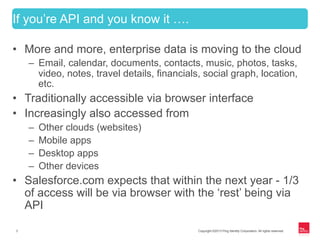
•  More and more, enterprise data is moving to the cloud
–  Email, calendar, documents, contacts, music, photos, tasks,
video, notes, travel details, financials, social graph, location,
etc.
•  Traditionally accessible via browser interface
•  Increasingly also accessed from
–  Other clouds (websites)
–  Mobile apps
–  Desktop apps
–  Other devices
•  Salesforce.com expects that within the next year - 1/3
of access will be via browser with the ‘rest’ being via
API
If you’re API and you know it ….
Copyright ©2013 Ping Identity Corporation. All rights reserved.4
On consumer web, once
prevalent API authentication
model was the so-called
‘password anti-pattern’
Copyright ©2013 Ping Identity Corporation. All rights reserved.5
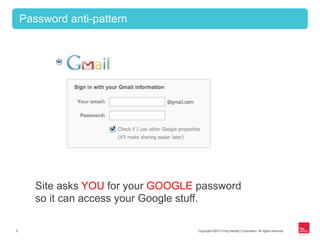
Password anti-pattern
Site asks YOU for your GOOGLE password
so it can access your Google stuff.
Copyright ©2013 Ping Identity Corporation. All rights reserved.6
•  Teaches users to be
indiscriminate with theirs
passwords
•  Distributed passwords present
breach risk
•  Doesn’t support granular
permissions, e.g. X can read but
not write
•  The hosting site is not involved in
the authorization step
•  Doesn’t support (easy) revocation
– to be sure of turning off access
users must change password
Tsk tsk!
Copyright ©2013 Ping Identity Corporation. All rights reserved.7
•  http://oauth.net/
– An open protocol to allow
secure API authorization in
a simple and standard
method from desktop and
web applications.
OAuth: Antidote to the Anti-Pattern
Copyright ©2013 Ping Identity Corporation. All rights reserved.8
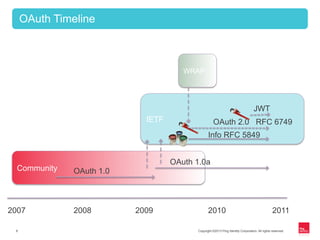
OAuth Timeline
Community
IETF
WRAP
2010 2011200920082007
OAuth 1.0
OAuth 1.0a
OAuth 2.0 RFC 6749
Info RFC 5849
JWT
Copyright ©2013 Ping Identity Corporation. All rights reserved.9
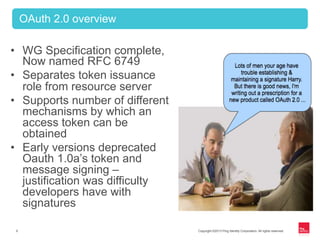
•  WG Specification complete,
Now named RFC 6749
•  Separates token issuance
role from resource server
•  Supports number of different
mechanisms by which an
access token can be
obtained
•  Early versions deprecated
Oauth 1.0a’s token and
message signing –
justification was difficulty
developers have with
signatures
OAuth 2.0 overview
Copyright ©2013 Ping Identity Corporation. All rights reserved.10
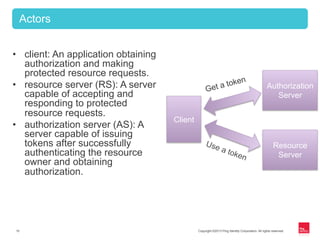
Actors
•  client: An application obtaining
authorization and making
protected resource requests.
•  resource server (RS): A server
capable of accepting and
responding to protected
resource requests.
•  authorization server (AS): A
server capable of issuing
tokens after successfully
authenticating the resource
owner and obtaining
authorization.
Client
Authorization
Server
Resource
Server
Get a token
Copyright ©2013 Ping Identity Corporation. All rights reserved.11
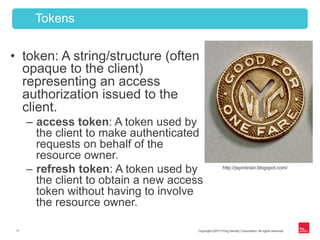
•  token: A string/structure (often
opaque to the client)
representing an access
authorization issued to the
client.
–  access token: A token used by
the client to make authenticated
requests on behalf of the
resource owner.
–  refresh token: A token used by
the client to obtain a new access
token without having to involve
the resource owner.
Tokens
http://jspinbrain.blogspot.com/
Copyright ©2013 Ping Identity Corporation. All rights reserved.12
•  May be Opaque or Structured for the
RS
•  Opaque to the client
– Format can be changed without modifying
clients
– Clients can work with multiple AS using
different token formats
•  Access tokens expire
Access Token
Copyright ©2013 Ping Identity Corporation. All rights reserved.13
•  Revocation of Refresh tokens stop
expired access tokens from being
refreshed.
•  Allow for refresh of Access token
without re-prompting the user.
•  The use of short lived access tokens
with refresh tokens relieves the RS from
needing to share state with the AS via a
back channel.
Refresh Token
Copyright ©2013 Ping Identity Corporation. All rights reserved.14
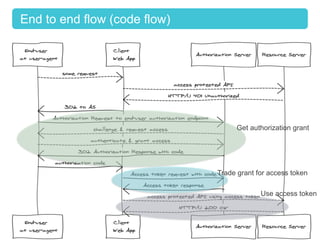
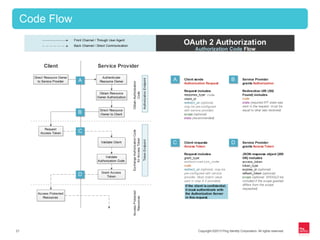
End to end flow (code flow)
Get authorization grant
Trade grant for access token
Use access token
Copyright ©2013 Ping Identity Corporation. All rights reserved.15
•  Authorization code one type of ‘authorization grant’
•  OAuth 2.0 defines others
–  Implicit (for clients that can’t keep a secret, e.g. Javascript
or embedded apps)
–  Resource owner password credentials (when the Client
can be trusted (temporarily) with the user password)
–  Client credentials (when the authorization is determined by
the client identity, and not a user’s permissions)
–  Extension point (for whatever else you might think of
exchanging for an access token)
•  It’s this flexibility that allows OAuth to support variety
of client types
Other ways to get an access token
Copyright ©2013 Ping Identity Corporation. All rights reserved.16
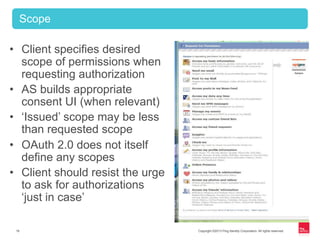
•  Client specifies desired
scope of permissions when
requesting authorization
•  AS builds appropriate
consent UI (when relevant)
•  ‘Issued’ scope may be less
than requested scope
•  OAuth 2.0 does not itself
define any scopes
•  Client should resist the urge
to ask for authorizations
‘just in case’
Scope
Copyright ©2013 Ping Identity Corporation. All rights reserved.17
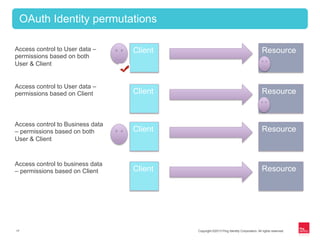
OAuth Identity permutations
Client Resource
Client Resource
Client Resource
Access control to User data –
permissions based on Client
Access control to business data
– permissions based on Client
Client Resource
Access control to Business data
– permissions based on both
User & Client
Access control to User data –
permissions based on both
User & Client
Copyright ©2013 Ping Identity Corporation. All rights reserved.18
•  Growing number of OAuth 2.0
implementations
–  Salesforce, for
•  authenticating REST API calls
•  Web server redirect flow
•  Trading SAML assertion for OAuth access token
–  Microsoft –Azure ACS
•  Evolution of OAuth WRAP support
–  Facebook – authentication & authorization for
Graph API
–  Google OpenID Connect & most API
–  PayPal OpenID Connect & X.commerce API
OAuth 2.0 adoption
Copyright ©2013 Ping Identity Corporation. All rights reserved.19
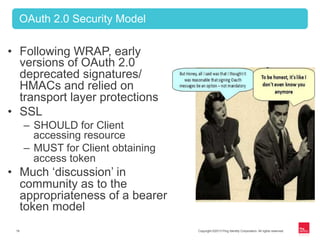
OAuth 2.0 Security Model
•  Following WRAP, early
versions of OAuth 2.0
deprecated signatures/
HMACs and relied on
transport layer protections
•  SSL
–  SHOULD for Client
accessing resource
–  MUST for Client obtaining
access token
•  Much ‘discussion’ in
community as to the
appropriateness of a bearer
token model
Copyright ©2013 Ping Identity Corporation. All rights reserved.20
Security Model cont’d
•  Compromise is for OAuth 2.0 to support
both a bearer token model as well as
(optional) client signatures
•  Monolithic spec is broken into
– ‘How to get a token’ spec RFC 6749
– ‘How to use’ a token specs
• Bearer RFC 6750
• Proof of Possession
Copyright ©2013 Ping Identity Corporation. All rights reserved.21
Code Flow
Copyright ©2013 Ping Identity Corporation. All rights reserved.22
•  A client is tricked by a resource into
presenting a access token via a http 403 error
response indicating insufficient_scope
•  The client can replay a bearer token at a real
resource that accepts the token.
Confused Deputy
Copyright ©2013 Ping Identity Corporation. All rights reserved.23
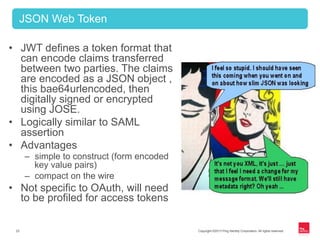
•  JWT defines a token format that
can encode claims transferred
between two parties. The claims
are encoded as a JSON object ,
this bae64urlencoded, then
digitally signed or encrypted
using JOSE.
•  Logically similar to SAML
assertion
•  Advantages
–  simple to construct (form encoded
key value pairs)
–  compact on the wire
•  Not specific to OAuth, will need
to be profiled for access tokens
JSON Web Token
Copyright ©2013 Ping Identity Corporation. All rights reserved.24
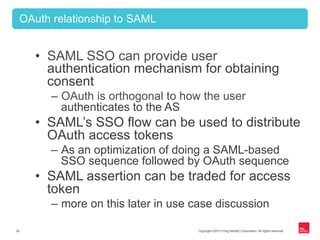
OAuth relationship to SAML
•  SAML SSO can provide user
authentication mechanism for obtaining
consent
–  OAuth is orthogonal to how the user
authenticates to the AS
•  SAML’s SSO flow can be used to distribute
OAuth access tokens
–  As an optimization of doing a SAML-based
SSO sequence followed by OAuth sequence
•  SAML assertion can be traded for access
token
–  more on this later in use case discussion
Copyright ©2013 Ping Identity Corporation. All rights reserved.25
OAuth 2.0
Use cases
Copyright ©2013 Ping Identity Corporation. All rights reserved.26
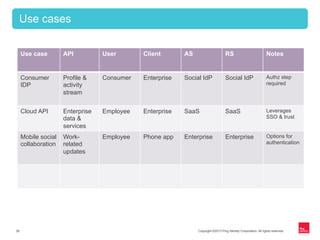
Use cases
Use case API User Client AS RS Notes
Consumer
IDP
Profile &
activity
stream
Consumer Enterprise Social IdP Social IdP Authz step
required
Cloud API Enterprise
data &
services
Employee Enterprise SaaS SaaS Leverages
SSO & trust
Mobile social
collaboration
Work-
related
updates
Employee Phone app Enterprise Enterprise Options for
authentication
Copyright ©2013 Ping Identity Corporation. All rights reserved.27
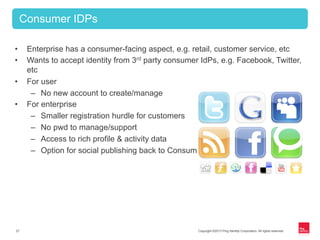
Consumer IDPs
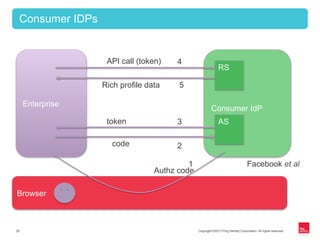
•  Enterprise has a consumer-facing aspect, e.g. retail, customer service, etc
•  Wants to accept identity from 3rd party consumer IdPs, e.g. Facebook, Twitter,
etc
•  For user
–  No new account to create/manage
•  For enterprise
–  Smaller registration hurdle for customers
–  No pwd to manage/support
–  Access to rich profile & activity data
–  Option for social publishing back to Consumer IdP
Copyright ©2013 Ping Identity Corporation. All rights reserved.28
Consumer IDPs
Enterprise
Consumer IdP
AS
RS
API call (token)
Authz code
?
Facebook et al
Browser
token
code
1
2
3
4
Rich profile data 5
Copyright ©2013 Ping Identity Corporation. All rights reserved.29
Cloud APIs
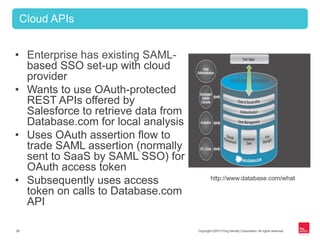
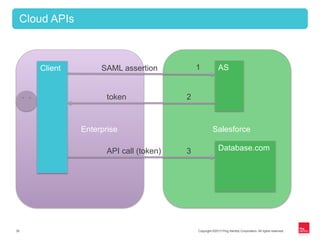
•  Enterprise has existing SAML-
based SSO set-up with cloud
provider
•  Wants to use OAuth-protected
REST APIs offered by
Salesforce to retrieve data from
Database.com for local analysis
•  Uses OAuth assertion flow to
trade SAML assertion (normally
sent to SaaS by SAML SSO) for
OAuth access token
•  Subsequently uses access
token on calls to Database.com
API
http://www.database.com/what
Copyright ©2013 Ping Identity Corporation. All rights reserved.30
Cloud APIs
Enterprise Salesforce
AS
Database.com
SAML assertion
token
API call (token)
1
2
3
Client
Copyright ©2013 Ping Identity Corporation. All rights reserved.31
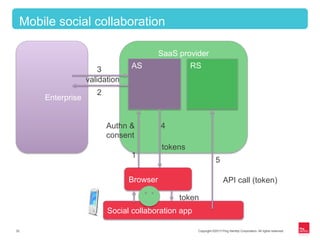
Mobile social collaboration
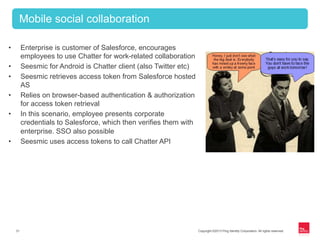
•  Enterprise is customer of Salesforce, encourages
employees to use Chatter for work-related collaboration
•  Seesmic for Android is Chatter client (also Twitter etc)
•  Seesmic retrieves access token from Salesforce hosted
AS
•  Relies on browser-based authentication & authorization
for access token retrieval
•  In this scenario, employee presents corporate
credentials to Salesforce, which then verifies them with
enterprise. SSO also possible
•  Seesmic uses access tokens to call Chatter API
Copyright ©2013 Ping Identity Corporation. All rights reserved.32
Mobile social collaboration
Enterprise
SaaS provider
AS RS
API call (token)Browser
Social collaboration app
token
Authn &
consent
1
2
3
tokens
validation
4
5
Copyright ©2013 Ping Identity Corporation. All rights reserved.33
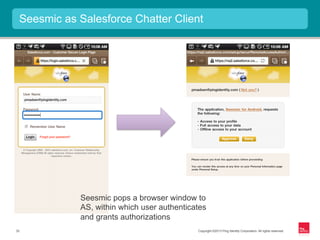
Seesmic as Salesforce Chatter Client
Seesmic pops a browser window to
AS, within which user authenticates
and grants authorizations
Copyright ©2013 Ping Identity Corporation. All rights reserved.34
Questions?
•  Related whitepaper at
pingidentity.com – ‘Essentials of
OAuth’
•  John Bradley tweets at @ve7jtb

CIS13: Introduction to OAuth 2.0

  • 1.
    Copyright ©2013 PingIdentity Corporation. All rights reserved.1 OAuth2 John Bradley, Sr. Technical Architect, Ping Identity
  • 2.
    Copyright ©2013 PingIdentity Corporation. All rights reserved.2 Copyright ©2013 Ping Identity Corporation. All rights reserved.2 OAuth 2.0
  • 3.
    Copyright ©2013 PingIdentity Corporation. All rights reserved.3 •  More and more, enterprise data is moving to the cloud –  Email, calendar, documents, contacts, music, photos, tasks, video, notes, travel details, financials, social graph, location, etc. •  Traditionally accessible via browser interface •  Increasingly also accessed from –  Other clouds (websites) –  Mobile apps –  Desktop apps –  Other devices •  Salesforce.com expects that within the next year - 1/3 of access will be via browser with the ‘rest’ being via API If you’re API and you know it ….
  • 4.
    Copyright ©2013 PingIdentity Corporation. All rights reserved.4 On consumer web, once prevalent API authentication model was the so-called ‘password anti-pattern’
  • 5.
    Copyright ©2013 PingIdentity Corporation. All rights reserved.5 Password anti-pattern Site asks YOU for your GOOGLE password so it can access your Google stuff.
  • 6.
    Copyright ©2013 PingIdentity Corporation. All rights reserved.6 •  Teaches users to be indiscriminate with theirs passwords •  Distributed passwords present breach risk •  Doesn’t support granular permissions, e.g. X can read but not write •  The hosting site is not involved in the authorization step •  Doesn’t support (easy) revocation – to be sure of turning off access users must change password Tsk tsk!
  • 7.
    Copyright ©2013 PingIdentity Corporation. All rights reserved.7 •  http://oauth.net/ – An open protocol to allow secure API authorization in a simple and standard method from desktop and web applications. OAuth: Antidote to the Anti-Pattern
  • 8.
    Copyright ©2013 PingIdentity Corporation. All rights reserved.8 OAuth Timeline Community IETF WRAP 2010 2011200920082007 OAuth 1.0 OAuth 1.0a OAuth 2.0 RFC 6749 Info RFC 5849 JWT
  • 9.
    Copyright ©2013 PingIdentity Corporation. All rights reserved.9 •  WG Specification complete, Now named RFC 6749 •  Separates token issuance role from resource server •  Supports number of different mechanisms by which an access token can be obtained •  Early versions deprecated Oauth 1.0a’s token and message signing – justification was difficulty developers have with signatures OAuth 2.0 overview
  • 10.
    Copyright ©2013 PingIdentity Corporation. All rights reserved.10 Actors •  client: An application obtaining authorization and making protected resource requests. •  resource server (RS): A server capable of accepting and responding to protected resource requests. •  authorization server (AS): A server capable of issuing tokens after successfully authenticating the resource owner and obtaining authorization. Client Authorization Server Resource Server Get a token
  • 11.
    Copyright ©2013 PingIdentity Corporation. All rights reserved.11 •  token: A string/structure (often opaque to the client) representing an access authorization issued to the client. –  access token: A token used by the client to make authenticated requests on behalf of the resource owner. –  refresh token: A token used by the client to obtain a new access token without having to involve the resource owner. Tokens http://jspinbrain.blogspot.com/
  • 12.
    Copyright ©2013 PingIdentity Corporation. All rights reserved.12 •  May be Opaque or Structured for the RS •  Opaque to the client – Format can be changed without modifying clients – Clients can work with multiple AS using different token formats •  Access tokens expire Access Token
  • 13.
    Copyright ©2013 PingIdentity Corporation. All rights reserved.13 •  Revocation of Refresh tokens stop expired access tokens from being refreshed. •  Allow for refresh of Access token without re-prompting the user. •  The use of short lived access tokens with refresh tokens relieves the RS from needing to share state with the AS via a back channel. Refresh Token
  • 14.
    Copyright ©2013 PingIdentity Corporation. All rights reserved.14 End to end flow (code flow) Get authorization grant Trade grant for access token Use access token
  • 15.
    Copyright ©2013 PingIdentity Corporation. All rights reserved.15 •  Authorization code one type of ‘authorization grant’ •  OAuth 2.0 defines others –  Implicit (for clients that can’t keep a secret, e.g. Javascript or embedded apps) –  Resource owner password credentials (when the Client can be trusted (temporarily) with the user password) –  Client credentials (when the authorization is determined by the client identity, and not a user’s permissions) –  Extension point (for whatever else you might think of exchanging for an access token) •  It’s this flexibility that allows OAuth to support variety of client types Other ways to get an access token
  • 16.
    Copyright ©2013 PingIdentity Corporation. All rights reserved.16 •  Client specifies desired scope of permissions when requesting authorization •  AS builds appropriate consent UI (when relevant) •  ‘Issued’ scope may be less than requested scope •  OAuth 2.0 does not itself define any scopes •  Client should resist the urge to ask for authorizations ‘just in case’ Scope
  • 17.
    Copyright ©2013 PingIdentity Corporation. All rights reserved.17 OAuth Identity permutations Client Resource Client Resource Client Resource Access control to User data – permissions based on Client Access control to business data – permissions based on Client Client Resource Access control to Business data – permissions based on both User & Client Access control to User data – permissions based on both User & Client
  • 18.
    Copyright ©2013 PingIdentity Corporation. All rights reserved.18 •  Growing number of OAuth 2.0 implementations –  Salesforce, for •  authenticating REST API calls •  Web server redirect flow •  Trading SAML assertion for OAuth access token –  Microsoft –Azure ACS •  Evolution of OAuth WRAP support –  Facebook – authentication & authorization for Graph API –  Google OpenID Connect & most API –  PayPal OpenID Connect & X.commerce API OAuth 2.0 adoption
  • 19.
    Copyright ©2013 PingIdentity Corporation. All rights reserved.19 OAuth 2.0 Security Model •  Following WRAP, early versions of OAuth 2.0 deprecated signatures/ HMACs and relied on transport layer protections •  SSL –  SHOULD for Client accessing resource –  MUST for Client obtaining access token •  Much ‘discussion’ in community as to the appropriateness of a bearer token model
  • 20.
    Copyright ©2013 PingIdentity Corporation. All rights reserved.20 Security Model cont’d •  Compromise is for OAuth 2.0 to support both a bearer token model as well as (optional) client signatures •  Monolithic spec is broken into – ‘How to get a token’ spec RFC 6749 – ‘How to use’ a token specs • Bearer RFC 6750 • Proof of Possession
  • 21.
    Copyright ©2013 PingIdentity Corporation. All rights reserved.21 Code Flow
  • 22.
    Copyright ©2013 PingIdentity Corporation. All rights reserved.22 •  A client is tricked by a resource into presenting a access token via a http 403 error response indicating insufficient_scope •  The client can replay a bearer token at a real resource that accepts the token. Confused Deputy
  • 23.
    Copyright ©2013 PingIdentity Corporation. All rights reserved.23 •  JWT defines a token format that can encode claims transferred between two parties. The claims are encoded as a JSON object , this bae64urlencoded, then digitally signed or encrypted using JOSE. •  Logically similar to SAML assertion •  Advantages –  simple to construct (form encoded key value pairs) –  compact on the wire •  Not specific to OAuth, will need to be profiled for access tokens JSON Web Token
  • 24.
    Copyright ©2013 PingIdentity Corporation. All rights reserved.24 OAuth relationship to SAML •  SAML SSO can provide user authentication mechanism for obtaining consent –  OAuth is orthogonal to how the user authenticates to the AS •  SAML’s SSO flow can be used to distribute OAuth access tokens –  As an optimization of doing a SAML-based SSO sequence followed by OAuth sequence •  SAML assertion can be traded for access token –  more on this later in use case discussion
  • 25.
    Copyright ©2013 PingIdentity Corporation. All rights reserved.25 Copyright ©2013 Ping Identity Corporation. All rights reserved.25 OAuth 2.0 Use cases
  • 26.
    Copyright ©2013 PingIdentity Corporation. All rights reserved.26 Use cases Use case API User Client AS RS Notes Consumer IDP Profile & activity stream Consumer Enterprise Social IdP Social IdP Authz step required Cloud API Enterprise data & services Employee Enterprise SaaS SaaS Leverages SSO & trust Mobile social collaboration Work- related updates Employee Phone app Enterprise Enterprise Options for authentication
  • 27.
    Copyright ©2013 PingIdentity Corporation. All rights reserved.27 Consumer IDPs •  Enterprise has a consumer-facing aspect, e.g. retail, customer service, etc •  Wants to accept identity from 3rd party consumer IdPs, e.g. Facebook, Twitter, etc •  For user –  No new account to create/manage •  For enterprise –  Smaller registration hurdle for customers –  No pwd to manage/support –  Access to rich profile & activity data –  Option for social publishing back to Consumer IdP
  • 28.
    Copyright ©2013 PingIdentity Corporation. All rights reserved.28 Consumer IDPs Enterprise Consumer IdP AS RS API call (token) Authz code ? Facebook et al Browser token code 1 2 3 4 Rich profile data 5
  • 29.
    Copyright ©2013 PingIdentity Corporation. All rights reserved.29 Cloud APIs •  Enterprise has existing SAML- based SSO set-up with cloud provider •  Wants to use OAuth-protected REST APIs offered by Salesforce to retrieve data from Database.com for local analysis •  Uses OAuth assertion flow to trade SAML assertion (normally sent to SaaS by SAML SSO) for OAuth access token •  Subsequently uses access token on calls to Database.com API http://www.database.com/what
  • 30.
    Copyright ©2013 PingIdentity Corporation. All rights reserved.30 Cloud APIs Enterprise Salesforce AS Database.com SAML assertion token API call (token) 1 2 3 Client
  • 31.
    Copyright ©2013 PingIdentity Corporation. All rights reserved.31 Mobile social collaboration •  Enterprise is customer of Salesforce, encourages employees to use Chatter for work-related collaboration •  Seesmic for Android is Chatter client (also Twitter etc) •  Seesmic retrieves access token from Salesforce hosted AS •  Relies on browser-based authentication & authorization for access token retrieval •  In this scenario, employee presents corporate credentials to Salesforce, which then verifies them with enterprise. SSO also possible •  Seesmic uses access tokens to call Chatter API
  • 32.
    Copyright ©2013 PingIdentity Corporation. All rights reserved.32 Mobile social collaboration Enterprise SaaS provider AS RS API call (token)Browser Social collaboration app token Authn & consent 1 2 3 tokens validation 4 5
  • 33.
    Copyright ©2013 PingIdentity Corporation. All rights reserved.33 Seesmic as Salesforce Chatter Client Seesmic pops a browser window to AS, within which user authenticates and grants authorizations
  • 34.
    Copyright ©2013 PingIdentity Corporation. All rights reserved.34 Questions? •  Related whitepaper at pingidentity.com – ‘Essentials of OAuth’ •  John Bradley tweets at @ve7jtb