© 2014 CA. All rights reserved.
OAuth In The Real World
How today’s authorization experts get
maximum value from OAuth
K. Scott Morrison
Senior Vice President and Distinguished Engineer
April 2014
Mehdi Medjaoul
Co-Founder & Executive Director of Webshell
2 © 2014 CA. All rights reserved.
Housekeeping
Layer 7
@layer7
layer7.com/blogs
layer7.com
Chat questions into the
sidebar or use hashtag:
#L7webinar
Webshell.io
@Webshell_
3 © 2014 CA. All rights reserved.
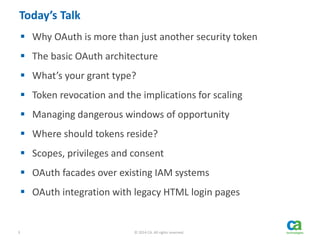
Today’s Talk
 Why OAuth is more than just another security token
 The basic OAuth architecture
 What’s your grant type?
 Token revocation and the implications for scaling
 Managing dangerous windows of opportunity
 Where should tokens reside?
 Scopes, privileges and consent
 OAuth facades over existing IAM systems
 OAuth integration with legacy HTML login pages
4 © 2014 CA. All rights reserved.
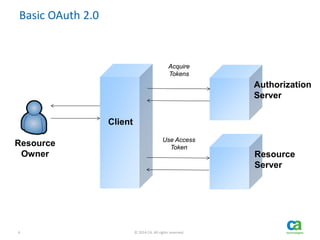
Basic OAuth 2.0
Client
Authorization
Server
Resource
Server
Resource
Owner
Acquire
Tokens
Use Access
Token
5 © 2014 CA. All rights reserved.
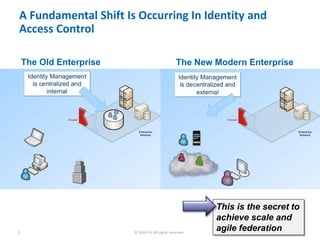
A Fundamental Shift Is Occurring In Identity and
Access Control
The Old Enterprise The New Modern Enterprise
This is the secret to
achieve scale and
agile federation
6 © 2014 CA. All rights reserved.
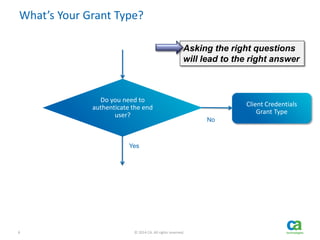
What’s Your Grant Type?
Do you need to
authenticate the end
user?
No
Yes
Client Credentials
Grant Type
Asking the right questions
will lead to the right answer
7 © 2014 CA. All rights reserved.
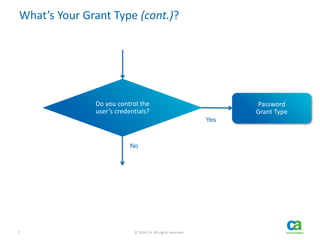
What’s Your Grant Type (cont.)?
Do you control the
user’s credentials?
Yes
No
Password
Grant Type
8 © 2014 CA. All rights reserved.
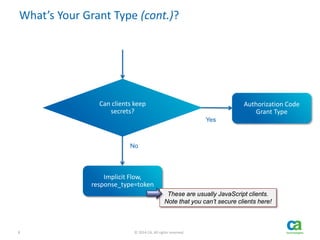
What’s Your Grant Type (cont.)?
Can clients keep
secrets?
Yes
No
Authorization Code
Grant Type
Implicit Flow,
response_type=token
These are usually JavaScript clients.
Note that you can’t secure clients here!
9 © 2014 CA. All rights reserved.
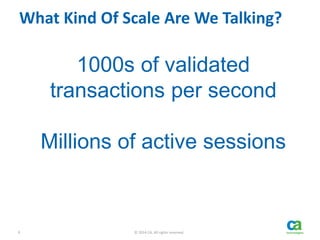
What Kind Of Scale Are We Talking?
1000s of validated
transactions per second
Millions of active sessions
10 © 2014 CA. All rights reserved.
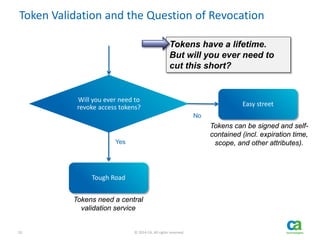
Token Validation and the Question of Revocation
Will you ever need to
revoke access tokens?
No
Yes
Easy street
Tough Road
Tokens have a lifetime.
But will you ever need to
cut this short?
Tokens can be signed and self-
contained (incl. expiration time,
scope, and other attributes).
Tokens need a central
validation service
11 © 2014 CA. All rights reserved.
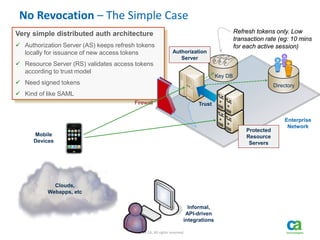
No Revocation – The Simple Case
Very simple distributed auth architecture
 Authorization Server (AS) keeps refresh tokens
locally for issuance of new access tokens
 Resource Server (RS) validates access tokens
according to trust model
 Need signed tokens
 Kind of like SAML
Enterprise
Network
Informal,
API-driven
integrations
Firewall
Mobile
Devices
Clouds,
Webapps, etc
Authorization
Server
Key DB
Directory
Protected
Resource
Servers
Trust
Refresh tokens only. Low
transaction rate (eg: 10 mins
for each active session)
12 © 2014 CA. All rights reserved.
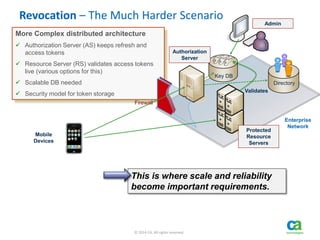
Revocation – The Much Harder Scenario
More Complex distributed architecture
 Authorization Server (AS) keeps refresh and
access tokens
 Resource Server (RS) validates access tokens
live (various options for this)
 Scalable DB needed
 Security model for token storage
Enterprise
Network
Firewall
Mobile
Devices
Authorization
Server
Key DB
Directory
Protected
Resource
Servers
Validates
Admin
This is where scale and reliability
become important requirements.
13 © 2014 CA. All rights reserved.
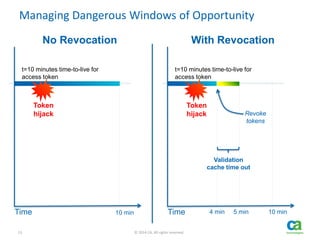
Managing Dangerous Windows of Opportunity
Time
t=10 minutes time-to-live for
access token
No Revocation
Token
hijack
10 min Time
t=10 minutes time-to-live for
access token
With Revocation
Token
hijack
4 min 5 min 10 min
Validation
cache time out
Revoke
tokens
14 © 2014 CA. All rights reserved.
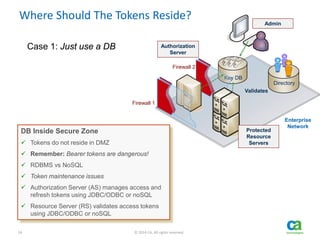
Where Should The Tokens Reside?
Enterprise
Network
Firewall 1
Authorization
Server
Directory
Validates
Admin
Key DB
Firewall 2
Protected
Resource
Servers
DB Inside Secure Zone
 Tokens do not reside in DMZ
 Remember: Bearer tokens are dangerous!
 RDBMS vs NoSQL
 Token maintenance issues
 Authorization Server (AS) manages access and
refresh tokens using JDBC/ODBC or noSQL
 Resource Server (RS) validates access tokens
using JDBC/ODBC or noSQL
Case 1: Just use a DB
15 © 2014 CA. All rights reserved.
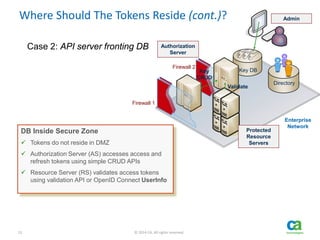
Where Should The Tokens Reside (cont.)?
Enterprise
Network
Firewall 1
Authorization
Server
Directory
Admin
Key DB
Firewall 2
DB Inside Secure Zone
 Tokens do not reside in DMZ
 Authorization Server (AS) accesses access and
refresh tokens using simple CRUD APIs
 Resource Server (RS) validates access tokens
using validation API or OpenID Connect UserInfo
Case 2: API server fronting DB
Validate
Key
CRUD
Protected
Resource
Servers
16 © 2014 CA. All rights reserved.
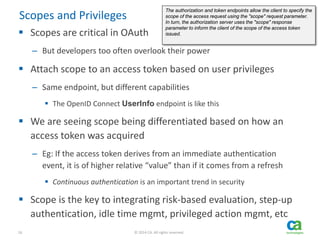
Scopes and Privileges
 Scopes are critical in OAuth
– But developers too often overlook their power
 Attach scope to an access token based on user privileges
– Same endpoint, but different capabilities
 The OpenID Connect UserInfo endpoint is like this
 We are seeing scope being differentiated based on how an
access token was acquired
– Eg: If the access token derives from an immediate authentication
event, it is of higher relative “value” than if it comes from a refresh
 Continuous authentication is an important trend in security
 Scope is the key to integrating risk-based evaluation, step-up
authentication, idle time mgmt, privileged action mgmt, etc
The authorization and token endpoints allow the client to specify the
scope of the access request using the "scope" request parameter.
In turn, the authorization server uses the "scope" response
parameter to inform the client of the scope of the access token
issued.
17 © 2014 CA. All rights reserved.
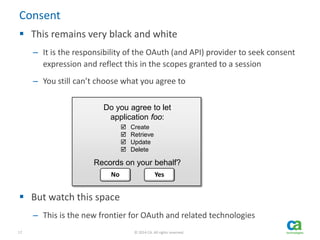
Consent
 This remains very black and white
– It is the responsibility of the OAuth (and API) provider to seek consent
expression and reflect this in the scopes granted to a session
– You still can’t choose what you agree to
 But watch this space
– This is the new frontier for OAuth and related technologies
Do you agree to let
application foo:
Records on your behalf?
 Create
 Retrieve
 Update
 Delete
No Yes
18 © 2014 CA. All rights reserved.
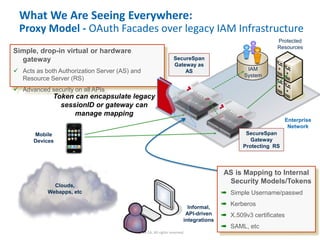
What We Are Seeing Everywhere:
Proxy Model - OAuth Facades over legacy IAM Infrastructure
Simple, drop-in virtual or hardware
gateway
 Acts as both Authorization Server (AS) and
Resource Server (RS)
 Advanced security on all APIs
Enterprise
Network
Informal,
API-driven
integrations
Mobile
Devices
Clouds,
Webapps, etc
Protected
Resources
SecureSpan
Gateway as
AS IAM
System
SecureSpan
Gateway
Protecting RS
Token can encapsulate legacy
sessionID or gateway can
manage mapping
AS is Mapping to Internal
Security Models/Tokens
➠ Simple Username/passwd
➠ Kerberos
➠ X.509v3 certificates
➠ SAML, etc
19 © 2014 CA. All rights reserved.
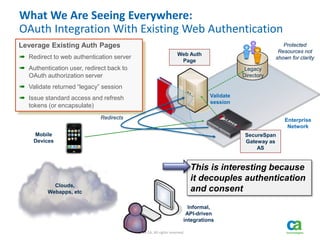
What We Are Seeing Everywhere:
OAuth Integration With Existing Web Authentication
Enterprise
Network
Informal,
API-driven
integrations
Mobile
Devices
Clouds,
Webapps, etc
Protected
Resources not
shown for clarity
SecureSpan
Gateway as
AS
Leverage Existing Auth Pages
➠ Redirect to web authentication server
➠ Authentication user, redirect back to
OAuth authorization server
➠ Validate returned “legacy” session
➠ Issue standard access and refresh
tokens (or encapsulate)
Legacy
Directory
Web Auth
Page
Validate
session
Redirects
This is interesting because
it decouples authentication
and consent
20 © 2014 CA. All rights reserved.
Summary
 You can tell OAuth is mature because its boundaries are being
pushed.
 But there is still considerable misunderstanding about how to
use OAuth effectively.
 Scalability and reliability remain difficult
 We highly recommend you use proven solutions rather than
trying to cobble together a solution.
@medjawii
OAuth.io@medjawii
APIscene.com
Are you getting the
maximum from OAuth?
OAuth.io@medjawii
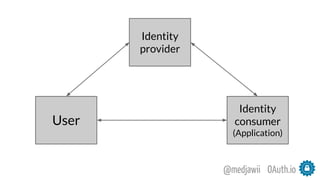
Identity
provider
Identity
consumer
(Application)
User
OAuth.io@medjawii
OAuth.io@medjawii
OAuth
provider
OAuth
consumer
(Application)
User
OAuth.io@medjawii
OAuth.io@medjawii
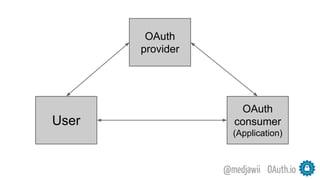
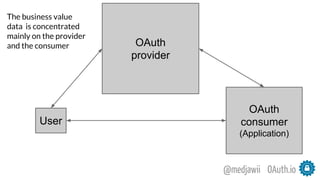
OAuth
provider
OAuth
consumer
(Application)
User
The business value
data is concentrated
mainly on the provider
and the consumer
OAuth.io@medjawii
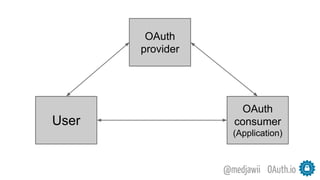
OAuth
provider
OAuth
consumer
(Application)
User
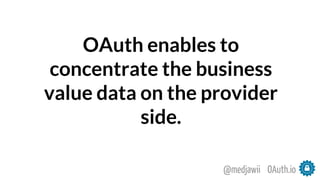
OAuth enables to
concentrate the business
value data on the provider
side.
OAuth.io@medjawii
The tale of 2 OAuth...
OAuth.io@medjawii
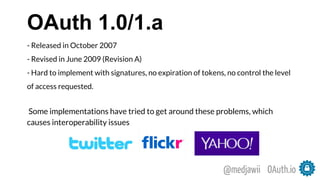
OAuth 1.0/1.a
- Released in October 2007
- Revised in June 2009 (Revision A)
- Hard to implement with signatures, no expiration of tokens, no control the level
of access requested.
Some implementations have tried to get around these problems, which
causes interoperability issues
OAuth.io@medjawii
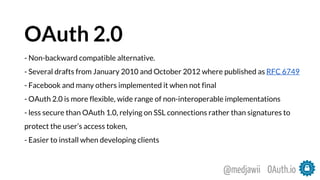
OAuth 2.0
- Non-backward compatible alternative.
- Several drafts from January 2010 and October 2012 where published as RFC 6749
- Facebook and many others implemented it when not final
- OAuth 2.0 is more flexible, wide range of non-interoperable implementations
- less secure than OAuth 1.0, relying on SSL connections rather than signatures to
protect the user’s access token,
- Easier to install when developing clients
OAuth.io@medjawii
The tale of 2 OAuth...
OAuth.io@medjawii
The tale of too many OAuth...
OAuth.io@medjawii
10 OAuth implementations
you can’t guess…
that differ from RFC6949
OAuth.io@medjawii
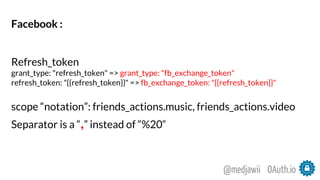
Facebook :
Refresh_token
grant_type: "refresh_token" => grant_type: "fb_exchange_token"
refresh_token: "{{refresh_token}}" => fb_exchange_token: "{{refresh_token}}"
scope “notation”: friends_actions.music, friends_actions.video
Separator is a “,” instead of “%20“
OAuth.io@medjawii
Deezer
client_id -> app_id=...
scope -> perms=email,read_friendlists...
state=... [non documented]
response_type=code [useless]
“Facebook is the standard”
OAuth.io@medjawii
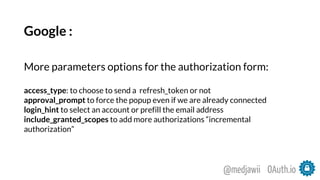
Google :
More parameters options for the authorization form:
access_type: to choose to send a refresh_token or not
approval_prompt to force the popup even if we are already connected
login_hint to select an account or prefill the email address
include_granted_scopes to add more authorizations “incremental
authorization”
OAuth.io@medjawii
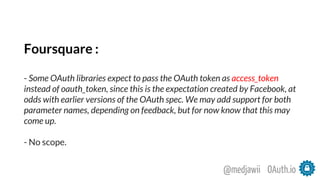
Foursquare :
- Some OAuth libraries expect to pass the OAuth token as access_token
instead of oauth_token, since this is the expectation created by Facebook, at
odds with earlier versions of the OAuth spec. We may add support for both
parameter names, depending on feedback, but for now know that this may
come up.
- No scope.
OAuth.io@medjawii
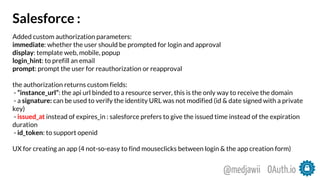
Salesforce :
Added custom authorization parameters:
immediate: whether the user should be prompted for login and approval
display: template web, mobile, popup
login_hint: to prefill an email
prompt: prompt the user for reauthorization or reapproval
the authorization returns custom fields:
- “instance_url”: the api url binded to a resource server, this is the only way to receive the domain
- a signature: can be used to verify the identity URL was not modified (id & date signed with a private
key)
- issued_at instead of expires_in : salesforce prefers to give the issued time instead of the expiration
duration
- id_token: to support openid
UX for creating an app (4 not-so-easy to find mouseclicks between login & the app creation form)
OAuth.io@medjawii
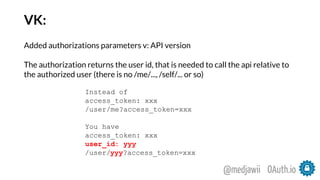
VK:
Added authorizations parameters v: API version
The authorization returns the user id, that is needed to call the api relative to
the authorized user (there is no /me/..., /self/... or so)
Instead of
access_token: xxx
/user/me?access_token=xxx
You have
access_token: xxx
user_id: yyy
/user/yyy?access_token=xxx
OAuth.io@medjawii
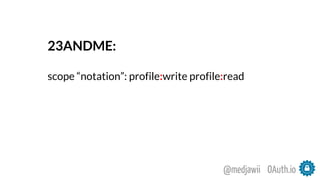
23ANDME:
scope “notation”: profile:write profile:read
OAuth.io@medjawii
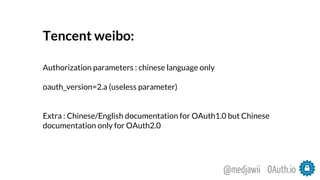
Tencent weibo:
Authorization parameters : chinese language only
oauth_version=2.a (useless parameter)
Extra : Chinese/English documentation for OAuth1.0 but Chinese
documentation only for OAuth2.0
OAuth.io@medjawii
This was just non exhaustive.
OAuth.io@medjawii
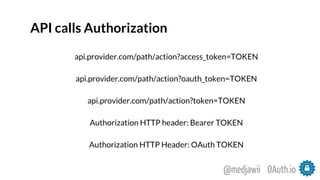
API calls Authorization
api.provider.com/path/action?access_token=TOKEN
api.provider.com/path/action?oauth_token=TOKEN
api.provider.com/path/action?token=TOKEN
Authorization HTTP header: Bearer TOKEN
Authorization HTTP Header: OAuth TOKEN
OAuth.io@medjawii
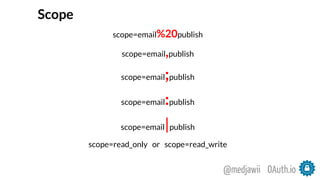
Scope
scope=email%20publish
scope=email,publish
scope=email;publish
scope=email:publish
scope=email|publish
scope=read_only or scope=read_write
OAuth.io@medjawii
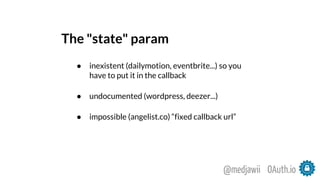
The "state" param
● inexistent (dailymotion, eventbrite...) so you
have to put it in the callback
● undocumented (wordpress, deezer...)
● impossible (angelist.co) “fixed callback url”
OAuth.io@medjawii
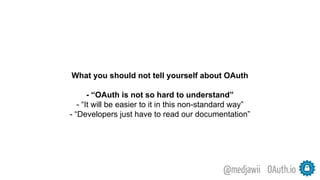
What you should not tell yourself about OAuth
- “OAuth is not so hard to understand”
- “It will be easier to it in this non-standard way”
- “Developers just have to read our documentation”
OAuth.io@medjawii
April fool: Introducing OAuth 3:0
- “0 token” paradigm
- No more secret key, everything public
The huge majority did not understand...
OAuth.io@medjawii
What you should not tell yourself about OAuth
- “OAuth is not so hard to understand”
- “It will be easier to it in this non-standard way”
- “Developers just have to read our documentation”
OAuth.io@medjawii
Even if you are right,
3rd party developers will be lost…
because of others providers already
did it wrong before you
OAuth.io@medjawii
What you should not tell yourself about OAuth
- “OAuth is not so hard to understand”
- “It will be easier to it in this non-standard way”
- “Developers just have to read our documentation”
OAuth.io@medjawii
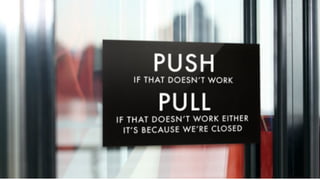
“In a design perspective,
documentation is a bug, not a feature”
It is the most important but the last place to find information
OAuth.io@medjawii
OAuth.io@medjawii
Devil’s in the details.
OAuth.io@medjawii
OAuth.io
100+ providers unified
and simplified
OAuth.io@medjawii
OAuth.io@medjawii
To retrieve you token
OAuth.io@medjawii
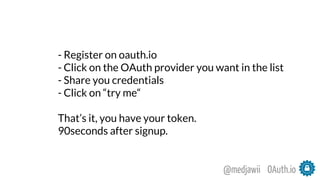
- Register on oauth.io
- Click on the OAuth provider you want in the list
- Share you credentials
- Click on “try me“
That’s it, you have your token.
90seconds after signup.
OAuth.io@medjawii
And for generating the pop-
up?
OAuth.io@medjawii
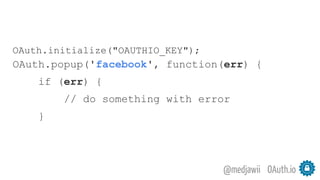
OAuth.initialize("OAUTHIO_KEY");
OAuth.popup('facebook', function(err) {
if (err) {
// do something with error
}
OAuth.io@medjawii
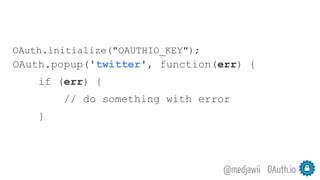
OAuth.initialize("OAUTHIO_KEY");
OAuth.popup('twitter', function(err) {
if (err) {
// do something with error
}
OAuth.io@medjawii
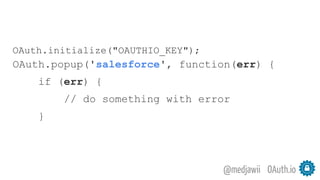
OAuth.initialize("OAUTHIO_KEY");
OAuth.popup('salesforce', function(err) {
if (err) {
// do something with error
}
OAuth.io@medjawii
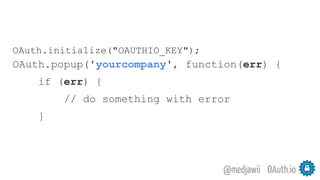
OAuth.initialize("OAUTHIO_KEY");
OAuth.popup('yourcompany', function(err) {
if (err) {
// do something with error
}
OAuth.io@medjawii
And for deeper APIs calls?
OAuth.io@medjawii
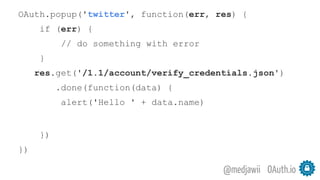
OAuth.popup('twitter', function(err, res) {
if (err) {
// do something with error
}
res.get('/1.1/account/verify_credentials.json')
.done(function(data) {
alert('Hello ' + data.name)
})
})
OAuth.io@medjawii
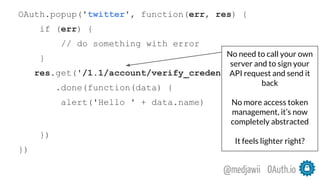
OAuth.popup('twitter', function(err, res) {
if (err) {
// do something with error
}
res.get('/1.1/account/verify_credentials.json')
.done(function(data) {
alert('Hello ' + data.name)
})
})
No need to call your own
server and to sign your
API request and send it
back
No more access token
management, it’s now
completely abstracted
It feels lighter right?
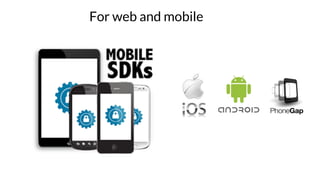
For web and mobile
Open source : oauthd for on premises
implementation to consume your own oauth
https://github.com/oauth-io/oauthd
Easy contributions process,
with a small JSON to fill on github
Questions?
Scott.Morrison@ca.com
@KScottMorrison
slideshare.net/CAinc
linkedin.com/KScottMorrison
ca.com
K. Scott Morrison
Distinguished Engineer
23 Copyright © 2014 CA. All rights reserved.
© Copyright CA 2013. All rights reserved. All trademarks, trade names, service marks and logos referenced herein belong to their respective
companies. No unauthorized use, copying or distribution permitted.
THIS PRESENTATION IS FOR YOUR INFORMATIONAL PURPOSES ONLY. CA assumes no responsibility for the accuracy or completeness of the
information. TO THE EXTENT PERMITTED BY APPLICABLE LAW, CA PROVIDES THIS DOCUMENT “AS IS” WITHOUT WARRANTY OF ANY KIND, INCLUDING,
WITHOUT LIMITATION, ANY IMPLIED WARRANTIES OF MERCHANTABILITY, FITNESS FOR A PARTICULAR PURPOSE, OR NONINFRINGEMENT. In no event
will CA be liable for any loss or damage, direct or indirect, in connection with this presentation, including, without limitation, lost profits, lost
investment, business interruption, goodwill, or lost data, even if CA is expressly advised of the possibility of such damages.
Certain information in this presentation may outline CA’s general product direction. This presentation shall not serve to (i) affect the rights and/or
obligations of CA or its licensees under any existing or future written license agreement or services agreement relating to any CA software product; or
(ii) amend any product documentation or specifications for any CA software product. The development, release and timing of any features or
functionality described in this presentation remain at CA’s sole discretion.
Notwithstanding anything in this presentation to the contrary, upon the general availability of any future CA product release referenced in this
presentation, CA may make such release available (i) for sale to new licensees of such product; and (ii) in the form of a regularly scheduled major
product release. Such releases may be made available to current licensees of such product who are current subscribers to CA maintenance and support
on a when and if-available basis.
notices

OAuth in the Real World featuring Webshell

  • 1.
    © 2014 CA.All rights reserved. OAuth In The Real World How today’s authorization experts get maximum value from OAuth K. Scott Morrison Senior Vice President and Distinguished Engineer April 2014 Mehdi Medjaoul Co-Founder & Executive Director of Webshell
  • 2.
    2 © 2014CA. All rights reserved. Housekeeping Layer 7 @layer7 layer7.com/blogs layer7.com Chat questions into the sidebar or use hashtag: #L7webinar Webshell.io @Webshell_
  • 3.
    3 © 2014CA. All rights reserved. Today’s Talk  Why OAuth is more than just another security token  The basic OAuth architecture  What’s your grant type?  Token revocation and the implications for scaling  Managing dangerous windows of opportunity  Where should tokens reside?  Scopes, privileges and consent  OAuth facades over existing IAM systems  OAuth integration with legacy HTML login pages
  • 4.
    4 © 2014CA. All rights reserved. Basic OAuth 2.0 Client Authorization Server Resource Server Resource Owner Acquire Tokens Use Access Token
  • 5.
    5 © 2014CA. All rights reserved. A Fundamental Shift Is Occurring In Identity and Access Control The Old Enterprise The New Modern Enterprise This is the secret to achieve scale and agile federation
  • 6.
    6 © 2014CA. All rights reserved. What’s Your Grant Type? Do you need to authenticate the end user? No Yes Client Credentials Grant Type Asking the right questions will lead to the right answer
  • 7.
    7 © 2014CA. All rights reserved. What’s Your Grant Type (cont.)? Do you control the user’s credentials? Yes No Password Grant Type
  • 8.
    8 © 2014CA. All rights reserved. What’s Your Grant Type (cont.)? Can clients keep secrets? Yes No Authorization Code Grant Type Implicit Flow, response_type=token These are usually JavaScript clients. Note that you can’t secure clients here!
  • 9.
    9 © 2014CA. All rights reserved. What Kind Of Scale Are We Talking? 1000s of validated transactions per second Millions of active sessions
  • 10.
    10 © 2014CA. All rights reserved. Token Validation and the Question of Revocation Will you ever need to revoke access tokens? No Yes Easy street Tough Road Tokens have a lifetime. But will you ever need to cut this short? Tokens can be signed and self- contained (incl. expiration time, scope, and other attributes). Tokens need a central validation service
  • 11.
    11 © 2014CA. All rights reserved. No Revocation – The Simple Case Very simple distributed auth architecture  Authorization Server (AS) keeps refresh tokens locally for issuance of new access tokens  Resource Server (RS) validates access tokens according to trust model  Need signed tokens  Kind of like SAML Enterprise Network Informal, API-driven integrations Firewall Mobile Devices Clouds, Webapps, etc Authorization Server Key DB Directory Protected Resource Servers Trust Refresh tokens only. Low transaction rate (eg: 10 mins for each active session)
  • 12.
    12 © 2014CA. All rights reserved. Revocation – The Much Harder Scenario More Complex distributed architecture  Authorization Server (AS) keeps refresh and access tokens  Resource Server (RS) validates access tokens live (various options for this)  Scalable DB needed  Security model for token storage Enterprise Network Firewall Mobile Devices Authorization Server Key DB Directory Protected Resource Servers Validates Admin This is where scale and reliability become important requirements.
  • 13.
    13 © 2014CA. All rights reserved. Managing Dangerous Windows of Opportunity Time t=10 minutes time-to-live for access token No Revocation Token hijack 10 min Time t=10 minutes time-to-live for access token With Revocation Token hijack 4 min 5 min 10 min Validation cache time out Revoke tokens
  • 14.
    14 © 2014CA. All rights reserved. Where Should The Tokens Reside? Enterprise Network Firewall 1 Authorization Server Directory Validates Admin Key DB Firewall 2 Protected Resource Servers DB Inside Secure Zone  Tokens do not reside in DMZ  Remember: Bearer tokens are dangerous!  RDBMS vs NoSQL  Token maintenance issues  Authorization Server (AS) manages access and refresh tokens using JDBC/ODBC or noSQL  Resource Server (RS) validates access tokens using JDBC/ODBC or noSQL Case 1: Just use a DB
  • 15.
    15 © 2014CA. All rights reserved. Where Should The Tokens Reside (cont.)? Enterprise Network Firewall 1 Authorization Server Directory Admin Key DB Firewall 2 DB Inside Secure Zone  Tokens do not reside in DMZ  Authorization Server (AS) accesses access and refresh tokens using simple CRUD APIs  Resource Server (RS) validates access tokens using validation API or OpenID Connect UserInfo Case 2: API server fronting DB Validate Key CRUD Protected Resource Servers
  • 16.
    16 © 2014CA. All rights reserved. Scopes and Privileges  Scopes are critical in OAuth – But developers too often overlook their power  Attach scope to an access token based on user privileges – Same endpoint, but different capabilities  The OpenID Connect UserInfo endpoint is like this  We are seeing scope being differentiated based on how an access token was acquired – Eg: If the access token derives from an immediate authentication event, it is of higher relative “value” than if it comes from a refresh  Continuous authentication is an important trend in security  Scope is the key to integrating risk-based evaluation, step-up authentication, idle time mgmt, privileged action mgmt, etc The authorization and token endpoints allow the client to specify the scope of the access request using the "scope" request parameter. In turn, the authorization server uses the "scope" response parameter to inform the client of the scope of the access token issued.
  • 17.
    17 © 2014CA. All rights reserved. Consent  This remains very black and white – It is the responsibility of the OAuth (and API) provider to seek consent expression and reflect this in the scopes granted to a session – You still can’t choose what you agree to  But watch this space – This is the new frontier for OAuth and related technologies Do you agree to let application foo: Records on your behalf?  Create  Retrieve  Update  Delete No Yes
  • 18.
    18 © 2014CA. All rights reserved. What We Are Seeing Everywhere: Proxy Model - OAuth Facades over legacy IAM Infrastructure Simple, drop-in virtual or hardware gateway  Acts as both Authorization Server (AS) and Resource Server (RS)  Advanced security on all APIs Enterprise Network Informal, API-driven integrations Mobile Devices Clouds, Webapps, etc Protected Resources SecureSpan Gateway as AS IAM System SecureSpan Gateway Protecting RS Token can encapsulate legacy sessionID or gateway can manage mapping AS is Mapping to Internal Security Models/Tokens ➠ Simple Username/passwd ➠ Kerberos ➠ X.509v3 certificates ➠ SAML, etc
  • 19.
    19 © 2014CA. All rights reserved. What We Are Seeing Everywhere: OAuth Integration With Existing Web Authentication Enterprise Network Informal, API-driven integrations Mobile Devices Clouds, Webapps, etc Protected Resources not shown for clarity SecureSpan Gateway as AS Leverage Existing Auth Pages ➠ Redirect to web authentication server ➠ Authentication user, redirect back to OAuth authorization server ➠ Validate returned “legacy” session ➠ Issue standard access and refresh tokens (or encapsulate) Legacy Directory Web Auth Page Validate session Redirects This is interesting because it decouples authentication and consent
  • 20.
    20 © 2014CA. All rights reserved. Summary  You can tell OAuth is mature because its boundaries are being pushed.  But there is still considerable misunderstanding about how to use OAuth effectively.  Scalability and reliability remain difficult  We highly recommend you use proven solutions rather than trying to cobble together a solution.
  • 21.
  • 22.
    Are you gettingthe maximum from OAuth? OAuth.io@medjawii
  • 23.
  • 24.
  • 26.
  • 27.
  • 28.
    The business value datais concentrated mainly on the provider and the consumer OAuth.io@medjawii OAuth provider OAuth consumer (Application) User
  • 29.
    OAuth enables to concentratethe business value data on the provider side. OAuth.io@medjawii
  • 30.
    The tale of2 OAuth... OAuth.io@medjawii
  • 31.
    OAuth 1.0/1.a - Releasedin October 2007 - Revised in June 2009 (Revision A) - Hard to implement with signatures, no expiration of tokens, no control the level of access requested. Some implementations have tried to get around these problems, which causes interoperability issues OAuth.io@medjawii
  • 32.
    OAuth 2.0 - Non-backwardcompatible alternative. - Several drafts from January 2010 and October 2012 where published as RFC 6749 - Facebook and many others implemented it when not final - OAuth 2.0 is more flexible, wide range of non-interoperable implementations - less secure than OAuth 1.0, relying on SSL connections rather than signatures to protect the user’s access token, - Easier to install when developing clients OAuth.io@medjawii
  • 33.
    The tale of2 OAuth... OAuth.io@medjawii
  • 34.
    The tale oftoo many OAuth... OAuth.io@medjawii
  • 35.
    10 OAuth implementations youcan’t guess… that differ from RFC6949 OAuth.io@medjawii
  • 36.
    Facebook : Refresh_token grant_type: "refresh_token"=> grant_type: "fb_exchange_token" refresh_token: "{{refresh_token}}" => fb_exchange_token: "{{refresh_token}}" scope “notation”: friends_actions.music, friends_actions.video Separator is a “,” instead of “%20“ OAuth.io@medjawii
  • 37.
    Deezer client_id -> app_id=... scope-> perms=email,read_friendlists... state=... [non documented] response_type=code [useless] “Facebook is the standard” OAuth.io@medjawii
  • 38.
    Google : More parametersoptions for the authorization form: access_type: to choose to send a refresh_token or not approval_prompt to force the popup even if we are already connected login_hint to select an account or prefill the email address include_granted_scopes to add more authorizations “incremental authorization” OAuth.io@medjawii
  • 39.
    Foursquare : - SomeOAuth libraries expect to pass the OAuth token as access_token instead of oauth_token, since this is the expectation created by Facebook, at odds with earlier versions of the OAuth spec. We may add support for both parameter names, depending on feedback, but for now know that this may come up. - No scope. OAuth.io@medjawii
  • 40.
    Salesforce : Added customauthorization parameters: immediate: whether the user should be prompted for login and approval display: template web, mobile, popup login_hint: to prefill an email prompt: prompt the user for reauthorization or reapproval the authorization returns custom fields: - “instance_url”: the api url binded to a resource server, this is the only way to receive the domain - a signature: can be used to verify the identity URL was not modified (id & date signed with a private key) - issued_at instead of expires_in : salesforce prefers to give the issued time instead of the expiration duration - id_token: to support openid UX for creating an app (4 not-so-easy to find mouseclicks between login & the app creation form) OAuth.io@medjawii
  • 41.
    VK: Added authorizations parametersv: API version The authorization returns the user id, that is needed to call the api relative to the authorized user (there is no /me/..., /self/... or so) Instead of access_token: xxx /user/me?access_token=xxx You have access_token: xxx user_id: yyy /user/yyy?access_token=xxx OAuth.io@medjawii
  • 42.
    23ANDME: scope “notation”: profile:writeprofile:read OAuth.io@medjawii
  • 43.
    Tencent weibo: Authorization parameters: chinese language only oauth_version=2.a (useless parameter) Extra : Chinese/English documentation for OAuth1.0 but Chinese documentation only for OAuth2.0 OAuth.io@medjawii
  • 44.
    This was justnon exhaustive. OAuth.io@medjawii
  • 45.
  • 46.
  • 47.
    The "state" param ●inexistent (dailymotion, eventbrite...) so you have to put it in the callback ● undocumented (wordpress, deezer...) ● impossible (angelist.co) “fixed callback url” OAuth.io@medjawii
  • 48.
    What you shouldnot tell yourself about OAuth - “OAuth is not so hard to understand” - “It will be easier to it in this non-standard way” - “Developers just have to read our documentation” OAuth.io@medjawii
  • 49.
    April fool: IntroducingOAuth 3:0 - “0 token” paradigm - No more secret key, everything public The huge majority did not understand... OAuth.io@medjawii
  • 50.
    What you shouldnot tell yourself about OAuth - “OAuth is not so hard to understand” - “It will be easier to it in this non-standard way” - “Developers just have to read our documentation” OAuth.io@medjawii
  • 51.
    Even if youare right, 3rd party developers will be lost… because of others providers already did it wrong before you OAuth.io@medjawii
  • 52.
    What you shouldnot tell yourself about OAuth - “OAuth is not so hard to understand” - “It will be easier to it in this non-standard way” - “Developers just have to read our documentation” OAuth.io@medjawii
  • 53.
    “In a designperspective, documentation is a bug, not a feature” It is the most important but the last place to find information OAuth.io@medjawii
  • 55.
  • 56.
  • 57.
    100+ providers unified andsimplified OAuth.io@medjawii
  • 58.
  • 59.
    OAuth.io@medjawii - Register onoauth.io - Click on the OAuth provider you want in the list - Share you credentials - Click on “try me“ That’s it, you have your token. 90seconds after signup.
  • 60.
  • 61.
  • 62.
  • 63.
  • 64.
  • 65.
  • 66.
    OAuth.io@medjawii OAuth.popup('twitter', function(err, res){ if (err) { // do something with error } res.get('/1.1/account/verify_credentials.json') .done(function(data) { alert('Hello ' + data.name) }) })
  • 67.
    OAuth.io@medjawii OAuth.popup('twitter', function(err, res){ if (err) { // do something with error } res.get('/1.1/account/verify_credentials.json') .done(function(data) { alert('Hello ' + data.name) }) }) No need to call your own server and to sign your API request and send it back No more access token management, it’s now completely abstracted It feels lighter right?
  • 68.
  • 69.
    Open source :oauthd for on premises implementation to consume your own oauth https://github.com/oauth-io/oauthd Easy contributions process, with a small JSON to fill on github
  • 70.
  • 71.
  • 72.
    23 Copyright ©2014 CA. All rights reserved. © Copyright CA 2013. All rights reserved. All trademarks, trade names, service marks and logos referenced herein belong to their respective companies. No unauthorized use, copying or distribution permitted. THIS PRESENTATION IS FOR YOUR INFORMATIONAL PURPOSES ONLY. CA assumes no responsibility for the accuracy or completeness of the information. TO THE EXTENT PERMITTED BY APPLICABLE LAW, CA PROVIDES THIS DOCUMENT “AS IS” WITHOUT WARRANTY OF ANY KIND, INCLUDING, WITHOUT LIMITATION, ANY IMPLIED WARRANTIES OF MERCHANTABILITY, FITNESS FOR A PARTICULAR PURPOSE, OR NONINFRINGEMENT. In no event will CA be liable for any loss or damage, direct or indirect, in connection with this presentation, including, without limitation, lost profits, lost investment, business interruption, goodwill, or lost data, even if CA is expressly advised of the possibility of such damages. Certain information in this presentation may outline CA’s general product direction. This presentation shall not serve to (i) affect the rights and/or obligations of CA or its licensees under any existing or future written license agreement or services agreement relating to any CA software product; or (ii) amend any product documentation or specifications for any CA software product. The development, release and timing of any features or functionality described in this presentation remain at CA’s sole discretion. Notwithstanding anything in this presentation to the contrary, upon the general availability of any future CA product release referenced in this presentation, CA may make such release available (i) for sale to new licensees of such product; and (ii) in the form of a regularly scheduled major product release. Such releases may be made available to current licensees of such product who are current subscribers to CA maintenance and support on a when and if-available basis. notices