1 
* E-mails: sales@nexright.com
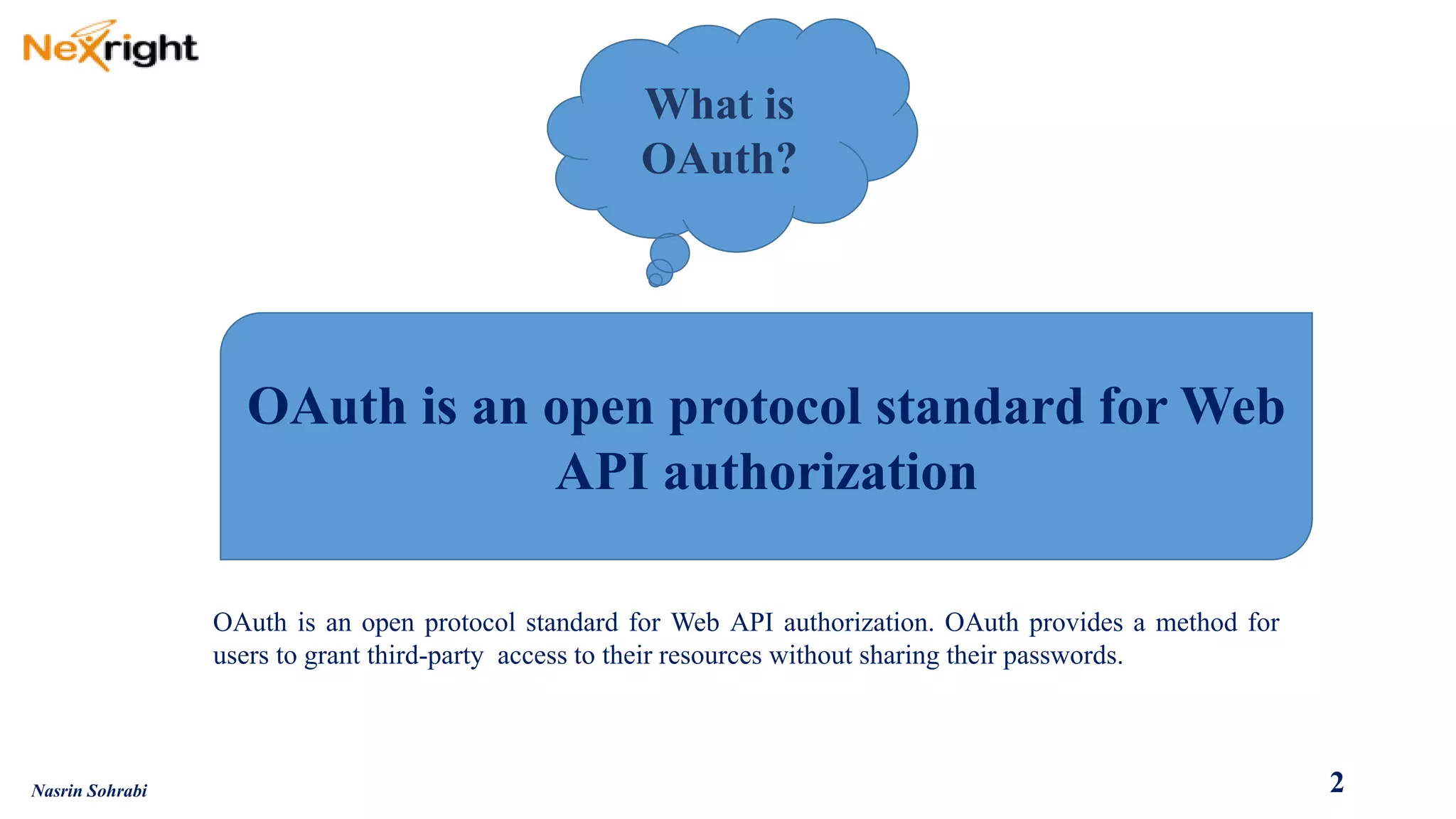
OAuthisanopenprotocolstandardforWebAPIauthorization.OAuthprovidesamethodforuserstograntthird-partyaccesstotheirresourceswithoutsharingtheirpasswords. 
What is OAuth? 
OAuth is an open protocol standard for Web API authorization 
2 
Nasrin Sohrabi
Why using OAuth2.0 ? 
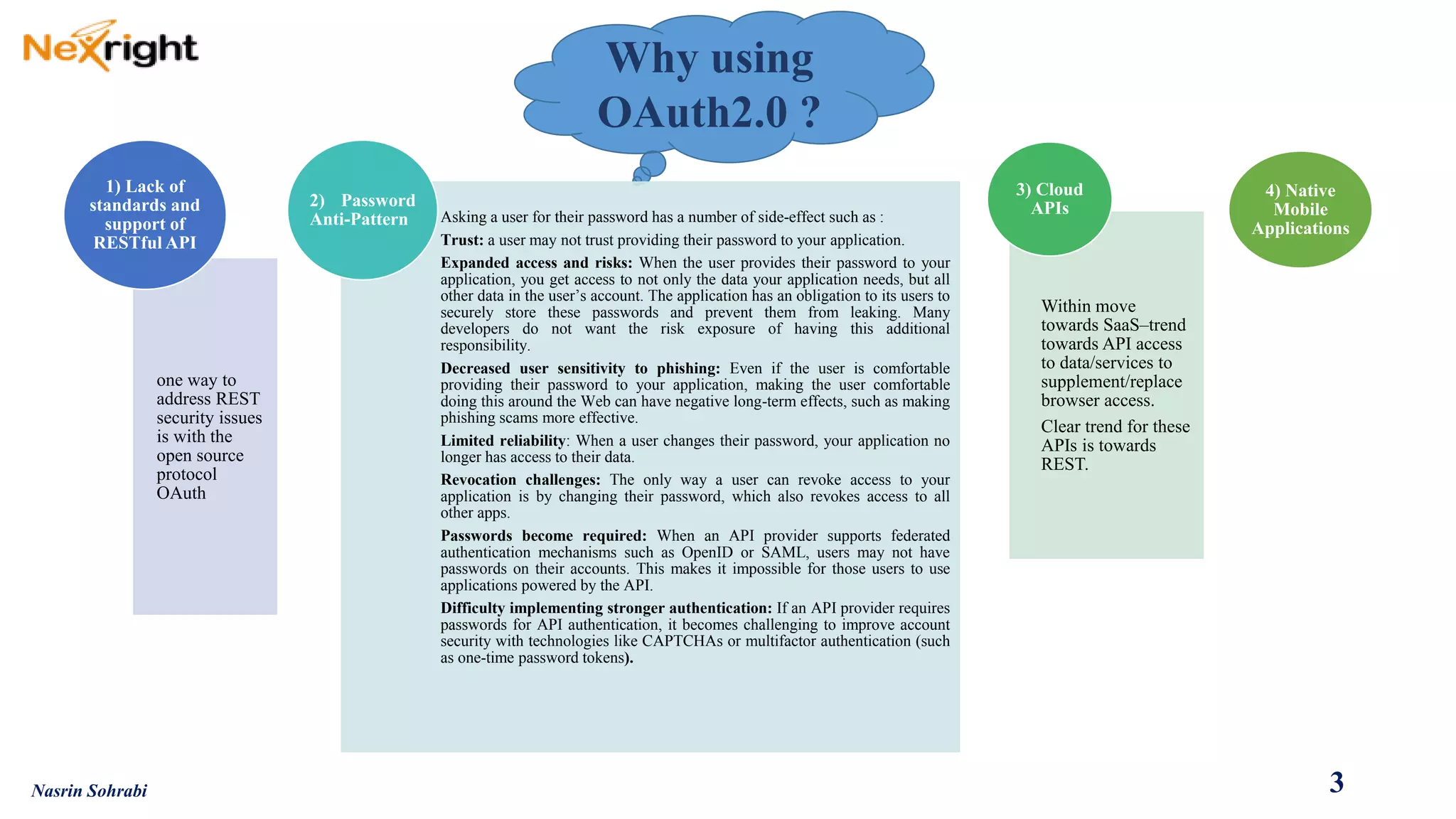
one way to address REST security issues is with the open source protocol OAuth 
1) Lack of standards and support of RESTfulAPI 
Askingauserfortheirpasswordhasanumberofside-effectsuchas: 
Trust:ausermaynottrustprovidingtheirpasswordtoyourapplication. 
Expandedaccessandrisks:Whentheuserprovidestheirpasswordtoyourapplication,yougetaccesstonotonlythedatayourapplicationneeds,butallotherdataintheuser’saccount.Theapplicationhasanobligationtoitsuserstosecurelystorethesepasswordsandpreventthemfromleaking.Manydevelopersdonotwanttheriskexposureofhavingthisadditionalresponsibility. 
Decreasedusersensitivitytophishing:Eveniftheuseriscomfortableprovidingtheirpasswordtoyourapplication,makingtheusercomfortabledoingthisaroundtheWebcanhavenegativelong-termeffects,suchasmakingphishingscamsmoreeffective. 
Limitedreliability:Whenauserchangestheirpassword,yourapplicationnolongerhasaccesstotheirdata. 
Revocationchallenges:Theonlywayausercanrevokeaccesstoyourapplicationisbychangingtheirpassword,whichalsorevokesaccesstoallotherapps. 
Passwordsbecomerequired:WhenanAPIprovidersupportsfederatedauthenticationmechanismssuchasOpenIDorSAML,usersmaynothavepasswordsontheiraccounts.ThismakesitimpossibleforthoseuserstouseapplicationspoweredbytheAPI. 
Difficultyimplementingstrongerauthentication:IfanAPIproviderrequirespasswordsforAPIauthentication,itbecomeschallengingtoimproveaccountsecuritywithtechnologieslikeCAPTCHAsormultifactorauthentication(suchasone-timepasswordtokens). 
2)PasswordAnti-Pattern 
Within move towards SaaS–trend towards API access to data/services to supplement/replace browser access. 
Clear trend for these APIs is towards REST. 
3) Cloud APIs 
4) Native Mobile Applications 
3 
Nasrin Sohrabi
Client Application 
User Agent 
How does OAuth2.0 work? 
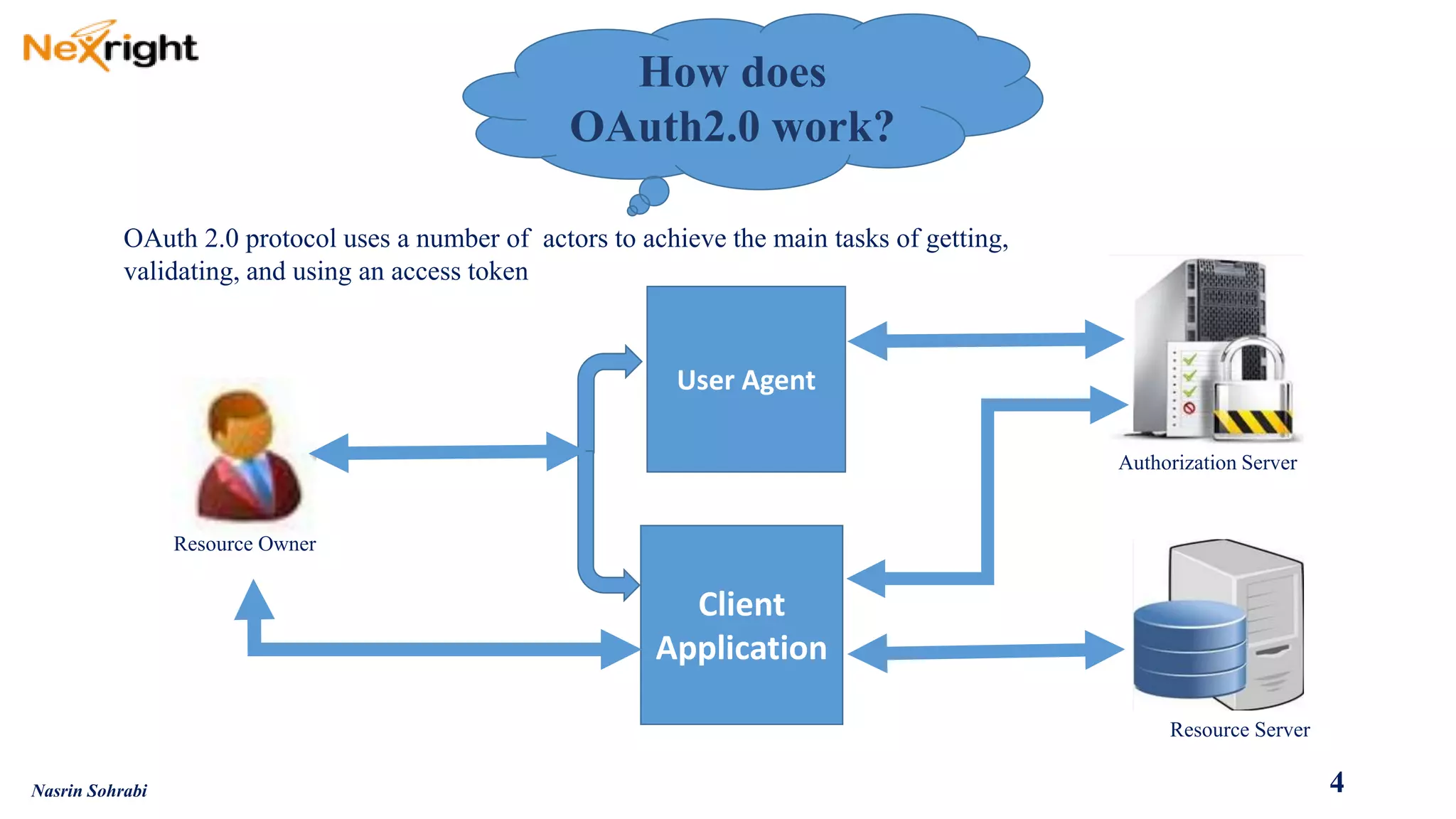
OAuth 2.0 protocol uses a number of actors to achieve the main tasks of getting, validating, and using an access token 
4 
Nasrin Sohrabi 
Authorization Server 
Resource Server 
Resource Owner
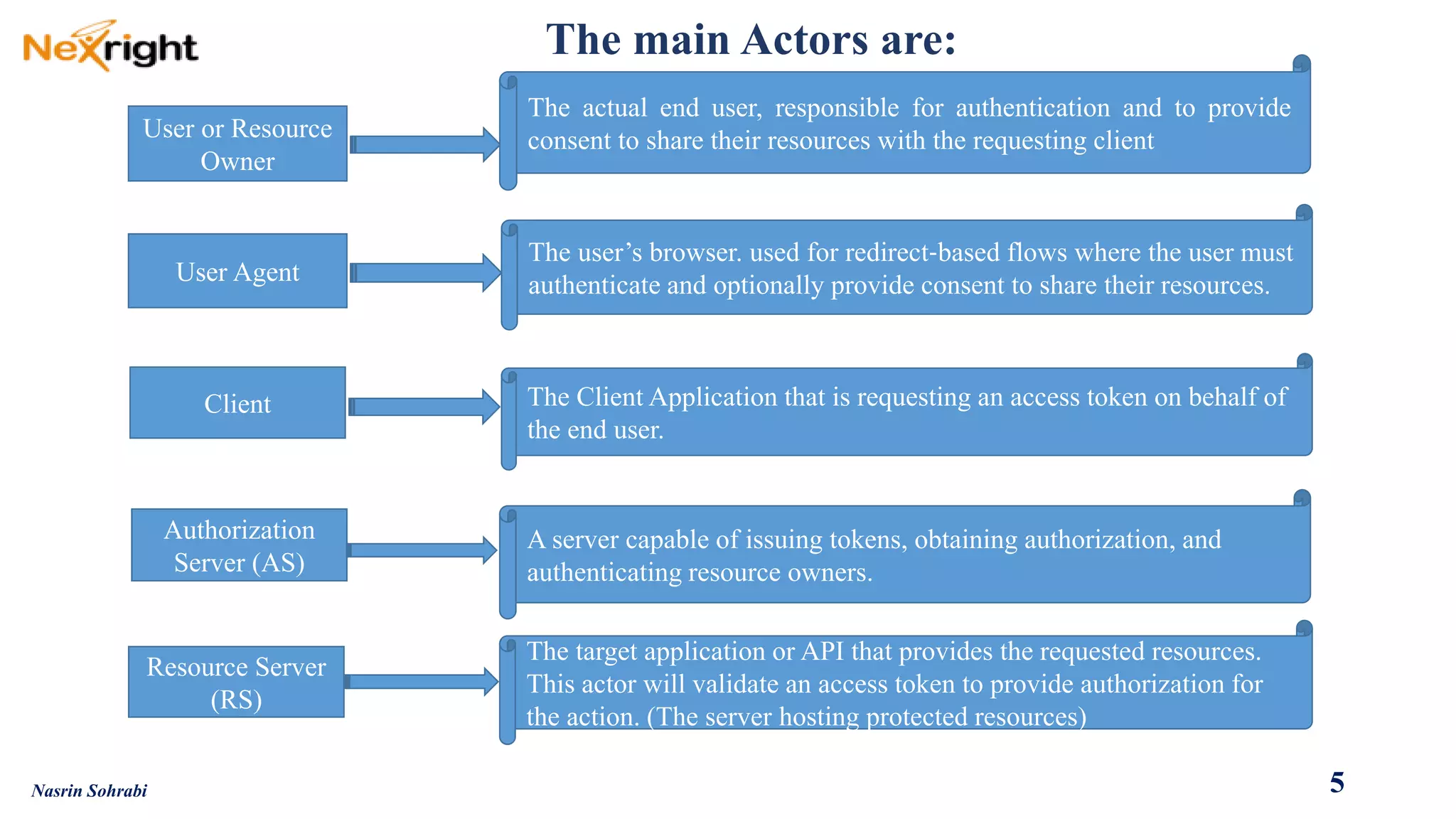
The main Actors are: 
User or Resource Owner 
Theactualenduser,responsibleforauthenticationandtoprovideconsenttosharetheirresourceswiththerequestingclient 
User Agent 
Theuser’sbrowser.usedforredirect‐basedflowswheretheusermustauthenticateandoptionallyprovideconsenttosharetheirresources. 
Client 
Authorization Server (AS) 
Resource Server (RS) 
The Client Application that is requesting an access token on behalf of the end user. 
A server capable of issuing tokens, obtaining authorization, and authenticating resource owners. 
The target application or API that provides the requested resources. This actor will validate an access token to provide authorization for theaction. (The server hosting protected resources) 
5 
Nasrin Sohrabi
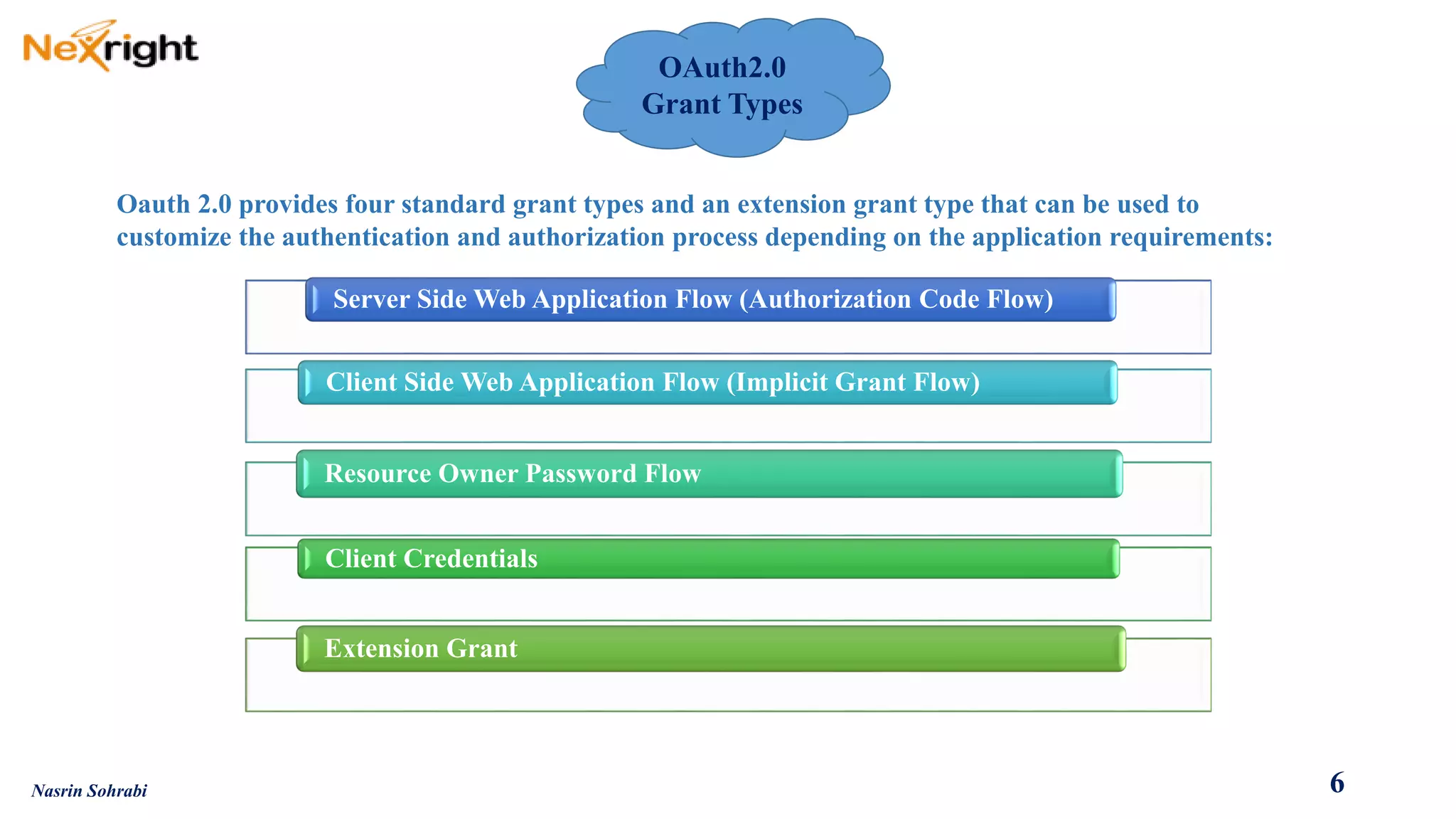
Oauth2.0 provides four standard grant typesandan extension grant type that can beusedto customize the authentication and authorization process depending on the application requirements: 
Server Side Web Application Flow (Authorization Code Flow) 
Client Side Web Application Flow (Implicit Grant Flow) 
Resource Owner Password Flow 
Client Credentials 
Extension Grant 
6 
Nasrin Sohrabi 
OAuth2.0 Grant Types
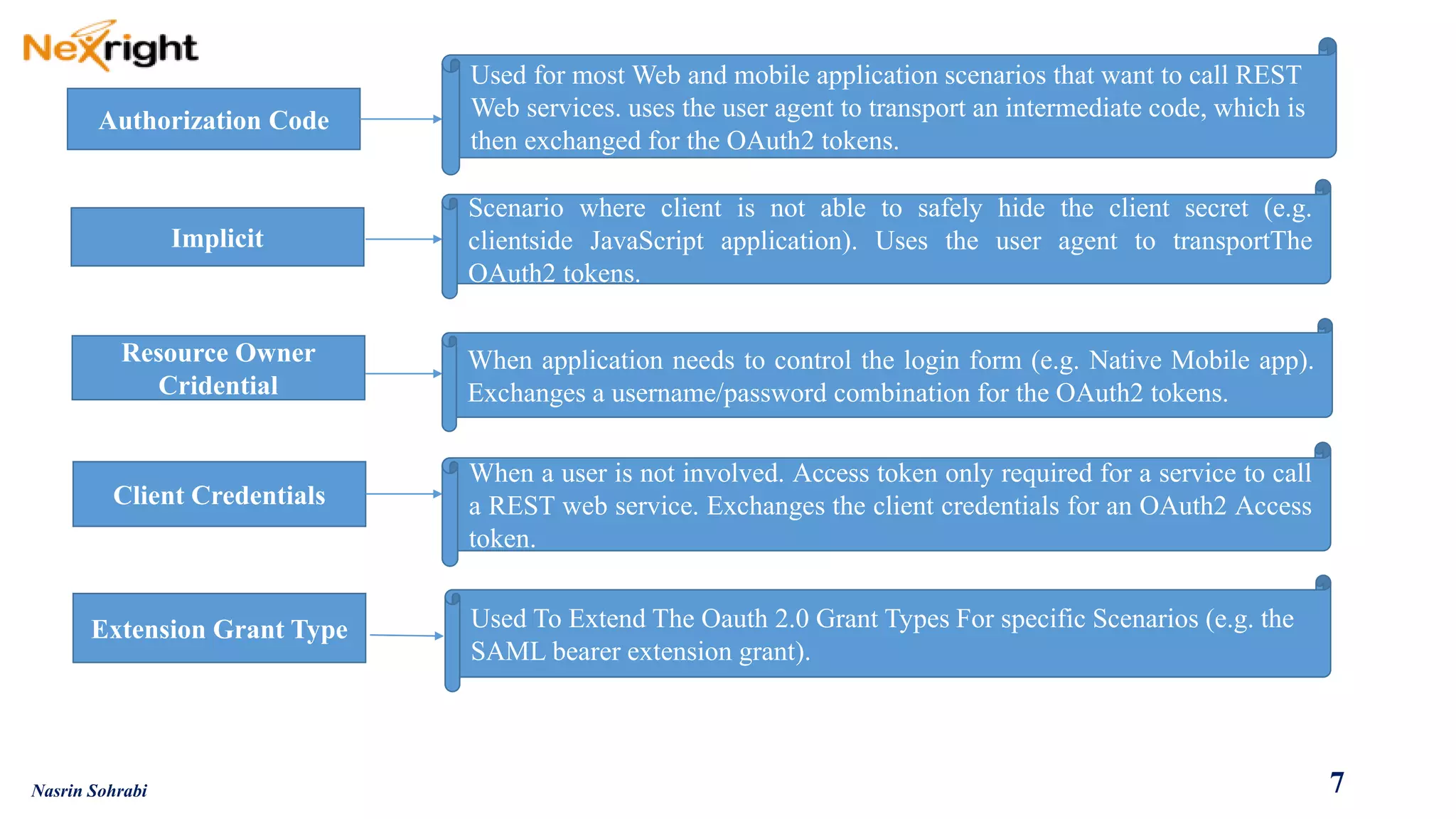
Authorization Code 
Resource Owner Cridential 
Implicit 
Client Credentials 
Used for most Web and mobile application scenarios that want to call REST Web services. uses the user agent to transport an intermediate code, which is then exchanged for the OAuth2 tokens. 
Scenariowhereclientisnotabletosafelyhidetheclientsecret(e.g. clientsideJavaScriptapplication).UsestheuseragenttotransportTheOAuth2tokens. 
Whenapplicationneedstocontroltheloginform(e.g.NativeMobileapp). Exchangesausername/passwordcombinationfortheOAuth2tokens. 
Whenauserisnotinvolved.AccesstokenonlyrequiredforaservicetocallaRESTwebservice.ExchangestheclientcredentialsforanOAuth2Accesstoken. 
Extension Grant Type 
Used To Extend The Oauth2.0 Grant Types For specific Scenarios (e.g. the SAML bearer extension grant). 
7 
Nasrin Sohrabi
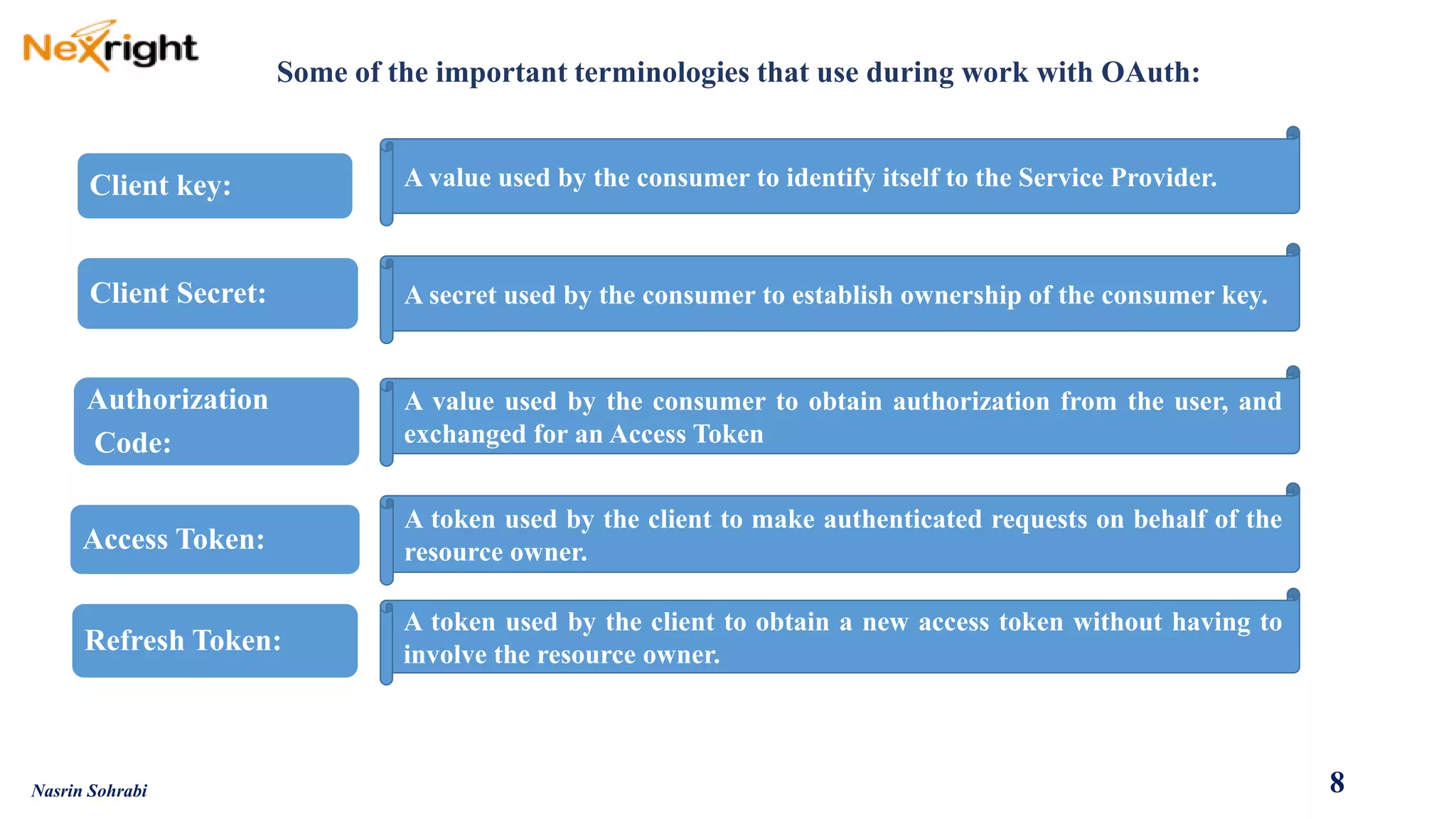
Some of the important terminologies that use during work with OAuth: 
Client key: 
Client Secret: 
Authorization 
Code: 
Access Token: 
Refresh Token: 
AvalueusedbytheconsumertoidentifyitselftotheServiceProvider. 
A secret used by the consumer to establish ownership of the consumer key. 
Avalueusedbytheconsumertoobtainauthorizationfromtheuser,andexchangedforanAccessToken 
Atokenusedbytheclienttomakeauthenticatedrequestsonbehalfoftheresourceowner. 
Atokenusedbytheclienttoobtainanewaccesstokenwithouthavingtoinvolvetheresourceowner. 
8 
Nasrin Sohrabi
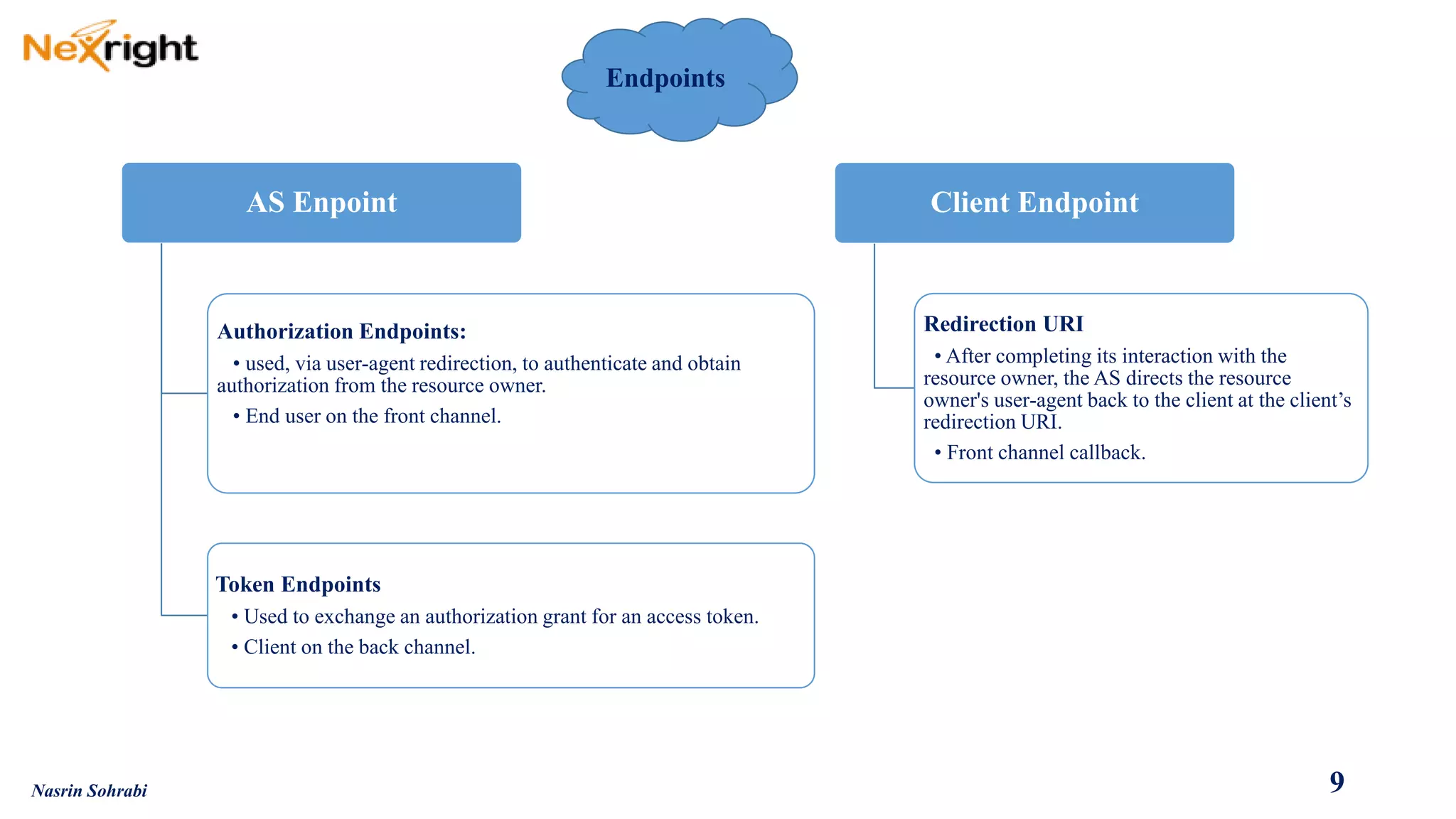
9 
AS Enpoint 
Authorization Endpoints: 
• used, via user-agent redirection, to authenticate and obtain authorization from the resource owner. 
• End user on the front channel. 
Token Endpoints 
• Used to exchange an authorization grant for an access token. 
• Client on the back channel. 
Client Endpoint 
Redirection URI 
• After completing its interaction with the resource owner, the AS directs the resource owner's user-agent back to the client at the client’s redirection URI. 
• Front channel callback. 
Nasrin Sohrabi 
Endpoints
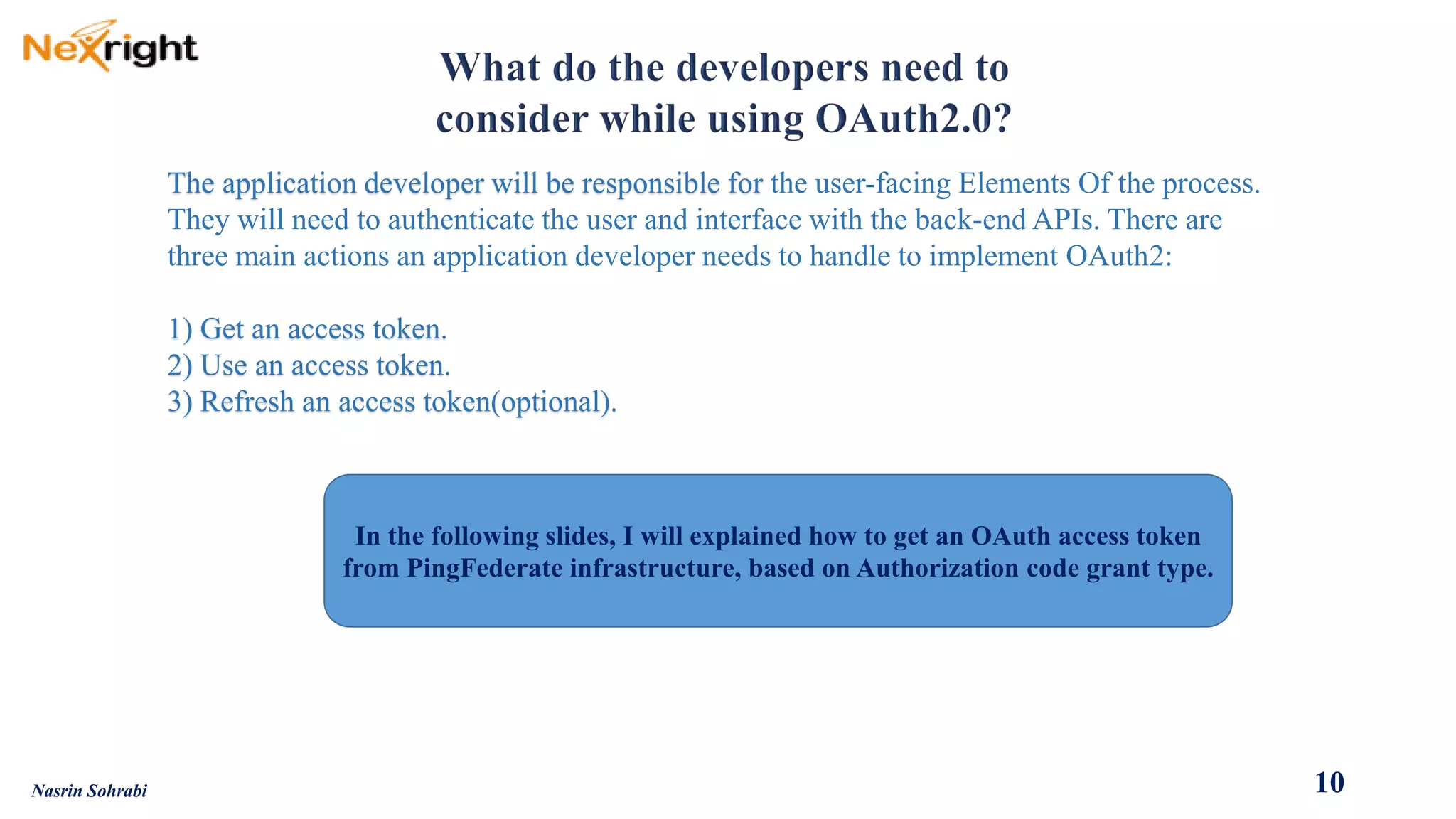
The application developer will be responsible for the user-facing Elements Of theprocess. 
They will needto authenticate the user and interface with the back-end APIs. There are three main actions an application developer needs to handle to implement OAuth2: 1) Get an access token. 2) Use an access token. 3) Refresh an access token(optional). 
10 
Nasrin Sohrabi 
In the following slides, I will explained how to get an OAuth access token from PingFederate infrastructure, based on Authorization code grant type.
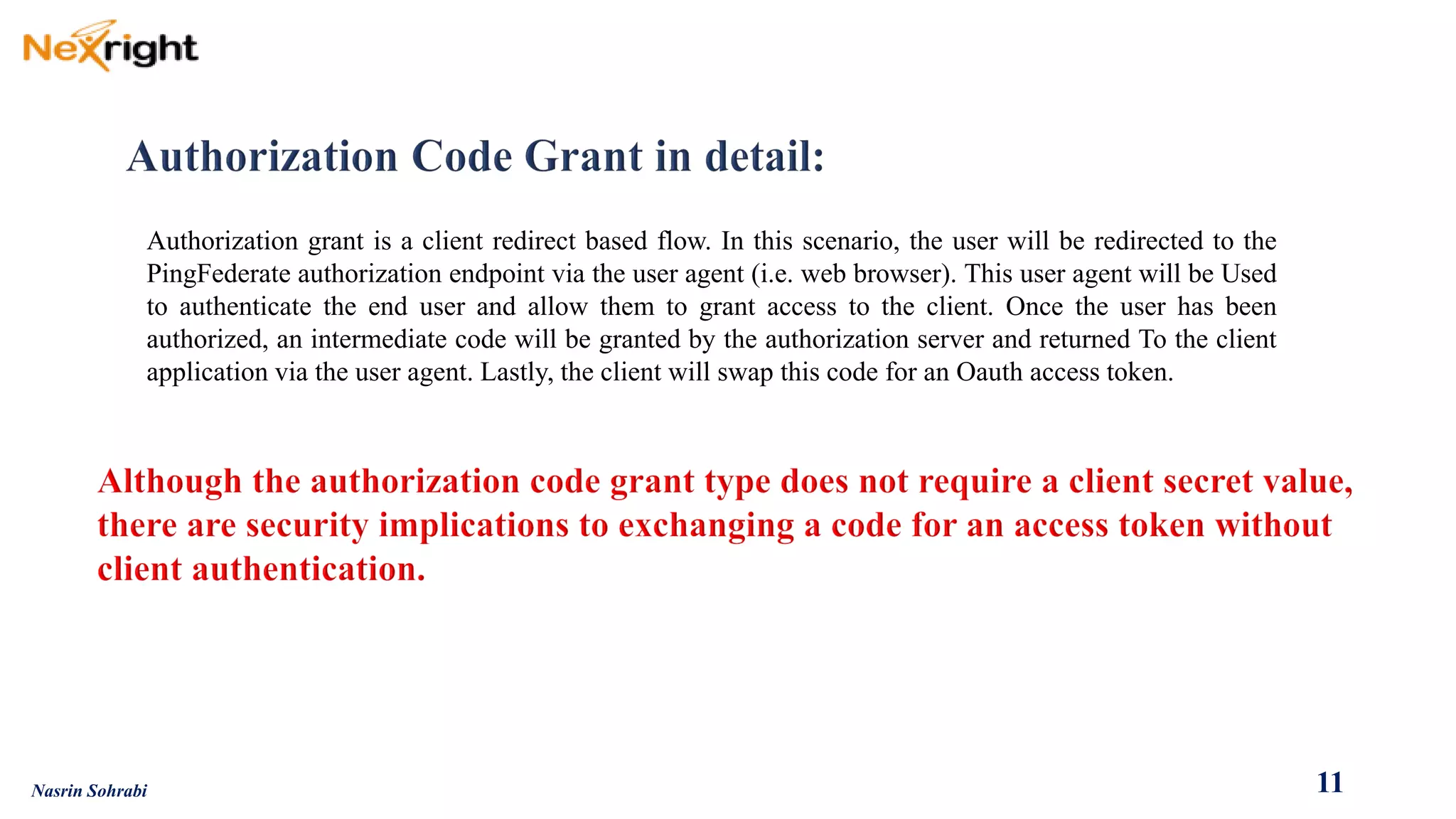
Authorizationgrantisaclientredirectbasedflow.Inthisscenario,theuserwillberedirectedtothePingFederateauthorizationendpointviatheuseragent(i.e.webbrowser).ThisuseragentwillbeUsedtoauthenticatetheenduserandallowthemtograntaccesstotheclient.Oncetheuserhasbeenauthorized,anintermediatecodewillbegrantedbytheauthorizationserverandreturnedTotheclientapplicationviatheuseragent.Lastly,theclientwillswapthiscodeforanOauthaccesstoken. 
11 
Nasrin Sohrabi
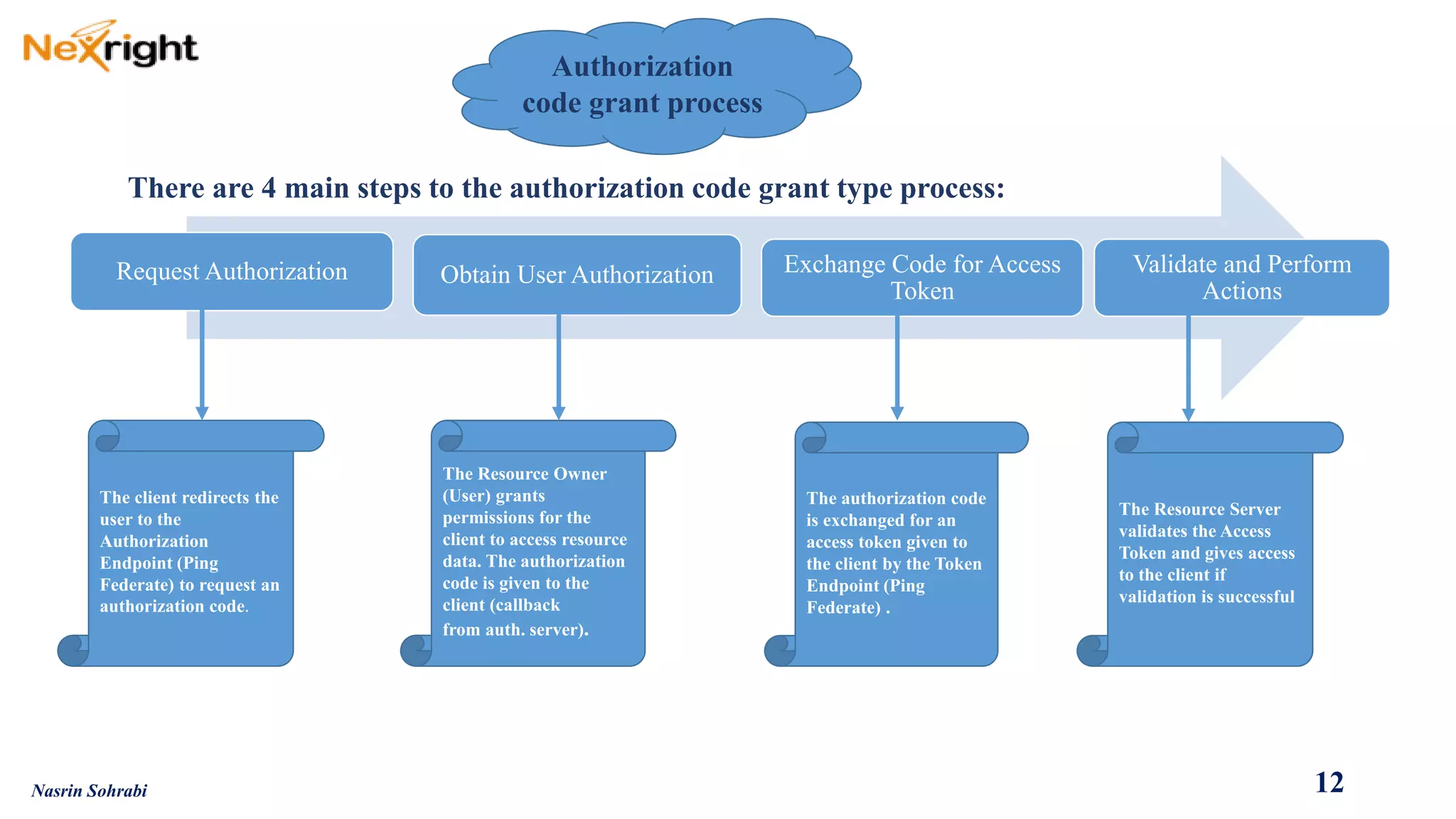
Authorization code grant process 
Request Authorization 
Obtain User Authorization 
Exchange Code for Access Token 
Validate and Perform Actions 
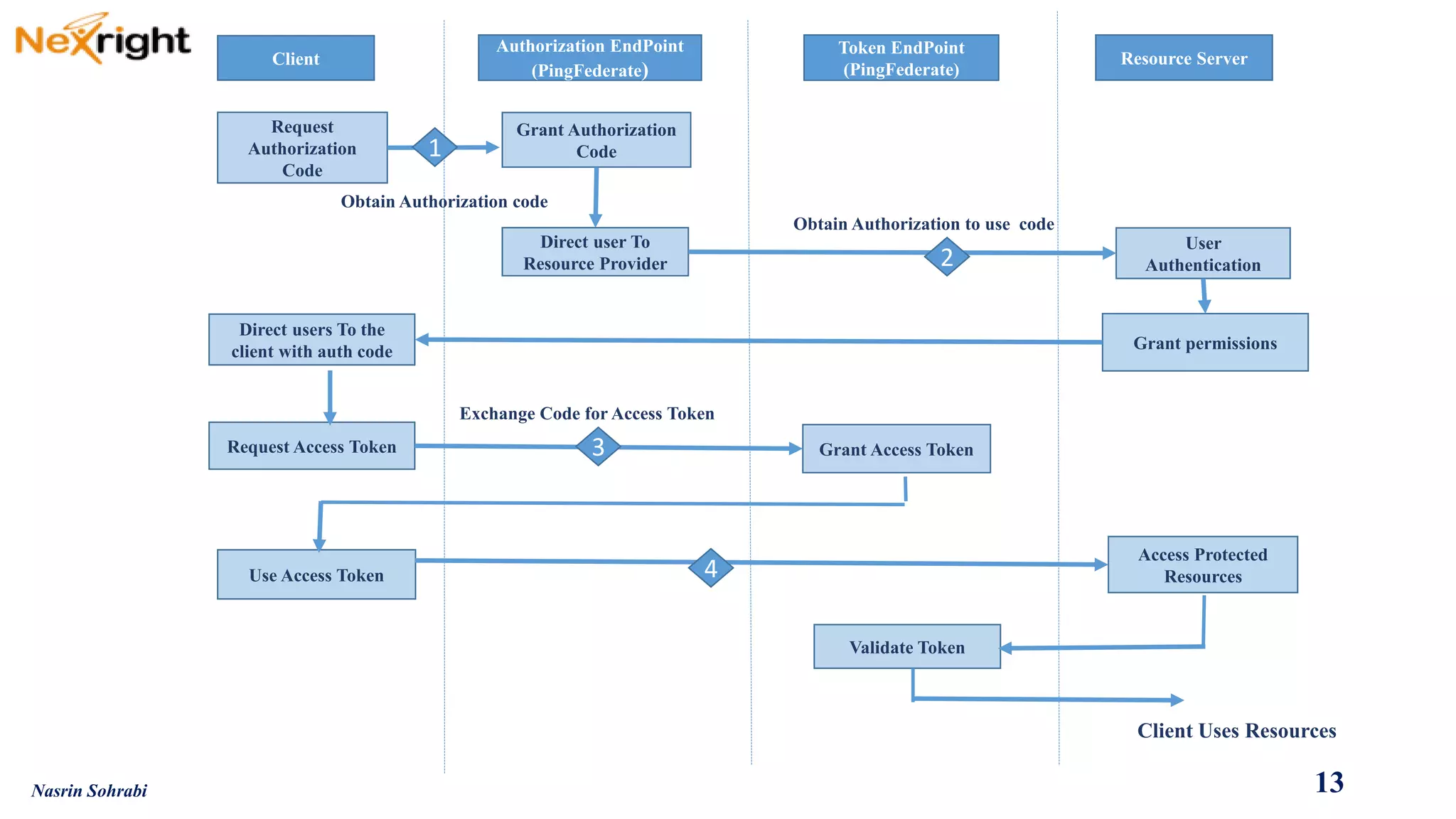
There are 4 main steps to the authorization code grant type process: 
The client redirects the user to the Authorization Endpoint (Ping Federate)to request an authorization code. 
The Resource Owner (User) grants permissions for the 
client to access resource data. The authorization code is given to the client (callback 
from auth. server). 
The authorization code is exchanged for an access token given to the client by the Token Endpoint (Ping Federate) . 
The Resource Server validates the Access Token and gives access to the client if validation is successful 
12 
Nasrin Sohrabi
Client 
Authorization EndPoint 
(PingFederate) 
Token EndPoint 
(PingFederate) 
Resource Server 
Grant Authorization Code 
Direct user To Resource Provider 
User Authentication 
Grant permissions 
Request Authorization Code 
Request Access Token 
Grant Access Token 
Direct users To the client with authcode 
1 
Obtain Authorization code 
2 
Obtain Authorization to use code 
Access Protected Resources 
Validate Token 
Use Access Token 
3 
Exchange Code for Access Token 
4 
Client Uses Resources 
13 
Nasrin Sohrabi
Phases in detail: 
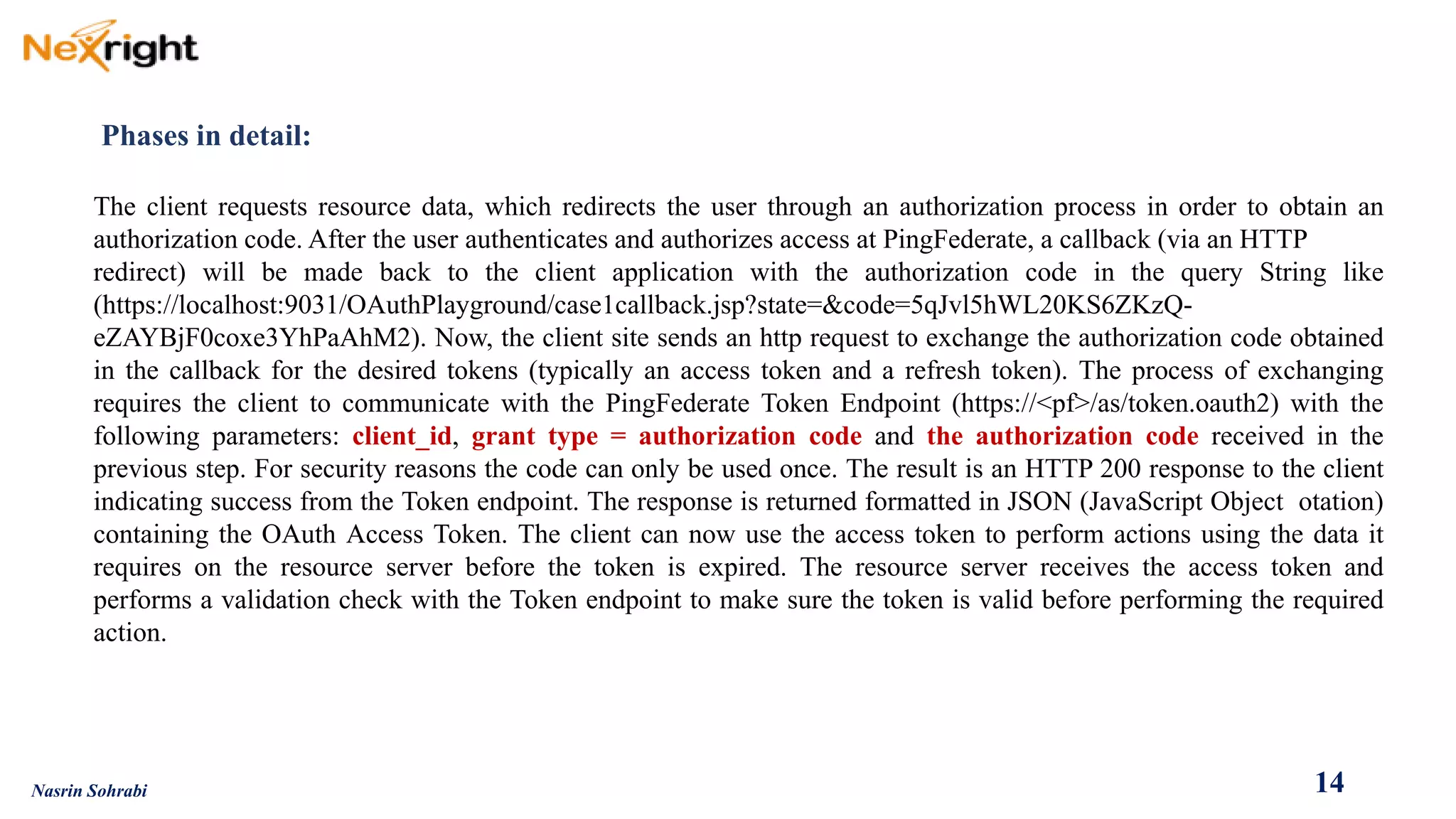
Theclientrequestsresourcedata,whichredirectstheuserthroughanauthorizationprocessinordertoobtainanauthorizationcode.AftertheuserauthenticatesandauthorizesaccessatPingFederate,acallback(viaanHTTP 
redirect)willbemadebacktotheclientapplicationwiththeauthorizationcodeinthequeryStringlike(https://localhost:9031/OAuthPlayground/case1callback.jsp?state=&code=5qJvl5hWL20KS6ZKzQ- eZAYBjF0coxe3YhPaAhM2).Now,theclientsitesendsanhttprequesttoexchangetheauthorizationcodeobtainedinthecallbackforthedesiredtokens(typicallyanaccesstokenandarefreshtoken).TheprocessofexchangingrequirestheclienttocommunicatewiththePingFederateTokenEndpoint(https://<pf>/as/token.oauth2)withthefollowingparameters:client_id,granttype=authorizationcodeandtheauthorizationcodereceivedinthepreviousstep.Forsecurityreasonsthecodecanonlybeusedonce.TheresultisanHTTP200responsetotheclientindicatingsuccessfromtheTokenendpoint.TheresponseisreturnedformattedinJSON(JavaScriptObjectotation) containingtheOAuthAccessToken.Theclientcannowusetheaccesstokentoperformactionsusingthedataitrequiresontheresourceserverbeforethetokenisexpired.TheresourceserverreceivestheaccesstokenandperformsavalidationcheckwiththeTokenendpointtomakesurethetokenisvalidbeforeperformingtherequiredaction. 
14 
Nasrin Sohrabi
Authorization Endpoint 
Web Client 
(Our application) 
Browser 
Token Endpoint 
1 
4 
3 
2 
1 
Request query string includes the OAuth client ID, response type and requested scopes and redirect uri. 
Request 
Redirect to Authorization Server 
3 
5 
15 
Nasrin Sohrabi 
PingFederate Server
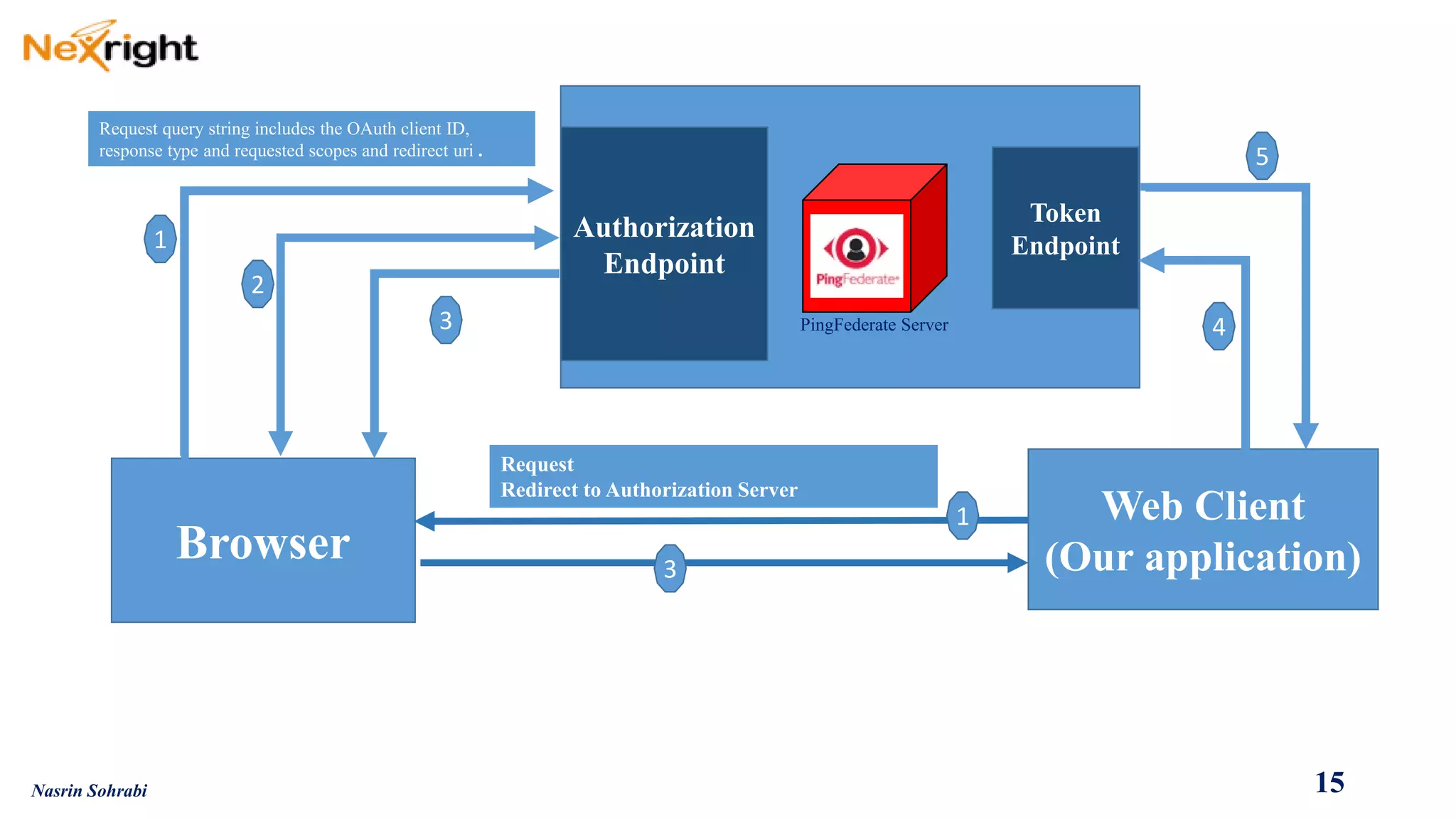
WebapplicationredirectsusertoAuthorizationServer(AS),whichisPingFederate,atitsauthorizationendpoint(https://<pf>/as/authorization.oauth2).RequestquerystringincludestheOAuthclientID,responsetype(inthiscaseauthorizationcode)andrequestedscopesandstate. 
UserauthenticatestoASviaIdPadapterorIdPconnection.Afterauthentication,userseesconfirmationpagewithrequestedscopesfromtheOAuthclientredirect,andclicks"Approve” 
ASredirectsuserbacktoclientsitewithAuthorizationCodeinquerystring. 
WebsiteresolvesAuthorizationCodetoanOAuthtoken(AccessToken[andRefreshToken])viaAPIcalltotheASTokenEndpoint(https://<pf>/as/token.oauth2) 
TheresultisanHTTP200responsetotheclientindicatingsuccessfromtheTokenEndpoint.TheresponseisreturnedformattedinJSON(JavaScriptObjectNotation) 
containingtheOAuthAccessToken 
2 
4 
5 
1 
3 
16 
Nasrin Sohrabi
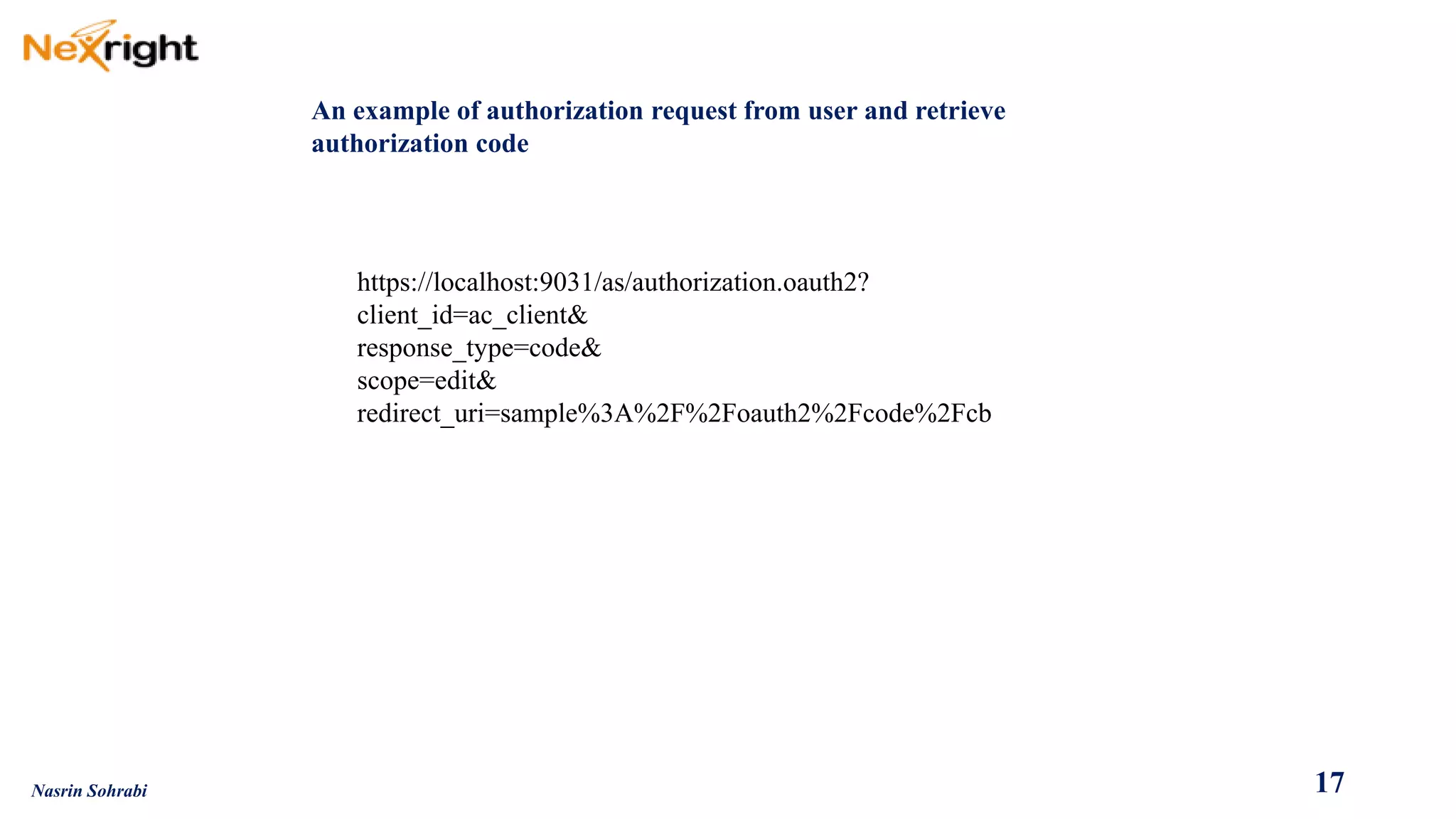
An example of authorization request from user and retrieve authorization code 
https://localhost:9031/as/authorization.oauth2? 
client_id=ac_client& 
response_type=code& 
scope=edit& 
redirect_uri=sample%3A%2F%2Foauth2%2Fcode%2Fcb 
17 
Nasrin Sohrabi
18 
References: 
1. Ryan Boyd, Getting Started with OAuth2.0, published by O’REILLY, February 2012. 
2. OAuth2 Developers Guide, PingIdentity, 07/09/2014. 
3. PingFederate Administrator’s Manual, June 27, 2014 . 
4. Ryan Boyd, OAuth2 Identity and Data Access, 2012. 
5. John DaSilva, Ping Identity and OAuth and OpenIDConnect In Action with PingFederate Hands-On, 7/8/2013. 
6. OAuth2 Tutorial, Ping Identity, July 2014. 
Nasrin Sohrabi
19 
Nasrin Sohrabi

O auth2.0 guide

  • 1.
    1 * E-mails:sales@nexright.com
  • 2.
  • 3.
    Why using OAuth2.0? one way to address REST security issues is with the open source protocol OAuth 1) Lack of standards and support of RESTfulAPI Askingauserfortheirpasswordhasanumberofside-effectsuchas: Trust:ausermaynottrustprovidingtheirpasswordtoyourapplication. Expandedaccessandrisks:Whentheuserprovidestheirpasswordtoyourapplication,yougetaccesstonotonlythedatayourapplicationneeds,butallotherdataintheuser’saccount.Theapplicationhasanobligationtoitsuserstosecurelystorethesepasswordsandpreventthemfromleaking.Manydevelopersdonotwanttheriskexposureofhavingthisadditionalresponsibility. Decreasedusersensitivitytophishing:Eveniftheuseriscomfortableprovidingtheirpasswordtoyourapplication,makingtheusercomfortabledoingthisaroundtheWebcanhavenegativelong-termeffects,suchasmakingphishingscamsmoreeffective. Limitedreliability:Whenauserchangestheirpassword,yourapplicationnolongerhasaccesstotheirdata. Revocationchallenges:Theonlywayausercanrevokeaccesstoyourapplicationisbychangingtheirpassword,whichalsorevokesaccesstoallotherapps. Passwordsbecomerequired:WhenanAPIprovidersupportsfederatedauthenticationmechanismssuchasOpenIDorSAML,usersmaynothavepasswordsontheiraccounts.ThismakesitimpossibleforthoseuserstouseapplicationspoweredbytheAPI. Difficultyimplementingstrongerauthentication:IfanAPIproviderrequirespasswordsforAPIauthentication,itbecomeschallengingtoimproveaccountsecuritywithtechnologieslikeCAPTCHAsormultifactorauthentication(suchasone-timepasswordtokens). 2)PasswordAnti-Pattern Within move towards SaaS–trend towards API access to data/services to supplement/replace browser access. Clear trend for these APIs is towards REST. 3) Cloud APIs 4) Native Mobile Applications 3 Nasrin Sohrabi
  • 4.
    Client Application UserAgent How does OAuth2.0 work? OAuth 2.0 protocol uses a number of actors to achieve the main tasks of getting, validating, and using an access token 4 Nasrin Sohrabi Authorization Server Resource Server Resource Owner
  • 5.
    The main Actorsare: User or Resource Owner Theactualenduser,responsibleforauthenticationandtoprovideconsenttosharetheirresourceswiththerequestingclient User Agent Theuser’sbrowser.usedforredirect‐basedflowswheretheusermustauthenticateandoptionallyprovideconsenttosharetheirresources. Client Authorization Server (AS) Resource Server (RS) The Client Application that is requesting an access token on behalf of the end user. A server capable of issuing tokens, obtaining authorization, and authenticating resource owners. The target application or API that provides the requested resources. This actor will validate an access token to provide authorization for theaction. (The server hosting protected resources) 5 Nasrin Sohrabi
  • 6.
    Oauth2.0 provides fourstandard grant typesandan extension grant type that can beusedto customize the authentication and authorization process depending on the application requirements: Server Side Web Application Flow (Authorization Code Flow) Client Side Web Application Flow (Implicit Grant Flow) Resource Owner Password Flow Client Credentials Extension Grant 6 Nasrin Sohrabi OAuth2.0 Grant Types
  • 7.
    Authorization Code ResourceOwner Cridential Implicit Client Credentials Used for most Web and mobile application scenarios that want to call REST Web services. uses the user agent to transport an intermediate code, which is then exchanged for the OAuth2 tokens. Scenariowhereclientisnotabletosafelyhidetheclientsecret(e.g. clientsideJavaScriptapplication).UsestheuseragenttotransportTheOAuth2tokens. Whenapplicationneedstocontroltheloginform(e.g.NativeMobileapp). Exchangesausername/passwordcombinationfortheOAuth2tokens. Whenauserisnotinvolved.AccesstokenonlyrequiredforaservicetocallaRESTwebservice.ExchangestheclientcredentialsforanOAuth2Accesstoken. Extension Grant Type Used To Extend The Oauth2.0 Grant Types For specific Scenarios (e.g. the SAML bearer extension grant). 7 Nasrin Sohrabi
  • 8.
    Some of theimportant terminologies that use during work with OAuth: Client key: Client Secret: Authorization Code: Access Token: Refresh Token: AvalueusedbytheconsumertoidentifyitselftotheServiceProvider. A secret used by the consumer to establish ownership of the consumer key. Avalueusedbytheconsumertoobtainauthorizationfromtheuser,andexchangedforanAccessToken Atokenusedbytheclienttomakeauthenticatedrequestsonbehalfoftheresourceowner. Atokenusedbytheclienttoobtainanewaccesstokenwithouthavingtoinvolvetheresourceowner. 8 Nasrin Sohrabi
  • 9.
    9 AS Enpoint Authorization Endpoints: • used, via user-agent redirection, to authenticate and obtain authorization from the resource owner. • End user on the front channel. Token Endpoints • Used to exchange an authorization grant for an access token. • Client on the back channel. Client Endpoint Redirection URI • After completing its interaction with the resource owner, the AS directs the resource owner's user-agent back to the client at the client’s redirection URI. • Front channel callback. Nasrin Sohrabi Endpoints
  • 10.
    The application developerwill be responsible for the user-facing Elements Of theprocess. They will needto authenticate the user and interface with the back-end APIs. There are three main actions an application developer needs to handle to implement OAuth2: 1) Get an access token. 2) Use an access token. 3) Refresh an access token(optional). 10 Nasrin Sohrabi In the following slides, I will explained how to get an OAuth access token from PingFederate infrastructure, based on Authorization code grant type.
  • 11.
  • 12.
    Authorization code grantprocess Request Authorization Obtain User Authorization Exchange Code for Access Token Validate and Perform Actions There are 4 main steps to the authorization code grant type process: The client redirects the user to the Authorization Endpoint (Ping Federate)to request an authorization code. The Resource Owner (User) grants permissions for the client to access resource data. The authorization code is given to the client (callback from auth. server). The authorization code is exchanged for an access token given to the client by the Token Endpoint (Ping Federate) . The Resource Server validates the Access Token and gives access to the client if validation is successful 12 Nasrin Sohrabi
  • 13.
    Client Authorization EndPoint (PingFederate) Token EndPoint (PingFederate) Resource Server Grant Authorization Code Direct user To Resource Provider User Authentication Grant permissions Request Authorization Code Request Access Token Grant Access Token Direct users To the client with authcode 1 Obtain Authorization code 2 Obtain Authorization to use code Access Protected Resources Validate Token Use Access Token 3 Exchange Code for Access Token 4 Client Uses Resources 13 Nasrin Sohrabi
  • 14.
    Phases in detail: Theclientrequestsresourcedata,whichredirectstheuserthroughanauthorizationprocessinordertoobtainanauthorizationcode.AftertheuserauthenticatesandauthorizesaccessatPingFederate,acallback(viaanHTTP redirect)willbemadebacktotheclientapplicationwiththeauthorizationcodeinthequeryStringlike(https://localhost:9031/OAuthPlayground/case1callback.jsp?state=&code=5qJvl5hWL20KS6ZKzQ- eZAYBjF0coxe3YhPaAhM2).Now,theclientsitesendsanhttprequesttoexchangetheauthorizationcodeobtainedinthecallbackforthedesiredtokens(typicallyanaccesstokenandarefreshtoken).TheprocessofexchangingrequirestheclienttocommunicatewiththePingFederateTokenEndpoint(https://<pf>/as/token.oauth2)withthefollowingparameters:client_id,granttype=authorizationcodeandtheauthorizationcodereceivedinthepreviousstep.Forsecurityreasonsthecodecanonlybeusedonce.TheresultisanHTTP200responsetotheclientindicatingsuccessfromtheTokenendpoint.TheresponseisreturnedformattedinJSON(JavaScriptObjectotation) containingtheOAuthAccessToken.Theclientcannowusetheaccesstokentoperformactionsusingthedataitrequiresontheresourceserverbeforethetokenisexpired.TheresourceserverreceivestheaccesstokenandperformsavalidationcheckwiththeTokenendpointtomakesurethetokenisvalidbeforeperformingtherequiredaction. 14 Nasrin Sohrabi
  • 15.
    Authorization Endpoint WebClient (Our application) Browser Token Endpoint 1 4 3 2 1 Request query string includes the OAuth client ID, response type and requested scopes and redirect uri. Request Redirect to Authorization Server 3 5 15 Nasrin Sohrabi PingFederate Server
  • 16.
    WebapplicationredirectsusertoAuthorizationServer(AS),whichisPingFederate,atitsauthorizationendpoint(https://<pf>/as/authorization.oauth2).RequestquerystringincludestheOAuthclientID,responsetype(inthiscaseauthorizationcode)andrequestedscopesandstate. UserauthenticatestoASviaIdPadapterorIdPconnection.Afterauthentication,userseesconfirmationpagewithrequestedscopesfromtheOAuthclientredirect,andclicks"Approve” ASredirectsuserbacktoclientsitewithAuthorizationCodeinquerystring. WebsiteresolvesAuthorizationCodetoanOAuthtoken(AccessToken[andRefreshToken])viaAPIcalltotheASTokenEndpoint(https://<pf>/as/token.oauth2) TheresultisanHTTP200responsetotheclientindicatingsuccessfromtheTokenEndpoint.TheresponseisreturnedformattedinJSON(JavaScriptObjectNotation) containingtheOAuthAccessToken 2 4 5 1 3 16 Nasrin Sohrabi
  • 17.
    An example ofauthorization request from user and retrieve authorization code https://localhost:9031/as/authorization.oauth2? client_id=ac_client& response_type=code& scope=edit& redirect_uri=sample%3A%2F%2Foauth2%2Fcode%2Fcb 17 Nasrin Sohrabi
  • 18.
    18 References: 1.Ryan Boyd, Getting Started with OAuth2.0, published by O’REILLY, February 2012. 2. OAuth2 Developers Guide, PingIdentity, 07/09/2014. 3. PingFederate Administrator’s Manual, June 27, 2014 . 4. Ryan Boyd, OAuth2 Identity and Data Access, 2012. 5. John DaSilva, Ping Identity and OAuth and OpenIDConnect In Action with PingFederate Hands-On, 7/8/2013. 6. OAuth2 Tutorial, Ping Identity, July 2014. Nasrin Sohrabi
  • 19.