Enterprise Access Control
Patterns For REST and
Web APIs
Francois Lascelles
Layer 7 Technologies


Session ID: STAR-402
Session Classification: intermediate
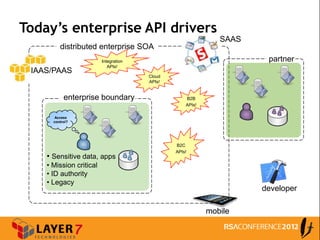
Today’s enterprise API drivers
                                                              SAAS
         distributed enterprise SOA
                         Integration                                  partner
                            APIs!
 IAAS/PAAS
                                       Cloud
                                       APIs!


           enterprise boundary                     B2B
                                                   APIs!

       Access
      control?


                                               B2C
                                               APIs!
    • Sensitive data, apps
    • Mission critical
    • ID authority
    • Legacy
                                                                     developer

                                                           mobile
REST access control standards gap
 WS-* web services have rich security standards
  and authentication/authorization mechanisms
 Web API, RESTful web services tend to use
  proprietary tokens, point-to-point solutions
 What are the common patterns in use?
 Which standards are emerging?
 How to use specialized infrastructure to
  implement access control?
 How to accommodate requesting party technical
  capabilities?
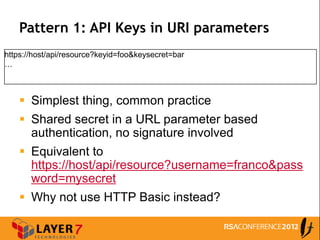
Pattern 1: API Keys in URI parameters
https://host/api/resource?keyid=foo&keysecret=bar
…


     Simplest thing, common practice
     Shared secret in a URL parameter based
      authentication, no signature involved
     Equivalent to
      https://host/api/resource?username=franco&pass
      word=mysecret
     Why not use HTTP Basic instead?
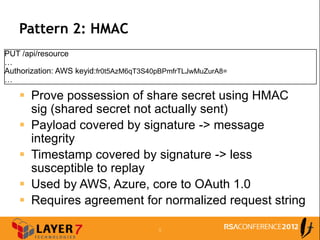
Pattern 2: HMAC
PUT /api/resource
…
Authorization: AWS keyid:fr0t5AzM6qT3S40pBPmfrTLJwMuZurA8=
…

    Prove possession of share secret using HMAC
     sig (shared secret not actually sent)
    Payload covered by signature -> message
     integrity
    Timestamp covered by signature -> less
     susceptible to replay
    Used by AWS, Azure, core to OAuth 1.0
    Requires agreement for normalized request string

                                        5
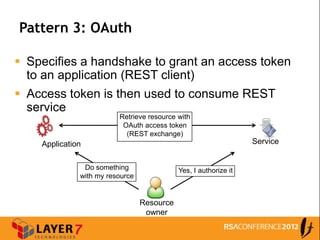
Pattern 3: OAuth

 Specifies a handshake to grant an access token
  to an application (REST client)
 Access token is then used to consume REST
  service
                         Retrieve resource with
                          OAuth access token
                           (REST exchange)
    Application                                                   Service


               Do something                 Yes, I authorize it
              with my resource


                                 Resource
                                  owner
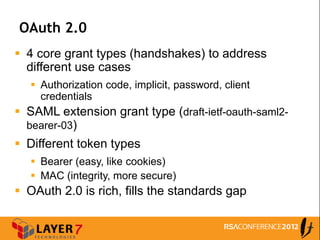
OAuth 2.0
 4 core grant types (handshakes) to address
  different use cases
    Authorization code, implicit, password, client
     credentials
 SAML extension grant type (draft-ietf-oauth-saml2-
  bearer-03)
 Different token types
    Bearer (easy, like cookies)
    MAC (integrity, more secure)
 OAuth 2.0 is rich, fills the standards gap
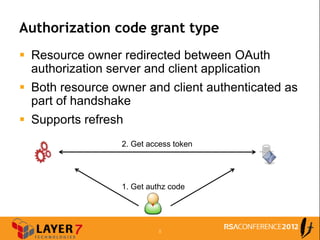
Authorization code grant type
 Resource owner redirected between OAuth
  authorization server and client application
 Both resource owner and client authenticated as
  part of handshake
 Supports refresh
                  2. Get access token


                  1. Get authz code


                           8
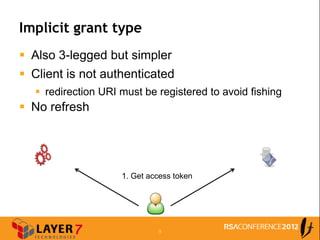
Implicit grant type
 Also 3-legged but simpler
 Client is not authenticated
   redirection URI must be registered to avoid fishing
 No refresh


                    1. Get access token


                             9
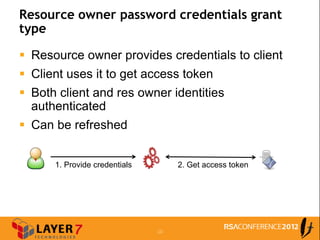
Resource owner password credentials grant
type

 Resource owner provides credentials to client
 Client uses it to get access token
 Both client and res owner identities
  authenticated
 Can be refreshed


      1. Provide credentials        2. Get access token


                               10
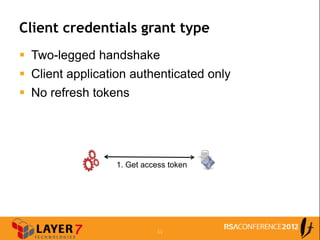
Client credentials grant type
 Two-legged handshake
 Client application authenticated only
 No refresh tokens


                 1. Get access token


                           11
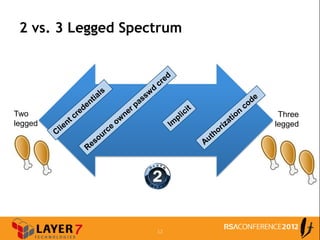
2 vs. 3 Legged Spectrum


Two                         Three
legged                     legged


                    12
Step-by-step enterprise API
access control
(from an OAuth perspective)


          13
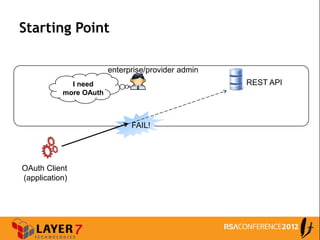
Starting Point

                        enterprise/provider admin
             I need                                 REST API
           more OAuth


                              FAIL!


OAuth Client
(application)
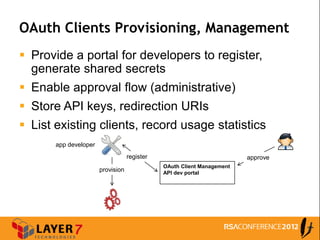
OAuth Clients Provisioning, Management
 Provide a portal for developers to register,
  generate shared secrets
 Enable approval flow (administrative)
 Store API keys, redirection URIs
 List existing clients, record usage statistics
       app developer
                                   register                             approve
                                              OAuth Client Management
                       provision              API dev portal
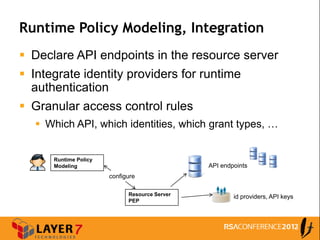
Runtime Policy Modeling, Integration
 Declare API endpoints in the resource server
 Integrate identity providers for runtime
  authentication
 Granular access control rules
    Which API, which identities, which grant types, …


      Runtime Policy
      Modeling                                 API endpoints
                       configure

                             Resource Server           id providers, API keys
                             PEP
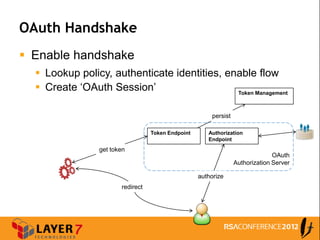
OAuth Handshake
 Enable handshake
   Lookup policy, authenticate identities, enable flow
   Create ‘OAuth Session’                    Token Management


                                                         persist

                                   Token Endpoint      Authorization
                                                       Endpoint
                 get token
                                                                                 OAuth
                                                                   Authorization Server

                                                    authorize
                        redirect
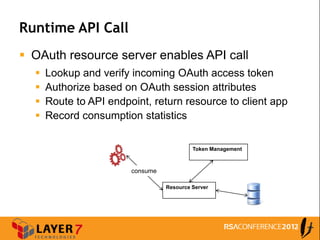
Runtime API Call
 OAuth resource server enables API call
     Lookup and verify incoming OAuth access token
     Authorize based on OAuth session attributes
     Route to API endpoint, return resource to client app
     Record consumption statistics

                                           Token Management


                        consume

                                  Resource Server
Token Refresh
 OAuth authorization server enables refresh
     Authenticate client
     Lookup and validate refresh token
     Create new access token
     Update ‘OAuth session’

                                            Token Management


                       refresh

                                 Token Endpoint
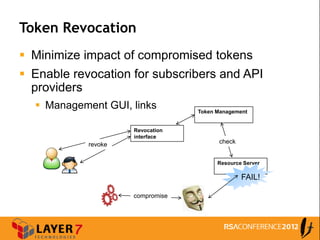
Token Revocation
 Minimize impact of compromised tokens
 Enable revocation for subscribers and API
  providers
   Management GUI, links         Token Management


                     Revocation
                     interface
            revoke                      check


                                        Resource Server

                                                FAIL!

                     compromise
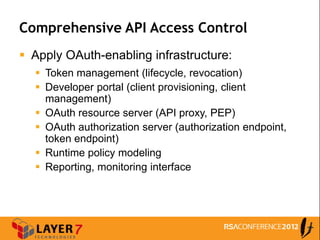
Comprehensive API Access Control
 Apply OAuth-enabling infrastructure:
   Token management (lifecycle, revocation)
   Developer portal (client provisioning, client
    management)
   OAuth resource server (API proxy, PEP)
   OAuth authorization server (authorization endpoint,
    token endpoint)
   Runtime policy modeling
   Reporting, monitoring interface
Thank you
For more information: info@layer7.com


             22

Enterprise Access Control Patterns for Rest and Web APIs

  • 1.
    Enterprise Access Control PatternsFor REST and Web APIs Francois Lascelles Layer 7 Technologies Session ID: STAR-402 Session Classification: intermediate
  • 2.
    Today’s enterprise APIdrivers SAAS distributed enterprise SOA Integration partner APIs! IAAS/PAAS Cloud APIs! enterprise boundary B2B APIs! Access control? B2C APIs! • Sensitive data, apps • Mission critical • ID authority • Legacy developer mobile
  • 3.
    REST access controlstandards gap  WS-* web services have rich security standards and authentication/authorization mechanisms  Web API, RESTful web services tend to use proprietary tokens, point-to-point solutions  What are the common patterns in use?  Which standards are emerging?  How to use specialized infrastructure to implement access control?  How to accommodate requesting party technical capabilities?
  • 4.
    Pattern 1: APIKeys in URI parameters https://host/api/resource?keyid=foo&keysecret=bar …  Simplest thing, common practice  Shared secret in a URL parameter based authentication, no signature involved  Equivalent to https://host/api/resource?username=franco&pass word=mysecret  Why not use HTTP Basic instead?
  • 5.
    Pattern 2: HMAC PUT/api/resource … Authorization: AWS keyid:fr0t5AzM6qT3S40pBPmfrTLJwMuZurA8= …  Prove possession of share secret using HMAC sig (shared secret not actually sent)  Payload covered by signature -> message integrity  Timestamp covered by signature -> less susceptible to replay  Used by AWS, Azure, core to OAuth 1.0  Requires agreement for normalized request string 5
  • 6.
    Pattern 3: OAuth Specifies a handshake to grant an access token to an application (REST client)  Access token is then used to consume REST service Retrieve resource with OAuth access token (REST exchange) Application Service Do something Yes, I authorize it with my resource Resource owner
  • 7.
    OAuth 2.0  4core grant types (handshakes) to address different use cases  Authorization code, implicit, password, client credentials  SAML extension grant type (draft-ietf-oauth-saml2- bearer-03)  Different token types  Bearer (easy, like cookies)  MAC (integrity, more secure)  OAuth 2.0 is rich, fills the standards gap
  • 8.
    Authorization code granttype  Resource owner redirected between OAuth authorization server and client application  Both resource owner and client authenticated as part of handshake  Supports refresh 2. Get access token 1. Get authz code 8
  • 9.
    Implicit grant type Also 3-legged but simpler  Client is not authenticated  redirection URI must be registered to avoid fishing  No refresh 1. Get access token 9
  • 10.
    Resource owner passwordcredentials grant type  Resource owner provides credentials to client  Client uses it to get access token  Both client and res owner identities authenticated  Can be refreshed 1. Provide credentials 2. Get access token 10
  • 11.
    Client credentials granttype  Two-legged handshake  Client application authenticated only  No refresh tokens 1. Get access token 11
  • 12.
    2 vs. 3Legged Spectrum Two Three legged legged 12
  • 13.
    Step-by-step enterprise API accesscontrol (from an OAuth perspective) 13
  • 14.
    Starting Point enterprise/provider admin I need REST API more OAuth FAIL! OAuth Client (application)
  • 15.
    OAuth Clients Provisioning,Management  Provide a portal for developers to register, generate shared secrets  Enable approval flow (administrative)  Store API keys, redirection URIs  List existing clients, record usage statistics app developer register approve OAuth Client Management provision API dev portal
  • 16.
    Runtime Policy Modeling,Integration  Declare API endpoints in the resource server  Integrate identity providers for runtime authentication  Granular access control rules  Which API, which identities, which grant types, … Runtime Policy Modeling API endpoints configure Resource Server id providers, API keys PEP
  • 17.
    OAuth Handshake  Enablehandshake  Lookup policy, authenticate identities, enable flow  Create ‘OAuth Session’ Token Management persist Token Endpoint Authorization Endpoint get token OAuth Authorization Server authorize redirect
  • 18.
    Runtime API Call OAuth resource server enables API call  Lookup and verify incoming OAuth access token  Authorize based on OAuth session attributes  Route to API endpoint, return resource to client app  Record consumption statistics Token Management consume Resource Server
  • 19.
    Token Refresh  OAuthauthorization server enables refresh  Authenticate client  Lookup and validate refresh token  Create new access token  Update ‘OAuth session’ Token Management refresh Token Endpoint
  • 20.
    Token Revocation  Minimizeimpact of compromised tokens  Enable revocation for subscribers and API providers  Management GUI, links Token Management Revocation interface revoke check Resource Server FAIL! compromise
  • 21.
    Comprehensive API AccessControl  Apply OAuth-enabling infrastructure:  Token management (lifecycle, revocation)  Developer portal (client provisioning, client management)  OAuth resource server (API proxy, PEP)  OAuth authorization server (authorization endpoint, token endpoint)  Runtime policy modeling  Reporting, monitoring interface
  • 22.
    Thank you For moreinformation: info@layer7.com 22

Editor's Notes

  • #5 Example problem: shared secrets that end up on traffic logs
  • #6 This relies on an agreed upon method for constructing string to sign (what is covered, in which order, etc).
  • #7 OAuth is resource oriented, perfect for restBenefit: password remains secret
  • #8 Grant types (flows)Authorization codeImplicitResource owner password credentialsClient credentialsSAMLFoo
  • #15 OAuth client is for example a webapp, an iOS app
  • #18 Showing authorization code grant type situationNote that theoauth client store is used to authorize the client (token endpoint)
  • #21 An application is compromised, a subscriber loses him mobile deviceLink?: when a subscriber issues authorization, he receives a confirmation email with a link to later revoke if needeManagement GUI: administration interface