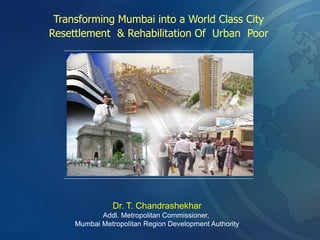
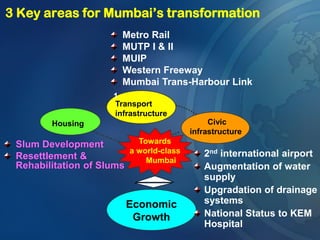
Transforming Mumbai into a World Class City
Resettlement & Rehabilitation Of Urban Poor
Dr. T. Chandrashekhar
Addl. Metropolitan Commissioner,
Mumbai Metropolitan Region Development Authority
Mumbai’s Vision
“Transforming Mumbai into a world class city
with a vibrant economy and globally
comparable quality of life.”
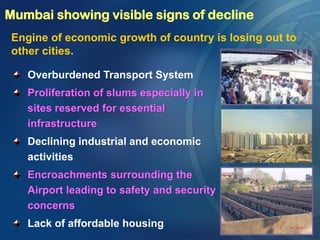
Mumbai showing visible signs of decline
Engine of economic growth of country is losing out to
other cities.
Overburdened Transport System
Proliferation of slums especially in
sites reserved for essential
infrastructure
Declining industrial and economic
activities
Encroachments surrounding the
Airport leading to safety and security
concerns
Lack of affordable housing
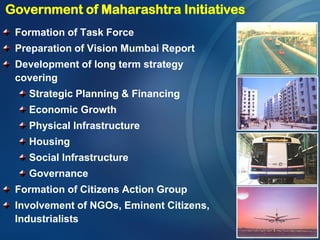
Government of Maharashtra Initiatives
Formation of Task Force
Preparation of Vision Mumbai Report
Development of long term strategy
covering
Strategic Planning & Financing
Economic Growth
Physical Infrastructure
Housing
Social Infrastructure
Governance
Formation of Citizens Action Group
Involvement of NGOs, Eminent Citizens,
Industrialists
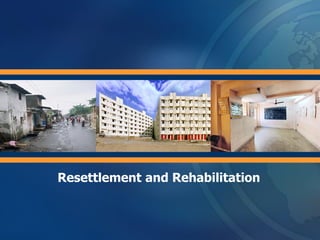
3 Key areas for Mumbai’s transformation
Transport
infrastructure
Civic
infrastructure
Economic
Growth
Housing
Towards
a world-class
Mumbai
Slum Development
Resettlement &
Rehabilitation of Slums
Metro Rail
MUTP I & II
MUIP
Western Freeway
Mumbai Trans-Harbour Link
1
2nd international airport
Augmentation of water
supply
Upgradation of drainage
systems
National Status to KEM
Hospital
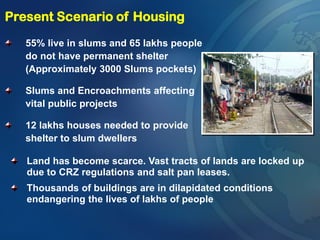
Resettlement and Rehabilitation
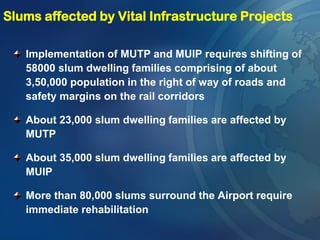
55% live in slums and 65 lakhs people
do not have permanent shelter
(Approximately 3000 Slums pockets)
Slums and Encroachments affecting
vital public projects
12 lakhs houses needed to provide
shelter to slum dwellers
Present Scenario of Housing
Land has become scarce. Vast tracts of lands are locked up
due to CRZ regulations and salt pan leases.
Thousands of buildings are in dilapidated conditions
endangering the lives of lakhs of people
Slums affected by Vital Infrastructure Projects
Implementation of MUTP and MUIP requires shifting of
58000 slum dwelling families comprising of about
3,50,000 population in the right of way of roads and
safety margins on the rail corridors
About 23,000 slum dwelling families are affected by
MUTP
About 35,000 slum dwelling families are affected by
MUIP
More than 80,000 slums surround the Airport require
immediate rehabilitation
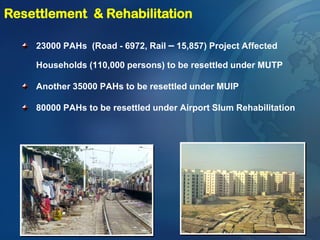
23000 PAHs (Road - 6972, Rail – 15,857) Project Affected
Households (110,000 persons) to be resettled under MUTP
Another 35000 PAHs to be resettled under MUIP
80000 PAHs to be resettled under Airport Slum Rehabilitation
Resettlement & Rehabilitation
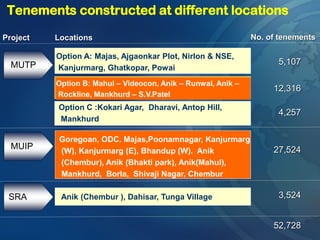
MUTP
Option A: Majas, Ajgaonkar Plot, Nirlon & NSE,
Kanjurmarg, Ghatkopar, Powai
LocationsProject
5,107
Option B: Mahul – Videocon, Anik – Runwal, Anik –
Rockline, Mankhurd – S.V.Patel
Option C :Kokari Agar, Dharavi, Antop Hill,
Mankhurd
MUIP
Anik (Chembur ), Dahisar, Tunga VillageSRA
No. of tenements
Tenements constructed at different locations
4,257
3,524
12,316
Goregoan, ODC. Majas,Poonamnagar, Kanjurmarg
(W), Kanjurmarg (E), Bhandup (W). Anik
(Chembur), Anik (Bhakti park), Anik(Mahul),
Mankhurd, Borla, Shivaji Nagar, Chembur
52,728
27,524
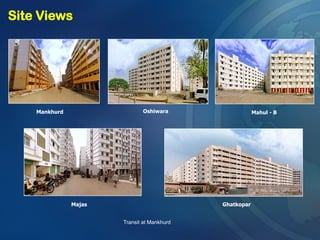
Site Views
Mankhurd Oshiwara Mahul - B
Majas Ghatkopar
Transit at Mankhurd
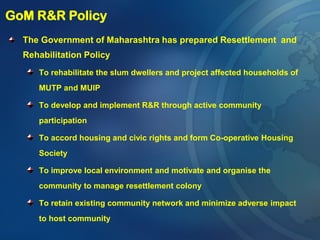
GoM R&R Policy
The Government of Maharashtra has prepared Resettlement and
Rehabilitation Policy
To rehabilitate the slum dwellers and project affected households of
MUTP and MUIP
To develop and implement R&R through active community
participation
To accord housing and civic rights and form Co-operative Housing
Society
To improve local environment and motivate and organise the
community to manage resettlement colony
To retain existing community network and minimize adverse impact
to host community
Eligibility - A PAP whose name is in the electoral as on 1st Jan, 95
Salient features of the slum rehabilitation scheme
Provide free tenement of 225 sq. ft. carpet area to each PAH
Provide Rs. 20,000/structure for future maintenance
Minimum density 500 t/s per hectare
Floor Space Index 2.5 available
For every sq. ft. built rehab purpose, developer entitled for one sq.
ft. for sale purpose
TDR is available against free sale component as spill over 2.5 FSI
One Balwadi, One Welfare centre and a Society office for every 100
tenements each admeasuring 225 sq. ft. each
Un-encroached land belonging to a private party is
conveyed free of cost to the government for the use of
re-housing PAPs currently encroaching public land
needed for vital public project
Land owner to receive 1:1 TDR in lieu of the land
Land owner/Developer to receive incremental TDR
against construction of rehabilitation tenements at the
ratio of 1:1.33
Salient features of the slum rehabilitation scheme
Step Involved in Slum Rehabilitation
Identification of vital public projects
Preparation of BSES Reports and Cadastral Maps
Identification of lands suitable for transit and permanent rehabilitation,
preparation of plans and approval to the schemes by the competent
authority
Preparation of eligible slum dwellers/PAPs list
Certification of the PAPs list by the Collector
Public consultations, issuance of identity cards and allotment letters
Construction of Transit tenements
Shifting of PAPs into transit tenements and clearing the corridors.
Construction of Permanent tenements
Shifting of PAPs into permanent tenements
Post resettlement activities such as Co. Op. Housing Soc.
Registration/transfer funds to the societies
Transit tenements provided temporary accommodations for slum
dwellers while permanent tenements were being completed
8000 transit tenement were constructed under MUTP along with
necessary infrastructure
The transit tenements are of approximately 120 sq.ft carpet area
each with common toilet facilities
Pedestrian pathways along with other basic amenities such as
water, electricity and ration shops have been provided
Construction of Transit Tenements
Based on recommendations of a Task Force assigned to frame a policy
regarding Resettlement & Rehabilitation the policy has been formulated.
Baseline Surveys, Resettlement and Rehabilitation Action Plan,
Rehabilitation Implementation Plans (RIPs) and Community
Environmental Management Plans (CEMPs) have been prepared with the
help of NGOs.
Rehabilitation Action Plan (RAP) prepared covering;
Number of families affected by the project
Policy framework and entitlements
Land acquisition details
Identification of resettlement sites and purchase of built houses
Plans for transit and permanent housing
Economic rehabilitation measures
Monitoring, evaluation procedures, grievance & redressal
mechanisms
Time-table including the preparation of detailed implementation
plans
Resettlement and Rehabilitation Process
The project is being implemented with the assistance
of the NGOs like SPARC and SRS
The process of community participation began from
the stage of conducting BSES and RIP preparation
and the post rehabilitation support and services for
each of the project component
Reputed NGOs and Community Based Organisations
working in the project areas engaged to carry out the
BSES through the active participation of the
community
NGOs and Community Involvement
NGOs involvement helped to:
Identify the community preferences in new relocation site
Shelter design
Formation of Co. Op. Housing Societies of the PAHs
Formation of Mahila Milan Committees
Training the groups in maintenance and management of community
needs
Preparing the community to adapt to new lifestyle in multi-storied building
Maintenance of the local environment and services
Training and assisting the communities in establishing community based
savings and loan during the post resettlement phase
Promote community savings, income earning activities and improved
quality of life
NGOs and Community Involvement
Two separate Committees have been appointed by MMRDA for
redressal of grievances of the Slum dwellers/ PAHs
Field Level Grievance Committee, comprising officials of the PMU,
representatives of the NGOs and Project Implementing Agencies
(PIAs), to hear the grievances of the PAHs at the first instance
High Level Grievance Redressal Committee, comprising the
officials of the MMRDA and the representatives of the NGOs, to
hear and decide appeals of the aggrieved Slum dwellers/ PAHs
A high level Independent Monitoring Panel has been constituted to
supervise the overall implementation process
Grievance Redressal Mechanism
Formation of Co. Op. Housing Soc. including their
PAH members and transfer of legal tenure of the land
in the names of the societies
Payment of all kind of monetary compensations &
transfer of maintenance charges
Providing community facilities, to the left over
population that are lost in the process of resettlement
Post Resettlement Activities
In order to monitor the rehab process, MIS has been
established by MMRDA
The MIS is prepared based on the inputs from the field
level operations to generate quarterly progress reports
Management Inofrmation System (MIS)
Innovation in Implementation
The mammoth task of rehabilitation and resettlement is
being implemented with the following fast and quick
actions:
• Establishment of SRA cell in MMRDA
• Motivating the developers to offer tenements under SRA
scheme
• Invitation of proposals through public notification for
construction of tenements under SRA
• Timely approvals after statutory scrutiny to the
proposals of the developers and grant of TDR benefits
Innovation in Implementation – contd.
Supervision to ensure design standard, quality
construction through PMCs ensuring development of
off-site infrastructure utilizing engineering capabilities
of MMRDA
Involvement of NGOs to carry out the BSES, preparation
of RIP, CEMP and EA etc.
Co-ordination with government agencies like revenue
department and collector encroachments to finalise
eligibility and entitlements
Shifting of families through NGOs involvement under
the supervision of trained and qualified team of MMRDA
Taking over of cleared lands and providing security to
prevent re-encroachments
Impact Assessment
The execution of MUTP, MUIP and resettlement and rehabilitation of
project affected/slum dwellers would have several spin off benefits
The cost of the R&R if entirely procured through public
procurement process, purely on financial terms would cost Rs.
1500 Cr.
The process through which these tenements were procured has
put a very limited burden on government and therefore saved the
public funds at large
This project not only helped to relieve Mumbai of it’s
transportation problems but also give the much awaited impetus
to the stagnant growth of Mumbai’s economy
The transport infrastructure project are expected to yield
remarkable benefits to the city in terms of improved productivity,
saving in fuel and travel time, reduction in pollution and overall
growth of the city
THANK YOU !

2.6.1 slum case study mumbai

  • 1.
    Transforming Mumbai intoa World Class City Resettlement & Rehabilitation Of Urban Poor Dr. T. Chandrashekhar Addl. Metropolitan Commissioner, Mumbai Metropolitan Region Development Authority
  • 2.
    Mumbai’s Vision “Transforming Mumbaiinto a world class city with a vibrant economy and globally comparable quality of life.”
  • 3.
    Mumbai showing visiblesigns of decline Engine of economic growth of country is losing out to other cities. Overburdened Transport System Proliferation of slums especially in sites reserved for essential infrastructure Declining industrial and economic activities Encroachments surrounding the Airport leading to safety and security concerns Lack of affordable housing
  • 4.
    Government of MaharashtraInitiatives Formation of Task Force Preparation of Vision Mumbai Report Development of long term strategy covering Strategic Planning & Financing Economic Growth Physical Infrastructure Housing Social Infrastructure Governance Formation of Citizens Action Group Involvement of NGOs, Eminent Citizens, Industrialists
  • 5.
    3 Key areasfor Mumbai’s transformation Transport infrastructure Civic infrastructure Economic Growth Housing Towards a world-class Mumbai Slum Development Resettlement & Rehabilitation of Slums Metro Rail MUTP I & II MUIP Western Freeway Mumbai Trans-Harbour Link 1 2nd international airport Augmentation of water supply Upgradation of drainage systems National Status to KEM Hospital
  • 6.
  • 7.
    55% live inslums and 65 lakhs people do not have permanent shelter (Approximately 3000 Slums pockets) Slums and Encroachments affecting vital public projects 12 lakhs houses needed to provide shelter to slum dwellers Present Scenario of Housing Land has become scarce. Vast tracts of lands are locked up due to CRZ regulations and salt pan leases. Thousands of buildings are in dilapidated conditions endangering the lives of lakhs of people
  • 8.
    Slums affected byVital Infrastructure Projects Implementation of MUTP and MUIP requires shifting of 58000 slum dwelling families comprising of about 3,50,000 population in the right of way of roads and safety margins on the rail corridors About 23,000 slum dwelling families are affected by MUTP About 35,000 slum dwelling families are affected by MUIP More than 80,000 slums surround the Airport require immediate rehabilitation
  • 9.
    23000 PAHs (Road- 6972, Rail – 15,857) Project Affected Households (110,000 persons) to be resettled under MUTP Another 35000 PAHs to be resettled under MUIP 80000 PAHs to be resettled under Airport Slum Rehabilitation Resettlement & Rehabilitation
  • 10.
    MUTP Option A: Majas,Ajgaonkar Plot, Nirlon & NSE, Kanjurmarg, Ghatkopar, Powai LocationsProject 5,107 Option B: Mahul – Videocon, Anik – Runwal, Anik – Rockline, Mankhurd – S.V.Patel Option C :Kokari Agar, Dharavi, Antop Hill, Mankhurd MUIP Anik (Chembur ), Dahisar, Tunga VillageSRA No. of tenements Tenements constructed at different locations 4,257 3,524 12,316 Goregoan, ODC. Majas,Poonamnagar, Kanjurmarg (W), Kanjurmarg (E), Bhandup (W). Anik (Chembur), Anik (Bhakti park), Anik(Mahul), Mankhurd, Borla, Shivaji Nagar, Chembur 52,728 27,524
  • 11.
    Site Views Mankhurd OshiwaraMahul - B Majas Ghatkopar Transit at Mankhurd
  • 12.
    GoM R&R Policy TheGovernment of Maharashtra has prepared Resettlement and Rehabilitation Policy To rehabilitate the slum dwellers and project affected households of MUTP and MUIP To develop and implement R&R through active community participation To accord housing and civic rights and form Co-operative Housing Society To improve local environment and motivate and organise the community to manage resettlement colony To retain existing community network and minimize adverse impact to host community
  • 13.
    Eligibility - APAP whose name is in the electoral as on 1st Jan, 95 Salient features of the slum rehabilitation scheme Provide free tenement of 225 sq. ft. carpet area to each PAH Provide Rs. 20,000/structure for future maintenance Minimum density 500 t/s per hectare Floor Space Index 2.5 available For every sq. ft. built rehab purpose, developer entitled for one sq. ft. for sale purpose TDR is available against free sale component as spill over 2.5 FSI One Balwadi, One Welfare centre and a Society office for every 100 tenements each admeasuring 225 sq. ft. each
  • 14.
    Un-encroached land belongingto a private party is conveyed free of cost to the government for the use of re-housing PAPs currently encroaching public land needed for vital public project Land owner to receive 1:1 TDR in lieu of the land Land owner/Developer to receive incremental TDR against construction of rehabilitation tenements at the ratio of 1:1.33 Salient features of the slum rehabilitation scheme
  • 15.
    Step Involved inSlum Rehabilitation Identification of vital public projects Preparation of BSES Reports and Cadastral Maps Identification of lands suitable for transit and permanent rehabilitation, preparation of plans and approval to the schemes by the competent authority Preparation of eligible slum dwellers/PAPs list Certification of the PAPs list by the Collector Public consultations, issuance of identity cards and allotment letters Construction of Transit tenements Shifting of PAPs into transit tenements and clearing the corridors. Construction of Permanent tenements Shifting of PAPs into permanent tenements Post resettlement activities such as Co. Op. Housing Soc. Registration/transfer funds to the societies
  • 16.
    Transit tenements providedtemporary accommodations for slum dwellers while permanent tenements were being completed 8000 transit tenement were constructed under MUTP along with necessary infrastructure The transit tenements are of approximately 120 sq.ft carpet area each with common toilet facilities Pedestrian pathways along with other basic amenities such as water, electricity and ration shops have been provided Construction of Transit Tenements
  • 17.
    Based on recommendationsof a Task Force assigned to frame a policy regarding Resettlement & Rehabilitation the policy has been formulated. Baseline Surveys, Resettlement and Rehabilitation Action Plan, Rehabilitation Implementation Plans (RIPs) and Community Environmental Management Plans (CEMPs) have been prepared with the help of NGOs. Rehabilitation Action Plan (RAP) prepared covering; Number of families affected by the project Policy framework and entitlements Land acquisition details Identification of resettlement sites and purchase of built houses Plans for transit and permanent housing Economic rehabilitation measures Monitoring, evaluation procedures, grievance & redressal mechanisms Time-table including the preparation of detailed implementation plans Resettlement and Rehabilitation Process
  • 18.
    The project isbeing implemented with the assistance of the NGOs like SPARC and SRS The process of community participation began from the stage of conducting BSES and RIP preparation and the post rehabilitation support and services for each of the project component Reputed NGOs and Community Based Organisations working in the project areas engaged to carry out the BSES through the active participation of the community NGOs and Community Involvement
  • 19.
    NGOs involvement helpedto: Identify the community preferences in new relocation site Shelter design Formation of Co. Op. Housing Societies of the PAHs Formation of Mahila Milan Committees Training the groups in maintenance and management of community needs Preparing the community to adapt to new lifestyle in multi-storied building Maintenance of the local environment and services Training and assisting the communities in establishing community based savings and loan during the post resettlement phase Promote community savings, income earning activities and improved quality of life NGOs and Community Involvement
  • 20.
    Two separate Committeeshave been appointed by MMRDA for redressal of grievances of the Slum dwellers/ PAHs Field Level Grievance Committee, comprising officials of the PMU, representatives of the NGOs and Project Implementing Agencies (PIAs), to hear the grievances of the PAHs at the first instance High Level Grievance Redressal Committee, comprising the officials of the MMRDA and the representatives of the NGOs, to hear and decide appeals of the aggrieved Slum dwellers/ PAHs A high level Independent Monitoring Panel has been constituted to supervise the overall implementation process Grievance Redressal Mechanism
  • 21.
    Formation of Co.Op. Housing Soc. including their PAH members and transfer of legal tenure of the land in the names of the societies Payment of all kind of monetary compensations & transfer of maintenance charges Providing community facilities, to the left over population that are lost in the process of resettlement Post Resettlement Activities
  • 22.
    In order tomonitor the rehab process, MIS has been established by MMRDA The MIS is prepared based on the inputs from the field level operations to generate quarterly progress reports Management Inofrmation System (MIS)
  • 23.
    Innovation in Implementation Themammoth task of rehabilitation and resettlement is being implemented with the following fast and quick actions: • Establishment of SRA cell in MMRDA • Motivating the developers to offer tenements under SRA scheme • Invitation of proposals through public notification for construction of tenements under SRA • Timely approvals after statutory scrutiny to the proposals of the developers and grant of TDR benefits
  • 24.
    Innovation in Implementation– contd. Supervision to ensure design standard, quality construction through PMCs ensuring development of off-site infrastructure utilizing engineering capabilities of MMRDA Involvement of NGOs to carry out the BSES, preparation of RIP, CEMP and EA etc. Co-ordination with government agencies like revenue department and collector encroachments to finalise eligibility and entitlements Shifting of families through NGOs involvement under the supervision of trained and qualified team of MMRDA Taking over of cleared lands and providing security to prevent re-encroachments
  • 25.
    Impact Assessment The executionof MUTP, MUIP and resettlement and rehabilitation of project affected/slum dwellers would have several spin off benefits The cost of the R&R if entirely procured through public procurement process, purely on financial terms would cost Rs. 1500 Cr. The process through which these tenements were procured has put a very limited burden on government and therefore saved the public funds at large This project not only helped to relieve Mumbai of it’s transportation problems but also give the much awaited impetus to the stagnant growth of Mumbai’s economy The transport infrastructure project are expected to yield remarkable benefits to the city in terms of improved productivity, saving in fuel and travel time, reduction in pollution and overall growth of the city
  • 26.