REDEVELOPMENT OF
BHENDI BAZAAR,
MUMBAI
Presented By:
Simran Aggarwal
MURP-I (20-22)
FOA, SUPVA
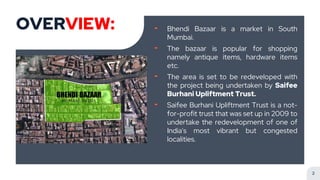
OVERVIEW: ╸ Bhendi Bazaar is a market in South
Mumbai.
╸ The bazaar is popular for shopping
namely antique items, hardware items
etc.
╸ The area is set to be redeveloped with
the project being undertaken by Saifee
Burhani Upliftment Trust.
╸ Saifee Burhani Upliftment Trust is a not-
for-profit trust that was set up in 2009 to
undertake the redevelopment of one of
India's most vibrant but congested
localities.
2
3
OVERVIEW:
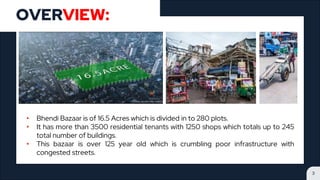
• Bhendi Bazaar is of 16.5 Acres which is divided in to 280 plots.
• It has more than 3500 residential tenants with 1250 shops which totals up to 245
total number of buildings.
• This bazaar is over 125 year old which is crumbling poor infrastructure with
congested streets.
NEED FOR
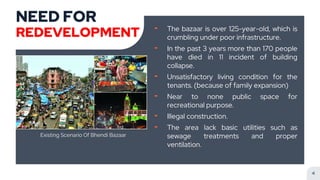
REDEVELOPMENT ╸ The bazaar is over 125-year-old, which is
crumbling under poor infrastructure.
╸ In the past 3 years more than 170 people
have died in 11 incident of building
collapse.
╸ Unsatisfactory living condition for the
tenants. (because of family expansion)
╸ Near to none public space for
recreational purpose.
╸ Illegal construction.
╸ The area lack basic utilities such as
sewage treatments and proper
ventilation.
Existing Scenario Of Bhendi Bazaar
4
INTENT &
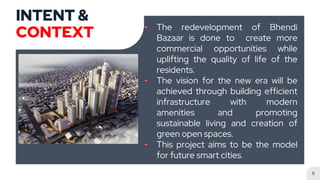
CONTEXT ╸ The redevelopment of Bhendi
Bazaar is done to create more
commercial opportunities while
uplifting the quality of life of the
residents.
╸ The vision for the new era will be
achieved through building efficient
infrastructure with modern
amenities and promoting
sustainable living and creation of
green open spaces.
╸ This project aims to be the model
for future smart cities.
5
STAKEHOLDERS
╸ This redevelopment project indicates the lack of required
stakeholders engaged in project formulation.
╸ The project was okayed by Maharashtra Housing and Area
Development Authority and Bombay Municipal Corporation.
6
METHODOLOGY
╸ Started in 2009, original deadline was 2023.
╸ Phase-I:
╶ Sub clusters 1 and 3 completed and tenants from the
location have been shifted.
╸ Phase-2:
╶ Expected to be completed by 2025
7
METHODOLOGY ADOPTED
8
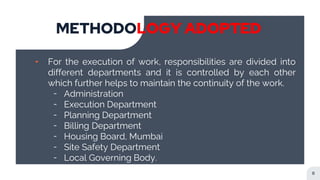
╸ For the execution of work, responsibilities are divided into
different departments and it is controlled by each other
which further helps to maintain the continuity of the work.
╶ Administration
╶ Execution Department
╶ Planning Department
╶ Billing Department
╶ Housing Board, Mumbai
╶ Site Safety Department
╶ Local Governing Body.
9
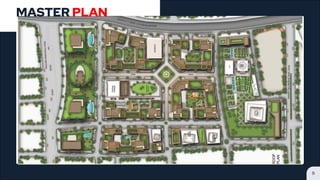
MASTER PLAN
10
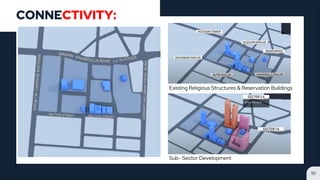
CONNECTIVITY:
Existing Religious Structures & Reservation Buildings
Sub- Sector Development
11
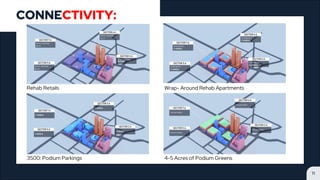
CONNECTIVITY:
Wrap- Around Rehab Apartments
4-5 Acres of Podium Greens
Rehab Retails
3500: Podium Parkings
12
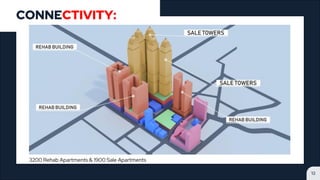
CONNECTIVITY:
3200 Rehab Apartments & 1900 Sale Apartments
13
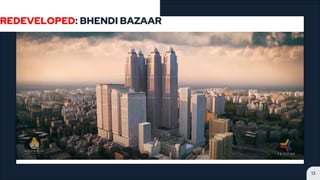
REDEVELOPED: BHENDI BAZAAR
DURING:
╸ The high priest of the Dawoodi Bohra community. The Bohris
form about 85 per cent of the population of Bhendi Bazaar.
╸ Between 2010 and 2013 the trust built several transit homes.
Most of them near Mazgaon which is about 5 km from Bhendi
Bazaar.
╸ In April, 2011 some 100 families wer also moved to transit colony.
14
AFTER:
1
• Following the design of neighborhood as per the policy issued by Maharashtra
Government in 2009.
• 100- 150 of chauls has been replaced by 17 high storey residential buildings.
• Widest streets up to 20 meters.
• Maximum green areas and proper ventilation.
AFTER:
╸ The entire redevelopment is eco-friendly.
╸ The building rise progressively in height from south to north,
thus ensuring that every flat catches the breeze coming from
the sea.
╸ Out of 17 towers, 13 will be used to rehabilitate the current
residents and remaining 4 towers will be put on sale for 1200-
1600 residence.
╸ The ground floor will be commercial with underground parking,
and residential parking will be built on top.
16
AFTER:
╸ According to a 2012 regulation of the MRTP Act, residential
tenants are supposed to get 35% more area on their existing
total carpet area and commercial tenants are eligible for an
additional 20%.
17
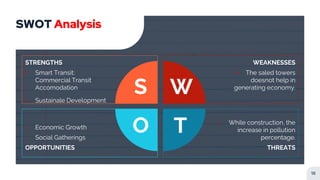
SWOT Analysis
18
STRENGTHS
• Smart Transit:
Commercial Transit
Accomodation
• Sustainale Development
WEAKNESSES
• The saled towers
doesnot help in
generating economy.
• Economic Growth
• Social Gatherings
OPPORTUNITIES
• While construction, the
increase in pollution
percentage.
THREATS
Thankyou!
19

Bhendi bazaar

  • 1.
    REDEVELOPMENT OF BHENDI BAZAAR, MUMBAI PresentedBy: Simran Aggarwal MURP-I (20-22) FOA, SUPVA
  • 2.
    OVERVIEW: ╸ BhendiBazaar is a market in South Mumbai. ╸ The bazaar is popular for shopping namely antique items, hardware items etc. ╸ The area is set to be redeveloped with the project being undertaken by Saifee Burhani Upliftment Trust. ╸ Saifee Burhani Upliftment Trust is a not- for-profit trust that was set up in 2009 to undertake the redevelopment of one of India's most vibrant but congested localities. 2
  • 3.
    3 OVERVIEW: • Bhendi Bazaaris of 16.5 Acres which is divided in to 280 plots. • It has more than 3500 residential tenants with 1250 shops which totals up to 245 total number of buildings. • This bazaar is over 125 year old which is crumbling poor infrastructure with congested streets.
  • 4.
    NEED FOR REDEVELOPMENT ╸The bazaar is over 125-year-old, which is crumbling under poor infrastructure. ╸ In the past 3 years more than 170 people have died in 11 incident of building collapse. ╸ Unsatisfactory living condition for the tenants. (because of family expansion) ╸ Near to none public space for recreational purpose. ╸ Illegal construction. ╸ The area lack basic utilities such as sewage treatments and proper ventilation. Existing Scenario Of Bhendi Bazaar 4
  • 5.
    INTENT & CONTEXT ╸The redevelopment of Bhendi Bazaar is done to create more commercial opportunities while uplifting the quality of life of the residents. ╸ The vision for the new era will be achieved through building efficient infrastructure with modern amenities and promoting sustainable living and creation of green open spaces. ╸ This project aims to be the model for future smart cities. 5
  • 6.
    STAKEHOLDERS ╸ This redevelopmentproject indicates the lack of required stakeholders engaged in project formulation. ╸ The project was okayed by Maharashtra Housing and Area Development Authority and Bombay Municipal Corporation. 6
  • 7.
    METHODOLOGY ╸ Started in2009, original deadline was 2023. ╸ Phase-I: ╶ Sub clusters 1 and 3 completed and tenants from the location have been shifted. ╸ Phase-2: ╶ Expected to be completed by 2025 7
  • 8.
    METHODOLOGY ADOPTED 8 ╸ Forthe execution of work, responsibilities are divided into different departments and it is controlled by each other which further helps to maintain the continuity of the work. ╶ Administration ╶ Execution Department ╶ Planning Department ╶ Billing Department ╶ Housing Board, Mumbai ╶ Site Safety Department ╶ Local Governing Body.
  • 9.
  • 10.
    10 CONNECTIVITY: Existing Religious Structures& Reservation Buildings Sub- Sector Development
  • 11.
    11 CONNECTIVITY: Wrap- Around RehabApartments 4-5 Acres of Podium Greens Rehab Retails 3500: Podium Parkings
  • 12.
  • 13.
  • 14.
    DURING: ╸ The highpriest of the Dawoodi Bohra community. The Bohris form about 85 per cent of the population of Bhendi Bazaar. ╸ Between 2010 and 2013 the trust built several transit homes. Most of them near Mazgaon which is about 5 km from Bhendi Bazaar. ╸ In April, 2011 some 100 families wer also moved to transit colony. 14
  • 15.
    AFTER: 1 • Following thedesign of neighborhood as per the policy issued by Maharashtra Government in 2009. • 100- 150 of chauls has been replaced by 17 high storey residential buildings. • Widest streets up to 20 meters. • Maximum green areas and proper ventilation.
  • 16.
    AFTER: ╸ The entireredevelopment is eco-friendly. ╸ The building rise progressively in height from south to north, thus ensuring that every flat catches the breeze coming from the sea. ╸ Out of 17 towers, 13 will be used to rehabilitate the current residents and remaining 4 towers will be put on sale for 1200- 1600 residence. ╸ The ground floor will be commercial with underground parking, and residential parking will be built on top. 16
  • 17.
    AFTER: ╸ According toa 2012 regulation of the MRTP Act, residential tenants are supposed to get 35% more area on their existing total carpet area and commercial tenants are eligible for an additional 20%. 17
  • 18.
    SWOT Analysis 18 STRENGTHS • SmartTransit: Commercial Transit Accomodation • Sustainale Development WEAKNESSES • The saled towers doesnot help in generating economy. • Economic Growth • Social Gatherings OPPORTUNITIES • While construction, the increase in pollution percentage. THREATS
  • 19.