Downloaded 673 times
![68.25 bits doesnt mean much to us in the sense of time, so we must convert 68.25 bits into a frame of time. To do this, it is necessary to calculate
the duration of a single bit, the duration is the amount of time it would take to transmit a single bit.
[Back to Top]
Duration of a Single Bit
As you recall, GSM uses Gaussian Minimum Shift Keying (GMSK) as its modulation method, which has a data throughput of 270.833
kilobits/second (kb/s).
Calculate duration of a bit.
Description Formula Result
Convert kilobits to bits 270.833 kb × 1000 270,833 bits
Calculate seconds per bit 1 sec ÷ 270,833 bits .00000369 seconds
Convert seconds to microseconds .00000369 sec × 1,000,000 3.69 µs
So now we know that it takes 3.69µs to transmit a single bit.
[Back to Top]
Propagation Delay
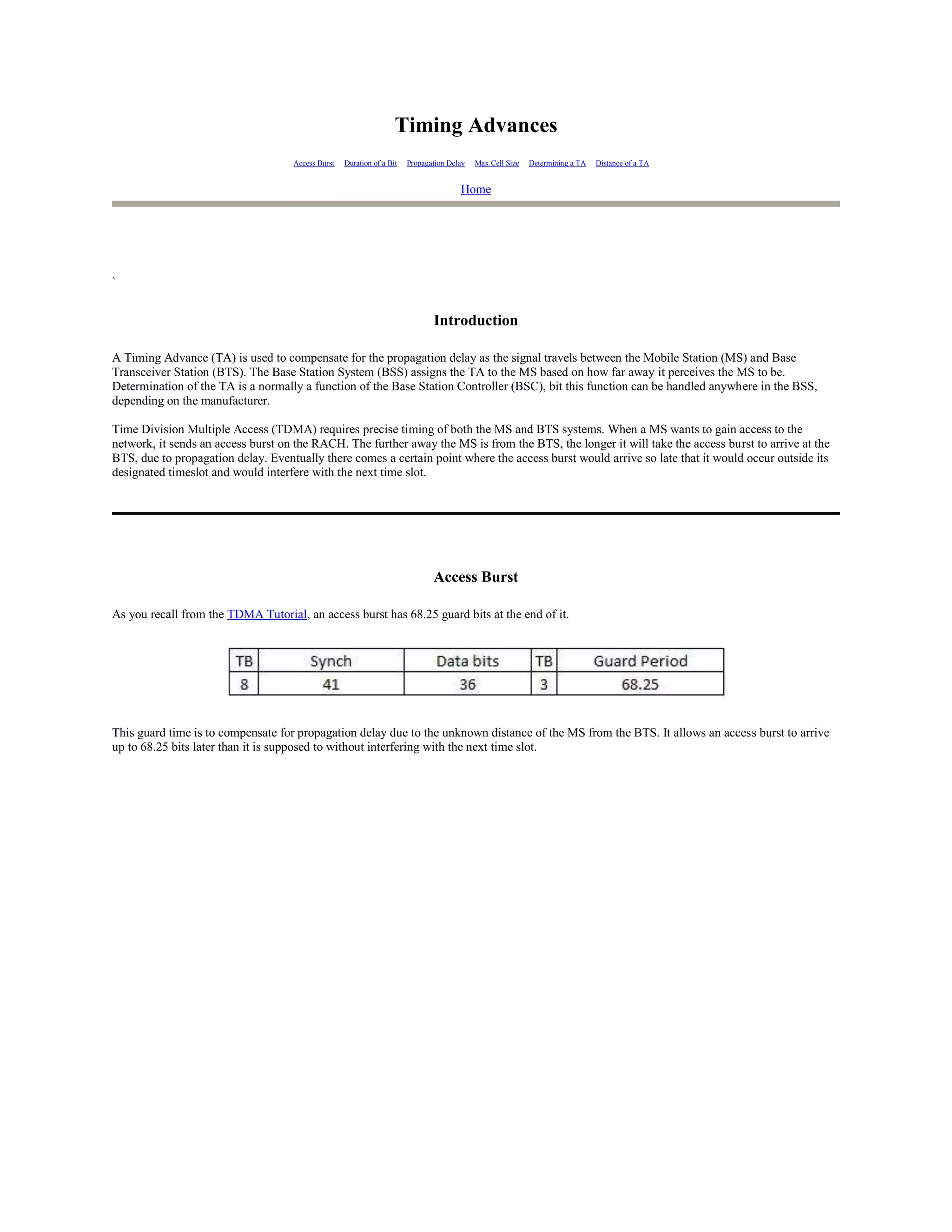
Now, if an access burst has a guard period of 68.25 bits this results in a maximum delay time of approximately 252µs (3.69µs × 68.25 bits). This
means that a signal from the MS could arrive up to 252µs after it is expected and it would not interfere with the next time slot.](https://image.slidesharecdn.com/timingadvances-121205141543-phpapp01/75/Timing-advances-2-2048.jpg)
![[Back to Top]
Maximum Size of a Cell
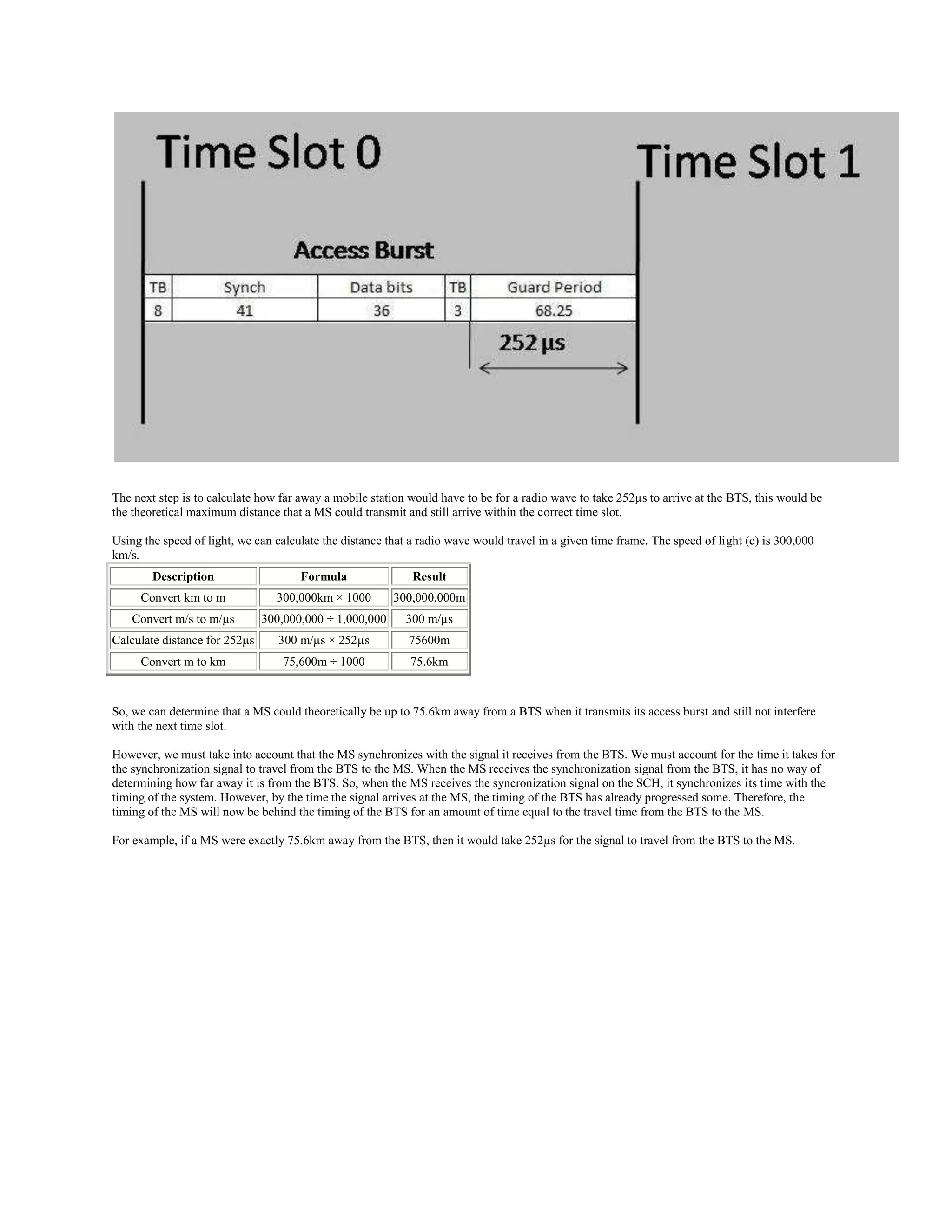
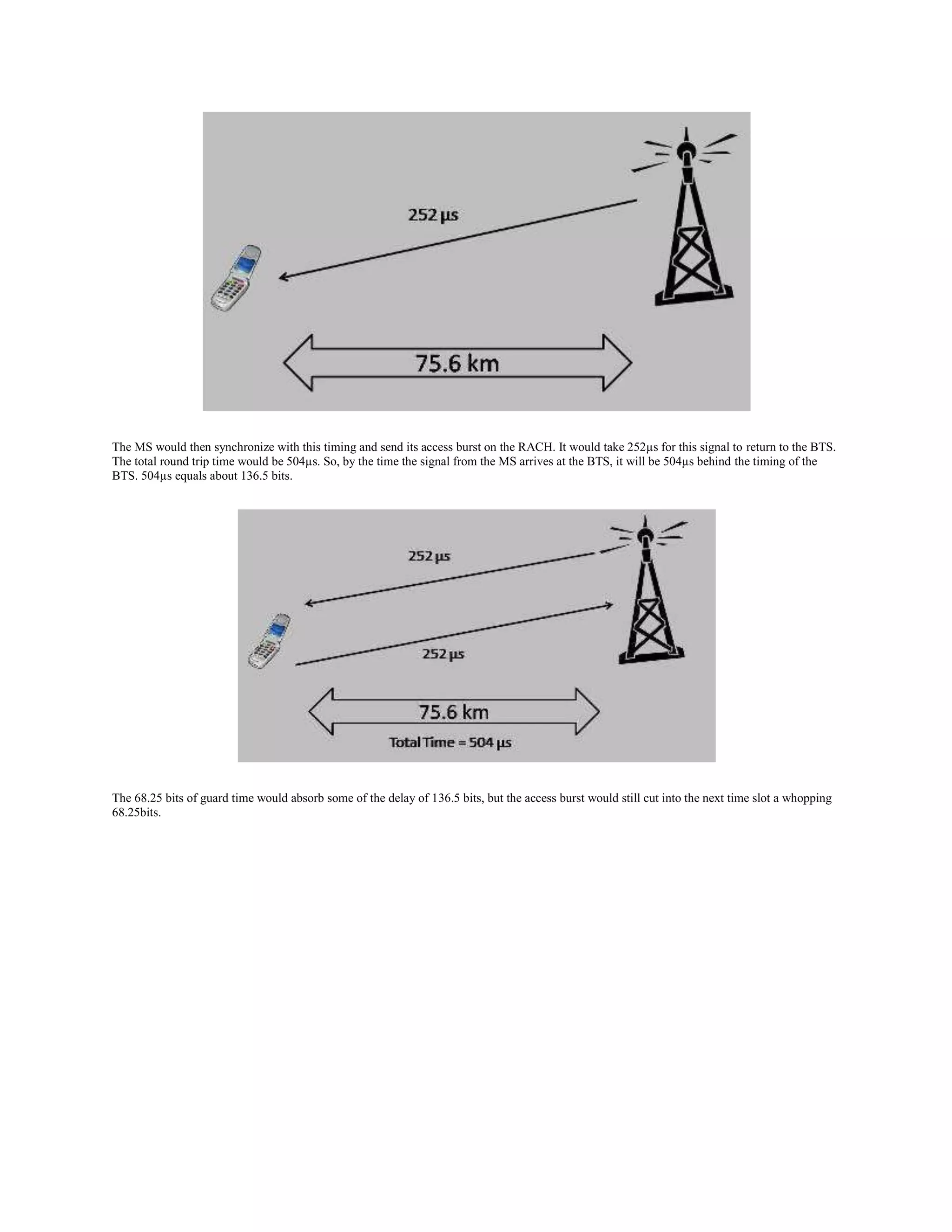
In order to compensate for the two-way trip of the radio link, we must divide the maximum delay distance in half. So, dividing 75.6km in half, we
get approximately 37.8 km. If a MS is further out than 37.8km and transmits an access burst it will most likely interfere with the following time
slot. Any distance less than 37.8km and the access burst should arrive within the guard time allowed for an access burst and it will not interfere
with the next time slot.
In GSM, the maximum distance of a cell is standardized at 35km. This is due mainly to the number of timing advances allowed in GSM, which is
explained below.
[Back to Top]
How a BSS Determines a Timing Advance
In order to determine the propagation delay between the MS and the BSS, the BSS uses the synchronization sequence within an access burst. The
BSS examines the synchronization sequence and sees how long it arrived after the time that it expected it to arrive. As we learned from above, the
duration of a single bit is approximately 3.69µs. So, if the BSS sees that the synchronization is late by a single bit, then it knows that the
propagation delay is 3.69µs. This is how the BSS knows which TA to send to the MS.](https://image.slidesharecdn.com/timingadvances-121205141543-phpapp01/75/Timing-advances-5-2048.jpg)
![For each 3.69µs of propagation delay, the TA will be incremented by 1. If the delay is less than 3.69µs, no adjustment is used and this is known
as TA0. For every TA, the MS will start its transmission 3.69µs (or one bit) early. Each TA really corresponds to a range of propagation delay.
Each TA is essentially equal to a 1-bit delay detected in the synchronization sequence.
TA From To
0 0µs 3.69µs
1 3.69µs 7.38µs
2 7.38µs 11.07µs
3 11.07µs 14.76µs
... ... ...
63 232.47µs 236.16µs
[Back to Top]
The Distance of a Timing Advance
When calculating the distances involved for each TA, we must remember that the total propagation delay accounts for a two-way trip of the radio
wave. The first leg is the synchronization signal traveling from the BTS to the MS, and the second leg is the access burst traveling from the MS to
the BTS. If we want to know the true distance of the MS from the BTS, we must divide the total propagation delay in half.
For example, if the BSS determines the total propagation delay to be 3.69µs, we can determine the distance of the MS from the BTS.
Description Formula Result
Determine one-way propagation time 3.69µs ÷ 2 1.845µs
Calculate distance
300 m/µs × 1.845µs 553.5m
(using speed of light.)](https://image.slidesharecdn.com/timingadvances-121205141543-phpapp01/75/Timing-advances-6-2048.jpg)
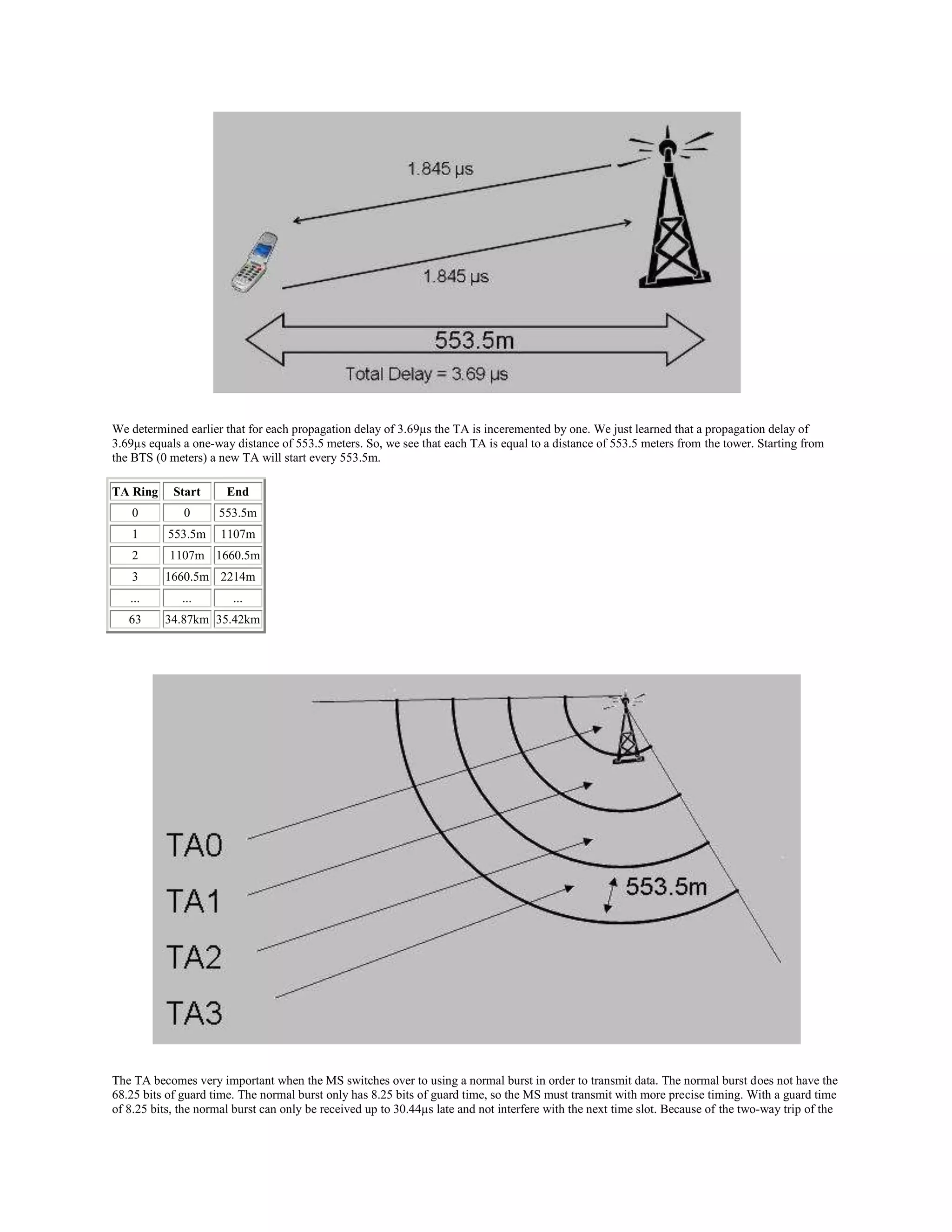


The document discusses timing advances in GSM networks. It explains that timing advances are used to compensate for propagation delay between mobile stations and base transceiver stations. The base station system determines the timing advance needed based on how far away it perceives the mobile station to be. Each timing advance corresponds to a range of distances, with each subsequent timing advance representing an additional 553.5 meters in distance from the base transceiver station. The maximum distance of a cell is standardized at 37.8 kilometers to account for the round trip delay of the radio signal.


