PULMONARY DRUG
DELIVERY SYSTEM
SILAMBARASAN I
DEPT OF PHARMACEUTICS
MTPG & RIHS
CONTENT
• Introduction of PDDS
• Definition
• Advantages
• Disadvantages
• Anatomy And Physiology Of
Respiratory Tract
• Mechanism Of PDDS
• Barrier Of PDDS
• Factor Affecting PDDS
• Aerosol
• History
• Advantage
• Disadvantage
• Components Of Aerosol
• Types Of Aerosol
• Evaluation
• Application
• Recent development
• References
2
INTRODUCTION
• Inhalation therapy has established itself as a valuable tool in the local
therapy of pulmonary diseases such as Asthma or COPD for several
decades.
• Carrier like Microparticles,Nanoparticles ,Liposomes can be used in
lung targeting.
• Optimum particle size is important for delivery of drugs.
• Currently, over 25 drug substances are marketed as inhalation aerosol
products for local pulmonary effects and about the same number of drugs
are in different stages of clinical development.
3
4
DEFINITION
Drugs which are given through
pulmonary route
LOCAL EFFECT
-Bronchial asthma
-COPD
SYSTEMIC EFFECT
-Migraine
-Volatile anesthetics
-Diabetes
5
ADVANTAGES
• Good targeting potential
• Rapid absorption
• Quick Onset of action
• Deliver high concentration of drug
• Needle-free delivery system
• By pass first pass effect
• Poor orally absorbed drug can be taken
6
DISADVANTAGES
• Some drug may produce irritation or toxicity.
• Some drug retained in lungs and clearence of drugs may be difficult.
• Difficulty in producing optimum particle size.
• Amount of drug delivered per puff is less which may be ineffective for
certain therapy.
• Patient have difficulty to usage of drug delivery device.
7
ANATOMY AND PHYSIOLOGY OF
RESPIRATORY TRACT
8
LUNGS
• Protected by Ribcage.
• Left lung is slightly smaller than Right lung.
• It is supported by diaphragm at the bottom of lungs.
• Major function is exchange of gases.
• About 100 million alveoli present in each lungs.
• About 10 % blood circulate through lungs (450 ml).
9
MECHANISM OF PULMONARY DRUG DELIVERY
10
BARRIER IN PULMONARY DRUG DELIVERY
MECHANICAL
• Coughing
• Sneezing
• Mucous layer
• Mucociliary clearence
• Pulmonary epithelium
CHEMICAL
• Surfactant
IMMUNOLOGICAL
• Alveolar macrophages
11
FACTORS AFFECTING PDDS
PHSYIOLOGICAL FACTOR
• Surface area
• Tidal volume
• Blood flow
• Disease state
• Inter subject variation
• Oral Vs Nasal breathing
• Breath holding
PHYSICOCHEMICAL FACTOR
• pKa
• Particle size
• Shape
• Density
• Electric charge
• Hygroscopy
• Surface roughness
• Solid state characteristics
12
AEROSOLS
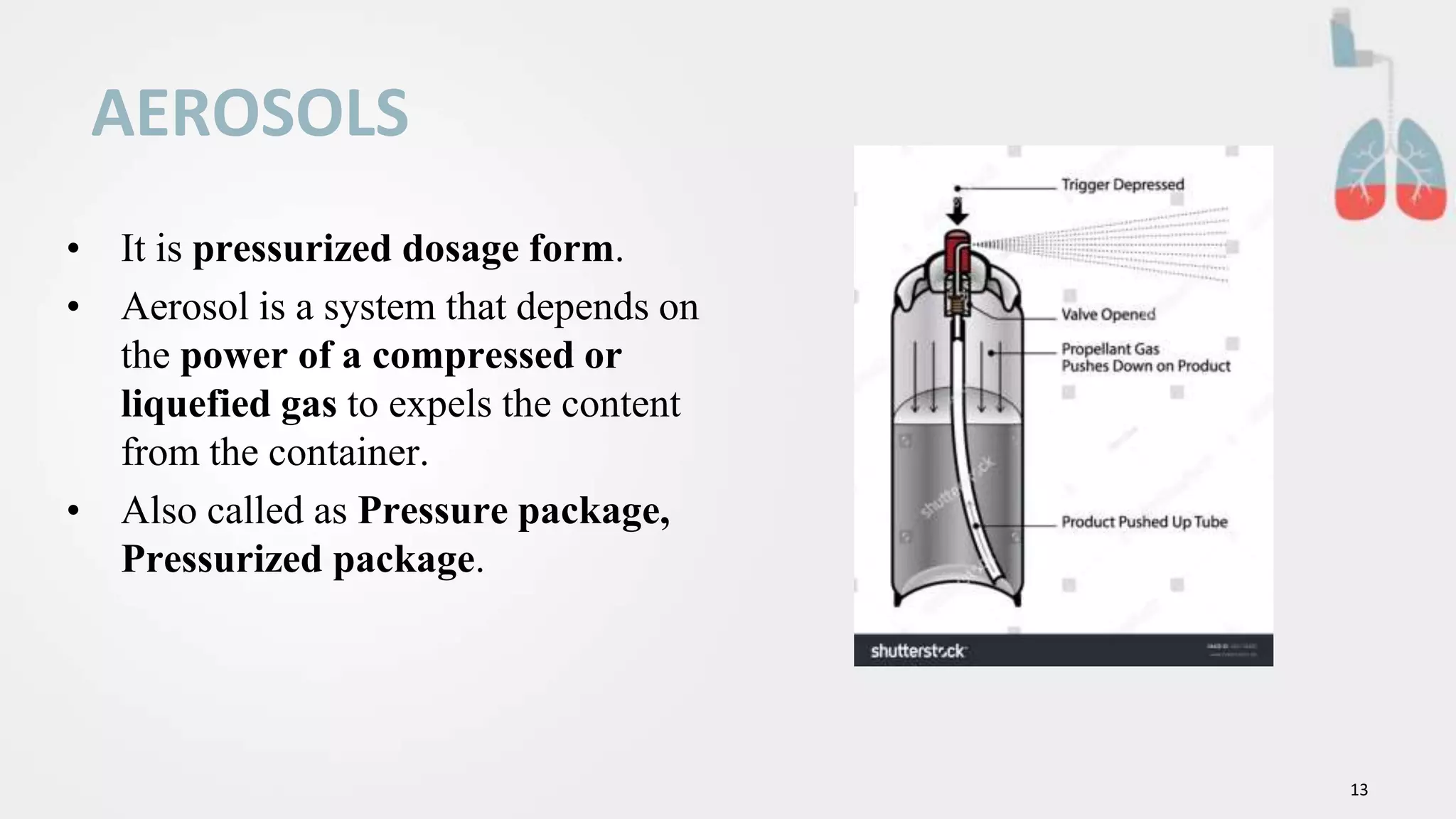
• It is pressurized dosage form.
• Aerosol is a system that depends on
the power of a compressed or
liquefied gas to expels the content
from the container.
• Also called as Pressure package,
Pressurized package.
13
HISTORY
• In 1942,Goodhue & Sullivan ,Dept of Agriculture ,USA developed
Aerosol insecticide.
• In early 1950,Aerosol used for Topical administration to treat burns,
minor cuts etc.
• In 1955,Epinephrine Pressurized package was developed to treat
Asthma.
14
ADVANTAGE
• Stability is high
• Directly applied to affected area
• Rapid onset of action
• Irritation produced by mechanical application of topical
medication is reduced
• No direct contact with medicament.
• No microorganism can enter.
15
DISADVANTAGE
• Costly
• Disposal of empty aerosol container is difficult
• Allergic in some cases
• Explosive
• Some formulation is difficult
• Sometime propellants may cause toxic reactions.
16
COMPONENTSOFAEROSOLS
1. Propellant
2. Container
3. Valveandactuator
4. Productconcentrate
17
1)PROPELLANTS
• Responsiblefordevelopingproperpressurewithinthecontainer.
• Providedrivingforcetoexpeltheproductfromthecontainer.
• Aidsinatomization.
TYPES OF PROPELLANTS
(a) LiquefiedgasesPropellants
(b) Compressed gasesPropellants
18
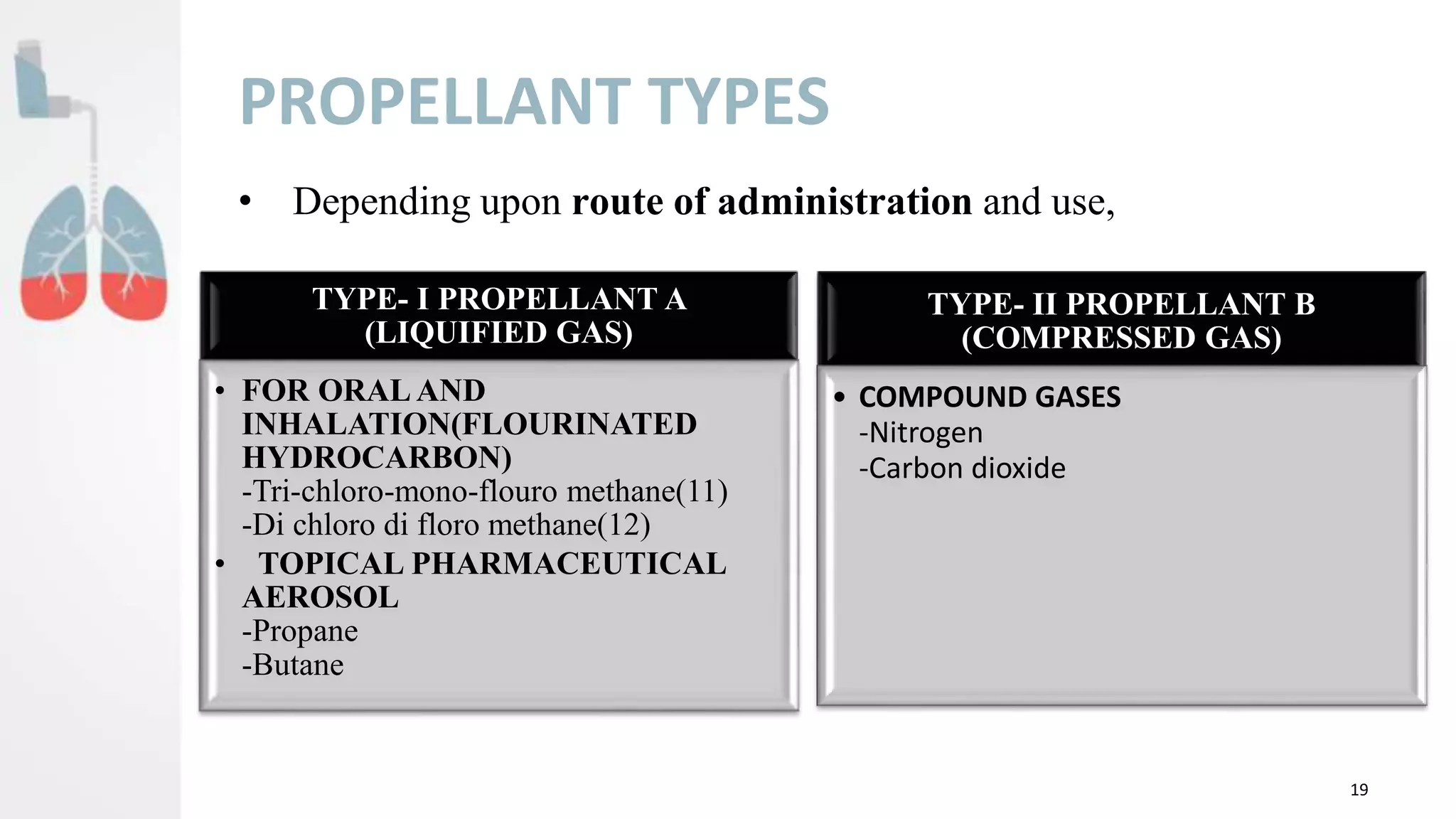
PROPELLANT TYPES
• Depending upon route of administration and use,
19
TYPE- I PROPELLANT A
(LIQUIFIED GAS)
• FOR ORAL AND
INHALATION(FLOURINATED
HYDROCARBON)
-Tri-chloro-mono-flouro methane(11)
-Di chloro di floro methane(12)
• TOPICAL PHARMACEUTICAL
AEROSOL
-Propane
-Butane
TYPE- II PROPELLANT B
(COMPRESSED GAS)
• COMPOUND GASES
-Nitrogen
-Carbon dioxide
A) LIQUIFIED GAS PROPELLANTS
 At room temperature and pressure ,they are gases.
 Liquefiedbyloweringthepressure&increasingthe
temperature.
 Whenliquefiedgasesare placed into a sealed container,
they immediately separatein liquidand vapor phase.
 Theproductis used up ,as thevalveis opened,some of
theliquidpropellantturnstogasandkeepstheheadspace
fullofgas.
 In thiswaythepressure in thecanremainsessentially
constantand thespray performanceismaintained.
20
CHLOROFLUORO CARBON
21
Advantages
• Chemicalinertness
• Lackoftoxicity
• Nonflammability.
• Lackofexplosiveness.
Disadvantages
• Highcost
• It depletesthe ozonelayer
Examples
Trichloromonofluoromethane – Propellant11
Dichlorodifluoromethane -Propellant12
Dichlorotetrafluoroethane -Propellant114
• Propellant of choice for oral and inhalation.
HYDROCARBONS
• Canbeused forwaterbasedaerosolsandtopicaluse.
22
Advantages
• Inexpensive
• Excellentsolvents
• It does not causeozone
depletion
Disadvantages
• Inflammable
• Unknowntoxicity produced
Example
Propane - Propellant A-108
Isobutane - Propellant A-31
Butane -PropellantA-17
HYDROFLUORO CARBONSAND
HYDROCHLORO FLUOROCARBONS
• ThesecompoundsbreakdownintheatmosphereatfasterratethanCFC.
• Lower ozone destroyingeffect.
23
Disadvantages:
• Poor solvent
• High cost
Advantages:
• Low inhalation toxicity
• High chemical stability
• High purity
• Not ozone depleting
EXAMPLE
HEPTAFLUORO PROPANE(HFA-227)
TETRAFLUOROETHANE (HFA-134A)
DIFLUOROETHANE - PROPELLANT 152A
CHLORODIFLUOROMETHANE - PROPELLANT 22
CHLORODIFLUOROETHANE - PROPELLANT 142 B
B)COMPRESSED GAS PROPELLANTS
• Compressed gas propellants occupy the head
space above the liquid in the can.
• When the aerosol valve is opened the gas
'pushes' the liquid out of the can.
• The amount of gas in the headspace remains the
same but it has more space, and as a result the
pressure will drop during the life of the can.
• Spray performance is maintained however by
careful choice of the aerosol valve and actuator.
• Examples:
Carbon dioxide, Nitrous oxide and Nitrogen
24
2) CONTAINERS
• Theymust beabletowithstandpressuresas high as 140 to180 psig at
130°F.
AEROSOLCONTAINERS
A. Metals
• Tinplatedsteel
• Aluminum
• Stainlesssteel
B. Glass
• Uncoatedglass
• Plastic coated glass
25
TIN PLATED CONTAINER
• It consist of a sheet of steel plate, this sheet is coated with tin by
electrolytic process .
• These sheets are lithographed at this point.
• The coated sheet is cut into three pieces ( top , bottom and body) .
• The top, bottom are attached to body by soldering.
• When required it is coated with organic material usually oleoresin,
phenolic, vinyl or epoxy coating.
• Recent developments in welding include Soudronic system and
Conoweld system.
26
ALUMINIUMCONTAINERS
• Usedforinhalationandtopicalaerosols.
• Manufacturedbyimpactextrusionprocess.
• Lightinweight,lessfragile,lessincompatibilityduetoitsseamlessnature.
• Greaterresistancetocorrosion.
• PurewaterandpureethanolcausecorrosiontoAluminumcontainers.
• Added resistancecanbeobtainedbycoatinginsideofthecontainerwithorganic
coatinglikephenolic,vinylorepoxyandpolyamideresins.
27
STAINLESSSTEELCONTAINER
• Used forinhalation aerosols.
ADVANTAGE:
• ExtremelyStrong.
• Resistanttomany materials.
• No needforinternalcoating.
DISADVANTAGE:
• Costly
28
GLASS CONTAINERS
• ThesecontainersarepreferredbecauseofitsAestheticvalueand absence
of incompatibilities.
• Thesecontainersarelimitedtotheproductshavingalowerpressure (33
psig) and lower percentageof the propellant.
• Used fortopicaland MDIaerosols.
TWOTYPES
1)UncoatedGlasscontainer
2)Plasticcoatedglasscontainer
29
CONT,
UNCOATEDGLASSCONTAINER:
• Lesscostandhighclarityandcontentscanbeviewedatalltimes.
PLASTICCOATEDGLASSCONTAINERS:
• Theseareprotectedby plasticcoatingthatpreventstheglass fromshattering
in the eventof breakage.
30
3A)VALVES
• Used to seal the aerosol container.
• To delivered the drug in desired form
such as spray, foam etc.
• To deliver given amount of
medication.
TYPES
1) Continuous spray valve
2) Metering valves
31
CONTINUOUS SPRAY VALVE
• Used for topical aerosols .
Valves assembly consists :
• Ferrule or mounting cup
• Valve body or housing
• Stem
• Dip tube
• Gasket
• Spring
32
FERRULE OR MOUNTING CUP :
• Used to attach valve to container.
• Made from Tin plated steel, Al , Brass .
• Underside of the valve cup is coated with
single or double epoxy or vinyl resins.
VALVE BODY OR HOUSING :
• Made up of Nylon or Derlin and contains a
opening at the point of attachment of dip tube.
(0.013 to 0.080 inch)
STEM :
• Made from Nylon or Derlin , brass and
stainless steel can also be used. (orifice - 0.013
to 0.030 inch).
33
GASKET :
• Made from Buna-N and neoprene rubber.
SPRING :
• Made from Stainless steel .
• Used to hold gasket in place.
DIP TUBE :
• Made from Poly ethylene or poly propylene.
• Inner diameter 0.120 – 0.125 inch.
• However for Capillary dip tube inner diameter is 0.050 inch and for
highly viscous products it is 0.195 inch.
34
METERING VALVES
• Used for dispensing of potent medication.
• Operates on the principle of a chamber whose size determines the
amount of medication dispensed.
• Approximately 50 to 150 mg ±10 % of liquid materials can be
dispensed at one time.
35
3B)ACTUATORS
• These are specially designed buttons which helps in delivering the drug
in desiredformi.e.,spray,wetstream,foamorsolidstream.
TYPESOFACTUATORS:
• Sprayactuators
• Foamactuators
• Solidsteam actuators
• Specialactuators
36
37
SPRAY
ACTUATORS
• It can be used
for topical
preparation
such as
antiseptics,
local
anesthetics
and spray
bandages.
FOAM
ACTUATORS
• It consists of
large orifice
which ranges
from 0.070-
0.125 inch
SOLID STREAM
ACTUATORS
• These
actuators are
required for
dispensing
semi solid
products such
as ointments
SPECIAL
ACTUATORS
It delivers the
medicament to
the appropriate
site of action
such as throat,
nose, dental and
eyes etc.
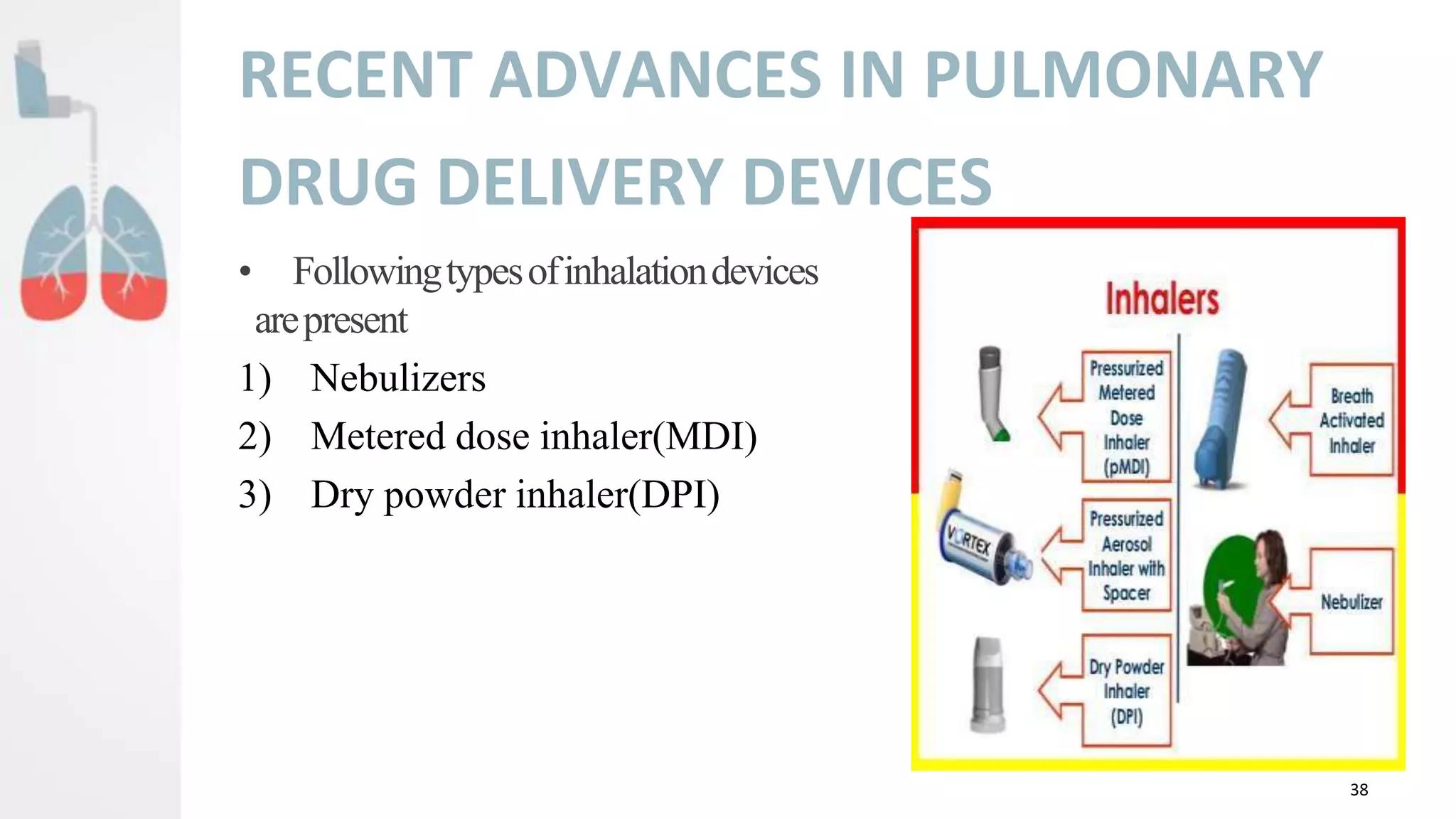
RECENT ADVANCES IN PULMONARY
DRUG DELIVERY DEVICES
• Followingtypesofinhalationdevices
arepresent
1) Nebulizers
2) Metered dose inhaler(MDI)
3) Dry powder inhaler(DPI)
38
1) NEBULIZER
• Nebulizers deliver relatively large doses of drugs as either
aqueous solution or suspension.
• Nebulizer used today for drug delivery to the respiratory tract and
are particularly useful for the treatment of hospitalized or non
ambulatory patients.
• Two types of Nebulizers
A) Ultrasonic Nebulizer
B)Air jet Nebulizer
39
A) ULTRASONIC NEBULIZER
-The ultrasonic nebulizers uses piezoelectric crystal,
vibrating at high frequency (usually 1-3 MHz) to generate a fountain
of liquid in the nebulizer chamber.(higher the frequency, smaller the
droplets produced)
-Not suitable for thermoliable drugs.
40
B) AIR JET NEBULIZER
• The jet of high-velocity gas is passed either tangentially or
coaxially through a narrow Venturi nozzle, typically 0.3-0.7 mm in
diameter.
• An area of negative pressure, where the air jet emerges, causes
liquid to be drawn up a feed tube from a fluid reservoir.
41
CONT,
ADVANTAGE:
 Thenebulizer cantransportlarge doses of drugs to thelungsthan MDI
or DPI.
 Thetreatment ofacuteasthmainan emergencycareunit.
 Rapid absorption, higher bioavailability.
 Avoidance of liverfirstpassmetabolism.
 Avoidance of metabolism by the gastrointestinaltract.
DISADVANTAGE:
 Highercosts.
 Theneed forhigherdrugdoses toachieve atherapeutic result.
42
2)METERED DOSE INHALER (MDI)
• Used for the treatment of respiratory
diseases such as asthma and COPD.
• They can be given in the form of
suspension or solution.
• Particle size of less than 5 microns.
• Used to minimize the number of
administration errors.
• It can delivered measured amount of
medicament accurately.
43
CONT,
ADVANTAGES
• It delivers specified amount
of dose
• Small size and convenience
• Usually expensive as
compared to dry powder
inhalers and nebulizers
• Quick to use
44
DISADVANTAGES
• Difficult to deliver high doses
• There is no information about
the number of dose left in
MDI
• Accurate co ordination
between actuation of dose and
inhalation is essential
3) DRY POWDER INHALER(DPI)
• DPIs are bolus drug delivery devices that contain solid drug in a
dry powder mix that is fluidized when the patient inhales.
• The drug with particle size of less than 5µm is used.
• Dry powder formulations either contain the active drug alone or
have a carrier powder (e.g. lactose) mixed with drug to
increase flow properties of drug.
• DPIs are a widely accepted inhaled delivery dosage form,
particularly in Europe., where they are currently used by
approximately 40% of asthma patients.
47
CONT,
ADVANTAGE
• Propellant-free.
• Less need for patient co-ordination.
• Less formulationproblem.
DISADVANTAGE
• Delivery on patient’sinspiratoryflowrateandprofile.
• Deviceresistanceand other design issues.
• Greaterpotential problems in dose uniformity.
• More expensive than pressurized metered dose inhalers.
48
TYPESOFDPI’s
UNIT-DOSE DEVICES
• Single dose powder inhalers are device in which a powder
containing capsule is placed in a holder. The capsule is opened
with in the device and the powder is inhaled.
MULTI DOSE DEVICE
• This device is truly a metered-dose powder delivery system.
The drug is contained with in a storage reservoir and can be
dispensed into the dosing chamber by a simple back and forth
twisting action on the base of the unit
49
50
51
EVALUATION TESTS
A. Flammability and combustibility :
1. Flash point
2. Flame Projection
B. Physicochemical characteristics :
1. Vapour pressure
2. Density
3. Moisture content
4. Identification of Propellants
52
C. Performance:
1. Aerosol valve discharge rate
2. Spray pattern
3. Dosage with metered valves
4. Net contents
5. Foam stability
6. Particle size determination
D. Biological testing :
1. Therapeutic activity
2. Toxicity studies
53
A) FLAMMABILITY AND COMBUSTIBILITY
1. Flash point:
Apparatus : Tag Open Cup Apparatus
Product is chilled to 25°F and test liquid
temperature is allowed to increase slowly and
the temperature at which vapors ignite is
called as Flash Point .
2. Flame Projection:
Product is sprayed for 4 sec into a flame and
the flame is extended ,exact length is
measured with a ruler.
54
B) PHYSICOCHEMICAL CHARACTERISTICS
PROPERTY METHOD
1. Vapour Pressure » Pressure gauge
» Can Puncturing Device.
2. Density » Hydrometer,
» Pycnometer.
3. Moisture » Karl Fisher Method,
» Gas Chromatography.
4. Identification of propellants » Gas Chromatography,
» IR Spectroscopy.
55
C)PERFORMANCE
1. Aerosol valve discharge rate :
• Contents of the aerosol product of known
weight is discharged for specific period of time.
• By reweighing the container after the time
limit, the change in the weight per time dispensed gives
the discharge rate ( g/sec).
56
2. Dosage with metered valves :
• Reproducibility of dosage can be determined by:
»Assay techniques
»Accurate weighing of filled container
followed by dispensing of several doses . Containers
are then reweighed and difference in weight divided by
number of doses dispensed gives average dose.
57
3. Net Contents :
• Tared cans that have been placed onto the filling lines are
reweighed and the difference in weight is equal to the net contents.
• In Destructive method : weighing a full container and then
dispensing as much of the content as possible . The contents
are then weighed . This gives the net content.
58
4. Foam stability :
Methods :
• Visual Evaluation,
• Time for given mass to penetrate the foam,
• Time for given rod that is inserted into the foam to fall ,
• Rotational Viscometer.
5. Particle Size Determination :
• Methods : Cascade Impactor,
Light Scattering Decay.
59
a) Cascade Impactor :
Principle :
• Stream of particles projected through a
series of nozzles and glass slides at high
velocity, larger particle are impacted
first on lower velocity stage and smaller
particles are collected at higher velocity
stage.
60
D)BIOLOGICAL TESTING
1.Therapeutic Activity :
» For Inhalation Aerosols : dosage of the product is
determined and is related to the particle size distribution.
» For Topical Aerosols : adsorption of therapeutic
ingredient is determined.
2.Toxicity :
» For Inhalation Aerosols : exposing test animals to vapors
sprayed from aerosol container.
» For Topical Aerosols : Irritation and Chilling effects are
determined.
61
APPLICATIONOFPDDS
62
NEWER DEVELOPMENT
• Dr Reddy's launches 'Dose Counter Inhalers' in India Friday, April 16,2010.
• This the first MDI in India that gives patients an advance indication of when the
inhaler is going to be empty.
• DCI is a new drug delivery device with a single device having 120 metered doses.
• There is a window in the inhaler that changes color from green to red.
63
REFERENCES
• “The Theory & Practice Of Industrial Pharmacy” by Leon
Lachman , H.A.Lieberman.
• “Aulton’s pharmaceutics” by Michael E .Aulton, Kevin M.g
Taylor
• www.slideshare.net
64
THANK YOU
65

Pulmonary Drug Delivery System

  • 1.
    PULMONARY DRUG DELIVERY SYSTEM SILAMBARASANI DEPT OF PHARMACEUTICS MTPG & RIHS
  • 2.
    CONTENT • Introduction ofPDDS • Definition • Advantages • Disadvantages • Anatomy And Physiology Of Respiratory Tract • Mechanism Of PDDS • Barrier Of PDDS • Factor Affecting PDDS • Aerosol • History • Advantage • Disadvantage • Components Of Aerosol • Types Of Aerosol • Evaluation • Application • Recent development • References 2
  • 3.
    INTRODUCTION • Inhalation therapyhas established itself as a valuable tool in the local therapy of pulmonary diseases such as Asthma or COPD for several decades. • Carrier like Microparticles,Nanoparticles ,Liposomes can be used in lung targeting. • Optimum particle size is important for delivery of drugs. • Currently, over 25 drug substances are marketed as inhalation aerosol products for local pulmonary effects and about the same number of drugs are in different stages of clinical development. 3
  • 4.
    4 DEFINITION Drugs which aregiven through pulmonary route LOCAL EFFECT -Bronchial asthma -COPD SYSTEMIC EFFECT -Migraine -Volatile anesthetics -Diabetes
  • 5.
    5 ADVANTAGES • Good targetingpotential • Rapid absorption • Quick Onset of action • Deliver high concentration of drug • Needle-free delivery system • By pass first pass effect • Poor orally absorbed drug can be taken
  • 6.
    6 DISADVANTAGES • Some drugmay produce irritation or toxicity. • Some drug retained in lungs and clearence of drugs may be difficult. • Difficulty in producing optimum particle size. • Amount of drug delivered per puff is less which may be ineffective for certain therapy. • Patient have difficulty to usage of drug delivery device.
  • 7.
    7 ANATOMY AND PHYSIOLOGYOF RESPIRATORY TRACT
  • 8.
  • 9.
    LUNGS • Protected byRibcage. • Left lung is slightly smaller than Right lung. • It is supported by diaphragm at the bottom of lungs. • Major function is exchange of gases. • About 100 million alveoli present in each lungs. • About 10 % blood circulate through lungs (450 ml). 9
  • 10.
    MECHANISM OF PULMONARYDRUG DELIVERY 10
  • 11.
    BARRIER IN PULMONARYDRUG DELIVERY MECHANICAL • Coughing • Sneezing • Mucous layer • Mucociliary clearence • Pulmonary epithelium CHEMICAL • Surfactant IMMUNOLOGICAL • Alveolar macrophages 11
  • 12.
    FACTORS AFFECTING PDDS PHSYIOLOGICALFACTOR • Surface area • Tidal volume • Blood flow • Disease state • Inter subject variation • Oral Vs Nasal breathing • Breath holding PHYSICOCHEMICAL FACTOR • pKa • Particle size • Shape • Density • Electric charge • Hygroscopy • Surface roughness • Solid state characteristics 12
  • 13.
    AEROSOLS • It ispressurized dosage form. • Aerosol is a system that depends on the power of a compressed or liquefied gas to expels the content from the container. • Also called as Pressure package, Pressurized package. 13
  • 14.
    HISTORY • In 1942,Goodhue& Sullivan ,Dept of Agriculture ,USA developed Aerosol insecticide. • In early 1950,Aerosol used for Topical administration to treat burns, minor cuts etc. • In 1955,Epinephrine Pressurized package was developed to treat Asthma. 14
  • 15.
    ADVANTAGE • Stability ishigh • Directly applied to affected area • Rapid onset of action • Irritation produced by mechanical application of topical medication is reduced • No direct contact with medicament. • No microorganism can enter. 15
  • 16.
    DISADVANTAGE • Costly • Disposalof empty aerosol container is difficult • Allergic in some cases • Explosive • Some formulation is difficult • Sometime propellants may cause toxic reactions. 16
  • 17.
    COMPONENTSOFAEROSOLS 1. Propellant 2. Container 3.Valveandactuator 4. Productconcentrate 17
  • 18.
    1)PROPELLANTS • Responsiblefordevelopingproperpressurewithinthecontainer. • Providedrivingforcetoexpeltheproductfromthecontainer. •Aidsinatomization. TYPES OF PROPELLANTS (a) LiquefiedgasesPropellants (b) Compressed gasesPropellants 18
  • 19.
    PROPELLANT TYPES • Dependingupon route of administration and use, 19 TYPE- I PROPELLANT A (LIQUIFIED GAS) • FOR ORAL AND INHALATION(FLOURINATED HYDROCARBON) -Tri-chloro-mono-flouro methane(11) -Di chloro di floro methane(12) • TOPICAL PHARMACEUTICAL AEROSOL -Propane -Butane TYPE- II PROPELLANT B (COMPRESSED GAS) • COMPOUND GASES -Nitrogen -Carbon dioxide
  • 20.
    A) LIQUIFIED GASPROPELLANTS  At room temperature and pressure ,they are gases.  Liquefiedbyloweringthepressure&increasingthe temperature.  Whenliquefiedgasesare placed into a sealed container, they immediately separatein liquidand vapor phase.  Theproductis used up ,as thevalveis opened,some of theliquidpropellantturnstogasandkeepstheheadspace fullofgas.  In thiswaythepressure in thecanremainsessentially constantand thespray performanceismaintained. 20
  • 21.
    CHLOROFLUORO CARBON 21 Advantages • Chemicalinertness •Lackoftoxicity • Nonflammability. • Lackofexplosiveness. Disadvantages • Highcost • It depletesthe ozonelayer Examples Trichloromonofluoromethane – Propellant11 Dichlorodifluoromethane -Propellant12 Dichlorotetrafluoroethane -Propellant114 • Propellant of choice for oral and inhalation.
  • 22.
    HYDROCARBONS • Canbeused forwaterbasedaerosolsandtopicaluse. 22 Advantages •Inexpensive • Excellentsolvents • It does not causeozone depletion Disadvantages • Inflammable • Unknowntoxicity produced Example Propane - Propellant A-108 Isobutane - Propellant A-31 Butane -PropellantA-17
  • 23.
    HYDROFLUORO CARBONSAND HYDROCHLORO FLUOROCARBONS •ThesecompoundsbreakdownintheatmosphereatfasterratethanCFC. • Lower ozone destroyingeffect. 23 Disadvantages: • Poor solvent • High cost Advantages: • Low inhalation toxicity • High chemical stability • High purity • Not ozone depleting EXAMPLE HEPTAFLUORO PROPANE(HFA-227) TETRAFLUOROETHANE (HFA-134A) DIFLUOROETHANE - PROPELLANT 152A CHLORODIFLUOROMETHANE - PROPELLANT 22 CHLORODIFLUOROETHANE - PROPELLANT 142 B
  • 24.
    B)COMPRESSED GAS PROPELLANTS •Compressed gas propellants occupy the head space above the liquid in the can. • When the aerosol valve is opened the gas 'pushes' the liquid out of the can. • The amount of gas in the headspace remains the same but it has more space, and as a result the pressure will drop during the life of the can. • Spray performance is maintained however by careful choice of the aerosol valve and actuator. • Examples: Carbon dioxide, Nitrous oxide and Nitrogen 24
  • 25.
    2) CONTAINERS • Theymustbeabletowithstandpressuresas high as 140 to180 psig at 130°F. AEROSOLCONTAINERS A. Metals • Tinplatedsteel • Aluminum • Stainlesssteel B. Glass • Uncoatedglass • Plastic coated glass 25
  • 26.
    TIN PLATED CONTAINER •It consist of a sheet of steel plate, this sheet is coated with tin by electrolytic process . • These sheets are lithographed at this point. • The coated sheet is cut into three pieces ( top , bottom and body) . • The top, bottom are attached to body by soldering. • When required it is coated with organic material usually oleoresin, phenolic, vinyl or epoxy coating. • Recent developments in welding include Soudronic system and Conoweld system. 26
  • 27.
    ALUMINIUMCONTAINERS • Usedforinhalationandtopicalaerosols. • Manufacturedbyimpactextrusionprocess. •Lightinweight,lessfragile,lessincompatibilityduetoitsseamlessnature. • Greaterresistancetocorrosion. • PurewaterandpureethanolcausecorrosiontoAluminumcontainers. • Added resistancecanbeobtainedbycoatinginsideofthecontainerwithorganic coatinglikephenolic,vinylorepoxyandpolyamideresins. 27
  • 28.
    STAINLESSSTEELCONTAINER • Used forinhalationaerosols. ADVANTAGE: • ExtremelyStrong. • Resistanttomany materials. • No needforinternalcoating. DISADVANTAGE: • Costly 28
  • 29.
    GLASS CONTAINERS • ThesecontainersarepreferredbecauseofitsAestheticvalueandabsence of incompatibilities. • Thesecontainersarelimitedtotheproductshavingalowerpressure (33 psig) and lower percentageof the propellant. • Used fortopicaland MDIaerosols. TWOTYPES 1)UncoatedGlasscontainer 2)Plasticcoatedglasscontainer 29
  • 30.
  • 31.
    3A)VALVES • Used toseal the aerosol container. • To delivered the drug in desired form such as spray, foam etc. • To deliver given amount of medication. TYPES 1) Continuous spray valve 2) Metering valves 31
  • 32.
    CONTINUOUS SPRAY VALVE •Used for topical aerosols . Valves assembly consists : • Ferrule or mounting cup • Valve body or housing • Stem • Dip tube • Gasket • Spring 32
  • 33.
    FERRULE OR MOUNTINGCUP : • Used to attach valve to container. • Made from Tin plated steel, Al , Brass . • Underside of the valve cup is coated with single or double epoxy or vinyl resins. VALVE BODY OR HOUSING : • Made up of Nylon or Derlin and contains a opening at the point of attachment of dip tube. (0.013 to 0.080 inch) STEM : • Made from Nylon or Derlin , brass and stainless steel can also be used. (orifice - 0.013 to 0.030 inch). 33
  • 34.
    GASKET : • Madefrom Buna-N and neoprene rubber. SPRING : • Made from Stainless steel . • Used to hold gasket in place. DIP TUBE : • Made from Poly ethylene or poly propylene. • Inner diameter 0.120 – 0.125 inch. • However for Capillary dip tube inner diameter is 0.050 inch and for highly viscous products it is 0.195 inch. 34
  • 35.
    METERING VALVES • Usedfor dispensing of potent medication. • Operates on the principle of a chamber whose size determines the amount of medication dispensed. • Approximately 50 to 150 mg ±10 % of liquid materials can be dispensed at one time. 35
  • 36.
    3B)ACTUATORS • These arespecially designed buttons which helps in delivering the drug in desiredformi.e.,spray,wetstream,foamorsolidstream. TYPESOFACTUATORS: • Sprayactuators • Foamactuators • Solidsteam actuators • Specialactuators 36
  • 37.
    37 SPRAY ACTUATORS • It canbe used for topical preparation such as antiseptics, local anesthetics and spray bandages. FOAM ACTUATORS • It consists of large orifice which ranges from 0.070- 0.125 inch SOLID STREAM ACTUATORS • These actuators are required for dispensing semi solid products such as ointments SPECIAL ACTUATORS It delivers the medicament to the appropriate site of action such as throat, nose, dental and eyes etc.
  • 38.
    RECENT ADVANCES INPULMONARY DRUG DELIVERY DEVICES • Followingtypesofinhalationdevices arepresent 1) Nebulizers 2) Metered dose inhaler(MDI) 3) Dry powder inhaler(DPI) 38
  • 39.
    1) NEBULIZER • Nebulizersdeliver relatively large doses of drugs as either aqueous solution or suspension. • Nebulizer used today for drug delivery to the respiratory tract and are particularly useful for the treatment of hospitalized or non ambulatory patients. • Two types of Nebulizers A) Ultrasonic Nebulizer B)Air jet Nebulizer 39
  • 40.
    A) ULTRASONIC NEBULIZER -Theultrasonic nebulizers uses piezoelectric crystal, vibrating at high frequency (usually 1-3 MHz) to generate a fountain of liquid in the nebulizer chamber.(higher the frequency, smaller the droplets produced) -Not suitable for thermoliable drugs. 40
  • 41.
    B) AIR JETNEBULIZER • The jet of high-velocity gas is passed either tangentially or coaxially through a narrow Venturi nozzle, typically 0.3-0.7 mm in diameter. • An area of negative pressure, where the air jet emerges, causes liquid to be drawn up a feed tube from a fluid reservoir. 41
  • 42.
    CONT, ADVANTAGE:  Thenebulizer cantransportlargedoses of drugs to thelungsthan MDI or DPI.  Thetreatment ofacuteasthmainan emergencycareunit.  Rapid absorption, higher bioavailability.  Avoidance of liverfirstpassmetabolism.  Avoidance of metabolism by the gastrointestinaltract. DISADVANTAGE:  Highercosts.  Theneed forhigherdrugdoses toachieve atherapeutic result. 42
  • 43.
    2)METERED DOSE INHALER(MDI) • Used for the treatment of respiratory diseases such as asthma and COPD. • They can be given in the form of suspension or solution. • Particle size of less than 5 microns. • Used to minimize the number of administration errors. • It can delivered measured amount of medicament accurately. 43
  • 44.
    CONT, ADVANTAGES • It deliversspecified amount of dose • Small size and convenience • Usually expensive as compared to dry powder inhalers and nebulizers • Quick to use 44 DISADVANTAGES • Difficult to deliver high doses • There is no information about the number of dose left in MDI • Accurate co ordination between actuation of dose and inhalation is essential
  • 47.
    3) DRY POWDERINHALER(DPI) • DPIs are bolus drug delivery devices that contain solid drug in a dry powder mix that is fluidized when the patient inhales. • The drug with particle size of less than 5µm is used. • Dry powder formulations either contain the active drug alone or have a carrier powder (e.g. lactose) mixed with drug to increase flow properties of drug. • DPIs are a widely accepted inhaled delivery dosage form, particularly in Europe., where they are currently used by approximately 40% of asthma patients. 47
  • 48.
    CONT, ADVANTAGE • Propellant-free. • Lessneed for patient co-ordination. • Less formulationproblem. DISADVANTAGE • Delivery on patient’sinspiratoryflowrateandprofile. • Deviceresistanceand other design issues. • Greaterpotential problems in dose uniformity. • More expensive than pressurized metered dose inhalers. 48
  • 49.
    TYPESOFDPI’s UNIT-DOSE DEVICES • Singledose powder inhalers are device in which a powder containing capsule is placed in a holder. The capsule is opened with in the device and the powder is inhaled. MULTI DOSE DEVICE • This device is truly a metered-dose powder delivery system. The drug is contained with in a storage reservoir and can be dispensed into the dosing chamber by a simple back and forth twisting action on the base of the unit 49
  • 50.
  • 51.
  • 52.
    EVALUATION TESTS A. Flammabilityand combustibility : 1. Flash point 2. Flame Projection B. Physicochemical characteristics : 1. Vapour pressure 2. Density 3. Moisture content 4. Identification of Propellants 52
  • 53.
    C. Performance: 1. Aerosolvalve discharge rate 2. Spray pattern 3. Dosage with metered valves 4. Net contents 5. Foam stability 6. Particle size determination D. Biological testing : 1. Therapeutic activity 2. Toxicity studies 53
  • 54.
    A) FLAMMABILITY ANDCOMBUSTIBILITY 1. Flash point: Apparatus : Tag Open Cup Apparatus Product is chilled to 25°F and test liquid temperature is allowed to increase slowly and the temperature at which vapors ignite is called as Flash Point . 2. Flame Projection: Product is sprayed for 4 sec into a flame and the flame is extended ,exact length is measured with a ruler. 54
  • 55.
    B) PHYSICOCHEMICAL CHARACTERISTICS PROPERTYMETHOD 1. Vapour Pressure » Pressure gauge » Can Puncturing Device. 2. Density » Hydrometer, » Pycnometer. 3. Moisture » Karl Fisher Method, » Gas Chromatography. 4. Identification of propellants » Gas Chromatography, » IR Spectroscopy. 55
  • 56.
    C)PERFORMANCE 1. Aerosol valvedischarge rate : • Contents of the aerosol product of known weight is discharged for specific period of time. • By reweighing the container after the time limit, the change in the weight per time dispensed gives the discharge rate ( g/sec). 56
  • 57.
    2. Dosage withmetered valves : • Reproducibility of dosage can be determined by: »Assay techniques »Accurate weighing of filled container followed by dispensing of several doses . Containers are then reweighed and difference in weight divided by number of doses dispensed gives average dose. 57
  • 58.
    3. Net Contents: • Tared cans that have been placed onto the filling lines are reweighed and the difference in weight is equal to the net contents. • In Destructive method : weighing a full container and then dispensing as much of the content as possible . The contents are then weighed . This gives the net content. 58
  • 59.
    4. Foam stability: Methods : • Visual Evaluation, • Time for given mass to penetrate the foam, • Time for given rod that is inserted into the foam to fall , • Rotational Viscometer. 5. Particle Size Determination : • Methods : Cascade Impactor, Light Scattering Decay. 59
  • 60.
    a) Cascade Impactor: Principle : • Stream of particles projected through a series of nozzles and glass slides at high velocity, larger particle are impacted first on lower velocity stage and smaller particles are collected at higher velocity stage. 60
  • 61.
    D)BIOLOGICAL TESTING 1.Therapeutic Activity: » For Inhalation Aerosols : dosage of the product is determined and is related to the particle size distribution. » For Topical Aerosols : adsorption of therapeutic ingredient is determined. 2.Toxicity : » For Inhalation Aerosols : exposing test animals to vapors sprayed from aerosol container. » For Topical Aerosols : Irritation and Chilling effects are determined. 61
  • 62.
  • 63.
    NEWER DEVELOPMENT • DrReddy's launches 'Dose Counter Inhalers' in India Friday, April 16,2010. • This the first MDI in India that gives patients an advance indication of when the inhaler is going to be empty. • DCI is a new drug delivery device with a single device having 120 metered doses. • There is a window in the inhaler that changes color from green to red. 63
  • 64.
    REFERENCES • “The Theory& Practice Of Industrial Pharmacy” by Leon Lachman , H.A.Lieberman. • “Aulton’s pharmaceutics” by Michael E .Aulton, Kevin M.g Taylor • www.slideshare.net 64
  • 65.