PHARMACEUTICAL
AREOSOLS
UNIT V CHAPTER 2
Assist. Prof. Gunjan P. Malode
Department of Pharmaceutics
DRGIOP, Amravati
INTRODUCTION
•Aerosol or Pressurized package is defined as ―Ab system that
depends on the power of a compressed gas or liquefied gas to
expel the contents from the container.‖
•Pharmaceutical Aerosol is defined as aerosol product
containing active ingredients dissolved ,suspended or
emulsified in a propellant or a mixture of solvent and
propellant and intended for oral or topical administration or
for administration into the eye, nose ,ear, rectum and vagina.
• In 1942 - First aerosol was developed. (insecticide)
•In1950 - Pharmaceutical aerosol for topical administration
was developed.
•In 1955 - Aerosol for the local activity in the
respiratory tract was developed (Epinephrine).
• Adose can be removed with out contamination of
materials.
• Stability is enhanced for these substances adversely
affected by oxygen and or moisture.
•When sterility is an important factor, it can be maintained
while a dose is being dispensed.
•The medication can be delivered directly to the
affected area in a desired form. (localized action)
•Irritation produced by the mechanical application of topical
medication is reduced or eliminated.
• Ease and convenience of application.
• Application of medication in thin layer .
• Rapid response to the medicament .
• Bypasses First pass effect.
ADVANTAGES OF AEROSOLS
DISADVANTAGES OF AEROSOLS
• Expensive.
•Chlorofluorocarbon propellants cause Ozone
layer depletion.
• Inflammability
• Toxicity
• Explosivity
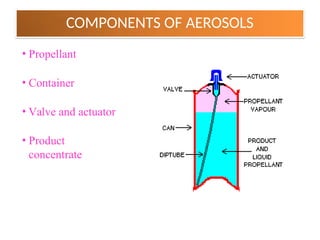
COMPONENTS OF AEROSOLS
• Propellant
• Container
• Valve and actuator
• Product
concentrate
PROPELLANTS
for developing proper pressure within
the
•Responsibl
container.
•Provide driving force to expel the product from
the container.
TYPES OF PROPELLANTS
(a) Liquefied gases Propellants
(b) Compressed gases Propellants
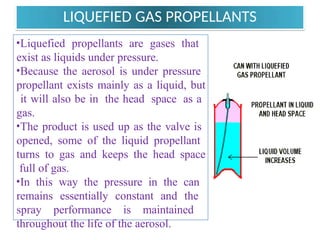
LIQUEFIED GAS PROPELLANTS
•Liquefied propellants are gases that
exist as liquids under pressure.
•Because the aerosol is under pressure
propellant exists mainly as a liquid, but
it will also be in the head space as a
gas.
•The product is used up as the valve is
opened, some of the liquid propellant
turns to gas and keeps the head space
full of gas.
•In this way the pressure in the can
remains essentially constant and the
spray performance is maintained
throughout the life of the aerosol.
CHLORO FLUORO CARBONS
Advantages
• Chemical inertness
• Lack of toxicity
• Non flammability.
• Lack of explosiveness.
• Propellant of choice for oral and
inhalation .
Disadvantages
• High cost
• It depletes the ozone
layer
Examples:
Trichloromonofluoromethane
Dichlorodifluoromethane
Dichlorotetrafluoroethane
- Propellant 11
- Propellant 12
- Propellant
114
HYDROCARBONS
• Can be used for water based aerosols and topical
use.
Advantages
• Inexpensive
• Excellent solvents
•It does not cause
ozone depletion
Disadvantages
• Inflammable
•Unknown
toxicity produced
Ex: Propane
Isobutane
Butane
- Propellant A-
108
- Propellant A-31
- Propellant A-17
HYDROFLUORO CARBONS AND
HYDRO CHLORO FLUORO CARBONS
•These compounds break down in the atmosphere at
faster rate than CFCs.
• Lower ozone destroying effect.
Advantages
• Low inhalation toxicity
• High chemical stability
• High purity
• Not ozone depleting
Disadvantages
• Poor solvent
• High cost
Examples: Heptafluoro propane (HFA-227)
Tetrafluoroethane (HFA-134a)
Difluoroethane - Propellant 152a
Chlorodifluoromethane -
Propellant 22 Chlorodifluoroethane -
Propellant 142 b
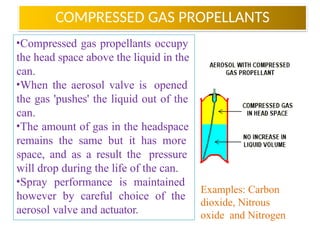
COMPRESSED GAS PROPELLANTS
•Compressed gas propellants occupy
the head space above the liquid in the
can.
•When the aerosol valve is opened
the gas 'pushes' the liquid out of the
can.
•The amount of gas in the headspace
remains the same but it has more
space, and as a result the pressure
will drop during the life of the can.
•Spray performance is maintained
however by careful choice of the
aerosol valve and actuator.
Examples: Carbon
dioxide, Nitrous
oxide and Nitrogen
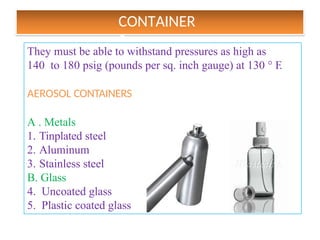
CONTAINER
S
They must be able to withstand pressures as high as
140 to 180 psig (pounds per sq. inch gauge) at 130 ° F.
AEROSOL CONTAINERS
A . Metals
1. Tinplated steel
2. Aluminum
3. Stainless steel
B. Glass
4. Uncoated glass
5. Plastic coated glass
TIN PLATED STEEL CONTAINERS
•It consist of a sheet of steel plate, this sheet is coated with
tin by electrolytic process .
•The coated sheet is cut into three pieces ( top , bottom and
body) .
• The top, bottom are attached to body by soldering .
•When required it is coated with organic material usually
oleoresin, phenolic , vinyl or epoxy coating .
•Welding eliminates soldering process, Saves considerable
manufacturing time and decreases the product/container
interaction.
•Recent developments in welding include Soudronic
system and Conoweld system.
ALUMINIUM CONTAINERS
• Used for inhalation and topical aerosols .
• Manufactured by impact extrusion process.
•Light in weight, less fragile, Less incompatibility due to
its seamless nature.
• Greater resistance to corrosion .
•Pure water and pure ethanol cause corrosion to
Al containers.
•Added resistance can be obtained by coating inside of
the container with organic coating like phenolic , vinyl or
epoxy and polyamide resins.
STAINLESS STEEL CONTAINERS
• Used for inhalation aerosols
Advantage :
• Extremely Strong.
• Resistant to many materials.
• No need for internal
coating.
Disadvantage :
• Costly
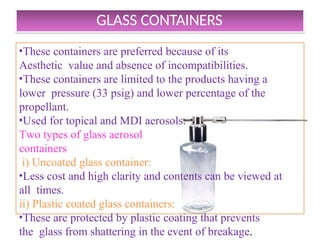
GLASS CONTAINERS
•These containers are preferred because of its
Aesthetic value and absence of incompatibilities.
•These containers are limited to the products having a
lower pressure (33 psig) and lower percentage of the
propellant.
•Used for topical and MDI aerosols.
Two types of glass aerosol
containers
i) Uncoated glass container:
•Less cost and high clarity and contents can be viewed at
all times.
ii) Plastic coated glass containers:
•These are protected by plastic coating that prevents
the glass from shattering in the event of breakage.
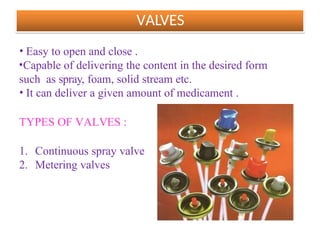
VALVES
• Easy to open and close .
•Capable of delivering the content in the desired form
such as spray, foam, solid stream etc.
• It can deliver a given amount of medicament .
TYPES OF VALVES :
1. Continuous spray valve
2. Metering valves
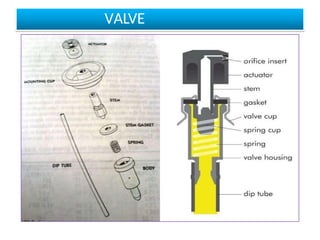
VALVE
ASSEMBLY
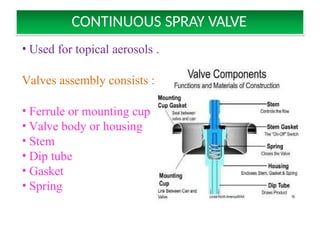
CONTINUOUS SPRAY VALVE
• Used for topical aerosols .
Valves assembly consists :
• Ferrule or mounting cup
• Valve body or housing
• Stem
• Dip tube
• Gasket
• Spring
FERRULE OR MOUNTING CUP :
• Used to attach valve to container.
• Made from Tin plated steel, Al , Brass .
•Under side of the valve cup is coated with single
or double epoxy or vinyl resins.
VALVE BODY OR HOUSING :
•Made up of Nylon or Derlin and contains a opening at
the point of attachment of dip tube. (0.013 to 0.080 inch)
STEM :
•Made from Nylon or Derlin , brass and stainless steel can
also be used. (orifice - 0.013 to 0.030 inch).
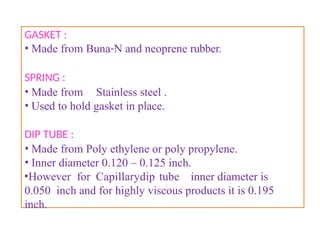
GASKET :
• Made from Buna-N and neoprene rubber.
SPRING :
• Made from Stainless steel .
• Used to hold gasket in place.
DIP TUBE :
• Made from Poly ethylene or poly propylene.
• Inner diameter 0.120 – 0.125 inch.
•However for Capillarydip tube inner diameter is
0.050 inch and for highly viscous products it is 0.195
inch.
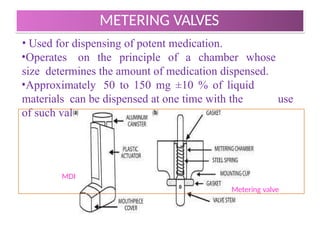
METERING VALVES
• Used for dispensing of potent medication.
•Operates on the principle of a chamber whose
size determines the amount of medication dispensed.
•Approximately 50 to 150 mg ±10 % of liquid
materials can be dispensed at one time with the use
of such valve.
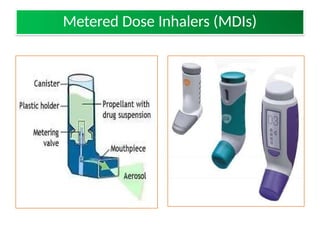
MDI
Metering valve
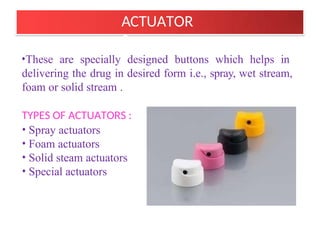
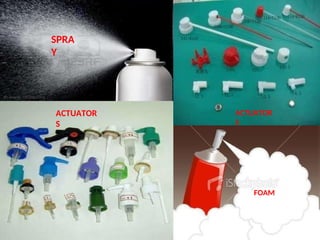
ACTUATOR
S
•These are specially designed buttons which helps in
delivering the drug in desired form i.e., spray, wet stream,
foam or solid stream .
TYPES OF ACTUATORS :
• Spray actuators
• Foam actuators
• Solid steam actuators
• Special actuators
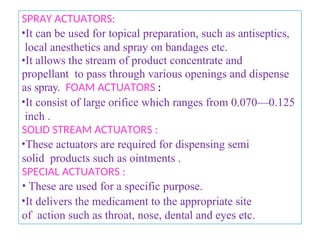
SPRAY ACTUATORS:
•It can be used for topical preparation, such as antiseptics,
local anesthetics and spray on bandages etc.
•It allows the stream of product concentrate and
propellant to pass through various openings and dispense
as spray. FOAM ACTUATORS :
•It consist of large orifice which ranges from 0.070—0.125
inch .
SOLID STREAM ACTUATORS :
•These actuators are required for dispensing semi
solid products such as ointments .
SPECIAL ACTUATORS :
• These are used for a specific purpose.
•It delivers the medicament to the appropriate site
of action such as throat, nose, dental and eyes etc.
FOAM
ACTUATOR
S
SPRA
Y
ACTUATOR
S
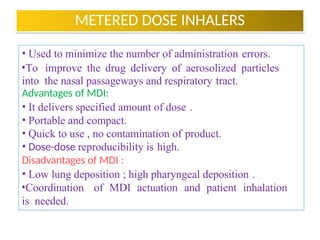
METERED DOSE INHALERS
• Used to minimize the number of administration errors.
•To improve the drug delivery of aerosolized particles
into the nasal passageways and respiratory tract.
Advantages of MDI:
• It delivers specified amount of dose .
• Portable and compact.
• Quick to use , no contamination of product.
• Dose-dose reproducibility is high.
Disadvantages of MDI :
• Low lung deposition ; high pharyngeal deposition .
•Coordination of MDI actuation and patient inhalation
is needed.
Metered Dose Inhalers (MDIs)
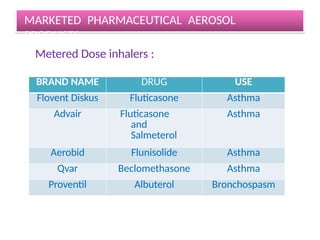
MARKETED PHARMACEUTICAL AEROSOL
PRODUCTS
Metered Dose inhalers :
BRAND NAME DRUG USE
Flovent Diskus Fluticasone Asthma
Advair Fluticasone
and
Salmeterol
Asthma
Aerobid Flunisolide Asthma
Qvar Beclomethasone Asthma
Proventil Albuterol Bronchospasm
FORMULATION OF AEROSOLS
• It consist of two essential components :
1. Product concentrate and
2. Propellant
Product concentrate :
Active ingredient or mixture of active ingredients and
other necessary agents such as solvents, anti oxidants and
surfactants.
Propellant :
• Single or blend of various propellants is used.
•Blend of solvents is used to achieve desired solubility
characteristics.
•Various surfactants are mixed to give the proper HLB
value for emulsion system.
•The propellants are selected to give the desired vapor
pressure, solubility and particle size.
•Pharmaceutical aerosol may be dispensed as fine mist,
wet spray, quick breaking foam, stable foam, semi solid
etc.
Type of system selected depends on
1. Physical, chemical and pharmacological
properties of drug.
2. Site of application .
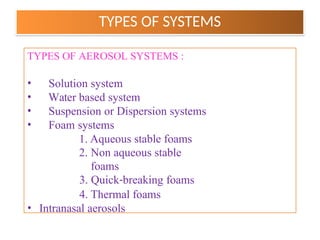
TYPES OF SYSTEMS
TYPES OF AEROSOL SYSTEMS :
• Solution system
• Water based system
• Suspension or Dispersion systems
• Foam systems
1. Aqueous stable foams
2. Non aqueous stable
foams
3. Quick-breaking foams
4. Thermal foams
• Intranasal aerosols
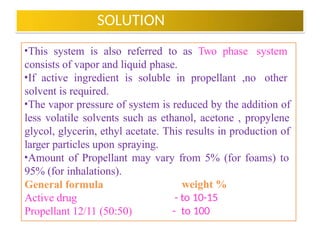
SOLUTION
SYSTEM
•This system is also referred to as Two phase system
consists of vapor and liquid phase.
•If active ingredient is soluble in propellant ,no other
solvent is required.
•The vapor pressure of system is reduced by the addition of
less volatile solvents such as ethanol, acetone , propylene
glycol, glycerin, ethyl acetate. This results in production of
larger particles upon spraying.
•Amount of Propellant may vary from 5% (for foams) to
95% (for inhalations).
General formula
Active drug
Propellant 12/11 (50:50)
weight %
- to 10-15
- to 100
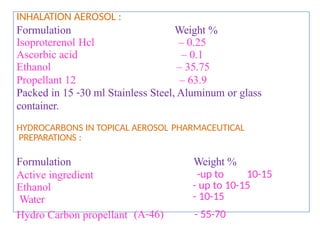
INHALATION AEROSOL :
Formulation Weight %
Isoproterenol Hcl – 0.25
Ascorbic acid – 0.1
Ethanol – 35.75
Propellant 12 – 63.9
Packed in 15 -30 ml Stainless Steel, Aluminum or glass
container.
HYDROCARBONS IN TOPICAL AEROSOL PHARMACEUTICAL
PREPARATIONS :
Formulation Weight %
Active ingredient
Ethanol
Water
-up to 10-15
- up to 10-15
- 10-15
Hydro Carbon propellant (A-46) - 55-70
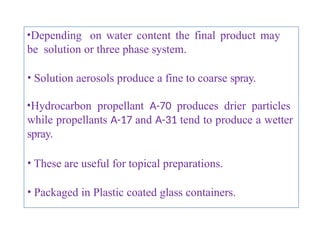
•Depending on water content the final product may
be solution or three phase system.
• Solution aerosols produce a fine to coarse spray.
•Hydrocarbon propellant A-70 produces drier particles
while propellants A-17 and A-31 tend to produce a wetter
spray.
• These are useful for topical preparations.
• Packaged in Plastic coated glass containers.
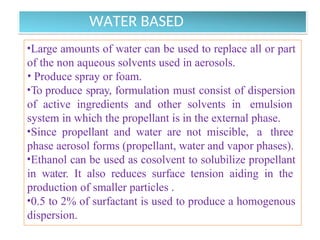
WATER BASED
SYSTEM
•Large amounts of water can be used to replace all or part
of the non aqueous solvents used in aerosols.
• Produce spray or foam.
•To produce spray, formulation must consist of dispersion
of active ingredients and other solvents in emulsion
system in which the propellant is in the external phase.
•Since propellant and water are not miscible, a three
phase aerosol forms (propellant, water and vapor phases).
•Ethanol can be used as cosolvent to solubilize propellant
in water. It also reduces surface tension aiding in the
production of smaller particles .
•0.5 to 2% of surfactant is used to produce a homogenous
dispersion.
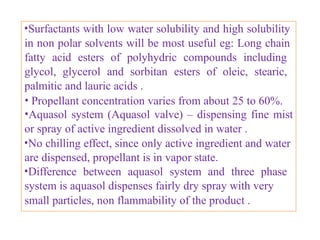
•Surfactants with low water solubility and high solubility
in non polar solvents will be most useful eg: Long chain
fatty acid esters of polyhydric compounds including
glycol, glycerol and sorbitan esters of oleic, stearic,
palmitic and lauric acids .
• Propellant concentration varies from about 25 to 60%.
•Aquasol system (Aquasol valve) – dispensing fine mist
or spray of active ingredient dissolved in water .
•No chilling effect, since only active ingredient and water
are dispensed, propellant is in vapor state.
•Difference between aquasol system and three phase
system is aquasol dispenses fairly dry spray with very
small particles, non flammability of the product .
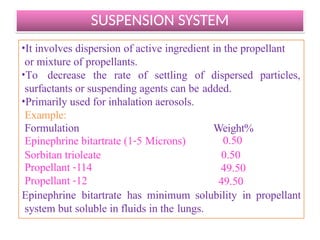
SUSPENSION SYSTEM
•It involves dispersion of active ingredient in the propellant
or mixture of propellants.
particles,
•To decrease the rate of settling of dispersed
surfactants or suspending agents can be added.
•Primarily used for inhalation aerosols.
Example:
Formulation
Epinephrine bitartrate (1-5 Microns)
Weight%
0.50
Sorbitan trioleate 0.50
Propellant -114 49.50
Propellant -12 49.50
Epinephrine bitartrate has minimum solubility in propellant
system but soluble in fluids in the lungs.
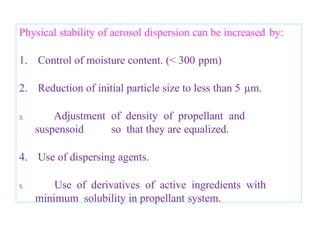
Physical stability of aerosol dispersion can be increased by:
1. Control of moisture content. (< 300 ppm)
2. Reduction of initial particle size to less than 5 Âľm.
3. Adjustment of density of propellant and
suspensoid so that they are equalized.
4. Use of dispersing agents.
5. Use of derivatives of active ingredients with
minimum solubility in propellant system.
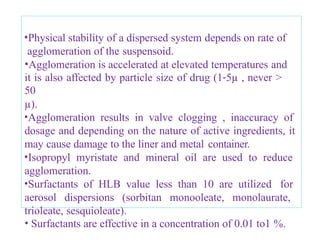
•Physical stability of a dispersed system depends on rate of
agglomeration of the suspensoid.
•Agglomeration is accelerated at elevated temperatures and
it is also affected by particle size of drug (1-5Âľ , never >
50
Âľ).
•Agglomeration results in valve clogging , inaccuracy of
dosage and depending on the nature of active ingredients, it
may cause damage to the liner and metal container.
•Isopropyl myristate and mineral oil are used to reduce
agglomeration.
•Surfactants of HLB value less than 10 are utilized for
aerosol dispersions (sorbitan monooleate, monolaurate,
trioleate, sesquioleate).
• Surfactants are effective in a concentration of 0.01 to1 %.
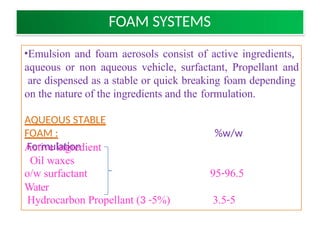
FOAM SYSTEMS
•Emulsion and foam aerosols consist of active ingredients,
aqueous or non aqueous vehicle, surfactant, Propellant and
are dispensed as a stable or quick breaking foam depending
on the nature of the ingredients and the formulation.
AQUEOUS STABLE
FOAM :
Formulation
%w/w
95-96.5
Active ingredient
Oil waxes
o/w surfactant
Water
Hydrocarbon Propellant (3 -5%) 3.5-5
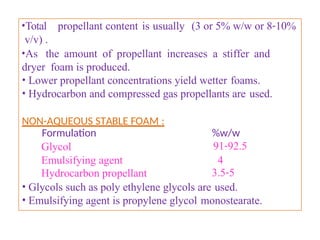
•Total propellant content is usually (3 or 5% w/w or 8-10%
v/v) .
•As the amount of propellant increases a stiffer and
dryer foam is produced.
• Lower propellant concentrations yield wetter foams.
• Hydrocarbon and compressed gas propellants are used.
NON-AQUEOUS STABLE FOAM :
Formulation %w/w
Glycol 91-92.5
Emulsifying agent 4
Hydrocarbon propellant 3.5-5
• Glycols such as poly ethylene glycols are used.
• Emulsifying agent is propylene glycol monostearate.
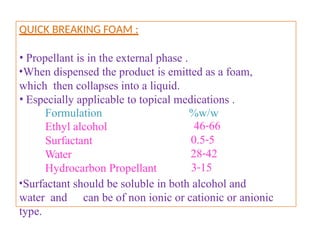
QUICK BREAKING FOAM :
• Propellant is in the external phase .
•When dispensed the product is emitted as a foam,
which then collapses into a liquid.
• Especially applicable to topical medications .
Formulation %w/w
Ethyl alcohol 46-66
Surfactant 0.5-5
Water 28-42
Hydrocarbon Propellant 3-15
•Surfactant should be soluble in both alcohol and
water and can be of non ionic or cationic or anionic
type.
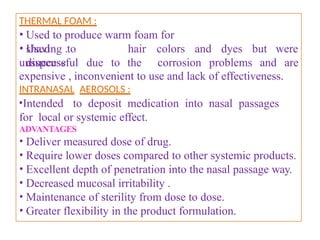
THERMAL FOAM :
• Used to produce warm foam for
shaving .
• Used to
dispense
unsuccessful due to
were
hair colors and dyes but
the corrosion problems and are
expensive , inconvenient to use and lack of effectiveness.
INTRANASAL AEROSOLS :
•Intended to deposit medication into nasal passages
for local or systemic effect.
ADVANTAGES
• Deliver measured dose of drug.
• Require lower doses compared to other systemic products.
• Excellent depth of penetration into the nasal passage way.
• Decreased mucosal irritability .
• Maintenance of sterility from dose to dose.
• Greater flexibility in the product formulation.
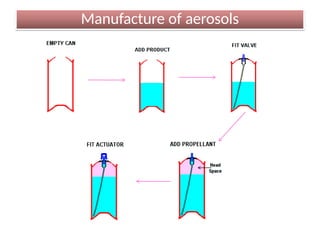
Manufacture of aerosols
MANUFACTURE OF PHARMACEUTICAL AEROSOLS
• Pressure filling apparatus
• Cold filling apparatus
• Compressed gas filling apparatus
PRESSURE FILLINGAPPARATUS
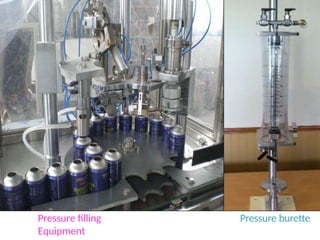
•It consists of a pressure burette capable of metering small
volumes of liquefied gas into the aerosol container under
pressure.
•Propellant is added through an inlet valve located at the
bottom or top of the pressure burette.
•The propellant is allowed to flow with its own vapor
pressure in the container through aerosol valve.
• The trapped air escapes out from the upper valve.
•The propellant stops flowing when the pressure of
burette and container becomes equal.
•If further propellant is to be added, a hose (rubber pipe)
leading to a cylinder of nitrogen is attached to the upper
valve, the pressure exerted by nitrogen helps in the flow
of the propellant into the container.
•Another pressure filling device makes use of piston
arrangement and is capable of maintaining positive
pressure .
•This type of device cannot be used for filling inhalation
aerosols which have metered valves.
PROCEDURE:
•This method involves filling of the concentrate into
the container at the room temperature.
• Then the valve is placed in the container and crimped.
•Through the opening of the valve the propellant are added
or it can be added ―under the cap .
‖
•Since the opening of the valve are smaller in size ranging
from 0.018-0.030 inches, it limits the production and the
process becomes slow.
•But with the use of rotary filling machines and newer filling
heads where the propellants are filled through valve stem, the
production rate is increased.
•The trapped air in the container and air present in head
space is removed before filling the propellant to protect the
products from getting adversely affected.
•Various units used in pressure filling line are arranged in
the following order :
Unscrambler , Air cleaner , Concentrate filler , Valve placer ,
Purger ,Valve crimper , Propellant filler ,Water bath ,
Labeler , Coder and Packing table .
•Purger ,vacuum crimper and pressure filler are replaced
with a single unit if filling is carried by ‗under the cap‘
method.
ADVANTAGES OF PRESSURE FILLING:
•Solutions, emulsions, suspensions can be filled by
this method as chilling does not occur.
• Contamination due to moisture is less.
• High production speed can be achieved.
• Loss of propellant is less.
DISADVANTAGES :
•Certain types of metering valves can be handled only by the
cold filling process or through use of an under the cap filler
and valve crimper.
• Process is slower than Cold filling method.
Pressure filling
Equipment
Pressure burette
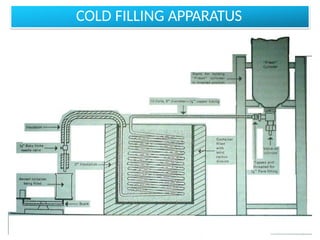
COLD FILLING APPARATUS
•It consist of an insulated box fitted with copper tubings and
the tubings are coiled to increase the area exposed to cooling.
•The insulated box should be filled with dry ice or acetone
prior to use.
•The apparatus can be operated with or without metered
valves.
•Hydrocarbon propellant cannot be filled into aerosol
containers using this apparatus because large amount of
propellant escapes out and vaporizes.
• This may lead to formation of an explosive mixture .
•Fluorocarbon vapors do not form any explosive or
flammable mixture though their vapors are heavier than air.
PROCEDURE:
•Non aqueous products and products which can withstand
low temperatures of - 40°F are used in this method.
• The product concentrate is chilled to a temperature of -
40°F and filled into already chilled container.
•Then the chilled propellant is added completely in 1 or 2
stages, depending on the amount.
•Another method is to chill both the product concentrate and
propellant in a separate pressure vessel to - 40 °F and then
filling them into the container.
• The valve is placed and crimped on to the container.
•Then test for leakage and strength of container is carried
out by passing container into a heated water bath, where the
contents of the container are heated to 130°F. After this, the
containers are air dried , capped and labeled.
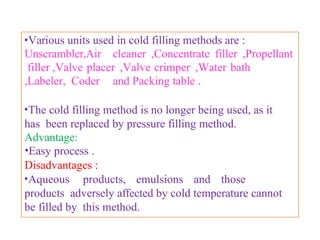
•Various units used in cold filling methods are :
Unscrambler,Air cleaner ,Concentrate filler ,Propellant
filler ,Valve placer ,Valve crimper ,Water bath
,Labeler, Coder and Packing table .
•The cold filling method is no longer being used, as it
has been replaced by pressure filling method.
Advantage:
•Easy process .
Disadvantages :
•Aqueous products, emulsions and those
products adversely affected by cold temperature cannot
be filled by this method.
COLD FILLING APPARATUS
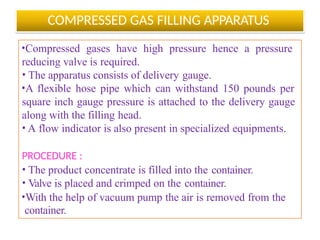
COMPRESSED GAS FILLING APPARATUS
•Compressed gases have high pressure hence a pressure
reducing valve is required.
• The apparatus consists of delivery gauge.
•A flexible hose pipe which can withstand 150 pounds per
square inch gauge pressure is attached to the delivery gauge
along with the filling head.
• A flow indicator is also present in specialized equipments.
PROCEDURE :
• The product concentrate is filled into the container.
• Valve is placed and crimped on the container.
•With the help of vacuum pump the air is removed from the
container.
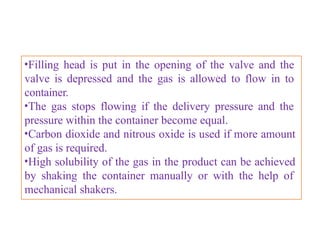
•Filling head is put in the opening of the valve and the
valve is depressed and the gas is allowed to flow in to
container.
•The gas stops flowing if the delivery pressure and the
pressure within the container become equal.
•Carbon dioxide and nitrous oxide is used if more amount
of gas is required.
•High solubility of the gas in the product can be achieved
by shaking the container manually or with the help of
mechanical shakers.
QUALITY CONTROL TESTS
It includes the testing of
1. Propellants
2. Valves, Actuators and Dip Tubes
3. Containers
4. Weight Checking
5. Leak Testing
6. Spray Testing
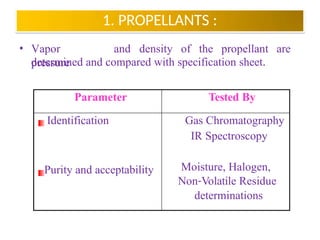
1. PROPELLANTS :
• Vapor
pressure
and density of the propellant are
determined and compared with specification sheet.
Parameter Tested By
Identification
Purity and acceptability
Gas Chromatography
IR Spectroscopy
Moisture, Halogen,
Non-Volatile Residue
determinations
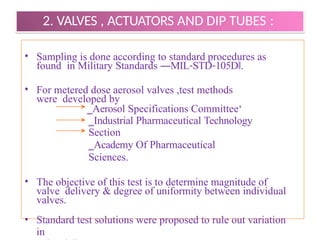
2. VALVES , ACTUATORS AND DIP TUBES :
• Sampling is done according to standard procedures as
found in Military Standards ―MIL-STD-105D .
‖
• For metered dose aerosol valves ,test methods
were developed by
‗Aerosol Specifications Committee‘
‗Industrial Pharmaceutical Technology
Section
‗Academy Of Pharmaceutical
Sciences.
• The objective of this test is to determine magnitude of
valve delivery & degree of uniformity between individual
valves.
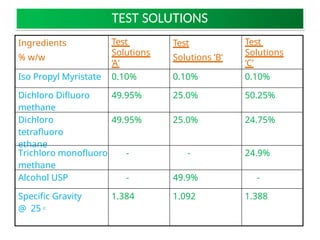
• Standard test solutions were proposed to rule out variation
in
TEST SOLUTIONS
Ingredients
% w/w
Test
Solutions
‘A’
Test
Solutions ‘B’
Test
Solutions
‘C’
Iso Propyl Myristate 0.10% 0.10% 0.10%
Dichloro Difluoro
methane
49.95% 25.0% 50.25%
Dichloro
tetrafluoro
ethane
49.95% 25.0% 24.75%
Trichloro monofluoro
methane
- - 24.9%
Alcohol USP - 49.9% -
Specific Gravity
@ 25 c
1.384 1.092 1.388
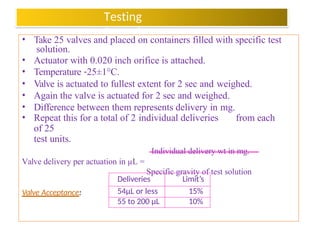
Testing
Procedure:
• Take 25 valves and placed on containers filled with specific test
solution.
• Actuator with 0.020 inch orifice is attached.
• Temperature -25±1°C.
• Valve is actuated to fullest extent for 2 sec and weighed.
• Again the valve is actuated for 2 sec and weighed.
• Difference between them represents delivery in mg.
• Repeat this for a total of 2 individual deliveries from each
of 25
test units.
Individual delivery wt in mg.
Valve delivery per actuation in ÂľL =
Specific gravity of test solution
Valve Acceptance:
Deliveries Limit’s
54ÂľL or less 15%
55 to 200 ÂľL 10%
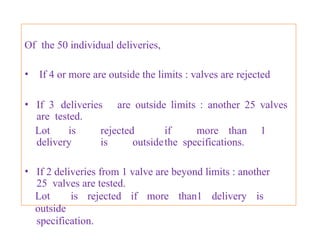
Of the 50 individual deliveries,
• If 4 or more are outside the limits : valves are rejected
• If 3 deliveries are outside limits : another 25 valves
are tested.
Lot is rejected if more than 1
delivery is outsidethe specifications.
• If 2 deliveries from 1 valve are beyond limits : another
25 valves are tested.
Lot is rejected if more than1 delivery is
outside
specification.
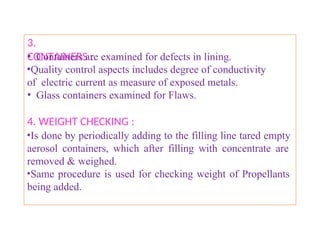
3.
CONTAINERS :
• Containers are examined for defects in lining.
•Quality control aspects includes degree of conductivity
of electric current as measure of exposed metals.
• Glass containers examined for Flaws.
4. WEIGHT CHECKING :
•Is done by periodically adding to the filling line tared empty
aerosol containers, which after filling with concentrate are
removed & weighed.
•Same procedure is used for checking weight of Propellants
being added.
5. LEAK TESTING :
• It is a means of checking crimping of the valve and detect
the defective containers due to leakage.
• Is done by measuring the Crimp‘s dimension &
comparing.
• Final testing of valve closure is done by passing the
filled containers through water bath.
6. SPRAY TESTING :
• Most pharmaceutical aerosols are 100% spray tested.
• This serves to clear the dip tube of pure propellant
and pure concentrate.
• To check for defects in valves and spray pattern.
EVALUATION TESTS
A.Flammability and combustibility :
1. Flash point
2. Flame Projection
B.Physicochemical characteristics :
1. Vapor pressure
2. Density
3. Moisture content
4. Identification of
Propellants
C. Performance:
1. Aerosol valve discharge
rate
2. Spray pattern
3. Dosage with metered valves
4. Net contents
5. Foam stability
6. Particle size determination
D. Biological testing :
7. Therapeutic activity
8. Toxicity studies
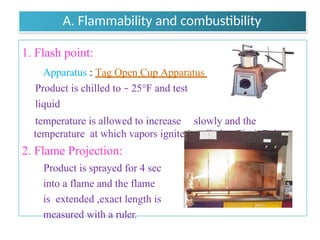
A. Flammability and combustibility
1. Flash point:
Apparatus : Tag Open Cup Apparatus
Product is chilled to – 25°F and test
liquid
temperature is allowed to increase slowly and the
temperature at which vapors ignite is called as Flash Point .
2. Flame Projection:
Product is sprayed for 4 sec
into a flame and the flame
is extended ,exact length is
measured with a ruler.
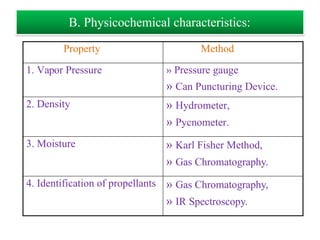
B. Physicochemical characteristics:
Property Method
1. Vapor Pressure Âť Pressure gauge
Âť Can Puncturing Device.
2. Density Âť Hydrometer,
Âť Pycnometer.
3. Moisture Âť Karl Fisher Method,
Âť Gas Chromatography.
4. Identification of propellants Âť Gas Chromatography,
Âť IR Spectroscopy.
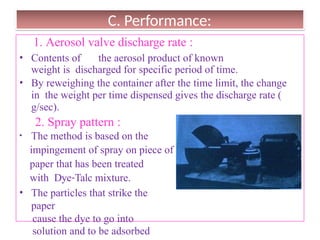
C. Performance:
1. Aerosol valve discharge rate :
• Contents of the aerosol product of known
weight is discharged for specific period of time.
• By reweighing the container after the time limit, the change
in the weight per time dispensed gives the discharge rate (
g/sec).
2. Spray pattern :
• The method is based on the
impingement of spray on piece of
paper that has been treated
with Dye-Talc mixture.
• The particles that strike the
paper
cause the dye to go into
solution and to be adsorbed
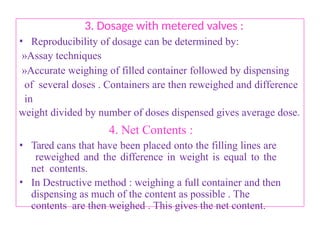
3. Dosage with metered valves :
• Reproducibility of dosage can be determined by:
ÂťAssay techniques
ÂťAccurate weighing of filled container followed by dispensing
of several doses . Containers are then reweighed and difference
in
weight divided by number of doses dispensed gives average dose.
4. Net Contents :
• Tared cans that have been placed onto the filling lines are
reweighed and the difference in weight is equal to the
net contents.
• In Destructive method : weighing a full container and then
dispensing as much of the content as possible . The
contents are then weighed . This gives the net content.
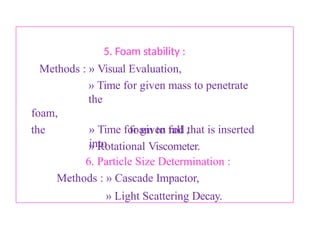
5. Foam stability :
Methods : Âť Visual Evaluation,
Âť Time for given mass to penetrate
the
foam,
Âť Time for given rod that is inserted
into
the foam to fall ,
Âť Rotational Viscometer.
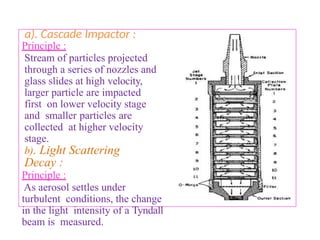
6. Particle Size Determination :
Methods : Âť Cascade Impactor,
Âť Light Scattering Decay.
a). Cascade Impactor :
Principle :
Stream of particles projected
through a series of nozzles and
glass slides at high velocity,
larger particle are impacted
first on lower velocity stage
and smaller particles are
collected at higher velocity
stage.
b). Light Scattering
Decay :
Principle :
As aerosol settles under
turbulent conditions, the change
in the light intensity of a Tyndall
beam is measured.
D. Biological testing:
1.Therapeutic Activity :
Âť For Inhalation Aerosols : dosage of the product is
determined and is related to the particle size distribution.
Âť For Topical Aerosols : is applied to test areas and
adsorption
of therapeutic ingredient is determined.
2.Toxicity :
Âť For Inhalation Aerosols : exposing test animals to vapors
sprayed from aerosol
container.
Âť For TopicalAerosols : Irritation and Chilling effects
are determined.
References
:
• “The Theory & Practice Of Industrial Pharmacy” by Leon
Lachman
, H.A.Lieberman.
• Remington’s “The Science & Practice Of Pharmacy”
21st
Edition, Volume-I.