SHWETA JINDAL 
B.tech3rd year (EI) 
BTBTN12410 
Roll no. - 7733
INTRODUCTION 
TYPES OF PROXIMITY SENSOR 
CONSTRUCTION 
WORKING 
APPLICATIONS 
ADVANTAGE 
DISADVANTAGE 
CONCLUSION 
REFRENCES
A Proximity Sensor Detects An Object When The 
Object Approaches Within The Detection Range And 
Boundary Of The Sensor. 
Proximity Sensor Includes All The Sensor That Perform 
Non Contact Detection In Comparison To Sensors Such 
As Limit Switch ,That Detect The Object By Physically 
Contacting Them.
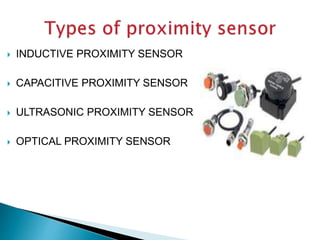
 INDUCTIVE PROXIMITY SENSOR 
 CAPACITIVE PROXIMITY SENSOR 
 ULTRASONIC PROXIMITY SENSOR 
 OPTICAL PROXIMITY SENSOR
 An Inductive proximity sensor is an electronic 
proximity sensor , which detect metallic object 
without touching them. 
 Their operating principle is based on a coil and 
high frequency oscillator that creates a field in 
the close surrounding of the sensing surface . 
 The operating distance of the sensor depends on 
the coil’s size as well as the target ‘s shape, size 
and material
 The Main Components Of The Inductive Proximity 
Sensor Are. Coil, Oscillator, Detector And The Output 
Circuit 
 The Operating Distance Of The Sensor Depends On 
The Actuator's Shape And Size And Is Strictly Linked 
To The Nature Of The Material 
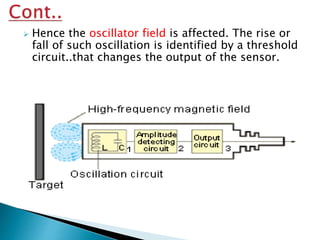
 The Coil Generates The High Frequency Magnetic 
Field In Front Of The Face. When The Metallic Target 
Comes In This Magnetic Field It Absorbs Some Of The 
Energy
 Hence the oscillator field is affected. The rise or 
fall of such oscillation is identified by a threshold 
circuit..that changes the output of the sensor.
ADVANTAGES 
 they are very accurate compared to other 
technologies. 
 Have high switching rate. 
 Can work in harsh environmental conditions. 
DISADVANTAGES 
 It can detect only metallic target. 
 Operating range may be limited.
 Capacitive Sensor Are Used For Non Contact 
Detection Of Metallic Object And Non Metallic 
Object(liquid, Plastic, Wooden Material Etc.) 
 Capacitive Proximity Sensors Use The Variation Of 
Capacitance Between The Sensor And Object Being 
Detected. 
 Capacitance Methods Are Very Sensitive , 
Distance Down To One Micro Inch Can Be Measured.
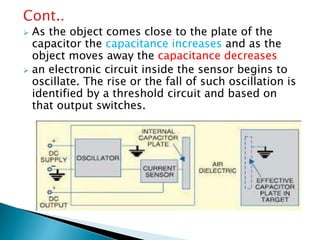
 The Main Components Of The Capacitive Proximity 
Sensor Are Plate, Oscillator, Threshold Detector And The 
Output Circuit. 
 The Plate Inside The Sensor Acts As One Plate Of The 
Capacitor And The Target Acts As Another Plate And The 
Air Acts As The Dielectric Between The Plates. 
 The Capacitive Sensor Can Detect Any Targets Whose 
Dielectric Constant Is More Than Air
Cont.. 
 As the object comes close to the plate of the 
capacitor the capacitance increases and as the 
object moves away the capacitance decreases 
 an electronic circuit inside the sensor begins to 
oscillate. The rise or the fall of such oscillation is 
identified by a threshold circuit and based on 
that output switches.
ADVANTAGES 
 It can detect both metallic and non metallic 
targets. 
 Good stability 
 High Speed 
 Capacitive sensors are good in terms of power 
usage 
 Low cost 
DISADVANTAGES 
 They are affected by temperature and humidity 
 Difficulties in designing 
 Capacitive proximity sensors are not as accurate 
compare to inductive sensors.
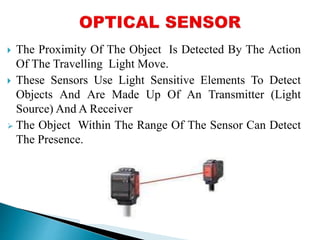
 The Proximity Of The Object Is Detected By The Action 
Of The Travelling Light Move. 
 These Sensors Use Light Sensitive Elements To Detect 
Objects And Are Made Up Of An Transmitter (Light 
Source) And A Receiver 
 The Object Within The Range Of The Sensor Can Detect 
The Presence.
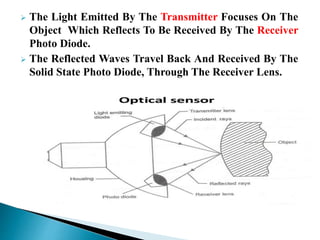
 The Light Emitted By The Transmitter Focuses On The 
Object Which Reflects To Be Received By The Receiver 
Photo Diode. 
 The Reflected Waves Travel Back And Received By The 
Solid State Photo Diode, Through The Receiver Lens.
ADVANTAGES 
 They Are Useful And Can Help Many Security 
Problems. 
DISADVANTGES 
 They Can Easily Be Set Off And Cause Problems. 
 They Are Expensive Than Inductive And Capacitive 
Proximity Sensor 
APPLICATION 
 Optical proximity sensors mostly apply in 
automobile/process eng. For distance 
measurement, level sensing etc.
 Ultrasonic Sensor Are Some Type Used In Place 
Of Optical Sensors . Instead Of Using An Light 
Beam , A High Frequency Sound Wave Is Used. 
 This Sound Wave Is Above Normal Hearing 
Frequencies And Are Called Ultrasonic 
Frequencies Around 40 KHz Are Common. 
 The Ultrasonic Sensor Can Measure Distances In 
Centimeters And Inches. It Provides Good 
Readings In Sensing Large-sized Objects With 
Hard Surfaces.
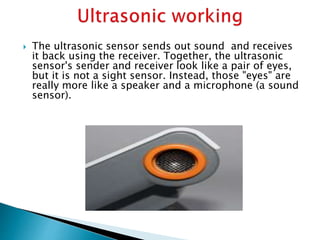
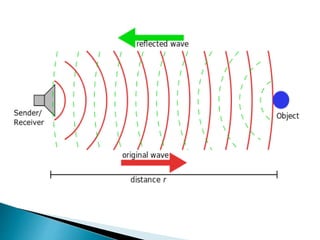
 The ultrasonic sensor sends out sound and receives 
it back using the receiver. Together, the ultrasonic 
sensor's sender and receiver look like a pair of eyes, 
but it is not a sight sensor. Instead, those "eyes" are 
really more like a speaker and a microphone (a sound 
sensor).
CONT. 
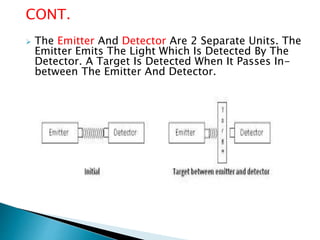
 The Emitter And Detector Are 2 Separate Units. The 
Emitter Emits The Light Which Is Detected By The 
Detector. A Target Is Detected When It Passes In-between 
The Emitter And Detector.
ADVANTAGES 
 Ultrasonic proximity sensors are not affected 
by atmospheric dust, snow, rain..etc 
 Can work in adverse conditions 
 Sensing distance is more compared to 
inductive or capacitive proximity sensors 
DISADVANTAGES 
 Ultrasonic sensors Has More Difficulties 
Reading Reflections From Soft, Curved, Thin 
Or Small Objects.
 The global market for these proximity sensors is 
expected to grow at a steady rate. Major 
industries using proximity sensors are machine 
tools, woodworking machines, packaging 
machines and other types of machinery. 
 Further applications of are automatic door units 
such as garage doors or doors inside buildings, 
elevator doors or doors inside railway coaches. 
 The building and automotive sector are further 
industries using high volumes of proximity 
sensors.
http://literature.rockwellautomation.com/idc/groups/l 
iterature/documents/ca/c116-ca502_-en-p.pdf 
http://en.wikipedia.org/wiki/Proximity_sensor 
http://www.fargocontrols.com/sensors.html 
http://www.autonics.co.in/products/products_2.php?b 
ig=01&mid=01/01 
http://www.ia.omron.com/support/guide/41/overview 
.html 
http://www.sensorcentral.com/photoelectric/proximity 
01.php 
http://www.engineershandbook.com/Components/pro 
ximitysensors.htm

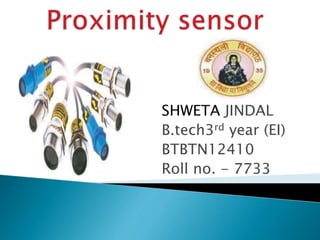
Proximity sensor

  • 1.
    SHWETA JINDAL B.tech3rdyear (EI) BTBTN12410 Roll no. - 7733
  • 2.
    INTRODUCTION TYPES OFPROXIMITY SENSOR CONSTRUCTION WORKING APPLICATIONS ADVANTAGE DISADVANTAGE CONCLUSION REFRENCES
  • 3.
    A Proximity SensorDetects An Object When The Object Approaches Within The Detection Range And Boundary Of The Sensor. Proximity Sensor Includes All The Sensor That Perform Non Contact Detection In Comparison To Sensors Such As Limit Switch ,That Detect The Object By Physically Contacting Them.
  • 4.
     INDUCTIVE PROXIMITYSENSOR  CAPACITIVE PROXIMITY SENSOR  ULTRASONIC PROXIMITY SENSOR  OPTICAL PROXIMITY SENSOR
  • 5.
     An Inductiveproximity sensor is an electronic proximity sensor , which detect metallic object without touching them.  Their operating principle is based on a coil and high frequency oscillator that creates a field in the close surrounding of the sensing surface .  The operating distance of the sensor depends on the coil’s size as well as the target ‘s shape, size and material
  • 6.
     The MainComponents Of The Inductive Proximity Sensor Are. Coil, Oscillator, Detector And The Output Circuit  The Operating Distance Of The Sensor Depends On The Actuator's Shape And Size And Is Strictly Linked To The Nature Of The Material  The Coil Generates The High Frequency Magnetic Field In Front Of The Face. When The Metallic Target Comes In This Magnetic Field It Absorbs Some Of The Energy
  • 7.
     Hence theoscillator field is affected. The rise or fall of such oscillation is identified by a threshold circuit..that changes the output of the sensor.
  • 8.
    ADVANTAGES  theyare very accurate compared to other technologies.  Have high switching rate.  Can work in harsh environmental conditions. DISADVANTAGES  It can detect only metallic target.  Operating range may be limited.
  • 10.
     Capacitive SensorAre Used For Non Contact Detection Of Metallic Object And Non Metallic Object(liquid, Plastic, Wooden Material Etc.)  Capacitive Proximity Sensors Use The Variation Of Capacitance Between The Sensor And Object Being Detected.  Capacitance Methods Are Very Sensitive , Distance Down To One Micro Inch Can Be Measured.
  • 11.
     The MainComponents Of The Capacitive Proximity Sensor Are Plate, Oscillator, Threshold Detector And The Output Circuit.  The Plate Inside The Sensor Acts As One Plate Of The Capacitor And The Target Acts As Another Plate And The Air Acts As The Dielectric Between The Plates.  The Capacitive Sensor Can Detect Any Targets Whose Dielectric Constant Is More Than Air
  • 12.
    Cont..  Asthe object comes close to the plate of the capacitor the capacitance increases and as the object moves away the capacitance decreases  an electronic circuit inside the sensor begins to oscillate. The rise or the fall of such oscillation is identified by a threshold circuit and based on that output switches.
  • 13.
    ADVANTAGES  Itcan detect both metallic and non metallic targets.  Good stability  High Speed  Capacitive sensors are good in terms of power usage  Low cost DISADVANTAGES  They are affected by temperature and humidity  Difficulties in designing  Capacitive proximity sensors are not as accurate compare to inductive sensors.
  • 15.
     The ProximityOf The Object Is Detected By The Action Of The Travelling Light Move.  These Sensors Use Light Sensitive Elements To Detect Objects And Are Made Up Of An Transmitter (Light Source) And A Receiver  The Object Within The Range Of The Sensor Can Detect The Presence.
  • 16.
     The LightEmitted By The Transmitter Focuses On The Object Which Reflects To Be Received By The Receiver Photo Diode.  The Reflected Waves Travel Back And Received By The Solid State Photo Diode, Through The Receiver Lens.
  • 17.
    ADVANTAGES  TheyAre Useful And Can Help Many Security Problems. DISADVANTGES  They Can Easily Be Set Off And Cause Problems.  They Are Expensive Than Inductive And Capacitive Proximity Sensor APPLICATION  Optical proximity sensors mostly apply in automobile/process eng. For distance measurement, level sensing etc.
  • 18.
     Ultrasonic SensorAre Some Type Used In Place Of Optical Sensors . Instead Of Using An Light Beam , A High Frequency Sound Wave Is Used.  This Sound Wave Is Above Normal Hearing Frequencies And Are Called Ultrasonic Frequencies Around 40 KHz Are Common.  The Ultrasonic Sensor Can Measure Distances In Centimeters And Inches. It Provides Good Readings In Sensing Large-sized Objects With Hard Surfaces.
  • 19.
     The ultrasonicsensor sends out sound and receives it back using the receiver. Together, the ultrasonic sensor's sender and receiver look like a pair of eyes, but it is not a sight sensor. Instead, those "eyes" are really more like a speaker and a microphone (a sound sensor).
  • 21.
    CONT.  TheEmitter And Detector Are 2 Separate Units. The Emitter Emits The Light Which Is Detected By The Detector. A Target Is Detected When It Passes In-between The Emitter And Detector.
  • 22.
    ADVANTAGES  Ultrasonicproximity sensors are not affected by atmospheric dust, snow, rain..etc  Can work in adverse conditions  Sensing distance is more compared to inductive or capacitive proximity sensors DISADVANTAGES  Ultrasonic sensors Has More Difficulties Reading Reflections From Soft, Curved, Thin Or Small Objects.
  • 23.
     The globalmarket for these proximity sensors is expected to grow at a steady rate. Major industries using proximity sensors are machine tools, woodworking machines, packaging machines and other types of machinery.  Further applications of are automatic door units such as garage doors or doors inside buildings, elevator doors or doors inside railway coaches.  The building and automotive sector are further industries using high volumes of proximity sensors.
  • 24.
    http://literature.rockwellautomation.com/idc/groups/l iterature/documents/ca/c116-ca502_-en-p.pdf http://en.wikipedia.org/wiki/Proximity_sensor http://www.fargocontrols.com/sensors.html http://www.autonics.co.in/products/products_2.php?b ig=01&mid=01/01 http://www.ia.omron.com/support/guide/41/overview .html http://www.sensorcentral.com/photoelectric/proximity 01.php http://www.engineershandbook.com/Components/pro ximitysensors.htm