PROXIMITY
SENSOR Prepared by
Ujjwal Kumar Choubey
ujjwalchoubey80@gmail.com
The proximity sensor is a group of sensors that can identify the object without getting
in contact with it, in various ways (Sound, magnetic, electromagnetic waves, optical).
It is widely used in all the industries and appliances used in daily basic.
TYPES OF PROXIMITY SENSOR
Proximity
Sensor
Inductive Capacitive Ultrasonic Magnetic
Variable
Reluctance
Reed
Switch
Optical
Through-
Beam
Reflective
Retro
Reflective
Polarized
Reflection with
Reflector
Diffuse-
Reflective
INDUCTIVE PROXIMITY SENSOR
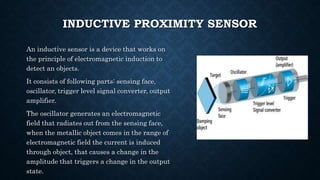
An inductive sensor is a device that works on
the principle of electromagnetic induction to
detect an objects.
It consists of following parts: sensing face,
oscillator, trigger level signal converter, output
amplifier.
The oscillator generates an electromagnetic
field that radiates out from the sensing face,
when the metallic object comes in the range of
electromagnetic field the current is induced
through object, that causes a change in the
amplitude that triggers a change in the output
state.
INDUCTIVE PROXIMITY SENSOR
In term of nonferrous object, when metals such
as aluminum or copper approaches the sensor,
the oscillation frequency increases. On the other
hand, when a ferrous-metal object such as iron
approaches the sensor, the oscillation frequency
decreases. This change in reference frequency
detects the sensor output signal.
Non-metallic substances such as liquids or some
kinds of dirt do not interact with the magnetic
field, so an inductive sensor can operate in wet
or dirty conditions.
CAPACITIVE PROXIMITY SENSOR
Capacitive Proximity Sensors detect changes in
the capacitance between the sensing object and
the Sensor.
It is similar to a capacitor with two parallel
plates, where the capacity of the two plates are
detected.
One of the plates is the object being measured
and the other is the Sensor’s sensing surface. It
detects the changes in the capacity generated
between these two poles.
CAPACITIVE PROXIMITY SENSOR
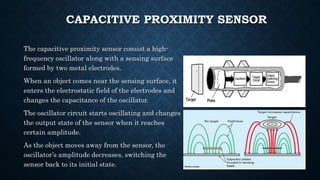
The capacitive proximity sensor consist a high-
frequency oscillator along with a sensing surface
formed by two metal electrodes.
When an object comes near the sensing surface, it
enters the electrostatic field of the electrodes and
changes the capacitance of the oscillator.
The oscillator circuit starts oscillating and changes
the output state of the sensor when it reaches
certain amplitude.
As the object moves away from the sensor, the
oscillator’s amplitude decreases, switching the
sensor back to its initial state.
ULTRASONIC PROXIMITY SENSOR
Ultrasonic proximity sensors are mainly for object
detection and distance measurement. Ultrasonic
sensors work by using sound frequencies higher
than the audible limit of human hearing (around
20 kHz), which is typically in the range of 25 to 50
kHz.
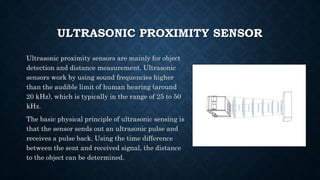
The basic physical principle of ultrasonic sensing is
that the sensor sends out an ultrasonic pulse and
receives a pulse back. Using the time difference
between the sent and received signal, the distance
to the object can be determined.
ULTRASONIC PROXIMITY SENSOR
Because ultrasonic proximity sensors use
sound rather than light, they can be used
where photoelectric sensors have difficulty,
such as in detecting clear plastic objects
and labels, highly reflective surfaces that
throw off optical sensors, or even liquid
levels.
They’re also immune to common
contaminants such as dust, moisture, and
ambient light.
MAGNETIC PROXIMITY SENSOR
Magnetic proximity sensors are used for non-contact position detection
beyond the normal limits of any inductive sensors. Magnetic sensors can
detect magnets through walls of non-ferrous metal, stainless steel,
aluminum, plastic or wood.
Mostly used sensor’s Working principles:
Variable reluctance
Reed switches
MAGNETIC PROXIMITY SENSOR
Variable reluctance Magnetic sensor
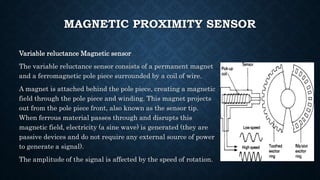
The variable reluctance sensor consists of a permanent magnet
and a ferromagnetic pole piece surrounded by a coil of wire.
A magnet is attached behind the pole piece, creating a magnetic
field through the pole piece and winding. This magnet projects
out from the pole piece front, also known as the sensor tip.
When ferrous material passes through and disrupts this
magnetic field, electricity (a sine wave) is generated (they are
passive devices and do not require any external source of power
to generate a signal).
The amplitude of the signal is affected by the speed of rotation.
MAGNETIC PROXIMITY SENSOR
Reed Switches
Reed switches are magnetically actuated switches. It
consist of two low reluctance ferro-magnetic reeds
(contact blades) sealed in a glass capsule containing
inert gas.
A magnetic field from an electromagnet or a
permanent magnet will cause the reeds to attract
each other to complete an electrical circuit.
OPTICAL PROXIMITY SENSOR
A Photoelectric Sensor consists of an Emitter for emitting light and a Receiver for receiving light.
When emitted light is interrupted or reflected by the sensing object, it changes the amount of light
that arrives at the Receiver.
The Receiver detects this change and converts it to an electrical output.
The light source for the majority of Photoelectric Sensors is infrared or visible light (generally red, or
green/blue for identifying colors).
Working principles:
 Through- beam optical sensor
 Reflective optical sensor
 Diffuse- reflective optical sensor
OPTICAL PROXIMITY SENSOR
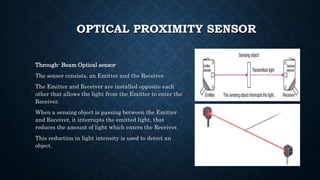
Through- Beam Optical sensor
The sensor consists, an Emitter and the Receiver.
The Emitter and Receiver are installed opposite each
other that allows the light from the Emitter to enter the
Receiver.
When a sensing object is passing between the Emitter
and Receiver, it interrupts the emitted light, that
reduces the amount of light which enters the Receiver.
This reduction in light intensity is used to detect an
object.
OPTICAL PROXIMITY SENSOR
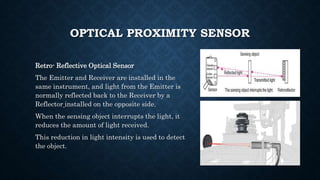
Retro- Reflective Optical Sensor
The Emitter and Receiver are installed in the
same instrument, and light from the Emitter is
normally reflected back to the Receiver by a
Reflector installed on the opposite side.
When the sensing object interrupts the light, it
reduces the amount of light received.
This reduction in light intensity is used to detect
the object.
OPTICAL PROXIMITY SENSOR
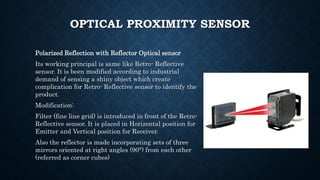
Polarized Reflection with Reflector Optical sensor
Its working principal is same like Retro- Reflective
sensor. It is been modified according to industrial
demand of sensing a shiny object which create
complication for Retro- Reflective sensor to identify the
product.
Modification:
Filter (fine line grid) is introduced in front of the Retro-
Reflective sensor. It is placed in Horizontal position for
Emitter and Vertical position for Receiver.
Also the reflector is made incorporating sets of three
mirrors oriented at right angles (90°) from each other
(referred as corner cubes)
OPTICAL PROXIMITY SENSOR
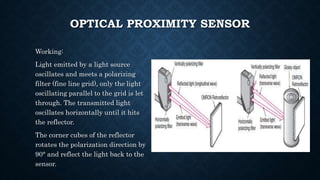
Working:
Light emitted by a light source
oscillates and meets a polarizing
filter (fine line grid), only the light
oscillating parallel to the grid is let
through. The transmitted light
oscillates horizontally until it hits
the reflector.
The corner cubes of the reflector
rotates the polarization direction by
90° and reflect the light back to the
sensor.
Working:
The light return passing through the vertically polarized
filter on the receiver
With the use of polarization and corner cubed reflectors,
Retro- Reflective sensors creates a closed light circuit
which ensures that light detected by the receiver was
sourced by the emitter.
OPTICAL PROXIMITY SENSOR
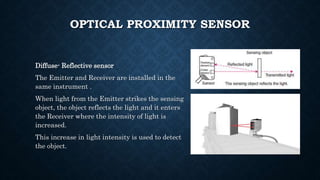
Diffuse- Reflective sensor
The Emitter and Receiver are installed in the
same instrument .
When light from the Emitter strikes the sensing
object, the object reflects the light and it enters
the Receiver where the intensity of light is
increased.
This increase in light intensity is used to detect
the object.
Proximity sensor

Proximity sensor

  • 1.
    PROXIMITY SENSOR Prepared by UjjwalKumar Choubey ujjwalchoubey80@gmail.com
  • 2.
    The proximity sensoris a group of sensors that can identify the object without getting in contact with it, in various ways (Sound, magnetic, electromagnetic waves, optical). It is widely used in all the industries and appliances used in daily basic.
  • 3.
    TYPES OF PROXIMITYSENSOR Proximity Sensor Inductive Capacitive Ultrasonic Magnetic Variable Reluctance Reed Switch Optical Through- Beam Reflective Retro Reflective Polarized Reflection with Reflector Diffuse- Reflective
  • 4.
    INDUCTIVE PROXIMITY SENSOR Aninductive sensor is a device that works on the principle of electromagnetic induction to detect an objects. It consists of following parts: sensing face, oscillator, trigger level signal converter, output amplifier. The oscillator generates an electromagnetic field that radiates out from the sensing face, when the metallic object comes in the range of electromagnetic field the current is induced through object, that causes a change in the amplitude that triggers a change in the output state.
  • 5.
    INDUCTIVE PROXIMITY SENSOR Interm of nonferrous object, when metals such as aluminum or copper approaches the sensor, the oscillation frequency increases. On the other hand, when a ferrous-metal object such as iron approaches the sensor, the oscillation frequency decreases. This change in reference frequency detects the sensor output signal. Non-metallic substances such as liquids or some kinds of dirt do not interact with the magnetic field, so an inductive sensor can operate in wet or dirty conditions.
  • 6.
    CAPACITIVE PROXIMITY SENSOR CapacitiveProximity Sensors detect changes in the capacitance between the sensing object and the Sensor. It is similar to a capacitor with two parallel plates, where the capacity of the two plates are detected. One of the plates is the object being measured and the other is the Sensor’s sensing surface. It detects the changes in the capacity generated between these two poles.
  • 7.
    CAPACITIVE PROXIMITY SENSOR Thecapacitive proximity sensor consist a high- frequency oscillator along with a sensing surface formed by two metal electrodes. When an object comes near the sensing surface, it enters the electrostatic field of the electrodes and changes the capacitance of the oscillator. The oscillator circuit starts oscillating and changes the output state of the sensor when it reaches certain amplitude. As the object moves away from the sensor, the oscillator’s amplitude decreases, switching the sensor back to its initial state.
  • 8.
    ULTRASONIC PROXIMITY SENSOR Ultrasonicproximity sensors are mainly for object detection and distance measurement. Ultrasonic sensors work by using sound frequencies higher than the audible limit of human hearing (around 20 kHz), which is typically in the range of 25 to 50 kHz. The basic physical principle of ultrasonic sensing is that the sensor sends out an ultrasonic pulse and receives a pulse back. Using the time difference between the sent and received signal, the distance to the object can be determined.
  • 9.
    ULTRASONIC PROXIMITY SENSOR Becauseultrasonic proximity sensors use sound rather than light, they can be used where photoelectric sensors have difficulty, such as in detecting clear plastic objects and labels, highly reflective surfaces that throw off optical sensors, or even liquid levels. They’re also immune to common contaminants such as dust, moisture, and ambient light.
  • 10.
    MAGNETIC PROXIMITY SENSOR Magneticproximity sensors are used for non-contact position detection beyond the normal limits of any inductive sensors. Magnetic sensors can detect magnets through walls of non-ferrous metal, stainless steel, aluminum, plastic or wood. Mostly used sensor’s Working principles: Variable reluctance Reed switches
  • 11.
    MAGNETIC PROXIMITY SENSOR Variablereluctance Magnetic sensor The variable reluctance sensor consists of a permanent magnet and a ferromagnetic pole piece surrounded by a coil of wire. A magnet is attached behind the pole piece, creating a magnetic field through the pole piece and winding. This magnet projects out from the pole piece front, also known as the sensor tip. When ferrous material passes through and disrupts this magnetic field, electricity (a sine wave) is generated (they are passive devices and do not require any external source of power to generate a signal). The amplitude of the signal is affected by the speed of rotation.
  • 12.
    MAGNETIC PROXIMITY SENSOR ReedSwitches Reed switches are magnetically actuated switches. It consist of two low reluctance ferro-magnetic reeds (contact blades) sealed in a glass capsule containing inert gas. A magnetic field from an electromagnet or a permanent magnet will cause the reeds to attract each other to complete an electrical circuit.
  • 13.
    OPTICAL PROXIMITY SENSOR APhotoelectric Sensor consists of an Emitter for emitting light and a Receiver for receiving light. When emitted light is interrupted or reflected by the sensing object, it changes the amount of light that arrives at the Receiver. The Receiver detects this change and converts it to an electrical output. The light source for the majority of Photoelectric Sensors is infrared or visible light (generally red, or green/blue for identifying colors). Working principles:  Through- beam optical sensor  Reflective optical sensor  Diffuse- reflective optical sensor
  • 14.
    OPTICAL PROXIMITY SENSOR Through-Beam Optical sensor The sensor consists, an Emitter and the Receiver. The Emitter and Receiver are installed opposite each other that allows the light from the Emitter to enter the Receiver. When a sensing object is passing between the Emitter and Receiver, it interrupts the emitted light, that reduces the amount of light which enters the Receiver. This reduction in light intensity is used to detect an object.
  • 15.
    OPTICAL PROXIMITY SENSOR Retro-Reflective Optical Sensor The Emitter and Receiver are installed in the same instrument, and light from the Emitter is normally reflected back to the Receiver by a Reflector installed on the opposite side. When the sensing object interrupts the light, it reduces the amount of light received. This reduction in light intensity is used to detect the object.
  • 16.
    OPTICAL PROXIMITY SENSOR PolarizedReflection with Reflector Optical sensor Its working principal is same like Retro- Reflective sensor. It is been modified according to industrial demand of sensing a shiny object which create complication for Retro- Reflective sensor to identify the product. Modification: Filter (fine line grid) is introduced in front of the Retro- Reflective sensor. It is placed in Horizontal position for Emitter and Vertical position for Receiver. Also the reflector is made incorporating sets of three mirrors oriented at right angles (90°) from each other (referred as corner cubes)
  • 17.
    OPTICAL PROXIMITY SENSOR Working: Lightemitted by a light source oscillates and meets a polarizing filter (fine line grid), only the light oscillating parallel to the grid is let through. The transmitted light oscillates horizontally until it hits the reflector. The corner cubes of the reflector rotates the polarization direction by 90° and reflect the light back to the sensor.
  • 18.
    Working: The light returnpassing through the vertically polarized filter on the receiver With the use of polarization and corner cubed reflectors, Retro- Reflective sensors creates a closed light circuit which ensures that light detected by the receiver was sourced by the emitter. OPTICAL PROXIMITY SENSOR
  • 19.
    OPTICAL PROXIMITY SENSOR Diffuse-Reflective sensor The Emitter and Receiver are installed in the same instrument . When light from the Emitter strikes the sensing object, the object reflects the light and it enters the Receiver where the intensity of light is increased. This increase in light intensity is used to detect the object.