INTRODUCTION
Proximity sensors are sensors that detect the movement/presence
of objects without physical contact and relay that information
captured into an electrical signal.
As per Japanese Industrial Standards (JIS) a contactless detecting
sensor is also be defined as a proximity switch.
Features
• Contactless sensing
Contactless proximity sensing allows for detection without touching the object,
ensuring object stays well-conditioned.
• Unaffected by surface conditions
Proximity sensors are nearly unaffected by surface color of objects as it mainly detects
physical changes.
• Suitable for wide range of applications
 Proximity sensors are suitable for damp conditions and wide temperature range
usage.
 Proximity sensors are present in smartphones as well. It consists of simple IR
technology that switches on and off display according to usage.
 For example, it turns off the display when a phone call is ongoing .
• Longer service life
Since a proximity sensor uses semiconductor outputs, there are no moving parts
dependent on the operating cycle. Thus, its service life tends to be longer as compared
to other sensors.
• High speed response rate
Compared to switches where contact is required for sensing, proximity sensors offer a
higher-speed response rate.
Types of proximity sensors
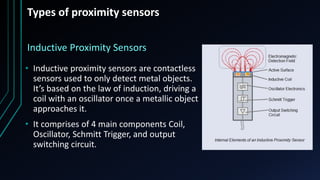
Inductive Proximity Sensors
• Inductive proximity sensors are contactless
sensors used to only detect metal objects.
It’s based on the law of induction, driving a
coil with an oscillator once a metallic object
approaches it.
• It comprises of 4 main components Coil,
Oscillator, Schmitt Trigger, and output
switching circuit.
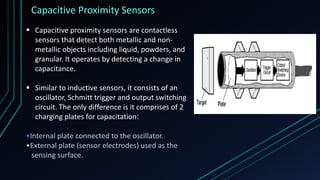
Capacitive Proximity Sensors
 Capacitive proximity sensors are contactless
sensors that detect both metallic and non-
metallic objects including liquid, powders, and
granular. It operates by detecting a change in
capacitance.
 Similar to inductive sensors, it consists of an
oscillator, Schmitt trigger and output switching
circuit. The only difference is it comprises of 2
charging plates for capacitation:
•Internal plate connected to the oscillator.
•External plate (sensor electrodes) used as the
sensing surface.
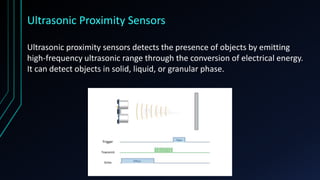
Ultrasonic Proximity Sensors
Ultrasonic proximity sensors detects the presence of objects by emitting
high-frequency ultrasonic range through the conversion of electrical energy.
It can detect objects in solid, liquid, or granular phase.
IR Proximity Sensors
Infrared proximity sensor detects the presence of an object by
emitting a beam of infrared light. Infrared proximity sensors
consist of an IR LED that emits, and a light detector for detection
of reflection. It has an in-built signal processing circuit that
determines an optical spot on the position sensitive detector.
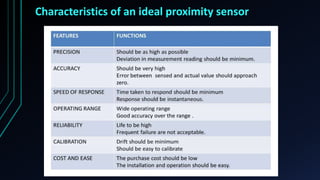
Characteristics of an ideal proximity sensor
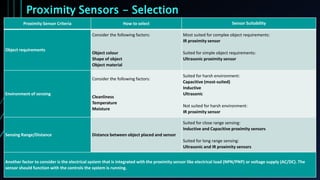
Proximity Sensors - Selection
Proximity Sensor Criteria How to select Sensor Suitability
Object requirements
Consider the following factors:
Object colour
Shape of object
Object material
Most suited for complex object requirements:
IR proximity sensor
Suited for simple object requirements:
Ultrasonic proximity sensor
Environment of sensing
Consider the following factors:
Cleanliness
Temperature
Moisture
Suited for harsh environment:
Capacitive (most-suited)
Inductive
Ultrasonic
Not suited for harsh environment:
IR proximity sensor
Sensing Range/Distance Distance between object placed and sensor
Suited for close range sensing:
Inductive and Capacitive proximity sensors
Suited for long range sensing:
Ultrasonic and IR proximity sensors
Another factor to consider is the electrical system that is integrated with the proximity sensor like electrical load (NPN/PNP) or voltage supply (AC/DC). The
sensor should function with the controls the system is running.
 Proximity sensors have a wide range of industrial and manufacturing
applications.
 Below mentioned are some of the uses:
 Used on automated production lines for object detection, position,
inspection and counting.
 Devices like smartphones have proximity sensors to detect the distance
between user and the mobile.
 Part detection on industrial conveyor systems.
 Collision detection in different types of robots.
 Used in sanitary equipment to control water flow.
Applications
Conclusion
With increased automation of complex production systems, components
that are capable of acquiring and transmitting information regarding the
production process become necessary. Proximity sensors, the most basic
data acquisition devices in automation fulfil these requirements by
providing information in the form of individual process variables to
controllers. They detect proximity of an object without any physical
contact and come in many types, each with its unique advantages.

Proximity Sensors ppt.pptx

  • 1.
    INTRODUCTION Proximity sensors aresensors that detect the movement/presence of objects without physical contact and relay that information captured into an electrical signal. As per Japanese Industrial Standards (JIS) a contactless detecting sensor is also be defined as a proximity switch.
  • 2.
    Features • Contactless sensing Contactlessproximity sensing allows for detection without touching the object, ensuring object stays well-conditioned. • Unaffected by surface conditions Proximity sensors are nearly unaffected by surface color of objects as it mainly detects physical changes. • Suitable for wide range of applications  Proximity sensors are suitable for damp conditions and wide temperature range usage.  Proximity sensors are present in smartphones as well. It consists of simple IR technology that switches on and off display according to usage.  For example, it turns off the display when a phone call is ongoing .
  • 3.
    • Longer servicelife Since a proximity sensor uses semiconductor outputs, there are no moving parts dependent on the operating cycle. Thus, its service life tends to be longer as compared to other sensors. • High speed response rate Compared to switches where contact is required for sensing, proximity sensors offer a higher-speed response rate.
  • 4.
    Types of proximitysensors Inductive Proximity Sensors • Inductive proximity sensors are contactless sensors used to only detect metal objects. It’s based on the law of induction, driving a coil with an oscillator once a metallic object approaches it. • It comprises of 4 main components Coil, Oscillator, Schmitt Trigger, and output switching circuit.
  • 5.
    Capacitive Proximity Sensors Capacitive proximity sensors are contactless sensors that detect both metallic and non- metallic objects including liquid, powders, and granular. It operates by detecting a change in capacitance.  Similar to inductive sensors, it consists of an oscillator, Schmitt trigger and output switching circuit. The only difference is it comprises of 2 charging plates for capacitation: •Internal plate connected to the oscillator. •External plate (sensor electrodes) used as the sensing surface.
  • 6.
    Ultrasonic Proximity Sensors Ultrasonicproximity sensors detects the presence of objects by emitting high-frequency ultrasonic range through the conversion of electrical energy. It can detect objects in solid, liquid, or granular phase.
  • 7.
    IR Proximity Sensors Infraredproximity sensor detects the presence of an object by emitting a beam of infrared light. Infrared proximity sensors consist of an IR LED that emits, and a light detector for detection of reflection. It has an in-built signal processing circuit that determines an optical spot on the position sensitive detector.
  • 8.
    Characteristics of anideal proximity sensor
  • 9.
    Proximity Sensors -Selection Proximity Sensor Criteria How to select Sensor Suitability Object requirements Consider the following factors: Object colour Shape of object Object material Most suited for complex object requirements: IR proximity sensor Suited for simple object requirements: Ultrasonic proximity sensor Environment of sensing Consider the following factors: Cleanliness Temperature Moisture Suited for harsh environment: Capacitive (most-suited) Inductive Ultrasonic Not suited for harsh environment: IR proximity sensor Sensing Range/Distance Distance between object placed and sensor Suited for close range sensing: Inductive and Capacitive proximity sensors Suited for long range sensing: Ultrasonic and IR proximity sensors Another factor to consider is the electrical system that is integrated with the proximity sensor like electrical load (NPN/PNP) or voltage supply (AC/DC). The sensor should function with the controls the system is running.
  • 10.
     Proximity sensorshave a wide range of industrial and manufacturing applications.  Below mentioned are some of the uses:  Used on automated production lines for object detection, position, inspection and counting.  Devices like smartphones have proximity sensors to detect the distance between user and the mobile.  Part detection on industrial conveyor systems.  Collision detection in different types of robots.  Used in sanitary equipment to control water flow. Applications
  • 11.
    Conclusion With increased automationof complex production systems, components that are capable of acquiring and transmitting information regarding the production process become necessary. Proximity sensors, the most basic data acquisition devices in automation fulfil these requirements by providing information in the form of individual process variables to controllers. They detect proximity of an object without any physical contact and come in many types, each with its unique advantages.