Language Detection Library
  - 99% over precision for 49 languages -

                 12/3/2010
    Nakatani Shuyo @ Cybozu Labs, Inc.
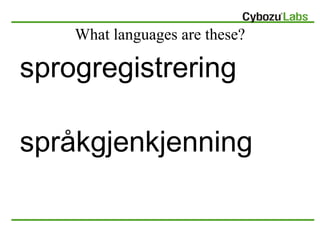
What languages are these?

sprogregistrering

språkgjenkjenning
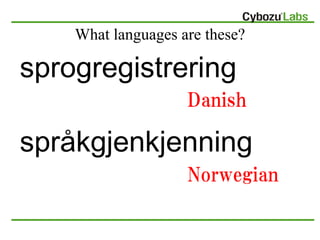
What languages are these?

sprogregistrering
                    Danish

språkgjenkjenning
                    Norwegian
‫?‪What languages are these‬‬

‫الكشف عن اللغة‬
  ‫تشخیص زبان‬
‫زبان کی شناخت‬
What languages are these?

‫الكشف عن اللغة‬          Arabic


  ‫تشخیص زبان‬            Persian

‫زبان کی شناخت‬           Urdu
What languages are these?

Language Detection

言語判別
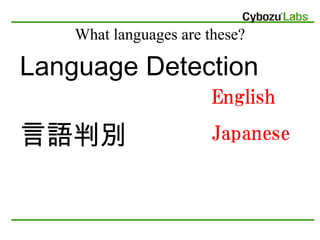
What languages are these?

Language Detection
                        English

言語判別                    Japanese
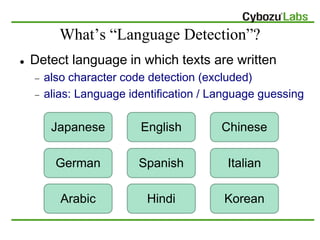
What’s “Language Detection”?
   Detect language in which texts are written
       also character code detection (excluded)
       alias: Language identification / Language guessing

         Japanese         English         Chinese

          German          Spanish          Italian

           Arabic          Hindi          Korean
Why Language Detection?
   Purpose
       For language of search criteria
            Query “Java” => Hit Chinese texts...
       For SPAM filter/Extract content filter
            To use language-specific information(punctuations,
             keywords)
   Usage
       Web search engine
            Apache Nutch bundles a language detection module
       Bulletin board
            Post in English, Japanese and Chinese
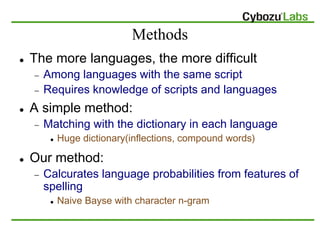
Methods
   The more languages, the more difficult
       Among languages with the same script
       Requires knowledge of scripts and languages
   A simple method:
       Matching with the dictionary in each language
            Huge dictionary(inflections, compound words)

   Our method:
       Calcurates language probabilities from features of
        spelling
            Naive Bayse with character n-gram
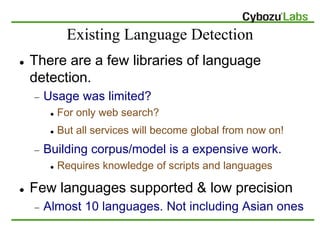
Existing Language Detection
   There are a few libraries of language
    detection.
       Usage was limited?
            For only web search?
            But all services will become global from now on!
       Building corpus/model is a expensive work.
            Requires knowledge of scripts and languages

   Few languages supported & low precision
       Almost 10 languages. Not including Asian ones
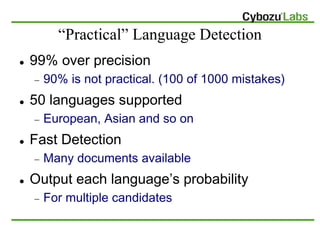
“Practical” Language Detection
   99% over precision
       90% is not practical. (100 of 1000 mistakes)
   50 languages supported
       European, Asian and so on
   Fast Detection
       Many documents available
   Output each language’s probability
       For multiple candidates
Language Detection Library for Java
   We developed a language detection library for
    Java.
       Generates the language profiles from training
        corpus
            Profile : the probabilities of all spellings in each language
       Returns the candidates and their probabilities for
        given texts
       49 languages supported
   Open Source (Apache License 2.0)
       http://code.google.com/p/language-detection/
Experiments
   Training
       49 languages from Wikipedia
            That can provide a test corpus of its language

   Test
       200 news articles of 49 languages
            Google News (24 languages)
            News sites in each language
            Crawling by RSS
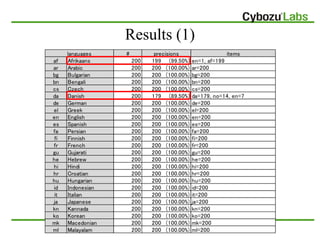
Results (1)
     languages    #          precisions                 items
af   Afrikaans        200   199 (99.50%)    en=1, af=199
ar   Arabic           200   200 (100.00%)   ar=200
bg   Bulgarian        200   200 (100.00%)   bg=200
bn   Bengali          200   200 (100.00%)   bn=200
cs   Czech            200   200 (100.00%)   cs=200
da   Danish           200   179 (89.50%)    da=179, no=14, en=7
de   German           200   200 (100.00%)   de=200
el   Greek            200   200 (100.00%)   el=200
en   English          200   200 (100.00%)   en=200
es   Spanish          200   200 (100.00%)   es=200
fa   Persian          200   200 (100.00%)   fa=200
fi   Finnish          200   200 (100.00%)   fi=200
fr   French           200   200 (100.00%)   fr=200
gu   Gujarati         200   200 (100.00%)   gu=200
he   Hebrew           200   200 (100.00%)   he=200
hi   Hindi            200   200 (100.00%)   hi=200
hr   Croatian         200   200 (100.00%)   hr=200
hu   Hungarian        200   200 (100.00%)   hu=200
id   Indonesian       200   200 (100.00%)   id=200
it   Italian          200   200 (100.00%)   it=200
ja   Japanese         200   200 (100.00%)   ja=200
kn   Kannada          200   200 (100.00%)   kn=200
ko   Korean           200   200 (100.00%)   ko=200
mk   Macedonian       200   200 (100.00%)   mk=200
ml   Malayalam        200   200 (100.00%)   ml=200
Results (2)
      languages             #        precisions                    items
  mr Marathi                 200    200 (100.00%)   mr=200
  ne  Nepali                 200    200 (100.00%)   ne=200
  nl  Dutch                  200    200 (100.00%)   nl=200
  no Norwegian               200    199 (99.50%)    da=1, no=199
  pa  Punjabi                200    200 (100.00%)   pa=200
  pl  Polish                 200    200 (100.00%)   pl=200
  pt  Portuguese             200    200 (100.00%)   pt=200
  ro  Romanian               200    200 (100.00%)   ro=200
  ru  Russian                200    200 (100.00%)   ru=200
  sk  Slovak                 200    200 (100.00%)   sk=200
  so Somali                  200    200 (100.00%)   so=200
  sq  Albanian               200    200 (100.00%)   sq=200
  sv  Swedish                200    200 (100.00%)   sv=200
  sw Swahili                 200    200 (100.00%)   sw=200
  ta  Tamil                  200    200 (100.00%)   ta=200
  te  Telugu                 200    200 (100.00%)   te=200
  th  Thai                   200    200 (100.00%)   th=200
   tl Tagalog                200    200 (100.00%)   tl=200
  tr  Turkish                200    200 (100.00%)   tr=200
  uk Ukrainian               200    200 (100.00%)   uk=200
  ur  Urdu                   200    200 (100.00%)   ur=200
  vi  Vietnamese             200    200 (100.00%)   vi=200
zh-cn Simplified Chinese     200    200 (100.00%)   zh-cn=200
zh-tw Traditional Chinese    200    200 (100.00%)   zh-tw=200
         sum                9800   9777 (99.77%)
Algorithms
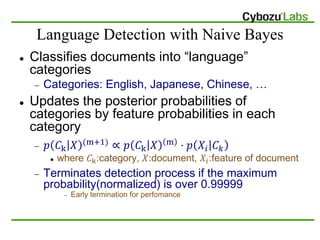
Language Detection with Naive Bayes
   Classifies documents into “language”
    categories
       Categories: English, Japanese, Chinese, …
   Updates the posterior probabilities of
    categories by feature probabilities in each
    category
        k     (m+1)    ∝  k     m   ⋅   
            where k :category, :document,  :feature of document
       Terminates detection process if the maximum
        probability(normalized) is over 0.99999
                 Early termination for perfomance
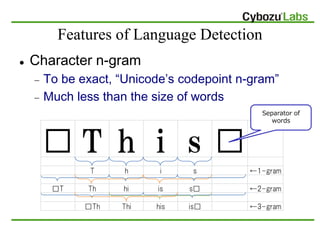
Features of Language Detection
   Character n-gram
       To be exact, “Unicode’s codepoint n-gram”
       Much less than the size of words
                                              Separator of
                                                 words


        □T h i s □
                T     h     i     s        ←1-gram

         □T    Th     hi   is    s□        ←2-gram

               □Th   Thi   his   is□       ←3-gram
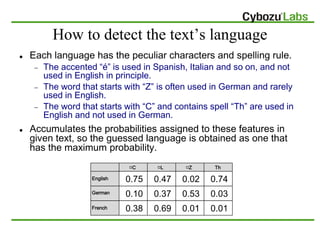
How to detect the text’s language
   Each language has the peculiar characters and spelling rule.
        The accented “é” is used in Spanish, Italian and so on, and not
         used in English in principle.
        The word that starts with “Z” is often used in German and rarely
         used in English.
        The word that starts with “C” and contains spell “Th” are used in
         English and not used in German.
   Accumulates the probabilities assigned to these features in
    given text, so the guessed language is obtained as one that
    has the maximum probability.
                               □C     □L      □Z     Th

                     English   0.75   0.47   0.02   0.74
                     German    0.10   0.37   0.53   0.03
                     French    0.38   0.69   0.01   0.01
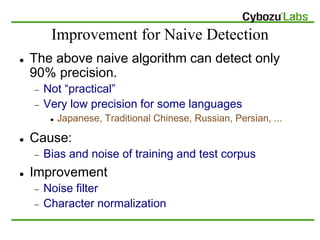
Improvement for Naive Detection
   The above naive algorithm can detect only
    90% precision.
       Not “practical”
       Very low precision for some languages
            Japanese, Traditional Chinese, Russian, Persian, ...

   Cause:
       Bias and noise of training and test corpus
   Improvement
       Noise filter
       Character normalization
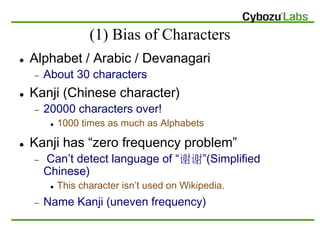
(1) Bias of Characters
   Alphabet / Arabic / Devanagari
       About 30 characters
   Kanji (Chinese character)
       20000 characters over!
            1000 times as much as Alphabets

   Kanji has “zero frequency problem”
       Can’t detect language of “谢谢”(Simplified
        Chinese)
            This character isn’t used on Wikipedia.
       Name Kanji (uneven frequency)
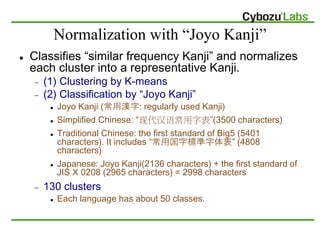
Normalization with “Joyo Kanji”
   Classifies “similar frequency Kanji” and normalizes
    each cluster into a representative Kanji.
       (1) Clustering by K-means
       (2) Classification by “Joyo Kanji”
            Joyo Kanji (常用漢字: regularly used Kanji)
            Simplified Chinese: “现代汉语常用字表”(3500 characters)
            Traditional Chinese: the first standard of Big5 (5401
             characters). It includes “常用国字標準字体表” (4808
             characters)
            Japanese: Joyo Kanji(2136 characters) + the first standard of
             JIS X 0208 (2965 characters) = 2998 characters
       130 clusters
            Each language has about 50 classes.
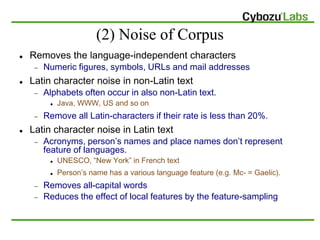
(2) Noise of Corpus
   Removes the language-independent characters
        Numeric figures, symbols, URLs and mail addresses
   Latin character noise in non-Latin text
        Alphabets often occur in also non-Latin text.
             Java, WWW, US and so on
        Remove all Latin-characters if their rate is less than 20%.
   Latin character noise in Latin text
        Acronyms, person’s names and place names don’t represent
         feature of languages.
             UNESCO, “New York” in French text
             Person’s name has a various language feature (e.g. Mc- = Gaelic).
        Removes all-capital words
        Reduces the effect of local features by the feature-sampling
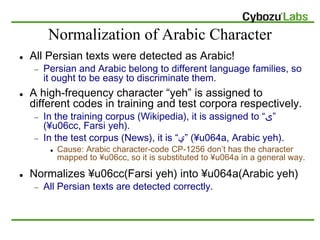
Normalization of Arabic Character
   All Persian texts were detected as Arabic!
       Persian and Arabic belong to different language families, so
        it ought to be easy to discriminate them.
   A high-frequency character “yeh” is assigned to
    different codes in training and test corpora respectively.
       In the training corpus (Wikipedia), it is assigned to “‫”ی‬
        (¥u06cc, Farsi yeh).
       In the test corpus (News), it is “‫¥( ”ي‬u064a, Arabic yeh).
            Cause: Arabic character-code CP-1256 don’t has the character
             mapped to ¥u06cc, so it is substituted to ¥u064a in a general way.

   Normalizes ¥u06cc(Farsi yeh) into ¥u064a(Arabic yeh)
       All Persian texts are detected correctly.
Conclusion
Conclusion
   We developed the language detection
    library for Java.
       49 languages can be detected in 99.8%
        precision.
       Our next product will use it (search by
        language).
   90% is easy. But 99% over is practical.
       Ideal: Answer from the novel beautiful theory
       Real: Unrefined steady way all along
Open Issues
   Short text (e.g. twitter)
   Arabic vowel signs
   Text in more than one language
   Source code in text
References
   [Habash 2009] Introduction to Arabic Natual Language Processing
        http://www.medar.info/conference_all/2009/Tutorial_1.pdf
   [Dunning 1994] Statistical Identification of Language
   [Sibun & Reynar 1996] Language identification: Examining the issues
   [Martins+ 2005] Language Identification in Web Pages
   千野栄一編「世界のことば100語辞典 ヨーロッパ編」
   町田和彦編「図説 世界の文字とことば」
   世界の文字研究会「世界の文字の図典」
   町田和彦「ニューエクスプレス ヒンディー語」
   中村公則「らくらくペルシャ語 文法から会話」
   道広勇司「アラビア系文字の基礎知識」
        http://moji.gr.jp/script/arabic/article01.html
   北研二,辻井潤一「確率的言語モデル」
Thank you for reading


   Language Detection Project Home
        http://code.google.com/p/language-detection/
   blog (in Japanese)
        http://d.hatena.ne.jp/n_shuyo/
   twitter
        http://twitter.com/shuyo

Language Detection Library for Java

  • 1.
    Language Detection Library - 99% over precision for 49 languages - 12/3/2010 Nakatani Shuyo @ Cybozu Labs, Inc.
  • 2.
    What languages arethese? sprogregistrering språkgjenkjenning
  • 3.
    What languages arethese? sprogregistrering Danish språkgjenkjenning Norwegian
  • 4.
    ‫?‪What languages arethese‬‬ ‫الكشف عن اللغة‬ ‫تشخیص زبان‬ ‫زبان کی شناخت‬
  • 5.
    What languages arethese? ‫الكشف عن اللغة‬ Arabic ‫تشخیص زبان‬ Persian ‫زبان کی شناخت‬ Urdu
  • 6.
    What languages arethese? Language Detection 言語判別
  • 7.
    What languages arethese? Language Detection English 言語判別 Japanese
  • 8.
    What’s “Language Detection”?  Detect language in which texts are written  also character code detection (excluded)  alias: Language identification / Language guessing Japanese English Chinese German Spanish Italian Arabic Hindi Korean
  • 9.
    Why Language Detection?  Purpose  For language of search criteria  Query “Java” => Hit Chinese texts...  For SPAM filter/Extract content filter  To use language-specific information(punctuations, keywords)  Usage  Web search engine  Apache Nutch bundles a language detection module  Bulletin board  Post in English, Japanese and Chinese
  • 10.
    Methods  The more languages, the more difficult  Among languages with the same script  Requires knowledge of scripts and languages  A simple method:  Matching with the dictionary in each language  Huge dictionary(inflections, compound words)  Our method:  Calcurates language probabilities from features of spelling  Naive Bayse with character n-gram
  • 11.
    Existing Language Detection  There are a few libraries of language detection.  Usage was limited?  For only web search?  But all services will become global from now on!  Building corpus/model is a expensive work.  Requires knowledge of scripts and languages  Few languages supported & low precision  Almost 10 languages. Not including Asian ones
  • 12.
    “Practical” Language Detection  99% over precision  90% is not practical. (100 of 1000 mistakes)  50 languages supported  European, Asian and so on  Fast Detection  Many documents available  Output each language’s probability  For multiple candidates
  • 13.
    Language Detection Libraryfor Java  We developed a language detection library for Java.  Generates the language profiles from training corpus  Profile : the probabilities of all spellings in each language  Returns the candidates and their probabilities for given texts  49 languages supported  Open Source (Apache License 2.0)  http://code.google.com/p/language-detection/
  • 14.
    Experiments  Training  49 languages from Wikipedia  That can provide a test corpus of its language  Test  200 news articles of 49 languages  Google News (24 languages)  News sites in each language  Crawling by RSS
  • 15.
    Results (1) languages # precisions items af Afrikaans 200 199 (99.50%) en=1, af=199 ar Arabic 200 200 (100.00%) ar=200 bg Bulgarian 200 200 (100.00%) bg=200 bn Bengali 200 200 (100.00%) bn=200 cs Czech 200 200 (100.00%) cs=200 da Danish 200 179 (89.50%) da=179, no=14, en=7 de German 200 200 (100.00%) de=200 el Greek 200 200 (100.00%) el=200 en English 200 200 (100.00%) en=200 es Spanish 200 200 (100.00%) es=200 fa Persian 200 200 (100.00%) fa=200 fi Finnish 200 200 (100.00%) fi=200 fr French 200 200 (100.00%) fr=200 gu Gujarati 200 200 (100.00%) gu=200 he Hebrew 200 200 (100.00%) he=200 hi Hindi 200 200 (100.00%) hi=200 hr Croatian 200 200 (100.00%) hr=200 hu Hungarian 200 200 (100.00%) hu=200 id Indonesian 200 200 (100.00%) id=200 it Italian 200 200 (100.00%) it=200 ja Japanese 200 200 (100.00%) ja=200 kn Kannada 200 200 (100.00%) kn=200 ko Korean 200 200 (100.00%) ko=200 mk Macedonian 200 200 (100.00%) mk=200 ml Malayalam 200 200 (100.00%) ml=200
  • 16.
    Results (2) languages # precisions items mr Marathi 200 200 (100.00%) mr=200 ne Nepali 200 200 (100.00%) ne=200 nl Dutch 200 200 (100.00%) nl=200 no Norwegian 200 199 (99.50%) da=1, no=199 pa Punjabi 200 200 (100.00%) pa=200 pl Polish 200 200 (100.00%) pl=200 pt Portuguese 200 200 (100.00%) pt=200 ro Romanian 200 200 (100.00%) ro=200 ru Russian 200 200 (100.00%) ru=200 sk Slovak 200 200 (100.00%) sk=200 so Somali 200 200 (100.00%) so=200 sq Albanian 200 200 (100.00%) sq=200 sv Swedish 200 200 (100.00%) sv=200 sw Swahili 200 200 (100.00%) sw=200 ta Tamil 200 200 (100.00%) ta=200 te Telugu 200 200 (100.00%) te=200 th Thai 200 200 (100.00%) th=200 tl Tagalog 200 200 (100.00%) tl=200 tr Turkish 200 200 (100.00%) tr=200 uk Ukrainian 200 200 (100.00%) uk=200 ur Urdu 200 200 (100.00%) ur=200 vi Vietnamese 200 200 (100.00%) vi=200 zh-cn Simplified Chinese 200 200 (100.00%) zh-cn=200 zh-tw Traditional Chinese 200 200 (100.00%) zh-tw=200 sum 9800 9777 (99.77%)
  • 17.
  • 18.
    Language Detection withNaive Bayes  Classifies documents into “language” categories  Categories: English, Japanese, Chinese, …  Updates the posterior probabilities of categories by feature probabilities in each category  k (m+1) ∝ k m ⋅  where k :category, :document, :feature of document  Terminates detection process if the maximum probability(normalized) is over 0.99999  Early termination for perfomance
  • 19.
    Features of LanguageDetection  Character n-gram  To be exact, “Unicode’s codepoint n-gram”  Much less than the size of words Separator of words □T h i s □ T h i s ←1-gram □T Th hi is s□ ←2-gram □Th Thi his is□ ←3-gram
  • 20.
    How to detectthe text’s language  Each language has the peculiar characters and spelling rule.  The accented “é” is used in Spanish, Italian and so on, and not used in English in principle.  The word that starts with “Z” is often used in German and rarely used in English.  The word that starts with “C” and contains spell “Th” are used in English and not used in German.  Accumulates the probabilities assigned to these features in given text, so the guessed language is obtained as one that has the maximum probability. □C □L □Z Th English 0.75 0.47 0.02 0.74 German 0.10 0.37 0.53 0.03 French 0.38 0.69 0.01 0.01
  • 21.
    Improvement for NaiveDetection  The above naive algorithm can detect only 90% precision.  Not “practical”  Very low precision for some languages  Japanese, Traditional Chinese, Russian, Persian, ...  Cause:  Bias and noise of training and test corpus  Improvement  Noise filter  Character normalization
  • 22.
    (1) Bias ofCharacters  Alphabet / Arabic / Devanagari  About 30 characters  Kanji (Chinese character)  20000 characters over!  1000 times as much as Alphabets  Kanji has “zero frequency problem”  Can’t detect language of “谢谢”(Simplified Chinese)  This character isn’t used on Wikipedia.  Name Kanji (uneven frequency)
  • 23.
    Normalization with “JoyoKanji”  Classifies “similar frequency Kanji” and normalizes each cluster into a representative Kanji.  (1) Clustering by K-means  (2) Classification by “Joyo Kanji”  Joyo Kanji (常用漢字: regularly used Kanji)  Simplified Chinese: “现代汉语常用字表”(3500 characters)  Traditional Chinese: the first standard of Big5 (5401 characters). It includes “常用国字標準字体表” (4808 characters)  Japanese: Joyo Kanji(2136 characters) + the first standard of JIS X 0208 (2965 characters) = 2998 characters  130 clusters  Each language has about 50 classes.
  • 24.
    (2) Noise ofCorpus  Removes the language-independent characters  Numeric figures, symbols, URLs and mail addresses  Latin character noise in non-Latin text  Alphabets often occur in also non-Latin text.  Java, WWW, US and so on  Remove all Latin-characters if their rate is less than 20%.  Latin character noise in Latin text  Acronyms, person’s names and place names don’t represent feature of languages.  UNESCO, “New York” in French text  Person’s name has a various language feature (e.g. Mc- = Gaelic).  Removes all-capital words  Reduces the effect of local features by the feature-sampling
  • 25.
    Normalization of ArabicCharacter  All Persian texts were detected as Arabic!  Persian and Arabic belong to different language families, so it ought to be easy to discriminate them.  A high-frequency character “yeh” is assigned to different codes in training and test corpora respectively.  In the training corpus (Wikipedia), it is assigned to “‫”ی‬ (¥u06cc, Farsi yeh).  In the test corpus (News), it is “‫¥( ”ي‬u064a, Arabic yeh).  Cause: Arabic character-code CP-1256 don’t has the character mapped to ¥u06cc, so it is substituted to ¥u064a in a general way.  Normalizes ¥u06cc(Farsi yeh) into ¥u064a(Arabic yeh)  All Persian texts are detected correctly.
  • 26.
  • 27.
    Conclusion  We developed the language detection library for Java.  49 languages can be detected in 99.8% precision.  Our next product will use it (search by language).  90% is easy. But 99% over is practical.  Ideal: Answer from the novel beautiful theory  Real: Unrefined steady way all along
  • 28.
    Open Issues  Short text (e.g. twitter)  Arabic vowel signs  Text in more than one language  Source code in text
  • 29.
    References  [Habash 2009] Introduction to Arabic Natual Language Processing  http://www.medar.info/conference_all/2009/Tutorial_1.pdf  [Dunning 1994] Statistical Identification of Language  [Sibun & Reynar 1996] Language identification: Examining the issues  [Martins+ 2005] Language Identification in Web Pages  千野栄一編「世界のことば100語辞典 ヨーロッパ編」  町田和彦編「図説 世界の文字とことば」  世界の文字研究会「世界の文字の図典」  町田和彦「ニューエクスプレス ヒンディー語」  中村公則「らくらくペルシャ語 文法から会話」  道広勇司「アラビア系文字の基礎知識」  http://moji.gr.jp/script/arabic/article01.html  北研二,辻井潤一「確率的言語モデル」
  • 30.
    Thank you forreading  Language Detection Project Home  http://code.google.com/p/language-detection/  blog (in Japanese)  http://d.hatena.ne.jp/n_shuyo/  twitter  http://twitter.com/shuyo