Chapter 1: 
Semiconductor Diodes
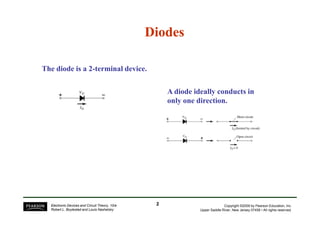
Diodes 
The diode is a 2-terminal device. 
A diode ideally conducts in 
only one direction. 
Copyright ©2009 by Pearson Education, Inc. 
Upper Saddle River, New Jersey 07458 • All rights reserved. 
Electronic Devices and Circuit Theory, 10/e 
Robert L. Boylestad and Louis Nashelsky 
2
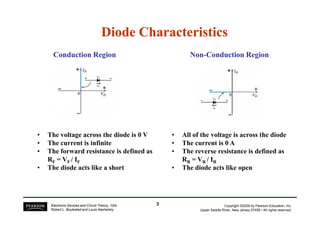
Diode Characteristics 
Conduction Region Non-Conduction Region 
Copyright ©2009 by Pearson Education, Inc. 
Upper Saddle River, New Jersey 07458 • All rights reserved. 
• The voltage across the diode is 0 V 
• The current is infinite 
• The forward resistance is defined as 
RF = VF / IF 
• The diode acts like a short 
Electronic Devices and Circuit Theory, 10/e 
Robert L. Boylestad and Louis Nashelsky 
• All of the voltage is across the diode 
• The current is 0 A 
• The reverse resistance is defined as 
RR = VR / IR 
• The diode acts like open 
3
Semiconductor Materials 
Materials commonly used in the development of 
semiconductor devices: 
• Silicon (Si) 
• Germanium (Ge) 
• Gallium Arsenide (GaAs) 
Copyright ©2009 by Pearson Education, Inc. 
Upper Saddle River, New Jersey 07458 • All rights reserved. 
Electronic Devices and Circuit Theory, 10/e 
Robert L. Boylestad and Louis Nashelsky 
4
Doping 
The electrical characteristics of silicon and germanium are improved 
by adding materials in a process called doping. 
There are just two types of doped semiconductor materials: 
n-type 
p-type 
• n-type materials contain an excess of conduction band electrons. 
• p-type materials contain an excess of valence band holes. 
Copyright ©2009 by Pearson Education, Inc. 
Upper Saddle River, New Jersey 07458 • All rights reserved. 
Electronic Devices and Circuit Theory, 10/e 
Robert L. Boylestad and Louis Nashelsky 
5
p-n Junctions 
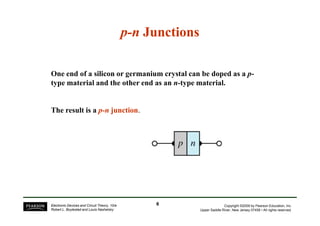
One end of a silicon or germanium crystal can be doped as a p-type 
material and the other end as an n-type material. 
The result is a p-n junction. 
Copyright ©2009 by Pearson Education, Inc. 
Upper Saddle River, New Jersey 07458 • All rights reserved. 
Electronic Devices and Circuit Theory, 10/e 
Robert L. Boylestad and Louis Nashelsky 
6
p-n Junctions 
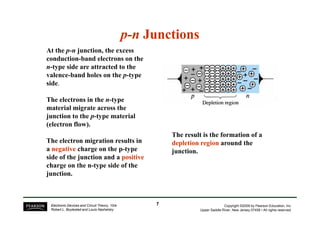
At the p-n junction, the excess 
conduction-band electrons on the 
n-type side are attracted to the 
valence-band holes on the p-type 
side. 
The electrons in the n-type 
material migrate across the 
junction to the p-type material 
Copyright ©2009 by Pearson Education, Inc. 
Upper Saddle River, New Jersey 07458 • All rights reserved. 
(electron flow). 
The electron migration results in 
a negative charge on the p-type 
side of the junction and a positive 
charge on the n-type side of the 
junction. 
Electronic Devices and Circuit Theory, 10/e 
Robert L. Boylestad and Louis Nashelsky 
The result is the formation of a 
depletion region around the 
junction. 
7
Diode Operating Conditions 
A diode has three operating conditions: 
• No bias 
• Forward bias 
• Reverse bias 
Copyright ©2009 by Pearson Education, Inc. 
Upper Saddle River, New Jersey 07458 • All rights reserved. 
Electronic Devices and Circuit Theory, 10/e 
Robert L. Boylestad and Louis Nashelsky 
8
Diode Operating Conditions 
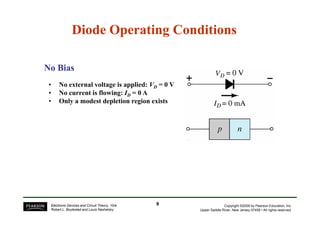
No Bias 
• No external voltage is applied: VD = 0 V 
• No current is flowing: ID = 0 A 
• Only a modest depletion region exists 
Copyright ©2009 by Pearson Education, Inc. 
Upper Saddle River, New Jersey 07458 • All rights reserved. 
Electronic Devices and Circuit Theory, 10/e 
Robert L. Boylestad and Louis Nashelsky 
9
Diode Operating Conditions 
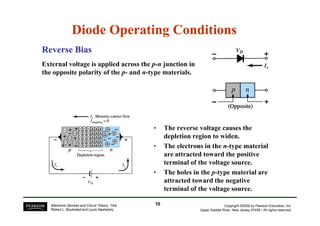
Reverse Bias 
External voltage is applied across the p-n junction in 
the opposite polarity of the p- and n-type materials. 
Copyright ©2009 by Pearson Education, Inc. 
Upper Saddle River, New Jersey 07458 • All rights reserved. 
Electronic Devices and Circuit Theory, 10/e 
Robert L. Boylestad and Louis Nashelsky 
• The reverse voltage causes the 
depletion region to widen. 
• The electrons in the n-type material 
are attracted toward the positive 
terminal of the voltage source. 
• The holes in the p-type material are 
attracted toward the negative 
terminal of the voltage source. 
10
Diode Operating Conditions 
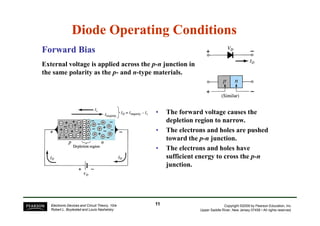
Forward Bias 
External voltage is applied across the p-n junction in 
the same polarity as the p- and n-type materials. 
• The forward voltage causes the 
Copyright ©2009 by Pearson Education, Inc. 
Upper Saddle River, New Jersey 07458 • All rights reserved. 
Electronic Devices and Circuit Theory, 10/e 
Robert L. Boylestad and Louis Nashelsky 
depletion region to narrow. 
• The electrons and holes are pushed 
toward the p-n junction. 
• The electrons and holes have 
sufficient energy to cross the p-n 
junction. 
11
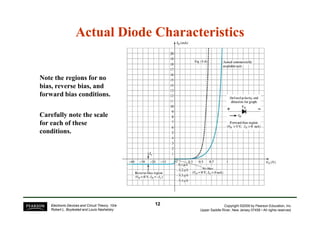
Actual Diode Characteristics 
Note the regions for no 
bias, reverse bias, and 
forward bias conditions. 
Carefully note the scale 
Copyright ©2009 by Pearson Education, Inc. 
Upper Saddle River, New Jersey 07458 • All rights reserved. 
for each of these 
conditions. 
Electronic Devices and Circuit Theory, 10/e 
Robert L. Boylestad and Louis Nashelsky 
12
Majority an and Minority Carriers 
Two currents through a diode: 
Majority Carriers 
• The majority carriers in n-type materials are electrons. 
• The majority carriers in p-type materials are holes. 
Copyright ©2009 by Pearson Education, Inc. 
Upper Saddle River, New Jersey 07458 • All rights reserved. 
Electronic Devices and Circuit Theory, 10/e 
Robert L. Boylestad and Louis Nashelsky 
Minority Carriers 
• The minority carriers in n-type materials are holes. 
• The minority carriers in p-type materials are electrons. 
13
Zener Region 
The Zener region is in the diode’s 
reverse-bias region. 
At some point the reverse bias voltage 
is so large the diode breaks down and 
the reverse current increases 
dramatically. 
• The maximum reverse voltage that won’t 
Copyright ©2009 by Pearson Education, Inc. 
Upper Saddle River, New Jersey 07458 • All rights reserved. 
take a diode into the zener region is 
called the peak inverse voltage or peak 
reverse voltage. 
• The voltage that causes a diode to enter 
the zener region of operation is called the 
zener voltage (VZ). 
Electronic Devices and Circuit Theory, 10/e 
Robert L. Boylestad and Louis Nashelsky 
14
Forward Bias Voltage 
The point at which the diode changes from no-bias condition 
to forward-bias condition occurs when the electrons and 
holes are given sufficient energy to cross the p-n junction. 
This energy comes from the external voltage applied across 
the diode. 
The forward bias voltage required for a: 
Copyright ©2009 by Pearson Education, Inc. 
• gallium arsenide diode ≅ 1.2 V 
• silicon diode ≅ 0.7 V 
• germanium diode ≅ 0.3 V 
Upper Saddle River, New Jersey 07458 • All rights reserved. 
Electronic Devices and Circuit Theory, 10/e 
Robert L. Boylestad and Louis Nashelsky 
15
Temperature Effects 
As temperature increases it adds energy to the diode. 
• It reduces the required forward bias voltage for forward-bias 
conduction. 
• It increases the amount of reverse current in the reverse-bias 
condition. 
• It increases maximum reverse bias avalanche voltage. 
Germanium diodes are more sensitive to temperature 
variations than silicon or gallium arsenide diodes. 
Copyright ©2009 by Pearson Education, Inc. 
Upper Saddle River, New Jersey 07458 • All rights reserved. 
Electronic Devices and Circuit Theory, 10/e 
Robert L. Boylestad and Louis Nashelsky 
16
Resistance Levels 
Semiconductors react differently to DC and AC currents. 
There are three types of resistance: 
• DC (static) resistance 
• AC (dynamic) resistance 
Copyright ©2009 by Pearson Education, Inc. 
Upper Saddle River, New Jersey 07458 • All rights reserved. 
• Average AC resistance 
Electronic Devices and Circuit Theory, 10/e 
Robert L. Boylestad and Louis Nashelsky 
17
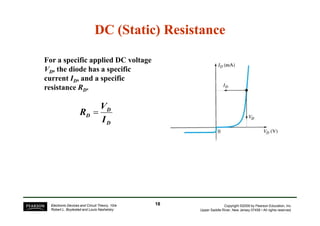
DC (Static) Resistance 
For a specific applied DC voltage 
VD, the diode has a specific 
current ID, and a specific 
resistance RD. 
D 
D 
V 
R = 
Copyright ©2009 by Pearson Education, Inc. 
Upper Saddle River, New Jersey 07458 • All rights reserved. 
D 
I 
Electronic Devices and Circuit Theory, 10/e 
Robert L. Boylestad and Louis Nashelsky 
18
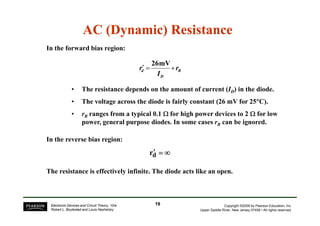
AC (Dynamic) Resistance 
26 mV 
r′ = + 
d r 
B 
D 
I 
In the forward bias region: 
• The resistance depends on the amount of current (ID) in the diode. 
• The voltage across the diode is fairly constant (26 mV for 25°C). 
• r ranges from a typical 0.1  for high power devices to 2  for low 
rB power, general purpose diodes. In some cases rB can be ignored. 
Copyright ©2009 by Pearson Education, Inc. 
Upper Saddle River, New Jersey 07458 • All rights reserved. 
Electronic Devices and Circuit Theory, 10/e 
Robert L. Boylestad and Louis Nashelsky 
rd′ = ∞ 
In the reverse bias region: 
The resistance is effectively infinite. The diode acts like an open. 
19
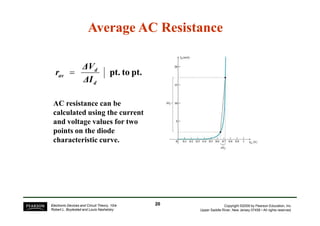
Average AC Resistance 
pt. to pt. 
d 
V 
d 
r = 
av 
I 
AC resistance can be 
calculated using the current 
Copyright ©2009 by Pearson Education, Inc. 
Upper Saddle River, New Jersey 07458 • All rights reserved. 
and voltage values for two 
points on the diode 
characteristic curve. 
Electronic Devices and Circuit Theory, 10/e 
Robert L. Boylestad and Louis Nashelsky 
20
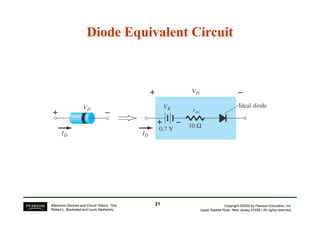
Diode Equivalent Circuit 
Copyright ©2009 by Pearson Education, Inc. 
Upper Saddle River, New Jersey 07458 • All rights reserved. 
Electronic Devices and Circuit Theory, 10/e 
Robert L. Boylestad and Louis Nashelsky 
21
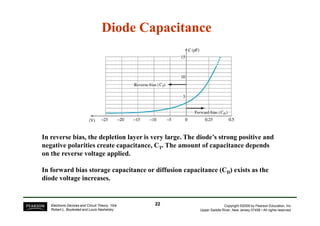
Diode Capacitance 
In reverse bias, the depletion layer is very large. The diode’s strong positive and 
negative polarities create capacitance, CT. The amount of capacitance depends 
on the reverse voltage applied. 
In forward bias storage capacitance or diffusion capacitance (CD) exists as the 
diode voltage increases. 
Copyright ©2009 by Pearson Education, Inc. 
Upper Saddle River, New Jersey 07458 • All rights reserved. 
Electronic Devices and Circuit Theory, 10/e 
Robert L. Boylestad and Louis Nashelsky 
22
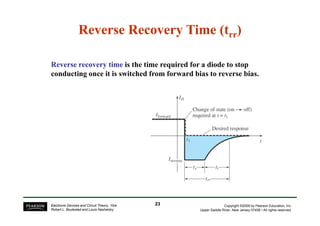
Reverse Recovery Time (trr) 
Reverse recovery time is the time required for a diode to stop 
conducting once it is switched from forward bias to reverse bias. 
Copyright ©2009 by Pearson Education, Inc. 
Upper Saddle River, New Jersey 07458 • All rights reserved. 
Electronic Devices and Circuit Theory, 10/e 
Robert L. Boylestad and Louis Nashelsky 
23
Diode Specification Sheets 
Data about a diode is presented uniformly for many different diodes. 
This makes cross-matching of diodes for replacement or design 
easier. 
1. Forward Voltage (VF) at a specified current and temperature 
2. Maximum forward current (IF) at a specified temperature 
3. Reverse saturation current (IR) at a specified voltage and 
temperature 
4. Reverse voltage rating, PIV or PRV or V(BR), at a specified 
5. Maximum power dissipation at a specified temperature 
6. Capacitance levels 
7. Reverse recovery time, trr 
8. Operating temperature range 
Copyright ©2009 by Pearson Education, Inc. 
Upper Saddle River, New Jersey 07458 • All rights reserved. 
temperature 
Electronic Devices and Circuit Theory, 10/e 
Robert L. Boylestad and Louis Nashelsky 
24
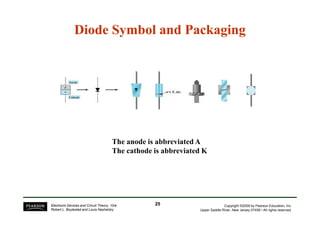
Diode Symbol and Packaging 
Copyright ©2009 by Pearson Education, Inc. 
The anode is abbreviated A 
The cathode is abbreviated K 
Upper Saddle River, New Jersey 07458 • All rights reserved. 
Electronic Devices and Circuit Theory, 10/e 
Robert L. Boylestad and Louis Nashelsky 
25
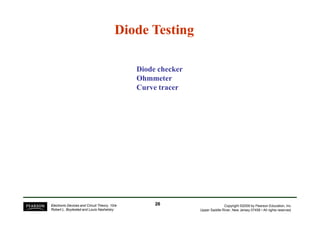
Diode Testing 
Diode checker 
Ohmmeter 
Curve tracer 
Copyright ©2009 by Pearson Education, Inc. 
Upper Saddle River, New Jersey 07458 • All rights reserved. 
Electronic Devices and Circuit Theory, 10/e 
Robert L. Boylestad and Louis Nashelsky 
26
Diode Checker 
Many digital multimeters have a diode checking function. 
The diode should be tested out of circuit. 
A normal diode exhibits its forward voltage: 
• Gallium arsenide ≅ 1.2 V 
Copyright ©2009 by Pearson Education, Inc. 
Upper Saddle River, New Jersey 07458 • All rights reserved. 
• Silicon diode ≅ 0.7 V 
• Germanium diode ≅ 0.3 V 
Electronic Devices and Circuit Theory, 10/e 
Robert L. Boylestad and Louis Nashelsky 
27
Ohmmeter 
An ohmmeter set on a low Ohms scale can be used to test a 
diode. The diode should be tested out of circuit. 
Copyright ©2009 by Pearson Education, Inc. 
Upper Saddle River, New Jersey 07458 • All rights reserved. 
Electronic Devices and Circuit Theory, 10/e 
Robert L. Boylestad and Louis Nashelsky 
28
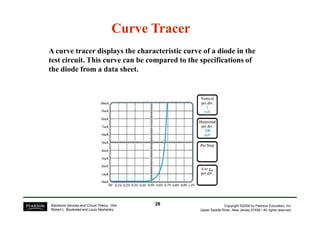
Curve Tracer 
A curve tracer displays the characteristic curve of a diode in the 
test circuit. This curve can be compared to the specifications of 
the diode from a data sheet. 
Copyright ©2009 by Pearson Education, Inc. 
Upper Saddle River, New Jersey 07458 • All rights reserved. 
Electronic Devices and Circuit Theory, 10/e 
Robert L. Boylestad and Louis Nashelsky 
29
Other Types of Diodes 
Zener diode 
Light-emitting diode 
Diode arrays 
Copyright ©2009 by Pearson Education, Inc. 
Upper Saddle River, New Jersey 07458 • All rights reserved. 
Electronic Devices and Circuit Theory, 10/e 
Robert L. Boylestad and Louis Nashelsky 
30
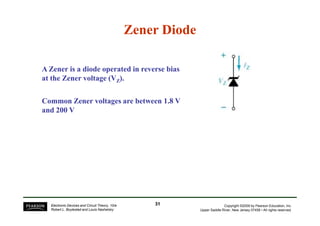
Zener Diode 
A Zener is a diode operated in reverse bias 
at the Zener voltage (VZ). 
Common Zener voltages are between 1.8 V 
and 200 V 
Copyright ©2009 by Pearson Education, Inc. 
Upper Saddle River, New Jersey 07458 • All rights reserved. 
Electronic Devices and Circuit Theory, 10/e 
Robert L. Boylestad and Louis Nashelsky 
31
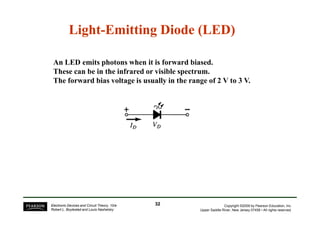
Light-Emitting Diode (LED) 
An LED emits photons when it is forward biased. 
These can be in the infrared or visible spectrum. 
The forward bias voltage is usually in the range of 2 V to 3 V. 
Copyright ©2009 by Pearson Education, Inc. 
Upper Saddle River, New Jersey 07458 • All rights reserved. 
Electronic Devices and Circuit Theory, 10/e 
Robert L. Boylestad and Louis Nashelsky 
32
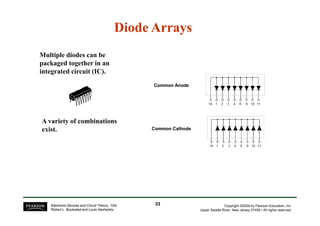
Multiple diodes can be 
packaged together in an 
integrated circuit (IC). 
Diode Arrays 
Common Anode 
Copyright ©2009 by Pearson Education, Inc. 
Upper Saddle River, New Jersey 07458 • All rights reserved. 
Electronic Devices and Circuit Theory, 10/e 
Robert L. Boylestad and Louis Nashelsky 
Common Cathode 
A variety of combinations 
exist. 
33

Electronic devices-and-circuit-theory-10th-ed-boylestad-chapter-1

  • 1.
  • 2.
    Diodes The diodeis a 2-terminal device. A diode ideally conducts in only one direction. Copyright ©2009 by Pearson Education, Inc. Upper Saddle River, New Jersey 07458 • All rights reserved. Electronic Devices and Circuit Theory, 10/e Robert L. Boylestad and Louis Nashelsky 2
  • 3.
    Diode Characteristics ConductionRegion Non-Conduction Region Copyright ©2009 by Pearson Education, Inc. Upper Saddle River, New Jersey 07458 • All rights reserved. • The voltage across the diode is 0 V • The current is infinite • The forward resistance is defined as RF = VF / IF • The diode acts like a short Electronic Devices and Circuit Theory, 10/e Robert L. Boylestad and Louis Nashelsky • All of the voltage is across the diode • The current is 0 A • The reverse resistance is defined as RR = VR / IR • The diode acts like open 3
  • 4.
    Semiconductor Materials Materialscommonly used in the development of semiconductor devices: • Silicon (Si) • Germanium (Ge) • Gallium Arsenide (GaAs) Copyright ©2009 by Pearson Education, Inc. Upper Saddle River, New Jersey 07458 • All rights reserved. Electronic Devices and Circuit Theory, 10/e Robert L. Boylestad and Louis Nashelsky 4
  • 5.
    Doping The electricalcharacteristics of silicon and germanium are improved by adding materials in a process called doping. There are just two types of doped semiconductor materials: n-type p-type • n-type materials contain an excess of conduction band electrons. • p-type materials contain an excess of valence band holes. Copyright ©2009 by Pearson Education, Inc. Upper Saddle River, New Jersey 07458 • All rights reserved. Electronic Devices and Circuit Theory, 10/e Robert L. Boylestad and Louis Nashelsky 5
  • 6.
    p-n Junctions Oneend of a silicon or germanium crystal can be doped as a p-type material and the other end as an n-type material. The result is a p-n junction. Copyright ©2009 by Pearson Education, Inc. Upper Saddle River, New Jersey 07458 • All rights reserved. Electronic Devices and Circuit Theory, 10/e Robert L. Boylestad and Louis Nashelsky 6
  • 7.
    p-n Junctions Atthe p-n junction, the excess conduction-band electrons on the n-type side are attracted to the valence-band holes on the p-type side. The electrons in the n-type material migrate across the junction to the p-type material Copyright ©2009 by Pearson Education, Inc. Upper Saddle River, New Jersey 07458 • All rights reserved. (electron flow). The electron migration results in a negative charge on the p-type side of the junction and a positive charge on the n-type side of the junction. Electronic Devices and Circuit Theory, 10/e Robert L. Boylestad and Louis Nashelsky The result is the formation of a depletion region around the junction. 7
  • 8.
    Diode Operating Conditions A diode has three operating conditions: • No bias • Forward bias • Reverse bias Copyright ©2009 by Pearson Education, Inc. Upper Saddle River, New Jersey 07458 • All rights reserved. Electronic Devices and Circuit Theory, 10/e Robert L. Boylestad and Louis Nashelsky 8
  • 9.
    Diode Operating Conditions No Bias • No external voltage is applied: VD = 0 V • No current is flowing: ID = 0 A • Only a modest depletion region exists Copyright ©2009 by Pearson Education, Inc. Upper Saddle River, New Jersey 07458 • All rights reserved. Electronic Devices and Circuit Theory, 10/e Robert L. Boylestad and Louis Nashelsky 9
  • 10.
    Diode Operating Conditions Reverse Bias External voltage is applied across the p-n junction in the opposite polarity of the p- and n-type materials. Copyright ©2009 by Pearson Education, Inc. Upper Saddle River, New Jersey 07458 • All rights reserved. Electronic Devices and Circuit Theory, 10/e Robert L. Boylestad and Louis Nashelsky • The reverse voltage causes the depletion region to widen. • The electrons in the n-type material are attracted toward the positive terminal of the voltage source. • The holes in the p-type material are attracted toward the negative terminal of the voltage source. 10
  • 11.
    Diode Operating Conditions Forward Bias External voltage is applied across the p-n junction in the same polarity as the p- and n-type materials. • The forward voltage causes the Copyright ©2009 by Pearson Education, Inc. Upper Saddle River, New Jersey 07458 • All rights reserved. Electronic Devices and Circuit Theory, 10/e Robert L. Boylestad and Louis Nashelsky depletion region to narrow. • The electrons and holes are pushed toward the p-n junction. • The electrons and holes have sufficient energy to cross the p-n junction. 11
  • 12.
    Actual Diode Characteristics Note the regions for no bias, reverse bias, and forward bias conditions. Carefully note the scale Copyright ©2009 by Pearson Education, Inc. Upper Saddle River, New Jersey 07458 • All rights reserved. for each of these conditions. Electronic Devices and Circuit Theory, 10/e Robert L. Boylestad and Louis Nashelsky 12
  • 13.
    Majority an andMinority Carriers Two currents through a diode: Majority Carriers • The majority carriers in n-type materials are electrons. • The majority carriers in p-type materials are holes. Copyright ©2009 by Pearson Education, Inc. Upper Saddle River, New Jersey 07458 • All rights reserved. Electronic Devices and Circuit Theory, 10/e Robert L. Boylestad and Louis Nashelsky Minority Carriers • The minority carriers in n-type materials are holes. • The minority carriers in p-type materials are electrons. 13
  • 14.
    Zener Region TheZener region is in the diode’s reverse-bias region. At some point the reverse bias voltage is so large the diode breaks down and the reverse current increases dramatically. • The maximum reverse voltage that won’t Copyright ©2009 by Pearson Education, Inc. Upper Saddle River, New Jersey 07458 • All rights reserved. take a diode into the zener region is called the peak inverse voltage or peak reverse voltage. • The voltage that causes a diode to enter the zener region of operation is called the zener voltage (VZ). Electronic Devices and Circuit Theory, 10/e Robert L. Boylestad and Louis Nashelsky 14
  • 15.
    Forward Bias Voltage The point at which the diode changes from no-bias condition to forward-bias condition occurs when the electrons and holes are given sufficient energy to cross the p-n junction. This energy comes from the external voltage applied across the diode. The forward bias voltage required for a: Copyright ©2009 by Pearson Education, Inc. • gallium arsenide diode ≅ 1.2 V • silicon diode ≅ 0.7 V • germanium diode ≅ 0.3 V Upper Saddle River, New Jersey 07458 • All rights reserved. Electronic Devices and Circuit Theory, 10/e Robert L. Boylestad and Louis Nashelsky 15
  • 16.
    Temperature Effects Astemperature increases it adds energy to the diode. • It reduces the required forward bias voltage for forward-bias conduction. • It increases the amount of reverse current in the reverse-bias condition. • It increases maximum reverse bias avalanche voltage. Germanium diodes are more sensitive to temperature variations than silicon or gallium arsenide diodes. Copyright ©2009 by Pearson Education, Inc. Upper Saddle River, New Jersey 07458 • All rights reserved. Electronic Devices and Circuit Theory, 10/e Robert L. Boylestad and Louis Nashelsky 16
  • 17.
    Resistance Levels Semiconductorsreact differently to DC and AC currents. There are three types of resistance: • DC (static) resistance • AC (dynamic) resistance Copyright ©2009 by Pearson Education, Inc. Upper Saddle River, New Jersey 07458 • All rights reserved. • Average AC resistance Electronic Devices and Circuit Theory, 10/e Robert L. Boylestad and Louis Nashelsky 17
  • 18.
    DC (Static) Resistance For a specific applied DC voltage VD, the diode has a specific current ID, and a specific resistance RD. D D V R = Copyright ©2009 by Pearson Education, Inc. Upper Saddle River, New Jersey 07458 • All rights reserved. D I Electronic Devices and Circuit Theory, 10/e Robert L. Boylestad and Louis Nashelsky 18
  • 19.
    AC (Dynamic) Resistance 26 mV r′ = + d r B D I In the forward bias region: • The resistance depends on the amount of current (ID) in the diode. • The voltage across the diode is fairly constant (26 mV for 25°C). • r ranges from a typical 0.1 for high power devices to 2 for low rB power, general purpose diodes. In some cases rB can be ignored. Copyright ©2009 by Pearson Education, Inc. Upper Saddle River, New Jersey 07458 • All rights reserved. Electronic Devices and Circuit Theory, 10/e Robert L. Boylestad and Louis Nashelsky rd′ = ∞ In the reverse bias region: The resistance is effectively infinite. The diode acts like an open. 19
  • 20.
    Average AC Resistance pt. to pt. d V d r = av I AC resistance can be calculated using the current Copyright ©2009 by Pearson Education, Inc. Upper Saddle River, New Jersey 07458 • All rights reserved. and voltage values for two points on the diode characteristic curve. Electronic Devices and Circuit Theory, 10/e Robert L. Boylestad and Louis Nashelsky 20
  • 21.
    Diode Equivalent Circuit Copyright ©2009 by Pearson Education, Inc. Upper Saddle River, New Jersey 07458 • All rights reserved. Electronic Devices and Circuit Theory, 10/e Robert L. Boylestad and Louis Nashelsky 21
  • 22.
    Diode Capacitance Inreverse bias, the depletion layer is very large. The diode’s strong positive and negative polarities create capacitance, CT. The amount of capacitance depends on the reverse voltage applied. In forward bias storage capacitance or diffusion capacitance (CD) exists as the diode voltage increases. Copyright ©2009 by Pearson Education, Inc. Upper Saddle River, New Jersey 07458 • All rights reserved. Electronic Devices and Circuit Theory, 10/e Robert L. Boylestad and Louis Nashelsky 22
  • 23.
    Reverse Recovery Time(trr) Reverse recovery time is the time required for a diode to stop conducting once it is switched from forward bias to reverse bias. Copyright ©2009 by Pearson Education, Inc. Upper Saddle River, New Jersey 07458 • All rights reserved. Electronic Devices and Circuit Theory, 10/e Robert L. Boylestad and Louis Nashelsky 23
  • 24.
    Diode Specification Sheets Data about a diode is presented uniformly for many different diodes. This makes cross-matching of diodes for replacement or design easier. 1. Forward Voltage (VF) at a specified current and temperature 2. Maximum forward current (IF) at a specified temperature 3. Reverse saturation current (IR) at a specified voltage and temperature 4. Reverse voltage rating, PIV or PRV or V(BR), at a specified 5. Maximum power dissipation at a specified temperature 6. Capacitance levels 7. Reverse recovery time, trr 8. Operating temperature range Copyright ©2009 by Pearson Education, Inc. Upper Saddle River, New Jersey 07458 • All rights reserved. temperature Electronic Devices and Circuit Theory, 10/e Robert L. Boylestad and Louis Nashelsky 24
  • 25.
    Diode Symbol andPackaging Copyright ©2009 by Pearson Education, Inc. The anode is abbreviated A The cathode is abbreviated K Upper Saddle River, New Jersey 07458 • All rights reserved. Electronic Devices and Circuit Theory, 10/e Robert L. Boylestad and Louis Nashelsky 25
  • 26.
    Diode Testing Diodechecker Ohmmeter Curve tracer Copyright ©2009 by Pearson Education, Inc. Upper Saddle River, New Jersey 07458 • All rights reserved. Electronic Devices and Circuit Theory, 10/e Robert L. Boylestad and Louis Nashelsky 26
  • 27.
    Diode Checker Manydigital multimeters have a diode checking function. The diode should be tested out of circuit. A normal diode exhibits its forward voltage: • Gallium arsenide ≅ 1.2 V Copyright ©2009 by Pearson Education, Inc. Upper Saddle River, New Jersey 07458 • All rights reserved. • Silicon diode ≅ 0.7 V • Germanium diode ≅ 0.3 V Electronic Devices and Circuit Theory, 10/e Robert L. Boylestad and Louis Nashelsky 27
  • 28.
    Ohmmeter An ohmmeterset on a low Ohms scale can be used to test a diode. The diode should be tested out of circuit. Copyright ©2009 by Pearson Education, Inc. Upper Saddle River, New Jersey 07458 • All rights reserved. Electronic Devices and Circuit Theory, 10/e Robert L. Boylestad and Louis Nashelsky 28
  • 29.
    Curve Tracer Acurve tracer displays the characteristic curve of a diode in the test circuit. This curve can be compared to the specifications of the diode from a data sheet. Copyright ©2009 by Pearson Education, Inc. Upper Saddle River, New Jersey 07458 • All rights reserved. Electronic Devices and Circuit Theory, 10/e Robert L. Boylestad and Louis Nashelsky 29
  • 30.
    Other Types ofDiodes Zener diode Light-emitting diode Diode arrays Copyright ©2009 by Pearson Education, Inc. Upper Saddle River, New Jersey 07458 • All rights reserved. Electronic Devices and Circuit Theory, 10/e Robert L. Boylestad and Louis Nashelsky 30
  • 31.
    Zener Diode AZener is a diode operated in reverse bias at the Zener voltage (VZ). Common Zener voltages are between 1.8 V and 200 V Copyright ©2009 by Pearson Education, Inc. Upper Saddle River, New Jersey 07458 • All rights reserved. Electronic Devices and Circuit Theory, 10/e Robert L. Boylestad and Louis Nashelsky 31
  • 32.
    Light-Emitting Diode (LED) An LED emits photons when it is forward biased. These can be in the infrared or visible spectrum. The forward bias voltage is usually in the range of 2 V to 3 V. Copyright ©2009 by Pearson Education, Inc. Upper Saddle River, New Jersey 07458 • All rights reserved. Electronic Devices and Circuit Theory, 10/e Robert L. Boylestad and Louis Nashelsky 32
  • 33.
    Multiple diodes canbe packaged together in an integrated circuit (IC). Diode Arrays Common Anode Copyright ©2009 by Pearson Education, Inc. Upper Saddle River, New Jersey 07458 • All rights reserved. Electronic Devices and Circuit Theory, 10/e Robert L. Boylestad and Louis Nashelsky Common Cathode A variety of combinations exist. 33