MEASURMENTS AND TESTING
       OF GEARS
Terminology of gear tooth
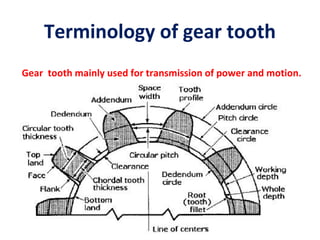
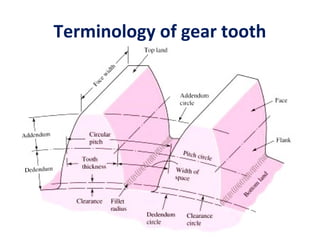
Gear tooth mainly used for transmission of power and motion.
Terminology of gear tooth
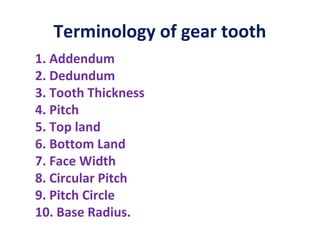
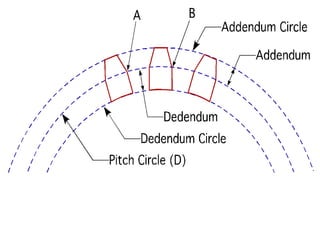
1. Addendum
2. Dedundum
3. Tooth Thickness
4. Pitch
5. Top land
6. Bottom Land
7. Face Width
8. Circular Pitch
9. Pitch Circle
10. Base Radius.
Terminology of gear tooth

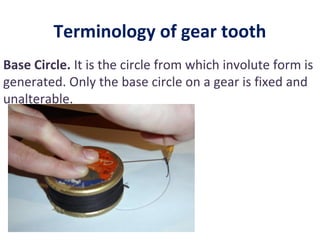
Base Circle. It is the circle from which involute form is
generated. Only the base circle on a gear is fixed and
unalterable.
Terminology of gear tooth
Base Circle. It is the circle from which involute form is
generated. Only the base circle on a gear is fixed and
unalterable.
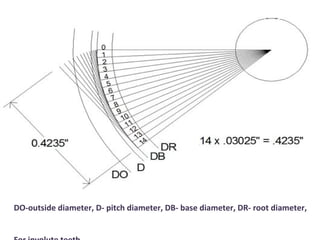
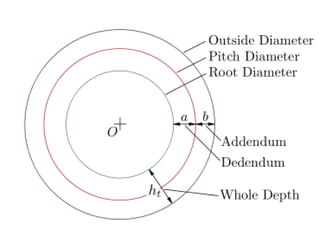
DO-outside diameter, D- pitch diameter, DB- base diameter, DR- root diameter,
Terminology of gear tooth
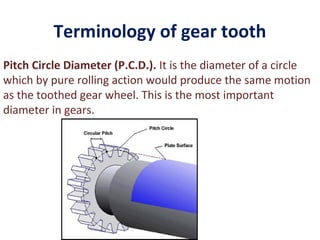
Pitch Circle Diameter (P.C.D.). It is the diameter of a circle
which by pure rolling action would produce the same motion
as the toothed gear wheel. This is the most important
diameter in gears.
Terminology of gear tooth
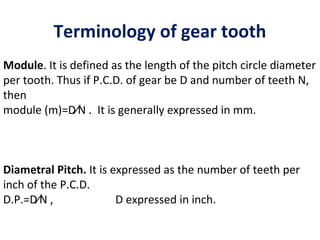
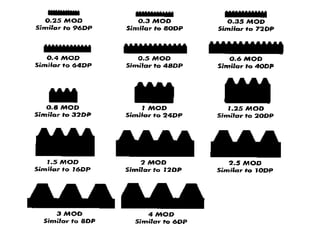
Module. It is defined as the length of the pitch circle diameter
per tooth. Thus if P.C.D. of gear be D and number of teeth N,
then
module (m)=D∕N . It is generally expressed in mm.


Diametral Pitch. It is expressed as the number of teeth per
inch of the P.C.D.
D.P.=D∕N ,              D expressed in inch.
Terminology of gear tooth
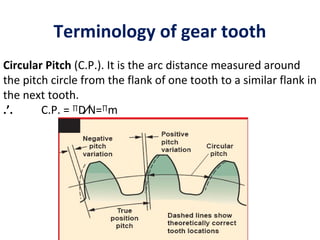
Circular Pitch (C.P.). It is the arc distance measured around
the pitch circle from the flank of one tooth to a similar flank in
the next tooth.
.’.     C.P. = ∏D∕N=∏m
Terminology of gear tooth
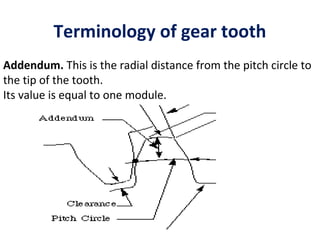
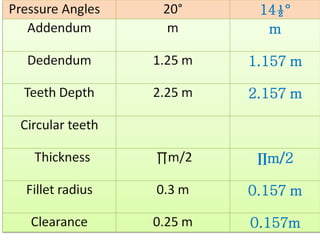
Addendum. This is the radial distance from the pitch circle to
the tip of the tooth.
Its value is equal to one module.
Terminology of gear tooth
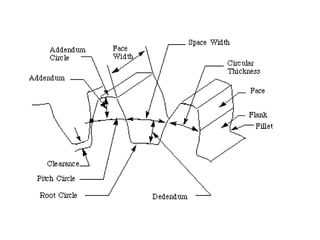
Clearance.
 This is the radial distance from the tip of a tooth to the
bottom of a mating tooth space when the teeth are
symmetri­cally engaged. Its standard value is 0.157 m.

Dedendum.
This is the radial distance from the pitch circle to the bottom
of the tooth space.
Dedendum=Addendum+ Clearance
=m+0.157 m=l.157 m.
Terminology of gear tooth
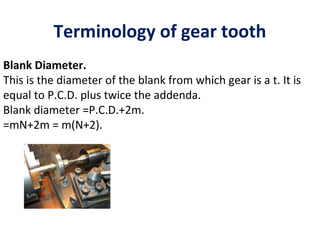
Blank Diameter.
This is the diameter of the blank from which gear is a t. It is
equal to P.C.D. plus twice the addenda.
Blank diameter =P.C.D.+2m.
=mN+2m = m(N+2).
Terminology of gear tooth
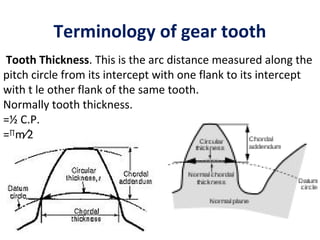
Tooth Thickness. This is the arc distance measured along the
pitch circle from its intercept with one flank to its intercept
with t le other flank of the same tooth.
Normally tooth thickness.
=½ C.P.
=∏m∕2
Terminology of gear tooth
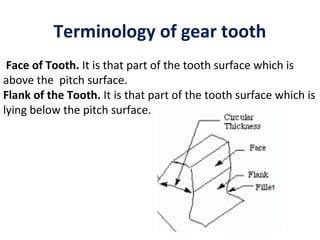
 Face of Tooth. It is that part of the tooth surface which is
above the pitch surface.
Flank of the Tooth. It is that part of the tooth surface which is
lying below the pitch surface.
Terminology of gear tooth
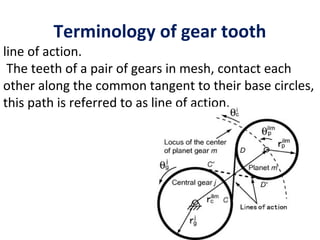
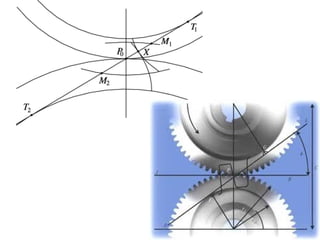
line of action.
 The teeth of a pair of gears in mesh, contact each
other along the common tangent to their base circles,
this path is referred to as line of action.
Terminology of gear tooth
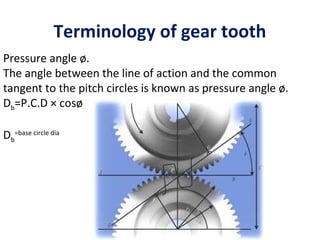
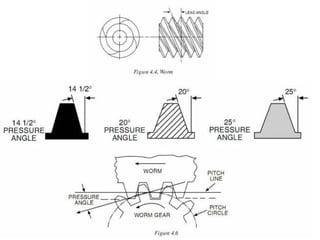
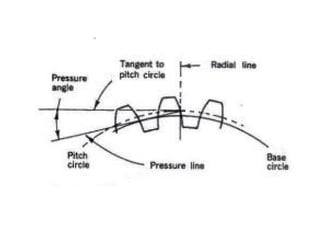
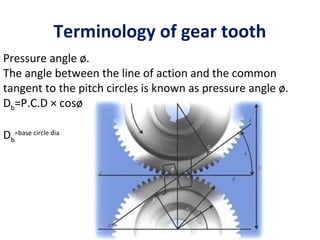
Pressure angle ø.
The angle between the line of action and the common
tangent to the pitch circles is known as pressure angle ø.
Db=P.C.D × cosø

Db=base circle dia
Terminology of gear tooth
Pressure angle ø.
The angle between the line of action and the common
tangent to the pitch circles is known as pressure angle ø.
Db=P.C.D × cosø

Db=base circle dia
Terminology of gear tooth
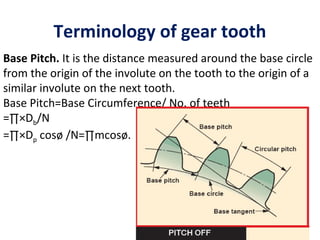
Base Pitch. It is the distance measured around the base circle
from the origin of the involute on the tooth to the origin of a
similar involute on the next tooth.
Base Pitch=Base Circumference/ No. of teeth
=∏×Db/N
=∏×Dp cosø /N=∏mcosø.
Terminology of gear tooth
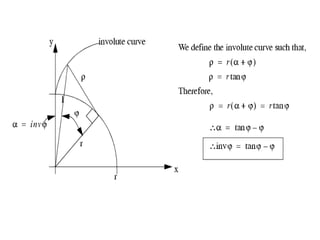
Involute Function.
It is found from the fundamental principle of the involute,
 that it is the locus of the end of a thread (imaginary)
unwound from the base circle.

Involute function δ=tan ø—ø
Where ø is the pressure angle.
Terminology of gear tooth
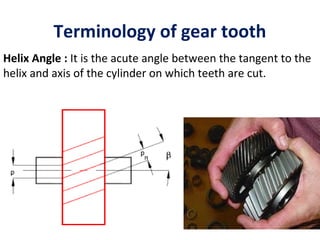
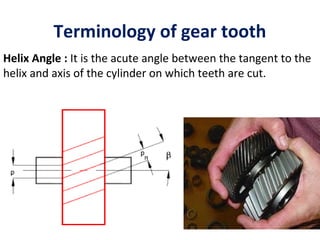
Helix Angle : It is the acute angle between the tangent to the
helix and axis of the cylinder on which teeth are cut.
Terminology of gear tooth
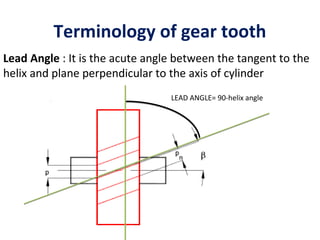
Lead Angle : It is the acute angle between the tangent to the
helix and plane perpendicular to the axis of cylinder
                                 LEAD ANGLE= 90­helix angle
Terminology of gear tooth
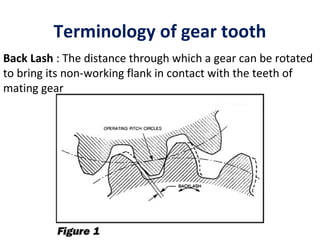
Back Lash : The distance through which a gear can be rotated
to bring its non­working flank in contact with the teeth of
mating gear
Anti backlash gear
Terminology of gear tooth
Helix Angle : It is the acute angle between the tangent to the
helix and axis of the cylinder on which teeth are cut.
Sources of Errors in Manufacturing Gears

 The gears (gear teeth) are generally
 made by one of the following two
 methods :
 (i) Reproducing method
 (ii) Generating method,
Sources of Errors in Manufacturing Gears
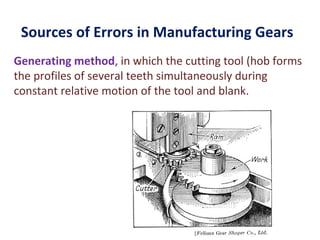
Generating method, in which the cutting tool (hob forms
the profiles of several teeth simultaneously during
constant relative motion of the tool and blank.
Sources of Errors in Manufacturing Gears
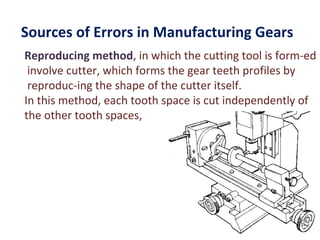
Reproducing method, in which the cutting tool is form­ed
 involve cutter, which forms the gear teeth profiles by
 reproduc­ing the shape of the cutter itself.
In this method, each tooth space is cut independently of
the other tooth spaces,
Sources of Errors in Manufacturing Gears

The various sources of errors in the
gear made by reproducing method can
be due to
(i)incorrect profile on the
cutting tool,
(ii) incorrect positioning of the
tool in relation to the work and
(iii) incorrect indexing of the
blank.
Sources of Errors in Manufacturing Gears

The sources of error when gears are
made by generating method are :
 (i) Errors in the manufacture
of the cutting tool
(ii) errors in positioning the
tool in relation to the work and
 (iii) errors in the relative
motion Of the tool and blank
during the generating
Measurement of Individual elements
       Measurement of tooth thickness
       The permissible error or the tolerance on
       thickness of tooth is the variation of actual
       thickness of tooth from its theoretical value.
       The tooth thickness is generally measured at
       pitch circle and is therefore, the pitch line
       thickness of tooth.
       There are various methods of measuring the
       gear tooth thickness.
       (i) Measurement of tooth thickness by gear
       tooth vernier calliper.
       (ii) Constant chord method.
       (iii) Base tangent method.
       (iv) Measurement by dimension over pins.
       Gear Tooth Caliper.
        w=Nm. sin( 90∕N)
       d= = Nm ∕2[1+2∕N− cos(90∕ N)]
Measurement of Individual elements


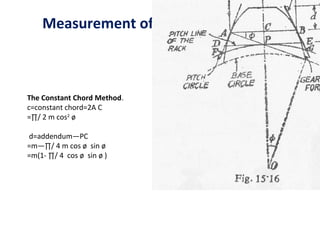
The Constant Chord Method.
c=constant chord=2A C
=∏/ 2 m cos2 ø

d=addendum—PC
=m—∏/ 4 m cos ø sin ø
=m(1­ ∏/ 4 cos ø sin ø )
Measurement of Individual elements
Base Pitch Measuring Instrument. This
instrument has three tips. One is the~!TX53
measuring tip, other one is the sensitive tip
whose position can be adjusted by a screw and
the further movement of it is transmitted
through a leverage system to the dial
indicator; and the third tip is the
supplementary adjustable stop which is meant
for the stability of the instrument and its posi­
tion cart also be adjusted by a screw. The
distance between­the
 fixed and sensitive tip is set to be equivalent
to the base pitch of the gear with the help of
slip gauges. The properly set­up instrument is
applied to the gear so that all the three tips
contact the tooth profile. The reading on dial
indicator is the error in the base pitch.
Measurement of Individual elements


     The Base Tangent Method. (‘David Brown’
     tangent comparator). In this method, the span
     of a convenient number of teeth is measured
     with the help of the tangent comparator. This
     uses a single vernier calliper
     BD=Nm cos ø [tanø –ø −∏ ∕ 2N +∏ S ∕ N ]
Measurement of Individual elements
Gear thread
Gear thread

Gear thread

  • 1.
  • 2.
    Terminology of geartooth Gear tooth mainly used for transmission of power and motion.
  • 3.
  • 4.
  • 5.
    Terminology of geartooth 1. Addendum 2. Dedundum 3. Tooth Thickness 4. Pitch 5. Top land 6. Bottom Land 7. Face Width 8. Circular Pitch 9. Pitch Circle 10. Base Radius.
  • 6.
    Terminology of geartooth Base Circle. It is the circle from which involute form is generated. Only the base circle on a gear is fixed and unalterable.
  • 7.
    Terminology of geartooth Base Circle. It is the circle from which involute form is generated. Only the base circle on a gear is fixed and unalterable.
  • 8.
    DO-outside diameter, D-pitch diameter, DB- base diameter, DR- root diameter,
  • 9.
    Terminology of geartooth Pitch Circle Diameter (P.C.D.). It is the diameter of a circle which by pure rolling action would produce the same motion as the toothed gear wheel. This is the most important diameter in gears.
  • 11.
    Terminology of geartooth Module. It is defined as the length of the pitch circle diameter per tooth. Thus if P.C.D. of gear be D and number of teeth N, then module (m)=D∕N . It is generally expressed in mm. Diametral Pitch. It is expressed as the number of teeth per inch of the P.C.D. D.P.=D∕N , D expressed in inch.
  • 13.
    Terminology of geartooth Circular Pitch (C.P.). It is the arc distance measured around the pitch circle from the flank of one tooth to a similar flank in the next tooth. .’. C.P. = ∏D∕N=∏m
  • 14.
    Terminology of geartooth Addendum. This is the radial distance from the pitch circle to the tip of the tooth. Its value is equal to one module.
  • 16.
    Terminology of geartooth Clearance. This is the radial distance from the tip of a tooth to the bottom of a mating tooth space when the teeth are symmetri­cally engaged. Its standard value is 0.157 m. Dedendum. This is the radial distance from the pitch circle to the bottom of the tooth space. Dedendum=Addendum+ Clearance =m+0.157 m=l.157 m.
  • 18.
    Terminology of geartooth Blank Diameter. This is the diameter of the blank from which gear is a t. It is equal to P.C.D. plus twice the addenda. Blank diameter =P.C.D.+2m. =mN+2m = m(N+2).
  • 21.
    Terminology of geartooth Tooth Thickness. This is the arc distance measured along the pitch circle from its intercept with one flank to its intercept with t le other flank of the same tooth. Normally tooth thickness. =½ C.P. =∏m∕2
  • 22.
    Terminology of geartooth Face of Tooth. It is that part of the tooth surface which is above the pitch surface. Flank of the Tooth. It is that part of the tooth surface which is lying below the pitch surface.
  • 23.
    Terminology of geartooth line of action. The teeth of a pair of gears in mesh, contact each other along the common tangent to their base circles, this path is referred to as line of action.
  • 25.
    Terminology of geartooth Pressure angle ø. The angle between the line of action and the common tangent to the pitch circles is known as pressure angle ø. Db=P.C.D × cosø Db=base circle dia
  • 28.
    Terminology of geartooth Pressure angle ø. The angle between the line of action and the common tangent to the pitch circles is known as pressure angle ø. Db=P.C.D × cosø Db=base circle dia
  • 29.
    Terminology of geartooth Base Pitch. It is the distance measured around the base circle from the origin of the involute on the tooth to the origin of a similar involute on the next tooth. Base Pitch=Base Circumference/ No. of teeth =∏×Db/N =∏×Dp cosø /N=∏mcosø.
  • 30.
    Terminology of geartooth Involute Function. It is found from the fundamental principle of the involute, that it is the locus of the end of a thread (imaginary) unwound from the base circle. Involute function δ=tan ø—ø Where ø is the pressure angle.
  • 32.
    Terminology of geartooth Helix Angle : It is the acute angle between the tangent to the helix and axis of the cylinder on which teeth are cut.
  • 33.
    Terminology of geartooth Lead Angle : It is the acute angle between the tangent to the helix and plane perpendicular to the axis of cylinder LEAD ANGLE= 90­helix angle
  • 34.
    Terminology of geartooth Back Lash : The distance through which a gear can be rotated to bring its non­working flank in contact with the teeth of mating gear
  • 35.
  • 36.
    Terminology of geartooth Helix Angle : It is the acute angle between the tangent to the helix and axis of the cylinder on which teeth are cut.
  • 38.
    Sources of Errorsin Manufacturing Gears The gears (gear teeth) are generally made by one of the following two methods : (i) Reproducing method (ii) Generating method,
  • 39.
    Sources of Errorsin Manufacturing Gears Generating method, in which the cutting tool (hob forms the profiles of several teeth simultaneously during constant relative motion of the tool and blank.
  • 40.
    Sources of Errorsin Manufacturing Gears Reproducing method, in which the cutting tool is form­ed involve cutter, which forms the gear teeth profiles by reproduc­ing the shape of the cutter itself. In this method, each tooth space is cut independently of the other tooth spaces,
  • 42.
    Sources of Errorsin Manufacturing Gears The various sources of errors in the gear made by reproducing method can be due to (i)incorrect profile on the cutting tool, (ii) incorrect positioning of the tool in relation to the work and (iii) incorrect indexing of the blank.
  • 43.
    Sources of Errorsin Manufacturing Gears The sources of error when gears are made by generating method are : (i) Errors in the manufacture of the cutting tool (ii) errors in positioning the tool in relation to the work and (iii) errors in the relative motion Of the tool and blank during the generating
  • 44.
    Measurement of Individualelements Measurement of tooth thickness The permissible error or the tolerance on thickness of tooth is the variation of actual thickness of tooth from its theoretical value. The tooth thickness is generally measured at pitch circle and is therefore, the pitch line thickness of tooth. There are various methods of measuring the gear tooth thickness. (i) Measurement of tooth thickness by gear tooth vernier calliper. (ii) Constant chord method. (iii) Base tangent method. (iv) Measurement by dimension over pins. Gear Tooth Caliper. w=Nm. sin( 90∕N) d= = Nm ∕2[1+2∕N− cos(90∕ N)]
  • 45.
    Measurement of Individualelements The Constant Chord Method. c=constant chord=2A C =∏/ 2 m cos2 ø d=addendum—PC =m—∏/ 4 m cos ø sin ø =m(1­ ∏/ 4 cos ø sin ø )
  • 46.
    Measurement of Individualelements Base Pitch Measuring Instrument. This instrument has three tips. One is the~!TX53 measuring tip, other one is the sensitive tip whose position can be adjusted by a screw and the further movement of it is transmitted through a leverage system to the dial indicator; and the third tip is the supplementary adjustable stop which is meant for the stability of the instrument and its posi­ tion cart also be adjusted by a screw. The distance between­the fixed and sensitive tip is set to be equivalent to the base pitch of the gear with the help of slip gauges. The properly set­up instrument is applied to the gear so that all the three tips contact the tooth profile. The reading on dial indicator is the error in the base pitch.
  • 47.
    Measurement of Individualelements The Base Tangent Method. (‘David Brown’ tangent comparator). In this method, the span of a convenient number of teeth is measured with the help of the tangent comparator. This uses a single vernier calliper BD=Nm cos ø [tanø –ø −∏ ∕ 2N +∏ S ∕ N ]
  • 48.

Editor's Notes

  • #45 Gear Tooth Caliper. (Refer Fig. 15.15). It is used to measure the thickness of gear teeth at the pitch line or chordal.thickness of teeth and the distance from the top of a tooth to the chord. The thickness of a tooth at pitch line and the addendum is measured by an adjustable tongue, each of which is adjusted independently by adjusting screw on graduated bars. Read more http://www.mechlook.com/measurement-and-testing-of-gears-measurement-of-individual-elements/
  • #46 In the above method, it is seen that both the chordal thickness and chordal addendum are depondent upon the number of teeth. Hence for measuring a large number of gears for set, each having different number of teeth would involve separate Calculations. Thus the procedure becomes laborious and time-consuming one. The constant chord method does away with these difficulties. Constant chord of a gear is measured where the tooth flanks touch the flanks of the basic rack. The teeth of the rack are straight and inclined to their centre lines at the pressure angle as shown in Fig. 15.16. Read more http://www.mechlook.com/measurement-and-testing-of-gears-measurement-of-individual-elements/
  • #47 Base Pitch. This is defined as the circular pitch of the teeth measured On the base circle. In Fig. 15.17, AB represents the portion of a gear base circle, CD and EF the sides of two teeth, Read more http://www.mechlook.com/measurement-and-testing-of-gears-measurement-of-individual-elements/