GHON’S COMPLEX
 Ms.SHANMUGAPRIYA.S
 Bsc.,nursing
GHON’S COMPLEX
Ghon’s complex is also known as primary
complex.It is a lesion seen in the lung that is
caused by tuberculosis
Cont..
 Ghon’s complex is present along with pulmonary
lymphadenopathy with nearby pulmonary lymph node
 It retains viable bacteria,making them sources of long term
infection,which may reactivate and trigger secondary
tuberculosis later in life.
 Typically,the inhaled bacilli implant in the distal airspaces
of the lower part of the upper lobe or the upper part of
lower lobe,usually closer to pleura.
 When there is a combination of parenchymal granuloma
and an involved hilar lymphnode on the same side,the two
together are called ghon’s complex.
Cont...
 As sensitization develops 1-1.5cm area of grey white
inflamation with consolidation emerges known as ghon’s
focus.
 In most of the cases,the center of this focus undergoes
caseous necrosis.
Differentiation:
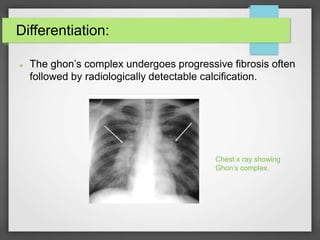
 The ghon’s complex undergoes progressive fibrosis often
followed by radiologically detectable calcification.
Chest x ray showing
Ghon’s complex.
Location:
 The location of the ghon’s complex is usually subpleural
and predominantly in upper part of lower lobe and lower
part of upper or middle lobe.
Epidemiology
 The ghon’s complex is not always present in a patient with
primary tb infections .
 Researchers estimate that in about 15% of cases of
primary TB,a ghon’s focus may develop while 9% of cases
of primary TB may develop tuberculomas.
Components :
 Ghon’s complex has 3 components,
 Pulomonary component,
 Lymphatic vessel component,
 Lymphnode component.
Cont..
 Pulmonary component:
 1-2cm solitary area
 Located peripherally under a patch of pleurisy
 In any part of the lung but more often in subpleural
focus in upper part of lower lobe
 Lymphatic vessel component:
 Lymphatics draining the lung lesion containing
bacilli.
 Lymphnode component:
 Enlarged hilar and tracheo branchial lymphnodes in
the area drained by lymph.
Fate of infection:
 Ghon’s focus with enlarged lymph nodes appear after 3-8
weeks after infection.
 Heals in 2-6 months calcified.
 Some bacteria remains alive and produce latent infection.
 Most heals with or without calcification.
 Bacilli escape from the draining nodes to the circulation
and then to other parts of lung and other organs.

Ghon's complex

  • 1.
  • 2.
    GHON’S COMPLEX Ghon’s complexis also known as primary complex.It is a lesion seen in the lung that is caused by tuberculosis
  • 3.
    Cont..  Ghon’s complexis present along with pulmonary lymphadenopathy with nearby pulmonary lymph node  It retains viable bacteria,making them sources of long term infection,which may reactivate and trigger secondary tuberculosis later in life.  Typically,the inhaled bacilli implant in the distal airspaces of the lower part of the upper lobe or the upper part of lower lobe,usually closer to pleura.  When there is a combination of parenchymal granuloma and an involved hilar lymphnode on the same side,the two together are called ghon’s complex.
  • 4.
    Cont...  As sensitizationdevelops 1-1.5cm area of grey white inflamation with consolidation emerges known as ghon’s focus.  In most of the cases,the center of this focus undergoes caseous necrosis.
  • 5.
    Differentiation:  The ghon’scomplex undergoes progressive fibrosis often followed by radiologically detectable calcification. Chest x ray showing Ghon’s complex.
  • 6.
    Location:  The locationof the ghon’s complex is usually subpleural and predominantly in upper part of lower lobe and lower part of upper or middle lobe.
  • 7.
    Epidemiology  The ghon’scomplex is not always present in a patient with primary tb infections .  Researchers estimate that in about 15% of cases of primary TB,a ghon’s focus may develop while 9% of cases of primary TB may develop tuberculomas.
  • 8.
    Components :  Ghon’scomplex has 3 components,  Pulomonary component,  Lymphatic vessel component,  Lymphnode component.
  • 9.
    Cont..  Pulmonary component: 1-2cm solitary area  Located peripherally under a patch of pleurisy  In any part of the lung but more often in subpleural focus in upper part of lower lobe  Lymphatic vessel component:  Lymphatics draining the lung lesion containing bacilli.  Lymphnode component:  Enlarged hilar and tracheo branchial lymphnodes in the area drained by lymph.
  • 10.
    Fate of infection: Ghon’s focus with enlarged lymph nodes appear after 3-8 weeks after infection.  Heals in 2-6 months calcified.  Some bacteria remains alive and produce latent infection.  Most heals with or without calcification.  Bacilli escape from the draining nodes to the circulation and then to other parts of lung and other organs.