1
Presentation
On
Cracking in Reinforced Concrete Flexural
Members
Instructor
Prof. Dr. Engr. Md. Monirul Islam
Chair & course coordinator
of
Civil engineering department
2
3
Sl. Name ID#
1.
2.
3.
4.
5.
6.
7.
Sl.
1. Cracking In Flexural Members
2. Uncracked Concrete Stage
3. Concrete Cracked–Elastic Stresses Stage
4. Failure—Ultimate-Strength Stage
5. Variables Affecting Width of Cracks
6. Equations for Crack Width
7. ACI Code Provisions for Crack Control
8. Example
5
Cracking In Flexural Members
All reinforced concrete beams crack, generally starting at loads well below
service level, and possibly even prior to loading due to restrained shrinkage.
Flexural cracking due to loads is not only inevitable, but actually necessary
for the reinforcement to be used effectively. Prior to the formation of
flexural cracks, the steel stress is no more than n times the stress in the
adjacent concrete, where n is the modular ratio E5/Ec. For materials
common in current practice, n is approximately 8.
Cracking In Flexural Members Cont’d
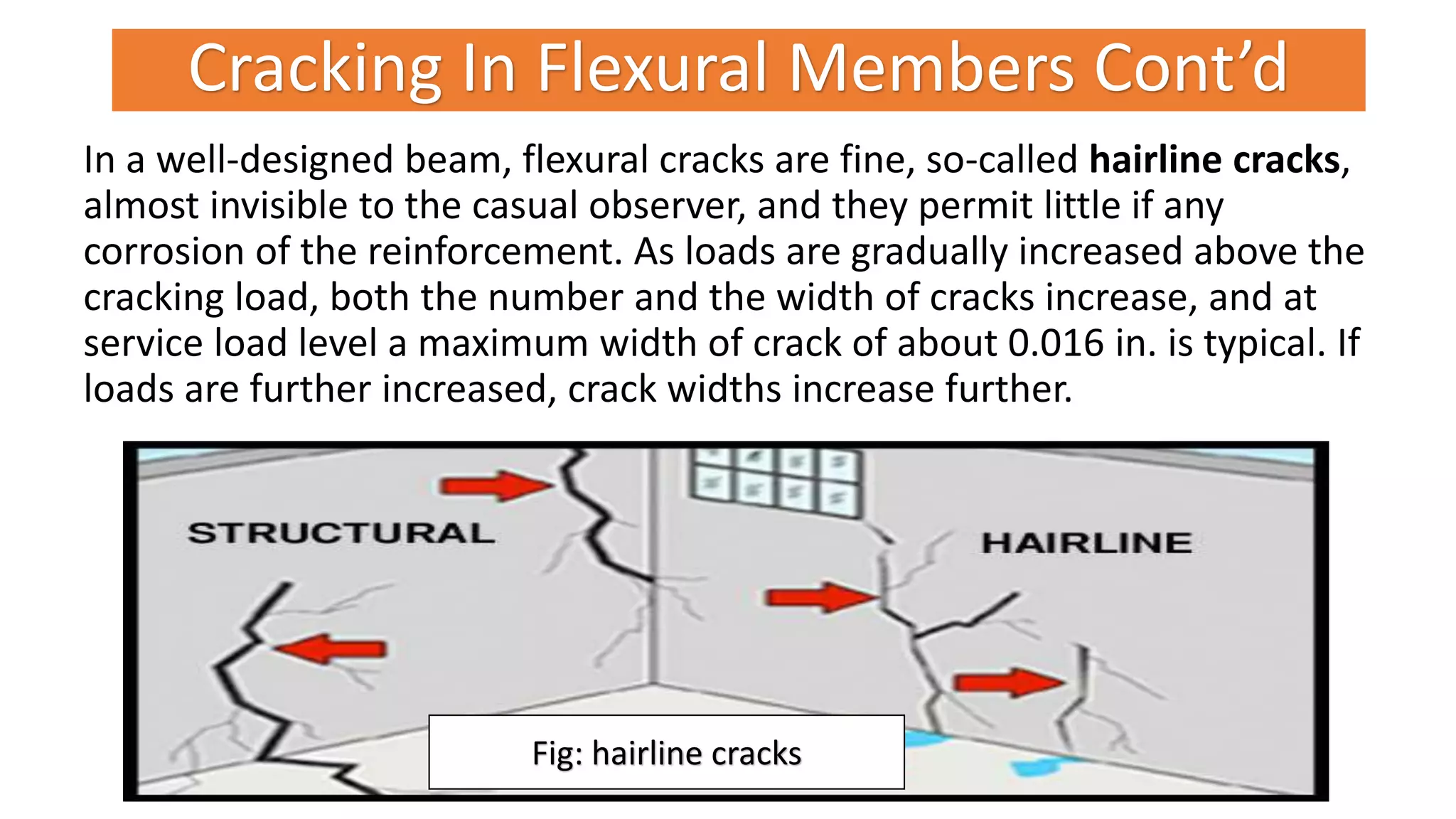
In a well-designed beam, flexural cracks are fine, so-called hairline cracks,
almost invisible to the casual observer, and they permit little if any
corrosion of the reinforcement. As loads are gradually increased above the
cracking load, both the number and the width of cracks increase, and at
service load level a maximum width of crack of about 0.016 in. is typical. If
loads are further increased, crack widths increase further.
Fig: hairline cracks
Uncracked Concrete Stage
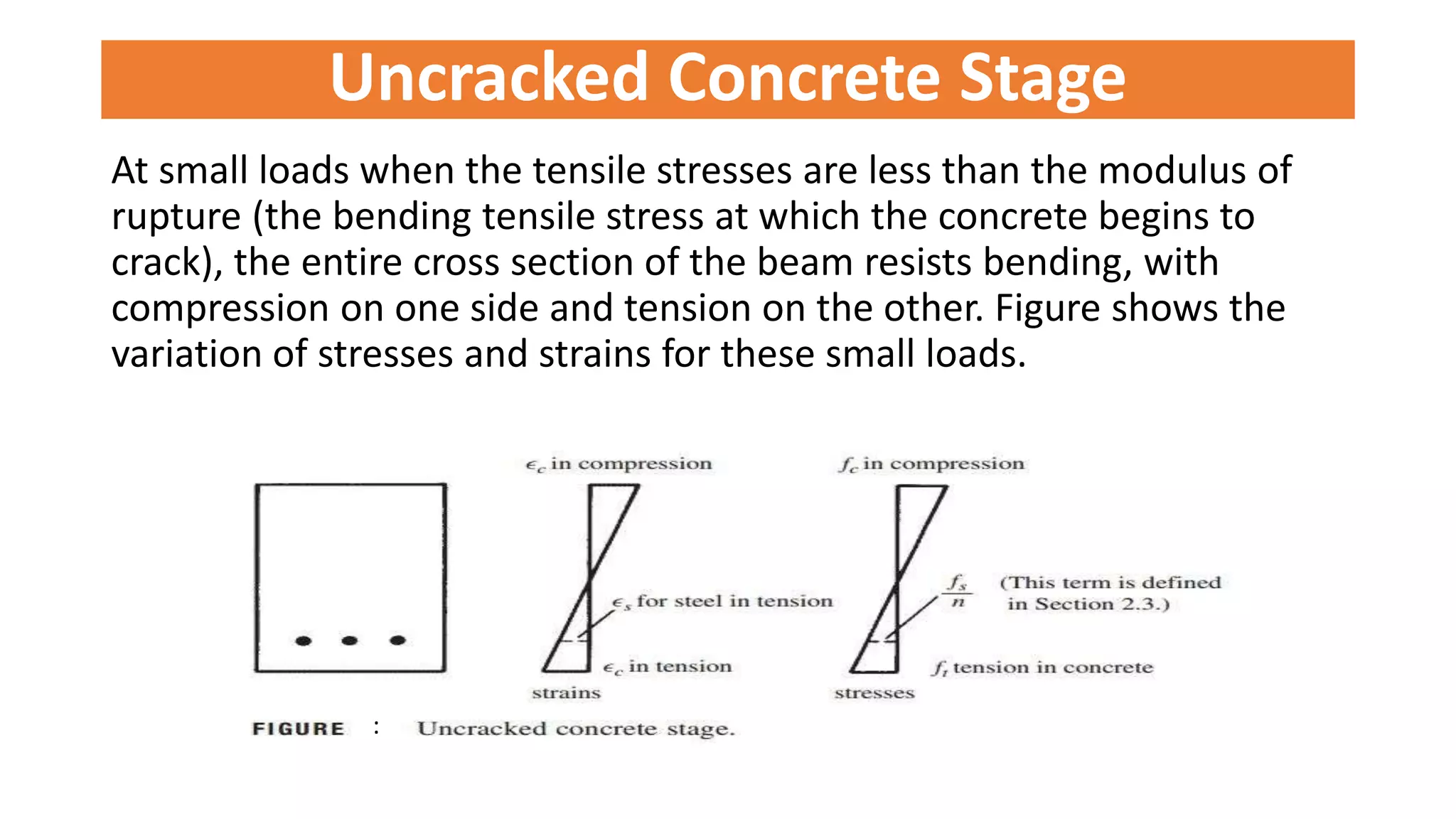
At small loads when the tensile stresses are less than the modulus of
rupture (the bending tensile stress at which the concrete begins to
crack), the entire cross section of the beam resists bending, with
compression on one side and tension on the other. Figure shows the
variation of stresses and strains for these small loads.
:
Concrete Cracked–Elastic Stresses Stage
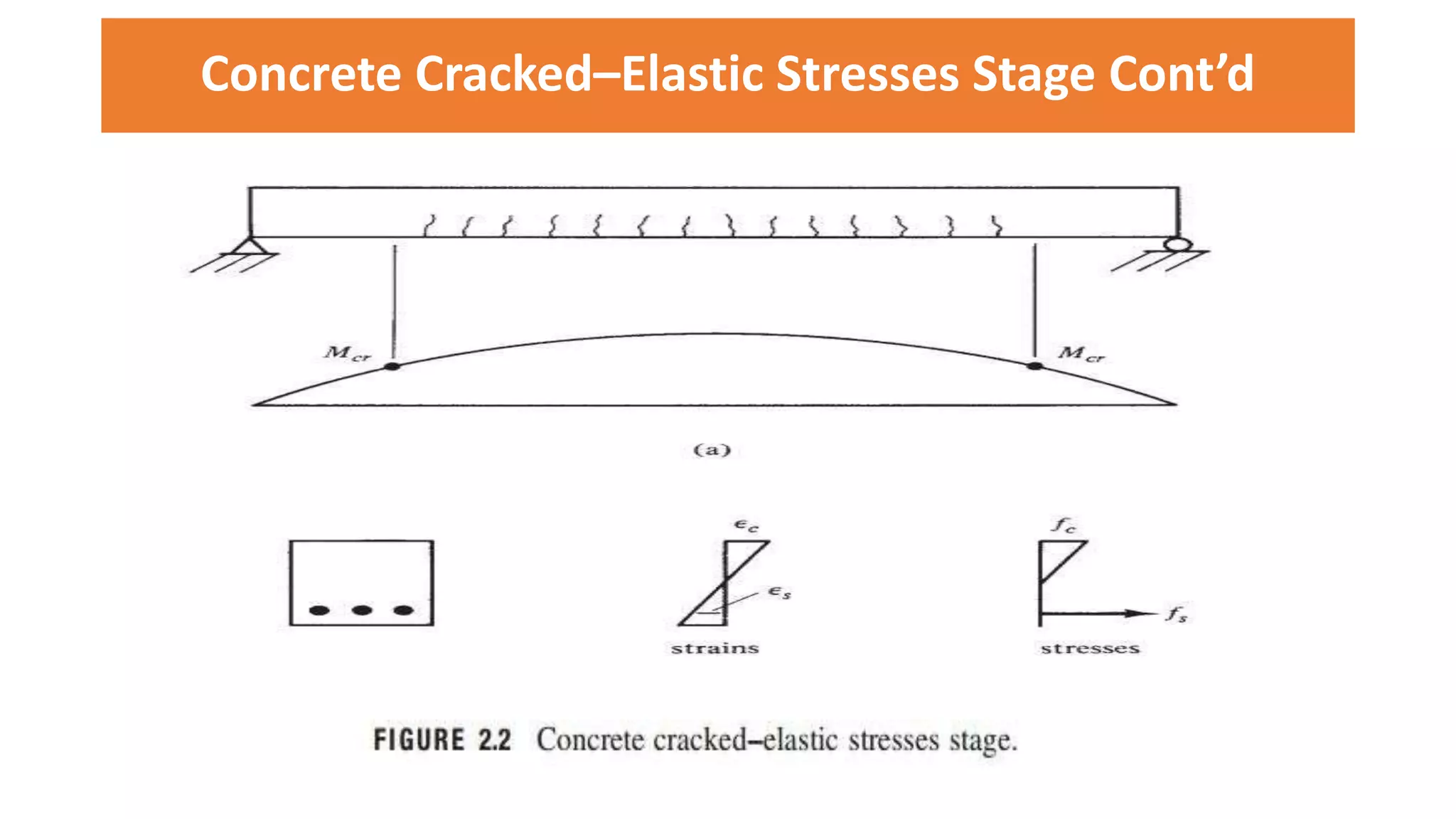
As the load is increased after the modulus of rupture of the
concrete is exceeded, cracks begin to develop in the bottom of
the beam. The moment at which these cracks begin to form—
that is, when the tensile stress in the bottom of the beam
equals the modulus of rupture—is referred to as the cracking
moment, Mcr. As the load is further increased, these cracks
quickly spread up to the vicinity of the neutral axis, and then
the neutral axis begins to move upward. The cracks occur at
those places along the beam where the actual moment is
greater than the cracking moment, as shown in Figure next
slide.
Concrete Cracked–Elastic Stresses Stage Cont’d
Failure—Ultimate-Strength Stage
Failure—Ultimate-Strength Stage Cont’d
Variables Affecting Width of Cracks
Crack width is proportional to fn
s, where fs is the steel stress and n is an
exponent that varies in the range from about 1.0 to 1.4. For steel stresses in
the range of practical interest, say from 20 to 36 ksi, n may be taken equal
to 1.0. The steel stress is easily computed based on elastic cracked-section
analysis. Alternatively, fs,may be taken equal to ~J. Generally, to control
cracking, it is better to use a larger number of smaller-diameter bars to
provide the required As than to use the minimum number of larger bars,
and the bars should be well distributed over the tensile zone of the
concrete. For deep flexural members, this includes additional
reinforcement on the sides of the web to prevent excessive surface crack
widths above or below the level of the main flexural reinforcement.
Variables Affecting Width of Cracks Cont’d
Equations for Crack Width
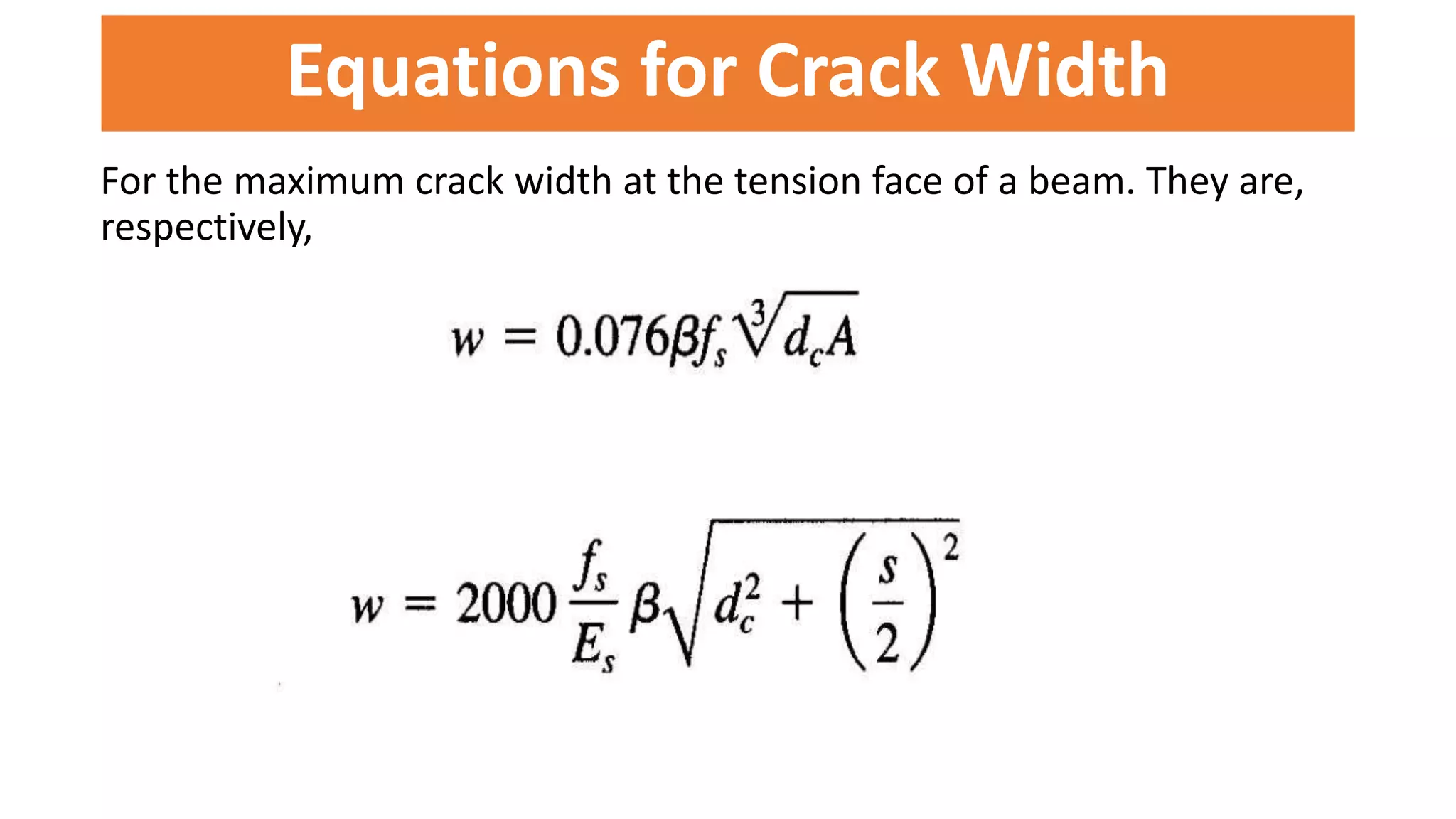
For the maximum crack width at the tension face of a beam. They are,
respectively,
Equations for Crack Width Cont’d
ACI Code Provisions for Crack Control
ACI Code Provisions for Crack Control Cont’d
For beams with relatively deep webs, some reinforcement
should be placed near the vertical faces of the web to control
the width of cracks in the concrete tension zone above the
level of the main reinforcement. Without such steel, crack
widths in the web wider than those at the level of the main
bars have been observed. According to ACI Code 10.6.7, if the
total depth of the beam h exceeds 36 in., longitudinal "skin“
reinforcement must be uniformly distributed along both side
faces of the member for a distance h/2 nearest the flexural
tension steel.
ACI Code Provisions for Crack Control Cont’d
Example
Example Cont’d
Here,
fs = Steel Stress
Ms = Service load moment
As = Steel Area
hf = Flange Thickness
d = Depth
Example Cont’d
24
25

Cracking in Reinforced Concrete Flexural Members (by Robin)

  • 1.
  • 2.
    Presentation On Cracking in ReinforcedConcrete Flexural Members Instructor Prof. Dr. Engr. Md. Monirul Islam Chair & course coordinator of Civil engineering department 2
  • 3.
  • 4.
  • 5.
    Sl. 1. Cracking InFlexural Members 2. Uncracked Concrete Stage 3. Concrete Cracked–Elastic Stresses Stage 4. Failure—Ultimate-Strength Stage 5. Variables Affecting Width of Cracks 6. Equations for Crack Width 7. ACI Code Provisions for Crack Control 8. Example 5
  • 6.
    Cracking In FlexuralMembers All reinforced concrete beams crack, generally starting at loads well below service level, and possibly even prior to loading due to restrained shrinkage. Flexural cracking due to loads is not only inevitable, but actually necessary for the reinforcement to be used effectively. Prior to the formation of flexural cracks, the steel stress is no more than n times the stress in the adjacent concrete, where n is the modular ratio E5/Ec. For materials common in current practice, n is approximately 8.
  • 7.
    Cracking In FlexuralMembers Cont’d In a well-designed beam, flexural cracks are fine, so-called hairline cracks, almost invisible to the casual observer, and they permit little if any corrosion of the reinforcement. As loads are gradually increased above the cracking load, both the number and the width of cracks increase, and at service load level a maximum width of crack of about 0.016 in. is typical. If loads are further increased, crack widths increase further. Fig: hairline cracks
  • 8.
    Uncracked Concrete Stage Atsmall loads when the tensile stresses are less than the modulus of rupture (the bending tensile stress at which the concrete begins to crack), the entire cross section of the beam resists bending, with compression on one side and tension on the other. Figure shows the variation of stresses and strains for these small loads. :
  • 9.
    Concrete Cracked–Elastic StressesStage As the load is increased after the modulus of rupture of the concrete is exceeded, cracks begin to develop in the bottom of the beam. The moment at which these cracks begin to form— that is, when the tensile stress in the bottom of the beam equals the modulus of rupture—is referred to as the cracking moment, Mcr. As the load is further increased, these cracks quickly spread up to the vicinity of the neutral axis, and then the neutral axis begins to move upward. The cracks occur at those places along the beam where the actual moment is greater than the cracking moment, as shown in Figure next slide.
  • 10.
  • 11.
  • 12.
  • 13.
    Variables Affecting Widthof Cracks Crack width is proportional to fn s, where fs is the steel stress and n is an exponent that varies in the range from about 1.0 to 1.4. For steel stresses in the range of practical interest, say from 20 to 36 ksi, n may be taken equal to 1.0. The steel stress is easily computed based on elastic cracked-section analysis. Alternatively, fs,may be taken equal to ~J. Generally, to control cracking, it is better to use a larger number of smaller-diameter bars to provide the required As than to use the minimum number of larger bars, and the bars should be well distributed over the tensile zone of the concrete. For deep flexural members, this includes additional reinforcement on the sides of the web to prevent excessive surface crack widths above or below the level of the main flexural reinforcement.
  • 14.
    Variables Affecting Widthof Cracks Cont’d
  • 15.
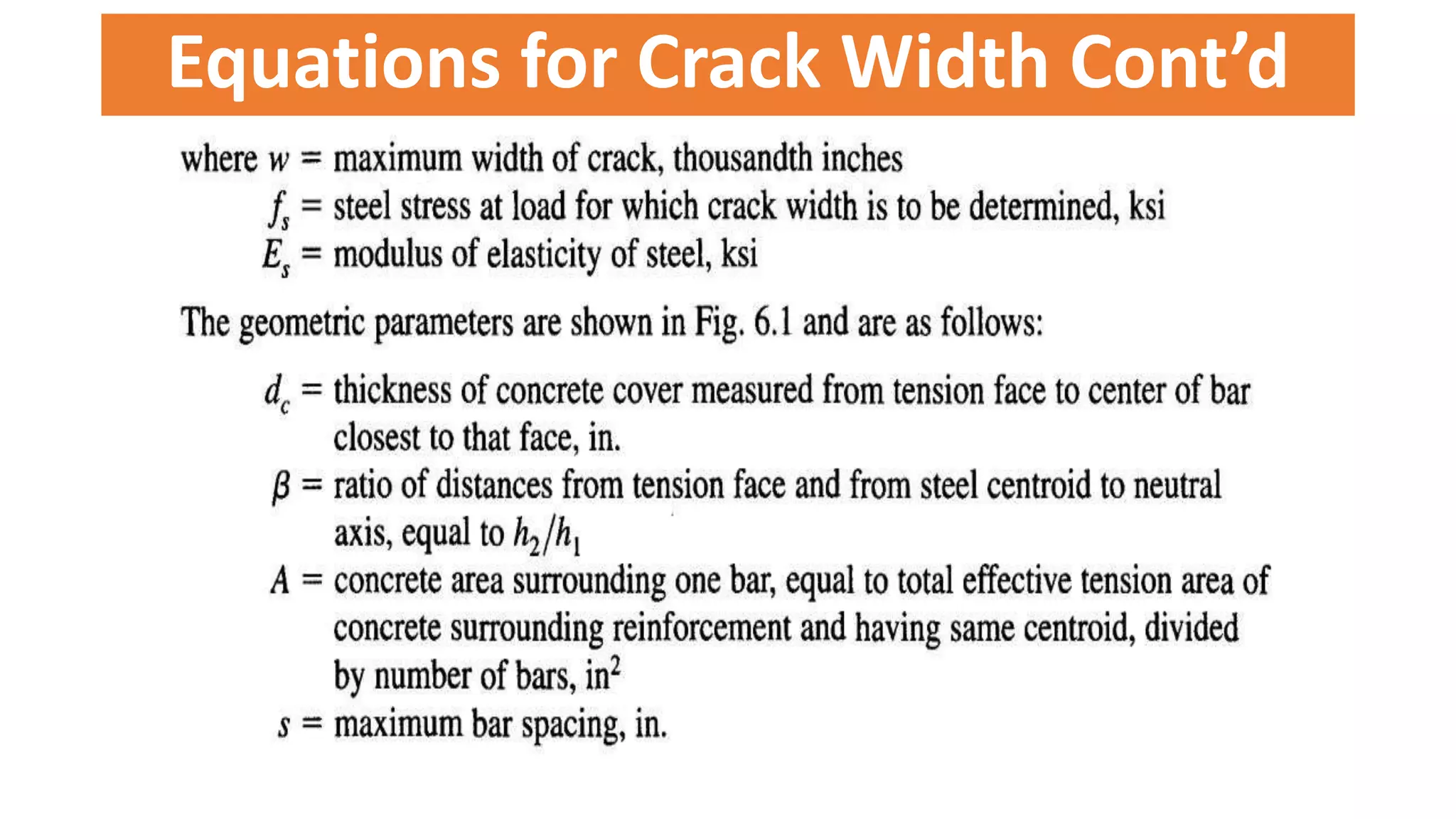
    Equations for CrackWidth For the maximum crack width at the tension face of a beam. They are, respectively,
  • 16.
    Equations for CrackWidth Cont’d
  • 17.
    ACI Code Provisionsfor Crack Control
  • 18.
    ACI Code Provisionsfor Crack Control Cont’d
  • 19.
    ACI Code Provisionsfor Crack Control Cont’d For beams with relatively deep webs, some reinforcement should be placed near the vertical faces of the web to control the width of cracks in the concrete tension zone above the level of the main reinforcement. Without such steel, crack widths in the web wider than those at the level of the main bars have been observed. According to ACI Code 10.6.7, if the total depth of the beam h exceeds 36 in., longitudinal "skin“ reinforcement must be uniformly distributed along both side faces of the member for a distance h/2 nearest the flexural tension steel.
  • 20.
    ACI Code Provisionsfor Crack Control Cont’d
  • 21.
  • 22.
    Example Cont’d Here, fs =Steel Stress Ms = Service load moment As = Steel Area hf = Flange Thickness d = Depth
  • 23.
  • 24.
  • 25.