CRACKS IN
STRUCTURE
MATERIALS, TESTING & EVALUATION
NAME A.MOHANA KRISHNA
BRANCH CIVIL ENGINEERING
CONTENTS
ABOUT STRUCTURAL CRACKS
DIFFERENCE BETWEEN STRUCTURAL AND NON STRUCTURAL CRACKS
TYPES OF CRACKS IN BUILDING.
PREVENTIVE MEASURES.
CONCLUSION
INTRODUCTION
Cracks are most occurrence in buildings, most common cause of cracking will be present at
foundation part due to clay shrinkage, land slip, vibration and subsidence. A building component
develops cracks whenever stress in the component exceeds its strength.
Cracks are generally classified in two types:
Structural cracks
Non structural cracks
Size of crack will be “ 1mm to greater than 2mm ”
STRUCTURAL CRACKS
Structural cracks are caused by a variety of issues, like poor soil bearing, overloading, swollen
soil, and poor construction sites
 Generally, structural cracks are accompanied by interior problems, like sloping floors and doors
and windows that stick when closed.
Structural cracks usually have some tell-tale sign.
The simplest explanation is that structural cracks indicate there has been
movement in the foundation
DIFFERENCE BETWEEN STRUCTURAL AND NON
STRUCTURAL CRACKS
Any foundation crack is terrible news. Foundation cracks can start very minimally but could end
up threatening the entire structural integrity of the building. Different things can cause structural
and non-structural foundation cracks.
NON-STRUCTURAL CRACKS
Non-structural cracks appear in your foundation but do not at present threaten the structural
integrity of the home. Weather conditions, temperature changes, and moisture content will cause
your foundation to crack.
Many factors can cause non-structural cracks, such as poor conditions at original construction,
poor concrete mix, rapid curing, or changes in moisture due to the cycle of seasons. Foundations
shifting, hydrostatic pressure, vegetation, or trees can also cause non-structural cracks. These
cracks are often very thin hairline cracks that are usually less than three millimeters in width.
TYPES OF CRACKING
Flexural cracking
Early thermal contraction cracking
Long term dry shrinkage cracking
Seasonal thermal contraction cracking
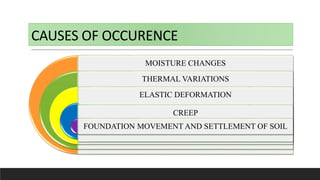
CAUSES OF OCCURENCE
MOISTURE CHANGES
THERMAL VARIATIONS
ELASTIC DEFORMATION
CREEP
FOUNDATION MOVEMENT AND SETTLEMENT OF SOIL
MOISTURE CHANGES
Most of the buildings have pores on the surface in the form of intermolecular by absorbing the
moisture and shrinkage on drying.
Initial shrinkage is partly irreversible and occurs in all building materials which are
cement/lime based e.g. concrete, mortar, masonry etc.
Some of the building materials absorb moisture from environment and undergo gradual
expansion (Initial expansion).
For the bricks it will take nearly 3 months for complete expansion. Generally these types of
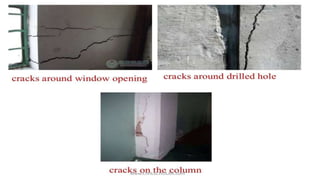
cracks are visible on door side, window opening and staircase wall.
THERMAL VARIATION
Due to thermal variation i9n the atmosphere, these cracks will be appeared on the structures.
Thermal stresses will be developed as the internal stresses in the structure.
Mainly these kind of cracks available only on the surface below the beam level, and adjacent
side area of a column.
Thermal movement depends on Color and Surface Characteristics of exposed building surfaces.
Dark colored and rough textured materials have lower reflectivity and hence rise in temperature
is more for these surfaces.
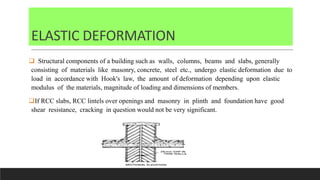
ELASTIC DEFORMATION
 Structural components of a building such as walls, columns, beams and slabs, generally
consisting of materials like masonry, concrete, steel etc., undergo elastic deformation due to
load in accordance with Hook's law, the amount of deformation depending upon elastic
modulus of the materials, magnitude of loading and dimensions of members.
If RCC slabs, RCC lintels over openings and masonry in plinth and foundation have good
shear resistance, cracking in question would not be very significant.
CREEP
 Movements due to creep In concrete, extent of creep depends on a number of factors, such as
water and cement content, water cement ratio, temperature, humidity, use of admixtures and
pozzolanas, age of concrete at the time of loading and size and shape of the component.
 Creep increases with increase in water and cement content, water cement ratio, and
temperature; it decreases with increase in humidity of the surrounding atmosphere and age
of material at the time of loading.
In brick work, creep may cease after 4 months while in concrete it may continue up to
about a year.
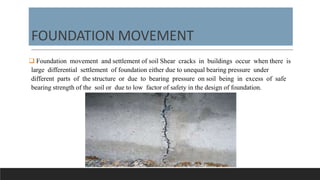
FOUNDATION MOVEMENT
 Foundation movement and settlement of soil Shear cracks in buildings occur when there is
large differential settlement of foundation either due to unequal bearing pressure under
different parts of the structure or due to bearing pressure on soil being in excess of safe
bearing strength of the soil or due to low factor of safety in the design of foundation.
DUE TO MOSTURE CHANGES ELASTIC DEFORMATION
PREVENTIVE MEASURES
1.EPOXY INJECTION : Cracks are narrow of range 0.05mm can be prevented by injecting
under pressure.
2.ROUTING AND SEALING: This method involves enlarging the cracks and then it can be
filled with suitable joint selvant. This process majorly applicable on horizontal surfaces such as
floors and pavements.
3.STITCHING: In this process holes were drilled on either sides of the cracks. And anchoring
the legs of staples in the holes by using non shrink grout.
4.DRILLING AND PLUGING: It’s consists of drilling down the length of the crack and grout
will be applied through the key. Its majorly used in prevention of vertical cracks.
PREVENTIVE MEASURES
5.GRAVITY FILLING : low viscosity monomers and resins can be used to fill the cracks having
the very thin width of cracks. It is permitted to wet surfaces also.
EPOXY INJECTION STITCHING
CONCLUSION
Though it is impossible to give guarantee against the cracking yet. But it can be
prevented by some measures.
In case of existing cracks, after the detail study and analysis of crack
parameters, most appropriate method of correction should be adopted for
effective and efficient repairing of cracks.
Cracks in structure/buildings

Cracks in structure/buildings

  • 1.
    CRACKS IN STRUCTURE MATERIALS, TESTING& EVALUATION NAME A.MOHANA KRISHNA BRANCH CIVIL ENGINEERING
  • 2.
    CONTENTS ABOUT STRUCTURAL CRACKS DIFFERENCEBETWEEN STRUCTURAL AND NON STRUCTURAL CRACKS TYPES OF CRACKS IN BUILDING. PREVENTIVE MEASURES. CONCLUSION
  • 3.
    INTRODUCTION Cracks are mostoccurrence in buildings, most common cause of cracking will be present at foundation part due to clay shrinkage, land slip, vibration and subsidence. A building component develops cracks whenever stress in the component exceeds its strength. Cracks are generally classified in two types: Structural cracks Non structural cracks Size of crack will be “ 1mm to greater than 2mm ”
  • 4.
    STRUCTURAL CRACKS Structural cracksare caused by a variety of issues, like poor soil bearing, overloading, swollen soil, and poor construction sites  Generally, structural cracks are accompanied by interior problems, like sloping floors and doors and windows that stick when closed. Structural cracks usually have some tell-tale sign. The simplest explanation is that structural cracks indicate there has been movement in the foundation
  • 5.
    DIFFERENCE BETWEEN STRUCTURALAND NON STRUCTURAL CRACKS Any foundation crack is terrible news. Foundation cracks can start very minimally but could end up threatening the entire structural integrity of the building. Different things can cause structural and non-structural foundation cracks. NON-STRUCTURAL CRACKS Non-structural cracks appear in your foundation but do not at present threaten the structural integrity of the home. Weather conditions, temperature changes, and moisture content will cause your foundation to crack. Many factors can cause non-structural cracks, such as poor conditions at original construction, poor concrete mix, rapid curing, or changes in moisture due to the cycle of seasons. Foundations shifting, hydrostatic pressure, vegetation, or trees can also cause non-structural cracks. These cracks are often very thin hairline cracks that are usually less than three millimeters in width.
  • 6.
    TYPES OF CRACKING Flexuralcracking Early thermal contraction cracking Long term dry shrinkage cracking Seasonal thermal contraction cracking
  • 7.
    CAUSES OF OCCURENCE MOISTURECHANGES THERMAL VARIATIONS ELASTIC DEFORMATION CREEP FOUNDATION MOVEMENT AND SETTLEMENT OF SOIL
  • 8.
    MOISTURE CHANGES Most ofthe buildings have pores on the surface in the form of intermolecular by absorbing the moisture and shrinkage on drying. Initial shrinkage is partly irreversible and occurs in all building materials which are cement/lime based e.g. concrete, mortar, masonry etc. Some of the building materials absorb moisture from environment and undergo gradual expansion (Initial expansion). For the bricks it will take nearly 3 months for complete expansion. Generally these types of cracks are visible on door side, window opening and staircase wall.
  • 9.
    THERMAL VARIATION Due tothermal variation i9n the atmosphere, these cracks will be appeared on the structures. Thermal stresses will be developed as the internal stresses in the structure. Mainly these kind of cracks available only on the surface below the beam level, and adjacent side area of a column. Thermal movement depends on Color and Surface Characteristics of exposed building surfaces. Dark colored and rough textured materials have lower reflectivity and hence rise in temperature is more for these surfaces.
  • 10.
    ELASTIC DEFORMATION  Structuralcomponents of a building such as walls, columns, beams and slabs, generally consisting of materials like masonry, concrete, steel etc., undergo elastic deformation due to load in accordance with Hook's law, the amount of deformation depending upon elastic modulus of the materials, magnitude of loading and dimensions of members. If RCC slabs, RCC lintels over openings and masonry in plinth and foundation have good shear resistance, cracking in question would not be very significant.
  • 11.
    CREEP  Movements dueto creep In concrete, extent of creep depends on a number of factors, such as water and cement content, water cement ratio, temperature, humidity, use of admixtures and pozzolanas, age of concrete at the time of loading and size and shape of the component.  Creep increases with increase in water and cement content, water cement ratio, and temperature; it decreases with increase in humidity of the surrounding atmosphere and age of material at the time of loading. In brick work, creep may cease after 4 months while in concrete it may continue up to about a year.
  • 12.
    FOUNDATION MOVEMENT  Foundationmovement and settlement of soil Shear cracks in buildings occur when there is large differential settlement of foundation either due to unequal bearing pressure under different parts of the structure or due to bearing pressure on soil being in excess of safe bearing strength of the soil or due to low factor of safety in the design of foundation.
  • 13.
    DUE TO MOSTURECHANGES ELASTIC DEFORMATION
  • 15.
    PREVENTIVE MEASURES 1.EPOXY INJECTION: Cracks are narrow of range 0.05mm can be prevented by injecting under pressure. 2.ROUTING AND SEALING: This method involves enlarging the cracks and then it can be filled with suitable joint selvant. This process majorly applicable on horizontal surfaces such as floors and pavements. 3.STITCHING: In this process holes were drilled on either sides of the cracks. And anchoring the legs of staples in the holes by using non shrink grout. 4.DRILLING AND PLUGING: It’s consists of drilling down the length of the crack and grout will be applied through the key. Its majorly used in prevention of vertical cracks.
  • 16.
    PREVENTIVE MEASURES 5.GRAVITY FILLING: low viscosity monomers and resins can be used to fill the cracks having the very thin width of cracks. It is permitted to wet surfaces also. EPOXY INJECTION STITCHING
  • 17.
    CONCLUSION Though it isimpossible to give guarantee against the cracking yet. But it can be prevented by some measures. In case of existing cracks, after the detail study and analysis of crack parameters, most appropriate method of correction should be adopted for effective and efficient repairing of cracks.