FIRE SAFETYFIRE SAFETY
DESIGNDESIGN
PRINCIPLESPRINCIPLES
The Fire Triangle:
Three elements - fuel,
oxygen and heat - are
required to start a fire.
The oxidation process
will not be possible
without any one of these
elements.
Fuel (Fire Load)
Oxygen (Ventilation) Heat (Ignition)
Fire is a rapid oxidation process
accompanied by the evolution
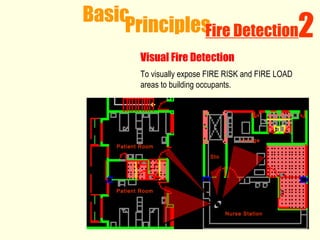
of heat, light, flame and the
emission of sound.
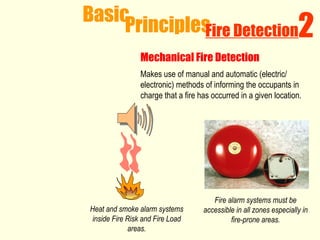
Definition and Causes of Fire
2Intro
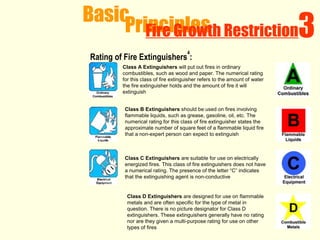
Ordinary combustible
materials such as wood,
cloth, paper, rubber and
plastics, etc.
Class A:
Flammable or combustible
liquids, flammable gases.
Class B:
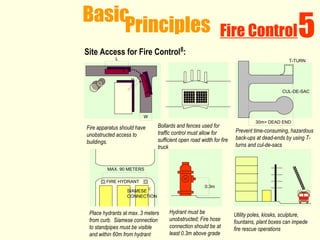
Energized electrical
equipment
Class C:
Fire involving:
Combustible metals such
as potassium, sodium,
magnesium and other
reactive metals
Class D:
How to
Suppress:
Use Water
Exclude air from
burning materials
No Water; Use electrically
non-conductive
extinguishing agents such
as gaseous systems
Heat-absorbing
medium which is not
reactive with burning
metals
Intro Classes of Fire
3
Intro Fire Growth
2
Pre-flashover or
growth phase
Stage 1:
FlashoverStage 2:
Fully developed
fire (Stable phase)
Stage 3:
Decay (Cooling
Period)
Stage 4:
Involves flaming combustion of an
item and may lead to a spread of
fire; or a smoldering, poorly-
ventilated fire with substantial
smoke.
Rapid change from a local fire to
one involving all combustible
materials in a room.
All materials in compartment are
alight; maximum rate of heat
release is dependent on either
available ventilation or quantity of
fuel.
Gradual consumption of fuel in the
compartment.
Stages
Behavior of Fire and Smoke
1
Vertical Shaft or Duct
(Stack Effect)
Suspended Ceiling
Ceiling Void
Smoke and Flame
likely to re-enter Enclosed Area
Vertical Shaft or Duct
Outlet to
adjoining space
Enclosed
Area
Outlet to
open air
1.00 m
Intro
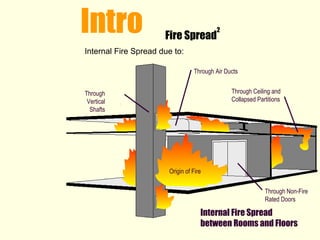
Internal Fire Spread due to:
Internal Fire Spread
between Rooms and Floors
Through
Vertical
Shafts
Through Air Ducts
Through Ceiling and
Collapsed Partitions
Through Non-Fire
Rated Doors
Origin of Fire
Fire Spread
2Intro
Fire Spread
Congested High Fire Load Areas
External Fire Spread due to:
Intro
Fire Spread
2
Ignition of Materials
Convection
Currents
Origin of Fire
Proximity of Buildings
Intro
External Fire Spread due to:
Aims in
Fire Safety Design
A To prevent fire
B To safeguard the lives of
occupants and firefighters
C To reduce damage on the
building, its contents, and on
surrounding buildings
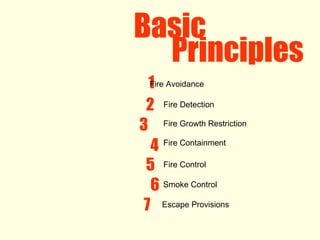
Basic
Principles
1Fire Avoidance
2 Fire Detection
3 Fire Growth Restriction
4 Fire Containment
5 Fire Control
6 Smoke Control
7 Escape Provisions
Definition & Implication
PrinciplesFire Avoidance1
1
Reducing the possibility of accidental ignition of
construction materials, as well as fittings and
fixtures.
This implies:
a. keeping separate heat
sources and materials which
might ignite readily through
proper planning and zoning
b. need to specify materials to
reduce the risk of fire starting
c. reducing fire load
Basic
PrinciplesFire Avoidance1
1
ForHospitals
(eg. Hospitals)Fire Zoning
Basic
ForMostBuildings
1. Life Risk Areas – areas in which all occupants are ambulant and
able to move unaided away from a fire
- eg. Outpatient department; Service Zone
2. High Fire Risk Areas – areas which, due to their function, are
more usually susceptible to an outbreak of fire, or to a rapid spread of
fire or smoke.
- eg. Kitchen or Boiler Room
3. High Fire Load Areas – areas which, because of their
construction or contents, contain large amounts of combustible
materials, thereby constituting a fire load in excess of that normally
found
- eg. Gas Storage, Linen Closets
4. High Life Risk Areas – areas in which persons may reside and
are not able to move unaided away from a fire.
- eg. Intensive Care Unit, Operating Department
Choice of Materials and Knowledge
on Material Performance
1
Steel
- does not burn
- may buckle in fire
- high conductivity spreads
heat
- loses half its strength in
550°C
Timber
- combustible
- little loss of strength
as charcoal formed
insulates wood core
- spreads flames
Masonry
- high fire resistance
- cracks at 575°C
- are subject to high
temperatures during
manufacture
Calcium Silicate
- excellent thermal shock
resistance
- up to 1000°C
- suitable for cladding
structural members
Glass
- standard float, toughened
and laminated glass panes do
not provide any fire resistance
- monolithic fire-rated glass is
available
Basic
PrinciplesFire Avoidance2
1
Concrete
-high fire resistance
- disintegrates at 400-500°C
- holes in concrete will
expose steel structural
members
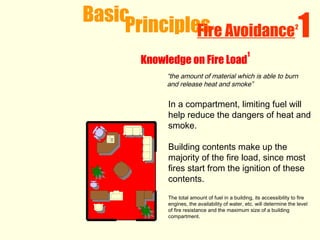
“the amount of material which is able to burn
and release heat and smoke”
In a compartment, limiting fuel will
help reduce the dangers of heat and
smoke.
Building contents make up the
majority of the fire load, since most
fires start from the ignition of these
contents.
The total amount of fuel in a building, its accessibility to fire
engines, the availability of water, etc. will determine the level
of fire resistance and the maximum size of a building
compartment.
Basic
PrinciplesFire Avoidance2
1
Knowledge on Fire Load
1
Visual Fire Detection
To visually expose FIRE RISK and FIRE LOAD
areas to building occupants.
Basic
Principles
Patient Room
Nurse Station
Patient Room
Sto
2Fire Detection
Lounge
fire-prone areas
should be visually
accessible
provide peepholes
on doors
Basic
Principles
Visual Fire Detection
2Fire Detection
Makes use of manual and automatic (electric/
electronic) methods of informing the occupants in
charge that a fire has occurred in a given location.
Heat and smoke alarm systems
inside Fire Risk and Fire Load
areas.
Basic
Principles
Mechanical Fire Detection
2Fire Detection
Fire alarm systems must be
accessible in all zones especially in
fire-prone areas.
Aimed at ensuring that the growing fire is extinguished
immediately and at providing adequate time for firemen to
arrive, control the fire and evacuate the occupants.
Basic
Principles
Actively extinguishing or slowing down
the development of a fire before the full
involvement of the room. This is done
by the room’s local occupants.
Means:
1. Fire Extinguisher
2. Water Supply
3. Fire Blanket
4. Bucket of Sand
3Fire Growth Restriction
Manual Means of Restricting
Fire Growth
5
Basic
Principles 3Fire Growth Restriction
Rating of Fire Extinguishers
4
:
Class A Extinguishers will put out fires in ordinary 
combustibles, such as wood and paper. The numerical rating 
for this class of fire extinguisher refers to the amount of water 
the fire extinguisher holds and the amount of fire it will 
extinguish 
Class B Extinguishers should be used on fires involving 
flammable liquids, such as grease, gasoline, oil, etc. The 
numerical rating for this class of fire extinguisher states the 
approximate number of square feet of a flammable liquid fire 
that a non-expert person can expect to extinguish 
Class C Extinguishers are suitable for use on electrically 
energized fires. This class of fire extinguishers does not have 
a numerical rating. The presence of the letter “C” indicates 
that the extinguishing agent is non-conductive 
Class D Extinguishers are designed for use on flammable 
metals and are often specific for the type of metal in 
question. There is no picture designator for Class D 
extinguishers. These extinguishers generally have no rating 
nor are they given a multi-purpose rating for use on other 
types of fires 
Basic
Principles 3Fire Growth Restriction
Types of Fire Extinguishers
4
:
Dry Chemical extinguishers are usually rated for multiple purpose use. They 
contain an extinguishing agent and use a compressed, non-flammable gas as a 
propellant 
Halon extinguishers contain a gas that interrupts the chemical reaction that takes 
place when fuels burn. These types of extinguishers are often used to protect 
valuable electrical equipment since them leave no residue to clean up. Halon 
extinguishers have a limited range, usually 1.2 to 1.8 meters. The initial application 
of Halon should be made at the base of the fire, even after the flames have been 
extinguished 
Carbon Dioxide (CO2) extinguishers are most effective on Class B and C (liquids 
and electrical) fires. Since the gas disperses quickly, these extinguishers are only 
effective from 1.0 to 2.4 feet. The carbon dioxide is stored as a compressed liquid 
in the extinguisher; as it expands, it cools the surrounding air. The cooling will often 
cause ice to form around the “horn” where the gas is expelled from the 
extinguisher. Since the fire could re-ignite, continue to apply the agent even after 
the fire appears to be out 
Basic
Principles
-Categories: General Use, Institutional,
Residential, Attics, Special Hazards,
Storage
-3 heads: upright, pendent and sidewall
-Rated to 175 psi
3Fire Growth Restriction
Mechanical Means of
Restricting Fire Growth
6
Sprinkler Specifications:
Sprinklers can be spaced
from 3.6 to 6.0 meters apart.
Assumes that measures to control a growing fire
may not be successful, hence its maximum size
needs to be restricted both to reduce the risk
and to allow effective firefighting.
Extend CHB
walls up to
slab
Provide 1 m.
ledge to prevent
spread of fire
- providing a 1-meter ledge to prevent fire from creeping up
exterior walls into the floor above through windows.
This implies:
1. Fire cladding of structural components to ensure stability
of structural frames.
2. The use of fire-rated walls and slabs to contain fire in
rooms, sub-compartments and compartments so as to
segregate areas where fire may occur.
3. Others:
- plugging all holes; extending CHB walls up to the slab;
Basic
Principles 4Fire Containment
Definition and Implication
Fire-Rated
Surface
Compartment
Compartment
Sizes
The more combustible the contents of a building, the
smaller the compartment should be.
Joints must be filled with non-combustible materials
to prevent the spread of smoke or flame.
Objectives
-To limit fire and smoke spread
-To allow longer escape time
-To reduce the maximum potential size of the fire
Containing fire-
prone areas by
means of fire-
resistive
enclosures
Definition
Basic
Principles 4Fire Containment
Sub-Compartment
Concepts of Fire Compartmentation
2
Room
Basic
Principles 4Fire Containment
Fire Rating of Construction Systems
3
Gypsum Walls
-Two layers 16mm type X gypsum 
wallboard or veneer base applied 
to each side of 62mm metal studs 
400mm O.C.
-Two layers 16mm type X gypsum 
wallboard or veneer base applied 
to each side of 50mmx100mm 
wood studs 600mm O.C.
-One layer 16mm type X 
gypsum wallboard or veneer 
base applied to each side of 
40mm metal studs 600mm 
O.C.
-One layer 12mm type X 
veneer base nailed to each 
side of 50mmX100mm wood 
studs 400mm O.C.
SteelWoodSteelWood
2 Hour1 Hour
Concrete Masonry Wall Units
4 Hour2 Hour
4” 6”
Basic
Principles 4Fire Containment
Fire Rating of Construction Systems
3
-Flush Metal Door
-No Glass Permitted
-3mm clearance at jambs
-10mm clearance at non-combustinle floor
-For openings in fire walls or walls that 
divide a single building into fire areas
-Maximum glass area 0.063 sq.m
-6mm thk Wire glass in a steel frame
-For openings in enclosures of vertical 
communications through buildings and in 
2-hour rated partitions providing horizontal 
fire separations
-Maximum glass area: 0.83 sq.m
-For openings in walls or partitions 
between rooms and corridors having a fire 
resistance rating of 1 hour or less
3 Hour2 Hour1 Hour
Door Openings For 1.2m X 3.0m single hollow metal doors (ga.20 steel face), with
labeled single-point or 3-point latching hardware, steel hinges or pivots
1.370m
max
0.83m
max
125mm
min
125mm
min
Covers those devices and systems which aid
firefighters in actively extinguishing the fire and
bringing it to an end earlier than a free-burning fire.
ensure that all areas inside
and outside the building
are covered by reach of the
firehose
Basic
Principles 5Fire Control
Definition and Implication
access road for firetrucks
Access Road
Basic
Principles 5Fire Control
Fire apparatus should have
unobstructed access to
buildings.
R
L
W
Bollards and fences used for
traffic control must allow for
sufficient open road width for fire
truck
Site Access for Fire Control8:
30m> DEAD END
CUL-DE-SAC
T-TURN
Prevent time-consuming, hazardous
back-ups at dead-ends by using T-
turns and cul-de-sacs
MAX. 90 METERS
FIRE HYDRANT
Place hydrants at max. 3 meters
from curb. Siamese connection
to standpipes must be visible
and within 60m from hydrant
SIAMESE 
CONNECTION
Utility poles, kiosks, sculpture,
fountains, plant boxes can impede
fire rescue operations
0.3m
Hydrant must be
unobstructed; Fire hose
connection should be at
least 0.3m above grade
Basic
Principles 5Fire Control
Firetrucks
75 ° (safe
angle)
30m.
33m.
Approx. 10 storeys
8.5 m.
26m.
75 °
25m.
Approx. 8-9 storeys
6.7 m.
22m.
75 °
20m.
Approx. 6-7 storeys
5.6 m.
Aerial Apparatus
Specifications:
Provides access to a building, especially in high
rise buildings, for fire brigades.
Is fully-equipped with firefighting equipment,
service elevator, stair and lobby.
Provides a sufficiently secure operating base
and a rest area in between firefighting
operations.
Wet and Dry
Risers
Elevator
shaft
Fire-rated
doors
Basic
Principles 5Fire Control
Concept of the Firefighting Shaft
Measures which can assist to some extent
occupants in the fire zone but are particularly
needed for others in adjacent areas or
compartments.
Techniques of Smoke
Control
a. SMOKE CONTAINMENT/
BARRIER – technique of
restricting the movement of
smoke by the provision of fire
resisting elements.
b. SMOKE DISPERSAL –
technique of clearing smoke
locally by provision of natural
cross-ventilation or mechanical
venting.
Make Up Air
Smoke Barrier
Smoke Plume
Shop
Mall
Basic
Principles 6Smoke Control
Definition and Techniques
2
Venting
Extraction of Smoke
Ceiling Reservoir
Low
Pressure
High
PressureUses barriers including
walls, floors and
doors, to contain
pressurized air
generated by
mechanical means to
keep smoke away
from protected areas
such as escape
staircases and
corridors.
c. PRESSURIZATION – technique whereby air is blown into
spaces which are designed to be kept clear of smoke.
Basic
Principles 6Smoke Control
Definition and Techniques
2
Cover a range of passive or active systems which
permit the occupants to move or be moved to a
place of safety within or to the outside of a building.
FIRE ESCAPE:
fire escape stairs designed to be used daily for familiarity
of escape route
well-maintained (not used as storage of junk)
CORRIDOR SYSTEM:
direct, not tortuous
simple lay-out
no barriers, cul-de-sacs, bottlenecks
doors open out, not in
easily detectible, not hidden from view
Basic
Principles 7Escape Provisions
Definition
Escape Route Leading to:
Place of Safety
Place of Safety
Stairway
Enclosure
c. Protected Stairway Enclosure
Place of Safety Place of Safety
Protected Escape
Route
a. Protected Escape Route
Place of Safety
Place of Safety
Protected Lobby
b. Protected Lobby
To provide safety,
the routes must
be properly
protected from
the effects of fire
and smoke for an
acceptable time
period, usually a
minimum of 60
minutes.
This can be
achieved by:
- Compartmentation
- Fire resistance of
escape route
structure
- Use of smoke
control systems to
keep smoke out of
escape routes
Protected escape routes are designed in such a
way that they lead to a place of safety, and once
inside the occupants are safe from the immediate
danger from fire and smoke.
Basic
Principles 7Escape Provisions
Protected Escape Routes
1
Access through
Courtyards
exit courtyard
Alternative
Means of Escape
-Doors should be as far
as possible from each
other; preferably on
opposite walls
-Both doors should not
open into the same
compartment
compart-
ment
courtyard
subcomp-
artment subcomp-
artment
subcomp-
artmentsubcomp-
artment
Place of
Safety
Place of
Safety
Basic
Principles 7Escape Provisions
Alternative Means of Escape
1
MEANS OF EGRESS
Means of EgressMeans of Egress
Components of an Egress System
1. Exit Access – a corridor, an aisle, a path across a room, or a short stair or
ramp that conducts the occupants of a building to an exit.
2. Exit – a protected means of evacuation (door opening, an enclosed and
protected exit passageway leading to a door, or an enclosed exit stair or
ramp) from an exit access to a safe discharge point, must be of 2 hour
construction with self closing doors rated at 1 1/2 hrs.
3. Exit Discharge – a means (door, protected exit corridor, path across a
ground floor vestibule or lobby) of moving from an exit to a safe discharge
point (public way or other large open area.)
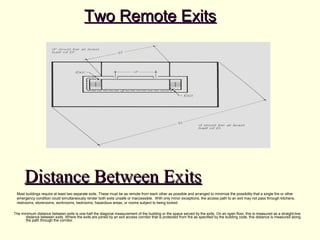
Distance Between ExitsDistance Between Exits
The minimum distance between exits is one-half the diagonal measurement of the building or the space served by the exits. On an open floor, this is measured as a straight-line
distance between exits. Where the exits are joined by an exit access corridor that is protected from fire as specified by the building code, this distance is measured along
the path through the corridor.
Most buildings require at least two separate exits. These must be as remote from each other as possible and arranged to minimize the possibility that a single fire or other
emergency condition could simultaneously render both exits unsafe or inaccessible. With only minor exceptions, the access path to an exit may not pass through kitchens,
restrooms, storerooms, workrooms, bedrooms, hazardous areas, or rooms subject to being locked.
Two Remote ExitsTwo Remote Exits
Dead-End CorridorsDead-End Corridors
General Rule is that a dead-end corridor must be 20’ or less in length.
Maximum Travel DistanceMaximum Travel Distance
Maximum travel distance to the nearest exit is specified by the code. Travel distance is
always measured along the actual path occupants must take to reach an exit. There are two
way to measure as shown on the diagram. The code will dictate which way you must
measure it.
DoorsDoors
Doors should always swing in the direction of egress travel in all buildings except
single family dwellings and in all rooms except those with fewer than 50
occupants.
Exit access corridors must be enclosed in fire-resistant walls and accessed via fire-
resistant doors. One-hour walls with 20-minute doors are required in most
buildings.
Exit StairwayExit Stairway
The most common type of exit is an enclosed stairway. The enclosure must be of 2-hour
construction with 1 ½ hour self-closing doors that swing in the direction of egress travel.
Stairway and landing widths are determined in accordance with the occupant load they serve
and are calculated according guidelines in the prevailing codes.
Exit PassagewayExit Passageway
MEANS OF ESCAPE REQUIREMENTS
 "Travel Distance" means the actual distance to be travelled by a
person from any point within a floor area to the nearest protected route
or final exit having regard to layout of walls, partitions and fittings.
 Safety from fire is normally considered to be attained in the open, at
ground
level at a point clear of the building. In larger, fire-compartmented
buildings,
safety from fire may be considered in terms of partial evacuation, or
evacuation to a place of relative safety. Generally, however, three
stages of evacuation accommodation can be identified:
Stages of Evacuation
(i) evacuation from room
(ii) horizontal evacuation
(iii) vertical evacuation
REFUGE AREAS
For buildings more than 24m in height, refuge area of 15 sq.m or an area
equivalent to 0.3 sq.m per person to accommodate the occupants of two
consecutive floors,which ever is higher, shall be provided as under.
For floors above 24 mt and up to 39 m - One refuge area on the floor
immediately above 24 m.
For floors above 39 m- One refuge area on the floor immediately above 39 m and
so on after every 15 m. Refuge area provided in excess of the requirements shall
be counted towards FAR.
The refuge area shall be provided on the periphery of the floor and open to air,
at-least on one side, protected with suitable railings.
RAMPS
Ramps shall comply with all the applicable requirements of stairways
regarding enclosure capacity and limiting dimensions.
The slope of a ramp shall not exceed 1 in 10. Ramps with slopes greater
than those recommended render them difficult to be used, particularly by
physically handicapped elderly people and children, and hence this
requirement.
Ramps in means of egress are required to be enclosed or protected.
Further, they must have landings located at the top, at the bottom
and at doors opening into the ramp
Automatic Fire Detection and Alarm
System:
Fire Alarm system comprising components for
automati cally detecting a fire, initiating an alarm
of fire and initiating other actions as appropriate.
Automatic Sprinkler System:
A system of water pipes fitted with sprinkler
heads at suitable intervals and heights and
designed to actuate automatically, control and
extinguish a fire by discharge of water.
Combustible Material:
The material which either burns itself or adds
heat to a fire.
Down comer:
An arrangement of fire fighting within the building
by means of down comer pipe connected to
terrace tank through terrace pump, gate valve
and non return valve and having mains not less
than 100mm internal diameter with landing
valves on each floor landing. It is also fitted with
inlet connections at ground level for charging
with water by pumping from fire services
appliances and air release valve at roof level to
release trapped air inside.
Dry Riser:
An arrangement of fire fighting within the building
by means of vertical rising mains not less than
100mm internal diameter with landing valves on
each floor/landing, which is normally dry but is
capable of being charged with water usually by
pumping from fire service appliances.
Emergency Lighting:
Lighting provided for use when the supply to the
normal lighting fails.
Requirements for installation, operation and
maintenance of emergency systems circuits and
equipments are given in National Electric Code(NEC).
Escape Lighting:
That part of emergency lighting which is provided
to ensure that the escape route is illuminated at
all material times (for example, at all times when
persons are on the premises), or at times the
main lighting is not available, either for the whole
building or the escape routes.
Escape lighting luminaries should be sited to
cover the following locations:
(a) Near each intersection of corridors,
(b) At each exit door,
(c) Near each change of direction in escape route,
(d) Near each staircase so that each flight of stairs
receives direct light,
(e) Near any other change of floor level,
(f) Outside each final exit and close to it,
(g) Near each fire alarm call point,
(h) Near fire fighting equipment, and
(j) To illuminate exit and safety signs as required
by the enforcing authority.
Fire Door:
A fire-resistive door approved for openings in
fire separation walls.
Fire Lift:
The lift installed to enable fire services personnel
to reach different floors with minimum deley,
having such features as required in accordance
with this Part.
Fire Resistance Rating:
The time that a material or construction will
withstand the standard fire exposure as
determined by fire test done in accordance with
the standard methods of fire tests of materials/
structures.
Fire Lift:
The lift installed to enable fire services personnel
to reach different floors with minimum deley,
having such features as required in accordance
with this Part.
4.15. Fire Lifts
4.15.1. Where applicable, fire lifts shall be provided with
a minimum capacity for 8 passengers and fully
automated with emergency switch on ground
level. In general, buildings 15m in height or above
shall be provided with fire lifts.
4.15.2. In case of fire, only firemen or any member of
fire service shall operate the fire lift. In normal
course, lifts may be used by other persons.
4.15.3. Each fire lift shall be equipped with suitable
intercommunication equipment for communicating
with the control room on the ground
floor of the building.
4.15.4. The number and location of fire lifts in a building
shall be decided after taking into consideration
various factors like building population, floor area,
compartmentation etc.
Fire Tower:
An enclosed staircase which can only be
approached from the various floors through
landings or lobbies separated from both the floor
areas and the staircase by fire-resisting doors,
and open to the outer air.
Means of Egress:
A continuous and unobstructed way of travel
from any point in a building or structure to a place
of comparative safety.
Wet Riser
An arrangement for fire fighting within the
building by means of vertical rising mains of not
less than 100 mm diameter with landing valves
on each floor/landing for fire fighting purposes and
permanently charged with water from a pressurised
Wet Riser
Difference between this and a dry riser, is that wet
risers are permanently charged with water by a fire
pump from a permanent water supply (which can
either be an underground water tank or an elevated
water tank at the terrace), whereas, the dry riser has
to be fed with water by fire brigade after their arrival.
Landing valves are nothing but internal hydrants
fitted with standard instantaneous female couplings
and may be of single or double outlet types.
Pressurisation is a method adopted for protected
escape routes against ingress of smoke,
especially in high-rise buildings.In pressurisation
air injected into the staircases, lobbies or
corridors, to raise their pressure in adjacent parts
of the building .As a result, ingress of smoke or
toxic gases into the escape routes will be
prevented.
Pressurisation system may be of two types:
(a) Single-stage, designed for operation only in the
event of emergency, and
(b) Two-stage, where normally a level of
pressurisation is maintained in the protected
escape routes, and an increased level of
pressurisation can be brought into operation in
an emergency.
Fire Extinguishing Equipment:
Portable fire
extinguishingManualFireExtinguishingEquipme
-These devices are used for extinguishing fire as soon-
as it starts.
-They are not so useful when once the fire has spread.
The discharge from a portable fire extinguisher lasts only
for a short duration of 20 to 120 seconds.
Fire sand bucket
- A fire sand bucket or fire bucket is a steel
bucket filled withstand which is used to put out
fires.
-They are placed in prominent positions in rooms
or corridors. They are a low-technology method
of fighting small fires.
-The main advantages of fire buckets are that
they are cheap, reliable and easy to use.
Fire Hydrants
These are provided on a ring main of 150 mm dia. in the
ground around the building periphery. The ring main gets
water from under ground water tank with pressure, so that
available pressure at each hydrant is of the order of about
3.5 to 4 kg/cm. The fire hydrants are placed at 300ft.c/c with
easy access in case of emergency.
Automatic Sprinkler System
- This arrangement is adopted for Commercial & industrial
buildings.
-The system consists of a net work of 20 mm dia. Fixed to
the ceiling of the room spaced at 3 m center to center.
-Heat actuated sprinkler heads are fixed to these pipes. The
pipes get supply from a header. Each sprinkler head is
provided with a fusible plug.
-In the event of fire, the fusible plug in the sprinkler nearest
to the wire melts due to rise of temperature, and water
gushes out of the sprinkler head. The fire is thus brought
under control in a short period.
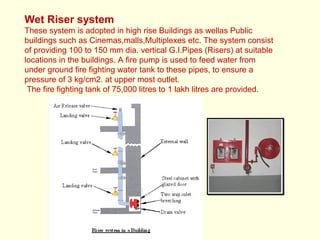
Wet Riser system
These system is adopted in high rise Buildings as wellas Public
buildings such as Cinemas,malls,Multiplexes etc. The system consist
of providing 100 to 150 mm dia. vertical G.I.Pipes (Risers) at suitable
locations in the buildings. A fire pump is used to feed water from
under ground fire fighting water tank to these pipes, to ensure a
pressure of 3 kg/cm2. at upper most outlet.
The fire fighting tank of 75,000 litres to 1 lakh litres are provided.
• 1 fire station or sub fire station within 1
to 3 km to be provided for 2 lakh
population
• Area for fire station with essential
residential accommodation
• Area for sub- fire-station with essential
residential accommodation
1 ha
0.60
ha
Norms as per UDPFI Guidelines:

1 Fire safety design principles

  • 1.
  • 2.
    The Fire Triangle: Threeelements - fuel, oxygen and heat - are required to start a fire. The oxidation process will not be possible without any one of these elements. Fuel (Fire Load) Oxygen (Ventilation) Heat (Ignition) Fire is a rapid oxidation process accompanied by the evolution of heat, light, flame and the emission of sound. Definition and Causes of Fire 2Intro
  • 3.
    Ordinary combustible materials suchas wood, cloth, paper, rubber and plastics, etc. Class A: Flammable or combustible liquids, flammable gases. Class B: Energized electrical equipment Class C: Fire involving: Combustible metals such as potassium, sodium, magnesium and other reactive metals Class D: How to Suppress: Use Water Exclude air from burning materials No Water; Use electrically non-conductive extinguishing agents such as gaseous systems Heat-absorbing medium which is not reactive with burning metals Intro Classes of Fire 3
  • 4.
    Intro Fire Growth 2 Pre-flashoveror growth phase Stage 1: FlashoverStage 2: Fully developed fire (Stable phase) Stage 3: Decay (Cooling Period) Stage 4: Involves flaming combustion of an item and may lead to a spread of fire; or a smoldering, poorly- ventilated fire with substantial smoke. Rapid change from a local fire to one involving all combustible materials in a room. All materials in compartment are alight; maximum rate of heat release is dependent on either available ventilation or quantity of fuel. Gradual consumption of fuel in the compartment. Stages
  • 5.
    Behavior of Fireand Smoke 1 Vertical Shaft or Duct (Stack Effect) Suspended Ceiling Ceiling Void Smoke and Flame likely to re-enter Enclosed Area Vertical Shaft or Duct Outlet to adjoining space Enclosed Area Outlet to open air 1.00 m Intro
  • 6.
    Internal Fire Spreaddue to: Internal Fire Spread between Rooms and Floors Through Vertical Shafts Through Air Ducts Through Ceiling and Collapsed Partitions Through Non-Fire Rated Doors Origin of Fire Fire Spread 2Intro
  • 7.
    Fire Spread Congested HighFire Load Areas External Fire Spread due to: Intro
  • 8.
    Fire Spread 2 Ignition ofMaterials Ignition of Materials Ignition of Materials Ignition of Materials Convection Currents Origin of Fire Proximity of Buildings Intro External Fire Spread due to:
  • 9.
    Aims in Fire SafetyDesign A To prevent fire B To safeguard the lives of occupants and firefighters C To reduce damage on the building, its contents, and on surrounding buildings
  • 10.
    Basic Principles 1Fire Avoidance 2 FireDetection 3 Fire Growth Restriction 4 Fire Containment 5 Fire Control 6 Smoke Control 7 Escape Provisions
  • 11.
    Definition & Implication PrinciplesFireAvoidance1 1 Reducing the possibility of accidental ignition of construction materials, as well as fittings and fixtures. This implies: a. keeping separate heat sources and materials which might ignite readily through proper planning and zoning b. need to specify materials to reduce the risk of fire starting c. reducing fire load Basic
  • 12.
    PrinciplesFire Avoidance1 1 ForHospitals (eg. Hospitals)FireZoning Basic ForMostBuildings 1. Life Risk Areas – areas in which all occupants are ambulant and able to move unaided away from a fire - eg. Outpatient department; Service Zone 2. High Fire Risk Areas – areas which, due to their function, are more usually susceptible to an outbreak of fire, or to a rapid spread of fire or smoke. - eg. Kitchen or Boiler Room 3. High Fire Load Areas – areas which, because of their construction or contents, contain large amounts of combustible materials, thereby constituting a fire load in excess of that normally found - eg. Gas Storage, Linen Closets 4. High Life Risk Areas – areas in which persons may reside and are not able to move unaided away from a fire. - eg. Intensive Care Unit, Operating Department
  • 13.
    Choice of Materialsand Knowledge on Material Performance 1 Steel - does not burn - may buckle in fire - high conductivity spreads heat - loses half its strength in 550°C Timber - combustible - little loss of strength as charcoal formed insulates wood core - spreads flames Masonry - high fire resistance - cracks at 575°C - are subject to high temperatures during manufacture Calcium Silicate - excellent thermal shock resistance - up to 1000°C - suitable for cladding structural members Glass - standard float, toughened and laminated glass panes do not provide any fire resistance - monolithic fire-rated glass is available Basic PrinciplesFire Avoidance2 1 Concrete -high fire resistance - disintegrates at 400-500°C - holes in concrete will expose steel structural members
  • 14.
    “the amount ofmaterial which is able to burn and release heat and smoke” In a compartment, limiting fuel will help reduce the dangers of heat and smoke. Building contents make up the majority of the fire load, since most fires start from the ignition of these contents. The total amount of fuel in a building, its accessibility to fire engines, the availability of water, etc. will determine the level of fire resistance and the maximum size of a building compartment. Basic PrinciplesFire Avoidance2 1 Knowledge on Fire Load 1
  • 15.
    Visual Fire Detection Tovisually expose FIRE RISK and FIRE LOAD areas to building occupants. Basic Principles Patient Room Nurse Station Patient Room Sto 2Fire Detection Lounge
  • 16.
    fire-prone areas should bevisually accessible provide peepholes on doors Basic Principles Visual Fire Detection 2Fire Detection
  • 17.
    Makes use ofmanual and automatic (electric/ electronic) methods of informing the occupants in charge that a fire has occurred in a given location. Heat and smoke alarm systems inside Fire Risk and Fire Load areas. Basic Principles Mechanical Fire Detection 2Fire Detection Fire alarm systems must be accessible in all zones especially in fire-prone areas.
  • 18.
    Aimed at ensuringthat the growing fire is extinguished immediately and at providing adequate time for firemen to arrive, control the fire and evacuate the occupants. Basic Principles Actively extinguishing or slowing down the development of a fire before the full involvement of the room. This is done by the room’s local occupants. Means: 1. Fire Extinguisher 2. Water Supply 3. Fire Blanket 4. Bucket of Sand 3Fire Growth Restriction Manual Means of Restricting Fire Growth 5
  • 19.
    Basic Principles 3Fire GrowthRestriction Rating of Fire Extinguishers 4 : Class A Extinguishers will put out fires in ordinary  combustibles, such as wood and paper. The numerical rating  for this class of fire extinguisher refers to the amount of water  the fire extinguisher holds and the amount of fire it will  extinguish  Class B Extinguishers should be used on fires involving  flammable liquids, such as grease, gasoline, oil, etc. The  numerical rating for this class of fire extinguisher states the  approximate number of square feet of a flammable liquid fire  that a non-expert person can expect to extinguish  Class C Extinguishers are suitable for use on electrically  energized fires. This class of fire extinguishers does not have  a numerical rating. The presence of the letter “C” indicates  that the extinguishing agent is non-conductive  Class D Extinguishers are designed for use on flammable  metals and are often specific for the type of metal in  question. There is no picture designator for Class D  extinguishers. These extinguishers generally have no rating  nor are they given a multi-purpose rating for use on other  types of fires 
  • 20.
    Basic Principles 3Fire GrowthRestriction Types of Fire Extinguishers 4 : Dry Chemical extinguishers are usually rated for multiple purpose use. They  contain an extinguishing agent and use a compressed, non-flammable gas as a  propellant  Halon extinguishers contain a gas that interrupts the chemical reaction that takes  place when fuels burn. These types of extinguishers are often used to protect  valuable electrical equipment since them leave no residue to clean up. Halon  extinguishers have a limited range, usually 1.2 to 1.8 meters. The initial application  of Halon should be made at the base of the fire, even after the flames have been  extinguished  Carbon Dioxide (CO2) extinguishers are most effective on Class B and C (liquids  and electrical) fires. Since the gas disperses quickly, these extinguishers are only  effective from 1.0 to 2.4 feet. The carbon dioxide is stored as a compressed liquid  in the extinguisher; as it expands, it cools the surrounding air. The cooling will often  cause ice to form around the “horn” where the gas is expelled from the  extinguisher. Since the fire could re-ignite, continue to apply the agent even after  the fire appears to be out 
  • 21.
    Basic Principles -Categories: General Use,Institutional, Residential, Attics, Special Hazards, Storage -3 heads: upright, pendent and sidewall -Rated to 175 psi 3Fire Growth Restriction Mechanical Means of Restricting Fire Growth 6 Sprinkler Specifications: Sprinklers can be spaced from 3.6 to 6.0 meters apart.
  • 22.
    Assumes that measuresto control a growing fire may not be successful, hence its maximum size needs to be restricted both to reduce the risk and to allow effective firefighting. Extend CHB walls up to slab Provide 1 m. ledge to prevent spread of fire - providing a 1-meter ledge to prevent fire from creeping up exterior walls into the floor above through windows. This implies: 1. Fire cladding of structural components to ensure stability of structural frames. 2. The use of fire-rated walls and slabs to contain fire in rooms, sub-compartments and compartments so as to segregate areas where fire may occur. 3. Others: - plugging all holes; extending CHB walls up to the slab; Basic Principles 4Fire Containment Definition and Implication
  • 23.
    Fire-Rated Surface Compartment Compartment Sizes The more combustiblethe contents of a building, the smaller the compartment should be. Joints must be filled with non-combustible materials to prevent the spread of smoke or flame. Objectives -To limit fire and smoke spread -To allow longer escape time -To reduce the maximum potential size of the fire Containing fire- prone areas by means of fire- resistive enclosures Definition Basic Principles 4Fire Containment Sub-Compartment Concepts of Fire Compartmentation 2 Room
  • 24.
    Basic Principles 4Fire Containment FireRating of Construction Systems 3 Gypsum Walls -Two layers 16mm type X gypsum  wallboard or veneer base applied  to each side of 62mm metal studs  400mm O.C. -Two layers 16mm type X gypsum  wallboard or veneer base applied  to each side of 50mmx100mm  wood studs 600mm O.C. -One layer 16mm type X  gypsum wallboard or veneer  base applied to each side of  40mm metal studs 600mm  O.C. -One layer 12mm type X  veneer base nailed to each  side of 50mmX100mm wood  studs 400mm O.C. SteelWoodSteelWood 2 Hour1 Hour Concrete Masonry Wall Units 4 Hour2 Hour 4” 6”
  • 25.
    Basic Principles 4Fire Containment FireRating of Construction Systems 3 -Flush Metal Door -No Glass Permitted -3mm clearance at jambs -10mm clearance at non-combustinle floor -For openings in fire walls or walls that  divide a single building into fire areas -Maximum glass area 0.063 sq.m -6mm thk Wire glass in a steel frame -For openings in enclosures of vertical  communications through buildings and in  2-hour rated partitions providing horizontal  fire separations -Maximum glass area: 0.83 sq.m -For openings in walls or partitions  between rooms and corridors having a fire  resistance rating of 1 hour or less 3 Hour2 Hour1 Hour Door Openings For 1.2m X 3.0m single hollow metal doors (ga.20 steel face), with labeled single-point or 3-point latching hardware, steel hinges or pivots 1.370m max 0.83m max 125mm min 125mm min
  • 26.
    Covers those devicesand systems which aid firefighters in actively extinguishing the fire and bringing it to an end earlier than a free-burning fire. ensure that all areas inside and outside the building are covered by reach of the firehose Basic Principles 5Fire Control Definition and Implication access road for firetrucks Access Road
  • 27.
    Basic Principles 5Fire Control Fireapparatus should have unobstructed access to buildings. R L W Bollards and fences used for traffic control must allow for sufficient open road width for fire truck Site Access for Fire Control8: 30m> DEAD END CUL-DE-SAC T-TURN Prevent time-consuming, hazardous back-ups at dead-ends by using T- turns and cul-de-sacs MAX. 90 METERS FIRE HYDRANT Place hydrants at max. 3 meters from curb. Siamese connection to standpipes must be visible and within 60m from hydrant SIAMESE  CONNECTION Utility poles, kiosks, sculpture, fountains, plant boxes can impede fire rescue operations 0.3m Hydrant must be unobstructed; Fire hose connection should be at least 0.3m above grade
  • 28.
    Basic Principles 5Fire Control Firetrucks 75° (safe angle) 30m. 33m. Approx. 10 storeys 8.5 m. 26m. 75 ° 25m. Approx. 8-9 storeys 6.7 m. 22m. 75 ° 20m. Approx. 6-7 storeys 5.6 m. Aerial Apparatus Specifications:
  • 29.
    Provides access toa building, especially in high rise buildings, for fire brigades. Is fully-equipped with firefighting equipment, service elevator, stair and lobby. Provides a sufficiently secure operating base and a rest area in between firefighting operations. Wet and Dry Risers Elevator shaft Fire-rated doors Basic Principles 5Fire Control Concept of the Firefighting Shaft
  • 30.
    Measures which canassist to some extent occupants in the fire zone but are particularly needed for others in adjacent areas or compartments. Techniques of Smoke Control a. SMOKE CONTAINMENT/ BARRIER – technique of restricting the movement of smoke by the provision of fire resisting elements. b. SMOKE DISPERSAL – technique of clearing smoke locally by provision of natural cross-ventilation or mechanical venting. Make Up Air Smoke Barrier Smoke Plume Shop Mall Basic Principles 6Smoke Control Definition and Techniques 2 Venting Extraction of Smoke Ceiling Reservoir
  • 31.
    Low Pressure High PressureUses barriers including walls,floors and doors, to contain pressurized air generated by mechanical means to keep smoke away from protected areas such as escape staircases and corridors. c. PRESSURIZATION – technique whereby air is blown into spaces which are designed to be kept clear of smoke. Basic Principles 6Smoke Control Definition and Techniques 2
  • 32.
    Cover a rangeof passive or active systems which permit the occupants to move or be moved to a place of safety within or to the outside of a building. FIRE ESCAPE: fire escape stairs designed to be used daily for familiarity of escape route well-maintained (not used as storage of junk) CORRIDOR SYSTEM: direct, not tortuous simple lay-out no barriers, cul-de-sacs, bottlenecks doors open out, not in easily detectible, not hidden from view Basic Principles 7Escape Provisions Definition
  • 33.
    Escape Route Leadingto: Place of Safety Place of Safety Stairway Enclosure c. Protected Stairway Enclosure Place of Safety Place of Safety Protected Escape Route a. Protected Escape Route Place of Safety Place of Safety Protected Lobby b. Protected Lobby To provide safety, the routes must be properly protected from the effects of fire and smoke for an acceptable time period, usually a minimum of 60 minutes. This can be achieved by: - Compartmentation - Fire resistance of escape route structure - Use of smoke control systems to keep smoke out of escape routes Protected escape routes are designed in such a way that they lead to a place of safety, and once inside the occupants are safe from the immediate danger from fire and smoke. Basic Principles 7Escape Provisions Protected Escape Routes 1
  • 34.
    Access through Courtyards exit courtyard Alternative Meansof Escape -Doors should be as far as possible from each other; preferably on opposite walls -Both doors should not open into the same compartment compart- ment courtyard subcomp- artment subcomp- artment subcomp- artmentsubcomp- artment Place of Safety Place of Safety Basic Principles 7Escape Provisions Alternative Means of Escape 1
  • 35.
  • 36.
    Means of EgressMeansof Egress Components of an Egress System 1. Exit Access – a corridor, an aisle, a path across a room, or a short stair or ramp that conducts the occupants of a building to an exit. 2. Exit – a protected means of evacuation (door opening, an enclosed and protected exit passageway leading to a door, or an enclosed exit stair or ramp) from an exit access to a safe discharge point, must be of 2 hour construction with self closing doors rated at 1 1/2 hrs. 3. Exit Discharge – a means (door, protected exit corridor, path across a ground floor vestibule or lobby) of moving from an exit to a safe discharge point (public way or other large open area.)
  • 37.
    Distance Between ExitsDistanceBetween Exits The minimum distance between exits is one-half the diagonal measurement of the building or the space served by the exits. On an open floor, this is measured as a straight-line distance between exits. Where the exits are joined by an exit access corridor that is protected from fire as specified by the building code, this distance is measured along the path through the corridor. Most buildings require at least two separate exits. These must be as remote from each other as possible and arranged to minimize the possibility that a single fire or other emergency condition could simultaneously render both exits unsafe or inaccessible. With only minor exceptions, the access path to an exit may not pass through kitchens, restrooms, storerooms, workrooms, bedrooms, hazardous areas, or rooms subject to being locked. Two Remote ExitsTwo Remote Exits
  • 38.
    Dead-End CorridorsDead-End Corridors GeneralRule is that a dead-end corridor must be 20’ or less in length.
  • 39.
    Maximum Travel DistanceMaximumTravel Distance Maximum travel distance to the nearest exit is specified by the code. Travel distance is always measured along the actual path occupants must take to reach an exit. There are two way to measure as shown on the diagram. The code will dictate which way you must measure it.
  • 40.
    DoorsDoors Doors should alwaysswing in the direction of egress travel in all buildings except single family dwellings and in all rooms except those with fewer than 50 occupants. Exit access corridors must be enclosed in fire-resistant walls and accessed via fire- resistant doors. One-hour walls with 20-minute doors are required in most buildings.
  • 41.
    Exit StairwayExit Stairway Themost common type of exit is an enclosed stairway. The enclosure must be of 2-hour construction with 1 ½ hour self-closing doors that swing in the direction of egress travel. Stairway and landing widths are determined in accordance with the occupant load they serve and are calculated according guidelines in the prevailing codes.
  • 42.
  • 43.
    MEANS OF ESCAPEREQUIREMENTS
  • 44.
     "Travel Distance"means the actual distance to be travelled by a person from any point within a floor area to the nearest protected route or final exit having regard to layout of walls, partitions and fittings.  Safety from fire is normally considered to be attained in the open, at ground level at a point clear of the building. In larger, fire-compartmented buildings, safety from fire may be considered in terms of partial evacuation, or evacuation to a place of relative safety. Generally, however, three stages of evacuation accommodation can be identified: Stages of Evacuation (i) evacuation from room (ii) horizontal evacuation (iii) vertical evacuation
  • 45.
    REFUGE AREAS For buildingsmore than 24m in height, refuge area of 15 sq.m or an area equivalent to 0.3 sq.m per person to accommodate the occupants of two consecutive floors,which ever is higher, shall be provided as under. For floors above 24 mt and up to 39 m - One refuge area on the floor immediately above 24 m. For floors above 39 m- One refuge area on the floor immediately above 39 m and so on after every 15 m. Refuge area provided in excess of the requirements shall be counted towards FAR. The refuge area shall be provided on the periphery of the floor and open to air, at-least on one side, protected with suitable railings.
  • 46.
    RAMPS Ramps shall complywith all the applicable requirements of stairways regarding enclosure capacity and limiting dimensions. The slope of a ramp shall not exceed 1 in 10. Ramps with slopes greater than those recommended render them difficult to be used, particularly by physically handicapped elderly people and children, and hence this requirement. Ramps in means of egress are required to be enclosed or protected. Further, they must have landings located at the top, at the bottom and at doors opening into the ramp
  • 47.
    Automatic Fire Detectionand Alarm System: Fire Alarm system comprising components for automati cally detecting a fire, initiating an alarm of fire and initiating other actions as appropriate. Automatic Sprinkler System: A system of water pipes fitted with sprinkler heads at suitable intervals and heights and designed to actuate automatically, control and extinguish a fire by discharge of water. Combustible Material: The material which either burns itself or adds heat to a fire.
  • 48.
    Down comer: An arrangementof fire fighting within the building by means of down comer pipe connected to terrace tank through terrace pump, gate valve and non return valve and having mains not less than 100mm internal diameter with landing valves on each floor landing. It is also fitted with inlet connections at ground level for charging with water by pumping from fire services appliances and air release valve at roof level to release trapped air inside. Dry Riser: An arrangement of fire fighting within the building by means of vertical rising mains not less than 100mm internal diameter with landing valves on each floor/landing, which is normally dry but is capable of being charged with water usually by pumping from fire service appliances.
  • 49.
    Emergency Lighting: Lighting providedfor use when the supply to the normal lighting fails. Requirements for installation, operation and maintenance of emergency systems circuits and equipments are given in National Electric Code(NEC). Escape Lighting: That part of emergency lighting which is provided to ensure that the escape route is illuminated at all material times (for example, at all times when persons are on the premises), or at times the main lighting is not available, either for the whole building or the escape routes.
  • 50.
    Escape lighting luminariesshould be sited to cover the following locations: (a) Near each intersection of corridors, (b) At each exit door, (c) Near each change of direction in escape route, (d) Near each staircase so that each flight of stairs receives direct light, (e) Near any other change of floor level, (f) Outside each final exit and close to it, (g) Near each fire alarm call point, (h) Near fire fighting equipment, and (j) To illuminate exit and safety signs as required by the enforcing authority.
  • 51.
    Fire Door: A fire-resistivedoor approved for openings in fire separation walls. Fire Lift: The lift installed to enable fire services personnel to reach different floors with minimum deley, having such features as required in accordance with this Part. Fire Resistance Rating: The time that a material or construction will withstand the standard fire exposure as determined by fire test done in accordance with the standard methods of fire tests of materials/ structures.
  • 53.
    Fire Lift: The liftinstalled to enable fire services personnel to reach different floors with minimum deley, having such features as required in accordance with this Part. 4.15. Fire Lifts 4.15.1. Where applicable, fire lifts shall be provided with a minimum capacity for 8 passengers and fully automated with emergency switch on ground level. In general, buildings 15m in height or above shall be provided with fire lifts. 4.15.2. In case of fire, only firemen or any member of fire service shall operate the fire lift. In normal course, lifts may be used by other persons.
  • 54.
    4.15.3. Each firelift shall be equipped with suitable intercommunication equipment for communicating with the control room on the ground floor of the building. 4.15.4. The number and location of fire lifts in a building shall be decided after taking into consideration various factors like building population, floor area, compartmentation etc.
  • 55.
    Fire Tower: An enclosedstaircase which can only be approached from the various floors through landings or lobbies separated from both the floor areas and the staircase by fire-resisting doors, and open to the outer air. Means of Egress: A continuous and unobstructed way of travel from any point in a building or structure to a place of comparative safety. Wet Riser An arrangement for fire fighting within the building by means of vertical rising mains of not less than 100 mm diameter with landing valves on each floor/landing for fire fighting purposes and permanently charged with water from a pressurised
  • 56.
    Wet Riser Difference betweenthis and a dry riser, is that wet risers are permanently charged with water by a fire pump from a permanent water supply (which can either be an underground water tank or an elevated water tank at the terrace), whereas, the dry riser has to be fed with water by fire brigade after their arrival. Landing valves are nothing but internal hydrants fitted with standard instantaneous female couplings and may be of single or double outlet types.
  • 57.
    Pressurisation is amethod adopted for protected escape routes against ingress of smoke, especially in high-rise buildings.In pressurisation air injected into the staircases, lobbies or corridors, to raise their pressure in adjacent parts of the building .As a result, ingress of smoke or toxic gases into the escape routes will be prevented. Pressurisation system may be of two types: (a) Single-stage, designed for operation only in the event of emergency, and (b) Two-stage, where normally a level of pressurisation is maintained in the protected escape routes, and an increased level of pressurisation can be brought into operation in an emergency.
  • 58.
    Fire Extinguishing Equipment: Portablefire extinguishingManualFireExtinguishingEquipme -These devices are used for extinguishing fire as soon- as it starts. -They are not so useful when once the fire has spread. The discharge from a portable fire extinguisher lasts only for a short duration of 20 to 120 seconds. Fire sand bucket - A fire sand bucket or fire bucket is a steel bucket filled withstand which is used to put out fires. -They are placed in prominent positions in rooms or corridors. They are a low-technology method of fighting small fires. -The main advantages of fire buckets are that they are cheap, reliable and easy to use.
  • 59.
    Fire Hydrants These areprovided on a ring main of 150 mm dia. in the ground around the building periphery. The ring main gets water from under ground water tank with pressure, so that available pressure at each hydrant is of the order of about 3.5 to 4 kg/cm. The fire hydrants are placed at 300ft.c/c with easy access in case of emergency. Automatic Sprinkler System - This arrangement is adopted for Commercial & industrial buildings. -The system consists of a net work of 20 mm dia. Fixed to the ceiling of the room spaced at 3 m center to center. -Heat actuated sprinkler heads are fixed to these pipes. The pipes get supply from a header. Each sprinkler head is provided with a fusible plug. -In the event of fire, the fusible plug in the sprinkler nearest to the wire melts due to rise of temperature, and water gushes out of the sprinkler head. The fire is thus brought under control in a short period.
  • 60.
    Wet Riser system Thesesystem is adopted in high rise Buildings as wellas Public buildings such as Cinemas,malls,Multiplexes etc. The system consist of providing 100 to 150 mm dia. vertical G.I.Pipes (Risers) at suitable locations in the buildings. A fire pump is used to feed water from under ground fire fighting water tank to these pipes, to ensure a pressure of 3 kg/cm2. at upper most outlet. The fire fighting tank of 75,000 litres to 1 lakh litres are provided.
  • 62.
    • 1 firestation or sub fire station within 1 to 3 km to be provided for 2 lakh population • Area for fire station with essential residential accommodation • Area for sub- fire-station with essential residential accommodation 1 ha 0.60 ha Norms as per UDPFI Guidelines: