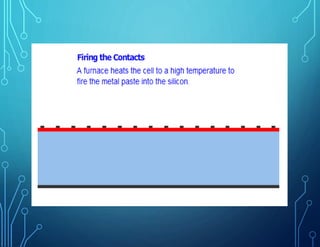
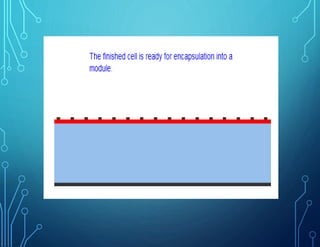
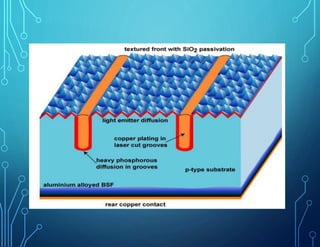
Fabrication Techniques:
a-Si Solar Cells
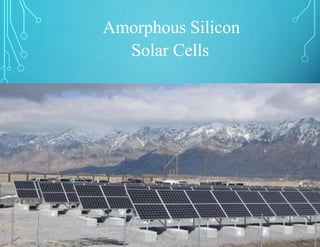
Amorphous Silicon
Solar Cells
14:150:491
Solar Cell Design and Processing
OUTLINE
• What is amorphous silicon?
• Atomic structure of a-Si:H
• Deposition methods
• Large-scale manufacturing
• Current state of a-Si
Amorphous Silicon
• The term “amorphous” commonly applied to
non-crystalline materials prepared by
deposition from gases.
• Non-crystalline:
– Chemical bonding of atoms nearly unchanged
from crystals
– Small, disorderly variation in the angles
between the bonds eliminates regular lattice
structure
Hydrogenated Amorphous
Silicon
• In early studies of amorphous silicon, it was
determined that plasma-deposited amorphous
silicon contained a significant percentage of
hydrogen atoms bonded into the amorphous
silicon structure.
• These atoms were discovered to be essential to the
improvement of the electronic properties of the
material.
• Amorphous silicon is generally known as
“hydrogenated amorphous silicon”, or a-Si:H.
ADVANTAGES OF A-SI:H OVER C-SI
• Technology is relatively simple and inexpensive
for a-Si:H
• For a given layer thickness, a-Si:H absorbs
much more energy than c-Si (about 2.5 times)
• Much less material required for a-Si:H films,
lighter weight and less expensive
• Can be deposited on a wide range of substrates,
including flexible, curved, and roll-away types
• Overall efficiency of around 10%, still lower
than crystalline silicon but improving
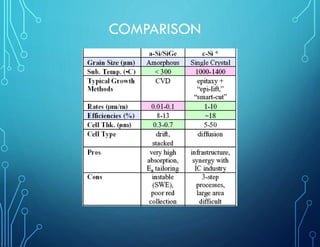
COMPARISON
Earlier Method:
• The first efforts were put by Chittick and Spear & LeComber
in the field of a-Si solar cells.
• They used silane-based glow discharge induced by radio
frequency voltages, this method is now commonly known as
plasma enhanced chemical vapor deposition or PECVD.
• Since that time many other methods have been introduced by
improving the material and deposition rate.
Atomic Structure
• Same basic structure shared by crystalline and
amorphous silicon
• For amorphous silicon, several percent of silicon
atoms make covalent bonds with only 3
neighboring silicon atoms, the remaining electron
bonds with a hydrogen atom
• 2 principal configurations for hydrogen:
– Dilute: a particular hydrogen atom is about 1 nm away
from any other hydrogen atom
– Clustered: there are two or more hydrogen atoms in
close proximity
– The density of hydrogen atoms depends on how the
material is made
Staebler-Wronski
Effect
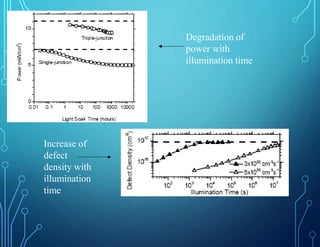
• There is a significant decline in the
efficiency of a-Si:H solar cells during
first few hundred hours of illumination
• A-Si:H modules reach steady-state after
about 1,000 hours of steady illumination
• Researchers believe that the increase in
defect density with light soaking is the
principal cause for the Staebler Wronski
effect
DEFECT DENSITY AND THE STAEBLER
WRONSKI EFFECT
• Defect density is the dangling bond, which occurs when
hydrogen does not bond to the fourth silicon bond
• Since defect density increases with illumination, it is
believed that illumination provides the energy required to
push hydrogen away from the fourth silicon bond, creating
a dangling bond
• Also, since it has been found that the density of hydrogen
in the film is determined by how the film is made, it may
be possible to reduce the Staebler Wronski effect with
manufacturing techniques
STAEBLER WRONSKI (CONT.)
• Performance degrades during illumination because
defect density (dangling bonds) increases, which
will capture electrons created by photons
• Researchers have found ways to reduce the effect
by incorporating fluorine in the gas mixture during
production
• Fluorine bonds tighter to silicon than hydrogen,
and is less mobile in the a-Si network
• Fluorinated a-Si cells show much better stability
under light soaking
Degradation of
power with
illumination time
Increase of
defect
density with
illumination
time
Doping a-Si:H
• Doping with phosphorous in c-Si raises the fermi energy
level by adding an extra electron
• In a-Si:H, P atoms bond only to 3 silicon neighbors,
leaving 2 electrons paired in “s” atomic orbitals which do
not participate in bonding. This is a chemically
advantageous
• It was found that occasionally, P can bond in a-Si:H as it
does in c-Si, where four electrons are shared with 4
neighboring Si atoms, but a negatively charged dangling
bond is also created
• Therefore, doping in a-Si:H is inefficient
– Most dopant atoms do not contribute a free electron and
do not raise the fermi energy level
– For each dopant that does contribute an electron, there
is a balancing Si dangling bond to receive it
Alloying with Additional
Elements
• Alloying with elements, such as Ge, can be
accomplished during film production
• The resulting alloys have wide ranges of
bandgaps
• This can be very useful for creating
multijunction pin cells, where the narrow
bandgap of a-SiGe allows for increased
absorption of lower energy photons
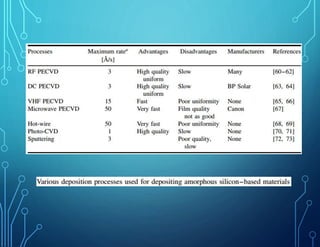
Deposition of Amorphous Silicon
• Silane-based (SiH4 gas) glow discharge
induced by RF voltages, or plasma
enhanced chemical vapor deposition
– 13.56 MHz excitation
– VHF
– Remote MW
• Hot-wire catalytic deposition
RF Glow Discharge Deposition
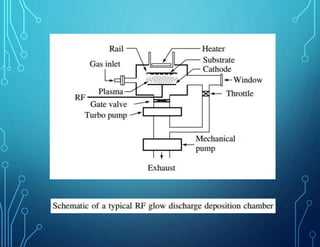
• A silicon-containing gas including mixture of H2 and
SiH4 flows into a vacuum chamber.
• There are two electrodes installed across which RF
power is applied keeping one of the electrodes
grounded.
• Due to this voltage a gas pressure is created
resulting into formation of plasma.
• This plasma excites and decomposes the gas present
in the chamber and lead to the formation of radicals
or ions.
• Now, the electrodes are mounted with several
substrates on which these radicals or ions diffuse to
form a thin hydrogenated silicon film.
• Gas pressure
– Higher for preparing microcrystalline films
– Lower for uniform deposition
• RF Power
– Higher power for higher deposition rate
– Above 100 mW/cm2, rapid reactions create silicon polyhydride
powder that contaminates the growing Si film
• Substrate temperature
– Lower T, more H incorporated in the film, increases the bandgap of
a-Si:H
• Below 150 deg. C., makes the powder formation worse
– Higher T, less hydrogen is incorporated and the bandgap is slightly
reduced
• Above 350 deg. C., the quality of the material degrades due to
loss of hydrogen and increasing defect density (dangling bonds)
• Electrode spacing
– Smaller spacing for uniform deposition
– Larger spacing makes maintaining plasma easier
DEPOSITION CONDITIONS
VHF Glow Discharge Deposition
• It has been determined that the deposition rate of
a-Si films increases linearly with plasma
excitation frequency
• High quality a-Si films have been created at rates
exceeding 1nm/s without making contaminating
polyhydride powder
• Challenges for large scale production include
adapting the technique to larger electrode sizes
INDIRECT MICROWAVE DEPOSITION
• When microwave plasma is in direct contact
with substrate, the deposited films have
very poor optoelectronic properties
• By exciting a carrier gas such as He or Ar,
the carrier gas then excites the silane gas
• This method shows promise for very high
deposition rate, 50 A/s, in the future
Hot-Wire Glow Discharge Deposition
• Silane gas is catalytically excited or decomposed
into radicals/ions by a superheated metal filament
(1800-2000 deg. C.)
• Silicon radicals diffuse inside the chamber and
deposit onto the heated substrate
• It has been found that HWCVD deposited a-Si
films show lower H content and improved light
stability when compared with RF PECVD films
• Challenges
– HW can deposit at a very high rate (150-300 A/s)
– Uniformity of HW films still poorer than RF films
– Filament material needs to be improved to reduce
maintenance time
– HW solar cells perform poorer than RF produced cells
Industrial Methods
1. Purifying the silicon
i. we firstly use silicon dioxide from either quartzite gravel or crushed
quartz
ii. The 99 percent pure silicon is purified even further from floating
zone technique
2. Making single crystal silicon
i. most commonly used process for creating the boule is called
the Czochralski method
3. Making silicon wafers
i. From the boule, silicon wafers are sliced one at a time
ii. The wafers are then polished to remove saw marks
4. Doping
i. The traditional way of doping (adding impurities to) silicon wafers
with boron and phosphorous
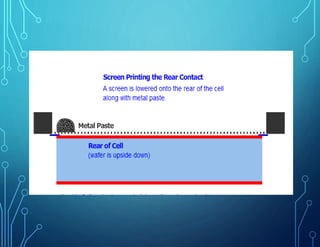
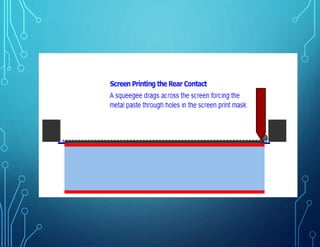
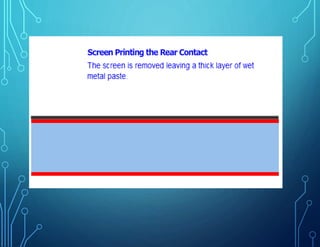
5. Placing electrical contacts
i. Electrical contacts connect each solar cell to another and to the
receiver of produced current
6. The anti-reflective coating
i. Because pure silicon is shiny, it can reflect up to 35 percent of the
sunlight
7. Encapsulating the cell
i. that is, sealed into silicon rubber or ethylene vinyl acetate
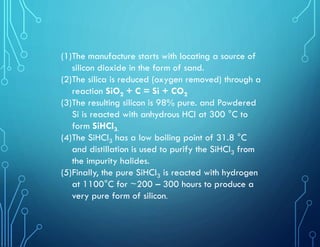
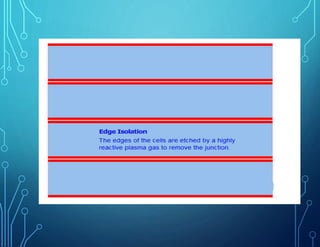
(1)The manufacture starts with locating a source of
silicon dioxide in the form of sand.
(2)The silica is reduced (oxygen removed) through a
reaction SiO2 + C = Si + CO2
(3)The resulting silicon is 98% pure. and Powdered
Si is reacted with anhydrous HCl at 300 °C to
form SiHCl3.
(4)The SiHCl3 has a low boiling point of 31.8 °C
and distillation is used to purify the SiHCl3 from
the impurity halides.
(5)Finally, the pure SiHCl3 is reacted with hydrogen
at 1100°C for ~200 – 300 hours to produce a
very pure form of silicon.
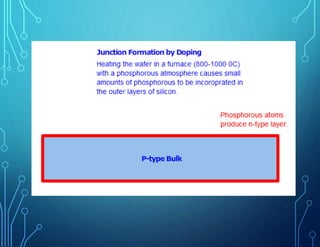
AFTER GETTING THE REQUIRED SILICON
FROM ABOVE MENTIONED CHEMICAL
PROCEDURE , different methods of solar
cells fabrication are applied , each
method involves doping of silicon to make
p-n junction , and required processes to
make a furnished solar cell.
Large-Scale Production
Continuous “roll to roll” manufacturing processes
developed by Energy Conversion Devices, Inc. A “roll”
of flexible substrate (stainless steel) is unrolled and
fed into the manufacturing process, and rolled back
up at the end.
Four continuous processes :
(1) Substrate washing.
(2) Sputter deposition of back-reflector.
(3) a-Si semiconductor deposition.
(4) ITO top electrode deposition. Large roll can be
cut into different sizes to meet application needs.
Pros/Cons of Roll-to-Roll
Advantages:
(1)Product is lightweight and flexible.
(2)Product can be cut to different sizes after manufacture.
(3)High production yield can be maintained.
Disadvantages are:
(1)Labor intensive.
(2)The four steps are currently not integrated into one machine;
each step requires drastically different working pressures.
(3)Cutting process is labor intensive
ION IMPLANT PROCESS
• Silicon based solar cells are commercially made using
thermal POCL3 diffusion method.
• During the process the phosphor-silicate glass (PSG)
generates on the surface resulted from the reaction
between oxygen and phosphorous.
• The next step involves removal of PSG layer.
• There are basically two ways by which a PSG layer can be
removed.
• First method includes wet isolation along with PSG cleaning
step and second method is known as laser isolation method.
• Both of these two processes reduces the wafer surface
area, Laser method especially reduces more surface area
than wet chemical process.
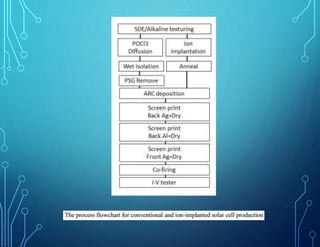
 ion dopants are bombarded with the wafers
 this results into penetration of ions thus damaging
the crystal. removed by annealing at high
tempreture
 After annealing, SiNx layer was formed to make
it anti-reflection
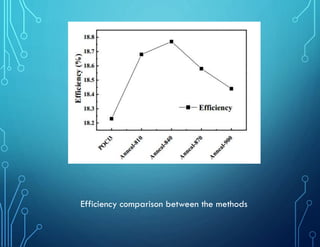
Efficiency comparison between the methods
CONCLUSION
• a-Si cells have been made with 15.2% initial
efficiency and 13% stable efficiency
• Rapid deposition processes are being refined so
that high rate, high quality can be achieved
• Research into light degradation remedies will
provide for cells with efficiencies comparable with
c-Si cells
• New applications for a-Si cells are being sought
such as building-integrated PV, space power,
consumer electronics, grid integration, and large
scale power generation
REFERENCES:
1. Fabrication of High-Efficiency Silicon Solar Cells
by Ion Implant Process, Chien-Ming Lee, Sheng-Po
Chang*, Shoou-Jinn Chang, Ching-In Wu, April 13
2. Amorphous Silicon–based Solar Cells Xunming
Deng and Eric A. Schiff , University of Toledo,
Toledo, OH, USA, Syracuse University, Syracuse, NY,
USA
3. POCl3 DIFFUSION WITH IN-SITU SiO2 BARRIER
FOR SELECTIVE EMITTER MULTICRYSTALLINE SOLAR
GRADE SILICON SOLAR CELLS
4.Wikihow.com
5. Google.com
6.Wikipedia.com
Amorphous silicon solar cells

Amorphous silicon solar cells

  • 1.
  • 2.
  • 3.
    OUTLINE • What isamorphous silicon? • Atomic structure of a-Si:H • Deposition methods • Large-scale manufacturing • Current state of a-Si
  • 4.
    Amorphous Silicon • Theterm “amorphous” commonly applied to non-crystalline materials prepared by deposition from gases. • Non-crystalline: – Chemical bonding of atoms nearly unchanged from crystals – Small, disorderly variation in the angles between the bonds eliminates regular lattice structure
  • 5.
    Hydrogenated Amorphous Silicon • Inearly studies of amorphous silicon, it was determined that plasma-deposited amorphous silicon contained a significant percentage of hydrogen atoms bonded into the amorphous silicon structure. • These atoms were discovered to be essential to the improvement of the electronic properties of the material. • Amorphous silicon is generally known as “hydrogenated amorphous silicon”, or a-Si:H.
  • 6.
    ADVANTAGES OF A-SI:HOVER C-SI • Technology is relatively simple and inexpensive for a-Si:H • For a given layer thickness, a-Si:H absorbs much more energy than c-Si (about 2.5 times) • Much less material required for a-Si:H films, lighter weight and less expensive • Can be deposited on a wide range of substrates, including flexible, curved, and roll-away types • Overall efficiency of around 10%, still lower than crystalline silicon but improving
  • 7.
  • 8.
    Earlier Method: • Thefirst efforts were put by Chittick and Spear & LeComber in the field of a-Si solar cells. • They used silane-based glow discharge induced by radio frequency voltages, this method is now commonly known as plasma enhanced chemical vapor deposition or PECVD. • Since that time many other methods have been introduced by improving the material and deposition rate.
  • 9.
    Atomic Structure • Samebasic structure shared by crystalline and amorphous silicon • For amorphous silicon, several percent of silicon atoms make covalent bonds with only 3 neighboring silicon atoms, the remaining electron bonds with a hydrogen atom • 2 principal configurations for hydrogen: – Dilute: a particular hydrogen atom is about 1 nm away from any other hydrogen atom – Clustered: there are two or more hydrogen atoms in close proximity – The density of hydrogen atoms depends on how the material is made
  • 10.
    Staebler-Wronski Effect • There isa significant decline in the efficiency of a-Si:H solar cells during first few hundred hours of illumination • A-Si:H modules reach steady-state after about 1,000 hours of steady illumination • Researchers believe that the increase in defect density with light soaking is the principal cause for the Staebler Wronski effect
  • 11.
    DEFECT DENSITY ANDTHE STAEBLER WRONSKI EFFECT • Defect density is the dangling bond, which occurs when hydrogen does not bond to the fourth silicon bond • Since defect density increases with illumination, it is believed that illumination provides the energy required to push hydrogen away from the fourth silicon bond, creating a dangling bond • Also, since it has been found that the density of hydrogen in the film is determined by how the film is made, it may be possible to reduce the Staebler Wronski effect with manufacturing techniques
  • 12.
    STAEBLER WRONSKI (CONT.) •Performance degrades during illumination because defect density (dangling bonds) increases, which will capture electrons created by photons • Researchers have found ways to reduce the effect by incorporating fluorine in the gas mixture during production • Fluorine bonds tighter to silicon than hydrogen, and is less mobile in the a-Si network • Fluorinated a-Si cells show much better stability under light soaking
  • 13.
    Degradation of power with illuminationtime Increase of defect density with illumination time
  • 14.
    Doping a-Si:H • Dopingwith phosphorous in c-Si raises the fermi energy level by adding an extra electron • In a-Si:H, P atoms bond only to 3 silicon neighbors, leaving 2 electrons paired in “s” atomic orbitals which do not participate in bonding. This is a chemically advantageous • It was found that occasionally, P can bond in a-Si:H as it does in c-Si, where four electrons are shared with 4 neighboring Si atoms, but a negatively charged dangling bond is also created • Therefore, doping in a-Si:H is inefficient – Most dopant atoms do not contribute a free electron and do not raise the fermi energy level – For each dopant that does contribute an electron, there is a balancing Si dangling bond to receive it
  • 15.
    Alloying with Additional Elements •Alloying with elements, such as Ge, can be accomplished during film production • The resulting alloys have wide ranges of bandgaps • This can be very useful for creating multijunction pin cells, where the narrow bandgap of a-SiGe allows for increased absorption of lower energy photons
  • 16.
    Deposition of AmorphousSilicon • Silane-based (SiH4 gas) glow discharge induced by RF voltages, or plasma enhanced chemical vapor deposition – 13.56 MHz excitation – VHF – Remote MW • Hot-wire catalytic deposition
  • 17.
    RF Glow DischargeDeposition • A silicon-containing gas including mixture of H2 and SiH4 flows into a vacuum chamber. • There are two electrodes installed across which RF power is applied keeping one of the electrodes grounded. • Due to this voltage a gas pressure is created resulting into formation of plasma. • This plasma excites and decomposes the gas present in the chamber and lead to the formation of radicals or ions. • Now, the electrodes are mounted with several substrates on which these radicals or ions diffuse to form a thin hydrogenated silicon film.
  • 19.
    • Gas pressure –Higher for preparing microcrystalline films – Lower for uniform deposition • RF Power – Higher power for higher deposition rate – Above 100 mW/cm2, rapid reactions create silicon polyhydride powder that contaminates the growing Si film • Substrate temperature – Lower T, more H incorporated in the film, increases the bandgap of a-Si:H • Below 150 deg. C., makes the powder formation worse – Higher T, less hydrogen is incorporated and the bandgap is slightly reduced • Above 350 deg. C., the quality of the material degrades due to loss of hydrogen and increasing defect density (dangling bonds) • Electrode spacing – Smaller spacing for uniform deposition – Larger spacing makes maintaining plasma easier DEPOSITION CONDITIONS
  • 20.
    VHF Glow DischargeDeposition • It has been determined that the deposition rate of a-Si films increases linearly with plasma excitation frequency • High quality a-Si films have been created at rates exceeding 1nm/s without making contaminating polyhydride powder • Challenges for large scale production include adapting the technique to larger electrode sizes
  • 21.
    INDIRECT MICROWAVE DEPOSITION •When microwave plasma is in direct contact with substrate, the deposited films have very poor optoelectronic properties • By exciting a carrier gas such as He or Ar, the carrier gas then excites the silane gas • This method shows promise for very high deposition rate, 50 A/s, in the future
  • 22.
    Hot-Wire Glow DischargeDeposition • Silane gas is catalytically excited or decomposed into radicals/ions by a superheated metal filament (1800-2000 deg. C.) • Silicon radicals diffuse inside the chamber and deposit onto the heated substrate • It has been found that HWCVD deposited a-Si films show lower H content and improved light stability when compared with RF PECVD films • Challenges – HW can deposit at a very high rate (150-300 A/s) – Uniformity of HW films still poorer than RF films – Filament material needs to be improved to reduce maintenance time – HW solar cells perform poorer than RF produced cells
  • 24.
  • 25.
    1. Purifying thesilicon i. we firstly use silicon dioxide from either quartzite gravel or crushed quartz ii. The 99 percent pure silicon is purified even further from floating zone technique 2. Making single crystal silicon i. most commonly used process for creating the boule is called the Czochralski method 3. Making silicon wafers i. From the boule, silicon wafers are sliced one at a time ii. The wafers are then polished to remove saw marks 4. Doping i. The traditional way of doping (adding impurities to) silicon wafers with boron and phosphorous 5. Placing electrical contacts i. Electrical contacts connect each solar cell to another and to the receiver of produced current 6. The anti-reflective coating i. Because pure silicon is shiny, it can reflect up to 35 percent of the sunlight 7. Encapsulating the cell i. that is, sealed into silicon rubber or ethylene vinyl acetate
  • 26.
    (1)The manufacture startswith locating a source of silicon dioxide in the form of sand. (2)The silica is reduced (oxygen removed) through a reaction SiO2 + C = Si + CO2 (3)The resulting silicon is 98% pure. and Powdered Si is reacted with anhydrous HCl at 300 °C to form SiHCl3. (4)The SiHCl3 has a low boiling point of 31.8 °C and distillation is used to purify the SiHCl3 from the impurity halides. (5)Finally, the pure SiHCl3 is reacted with hydrogen at 1100°C for ~200 – 300 hours to produce a very pure form of silicon.
  • 27.
    AFTER GETTING THEREQUIRED SILICON FROM ABOVE MENTIONED CHEMICAL PROCEDURE , different methods of solar cells fabrication are applied , each method involves doping of silicon to make p-n junction , and required processes to make a furnished solar cell.
  • 43.
    Large-Scale Production Continuous “rollto roll” manufacturing processes developed by Energy Conversion Devices, Inc. A “roll” of flexible substrate (stainless steel) is unrolled and fed into the manufacturing process, and rolled back up at the end. Four continuous processes : (1) Substrate washing. (2) Sputter deposition of back-reflector. (3) a-Si semiconductor deposition. (4) ITO top electrode deposition. Large roll can be cut into different sizes to meet application needs.
  • 44.
    Pros/Cons of Roll-to-Roll Advantages: (1)Productis lightweight and flexible. (2)Product can be cut to different sizes after manufacture. (3)High production yield can be maintained. Disadvantages are: (1)Labor intensive. (2)The four steps are currently not integrated into one machine; each step requires drastically different working pressures. (3)Cutting process is labor intensive
  • 45.
    ION IMPLANT PROCESS •Silicon based solar cells are commercially made using thermal POCL3 diffusion method. • During the process the phosphor-silicate glass (PSG) generates on the surface resulted from the reaction between oxygen and phosphorous. • The next step involves removal of PSG layer. • There are basically two ways by which a PSG layer can be removed. • First method includes wet isolation along with PSG cleaning step and second method is known as laser isolation method. • Both of these two processes reduces the wafer surface area, Laser method especially reduces more surface area than wet chemical process.
  • 46.
     ion dopantsare bombarded with the wafers  this results into penetration of ions thus damaging the crystal. removed by annealing at high tempreture  After annealing, SiNx layer was formed to make it anti-reflection
  • 48.
  • 49.
    CONCLUSION • a-Si cellshave been made with 15.2% initial efficiency and 13% stable efficiency • Rapid deposition processes are being refined so that high rate, high quality can be achieved • Research into light degradation remedies will provide for cells with efficiencies comparable with c-Si cells • New applications for a-Si cells are being sought such as building-integrated PV, space power, consumer electronics, grid integration, and large scale power generation
  • 50.
    REFERENCES: 1. Fabrication ofHigh-Efficiency Silicon Solar Cells by Ion Implant Process, Chien-Ming Lee, Sheng-Po Chang*, Shoou-Jinn Chang, Ching-In Wu, April 13 2. Amorphous Silicon–based Solar Cells Xunming Deng and Eric A. Schiff , University of Toledo, Toledo, OH, USA, Syracuse University, Syracuse, NY, USA 3. POCl3 DIFFUSION WITH IN-SITU SiO2 BARRIER FOR SELECTIVE EMITTER MULTICRYSTALLINE SOLAR GRADE SILICON SOLAR CELLS 4.Wikihow.com 5. Google.com 6.Wikipedia.com