Basic Principles  of Learning 6
Definition of Learning Relative permanent change in behavior brought about through experience or interactions with the environment Not all changes result from learning Change in behavior not always immediate Years of isolating and studying behavior produced different principles of learning Basic Principles of Learning
Conditioning Conditioning  :  process of learning associations between environmental stimuli and behavioral responses
Factors of Learning Association:  Horn-Car, Symbol-Direction, Smoke-Fire Reinforcement:  that strengthen the association of stimulus. Positive or negative consequences of a behavior. Continuity:  Faster presentation of unconditioned stimulus after the presentation of conditioned stimulus Motives:  a precondition for any type of learning
Types of Learning 1. Classical Conditioning 2. Instrumental Learning/Operant Learning 3. Cognitive Learning 4. Latent Learning  5. Perceptual Learning
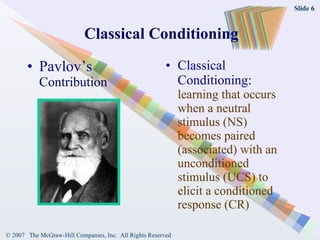
Classical Conditioning Pavlov’s   Contribution Classical Conditioning:   learning that occurs when a neutral stimulus (NS) becomes paired (associated) with an unconditioned stimulus (UCS) to elicit a conditioned response (CR)
Classical Conditioning:  Learning by Association Ivan Pavlov in Russia Nobel Prize for saliva in digestion Reflexive response controlled by  arbitrary  stimulus (salivation when attendant approached) Association  - key element  First recognized by Aristotle Pavlov: classical conditioning was form of learning through association Basic Principles of Learning
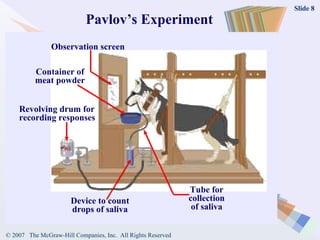
Pavlov’s Experiment Container of meat powder Observation screen Revolving drum for recording responses Device to count drops of saliva Tube for collection of saliva
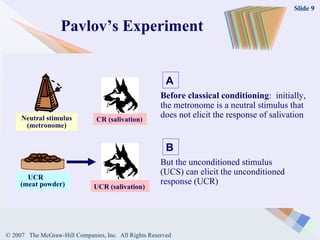
Pavlov’s Experiment CR (salivation) UCR  (meat powder) Before classical conditioning :  initially, the metronome is a neutral stimulus that does not elicit the response of salivation But the unconditioned stimulus (UCS) can elicit the unconditioned response (UCR) UCR (salivation) Neutral stimulus (metronome) B A
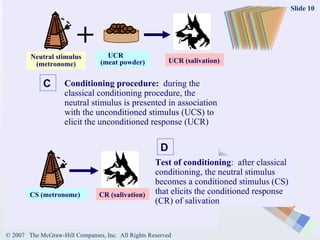
Test of conditioning :  after classical conditioning, the neutral stimulus becomes a conditioned stimulus (CS) that elicits the conditioned response (CR) of salivation Neutral stimulus (metronome) CS (metronome) Conditioning procedure:   during the classical conditioning procedure, the neutral stimulus is presented in association with the unconditioned stimulus (UCS) to elicit the unconditioned response (UCR) UCR (salivation) UCR  (meat powder) CR (salivation) C D
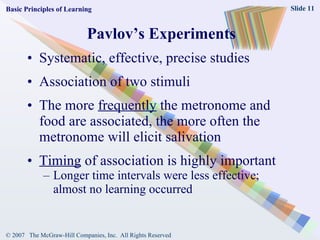
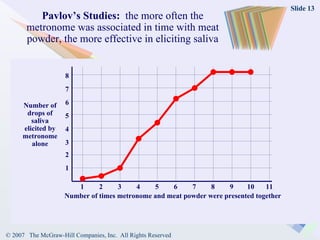
Pavlov’s Experiments Systematic, effective, precise studies Association of two stimuli The more  frequently  the metronome and food are associated, the more often the metronome will elicit salivation Timing  of association is highly important Longer time intervals were less effective; almost no learning occurred Basic Principles of Learning
Additional Example of Classical Conditioning Generalization:   When a conditioned response to a stimulus has been acquired, other similar stimuli will evoke the same response.  Discrimination:  A process complementary to generalization discrimination. Whereas generalization is reaction to similarities, discrimination is reaction to differences.
Number of drops of saliva elicited by metronome alone Number of times metronome and meat powder were presented together 2 3 4 5 6 7 8 2 1 3 4 5 6 7 8 9 10 11 1 Pavlov’s Studies:  the more often the metronome was associated in time with meat powder, the more effective in eliciting saliva
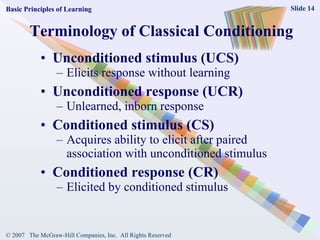
Terminology of Classical Conditioning Unconditioned stimulus (UCS)  Elicits response without learning Unconditioned response (UCR) Unlearned, inborn response Conditioned stimulus (CS) Acquires ability to elicit after paired association with unconditioned stimulus  Conditioned response (CR) Elicited by conditioned stimulus Basic Principles of Learning
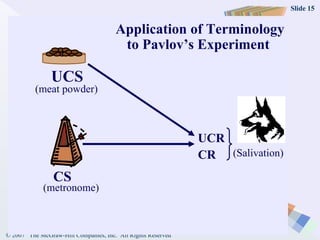
UCS CS (meat powder) (metronome) UCR CR (Salivation) Application of Terminology to Pavlov’s Experiment
Definition of Classical Conditioning Form of learning in which CS followed by UCS elicits UCR Pairing of CS and UCS allows CS to elicit CR almost identical or similar to UCR Considered learning because New behavior acquired Old behavior elicited by new stimulus Does not depend on behavior of individual Basic Principles of Learning
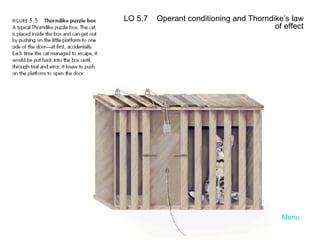
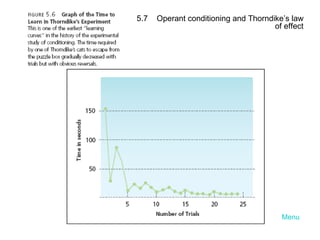
Operant Conditioning Operant conditioning  - the learning of  voluntary  behavior through the effects of pleasant and unpleasant consequences to responses. Thorndike’s Law of Effect  - law stating that if a response is followed by a pleasurable consequence, it will tend to be repeated, and if followed by an unpleasant consequence, it will tend not to be repeated. LO 5.7  Operant conditioning and Thorndike’s law of effect Menu
LO 5.7   Operant conditioning and Thorndike’s law of effect Menu
Menu LO 5.7   Operant conditioning and Thorndike’s law of effect
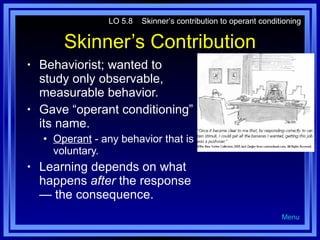
Skinner’s Contribution Behaviorist; wanted to study only observable, measurable behavior. Gave “operant conditioning” its name. Operant  - any behavior that is voluntary. Learning depends on what happens  after  the response — the consequence. LO 5.8  Skinner’s contribution to operant conditioning Menu
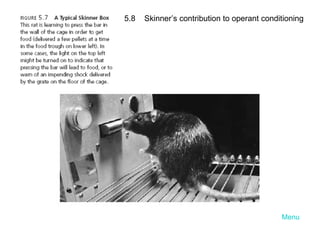
Menu LO 5.8  Skinner’s contribution to operant conditioning
Reinforcement Reinforcement  - any event or stimulus, that when following a response, increases the probability that the response will occur again. Primary reinforcer  - any reinforcer that is naturally reinforcing by meeting a basic biological need, such as hunger, thirst, or touch. Secondary reinforcer  - any reinforcer that becomes reinforcing after being paired with a primary reinforcer, such as praise, tokens, or gold stars. LO 5.9  Important concepts in operant conditioning Menu
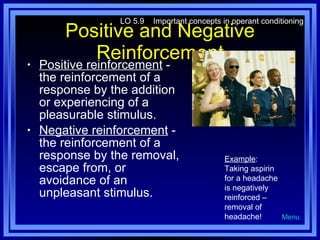
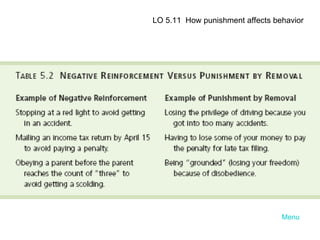
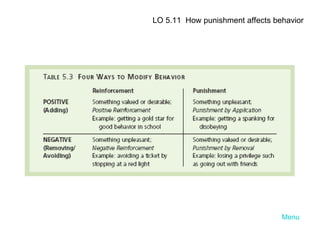
Positive and Negative Reinforcement Positive reinforcement  - the reinforcement of a response by the addition or experiencing of a pleasurable stimulus. Negative reinforcement  - the reinforcement of a response by the removal, escape from, or avoidance of an unpleasant stimulus. LO 5.9  Important concepts in operant conditioning Menu Example : Taking aspirin for a headache is negatively reinforced – removal of headache!
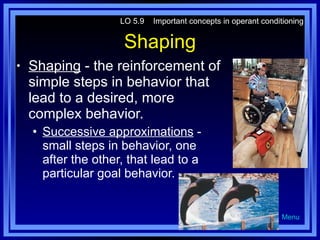
Shaping Shaping  - the reinforcement of simple steps in behavior that lead to a desired, more complex behavior. Successive approximations  - small steps in behavior, one after the other, that lead to a particular goal behavior. LO 5.9  Important concepts in operant conditioning Menu
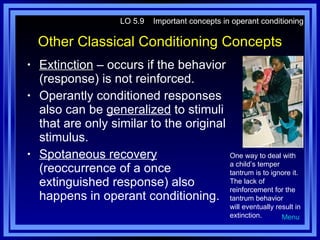
Other Classical Conditioning Concepts Extinction  – occurs if the behavior (response) is not reinforced. Operantly conditioned responses also can be  generalized  to stimuli that are only similar to the original stimulus. Spotaneous recovery  (reoccurrence of a once extinguished response) also happens in operant conditioning. LO 5.9  Important concepts in operant conditioning Menu One way to deal with a child’s temper tantrum is to ignore it. The lack of reinforcement for the tantrum behavior will eventually result in extinction.
Menu LO 5.9  Important concepts in operant conditioning
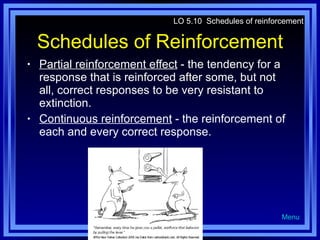
Schedules of Reinforcement Partial reinforcement effect  - the tendency for a response that is reinforced after some, but not all, correct responses to be very resistant to extinction. Continuous reinforcement  - the reinforcement of each and every correct response. LO 5.10  Schedules of reinforcement Menu
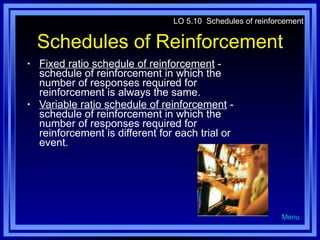
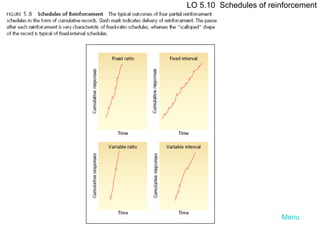
Schedules of Reinforcement Fixed ratio schedule of reinforcement  - schedule of reinforcement in which the number of responses required for reinforcement is always the same. Variable ratio schedule of reinforcement  - schedule of reinforcement in which the number of responses required for reinforcement is different for each trial or event. LO 5.10  Schedules of reinforcement Menu
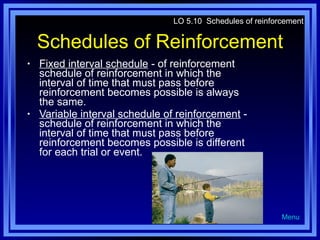
Schedules of Reinforcement Fixed interval schedule  - of reinforcement schedule of reinforcement in which the interval of time that must pass before reinforcement becomes possible is always the same. Variable interval schedule of reinforcement  - schedule of reinforcement in which the interval of time that must pass before reinforcement becomes possible is different for each trial or event. LO 5.10  Schedules of reinforcement Menu
Menu LO 5.10  Schedules of reinforcement
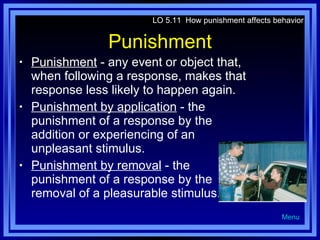
Punishment Punishment  - any event or object that, when following a response, makes that response less likely to happen again. Punishment by application  - the punishment of a response by the addition or experiencing of an unpleasant stimulus. Punishment by removal  - the punishment of a response by the removal of a pleasurable stimulus. LO 5.11  How punishment affects behavior Menu
Menu LO 5.11  How punishment affects behavior
How to Make Punishment More Effective Punishment should immediately follow the behavior it is meant to punish.  Punishment should be consistent. Punishment of the wrong behavior should be paired, whenever possible, with reinforcement of the right behavior. LO 5.11  How punishment affects behavior Menu
Operant Stimuli and Stimulus Control Discriminative stimulus  - any stimulus, such as a stop sign or a doorknob, that provides the organism with a cue for making a certain response in order to obtain reinforcement. LO 5.12  How operant stimuli control behavior Menu
Behavior Resistant to Conditioning Instinctive drift  - tendency for an animal’s behavior to revert to genetically controlled patterns. Each animal comes into the world (and the laboratory) with certain genetically determined instinctive patterns of behavior already in place. These instincts differ from species to species. There are some responses that simply cannot be trained into an animal regardless of conditioning. LO 5.13  Kind of behavior resistant to conditioning Raccoons commonly dunk their food in and out of water before eating. This “ washing” behavior is controlled by instinct and difficult to change even using operant techniques. Menu
Behavior Modification Behavior modification  - the use of operant conditioning techniques to bring about desired changes in behavior. Token economy  - type of behavior modification in which desired behavior is rewarded with tokens. Time-out  - a form of mild punishment by removal in which a misbehaving animal, child, or adult is placed in a special area away from the attention of others. Essentially, the organism is being “removed” from any possibility of positive reinforcement in the form of attention. Applied behavior analysis (ABA)  – modern term for a form of behavior modification that uses shaping techniques to mold a desired behavior or response. LO 5.14  Behavior modification Menu
Cognitive Learning Theory Early days of learning – focus was on behavior. 1950s and more intensely in the 1960s, many psychologists were becoming aware that  cognition , the mental events that take place inside a person’s mind while behaving, could no longer be ignored. Edward Tolman  – early cognitive scientist. LO 5.16  Cognitive learning theory Menu
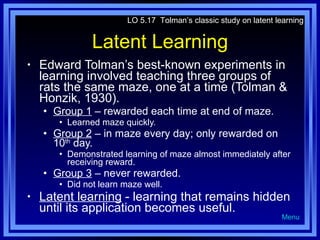
Latent Learning Edward Tolman’s best-known experiments in learning involved teaching three groups of rats the same maze, one at a time (Tolman & Honzik, 1930). Group 1  – rewarded each time at end of maze. Learned maze quickly. Group 2  – in maze every day; only rewarded on 10 th  day. Demonstrated learning of maze almost immediately after receiving reward. Group 3  – never rewarded. Did not learn maze well. Latent learning  - learning that remains hidden until its application becomes useful. LO 5.17  Tolman’s classic study on latent learning Menu
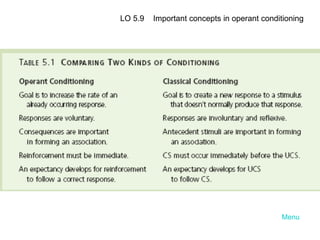
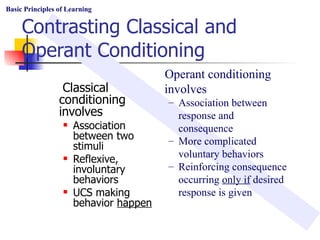
Contrasting Classical and Operant Conditioning Classical conditioning involves Association between two stimuli Reflexive, involuntary behaviors UCS making behavior  happen Basic Principles of Learning Operant conditioning involves Association between response and consequence More complicated voluntary behaviors Reinforcing consequence occurring  only if  desired response is given

Learningl

  • 1.
    Basic Principles of Learning 6
  • 2.
    Definition of LearningRelative permanent change in behavior brought about through experience or interactions with the environment Not all changes result from learning Change in behavior not always immediate Years of isolating and studying behavior produced different principles of learning Basic Principles of Learning
  • 3.
    Conditioning Conditioning : process of learning associations between environmental stimuli and behavioral responses
  • 4.
    Factors of LearningAssociation: Horn-Car, Symbol-Direction, Smoke-Fire Reinforcement: that strengthen the association of stimulus. Positive or negative consequences of a behavior. Continuity: Faster presentation of unconditioned stimulus after the presentation of conditioned stimulus Motives: a precondition for any type of learning
  • 5.
    Types of Learning1. Classical Conditioning 2. Instrumental Learning/Operant Learning 3. Cognitive Learning 4. Latent Learning 5. Perceptual Learning
  • 6.
    Classical Conditioning Pavlov’s Contribution Classical Conditioning: learning that occurs when a neutral stimulus (NS) becomes paired (associated) with an unconditioned stimulus (UCS) to elicit a conditioned response (CR)
  • 7.
    Classical Conditioning: Learning by Association Ivan Pavlov in Russia Nobel Prize for saliva in digestion Reflexive response controlled by arbitrary stimulus (salivation when attendant approached) Association - key element First recognized by Aristotle Pavlov: classical conditioning was form of learning through association Basic Principles of Learning
  • 8.
    Pavlov’s Experiment Containerof meat powder Observation screen Revolving drum for recording responses Device to count drops of saliva Tube for collection of saliva
  • 9.
    Pavlov’s Experiment CR(salivation) UCR (meat powder) Before classical conditioning : initially, the metronome is a neutral stimulus that does not elicit the response of salivation But the unconditioned stimulus (UCS) can elicit the unconditioned response (UCR) UCR (salivation) Neutral stimulus (metronome) B A
  • 10.
    Test of conditioning: after classical conditioning, the neutral stimulus becomes a conditioned stimulus (CS) that elicits the conditioned response (CR) of salivation Neutral stimulus (metronome) CS (metronome) Conditioning procedure: during the classical conditioning procedure, the neutral stimulus is presented in association with the unconditioned stimulus (UCS) to elicit the unconditioned response (UCR) UCR (salivation) UCR (meat powder) CR (salivation) C D
  • 11.
    Pavlov’s Experiments Systematic,effective, precise studies Association of two stimuli The more frequently the metronome and food are associated, the more often the metronome will elicit salivation Timing of association is highly important Longer time intervals were less effective; almost no learning occurred Basic Principles of Learning
  • 12.
    Additional Example ofClassical Conditioning Generalization: When a conditioned response to a stimulus has been acquired, other similar stimuli will evoke the same response. Discrimination: A process complementary to generalization discrimination. Whereas generalization is reaction to similarities, discrimination is reaction to differences.
  • 13.
    Number of dropsof saliva elicited by metronome alone Number of times metronome and meat powder were presented together 2 3 4 5 6 7 8 2 1 3 4 5 6 7 8 9 10 11 1 Pavlov’s Studies: the more often the metronome was associated in time with meat powder, the more effective in eliciting saliva
  • 14.
    Terminology of ClassicalConditioning Unconditioned stimulus (UCS) Elicits response without learning Unconditioned response (UCR) Unlearned, inborn response Conditioned stimulus (CS) Acquires ability to elicit after paired association with unconditioned stimulus Conditioned response (CR) Elicited by conditioned stimulus Basic Principles of Learning
  • 15.
    UCS CS (meatpowder) (metronome) UCR CR (Salivation) Application of Terminology to Pavlov’s Experiment
  • 16.
    Definition of ClassicalConditioning Form of learning in which CS followed by UCS elicits UCR Pairing of CS and UCS allows CS to elicit CR almost identical or similar to UCR Considered learning because New behavior acquired Old behavior elicited by new stimulus Does not depend on behavior of individual Basic Principles of Learning
  • 17.
    Operant Conditioning Operantconditioning - the learning of voluntary behavior through the effects of pleasant and unpleasant consequences to responses. Thorndike’s Law of Effect - law stating that if a response is followed by a pleasurable consequence, it will tend to be repeated, and if followed by an unpleasant consequence, it will tend not to be repeated. LO 5.7 Operant conditioning and Thorndike’s law of effect Menu
  • 18.
    LO 5.7 Operant conditioning and Thorndike’s law of effect Menu
  • 19.
    Menu LO 5.7 Operant conditioning and Thorndike’s law of effect
  • 20.
    Skinner’s Contribution Behaviorist;wanted to study only observable, measurable behavior. Gave “operant conditioning” its name. Operant - any behavior that is voluntary. Learning depends on what happens after the response — the consequence. LO 5.8 Skinner’s contribution to operant conditioning Menu
  • 21.
    Menu LO 5.8 Skinner’s contribution to operant conditioning
  • 22.
    Reinforcement Reinforcement - any event or stimulus, that when following a response, increases the probability that the response will occur again. Primary reinforcer - any reinforcer that is naturally reinforcing by meeting a basic biological need, such as hunger, thirst, or touch. Secondary reinforcer - any reinforcer that becomes reinforcing after being paired with a primary reinforcer, such as praise, tokens, or gold stars. LO 5.9 Important concepts in operant conditioning Menu
  • 23.
    Positive and NegativeReinforcement Positive reinforcement - the reinforcement of a response by the addition or experiencing of a pleasurable stimulus. Negative reinforcement - the reinforcement of a response by the removal, escape from, or avoidance of an unpleasant stimulus. LO 5.9 Important concepts in operant conditioning Menu Example : Taking aspirin for a headache is negatively reinforced – removal of headache!
  • 24.
    Shaping Shaping - the reinforcement of simple steps in behavior that lead to a desired, more complex behavior. Successive approximations - small steps in behavior, one after the other, that lead to a particular goal behavior. LO 5.9 Important concepts in operant conditioning Menu
  • 25.
    Other Classical ConditioningConcepts Extinction – occurs if the behavior (response) is not reinforced. Operantly conditioned responses also can be generalized to stimuli that are only similar to the original stimulus. Spotaneous recovery (reoccurrence of a once extinguished response) also happens in operant conditioning. LO 5.9 Important concepts in operant conditioning Menu One way to deal with a child’s temper tantrum is to ignore it. The lack of reinforcement for the tantrum behavior will eventually result in extinction.
  • 26.
    Menu LO 5.9 Important concepts in operant conditioning
  • 27.
    Schedules of ReinforcementPartial reinforcement effect - the tendency for a response that is reinforced after some, but not all, correct responses to be very resistant to extinction. Continuous reinforcement - the reinforcement of each and every correct response. LO 5.10 Schedules of reinforcement Menu
  • 28.
    Schedules of ReinforcementFixed ratio schedule of reinforcement - schedule of reinforcement in which the number of responses required for reinforcement is always the same. Variable ratio schedule of reinforcement - schedule of reinforcement in which the number of responses required for reinforcement is different for each trial or event. LO 5.10 Schedules of reinforcement Menu
  • 29.
    Schedules of ReinforcementFixed interval schedule - of reinforcement schedule of reinforcement in which the interval of time that must pass before reinforcement becomes possible is always the same. Variable interval schedule of reinforcement - schedule of reinforcement in which the interval of time that must pass before reinforcement becomes possible is different for each trial or event. LO 5.10 Schedules of reinforcement Menu
  • 30.
    Menu LO 5.10 Schedules of reinforcement
  • 31.
    Punishment Punishment - any event or object that, when following a response, makes that response less likely to happen again. Punishment by application - the punishment of a response by the addition or experiencing of an unpleasant stimulus. Punishment by removal - the punishment of a response by the removal of a pleasurable stimulus. LO 5.11 How punishment affects behavior Menu
  • 32.
    Menu LO 5.11 How punishment affects behavior
  • 33.
    Menu LO 5.11 How punishment affects behavior
  • 34.
    How to MakePunishment More Effective Punishment should immediately follow the behavior it is meant to punish. Punishment should be consistent. Punishment of the wrong behavior should be paired, whenever possible, with reinforcement of the right behavior. LO 5.11 How punishment affects behavior Menu
  • 35.
    Operant Stimuli andStimulus Control Discriminative stimulus - any stimulus, such as a stop sign or a doorknob, that provides the organism with a cue for making a certain response in order to obtain reinforcement. LO 5.12 How operant stimuli control behavior Menu
  • 36.
    Behavior Resistant toConditioning Instinctive drift - tendency for an animal’s behavior to revert to genetically controlled patterns. Each animal comes into the world (and the laboratory) with certain genetically determined instinctive patterns of behavior already in place. These instincts differ from species to species. There are some responses that simply cannot be trained into an animal regardless of conditioning. LO 5.13 Kind of behavior resistant to conditioning Raccoons commonly dunk their food in and out of water before eating. This “ washing” behavior is controlled by instinct and difficult to change even using operant techniques. Menu
  • 37.
    Behavior Modification Behaviormodification - the use of operant conditioning techniques to bring about desired changes in behavior. Token economy - type of behavior modification in which desired behavior is rewarded with tokens. Time-out - a form of mild punishment by removal in which a misbehaving animal, child, or adult is placed in a special area away from the attention of others. Essentially, the organism is being “removed” from any possibility of positive reinforcement in the form of attention. Applied behavior analysis (ABA) – modern term for a form of behavior modification that uses shaping techniques to mold a desired behavior or response. LO 5.14 Behavior modification Menu
  • 38.
    Cognitive Learning TheoryEarly days of learning – focus was on behavior. 1950s and more intensely in the 1960s, many psychologists were becoming aware that cognition , the mental events that take place inside a person’s mind while behaving, could no longer be ignored. Edward Tolman – early cognitive scientist. LO 5.16 Cognitive learning theory Menu
  • 39.
    Latent Learning EdwardTolman’s best-known experiments in learning involved teaching three groups of rats the same maze, one at a time (Tolman & Honzik, 1930). Group 1 – rewarded each time at end of maze. Learned maze quickly. Group 2 – in maze every day; only rewarded on 10 th day. Demonstrated learning of maze almost immediately after receiving reward. Group 3 – never rewarded. Did not learn maze well. Latent learning - learning that remains hidden until its application becomes useful. LO 5.17 Tolman’s classic study on latent learning Menu
  • 40.
    Contrasting Classical andOperant Conditioning Classical conditioning involves Association between two stimuli Reflexive, involuntary behaviors UCS making behavior happen Basic Principles of Learning Operant conditioning involves Association between response and consequence More complicated voluntary behaviors Reinforcing consequence occurring only if desired response is given