Dr. Rakhesh Singh Kshetrimayum
5. Plane Electromagnetic Waves
Dr. Rakhesh Singh Kshetrimayum
3/19/20141 Electromagnetic FieldTheory by R. S. Kshetrimayum
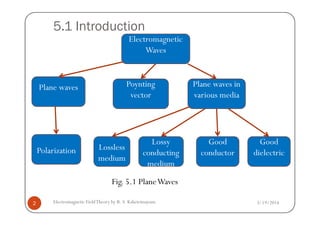
5.1 Introduction
Electromagnetic
Waves
Plane waves Poynting
vector
Plane waves in
various media
3/19/2014Electromagnetic FieldTheory by R. S. Kshetrimayum2
Polarization Lossless
medium
Good
conductor
Fig. 5.1 PlaneWaves
Lossy
conducting
medium
Good
dielectric
5.2 Plane waves
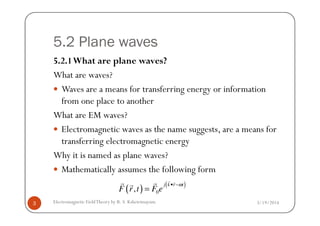
5.2.1What are plane waves?
What are waves?
Waves are a means for transferring energy or information
from one place to another
What are EM waves?What are EM waves?
Electromagnetic waves as the name suggests, are a means for
transferring electromagnetic energy
Why it is named as plane waves?
Mathematically assumes the following form
3/19/20143 Electromagnetic FieldTheory by R. S. Kshetrimayum
( ) ( )
0,
j k r t
F r t F e
ω• −
=
r rr rr
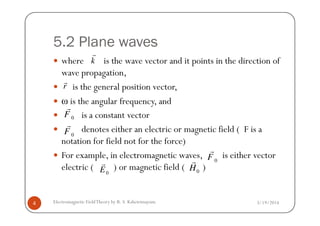
5.2 Plane waves
where is the wave vector and it points in the direction of
wave propagation,
is the general position vector,
ω is the angular frequency, and
is a constant vector
k
r
r
r
F
r
3/19/2014Electromagnetic FieldTheory by R. S. Kshetrimayum4
is a constant vector
denotes either an electric or magnetic field ( F is a
notation for field not for the force)
For example, in electromagnetic waves, is either vector
electric ( ) or magnetic field ( )
0F
0F
r
0F
r
0E
r
0H
r
5.2 Plane waves
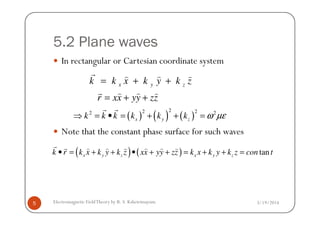
In rectangular or Cartesian coordinate system
x y zk k x k y k z= + +
r ) ) )
r xx yy zz= + +
r ) ) )
( ) ( ) ( )
22 22 2
k k k k k k ω µε⇒ = • = + + =
r r
3/19/2014Electromagnetic FieldTheory by R. S. Kshetrimayum5
Note that the constant phase surface for such waves
( ) ( ) ( )
22 22 2
x y zk k k k k k ω µε⇒ = • = + + =
( ) ( ) tanx y z x y zk r k x k y k z xx yy zz k x k y k z con t• = + + • + + = + + =
r r ) ) ) )) )
5.2 Plane waves
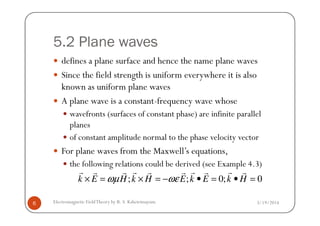
defines a plane surface and hence the name plane waves
Since the field strength is uniform everywhere it is also
known as uniform plane waves
A plane wave is a constant-frequency wave whose
wavefronts (surfaces of constant phase) are infinite parallel
3/19/2014Electromagnetic FieldTheory by R. S. Kshetrimayum6
wavefronts (surfaces of constant phase) are infinite parallel
planes
of constant amplitude normal to the phase velocity vector
For plane waves from the Maxwell’s equations,
the following relations could be derived (see Example 4.3)
; ; 0; 0k E H k H E k E k Hωµ ωε× = × = − • = • =
r r r rr r r r r r
5.2 Plane waves
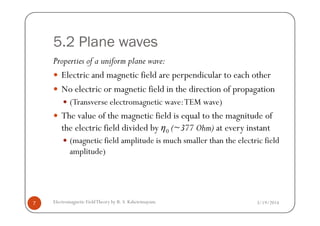
Properties of a uniform plane wave:
Electric and magnetic field are perpendicular to each other
No electric or magnetic field in the direction of propagation
(Transverse electromagnetic wave:TEM wave)
The value of the magnetic field is equal to the magnitude of
3/19/2014Electromagnetic FieldTheory by R. S. Kshetrimayum7
The value of the magnetic field is equal to the magnitude of
the electric field divided by η0 (~377 Ohm) at every instant
(magnetic field amplitude is much smaller than the electric field
amplitude)
5.2 Plane waves
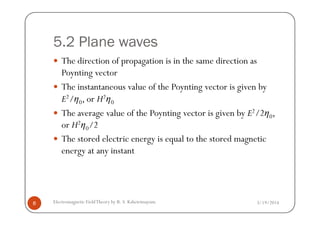
The direction of propagation is in the same direction as
Poynting vector
The instantaneous value of the Poynting vector is given by
E2/η0, or H2η0
The average value of the Poynting vector is given by E2/2η0,
3/19/2014Electromagnetic FieldTheory by R. S. Kshetrimayum8
The average value of the Poynting vector is given by E2/2η0,
or H2η0/2
The stored electric energy is equal to the stored magnetic
energy at any instant
5.2 Plane waves
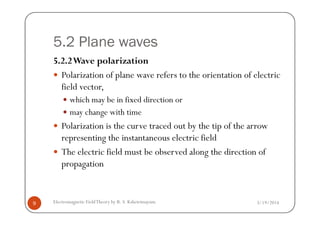
5.2.2Wave polarization
Polarization of plane wave refers to the orientation of electric
field vector,
which may be in fixed direction or
may change with time
3/19/2014Electromagnetic FieldTheory by R. S. Kshetrimayum9
may change with time
Polarization is the curve traced out by the tip of the arrow
representing the instantaneous electric field
The electric field must be observed along the direction of
propagation
5.2 Plane waves
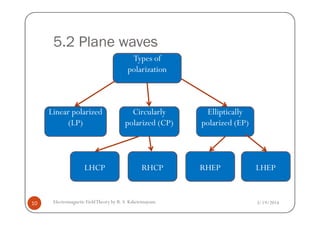
Types of
polarization
Linear polarized Circularly Elliptically
3/19/2014Electromagnetic FieldTheory by R. S. Kshetrimayum10
Linear polarized
(LP)
Circularly
polarized (CP)
Elliptically
polarized (EP)
RHCPLHCP RHEP LHEP
5.2 Plane waves
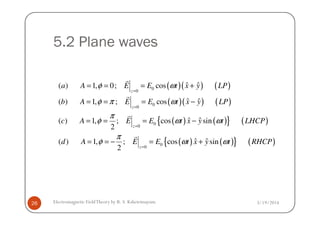
If the vector that describes the electric field at a point in
space
varies as function of time and
is always directed along a line
which is normal to the direction of propagation
3/19/2014Electromagnetic FieldTheory by R. S. Kshetrimayum11
which is normal to the direction of propagation
the field is said to be linearly polarized
If the figure that electric field trace is a circle (or ellipse),
then, the field is said to be circularly (or elliptically) polarized
5.2 Plane waves
Besides, the figure that electric field traces is circle and
anticlockwise (or clockwise) direction,
then, electric field is also said to be right-hand (or left-hand)
circularly polarized wave (RHCP/LHCP)
Besides, the figure that electric field traces is ellipse and
3/19/2014Electromagnetic FieldTheory by R. S. Kshetrimayum12
Besides, the figure that electric field traces is ellipse and
anticlockwise (or clockwise) direction,
then, electric field is also said to be right-hand (or left-hand)
elliptically polarized (RHEP/LHEP)
5.2 Plane waves
Let us consider the superposition of
a x- linearly polarized wave with complex amplitude Ex and
a y- linearly polarized wave with complex amplitude Ey,
both travelling in the positive z-direction
Note that E and E may be varying with time for general
3/19/2014Electromagnetic FieldTheory by R. S. Kshetrimayum13
Note that Ex and Ey may be varying with time for general
case
so we may choose it for a particular instant of time
Note that since the electric field is varying with both space
and time
5.2 Plane waves
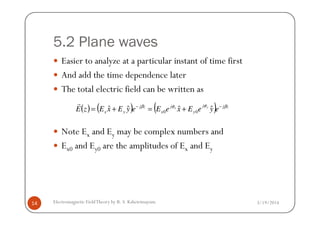
Easier to analyze at a particular instant of time first
And add the time dependence later
The total electric field can be written as
( ) ( ) ( ) zjj
y
j
x
zj
yx eyeExeEeyExEzE yx βφφβ −−
+=+= ˆˆˆˆ 00
r
3/19/2014Electromagnetic FieldTheory by R. S. Kshetrimayum14
Note Ex and Ey may be complex numbers and
Ex0 and Ey0 are the amplitudes of Ex and Ey
( ) ( ) ( )yxyx eyeExeEeyExEzE 00
5.2 Plane waves
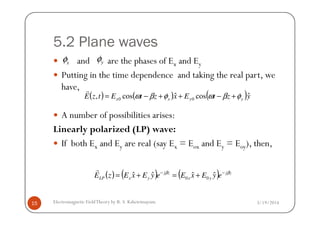
and are the phases of Ex and Ey
Putting in the time dependence and taking the real part, we
have,
A number of possibilities arises:
( ) ( ) ( )yztExztEtzE yyxx
ˆcosˆcos, 00 φβωφβω +−++−=
r
xφ yφ
3/19/2014Electromagnetic FieldTheory by R. S. Kshetrimayum15
A number of possibilities arises:
Linearly polarized (LP) wave:
If both Ex and Ey are real (say Ex = Eox and Ey = Eoy), then,
( ) ( ) ( ) zj
yx
zj
yxLP eyExEeyExEzE ββ −−
+=+= ˆˆˆˆ 00
r
5.2 Plane waves
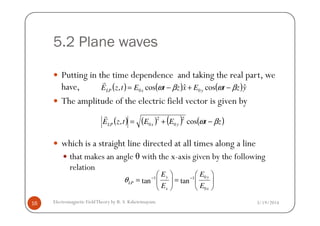
Putting in the time dependence and taking the real part, we
have,
The amplitude of the electric field vector is given by
( ) ( ) ( )yztExztEtzE yxLP
ˆcosˆcos, 00 βωβω −+−=
r
3/19/2014Electromagnetic FieldTheory by R. S. Kshetrimayum16
which is a straight line directed at all times along a line
that makes an angle θ with the x-axis given by the following
relation
01 1
0
tan tan
y y
LP
x x
E E
E E
θ − −
   
= =   
   
( ) ( ) ( ) ( )ztEEtzE yxLP βω −+= cos,
2
0
2
0
r
5.2 Plane waves
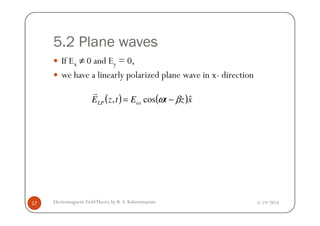
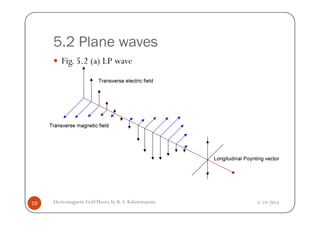
If Ex ≠ 0 and Ey = 0,
we have a linearly polarized plane wave in x- direction
( ) ( )xztEtzE oxLP
ˆcos, βω −=
r
3/19/2014Electromagnetic FieldTheory by R. S. Kshetrimayum17
5.2 Plane waves
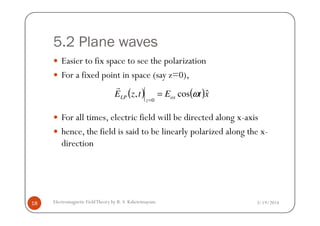
Easier to fix space to see the polarization
For a fixed point in space (say z=0),
For all times, electric field will be directed along x-axis
( ) ( )xtEtzE ox
z
LP
ˆcos,
0
ω=
=
r
3/19/2014Electromagnetic FieldTheory by R. S. Kshetrimayum18
For all times, electric field will be directed along x-axis
hence, the field is said to be linearly polarized along the x-
direction
5.2 Plane waves
Fig. 5.2 (a) LP wave
3/19/2014Electromagnetic FieldTheory by R. S. Kshetrimayum19
5.2 Plane waves
Circularly polarized (CP) wave:
Now consider the case Ex = j Ey = Eo, where Eo is real so
that
0 2
0 0; ;
j
j
x yE E e E E e
π
−
= =
3/19/2014Electromagnetic FieldTheory by R. S. Kshetrimayum20
The time domain form of this field is (putting in the time
dependence and taking the real part)
0 0x y
ˆ ˆ( ) j z
RHCP oE E x jy e β−
= −
r
ˆ ˆ( , ) [ cos( ) cos( )]
2
RHCP oE z t E x t z y t z
π
ω β ω β= − + − −
r
5.2 Plane waves
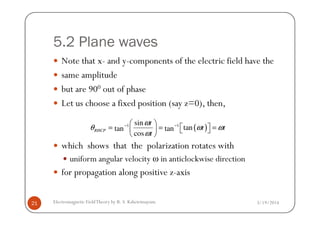
Note that x- and y-components of the electric field have the
same amplitude
but are 900 out of phase
Let us choose a fixed position (say z=0), then,
3/19/2014Electromagnetic FieldTheory by R. S. Kshetrimayum21
which shows that the polarization rotates with
uniform angular velocity ω in anticlockwise direction
for propagation along positive z-axis
( )1 1sin
tantan tan
cos
RHCP
t
t t
t
ω
θ ω ω
ω
− − 
 = = =   
 
5.2 Plane waves
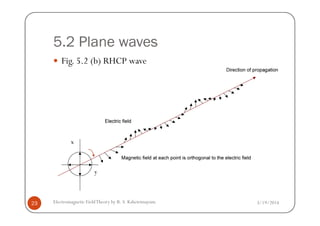
An observer sitting at z=0 will see
the electric field rotating in a circle and
the field never goes to zero
Since the fingers of right hand point in the direction of
rotation of the tip of the electric field vector
3/19/2014Electromagnetic FieldTheory by R. S. Kshetrimayum22
rotation of the tip of the electric field vector
when the thumb points in the direction of propagation,
this type of wave is referred to as right hand circularly
polarized wave (RHCP wave)
5.2 Plane waves
Fig. 5.2 (b) RHCP wave
3/19/2014Electromagnetic FieldTheory by R. S. Kshetrimayum23
x
y
5.2 Plane waves
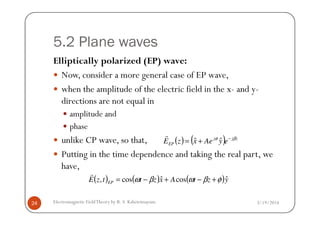
Elliptically polarized (EP) wave:
Now, consider a more general case of EP wave,
when the amplitude of the electric field in the x- and y-
directions are not equal in
amplitude and
3/19/2014Electromagnetic FieldTheory by R. S. Kshetrimayum24
amplitude and
phase
unlike CP wave, so that,
Putting in the time dependence and taking the real part, we
have,
( ) ( ) zjj
EP eyAexzE βφ −
+= ˆˆ
r
( ) ( ) ( )yztAxzttzE EP
ˆcosˆcos, φβωβω +−+−=
r
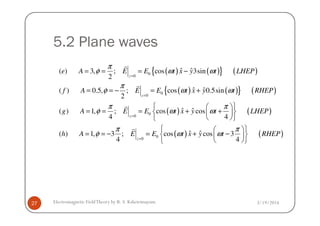
5.2 Plane waves
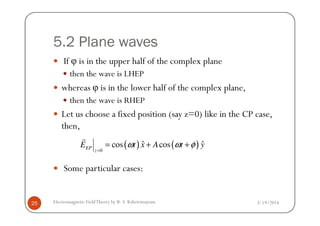
If φ is in the upper half of the complex plane
then the wave is LHEP
whereas φ is in the lower half of the complex plane,
then the wave is RHEP
Let us choose a fixed position (say z=0) like in the CP case,
3/19/2014Electromagnetic FieldTheory by R. S. Kshetrimayum25
Let us choose a fixed position (say z=0) like in the CP case,
then,
Some particular cases:
( ) ( )0
ˆ ˆcos cosEP z
E t x A t yω ω φ
=
= + +
r
5.2 Plane waves
( )( ) ( )
( )( ) ( )
{ }
0
0
0
0
ˆ ˆ( ) 1, 0; cos
ˆ ˆ( ) 1, ; cos
z
z
a A E E t x y LP
b A E E t x y LP
φ ω
φ π ω
π
=
=
= = = +
= = = −
r
r
r
3/19/2014Electromagnetic FieldTheory by R. S. Kshetrimayum26
( ) ( ){ } ( )
( ) ( ){ } ( )
0
0
0
0
ˆ ˆ( ) 1, ; cos sin
2
ˆ ˆ( ) 1, ; cos sin
2
z
z
c A E E t x y t LHCP
d A E E t x y t RHCP
π
φ ω ω
π
φ ω ω
=
=
= = = −
= = − = +
r
r
5.2 Plane waves
( ) ( ){ } ( )
( ) ( ){ } ( )
( ) ( )
0
0
0
0
0
ˆ ˆ( ) 3, ; cos 3sin
2
ˆ ˆ( ) 0.5, ; cos 0.5sin
2
ˆ ˆ( ) 1, ; cos cos
4 4
z
z
e A E E t x y t LHEP
f A E E t x y t RHEP
g A E E t x y t LHEP
π
φ ω ω
π
φ ω ω
π π
φ ω ω
=
=
= = = −
= = − = +
  
= = = + +  
 
r
r
r
3/19/2014Electromagnetic FieldTheory by R. S. Kshetrimayum27
( ) ( )
( ) ( )
0
0
0
0
ˆ ˆ( ) 1, ; cos cos
4 4
ˆ ˆ( ) 1, 3 ; cos cos 3
4 4
z
z
g A E E t x y t LHEP
h A E E t x y t RHEP
φ ω ω
π π
φ ω ω
=
=
= = = + +  
  
  
= = − = + −  
  
r
5.2 Plane waves
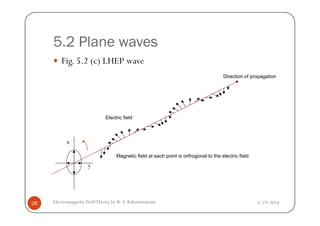
Fig. 5.2 (c) LHEP wave
Direction of propagation
3/19/2014Electromagnetic FieldTheory by R. S. Kshetrimayum28
Electric field
Magnetic field at each point is orthogonal to the electric field
x
y
5.3 Poynting vector & power flow in EM fields
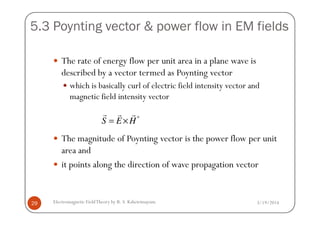
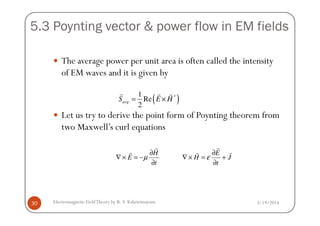
The rate of energy flow per unit area in a plane wave is
described by a vector termed as Poynting vector
which is basically curl of electric field intensity vector and
magnetic field intensity vector
3/19/2014Electromagnetic FieldTheory by R. S. Kshetrimayum29
The magnitude of Poynting vector is the power flow per unit
area and
it points along the direction of wave propagation vector
*
S E H= ×
r r r
5.3 Poynting vector & power flow in EM fields
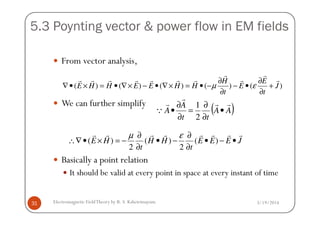
The average power per unit area is often called the intensity
of EM waves and it is given by
Let us try to derive the point form of Poynting theorem from
( )*1
Re
2
avgS E H= ×
r r r
3/19/2014Electromagnetic FieldTheory by R. S. Kshetrimayum30
Let us try to derive the point form of Poynting theorem from
two Maxwell’s curl equations
t
H
E
∂
∂
−=×∇
r
r
µ J
t
E
H
r
r
r
+
∂
∂
=×∇ ε
5.3 Poynting vector & power flow in EM fields
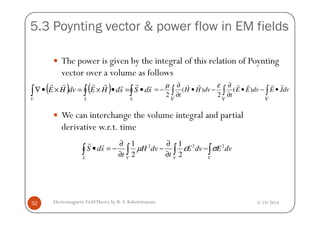
From vector analysis,
We can further simplify
)()()()()( J
t
E
E
t
H
HHEEHHE
r
r
r
r
rrrrrrr
+
∂
∂
•−
∂
∂
−•=×∇•−×∇•=ו∇ εµ
( )AA
tt
A
A
rr
r
r
Q •
∂
∂
=
∂
∂
•
2
1
3/19/2014Electromagnetic FieldTheory by R. S. Kshetrimayum31
Basically a point relation
It should be valid at every point in space at every instant of time
( ) ( ) ( )
2 2
E H H H E E E J
t t
µ ε∂ ∂
∴∇ • × = − • − • − •
∂ ∂
r r r r r r r r
( )AA
tt
AQ •
∂
=
∂
•
2
5.3 Poynting vector & power flow in EM fields
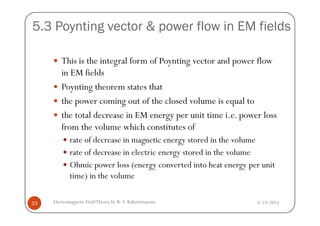
The power is given by the integral of this relation of Poynting
vector over a volume as follows
We can interchange the volume integral and partial
∫∫∫ •−•
∂
∂
−•
∂
∂
−=
VVV
dvJEdvEE
t
dvHH
t
rrrrrr
)(
2
)(
2
εµ
( ) ( ) ∫∫∫ •=•×=ו∇
SSV
sdSsdHEdvHE
rrrrrrr
3/19/2014Electromagnetic FieldTheory by R. S. Kshetrimayum32
We can interchange the volume integral and partial
derivative w.r.t. time
∫∫∫∫ −
∂
∂
−
∂
∂
−=•
VVVS
dvEdvE
t
dvH
t
sdS 222
2
1
2
1
σεµ
rr
5.3 Poynting vector & power flow in EM fields
This is the integral form of Poynting vector and power flow
in EM fields
Poynting theorem states that
the power coming out of the closed volume is equal to
the total decrease in EM energy per unit time i.e. power loss
3/19/2014Electromagnetic FieldTheory by R. S. Kshetrimayum33
the total decrease in EM energy per unit time i.e. power loss
from the volume which constitutes of
rate of decrease in magnetic energy stored in the volume
rate of decrease in electric energy stored in the volume
Ohmic power loss (energy converted into heat energy per unit
time) in the volume
5.3 Poynting vector & power flow in EM fields
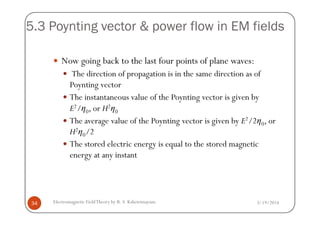
Now going back to the last four points of plane waves:
The direction of propagation is in the same direction as of
Poynting vector
The instantaneous value of the Poynting vector is given by
E2/η0, or H2η0
3/19/2014Electromagnetic FieldTheory by R. S. Kshetrimayum34
E / 0, or H 0
The average value of the Poynting vector is given by E2/2η0, or
H2η0/2
The stored electric energy is equal to the stored magnetic
energy at any instant
5.3 Poynting vector & power flow in EM fields
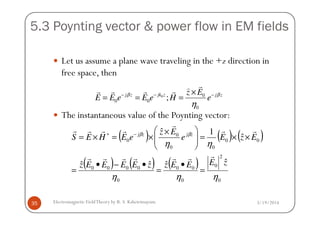
Let us assume a plane wave traveling in the +z direction in
free space, then
The instantaneous value of the Poynting vector:
0 0
0 0
0
;jk zj z j zz E
E E e E e H eβ β
η
−− −×
= = =
r)r r r r
3/19/2014Electromagnetic FieldTheory by R. S. Kshetrimayum35
The instantaneous value of the Poynting vector:
( ) ( ) ( )
( ) ( ) ( )
0
2
0
0
00
0
0000
00
00
0
0
ˆˆˆˆ
ˆ
1ˆ
ηηη
ηη
ββ
zEEEzzEEEEz
EzEe
Ez
eEHES zjzj
rrrrrrr
rr
r
rrrr
=
•
=
•−•
=
××=






 ×
×=×= −∗
5.3 Poynting vector & power flow in EM fields
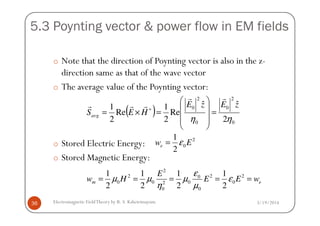
o Note that the direction of Poynting vector is also in the z-
direction same as that of the wave vector
o The average value of the Poynting vector:
( )
2
0
2
0 ˆˆ
Re
1
Re
1 zEzE
HESavg
rr
rrr
=





=×= ∗
3/19/2014Electromagnetic FieldTheory by R. S. Kshetrimayum36
o Stored Electric Energy:
o Stored Magnetic Energy:
( )
00 2
Re
2
Re
2 ηη
HESavg =






=×=
2
0
1
2
ew Eε=
2
2 2 20
0 0 0 02
0 0
1 1 1 1
2 2 2 2
m e
E
w H E E w
ε
µ µ µ ε
η µ
= = = = =
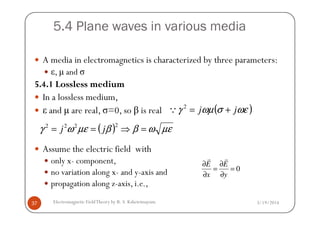
5.4 Plane waves in various media
A media in electromagnetics is characterized by three parameters:
ε, µ and σ
5.4.1 Lossless medium
In a lossless medium,
ε and µ are real, σ=0, so β is real ( )ωεσωµγ jj +=2
Q
3/19/2014Electromagnetic FieldTheory by R. S. Kshetrimayum37
ε and µ are real, σ=0, so β is real
Assume the electric field with
only x- component,
no variation along x- and y-axis and
propagation along z-axis, i.e.,
0
E E
x y
∂ ∂
= =
∂ ∂
r r
( )ωεσωµγ jj +=Q
( ) µεωββµεωγ =⇒==
2222
jj
5.4 Plane waves in various media
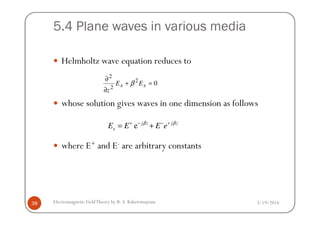
Helmholtz wave equation reduces to
whose solution gives waves in one dimension as follows
02
2
2
=+
∂
∂
xx EE
z
β
3/19/2014Electromagnetic FieldTheory by R. S. Kshetrimayum38
where E+ and E- are arbitrary constants
e j z j z
xE E E eβ β+ − − +
= +
5.4 Plane waves in various media
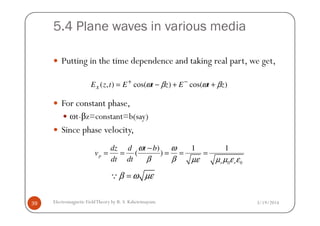
Putting in the time dependence and taking real part, we get,
For constant phase,
ωt-βz=constant=b(say)
)cos()cos(),( ztEztEtzEx βωβω ++−= −+
3/19/2014Electromagnetic FieldTheory by R. S. Kshetrimayum39
ωt-βz=constant=b(say)
Since phase velocity,
0 0
) 1 1
( )p
r r
dz d t b
v
dt dt
ω ω
β β µε µ µ ε ε
−
= = = = =
β ω µε=Q
5.4 Plane waves in various media
For free space,
which is the speed of light in free space
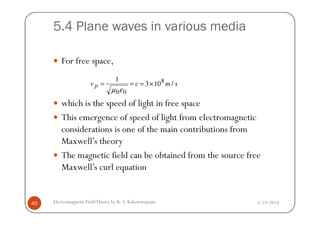
This emergence of speed of light from electromagnetic
smcv p /103
1 8
00
×===
εµ
3/19/2014Electromagnetic FieldTheory by R. S. Kshetrimayum40
This emergence of speed of light from electromagnetic
considerations is one of the main contributions from
Maxwell’s theory
The magnetic field can be obtained from the source free
Maxwell’s curl equation
5.4 Plane waves in various media
HjE
rr
ωµ−=×∇
( )
ˆ ˆ ˆ
ˆ e j z j z
x y z
E j E j j
H y E E eβ β+ − − +∇× ∇× ∂ ∂ ∂ ∂ 
= − = = = + 
r r
r
3/19/2014Electromagnetic FieldTheory by R. S. Kshetrimayum41
( )ˆ e
e 0 0j z j z
H y E E e
j x y z z
E E eβ β
ωµ ωµ ωµ ωµ
+ − − +
= − = = = + 
∂ ∂ ∂ ∂ 
+
( )
{ }( )
{ }
( ) ( )( ) ( )
ˆ ˆ
( ) ( ) 1
ˆ ˆ[ ]
j z j zj z j z
j z j z
j z j z
j E e E ej E e E e j
H j y j y
E e E e
y E e E e y
β ββ β
β β
β β
ββ β
ωµ ωµ
β
ωµ η
+ − − ++ − − +
+ − − +
+ − − +
− −− +
= =
−
= = −
r
5.4 Plane waves in various media
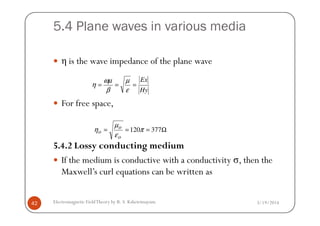
η is the wave impedance of the plane wave
For free space,
Hy
Ex
===
ε
µ
β
ωµ
η
3/19/2014Electromagnetic FieldTheory by R. S. Kshetrimayum42
5.4.2 Lossy conducting medium
If the medium is conductive with a conductivity σ, then the
Maxwell’s curl equations can be written as
Ω=== 377120π
ε
µ
η
o
o
o
5.4 Plane waves in various media
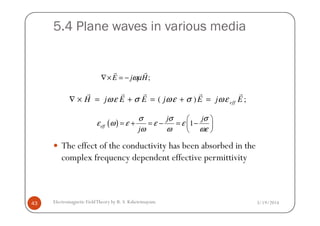
;E j Hωµ∇× = −
r r
( ) ;effH j E E j E j Eωε σ ωε σ ωε∇ × = + = + =
r r r r r
3/19/2014Electromagnetic FieldTheory by R. S. Kshetrimayum43
The effect of the conductivity has been absorbed in the
complex frequency dependent effective permittivity
( ) 1eff
j j
j
σ σ σ
ε ω ε ε ε
ω ω ωε
 
= + = − = − 
 
5.4 Plane waves in various media
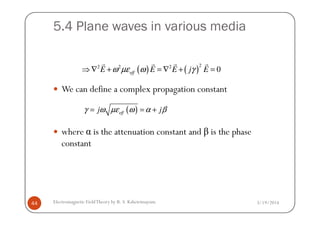
We can define a complex propagation constant
( ) ( )
22 2 2
0effE E E j Eω µε ω γ⇒ ∇ + = ∇ + =
r r r r
( )effj jγ ω µε ω α β= = +
3/19/2014Electromagnetic FieldTheory by R. S. Kshetrimayum44
where α is the attenuation constant and β is the phase
constant
( )effj jγ ω µε ω α β= = +
5.4 Plane waves in various media
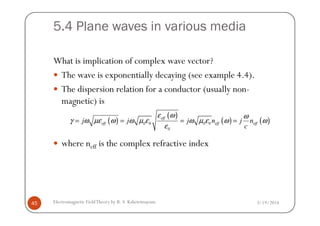
What is implication of complex wave vector?
The wave is exponentially decaying (see example 4.4).
The dispersion relation for a conductor (usually non-
magnetic) is
( )ε ω ω
3/19/2014Electromagnetic FieldTheory by R. S. Kshetrimayum45
where neff is the complex refractive index
( )
( )
( ) ( )0 0 0 0
0
eff
eff eff effj j j n j n
c
ε ω ω
γ ω µε ω ω µ ε ω µ ε ω ω
ε
= = = =
5.4 Plane waves in various media
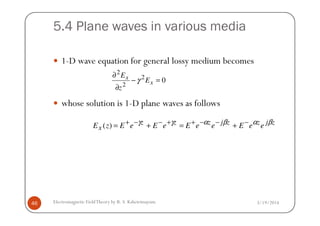
1-D wave equation for general lossy medium becomes
whose solution is 1-D plane waves as follows
02
2
2
=−
∂
∂
x
x
E
z
E
γ
3/19/2014Electromagnetic FieldTheory by R. S. Kshetrimayum46
zjzzjzzz
x eeEeeEeEeEzE βαβαγγ −−−++−−+ +=+=)(
5.4 Plane waves in various media
Putting the time dependence and taking real part, we get,
The magnetic field can be found out from Maxwell’s
equations as in the previous section
)cos()cos(),( zteEzteEtzE zz
x βωβω αα ++−= −−+
3/19/2014Electromagnetic FieldTheory by R. S. Kshetrimayum47
equations as in the previous section
1
( ) [ ]z z
y
eff
H z E e E eγ γ
η
+ − −
= −
5.4 Plane waves in various media
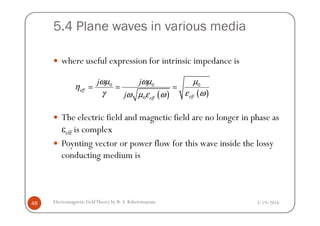
where useful expression for intrinsic impedance is
The electric field and magnetic field are no longer in phase as
( ) ( )
0 0 0
0
eff
effeff
j j
j
ωµ ωµ µ
η
γ ε ωω µ ε ω
= = =
3/19/2014Electromagnetic FieldTheory by R. S. Kshetrimayum48
The electric field and magnetic field are no longer in phase as
εeff is complex
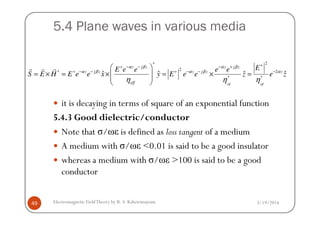
Poynting vector or power flow for this wave inside the lossy
conducting medium is
5.4 Plane waves in various media
it is decaying in terms of square of an exponential function
5.4.3 Good dielectric/conductor
2*
2* 2
* *
ˆ ˆ ˆ ˆ
eff eff
z j z z j z
z j z z j z z
eff
EE e e e e
S E H E e e x y E e e z e z
α β α β
α β α β α
η η η
++ − − − +
+ − − + − − −
 
= × = × = × =  
 
r r r
3/19/2014Electromagnetic FieldTheory by R. S. Kshetrimayum49
5.4.3 Good dielectric/conductor
Note that σ/ωε is defined as loss tangent of a medium
A medium with σ/ωε <0.01 is said to be a good insulator
whereas a medium with σ/ωε >100 is said to be a good
conductor
5.4 Plane waves in various media
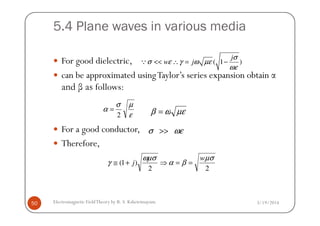
For good dielectric,
can be approximated usingTaylor’s series expansion obtain α
and β as follows:
( 1 )
j
w j
σ
σ ε γ ω µε
ωε
<< ∴ = −Q
ε
µσ
α
2
= µεωβ =
3/19/2014Electromagnetic FieldTheory by R. S. Kshetrimayum50
For a good conductor,
Therefore,
ε
α
2
= µεωβ =
ωεσ >>
22
)1(
µσ
βα
ωµσ
γ
w
j ==⇒+≅
5.4 Plane waves in various media
Skin effect
The fields do attenuate as they travel in a good dielectric
medium
α in a good dielectric is very small in comparison to that of a
good conductor
3/19/2014Electromagnetic FieldTheory by R. S. Kshetrimayum51
good conductor
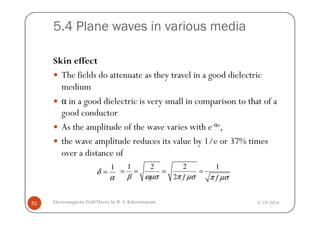
As the amplitude of the wave varies with e-αz,
the wave amplitude reduces its value by 1/e or 37% times
over a distance of
1
δ
α
=
1 2 2 1
2 f fβ ωµσ π µσ π µσ
= = = =
5.4 Plane waves in various media
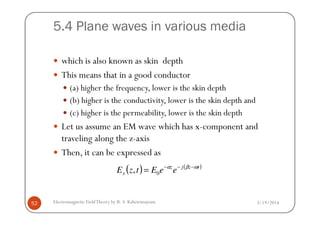
which is also known as skin depth
This means that in a good conductor
(a) higher the frequency, lower is the skin depth
(b) higher is the conductivity, lower is the skin depth and
(c) higher is the permeability, lower is the skin depth
3/19/2014Electromagnetic FieldTheory by R. S. Kshetrimayum52
(c) higher is the permeability, lower is the skin depth
Let us assume an EM wave which has x-component and
traveling along the z-axis
Then, it can be expressed as
( ) ( )tzjz
x eeEtzE ωβα −−−
= 0,
5.4 Plane waves in various media
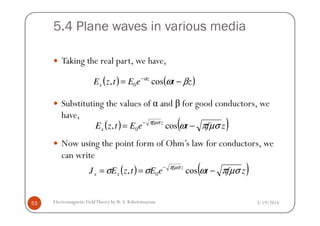
Taking the real part, we have,
Substituting the values of α and β for good conductors, we
have,
( ) ( )zteEtzE z
x βωα
−= −
cos, 0
3/19/2014Electromagnetic FieldTheory by R. S. Kshetrimayum53
have,
Now using the point form of Ohm’s law for conductors, we
can write
( ) ( )zfteEtzE zf
x µσπωµσπ
−= −
cos, 0
( ) ( )zfteEtzEJ zf
xx µσπωσσ µσπ
−== −
cos, 0
5.4 Plane waves in various media
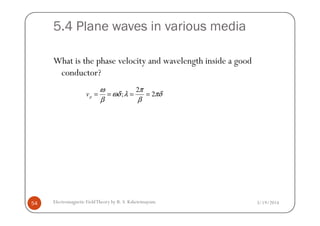
What is the phase velocity and wavelength inside a good
conductor?
2
; 2pv
ω π
ωδ λ πδ
β β
= = = =
3/19/2014Electromagnetic FieldTheory by R. S. Kshetrimayum54
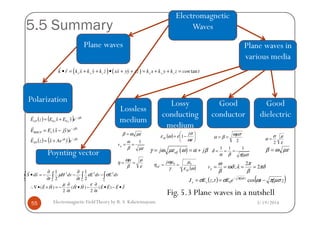
5.5 Summary
Electromagnetic
Waves
Plane waves
Polarization
Lossless
Good
conductor
Plane waves in
various media
Lossy
conducting
Good
dielectric
( ) ( ) tanx y z x y zk r k x k y k z xx yy zz k x k y k z con t• = + + • + + = + + =
r r ) ) ) )) )
3/19/2014Electromagnetic FieldTheory by R. S. Kshetrimayum55
Poynting vector
Lossless
medium
conductor
Fig. 5.3 Plane waves in a nutshell
conducting
medium
dielectric
ˆ ˆ( ) j z
RHCP oE E x jy e β−
= −
r
∫∫∫∫ −
∂
∂
−
∂
∂
−=•
VVVS
dvEdvE
t
dvH
t
sdS 222
2
1
2
1
σεµ
rr
( ) ( ) ( )
2 2
E H H H E E E J
t t
µ ε∂ ∂
∴∇ • × = − • − • − •
∂ ∂
r r r r r r r r
µεωβ =
µεβ
ω 1
==pv
ε
µ
β
ωµ
η ==
( ) 





−=
ωε
σ
εωε
j
eff 1
( )effj jγ ω µε ω α β= = +
( )ωε
µ
γ
ωµ
η
eff
eff
j 00
==
ε
µσ
α
2
=
µεωβ =
µσπβα
δ
f
111
===
2
ωµσ
βα ==
2
; 2pv
ω π
ωδ λ πδ
β β
= = = =
( ) ( )zfteEtzEJ zf
xx µσπωσσ µσπ
−== −
cos, 0
( ) ( ) zj
yxLP eyExEzE β−
+= ˆˆ 00
r
( ) ( ) zjj
EP eyAexzE βφ −
+= ˆˆ
r

5 slides

  • 1.
    Dr. Rakhesh SinghKshetrimayum 5. Plane Electromagnetic Waves Dr. Rakhesh Singh Kshetrimayum 3/19/20141 Electromagnetic FieldTheory by R. S. Kshetrimayum
  • 2.
    5.1 Introduction Electromagnetic Waves Plane wavesPoynting vector Plane waves in various media 3/19/2014Electromagnetic FieldTheory by R. S. Kshetrimayum2 Polarization Lossless medium Good conductor Fig. 5.1 PlaneWaves Lossy conducting medium Good dielectric
  • 3.
    5.2 Plane waves 5.2.1Whatare plane waves? What are waves? Waves are a means for transferring energy or information from one place to another What are EM waves?What are EM waves? Electromagnetic waves as the name suggests, are a means for transferring electromagnetic energy Why it is named as plane waves? Mathematically assumes the following form 3/19/20143 Electromagnetic FieldTheory by R. S. Kshetrimayum ( ) ( ) 0, j k r t F r t F e ω• − = r rr rr
  • 4.
    5.2 Plane waves whereis the wave vector and it points in the direction of wave propagation, is the general position vector, ω is the angular frequency, and is a constant vector k r r r F r 3/19/2014Electromagnetic FieldTheory by R. S. Kshetrimayum4 is a constant vector denotes either an electric or magnetic field ( F is a notation for field not for the force) For example, in electromagnetic waves, is either vector electric ( ) or magnetic field ( ) 0F 0F r 0F r 0E r 0H r
  • 5.
    5.2 Plane waves Inrectangular or Cartesian coordinate system x y zk k x k y k z= + + r ) ) ) r xx yy zz= + + r ) ) ) ( ) ( ) ( ) 22 22 2 k k k k k k ω µε⇒ = • = + + = r r 3/19/2014Electromagnetic FieldTheory by R. S. Kshetrimayum5 Note that the constant phase surface for such waves ( ) ( ) ( ) 22 22 2 x y zk k k k k k ω µε⇒ = • = + + = ( ) ( ) tanx y z x y zk r k x k y k z xx yy zz k x k y k z con t• = + + • + + = + + = r r ) ) ) )) )
  • 6.
    5.2 Plane waves definesa plane surface and hence the name plane waves Since the field strength is uniform everywhere it is also known as uniform plane waves A plane wave is a constant-frequency wave whose wavefronts (surfaces of constant phase) are infinite parallel 3/19/2014Electromagnetic FieldTheory by R. S. Kshetrimayum6 wavefronts (surfaces of constant phase) are infinite parallel planes of constant amplitude normal to the phase velocity vector For plane waves from the Maxwell’s equations, the following relations could be derived (see Example 4.3) ; ; 0; 0k E H k H E k E k Hωµ ωε× = × = − • = • = r r r rr r r r r r
  • 7.
    5.2 Plane waves Propertiesof a uniform plane wave: Electric and magnetic field are perpendicular to each other No electric or magnetic field in the direction of propagation (Transverse electromagnetic wave:TEM wave) The value of the magnetic field is equal to the magnitude of 3/19/2014Electromagnetic FieldTheory by R. S. Kshetrimayum7 The value of the magnetic field is equal to the magnitude of the electric field divided by η0 (~377 Ohm) at every instant (magnetic field amplitude is much smaller than the electric field amplitude)
  • 8.
    5.2 Plane waves Thedirection of propagation is in the same direction as Poynting vector The instantaneous value of the Poynting vector is given by E2/η0, or H2η0 The average value of the Poynting vector is given by E2/2η0, 3/19/2014Electromagnetic FieldTheory by R. S. Kshetrimayum8 The average value of the Poynting vector is given by E2/2η0, or H2η0/2 The stored electric energy is equal to the stored magnetic energy at any instant
  • 9.
    5.2 Plane waves 5.2.2Wavepolarization Polarization of plane wave refers to the orientation of electric field vector, which may be in fixed direction or may change with time 3/19/2014Electromagnetic FieldTheory by R. S. Kshetrimayum9 may change with time Polarization is the curve traced out by the tip of the arrow representing the instantaneous electric field The electric field must be observed along the direction of propagation
  • 10.
    5.2 Plane waves Typesof polarization Linear polarized Circularly Elliptically 3/19/2014Electromagnetic FieldTheory by R. S. Kshetrimayum10 Linear polarized (LP) Circularly polarized (CP) Elliptically polarized (EP) RHCPLHCP RHEP LHEP
  • 11.
    5.2 Plane waves Ifthe vector that describes the electric field at a point in space varies as function of time and is always directed along a line which is normal to the direction of propagation 3/19/2014Electromagnetic FieldTheory by R. S. Kshetrimayum11 which is normal to the direction of propagation the field is said to be linearly polarized If the figure that electric field trace is a circle (or ellipse), then, the field is said to be circularly (or elliptically) polarized
  • 12.
    5.2 Plane waves Besides,the figure that electric field traces is circle and anticlockwise (or clockwise) direction, then, electric field is also said to be right-hand (or left-hand) circularly polarized wave (RHCP/LHCP) Besides, the figure that electric field traces is ellipse and 3/19/2014Electromagnetic FieldTheory by R. S. Kshetrimayum12 Besides, the figure that electric field traces is ellipse and anticlockwise (or clockwise) direction, then, electric field is also said to be right-hand (or left-hand) elliptically polarized (RHEP/LHEP)
  • 13.
    5.2 Plane waves Letus consider the superposition of a x- linearly polarized wave with complex amplitude Ex and a y- linearly polarized wave with complex amplitude Ey, both travelling in the positive z-direction Note that E and E may be varying with time for general 3/19/2014Electromagnetic FieldTheory by R. S. Kshetrimayum13 Note that Ex and Ey may be varying with time for general case so we may choose it for a particular instant of time Note that since the electric field is varying with both space and time
  • 14.
    5.2 Plane waves Easierto analyze at a particular instant of time first And add the time dependence later The total electric field can be written as ( ) ( ) ( ) zjj y j x zj yx eyeExeEeyExEzE yx βφφβ −− +=+= ˆˆˆˆ 00 r 3/19/2014Electromagnetic FieldTheory by R. S. Kshetrimayum14 Note Ex and Ey may be complex numbers and Ex0 and Ey0 are the amplitudes of Ex and Ey ( ) ( ) ( )yxyx eyeExeEeyExEzE 00
  • 15.
    5.2 Plane waves andare the phases of Ex and Ey Putting in the time dependence and taking the real part, we have, A number of possibilities arises: ( ) ( ) ( )yztExztEtzE yyxx ˆcosˆcos, 00 φβωφβω +−++−= r xφ yφ 3/19/2014Electromagnetic FieldTheory by R. S. Kshetrimayum15 A number of possibilities arises: Linearly polarized (LP) wave: If both Ex and Ey are real (say Ex = Eox and Ey = Eoy), then, ( ) ( ) ( ) zj yx zj yxLP eyExEeyExEzE ββ −− +=+= ˆˆˆˆ 00 r
  • 16.
    5.2 Plane waves Puttingin the time dependence and taking the real part, we have, The amplitude of the electric field vector is given by ( ) ( ) ( )yztExztEtzE yxLP ˆcosˆcos, 00 βωβω −+−= r 3/19/2014Electromagnetic FieldTheory by R. S. Kshetrimayum16 which is a straight line directed at all times along a line that makes an angle θ with the x-axis given by the following relation 01 1 0 tan tan y y LP x x E E E E θ − −     = =        ( ) ( ) ( ) ( )ztEEtzE yxLP βω −+= cos, 2 0 2 0 r
  • 17.
    5.2 Plane waves IfEx ≠ 0 and Ey = 0, we have a linearly polarized plane wave in x- direction ( ) ( )xztEtzE oxLP ˆcos, βω −= r 3/19/2014Electromagnetic FieldTheory by R. S. Kshetrimayum17
  • 18.
    5.2 Plane waves Easierto fix space to see the polarization For a fixed point in space (say z=0), For all times, electric field will be directed along x-axis ( ) ( )xtEtzE ox z LP ˆcos, 0 ω= = r 3/19/2014Electromagnetic FieldTheory by R. S. Kshetrimayum18 For all times, electric field will be directed along x-axis hence, the field is said to be linearly polarized along the x- direction
  • 19.
    5.2 Plane waves Fig.5.2 (a) LP wave 3/19/2014Electromagnetic FieldTheory by R. S. Kshetrimayum19
  • 20.
    5.2 Plane waves Circularlypolarized (CP) wave: Now consider the case Ex = j Ey = Eo, where Eo is real so that 0 2 0 0; ; j j x yE E e E E e π − = = 3/19/2014Electromagnetic FieldTheory by R. S. Kshetrimayum20 The time domain form of this field is (putting in the time dependence and taking the real part) 0 0x y ˆ ˆ( ) j z RHCP oE E x jy e β− = − r ˆ ˆ( , ) [ cos( ) cos( )] 2 RHCP oE z t E x t z y t z π ω β ω β= − + − − r
  • 21.
    5.2 Plane waves Notethat x- and y-components of the electric field have the same amplitude but are 900 out of phase Let us choose a fixed position (say z=0), then, 3/19/2014Electromagnetic FieldTheory by R. S. Kshetrimayum21 which shows that the polarization rotates with uniform angular velocity ω in anticlockwise direction for propagation along positive z-axis ( )1 1sin tantan tan cos RHCP t t t t ω θ ω ω ω − −   = = =     
  • 22.
    5.2 Plane waves Anobserver sitting at z=0 will see the electric field rotating in a circle and the field never goes to zero Since the fingers of right hand point in the direction of rotation of the tip of the electric field vector 3/19/2014Electromagnetic FieldTheory by R. S. Kshetrimayum22 rotation of the tip of the electric field vector when the thumb points in the direction of propagation, this type of wave is referred to as right hand circularly polarized wave (RHCP wave)
  • 23.
    5.2 Plane waves Fig.5.2 (b) RHCP wave 3/19/2014Electromagnetic FieldTheory by R. S. Kshetrimayum23 x y
  • 24.
    5.2 Plane waves Ellipticallypolarized (EP) wave: Now, consider a more general case of EP wave, when the amplitude of the electric field in the x- and y- directions are not equal in amplitude and 3/19/2014Electromagnetic FieldTheory by R. S. Kshetrimayum24 amplitude and phase unlike CP wave, so that, Putting in the time dependence and taking the real part, we have, ( ) ( ) zjj EP eyAexzE βφ − += ˆˆ r ( ) ( ) ( )yztAxzttzE EP ˆcosˆcos, φβωβω +−+−= r
  • 25.
    5.2 Plane waves Ifφ is in the upper half of the complex plane then the wave is LHEP whereas φ is in the lower half of the complex plane, then the wave is RHEP Let us choose a fixed position (say z=0) like in the CP case, 3/19/2014Electromagnetic FieldTheory by R. S. Kshetrimayum25 Let us choose a fixed position (say z=0) like in the CP case, then, Some particular cases: ( ) ( )0 ˆ ˆcos cosEP z E t x A t yω ω φ = = + + r
  • 26.
    5.2 Plane waves ()( ) ( ) ( )( ) ( ) { } 0 0 0 0 ˆ ˆ( ) 1, 0; cos ˆ ˆ( ) 1, ; cos z z a A E E t x y LP b A E E t x y LP φ ω φ π ω π = = = = = + = = = − r r r 3/19/2014Electromagnetic FieldTheory by R. S. Kshetrimayum26 ( ) ( ){ } ( ) ( ) ( ){ } ( ) 0 0 0 0 ˆ ˆ( ) 1, ; cos sin 2 ˆ ˆ( ) 1, ; cos sin 2 z z c A E E t x y t LHCP d A E E t x y t RHCP π φ ω ω π φ ω ω = = = = = − = = − = + r r
  • 27.
    5.2 Plane waves () ( ){ } ( ) ( ) ( ){ } ( ) ( ) ( ) 0 0 0 0 0 ˆ ˆ( ) 3, ; cos 3sin 2 ˆ ˆ( ) 0.5, ; cos 0.5sin 2 ˆ ˆ( ) 1, ; cos cos 4 4 z z e A E E t x y t LHEP f A E E t x y t RHEP g A E E t x y t LHEP π φ ω ω π φ ω ω π π φ ω ω = = = = = − = = − = +    = = = + +     r r r 3/19/2014Electromagnetic FieldTheory by R. S. Kshetrimayum27 ( ) ( ) ( ) ( ) 0 0 0 0 ˆ ˆ( ) 1, ; cos cos 4 4 ˆ ˆ( ) 1, 3 ; cos cos 3 4 4 z z g A E E t x y t LHEP h A E E t x y t RHEP φ ω ω π π φ ω ω = = = = = + +         = = − = + −      r
  • 28.
    5.2 Plane waves Fig.5.2 (c) LHEP wave Direction of propagation 3/19/2014Electromagnetic FieldTheory by R. S. Kshetrimayum28 Electric field Magnetic field at each point is orthogonal to the electric field x y
  • 29.
    5.3 Poynting vector& power flow in EM fields The rate of energy flow per unit area in a plane wave is described by a vector termed as Poynting vector which is basically curl of electric field intensity vector and magnetic field intensity vector 3/19/2014Electromagnetic FieldTheory by R. S. Kshetrimayum29 The magnitude of Poynting vector is the power flow per unit area and it points along the direction of wave propagation vector * S E H= × r r r
  • 30.
    5.3 Poynting vector& power flow in EM fields The average power per unit area is often called the intensity of EM waves and it is given by Let us try to derive the point form of Poynting theorem from ( )*1 Re 2 avgS E H= × r r r 3/19/2014Electromagnetic FieldTheory by R. S. Kshetrimayum30 Let us try to derive the point form of Poynting theorem from two Maxwell’s curl equations t H E ∂ ∂ −=×∇ r r µ J t E H r r r + ∂ ∂ =×∇ ε
  • 31.
    5.3 Poynting vector& power flow in EM fields From vector analysis, We can further simplify )()()()()( J t E E t H HHEEHHE r r r r rrrrrrr + ∂ ∂ •− ∂ ∂ −•=×∇•−×∇•=ו∇ εµ ( )AA tt A A rr r r Q • ∂ ∂ = ∂ ∂ • 2 1 3/19/2014Electromagnetic FieldTheory by R. S. Kshetrimayum31 Basically a point relation It should be valid at every point in space at every instant of time ( ) ( ) ( ) 2 2 E H H H E E E J t t µ ε∂ ∂ ∴∇ • × = − • − • − • ∂ ∂ r r r r r r r r ( )AA tt AQ • ∂ = ∂ • 2
  • 32.
    5.3 Poynting vector& power flow in EM fields The power is given by the integral of this relation of Poynting vector over a volume as follows We can interchange the volume integral and partial ∫∫∫ •−• ∂ ∂ −• ∂ ∂ −= VVV dvJEdvEE t dvHH t rrrrrr )( 2 )( 2 εµ ( ) ( ) ∫∫∫ •=•×=ו∇ SSV sdSsdHEdvHE rrrrrrr 3/19/2014Electromagnetic FieldTheory by R. S. Kshetrimayum32 We can interchange the volume integral and partial derivative w.r.t. time ∫∫∫∫ − ∂ ∂ − ∂ ∂ −=• VVVS dvEdvE t dvH t sdS 222 2 1 2 1 σεµ rr
  • 33.
    5.3 Poynting vector& power flow in EM fields This is the integral form of Poynting vector and power flow in EM fields Poynting theorem states that the power coming out of the closed volume is equal to the total decrease in EM energy per unit time i.e. power loss 3/19/2014Electromagnetic FieldTheory by R. S. Kshetrimayum33 the total decrease in EM energy per unit time i.e. power loss from the volume which constitutes of rate of decrease in magnetic energy stored in the volume rate of decrease in electric energy stored in the volume Ohmic power loss (energy converted into heat energy per unit time) in the volume
  • 34.
    5.3 Poynting vector& power flow in EM fields Now going back to the last four points of plane waves: The direction of propagation is in the same direction as of Poynting vector The instantaneous value of the Poynting vector is given by E2/η0, or H2η0 3/19/2014Electromagnetic FieldTheory by R. S. Kshetrimayum34 E / 0, or H 0 The average value of the Poynting vector is given by E2/2η0, or H2η0/2 The stored electric energy is equal to the stored magnetic energy at any instant
  • 35.
    5.3 Poynting vector& power flow in EM fields Let us assume a plane wave traveling in the +z direction in free space, then The instantaneous value of the Poynting vector: 0 0 0 0 0 ;jk zj z j zz E E E e E e H eβ β η −− −× = = = r)r r r r 3/19/2014Electromagnetic FieldTheory by R. S. Kshetrimayum35 The instantaneous value of the Poynting vector: ( ) ( ) ( ) ( ) ( ) ( ) 0 2 0 0 00 0 0000 00 00 0 0 ˆˆˆˆ ˆ 1ˆ ηηη ηη ββ zEEEzzEEEEz EzEe Ez eEHES zjzj rrrrrrr rr r rrrr = • = •−• = ××=        × ×=×= −∗
  • 36.
    5.3 Poynting vector& power flow in EM fields o Note that the direction of Poynting vector is also in the z- direction same as that of the wave vector o The average value of the Poynting vector: ( ) 2 0 2 0 ˆˆ Re 1 Re 1 zEzE HESavg rr rrr =      =×= ∗ 3/19/2014Electromagnetic FieldTheory by R. S. Kshetrimayum36 o Stored Electric Energy: o Stored Magnetic Energy: ( ) 00 2 Re 2 Re 2 ηη HESavg =       =×= 2 0 1 2 ew Eε= 2 2 2 20 0 0 0 02 0 0 1 1 1 1 2 2 2 2 m e E w H E E w ε µ µ µ ε η µ = = = = =
  • 37.
    5.4 Plane wavesin various media A media in electromagnetics is characterized by three parameters: ε, µ and σ 5.4.1 Lossless medium In a lossless medium, ε and µ are real, σ=0, so β is real ( )ωεσωµγ jj +=2 Q 3/19/2014Electromagnetic FieldTheory by R. S. Kshetrimayum37 ε and µ are real, σ=0, so β is real Assume the electric field with only x- component, no variation along x- and y-axis and propagation along z-axis, i.e., 0 E E x y ∂ ∂ = = ∂ ∂ r r ( )ωεσωµγ jj +=Q ( ) µεωββµεωγ =⇒== 2222 jj
  • 38.
    5.4 Plane wavesin various media Helmholtz wave equation reduces to whose solution gives waves in one dimension as follows 02 2 2 =+ ∂ ∂ xx EE z β 3/19/2014Electromagnetic FieldTheory by R. S. Kshetrimayum38 where E+ and E- are arbitrary constants e j z j z xE E E eβ β+ − − + = +
  • 39.
    5.4 Plane wavesin various media Putting in the time dependence and taking real part, we get, For constant phase, ωt-βz=constant=b(say) )cos()cos(),( ztEztEtzEx βωβω ++−= −+ 3/19/2014Electromagnetic FieldTheory by R. S. Kshetrimayum39 ωt-βz=constant=b(say) Since phase velocity, 0 0 ) 1 1 ( )p r r dz d t b v dt dt ω ω β β µε µ µ ε ε − = = = = = β ω µε=Q
  • 40.
    5.4 Plane wavesin various media For free space, which is the speed of light in free space This emergence of speed of light from electromagnetic smcv p /103 1 8 00 ×=== εµ 3/19/2014Electromagnetic FieldTheory by R. S. Kshetrimayum40 This emergence of speed of light from electromagnetic considerations is one of the main contributions from Maxwell’s theory The magnetic field can be obtained from the source free Maxwell’s curl equation
  • 41.
    5.4 Plane wavesin various media HjE rr ωµ−=×∇ ( ) ˆ ˆ ˆ ˆ e j z j z x y z E j E j j H y E E eβ β+ − − +∇× ∇× ∂ ∂ ∂ ∂  = − = = = +  r r r 3/19/2014Electromagnetic FieldTheory by R. S. Kshetrimayum41 ( )ˆ e e 0 0j z j z H y E E e j x y z z E E eβ β ωµ ωµ ωµ ωµ + − − + = − = = = +  ∂ ∂ ∂ ∂  + ( ) { }( ) { } ( ) ( )( ) ( ) ˆ ˆ ( ) ( ) 1 ˆ ˆ[ ] j z j zj z j z j z j z j z j z j E e E ej E e E e j H j y j y E e E e y E e E e y β ββ β β β β β ββ β ωµ ωµ β ωµ η + − − ++ − − + + − − + + − − + − −− + = = − = = − r
  • 42.
    5.4 Plane wavesin various media η is the wave impedance of the plane wave For free space, Hy Ex === ε µ β ωµ η 3/19/2014Electromagnetic FieldTheory by R. S. Kshetrimayum42 5.4.2 Lossy conducting medium If the medium is conductive with a conductivity σ, then the Maxwell’s curl equations can be written as Ω=== 377120π ε µ η o o o
  • 43.
    5.4 Plane wavesin various media ;E j Hωµ∇× = − r r ( ) ;effH j E E j E j Eωε σ ωε σ ωε∇ × = + = + = r r r r r 3/19/2014Electromagnetic FieldTheory by R. S. Kshetrimayum43 The effect of the conductivity has been absorbed in the complex frequency dependent effective permittivity ( ) 1eff j j j σ σ σ ε ω ε ε ε ω ω ωε   = + = − = −   
  • 44.
    5.4 Plane wavesin various media We can define a complex propagation constant ( ) ( ) 22 2 2 0effE E E j Eω µε ω γ⇒ ∇ + = ∇ + = r r r r ( )effj jγ ω µε ω α β= = + 3/19/2014Electromagnetic FieldTheory by R. S. Kshetrimayum44 where α is the attenuation constant and β is the phase constant ( )effj jγ ω µε ω α β= = +
  • 45.
    5.4 Plane wavesin various media What is implication of complex wave vector? The wave is exponentially decaying (see example 4.4). The dispersion relation for a conductor (usually non- magnetic) is ( )ε ω ω 3/19/2014Electromagnetic FieldTheory by R. S. Kshetrimayum45 where neff is the complex refractive index ( ) ( ) ( ) ( )0 0 0 0 0 eff eff eff effj j j n j n c ε ω ω γ ω µε ω ω µ ε ω µ ε ω ω ε = = = =
  • 46.
    5.4 Plane wavesin various media 1-D wave equation for general lossy medium becomes whose solution is 1-D plane waves as follows 02 2 2 =− ∂ ∂ x x E z E γ 3/19/2014Electromagnetic FieldTheory by R. S. Kshetrimayum46 zjzzjzzz x eeEeeEeEeEzE βαβαγγ −−−++−−+ +=+=)(
  • 47.
    5.4 Plane wavesin various media Putting the time dependence and taking real part, we get, The magnetic field can be found out from Maxwell’s equations as in the previous section )cos()cos(),( zteEzteEtzE zz x βωβω αα ++−= −−+ 3/19/2014Electromagnetic FieldTheory by R. S. Kshetrimayum47 equations as in the previous section 1 ( ) [ ]z z y eff H z E e E eγ γ η + − − = −
  • 48.
    5.4 Plane wavesin various media where useful expression for intrinsic impedance is The electric field and magnetic field are no longer in phase as ( ) ( ) 0 0 0 0 eff effeff j j j ωµ ωµ µ η γ ε ωω µ ε ω = = = 3/19/2014Electromagnetic FieldTheory by R. S. Kshetrimayum48 The electric field and magnetic field are no longer in phase as εeff is complex Poynting vector or power flow for this wave inside the lossy conducting medium is
  • 49.
    5.4 Plane wavesin various media it is decaying in terms of square of an exponential function 5.4.3 Good dielectric/conductor 2* 2* 2 * * ˆ ˆ ˆ ˆ eff eff z j z z j z z j z z j z z eff EE e e e e S E H E e e x y E e e z e z α β α β α β α β α η η η ++ − − − + + − − + − − −   = × = × = × =     r r r 3/19/2014Electromagnetic FieldTheory by R. S. Kshetrimayum49 5.4.3 Good dielectric/conductor Note that σ/ωε is defined as loss tangent of a medium A medium with σ/ωε <0.01 is said to be a good insulator whereas a medium with σ/ωε >100 is said to be a good conductor
  • 50.
    5.4 Plane wavesin various media For good dielectric, can be approximated usingTaylor’s series expansion obtain α and β as follows: ( 1 ) j w j σ σ ε γ ω µε ωε << ∴ = −Q ε µσ α 2 = µεωβ = 3/19/2014Electromagnetic FieldTheory by R. S. Kshetrimayum50 For a good conductor, Therefore, ε α 2 = µεωβ = ωεσ >> 22 )1( µσ βα ωµσ γ w j ==⇒+≅
  • 51.
    5.4 Plane wavesin various media Skin effect The fields do attenuate as they travel in a good dielectric medium α in a good dielectric is very small in comparison to that of a good conductor 3/19/2014Electromagnetic FieldTheory by R. S. Kshetrimayum51 good conductor As the amplitude of the wave varies with e-αz, the wave amplitude reduces its value by 1/e or 37% times over a distance of 1 δ α = 1 2 2 1 2 f fβ ωµσ π µσ π µσ = = = =
  • 52.
    5.4 Plane wavesin various media which is also known as skin depth This means that in a good conductor (a) higher the frequency, lower is the skin depth (b) higher is the conductivity, lower is the skin depth and (c) higher is the permeability, lower is the skin depth 3/19/2014Electromagnetic FieldTheory by R. S. Kshetrimayum52 (c) higher is the permeability, lower is the skin depth Let us assume an EM wave which has x-component and traveling along the z-axis Then, it can be expressed as ( ) ( )tzjz x eeEtzE ωβα −−− = 0,
  • 53.
    5.4 Plane wavesin various media Taking the real part, we have, Substituting the values of α and β for good conductors, we have, ( ) ( )zteEtzE z x βωα −= − cos, 0 3/19/2014Electromagnetic FieldTheory by R. S. Kshetrimayum53 have, Now using the point form of Ohm’s law for conductors, we can write ( ) ( )zfteEtzE zf x µσπωµσπ −= − cos, 0 ( ) ( )zfteEtzEJ zf xx µσπωσσ µσπ −== − cos, 0
  • 54.
    5.4 Plane wavesin various media What is the phase velocity and wavelength inside a good conductor? 2 ; 2pv ω π ωδ λ πδ β β = = = = 3/19/2014Electromagnetic FieldTheory by R. S. Kshetrimayum54
  • 55.
    5.5 Summary Electromagnetic Waves Plane waves Polarization Lossless Good conductor Planewaves in various media Lossy conducting Good dielectric ( ) ( ) tanx y z x y zk r k x k y k z xx yy zz k x k y k z con t• = + + • + + = + + = r r ) ) ) )) ) 3/19/2014Electromagnetic FieldTheory by R. S. Kshetrimayum55 Poynting vector Lossless medium conductor Fig. 5.3 Plane waves in a nutshell conducting medium dielectric ˆ ˆ( ) j z RHCP oE E x jy e β− = − r ∫∫∫∫ − ∂ ∂ − ∂ ∂ −=• VVVS dvEdvE t dvH t sdS 222 2 1 2 1 σεµ rr ( ) ( ) ( ) 2 2 E H H H E E E J t t µ ε∂ ∂ ∴∇ • × = − • − • − • ∂ ∂ r r r r r r r r µεωβ = µεβ ω 1 ==pv ε µ β ωµ η == ( )       −= ωε σ εωε j eff 1 ( )effj jγ ω µε ω α β= = + ( )ωε µ γ ωµ η eff eff j 00 == ε µσ α 2 = µεωβ = µσπβα δ f 111 === 2 ωµσ βα == 2 ; 2pv ω π ωδ λ πδ β β = = = = ( ) ( )zfteEtzEJ zf xx µσπωσσ µσπ −== − cos, 0 ( ) ( ) zj yxLP eyExEzE β− += ˆˆ 00 r ( ) ( ) zjj EP eyAexzE βφ − += ˆˆ r