DEPARTMENT OF ORAL AND
MAXILLOFACIAL SURGERY
Presented by –
ABHIJEET KAMBLE
FINAL YEAR
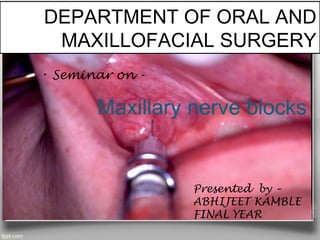
Maxillary nerve blocks
• Seminar on -
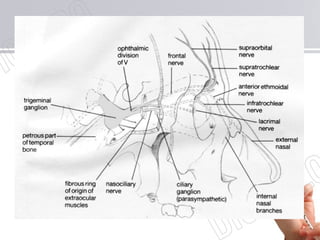
Opthalmic division V1
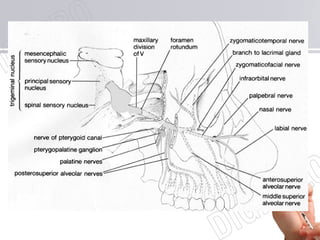
Maxillary nerve V2
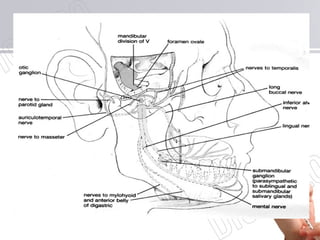
Mandibular nerve V3
www.themegallery.com
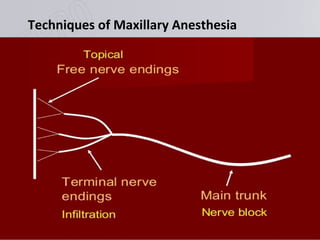
Techniques of Maxillary Anesthesia
www.themegallery.com
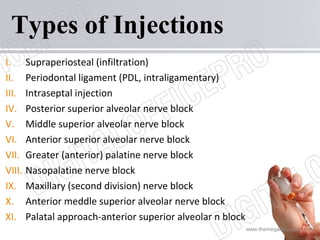
Types of Injections
I. Supraperiosteal (infiltration)
II. Periodontal ligament (PDL, intraligamentary)
III. Intraseptal injection
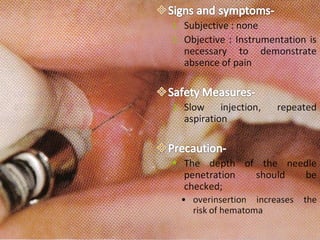
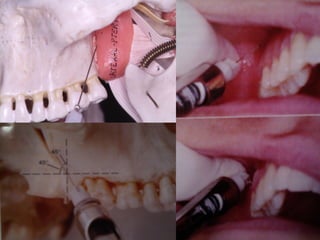
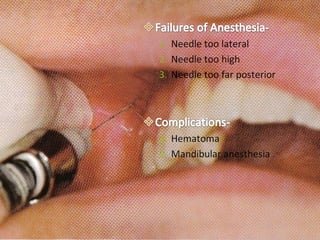
IV. Posterior superior alveolar nerve block
V. Middle superior alveolar nerve block
VI. Anterior superior alveolar nerve block
VII. Greater (anterior) palatine nerve block
VIII. Nasopalatine nerve block
IX. Maxillary (second division) nerve block
X. Anterior meddle superior alveolar nerve block
XI. Palatal approach-anterior superior alveolar n block
www.themegallery.com
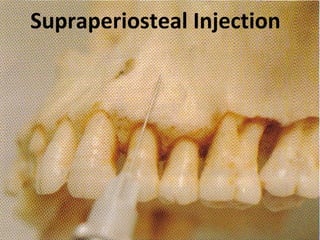
Supraperiosteal Injection
www.themegallery.com
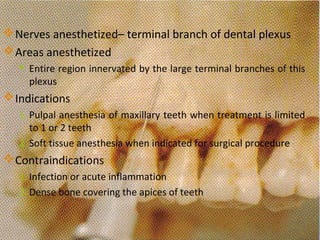
Nerves anesthetized– terminal branch of dental plexus
Areas anesthetized
 Entire region innervated by the large terminal branches of this
plexus
Indications
1. Pulpal anesthesia of maxillary teeth when treatment is limited
to 1 or 2 teeth
2. Soft tissue anesthesia when indicated for surgical procedure
Contraindications
1. Infection or acute inflammation
2. Dense bone covering the apices of teeth
www.themegallery.com
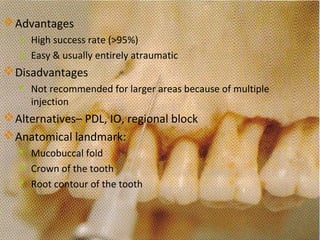
Advantages
1. High success rate (>95%)
2. Easy & usually entirely atraumatic
Disadvantages
 Not recommended for larger areas because of multiple
injection
Alternatives– PDL, IO, regional block
Anatomical landmark:
 Mucobuccal fold
 Crown of the tooth
 Root contour of the tooth
www.themegallery.com
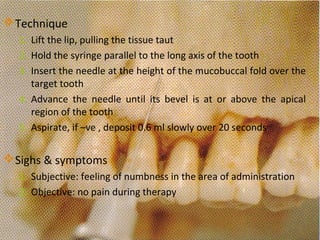
Technique
1. Lift the lip, pulling the tissue taut
2. Hold the syringe parallel to the long axis of the tooth
3. Insert the needle at the height of the mucobuccal fold over the
target tooth
4. Advance the needle until its bevel is at or above the apical
region of the tooth
5. Aspirate, if –ve , deposit 0.6 ml slowly over 20 seconds
Sighs & symptoms
1. Subjective: feeling of numbness in the area of administration
2. Objective: no pain during therapy
www.themegallery.com
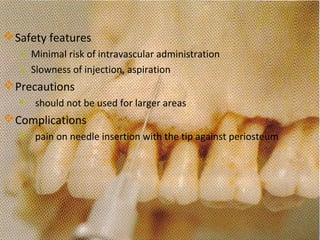
Safety features
1. Minimal risk of intravascular administration
2. Slowness of injection, aspiration
Precautions
 should not be used for larger areas
Complications
 pain on needle insertion with the tip against periosteum
www.themegallery.com
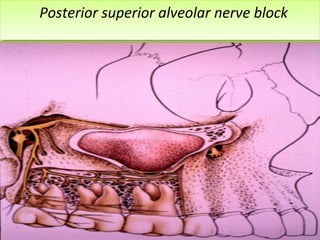
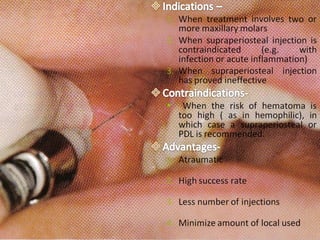
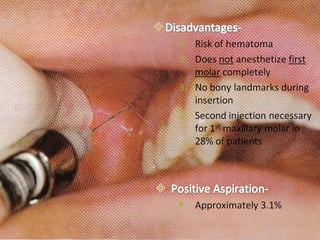
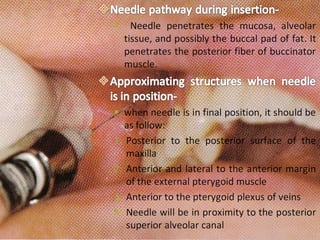
Posterior superior alveolar nerve blockPosterior superior alveolar nerve block
www.themegallery.com
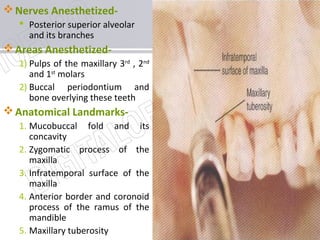
Nerves Anesthetized-
 Posterior superior alveolar
and its branches
Areas Anesthetized-
1) Pulps of the maxillary 3rd
, 2nd
and 1st
molars
2) Buccal periodontium and
bone overlying these teeth
Anatomical Landmarks-
1. Mucobuccal fold and its
concavity
2. Zygomatic process of the
maxilla
3. Infratemporal surface of the
maxilla
4. Anterior border and coronoid
process of the ramus of the
mandible
5. Maxillary tuberosity
www.themegallery.com
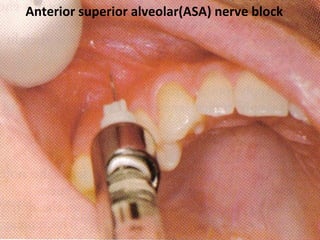
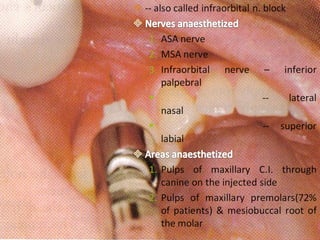
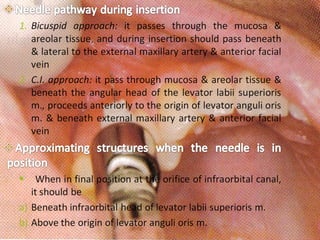
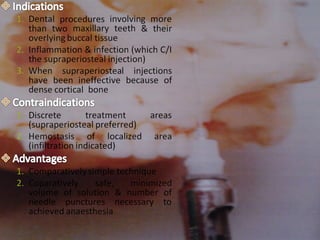
Anterior superior alveolar(ASA) nerve block
www.themegallery.com
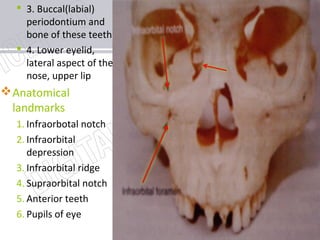
 3. Buccal(labial)
periodontium and
bone of these teeth
 4. Lower eyelid,
lateral aspect of the
nose, upper lip
Anatomical
landmarks
1. Infraorbotal notch
2. Infraorbital
depression
3. Infraorbital ridge
4. Supraorbital notch
5. Anterior teeth
6. Pupils of eye
www.themegallery.com
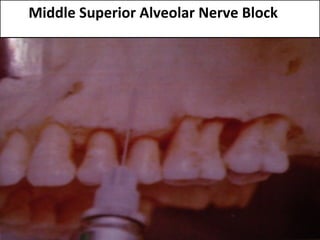
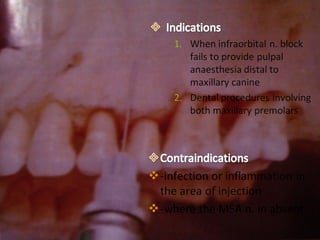
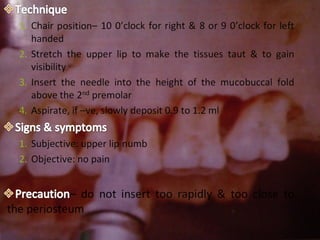
Middle Superior Alveolar Nerve Block
www.themegallery.com
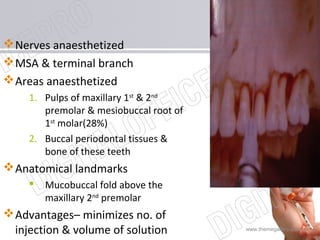
Nerves anaesthetized
MSA & terminal branch
Areas anaesthetized
1. Pulps of maxillary 1st
& 2nd
premolar & mesiobuccal root of
1st
molar(28%)
2. Buccal periodontal tissues &
bone of these teeth
Anatomical landmarks
 Mucobuccal fold above the
maxillary 2nd
premolar
Advantages– minimizes no. of
injection & volume of solution
www.themegallery.com
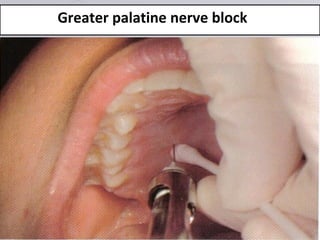
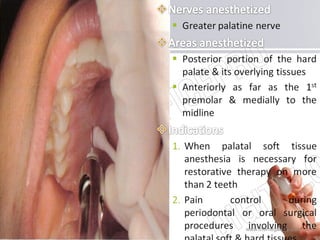
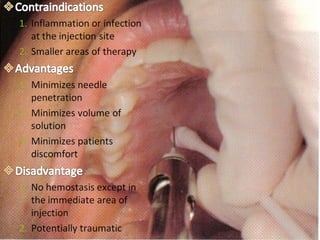
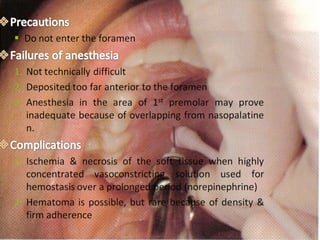
Greater palatine nerve block
www.themegallery.com
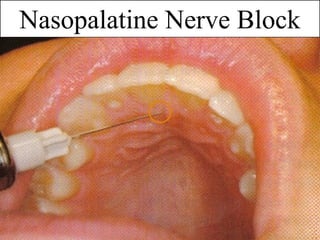
Nasopalatine Nerve Block
www.themegallery.com
Technique
Two types of technique– 1.single
penetration
2. multiple penetration
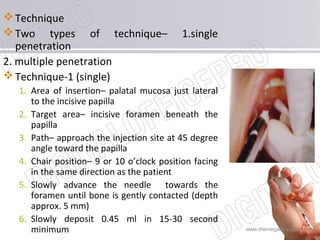
Technique-1 (single)
1. Area of insertion– palatal mucosa just lateral
to the incisive papilla
2. Target area– incisive foramen beneath the
papilla
3. Path– approach the injection site at 45 degree
angle toward the papilla
4. Chair position– 9 or 10 o’clock position facing
in the same direction as the patient
5. Slowly advance the needle towards the
foramen until bone is gently contacted (depth
approx. 5 mm)
6. Slowly deposit 0.45 ml in 15-30 second
minimum
www.themegallery.com
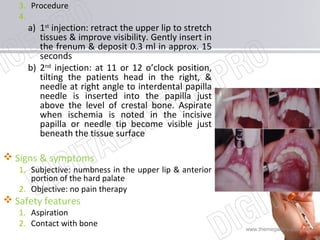
3. Procedure
4.
a) 1st
injection: retract the upper lip to stretch
tissues & improve visibility. Gently insert in
the frenum & deposit 0.3 ml in approx. 15
seconds
b) 2nd
injection: at 11 or 12 o’clock position,
tilting the patients head in the right, &
needle at right angle to interdental papilla
needle is inserted into the papilla just
above the level of crestal bone. Aspirate
when ischemia is noted in the incisive
papilla or needle tip become visible just
beneath the tissue surface
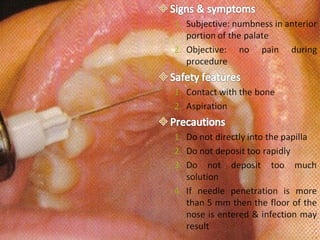
 Signs & symptoms
1. Subjective: numbness in the upper lip & anterior
portion of the hard palate
2. Objective: no pain therapy
 Safety features
1. Aspiration
2. Contact with bone
www.themegallery.com
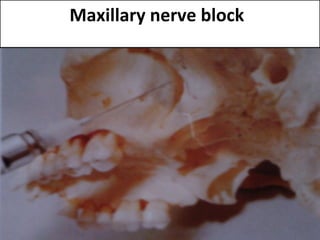
Maxillary nerve block
www.themegallery.com
Alternatives
1. PSA nerve block
2. ASA nerve block
3. GP nerve block
4. Nasopalatine nerve block
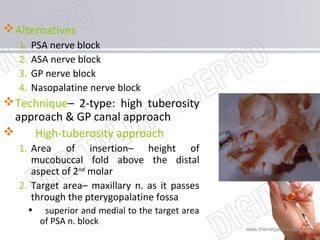
Technique– 2-type: high tuberosity
approach & GP canal approach
 High-tuberosity approach
1. Area of insertion– height of
mucobuccal fold above the distal
aspect of 2nd
molar
2. Target area– maxillary n. as it passes
through the pterygopalatine fossa
• superior and medial to the target area
of PSA n. block
www.themegallery.com
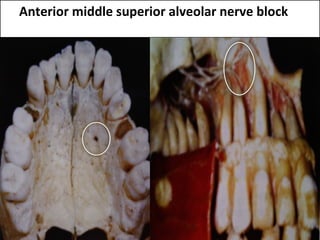
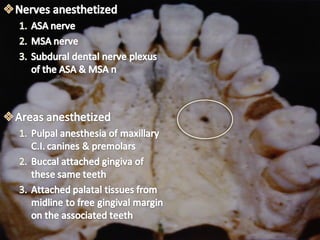
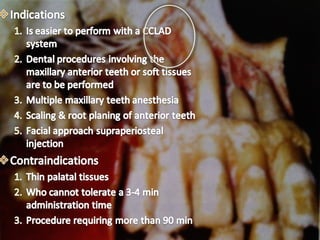
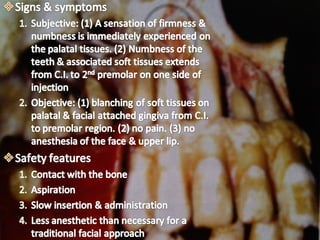
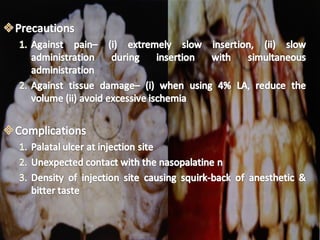
Anterior middle superior alveolar nerve block
www.themegallery.com
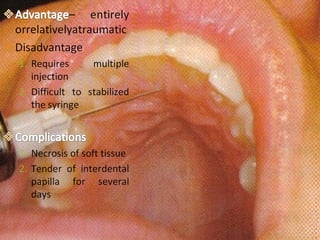
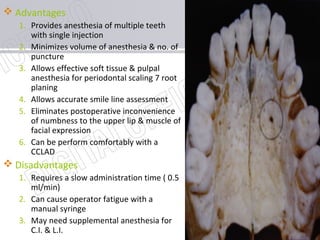
 Advantages
1. Provides anesthesia of multiple teeth
with single injection
2. Minimizes volume of anesthesia & no. of
puncture
3. Allows effective soft tissue & pulpal
anesthesia for periodontal scaling 7 root
planing
4. Allows accurate smile line assessment
5. Eliminates postoperative inconvenience
of numbness to the upper lip & muscle of
facial expression
6. Can be perform comfortably with a
CCLAD
 Disadvantages
1. Requires a slow administration time ( 0.5
ml/min)
2. Can cause operator fatigue with a
manual syringe
3. May need supplemental anesthesia for
C.I. & L.I.
www.themegallery.com

maxillary nerve blocks

Editor's Notes

  • #3 It arises from medial part of convex anterior border of trigeminal ganglion.Then it pierces the duramater of trigeminal cave and enters into lateral wall of cavernous sinus.Finally,it entera the orbit through the superior orbital fissure and divides into three branches namely lacrimal,frontal and nasocilliary.
  • #4 It arises