e-Learning and Pedagogy a New Trend in e-Learning Dr Wolfgang Greller Faculty Day University of Veterinary Science Vienna 22 March 2005
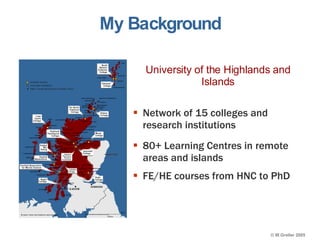
My Background FE/HE courses from HNC to PhD  80+ Learning Centres in remote areas and islands Network of 15 colleges and research institutions University of the Highlands and Islands
Why e-Learning? Offers flexible learning on demand, any time or anywhere Allows for creative innovation in education and new ways of delivery Provides a safe environment Creates an economy of scale that is otherwise impossible Captures teaching and learning
Benefits of ICT Charles Clarke  (prev. Minister of Education, now Home Secretary of the UK): “ Institutions should take full advantage of the benefits of ICT, both  pedagogically  to enhance teaching, and  administratively  to maximise value for money” “ They need to respond effectively to the increased ICT  demands  of today’s students”
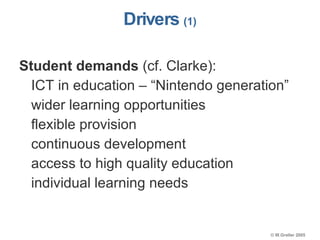
Drivers  (1) Student demands  (cf. Clarke): ICT in education – “Nintendo generation” wider learning opportunities flexible provision continuous development access to high quality education individual learning needs
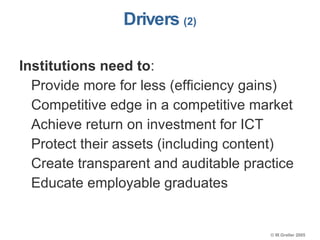
Drivers  (2) Institutions need to : Provide more for less (efficiency gains) Competitive edge in a competitive market Achieve return on investment for ICT Protect their assets (including content) Create transparent and auditable practice Educate employable graduates
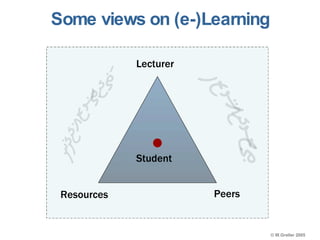
Some views on (e-)Learning Lecturer Resources Peers University Services Student
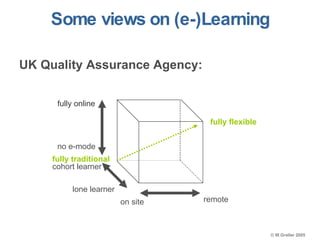
Some views on (e-)Learning UK Quality Assurance Agency: lone learner fully online no e-mode cohort learner remote on site fully flexible fully traditional
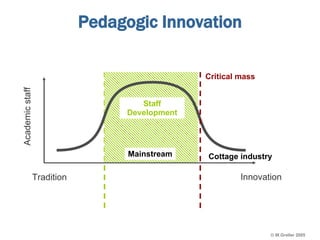
Pedagogic Innovation Staff Development Academic staff Innovation Tradition Critical mass Cottage industry Mainstream
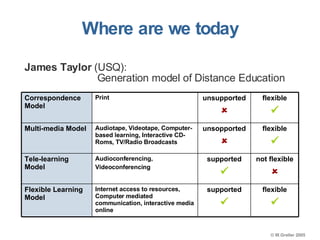
Where are we today James Taylor  (USQ):    Generation model of Distance Education flexible  supported  Internet access to resources, Computer mediated communication, interactive media online Flexible Learning Model not flexible  supported  Audioconferencing, Videoconferencing Tele-learning Model flexible  unsopported  Audiotape, Videotape, Computer-based learning, Interactive CD-Roms, TV/Radio Broadcasts Multi-media Model flexible  unsupported  Print Correspondence Model
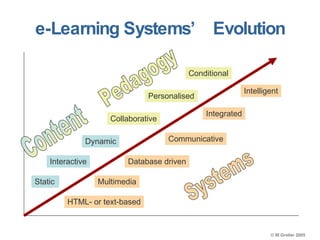
e-Learning Systems’ Evolution Static Interactive Collaborative Personalised Conditional Dynamic HTML- or text-based Database driven Communicative Integrated Intelligent Content Pedagogy Multimedia Systems
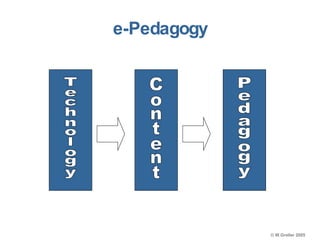
e-Pedagogy Technology Content Pedagogy
LEARNING The big question e   - How?
The Problem Zone e-Learning is driven by technology not by pedagogy Current tools and platforms only provide (structured) content – does not produce learning Learning is a social activity Pedagogy of e-Learning is hidden and not portable HEFCE strategy (2005) : Committed to  fully  embed e-learning in a   sustainable way within the next 10 years! but
Pain ?! Technology can be limiting to pedagogy Content by itself has little or no value to the learner (cf. MIT OpenCourseware) – it needs to be supported and contextualised The academic focus lies on research not on teaching Academic lecturers are a largely untrained workforce (Casey & Brosnan 2004) These factors lead to poor pedagogic quality of online provision and a mixed student experience
Learning Design Good pedagogy  can be derived from different sources (Koper 2005): Pedagogic theory Good practice Educational patterns
Learning Design In 2003, the IMS Global Consortium adopted the IMS Learning Design specification: It makes L&T processes explicit to be reflected, refined, reviewed and shared It makes them machine readable and discoverable It creates portability from system to system and supports blended learning It contains learning sequences/activities It supports multi-user activities
Learning Design The basic idea of LD is to create a  common vocabulary  for users of any pedagogic application into which existing and new designs can be translated (Koper 2005). It allows learners to do: different things  @  the same time the same things  @  different times
Learning Design Identifies the learners as: People in specific groups and roles engage in activities using an environment with appropriate resources and services Will lead to the next generation of virtual learning environments (VLEs)
Learning Desing Implementation of LD: There is still a looooooooooong way to go……… Wolfgang Greller Head of Learning Environments UHI Millennium Institute Stornoway, Isle of Lewis SCOTLAND [email_address]

Elearning And Pedagogy

  • 1.
    e-Learning and Pedagogya New Trend in e-Learning Dr Wolfgang Greller Faculty Day University of Veterinary Science Vienna 22 March 2005
  • 2.
    My Background FE/HEcourses from HNC to PhD 80+ Learning Centres in remote areas and islands Network of 15 colleges and research institutions University of the Highlands and Islands
  • 3.
    Why e-Learning? Offersflexible learning on demand, any time or anywhere Allows for creative innovation in education and new ways of delivery Provides a safe environment Creates an economy of scale that is otherwise impossible Captures teaching and learning
  • 4.
    Benefits of ICTCharles Clarke (prev. Minister of Education, now Home Secretary of the UK): “ Institutions should take full advantage of the benefits of ICT, both pedagogically to enhance teaching, and administratively to maximise value for money” “ They need to respond effectively to the increased ICT demands of today’s students”
  • 5.
    Drivers (1)Student demands (cf. Clarke): ICT in education – “Nintendo generation” wider learning opportunities flexible provision continuous development access to high quality education individual learning needs
  • 6.
    Drivers (2)Institutions need to : Provide more for less (efficiency gains) Competitive edge in a competitive market Achieve return on investment for ICT Protect their assets (including content) Create transparent and auditable practice Educate employable graduates
  • 7.
    Some views on(e-)Learning Lecturer Resources Peers University Services Student
  • 8.
    Some views on(e-)Learning UK Quality Assurance Agency: lone learner fully online no e-mode cohort learner remote on site fully flexible fully traditional
  • 9.
    Pedagogic Innovation StaffDevelopment Academic staff Innovation Tradition Critical mass Cottage industry Mainstream
  • 10.
    Where are wetoday James Taylor (USQ): Generation model of Distance Education flexible  supported  Internet access to resources, Computer mediated communication, interactive media online Flexible Learning Model not flexible  supported  Audioconferencing, Videoconferencing Tele-learning Model flexible  unsopported  Audiotape, Videotape, Computer-based learning, Interactive CD-Roms, TV/Radio Broadcasts Multi-media Model flexible  unsupported  Print Correspondence Model
  • 11.
    e-Learning Systems’ EvolutionStatic Interactive Collaborative Personalised Conditional Dynamic HTML- or text-based Database driven Communicative Integrated Intelligent Content Pedagogy Multimedia Systems
  • 12.
  • 13.
    LEARNING The bigquestion e - How?
  • 14.
    The Problem Zonee-Learning is driven by technology not by pedagogy Current tools and platforms only provide (structured) content – does not produce learning Learning is a social activity Pedagogy of e-Learning is hidden and not portable HEFCE strategy (2005) : Committed to fully embed e-learning in a sustainable way within the next 10 years! but
  • 15.
    Pain ?! Technologycan be limiting to pedagogy Content by itself has little or no value to the learner (cf. MIT OpenCourseware) – it needs to be supported and contextualised The academic focus lies on research not on teaching Academic lecturers are a largely untrained workforce (Casey & Brosnan 2004) These factors lead to poor pedagogic quality of online provision and a mixed student experience
  • 16.
    Learning Design Goodpedagogy can be derived from different sources (Koper 2005): Pedagogic theory Good practice Educational patterns
  • 17.
    Learning Design In2003, the IMS Global Consortium adopted the IMS Learning Design specification: It makes L&T processes explicit to be reflected, refined, reviewed and shared It makes them machine readable and discoverable It creates portability from system to system and supports blended learning It contains learning sequences/activities It supports multi-user activities
  • 18.
    Learning Design Thebasic idea of LD is to create a common vocabulary for users of any pedagogic application into which existing and new designs can be translated (Koper 2005). It allows learners to do: different things @ the same time the same things @ different times
  • 19.
    Learning Design Identifiesthe learners as: People in specific groups and roles engage in activities using an environment with appropriate resources and services Will lead to the next generation of virtual learning environments (VLEs)
  • 20.
    Learning Desing Implementationof LD: There is still a looooooooooong way to go……… Wolfgang Greller Head of Learning Environments UHI Millennium Institute Stornoway, Isle of Lewis SCOTLAND [email_address]