ICH GUIDELINE- Quality
Pharmansh
Introduction:
The International Council for Harmonization of Technical Requirements for Pharmaceuticals for Human
Use.
 Unique in bringing together the regulatory authorities and pharmaceutical industry to discuss scientific
and technical aspects of drug registration.
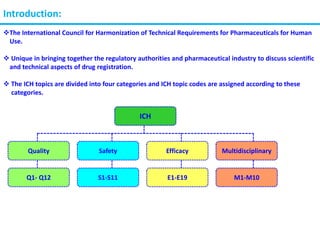
 The ICH topics are divided into four categories and ICH topic codes are assigned according to these
categories.
ICH
SafetyQuality Efficacy Multidisciplinary
Q1- Q12 S1-S11 E1-E19 M1-M10
Introduction:
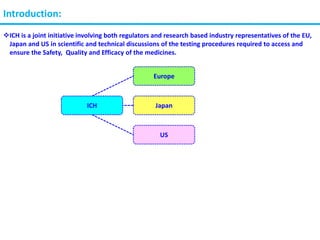
ICH is a joint initiative involving both regulators and research based industry representatives of the EU,
Japan and US in scientific and technical discussions of the testing procedures required to access and
ensure the Safety, Quality and Efficacy of the medicines.
ICH Japan
Europe
US
Quality Guideline:
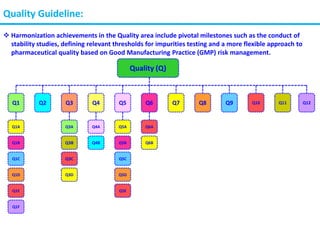
 Harmonization achievements in the Quality area include pivotal milestones such as the conduct of
stability studies, defining relevant thresholds for impurities testing and a more flexible approach to
pharmaceutical quality based on Good Manufacturing Practice (GMP) risk management.
Quality (Q)
Q1 Q2 Q3 Q4 Q5 Q6 Q7 Q8 Q9 Q10 Q11 Q12
Q1A
Q1B
Q1C
Q1E
Q1F
Q1D
Q3A
Q3B
Q3C
Q3D
Q4A
Q4B
Q5A
Q5B
Q5C
Q5E
Q5D
Q6A
Q6B
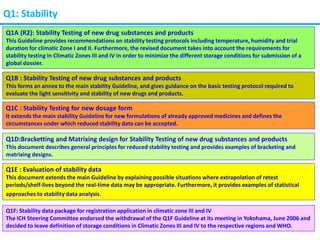
Q1: Stability
Q1A (R2): Stability Testing of new drug substances and products
This Guideline provides recommendations on stability testing protocols including temperature, humidity and trial
duration for climatic Zone I and II. Furthermore, the revised document takes into account the requirements for
stability testing in Climatic Zones III and IV in order to minimize the different storage conditions for submission of a
global dossier.
Q1B : Stability Testing of new drug substances and products
This forms an annex to the main stability Guideline, and gives guidance on the basic testing protocol required to
evaluate the light sensitivity and stability of new drugs and products.
Q1C : Stability Testing for new dosage form
It extends the main stability Guideline for new formulations of already approved medicines and defines the
circumstances under which reduced stability data can be accepted.
Q1D:Bracketting and Matrixing design for Stability Testing of new drug substances and products
This document describes general principles for reduced stability testing and provides examples of bracketing and
matrixing designs.
Q1E : Evaluation of stability data
This document extends the main Guideline by explaining possible situations where extrapolation of retest
periods/shelf-lives beyond the real-time data may be appropriate. Furthermore, it provides examples of statistical
approaches to stability data analysis.
Q1F: Stability data package for registration application in climatic zone III and IV
The ICH Steering Committee endorsed the withdrawal of the Q1F Guideline at its meeting in Yokohama, June 2006 and
decided to leave definition of storage conditions in Climatic Zones III and IV to the respective regions and WHO.
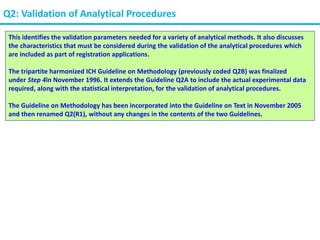
Q2: Validation of Analytical Procedures
This identifies the validation parameters needed for a variety of analytical methods. It also discusses
the characteristics that must be considered during the validation of the analytical procedures which
are included as part of registration applications.
The tripartite harmonized ICH Guideline on Methodology (previously coded Q2B) was finalized
under Step 4in November 1996. It extends the Guideline Q2A to include the actual experimental data
required, along with the statistical interpretation, for the validation of analytical procedures.
The Guideline on Methodology has been incorporated into the Guideline on Text in November 2005
and then renamed Q2(R1), without any changes in the contents of the two Guidelines.
Q3: Impurities
Q3A: Impurities in new drug substances
The Guideline addresses the chemistry and safety aspects of impurities, including the listing of impurities in
specifications and defines the thresholds for reporting, identification and qualification. The revision of the guideline
has allowed clarifying some inconsistencies, to revise the decision tree, to harmonize with Q3B and to address some
editorial issues.
Q3B: Impurities in new drug products
It complements the Guideline on impurities in new drug substances and provides advice in regard to impurities in
products containing new, chemically synthesized drug substances. The Guideline specifically deals with those
impurities which might arise as degradation products of the drug substance or arising from interactions between drug
substance and excipients or components of primary packaging materials. The Guideline sets out a rationale for the
reporting, identification and qualification of such impurities based on a scientific appraisal of likely and actual
impurities observed, and of the safety implications, following the principles elaborated in the parent Guideline.
Threshold values for reporting and control of impurities are proposed, based on the maximum daily dose of the drug
substance administered in the product.
Q3C: Guideline for residual Solvents
This recommends the use of less toxic solvents in the manufacture of drug substances and dosage forms, and sets
pharmaceutical limits for residual solvents (organic volatile impurities) in drug products.
Q3D: Guideline for Elemental Impurities
This guidance aims to provide a global policy for limiting metal impurities qualitatively and quantitatively in drug
products and ingredients. The existing ICH Q3A Guideline classifies impurities as organic, inorganic, and residual
solvents. The Q3A and Q3B Guidelines effectively address the requirements for organic impurities. An additional
Guideline Q3C was developed to provide clarification of the requirements for residual solvents.
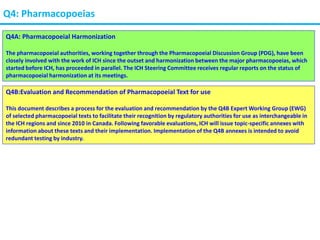
Q4: Pharmacopoeias
Q4A: Pharmacopoeial Harmonization
The pharmacopoeial authorities, working together through the Pharmacopoeial Discussion Group (PDG), have been
closely involved with the work of ICH since the outset and harmonization between the major pharmacopoeias, which
started before ICH, has proceeded in parallel. The ICH Steering Committee receives regular reports on the status of
pharmacopoeial harmonization at its meetings.
Q4B:Evaluation and Recommendation of Pharmacopoeial Text for use
This document describes a process for the evaluation and recommendation by the Q4B Expert Working Group (EWG)
of selected pharmacopoeial texts to facilitate their recognition by regulatory authorities for use as interchangeable in
the ICH regions and since 2010 in Canada. Following favorable evaluations, ICH will issue topic-specific annexes with
information about these texts and their implementation. Implementation of the Q4B annexes is intended to avoid
redundant testing by industry.
Q4: Pharmacopoeias
Q4A: Pharmacopoeial Harmonization
The pharmacopoeial authorities, working together through the Pharmacopoeial Discussion Group (PDG), have been
closely involved with the work of ICH since the outset and harmonization between the major pharmacopoeias, which
started before ICH, has proceeded in parallel. The ICH Steering Committee receives regular reports on the status of
pharmacopoeial harmonization at its meetings.
Q4B:Evaluation and Recommendation of Pharmacopoeial Text for use
This document describes a process for the evaluation and recommendation by the Q4B Expert Working Group (EWG)
of selected pharmacopoeial texts to facilitate their recognition by regulatory authorities for use as interchangeable in
the ICH regions and since 2010 in Canada. Following favorable evaluations, ICH will issue topic-specific annexes with
information about these texts and their implementation. Implementation of the Q4B annexes is intended to avoid
redundant testing by industry.
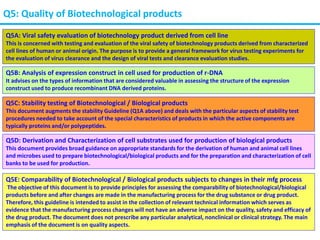
Q5: Quality of Biotechnological products
Q5A: Viral safety evaluation of biotechnology product derived from cell line
This is concerned with testing and evaluation of the viral safety of biotechnology products derived from characterized
cell lines of human or animal origin. The purpose is to provide a general framework for virus testing experiments for
the evaluation of virus clearance and the design of viral tests and clearance evaluation studies.
Q5B: Analysis of expression construct in cell used for production of r-DNA
It advises on the types of information that are considered valuable in assessing the structure of the expression
construct used to produce recombinant DNA derived proteins.
Q5C: Stability testing of Biotechnological / Biological products
This document augments the stability Guideline (Q1A above) and deals with the particular aspects of stability test
procedures needed to take account of the special characteristics of products in which the active components are
typically proteins and/or polypeptides.
Q5D: Derivation and Characterization of cell substrates used for production of biological products
This document provides broad guidance on appropriate standards for the derivation of human and animal cell lines
and microbes used to prepare biotechnological/biological products and for the preparation and characterization of cell
banks to be used for production.
Q5E: Comparability of Biotechnological / Biological products subjects to changes in their mfg process
The objective of this document is to provide principles for assessing the comparability of biotechnological/biological
products before and after changes are made in the manufacturing process for the drug substance or drug product.
Therefore, this guideline is intended to assist in the collection of relevant technical information which serves as
evidence that the manufacturing process changes will not have an adverse impact on the quality, safety and efficacy of
the drug product. The document does not prescribe any particular analytical, nonclinical or clinical strategy. The main
emphasis of the document is on quality aspects.
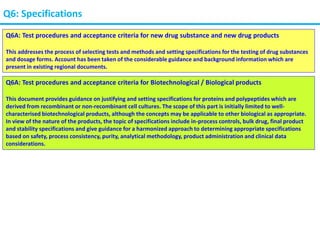
Q6: Specifications
Q6A: Test procedures and acceptance criteria for new drug substance and new drug products
This addresses the process of selecting tests and methods and setting specifications for the testing of drug substances
and dosage forms. Account has been taken of the considerable guidance and background information which are
present in existing regional documents.
Q6A: Test procedures and acceptance criteria for Biotechnological / Biological products
This document provides guidance on justifying and setting specifications for proteins and polypeptides which are
derived from recombinant or non-recombinant cell cultures. The scope of this part is initially limited to well-
characterised biotechnological products, although the concepts may be applicable to other biological as appropriate.
In view of the nature of the products, the topic of specifications include in-process controls, bulk drug, final product
and stability specifications and give guidance for a harmonized approach to determining appropriate specifications
based on safety, process consistency, purity, analytical methodology, product administration and clinical data
considerations.
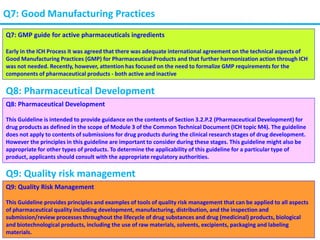
Q7: Good Manufacturing Practices
Q7: GMP guide for active pharmaceuticals ingredients
Early in the ICH Process it was agreed that there was adequate international agreement on the technical aspects of
Good Manufacturing Practices (GMP) for Pharmaceutical Products and that further harmonization action through ICH
was not needed. Recently, however, attention has focused on the need to formalize GMP requirements for the
components of pharmaceutical products - both active and inactive
Q8: Pharmaceutical Development
This Guideline is intended to provide guidance on the contents of Section 3.2.P.2 (Pharmaceutical Development) for
drug products as defined in the scope of Module 3 of the Common Technical Document (ICH topic M4). The guideline
does not apply to contents of submissions for drug products during the clinical research stages of drug development.
However the principles in this guideline are important to consider during these stages. This guideline might also be
appropriate for other types of products. To determine the applicability of this guideline for a particular type of
product, applicants should consult with the appropriate regulatory authorities.
Q9: Quality risk management
Q9: Quality Risk Management
This Guideline provides principles and examples of tools of quality risk management that can be applied to all aspects
of pharmaceutical quality including development, manufacturing, distribution, and the inspection and
submission/review processes throughout the lifecycle of drug substances and drug (medicinal) products, biological
and biotechnological products, including the use of raw materials, solvents, excipients, packaging and labeling
materials.
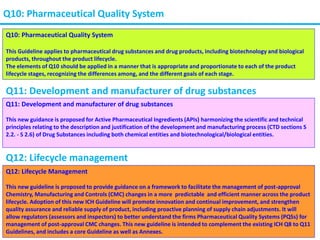
Q10: Pharmaceutical Quality System
This Guideline applies to pharmaceutical drug substances and drug products, including biotechnology and biological
products, throughout the product lifecycle.
The elements of Q10 should be applied in a manner that is appropriate and proportionate to each of the product
lifecycle stages, recognizing the differences among, and the different goals of each stage.
Q11: Development and manufacturer of drug substances
This new guidance is proposed for Active Pharmaceutical Ingredients (APIs) harmonizing the scientific and technical
principles relating to the description and justification of the development and manufacturing process (CTD sections S
2.2. - S 2.6) of Drug Substances including both chemical entities and biotechnological/biological entities.
Q12: Lifecycle management
Q12: Lifecycle Management
This new guideline is proposed to provide guidance on a framework to facilitate the management of post-approval
Chemistry, Manufacturing and Controls (CMC) changes in a more predictable and efficient manner across the product
lifecycle. Adoption of this new ICH Guideline will promote innovation and continual improvement, and strengthen
quality assurance and reliable supply of product, including proactive planning of supply chain adjustments. It will
allow regulators (assessors and inspectors) to better understand the firms Pharmaceutical Quality Systems (PQSs) for
management of post-approval CMC changes. This new guideline is intended to complement the existing ICH Q8 to Q11
Guidelines, and includes a core Guideline as well as Annexes.

Ich guideline quality

  • 1.
  • 2.
    Introduction: The International Councilfor Harmonization of Technical Requirements for Pharmaceuticals for Human Use.  Unique in bringing together the regulatory authorities and pharmaceutical industry to discuss scientific and technical aspects of drug registration.  The ICH topics are divided into four categories and ICH topic codes are assigned according to these categories. ICH SafetyQuality Efficacy Multidisciplinary Q1- Q12 S1-S11 E1-E19 M1-M10
  • 3.
    Introduction: ICH is ajoint initiative involving both regulators and research based industry representatives of the EU, Japan and US in scientific and technical discussions of the testing procedures required to access and ensure the Safety, Quality and Efficacy of the medicines. ICH Japan Europe US
  • 4.
    Quality Guideline:  Harmonizationachievements in the Quality area include pivotal milestones such as the conduct of stability studies, defining relevant thresholds for impurities testing and a more flexible approach to pharmaceutical quality based on Good Manufacturing Practice (GMP) risk management. Quality (Q) Q1 Q2 Q3 Q4 Q5 Q6 Q7 Q8 Q9 Q10 Q11 Q12 Q1A Q1B Q1C Q1E Q1F Q1D Q3A Q3B Q3C Q3D Q4A Q4B Q5A Q5B Q5C Q5E Q5D Q6A Q6B
  • 5.
    Q1: Stability Q1A (R2):Stability Testing of new drug substances and products This Guideline provides recommendations on stability testing protocols including temperature, humidity and trial duration for climatic Zone I and II. Furthermore, the revised document takes into account the requirements for stability testing in Climatic Zones III and IV in order to minimize the different storage conditions for submission of a global dossier. Q1B : Stability Testing of new drug substances and products This forms an annex to the main stability Guideline, and gives guidance on the basic testing protocol required to evaluate the light sensitivity and stability of new drugs and products. Q1C : Stability Testing for new dosage form It extends the main stability Guideline for new formulations of already approved medicines and defines the circumstances under which reduced stability data can be accepted. Q1D:Bracketting and Matrixing design for Stability Testing of new drug substances and products This document describes general principles for reduced stability testing and provides examples of bracketing and matrixing designs. Q1E : Evaluation of stability data This document extends the main Guideline by explaining possible situations where extrapolation of retest periods/shelf-lives beyond the real-time data may be appropriate. Furthermore, it provides examples of statistical approaches to stability data analysis. Q1F: Stability data package for registration application in climatic zone III and IV The ICH Steering Committee endorsed the withdrawal of the Q1F Guideline at its meeting in Yokohama, June 2006 and decided to leave definition of storage conditions in Climatic Zones III and IV to the respective regions and WHO.
  • 6.
    Q2: Validation ofAnalytical Procedures This identifies the validation parameters needed for a variety of analytical methods. It also discusses the characteristics that must be considered during the validation of the analytical procedures which are included as part of registration applications. The tripartite harmonized ICH Guideline on Methodology (previously coded Q2B) was finalized under Step 4in November 1996. It extends the Guideline Q2A to include the actual experimental data required, along with the statistical interpretation, for the validation of analytical procedures. The Guideline on Methodology has been incorporated into the Guideline on Text in November 2005 and then renamed Q2(R1), without any changes in the contents of the two Guidelines.
  • 7.
    Q3: Impurities Q3A: Impuritiesin new drug substances The Guideline addresses the chemistry and safety aspects of impurities, including the listing of impurities in specifications and defines the thresholds for reporting, identification and qualification. The revision of the guideline has allowed clarifying some inconsistencies, to revise the decision tree, to harmonize with Q3B and to address some editorial issues. Q3B: Impurities in new drug products It complements the Guideline on impurities in new drug substances and provides advice in regard to impurities in products containing new, chemically synthesized drug substances. The Guideline specifically deals with those impurities which might arise as degradation products of the drug substance or arising from interactions between drug substance and excipients or components of primary packaging materials. The Guideline sets out a rationale for the reporting, identification and qualification of such impurities based on a scientific appraisal of likely and actual impurities observed, and of the safety implications, following the principles elaborated in the parent Guideline. Threshold values for reporting and control of impurities are proposed, based on the maximum daily dose of the drug substance administered in the product. Q3C: Guideline for residual Solvents This recommends the use of less toxic solvents in the manufacture of drug substances and dosage forms, and sets pharmaceutical limits for residual solvents (organic volatile impurities) in drug products. Q3D: Guideline for Elemental Impurities This guidance aims to provide a global policy for limiting metal impurities qualitatively and quantitatively in drug products and ingredients. The existing ICH Q3A Guideline classifies impurities as organic, inorganic, and residual solvents. The Q3A and Q3B Guidelines effectively address the requirements for organic impurities. An additional Guideline Q3C was developed to provide clarification of the requirements for residual solvents.
  • 8.
    Q4: Pharmacopoeias Q4A: PharmacopoeialHarmonization The pharmacopoeial authorities, working together through the Pharmacopoeial Discussion Group (PDG), have been closely involved with the work of ICH since the outset and harmonization between the major pharmacopoeias, which started before ICH, has proceeded in parallel. The ICH Steering Committee receives regular reports on the status of pharmacopoeial harmonization at its meetings. Q4B:Evaluation and Recommendation of Pharmacopoeial Text for use This document describes a process for the evaluation and recommendation by the Q4B Expert Working Group (EWG) of selected pharmacopoeial texts to facilitate their recognition by regulatory authorities for use as interchangeable in the ICH regions and since 2010 in Canada. Following favorable evaluations, ICH will issue topic-specific annexes with information about these texts and their implementation. Implementation of the Q4B annexes is intended to avoid redundant testing by industry.
  • 9.
    Q4: Pharmacopoeias Q4A: PharmacopoeialHarmonization The pharmacopoeial authorities, working together through the Pharmacopoeial Discussion Group (PDG), have been closely involved with the work of ICH since the outset and harmonization between the major pharmacopoeias, which started before ICH, has proceeded in parallel. The ICH Steering Committee receives regular reports on the status of pharmacopoeial harmonization at its meetings. Q4B:Evaluation and Recommendation of Pharmacopoeial Text for use This document describes a process for the evaluation and recommendation by the Q4B Expert Working Group (EWG) of selected pharmacopoeial texts to facilitate their recognition by regulatory authorities for use as interchangeable in the ICH regions and since 2010 in Canada. Following favorable evaluations, ICH will issue topic-specific annexes with information about these texts and their implementation. Implementation of the Q4B annexes is intended to avoid redundant testing by industry.
  • 10.
    Q5: Quality ofBiotechnological products Q5A: Viral safety evaluation of biotechnology product derived from cell line This is concerned with testing and evaluation of the viral safety of biotechnology products derived from characterized cell lines of human or animal origin. The purpose is to provide a general framework for virus testing experiments for the evaluation of virus clearance and the design of viral tests and clearance evaluation studies. Q5B: Analysis of expression construct in cell used for production of r-DNA It advises on the types of information that are considered valuable in assessing the structure of the expression construct used to produce recombinant DNA derived proteins. Q5C: Stability testing of Biotechnological / Biological products This document augments the stability Guideline (Q1A above) and deals with the particular aspects of stability test procedures needed to take account of the special characteristics of products in which the active components are typically proteins and/or polypeptides. Q5D: Derivation and Characterization of cell substrates used for production of biological products This document provides broad guidance on appropriate standards for the derivation of human and animal cell lines and microbes used to prepare biotechnological/biological products and for the preparation and characterization of cell banks to be used for production. Q5E: Comparability of Biotechnological / Biological products subjects to changes in their mfg process The objective of this document is to provide principles for assessing the comparability of biotechnological/biological products before and after changes are made in the manufacturing process for the drug substance or drug product. Therefore, this guideline is intended to assist in the collection of relevant technical information which serves as evidence that the manufacturing process changes will not have an adverse impact on the quality, safety and efficacy of the drug product. The document does not prescribe any particular analytical, nonclinical or clinical strategy. The main emphasis of the document is on quality aspects.
  • 11.
    Q6: Specifications Q6A: Testprocedures and acceptance criteria for new drug substance and new drug products This addresses the process of selecting tests and methods and setting specifications for the testing of drug substances and dosage forms. Account has been taken of the considerable guidance and background information which are present in existing regional documents. Q6A: Test procedures and acceptance criteria for Biotechnological / Biological products This document provides guidance on justifying and setting specifications for proteins and polypeptides which are derived from recombinant or non-recombinant cell cultures. The scope of this part is initially limited to well- characterised biotechnological products, although the concepts may be applicable to other biological as appropriate. In view of the nature of the products, the topic of specifications include in-process controls, bulk drug, final product and stability specifications and give guidance for a harmonized approach to determining appropriate specifications based on safety, process consistency, purity, analytical methodology, product administration and clinical data considerations.
  • 12.
    Q7: Good ManufacturingPractices Q7: GMP guide for active pharmaceuticals ingredients Early in the ICH Process it was agreed that there was adequate international agreement on the technical aspects of Good Manufacturing Practices (GMP) for Pharmaceutical Products and that further harmonization action through ICH was not needed. Recently, however, attention has focused on the need to formalize GMP requirements for the components of pharmaceutical products - both active and inactive Q8: Pharmaceutical Development Q8: Pharmaceutical Development This Guideline is intended to provide guidance on the contents of Section 3.2.P.2 (Pharmaceutical Development) for drug products as defined in the scope of Module 3 of the Common Technical Document (ICH topic M4). The guideline does not apply to contents of submissions for drug products during the clinical research stages of drug development. However the principles in this guideline are important to consider during these stages. This guideline might also be appropriate for other types of products. To determine the applicability of this guideline for a particular type of product, applicants should consult with the appropriate regulatory authorities. Q9: Quality risk management Q9: Quality Risk Management This Guideline provides principles and examples of tools of quality risk management that can be applied to all aspects of pharmaceutical quality including development, manufacturing, distribution, and the inspection and submission/review processes throughout the lifecycle of drug substances and drug (medicinal) products, biological and biotechnological products, including the use of raw materials, solvents, excipients, packaging and labeling materials.
  • 13.
    Q10: Pharmaceutical QualitySystem Q10: Pharmaceutical Quality System This Guideline applies to pharmaceutical drug substances and drug products, including biotechnology and biological products, throughout the product lifecycle. The elements of Q10 should be applied in a manner that is appropriate and proportionate to each of the product lifecycle stages, recognizing the differences among, and the different goals of each stage. Q11: Development and manufacturer of drug substances Q11: Development and manufacturer of drug substances This new guidance is proposed for Active Pharmaceutical Ingredients (APIs) harmonizing the scientific and technical principles relating to the description and justification of the development and manufacturing process (CTD sections S 2.2. - S 2.6) of Drug Substances including both chemical entities and biotechnological/biological entities. Q12: Lifecycle management Q12: Lifecycle Management This new guideline is proposed to provide guidance on a framework to facilitate the management of post-approval Chemistry, Manufacturing and Controls (CMC) changes in a more predictable and efficient manner across the product lifecycle. Adoption of this new ICH Guideline will promote innovation and continual improvement, and strengthen quality assurance and reliable supply of product, including proactive planning of supply chain adjustments. It will allow regulators (assessors and inspectors) to better understand the firms Pharmaceutical Quality Systems (PQSs) for management of post-approval CMC changes. This new guideline is intended to complement the existing ICH Q8 to Q11 Guidelines, and includes a core Guideline as well as Annexes.