Introduc)on	
  to	
  Deep	
  Learning	
  
Massimiliano	
  Ruocco	
  
Outline
•  Introduction and Motivation for DL
•  From NN to Deep Learning
•  Deep Learning Models
•  Deep Learning in the Real World
•  Conclusion
Introduction and
Motivation for DL	
  
Introduction
Deep Learning - WHAT
Class of ML training algorithm
Introduction
Deep Learning - Motivations
•  ML Algorithms:
–  Supervised
–  Unsupervised
–  Semi-supervised
–  Reinforcement Learning
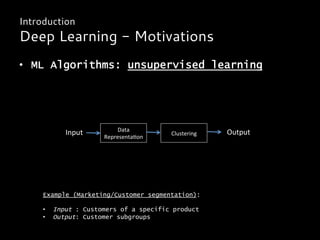
•  ML Algorithms: unsupervised learning
Data	
  
Representa)on	
  
Input	
   Clustering	
   Output	
  
Example (Marketing/Customer segmentation):
•  Input : Customers of a specific product
•  Output: Customer subgroups
Introduction
Deep Learning - Motivations
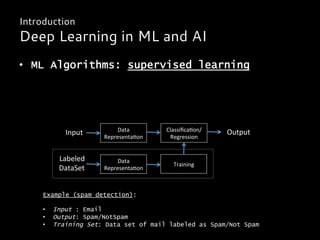
•  ML Algorithms: supervised learning
Data	
  
Representa)on	
  
Input	
   Classifica)on/	
  
Regression	
  
Output	
  
Training	
  
Labeled	
  	
  
DataSet	
  
Data	
  
Representa)on	
  
Example (spam detection):
•  Input : Email
•  Output: Spam/NotSpam
•  Training Set: Data set of mail labeled as Spam/Not Spam
Introduction
Deep Learning in ML and AI
•  ML Algorithms: supervised learning
Data	
  
Representa)on	
  
Input	
   Classifica)on/	
  
Regression	
  
Output	
  
Training	
  
Labeled	
  	
  
DataSet	
  
Data	
  
Representa)on	
  
Example (spam detection):
•  Input : Email
•  Output: Spam/NotSpam
•  Training Set: Data set of mail labeled as Spam/Not Spam
Introduction
Deep Learning – Representation Problem
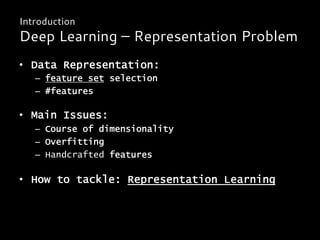
•  Data Representation:
–  feature set selection
–  #features
•  Main Issues:
–  Course of dimensionality
–  Overfitting
–  Handcrafted features
•  How to tackle: Representation Learning
Introduction
Deep Learning – Representation Problem
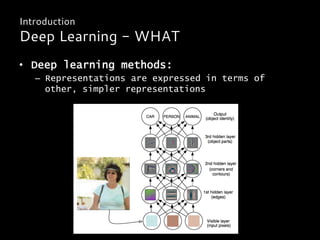
•  Deep learning methods:
–  Representations are expressed in terms of
other, simpler representations
Introduction
Deep Learning - WHAT
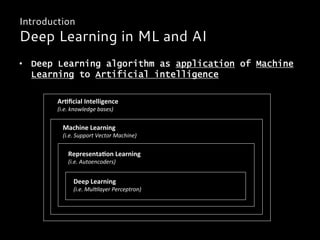
•  Deep Learning algorithm as application of Machine
Learning to Artificial intelligence
Ar#ficial	
  Intelligence	
  	
  
(i.e.	
  knowledge	
  bases)	
  
Machine	
  Learning	
  	
  
(i.e.	
  Support	
  Vector	
  Machine)	
  
Representa#on	
  Learning	
  	
  
(i.e.	
  Autoencoders)	
  
Deep	
  Learning	
  	
  
(i.e.	
  Mul=layer	
  Perceptron)	
  
Introduction
Deep Learning in ML and AI
From Neural Network to
Deep Learning	
  
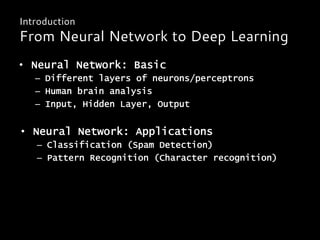
•  Neural Network: Basic
–  Different layers of neurons/perceptrons
–  Human brain analysis
–  Input, Hidden Layer, Output
•  Neural Network: Applications
–  Classification (Spam Detection)
–  Pattern Recognition (Character recognition)
Introduction
From Neural Network to Deep Learning
•  The core: Neuron
Introduction
From Neural Network to Deep Learning
W1	
  
W2	
  
W3	
  
x1	
  
x2	
  
xn	
  
Sigmoid	
  func)on	
  
1/(1+e-­‐z)	
  
Output	
  hw(x)	
  	
  
x	
  =	
  [x0…xn]T	
  	
  
w	
  =	
  [w0…wn]T	
  	
  
z	
  =	
  wTx	
  
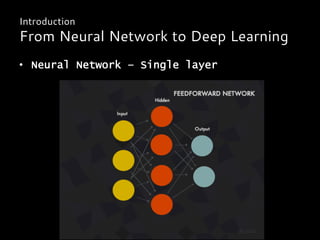
•  Neural Network – Single layer
Introduction
From Neural Network to Deep Learning
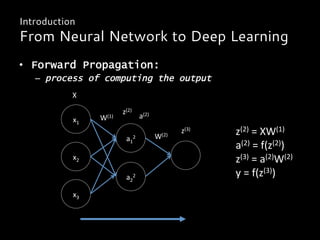
•  Forward Propagation:
–  process of computing the output
Introduction
From Neural Network to Deep Learning
x1	
  
x2	
  
x3	
  
a1
2	
  
a2
2	
  
W(1)	
  
W(2)	
  
a(2)	
  z(2)	
  
z(3)	
  
X	
  
z(2)	
  =	
  XW(1)	
  
a(2)	
  =	
  f(z(2))	
  	
  
z(3)	
  =	
  a(2)W(2)	
  
y	
  =	
  f(z(3))	
  	
  
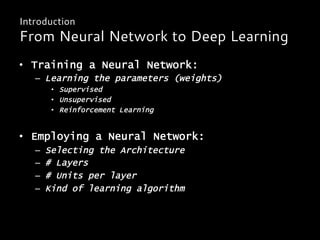
•  Training a Neural Network:
–  Learning the parameters (weights)
•  Supervised
•  Unsupervised
•  Reinforcement Learning
•  Employing a Neural Network:
–  Selecting the Architecture
–  # Layers
–  # Units per layer
–  Kind of learning algorithm
Introduction
From Neural Network to Deep Learning
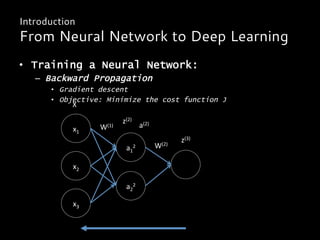
•  Training a Neural Network:
–  Backward Propagation
•  Gradient descent
•  Objective: Minimize the cost function J
Introduction
From Neural Network to Deep Learning
x1	
  
x2	
  
x3	
  
a1
2	
  
a2
2	
  
W(1)	
  
W(2)	
  
a(2)	
  z(2)	
  
z(3)	
  
X	
  
•  DNN à Typically artificial neural netwok
with 3 or more levels of non-linear
operations
Introduction
From Neural Network to Deep Learning
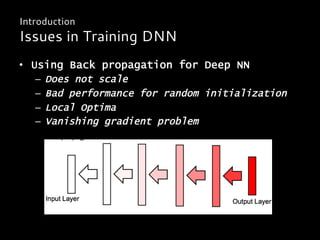
•  Using Back propagation for Deep NN
–  Does not scale
–  Bad performance for random initialization
–  Local Optima
–  Vanishing gradient problem
Introduction
Issues in Training DNN
Introduction
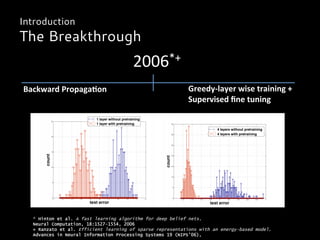
The Breakthrough
2006*+	
  
Backward	
  Propaga#on	
   Greedy-­‐layer	
  wise	
  training	
  +	
  	
  
Supervised	
  fine	
  tuning	
  
* Hinton et al. A fast learning algorithm for deep belief nets.
Neural Computation, 18:1527–1554, 2006
+ Ranzato et al. Efficient learning of sparse representations with an energy-based model.
Advances in Neural Information Processing Systems 19 (NIPS’06),
•  Deep learning methods:
–  Class of ML algorithm
–  Use cascade of many levels of non linear
processing units for feature extraction
–  Hierarchy of concepts
–  Multiple-layered model
–  NN with high number of hidden layers
–  NEW LEARNING ALGORITHM Overcoming previous
training problems
Introduction
Deep Learning - Summary
Deep	
  Learning	
  Models	
  
Deep Learning Models
Introduction
•  Two main classes:
–  Generative
•  Deep Network for supervised Learning
–  Discriminative
•  Deep Network for unsupervised learning
–  Hybrid
Deep Learning Models
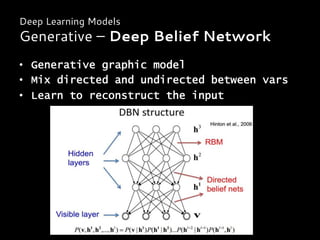
Generative – Deep Belief Network
•  Generative graphic model
•  Mix directed and undirected between vars
•  Learn to reconstruct the input
Deep Learning Models
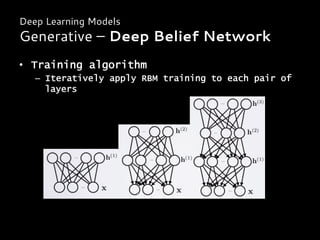
Generative – Deep Belief Network
•  Training algorithm
–  Iteratively apply RBM training to each pair of
layers
Deep Learning Models
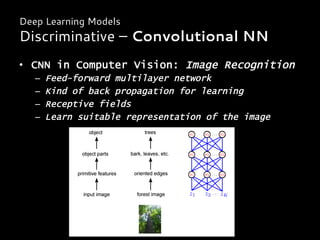
Discriminative – Convolutional NN
•  CNN in Computer Vision: Image Recognition
–  Feed-forward multilayer network
–  Kind of back propagation for learning
–  Receptive fields
–  Learn suitable representation of the image
Deep Learning Models
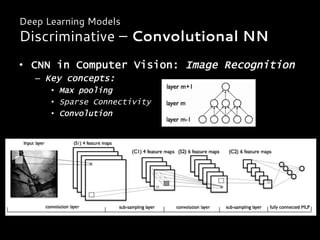
Discriminative – Convolutional NN
•  CNN in Computer Vision: Image Recognition
–  Key concepts:
•  Max pooling
•  Sparse Connectivity
•  Convolution
Deep	
  Learning	
  in	
  the	
  Real	
  World	
  
•  NLP
•  Image Classification/Computer Vision
•  Speech Recognition
Introduction
Deep Learning – Application Field
•  [Google] 2013
acquired DNNresearch of professor Geoff
Hinton to improve the state of the art in
image recognition in photos
•  [Facebook] 2013
hired deep learning expert Yann to head up
the company’s new artificial intelligence lab
specialized in deep learning for computer
vision and image recognition
•  [Pinterest] 2014
announced it has acquired Visual Graph
•  [Google + Baidu]:
20G13 - Deep Learning Visual Search Engine
Deep Learning in the Real World
Facts
•  [Baidu] 2013:
Deep Learning Visual Search Engine
•  [Google] 2013
Photo Search Engine
•  [Microsoft] 2013
Search by voice on Xbox console
•  [Google] 2014
word2vec for word tagging or text messaging
suggestion
Deep Learning in the Real World
Products
Thanks	
  for	
  the	
  aUen)on	
  

Introduction to Deep learning

  • 1.
    Introduc)on  to  Deep  Learning   Massimiliano  Ruocco  
  • 2.
    Outline •  Introduction andMotivation for DL •  From NN to Deep Learning •  Deep Learning Models •  Deep Learning in the Real World •  Conclusion
  • 3.
  • 4.
    Introduction Deep Learning -WHAT Class of ML training algorithm
  • 5.
    Introduction Deep Learning -Motivations •  ML Algorithms: –  Supervised –  Unsupervised –  Semi-supervised –  Reinforcement Learning
  • 6.
    •  ML Algorithms:unsupervised learning Data   Representa)on   Input   Clustering   Output   Example (Marketing/Customer segmentation): •  Input : Customers of a specific product •  Output: Customer subgroups Introduction Deep Learning - Motivations
  • 7.
    •  ML Algorithms:supervised learning Data   Representa)on   Input   Classifica)on/   Regression   Output   Training   Labeled     DataSet   Data   Representa)on   Example (spam detection): •  Input : Email •  Output: Spam/NotSpam •  Training Set: Data set of mail labeled as Spam/Not Spam Introduction Deep Learning in ML and AI
  • 8.
    •  ML Algorithms:supervised learning Data   Representa)on   Input   Classifica)on/   Regression   Output   Training   Labeled     DataSet   Data   Representa)on   Example (spam detection): •  Input : Email •  Output: Spam/NotSpam •  Training Set: Data set of mail labeled as Spam/Not Spam Introduction Deep Learning – Representation Problem
  • 9.
    •  Data Representation: – feature set selection –  #features •  Main Issues: –  Course of dimensionality –  Overfitting –  Handcrafted features •  How to tackle: Representation Learning Introduction Deep Learning – Representation Problem
  • 10.
    •  Deep learningmethods: –  Representations are expressed in terms of other, simpler representations Introduction Deep Learning - WHAT
  • 11.
    •  Deep Learningalgorithm as application of Machine Learning to Artificial intelligence Ar#ficial  Intelligence     (i.e.  knowledge  bases)   Machine  Learning     (i.e.  Support  Vector  Machine)   Representa#on  Learning     (i.e.  Autoencoders)   Deep  Learning     (i.e.  Mul=layer  Perceptron)   Introduction Deep Learning in ML and AI
  • 12.
    From Neural Networkto Deep Learning  
  • 13.
    •  Neural Network:Basic –  Different layers of neurons/perceptrons –  Human brain analysis –  Input, Hidden Layer, Output •  Neural Network: Applications –  Classification (Spam Detection) –  Pattern Recognition (Character recognition) Introduction From Neural Network to Deep Learning
  • 14.
    •  The core:Neuron Introduction From Neural Network to Deep Learning W1   W2   W3   x1   x2   xn   Sigmoid  func)on   1/(1+e-­‐z)   Output  hw(x)     x  =  [x0…xn]T     w  =  [w0…wn]T     z  =  wTx  
  • 15.
    •  Neural Network– Single layer Introduction From Neural Network to Deep Learning
  • 16.
    •  Forward Propagation: – process of computing the output Introduction From Neural Network to Deep Learning x1   x2   x3   a1 2   a2 2   W(1)   W(2)   a(2)  z(2)   z(3)   X   z(2)  =  XW(1)   a(2)  =  f(z(2))     z(3)  =  a(2)W(2)   y  =  f(z(3))    
  • 17.
    •  Training aNeural Network: –  Learning the parameters (weights) •  Supervised •  Unsupervised •  Reinforcement Learning •  Employing a Neural Network: –  Selecting the Architecture –  # Layers –  # Units per layer –  Kind of learning algorithm Introduction From Neural Network to Deep Learning
  • 18.
    •  Training aNeural Network: –  Backward Propagation •  Gradient descent •  Objective: Minimize the cost function J Introduction From Neural Network to Deep Learning x1   x2   x3   a1 2   a2 2   W(1)   W(2)   a(2)  z(2)   z(3)   X  
  • 19.
    •  DNN àTypically artificial neural netwok with 3 or more levels of non-linear operations Introduction From Neural Network to Deep Learning
  • 20.
    •  Using Backpropagation for Deep NN –  Does not scale –  Bad performance for random initialization –  Local Optima –  Vanishing gradient problem Introduction Issues in Training DNN
  • 21.
    Introduction The Breakthrough 2006*+   Backward  Propaga#on   Greedy-­‐layer  wise  training  +     Supervised  fine  tuning   * Hinton et al. A fast learning algorithm for deep belief nets. Neural Computation, 18:1527–1554, 2006 + Ranzato et al. Efficient learning of sparse representations with an energy-based model. Advances in Neural Information Processing Systems 19 (NIPS’06),
  • 22.
    •  Deep learningmethods: –  Class of ML algorithm –  Use cascade of many levels of non linear processing units for feature extraction –  Hierarchy of concepts –  Multiple-layered model –  NN with high number of hidden layers –  NEW LEARNING ALGORITHM Overcoming previous training problems Introduction Deep Learning - Summary
  • 23.
  • 24.
    Deep Learning Models Introduction • Two main classes: –  Generative •  Deep Network for supervised Learning –  Discriminative •  Deep Network for unsupervised learning –  Hybrid
  • 25.
    Deep Learning Models Generative– Deep Belief Network •  Generative graphic model •  Mix directed and undirected between vars •  Learn to reconstruct the input
  • 26.
    Deep Learning Models Generative– Deep Belief Network •  Training algorithm –  Iteratively apply RBM training to each pair of layers
  • 27.
    Deep Learning Models Discriminative– Convolutional NN •  CNN in Computer Vision: Image Recognition –  Feed-forward multilayer network –  Kind of back propagation for learning –  Receptive fields –  Learn suitable representation of the image
  • 28.
    Deep Learning Models Discriminative– Convolutional NN •  CNN in Computer Vision: Image Recognition –  Key concepts: •  Max pooling •  Sparse Connectivity •  Convolution
  • 29.
    Deep  Learning  in  the  Real  World  
  • 30.
    •  NLP •  ImageClassification/Computer Vision •  Speech Recognition Introduction Deep Learning – Application Field
  • 31.
    •  [Google] 2013 acquiredDNNresearch of professor Geoff Hinton to improve the state of the art in image recognition in photos •  [Facebook] 2013 hired deep learning expert Yann to head up the company’s new artificial intelligence lab specialized in deep learning for computer vision and image recognition •  [Pinterest] 2014 announced it has acquired Visual Graph •  [Google + Baidu]: 20G13 - Deep Learning Visual Search Engine Deep Learning in the Real World Facts
  • 32.
    •  [Baidu] 2013: DeepLearning Visual Search Engine •  [Google] 2013 Photo Search Engine •  [Microsoft] 2013 Search by voice on Xbox console •  [Google] 2014 word2vec for word tagging or text messaging suggestion Deep Learning in the Real World Products
  • 33.
    Thanks  for  the  aUen)on