Outline
 Introduction
 How CBCT works
 CBCT vs Conventional CT
 CBCT in dentistry
 Conclusion
Introduction
 Radiology is important in the diagnostic assessment of
the dental patient
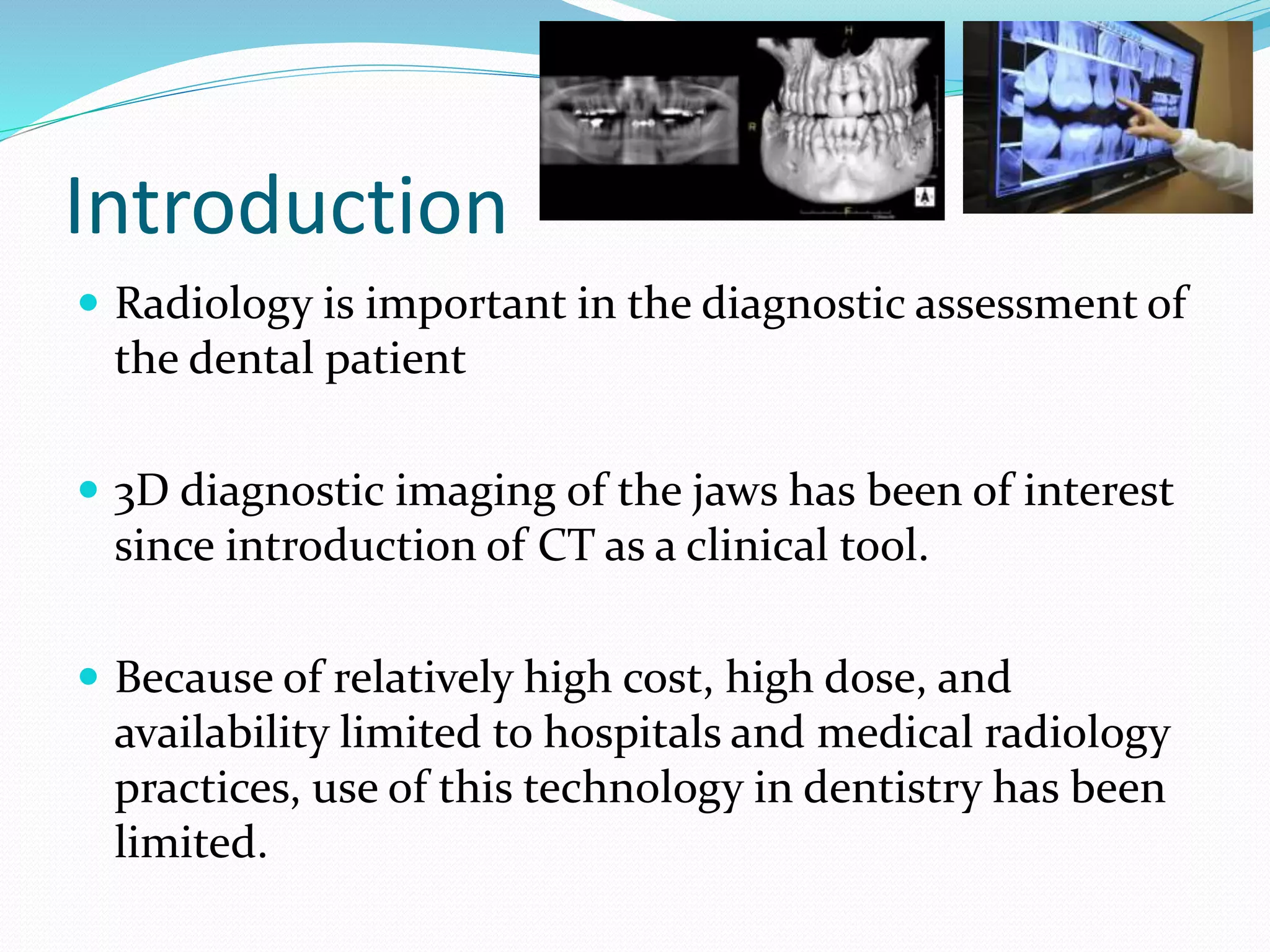
 3D diagnostic imaging of the jaws has been of interest
since introduction of CT as a clinical tool.
 Because of relatively high cost, high dose, and
availability limited to hospitals and medical radiology
practices, use of this technology in dentistry has been
limited.
What is CBCT?
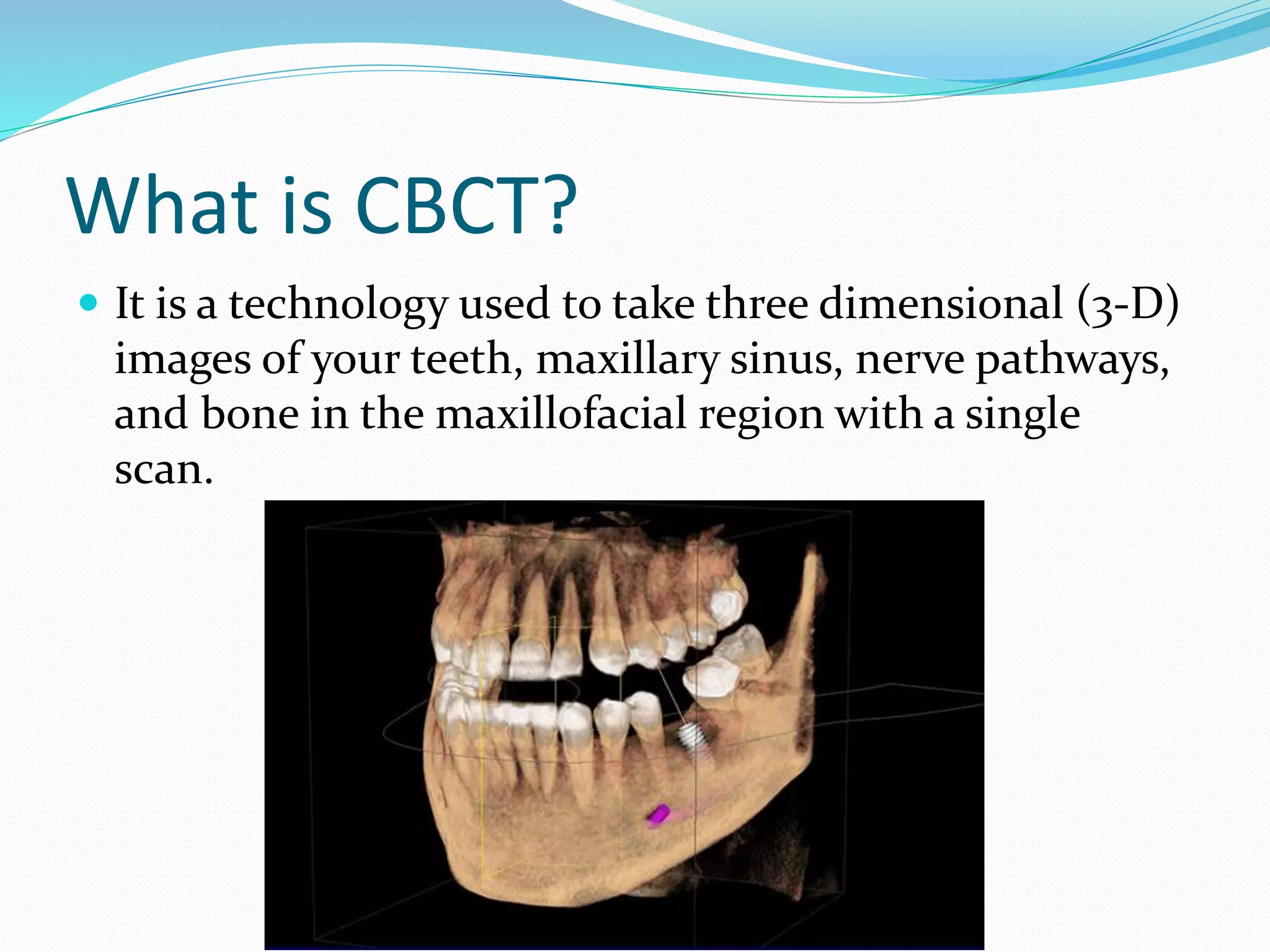
 It is a technology used to take three dimensional (3-D)
images of your teeth, maxillary sinus, nerve pathways,
and bone in the maxillofacial region with a single
scan.
What is CBCT?
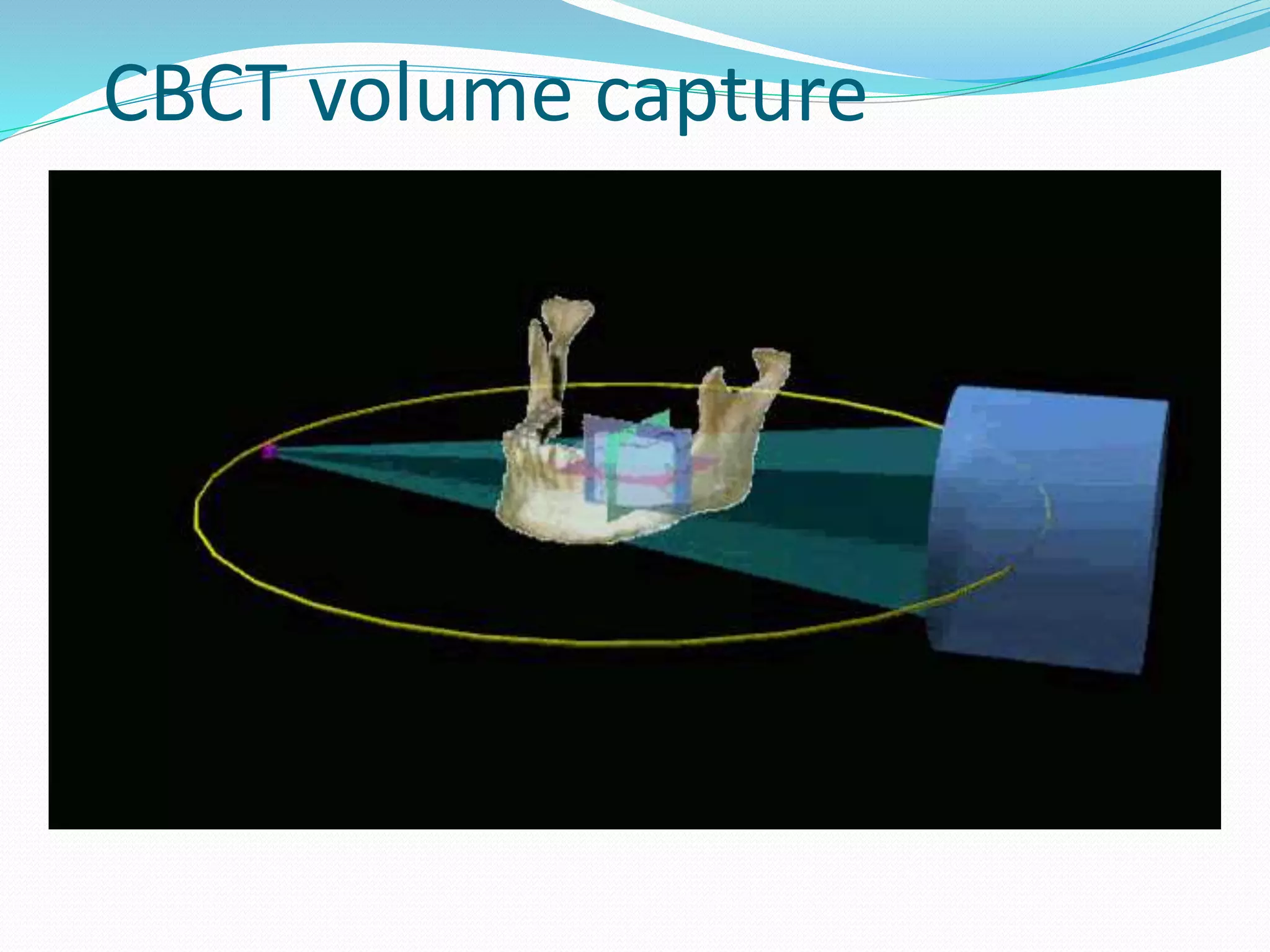
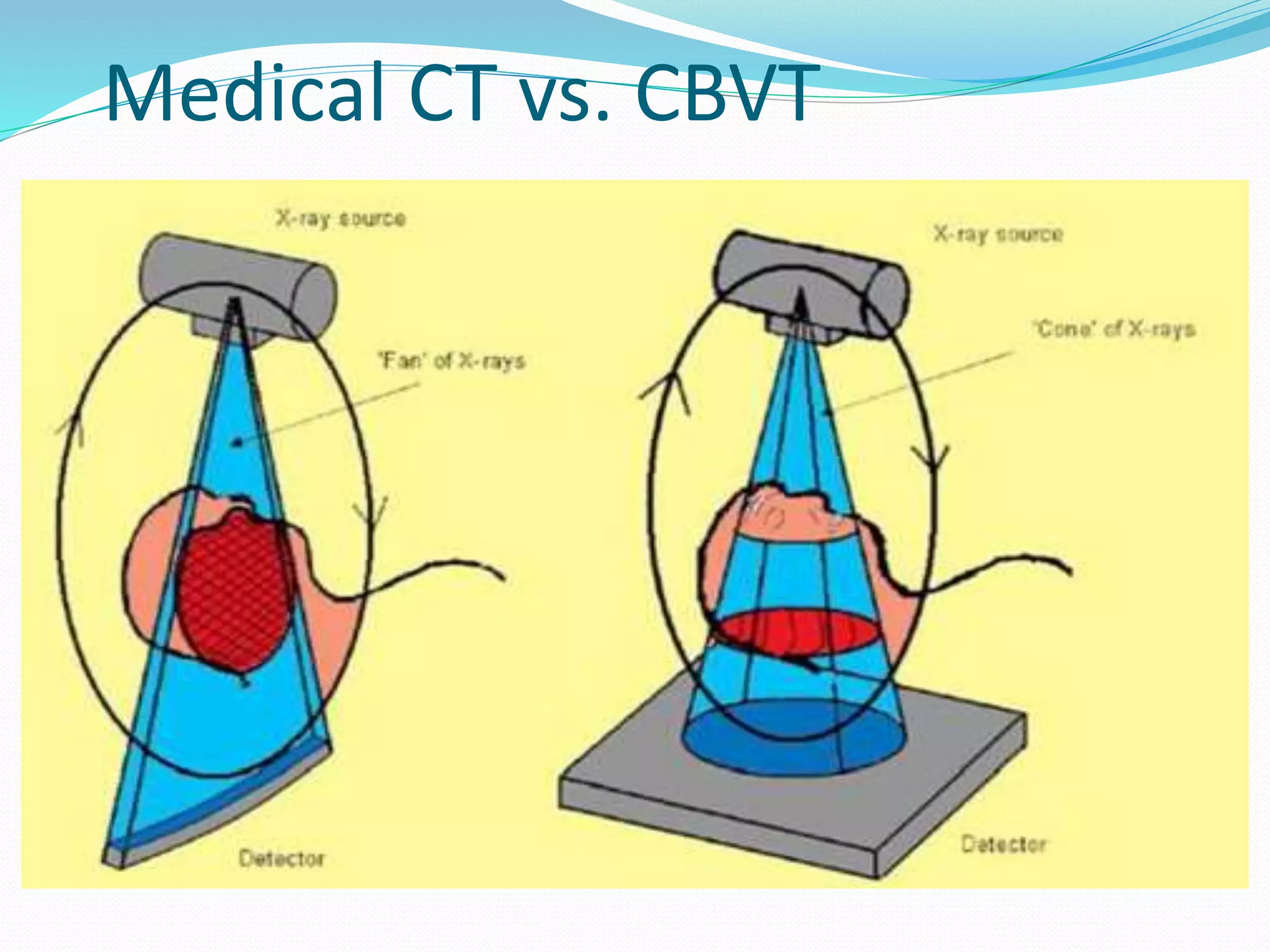
 The CBCT system rotates around the patient in
approximately 30 seconds, capturing data using a
cone-shaped x-ray beam.
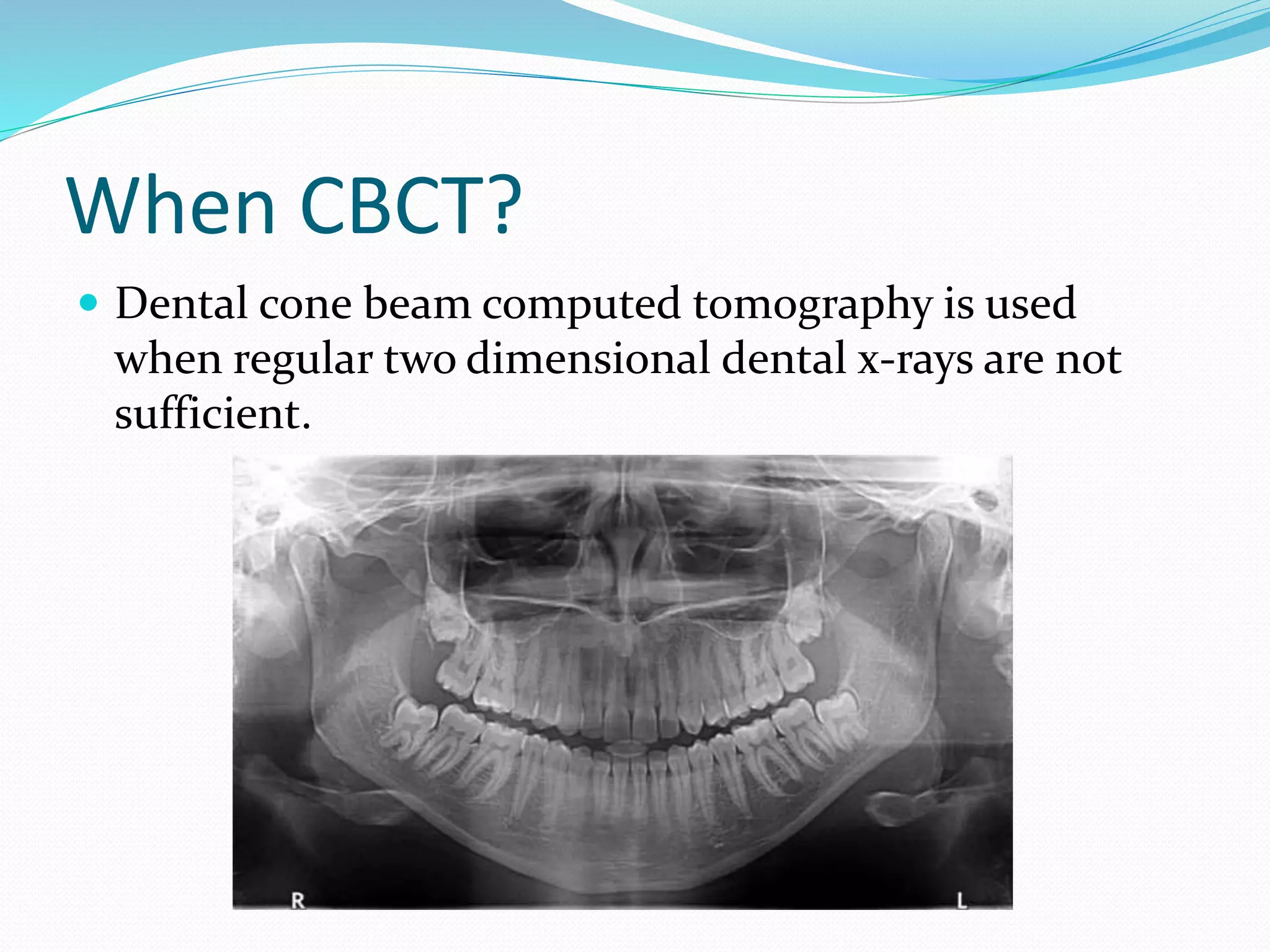
When CBCT?
 Dental cone beam computed tomography is used
when regular two dimensional dental x-rays are not
sufficient.
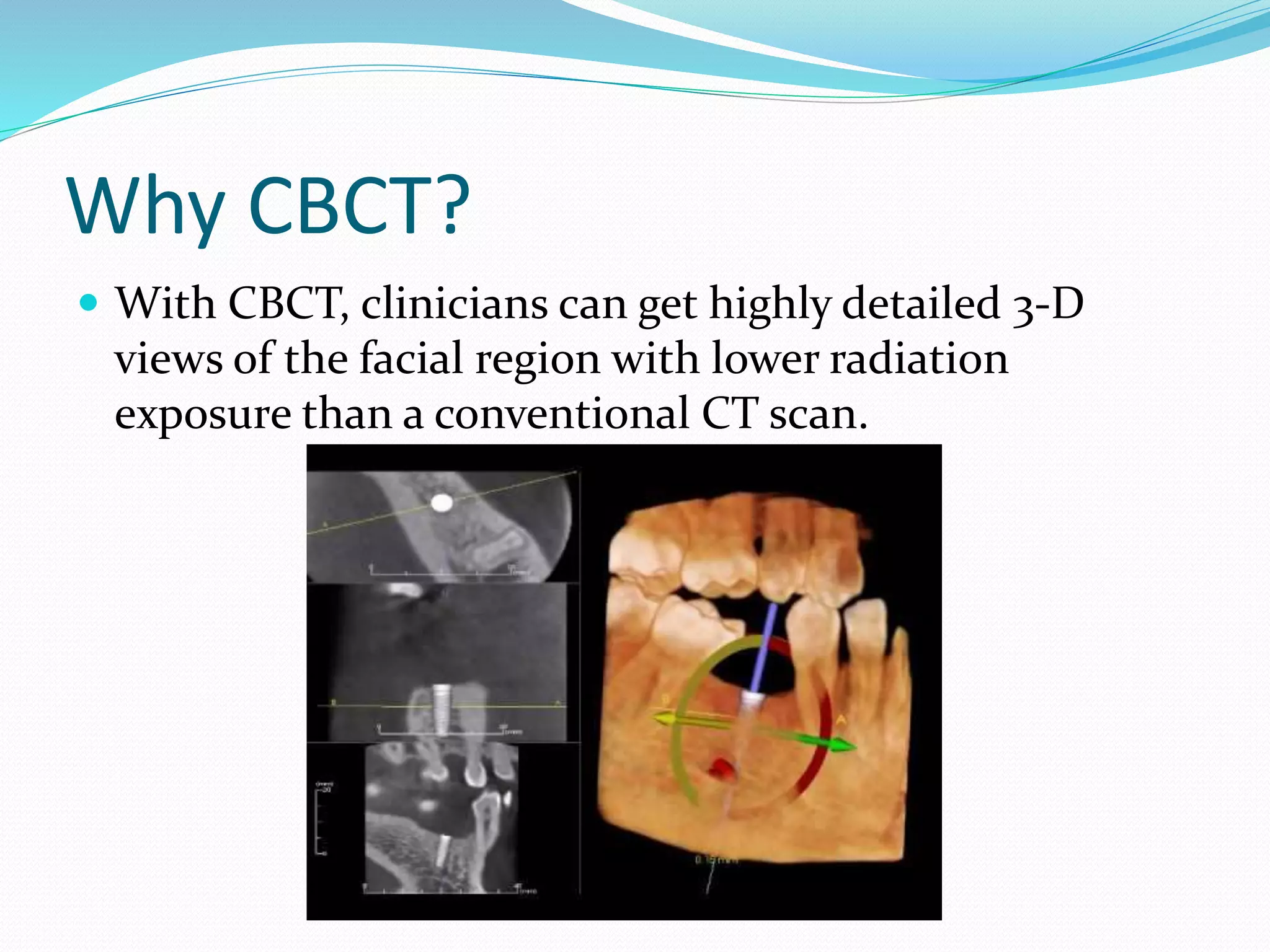
Why CBCT?
 With CBCT, clinicians can get highly detailed 3-D
views of the facial region with lower radiation
exposure than a conventional CT scan.
Why CBCT?
This may help with the diagnosis,
treatment planning and evaluation
of certain conditions.
CBCT volume capture
Medical CT vs. CBVT
Medical CT vs. CBVT
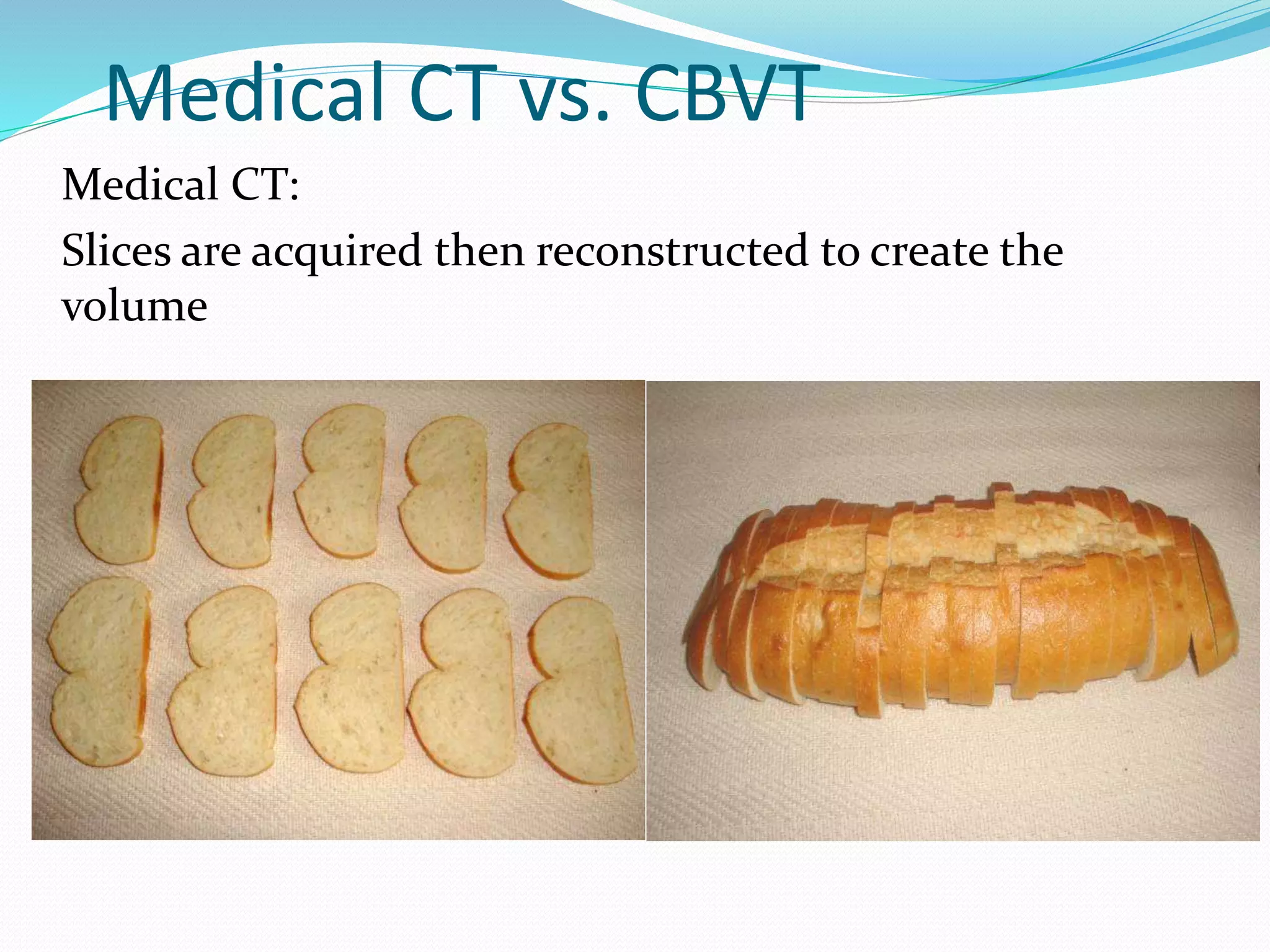
Medical CT:
Slices are acquired then reconstructed to create the
volume
Medical CT vs. CBVT
CBCT:
The volume is acquired then slices are reconstructed from
the volume
Advantages
 Rapid scan time
 Beam limitation
 Image accuracy
 Reduction in patient radiation dose when compared to
medical ct (10 times less)
 Economical comfortable and safe
Disadvantages
 Scatter
 Motion artifacts due to increased scan time
 Poor contrast resolution, thus soft tissue cannot be
reviewed
Use in dentistry
 Implantology and prosthodontics
 Oral and maxillofacial surgery
 Endodontics
 Periodontics
 Orthodontics
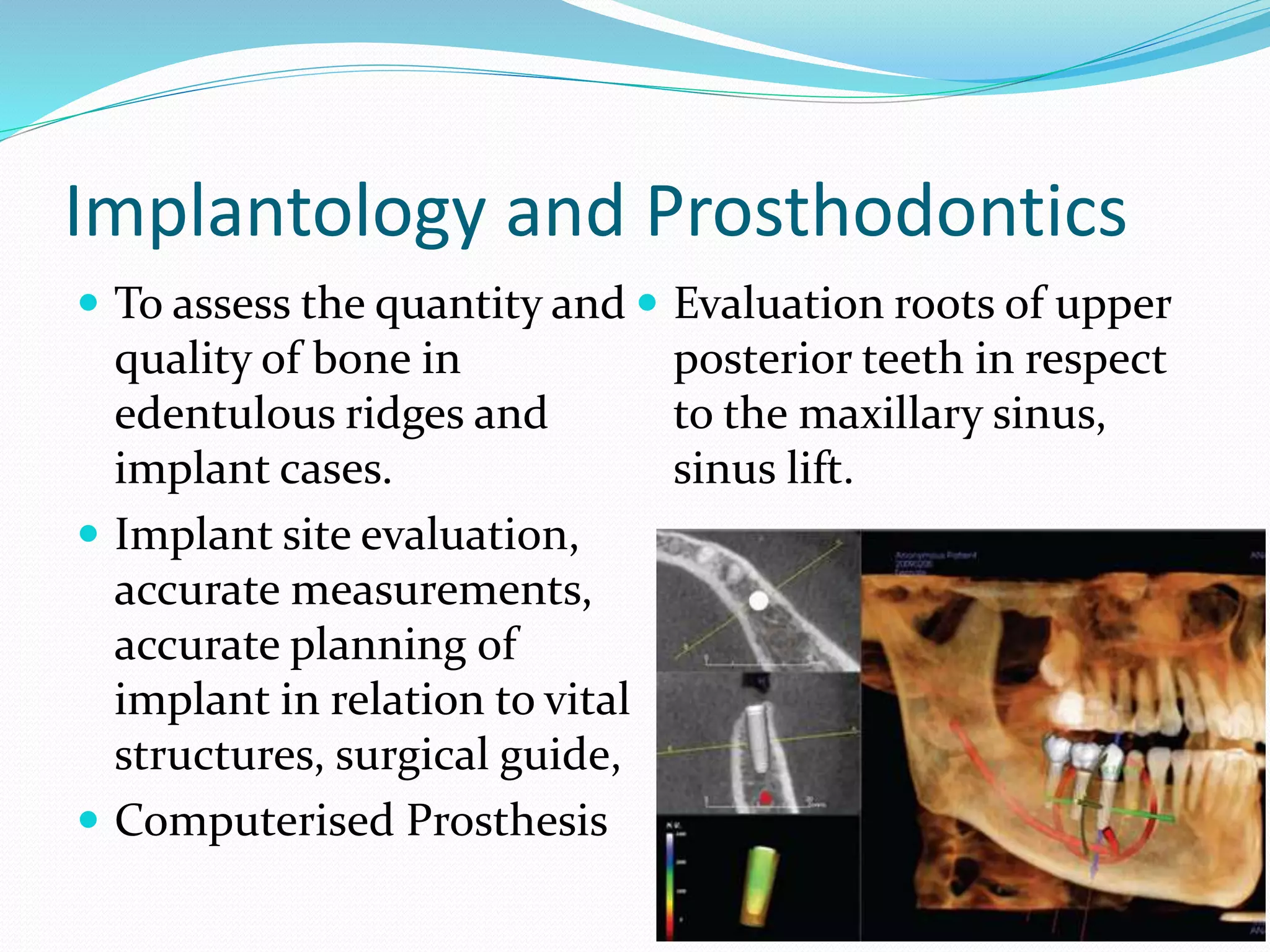
Implantology and Prosthodontics
 To assess the quantity and
quality of bone in
edentulous ridges and
implant cases.
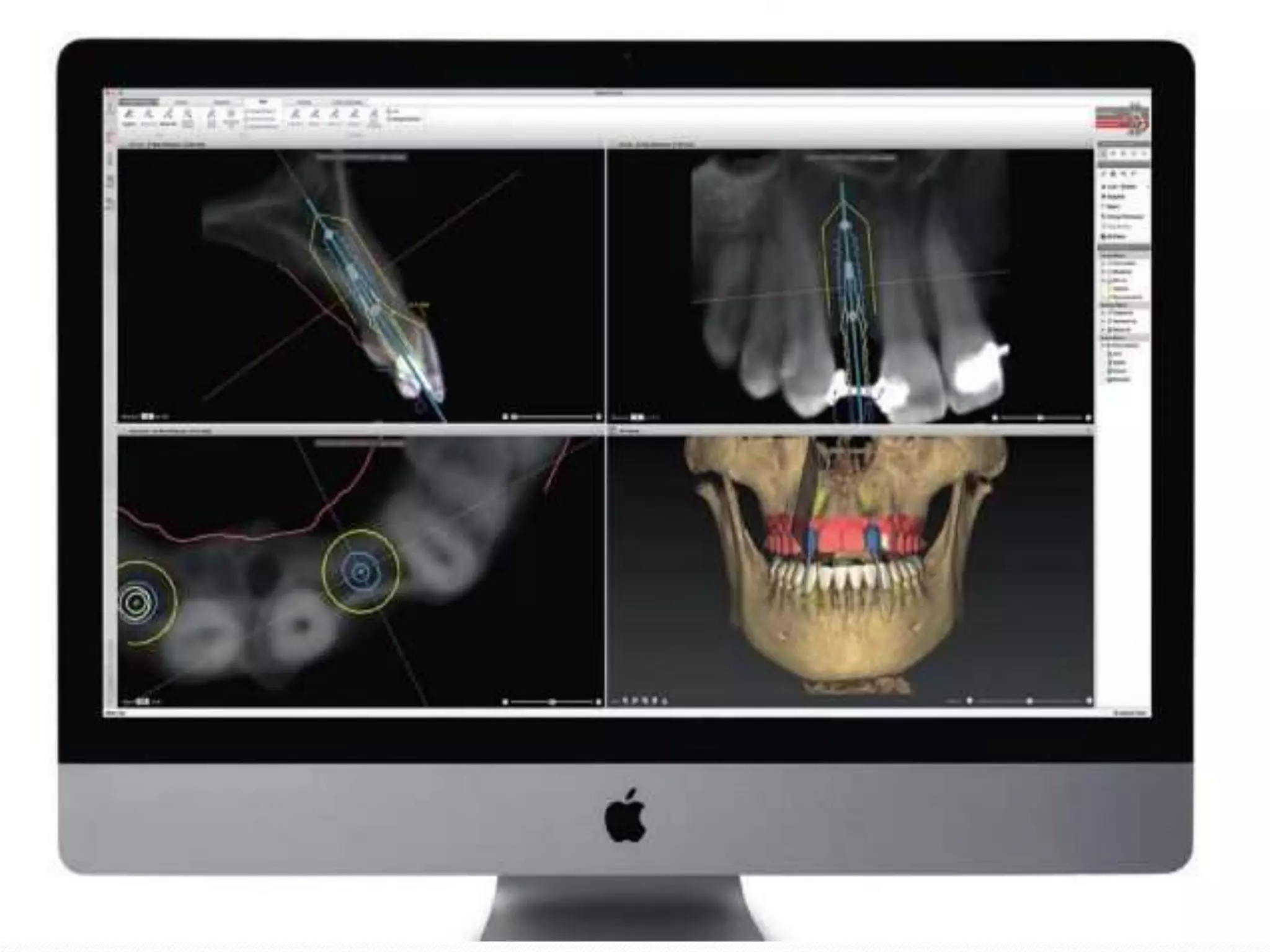
 Implant site evaluation,
accurate measurements,
accurate planning of
implant in relation to vital
structures, surgical guide,
 Computerised Prosthesis
 Evaluation roots of upper
posterior teeth in respect
to the maxillary sinus,
sinus lift.
Oral and Maxillofacial surgery
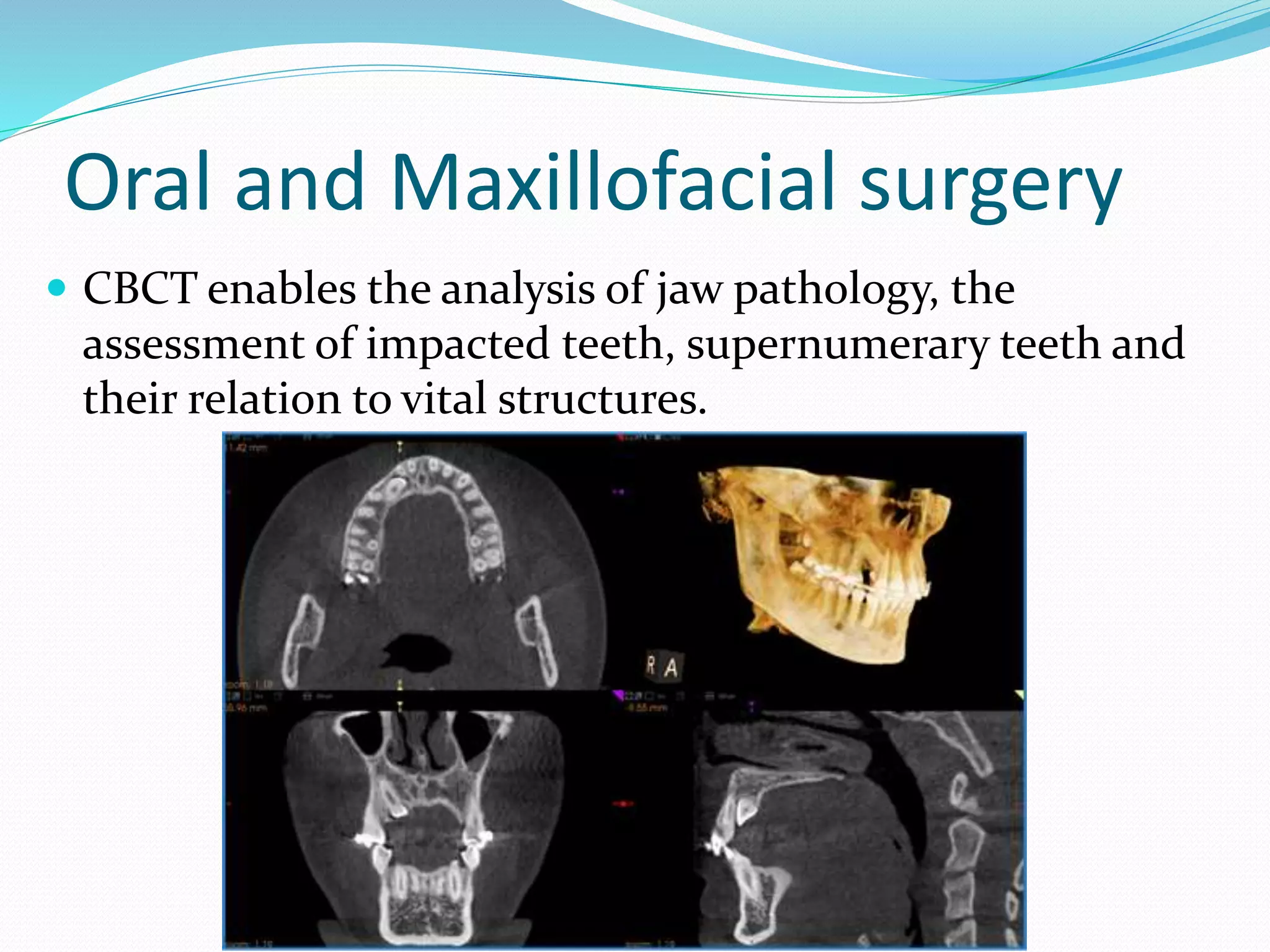
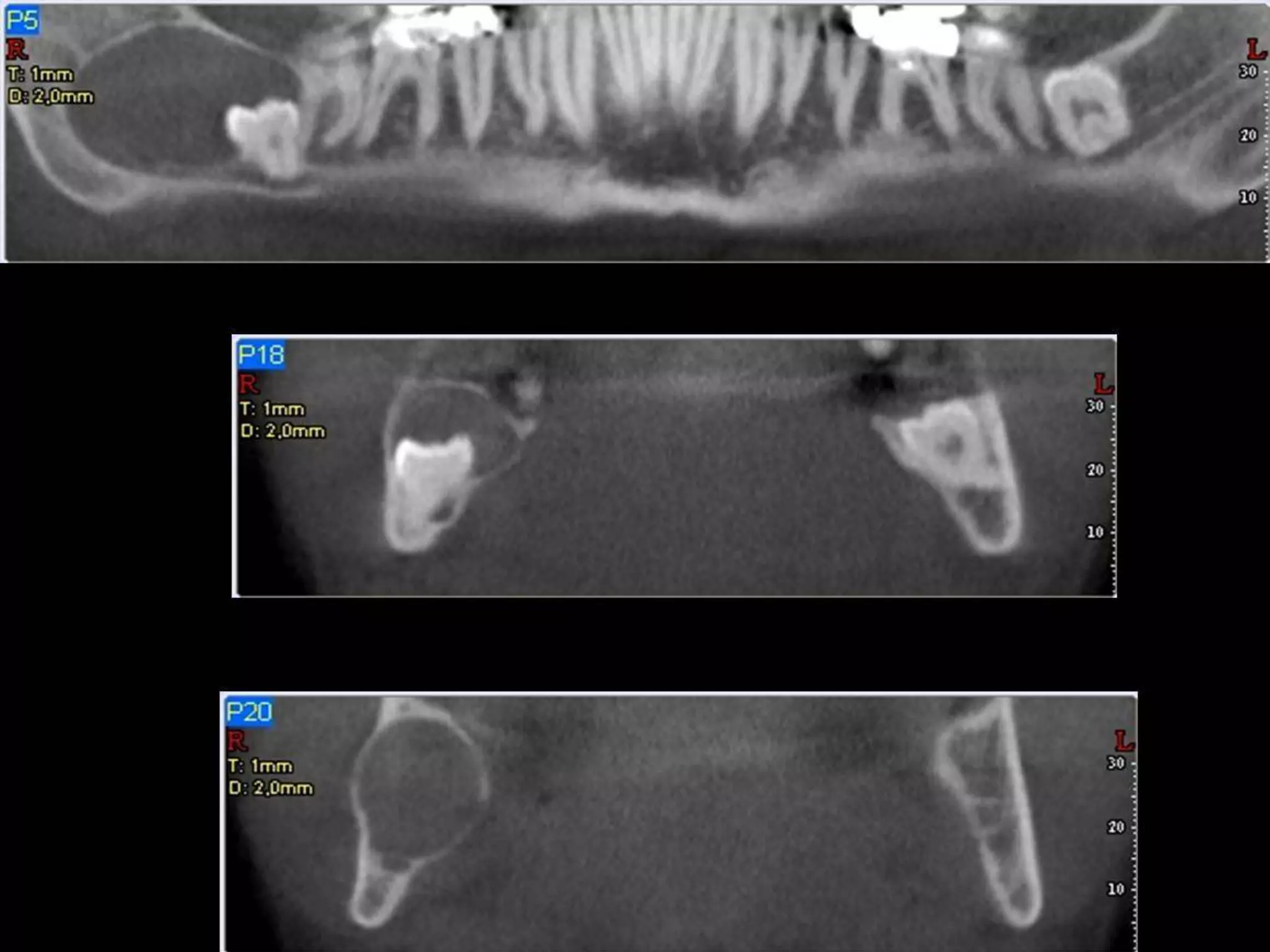
 CBCT enables the analysis of jaw pathology, the
assessment of impacted teeth, supernumerary teeth and
their relation to vital structures.
 The assessment of bone grafts.
 It is also helpful in analysing and assessing paranasal
sinuses
 Orthognathic surgeries
 Post treatment esthetic evaluation
 TMJ, and condyle
 Tooth auto transplants
 Cleft palate
 Craniofacial reconstruction
 Mid face fracture cases of fractures of the facial bones
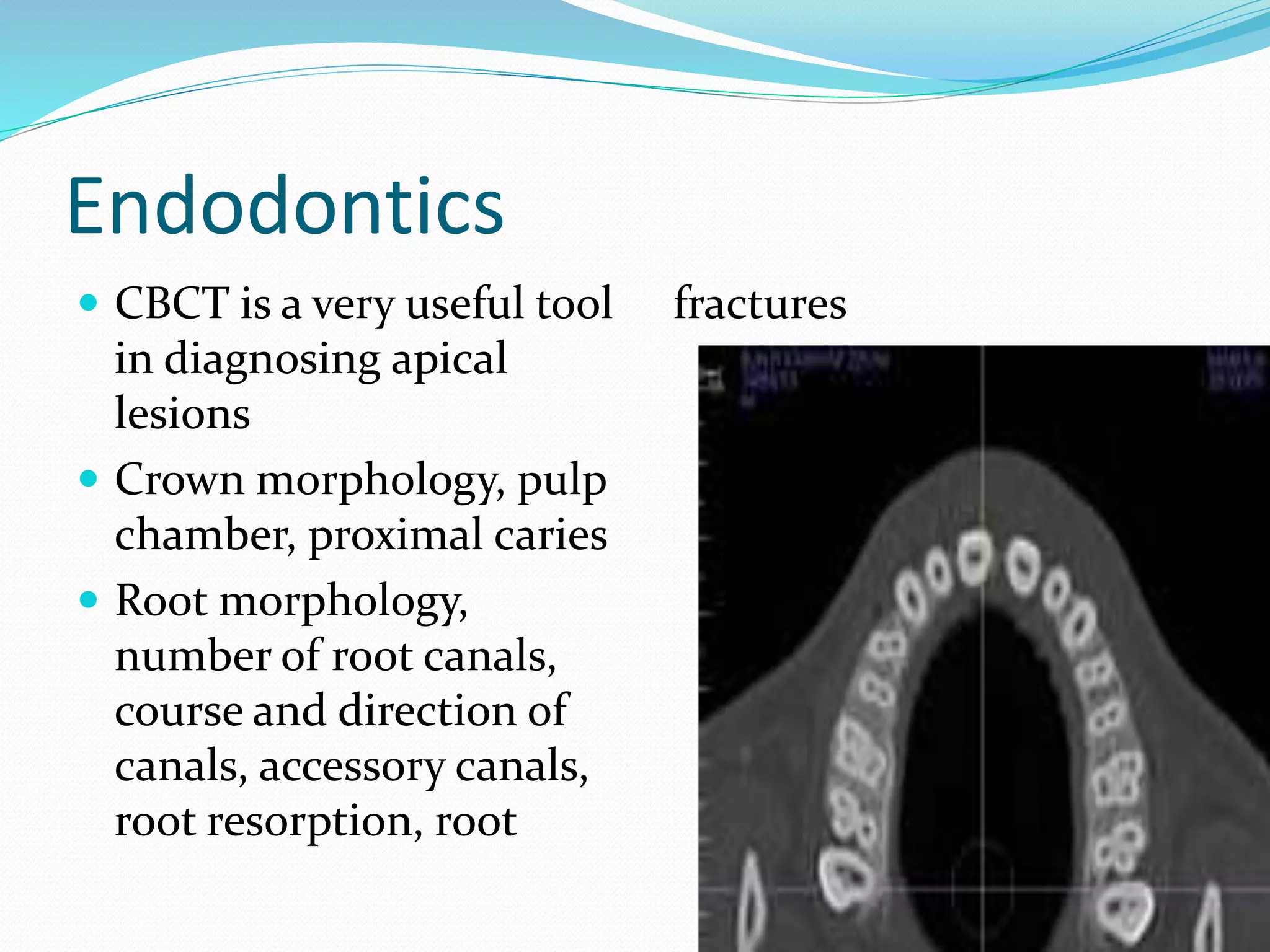
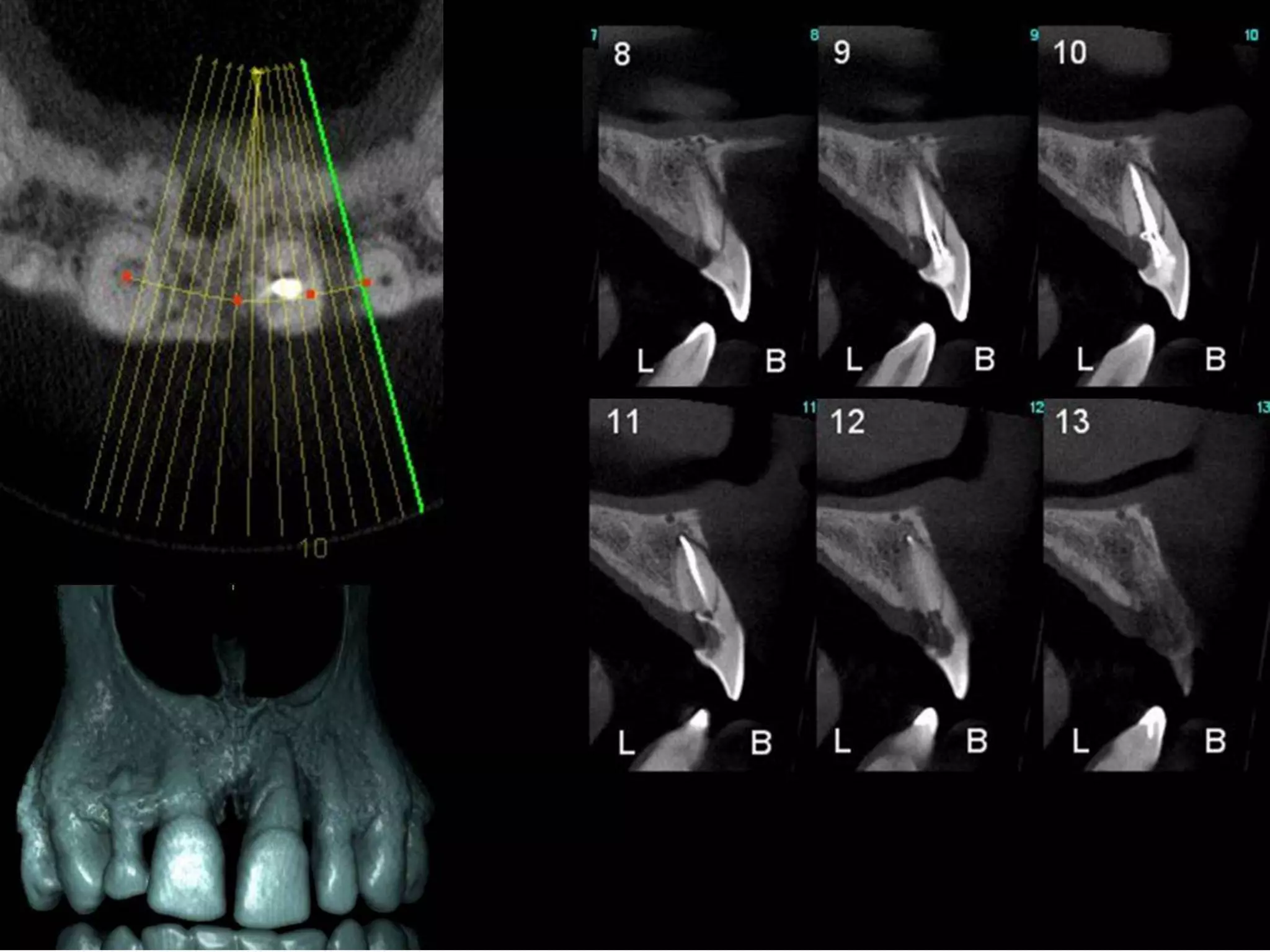
Endodontics
 CBCT is a very useful tool
in diagnosing apical
lesions
 Crown morphology, pulp
chamber, proximal caries
 Root morphology,
number of root canals,
course and direction of
canals, accessory canals,
root resorption, root
fractures
Endodontics
 Obturation, filling, under and overfilling, sinus
problems
 Broken instruments
 Useful in planning periapical endodontic surgery as
the anatomical structures such as inferior dental canal,
mental foramen, maxillary sinus can be easily
differentiated and relation to root can be quantified.
Periodontics
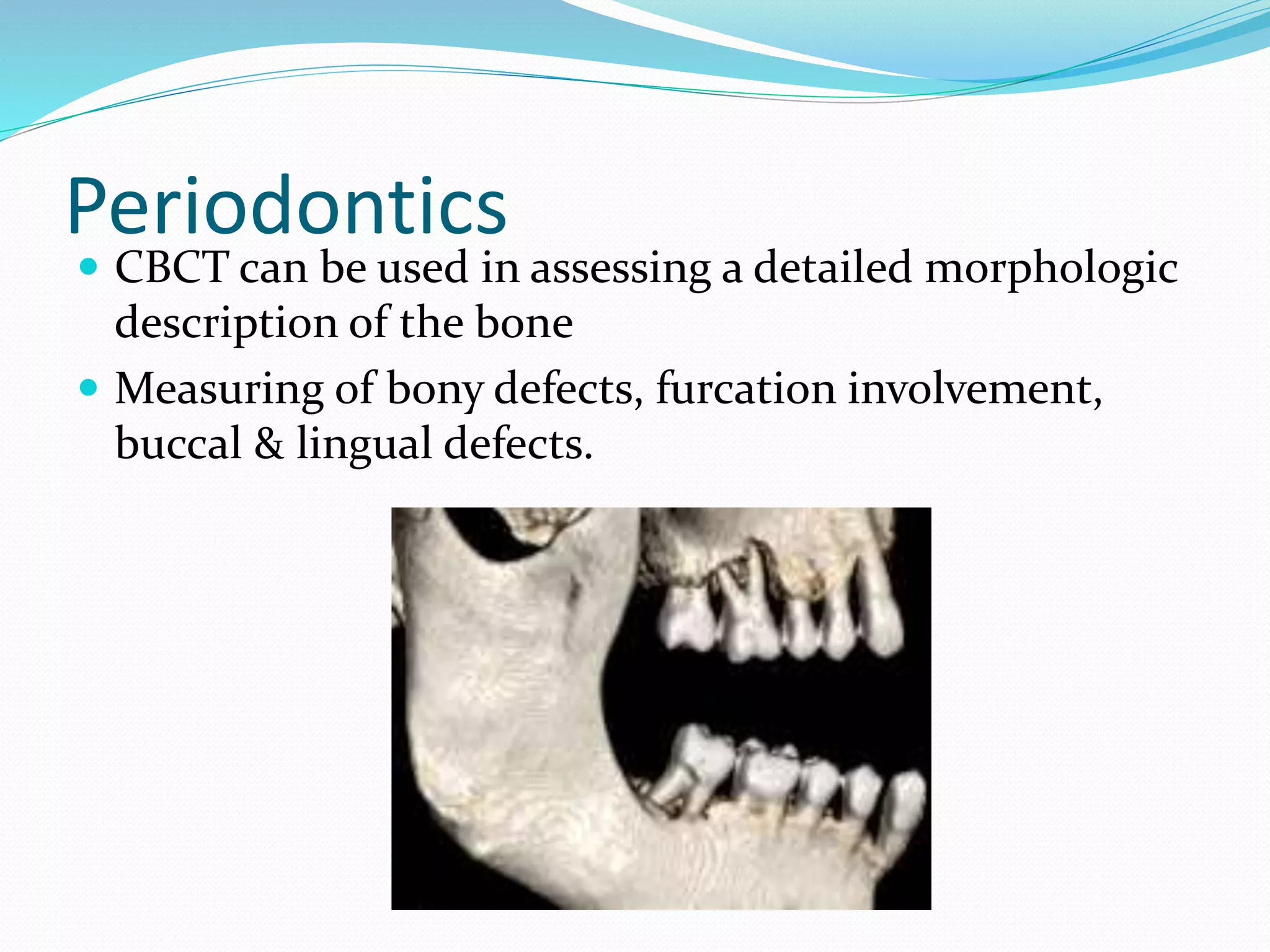
 CBCT can be used in assessing a detailed morphologic
description of the bone
 Measuring of bony defects, furcation involvement,
buccal & lingual defects.
Orthodontics
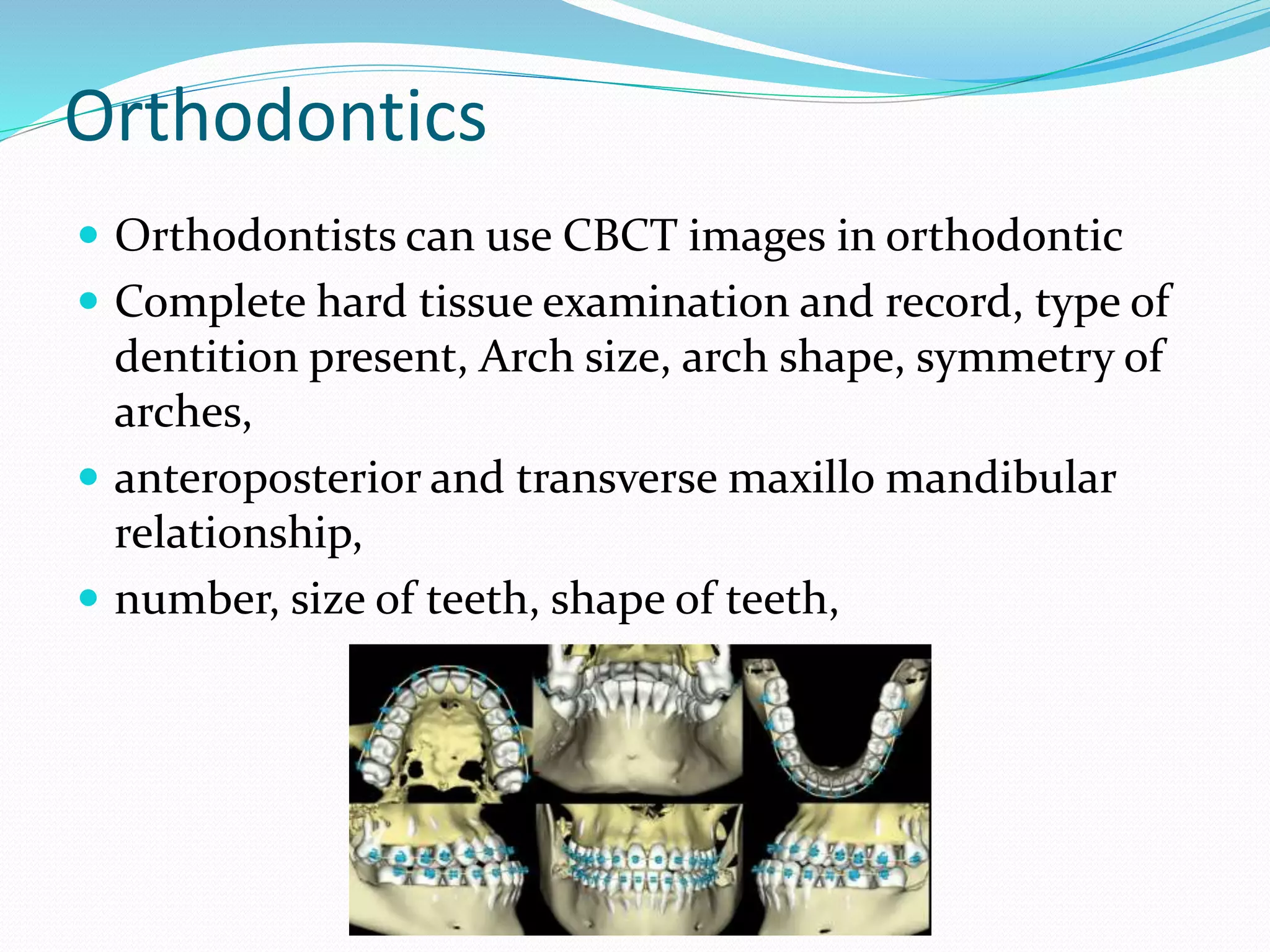
 Orthodontists can use CBCT images in orthodontic
 Complete hard tissue examination and record, type of
dentition present, Arch size, arch shape, symmetry of
arches,
 anteroposterior and transverse maxillo mandibular
relationship,
 number, size of teeth, shape of teeth,
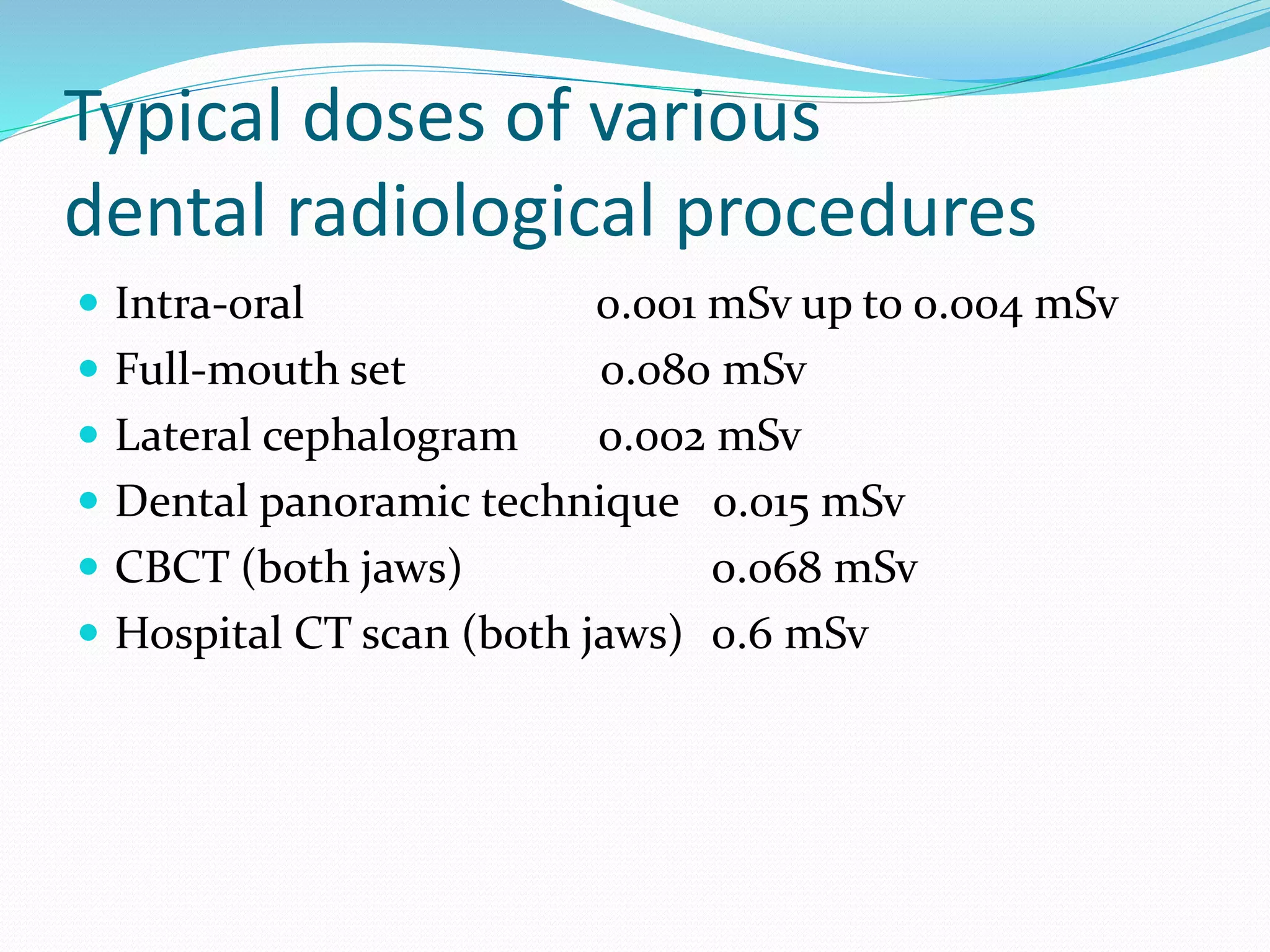
Typical doses of various
dental radiological procedures
 Intra-oral 0.001 mSv up to 0.004 mSv
 Full-mouth set 0.080 mSv
 Lateral cephalogram 0.002 mSv
 Dental panoramic technique 0.015 mSv
 CBCT (both jaws) 0.068 mSv
 Hospital CT scan (both jaws) 0.6 mSv
Conclusion
 It is vital or any clinician to remain in touch with latest
innovations in the field of one's expertise and apply
the same for the benefit of patient care and be ready
and willing to accept new trends.
 CBCT is one such recent advancement in the field of
Dentistry which one should learn and adapt into
clinical practice.
References
 https://www.oaklandoralsurgery.com/blog/what-is-
cbct/
 https://www.ncbi.nlm.nih.gov/pmc/articles/PMC4377
156/

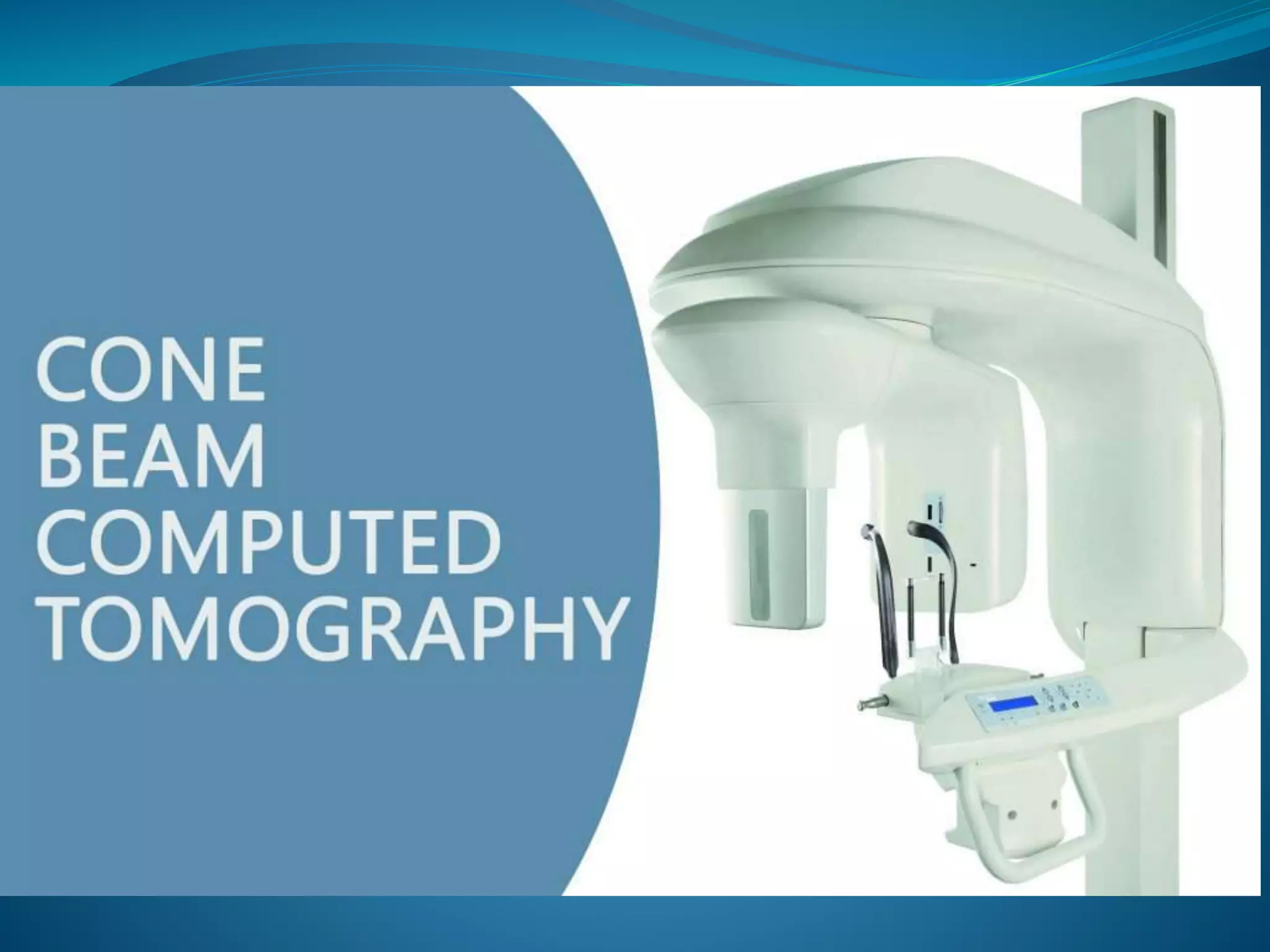
CBCT

  • 2.
    Outline  Introduction  HowCBCT works  CBCT vs Conventional CT  CBCT in dentistry  Conclusion
  • 3.
    Introduction  Radiology isimportant in the diagnostic assessment of the dental patient  3D diagnostic imaging of the jaws has been of interest since introduction of CT as a clinical tool.  Because of relatively high cost, high dose, and availability limited to hospitals and medical radiology practices, use of this technology in dentistry has been limited.
  • 4.
    What is CBCT? It is a technology used to take three dimensional (3-D) images of your teeth, maxillary sinus, nerve pathways, and bone in the maxillofacial region with a single scan.
  • 5.
    What is CBCT? The CBCT system rotates around the patient in approximately 30 seconds, capturing data using a cone-shaped x-ray beam.
  • 6.
    When CBCT?  Dentalcone beam computed tomography is used when regular two dimensional dental x-rays are not sufficient.
  • 7.
    Why CBCT?  WithCBCT, clinicians can get highly detailed 3-D views of the facial region with lower radiation exposure than a conventional CT scan.
  • 8.
    Why CBCT? This mayhelp with the diagnosis, treatment planning and evaluation of certain conditions.
  • 10.
  • 11.
  • 12.
    Medical CT vs.CBVT Medical CT: Slices are acquired then reconstructed to create the volume
  • 13.
    Medical CT vs.CBVT CBCT: The volume is acquired then slices are reconstructed from the volume
  • 15.
    Advantages  Rapid scantime  Beam limitation  Image accuracy  Reduction in patient radiation dose when compared to medical ct (10 times less)  Economical comfortable and safe
  • 16.
    Disadvantages  Scatter  Motionartifacts due to increased scan time  Poor contrast resolution, thus soft tissue cannot be reviewed
  • 17.
    Use in dentistry Implantology and prosthodontics  Oral and maxillofacial surgery  Endodontics  Periodontics  Orthodontics
  • 18.
    Implantology and Prosthodontics To assess the quantity and quality of bone in edentulous ridges and implant cases.  Implant site evaluation, accurate measurements, accurate planning of implant in relation to vital structures, surgical guide,  Computerised Prosthesis  Evaluation roots of upper posterior teeth in respect to the maxillary sinus, sinus lift.
  • 21.
    Oral and Maxillofacialsurgery  CBCT enables the analysis of jaw pathology, the assessment of impacted teeth, supernumerary teeth and their relation to vital structures.
  • 22.
     The assessmentof bone grafts.  It is also helpful in analysing and assessing paranasal sinuses
  • 23.
     Orthognathic surgeries Post treatment esthetic evaluation  TMJ, and condyle  Tooth auto transplants  Cleft palate  Craniofacial reconstruction  Mid face fracture cases of fractures of the facial bones
  • 26.
    Endodontics  CBCT isa very useful tool in diagnosing apical lesions  Crown morphology, pulp chamber, proximal caries  Root morphology, number of root canals, course and direction of canals, accessory canals, root resorption, root fractures
  • 28.
    Endodontics  Obturation, filling,under and overfilling, sinus problems  Broken instruments  Useful in planning periapical endodontic surgery as the anatomical structures such as inferior dental canal, mental foramen, maxillary sinus can be easily differentiated and relation to root can be quantified.
  • 29.
    Periodontics  CBCT canbe used in assessing a detailed morphologic description of the bone  Measuring of bony defects, furcation involvement, buccal & lingual defects.
  • 30.
    Orthodontics  Orthodontists canuse CBCT images in orthodontic  Complete hard tissue examination and record, type of dentition present, Arch size, arch shape, symmetry of arches,  anteroposterior and transverse maxillo mandibular relationship,  number, size of teeth, shape of teeth,
  • 31.
    Typical doses ofvarious dental radiological procedures  Intra-oral 0.001 mSv up to 0.004 mSv  Full-mouth set 0.080 mSv  Lateral cephalogram 0.002 mSv  Dental panoramic technique 0.015 mSv  CBCT (both jaws) 0.068 mSv  Hospital CT scan (both jaws) 0.6 mSv
  • 32.
    Conclusion  It isvital or any clinician to remain in touch with latest innovations in the field of one's expertise and apply the same for the benefit of patient care and be ready and willing to accept new trends.  CBCT is one such recent advancement in the field of Dentistry which one should learn and adapt into clinical practice.
  • 33.

Editor's Notes