ENVIRONMENTAL STUDIES Definition, scope & Multidisciplinary nature, Need for public awareness, Introduction to Green Technology
ENVIRONMENT environner (Fr) : to encircle or surround surrounding external conditions influencing development or growth of people, animal or plants; living or working conditions etc. Circumstances and conditions that surround an organism Social and cultural conditions that affect an individual
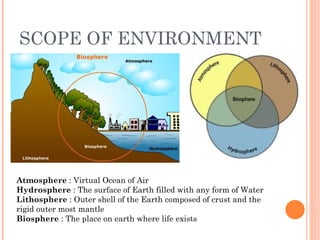
SCOPE OF ENVIRONMENT Atmosphere  : Virtual Ocean of Air  Hydrosphere  : The surface of Earth filled with any form of Water  Lithosphere  : Outer shell of the Earth composed of crust and the rigid outer most mantle  Biosphere  : The place on earth where life exists
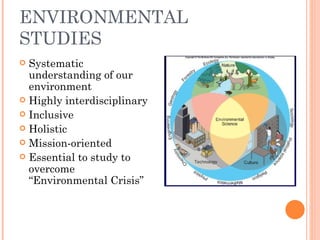
ENVIRONMENTAL STUDIES Systematic understanding of our environment  Highly interdisciplinary Inclusive Holistic Mission-oriented Essential to study to overcome “Environmental Crisis”
OBJECTIVES OF EVS Awareness : about our environment and its allied problems Knowledge : acquire basic understanding and experience about our environment and associated problems Attitude : concern for the environment and active participation in its improvement and protection Skill : identifying and solving environmental problems Participation : providing opportunity to be involved in resolving the environmental problems
IMPORTANCE OF EVS The EVS enlighten us about the importance of protection and conservation of our environment EVS have become significant for the following reasons: Environment issues being of international importance Problems cropped in the wake of development Explosive increase in pollution Need for an alternative solution Need to save humanity from extinction Need for wise planning of development
BENEFITS OF EVS Conservation of energy and fast depleting natural resources Increase in economic productivity Imparting knowledge about waste management, treatment and disposal Develop social responsibility towards environment protection Creating awareness to control population Inculcating attitude and values towards understanding interdependence of nature and man and work towards sustainable development
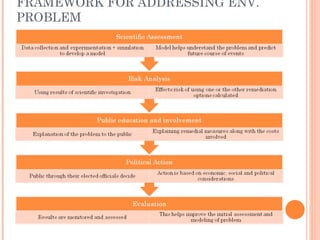
FRAMEWORK FOR ADDRESSING ENV. PROBLEM
MAJOR GLOBAL ENVIRONMENTAL PROBLEMS From http://www.pref.kyoto.jp/intro/21cent/kankyo/contents_e/globe_prob/index.html Global Warming Ozone Layer Depletion Acid Rain Deforestation Loss of Biodiversity Water Pollution Desertification Waste disposal Rapid population growth Depletion of non-renewable energy sources Food and Water shortage
NEED FOR PUBLIC AWARENESS Important to understand that natural environment and man-made environment are interdependent Essential to make the public aware of the formidable consequences of the Environmental Degradation (be it local or regional or global) reformative measures if not undertaken, would result in the extinction of life. Environmental protection is every individual’s obligation and duty And so, Environmental consciousness needs to be propagated at all levels
ENVIRONMENTAL EDUCATION: GOALS To develop teaching materials and aids for formal education sector To encourage non-governmental organizations for promoting awareness To promote environment education through existing educational/scientific/research institutes To ensure training and manpower development in environment education To mobilize people’s awareness for the preservation and conservation of environment
FORMAL ENV. EDUCATION IN INDIA In schools : through text books  In colleges & university level M.Sc, M. Phil, PhD programs in Env. Chem/ Bio/Toxicology M.E and M.Tech in Env. Engineering (Civil&Chem) PG diploma in Env. Management Environmental Appreciation Course IGNOU & MOEF have a non-credit three months awareness course to create env. Consciousness and leadership among people  In Management and Business Studies So that managers and leaders can introduce environmentally sound practices in their operations
NON-FORMAL EDUCATION AND AWARENESS National Environment Awareness Campaign(NEAC) Introduced in mid-1986, its is a multi-media campaign Nominal financial assistance provided to NGO’s /schools/ other institutions to conduct awareness activities Activities- seminars, workshops, camps, rallies, exhibitions, debates, street theatre, planting of trees, cleaning of public areas/water bodies etc.. Implemented through 28 Regional Resource Agencies Eco Clubs of National Green Corps To sensitize school students Eco-clubs are being set up in 100 schools of every district in the country. 50,000 have been set up so far. Govt. provides financial assistance and training to teachers and the resource material
NON-FORMAL EDUCATION AND AWARENESS (CONTD..) GLOBE ( G lobal  L earning and  O bservations to  B enefit the  E nvironment) India joined this intl. program aimed at school students in 2000 Students of GLOBE school collect data about environmental parameters under trained teachers and data is used to explain various hypothesis Students interact with GLOBE scientists and participate in workshops on basic and advanced GLOBE protocols Mass Awareness Focusing on rural areas. Doordarshan and other channels telecast env. based programs/commercials/films/documentaries Professional media agencies are hired to assist
NON-FORMAL EDUCATION AND AWARENESS (CONTD..) Other awareness program Green Olympiad conducted by TERI- 80000 school students from Russia, UAE and India participate Awareness activities by NGO’s and other institutions on Environment days like Earth day TV quiz program for winners of regional written environmental quiz programs Vacation program on Natural resources- building a broader constituency of support for conservation, for high school students, organized by Ashoka Trust for Research in Ecology and Environment (ATREE), an NGO
NON-FORMAL EDUCATION AND AWARENESS (CONTD..) Centres of Excellence Scheme started in 1983 to strengthen research, awareness and training in priority areas of environmental science and management Nine centres have been established Centre for Environmental Education, Ahemdabad C.P.R. Environmental Education Centre, Chennai Centre for Ecological Sciences, IISc. Bangalore Salim Ali Centre for Ornithology and Natural History, Coimbatore Centre for Mining Environment, ISM, Dhanbad Centre for Env. Management of Degraded Ecosystems, DU, Delhi Tropical Botanical Garden and Research Inst., Thiruvananthpuram Madras School of  Economics, Chennai Foundation for Revitalization of Local Health Traditions, Bangalore
GREEN TECHNOLOGY Advancement in science and technology led to indiscriminate exploitation of exhaustible resources and expulsion of hazardous chemical and synthetic wastes in the environment. This has created extraordinary technical, health, economic, environmental, political and social problems. Green Technology or Clean Tech , encompasses a continuously evolving group of methods and materials, from techniques for generating energy to non-toxic cleaning products
GREEN TECHNOLOGY (CONTD.) Green Technology or Clean Tech , is the development and application of products, equipment and systems used to conserve the natural environment and resources, which minimize and reduces the negative impact of human activities. Criteria of Green Tech products, equipments or systems: It minimizes the degradation of the environment It has zero or low green house gas (GHG) emission  It is safe for use and promotes healthy and improved environment for all forms of life It conserves the use of energy and natural resources It promotes the use of renewable resources.
GOALS OF GREEN TECH Sustainability  - meeting present needs of society without compromising the ability of future generations to meet their own needs "Cradle to cradle" design  - ending the "cradle to grave" cycle of manufactured products, by creating products that can be fully reclaimed or re-used.  Source reduction  - reducing waste and pollution by changing patterns of production and consumption. Innovation  - developing alternatives to technologies - whether fossil fuel or chemical intensive agriculture - that have been demonstrated to damage health and the environment. Viability  - creating a center of economic activity around technologies and products that benefit the environment, speeding their implementation and creating new careers that truly protect the planet.
GREEN TECH SUBJECT AREAS Energy  development of alternative fuels, new means of generating energy and energy efficiency Green building  encompasses everything from the choice of building materials to building location Environmentally preferred purchasing  government purchasing of products whose contents and methods of production have the smallest possible impact on the environment Green chemistry  invention, design and application of chemical products and processes to reduce & eliminate the use and generation of hazardous substances Green nanotechnology  application of green chemistry and green engineering principles to materials at nano-scale Green computing  designing, manufacturing, using, and disposing of computers & associated subsystems, effectively with minimal or no impact on the environment
EXAMPLES OF CLEAN TECH Un-leaded petrol, sulphur free coal, CNG, LPG, Bio-fuels, hybrid vehicles Air pollution control equipments like catalytic converters, electrostatic precipitators, flue-gas desulphurization units etc. Genetically engineered crops which require less chemical pesticides due to their genetic  resistance to diseases and pests Solar energy, hydro energy, ocean energy, geothermal energy, wind energy as alternatives Recycling of waste paper, metal, glass, flyash, slag, red-mud etc.
QUESTIONS

Introduction to Environmental Studies

  • 1.
    ENVIRONMENTAL STUDIES Definition,scope & Multidisciplinary nature, Need for public awareness, Introduction to Green Technology
  • 2.
    ENVIRONMENT environner (Fr): to encircle or surround surrounding external conditions influencing development or growth of people, animal or plants; living or working conditions etc. Circumstances and conditions that surround an organism Social and cultural conditions that affect an individual
  • 3.
    SCOPE OF ENVIRONMENTAtmosphere : Virtual Ocean of Air Hydrosphere : The surface of Earth filled with any form of Water Lithosphere : Outer shell of the Earth composed of crust and the rigid outer most mantle Biosphere : The place on earth where life exists
  • 4.
    ENVIRONMENTAL STUDIES Systematicunderstanding of our environment Highly interdisciplinary Inclusive Holistic Mission-oriented Essential to study to overcome “Environmental Crisis”
  • 5.
    OBJECTIVES OF EVSAwareness : about our environment and its allied problems Knowledge : acquire basic understanding and experience about our environment and associated problems Attitude : concern for the environment and active participation in its improvement and protection Skill : identifying and solving environmental problems Participation : providing opportunity to be involved in resolving the environmental problems
  • 6.
    IMPORTANCE OF EVSThe EVS enlighten us about the importance of protection and conservation of our environment EVS have become significant for the following reasons: Environment issues being of international importance Problems cropped in the wake of development Explosive increase in pollution Need for an alternative solution Need to save humanity from extinction Need for wise planning of development
  • 7.
    BENEFITS OF EVSConservation of energy and fast depleting natural resources Increase in economic productivity Imparting knowledge about waste management, treatment and disposal Develop social responsibility towards environment protection Creating awareness to control population Inculcating attitude and values towards understanding interdependence of nature and man and work towards sustainable development
  • 8.
  • 9.
    MAJOR GLOBAL ENVIRONMENTALPROBLEMS From http://www.pref.kyoto.jp/intro/21cent/kankyo/contents_e/globe_prob/index.html Global Warming Ozone Layer Depletion Acid Rain Deforestation Loss of Biodiversity Water Pollution Desertification Waste disposal Rapid population growth Depletion of non-renewable energy sources Food and Water shortage
  • 10.
    NEED FOR PUBLICAWARENESS Important to understand that natural environment and man-made environment are interdependent Essential to make the public aware of the formidable consequences of the Environmental Degradation (be it local or regional or global) reformative measures if not undertaken, would result in the extinction of life. Environmental protection is every individual’s obligation and duty And so, Environmental consciousness needs to be propagated at all levels
  • 11.
    ENVIRONMENTAL EDUCATION: GOALSTo develop teaching materials and aids for formal education sector To encourage non-governmental organizations for promoting awareness To promote environment education through existing educational/scientific/research institutes To ensure training and manpower development in environment education To mobilize people’s awareness for the preservation and conservation of environment
  • 12.
    FORMAL ENV. EDUCATIONIN INDIA In schools : through text books In colleges & university level M.Sc, M. Phil, PhD programs in Env. Chem/ Bio/Toxicology M.E and M.Tech in Env. Engineering (Civil&Chem) PG diploma in Env. Management Environmental Appreciation Course IGNOU & MOEF have a non-credit three months awareness course to create env. Consciousness and leadership among people In Management and Business Studies So that managers and leaders can introduce environmentally sound practices in their operations
  • 13.
    NON-FORMAL EDUCATION ANDAWARENESS National Environment Awareness Campaign(NEAC) Introduced in mid-1986, its is a multi-media campaign Nominal financial assistance provided to NGO’s /schools/ other institutions to conduct awareness activities Activities- seminars, workshops, camps, rallies, exhibitions, debates, street theatre, planting of trees, cleaning of public areas/water bodies etc.. Implemented through 28 Regional Resource Agencies Eco Clubs of National Green Corps To sensitize school students Eco-clubs are being set up in 100 schools of every district in the country. 50,000 have been set up so far. Govt. provides financial assistance and training to teachers and the resource material
  • 14.
    NON-FORMAL EDUCATION ANDAWARENESS (CONTD..) GLOBE ( G lobal L earning and O bservations to B enefit the E nvironment) India joined this intl. program aimed at school students in 2000 Students of GLOBE school collect data about environmental parameters under trained teachers and data is used to explain various hypothesis Students interact with GLOBE scientists and participate in workshops on basic and advanced GLOBE protocols Mass Awareness Focusing on rural areas. Doordarshan and other channels telecast env. based programs/commercials/films/documentaries Professional media agencies are hired to assist
  • 15.
    NON-FORMAL EDUCATION ANDAWARENESS (CONTD..) Other awareness program Green Olympiad conducted by TERI- 80000 school students from Russia, UAE and India participate Awareness activities by NGO’s and other institutions on Environment days like Earth day TV quiz program for winners of regional written environmental quiz programs Vacation program on Natural resources- building a broader constituency of support for conservation, for high school students, organized by Ashoka Trust for Research in Ecology and Environment (ATREE), an NGO
  • 16.
    NON-FORMAL EDUCATION ANDAWARENESS (CONTD..) Centres of Excellence Scheme started in 1983 to strengthen research, awareness and training in priority areas of environmental science and management Nine centres have been established Centre for Environmental Education, Ahemdabad C.P.R. Environmental Education Centre, Chennai Centre for Ecological Sciences, IISc. Bangalore Salim Ali Centre for Ornithology and Natural History, Coimbatore Centre for Mining Environment, ISM, Dhanbad Centre for Env. Management of Degraded Ecosystems, DU, Delhi Tropical Botanical Garden and Research Inst., Thiruvananthpuram Madras School of Economics, Chennai Foundation for Revitalization of Local Health Traditions, Bangalore
  • 17.
    GREEN TECHNOLOGY Advancementin science and technology led to indiscriminate exploitation of exhaustible resources and expulsion of hazardous chemical and synthetic wastes in the environment. This has created extraordinary technical, health, economic, environmental, political and social problems. Green Technology or Clean Tech , encompasses a continuously evolving group of methods and materials, from techniques for generating energy to non-toxic cleaning products
  • 18.
    GREEN TECHNOLOGY (CONTD.)Green Technology or Clean Tech , is the development and application of products, equipment and systems used to conserve the natural environment and resources, which minimize and reduces the negative impact of human activities. Criteria of Green Tech products, equipments or systems: It minimizes the degradation of the environment It has zero or low green house gas (GHG) emission It is safe for use and promotes healthy and improved environment for all forms of life It conserves the use of energy and natural resources It promotes the use of renewable resources.
  • 19.
    GOALS OF GREENTECH Sustainability - meeting present needs of society without compromising the ability of future generations to meet their own needs "Cradle to cradle" design - ending the "cradle to grave" cycle of manufactured products, by creating products that can be fully reclaimed or re-used. Source reduction - reducing waste and pollution by changing patterns of production and consumption. Innovation - developing alternatives to technologies - whether fossil fuel or chemical intensive agriculture - that have been demonstrated to damage health and the environment. Viability - creating a center of economic activity around technologies and products that benefit the environment, speeding their implementation and creating new careers that truly protect the planet.
  • 20.
    GREEN TECH SUBJECTAREAS Energy development of alternative fuels, new means of generating energy and energy efficiency Green building encompasses everything from the choice of building materials to building location Environmentally preferred purchasing government purchasing of products whose contents and methods of production have the smallest possible impact on the environment Green chemistry invention, design and application of chemical products and processes to reduce & eliminate the use and generation of hazardous substances Green nanotechnology application of green chemistry and green engineering principles to materials at nano-scale Green computing designing, manufacturing, using, and disposing of computers & associated subsystems, effectively with minimal or no impact on the environment
  • 21.
    EXAMPLES OF CLEANTECH Un-leaded petrol, sulphur free coal, CNG, LPG, Bio-fuels, hybrid vehicles Air pollution control equipments like catalytic converters, electrostatic precipitators, flue-gas desulphurization units etc. Genetically engineered crops which require less chemical pesticides due to their genetic resistance to diseases and pests Solar energy, hydro energy, ocean energy, geothermal energy, wind energy as alternatives Recycling of waste paper, metal, glass, flyash, slag, red-mud etc.
  • 22.