Blah, blah, blah…
      …
Mmmmmmm


             Tom     Bob


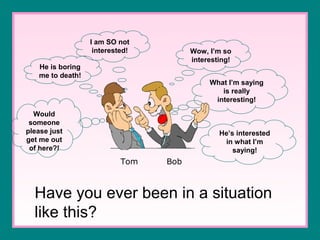
• What is happening in this picture?
• What do you think Tom is thinking?
  And Bob?
I am SO not
                   interested!         Wow, I’m so
                                       interesting!
   He is boring
   me to death!
                                            What I’m saying
                                               is really
                                             interesting!

  Would
 someone
please just                                    He’s interested
get me out                                      in what I’m
 of here?!                                         saying!
                           Tom   Bob


  Have you ever been in a situation
  like this?
Emotion Verbs and Adjectives

•   There are many verbs which communicate
    emotions or feelings, such as:

                     excite
                   interest
                    amaze
                    irritate
                    horrify

•   Many of these verbs can be modified to
    form adjectives.
-ing and –ed adjective pairs
There are many pairs of adjectives
  derived from such verbs, for example:

                   exciting      excited
                   interesting   interested
                   amazing       amazed
                   irritating    irritated
                   horrifying    horrified


Can you think of others?
So… What’s the difference?

 When we talk about emotions or feelings,
 we divide people or things into two
 categories, based on whether they

• produce the emotion (the “Cause”)
              or
• experience the emotion (the “Experiencer”)
The cause
• The cause can be a thing or a person.
• In this case, we use the –ing form of
the adjective.


               The contortionist was
                     amazing.
The experiencer

• Usually, an experiencer is a person,
  who experiences the emotion or feeling.

• The experiencer is affected by the
  cause that produces the
  emotion/feeling.

• In this case, we use the –ed form of
  the adjective.
The children were amazed
 by the contortionist.


                      Cause


    Experiencers
Compare the two adjectives:


  The contortionist was
  amazing; as a result,
  the children were
  amazed!
frighten


The movie is ________________.

The girls are ________________.
frighten


• The movie is    frightening       .
     (Cause)


• The girls are   frightened    .
 (Experiencers)
entertain


This family is ________________.

The TV show is ______________.
entertain


This family is _entertained_.
 (Experiencers)


The TV show is _entertaining_.
        (Cause)
frustrate


The woman is _______________.

The computer is _____________.
frustrate


The woman is frustrated .
 (Experiencer)

The computer is frustrating .
      (Cause)
bore


This teacher is ________.

These students are _________.
bore


This teacher is boring .
   (Cause)


These students are bored .
  (Experiencers)
Your turn!
Make up a pair of sentences using
 this verb and picture:


      confuse
Your turn!
Make up a pair of sentences using
 this verb and picture:


                     terrify
Your turn!
Make up a pair of sentences using
 this verb and picture:


                     relax
                     /rɪˈlæks/
Your turn!
Make up a pair of sentences using
 this verb and picture:


                embarrass
              /ɪmˈbærəs/
Click here to watch this
video to learn more about
 the differences between
     these adjectives

Bored or boring

  • 2.
    Blah, blah, blah… … Mmmmmmm Tom Bob • What is happening in this picture? • What do you think Tom is thinking? And Bob?
  • 3.
    I am SOnot interested! Wow, I’m so interesting! He is boring me to death! What I’m saying is really interesting! Would someone please just He’s interested get me out in what I’m of here?! saying! Tom Bob Have you ever been in a situation like this?
  • 4.
    Emotion Verbs andAdjectives • There are many verbs which communicate emotions or feelings, such as: excite interest amaze irritate horrify • Many of these verbs can be modified to form adjectives.
  • 5.
    -ing and –edadjective pairs There are many pairs of adjectives derived from such verbs, for example: exciting excited interesting interested amazing amazed irritating irritated horrifying horrified Can you think of others?
  • 6.
    So… What’s thedifference? When we talk about emotions or feelings, we divide people or things into two categories, based on whether they • produce the emotion (the “Cause”) or • experience the emotion (the “Experiencer”)
  • 7.
    The cause • Thecause can be a thing or a person. • In this case, we use the –ing form of the adjective. The contortionist was amazing.
  • 8.
    The experiencer • Usually,an experiencer is a person, who experiences the emotion or feeling. • The experiencer is affected by the cause that produces the emotion/feeling. • In this case, we use the –ed form of the adjective.
  • 9.
    The children wereamazed by the contortionist. Cause Experiencers
  • 10.
    Compare the twoadjectives: The contortionist was amazing; as a result, the children were amazed!
  • 11.
    frighten The movie is________________. The girls are ________________.
  • 12.
    frighten • The movieis frightening . (Cause) • The girls are frightened . (Experiencers)
  • 13.
    entertain This family is________________. The TV show is ______________.
  • 14.
    entertain This family is_entertained_. (Experiencers) The TV show is _entertaining_. (Cause)
  • 15.
    frustrate The woman is_______________. The computer is _____________.
  • 16.
    frustrate The woman isfrustrated . (Experiencer) The computer is frustrating . (Cause)
  • 17.
    bore This teacher is________. These students are _________.
  • 18.
    bore This teacher isboring . (Cause) These students are bored . (Experiencers)
  • 19.
    Your turn! Make upa pair of sentences using this verb and picture: confuse
  • 20.
    Your turn! Make upa pair of sentences using this verb and picture: terrify
  • 21.
    Your turn! Make upa pair of sentences using this verb and picture: relax /rɪˈlæks/
  • 22.
    Your turn! Make upa pair of sentences using this verb and picture: embarrass /ɪmˈbærəs/
  • 23.
    Click here towatch this video to learn more about the differences between these adjectives

Editor's Notes

  • #2 For a review of spelling rules addressing how to add –ed and –ing to verbs, see eslprintables PowerPoints http://www.eslprintables.com/powerpoint.asp?id=15583#thetop And http://www.eslprintables.com/powerpoint.asp?id=15342#thetop
  • #6 Additional possibilities: frighten amuse fascinate frustrate excite bore confuse terrify alarm annoy astonish bewilder concern convince depress disappoint disgust embarrass encourage entertain exhaust humiliate inspire intrigue overwhelm perplex please puzzle relax satisfy shock surprise tire worr y