ANESTHESIA FOR
CHRONIC LUNG DISEASE
 Preoperative assessment
 Intraoperative management
   Monitoring
   Lung isolation techniques
   Positioning
   One lung Ventilation
 Postoperative management
   Postoperative analgesia
   Complications
Preoperative Assessment
 Aim
  Identify patients at high risk
  Use that risk assessment to stratify
  perioperative management and focus
  resources on the high-risk patients to
  improve their outcome.
Assessment of Respiratory
function
 Detailed history
 Baseline Spirometry
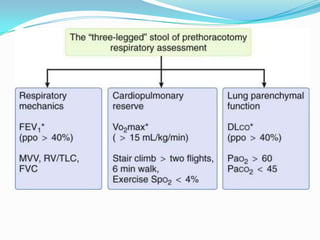
 Respiratory Mechanics
 Lung parenchymal function
 Cardiopulmonary interaction
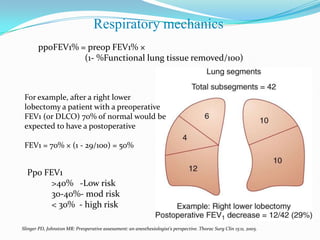
Respiratory mechanics
       ppoFEV1% = preop FEV1% ×
                 (1- %Functional lung tissue removed/100)


 For example, after a right lower
 lobectomy a patient with a preoperative
 FEV1 (or DLCO) 70% of normal would be
 expected to have a postoperative

 FEV1 = 70% × (1 - 29/100) = 50%


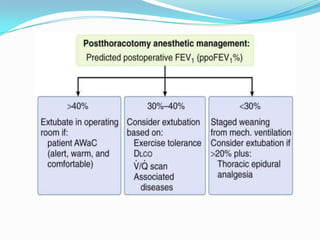
  Ppo FEV1
        >40% -Low risk
        30-40%- mod risk
        < 30% - high risk

Slinger PD, Johnston MR: Preoperative assessment: an anesthesiologist's perspective. Thorac Surg Clin 15:11, 2005.
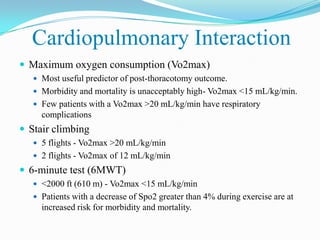
Cardiopulmonary Interaction
 Maximum oxygen consumption (Vo2max)
    Most useful predictor of post-thoracotomy outcome.
    Morbidity and mortality is unacceptably high- Vo2max <15 mL/kg/min.
    Few patients with a Vo2max >20 mL/kg/min have respiratory
     complications
 Stair climbing
    5 flights - Vo2max >20 mL/kg/min
    2 flights - Vo2max of 12 mL/kg/min
 6-minute test (6MWT)
    <2000 ft (610 m) - Vo2max <15 mL/kg/min
    Patients with a decrease of Spo2 greater than 4% during exercise are at
     increased risk for morbidity and mortality.
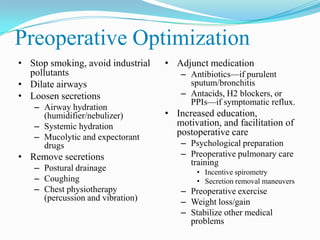
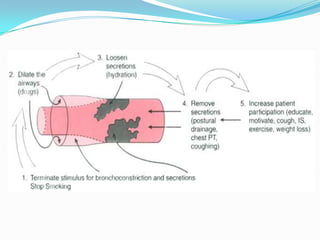
Preoperative Optimization
• Stop smoking, avoid industrial   • Adjunct medication
  pollutants                           – Antibiotics—if purulent
• Dilate airways                         sputum/bronchitis
• Loosen secretions                    – Antacids, H2 blockers, or
                                         PPIs—if symptomatic reflux.
   – Airway hydration
     (humidifier/nebulizer)        • Increased education,
   – Systemic hydration              motivation, and facilitation of
   – Mucolytic and expectorant
                                     postoperative care
     drugs                             – Psychological preparation
• Remove secretions                    – Preoperative pulmonary care
                                         training
   – Postural drainage                     • Incentive spirometry
   – Coughing                              • Secretion removal maneuvers
   – Chest physiotherapy               – Preoperative exercise
     (percussion and vibration)        – Weight loss/gain
                                       – Stabilize other medical
                                         problems
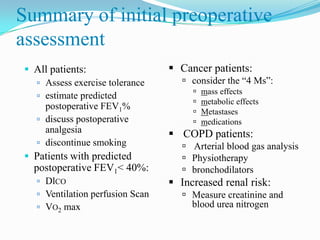
Summary of initial preoperative
assessment
  All patients:                    Cancer patients:
    Assess exercise tolerance         consider the “4 Ms”:
                                           mass effects
    estimate predicted
                                           metabolic effects
     postoperative FEV1%
                                           Metastases
    discuss postoperative                 medications
     analgesia                      COPD patients:
    discontinue smoking               Arterial blood gas analysis
  Patients with predicted             Physiotherapy
   postoperative FEV1< 40%:            bronchodilators
     DlCO                          Increased renal risk:
     Ventilation perfusion Scan       Measure creatinine and
     VO2 max                           blood urea nitrogen
Intraoperative Monitoring
•   Oxygenation
•   Capnometry
•   Arterial blood pressure
•   CVP
•   Pulmonary artery pressure
•   Fibreoptic bronchoscopy
•   Urine output
•   Temperature
Lung Isolation Techniques

• Double lumen tube
• Bronchial blocker
  – Arndt
  – Cohen
  – Fuji
• Univent tube
• Endobronchial tube
• Endotracheal tube advanced into bronchus
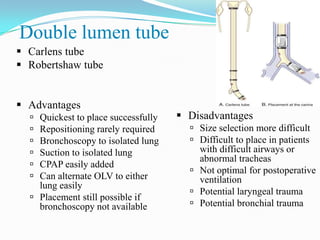
Double lumen tube
 Carlens tube
 Robertshaw tube


 Advantages
   Quickest to place successfully    Disadvantages
   Repositioning rarely required       Size selection more difficult
   Bronchoscopy to isolated lung       Difficult to place in patients
   Suction to isolated lung             with difficult airways or
                                         abnormal tracheas
   CPAP easily added
                                        Not optimal for postoperative
   Can alternate OLV to either          ventilation
    lung easily
                                        Potential laryngeal trauma
   Placement still possible if
    bronchoscopy not available          Potential bronchial trauma
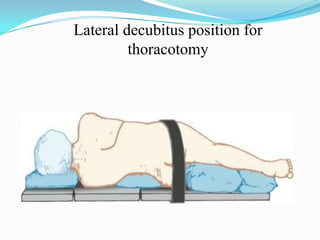
Lateral decubitus position for
         thoracotomy
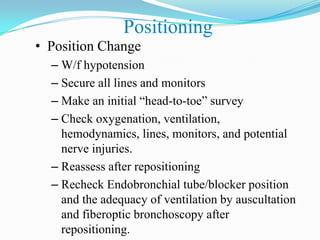
Positioning
• Position Change
  – W/f hypotension
  – Secure all lines and monitors
  – Make an initial “head-to-toe” survey
  – Check oxygenation, ventilation,
    hemodynamics, lines, monitors, and potential
    nerve injuries.
  – Reassess after repositioning
  – Recheck Endobronchial tube/blocker position
    and the adequacy of ventilation by auscultation
    and fiberoptic bronchoscopy after
    repositioning.
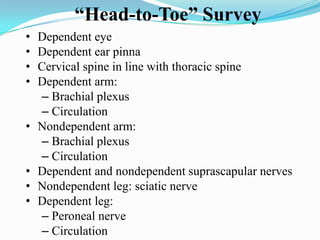
“Head-to-Toe” Survey
•   Dependent eye
•   Dependent ear pinna
•   Cervical spine in line with thoracic spine
•   Dependent arm:
    – Brachial plexus
    – Circulation
•   Nondependent arm:
    – Brachial plexus
    – Circulation
•   Dependent and nondependent suprascapular nerves
•   Nondependent leg: sciatic nerve
•   Dependent leg:
    – Peroneal nerve
    – Circulation
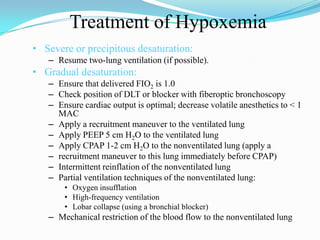
Treatment of Hypoxemia
• Severe or precipitous desaturation:
   – Resume two-lung ventilation (if possible).
• Gradual desaturation:
   – Ensure that delivered FIO2 is 1.0
   – Check position of DLT or blocker with fiberoptic bronchoscopy
   – Ensure cardiac output is optimal; decrease volatile anesthetics to < 1
     MAC
   – Apply a recruitment maneuver to the ventilated lung
   – Apply PEEP 5 cm H2O to the ventilated lung
   – Apply CPAP 1-2 cm H2O to the nonventilated lung (apply a
   – recruitment maneuver to this lung immediately before CPAP)
   – Intermittent reinflation of the nonventilated lung
   – Partial ventilation techniques of the nonventilated lung:
       • Oxygen insufflation
       • High-frequency ventilation
       • Lobar collapse (using a bronchial blocker)
   – Mechanical restriction of the blood flow to the nonventilated lung
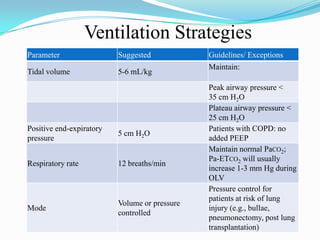
Ventilation Strategies
Parameter                 Suggested            Guidelines/ Exceptions
                                               Maintain:
Tidal volume              5-6 mL/kg
                                               Peak airway pressure <
                                               35 cm H2O
                                               Plateau airway pressure <
                                               25 cm H2O
Positive end-expiratory                        Patients with COPD: no
                          5 cm H2O
pressure                                       added PEEP
                                               Maintain normal PaCO2;
                                               Pa-ETCO2 will usually
Respiratory rate          12 breaths/min
                                               increase 1-3 mm Hg during
                                               OLV
                                               Pressure control for
                                               patients at risk of lung
                          Volume or pressure
Mode                                           injury (e.g., bullae,
                          controlled
                                               pneumonectomy, post lung
                                               transplantation)
Postoperative mangement-
            Analgesia
• Systemic Analgesia
  – Opioids
  – Nonsteroidal Anti-inflammatory Drugs
  – Ketamine
  – Dexmedetomidine
• Local Anesthetics/Nerve Blocks
  – Intercostal Nerve Blocks
  – Intrapleural Analgesia
  – Epidural Analgesia
  – Paravertebral Block
Thoracic Epidural Analgesia

• Better preservation of the functional
  residual volume
• Efficient mucociliary clearance
• Alleviation of the inhibiting reflexes acting
  on the diaphragm
• prevention of atelectasis and secondary
  infections
Postoperative Complications

• Early Major Complications
  – Torsion of a remaining lobe after lobectomy
  – Dehiscence of a bronchial stump
  – Hemorrhage from a major vessel
  – Respiratory Failure
  – Cardiac Herniation
Anaesthetic management of bronchopleural fistula

Bronchopleural fistula
   Communication from major bronchus to pleural space
   Commonly associated with pneumonectomy, trauma,
   abscess or empyema
   Relevant complications
      Pus may contaminate other lung-associated injuries with trauma
Surgery
   Usually semi-elective
   Resuturing of bronchial stump, muscle flap to stump,
   drainage of abscess
      High risk surgery requiring GA and one-lung ventilation
   If incidental surgery, GA may be avoided, regional preferred
      Positioning still important to avoid soiling
 Patient
    Commonly debilitated, may have coexistent medical
     problems
    Respiratory function assessed
       Clinical, spirometry, ABGs
   Routine assessment for thoracic surgery
       Consideration of epidural
 Decision to proceed
   Respiratory function optimized
   Chest drain inserted to avoid tension pneumothorax and
    drain pleural collection
 Induction
   Objectives
       Maintain oxygenation and ventilation, avoid tension pneumothorax
       Avoid soiling good lung
   Protection of lung requires DLT, bronchial lumen to good side
   Small leak without infection may be manageable with single-lumen
    ETT
   Paediatric patients are typically too small for DLT or FOB -->
    blocker or endobronchial intubation
   Fistula reduces effectiveness of mask IPPV, so spontaneous
    ventilation
   Ideally awake DLT intubation
       Topical local anaesthetic to airway
       Position head-up and bad side down
       Sedation for intubation
   Alternatively spontaneously ventilating GA with DLT insertion
    when deep
   Verification of DLT position with differential ventilation or FOB
 Maintenance
   IPPV to healthy lung
   Lung with fistula may benefit from small VT ventilation
    or CPAP below critical pressure for fistula or HFJV
 Emergence
   Avoid high airway pressures if fistula has been repaired
     Hand ventilation or SIMV

 Postoperative
   Epidural analgesia
   HDU monitoring post-op
     High incidence of arrhythmia post-thoracotomy
Anesthesia for chronic lung disease

Anesthesia for chronic lung disease

  • 1.
  • 2.
     Preoperative assessment Intraoperative management  Monitoring  Lung isolation techniques  Positioning  One lung Ventilation  Postoperative management  Postoperative analgesia  Complications
  • 3.
    Preoperative Assessment  Aim  Identify patients at high risk  Use that risk assessment to stratify perioperative management and focus resources on the high-risk patients to improve their outcome.
  • 4.
    Assessment of Respiratory function Detailed history  Baseline Spirometry  Respiratory Mechanics  Lung parenchymal function  Cardiopulmonary interaction
  • 5.
    Respiratory mechanics ppoFEV1% = preop FEV1% × (1- %Functional lung tissue removed/100) For example, after a right lower lobectomy a patient with a preoperative FEV1 (or DLCO) 70% of normal would be expected to have a postoperative FEV1 = 70% × (1 - 29/100) = 50% Ppo FEV1 >40% -Low risk 30-40%- mod risk < 30% - high risk Slinger PD, Johnston MR: Preoperative assessment: an anesthesiologist's perspective. Thorac Surg Clin 15:11, 2005.
  • 6.
    Cardiopulmonary Interaction  Maximumoxygen consumption (Vo2max)  Most useful predictor of post-thoracotomy outcome.  Morbidity and mortality is unacceptably high- Vo2max <15 mL/kg/min.  Few patients with a Vo2max >20 mL/kg/min have respiratory complications  Stair climbing  5 flights - Vo2max >20 mL/kg/min  2 flights - Vo2max of 12 mL/kg/min  6-minute test (6MWT)  <2000 ft (610 m) - Vo2max <15 mL/kg/min  Patients with a decrease of Spo2 greater than 4% during exercise are at increased risk for morbidity and mortality.
  • 9.
    Preoperative Optimization • Stopsmoking, avoid industrial • Adjunct medication pollutants – Antibiotics—if purulent • Dilate airways sputum/bronchitis • Loosen secretions – Antacids, H2 blockers, or PPIs—if symptomatic reflux. – Airway hydration (humidifier/nebulizer) • Increased education, – Systemic hydration motivation, and facilitation of – Mucolytic and expectorant postoperative care drugs – Psychological preparation • Remove secretions – Preoperative pulmonary care training – Postural drainage • Incentive spirometry – Coughing • Secretion removal maneuvers – Chest physiotherapy – Preoperative exercise (percussion and vibration) – Weight loss/gain – Stabilize other medical problems
  • 11.
    Summary of initialpreoperative assessment  All patients:  Cancer patients:  Assess exercise tolerance  consider the “4 Ms”:  mass effects  estimate predicted  metabolic effects postoperative FEV1%  Metastases  discuss postoperative  medications analgesia  COPD patients:  discontinue smoking  Arterial blood gas analysis  Patients with predicted  Physiotherapy postoperative FEV1< 40%:  bronchodilators  DlCO  Increased renal risk:  Ventilation perfusion Scan  Measure creatinine and  VO2 max blood urea nitrogen
  • 12.
    Intraoperative Monitoring • Oxygenation • Capnometry • Arterial blood pressure • CVP • Pulmonary artery pressure • Fibreoptic bronchoscopy • Urine output • Temperature
  • 13.
    Lung Isolation Techniques •Double lumen tube • Bronchial blocker – Arndt – Cohen – Fuji • Univent tube • Endobronchial tube • Endotracheal tube advanced into bronchus
  • 14.
    Double lumen tube Carlens tube  Robertshaw tube  Advantages  Quickest to place successfully  Disadvantages  Repositioning rarely required  Size selection more difficult  Bronchoscopy to isolated lung  Difficult to place in patients  Suction to isolated lung with difficult airways or abnormal tracheas  CPAP easily added  Not optimal for postoperative  Can alternate OLV to either ventilation lung easily  Potential laryngeal trauma  Placement still possible if bronchoscopy not available  Potential bronchial trauma
  • 15.
  • 16.
    Positioning • Position Change – W/f hypotension – Secure all lines and monitors – Make an initial “head-to-toe” survey – Check oxygenation, ventilation, hemodynamics, lines, monitors, and potential nerve injuries. – Reassess after repositioning – Recheck Endobronchial tube/blocker position and the adequacy of ventilation by auscultation and fiberoptic bronchoscopy after repositioning.
  • 17.
    “Head-to-Toe” Survey • Dependent eye • Dependent ear pinna • Cervical spine in line with thoracic spine • Dependent arm: – Brachial plexus – Circulation • Nondependent arm: – Brachial plexus – Circulation • Dependent and nondependent suprascapular nerves • Nondependent leg: sciatic nerve • Dependent leg: – Peroneal nerve – Circulation
  • 18.
    Treatment of Hypoxemia •Severe or precipitous desaturation: – Resume two-lung ventilation (if possible). • Gradual desaturation: – Ensure that delivered FIO2 is 1.0 – Check position of DLT or blocker with fiberoptic bronchoscopy – Ensure cardiac output is optimal; decrease volatile anesthetics to < 1 MAC – Apply a recruitment maneuver to the ventilated lung – Apply PEEP 5 cm H2O to the ventilated lung – Apply CPAP 1-2 cm H2O to the nonventilated lung (apply a – recruitment maneuver to this lung immediately before CPAP) – Intermittent reinflation of the nonventilated lung – Partial ventilation techniques of the nonventilated lung: • Oxygen insufflation • High-frequency ventilation • Lobar collapse (using a bronchial blocker) – Mechanical restriction of the blood flow to the nonventilated lung
  • 19.
    Ventilation Strategies Parameter Suggested Guidelines/ Exceptions Maintain: Tidal volume 5-6 mL/kg Peak airway pressure < 35 cm H2O Plateau airway pressure < 25 cm H2O Positive end-expiratory Patients with COPD: no 5 cm H2O pressure added PEEP Maintain normal PaCO2; Pa-ETCO2 will usually Respiratory rate 12 breaths/min increase 1-3 mm Hg during OLV Pressure control for patients at risk of lung Volume or pressure Mode injury (e.g., bullae, controlled pneumonectomy, post lung transplantation)
  • 20.
    Postoperative mangement- Analgesia • Systemic Analgesia – Opioids – Nonsteroidal Anti-inflammatory Drugs – Ketamine – Dexmedetomidine • Local Anesthetics/Nerve Blocks – Intercostal Nerve Blocks – Intrapleural Analgesia – Epidural Analgesia – Paravertebral Block
  • 21.
    Thoracic Epidural Analgesia •Better preservation of the functional residual volume • Efficient mucociliary clearance • Alleviation of the inhibiting reflexes acting on the diaphragm • prevention of atelectasis and secondary infections
  • 22.
    Postoperative Complications • EarlyMajor Complications – Torsion of a remaining lobe after lobectomy – Dehiscence of a bronchial stump – Hemorrhage from a major vessel – Respiratory Failure – Cardiac Herniation
  • 23.
    Anaesthetic management ofbronchopleural fistula Bronchopleural fistula Communication from major bronchus to pleural space Commonly associated with pneumonectomy, trauma, abscess or empyema Relevant complications Pus may contaminate other lung-associated injuries with trauma Surgery Usually semi-elective Resuturing of bronchial stump, muscle flap to stump, drainage of abscess High risk surgery requiring GA and one-lung ventilation If incidental surgery, GA may be avoided, regional preferred Positioning still important to avoid soiling
  • 24.
     Patient  Commonly debilitated, may have coexistent medical problems  Respiratory function assessed  Clinical, spirometry, ABGs  Routine assessment for thoracic surgery  Consideration of epidural  Decision to proceed  Respiratory function optimized  Chest drain inserted to avoid tension pneumothorax and drain pleural collection
  • 25.
     Induction  Objectives  Maintain oxygenation and ventilation, avoid tension pneumothorax  Avoid soiling good lung  Protection of lung requires DLT, bronchial lumen to good side  Small leak without infection may be manageable with single-lumen ETT  Paediatric patients are typically too small for DLT or FOB --> blocker or endobronchial intubation  Fistula reduces effectiveness of mask IPPV, so spontaneous ventilation  Ideally awake DLT intubation  Topical local anaesthetic to airway  Position head-up and bad side down  Sedation for intubation  Alternatively spontaneously ventilating GA with DLT insertion when deep  Verification of DLT position with differential ventilation or FOB
  • 26.
     Maintenance  IPPV to healthy lung  Lung with fistula may benefit from small VT ventilation or CPAP below critical pressure for fistula or HFJV  Emergence  Avoid high airway pressures if fistula has been repaired  Hand ventilation or SIMV  Postoperative  Epidural analgesia  HDU monitoring post-op  High incidence of arrhythmia post-thoracotomy