History of Numerical Algorithms Reva Narasimhan Kean University, Union, NJ
Overview History Review of important people and projects Examples of importance of understanding numerical algorithms Role in teaching with technology
Introduction What is  numerical analysis , also referred to as  scientific computing ? An integration of mathematical analysis, software,and large, complex problems in applications Why is it important?  Most equations cannot be solved by analytical methods.
Beginnings… Began with the 1947 paper by John von Neumann and Herman Goldstine, "Numerical Inverting of Matrices of High Order" (Bulletin of the AMS, Nov. 1947). It is one of the first papers to study rounding error and include discussion of what today is called scientific computing.  
Beginnings… ENIAC was the first electronic digital computer. Funded by the U.S. Army to help with calculation of trajectories of ballistics (early 1940’s) At that time, computer time was extremely expensive
Numerical Analysis Specialities numerical linear algebra: used in digital imaging and compression numerical methods for ordinary and partial differential equations:  Aircraft and automobile design Computational finance Computational biology Weather forecasting methods of approximation of functions: used in approximating curves in CAD/CAM design
Important People and Projects James Wilkinson : round off error analysis and solving eigenvalue problems. (Late 50’s, Early 60’s) Cooley-Tukey: FFT algorithm (1960’s) Peter Lax (Courant Institute) – numerical PDE’s EISPACK and LINPACK projects run by the Argonne National Laboratory to produce high quality, tested and portable mathematical software during the early- to mid-1970s.  These were linear algebra packages written in FORTRAN
Important People and Projects QUADPACK project : numerical integration package (mid 1970’s) Bill Gear, Lawrence Shampine: Numerical ODE’s (1980’s) Cleve Moler : founder of MATLAB; (late 1980’s) Stephen Wolfram : founder of Mathematica (early 1990’s)
Math Software Packages Many of the early software were incorporated in MATLAB, Maple and Mathematica Sophisticated mathematical analysis can also be done by Excel – widely used in engineering and business
Numerical algorithms commonly in use Simplex method for linear programming Splines in CAD/CAM design Matrix computations for digital imaging Digital animation ( Toy Story ,  Shrek …)  Numerical fluid dynamics for simulation of blood flow Options pricing models in finance
Example: Digital Imaging A picture can be represented as a m X n array, with each element of the array representing the color value at that point Using the language of linear algebra, this array can be manipulated in many ways Algorithm in numerical linear algebra play an important role in the manipulation of digital images In addition to numerical linear algebra, statistics and signal processing tools are also used
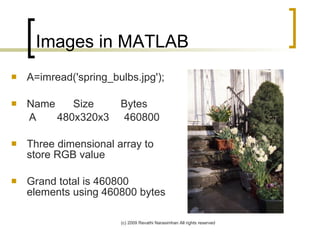
Images in MATLAB A=imread('spring_bulbs.jpg'); Name  Size  Bytes  A  480x320x3  460800  Three dimensional array to store RGB value Grand total is 460800 elements using 460800 bytes
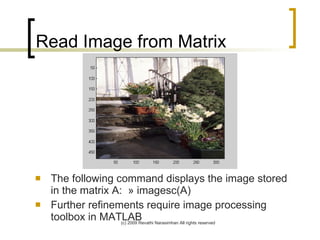
Read Image from Matrix The following command displays the image stored in the matrix A:  » imagesc(A) Further refinements require image processing toolbox in MATLAB
Image processing in software This  Adobe web page  shows how to use matrices in refining an image
Roundoff error and significant digits Since machines can support only a finite number of digits, it is important to know the effect of rounding error To understand rounding error, examine a simple problem
Example: Curve Fitting Examine data in Example of  population growth
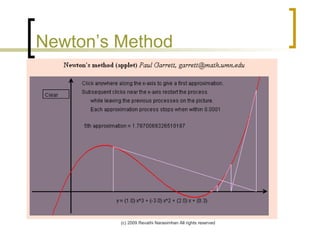
Teaching with Technology Nonlinear equation solvers: use of Newton’s method Numerical Integration Numerical solution of ODE’s
Newton’s Method
Role of Mathematical analysis How does the behavior of the function affect the root that you find? What happens if your initial guess is near a local maximum or minimum? How many roots are there anyway? Thus, proper use of technology requires a higher level of conceptual understanding
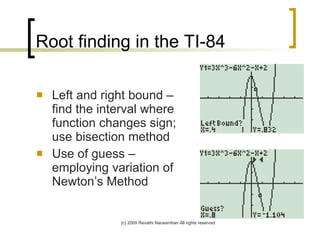
Root finding in the TI-84  Left and right bound – find the interval where function changes sign; use bisection method Use of guess – employing variation of Newton’s Method
Goal Seek in Excel This is really a nonlinear equation solver using an iterative method In the 1970’s and 1980’s, numerical computations were done on mainframes Now, a lot of quantitative analysis takes place on the desktop PC, using Excel
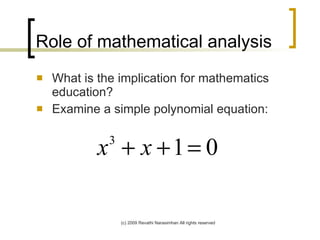
Role of mathematical analysis What is the implication for mathematics education? Examine a simple polynomial equation:
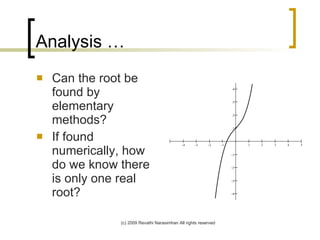
Analysis … Can the root be found by elementary methods? If found numerically, how do we know there is only one real root?
Implication for Technology in Education Important for students to be familiar with effects of roundoff error Spreadsheets are used in analysis of large amounts of data and is a tool for  all  commercial and governmental decision-makers. A robust quantitative curriculum: numerical methods,  introduction to computer simulation, and statistics.  “ Quantitative arguments are underpinning successful business and political decisions. Students of commerce and government must become equally skilled consumers of quantitative information.” (Deborah Hughes-Hallett, 2000)
Summary  Wide use of numerical algorithms brings about new ideas in teaching mathematics Quantitative literacy involves knowing how to use technology such as a spreadsheet to analyze a problem Conceptual understanding is a necessity for proper use of technology
Contact Information [email_address] http://www.mymathspace.net

Numerical Algorithms

  • 1.
    History of NumericalAlgorithms Reva Narasimhan Kean University, Union, NJ
  • 2.
    Overview History Reviewof important people and projects Examples of importance of understanding numerical algorithms Role in teaching with technology
  • 3.
    Introduction What is numerical analysis , also referred to as scientific computing ? An integration of mathematical analysis, software,and large, complex problems in applications Why is it important? Most equations cannot be solved by analytical methods.
  • 4.
    Beginnings… Began withthe 1947 paper by John von Neumann and Herman Goldstine, "Numerical Inverting of Matrices of High Order" (Bulletin of the AMS, Nov. 1947). It is one of the first papers to study rounding error and include discussion of what today is called scientific computing.  
  • 5.
    Beginnings… ENIAC wasthe first electronic digital computer. Funded by the U.S. Army to help with calculation of trajectories of ballistics (early 1940’s) At that time, computer time was extremely expensive
  • 6.
    Numerical Analysis Specialitiesnumerical linear algebra: used in digital imaging and compression numerical methods for ordinary and partial differential equations: Aircraft and automobile design Computational finance Computational biology Weather forecasting methods of approximation of functions: used in approximating curves in CAD/CAM design
  • 7.
    Important People andProjects James Wilkinson : round off error analysis and solving eigenvalue problems. (Late 50’s, Early 60’s) Cooley-Tukey: FFT algorithm (1960’s) Peter Lax (Courant Institute) – numerical PDE’s EISPACK and LINPACK projects run by the Argonne National Laboratory to produce high quality, tested and portable mathematical software during the early- to mid-1970s. These were linear algebra packages written in FORTRAN
  • 8.
    Important People andProjects QUADPACK project : numerical integration package (mid 1970’s) Bill Gear, Lawrence Shampine: Numerical ODE’s (1980’s) Cleve Moler : founder of MATLAB; (late 1980’s) Stephen Wolfram : founder of Mathematica (early 1990’s)
  • 9.
    Math Software PackagesMany of the early software were incorporated in MATLAB, Maple and Mathematica Sophisticated mathematical analysis can also be done by Excel – widely used in engineering and business
  • 10.
    Numerical algorithms commonlyin use Simplex method for linear programming Splines in CAD/CAM design Matrix computations for digital imaging Digital animation ( Toy Story , Shrek …) Numerical fluid dynamics for simulation of blood flow Options pricing models in finance
  • 11.
    Example: Digital ImagingA picture can be represented as a m X n array, with each element of the array representing the color value at that point Using the language of linear algebra, this array can be manipulated in many ways Algorithm in numerical linear algebra play an important role in the manipulation of digital images In addition to numerical linear algebra, statistics and signal processing tools are also used
  • 12.
    Images in MATLABA=imread('spring_bulbs.jpg'); Name Size Bytes A 480x320x3 460800 Three dimensional array to store RGB value Grand total is 460800 elements using 460800 bytes
  • 13.
    Read Image fromMatrix The following command displays the image stored in the matrix A: » imagesc(A) Further refinements require image processing toolbox in MATLAB
  • 14.
    Image processing insoftware This Adobe web page shows how to use matrices in refining an image
  • 15.
    Roundoff error andsignificant digits Since machines can support only a finite number of digits, it is important to know the effect of rounding error To understand rounding error, examine a simple problem
  • 16.
    Example: Curve FittingExamine data in Example of population growth
  • 17.
    Teaching with TechnologyNonlinear equation solvers: use of Newton’s method Numerical Integration Numerical solution of ODE’s
  • 18.
  • 19.
    Role of Mathematicalanalysis How does the behavior of the function affect the root that you find? What happens if your initial guess is near a local maximum or minimum? How many roots are there anyway? Thus, proper use of technology requires a higher level of conceptual understanding
  • 20.
    Root finding inthe TI-84 Left and right bound – find the interval where function changes sign; use bisection method Use of guess – employing variation of Newton’s Method
  • 21.
    Goal Seek inExcel This is really a nonlinear equation solver using an iterative method In the 1970’s and 1980’s, numerical computations were done on mainframes Now, a lot of quantitative analysis takes place on the desktop PC, using Excel
  • 22.
    Role of mathematicalanalysis What is the implication for mathematics education? Examine a simple polynomial equation:
  • 23.
    Analysis … Canthe root be found by elementary methods? If found numerically, how do we know there is only one real root?
  • 24.
    Implication for Technologyin Education Important for students to be familiar with effects of roundoff error Spreadsheets are used in analysis of large amounts of data and is a tool for all commercial and governmental decision-makers. A robust quantitative curriculum: numerical methods, introduction to computer simulation, and statistics. “ Quantitative arguments are underpinning successful business and political decisions. Students of commerce and government must become equally skilled consumers of quantitative information.” (Deborah Hughes-Hallett, 2000)
  • 25.
    Summary Wideuse of numerical algorithms brings about new ideas in teaching mathematics Quantitative literacy involves knowing how to use technology such as a spreadsheet to analyze a problem Conceptual understanding is a necessity for proper use of technology
  • 26.
    Contact Information [email_address]http://www.mymathspace.net