
Fun with Functions
Reva Narasimhan
Associate Professor of Mathematics
Kean University, NJ
www.mymathspace.net/nctm
• Introduction
• Why functions?
• Challenges in teaching the function concept
• Examples of lively applications to connect concepts and
  skills
• Questions


Overview
(c) 2011 R. Narasimhan For non profit classroom use only
• Serves as a unifying theme in understanding concepts in
  algebra through calculus and beyond
• The language of functions is extremely useful in
  applications
• Has a graphical, symbolic, tabular and verbal components


Why Functions?
(c) 2011 R. Narasimhan For non profit classroom use only
Challenges
• Making connections between math
  topics
• Increasing student interaction

• Balance of skills and technology and
  applications and …

• Time constraints in covering material

                 (c) 2011 R. Narasimhan For non
                 profit classroom use only
• Start with an example in a familiar context
• Work with the example and obtain new insights
• Use the example to introduce a new idea


How can applications
help?
(c) 2011 R. Narasimhan For non profit classroom use only
• Explore multiple ideas using a single example
      • Just-in-time introduction of new algebraic skills


Time Constraints
(c) 2011 R. Narasimhan For non profit classroom use only
1.     Count how many total M&M’s there are in your
       packet. This is the initial value.
2.     Shake up M&M’s and drop the candies on a piece of
       paper.
3.     Count how many have “m” on top
4.     Record on paper.
5.     Remove the candies with no “m” on top and repeat
       Steps 2-4 until no more candies are left.
6.     Record results in the given table and model the
       behavior.


 Exponential Decay
(c) 2011 R. Narasimhan For non profit classroom use only
Making Connections

• Application – Phone plan comparison
• Objective – to introduce inequalities and
  function notation


                (c) 2011 R. Narasimhan For non
                profit classroom use only
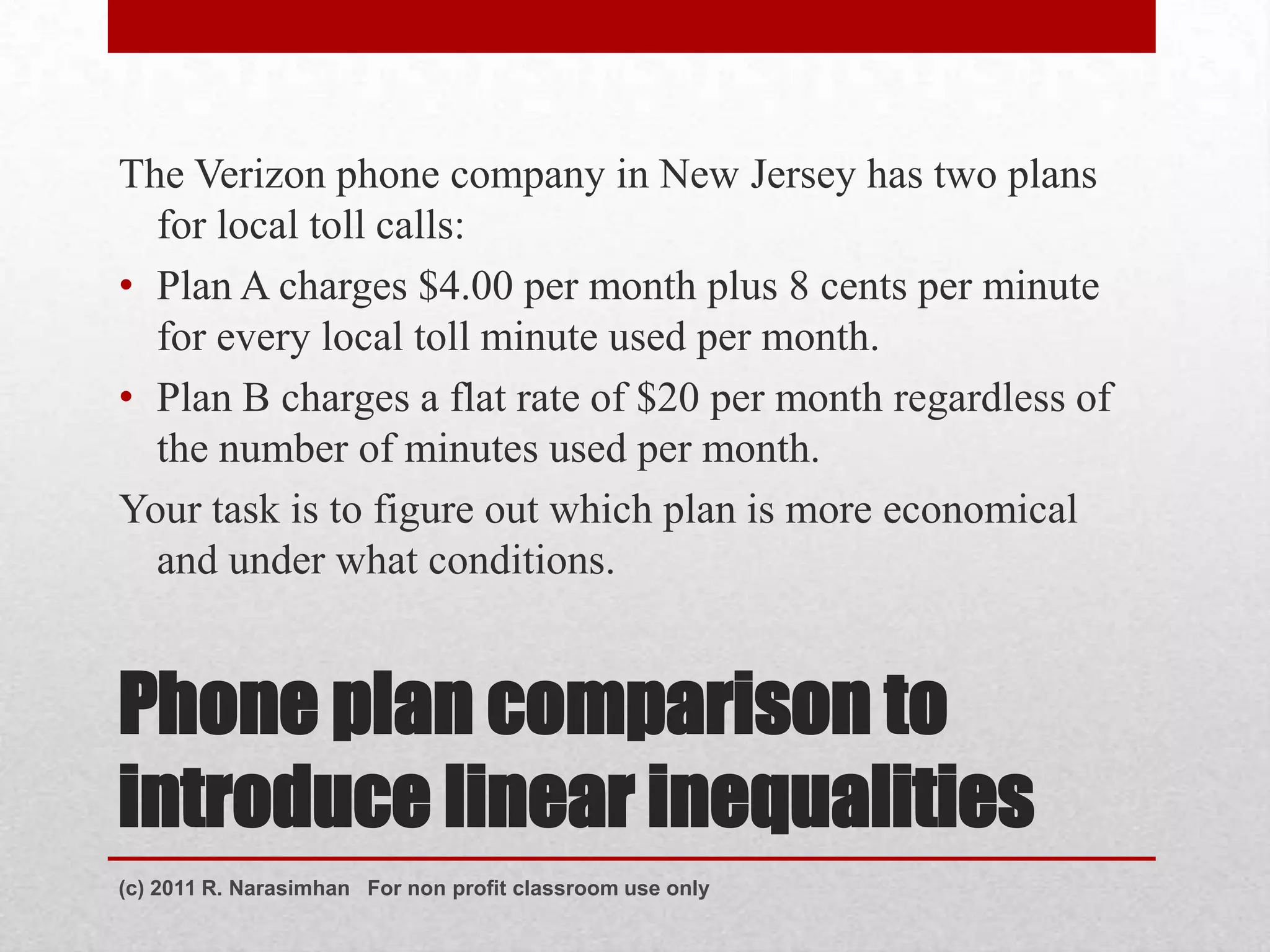
The Verizon phone company in New Jersey has two plans
  for local toll calls:
• Plan A charges $4.00 per month plus 8 cents per minute
  for every local toll minute used per month.
• Plan B charges a flat rate of $20 per month regardless of
  the number of minutes used per month.
Your task is to figure out which plan is more economical
  and under what conditions.


Phone plan comparison to
introduce linear inequalities
(c) 2011 R. Narasimhan For non profit classroom use only
• Write an expression for the monthly cost for Plan
  A, using the number of minutes as the input variable.
• What kind of function did you obtain?
• What is the y-intercept of the graph of this function and
  what does it signify?
• What is the slope of this function and what does it
  signify?


Questions
(c) 2011 R. Narasimhan For non profit classroom use only
• Write an expression for the monthly cost for Plan
  B, using the number of minutes as the input variable.
• What kind of function did you obtain?
• What is the y-intercept of the graph of this function and
  what does it signify?
• What is the slope of this function and what does it
  signify?


Questions
(c) 2011 R. Narasimhan For non profit classroom use only
• Introduce new algebraic skills to proceed further.
• Practice algebraic skills
• Revisit problem and finish up
• Develop other what-if scenarios which build on this
  model.
• Discuss limitation of model
• If technology is used, how would it be incorporated
  within this unit?


What next?
(c) 2011 R. Narasimhan For non profit classroom use only
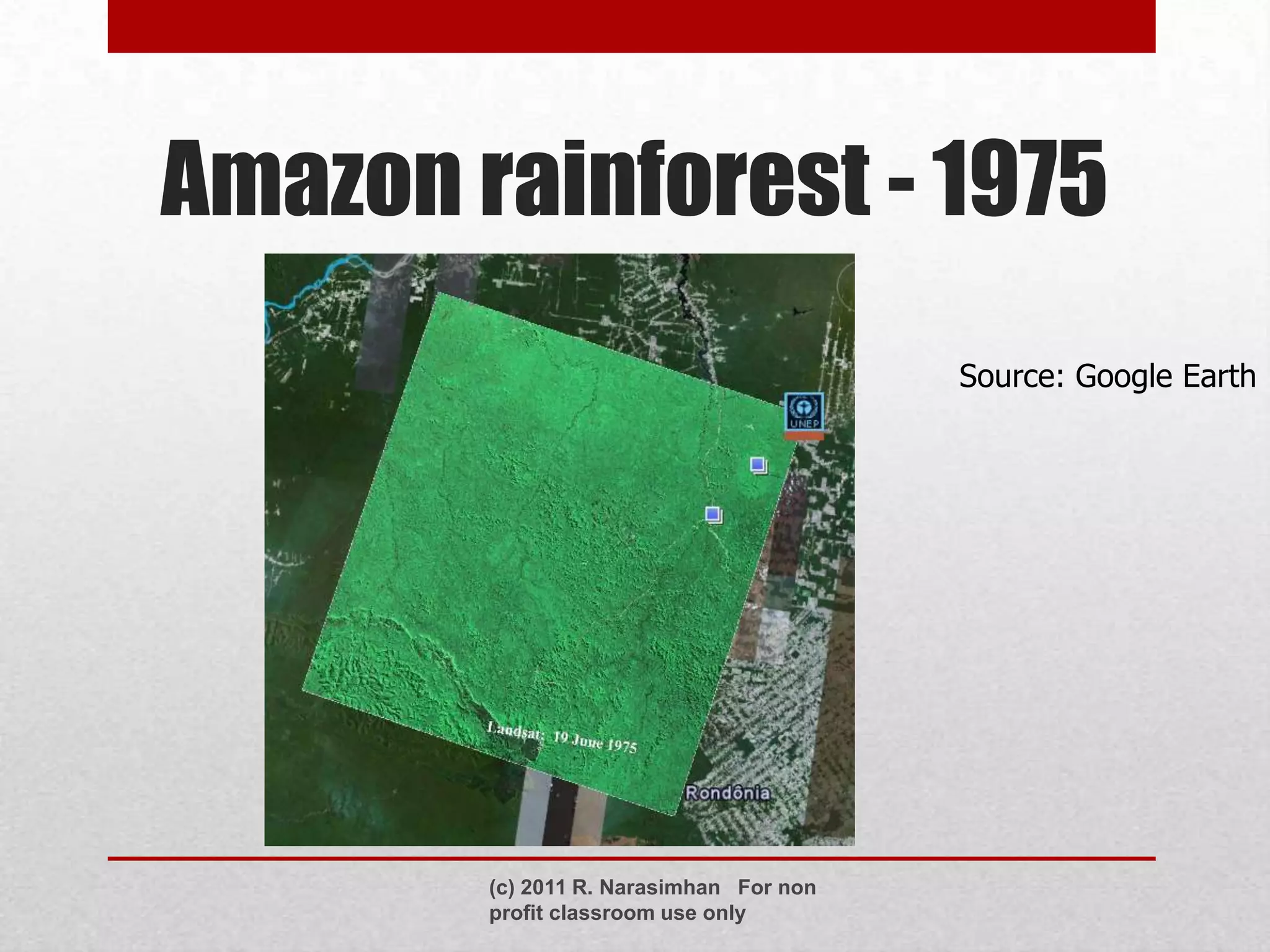
Amazon rainforest - 1975
                                         Source: Google Earth


        (c) 2011 R. Narasimhan For non
        profit classroom use only
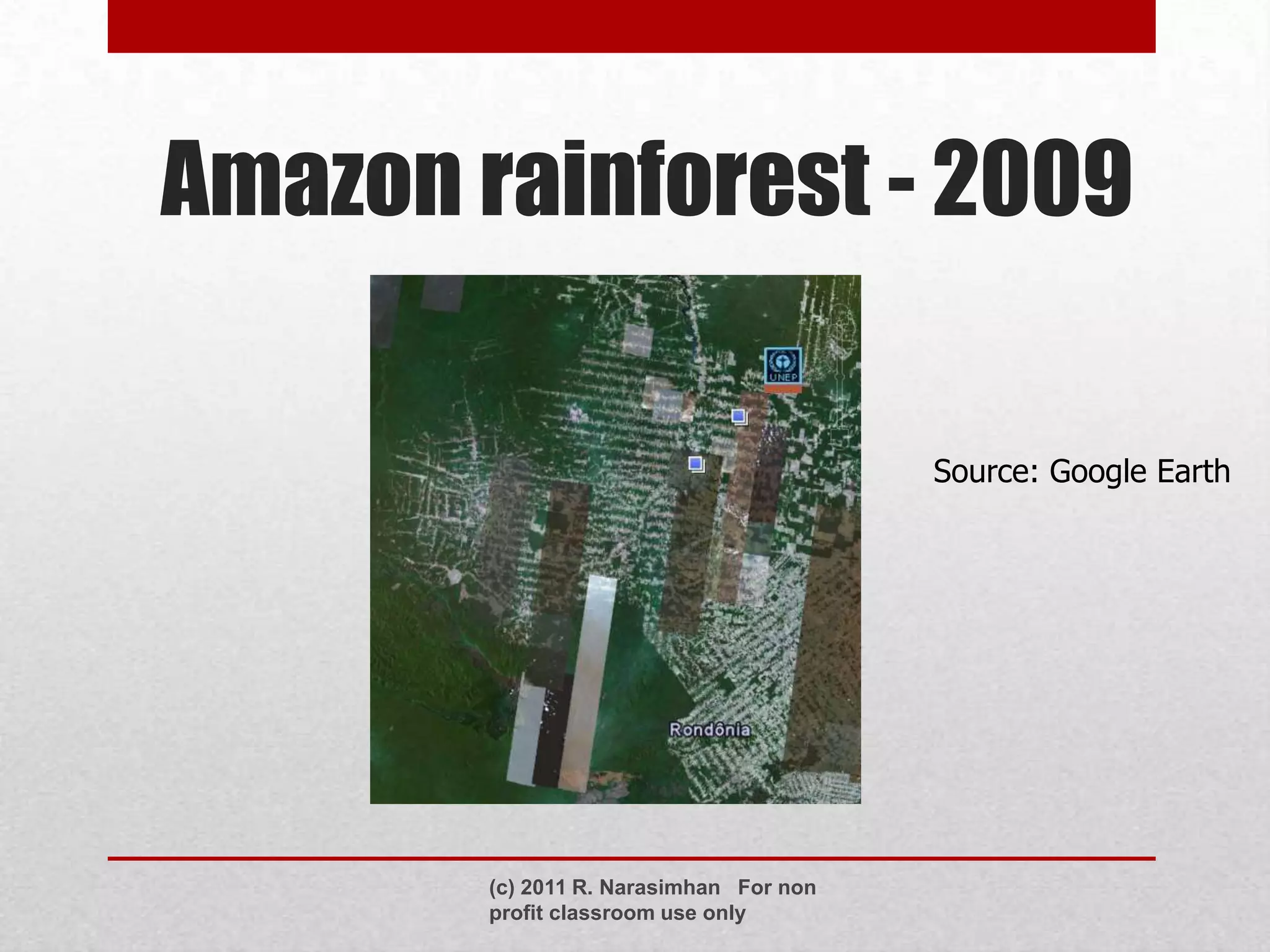
Amazon rainforest - 2009

                                         Source: Google Earth


        (c) 2011 R. Narasimhan For non
        profit classroom use only
Making Connections

• Application – Rainforest decline
• Objective – to introduce exponential
  functions
 The total area of the world’s tropical rainforests have been
 declining at a rate of approximately 8% every ten years. Put
 another way, 92% of the total area of rainforests will be retained
 ten years from now. For illustration, consider a 10000 square
 kilometer area of rainforest. (Source: World Resources Institute)


                       (c) 2011 R. Narasimhan For non
                       profit classroom use only
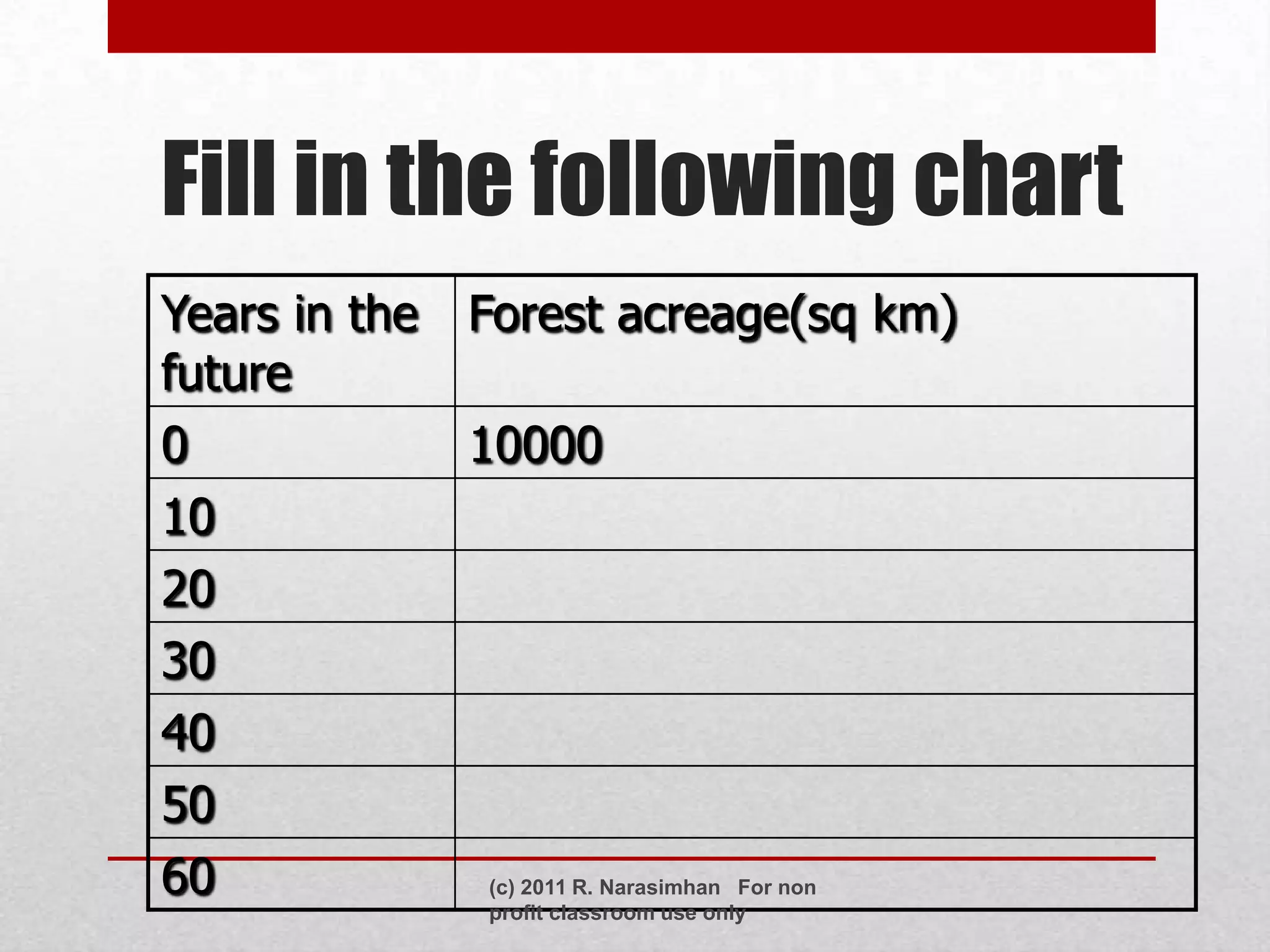
Fill in the following chart
Years in the   Forest acreage(sq km)
future
0              10000
10
20
30
40
50
60             (c) 2011 R. Narasimhan For non
               profit classroom use only
Questions
•         Assume that the given trend will continue. Fill in the table to see how
          much of this rainforest will remain in 90 years.
•         Plot the points in the table above, using the number of years in the
          horizontal axis and the total acreage in the vertical axis. What do you
          observe?
•         From your table, approximately how long will it take for the acreage
          of the given region to decline to half its original size?
•         Can you give an expression for the total acreage of rainforest after t
          years? (Hint: Think of t in multiples of 10.)

Use this as the entry to give a short introduction to exponential functions.


    (c) 2011 R. Narasimhan For non profit classroom use only
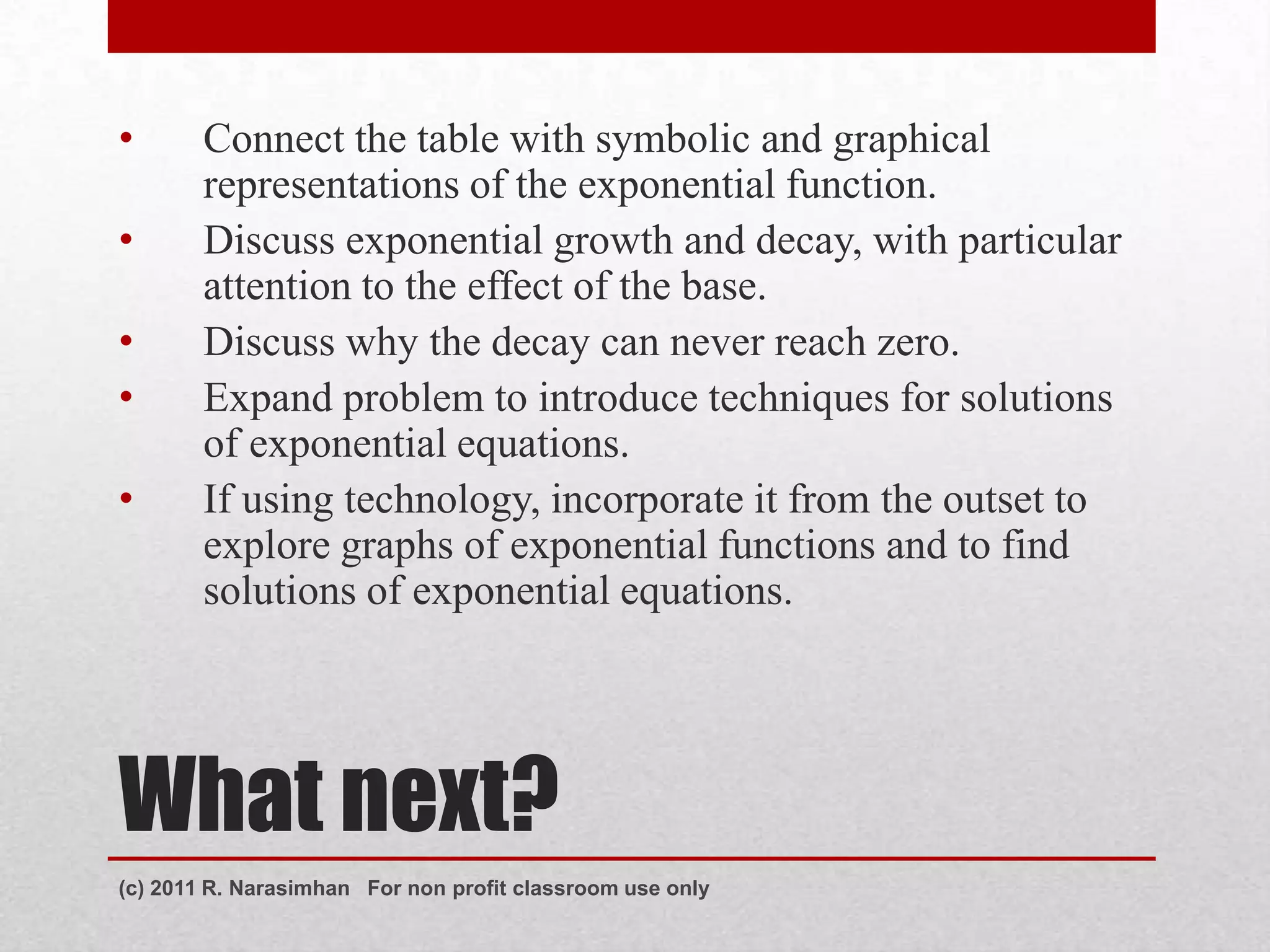
•       Connect the table with symbolic and graphical
        representations of the exponential function.
•       Discuss exponential growth and decay, with particular
        attention to the effect of the base.
•       Discuss why the decay can never reach zero.
•       Expand problem to introduce techniques for solutions
        of exponential equations.
•       If using technology, incorporate it from the outset to
        explore graphs of exponential functions and to find
        solutions of exponential equations.


What next?
(c) 2011 R. Narasimhan For non profit classroom use only
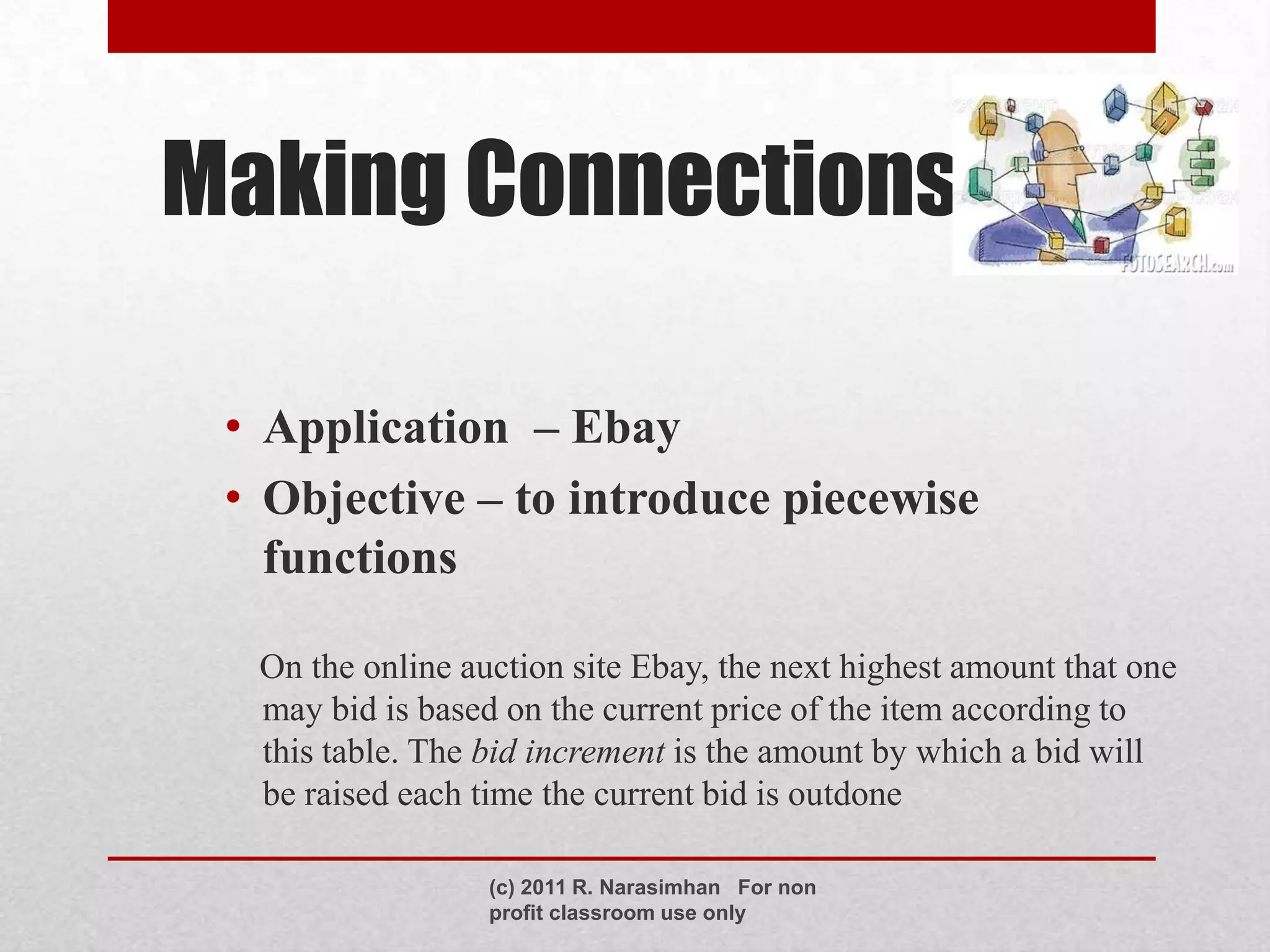
Making Connections

 • Application – Ebay
 • Objective – to introduce piecewise
   functions

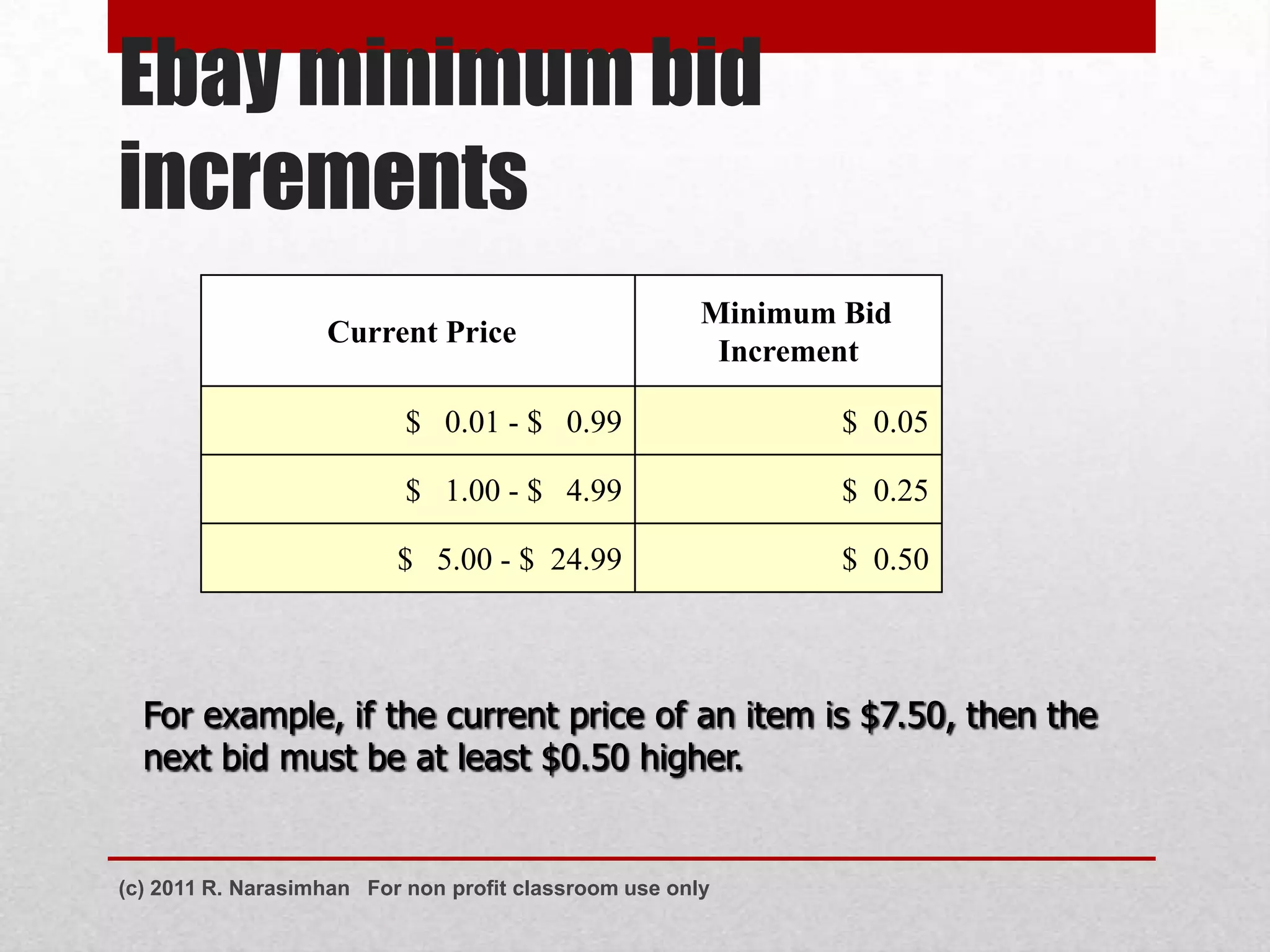
  On the online auction site Ebay, the next highest amount that one
  may bid is based on the current price of the item according to
  this table. The bid increment is the amount by which a bid will
  be raised each time the current bid is outdone

                  (c) 2011 R. Narasimhan For non
                  profit classroom use only
Ebay minimum bid
increments
                                                       Minimum Bid
                   Current Price
                                                        Increment

                           $ 0.01 - $ 0.99                     $ 0.05

                           $ 1.00 - $ 4.99                     $ 0.25

                          $ 5.00 - $ 24.99                     $ 0.50


  For example, if the current price of an item is $7.50, then the
  next bid must be at least $0.50 higher.


(c) 2011 R. Narasimhan For non profit classroom use only
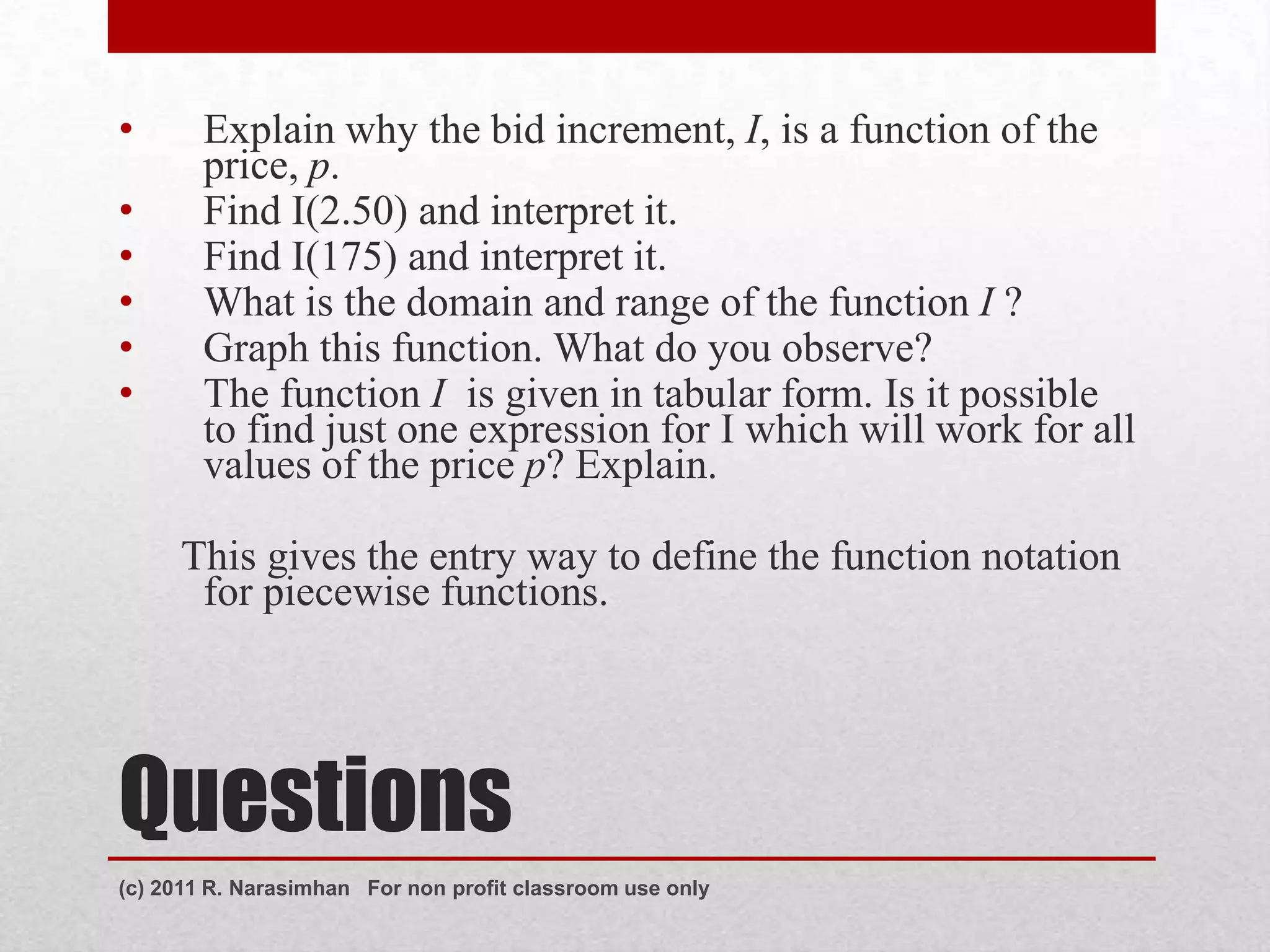
•       Explain why the bid increment, I, is a function of the
        price, p.
•       Find I(2.50) and interpret it.
•       Find I(175) and interpret it.
•       What is the domain and range of the function I ?
•       Graph this function. What do you observe?
•       The function I is given in tabular form. Is it possible
        to find just one expression for I which will work for all
        values of the price p? Explain.

     This gives the entry way to define the function notation
      for piecewise functions.


Questions
(c) 2011 R. Narasimhan For non profit classroom use only
What next?
•  Introduce the idea of piecewise functions.
•  Introduce the function notation associated with
   piecewise functions. Use a simple case first, and then
   extend. Relate back to the tabular form of functions.
•  Practice the symbolic form of piecewise functions.
•  Graph more piecewise functions. Relate to the table
   and symbolic form for piecewise functions.


Follow up
(c) 2011 R. Narasimhan For non profit classroom use only
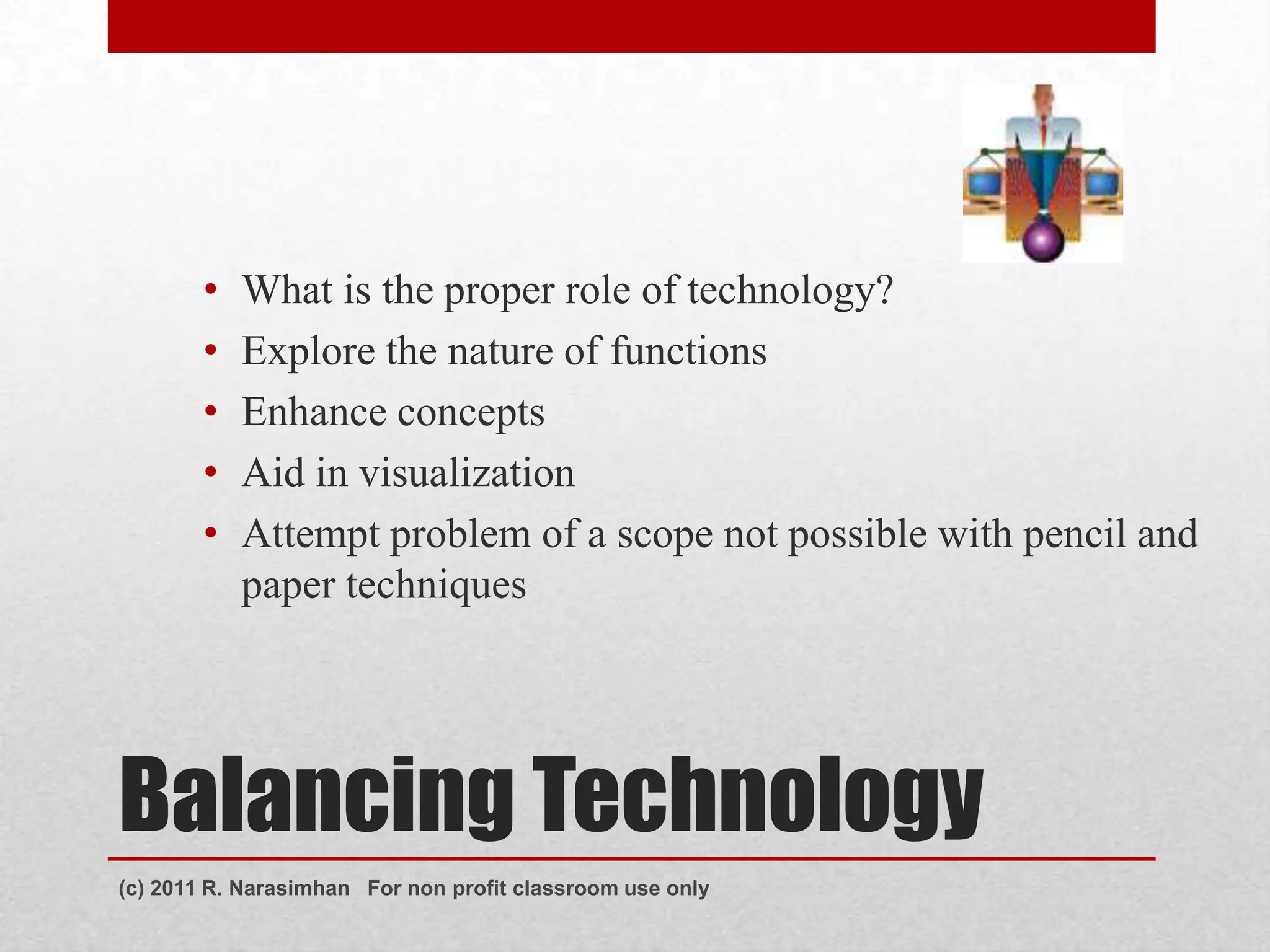
•   What is the proper role of technology?
        •   Explore the nature of functions
        •   Enhance concepts
        •   Aid in visualization
        •   Attempt problem of a scope not possible with pencil and
            paper techniques


Balancing Technology
(c) 2011 R. Narasimhan For non profit classroom use only
• Using functions early and often
• Reducing “algebra fatigue”
• Multi-step problems pull together various concepts and
  skills in one setting
• A simple idea is built upon and extended


Pedagogy
(c) 2011 R. Narasimhan For non profit classroom use only
• Lively applications hold student interest and get them to
  connect with the mathematics they are learning.
• New algebraic skills that are introduced are now in some
  context.
• Gives some rationale for why we define mathematical
  objects the way we do.


Summary
(c) 2011 R. Narasimhan For non profit classroom use only
• Email:
rnarasim@kean.edu

• Web:
http://www.mymathspace.net/nctm


Contact Information
(c) 2011 R. Narasimhan For non profit classroom use only

Fun with Functions

  • 1.
    Fun with Functions RevaNarasimhan Associate Professor of Mathematics Kean University, NJ www.mymathspace.net/nctm
  • 2.
    • Introduction • Whyfunctions? • Challenges in teaching the function concept • Examples of lively applications to connect concepts and skills • Questions Overview (c) 2011 R. Narasimhan For non profit classroom use only
  • 3.
    • Serves asa unifying theme in understanding concepts in algebra through calculus and beyond • The language of functions is extremely useful in applications • Has a graphical, symbolic, tabular and verbal components Why Functions? (c) 2011 R. Narasimhan For non profit classroom use only
  • 4.
    Challenges • Making connectionsbetween math topics • Increasing student interaction • Balance of skills and technology and applications and … • Time constraints in covering material (c) 2011 R. Narasimhan For non profit classroom use only
  • 5.
    • Start withan example in a familiar context • Work with the example and obtain new insights • Use the example to introduce a new idea How can applications help? (c) 2011 R. Narasimhan For non profit classroom use only
  • 6.
    • Explore multipleideas using a single example • Just-in-time introduction of new algebraic skills Time Constraints (c) 2011 R. Narasimhan For non profit classroom use only
  • 7.
    1. Count how many total M&M’s there are in your packet. This is the initial value. 2. Shake up M&M’s and drop the candies on a piece of paper. 3. Count how many have “m” on top 4. Record on paper. 5. Remove the candies with no “m” on top and repeat Steps 2-4 until no more candies are left. 6. Record results in the given table and model the behavior. Exponential Decay (c) 2011 R. Narasimhan For non profit classroom use only
  • 8.
    Making Connections • Application– Phone plan comparison • Objective – to introduce inequalities and function notation (c) 2011 R. Narasimhan For non profit classroom use only
  • 9.
    The Verizon phonecompany in New Jersey has two plans for local toll calls: • Plan A charges $4.00 per month plus 8 cents per minute for every local toll minute used per month. • Plan B charges a flat rate of $20 per month regardless of the number of minutes used per month. Your task is to figure out which plan is more economical and under what conditions. Phone plan comparison to introduce linear inequalities (c) 2011 R. Narasimhan For non profit classroom use only
  • 10.
    • Write anexpression for the monthly cost for Plan A, using the number of minutes as the input variable. • What kind of function did you obtain? • What is the y-intercept of the graph of this function and what does it signify? • What is the slope of this function and what does it signify? Questions (c) 2011 R. Narasimhan For non profit classroom use only
  • 11.
    • Write anexpression for the monthly cost for Plan B, using the number of minutes as the input variable. • What kind of function did you obtain? • What is the y-intercept of the graph of this function and what does it signify? • What is the slope of this function and what does it signify? Questions (c) 2011 R. Narasimhan For non profit classroom use only
  • 12.
    • Introduce newalgebraic skills to proceed further. • Practice algebraic skills • Revisit problem and finish up • Develop other what-if scenarios which build on this model. • Discuss limitation of model • If technology is used, how would it be incorporated within this unit? What next? (c) 2011 R. Narasimhan For non profit classroom use only
  • 13.
    Amazon rainforest -1975 Source: Google Earth (c) 2011 R. Narasimhan For non profit classroom use only
  • 14.
    Amazon rainforest -2009 Source: Google Earth (c) 2011 R. Narasimhan For non profit classroom use only
  • 15.
    Making Connections • Application– Rainforest decline • Objective – to introduce exponential functions The total area of the world’s tropical rainforests have been declining at a rate of approximately 8% every ten years. Put another way, 92% of the total area of rainforests will be retained ten years from now. For illustration, consider a 10000 square kilometer area of rainforest. (Source: World Resources Institute) (c) 2011 R. Narasimhan For non profit classroom use only
  • 16.
    Fill in thefollowing chart Years in the Forest acreage(sq km) future 0 10000 10 20 30 40 50 60 (c) 2011 R. Narasimhan For non profit classroom use only
  • 17.
    Questions • Assume that the given trend will continue. Fill in the table to see how much of this rainforest will remain in 90 years. • Plot the points in the table above, using the number of years in the horizontal axis and the total acreage in the vertical axis. What do you observe? • From your table, approximately how long will it take for the acreage of the given region to decline to half its original size? • Can you give an expression for the total acreage of rainforest after t years? (Hint: Think of t in multiples of 10.) Use this as the entry to give a short introduction to exponential functions. (c) 2011 R. Narasimhan For non profit classroom use only
  • 18.
    Connect the table with symbolic and graphical representations of the exponential function. • Discuss exponential growth and decay, with particular attention to the effect of the base. • Discuss why the decay can never reach zero. • Expand problem to introduce techniques for solutions of exponential equations. • If using technology, incorporate it from the outset to explore graphs of exponential functions and to find solutions of exponential equations. What next? (c) 2011 R. Narasimhan For non profit classroom use only
  • 19.
    Making Connections •Application – Ebay • Objective – to introduce piecewise functions On the online auction site Ebay, the next highest amount that one may bid is based on the current price of the item according to this table. The bid increment is the amount by which a bid will be raised each time the current bid is outdone (c) 2011 R. Narasimhan For non profit classroom use only
  • 20.
    Ebay minimum bid increments Minimum Bid Current Price Increment $ 0.01 - $ 0.99 $ 0.05 $ 1.00 - $ 4.99 $ 0.25 $ 5.00 - $ 24.99 $ 0.50 For example, if the current price of an item is $7.50, then the next bid must be at least $0.50 higher. (c) 2011 R. Narasimhan For non profit classroom use only
  • 21.
    Explain why the bid increment, I, is a function of the price, p. • Find I(2.50) and interpret it. • Find I(175) and interpret it. • What is the domain and range of the function I ? • Graph this function. What do you observe? • The function I is given in tabular form. Is it possible to find just one expression for I which will work for all values of the price p? Explain. This gives the entry way to define the function notation for piecewise functions. Questions (c) 2011 R. Narasimhan For non profit classroom use only
  • 22.
    What next? • Introduce the idea of piecewise functions. • Introduce the function notation associated with piecewise functions. Use a simple case first, and then extend. Relate back to the tabular form of functions. • Practice the symbolic form of piecewise functions. • Graph more piecewise functions. Relate to the table and symbolic form for piecewise functions. Follow up (c) 2011 R. Narasimhan For non profit classroom use only
  • 23.
    What is the proper role of technology? • Explore the nature of functions • Enhance concepts • Aid in visualization • Attempt problem of a scope not possible with pencil and paper techniques Balancing Technology (c) 2011 R. Narasimhan For non profit classroom use only
  • 24.
    • Using functionsearly and often • Reducing “algebra fatigue” • Multi-step problems pull together various concepts and skills in one setting • A simple idea is built upon and extended Pedagogy (c) 2011 R. Narasimhan For non profit classroom use only
  • 25.
    • Lively applicationshold student interest and get them to connect with the mathematics they are learning. • New algebraic skills that are introduced are now in some context. • Gives some rationale for why we define mathematical objects the way we do. Summary (c) 2011 R. Narasimhan For non profit classroom use only
  • 26.
    • Email: rnarasim@kean.edu • Web: http://www.mymathspace.net/nctm ContactInformation (c) 2011 R. Narasimhan For non profit classroom use only