3/20/2018
1
OFF LABEL USE :
An Overview
Dr.RENJU.RAVI MD
MUHS - MSc Pharmaceutical Medicine class
3/20/2018
2
Definitions and overlapping terms
Types of ‘off-label‘ use and examples
Consequences following ‘off-label’ use
Regulatory and legal aspects
Drug repositioning
Summary
OUTLINE
MUHS - MSc Pharmaceutical Medicine class
3/20/2018
3
Definitio
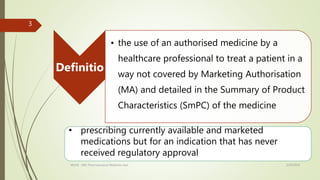
• the use of an authorised medicine by a
healthcare professional to treat a patient in a
way not covered by Marketing Authorisation
(MA) and detailed in the Summary of Product
Characteristics (SmPC) of the medicine
• prescribing currently available and marketed
medications but for an indication that has never
received regulatory approval
MUHS - MSc Pharmaceutical Medicine class
3/20/2018
4
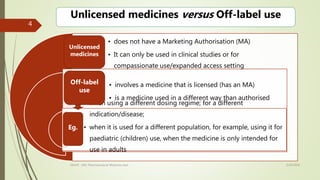
• does not have a Marketing Authorisation (MA)
• It can only be used in clinical studies or for
compassionate use/expanded access setting
• involves a medicine that is licensed (has an MA)
• is a medicine used in a different way than authorised
• when using a different dosing regime; for a different
indication/disease;
• when it is used for a different population, for example, using it for
paediatric (children) use, when the medicine is only intended for
use in adults
Unlicensed
medicines
Off-label
use
Eg.
Unlicensed medicines versus Off-label use
MUHS - MSc Pharmaceutical Medicine class
3/20/2018
5
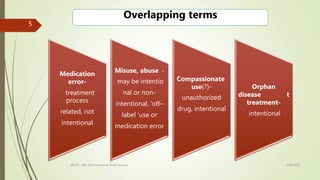
Medication
error-
treatment
process
related, not
intentional
Misuse, abuse -
may be intentio
nal or non-
intentional, ‘off–
label ‘use or
medication error
Compassionate
use(?)-
unauthorized
drug, intentional
Orphan
disease t
treatment-
intentional
Overlapping terms
MUHS - MSc Pharmaceutical Medicine class
3/20/2018
6
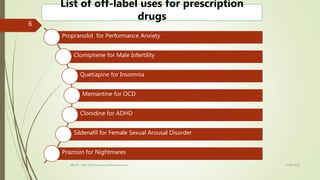
Propranolol for Performance Anxiety
Clomiphene for Male Infertility
Quetiapine for Insomnia
Memantine for OCD
Clonidine for ADHD
Sildenafil for Female Sexual Arousal Disorder
Prazosin for Nightmares
List of off-label uses for prescription
drugs
MUHS - MSc Pharmaceutical Medicine class
3/20/2018MUHS - MSc Pharmaceutical Medicine class
7
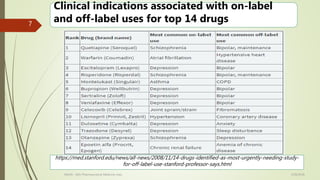
Clinical indications associated with on-label
and off-label uses for top 14 drugs
https://med.stanford.edu/news/all-news/2008/11/14-drugs-identified-as-most-urgently-needing-study-
for-off-label-use-stanford-professor-says.html
3/20/2018
8
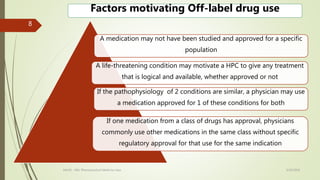
A medication may not have been studied and approved for a specific
population
A life-threatening condition may motivate a HPC to give any treatment
that is logical and available, whether approved or not
If the pathophysiology of 2 conditions are similar, a physician may use
a medication approved for 1 of these conditions for both
If one medication from a class of drugs has approval, physicians
commonly use other medications in the same class without specific
regulatory approval for that use for the same indication
Factors motivating Off-label drug use
MUHS - MSc Pharmaceutical Medicine class
3/20/2018
9
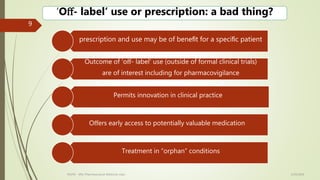
prescription and use may be of benefit for a specific patient
Outcome of ‘off- label’ use (outside of formal clinical trials)
are of interest including for pharmacovigilance
Permits innovation in clinical practice
Offers early access to potentially valuable medication
Treatment in “orphan” conditions
‘Off- label‘ use or prescription: a bad thing?
MUHS - MSc Pharmaceutical Medicine class
3/20/2018
10
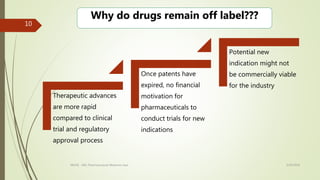
Therapeutic advances
are more rapid
compared to clinical
trial and regulatory
approval process
Once patents have
expired, no financial
motivation for
pharmaceuticals to
conduct trials for new
indications
Potential new
indication might not
be commercially viable
for the industry
Why do drugs remain off label???
MUHS - MSc Pharmaceutical Medicine class
3/20/2018
11
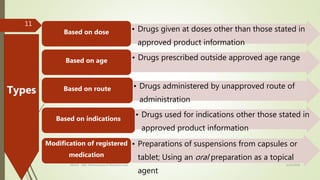
• Drugs given at doses other than those stated in
approved product information
Based on dose
• Drugs prescribed outside approved age rangeBased on age
• Drugs administered by unapproved route of
administration
Based on route
• Drugs used for indications other those stated in
approved product information
Based on indications
• Preparations of suspensions from capsules or
tablet; Using an oral preparation as a topical
agent
Modification of registered
medication
Types
MUHS - MSc Pharmaceutical Medicine class
12
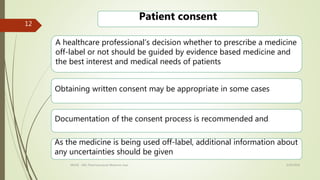
Obtaining written consent may be appropriate in some cases
Documentation of the consent process is recommended and,
As the medicine is being used off-label, additional information about
any uncertainties should be given
A healthcare professional’s decision whether to prescribe a medicine
off-label or not should be guided by evidence based medicine and
the best interest and medical needs of patients
3/20/2018MUHS - MSc Pharmaceutical Medicine class
Patient consent
3/20/2018
13
MUHS - MSc Pharmaceutical Medicine class
Professional conduct – controlled by Professional Conduct, Etiquette and
Ethics Regulations, 2017, ICMRPrescription of drugs
- Should not violate Drugs and Cosmetics Act (steroids, psychotropic
and narcotic drugs)
- Should not violate human rights
- Should not violate ICMR guidelines for research
no mention regarding “off-label” use
Regulatory guideline in India regarding off-label use
3/20/2018
14
MUHS - MSc Pharmaceutical Medicine class
Govt. of India, 2004 →
committee under Indian
Medical Association to make
specific guidelines
governing off-label drug use
Strongly favored off-label use of
drugs (if evidence based)
Indian law does not currently allow drugs to
be prescribed for indications for which they
have not been approved
Amendments to the
Indian Medical Council
Act 2 years ago made
off-label prescribing
illegal
Marketing such drugs by
pharmaceutical company is
considered as contravention of the
law and action is taken under the
Drugs and Magic Remedies
(Objectionable Advertisements) Act,
1954
BUT
Regulatory guideline in India
regarding off-label use
3/20/2018
15
MUHS - MSc Pharmaceutical Medicine class
Bavdekar SB, Sadawarte PA, Gogtay
NJ, Jain SS, Jadhav S. Offlabel drug use
in a Pediatric Intensive Care Unit.
Indian J Pediatr. 2009
Nov;76(11):1113-8
• Out of 2237 prescriptions in children , 1579 (70.58%)
were off-label in nature
Kharadi D, Patel K, Rana D, Patel V.
Off-label drug use in Psychiatry
Outpatient Department: A Prospective
Study at a Tertiary Care Teaching
Hospital. Journal of Basic and Clinical
Pharmacy 6.2 (2015): 45–9
• Of 250 patients in psychiatry OPD, 198 (79.2%)
received at least one off-label drug
What Is the current status in India???
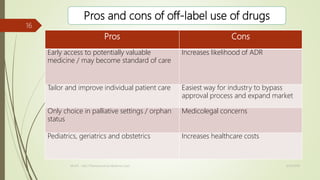
Pros Cons
Early access to potentially valuable
medicine / may become standard of care
Increases likelihood of ADR
Tailor and improve individual patient care Easiest way for industry to bypass
approval process and expand market
Only choice in palliative settings / orphan
status
Medicolegal concerns
Pediatrics, geriatrics and obstetrics Increases healthcare costs
3/20/2018
16
Pros and cons of off-label use of drugs
MUHS - MSc Pharmaceutical Medicine class
3/20/2018
17
MUHS - MSc Pharmaceutical Medicine class
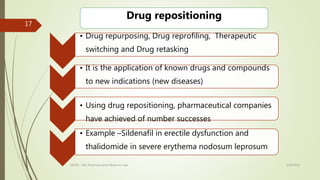
Drug repositioning
• Drug repurposing, Drug reprofiling, Therapeutic
switching and Drug retasking
• It is the application of known drugs and compounds
to new indications (new diseases)
• Using drug repositioning, pharmaceutical companies
have achieved of number successes
• Example –Sildenafil in erectile dysfunction and
thalidomide in severe erythema nodosum leprosum
3/20/2018
18
MUHS - MSc Pharmaceutical Medicine class
Repositioned drug has already passed a
significant number of toxicity and other tests
Its safety is known
The risk of failure for reasons of adverse
toxicology are reduced
Advantage of drug repositioning over traditional
drug development
3/20/2018
19
MUHS - MSc Pharmaceutical Medicine class
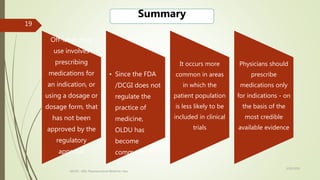
Off-label drug
use involves
prescribing
medications for
an indication, or
using a dosage or
dosage form, that
has not been
approved by the
regulatory
approval
• Since the FDA
/DCGI does not
regulate the
practice of
medicine,
OLDU has
become
common
It occurs more
common in areas
in which the
patient population
is less likely to be
included in clinical
trials
Physicians should
prescribe
medications only
for indications - on
the basis of the
most credible
available evidence
Summary
3/20/2018MUHS - MSc Pharmaceutical Medicine class
20
THANK YOU

Off label use

  • 1.
    3/20/2018 1 OFF LABEL USE: An Overview Dr.RENJU.RAVI MD MUHS - MSc Pharmaceutical Medicine class
  • 2.
    3/20/2018 2 Definitions and overlappingterms Types of ‘off-label‘ use and examples Consequences following ‘off-label’ use Regulatory and legal aspects Drug repositioning Summary OUTLINE MUHS - MSc Pharmaceutical Medicine class
  • 3.
    3/20/2018 3 Definitio • the useof an authorised medicine by a healthcare professional to treat a patient in a way not covered by Marketing Authorisation (MA) and detailed in the Summary of Product Characteristics (SmPC) of the medicine • prescribing currently available and marketed medications but for an indication that has never received regulatory approval MUHS - MSc Pharmaceutical Medicine class
  • 4.
    3/20/2018 4 • does nothave a Marketing Authorisation (MA) • It can only be used in clinical studies or for compassionate use/expanded access setting • involves a medicine that is licensed (has an MA) • is a medicine used in a different way than authorised • when using a different dosing regime; for a different indication/disease; • when it is used for a different population, for example, using it for paediatric (children) use, when the medicine is only intended for use in adults Unlicensed medicines Off-label use Eg. Unlicensed medicines versus Off-label use MUHS - MSc Pharmaceutical Medicine class
  • 5.
    3/20/2018 5 Medication error- treatment process related, not intentional Misuse, abuse- may be intentio nal or non- intentional, ‘off– label ‘use or medication error Compassionate use(?)- unauthorized drug, intentional Orphan disease t treatment- intentional Overlapping terms MUHS - MSc Pharmaceutical Medicine class
  • 6.
    3/20/2018 6 Propranolol for PerformanceAnxiety Clomiphene for Male Infertility Quetiapine for Insomnia Memantine for OCD Clonidine for ADHD Sildenafil for Female Sexual Arousal Disorder Prazosin for Nightmares List of off-label uses for prescription drugs MUHS - MSc Pharmaceutical Medicine class
  • 7.
    3/20/2018MUHS - MScPharmaceutical Medicine class 7 Clinical indications associated with on-label and off-label uses for top 14 drugs https://med.stanford.edu/news/all-news/2008/11/14-drugs-identified-as-most-urgently-needing-study- for-off-label-use-stanford-professor-says.html
  • 8.
    3/20/2018 8 A medication maynot have been studied and approved for a specific population A life-threatening condition may motivate a HPC to give any treatment that is logical and available, whether approved or not If the pathophysiology of 2 conditions are similar, a physician may use a medication approved for 1 of these conditions for both If one medication from a class of drugs has approval, physicians commonly use other medications in the same class without specific regulatory approval for that use for the same indication Factors motivating Off-label drug use MUHS - MSc Pharmaceutical Medicine class
  • 9.
    3/20/2018 9 prescription and usemay be of benefit for a specific patient Outcome of ‘off- label’ use (outside of formal clinical trials) are of interest including for pharmacovigilance Permits innovation in clinical practice Offers early access to potentially valuable medication Treatment in “orphan” conditions ‘Off- label‘ use or prescription: a bad thing? MUHS - MSc Pharmaceutical Medicine class
  • 10.
    3/20/2018 10 Therapeutic advances are morerapid compared to clinical trial and regulatory approval process Once patents have expired, no financial motivation for pharmaceuticals to conduct trials for new indications Potential new indication might not be commercially viable for the industry Why do drugs remain off label??? MUHS - MSc Pharmaceutical Medicine class
  • 11.
    3/20/2018 11 • Drugs givenat doses other than those stated in approved product information Based on dose • Drugs prescribed outside approved age rangeBased on age • Drugs administered by unapproved route of administration Based on route • Drugs used for indications other those stated in approved product information Based on indications • Preparations of suspensions from capsules or tablet; Using an oral preparation as a topical agent Modification of registered medication Types MUHS - MSc Pharmaceutical Medicine class
  • 12.
    12 Obtaining written consentmay be appropriate in some cases Documentation of the consent process is recommended and, As the medicine is being used off-label, additional information about any uncertainties should be given A healthcare professional’s decision whether to prescribe a medicine off-label or not should be guided by evidence based medicine and the best interest and medical needs of patients 3/20/2018MUHS - MSc Pharmaceutical Medicine class Patient consent
  • 13.
    3/20/2018 13 MUHS - MScPharmaceutical Medicine class Professional conduct – controlled by Professional Conduct, Etiquette and Ethics Regulations, 2017, ICMRPrescription of drugs - Should not violate Drugs and Cosmetics Act (steroids, psychotropic and narcotic drugs) - Should not violate human rights - Should not violate ICMR guidelines for research no mention regarding “off-label” use Regulatory guideline in India regarding off-label use
  • 14.
    3/20/2018 14 MUHS - MScPharmaceutical Medicine class Govt. of India, 2004 → committee under Indian Medical Association to make specific guidelines governing off-label drug use Strongly favored off-label use of drugs (if evidence based) Indian law does not currently allow drugs to be prescribed for indications for which they have not been approved Amendments to the Indian Medical Council Act 2 years ago made off-label prescribing illegal Marketing such drugs by pharmaceutical company is considered as contravention of the law and action is taken under the Drugs and Magic Remedies (Objectionable Advertisements) Act, 1954 BUT Regulatory guideline in India regarding off-label use
  • 15.
    3/20/2018 15 MUHS - MScPharmaceutical Medicine class Bavdekar SB, Sadawarte PA, Gogtay NJ, Jain SS, Jadhav S. Offlabel drug use in a Pediatric Intensive Care Unit. Indian J Pediatr. 2009 Nov;76(11):1113-8 • Out of 2237 prescriptions in children , 1579 (70.58%) were off-label in nature Kharadi D, Patel K, Rana D, Patel V. Off-label drug use in Psychiatry Outpatient Department: A Prospective Study at a Tertiary Care Teaching Hospital. Journal of Basic and Clinical Pharmacy 6.2 (2015): 45–9 • Of 250 patients in psychiatry OPD, 198 (79.2%) received at least one off-label drug What Is the current status in India???
  • 16.
    Pros Cons Early accessto potentially valuable medicine / may become standard of care Increases likelihood of ADR Tailor and improve individual patient care Easiest way for industry to bypass approval process and expand market Only choice in palliative settings / orphan status Medicolegal concerns Pediatrics, geriatrics and obstetrics Increases healthcare costs 3/20/2018 16 Pros and cons of off-label use of drugs MUHS - MSc Pharmaceutical Medicine class
  • 17.
    3/20/2018 17 MUHS - MScPharmaceutical Medicine class Drug repositioning • Drug repurposing, Drug reprofiling, Therapeutic switching and Drug retasking • It is the application of known drugs and compounds to new indications (new diseases) • Using drug repositioning, pharmaceutical companies have achieved of number successes • Example –Sildenafil in erectile dysfunction and thalidomide in severe erythema nodosum leprosum
  • 18.
    3/20/2018 18 MUHS - MScPharmaceutical Medicine class Repositioned drug has already passed a significant number of toxicity and other tests Its safety is known The risk of failure for reasons of adverse toxicology are reduced Advantage of drug repositioning over traditional drug development
  • 19.
    3/20/2018 19 MUHS - MScPharmaceutical Medicine class Off-label drug use involves prescribing medications for an indication, or using a dosage or dosage form, that has not been approved by the regulatory approval • Since the FDA /DCGI does not regulate the practice of medicine, OLDU has become common It occurs more common in areas in which the patient population is less likely to be included in clinical trials Physicians should prescribe medications only for indications - on the basis of the most credible available evidence Summary
  • 20.
    3/20/2018MUHS - MScPharmaceutical Medicine class 20 THANK YOU